‘Greece seizes Russian oil tankers’
Samizdat | April 19, 2022
Greece seized a Russian oil tanker in the Aegean Sea on Tuesday as part of European Union sanctions imposed on Moscow over the war in Ukraine, Kathimerini daily has reported.
According to the newspaper, the Russian-flagged Pegas ship, with 19 crew members on board, was seized on April 19 near the coastal city of Karystos on the southern coast of the island of Evia.“It has been seized as part of EU sanctions,” a shipping ministry official was quoted as saying.
A coastguard spokeswoman told AFP that the seizure order concerned the ship itself and would not affect its cargo.
Greek media had reported earlier that the vessel faced engine trouble and was being escorted by a tugboat towards the Peloponnese, but was forced to moor at Karystos due to poor weather.
According to the Maritime Bulletin portal, another Russian tanker, VF Tanker 2, was detained earlier near Euboea due to EU sanctions. The vessel reportedly left the port of Piraeus on April 17, bound for Russian Kavkaz port in the Black Sea, but for some unknown reason ended up in Karystos Bay.
The European Union, of which Greece is a member, has adopted a wide range of sanctions against Moscow. They include import and export bans for a wide array of goods, as well as an embargo on access to EU ports by Russian-flagged ships. Russian oil aboard those ships has not been sanctioned.
‘Germany investigates Russia supporters’
Samizdat | April 18, 2022
Since February 24, authorities across multiple German regions have launched more than 140 investigations into acts seen as endorsements of Russia’s military campaign in Ukraine, Redaktionsnetzwerk Deutschland (RND) reported on Monday, citing regional internal and justice ministers.
In the majority of cases, those suspected had displayed the letter ‘Z’, the ubiquitous marking on Russian equipment in Ukraine that has become a sign of support for Moscow’s offensive. In Saxony-Anhalt, for instance, 17 out of 19 such cases revolve around the letter, while in the city-state of Hamburg, 16 out of 17 probes were launched for that reason.
In a number of German regions, the ‘Z’ symbol has been deemed off limits since late February. A spokesperson for Saxony-Anhalt’s interior ministry told RND that “display of this symbol in public in connection with the Russian aggressive war leads to the launch of an investigation,” if the authorities construe the letter as an endorsement of Moscow’s actions.
German authorities invoke Section 140 of the country’s criminal code, according to which people endorsing the criminal acts of others can face a fine or even up to three years behind bars.
The outlet notes that the total number of probes into Russian sympathizers launched across Germany since late February is likely higher than the cited 140, given that not all regions are keeping a tally of these specific instances. Bavaria is a case in point; however, its Justice Minister Georg Eisenreich hastened to assure the journalists that just because the region was not singling out such investigations did not mean that this kind of behavior was going unchecked by the authorities. He pointed out that while “freedom of expression is cherished in our constitution,” with everyone having the right to express their opinion in Germany, this “freedom of expression, however, ends where criminal law begins.” Eisenreich added that the Bavarian authorities would not brook it “when crimes against international law are endorsed.”
Earlier this month, rallies in support of Russia were held in several cities across Germany. The majority of participants were either immigrants from the former Soviet Union or their children, but there were also German supporters of the Kremlin’s military operation present at the events. The demonstrators denounced the perceived rise of Russophobia in Germany.
Russia attacked the neighboring state in late February, following Ukraine’s failure to implement the terms of the Minsk agreements, first signed in 2014, and Moscow’s eventual recognition of the Donbass republics of Donetsk and Lugansk. The German and French brokered protocols were designed to give the breakaway regions special status within the Ukrainian state. The Kremlin has since demanded that Ukraine officially declare itself a neutral country that will never join the US-led NATO military bloc. Kiev insists the Russian offensive was completely unprovoked and has denied claims it was planning to retake the two republics by force.
Boris Johnson Supports Ukraine to the Detriment of the Brits
By Valery Kulikov – New Eastern Outlook – 15.04.2022
A highly sensationalist article by Bloomberg clearly shows that the British government left more than 5 million Britons without support in the current crisis in implementing its pronounced Russophobic policy!
As the publication emphasizes, a significant part of the British population feels the consequences of the cost of living crisis especially strongly, and this is due more to politics than to the economy. An increase in electricity bills and in the cost of food and loan rates has already become a difficult test for all the British without exception. Thus, since April 1, gas and electricity prices alone have increased by 54%! Prices for fruits and vegetables in Britain may soon rise by a third, which is already creating problems and a shortage of products on the shelves of British stores. At the same time, warehouses are already running out of sunflower oil, which jeopardizes the production of traditionally beloved British dishes, writes Daily Mail.
New statistics shows that food inflation in Britain has already increased by 5.3% year-on-year. The Bank of England warned last week that the incomes of many Britons will experience an “historic” shock after inflation jumped to a 30-year high last month, has already reached 6.2%, and, according to forecasts, may rise to 8% this spring, notes Daily Mail.
The independent Food Aid Network, which consists of more than 550 food banks from all over Britain, has sent a letter to Prime Minister Boris Johnson, writes The Independent, with a demand to take urgent measures, since the number of requests for help has increased enormously in recent weeks. This is due to high electricity bills, rising food prices and health insurance. For this very reason, many families are barely surviving, and in some food banks the number of requests has doubled since the end of 2021. Some food banks have already had to reduce the amount of food they provide.
Britain is witnessing the biggest decline in living standards since the 1950s, and many British families in such conditions have to wonder, “how to survive further”?
“Fuel poverty” has affected 88% of the British population, Sky News reports. As the British told the TV channel, against the background of rising energy prices, they are forced to go to bed earlier or take buses and trains all day to keep warm. At the same time, the country predicts that as energy prices continue to rise, it will be even more difficult for families already living on the brink.
However, instead of providing effective assistance to the residents of the kingdom and reducing unnecessary spending, at the expense of the British taxpayers, on “settling in and helping Ukraine,” the British government continues to take not just a wait-and-see stance, but one overtly contradicting the interests of its own people. Against this background, the “decision”, covered by The Sun, of the British company Octopus Energy to distribute blankets with electric heating to financially struggling customers in order to “help them survive a sharp rise in heating prices,” is perceived as a cruel joke on the impoverished Britons. This company did not even stop to think about how the British will pay bills for the use of electric blankets when they do not have enough money to pay for heating their homes! Do not forget that in early April, energy prices in the United Kingdom jumped by 54% due to a strong rise in wholesale gas prices. The rates increase has hit millions of households across the kingdom. Now the energy bill for the country’s residents will increase by an average of 700 pounds per year.
The results of a survey conducted by the National Statistical Service indicate that residents of the United Kingdom have to seriously reduce spending. More than half of respondents stated that they save on “non-essential” goods, 34% – on gas or electricity, and 31% – on food and essential goods.
On March 28, Chancellor of the Exchequer Rishi Sunak, speaking before the British Parliament, said that although rising costs have been hitting people across Europe in recent weeks, no major economy leaves its unemployed population in such a vulnerable position. There are 5.3 million people in Britain today who could work but depend solely on state aid, and more and more Britons are forced to resort to the services of food banks and apply for short-term cash loans at high interest rates. This number of disadvantaged Britons is approximately equal to the number of all residents of Scotland and accounts for a tenth of people of working age in the United Kingdom.
Against the background of the lack of financial assistance from the government to the catastrophically impoverished Britons, the inhabitants of the kingdom were perplexed at learning the results of the recent trip of the British Prime Minister to Kiev, where he arrived with a new package of financial and military assistance to this country. In particular, Boris Johnson said that Britain would supply Ukraine with an additional 120 armored vehicles and anti-ship complexes. In addition, Kiev will receive new loan guarantees from Britain worth USD 500 million through the World Bank, while the British Prime Minister expressed readiness to help in the restoration of Kiev and the Kiev region after the end of the Russian military operation.
This is causing new anti-government protests among Britons who are outraged by the sharp rise in the cost of living over the past couple of months and the failed government policies. Protest demonstrations took place across the country, including in Belfast, where the rally participants demanded that the government allocate an additional thousand pounds to each family in Northern Ireland to help the population reduce the rising costs of fuel and food. Similar actions took place in dozens of other cities across the kingdom. British households are telling the government that they are experiencing more blows to their finances amid an unprecedented crisis caused by the rising cost of living.
“The residents of Britain are facing difficult times due to anti-Russian sanctions, but the country’s authorities, apparently, do not realize the threat,” was the conclusion of retired General Jonathan Shaw made on the pages of The Independent. He is convinced that the Johnson government’s Russophobic policy of banning, in particular, imports of wheat and oil, will hit the standard of living of the population, which will become “much worse.” Shaw believes that many people in Britain, like the government, have “the wrong mentality” about the severity of the consequences of the “new cold war” with Russia.
Recall that in early March, the British government announced its intention to stop importing oil and petroleum products from Russia. After that, the cost of gasoline and diesel fuel at British gas stations went up sharply, breaking several records along the way.
Considering how much attention Boris Johnson pays to the sanctions policy against Russia, it is surprising how this Titanic still manages to stay afloat despite the widespread negative attitude towards it. At the same time, his criticism is growing every day, in proportion to the rate of decline in the standard of living of the population and the resolution of the issue of Scotland’s independence referendum.
In principle, it is already obvious to everyone today that the era of economic liberalism in its former form has come to an end. In fact, the current Western political elites openly follow the path of forming an ultratotalitarian supersystem, supranational hyperfascism, in which the former values of capitalism, free market and political freedoms of citizens have almost entirely lost their value. And the “welfare state” that the collective West was so proud of is already a thing of the past. And by trying to unleash an even more Russophobic sanctions policy, the rulers of Britain and some other parts of the West only accelerate the change of political power in their states.
A picture is worth a thousand words, inflation was ready to go
The Naked Emperor’s Newsletter | April 13, 2022
A post on what is maybe the most obvious thing in the world but most can’t see, ignore or don’t want to talk about.
M1 money supply in the US since the ‘60s. It’s amazing how M1 money supply predicts Russia’s invasion of Ukraine and increases six fold, two years early.

Grrrrrr, I’m so angry that Putin has caused all this inflation. Sorry, I forgot to take my ‘triggered’ pills, I’m so easily triggered these days. As Neil points out below, the area highlighted in red should read Trump/Biden.
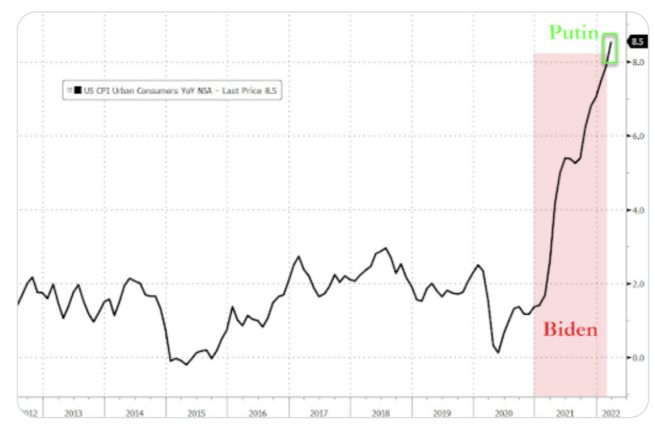
The inevitable, and only just beginning, conclusion.
Never stop telling the people that overreacted on Covid that their shrieking has caused today’s pain. Otherwise, it will just happen all over again. They selfishly got caught up in thinking about their own mortality without thinking about the complexity of the situation and the consequences that follow.
Government loans were necessary to support low income workers who were being denied a living by the wealthy laptop class but the economy should never have shut down in the first place. Moreover, much of the printed money was fraudulently taken by the wealthy who know how to game the system. I personally have heard many stories of loans being taken out to buy second homes or other assets and this is just the small scale stuff.
And if your argument is “it was necessary to save lives” then predominantly the lives that you saved were the elderly who you trapped and scared witless in their homes or care home rooms. They eventually died anyway, because that is life and what happens when you are old, but instead of happily enjoying those extra 6 months you gave them, they were forced to be alone with maybe the occasional zoom call if they were lucky.
As I’m typing I’m thinking back to a conversation I had with a doctor friend in early March 2020. He asked me if I was worried about dying from the virus. I said that I was more worried about what this is all going to do to the economy to which he replied that I need to get my priorities right.
Western Dissent from US/NATO Policy on Ukraine is Small, Yet the Censorship Campaign is Extreme
Preventing us from asking who benefits from a protracted proxy war, and who pays the price, is paramount. A closed propaganda system achieves that.
By Glenn Greenwald | April 13, 2022
If one wishes to be exposed to news, information or perspective that contravenes the prevailing US/NATO view on the war in Ukraine, a rigorous search is required. And there is no guarantee that search will succeed. That is because the state/corporate censorship regime that has been imposed in the West with regard to this war is stunningly aggressive, rapid and comprehensive.
On a virtually daily basis, any off-key news agency, independent platform or individual citizen is liable to be banished from the internet. In early March, barely a week after Russia’s invasion of Ukraine, the twenty-seven nation European Union — citing “disinformation” and “public order and security” — officially banned the Russian state-news outlets RT and Sputnik from being heard anywhere in Europe. In what Reuters called “an unprecedented move,” all television and online platforms were barred by force of law from airing content from those two outlets. Even prior to that censorship order from the state, Facebook and Google were already banning those outlets, and Twitter immediately announced they would as well, in compliance with the new EU law.
But what was “unprecedented” just six weeks ago has now become commonplace, even normalized. Any platform devoted to offering inconvenient-to-NATO news or alternative perspectives is guaranteed a very short lifespan. Less than two weeks after the EU’s decree, Google announced that it was voluntarily banning all Russian-affiliated media worldwide, meaning Americans and all other non-Europeans were now blocked from viewing those channels on YouTube if they wished to. As so often happens with Big Tech censorship, much of the pressure on Google to more aggressively censor content about the war in Ukraine came from its own workforce: “Workers across Google had been urging YouTube to take additional punitive measures against Russian channels.”
So prolific and fast-moving is this censorship regime that it is virtually impossible to count how many platforms, agencies and individuals have been banished for the crime of expressing views deemed “pro-Russian.” On Tuesday, Twitter, with no explanation as usual, suddenly banned one of the most informative, reliable and careful dissident accounts, named “Russians With Attitude.” Created in late 2020 by two English-speaking Russians, the account exploded in popularity since the start of the war, from roughly 20,000 followers before the invasion to more than 125,000 followers at the time Twitter banned it. An accompanying podcast with the same name also exploded in popularity and, at least as of now, can still be heard on Patreon.
What makes this outburst of Western censorship so notable — and what is at least partially driving it — is that there is a clear, demonstrable hunger in the West for news and information that is banished by Western news sources, ones which loyally and unquestioningly mimic claims from the U.S. government, NATO, and Ukrainian officials. As The Washington Post acknowledged when reporting Big Tech’s “unprecedented” banning of RT, Sputnik and other Russian sources of news: “In the first four days of Russia’s invasion of Ukraine, viewership of more than a dozen Russian state-backed propaganda channels on YouTube spiked to unusually high levels.”
Note that this censorship regime is completely one-sided and, as usual, entirely aligned with U.S. foreign policy. Western news outlets and social media platforms have been flooded with pro-Ukrainian propaganda and outright lies from the start of the war. A New York Times article from early March put it very delicately in its headline: “Fact and Mythmaking Blend in Ukraine’s Information War.” Axios was similarly understated in recognizing this fact: “Ukraine misinformation is spreading — and not just from Russia.” Members of the U.S. Congress have gleefully spread fabrications that went viral to millions of people, with no action from censorship-happy Silicon Valley corporations. That is not a surprise: all participants in war use disinformation and propaganda to manipulate public opinion in their favor, and that certainly includes all direct and proxy-war belligerents in the war in Ukraine.
Yet there is little to no censorship — either by Western states or by Silicon Valley monopolies — of pro-Ukrainian disinformation, propaganda and lies. The censorship goes only in one direction: to silence any voices deemed “pro-Russian,” regardless of whether they spread disinformation. The “Russians With Attitude” Twitter account became popular in part because they sometimes criticized Russia, in part because they were more careful with facts and viral claims that most U.S. corporate media outlets, and in part because there is such a paucity of outlets that are willing to offer any information that undercuts what the U.S. Government and NATO want you to believe about the war.
Their crime, like the crime of so many other banished accounts, was not disinformation but skepticism about the US/NATO propaganda campaign. Put another way, it is not “disinformation” but rather viewpoint-error that is targeted for silencing. One can spread as many lies and as much disinformation as one wants provided that it is designed to advance the NATO agenda in Ukraine (just as one is free to spread disinformation provided that its purpose is to strengthen the Democratic Party, which wields its majoritarian power in Washington to demand greater censorship and commands the support of most of Silicon Valley). But what one cannot do is question the NATO/Ukrainian propaganda framework without running a very substantial risk of banishment.
It is unsurprising that Silicon Valley monopolies exercise their censorship power in full alignment with the foreign policy interests of the U.S. Government. Many of the key tech monopolies — such as Google and Amazon — routinely seek and obtain highly lucrative contracts with the U.S. security state, including both the CIA and NSA. Their top executives enjoy very close relationships with top Democratic Party officials. And Congressional Democrats have repeatedly hauled tech executives before their various Committees to explicitly threaten them with legal and regulatory reprisals if they do not censor more in accordance with the policy goals and political interests of that party.
But one question lingers: why is there so much urgency about silencing the small pockets of dissenting voices about the war in Ukraine? This war has united the establishment wings of both parties and virtually the entire corporate media with a lockstep consensus not seen since the days and weeks after the 9/11 attack. One can count on both hands the number of prominent political and media figures who have been willing to dissent even minimally from that bipartisan Washington consensus — dissent that instantly provokes vilification in the form of attacks on one’s patriotism and loyalties. Why is there such fear of allowing these isolated and demonized voices to be heard at all?
The answer seems clear. The benefits from this war for multiple key Washington power centers cannot be overstated. The billions of dollars in aid and weapons being sent by the U.S. to Ukraine are flying so fast and with such seeming randomness that it is difficult to track. “Biden approves $350 million in military aid for Ukraine,” Reuters said on February 26; “Biden announces $800 million in military aid for Ukraine,” announced The New York Times on March 16; on March 30, NBC’s headline read: “Ukraine to receive additional $500 million in aid from U.S., Biden announces”; on Tuesday, Reuters announced: “U.S. to announce $750 million more in weapons for Ukraine, officials say.” By design, these gigantic numbers have long ago lost any meaning and provoke barely a peep of questioning let alone objection.
It is not a mystery who is benefiting from this orgy of military spending. On Tuesday, Reuters reported that “the Pentagon will host leaders from the top eight U.S. weapons manufacturers on Wednesday to discuss the industry’s capacity to meet Ukraine’s weapons needs if the war with Russia lasts years.” Among those participating in this meeting about the need to increase weapons manufacturing to feed the proxy war in Ukraine is Raytheon, which is fortunate to have retired General Lloyd Austin as Defense Secretary, a position to which he ascended from the Raytheon Board of Directors. It is virtually impossible to imagine an event more favorable to the weapons manufacturer industry than this war in Ukraine:
Demand for weapons has shot up after Russia’s invasion on Feb. 24 spurred U.S. and allied weapons transfers to Ukraine. Resupplying as well as planning for a longer war is expected to be discussed at the meeting, the sources told Reuters on condition of anonymity. . .
Resupplying as well as planning for a longer war is expected to be discussed at the meeting. . . The White House said last week that it has provided more than $1.7 billion in security assistance to Ukraine since the invasion, including over 5,000 Javelins and more than 1,400 Stingers.
This permanent power faction is far from the only one to be reaping benefits from the war in Ukraine and to have its fortunes depend upon prolonging the war as long as possible. The union of the U.S. security state, Democratic Party neocons, and their media allies has not been riding this high since the glory days of 2002. One of MSNBC’s most vocal DNC boosters, Chris Hayes, gushed that the war in Ukraine has revitalized faith and trust in the CIA and intelligence community more than any event in recent memory — deservedly so, he said: “The last few weeks have been like the Iraq War in reverse for US intelligence.” One can barely read a mainstream newspaper or watch a corporate news outlet without seeing the nation’s most bloodthirsty warmongering band of neocons — David Frum, Bill Kristol, Liz Cheney, Wesley Clark, Anne Applebaum, Adam Kinzinger — being celebrated as wise experts and heroic warriors for freedom.
This war has been very good indeed for the permanent Washington political and media class. And although it was taboo for weeks to say so, it is now beyond clear that the only goal that the U.S. and its allies have when it comes to the war in Ukraine is to keep it dragging on for as long as possible. Not only are there no serious American diplomatic efforts to end the war, but the goal is to ensure that does not happen. They are now saying that explicitly, and it is not hard to understand why.
The benefits from endless quagmire in Ukraine are as immense as they are obvious. The military budget skyrockets. Punishment is imposed on the arch-nemesis of the Democratic Party — Russia and Putin — while they are bogged down in a war from which Ukrainians suffer most. The citizenry unites behind their leaders and is distracted.
Russia will find buyers for its oil – Putin
Samizdat | April 13, 2022
Russia can easily redirect exports of its vast energy resources away from the West to countries that really need them, while increasing domestic energy consumption, President Vladimir Putin said on Wednesday.
“When it comes to Russian oil, gas and coal, we will be able to increase their consumption on the domestic market and stimulate the deep processing of raw materials,” Putin said speaking at a meeting on the development of the Russian Arctic.
“We will also increase the supply of energy resources to other regions of the world where they are really needed,” he added.
The statement comes amid the latest ban on Russian oil imports imposed by the US, Canada, Britain and Australia in response to Moscow’s military operation in Ukraine. The ban on energy imports was part of broader anti-Russian sanctions that are aimed at cutting the country’s economy off from the global trade and financial system.
Putin attributed the current energy crunch in Europe to the refusal by countries to “cooperate with Russia normally, thus, hitting millions of Europeans.”
“Of course we are also facing problems but this opens up new opportunities,” he said.
Putin added that “hostile countries” had destroyed supply chains in Russia’s Arctic regions and some nations were not fulfilling their contractual obligations, creating issues for Moscow.
On Wednesday, Russian Energy Minister Nikolai Shulginov said Moscow was ready to sell oil and oil products to “friendly nations” as traditional importers are shunning Russian energy supplies, forcing the country to reduce crude production.
Washington warns against ‘preserving’ ties with Moscow
Samizdat | April 13, 2022
US Treasury Secretary Janet Yellen will issue a stark warning to countries “sitting on the fence” when it comes to sanctions against Russia in a speech to be delivered on Wednesday, saying that such “short-sighted” policies would not go unnoticed.
In a speech at an Atlantic Council event amid Moscow’s ongoing military offensive in Ukraine, Yellen will say that the US government remains fully committed to pushing Russia “further towards economic, financial, and strategic isolation,” according to an excerpt quoted by the media.
“And let’s be clear, the unified coalition of sanctioning countries will not be indifferent to actions that undermine the sanctions we’ve put in place,” Yellen will say.
In her opinion, the measures being imposed on Russia by the US and its allies are necessary because the future of the international order, “both for peaceful security and economic prosperity,” is now at stake. However, she will emphasize that some countries are still “sitting on the fence, perhaps seeing an opportunity to gain by preserving their relationship with Russia and backfilling the void left by others.”
Such behavior, the US Treasury Secretary will stress, is “short-sighted.”
The warning comes two days after US President Joe Biden called on India, which has not introduced sanctions against Moscow, not to increase its energy imports from Russia. In a meeting with Indian Prime Minister Narendra Modi, Biden offered assistance in the search for other sources of energy supply, explaining that it is not in India’s interests to increase its dependence on Russia.
Another big international player – China – has also been the subject of US criticism for its ‘neutral’ position on the Ukrainian conflict. Last month, the US administration went even further by warning Beijing of “the implications and consequences” which would follow if China decided to provide any material support for Russia.
There are also increasing tensions in the EU. Hungary and Poland, which were staunch allies prior to the conflict in Ukraine, had moved away from each other even before current events due to their very different relationships with Russia.
The events of the past six weeks have apparently driven them even further apart, with Warsaw announcing that it would freeze bilateral relations until Hungary aligns itself with Kiev. The European Commission also warned Hungary against fulfilling Moscow’s request and paying for the Russian gas in rubles, saying it would violate the sanctions regime.
Shutting Down Russia Bashing, Western Financed NGOs in Moscow
By Stephen Lendman | April 9, 2022
On Friday, Russia’s Justice Ministry ordered the closure of hostile Western NGOs in the country.
To date, 15 organizations were removed from its registry of international groups for “violations of the current legislation of the Russian Federation” — with no further elaboration.
They include offices of the Carnegie Endowment for International Peace, Institute for International Education, Friedrich Naumann Foundation for Freedom, the Friedrich Ebert Foundation, the Aga Khan Foundation, and the Wspolnota Polska Association.
On Friday, Human Rights Watch (HRW) and Amnesty International (AI) were added to Russia’s persona non grata list.
Both organizations publish defamatory reports on invented US/Western enemies.
They operate as mouthpieces for their interests.
They’re imperial tools.
HRW’s executive director Kenneth Roth is a former US federal prosecutor.
His predecessor Aryeh Neier left to become president of George Soros’ Open Society Institute.
Other past and present HRW staffers are former US officials or have ties to sources and groups representing Washington’s geopolitical interests — including the infamous undemocratic National Endowment for Democracy (NED).
Like HRW, AI fronts for powerful US/Western interests.
Both organizations are more concerned about serving their funding sources and publicity to attract more of the same than human rights.
Russia shut down HRW for fake news rubbish like the following, saying:
“Today, Russia is more repressive than it has ever been in the post-Soviet era (sic).”
“(A)uthorities crack down on critical media, harass peaceful protesters, engage in smear campaigns against independent groups, and stifle them with fines (sic).”
In early April, HRW defied reality by falsely accusing Russian forces in Ukraine of “rape… summary execution(s), (along with) committing laws-of-war violations against civilians (sic), (and) looting civilian property (sic).”
HRW provided no verifiable evidence to support what it falsely claimed to document — because none exists.
It falsely claimed that Russian forces “rounded up” men in Ukraine and “executed them (sic).”
Ignoring generous humanitarian aid provided by Russian forces to Ukrainians, HRW falsely accused them of forcibly “taking food, firewood, clothing, and other items” in areas of the country where they’ve operated.
In response to shutting down its office and de-registering the group, HRW’s Roth said the following:
“This new iron curtain (sic) will not stop our ongoing efforts to defend the rights of all Russians and to protect civilians in Ukraine (sic).”
He lied accusing Moscow of “criminalizing” independent war reporting.
There’s nothing remotely “independent” about US/Western NGOs, notably not imperial tools like HRW, AI and other groups that are bribed with big bucks to serve their interests.
Ignoring democracy as it should be in Russia compared to US/Western fantasy versions, Roth falsely accused the country of “turn(ing) toward authoritarianism (sic).”
The above Big Lies were followed by an appeal for donations to continue its bashing of invented US/Western enemies.
Russia shut down AI for falsely accusing its authorities of “violat(ing) the rights to freedom of expression, association and peaceful assembly…torture…disappearances…deportation of refugees and asylum seekers (along with) failure to address domestic violence (sic).”
It lied accusing Russia of “aggression in Ukraine (sic).”
It lied claiming that Russian forces “extrajudicially executed civilians in” the country (sic).
It lied saying that they’re responsible for “horrifying violence (and) widespread intimidation (sic).”
AI’s head Agnes Callamard turned truth on its head, falsely claiming that Russian forces are “kill(ing) unarmed civilians…in their homes and streets in acts of unspeakable cruelty and shocking brutality (sic),” adding:
“We gathered (so-called) evidence that Russian forces have committed extrajudicial executions and other unlawful killings (sic).”
“People in Ukraine are facing a catastrophic human rights crisis.”
“People are dying, including children, and many thousands of lives are at risk.”
“Take action to demand that the Russian authorities stop this act of aggression and protect civilians now (sic).”
All of the above and lots more of the same apply to Nazified Ukrainian forces — clearly not Russia.
Yet HRW and AI falsely accused Moscow of their war crimes and related atrocities — in deference to their US/Western donors.
AI lied accusing Russian authorities of “an unprecedented, nationwide crackdown on independent journalism, anti-war protests and dissenting voices following Russia’s invasion of Ukraine (sic).”
“The Kremlin remains hellbent on hiding the human cost of its war and has blocked independent news sites and social media (sic).”
The above applies to how US/Western regimes operate, not Russia.
In response to Russia’s shutdown of its office, AI’s Callamard falsely said the following:
“Amnesty’s closing down in Russia is only the latest in a long list of organizations that have been punished for defending human rights (sic) and speaking the truth to the Russian authorities (sic).”
“In a country where scores of activists and dissidents have been imprisoned, killed or exiled (sic), where independent media has been smeared, blocked or forced to self-censor (sic), and where civil society organizations have been outlawed or liquidated (sic), you must be doing something right if the Kremlin tries to shut you up (sic).”
Russia should have shut down imperial tools HRW and AI long ago.
Pretending support for human rights belies how they, in fact, operate.
The rights and interests of US/Western donors alone are served — at the expense of what both organizations falsely claim to stand for.
Ukraine War Frenzy Proves: It’s Still John McCain’s GOP
By Michael Tracey | April 7, 2022
“The senator from Kentucky is now working for Vladimir Putin,” fumed John McCain back in March 2017. His target: Rand Paul, who had committed the unforgivable offense of momentarily delaying the latest round of NATO expansion. Montenegro, a tiny country in southeastern Europe that most Americans have never heard of, was about to join the sprawling military alliance — and McCain was determined to see the final ratification ritual proceed with as little debate as possible. So he hurled the time-honored “working for Putin” accusation, and sure enough, Paul quickly withdrew his minor procedural objection. The glorious ascension of Montenegro to NATO membership status was thereby assured.
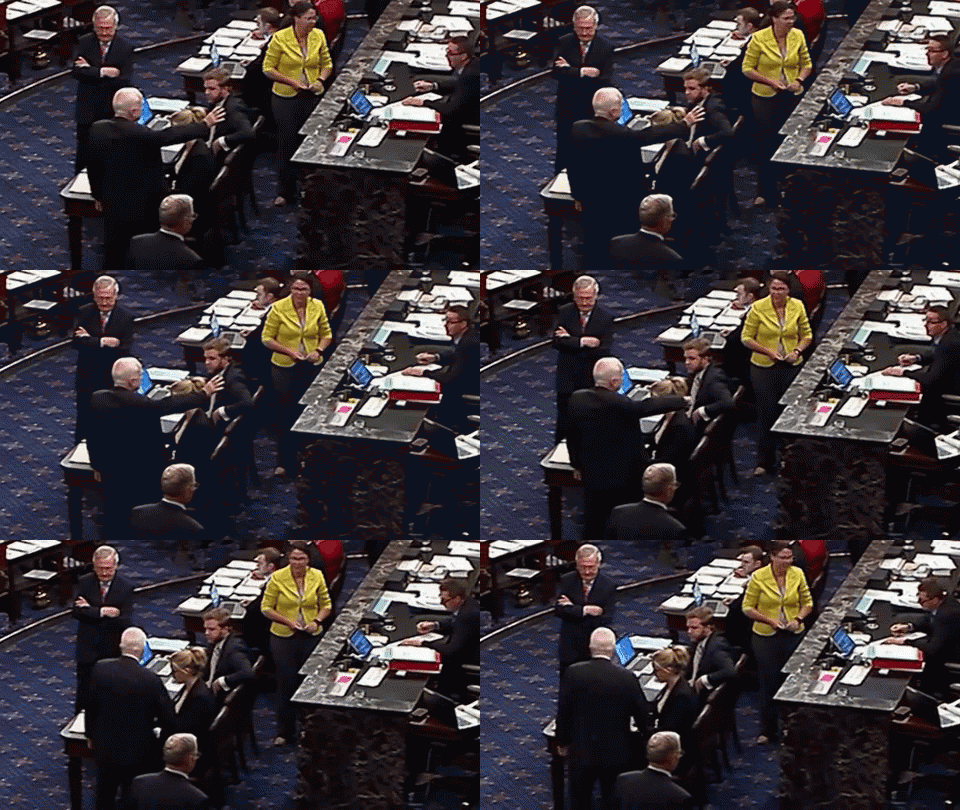
Since that episode, a lot has transpired regarding the public perception of McCain. He delighted liberals by feuding regularly with Donald Trump — even going so far as to denounce Trump for engaging in “disgraceful” and “pathetic” flattery of Putin. “No prior president has ever abased himself more abjectly before a tyrant,” McCain raged. He undermined Congressional Republicans’ legislative agenda during the brief window in Trump’s presidency when the party had unified control of government — famously delivering a dramatic thumbs-down gesture to derail GOP hopes of repealing Obamacare, as a chagrined Mitch McConnell watched powerlessly on.
McCain had returned to his most natural state. After annoying Democrats by running against Barack Obama in the 2008 election, and being surly about his defeat for some time afterwards, he had once again resumed playing the “maverick” role he so relished — reviled by “his own side,” and loved by the “other side.” His death in 2018 brought forth the most effusive display of state-sanctioned grief that any US political figure had received since Ronald Reagan died in 2004, with all the universal media adulation that entails. Trump’s exclusion from the funeral proceedings, at McCain’s posthumous direction, was just the icing on the cake.
But nowadays, if you bring up McCain in certain GOP circles, it will often be claimed that his influence has mercifully dissipated. The Republican Party experienced a bonafide ideological upheaval under Trump, they’ll say, and the McCain worldview — defined mainly by his unwavering commitment to a hyper-interventionist US foreign policy — has since fallen starkly out of favor. (Back when opposing interventionist foreign policy was still considered something of a “progressive” virtue, Mother Jones would routinely mock McCain by merely counting up the comically large number of countries he’d expressed a desire to attack. Did you know McCain once wanted to impose a No Fly Zone in Sudan?)
By “conservative opinion elites,” I refer roughly to the kind of people who write for obscure magazines with obscure funding sources, earnestly enjoy Think Tank social hours, and incessantly convene panels to discuss “the future of conservatism.” These types have a particular incentive to believe that McCain’s foreign policy paradigm has really been purged from the party. They’re deeply invested in the idea that the GOP underwent a genuine transformation in the past decade or so — discarding the outmoded “neocon” dogmas associated with the reign of George W. Bush, and embracing the hardened, nationalist realism associated with Donald Trump.
For a particular kind of ambitious professional conservative, this is a very flattering theory. Because if true, it means the GOP old guard is being slowly but surely displaced, and all kinds of new, innovative ideas are in the offing. Ideally with lots of ambiguous sinecures, TV gigs, and consultant opportunities attached. There’s just one problem though: when it comes to the issue area that always animated McCain the most — which was without a doubt foreign policy — recent events demonstrate that his influence is far from buried. On the contrary, it couldn’t be more alive and well. The year might be 2022, and he might have been physically dead for a while. But it’s still John McCain’s GOP.
A common fallacy heard among conservative opinion-makers who might wish to disassociate from McCain goes something like this: yes, there’s a contingent of the Republican Party that stubbornly hews to McCain-like foreign policy dogma, but it’s really only a limited handful of wackadoodles like Lindsey Graham. In other words, “the neocons” are a small, dwindling faction of the party, and aren’t representative of the typical Republican elected official or rank-and-file voter, who tend to be increasingly skeptical of US interventionism.
That’s a clever little exercise in self-rationalization, but also a bunch of baloney. On the one hand, it’s true that Graham is a… unique figure in various respects. He’s the person currently in elected office who had the closest political and personal association with McCain. Alongside their former cherished colleague, Joe Lieberman, these “three amigos” bonded over a shared, impassioned commitment to omni-directional foreign policy belligerence. (Right on cue, Lieberman was rolled out of semi-retirement last month to demand a “No Fly Zone.”)

But while Graham occasionally blurts out something uniquely insane, such as his tweeted call for the assassination of Putin — he’s far from some kind of wild outlier. In fact, his foreign policy views are comfortably ensconced in the mainstream of the GOP, notwithstanding the popular conceit that “MAGA” has supplanted “neocon” as the party’s dominant sensibility. Because if Graham is the closest living incarnation of the traditional McCain worldview, then perhaps that worldview isn’t nearly as incompatible with “MAGA” as some may want to think.
Recall: even as McCain and Trump brawled over what was essentially a clash of personalities, Graham successfully insinuated himself as one of Trump’s most trusted confidants — regularly hitting the golf links with him, and advising him on key policy matters. This has continued even into Trump’s post-presidency, with Graham operating as one of the most ardent advocates of another Trump run in 2024. “I think he’s the best person in the Republican Party to take up the cause in 2024,” Graham exuberantly told Fox News in January. “I expect him to run… I’ll take bets if anybody wants to bet. I’ll give odds.”
Do you really think Graham would be staking out this position if he viewed Trump’s foreign policy outlook as antithetical to his own?
If there’s some kind of enormous ideological conflict between Trump and Graham — who, remember, proudly carries on the McCain mantle — it has not been at all evident for a long time. It would also be weird to characterize Graham as some kind of aberrational nuisance within the GOP, considering that Graham raked in a record-shattering amount of donations for a GOP Senate candidate during his 2020 re-election campaign in South Carolina. And he accomplished this mostly by utilizing conservative media and direct-mailing lists to hammer home the pledge that he would serve in office as an unflinchingly loyal backer of Trump.
For a vivid illustration of persistent McCain/Graham influence as it relates to current events, take a look at this video that recently resurfaced from December 2016, featuring the esteemed Senatorial pals on a trip to Ukraine. Joined in wonderfully “bipartisan” fashion by Amy Klobuchar, the trio delivered a searing address to a unit of Ukrainian soldiers. If you haven’t seen the video, please do watch, because it confirms the extent to which a vocal faction of the US establishment — with McCain and Graham at the forefront — had invested ideologically and militarily in the cause of Ukraine, and by extension the cause of defeating Russia. Graham proclaims to the assembled soldiers: “Your fight is our fight. 2017 will be the year of offense. All of us will go back to Washington, and we will push the case against Russia.” McCain similarly declared, “I am convinced you will win. And we will do everything we can to provide you with what you need to win.”
While in 2016 the cause of arming Ukraine to defeat Russia on the battlefield was a somewhat more marginal preoccupation, today it’s been sanctified as virtually unshakable consensus in both parties. Funneling weapons to Ukraine was once seen as cranky McCain’s pet cause, a fixation that stemmed from his peculiarly hyper-interventionist worldview. Now, whether the US should be waging a proxy war against Russia in Ukraine is barely even considered a debatable proposition: just another McCain priority eventually consecrated as mainstream orthodoxy. “It’s bringing Congress together in a way, frankly, I haven’t seen in my 12 years,” Chris Coons, the Democratic senator from Delaware and Biden advisor, reverentially told the New York Times. “You’d have to go back to 9/11 to see such a unified commitment.” McCain is no doubt smiling down from the heavens at this great outbreak of “unification.” Because it’s proof of his enduring legacy; with his worldview and geopolitical objectives having arguably become more widely adopted than ever before.
But the coalescence of McCain-like consensus didn’t start with Russia’s invasion in February 2022. For one thing, Graham was proven right when he prophesied that 2017 would be the “year of offense” — because that was the year he, McCain, and other hawks successfully lobbied Trump to sign off on transfers of lethal weapons to Ukraine. Whatever personality conflict existed between McCain and Trump, the actual policy portfolio enacted by Trump vis-a-vis Russia wasn’t all that different from what McCain’s might’ve been. Indeed, when Trump announced the weapons transfers, McCain showered him with praise. And when Trump abrogated the INF Treaty, he was fulfilling another longtime McCain goal.
Listening to Republican politicians comment on Ukraine policy today, you can almost close your eyes and hear McCain’s irascible voice. For an example of how the McCain worldview is far from limited to so-called “neocons,” but instead a feature of entirely mainstream GOP thinking, consider the recent activities of Sen. Rick Scott (R-FL). If there’s any apt descriptor for Scott, it’s that he’s basically a conventional Republican. Not some kind of overly-ideological “neocon,” but rather a business guy who made a huge fortune defrauding Medicare, somehow leveraged that into becoming Governor of Florida, and is now in the US Senate. He also appears to have higher ambitions, as evidenced by his position running the National Republican Senatorial Committee — the campaign wing of the Senate GOP caucus. Scott isn’t especially bright, but he’s more or less able to articulate the standard bromides aimed squarely at the median Republican, and is thus capable of formulating strategy on behalf of the party for the upcoming midterm elections. He also released a manifesto outlining his bold vision for conservatism, which among other things includes that all Americans be made to pay income tax regardless of their income bracket.
The point is, Scott is situating himself at the center of the party in service of some future gambit, may be to challenge Mitch McConnell for GOP Leader (which Trump has encouraged) or maybe even to launch his own presidential campaign at some point, which I’m sure would be a barrel of laughs.
So what is Rick Scott’s big proposal on the Ukraine issue? You guessed it: demanding a No Fly Zone, or short of that, demanding the US send fighter jets into Ukraine. This is apparently the position that Scott calculates will resonate most potently with the prototypical GOP donor and voter. Again, Scott isn’t intrinsically some sort of deeply ideological McCain-Graham foreign policy fanatic. Yet, he’s espousing views that could have been directly pilfered from the McCain-Graham school of thought — just because that school of thought is so thoroughly mainstream within the GOP, whatever superficial animosities some party members may still harbor against McCain.
Part of this owes to standard partisan reflex. Desperately seeking some angle of attack against Biden in relation to Ukraine, Republicans have settled on denouncing him for not escalating the US proxy war aggressively enough. It’s incredibly easy to imagine the ghost of McCain making the exact same criticisms as, say, Ted Cruz is making at the moment. Days after Biden committed the threshold-crossing act of calling for regime change in Russia — thereby announcing that the policy of the US is to depose Putin — Cruz went on Newsmax and complained that Biden’s “approach to every enemy of America is weakness and appeasement.” Only in a McCain-inflected universe does it make even the faintest sense for a president orchestrating a giant weapons-funneling operation, and waging a proxy war of unprecedented scale — which continues intensifying by the day — to be accused of “appeasement.” But it’s clearly still McCain’s world that the GOP is living in. That was always McCain’s tack: his problem with any given US intervention was of course never the intervention itself, but rather that it wasn’t going far enough, and if you weren’t willing to go as far as he wanted, you were some sort of abject appeaser.
On the subject of Ukraine, this pattern gets repeated over and over by GOP chieftains. Biden proposes the biggest Pentagon budget in US history, and right on cue, Mitch McConnell denounces it as somehow “soft” on Russia and “far-left.” Biden announces yet another massive tranche of missiles, grenades, and heavy artillery being dispatched to Ukraine, and Kevin McCarthy, the House Minority Leader, immediately ridicules him for not giving Ukraine fighter jets. “Provide them the planes where they can create a No Fly Zone,” McCarthy demanded in a March 16 press conference. (It’s unclear whether McCarthy is satisfied with Biden’s latest decision to send tanks.)
Though it is now common to characterize Russia as committing “genocide” since footage emerged in the past several days purporting to show Russian attacks on Ukrainian civilians, Steve Scalise, the House Republican Whip, led the charge in making that designation weeks ago. “There’s nothing less than genocide going on in Ukraine,” he alleged during that same March 16 press conference, alongside McCarthy. Scalise had been so profoundly moved by Zelensky’s expertly-crafted Zoom address to Congress earlier in the day that he was compelled to issue the “genocide” allegation immediately thereafter. (No word on what independent investigative mission Scalise carried out in order to ascertain the relevant facts.)
Biden may have caused a stir when he condemned Putin as a “war criminal” — thus confirming a complete lack of interest in facilitating any kind of negotiated settlement to the conflict — but first out of the gate in making this accusation was Elise Stefanik, the New York GOP Congresswoman who serves as the chair of the House Republican Conference. Initially viewed as a “moderate,” Stefanik gamely generated big attention in recent years as a bombastic defender of Trump, raising a ton of money in the process. “As a new mom, it is heart-wrenching to watch the video that President Zelensky just played in terms of the bombing of maternity wards,” Stefanik weepily inveighed, also during the March 16 press conference with McCarthy and Scalise. “Make no mistake, there will be consequences on the global stage for Vladimir Putin, who is a war criminal and a thug,” she cried. The pattern is clear: all throughout the run-up to the invasion and ever since, it’s generally been the GOP which employs the most extreme rhetoric and makes the most extreme policy demands, with Biden eventually coming around not long afterwards. In taking this tack, Republicans could hardly pay a more fitting tribute to McCain.
Joni Ernst, the GOP Senator from Iowa, recently debuted a new criticism: apparently, the Biden Administration hasn’t been forthcoming enough about the weapons it’s transferring to Ukraine. But don’t be silly: seeking actual transparency on behalf of the American public is the farthest thing from Ernst’s mind. She totally supports the Biden Administration’s secrecy — she just wants to make sure that the US is dumping what she regards as a sufficient quantity of weapons. “Certainly, we do need to keep it secret, what is being transferred,” Ernst clarified during an appearance on Fox. “And that’s why we’ve asked to have those numbers provided to us in a classified setting.” Explaining the ultimate objective for these efforts, Ernst might as well have been paying direct homage to McCain: “We want to make sure that [Ukrainians] win this war, and they can win this war,” she roared.
But the biggest blow dealt to those conservative opinion elites — the guys who cling to the conceit that the GOP has really and truly changed its foreign policy orientation — comes in the form of Josh Hawley, one of their great hopes for a supposed convention-defying thinker willing to buck party consensus. Because when push comes to shove, it turns out Hawley is just another McCain mini-me.
A central venue for the recurring attempt to “re-imagine conservatism,” or something to that effect, is currently this outfit called “National Conservatism” (NatCon for short) which hosts occasional conferences. I actually attended one in Orlando last October out of morbid curiosity, and the big tell that maybe soaring intellectual heights would not be achieved there was the organizers’ decision to anoint Dave Rubin as a featured speaker. In all honesty, I have never once heard Dave Rubin utter anything resembling an original thought — but there he was, at the podium, sharing his keen insights on behalf of this exciting new GOP faction.
The three GOP elected officials chosen by NatCon to exemplify a re-invigorated “national conservatism” — presumably one which departed from the legacy of old fogies like McCain — were Hawley, Cruz, and Marco Rubio. Few would be surprised that Rubio soon thereafter turned around and started beating the standard war drums. And Cruz will just do whatever best positions him to win the GOP presidential nomination at some point. But Hawley in particular is often touted as a sort of tribune for the emerging “heterodox” wing of the GOP, alienated from the tired ideological construct that weds together military intervention and free markets. Yet, all three NatCon speakers joined the majority of their Senate GOP colleagues in signing a letter last month to demand that Joe Biden send fighter jets into Ukraine — exactly the kind of escalation you’d think these enlightened “NatCons” would be eager to reject. (Surprise! The letter was organized by Lindsey Graham.)
While there are some NatCon types who really do go against the grain, ultimately the larger enterprise functions as an attempt by the same old GOP establishment forces to perpetually re-brand themselves. Kind of like the Tea Party in the early 2010s, which was initially painted as some sort of revolutionary force, but immediately got subsumed into the Republican National Committee and conservative infotainment complex. The NatCon movement’s three elected standard-bearers behaving exactly as McCain would have wanted them to is good evidence that there really has not been any profound break from the past.
Just look at the latest super-serious “Policy Brief” issued by the Heritage Foundation — still the in-house “Think Tank” of official Washington, DC movement conservatism. It’s basically a litany of generic interventionist prescriptions for how the US can “do much more” to ensure Ukraine’s battlefield victory. Suggestions include facilitating “the free and unrestricted transfer of weapons, munitions, and other supplies to the Ukrainians, including a continuous flow of intelligence” — which just translates to an endorsement of the Biden Administration’s status quo, except a degree or two more aggressive. If there really is this wave of insidious anti-interventionism that we’re always being warned is on the brink of taking over the GOP, nowhere is it evident at the GOP’s most influential Think Tank, the place dopey members of Congress — most of whom barely ever thought about the concept of Ukraine before February 2022 — go to receive their talking points.
Then there’s conservative media, which has returned triumphantly to its 2003 heyday as a reliable organ for pro-war agitprop. Republican “id” Sean Hannity is predictably leading the charge. One day he’s calling on NATO to bomb a Russian convoy in Ukraine; the next he’s having a friendly on-air chat with Sean Penn of all people, discussing their mutual support for sending in fighter jets. Meanwhile, in order to keep up the facade that the GOP is somehow nefariously pro-Putin, the non-conservative media continuously seeks out the handful of marginal exceptions who ultimately have no real influence at all on the priorities of the party. (Yes, I’m aware that Tucker Carlson exists, as I appear on his show occasionally. But to whatever extent he’s skeptical of US intervention in Ukraine, this is not reflected in the behavior of the mainline GOP.)
Which brings us to Donald Trump himself. To the degree that Trump appears to have any criticisms of Biden Administration policy in relation to Ukraine, it consists of the retrospective counter-factual whereby Trump claims Putin never would’ve invaded on his watch. Which is possible, but unprovable. With the invasion having happened, though, Trump now assails Biden for “allowing” Putin “to get away with this travesty and assault on humanity.” In a speech shortly after the invasion, Trump insinuated that the US should be threatening to “blow him to pieces” — i.e., threatening nuclear retaliation.
“No president was ever as tough on Russia as I was,” Trump declared on February 28. Those convinced he was compromised by Putin in some sort of extravagant collusion plot never seem to have noticed, but many of the key US actions which precipitated the invasion were committed under Trump: the most obvious being the successful McCain-Graham lobbying effort to get him to start sending Ukraine lethal weaponry. Trump still brags about the decision to this day, stating, “We also gave a lot of the javelins that you’re hearing so much about, we gave those javelins when President Obama was giving sheets and pillows and I guess blankets. That didn’t help too much. But we gave javelins, and a lot of them too, and I guess that’s helping a lot.”
Well, maybe it would’ve been a smarter idea to stick with the blankets. At least if the goal was to avert war. Because for years, Putin warned that these kinds of US weapons shipments were going to drastically heighten tensions. In his speech announcing the invasion, Putin couldn’t have been more explicit about one of his primary motivations to launch the war: “Any further expansion of the North Atlantic alliance’s infrastructure or the ongoing efforts to gain a military foothold of the Ukrainian territory are unacceptable for us.”
It was under Trump that Ukraine was elevated to “Enhanced Opportunities Partner” status within NATO — exactly the sort of military-infrastructural encroachment that Putin denounced. Trump also happens to be the one who formally effectuated the accession of Montenegro into NATO, which McCain had fulminated against Rand Paul for temporarily impeding, as well as the subsequent accession of North Macedonia — thereby continuing the process of NATO expansion which Putin also angrily cites as a central reason for the invasion. When Putin reproaches the US/NATO “military machine” for expanding so much that it is now “approaching our very border” — that’s a process which culminated under Trump!
Even as Democrats screamed that Trump was somehow surreptitiously governing on Putin’s behalf, what he was really doing was enacting a McCain-like policy agenda that cratered US-Russia relations — a trend which proceeded apace under Biden. While the media obsessed over their delusional theory that Trump was collusively enabling Putin, the real issue was always that his Administration did everything in its policy capacity to fray the US-Russia relationship. Hence the diplomatic impasse on bitter display right now.
Oh and by the way, half of the hawks that are constantly on TV demanding more confrontational action against Russia — including Mike Pompeo, H.R. McMaster, Fiona Hill, Kurt Volker, and of course uber-hawk John Bolton — were all hired by Trump.
Unsurprisingly, this McCain-inspired frenzy engulfing Republican elected officials and conservative media is also reflected in the sentiments of rank-and-file GOP voters. During the Trump years, it was Democrats who led the way in declaring Russia a top “enemy,” convinced as they were that Putin had “interfered” in the 2016 election to malevolently install Trump in power. Today, according to recent polling, Republicans now match or surpass Democrats in their antipathy for Russia.
“Crises” such as the one currently underway are always clarifying. One thing they can do is peel back a veneer. And in the case of the GOP, when that veneer is peeled back — beneath all the bogus rhetorical conceits and phony re-branding exercises — what’s revealed is the smiling, satisfied visage of John McCain. Still getting his way in the afterlife.
Serbia says it was blackmailed over UN vote
Samizdat | April 8, 2022
Serbian President Aleksandar Vucic has said that his country has been pressured under the threat of sanctions to back Russia’s suspension from the UN Human Rights Council.
Belgrade has close historical ties with Moscow but joined other Western nations this week in a vote against Russia in response to its ongoing military campaign in Ukraine. “Our initial decision was to abstain, but then we were subjected to countless and difficult pressure,” Vucic told RTS TV on Thursday.
“They said – do you know that a decision is being made whether Serbia will be exempted from the package of sanctions on [Russian] oil, and whether it will be able to import oil after May 15?” the president said. He compared the possible effect of sanctions on Serbia to “a nuclear strike.”
Unlike the EU, Serbia has not imposed any sanctions on Moscow. “The Republic of Serbia believes that it’s not in its vital political and economic interests to impose sanctions on any country,” Vucic said, while stressing that he wants to maintain good relations with the European bloc, as well as with Russia.
Belgrade previously said that getting cut off from Russian energy would damage its economy. On Friday, Serbian media outlets quoted its sources in Brussels as saying that Serbia will be exempt from possible sanctions on Russian oil and gas.
At the same time, Blic newspaper quoted EU spokesman Peter Stano as saying that the bloc expects Belgrade to follow its restrictions on Russia or impose its own sanctions on Moscow.
On Thursday, the UN General Assembly voted to suspend Russia from the organization’s human rights panel. Serbia was among the 93 member states that backed the suspension.
The EU banned the imports of Russian coal, but has so far stopped short of banning the imports of oil and gas. European Council President Charles Michel, however, said on Wednesday that the bloc will need sanctions on Russian oil and gas “sooner or later.”
UN suspends Russia from Human Rights Council
Samizdat | April 7, 2022
The United Nations’ General Assembly voted on Thursday to suspend Russia from the UN Human Rights Council. The US-proposed resolution received 93 votes, with 24 countries opposed and 58 abstaining.
China, a fellow permanent Security Council member, was a prominent “no” vote. Among the abstentions, the most prominent were India, Brazil, Saudi Arabia and South Africa.
US Ambassador Linda Thomas-Greenfield had called for Russia to be expelled from the 47-nation body on Monday, calling its participation a “farce,” after videos and photos from the town near Kiev showed dead bodies of what appeared to be civilians. Ukraine and the US accused Russia of a massacre, which Moscow has vehemently denied.
“We believe that the members of the Russian forces committed war crimes in Ukraine, and we believe that Russia needs to be held accountable,” Thomas-Greenfield said Monday.
When Moscow called for an emergency Security Council session on the investigation of the alleged atrocities, the UK – currently presiding – refused. The US and its allies instead chose to ratchet up sanctions against Russia, based entirely on Ukrainian allegations as the presumption of Russian guilt.
Ukrainian Foreign Minister Dmitry Kuleba cheered Thursday’s vote. “War criminals have no place in UN bodies aimed at protecting human rights. Grateful to all member states which supported the relevant UNGA resolution and chose the right side of history,” he tweeted.
Moscow has said that attempts to expel Russia from the Human Rights Council are political and undertaken by countries who seek to continue “the politics of neo-colonialism of human rights” in international relations.
Gennady Gatilov, Russia’s ambassador to the UN mission in Geneva, called the US resolution “unfounded and purely emotional bravado that looks good on camera — just how the US likes it,” and accused Washington of “exploiting” the Ukrainian crisis for its own benefit.
Featured Video

The Truth About the Trump Shootings with Ken Silva
or go to
Aletho News Archives – Video-Images
From the Archives
Trans ‘milk’ as good as the real thing – NHS
RT | February 18, 2024
The drug-induced nipple secretions of trans women are as good as mothers’ breast milk for babies, the University of Sussex Hospitals NHS Trust claimed in a letter to campaigners made public in a report by British think tank the Policy Exchange on Sunday.
The healthcare trust’s medical director, Rachel James, argued that the off-label prescription drug cocktail men transitioning to female take in order to produce milk was “similar to the natural hormones which encourage lactation to develop when the baby is newly born.”
“The evidence which is available demonstrates that the milk is comparable to that produced following the birth of a baby,” James wrote in the letter, sent to Children of Transitioners last August.
Biological men who wish to lactate must first take hormones to grow milk glands and then take high doses of either domperidone or metoclopramide to stimulate milk production. Neither drug is approved for this use, though they are occasionally prescribed off-label to biological women who have trouble lactating.
However, domperidone’s own manufacturer, Janssen, warns patients the drug “may cause unwanted side effects affecting the heart in a breastfed baby” and “should be used during breastfeeding only if your physician considers this clearly necessary.” … continue
Blog Roll
 Aletho News
- Seyed M. Marandi: U.S. Strike Imminent – Toward Total War in the Middle East
- Russia Voted Under Fire. Washington Is Loading the Tankers.
- 12 Things Your Oncologist Was Trained Not to Tell You
- Anthrax Attacks Paved Way for COVID-Era ‘Junk Drugs and Vaccines’
- How Real Is the Impact of Western Sanctions on Israel?
- France, You Are Guilty: How Paris Turned Western Sahara into the Maghreb’s Powder Keg
- 2025 Nature Paper Claiming Worsening Global Drought Gets RETRACTED …Heavily Flawed
- Your Milk Is Not the Problem
- The Truth About the Trump Shootings with Ken Silva
- ARE PATIENTS BEING PROPERLY INFORMED ABOUT OZEMPIC?
- If Americans Knew
- Salah Sarsour’s Legal Team Says DHS Has Not Met Its Burden to Prove He Is Deportable
- An analysis of tax forms by The Intercept show Kraft’s charity and LLC have donated to Friends of the IDF and AIPAC’s super PAC.
- Israeli attacks kill four Palestinians in Gaza – Daily Update
- Inside Gaza’s death trap of collapsing, bombed-out buildings
- The everyday items Israel bans from Gaza every day
- Inside the siege, the ruined buildings of Gaza – Daily Update
- Debunking The Claim That Macklemore Has A “History Of Antisemitism”
- CPJ demands release of arrested Palestinian-US journalist near Bethlehem
- Robert Kraft: The Billionaire Friend of Netanyahu Pulling The Strings Behind the Macklemore/Ed Sheeran Blow Up
- Columbia Administered Fund Gives Big Money to Pro-Israel Groups
- No Tricks Zone
- 2025 Nature Paper Claiming Worsening Global Drought Gets RETRACTED …Heavily Flawed
- New Study: ‘Global Drought Shows No Detectable Recent Acceleration Under Climate Warming’
- Economic Masterminds: German Socialists Suggest Taxing Productivity Gains Stemming From Using AI
- The South China Sea Has Not Been Cooperating With The Climate Change Narrative
- Energy Crisis: Germany Enters Heating Season With Historically Low Gas Reserve Fill Levels
- New Study: The Antarctic Ice Sheet Gained Mass From 2020-2024 Due To Staggering Snow And Ice Accumulation
- Study: Ocean Heating Rates From Thousands Of Years Ago ‘Dwarf’ Modern Ocean Heating Rates
- Climate Extremists Target, Attack Large-Scale Power Grid Infrastructure In Germany!
- New Study: Antarctic Ice Melt Has Contributed Less Than 1 Centimeter To Sea Level Rise In The Last 30 Years
- Fear Of Debate: Alarmist German Climate Scientist Calls On Mainstream Media To Discredit Skeptic Voices
 Aletho News