Viral ‘Russian Mobile Crematorium’ Tweet is From an 8-Year-Old YouTube Video
Fact checkers strangely AWOL
By Paul Joseph Watson | Summit News | April 7, 2022
A viral tweet that remains unchecked by “fact checkers” claims to show a Russian-operated ‘mobile crematorium’ in Mariupol, but the image is taken from an 8-year-old YouTube video.
Whoops.
The tweet was posted by news outlet NEXTA, which boasts nearly a million followers on Twitter. The tweet has received over 7,000 retweets and almost 11,000 likes.
“Mobile crematoria in #Mariupol,” states the tweet.
“Mayor of Mariupol Vadim Boychenko said today that #Russian mobile crematoria have started operating in the city.”
“According to him, tens of thousands of people could have died in Mariupol and the cremation, “covering up the traces of crimes”.
Except a simple reverse image search reveals the ‘mobile crematorium’ to be a screenshot from an 8-year-old YouTube video.
Much vaunted “fact checkers” are yet to comment on the issue, and Twitter hasn’t placed a ‘warning label’ on the tweet letting users know it is fake news.
Twitter users pointed out that this is recycled propaganda, since the same debunked claim about “mobile crematoriums” was made at the start of the war.
The tweet emerged at the same time Ukrainian authorities in Mariupol started claiming that Russian troops are “burning the bodies of tens of thousands of civilians” as part of a “new Auschwitz.”
Seizing on the outrage sparked by alleged war crimes in Bucha, Mariupol City Council said, “Russian mobile crematoriums have been launched” in the city.
“The world has not seen the scale of the tragedy in Mariupol since the existence of Nazis concentration camps,” claimed Mayor of Mariupol Vadim Boychenko.
There have been innumerable fake news incidents either staged entirely or fabricated by Ukrainian officials which have gone unchecked by “fact checkers” since the start of the war.
They include the ‘Ghost of Kiev’ farce, the supposed ‘slaughter’ of Ukrainian soldiers on Snake Island and the ‘attack’ on a Holocaust memorial in Kiev that never happened.
Russia responds to Human Rights council expulsion threat
Samizdat | April 7, 2022
The possible suspension of Russia from the UN Human Rights Council threatens to destroy “the basement of current multilateral system,” First Deputy Permanent Representative to the UN Dmitry Polyanskiy said ahead of Thursday’s vote by the organisation’s General Assembly (UNGA) on the matter.
Polyanskiy wrote on Telegram that this is a “premeditated tactical move” which, in his opinion, has nothing to do either Russia’s attack on Ukraine nor with alleged human rights violations by Moscow, as these claims “are far from being verified and proven.” However, he warned, the motion, if accepted, “risks devastating consequences for the UN System.”
“Russia plays an important ballancing role, its removal from HRC will deprive developing countries of a vocal and powerful defender. That’s why Western countries are keen to do it and strike the ballance [sic] in their favor,” the official explained.
In Polyanskiy’s words, the West is trying “to undermine UN institutions behind the smokescreen of punishing Russia.” “By doing so they risk to destroy the basement of current multilateral system which emerged after WW2 and has been saving the world from WW3,” he underlined.
He also pointed out to the fact that in 2018, during Donald Trump’s presidency, the US withdrew from the council and “consistently belittled its role.”
Therefore, Polyanskiy argues, Washington “can’t be considered a champion of the body.
“And knowing the bleak US human rights record and the shameful practice [of] blackmailing [the] ICC (International Criminal Court ) for trying to make US soldiers accountable for their heinous crimes abroad, Washington is the last one to be moralizing others on Human Rights,” he wrote.
Moscow’s diplomat expressed hope that during the upcoming “extremely hypocritical” show Russia’s colleagues from, what he called, the “remaining independent countries” would remember about all these facts.
The move to expel Russia from the council came shortly after Kiev published images of dead bodies in the Ukrainian town of Bucha, northwest of the capital and called them evidence of genocide perpetrated by Russian troops. Moscow denied the allegations and said the Ukrainian government was manipulating public opinion with staged scenes.
The resolution which was endorsed by Western nations before any independent investigation could take place, expresses “grave concern at the ongoing human rights and humanitarian crisis in Ukraine, particularly at the reports of violations and abuses of human rights and violations of international humanitarian law by the Russian Federation, including gross and systematic violations and abuses of human rights.”
To suspend a state from the UN Human Rights Council a two-thirds majority vote by the 193-member General Assembly is needed. Russia’s envoy to the UN Vassily Nebenzia during a UN Security Council meeting on Tuesday called the suggestion to kick Russia out from the council “unbelievable” and expressed hope that “UN colleagues will not allow themselves to be manipulated and will not play along with Washington in its extremely dangerous undertaking.”
The Kremlin’s spokesperson Dmitry Peskov, in his turn, said that the work of the council and UN institutions is “unthinkable without the participation of Russia.”
Moscow attacked its neighbor in late February, following Ukraine’s failure to implement the terms of the Minsk agreements signed in 2014, and Russia’s eventual recognition of the Donbass republics of Donetsk and Lugansk. The German and French brokered protocols had been designed to regularize the status of those regions within the Ukrainian state.
Russia has now demanded that Ukraine officially declare itself a neutral country that will never join the US-led NATO military bloc. Kiev insists the Russian offensive was completely unprovoked and has denied claims it was planning to retake the two republics by force.
Bucha, Budapest and the Multiplying Problems of Real War Criminals
By Tom Luongo | Gold Goats N’ Guns | April 5, 2022
Fungal President Joe Biden openly declared Russian President Vladimir Putin a “war criminal” in a recent outburst while speaking at NATO. He’s repeated this in the wake of the initial images coming out of the town of Bucha, Ukraine where an alleged massacre of civilians by Russian soldiers took place.
Like many incidents similar to this in the past it is hard to take any of these claims of blame seriously. The US and UK have staged many a ‘false flag’ operation in the past at convenient times to gin up diplomatic outrage to advance a particular political agenda.
That agenda is always to justify more war to deal with the villain du jour. Today it’s Putin. In the past it’s been Saddam Hussein, Slobodan Milosevic or Bashar al-Assad. The playbook is always the same. Shocking images and film of honest-to-god atrocities against civilians and an endless back and forth of accusations and suppression of real information about the event.
Sadly, that becomes the focus not the fact that civilians were murdered for political gains.
Bucha seems to fit this pattern quite well, if more crudely implemented than events like this in the past.
The censorship is nearly total to support the ‘current thing,’ in this case Bucha. But it is no different than the campaigns against certain medications to fight COVID-19.
When it comes to foreign policy objectives, there is always a common denominator in these events to frame that villain and Putin, in particular, as some evil madman… British intelligence.
From the poisoning of Sergei Skripal, to the downing of MH-17 over Ukraine, to the ammonia gas attack in Douma, at the center of these allegations is always some arm of the Brits.
All the roads to RussiaGate lead through Ukraine and British Intelligence. At some point you just have to face the face of the agitator. Every one of those stories have logical inconsistencies wide enough to drive a column of tanks through.
These are painstakingly worked through by investigative journalists pushed to the fringe by the technocrats’ willing partners in Silicon Valley to minimize their influence over the narrative.
That, in itself, should be considered prima facia evidence of malfeasance but sadly it isn’t.
From the moment Russia’s troops crossed the border into Ukraine on February 24th there has been a clear strategy by the Russian Ministries of Defense and Foreign Affairs to head off potential false flags publicly before they could be pulled off.
The Russian Foreign Ministry singled out the UK for its histrionics saying if they wanted to lead the charge, they’ll get the worst treatment.
With the pullout of Russian troops from around Kiev however, they have little control over the preparing of the stage. You believe what you want to believe about Bucha, I don’t care.
Given the track record of Russia’s accusers here I’m taking the position that these allegations have to be incontrovertibly proven publicly for me to believe a word of them. Here’s one version of the story (warning: very graphic).
That is how low the credibility of the sources on this are. The UK government has been, along with Biden’s Dept. of State and National Security Council, the most belligerent in their response to Russia’s military operation. Their history and naked hatred of all things Russian stretches back multiple centuries.
In short, they have motive, means and opportunity to stage a false flag to push public sentiment further towards NATO’s intervention into Ukraine officially, therefore a false flag is the most likely scenario.
Complaints about how Russia waged the initial part of this war have centered on their unwillingness (but not opposition) to target civilians. Kiev could have easily been taken if the Russians wanted to commit massive atrocities against civilians.
They did not do so. That flies in the face of what’s being alleged about Bucha. That doesn’t mean it didn’t happen the way it is being alleged, but the burden of proof lies with the accuser (Ukraine) and their allies (The US and UK).
And the main amplifier of this story, the UK, blocked not one but two proposals by the Russian Federation to investigate what happened in Bucha. We can’t have that, there’s a war to escalate.
Remember this story is only possible because the Russians first got repulsed from taking Kiev and then pulled back from the areas surrounding it. They are redeploying forces and regrouping for a major push against Ukrainian forces trapped in the eastern part of Ukraine.
That operation will likely wipe out what’s left of the UAF troops there and push the next phase of this war on the ground to its natural state of equilibrium for the next few months.
There are so many people whose crimes in Ukraine would be exposed by a Russian win there that it is truly existential to keep that from happening. It goes deeper than even the ideology of the West which needs to subjugate Russia if the Davos plan for global governance is going to have any hope of succeeding.
This is also personal for everyone from Joe Biden himself to hundreds, if not thousands of people complicit in the various schemes, plots and crimes committed in the petrie dish of corruption they’ve staged their attacks on common decency from.
So, when I say they have motive, means and opportunity, I mean it. These are the same people who impeached Donald Trump over a phone call. Of course they will say the quiet parts out loud about what they want to do to Putin for screwing up their grand plans.
This brings me back to my article from the other day handicapping the Hungarian elections. Because Hungary is now in a very strong position I posited they’d be in if Viktor Orban won the election, which he did, emphatically. And that means the EU is in a very precarious position to continue supporting an anti-Russia policy stance.
With a fiscally, monetarily (they are not on the euro) and energy independent Hungary there is little argument for them staying in the EU if Brussels is going to treat them as second class members. Orban and his government have been resolute in their refusal to get involved in the Russia/Ukraine conflict even though there has been serious pressure applied by NATO.
In anticipation of any resistance to the EU’s new set of draconian and frankly insane sanctions on Russia the European Commission wasted no time in announcing they are beginning ‘rule of law’ procedures against Hungary to cut them out of any monetary distributions within the bloc.
The European Commission will soon trigger a powerful new mechanism to cut funding to Hungary for eroding the bloc’s rule-of-law standards, Commission President Ursula von der Leyen said Tuesday.
The announcement comes two days after Hungarian Prime Minister Viktor Orbán won a fourth consecutive term in an election that international observers said was marred by an uneven playing field benefiting the ruling Fidesz party…
… Von der Leyen said her team informed Hungary of its decision on Tuesday after reviewing Budapest’s responses to an informal letter the Commission sent last November asking for information on its rule-of-law concerns.
“We’ve carefully assessed the result of these questions,” von der Leyen said, speaking to the European Parliament. “Our conclusion is we have to move on [to] the next step.”
There’s nothing ‘careful’ about the EU’s assessment here. Hungary and Poland were forced to accept these new rules in a major political battle with the EU in 2021 over their Green New Deal. He wasn’t in a strong enough position to stop this and it meant then we would wind up here today if he won re-election.
The EC’s formal charges against Hungary over their furry law is just like other such moves, namely against Poland for its hated Supreme Court recall law. They are forcing the ultimate choice on Hungary because all the EU really has is Article 7 censure and expulsion from the Union as a threat.
The amount of money they are holding as a carrot to Orban in COVID relief funds is just 30 pieces of silver and he knows it.
So, if you play this out to the end, this is where Orban has to go. He must force the EU to do what Mark Rutte said last month, kick them out or back down.
Today the European Commission is staring at the real threat: that Hungary has no intention of going along with the new sanctions and Orban actually welcomes Von der Leyen’s move to censure and cut off Hungary’s funds from the EU budget.
They will be a country that now pays in but gets nothing in return other than the stick.
But as long as they are a member of the European Commission they can and will veto anything else Von der Leyen cooks up to punish Russia with as a political cudgel to beat vulnerable EU members into going along with.
The EC thinks they will be making an example of Hungary but what they will really be doing is giving Orban an even stronger hand to play on the European Council. Now he can stay in Budapest and tell Hungarians that the EU no longer works for Hungarians and they would be better off free from their yoke.
Hung-exit, anyone?
Elections have consequences when you don’t control the outcome of them. This is why the neocons and war criminals like Hillary Clinton, Lindsey Graham and Joe Biden are all screaming that something or someone has to do something to stop Putin whose operation in Ukraine still has the potential to expose everything.
It’s why Bucha was so haphazardly staged and ham-fistedly packaged up to us.
The blow out results in Hungary on Sunday were a major blow to EU confidence and solidarity. Twelve years of calling Orban a Nazi while supporting real 4th generation Nazis in Ukraine landed with a whimper.
Von der Leyen is a certifiable idiot for invoking the ‘rule of law’ weapon against Orban here using the alleged events at Bucha. She’s using it as an excuse to purposefully destroy the European economy per the directive of her Davos handlers. Their calculus is simple, burn the entire global economy down to punish Putin, Xi and everyone else not down with the Comintern.
It exposes the EU’s complicity in the war on Russia as willing partners with the US and UK because if they wanted to continue virtue signaling they would propose crazy new sanctions and let Hungary veto them.
But now we can only conclude this is exactly what they wanted.
That puts things into stark relief as we look ahead to the increasingly likely probability that French President Emmanuel Macron loses to Marine LePen in France who would be in a far stronger position to break up EU solidarity, freezing it politically at a time when Europe’s financial vulnerability has never been higher.
Meanwhile Putin keeps saying “Got Gold or Rubles?” and Orban is preparing a cold dish of political revenge on the nastiest people in Europe. When this mouse roars, they may finally have to listen.
US warns India over Russian weapons
Samizdat | April 6, 2022
US Secretary of Defense Lloyd Austin said on Tuesday that India’s continued purchase of Russian weapons systems is “not in their best interest,” and that there will be a “requirement” that leaders in New Delhi swap some of these systems for US and allied armaments. India is the world’s largest military importer, and counts on Russia for nearly half of its external supply of weaponry.
Austin was responding to a question from Representative Joe Wilson (R-South Carolina), who described India as a “treasured ally” of the US and “the world’s largest democracy.” What, Wilson asked Austin, could the US do to convince “Indian leaders to reject Putin and align with its natural allies of democracy?”
Austin responded that the US has “the finest weapons systems in the world,” and would offer them to New Delhi.
“We continue to work with [India] to ensure that they understand that it’s not in their … best interest to continue to invest in Russian equipment,” Austin told the members of the House Armed Services Committee. “And our requirement going forward is that they downscale the types of equipment that they’re investing in and look to invest more in the types of things that will make us continue to be compatible,” he added.
Austin is not the first US official to talk of boosting arms sales to India. Former President Donald Trump inked a $3 billion arms deal with Indian Prime Minister Narendra Modi in 2020, selling India Apache helicopters and Hellfire missiles, in an apparent bid to counter China in South Asia.
Despite this boost in sales, the US remains India’s third-largest arms supplier, providing just 12% of New Delhi’s lethal imports between 2017 and 2021. France provides 27% of India’s imported weapons, while Russia provides a whopping 46%, with all figures supplied by the Stockholm International Peace Research Institute.
This partnership dates back to the Cold War, when India, as a founding member of the Non-Aligned movement, bought weapons from the Soviets without ever entering into a formal alliance with the USSR. According to some analysts, 85% of major Indian weapons systems to this day are of Russian or Soviet origin.
These include the Indian Air Force’s Su-30, MiG-21 and MiG-29 fighter aircraft, the Indian Army’s T90MS main battle tank, and the Indian Navy’s sole aircraft carrier, the Russian-built INS Vikramaditya. Furthermore, despite intense pressure from Washington, including veiled threats of sanctions, New Delhi has pressed ahead with acquiring the Russian S-400 air defense system.
It is unclear which weapons systems Austin wants India to “downscale” its investment in, but allied purchases of the S-400 in particular have irked Washington in the past. Turkey bought the Russian system despite repeated warnings from the US, and was sanctioned and booted from the F-35 fighter program in 2019 in response.
Austin’s call to divest comes as the US pressures other world powers to back its attempts to isolate Russia following the latter’s military offensive on Ukraine. While European nations have heeded the call and sanctioned Russia – even to the detriment of their own economies – India has refused to abandon its neutral stance and has continued to trade with Russia, despite the White House’s protestations.
‘US can’t replace Russian coal supplies to Europe’ proposed sanctions fail to pass
Samizdat | April 6, 2022
The US coal mining industry is unable to expand production to replace Russian coal on the European market, the country’s biggest exporter said on Tuesday.
The comment follows a proposal by the European Commission to impose a ban on coal imports from Russia as part of a wider package of sanctions on Moscow over the conflict in Ukraine.
“I don’t see any ability for the industry to expand production. It’s like looking at a sweet dessert that you just can’t reach,” Ernie Thrasher, chief executive officer of Xcoal Energy & Resources LLC., the US’ biggest exporter, told Bloomberg.
The US is among the world’s top five coal exporters, and sells most of its coal to India, Brazil and South Korea.
According to Thrasher, most of the US coal output has already been sold under long-term contracts and there are few spare tons to deliver to Europe. With coal being the dirtiest fossil fuel, there has been little investment in new capacity, he explained, adding that tight labor markets and supply-chain bottlenecks caused by the coronavirus pandemic would also make it difficult to deliver extra tons for export.
According to media reports, potential buyers from some EU countries have already approached Indonesia and Australia, the world’s largest thermal coal exporters. But those countries have limited capacity as well. The EU wants to move away from Russian supplies, which meet 70% of Europe’s demand for thermal coal.
Shares of US coal miners surged after the European Union announced its sanctions plan against Russia on Tuesday. Coal prices in the US have been on the rise, surpassing $100 a ton last week for the first time since 2008.
‘EU fails to agree new Russia sanctions’
EU policy makers failed to agree Wednesday on a new package of sanctions against Moscow, including a ban on Russian coal imports, Reuters reports, citing its sources. The latest round of economic restrictions was proposed by the European Commission earlier this week.
Persons familiar with the matter explained the fiasco citing “technical issues” that needed to be resolved, including on whether a coal import ban would affect existing contracts.
The sources noted that it was not clear yet how the issues will be resolved, but the EU hopes to reach a compromise at a meeting on Thursday.
NATO and Asian nations plot response to China’s ‘systemic challenge to security’
Samizdat | April 5, 2022
NATO plans to deepen its cooperation with partners in Asia as a response to a rising “security challenge” coming from China, which refuses to condemn Russia’s ongoing military operation in Ukraine, Secretary General Jens Stoltenberg said during a press conference on Tuesday.
He announced that the bloc will host foreign ministers from member states as well as Finland, Sweden, Georgia, and the EU. However, he also noted that NATO’s Asia-Pacific partners such as Australia, New Zealand, Japan, and South Korea have been invited as well, stating that the current security crisis has “global implications.”
The ministers will discuss new strategic concepts which will account for the military conflict in Ukraine, but will also include for the first time the issue of China’s “growing influence and coercive policies on the global stage which pose a systemic challenge to our security and to our democracies.”
“We see that China has been unwilling to condemn Russia’s aggression and has joined Moscow in questioning the right of nations to choose their own path,” said Stoltenberg, urging that democracies must stand up for their values against “authoritarian powers.”
He expressed hope that NATO would be able to deepen its cooperation with its Asia-Pacific partners in areas such as “arms control, cyber, hybrid and technology.”
Since the start of Russia’s military offensive against Ukraine, Beijing has held off on taking a particular stance on the issue, calling for a peaceful resolution to the conflict but refusing to condemn Moscow’s actions or join the sweeping economic sanctions imposed on Russia by the likes of the US, Canada, the UK, the EU, Japan, Australia, and other nations.
For the last few weeks, the US has increasingly been putting more pressure on China to “pick a side,” with Joe Biden warning Beijing of potential “consequences” and “costs” should China choose to back Russia in the Ukraine conflict, either militarily or by helping circumvent international sanctions.
Washington nudges Moscow toward default
Samizdat | April 5, 2022
The US authorities have stopped the Russian government from paying holders of its sovereign debt more than $600 million from reserves frozen in American bank accounts.
“Russia must choose between draining remaining valuable dollar reserves or new revenue coming in, or default,” a US Treasury spokesperson said on Monday as the largest of the payments came due, including a $552.4 million principal payment on a maturing bond.
An $84 million coupon payment was due on the same day on a 2042 sovereign dollar bond.
JPMorgan, which had been processing payments as a correspondent bank heretofore, was stopped by the US regulator, according to a source familiar with the issue, as cited by Reuters. Now Russia has a 30-day grace period to make the payment.
Russia’s foreign currency reserves held by the country’s central bank at US financial institutions had been previously frozen as part of Western sanctions imposed on Moscow over its military operation in Ukraine.
However, the country was allowed to use the funds to make coupon payments on dollar-denominated sovereign debt on a case-by-case basis. Since February 24, when the operation was launched, Russia managed to make as many as five bond payments, having averted the default that was predicted by international rating agencies.
Moscow was last allowed to make a $447 million coupon payment on a 2030 sovereign dollar bond on March 31.
The sanctions-hit country has a total of 15 international bonds outstanding with a face value of around $40 billion.
Biden, Zelensky and the Neocons

BY PHILIP GIRALDI • UNZ REVIEW • APRIL 5, 2022
There are many backstories surfacing from what is going on in Ukraine and Washington that have been largely ignored amid the drumbeat of casualty counts combined with claims and counter-claims from the two sides. Two stories that I believe have received insufficient attention are the US government’s three decades long obsession with weakening and de facto destroying the Russian state and the dominant neocon plus associate liberal democracy promoter role in what has become American foreign policy.
To be sure, anyone who doubts that the US is currently on a course to not only replace President Vladimir Putin but also to crash the Russian economy is delusional. Washington has been trying to deconstruct the former Soviet Union ever since 1991, beginning with President Bill Clinton’s expansion of NATO into Eastern Europe in spite of a pledge not to do so and his unleashing the oligarchs who looted the country’s natural resources under President Boris Yeltsin. The pressure continued under the beatified President Barack Obama, who appointed as Ambassador Michael McFaul, who saw his mission as connecting with dissidents and opposition forces inside Russia, a role incompatible with his promotion of US interests and protecting US persons.
And then we had the redoubtable President Donald Trump undoing confidence building agreements with Russia followed by the current disaster that is unfolding before our very eyes. One should not ignore the fact that the fighting in Ukraine came about largely because the Biden Administration refused to negotiate seriously regarding the mostly reasonable demands that the Kremlin was making to enhance its own security. Former US arms inspector Scott Ritter cites a reported comment by a senior Biden Administration official which sums up the current policy, such as it is: “The only end game now is the end of Putin regime. Until then, all the time Putin stays, [Russia] will be a pariah state that will never be welcomed back into the community of nations.”
Indeed, President Joe Biden’s recent disastrous trip to Europe can likely be characterized as one wishes to see it and the media has certainly done considerable spinning, but Biden left behind a legacy of various gaffes and lapsus linguae that made clear that the US is in the game to defeat Russia however long it will take to play out. And Biden has considerable support from brain dead congressmen like Republican Senator Lindsey Graham who has called for someone to murder Putin, lamenting “Is there a Brutus in Russia?”
On his trip, Biden revealed that he expects US combat troops to go to Ukraine’s assistance and he has also taken delight in denouncing Putin as a “killer,” a “thug,” a “murderous dictator” and a “man who cannot remain in power.” In so doing, he has openly called for Putin’s removal from office, i.e. regime change, while also opening the door to an obvious false flag operation in his unwillingness to reveal when questioned by a reporter how the US might respond if Russia were to use chemical weapons in Ukraine. That he has taken those positions means that it will be impossible to restore manageable relations with Moscow post Ukraine. It is a heavy price to pay for something that is little more than posturing.
The chemical weapon issue is particularly important as President Donald Trump bombed Syria with cruise missiles in the wake of a fabricated report that Bashar al-Assad had used such weapons in an attack on Khan Shaykhun in 2017. It turned out that the anti-regime terrorists who were occupying the city at the time had themselves staged the attack and deliberately blamed it on the Syrian government to produce an expected US response.
Based on what I am seeing and hearing, I would conclude that the neoconservatives and their liberal democracy promoting friends are working hard from the inside to make something like a war with Russia happen. Note in particular that we are talking about war with shooting and deaths, not just a reincarnation or extension of the Cold War of yore. News on April 1st, admittedly April Fools’ Day, suggests that Ukraine has staged helicopter launched missile attacks on a fuel storage depot inside Russia, which, if true, could produce a massive escalation from the Kremlin. It would be a typical neocon maneuver to dramatically increase the level of the fighting and draw the United States into the conflict.
In addition to that, I know I am not the only one who has noticed the pace and focus of Ukrainian President Volodymyr Zelenskys’ widely promoted appeals to groups and world governments to come to his country’s aid, to include establishment of a no-fly zone. The appeals are slick, convincing and carefully focused, with Zelensky being framed as a “hero” fighting valiantly against savage invaders. To put it mildly they are way beyond the capabilities and experience level of a former comedian, whose performances featured erotic dancing and playing a piano with his penis, corruptly placed on the presidential hotseat by a billionaire oligarch Israeli citizen.
The US media is, of course, lavishly praising Zelensky, but I would bet that he has a cadre of American and possibly Israeli neoconservatives working diligently behind him to get it right, coaching him on what to say and do. There might be US government players also in on the act, to include NED (National Endowment for Democracy), CIA information specialists, State Department media consultants and observers from the National Security Council. Indeed, there is as much a war going on over the airwaves and internet to influence thinking internationally as there is fighting taking place on the ground.
One should conclude that the CIA is playing the central role in the “Russia Project” because of its ability to shield what it is doing from scrutiny. Based on previous operations to overthrow governments in various places, one might assume that the so-called covert action approach is multi-level. It consists of media placements that are intended to sway opinion both inside and outside Russia and produce unrest, the identification and recruitment of Russian government officials when they travel overseas, and the support of dissidents both internally and externally who share a negative view of Moscow and its policies. A major component in the approach is to obtain Western liberal support for harsh sanctions and other repressive measures against the Kremlin based on the fraudulent proposition that Putin and his associates are out to destroy “democracy” and “freedom.” Ironically, Americans are less “free” and also poorer because of the actions of their own government since 2001, not because of Vladimir Putin.
As was the case with Iraq, Afghanistan and the long list of American interventions, it is the neocons who are in front demanding a powerful military response, both to Russia and, inevitably, to Iran. What is particularly noticeable is how the neocons and their liberal democracy promoting counterparts have in several areas dominated the foreign policies of both parties. Leading neocon Bill Kristol, who called the Biden speech “a historic call to action on par with Ronald Reagan[‘s] ‘Mr. Gorbachev, tear down this wall speech,’” recently also contributed “There would be no real prospect of an awakening in the United States and Europe were it not for the stand the Ukrainians have made. We would still be denying the threats we face. We would still be turning away from the urgency of the task we face. We would even, I daresay, still fail to appreciate the preciousness of the freedom and decency we have the obligation—and the honor—to defend. It is the Ukrainians who have shown us what free men and women can do, and what they are sometimes required to do, in defense of that freedom. It is the Ukrainians who have shown the world that we are in a new period of consequences. It is the Ukrainians who have given us the example of what it means today to fight back against brutality, and to fight for freedom.”
Kristol is, as so often, full of flag waving, chest puffing nonsense, peddling the notion that the United States has an obligation to police the world. Another leading neocon and regular Washington Post and The Atlantic contributor Anne Applebaum puts it this way and in so doing expands the playing field to include much of the world: “Unless democracies defend themselves together, the forces of autocracy will destroy them. I am using the word forces, in the plural, deliberately. Many American politicians would understandably prefer to focus on the long-term competition with China. But as long as Russia is ruled by Putin, then Russia is at war with us too. So are Belarus, North Korea, Venezuela, Iran, Nicaragua, Hungary, and potentially many others.”
It would be nice, for a change, to end an article on a high note, but high notes are hard to find these days. If there is anything beyond Ukraine to demonstrate the insanity of US foreign policy it would have to be, inevitably, recent news out of Israel. US Secretary of State Tony Blinken was recently in Israel trying in part to sell the possibility that the Biden Administration might actually come to a non-proliferation agreement with Iran over its nuclear program. Israel strongly opposes any such move and its lobby in the US led by various neocon think tanks has been working hard to kill any deal. So, what did Blinken do? He asked Israeli Prime Minister Naftali Bennett for suggestions of what might be done in lieu of an actual agreement. Naftali reportedly suggested harsher sanctions on Iran. Cut it any way you want, but the renewal of 2015’s Joint Comprehensive Plan of Action (JCPOA) is beneficial for both the United States and all of Iran’s neighbors, and here the US senior-most representative involved in the negotiations is asking the head of a foreign government to tell him what to do. Something is very wrong in Washington.
Philip M. Giraldi, Ph.D., is Executive Director of the Council for the National Interest, a 501(c)3 tax deductible educational foundation (Federal ID Number #52-1739023) that seeks a more interests-based U.S. foreign policy in the Middle East. Website is councilforthenationalinterest.org, address is P.O. Box 2157, Purcellville VA 20134 and its email is inform@cnionline.org.
Insane West Declares Putin Insane
By Linh Dinh | Postcards From The End | April 4, 2022
Even before Russia invaded Ukraine, the New York Times strongly hinted Putin had lost it. Anton Troianovski on 2/18/22, “The 20-foot-long table that Mr. Putin has used to socially distance himself this month from European leaders flying in for crisis talks symbolizes, to some longtime observers, his detachment from the rest of the world. For almost two years, Mr. Putin has ensconced himself in a virus-free cocoon unlike that of any Western leader, with state television showing him holding most key meetings by teleconference alone in a room and keeping even his own ministers at a distance on the rare occasions that he summons them in person.” Though social distancing was an indication of health and good sense in the West, it was a sign of madness in Putin.
As Russian tanks crossed into Ukraine Douglas Murray concluded in The Sun that Putin was “insane and dangerous,” with the weak West enabling his deranged behavior.
On 2/27/22, Condoleezza Rice deemed Putin “erratic,” with “an ever-deepening, delusional rendering of history.”
Getting deep, Father Cyril Hovorun explained in Premier Christianity on 2/29/22, “It’s irrational: [Putin] destroys his own country for the sake of retaking Ukraine, which is looking increasingly unlikely […] He is driven by a sort of metaphysics. I would not call it religion, although there is a component of traditional Christianity in it. It’s really a sort of metaphysical outlook, which I believe to be dangerous […] Just like Dietrich Bonhoeffer talked of cheap grace, I would say Putin has adopted cheap spirituality […] It’s a mix of post-Soviet metaphysics, superstition and, I would call it, a dualistic worldview. There is a part of the world which is good, and he believes this is Russia, and then there is a part of the world which is bad, and he believes this is the West.”
On 3/1/22, Fox News summarized, “Russian leader is not crazy, he’s consistent. Since taking power 22 years ago, Putin has specialized in killing.”
There are many more declarations of Putin’s madness in the West. It is remarkable, this unhinged chorus, for Russia’s invasion of Ukraine can’t be more logical, or conducted more sanely.
Russia has to 1) put an end to Ukraine’s unending attacks on Russians in the Donbas 2) preempt an invasion of the Donbas, as evidenced by a huge buildup of Ukrainian troops in the region 3) prevent Ukraine’s entry into NATO, which would put nuclear warheads within six minutes of Moscow 4) investigate and neutralize around 30 illegal chemical labs, apparently aimed at Russia.
If anything, Putin should have acted sooner. In any case, he’s much saner than any Western leader. With Boris Johnson, Emmanuel Macron, Justin Trudeau and Olaf Scholz, etc., the West is fronted by a gallery of buffoons, as led by the appallingly corrupt and idiotic Biden.
After 13 US soldiers were killed during the farcically chaotic withdrawal from Afghanistan, Biden cartoonishly intoned with much gravity, “We will not forgive, we will not forget. We will hunt you down and make you pay.” Thoughtful Putin never talks like that. It’s embarrassing, but cliches, slogans, slurs and lies now make up much of American English.
Biden then sent drones to massacre ten members of one Afghan family, a war crime barely noticed by Americans and already forgotten. To punish that starving country further, grifting, fogged up and fondling Joe then stole $3.5 billion of its frozen assets to compensate victims of 9/11, a tragedy Afghanistan had nothing to do with, and neither did Bin Laden, in case you haven’t figured it out.
The dumbing down of the West has been a decades-long process. Though we’re well into Idiocracy territory, there are still some brain cells left to concuss or wring dry, just for the fun of it. During World War II, English speaking soldiers read Henry James and Anthony Trollop, I kid you not. Paul Fussel, “Siegfried Sassoon favored James’s middle-period works because they were ‘so all beautifully remote’ from Hitlerism and its brutal behavior,’ and Trollope’s novels were widely read because, in addition to their distance from the current violence and stupidity, they were handily available in the World’s Classics pocket-sized editions, fit to be slipped into uniform pockets and gas-mask containers, like the equally popular unbellicose works of Dickens and Jane Austen. But Austen was valuable regardless of format.”
Even if Russians have gone through an intellectual decline, they can’t be as dumb as Americans, for Putin doesn’t address them as morons. From a speech on 2/24/22, here’s Putin explaining NATO’s aggression and insolence over three decades:
It is a fact that over the past 30 years we have been patiently trying to come to an agreement with the leading NATO countries regarding the principles of equal and indivisible security in Europe. In response to our proposals, we invariably faced either cynical deception and lies or attempts at pressure and blackmail, while the North Atlantic alliance continued to expand despite our protests and concerns. Its military machine is moving and, as I said, is approaching our very border.
Why is this happening? Where did this insolent manner of talking down from the height of their exceptionalism, infallibility and all-permissiveness come from? What is the explanation for this contemptuous and disdainful attitude to our interests and absolutely legitimate demands?
Instead of working a crowd with catch phrases, slogans and vacuous quips, Putin succinctly and patiently clarifies. After recounting America’s illegal attacks on Iraq, Libya and Syria, Putin summarizes Uncle Sam’s modus operandi and its implication for Russia:
Overall, it appears that nearly everywhere, in many regions of the world where the United States brought its ‘law and order,’ this created bloody, non-healing wounds and the curse of international terrorism and extremism. I have only mentioned the most glaring but far from only examples of disregard for international law.
This array includes promises not to expand NATO eastwards even by an inch. To reiterate: they have deceived us, or, to put it simply, they have played us. Sure, one often hears that politics is a dirty business. It could be, but it shouldn’t be as dirty as it is now, not to such an extent. This type of con-artist behavior is contrary not only to the principles of international relations but also and above all to the generally accepted norms of morality and ethics. Where is justice and truth here? Just lies and hypocrisy all around.
[…]
Incidentally, US politicians, political scientists and journalists write and say that a veritable “empire of lies” has been created inside the United States in recent years. It is hard to disagree with this—it is really so. But one should not be modest about it: the United States is still a great country and a system-forming power. All its satellites not only humbly and obediently say yes to and parrot it at the slightest pretext but also imitate its behavior and enthusiastically accept the rules it is offering them. Therefore, one can say with good reason and confidence that the whole so-called Western bloc formed by the United States in its own image and likeness is, in its entirety, the very same “empire of lies.”
Deranged, the West declares the sanest leader alive a madman, and cheerleads a corrupt clown in Zelensky who pretended to play the piano with his dick on television, whose citizens are punished by being taped to utility poles with their pants pulled down, whose soldiers film each other shooting handcuffed Russian POWs in the legs and even groins, with one screaming victim stabbed in the neck then eye.
If the West still had an independent and varied media, news outlets would not ignore or gloss over such sensational war crimes, as the New York Post did on 3/28/22:
Senior presidential adviser Oleksiy Arestovych said the government is taking the videos very seriously.
Meanwhile, Ukrainian military commander Gen. Valerii Zaluzhnyi accused Russia of “staging” the videos and warned the public to only trust “official sources.”
“In order to discredit the Ukrainian defense forces, the enemy is filming and distributing staging videos with inhumane attitude of ‘Ukrainian military’ to ‘Russian prisoners,’” Zaluzhnyi said in a statement.
In the New York Post, much more space is given to Zelensky’s pronouncements, such as this on 4/3/22, “We are the citizens of Ukraine. We have more than a hundred nationalities. This is about destruction and extermination of all these nationalities. We don’t want to be subdued to the policy of the Russian Federation. This is the reason we are being destroyed and exterminated. And this is happening in the Europe of the 21st century. So this is the torture of the whole nation.”
If Russia is exterminating “all these nationalities,” then it’s a Holocaust, isn’t it, but we can’t use that word, for it’s reserved for Jews. Zelensky, though, sure knows how to evoke that mythical genocide to confirm, once again, that Putin is a Hitler.
Even if Russian troops did massacre civilians in Bucha, it’s obviously not Putin’s intention, for if he wanted to exterminate Ukrainians, then Kiev, Kharkov, Odessa and Lviv, etc., would have been razed already. Instead, there’s still electricity, water and Wifi in all those cities. To allow civilians to escape the war, Putin never destroyed Ukraine’s rail system. Instead, it’s Zelensky’s troops who hold them hostage as human shields. What the US and UK did to Germans and Japanese at the end of WWII was far, far worse, but even that didn’t qualify as extermination, and how many massacres of civilians did the US commit in Vietnam?
Uniformity of opinions has become the law of the land in the Jewjerked empire of lies, so Jewish Zelensky is preposterously declared a new Churchill, and his propaganda, no matter how crude, is embraced. In one video, a sunglasses wearing Ukrainian beauty with perfect skin and makeup coolly walks from a supposed battle, amid wrecked tanks, with smoke and flames in the background. Nonchalantly, she flashes a victory sign. An assault rifle is slung over her shoulder, and, get this, she sports a Palestinian keffiyeh!
This cool leftist fashion statement deflects from the fact the Ukraine fiasco is a Jewish Fascist operation. Jews orchestrated this war, and now that it’s started, want it to last, if not spread. Jews hate Slavs as much as they hate Arabs, so a smoldering Syria in Europe is overflowing champagne to them. Again, you always know what the Jewish agenda is by what the Jewjacked media is pushing.
Ukrainian Police Said They Conducted “Clearing Op” in Bucha a Day Before Dead Body Videos Emerged
Narrative fail
By Paul Joseph Watson | Summit News | April 4, 2022
Ukrainian police posted on Facebook that they had conducted a “clearing op” in Bucha the day before videos emerged showing dead bodies scattered around the settlement, as the war of words over the alleged “war crime” continues.
NATO powers and pro-Ukraine commentators have seized upon the alleged atrocity in a bid to escalate the war, with MSNBC hosts and guests even asserting that it justifies directly attacking Russia and putting American boots on the ground in Ukraine.
MSNBC host Ali Velshi demanded “direct military involvement,” something that would almost inevitably kick off World War III, in response to the alleged incident.
Former Army Major John Spencer also appeared on the same show to demand American “boots on the ground” in Ukraine.
Moscow has vehemently denied involvement, claiming Ukraine shelled the city after Russian troops had already withdrawn.
The only evidence offered so far pointing to Russian responsibility is the claims of Ukrainian authorities, with are being breathlessly amplified by the mainstream media without an ounce of skepticism.
Margaret Brennan of CBS admitted that Ukrainian President Zelensky’s team had “handed” her the videos and they were broadcast, as journalist Michael Tracey wrote, with “zero independent corroboration.”
The notion that Ukrainian authorities, who have been caught staging innumerable incidents already in a bid to lobby for more NATO military involvement, would lie about this is seemingly not even a consideration.
A timeline provided from reporting by the New York Times suggests that pro-Ukrainian Azov neo-nazi militants entered Bucha after Russian troops left and after the Mayor of Bucha had announced the town’s liberation with no mention of any atrocities.
One member of Azov was reportedly heard asking if he could shoot individuals who weren’t wearing blue armbands.
Another report asserts that Ukrainian national police posted on Facebook how they had conducted a “clearing operation” in Bucha before the alleged atrocities occurred accompanied by a video of their men walking around the town.
“Today, on 2 April, in the liberated city of Bucha, Kiev region, special units of the Ukrainian National Police began clearing the area of saboteurs and accomplices of Russian troops,” the Facebook post said.
As ever, with propaganda on both sides, it is virtually impossible to know what happened in Bucha, but to claim it’s an open and shut case of “war crimes” as the western media proclaims without any independent evidence is clearly ludicrous.
Google to demonetize sites that “dismiss” the Russia-Ukraine war
By Cindy Harper | Reclaim The Net | April 3, 2022
On YouTube channels, apps, and websites, Google will no longer run ads on content that condones or dismisses the ongoing Russian invasion of Ukraine.
The move is in line with Google’s policy that says it wants to prevent the monetization of content that denies tragic events and incites violence.
“We can confirm that we’re taking additional steps to clarify, and in some instances expand our monetization guidelines as they relate to the war in Ukraine,” a Google spokesperson said.
In an email to publishers, obtained by Reclaim The Net, Google said it would not run ads alongside content with “claims that imply victims are responsible for their own tragedy or similar instances of victim blaming, such as claims that Ukraine is committing genocide or deliberately attacking its own citizens.”
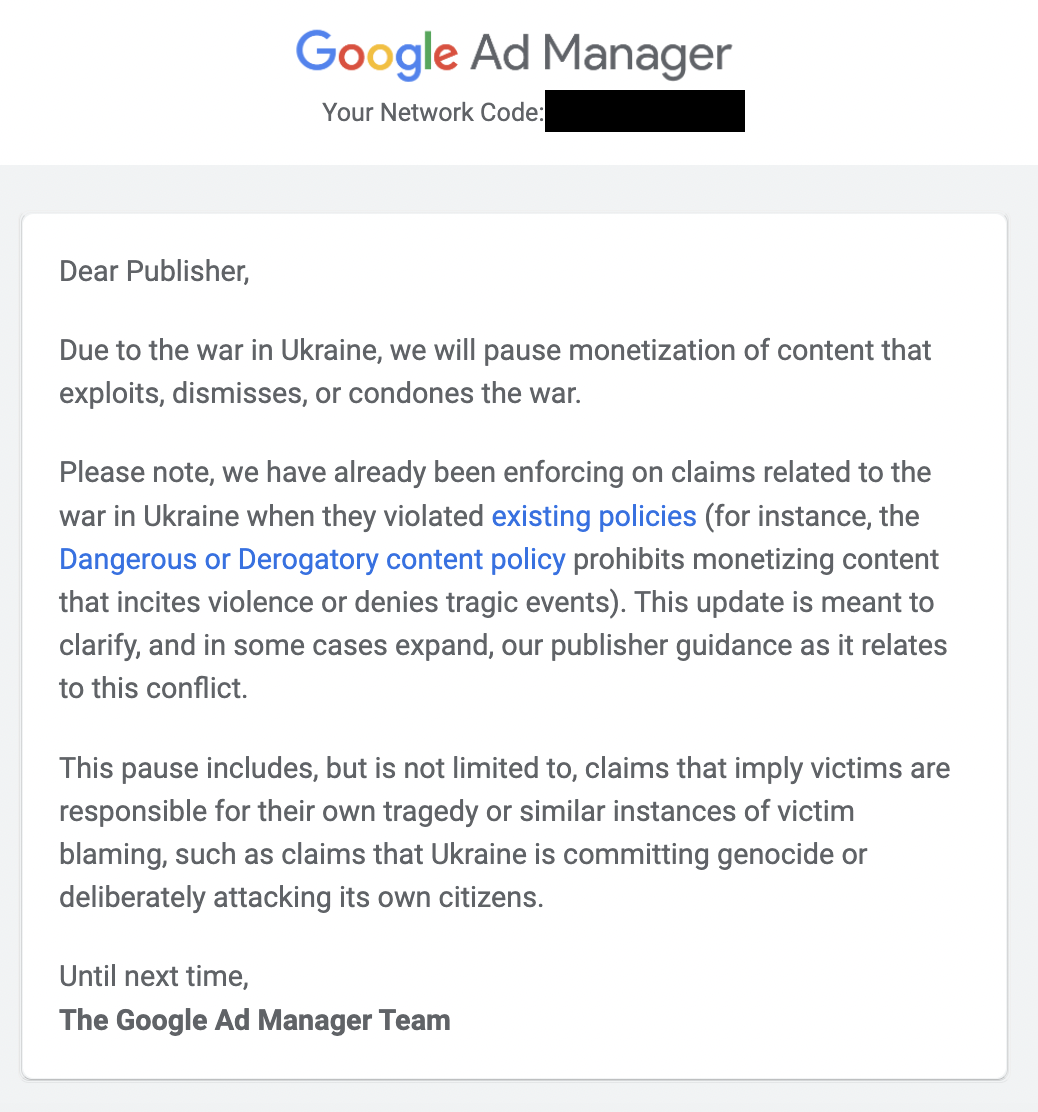
Russia has been accusing western media and online platforms of spreading fake news about the war, which it calls a “special military operation.”
On Wednesday, Russian media reported that internet watchdog Roskomnadzor had blocked Google News, for spreading fake news.
In early March, Google said it had stopped the sale of online ads in Russia.
Featured Video

The Truth About the Trump Shootings with Ken Silva
or go to
Aletho News Archives – Video-Images
From the Archives
Trans ‘milk’ as good as the real thing – NHS
RT | February 18, 2024
The drug-induced nipple secretions of trans women are as good as mothers’ breast milk for babies, the University of Sussex Hospitals NHS Trust claimed in a letter to campaigners made public in a report by British think tank the Policy Exchange on Sunday.
The healthcare trust’s medical director, Rachel James, argued that the off-label prescription drug cocktail men transitioning to female take in order to produce milk was “similar to the natural hormones which encourage lactation to develop when the baby is newly born.”
“The evidence which is available demonstrates that the milk is comparable to that produced following the birth of a baby,” James wrote in the letter, sent to Children of Transitioners last August.
Biological men who wish to lactate must first take hormones to grow milk glands and then take high doses of either domperidone or metoclopramide to stimulate milk production. Neither drug is approved for this use, though they are occasionally prescribed off-label to biological women who have trouble lactating.
However, domperidone’s own manufacturer, Janssen, warns patients the drug “may cause unwanted side effects affecting the heart in a breastfed baby” and “should be used during breastfeeding only if your physician considers this clearly necessary.” … continue
Blog Roll
 Aletho News
- Seyed M. Marandi: U.S. Strike Imminent – Toward Total War in the Middle East
- Russia Voted Under Fire. Washington Is Loading the Tankers.
- 12 Things Your Oncologist Was Trained Not to Tell You
- Anthrax Attacks Paved Way for COVID-Era ‘Junk Drugs and Vaccines’
- How Real Is the Impact of Western Sanctions on Israel?
- France, You Are Guilty: How Paris Turned Western Sahara into the Maghreb’s Powder Keg
- 2025 Nature Paper Claiming Worsening Global Drought Gets RETRACTED …Heavily Flawed
- Your Milk Is Not the Problem
- The Truth About the Trump Shootings with Ken Silva
- ARE PATIENTS BEING PROPERLY INFORMED ABOUT OZEMPIC?
- If Americans Knew
- Salah Sarsour’s Legal Team Says DHS Has Not Met Its Burden to Prove He Is Deportable
- An analysis of tax forms by The Intercept show Kraft’s charity and LLC have donated to Friends of the IDF and AIPAC’s super PAC.
- Israeli attacks kill four Palestinians in Gaza – Daily Update
- Inside Gaza’s death trap of collapsing, bombed-out buildings
- The everyday items Israel bans from Gaza every day
- Inside the siege, the ruined buildings of Gaza – Daily Update
- Debunking The Claim That Macklemore Has A “History Of Antisemitism”
- CPJ demands release of arrested Palestinian-US journalist near Bethlehem
- Robert Kraft: The Billionaire Friend of Netanyahu Pulling The Strings Behind the Macklemore/Ed Sheeran Blow Up
- Columbia Administered Fund Gives Big Money to Pro-Israel Groups
- No Tricks Zone
- 2025 Nature Paper Claiming Worsening Global Drought Gets RETRACTED …Heavily Flawed
- New Study: ‘Global Drought Shows No Detectable Recent Acceleration Under Climate Warming’
- Economic Masterminds: German Socialists Suggest Taxing Productivity Gains Stemming From Using AI
- The South China Sea Has Not Been Cooperating With The Climate Change Narrative
- Energy Crisis: Germany Enters Heating Season With Historically Low Gas Reserve Fill Levels
- New Study: The Antarctic Ice Sheet Gained Mass From 2020-2024 Due To Staggering Snow And Ice Accumulation
- Study: Ocean Heating Rates From Thousands Of Years Ago ‘Dwarf’ Modern Ocean Heating Rates
- Climate Extremists Target, Attack Large-Scale Power Grid Infrastructure In Germany!
- New Study: Antarctic Ice Melt Has Contributed Less Than 1 Centimeter To Sea Level Rise In The Last 30 Years
- Fear Of Debate: Alarmist German Climate Scientist Calls On Mainstream Media To Discredit Skeptic Voices
 Aletho News