The Stink Without a Secret
By Craig Murray | July 3, 2017
After six solid months of co-ordinated allegation from the mainstream media allied to the leadership of state security institutions, not one single scrap of solid evidence for Trump/Russia election hacking has emerged.
I do not support Donald Trump. I do support truth. There is much about Trump that I dislike intensely. Neither do I support the neo-liberal political establishment in the USA. The latter’s control of the mainstream media, and cunning manipulation of identity politics, seeks to portray the neo-liberal establishment as the heroes of decent values against Trump. Sadly, the idea that the neo-liberal establishment embodies decent values is completely untrue.
Truth disappeared so long ago in this witch-hunt that it is no longer even possible to define what the accusation is. Belief in “Russian hacking” of the US election has been elevated to a generic accusation of undefined wrongdoing, a vague malaise we are told is floating poisonously in the ether, but we are not allowed to analyse. What did the Russians actually do?
The original, base accusation is that it was the Russians who hacked the DNC and Podesta emails and passed them to Wikileaks. (I can assure you that is untrue).
The authenticity of those emails is not in question. What they revealed of cheating by the Democratic establishment in biasing the primaries against Bernie Sanders, led to the forced resignation of Debbie Wasserman Shultz as chair of the Democratic National Committee. They also led to the resignation from CNN of Donna Brazile, who had passed debate questions in advance to Clinton. Those are facts. They actually happened. Let us hold on to those facts, as we surf through lies. There was other nasty Clinton Foundation and cash for access stuff in the emails, but we do not even need to go there for the purpose of this argument.
The original “Russian hacking” allegation was that it was the Russians who nefariously obtained these damning emails and passed them to Wikileaks. The “evidence” for this was twofold. A report from private cyber security firm Crowdstrike claimed that metadata showed that the hackers had left behind clues, including the name of the founder of the Soviet security services. The second piece of evidence was that a blogger named Guccifer2 and a website called DNC Leaks appeared to have access to some of the material around the same time that Wikileaks did, and that Guccifer2 could be Russian.
That is it. To this day, that is the sum total of actual “evidence” of Russian hacking. I won’t say hang on to it as a fact, because it contains no relevant fact. But at least it is some form of definable allegation of something happening, rather than “Russian hacking” being a simple article of faith like the Holy Trinity.
But there are a number of problems that prevent this being fact at all. Nobody has ever been able to refute the evidence of Bill Binney, former Technical Director of the NSA who designed its current surveillance systems. Bill has stated that the capability of the NSA is such, that if the DNC computers had been hacked, the NSA would be able to trace the actual packets of that information as those emails travelled over the internet, and give a precise time, to the second, for the hack. The NSA simply do not have the event – because there wasn’t one. I know Bill personally and am quite certain of his integrity.
As we have been repeatedly told, “17 intelligence agencies” sign up to the “Russian hacking”, yet all these king’s horses and all these king’s men have been unable to produce any evidence whatsoever of the purported “hack”. Largely because they are not in fact trying. Here is another actual fact I wish you to hang on to: The Democrats have refused the intelligence agencies access to their servers to discover what actually happened. I am going to say that again.
The Democrats have refused the intelligence agencies access to their servers to discover what actually happened.
The heads of the intelligence community have said that they regard the report from Crowdstrike – the Clinton aligned private cyber security firm – as adequate. Despite the fact that the Crowdstrike report plainly proves nothing whatsoever and is based entirely on an initial presumption there must have been a hack, as opposed to an internal download.
Not actually examining the obvious evidence has been a key tool in keeping the “Russian hacking” meme going. On 24 May the Guardian reported triumphantly, following the Washington Post, that
“Fox News falsely alleged federal authorities had found thousands of emails between Rich and Wikileaks, when in fact law enforcement officials disputed that Rich’s laptop had even been in possession of, or examined by, the FBI.”
It evidently did not occur to the Guardian as troubling, that those pretending to be investigating the murder of Seth Rich have not looked at his laptop.
There is a very plain pattern here of agencies promoting the notion of a fake “Russian crime”, while failing to take the most basic and obvious initial steps if they were really investigating its existence. I might add to that, there has been no contact with me at all by those supposedly investigating. I could tell them these were leaks not hacks. Wikileaks. The clue is in the name.
So those “17 agencies” are not really investigating but are prepared to endorse weird Crowdstrike claims, like the idea that Russia’s security services are so amateur as to leave fingerprints with the name of their founder. If the Russians fed the material to Wikileaks, why would they also set up a vainglorious persona like Guccifer2 who leaves obvious Russia pointing clues all over the place?
Of course we need to add from the Wikileaks “Vault 7” leak release, information that the CIA specifically deploys technology that leaves behind fake fingerprints of a Russian computer hacking operation.
Crowdstrike have a general anti-Russian attitude. They published a report seeking to allege that the same Russian entities which “had hacked” the DNC were involved in targeting for Russian artillery in the Ukraine. This has been utterly discredited.
Some of the more crazed “Russiagate” allegations have been quietly dropped. The mainstream media are hoping we will all forget their breathless endorsement of the reports of the charlatan Christopher Steele, a former middle ranking MI6 man with very limited contacts that he milked to sell lurid gossip to wealthy and gullible corporations. I confess I rather admire his chutzpah.
Given there is no hacking in the Russian hacking story, the charges have moved wider into a vague miasma of McCarthyite anti-Russian hysteria. Does anyone connected to Trump know any Russians? Do they have business links with Russian finance?
Of course they do. Trump is part of the worldwide oligarch class whose financial interests are woven into a vast worldwide network that enslaves pretty well the rest of us. As are the Clintons and the owners of the mainstream media who are stoking up the anti-Russian hysteria. It is all good for their armaments industry interests, in both Washington and Moscow.
Trump’s judgement is appalling. His sackings or inappropriate directions to people over this subject may damage him.
The old Watergate related wisdom is that it is not the crime that gets you, it is the cover-up. But there is a fundamental difference here. At the centre of Watergate there was an actual burglary. At the centre of Russian hacking there is a void, a hollow, and emptiness, an abyss, a yawning chasm. There is nothing there.
Those who believe that opposition to Trump justifies whipping up anti-Russian hysteria on a massive scale, on the basis of lies, are wrong. I remain positive that the movement Bernie Sanders started will bring a new dawn to America in the next few years. That depends on political campaigning by people on the ground and on social media. Leveraging falsehoods and cold war hysteria through mainstream media in an effort to somehow get Clinton back to power is not a viable alternative. It is a fantasy and even were it practical, I would not want it to succeed.
Foisting Blame for Cyber-hacking on Russia
By Gareth Porter | Consortium News | July 2, 2017
Recent hearings by the Senate and House Intelligence Committees reflected the rising tide of Russian-election-hacking hysteria and contributed further to it. Both Democrats and Republicans on the two committees appeared to share the alarmist assumptions about Russian hacking, and the officials who testified did nothing to discourage the politicians.
On June 21, Samuel Liles, acting director of the Intelligence and Analysis Office’s Cyber Division at the Department of Homeland Security, and Jeanette Manfra, acting deputy under secretary for cyber-security and communications, provided the main story line for the day in testimony before the Senate committee — that efforts to hack into election databases had been found in 21 states.
Former DHS Secretary Jeh Johnson and FBI counter-intelligence chief Bill Priestap also endorsed the narrative of Russian government responsibility for the intrusions on voter registration databases.
But none of those who testified offered any evidence to support this suspicion nor were they pushed to do so. And beneath the seemingly unanimous embrace of that narrative lies a very different story.
The Department of Homeland Security (DHS) has a record of spreading false stories about alleged Russian hacking into U.S. infrastructure, such as the tale of a Russian intrusion into the Burlington, Vermont electrical utility in December 2016 that DHS later admitted was untrue. There was another bogus DHS story about Russia hacking into a Springfield, Illinois water pump in November 2011.
So, there’s a pattern here. Plus, investigators, assessing the notion that Russia hacked into state electoral databases, rejected that suspicion as false months ago. Last September, Assistant Secretary of DHS for Cybersecurity Andy Ozment and state officials explained that the intrusions were not carried out by Russian intelligence but by criminal hackers seeking personal information to sell on the Internet.
Both Ozment and state officials responsible for the state databases revealed that those databases have been the object of attempted intrusions for years. The FBI provided information to at least one state official indicating that the culprits in the hacking of the state’s voter registration database were cyber-criminals.
Illinois is the one state where hackers succeeded in breaking into a voter registration database last summer. The crucial fact about the Illinois hacking, however, was that the hackers extracted personal information on roughly 90,000 registered voters, and that none of the information was expunged or altered.
The Actions of Cybercriminals
That was an obvious clue to the motive behind the hack. Assistant DHS Secretary Ozment testified before the House Subcommittee on Information Technology on Sept. 28 (at 01:02.30 of the video) that the apparent interest of the hackers in copying the data suggested that the hacking was “possibly for the purpose of selling personal information.”
Ozment ‘s testimony provides the only credible motive for the large number of states found to have experienced what the intelligence community has called “scanning and probing” of computers to gain access to their electoral databases: the personal information involved – even e-mail addresses – is commercially valuable to the cybercriminal underworld.
That same testimony also explains why so many more states reported evidence of attempts to hack their electoral databases last summer and fall. After hackers had gone after the Illinois and Arizona databases, Ozment said, DHS had provided assistance to many states in detecting attempts to hack their voter registration and other databases.
“Any time you more carefully monitor a system you’re going to see more bad guys poking and prodding at it,” he observed, “because they’re always poking and prodding.” [Emphasis added]
State election officials have confirmed Ozment’s observation. Ken Menzel, the general counsel for the Illinois Secretary of State, told this writer, “What’s new about what happened last year is not that someone tried to get into our system but that they finally succeeded in getting in.” Menzel said hackers “have been trying constantly to get into it since 2006.”
And it’s not just state voter registration databases that cybercriminals are after, according to Menzel. “Every governmental data base – driver’s licenses, health care, you name it – has people trying to get into it,” he said.
Arizona Secretary of State Michele Reagan told Mother Jones that her I.T. specialists had detected 193,000 distinct attempts to get into the state’s website in September 2016 alone and 11,000 appeared to be trying to “do harm.”
Reagan further revealed that she had learned from the FBI that hackers had gotten a user name and password for their electoral database, and that it was being sold on the “dark web” – an encrypted network used by cyber criminals to buy and sell their wares. In fact, she said, the FBI told her that the probe of Arizona’s database was the work of a “known hacker” who had been closely monitored “frequently.”
James Comey’s Role
The sequence of events indicates that the main person behind the narrative of Russian hacking state election databases from the beginning was former FBI Director James Comey. In testimony to the House Judiciary Committee on Sept. 28, Comey suggested that the Russian government was behind efforts to penetrate voter databases, but never said so directly.
Comey told the committee that FBI Counterintelligence was working to “understand just what mischief Russia is up to with regard to our elections.” Then he referred to “a variety of scanning activities” and “attempted intrusions” into election-related computers “beyond what we knew about in July and August,” encouraging the inference that it had been done by Russian agents.
The media then suddenly found unnamed sources ready to accuse Russia of hacking election data even while admitting that they lacked evidence. The day after Comey’s testimony ABC headlined, “Russia Hacking Targeted Nearly Half of States’ Voter Registration Systems, Successfully Infiltrating 4.” The story itself revealed, however, that it was merely a suspicion held by “knowledgeable” sources.
Similarly, NBC News headline announced, “Russians Hacked Two U.S. Voter Databases, Officials Say.” But those who actually read the story closely learned that in fact none of the unnamed sources it cited were actually attributing the hacking to the Russians.
It didn’t take long for Democrats to turn the Comey teaser — and these anonymously sourced stories with misleading headlines about Russian database hacking — into an established fact. A few days later, the ranking Democrat on the House Intelligence Committee, Rep. Adam Schiff declared that there was “no doubt” Russia was behind the hacks on state electoral databases.
On Oct. 7, DHS and the Office of the Director of National Intelligence issued a joint statement that they were “not in a position to attribute this activity to the Russian government.” But only a few weeks later, DHS participated with FBI in issuing a “Joint Analysis Report” on “Russian malicious cyber activity” that did not refer directly to scanning and spearphishing aimed of state electoral databases but attributed all hacks related to the election to “actors likely associated with RIS [Russian Intelligence Services].”
Suspect Claims
But that claim of a “likely” link between the hackers and Russia was not only speculative but highly suspect. The authors of the DHS-ODNI report claimed the link was “supported by technical indicators from the U.S. intelligence community, DHS, FBI, the private sector and other entities.” They cited a list of hundreds of I.P. addresses and other such “indicators” used by hackers they called “Grizzly Steppe” who were supposedly linked to Russian intelligence.
But as I reported last January, the staff of Dragos Security, whose CEO Rob Lee, had been the architect of a U.S. government system for defense against cyber attack, pointed out that the vast majority of those indicators would certainly have produced “false positives.”
Then, on Jan. 6 came the “intelligence community assessment” – produced by selected analysts from CIA, FBI and National Security Agency and devoted almost entirely to the hacking of e-mail of the Democratic National Committee and Hillary Clinton’s campaign chairman John Podesta. But it included a statement that “Russian intelligence obtained and maintained access to elements of multiple state or local election boards.” Still, no evidence was evinced on this alleged link between the hackers and Russian intelligence.
Over the following months, the narrative of hacked voter registration databases receded into the background as the drumbeat of media accounts about contacts between figures associated with the Trump campaign and Russians built to a crescendo, albeit without any actual evidence of collusion regarding the e-mail disclosures.
But a June 5 story brought the voter-data story back into the headlines. The story, published by The Intercept, accepted at face value an NSA report dated May 5, 2017, that asserted Russia’s military intelligence agency, the GRU, had carried out a spear-phishing attack on a U.S. company providing election-related software and had sent e-mails with a malware-carrying word document to 122 addresses believed to be local government organizations.
But the highly classified NSA report made no reference to any evidence supporting such an attribution. The absence of any hint of signals intelligence supporting its conclusion makes it clear that the NSA report was based on nothing more than the same kind of inconclusive “indicators” that had been used to establish the original narrative of Russians hacking electoral databases.
A Checkered History
So, the history of the U.S. government’s claim that Russian intelligence hacked into election databases reveals it to be a clear case of politically motivated analysis by the DHS and the Intelligence Community. Not only was the claim based on nothing more than inherently inconclusive technical indicators but no credible motive for Russian intelligence wanting personal information on registered voters was ever suggested.
Russian intelligence certainly has an interest in acquiring intelligence related to the likely outcome of American elections, but it would make no sense for Russia’s spies to acquire personal voting information about 90,000 registered voters in Illinois.
When FBI Counter-intelligence chief Priestap was asked at the June 21 hearing how Moscow might use such personal data, his tortured effort at an explanation clearly indicated that he was totally unprepared to answer the question.
“They took the data to understand what it consisted of,” said Priestap, “so they can affect better understanding and plan accordingly in regards to possibly impacting future election by knowing what is there and studying it.”
In contrast to that befuddled non-explanation, there is highly credible evidence that the FBI was well aware that the actual hackers in the cases of both Illinois and Arizona were motivated by the hope of personal gain.
The Mad Chase for Russia-gate Prey
By Daniel Lazare | Consortium News | June 30, 2017
June is turning out to be the cruelest month for the Russia-gate industry. The pain began on June 8 when ex-FBI Director James Comey testified that a sensational New York Times article declaring that “members of Donald J. Trump’s 2016 presidential campaign and other Trump associates had repeated contacts with senior Russian intelligence officials” was “in the main … not true.”
Then came Republican Karen Handel’s June 20 victory in a special election in Georgia’s sixth congressional district, sparking bitter recriminations among Democrats who had hoped to ride to victory on a Russia-gate-propelled wave of resistance to Trump.
More evidence that the strategy was not working came a day later when the Harris Poll and Harvard’s Center for American Political Studies produced a devastating survey showing that 62 percent of voters see no evidence that the Trump campaign colluded with Russia, while 54 percent believe the “Deep State” is trying to unseat the President by leaking classified information. The poll even showed a small bounce in Trump’s popularity, with 45 percent viewing him favorably as opposed to only 39 percent for his defeated Democratic rival Hillary Clinton.
The mainstream news media also came in for some lumps. On June 23, CNN retracted a story that had claimed that Congress was looking into reports that the Trump transition team met secretly with a Russian investment fund under sanction from the U.S. government. Three days later, CNN announced that three staffers responsible for the blooper – reporter and Pulitzer Prize-nominee Thomas Frank; Pulitzer-winner Eric Lichtblau, late of the New York Times ; and Lex Haris, executive editor in charge of investigations – had resigned.
Adding to CNN’s embarrassment, Project Veritas, the brainchild of rightwing provocateur James O’Keefe, released an undercover video in which a CNN producer named John Bonifield explained that the network can’t stop talking about Russia because it boosts ratings and then went on to say about Russia-gate:
“Could be bullshit, I mean it’s mostly bullshit right now. Like, we don’t have any big giant proof. But … the leaks keep leaking, and there are so many great leaks, and it’s amazing, and I just refuse to believe that if they had something really good like that, that wouldn’t leak because we’ve been getting all these other leaks. So I just feel like they don’t really have it but they want to keep digging. And so I think the president is probably right to say, like, look, you’re witch-hunting me, like, you have no smoking gun, you have no real proof.”
Project Veritas also released an undercover video interview with CNN contributor Van Jones calling the long-running probe into possible collusion between Trump’s 2016 campaign and Russia a “nothing-burger,” a position similar to the skepticism that Jones has displayed in his on-air comments.
True, the Bonifield video was only a medical reporter sounding off about a story that he’s not even covering and doing so to a dirty-trickster who has received financing from Trump and who, after another undercover film stunt, was ordered in 2013 to apologize and pay $100,000 to an anti-poverty worker whose privacy he had invaded.
Good for Ratings
But, still, Bonifield’s “president-is-probably-right” comment is hard to shake. Ditto Van Jones’ “nothing-burger.” Unless both quotes are completely doctored, it appears that the scuttlebutt among CNNers is that Russia-gate is a lot of hot air but no one cares because it’s sending viewership through the roof.
And if that’s what CNN thinks, then it may be what MSNBC’s Rachel Maddow thinks as she also plays the Russia card for all it’s worth. It may also be what The Washington Post has in the back of its mind even while hyperventilating about Russian President Vladimir Putin’s “crime of the century, an unprecedented and largely successful destabilizing attack on American democracy.”
The New York Times also got caught up in its enthusiasm to hype the Russia-gate case on June 25 when it ran a story slamming Trump for “refus[ing] to acknowledge a basic fact agreed upon by 17 American intelligence agencies that he now oversees: Russia orchestrated the attacks [on Democratic emails], and did it to help get him elected.”
The “17-intelligence-agency” canard has been a favorite go-to assertion for both Democrats and the mainstream news media, although it was repudiated in May by President Obama’s Director of National Intelligence James Clapper and CIA Director John Brennan.
So, on June 29, the Times apparently found itself with no choice but to issue a correction stating: “The [Russia-hacking] assessment was made by four intelligence agencies — the Office of the Director of National Intelligence, the Central Intelligence Agency, the Federal Bureau of Investigation and the National Security Agency. The assessment was not approved by all 17 organizations in the American intelligence community.”
This point is important because, as Consortiumnews.com and other non-mainstream news outlets have argued for more than a month, it is much easier to manipulate a finding by hand-picking analysts from a small number of intelligence agencies than by seeking the judgments and dissents from all 17.
Despite the correction, the Times soon returned to its pattern of shading the truth regarding the U.S. intelligence assessment. On June 30, a Times article reported: “Mr. Trump has repeatedly cast doubt on the unanimous conclusion of United States intelligence agencies that Russia sought to interfere in the 2016 race.”
The Times’ phrase “unanimous conclusion” conveys the false impression that all 17 agencies were onboard without specifically saying so, although we now know that the Times’ editors are aware that only selected analysts from three agencies plus the DNI’s office were involved.
In other words, the Times cited a “unanimous conclusion of United States intelligence agencies” to mislead its readers without specifically repeating the “all-17-agencies” falsehood. This behavior suggests that the Times is so blinded by its anti-Trump animus that it wants to conceal from its readers how shaky the whole tale is.
Holes from the Start
But the problems with Russia-gate date back to the beginning. Where Watergate was about a real burglary, this one began with a cyber break-in that may or may not have occurred. In his June 8 testimony before the Senate Intelligence Committee, Comey conceded that the FBI never checked the DNC’s servers to confirm that they had truly been hacked.
COMMITTEE CHAIRMAN RICHARD BURR: Did you ever have access to the actual hardware that was hacked? Or did you have to rely on a third party to provide you the data that they had collected?
COMEY: In the case of the DNC, and, I believe, the DCCC [i.e. the Democratic Congressional Campaign Committee], but I’m sure the DNC, we did not have access to the devices themselves. We got relevant forensic information from a private party, a high-class entity, that had done the work. But we didn’t get direct access.
BURR: But no content?
COMEY: Correct.
BURR: Isn’t content an important part of the forensics from a counterintelligence standpoint?
COMEY: It is, although what was briefed to me by my folks — the people who were my folks at the time – is that they had gotten the information from the private party that they needed to understand the intrusion by the spring of 2016.
The FBI apparently was confident that it could rely on such “a high-class entity” as CrowdStrike to tell it what it needed to know. Yet neither the Democratic National Committee nor CrowdStrike, the Irvine, California, cyber-security firm the DNC hired, was remotely objective.
Hillary Clinton was on record calling Putin a “bully” whose goal was “to stymie, to confront, to undermine American power” while Dmitri Aperovitch, CrowdStrike’s chief technical officer, is a Russian émigré who is both anti-Putin personally and an associate of the Atlantic Council, a pro-Clinton/anti-Russian think tank that is funded by the Saudis, the United Arab Emirates and the Ukrainian World Congress. The Atlantic Council is one of the most anti-Russian voices in Washington.
So, an anti-Putin DNC hired an anti-Putin security specialist, who, to absolutely no one’s surprise, “immediately” determined that the break-in was the work of hackers “closely linked to the Russian government’s powerful and highly capable intelligence services.”
Comey’s trust in CrowdStrike was akin to cops trusting a private eye not only to investigate a murder, but to determine if it even occurred. Yet the mainstream media’s pack journalists saw no reason to question the FBI because doing so would not accord with an anti-Trump bias so pronounced that even journalism profs have begun to notice.
Doubts about CrowdStrike
Since CrowdStrike issued its findings, it has come under wide-ranging criticism. Cyber experts have called its analysis inconsistent because while praising the alleged hackers to the skies (“our team considers them some of the best adversaries out of all the numerous nation-state, criminal and hacktivist/terrorist groups we encounter on a daily basis”), CrowdStrike says it was able to uncover their identity because they made kindergarten-level mistakes, most notably uploading documents in a Russian-language format under the name “Felix Edmundovich,” a reference to Felix E. Dzerzhinsky, founder of the Soviet secret police.
“Raise your hand if you think that a GRU or FSB officer would add Iron Felix’s name to the metadata of a stolen document before he released it to the world while pretending to be a Romanian hacker,” wisecracked cyber-skeptic Jeffrey Carr.
Others noted how easy it is for even novice hackers to leave a false trail. In Seattle, cyber-sleuths Mark Maunder and Rob McMahon of Wordfence, makers of a popular computer-security program, discovered that “malware” found in the DNC was an early version of a publicly available program developed in the Ukraine – which was strange, they said, because one would expect Russian intelligence to develop its own tools or use ones that were more up to date.
But even if the malware was Russian, experts pointed out that its use in this instance no more implicates Russian intelligence than the use of an Uzi in a bank robbery implicates Mossad.
Other loose threads appeared. In January, Carr poured cold water on a subsequent CrowdStrike report charging that pro-Russian separatists had used similar malware to zero in on pro-government artillery units in the eastern Ukraine.
The Ukrainian ministry of defense and the London think tank from which CrowdStrike obtained much of its data agreed that the company didn’t know what it was talking about. But if CrowdStrike was wrong about the Ukraine case, how could everyone be sure it was right about the DNC?
In March, Wikileaks went public with its “Vault 7” findings showing, among other things, that the CIA has developed sophisticated software in order to scatter false clues – which inevitably led to dark mutterings that maybe the agency had hacked the DNC itself in order to blame it on the Russians.
Finally, although Wikileaks policy is never to comment on its sources, Julian Assange, the group’s founder, decided to make an exception.
“The Clinton camp has been able to project a neo-McCarthyist hysteria that Russia is responsible for everything,” he told journalist John Pilger in November. “Hillary Clinton has stated multiple times, falsely, that 17 U.S. intelligence agencies had assessed that Russia was the source of our publications. That’s false – we can say that the Russian government is not the source.”
Craig Murray, an ex-British diplomat who is a Wikileaks adviser, disclosed that he personally flew to Washington to meet with a person who was either the original source or an associate of the source. Murray said the motive for the leak was “disgust at the corruption of the Clinton Foundation and the tilting of the primary election playing field against Bernie Sanders.”
Conceivably, such contacts could have been cutouts to conceal from WikiLeaks the actual sources. Still, Wikileaks’ record of veracity should be enough to give anyone pause. Yet the press either ignored the WikiLeaks comments or, in the case of The Washington Post, struggled to prove that WikiLeaks was lying.
Unstable Foundation
The stories that have been built upon this unstable foundation have proved shaky, too. In March, the Times published a front-page exposé asserting that Trump campaign manager Paul Manafort “had regular communications with his longtime associate – a former Russian military translator in Kiev who has been investigated in Ukraine on suspicion of being a Russian intelligence agent.” But if the man was merely a suspected spy as opposed to a convicted one, then what’s the problem?
The article also noted that Jason Greenblatt, a former Trump lawyer who is now a special White House representative for international negotiations, met last summer with Rabbi Berel Lazar, “the chief rabbi of Russia and an ally of Russia’s president, Vladimir V. Putin.” But an Orthodox Jew paying a call on Russia’s chief rabbi is hardly extraordinary. Neither is the fact that the rabbi is a Putin ally since Putin enjoys broad support in the Russian Jewish community.
In April, the Times published another innuendo-laden front-page story about businessman Carter Page whose July 2016 trip to Moscow proved to be “a catalyst for the F.B.I. investigation into connections between Russia and President Trump’s campaign.”
Page’s sins chiefly consist of lecturing at a Moscow academic institute about U.S.-Russian relations in terms that The New York Times believed “echoed the position of President Vladimir V. Putin of Russia” and, on another occasion, meeting with a suspected Russian intelligence agent in New York.
“There is no evidence that Mr. Page knew the man was an intelligence officer,” the article added. So is it now a crime to talk with a Russian or some other foreign national who, unbeknownst to you, may turn out to be an intelligence agent?
Then there is poor Mike Flynn, driven out as national security adviser after just 24 days in office for allegedly misrepresenting conversations with Russian Ambassador Sergey Kislyak – exchanges during the Trump transition that supposedly exposed him to the possibility of Russian blackmail although U.S. intelligence was monitoring the talks and therefore knew their exact contents. And, since the Russians no doubt assumed as much, it’s hard to see what they could have blackmailed him with. [See Consortiumnews.com’s “Turning Gen. Flynn into Road Kill.”]
Yet the mainstream media eagerly gobbled up this blackmail possibility while presenting with a straight face the claim by Obama holdovers at the Justice Department that the Flynn-Kislyak conversations might have violated the 1799 Logan Act, an ancient relic that has never been used to prosecute anyone in its entire two-century history.
So, if the scandal is looking increasingly threadbare now, could the reason be that there was little or nothing to it when it was first announced during the final weeks of the 2016 campaign?
Although it’s impossible to say what evidence might eventually emerge, Russia-gate is looking more and more like a Democratic version of Benghazi, a pseudo-scandal that no one could ever figure out but which wound up making Hillary Clinton look like a persecuted hero and the Republicans seem like obsessed idiots.
As much as that epic inquiry turned out to be mostly a witch-hunt, Americans are beginning to sense the same about Washington’s latest game of “gotcha.”
The United States is still a democracy in some vague sense of the word, and “We the People” are losing patience with subterranean maneuvers on the part of the Democrats, the neoconservatives, and the intelligence agencies seeking to reverse a presidential election.
Like Benghazi or possibly even the Birthergate scam about President Obama’s Kenyan birthplace, the whole convoluted Russia-gate tale grows stranger by the day.
Daniel Lazare is the author of several books including The Frozen Republic: How the Constitution Is Paralyzing Democracy (Harcourt Brace).
NYT Finally Retracts Russia-gate Canard
By Robert Parry | Consortium News | June 29, 2017
The New York Times has finally admitted that one of the favorite Russia-gate canards – that all 17 U.S. intelligence agencies concurred on the assessment of Russian hacking of Democratic emails – is false.
On Thursday, the Times appended a correction to a June 25 article that had repeated the false claim, which has been used by Democrats and the mainstream media for months to brush aside any doubts about the foundation of the Russia-gate scandal and portray President Trump as delusional for doubting what all 17 intelligence agencies supposedly knew to be true.
In the Times’ White House Memo of June 25, correspondent Maggie Haberman mocked Trump for “still refus[ing] to acknowledge a basic fact agreed upon by 17 American intelligence agencies that he now oversees: Russia orchestrated the attacks, and did it to help get him elected.”
However, on Thursday, the Times – while leaving most of Haberman’s ridicule of Trump in place – noted in a correction that the relevant intelligence “assessment was made by four intelligence agencies — the Office of the Director of National Intelligence, the Central Intelligence Agency, the Federal Bureau of Investigation and the National Security Agency. The assessment was not approved by all 17 organizations in the American intelligence community.”
The Times’ grudging correction was vindication for some Russia-gate skeptics who had questioned the claim of a full-scale intelligence assessment, which would usually take the form of a National Intelligence Estimate (or NIE), a product that seeks out the views of the entire Intelligence Community and includes dissents.
The reality of a more narrowly based Russia-gate assessment was admitted in May by President Obama’s Director of National Intelligence James Clapper and Obama’s CIA Director John Brennan in sworn congressional testimony.
Clapper testified before a Senate Judiciary subcommittee on May 8 that the Russia-hacking claim came from a “special intelligence community assessment” (or ICA) produced by selected analysts from the CIA, NSA and FBI, “a coordinated product from three agencies – CIA, NSA, and the FBI – not all 17 components of the intelligence community,” the former DNI said.
Clapper further acknowledged that the analysts who produced the Jan. 6 assessment on alleged Russian hacking were “hand-picked” from the CIA, FBI and NSA.
Yet, as any intelligence expert will tell you, if you “hand-pick” the analysts, you are really hand-picking the conclusion. For instance, if the analysts were known to be hard-liners on Russia or supporters of Hillary Clinton, they could be expected to deliver the one-sided report that they did.
Politicized Intelligence
In the history of U.S. intelligence, we have seen how this selective approach has worked, such as the phony determination of the Reagan administration pinning the attempted assassination of Pope John Paul II and other acts of terror on the Soviet Union.
CIA Director William Casey and Deputy Director Robert Gates shepherded the desired findings through the process by putting the assessment under the control of pliable analysts and sidelining those who objected to this politicization of intelligence.
The point of enlisting the broader intelligence community – and incorporating dissents into a final report – is to guard against such “stove-piping” of intelligence that delivers the politically desired result but ultimately distorts reality.
Another painful example of politicized intelligence was President George W. Bush’s 2002 National Intelligence Estimate on Iraq’s WMD that removed State Department and other dissents from the declassified version that was given to the public.
Since Clapper’s and Brennan’s testimony in May, the Times and other mainstream news outlets have avoided a direct contradiction of their earlier acceptance of the 17-intelligence-agencies canard by simply referring to a judgment by “the intelligence community.”
That finessing of their earlier errors has allowed Hillary Clinton and other senior Democrats to continue referencing this fictional consensus without challenge, at least in the mainstream media.
For instance, on May 31 at a technology conference in California, Clinton referred to the Jan. 6 report, asserting that “Seventeen agencies, all in agreement, which I know from my experience as a Senator and Secretary of State, is hard to get. They concluded with high confidence that the Russians ran an extensive information war campaign against my campaign, to influence voters in the election.”
The failure of the major news organizations to clarify this point about the 17 agencies may have contributed to Haberman’s mistake on June 25 as she simply repeated the groupthink that nearly all the Important People in Washington just knew to be true.
But the Times’ belated correction also underscores the growing sense that the U.S. mainstream media has joined in a political vendetta against Trump and has cast aside professional standards to the point of repeating false claims designed to denigrate him.
That, in turn, plays into Trump’s Twitter complaints that he and his administration are the targets of a “witch hunt” led by the “fake news” media, a grievance that appears to be energizing his supporters and could discredit whatever ongoing investigations eventually conclude.
Investigative reporter Robert Parry broke many of the Iran-Contra stories for The Associated Press and Newsweek in the 1980s.
Two More Anti-Russian Bills in US Congress Aimed at ‘Keeping Close Eye on Trump’
Sputnik – June 25, 2017
A congresswoman and member of the US Democratic Party, Maxine Waters, introduced two bills directed against Russia in the US Congress.
According to Waters, she seeks to prevent US President Donald Trump’s administration from lifting or weakening sanctions imposed on Russia by the Barack Obama administration. She also wants to restrict access to Russian diplomatic compounds located in New York and Maryland.
In her opinion, Trump’s team “has been uniquely consistent on attempting to appease” Russia over its alleged involvement in the Ukrainian crisis and the US presidential election.
“We need to keep a close eye on this administration, and since we cannot trust that they will not lift Russian sanctions or weaken other punishments, there is a need for strong legislative action,” Water’s statement said, published on her official website.
According to the politician, despite “the full scope of Russian efforts to undermine our democracy,” Donald Trump and his team members “many of whom have ties to Russia or pro-Russia forces in Ukraine” have focused their efforts on lifting restrictive measures “rightly imposed on Russia.”
Earlier, it was reported that the United States was taking steps to give two diplomatic compounds back to Russia it had frozen in December over allegations of Moscow’s interference in the US presidential election.
“As the Trump administration considers taking action to reverse or lessen these punishments, many of Donald Trump’s associates and campaign operatives — such as his former campaign foreign policy adviser Carter Page, former national security adviser Michael Flynn and son-in-law and senior adviser Jared Kushner — remain at the center of Justice Department and/or Congressional probes into Russian interference in the 2016 election,” a statement on the congresswoman’s website claimed.
The Freezing Russian Sanctions Act and the Deny Russian Access to Diplomatic Compounds Act are designed to prevent “attempts” by the White House to take a softer approach toward Russia and imply the preservation of all restrictions introduced by Trump’s predecessor. On June 20, the US Department of the Treasury Office of Foreign Assets Control (OFAC) also introduced new sanctions against some 40 individuals and entities on the pretext of their alleged involvement in the ongoing conflict in Donbass.
The new sanctions include the freezing of assets subject to US jurisdiction and prohibit US individuals from doing business with them. The Treasury Department’s move comes after the US Senate voted in favor of extending sanctions against Russia over its alleged meddling in the 2016 US presidential election on June 14.
Oliver Stone’s Israel remarks CENSORED by Stephen Colbert’s Late Show
By Adam Garrie | The Duran | June 16, 2017
Reports have surfaced that during his heated exchange with Stephen Colbert, Oliver Stone responded to statements from Colbert repeating the tired narrative about Russia interfering in the US election by bringing up an elephant in the room that many media outlets have totally ignored.
Stone said of alleged and thus far totally unproved Russian interference,
“Israel had far more involvement in the US election than Russia, why don’t you ask me about that?”
Colbert, quick to end that part of the discussion replied,
“I’ll ask you about that when you make a documentary about Israel”
This section of the interview was edited out of the final broadcast, but multiple sources, including many pro-Israel sources testify to the existence of the in-studio exchange.
Few could reasonably deny that the pro-Israel lobby in the US is extremely power, well funded and influential.
Oliver Stone touched on a deeply important issue, one that clearly did not fit the anti-Russia stance of Stephen Colbert and his producers.
Oliver Stone: Israel is more dangerous than Russia
Do we have enough evidence which points to the idea that Israel has been meddling in U.S. elections and foreign affairs? Yes.

“You can’t mention Israel, Bro!”
By Jonas E. Alexis | Veterans Today | June 16, 2017
Oliver Stone probably didn’t know that he was attacking the Neoconservative hawks, warmongers, and ethnic cleansers in Washington when he told Stephen Colbert that “Israel had far more involvement in the US election than Russia.”[1]
That statement indeed was a political bomb, and it almost certainly took Colbert by surprise. In response to this claim, the Jewish Press declared:
“Stone was obviously pulling the old anti-Israel, leftist line about how AIPAC is controlling Washington (much the way the ‘Jews’ control Hollywood) – and in his haste to save face apparently forgot the difference between contributing to political campaigns and hacking DNC computers.”[2]
Well, obviously Stone stroke a nerve, for we all know by now that AIPAC has had and continues to have a tremendously powerful influence on U.S. foreign policy. Once again, this is not conspiracy stuff. The scholarly studies on this issue are just an embarrassment to riches:
Paul R. Pillar, Intelligence and U.S. Foreign Policy: Iraq, 9/11, and Misguided Reform (New York: Columbia University Pres, 2011).
Michael MacDonald, Overreach: Delusions of Regime Change in Iraq (Cambridge: Harvard University Press, 2014).
John M. Schuessler, Deceit on the Road to War: Presidents, Politics, and American Democracy (New York: Cornell University Press, 2015).
John J. Mearsheimer, Why Leaders Lie: The Truth About Lying in International Politics (New York: Oxford University Press, 2011).
Muhammad Idrees Ahmad, The Road to Iraq: The Making of a Neoconservative War (Edinburgh: Edinburgh University Press, 2014).
Stefan Halper and Jonathan Clarke, America Alone: The Neo-Conservatives and the Global Order (Cambridge: Cambridge University Press, 2004).
Murray Friedman, The Neoconservative Revolution: Jewish Intellectuals and the Shaping of Public Policy (Cambridge: Cambridge University Press, 2005).
John J. Mearsheimer and Stephen Walt, The Israel Lobby and US Foreign Policy (New York: Farrar & Straus, 2007).
Bob Woodward, Plan of Attack: The Definitive Account of the Decision to Invade Iraq (New York: Simon & Schuster, 2004).
Michael Isikoff and David Corn, Hubris: The Inside Story of Spin, Scandal, and the Selling of the Iraq War (New York: Random House, 2006).
But the simple question is this: do we have enough evidence which points to the idea that Israel has been meddling in U.S. elections and foreign affairs? Yes.
In 1987, Jewish American Jonathan Jay Pollard was sent to prison for life for spying for Israel. In 1995, Israel publicly denied that Pollard was a spy, but recanted that statement three years later. BBC News itself declared,
“Israel has officially acknowledged for the first time that an American Jew, Jonathan Pollard, who was arrested in the United States 13 years ago, was one of its spies. Pollard, a former intelligence analyst for the United States Navy, is serving a life sentence in North Carolina for passing classified military documents to Israel. Until now, the Israeli authorities had always denied that Pollard was working under their direction.”[3]
For years the Israelis “refused to tell the United States what Pollard gave them.”[4] Then in 2010 Netanyahu made it clear that Pollard was an Israeli spy who was working for the Israeli government, “for which Israel took full responsibility.” Yet even after this admission, Ambassador Michael Oren said he hoped for Pollard’s earliest release.[5]
In 2005, Steve J. Rosen and Keith Weissman, who served for twenty-three years as top officials for American Israel Public Affairs (AIPAC), were accused of similar charges. As the trial was nearing, both the Israel Lobby and the defense team “described the proceedings as a frame-up, the result of an intra-bureaucratic struggle within the government, and a plot by anti-Semites in Bush’s Justice Department to carry out a Washington pogrom.”[6]
Neither man was convicted, thanks again to their Jewish friends: “While most of the more cautious elements in the Jewish community are staying well away from this case, the radicals, such as Rabbi Avi Weiss and his AMCHA Coalition for Jewish Concerns, who have previously devoted their efforts to freeing Jonathan Pollard, have now turned their attention to Rosen and Weissman.”[7]
Neoconservative Daniel Pipes declared that “we worried about the ramifications for us [meaning Jews] if [Rosen] were found guilty.”[8] He ended the article by congratulating both Rosen and Weissman. Pulitzer winner Dorothy Rabinowitz also praised them, characterizing their actions as “activities that go on every day in Washington, and that are clearly protected under the First Amendment.”[9]
The implication seems to be that Americans spying for Israel are protected by the First Amendment. In fact, “several prominent Neocons have been investigated on credible charges of spying for Israel: Perle, Wolfowitz, Stephen Bryen, Douglas Feith, and Michael Ledeen.”[10]
“In 1970 Perle was recorded by the FBI discussing classified information with the Israeli embassy. In 1981 he was on the payroll of an Israeli defense contractor shortly before being appointed Assistant Secretary of Defense for International Security Policy…During his tenure in the Reagan administration, Perle recommended purchase of an artillery shell made by Soltan, an Israeli munitions manufacturer…
“At the present time, Perle is on the board of directors of Onset Technology, a technology company founded by Israelis Gadi Mazor and Ron Maor with research companies and investment funds. He was also a close personal friend of Israel Prime Minister Ariel Sharon.”[11]
Similarly, “Feith has been suspected of spying for Israel. In 1972 Feith was fired from a position with the National Security Council because of an investigation into whether he had provided documents to the Israeli embassy. Nevertheless, Perle, who was Assistant Secretary for International Security Policy, hired him as his ‘special counsel,’ and then as his deputy. Feith worked for Perle until 1986 when he left government service to form a law firm, Feith and Zell, which was originally based in Israel and best known for obtaining a pardon for the notorious Marc Rich during the final days of the Clinton administration.”[12]
In 1997, Army tank engineer David A. Tenenbaum “gave classified military information on Patriot missiles and armored military vehicles to Israeli officials,” which was sent “to every Israeli military liaison official posted to the command over the last 10 years.”[13]
The Israel government, of course, “denied that any inappropriate activity had taken place.”166 David Bar Illan, chief spokesman for Prime Minister Benjamin Netanyahu, put out a statement, saying, “There has been no improper contact between Tenenbaum and anybody or institution of the Israeli Government.” According to the affidavit, “Tenenbaum admitted to divulging non-releasable classified information to every Israeli liaison officer.”[14] So Tenenbaum admitted, but Israel denied.
Justin Raimondo writes that if Rabinowitz is right in saying that the actions of Jewish spies are covered by the First Amendment, then “we are all in big trouble,” since it would mean that organized Jewry is betraying the American people. In 2004, the FBI came to the same conclusion.[15] In fact, in 2003 the FBI decided not to hire Jews for Arabic translation jobs, since they tended to present an opposite story of the actual event.
In 2004, a former intelligence official who was familiar with the latest FBI probe and who had recently left government work told the Los Angeles Times, “There is a huge, aggressive, ongoing set of Israeli activities directed against the United States. Anybody who worked in counterintelligence in a professional capacity will tell you the Israelis are among the most aggressive and active countries targeting the United States.”[16]
The shocking fact is that “the FBI has investigated several incidents of suspected intelligence breaches involving Israel since the Pollard case, including a 1997 case in which the National Security Agency bugged two Israeli intelligence officials in Washington discussing efforts to obtain a sensitive U.S. diplomatic document. Israel denied wrongdoing in that case and all others, and no one has been prosecuted.”[17]
Yet World Net Daily, a thoroughly Zionist outlet, accused the FBI of fostering anti-Semitism.[18] Since the Pollard affair, the FBI has suspected Israel of espionage, gathering enough evidence that they had continuing reason for suspicion through to the Clinton administration.[19] Even the Washington Post declares that there were “possible espionage” cases in which Israel was of major concern, especially “among those who translate and oversee some of the FBI’s most sensitive, top-secret wiretaps in counterintelligence and counterterrorist investigations.”[20]
The FBI’s suspicions were firmly based on documentation, considering that they had formerly had historical confrontations with Israel and Jewish spies. Even in December of 2008, Israeli traitor Ben-Ami Kadish, then 85 years old, was arrested and pleaded guilty for passing classified documents to Israel in the 1980s. To Judge William H. Pauley III, this was a disgrace to our security, because Kadish should have been charged years ago for many more charges.[21]
Again, in 2009, scientist Stewart Nozette, who worked for years in NASA, was caught spying for Israel. The New York Times article was titled “The Scientist Who Mistook Himself for a Spy.”[22] These acts of disloyalty are quite embarrassing, yet pointing out serious cases in which the United States is being wounded from within by the Israeli regime is like finding yourself in the middle of World War III.
Even in Britain in 2010, senior officials (particularly a senior Mossad agent) in Israel were accused of forging British passports used in a plot to kill a Hamas leader in the United Arab Emirates. “Police in Dubai have already said they are ‘99% certain’ the Mossad was behind Mabhouh’s killing, and [David] Miliband’s remarks represented the first official endorsement of that view by a western government.”[23] Miliband is British Foreign Secretary.
But involvement in espionage is just the tip of the iceberg. Ludwig Fainberg was a notorious mobster; “according to the FBI, he was the middleman for an international drugs and weapons smuggling conspiracy linking Colombian drug lords with the Russian Mafia in Miami. Fainberg’s claim to fame was that in the mid-1990s, he ventured onto a high-security naval base in the far northern reaches of Russia. His mission was to negotiate the purchase of a Russian Cold War-era diesel submarine—complete with a retired naval captain and a twenty-five-men crew—for the Colombian cartel. The price tag: a cool $5.5 million…From 1990 until he was arrested and charged in Miami in February 1997 for smuggling and racketeering, Fainberg ran an infamous strip club called Spoky’s.”[24]
It has also been documented that the Mossad—the Israeli secret service—was responsible for the murder of Jewish media mogul Robert Maxwell. After Jewish journalist Seymour Hersh wrote The Sampson Option: Israel, America and the Bomb, which shows that Maxwell had secret ties with the Israeli secret service, which then decided to do away with Maxwell to prevent him from ever revealing those ties.[25]
In 2001, the FBI charged Irving D. Rubin, chairman of the Jewish Defense League—an organization “whose aim was to defend Jews with ‘all necessary means,’ including the use of violence”[26]—with conspiracy to bomb private and government property, particularly the King Fahd Mosque in Culver City, California, and the office of U.S. Representative Darrell Issa, an Arab-American.[27]
However, Neocon hawks and warmongers have never touched on these vitally crucial issues. Instead of discussing events like these, Neoconservatives prefer to highlight Islamic suicide bombings, keeping the average American’s focus on hating or fearing the Muslim world and away from their own subversive actions at home.
Michael Hoffman points out that “when a Jewish bus is bombed by a Palestinian, graphic photos of the carnage and interviews with survivors are immediately beamed around the world. But when Palestinians are massacred by the Israeli army, the killings are perpetrated in secret, behind the veil of a ‘closed military zone.’”[28] If the Israeli-Palestinian conflict is to be resolved, we cannot afford double standards.
Pointing out terrorism in other countries is one thing, and acting in the manner of terrorism is another issue altogether. Mearsheimer and Walt write:
“Zionists used terrorism when they were trying to drive the British out of Palestine and establish their own state—for example, by bombing the King David Hotel in Jerusalem in 1946 and assassinating UN mediator Folke Bernadotte in 1948, among other acts—and the United States has backed a number of “terrorist” organizations in the past…American presidents have also welcomed a number of former terrorists to the White House (including PLO chairman Yasser Arafat, and Israeli Prime Ministers Menachem Begin and Yitzhak Shamir, who played key roles in the main Zionist terror organizations), which merely underscores the fact that terrorism is a tactic and not a unified movement.”[29]
This brings us to our conclusion: it is really silly to say that Russia is an enemy of the United States when U.S. officials are still making diabolical pacts with the Israeli regime and even Saudi Arabia. It just doesn’t add up, and it is interesting to see that even a person like Oliver Stone is realizing that the press, the media and other news outlets are essentially shooting themselves in the toes when they are not reporting the real thing.
[1] Quoted in David Israel, “Oliver Stone Tells Colbert Israel Had More Influence than Russia on 2016 Election,” Jewish Press, June 14, 2017.
[2] Ibid.
[3] “Israel Admits It Spied on US,” BBC, May 12, 1998.
[4] “Netanyahu and Foe Tangle over Pollard,” Daily News, January 19, 1999.
[5] “Netanyahu: Pollard was an Israeli Spy,” Haaretz, June 26, 2010.
[6] Justin Raimondo, “AIPAC on Trial,” American Conservative, May 7, 2007.
[7] Ibid.
[8] Daniel Pipes, “Standing with Steven J. Rosen,” DanielPipes.org, May 5, 2009.
[9] Raimondo, “AIPAC on Trial,” American Conservative, May 7, 2007.
[10] MacDonald, Cultural Insurrections, 152.
[11] Ibid., 177.
[12] Ibid., 181.
[13] Keith Bradsher, “Army Engineer Gave Military Data to Israel,” NY Times, Feb. 20, 1997; “Civilian Engineer Gave Military Secrets to Israelis,” Washington Post, Feb. 20, 1997.
[14] Ibid.
[15] “FBI Suspects Israel Has Mole in Pentagon—CBS,” Washington Post, August 27, 2004; Curt Anderson, “Alleged Leak to Israel Probed for a Year,” Washington Post, August 28, 2004.
[16] Bob Drogin and Greg Miller, “Israel Has Long Spied on US, Says Officials,” LA Times, September 3, 2004.
[17] Ibid.
[18] Paul Sperry, “FBI: Jews Need Not Apply for Arabic Linguist Job,” WorldNetDaily.com, October 9, 2003.
[19] J. Michael Waller and Paul M. Rodriguez, “FBI Probes Espionage at Clinton White House,” Insight Magazine, May 6, 2000.
[20] James V. Grimaldi, “Two FBI Whistle-Blowers Allege Lax Security, Possible Espionage,” Washington Post, June 19, 2002.
[21] Benjamin Weiser, “Man, 85, Avoids Jail Time for Giving Military Secret,” NY Times, May 29, 2009.
[22] Robert Mackey, “The Scientist Who Mistook Himself for a Spy,” NY Times, October 21, 2009.
[23] Julian Borger, “Britain Expels Mossad Agent over Forged Passport Plot,” Guardian, March 23, 2010.
[24] See Victor Malarek, The Natashas: Inside the New Global Sex Trade.
[25] See Gordon Thomas and Martin Dillon, Robert Maxwell, Israel’s Superspy.
[26] Murray Friedman, Neoconservative Revolution: Jewish Intellectuals and the Shaping of Public Policy (Cambridge: Cambridge University Press, 2005), 102.
[27] Tom Tugen, “JDL Head Arrested,” JewishJournal.com, December 13, 2001.
[28] Hoffman and Lieberman, The Israeli Holocaust Against the Palestinians, 66.
[29] Mearsheimer and Walt, The Israel Lobby, 63.
US senators agree new set of sanctions against Russia
RT | June 13, 2017
US senators have agreed on new sanctions against Russia because of alleged Russia’s ‘interference’ in the 2016 US election, as well as the situations in Crimea and in Syria. Russia is monitoring the situation closely, the Kremlin spokesman said.
The step would reportedly see new sanctions imposed on Russians who are allegedly “guilty of human rights abuses”, “supplying weapons to Syria’s government”, as well as cyber attackers, Associated Press and Reuters report.
The fresh sanctions would also see Russian mining, metals, shipping and railways affected, with the Senate also planning on putting into law some previous sanctions touching Russian energy projects and debt financing.
The latest measure will be attached as an amendment to a larger bill that would see new sanctions imposed on Iran.
The step is supported by both Republicans and Democrats, and the vote is set to take place on Thursday, RIA Novosti reported. If approved, the legislation will then be approved by the House of Representatives and, finally, be signed into law by President Donald Trump.
Should Trump reject the new sanctions, the measure’s backers say that there will be enough congressional support to override the veto, AP reported.
“By codifying existing sanctions and requiring Congressional review of any decision to weaken or lift them, we are ensuring that the United States continues to punish President [Vladimir] Putin for his reckless and destabilizing actions,” Senate Minority Leader Chuck Schumer wrote in a statement, as cited by Reuters.
“These additional sanctions will also send a powerful and bipartisan statement to Russia and any other country who might try to interfere in our elections that they will be punished,” Schumer added.
Kremlin spokesman Dmitry Peskov has said that Moscow views the proposed sanctions “negatively,” adding that the Russian leadership is “attentively monitoring” the situation.
Russia has repeatedly denied any interference in the US election.
Last week, the former FBI Director James Comey stated that there had been many stories about Russia which are “just dead wrong” but, nonetheless, reiterated the “high-confidence judgement” that Moscow had systematically interfered in the US elections last year.
Germany’s Die Linke Calls for Improvement in Russia Relations
Sputnik – June 12, 2017
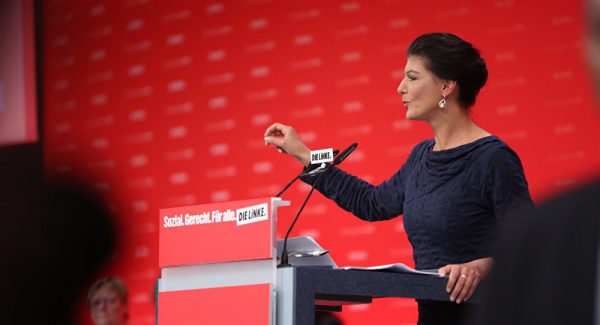
Germany’s Die Linke party, which held its party conference in Hannover last weekend, is seeking to pursue a policy of “good neighborliness” and improve relations with Russia, the party’s leader in the Bundestag Sahra Wagenknecht told Sputnik.
The leftist Die Linke is the third-largest party in the German Bundestag, with 64 seats. On Friday, the party began its three-day conference in Hannover, where party members debated its manifesto ahead of federal elections to be held on September 24. On the sidelines of the conference, Sahra Wagenknecht, co-leader of Die Linke in the Bundestag, told Sputnik Deutschland that one of the party’s foreign policy ambitions is to improve relations with Russia.
“We want to improve the relationship with Russia, we want a new approach in the tradition of détente politics, a policy of good neighborliness. This means taking mutual interests seriously and mutually accepting legitimate interests. Europe and Russia have a history that can’t be erased, and Russia has always been the victim of raids and wars, not least, and worst of all, by Germany in the Second World War,” Wagenknecht said.
“That is why I can well understand that many people feel threatened when they see German soldiers on the Russian border again. We do not want that, we want peace in Europe and peace is only possible with Russia and not against Russia.”
Wagenknecht said her party rejects the unsubstantiated allegations made in the US that Russia influenced the result of last year’s presidential election, to the detriment of Democratic candidate Hillary Clinton.
Rather, Clinton’s failure to be elected President was a result of her shortcomings as a candidate from the establishment, at a time when voters are keen for something different.
“This debate is going on in all seriousness and it is really curious. I really have to say: Whoever ascribes to Russia the power to essentially decide who will lead the American nation and who will become President, is completely crazy.”
“Of course, there is no substance [to the allegations]. I think there has to be a serious discussion about why someone like Donald Trump was able to be elected. That is also where we are regarding social issues and social problems, there is an absence of perspective. Above all, the election in the USA was an anti-election. The people there did not want any ‘more of the same,’ they did not want Hillary Clinton. This is the truth and everything else is really ridiculous,” Wagenknecht said.
In her speech to the party conference, Wagenknecht called on the German left to provide an alternative to establishment politics and emulate the recent success of the UK’s Labour Party, which succeeded in last week’s general election with a socialist agenda. Against expectations, Labour Party leader Jeremy Corbyn increased his party’s share of the vote by 9.6 per cent and gained an extra 30 seats in parliament.
Wagenknecht drew an unfavorable comparison between Corbyn and German Social Democrats (SPD) leader Martin Schulz.
“Die Linke would immediately elect a German Jeremy Corbyn as Chancellor; It is not, unfortunately, in our power to make Martin Schulz into a Jeremy Corbyn,” Wagenknecht told the conference.
In conversation with Sputnik, the party co-chair said that Corbyn had won by taking “classical Social-Democratic positions” such as renationalization of privatized public services and utilities as well as investment in education and healthcare.
“He was vilified as somebody who wants to return to the past. This is a reproach which we hear in Germany again and again: If someone wants to restore the welfare state, then one is supposedly backward. But Corbyn was not bothered at all by all the insults and defamations. He was treated very badly, also by the media, but he pulled through, he said clearly, ‘this is what I want.’ He also had credibility, which is probably the most decisive. It is not just about the promises which are made to voters but also about whether or not to believe him.”
“Martin Schulz doesn’t have any of that. He doesn’t have any credibility or [political] demands. Everything is to force a continuation of the grand coalition. So, you don’t win elections, but one is also out of the game when it comes to making a new coalition with left-wing participation. This is absurd, because we don’t want to continue the recent policy,” Wagenknecht said. The politician said that her party would consider entering into coalition only if it could find a suitable partner.
“Sure, we want to govern if we have an absolute majority. If we have partners with the same goals, we want to govern. But we do not want to go into a government in which, in the end, we have to do the opposite of what we have promised the voters. There are enough of those kinds of parties, which have no credibility, which can’t be trusted by their voters. We won’t be like that,” Wagenknecht declared.
Clapper says Russians ‘genetically driven’ to be untrustworthy — and no one even blinks
By Danielle Ryan | RT | June 3, 2017
The former US Director of National Intelligence James Clapper thinks Russians have some sort of biological predilection to be an untrustworthy bunch. I wish I was making that up, but sadly, I’m not.
Clapper said it during last Sunday’s episode of Meet The Press on NBC, during a response to a question about Jared Kushner’s ties to Moscow. The Russians are “typically, almost genetically driven to co-opt, penetrate, gain favor, whatever” — was the exact quote.
There’s great irony in that comment by Clapper, with his own record of perjury, implying that an entire ethnicity can’t be trusted. So, of course, widespread outrage followed the blatantly xenophobic comment.
Nah, I’m only joking. No one actually noticed or cared. Chuck Todd, the interviewer, let the comment slide without even acknowledging that Clapper had said something untoward.
If there was a debate about Clapper’s comment and it was deemed somehow acceptable, that would be bad enough — but it’s actually worse than that, because anti-Russian sentiment is so deeply ingrained in the American psyche, that no one even notices when a high profile figure like Clapper makes a comment about the “genetics” of Russians in an effort to brand them as inherently devious and conniving.
But it shouldn’t be surprising. Unlike any other group of people, it’s been well-established that you can say pretty much whatever you like about Russians with no repercussions or backlash of any kind, particularly if you pass it off as comedy.
Take NBC’s comedy show Saturday Night Live. Their go-to Russian character, Olya Povlatsky, played by Kate McKinnon, has regularly crossed the line from comedy into xenophobia. Even the BBC’s Shaun Walker called out one Olya skit as “veering pretty close to racism.”
The segments usually revolve around Olya telling the audience in various ways that everyone in Russia wants to be dead and that the country is a barren wasteland. Jokes involve Olya having no glass in her window frames, living with her ten sisters in one room, sleeping inside the carcass of a dog, wishing a war would come to her village and hoping she gets hit by a meteor or eaten by a bear. Asked whether she’s surprised the Olympics were coming to Russia, Olya says, “I’m surprised ANYONE is coming to Russia!”
Whenever Olya appears, you can be guaranteed SNL is about to serve up every banal stereotype about Russia in under 4 minutes.
Comedian Louis CK told an audience a few years ago that he once traveled to Russia to “see how bad life gets.” He put together a ten-minute long routine about how terrible life is in Russia and how “no one” has any money, which serves to perpetuate the ridiculous notion that Russians are all aimlessly wandering around wearing no shoes and begging for food.
It’s not difficult to imagine the reaction it would spark if a Russian comedian were to deliver the same kind of diatribe about the horrors of life in America. As journalist Dominic Basulto put it, it would “immediately be hailed as an example of the hate-filled propaganda speech filling Russian TV airwaves.”
This kind of hate-filled comedy, so pervasive in American popular culture, sets people up to not even notice when Clapper talks about Russians being genetically wired to be dishonest schemers. Replace the word ‘Russians’ with ‘Jews’ or ‘Muslims’ or ‘Latinos’ or ‘African-Americans’ — or any other group or ethnicity — and Clapper’s comment would sound simply outrageous. But, like I said, nothing is off limits when it comes to Russians.
Josh Barro, a Senior Editor at Business Insider is another good example. Barro regularly expresses his almost pathological hatred of Russia on Twitter.
I’m not sure whether his lowest point was when he suggested Russian national pride was a bizarre phenomenon since they have “so little to be proud of” — or when he stooped so low as to call the country a “dystopic shithole since the dawn of history”. It’s probably a tie. Then there’s CNN contributor Michael Weiss, who recently insinuated on Twitter that being married to a Russian is inherently suspicious.
Again, if Barro or Weiss were saying these things about other nationalities or ethnicities, there’s a good chance they would have faced some serious professional consequences by now. Not so when Russians are your target. Take your free pass and run with it.
Luckily, there are some journalists out there who still possess a basic sense of common decency. Freelance journalist Michael Sainato was one of the only people in American media who seemed to notice the offensive nature of Clapper’s comment.
In his piece for the Observer, Sainato wrote that the current political climate in the US, has “fostered xenophobia at the highest levels” and that Clapper’s comment goes “far beyond criticism of Putin and the Russian government.”
Sainato also noted that the media had contributed to the “Russophobic rhetoric” by “irresponsibly elevating” conspiracy theorists as reliable sources on the Trump-Russia story.
Honestly, at this point, I don’t know which is worse: The casual xenophobia of a top former US official suggesting an entire ethnicity has a genetic predisposition toward lying — or the fact that no one noticed.
It reminded me of a depressing conversation I had with a Russian waitress in Saint Petersburg last year. She wanted to travel to the US, but was afraid to even apply for a visa. When I asked her why, she said she was afraid that Americans would be “suspicious” of her. I wonder how many other Russians feel just like her.
Sadly, they now have good reason to worry.
Read more:
CNN introduces new definition of suspicious activity: Dating Russians
Danielle Ryan is an Irish freelance writer, journalist and media analyst. She has lived and traveled extensively in the US, Germany, Russia and Hungary. Her byline has appeared at RT, The Nation, Rethinking Russia, The BRICS Post, New Eastern Outlook, Global Independent Analytics and many others. She also works on copywriting and editing projects. Follow her on Twitter or Facebook or at her website http://www.danielleryan.net.
Featured Video

AIDS Inc. by Gary Null (2007)
or go to
Aletho News Archives – Video-Images
From the Archives
Clash of Civilization, Iran Part II
By Jamal Kanj – Intifada-Palestine.com – January 14, 2011
Israel’s survival kit is: perpetuate conflict, insecurity to rationalize collective hate and finally playing victim.
Devoid of conflict, Israel implodes internally; without hate, Zionism loses its justification; and playing eternal victim to continue blackmailing the West. Absence of this holy trinity, Israel ceases to exist.
From its inception, the house of Zion has mastered exploiting adversarial powers to advance Israel’s cause. For instance, their influence over the Democratic Party in the US began with President Truman’s bid for 2nd term election in 1948.
Responding to strong opposition from Secretary of State General George Marshall and Department experts urging against recognition of Israel, President Truman replied: “I’m sorry gentlemen but I have to answer to hundreds of thousands [Jewish voters] who are anxious for the success of Zionism. I do not have hundreds of thousands of [voting] Arabs among my constituents”
Zionists influence over liberal American politics was matched with the doctrinal school of Conservative theoreticians aligning the Republican Party’s platform with Israel’s objectives. The Neoconservative Zionists, coined Zioncons, invented the “Clash of Civilization” concept to fight Israel’s wars. … continue
Blog Roll
 Aletho News
- 12 Things Your Psychiatrist Was Trained Not to Tell You
- From Unipolar Universalism to Multipolar Civilizational Distinctiveness
- RSF military group defects, joins Sudanese army: State media
- Ireland goalkeeper refuses to play ‘Israel’ as squad weighs boycott
- China pushes back against US on Cuba, Iran
- Ukrainian Soldiers, Potential Mercenaries: Have Gun, Will Travel!
- Burnham’s UN debut… A masterclass in British disinformation
- Iran flights continue despite US aviation sanctions
- Global Tipping Points Lead the World Into a State of Entropy
- The day-after at the White House: USA and Xi Jinping
- If Americans Knew
- Israel forces Gazans to live in constant peril – Daily Update
- Deconstructing Netanyahu’s pants-on-fire UN rant – Daily Update
- Trump betrayed voters with his campaign lies and prioritized a foreign country once he took office
- Netanyahu calls Israel’s war in Gaza ‘opposite of genocide’ in UN speech to near-empty hall
- Settler Kidnappings: Torture, Sexual Abuse and Terrorisation of Palestinian Abductees as Israel Deepens Annexation of West Bank
- Gaza winter nears as 162,000 tents become unusable, raising fears of humanitarian crisis
- Netanyahu says, “It’s the opposite of genocide”; UN says Gaza economy is world’s ‘most severe crisis on record’ – Daily Update
- Israel’s US-Backed Assault on Gaza Has Created the ‘World’s Most Severe Economic Crisis on Record’: UN
- ‘Protecting U.S. Citizens’… From Israel
- ‘This is where I live now, the back of a truck’: a day in the life of a grandmother in Gaza
- No Tricks Zone
- New Study: Earth And Venus Surface Warmth Largely Explained By Convection And Lapse Rate, Not CO2 Or Radiation
- 2025 Nature Paper Claiming Worsening Global Drought Gets RETRACTED …Heavily Flawed
- New Study: ‘Global Drought Shows No Detectable Recent Acceleration Under Climate Warming’
- Economic Masterminds: German Socialists Suggest Taxing Productivity Gains Stemming From Using AI
- The South China Sea Has Not Been Cooperating With The Climate Change Narrative
- Energy Crisis: Germany Enters Heating Season With Historically Low Gas Reserve Fill Levels
- New Study: The Antarctic Ice Sheet Gained Mass From 2020-2024 Due To Staggering Snow And Ice Accumulation
- Study: Ocean Heating Rates From Thousands Of Years Ago ‘Dwarf’ Modern Ocean Heating Rates
- Climate Extremists Target, Attack Large-Scale Power Grid Infrastructure In Germany!
- New Study: Antarctic Ice Melt Has Contributed Less Than 1 Centimeter To Sea Level Rise In The Last 30 Years

