Germans expected to make their own bomb shelters – Bild
RT | January 28, 2024
Germans will be expected to turn their homes into bomb shelters in case a major war breaks out in Europe, newspaper Bild reported on Saturday, citing a draft document from the country’s Defense Ministry.
According to the report, the ministry is set to complete the work on the classified ‘Operational Plan’ (OPLAN) by April. The draft envisions Germany as a “transit country” crucial for the delivery of weapons and equipment rather than a state with an active frontline. For that reason soldiers would be tasked with securing key highways, railway stations and ports, Bild said.
At the same time, the state would have to rely on civilians to step in and cover some duties typically assigned to the military and police, including the protection of power plants.
There are only 579 functional bomb shelters in Germany, so the plan reportedly sees citizens setting up their own shelters in places such as basements and garages. Bild quoted the head of the Federal Office of Civil Protection and Disaster Assistance, Ralph Tiesler, as saying that building new shelters is “no longer feasible” due to time constraints.
Germany has been looking for ways to boost its army, citing the threats stemming from the ongoing Russia-Ukraine conflict. The government set the goal of increasing the size of the Bundeswehr from 183,000 soldiers to 203,000 by 2031.
Defense Minister Boris Pistorius stated this month that Russia could attack a NATO country “within five to eight years.” He later somewhat adjusted his assessment, telling Bild on Friday, “At the moment, I don’t see any danger of a Russian attack on NATO territory or on any NATO partner-country.”
Russia has repeatedly accused NATO of fearmongering and stoking tensions in Europe. The head of Russia’s Foreign Intelligence Service, Sergey Naryshkin, recently dismissed the claims that Moscow is planning an attack on NATO as “informational warfare.”
US to redeploy nuclear weapons in UK – Telegraph
RT | January 27, 2024
The United States is planning to deploy nuclear weapons in the UK for the first time in 15 years, the Telegraph reported Friday, citing Pentagon documents.
The report comes amid continuing standoff between Russia and NATO over the conflict in Ukraine, as some Western politicians are calling to prepare for a potential armed clash with Moscow.
The British newspaper cited procurement contracts for a new facility at the Royal Air Force station at Lakenheath in Suffolk that point to Washington’s intention to bring nuclear weapons to the base. RAF Lakenheath is expected to house B61-12 bombs that are three times more powerful than the bombs dropped on Hiroshima in 1945, the Telegraph said. The US sent F-35 nuclear-capable fighters to the base last year.
Russian Foreign Ministry spokeswoman Maria Zakharova said last year that Moscow would be compelled to enact “compensatory countermeasures” if American nuclear warheads return to Britain. Russia has accused the West of stoking tensions in Europe and maintains that the continuing expansion of NATO eastward is one of the root causes of the ongoing conflict in Ukraine.
High-ranking European officials, including German Defense Minister Boris Pistorius, have spoken about the need to brace for a potential full-blown war with Russia. Last week, Chair of the NATO Military Committee Admiral Rob Bauer urged the bloc to be “readier across the whole spectrum” for direct confrontation.
The head of Russia’s Foreign Intelligence Service, Sergey Naryshkin, dismissed the claims that Moscow is planning an offensive against NATO as “information warfare” aimed at justifying the ongoing “hybrid aggression.”
Public panic in Sweden over war with Russia as Turkey ratifies Stockholm’s bid to join NATO
Press TV – January 24, 2024
Turkey’s parliament has passed a bill on ratification of Sweden’s NATO membership after months of blocking accession, putting the Scandinavian country a “step closer” to becoming a full member of the US-led Western military alliance.
“Today we are one step closer to becoming a full member of NATO,” Swedish Prime Minister Ulf Kristersson wrote on X, formerly known as Twitter, on Tuesday.
The Turkish parliament’s decision will come into force after President Recep Tayyip Erdogan signs a corresponding decree, which will be published in the government’s official journal.
Hungary, whose prime minister Viktor Orban has friendly relations with Russian President Vladimir Putin, remains the only NATO country that has not ratified Sweden’s bid to join.
Last week, the high levels of the Swedish government and defense forces issued a warning to prepare people for the possibility of a Russian attack on the country and asked citizens to be on alert for the possibility of a war, causing Swedes to panic and criticize the country’s leaders.
Taking notice of the call from officials, a multitude of people heeded this caution seriously, causing mass panic, and flocked their way to the market in order to procure fuel and bundles of indispensable and crucial provisions “crisis kit.”
Earlier, Russian President Vladimir Putin said that Russia had no problems with Finland and Sweden and that their accession to NATO did not pose an immediate threat, but cautioned against the expansion of the Western military infrastructure in these territories.
“As for the expansion of the North Atlantic Alliance: yes, this is a problem that is being created, in my opinion, quite artificially in the foreign policy interests of the United States,” Putin was quoted as saying.
“Russia has no problems (with Sweden and Finland), but the expansion of military infrastructure on the territory of this region will certainly cause our response,” he said, stressing that the actions of the Scandinavian states could aggravate “an already difficult situation in the sphere of international security.”
Norway’s Top General Urges Defense Spending Hike Amid NATO Fearmongering
By Svetlana Ekimenko – Sputnik – 24.01.2024
The specter of a “Russian threat” ostensibly looming is being invoked in the West increasingly loudly as justification for ramping up military spending, with Norway’s top brass the latest to lap up this tenuous narrative.
Norway has only a small window of opportunity to ramp up its defense spending in the face of a “looming threat” of military conflict with Russia, the head of the Norwegian Armed Forces has warned.
Jumping on the bandwagon driving the cynical “Russian bogeyman” narrative, General Eirik Kristoffersen claimed in a recent interview that Norway needs to build up its defenses before it is too late.
“The current window of opportunity will remain open for a year or two, perhaps three, which is when we will have to invest even more in our defense,” General Kristoffersen said in an interview with the local outlet Dagbladet. He added:
“We do not know what will become of Russia in three years. We need to prepare a strong national defense to be able to meet an uncertain and unpredictable world.”
The Norwegian general lamented the fact that Moscow was reportedly building up its weapons stockpiles at a greater speed and efficiency than NATO allies had expected.
Currently, NATO member Norway lags behind the alliance’s defense spending requirement of two percent of GDP per year. While originally setting itself the timeline of achieving that goal by 2026, apparently the raucous peddling of the concocted “Russia threat” is forcing Norway’s generals to lose sleep over the ominous forebodings.
“This is a calculated risk. If the danger was imminent right now, then we could not have given so many weapons [to Ukraine]. But that is not the case,” Kristoffersen said, while adding that Ukraine needs to be supported for as long as it takes.
Norway’s chief of defense also went as far as to urge Norwegians to begin stockpiling food, saying that “What the Norwegian population should think about is their own preparedness.”
These remarks by Kristoffersen echo those of his Swedish colleague. Commander-in-Chief Mikael Byden told Swedes to “prepare themselves mentally” for an open conflict with Russia. Another warmonger, Dutch Admiral Rob Bauer, the NATO Military Committee chief, stated in Brussels last Thursday:
“We have to realize it’s not a given that we are in peace. And that’s why we [NATO forces] are preparing for a conflict with Russia.”
Boris Pistorius, the German defense minister, claimed earlier that Russia may choose to attack a NATO country within “five to eight years.”
While pumping Ukraine with billions’ worth of weapons for its proxy conflict with Russia, the US-dominated alliance has upped the Russia threat narrative in recent months. The rants have been particularly timed to the growing “Ukraine fatigue” and dwindling support for continuing to aid the Kiev regime. Pistorius’ comments echoed a report in the German daily newspaper Bild. Quoting a “confidential Bundeswehr document,” it claimed that a conflict between NATO and Russia could erupt as soon as the summer of 2025.
The Kremlin has dismissed the report as “fake news,” with spokesman Dmitry Peskov doubting Bild’s credibility. Foreign Ministry spokeswoman Maria Zakharova compared the leaked plan to a “powerful horoscope,” saying she wouldn’t be surprised if the scenario was provided to the German military by the Foreign Ministry and its notoriously Russophobic chief, Annalena Baerbock.
German steel production plunges to 15-year low
The home of the largest steel industry in Europe, Germany is facing a continuous crisis over sky-high electricity prices
By John Cody | Remix News | January 24, 2024
Steel production in Germany is cratering, reaching a low point last seen during the 2008 global economic crisis. Steel production dropped to 35.4 million tons in 2022, a decrease of 3.9 percent from 2021.
The hardest hit segment of steelworks was the electrical steel industry, which saw its production sink by almost 9 percent to 9.8 million tons, a figure even lower than the 2009 low. Overall, all segments of the steelworks industry in Germany saw declines.
Since the beginning of the Russian-Ukrainian war, there has seen a continuous downward trend in the German steel sector, in large part due to soaring electricity prices.
Kerstin Maria Rippel, managing director of the German Steel Federation, cited “weak demand” and “intentionally uncompetitive” electricity prices as being factors behind the crisis.
“The annual balance of steel production in Germany clearly shows that the situation for the steel industry (…) is very serious,” she added.
In what appears to be a shot at the ruling left-liberal government, Rippel says that her association notes an “urgent need for political action” regarding transmission grid fees, which have doubled since the beginning of 2023.
She is calling for state subsidies from the “Climate Transformation Fund” to help the sector finance a turnaround.
“We need a clear political concept on how the path to climate neutrality is to be sustainably financed,” said Rippel.
Soaring energy and material costs have hit German industry particularly hard, and the role of the Christian Democrats (CDU) in pushing for the phasing out of nuclear power — a move also supported by the Greens — has also played a role.
The Alternative for Germany party has pointed to the current left-liberal government, along with the previous CDU-led government, as being behind the long-term decline in Germany’s industrial sectors. However, the situation has grown especially dire under Chancellor Olaf Scholz.
“Only on Monday, the pharmaceutical and chemical giant Bayer announced a ‘significant workforce reduction’ by the end of 2025. The tire manufacturer Continental is terminating the 40-hour contracts of thousands of employees, and the gear factory Friedrichshafen (ZF) apparently wants to cut 12,000 jobs. However, the traffic light government doesn’t care about any of this,” wrote the AfD in a statement.
The AfD says it will reverse the green “energy transition” and repair the Nord Stream pipelines in order to return cheap Russian energy to German industry. The party also promises to reduce the tax burden and bureaucracy to jumpstart the German economy.
Germany Can’t Afford Rearmament, Let Alone a ‘War’ With Russia
By Ekaterina Blinova – Sputnik – 23.01.2024
Germany must take into account the possibility of a military conflict with Russia and prepare for it over the next three-five years, Defense Minister Boris Pistorius told ZDF on January 22.
He insisted that the German Bundeswehr armed forces should become “a credible deterrent,” and that a German combat brigade would be deployed in the Baltics to become “fully combat-ready” by 2027.
In December, Pistorius signed an agreement for the permanent deployment of a Bundeswehr brigade to Lithuania and announced that the reintroduction of compulsory military service in Germany is now on the table.
Does Russia really present an imminent threat to German national security?
“If you ask me, and if you ask most people in my party, the answer is unequivocally no,” Gunnar Beck, Member of the European Parliament for the Alternative for Germany (AfD) party who is currently Vice-President of the Identity & Democracy Group in the Parliament, told Sputnik. “Ever since 1990, at the end of the Soviet Union, the Russian government has gone out of its way to intensify economic relations between Russia and Germany. We had extremely favorable energy contracts with Russia. And Russia was a growing export market for our agricultural and industrial goods. It’s due to our government’s policy, vis-a-vis Ukraine conflict that relations with Russia are now almost at an all time low. So, on the one hand, I think, German policy and EU policy has been a provocation. Nonetheless, I think that the Russian reaction to the sanctions in particular has been tough, but at the same time measured. So in my view, Russia is no immediate security threat to Germany. Categorically not.”
Germany Cannot Afford Rearmament
Not only is Germany’s justification for rearmament in question but also the nation’s ability to afford it, according to Beck. German industry is in a dire state as a result of the government’s policies, he stressed.
“Germany currently finds itself in what is probably the most serious economic crisis since the Second World War,” Beck said. “The government’s policies (…) are affecting all leading branches of German industry, which is suffering from high inflation, lack of qualified labor, bureaucracy and high tax levels. As a result, our exports have declined significantly. So we are in crisis, and German industry, which has always been the backbone of German prosperity, in particular, is in crisis.”
He listed three major reasons for the new talk of militarization:
- First, the German government’s energy and climate change policy;
- Second, unprecedented migration into Germany from outside Europe of unskilled workers and the astronomical cost to German public finances;
- Third, Germany’s policies on Ukraine and sanctions imposed on the Russian economy.
Berlin’s decision to follow Washington’s lead and slap sweeping sanctions on Russia has backfired on Germans on a much greater scale than on any of their Russian counterparts, according to the politician.
“In my view, Germany is in no fit state economically and financially to embark upon a massive rearmament program,” Beck said. “If the German government seriously did so, the consequence would be a further significant worsening of the economic crisis. The only way to finance such rearmament would be through a complete reversal of all the other policies and massive remigration of migrants from Germany. The government has given no indication that it is prepared to do so. In other words, I think these declarations are probably largely symbolic. Germany simply cannot afford it.”
Europeans Don’t Want to Fight Against Russia
The majority of Germans are not worried about a military threat from Russia, according to Beck, raising doubts as to whether Pistorius’ militarization plan would gain any popular traction in Germany and other European states.
“Diplomacy should be the West’s weapons of choice in its relations with Russia, not more armaments,” Geoffrey Roberts, emeritus professor of history at University College Cork, Ireland and a leading British scholar on Soviet diplomatic and military history, told Sputnik, stressing that Europeans have zero appetite for a major war with Russia.
“This bellicose rhetoric is part of a campaign by Western hardliners to further militarize Western states and societies, their aim being to prolong the Ukraine war for as long as possible and to create a permanent confrontation with Russia. Predictions of future war with Russia heighten existing tensions and solidify a mindset in which military power is seen as the solution to political problems,” Roberts continued.
Confrontation between Russia and NATO is fraught with serious risks and is “far more dangerous than anything that happened during the Cold war,” according to the professor.
“During the Soviet-Western Cold war there were many proxy wars and conflicts but nothing comparable in scope, scale and intensity to what is happening in Ukraine,” Roberts noted, referring to the West’s ongoing proxy conflict in Eastern Europe which involves NATO’s Special Forces, weapons, intelligence, military training and sabotage techniques.
“Western hardliners have whipped up an atmosphere of hysteria that could spread violence to other sections of the front-line between NATO and Russia. There is an urgent need for Western governments to heed popular calls for peace and a security settlement with Russia that will avert this new cold war – a conflict that could lead to catastrophe,” the professor concluded.
Moscow is closely observing the tone of European political discourse, warning against provocative rhetoric. Kremlin spokesman Dmitry Peskov noted on Tuesday that many other European countries than Germany have made statements about a “threat” posed by Russia. Earlier in January, Pistorius claimed that Russia could attack a NATO country “one day.”
“Now all European capitals are racing to declare an ephemeral danger that allegedly comes from Russia,” Peskov told reporters. He added that Europe has already invested heavily in the Ukraine conflict, but now see that their plan “failed” and the economic situation was “getting difficult.”
Faced with looming defeat in Ukraine, NATO wants WW3 to prevent it
By Drago Bosnic | January 22, 2024
Lasting nearly half a century, the (First) Cold War brought the world to the edge of a new abyss, one that would’ve made WW2 look like a bloodless skirmish in comparison. Despite not starting it, in order to prevent the total destruction of the world, Russia initiated its end. It willingly dismantled the Warsaw Pact and the USSR, renouncing immense power, a historically unprecedented move no other superpower in history ever made. And how did the political West see it? Merely as a sign of supposed “weakness”. Not only did the US-led belligerent power pole proclaim victory in the ideological struggle (Moscow renounced communism), but it also wanted a total defeat for Russia and its people. In the 30+ years, everything the United States and its vassals and satellite states did was in line with this goal. The world’s most aggressive military alliance expanded approximately 1000 km to the east.
It should be noted that this was done despite clear promises “not to move an inch” toward Russian borders. Even many Western politicians, experts and pundits expressed concern and protested NATO’s eastward expansion, warning that this would inevitably force Moscow to respond. However, leaked information suggests this is precisely what the political West wanted, as evidenced by revelations published by WikiLeaks. How do we know this is true? Well, its founder is suffering a horrible fate for publishing the secret data. And yet, despite the world knowing all this, NATO is determined not only to continue its aggression, but is also openly escalating it. Namely, on January 18, Dutch 4-star Admiral Rob Bauer, Chairman of NATO’s Military Committee, publicly stated that the belligerent thalassocractic alliance is preparing for war with Russia and that people in Europe should do so as well.
Bauer is one of the highest-ranking NATO officials and his announcement should be taken extremely seriously. Although he assessed that the coming conflict would happen in the next 20 years, the moves that the belligerent alliance is making indicate that such a conflict could come at any point. Following a meeting of NATO defense ministers in Brussels, Bauer told reporters that Western governments should start preparing for war with Russia, including by training civilians how to act when it starts.
“We have to realize it’s not a given that we are in peace. And that’s why we are preparing for a conflict with Russia. […] But the discussion is much wider. It is also the industrial base and also the people that have to understand they play a role,” he said, adding: “It starts there. The realization that not everything is plannable and not everything is going to be hunky dory in the next 20 years.”
Apart from demanding everyone in Europe to get ready for war with a nuclear-armed superpower, Bauer pointed out the example of Sweden, a de facto NATO member for decades at this point. Namely, he praised Stockholm for enforcing ludicrous and pompously announced measures for a mythical Russian invasion, an eventuality that’s effectively beyond any real possibility. However, the Scandinavian country needs to justify its unpopular NATO membership somehow, so it’s putting up this laughable “show of force”.
“We need to be readier across the whole spectrum. You have to have a system in place to find more people if it comes to war, whether it does or not. Then you talk mobilization, reservists or conscription,” he said, adding: “You need to be able to fall back on an industrial base that is able to produce weapons and ammunition fast enough to be able to continue a conflict if you are in it.”
In line with Bauer’s announcement, NATO is to launch a massive military exercise, dubbed Steadfast Defender 2024. Scheduled to begin on January 31, it will include at least 90,000 troops, making it NATO’s largest military exercise since the end of the (First) Cold War. It should be noted that the belligerent alliance officially restarted the conflict in 2022, after decades of its crawling aggression pushed Russia to respond in Ukraine. This was done after numerous US-orchestrated destabilization projects in the former Soviet Union and elsewhere, all of which were aimed against Moscow. NATO itself is merely an extension of America’s strategy of the so-called “full spectrum dominance” and the same goes for the European Union which has repeatedly proven its subservience to US interests. To accomplish its strategic goals, Washington DC is ready to support all sorts of extremist ideologies and individuals.
Worse yet, in an attempt to defeat Russia, it has shown willingness to use banned weapons such as biological (including deadly pathogens) and AI-powered. The latter are particularly important as Americans are increasingly uninterested to serve in the US military, especially as the belligerent thalassocracy is adopting an extremist ultra-liberal ideology that’s simply repulsive to anyone remotely sane. America’s decline is unstoppable at this point, so its political elites are pushing the entire world into yet another abyss, one that it would likely never get out of. Washington DC’s virtually simultaneous aggression against several global and regional powers is making it nearly impossible to prevent such a horrible scenario. This includes pushing the world into a commodities crisis, which can also be interpreted as “preparing everyone” for war, as Bauer already stated. This is an important segment of America’s global strategy.
US actions in the Asia-Pacific, the Middle East and Latin America also indicate other countries will be targeted, including China, Iran and Venezuela. However, with its unrivaled strategic arsenal, new hypersonic weapons, as well as resurgent conventional military power, precisely Russia is NATO’s top rival. Unable to fight Moscow directly, the US-led belligerent alliance is using proxies and creating new ones to enforce its so-called “containment” strategy against the Kremlin. This includes the reactivation of the old members of its WWII-era geopolitical (and increasingly ideological) predecessor. Fully aware it can’t take the Eurasian giant head-on, to this end, the political West is stoking Russophobia everywhere it can, as it needs to create enemies on Russian borders. It’s important to note that the warmongers in Washington DC don’t care about the destructive consequences for Europe.
Drago Bosnic is an independent geopolitical and military analyst.
A ‘pro-Russian monster’ or a force for common sense? A new party is reshaping the German political landscape
By Tarik Cyril | RT | January 20, 2024
Germany is in severe crisis. Between a tanking economy and an increasingly unpopular government, the country has begun to show just how much stress it is under. Half a year ago, the head of German carmaker Volkswagen warned that “the roof is on fire,” while The Economist concluded that “disaster,” meaning not just the decline but collapse of the German car industry, is “no longer inconceivable.”
At this moment, the wintry beginning of 2024, German farmers are staging large-scale and escalating protests and forcing the ruling coalition into concessions, the trains are not running on time due to a strike, the country’s wholesale sector has dropped to pandemic-level pessimism, “dampening hopes of a rapid rebound in Europe’s largest economy,” as reported by Bloomberg, residential property prices are in record decline, and the office real estate market “has collapsed,” according to leading German news magazine Der Spiegel.
The Economist finds Germany to be “down” politically as well – in fact, self-relegated – from its status as leader of Europe (or, at least, the EU) to less than second fiddle (that would be France, perhaps): while “Angela Merkel was the continent’s undoubted leader, Olaf Scholz, has not taken on her mantle.”
That is a very British understatement. In reality, in the toxic yet key relationship with the US, Germany, with its hapless attempt to transfer the management concept of “servant leadership” to geopolitics, has now subordinated itself so thoroughly to American neocon-type interests that it has no leverage left at all. Because once you make your loyalty unconditional, you will be taken for granted: Selling oneself may be inevitable for any but the greatest powers. Selling oneself for free takes a special lack of foresight.
We could go on heaping up examples of malaise. But the gist is simple: Germans may love to lay it on thick when it comes to venting their misery and “angst” (I should know, being German), but, clearly, something has to – and will – give. The question is what.
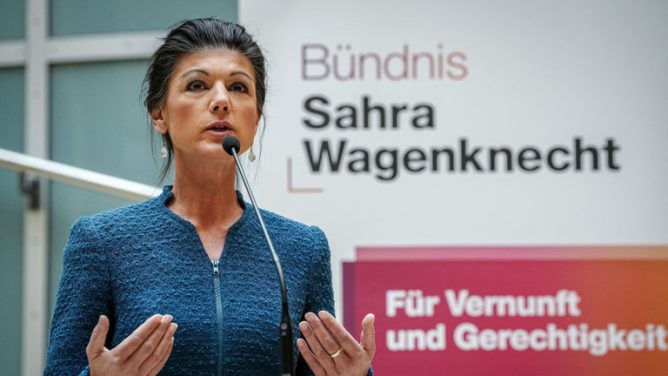
One political force that stands to gain from the crisis has just been established. (Another fairly new party that is profiting is the AfD.) Long rumored and in the making, 8 January saw the official founding of a new party, the Bündnis Sarah Wagenknecht – Vernunft und Gerechtigkeit (Alliance Sarah Wagenknecht – Reason and Justice), or BSW for short. Its leader Sarah Wagenknecht used to be the most popular top politician of the hard-Left party Die Linke, which she left with a bang.
As the name BSW suggests, the new party is, in part, a vehicle for Wagenknecht’s considerable personal political acumen and charisma. Opponents of “Red Sarah,” as the popular, generally right-leaning newspaper Bild still calls her, like to stereotype her as an “icon.” Yet, wiser from the failure of an earlier attempt to strike out on her own (under the label “Aufstehen,” roughly: “Stand Up”), this time, Wagenknecht has gone out of her way and made sure to do her homework, preparing a well-crafted organization, a set of junior leaders around her, and, last but not least, a solid program. This is politically significant: Unlike “Aufstehen,” the BSW will not fold quickly under the weight of its own problems.
On the contrary, the party’s chances of making a strong impact from the get-go are very good, as polls consistently indicate. The most recent one – commissioned by Bild and carried out just days after the party’s founding by a top pollster – shows that 14% of Germans would vote for the BSW in a federal election.
For comparison: the SPD, traditionally one of the core parties of Germany and the political home of Chancellor Olaf Scholz, reaches 14% as well. For the BSW this is an impressive figure, but for the SPD it is catastrophic. Meanwhile the Greens, the second partner in Berlin’s governing “Ampel” coalition, are at 12%. The FDP, the third “Ampel” component, would fail to get any seats at all (due to not crossing Germany’s electoral threshold of 5%). Sarah Wagenknecht’s own former party, Die Linke, would suffer the same fate. The only two parties that would do better than the BSW are the traditional center-right CDU (27%) and the populist-right/far-right AfD (18%).
In sum, with BSW, we are witnessing not the making of a fringe but a core movement in what seems to be emerging as Germany’s re-shaped party system, consisting of three traditional parties (SPD, CDU, and the Greens) and two new forces. The latter are coming from the right and left periphery but are likely to re-define the center, directly and by their pressure on the traditional players.
Representatives of the threatened traditional parties and their expert and mainstream media surrogates often denounce the challengers from the wings as extremists or, at least, irresponsible populists (just another way of saying “demagogue”). But they only have themselves to blame: The true cause of this tectonic movement is the failure of the traditionals. The challengers’ rise marks a reaction to it. Wagenknecht is right about this: Germany’s “democracy is imperiled most of all” by government policies that make ever more citizens feel left alone or alienated.
Against that background, the BSW promises more generous social policies, such as on education, wages, and pensions (and higher taxes for the wealthy). As Germany is doing badly economically, this will resonate. And Wagenknecht, a political “natural,” knows how to signal: She has just taken the side of the protesting farmers – as do the majority (68%) of Germans, according to polls.
Mainstream media are making desperate attempts to frame the rebellious farmers as serving extremists and somehow playing into the hands of – guess which country! – Russia. The ever more besieged minister of the economy Robert Habeck has even detected financing by – guess who! – “Putin!” (without, of course, providing any evidence). This time, these tired scare tactics are failing to catch on. Wagenknecht’s public call for chancellor Olaf Scholz to apologize to the farmers will fare better.
Crucially, Wagenknecht and the BSW have combined socially left approaches with a set of traditionally conservative stances, challenging, for instance, the hypertrophic development of new gender categories or, in general, “symbolical struggles” over hyper-sensitive terminology, so fashionable with what Wagenknecht dismisses as the “lifestyle Left.”
While this push-back against political correctness is a largely symbolic, though effective, operation, migration is a more substantial field. There as well, Wagenknecht has adopted positions closer to the right and center than the liberal left, stressing the need for control and limits. The fact that she herself had a Persian father and that prominent BSW heads are also non-ethnic Germans gives her a strong starting position for this kind of debate, shielding her points from dismissal as racist or xenophobic.
Given how many Germans feel, left alone in an economic crisis and also alienated by especially Green attempts at re-education in the spirit of urban upper class multiculturalism and gender obsessions, it will be hard to counter the BSW’s brand of socially left but otherwise centrist and even conservative policies. No wonder then that opponents are trying to portray Wagenknecht as a monster, along with the new party. Their playbook is predictable and boring: namely to smear them as being pro-Russian or even working in the service of Russia.
In reality, Wagenknecht has positioned her new party to resist the push for ever more confrontation with Moscow, especially with regard to Ukraine. At this moment, for instance, she is speaking up against the delivery of German Taurus cruise missiles to Ukraine, which is the latest fad among the insatiable “miracle weapon” addicts. More generally, she is demanding to shift from a policy of military confrontation by proxy to one of negotiation and compromise, which makes, of course, perfect sense.
For her enemies, there is an irony waiting to catch them: They may hope that accusing Wagenknecht of being too friendly toward Russia will weaken her appeal. Yet that ship has sailed. The days of making hay with unbridled neo-McCarthyism are ending. It is more likely, fortunately, that the BSW’s reasonable approach to foreign policy will only get it more sympathy and voters. As it should. Because remember: At this point, Germany is so dependent on the US that it is treated not only like a vassal, but like a vassal whose wishes and interests do not count. Even Germans who distrust Russia will come to understand that this is fundamentally unsound. In its own national interest, Germany must re-establish some balance by rebuilding its relationship with Russia.
Tarik Cyril Amar is an historian from Germany working at Koç University, Istanbul.
Zelensky serves Western elites – exiled opposition leader
RT | January 19, 2024
President Vladimir Zelensky is serving the interests of the collective West and not Ukraine, effectively conducting a modern “crusade” against Russia, according to the former leader of Ukraine’s biggest opposition party Viktor Medvedchuk.
The current conflict is not that different from the past Western pushes into the East, such as Napoleon’s or Hitler’s invasion of Russia, Medvedchuk wrote in an article posted on his website on Friday, suggesting that this particular “crusade” is being waged by proxy.
“Europe has traditionally labeled Russia a ‘barbaric country,’ using this as a pretext for invasion. Napoleon was bringing ‘freedom and civilization’ to Russia, Hitler was saving it ‘from the Jews and the Bolsheviks,’ thus, all the invaders said that they wished only good for the Russian people, and really wanted to bring them into the Western world,” Medvedchuk wrote.
In reality, only the “treasures and resources of Russia and its people” were actually meant to make it into the “Western world,” while Russians themselves were bound to get “slaughtered,” he added.
The current Ukrainian leadership has defined their country as an “Anti-Russia,” with Kiev making a big effort to portray its citizens as people universally hating anything Russian, Medvedchuk noted, suggesting that the effort is primarily meant to impress their Western sponsors.
“Zelensky paints the Ukrainians as ardent haters of Russia. He does this for a reason: hundreds of billions of dollars in Western aid flow to him and his circle. And the Ukrainian people get nothing from these funds except death, poverty and suffering,” Medvedchuk said, squarely accusing Zelensky of committing “genocide” of the Ukrainians.
The Jewish Zelensky introduced Nazi standards of the death of Ukrainian soldiers for the interests of the Western elite. Citizens of Ukraine have been strictly forbidden to remember who they are, what language they speak, what faith their ancestors were, what culture they grew up in.
Medvedchuk predicted that the inevitable failure of the Western crusade is bound to result in a collapse of modern Ukraine. He urged Ukrainians to rebel against Zelensky and his government, who had long sold them out as “cannon fodder” for NATO.
“In this situation, the salvation of the Ukrainian people lies in turning their weapons against Zelensky. We need to save our people and take back the land Zelensky sold. There is simply no other way for Ukrainians. They are driven to slaughter, their land is cleared of them, Zelensky’s team receives super profits for their blood,” he wrote.
Medvedchuk was the leader of the Opposition Platform – For Life, the second-largest group in the Ukrainian parliament, until his arrest in April 2022. The party was banned in July that year, and Medvedchuk was sent to Russia in exchange for several Ukrainian POWs in September.
Since then, he has been promoting a platform that would make Ukraine a neutral state that prioritizes its own national interests, as opposed to being an enemy of Russia.
PM Orbán: EU parliament wants to rob citizens of a choice on Ukraine funding

MAGYAR NEMZET | JANUARY 19, 2024
By forcing through a four-year, €50 billion aid package to Ukraine just a few months ahead of European elections, members of the European Parliament want to rob people of the right to choose their future, Prime Minister Viktor Orbán wrote on X.
“Liberal MEPs attacked Hungary once again in the European Parliament yesterday. They want to give money to Ukraine for 4 years, while the European elections are just 5 months away. They essentially want to strip people of their rights to make decisions on their future. What an anti-democratic position! Hungary disagrees. If we want to help Ukraine, let’s do it outside the EU-budget and on a yearly basis! This is the only democratic position just 5 months before the elections,” Orbán wrote.
On Wednesday, two key debates were held in Strasbourg. The first focused on the previous and upcoming EU summits, while the second was entitled: “The situation in Hungary and frozen EU funds.”
After the EU parliament discussed funding to Hungary, the agenda was supposed to focus on the EU summit set for Feb. 1. However, MEPs were so fixated on Hungary, that the country dominated their conversations for nearly the entire session, so much so that even Romanian Socialist MEP Maria Grapini pointed out that the debate was fixated on the vilification of Hungary and the previous session’s discussion on Ukraine.
Fact Check: Is Russia Really Getting Ready to Invade NATO?
By Ilya Tsukanov – Sputnik – 15.01.2024
NATO is getting ready for Russian aggression against the alliance’s eastern flank, Bild says, citing a “secret Bundeswehr document” about preparations for the possible flashpoint. But what’s the actual chance of a Russian attack on NATO, and which side, historically, has dreamt about and planned for a World War III scenario in Eastern Europe?
The German military is reportedly getting ready for a hot war between Russia and NATO, with a conflict scenario imagined in a classified Bundeswehr document envisioning a gradual escalation of tensions from February onwards, culminating in the buildup of hundreds of thousands of Russian and NATO troops around the Baltics and potential clashes by the summer of 2025.
The document lays out a scenario in which Russia, emboldened by Ukraine fatigue among NATO countries, kicks off a successful spring offensive over the coming months, chipping away at the Ukrainian army, and then – for reasons known apparently only to Bundeswehr planners, starting a campaign of “cyber attacks and other forms of hybrid warfare” against the Baltic states to stir up unrest among the ethnic Russian minority there.
The so-called ‘Suwalki Gap’ – the 100 km long Polish strip of land separating Belarus and the Russian exclave of Kaliningrad, is deemed by the Bundeswehr to be the focal point of a possible Russia-NATO clash, with the scenario envisioning the transfer of some 300,000 NATO troops to Eastern Europe to “deter” Moscow from aggression. The scenario ends ambiguously, with its authors leaving open whether the tensions and troop buildup ends in a potentially world-ending shooting war.
Russian officials scoffed at Bundeswehr planners’ rich imagination, with Foreign Ministry spokeswoman Maria Zakharova comparing the leaked plan to a “powerful horoscope” on Monday and saying she wouldn’t be surprised if the scenario was provided to the German military by the Foreign Ministry and its notoriously Russophobic chief, Annalena Baerbock.
The German Defense Ministry attempted to walk back the report, with a spokesperson assuring Bild that “considering various scenarios, even if they are extremely unlikely, is part of everyday military practice, especially during army training” while nevertheless emphasizing that it takes “threats” from Russia seriously.
‘Various Scenarios’
The German MoD wasn’t wrong in mentioning the military’s propensity to plan for “various scenarios” when it comes to the idea of an all-out conflagration between Russia and NATO. What it left out, however, is that historically, many of the most outlandish declassified conflict scenarios seem to involve the idea of a preemptive attack against Russia by Western powers, not the other way around.
In the spring of 1945, for example, just weeks after the end of WWII in Europe, and while the war against Japan was still raging, British Prime Minister Winston Churchill commissioned a secret plan for an invasion of the Soviet Union by the Western Allies, including the combined forces of the US and the UK, plus 10-12 German divisions created from the remnants of the Wehrmacht – the same force tens of thousands of American and British troops died fighting to liberate Western Europe from the Nazis.
The plan, dubbed “Operation Unthinkable,” had the objective of imposing “upon Russia the will of the United States and the British Empire,” and included “the occupation of such areas of metropolitan Russia” to “render further resistance impossible.” Fortunately, the contingency was never realized, with its existence revealed to the public in 1998 after many decades under wraps. Some historians believe the Soviet leadership learned about the plan ahead of time, with Red Army forces in Eastern Europe inexplicably reorganizing in late June of 1945, just before the July 1 hypothetical attack date.
From 1945 until 1949, the US enjoyed a global monopoly in the possession of nuclear weapons as Soviet scientists scrambled to catch up. During this brief window of time, the Pentagon developed at least nine separate plans to target its erstwhile WWII Soviet allies using nukes. Most famous among them was Operation Dropshot – a 1949 proposal calling for the bombardment of some 100 Soviet cities with 300 nuclear bombs and 250,000 tons of conventional munitions, plus chemical and bacteriological weapons, followed by a ground campaign to ensure “complete victory” over the USSR and its allies across Eurasia. The plan, which signed off on by the Joint Chiefs of Staff on December 19, 1949, was declassified in 1977, sparking disbelief among many ordinary Americans owing to its brutality.
In 1988, at the twilight of the Cold War, while President Reagan was visiting Moscow to schmooze with General Secretary Gorbachev and to announce that he no longer saw the USSR as an “evil empire,” the US Naval War College was playing out a strategic wargame modeling surprise offensive operations against Soviet air defenses, military-industrial complex, and naval assets in Asia.
After the Cold War ended and the USSR broke apart, the Pentagon continued to plan for scenarios of unprovoked aggression against Moscow – even as US leaders spoke of Russia as their ‘partners’ in the “new world order” announced by President George H.W. Bush in his State of the Union address in January 1991. In the early 2000s, while Bush’s son George W. Bush gushed about looking into President Putin’s eyes to “get a sense of his soul,” Pentagon planners were busy coming up with Prompt Global Strike – a scenario proposing the massed launch of precision-guided conventional missiles to decapitate the Russian leadership and declaw its nuclear forces.
The concept, still around and now called ‘Conventional Prompt Strike’, proposes the use of thousands of conventional ballistic and cruise missiles, as well as air and space assets, either in place of or in coordination with nuclear weapons. The US began to develop the Prompt Global Strike idea at the same time that the US withdrew from the Anti-Ballistic Missile Treaty with Russia in 2002, with that move, combined with NATO encroachment on Russia’s western borders from 1999 onward, forcing Moscow to invest significant resources into the development of fundamentally new strategic weapons, including hypersonic missiles.
The above examples serve to demonstrate that whatever the geopolitical climate at the time – and whether Moscow is an erstwhile ally in the fight against German Nazism and Japanese militarism, an adversary at the start of the Cold War, a newfound friend at its end, or a trusted ‘partner’ at the dawn of the 21st century, US and allied military planners will find cause to come up with scenarios for a war of aggression against Russia. The historical detour adds a dose of context to reporting on purported Russian plans to attack NATO without provocation, with such plans seemingly being more the alliance’s forte.
Tactical Blindspots
The Bundeswehr’s fearmongering about the potential for “Russian aggression against NATO” in the Suwalki Gap isn’t new. In fact, Sputnik has been reporting on and poking holes in similar claims since at least 2015, when Pentagon officials first began warning that Russia might attempt to close the gap, thus cutting off the Baltics from Poland and the West. Then, as now, the US and its allies never bothered to explain what on Earth would motivate Russia to attack NATO.
In 2017, following another dose of fearmongering related to Russia and the Suwalki Gap in the Wall Street Journal, political observer Yevgeny Krutikov said that NATO’s fears were nothing short of “stupidity,” pointing out that most of the Suwalki Gap area consists of woodland, lakes and swamps, including a national park, and that the region lacks any major roads. “It does not even cross anyone’s mind that tanks can’t pass through the Suwalki woods,” Krutikov stressed at the time.
Strategic Fallacies in Logic
Seven years later, the Suwalki Gap has reemerged in the minds of Western military planners as the place where Russia-NATO tensions could go hot. Leaving aside tactical considerations, the question Sputnik and others have asked, and which NATO have never been able to answer, is why Moscow would launch what amounts to an unprovoked invasion of Poland – a NATO member, and proceed to attack three more NATO allies (Lithuania, Latvia and Estonia), thus triggering World War III in the process.
Russia’s military demonstrated its capabilities against Ukraine in the proxy war with NATO in Ukraine, with the country’s troops, equipment and military production capabilities more than a match for an army trained, armed and funded by the Western bloc, and even earning the ranking of number one in the world militarily – above the United States, in a recent US report.
That said, a direct confrontation with NATO could very quickly turn against Russia’s favor, with the alliance having more than four times the total military personnel and active duty troops, three times the number of paramilitary reserves, nearly five times as many aircraft, six times as many armored vehicles, 3.5 times more warships, and over six times the population.
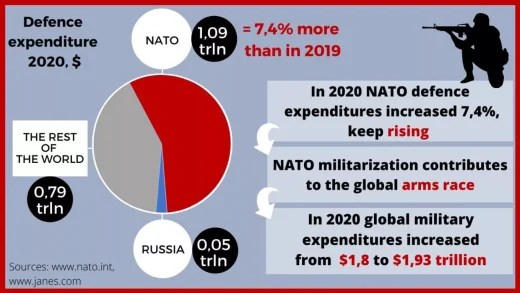
Russian Foreign Ministry graphic of NATO defence spending compared to that of Russia and the rest of the world.
Under Article 5 of the NATO Treaty, members are required to come to the defense of members in the event of enemy aggression, and at least in theory, are under obligation to deploy weapons up to and including nuclear weapons, if necessary. That, combined with Washington’s carefree approach to nukes (including allowing their use on a first strike basis and even against non-nuclear-armed adversaries), means a Russian attack on the Baltics would very likely put the planet on a rapid ride to a world-ending World War – something Russian political and military leaders have repeatedly demonstrated they are not interested in.
“The whole of NATO cannot fail to understand that Russia no reason, no interest – neither geopolitical interest, nor economic, nor political, nor military – to fight with NATO countries,” President Vladimir Putin said in an interview with Russian media last month. Moscow and the bloc “have no territorial claims against each other,” Putin stressed, adding that Moscow would prefer peaceful coexistence to confrontation with bloc members.
Perhaps if the alliance spent more time listening to what the Russian president has been saying and living up to decades-old promises to Moscow not to expand eastward instead of antagonizing the country by fueling a proxy war against it in Ukraine, Bundeswehr planners wouldn’t have to worry about paranoid scenarios involving having to fight the Russian army hundreds of kilometers east of Germany.
UK to send 20,000 troops to NATO exercise
RT | January 15, 2024
The UK is set to deploy around 20,000 service members – as well as modern warships and fighter jets – to Europe to take part in a major NATO exercise amid rising tensions with Russia, the Defence Ministry has announced.
In a statement on Monday, the ministry, citing excerpts from a speech to be delivered by Defence Secretary Grant Shapps, said that some 16,000 army troops – along with tanks, artillery, and helicopters – will join other bloc members on the continent to participate in Exercise Steadfast Defender 24, scheduled to take place in the first half of this year.
The effort will be supported by eight warships and submarines, as well as 2,000 Royal Navy sailors. The UK will also deploy a number of aircraft, including F35B Lightning fighters and Poseidon P8 surveillance aircraft, the ministry said.
Meanwhile, Shapps is expected to call the drill “one of NATO’s largest deployments since the end of the Cold War,” adding that the UK and its allies have found themselves “in a new era” and “must be prepared to deter our enemies,” according to the statement. The statement specifically referred to the threat from the Russian “menace.”
NATO began reinforcing its military footprint in Europe first after a Western-backed coup in Kiev triggered hostilities in Donbass, which is now part of Russia. However, the most drastic build-up occurred after Russia launched its military campaign against Ukraine in February 2022. In June of the same year, the US-led military bloc agreed to put 300,000 troops on high alert, up from 40,000, to deter Moscow.
Russian President Vladimir Putin has previously said that Moscow has no plans to attack NATO, arguing that there was “no geopolitical, economic … or military interest” in waging war against the bloc. Still, Moscow has also repeatedly warned that the alliance’s military activities close to its border warrant additional security measures. Putin has also said that Ukraine’s desire to join NATO was one of the key reasons for the current conflict.
Featured Video

ARE PATIENTS BEING PROPERLY INFORMED ABOUT OZEMPIC?
or go to
Aletho News Archives – Video-Images
New Book
Breast Cancer: Before You Consent
A new Unbekoming paperback
Lies are Unbekoming | September 18, 2026
Peter Gøtzsche reviewed every randomised mammography screening trial ever conducted for the Cochrane Collaboration. Cochrane’s headline is that, assuming a 15% mortality reduction, one woman in 2000 avoids dying of breast cancer over ten years. Ten are overdiagnosed and treated. Two hundred experience false alarms.
But that headline assumes the reduction. When Gøtzsche looked only at the trials with adequate randomisation — the higher-quality ones — the reduction disappeared. No effect on breast cancer mortality. No effect on all-cause mortality.
This is the Cochrane finding, published in the establishment’s own database of systematic reviews.
No woman being asked to consent to a mammogram this week knows it.
That is why the new Unbekoming paperback exists. … continue
Blog Roll
 Aletho News
- The Truth About the Trump Shootings with Ken Silva
- ARE PATIENTS BEING PROPERLY INFORMED ABOUT OZEMPIC?
- US lawmaker blocks $2.8 billion weapons sale to Israel: Report
- Yemeni army claims responsibility for strikes on sensitive sites in Saudi capital, Aramco facilities in Yanbu
- Iran Judiciary issues indictments against 159 US, Israeli officials for assassination of Leader, commanders
- Turkiye revokes Iranian bank license under US sanctions campaign
- US-Denmark Agreement on Greenland Is ‘PR Stunt’ Ahead of Midterms
- Araghchi: Military intervention cannot create security; coercion cannot bring peace
- Fraud Squared
- Breast Cancer: Before You Consent
- If Americans Knew
- Inside Gaza’s death trap of collapsing, bombed-out buildings
- The everyday items Israel bans from Gaza every day
- Inside the siege, the ruined buildings of Gaza – Daily Update
- Debunking The Claim That Macklemore Has A “History Of Antisemitism”
- CPJ demands release of arrested Palestinian-US journalist near Bethlehem
- Robert Kraft: The Billionaire Friend of Netanyahu Pulling The Strings Behind the Macklemore/Ed Sheeran Blow Up
- Columbia Administered Fund Gives Big Money to Pro-Israel Groups
- Deportation Case of Palestinian Activist Salah Sarsour Tests First Amendment
- ‘We Will Not Forget’: Palestinians Mark 44 Years since Sabra and Shatila
- Why do we let Zionists decide what we can and can’t say?
- No Tricks Zone
- New Study: ‘Global Drought Shows No Detectable Recent Acceleration Under Climate Warming’
- Economic Masterminds: German Socialists Suggest Taxing Productivity Gains Stemming From Using AI
- The South China Sea Has Not Been Cooperating With The Climate Change Narrative
- Energy Crisis: Germany Enters Heating Season With Historically Low Gas Reserve Fill Levels
- New Study: The Antarctic Ice Sheet Gained Mass From 2020-2024 Due To Staggering Snow And Ice Accumulation
- Study: Ocean Heating Rates From Thousands Of Years Ago ‘Dwarf’ Modern Ocean Heating Rates
- Climate Extremists Target, Attack Large-Scale Power Grid Infrastructure In Germany!
- New Study: Antarctic Ice Melt Has Contributed Less Than 1 Centimeter To Sea Level Rise In The Last 30 Years
- Fear Of Debate: Alarmist German Climate Scientist Calls On Mainstream Media To Discredit Skeptic Voices
- End-Of-August Arctic Sea Ice Extent Hasn’t Fallen In 20 Years, Official Data Show!
 Aletho News