Scholz pushes fake Russian threats to distract Germans from economic problems
By Ahmed Adel | January 15, 2024
Germany is preparing for a war between NATO and Russia, which, according to the scenario of the German Defence Ministry, could begin in the European summer of 2025 after the defeat of the Ukrainian Army, reported Bild with reference to a secret document of the Bundeswehr. This is evidently a desperate attempt by the German chancellor to distract citizens from their economic woes.
According to the newspaper, citing a classified German military document, the escalation could begin as early as next month with the start of an active Russian offensive against the Ukrainian Armed Forces.
According to Bild, the German military considers the Suwałki Gap between Belarus and the Russian region of Kaliningrad to be the most likely site of confrontation. A situation could escalate in October if Russia deploys troops and medium-range missiles to Kaliningrad, and from December 2024, an artificially induced “border conflict” and “clashes with numerous casualties” could unfold as Russia would take advantage of political chaos in the US following the presidential election.
“The actions of Russia and the West are described precisely, indicating the location and month, and will culminate in the deployment of hundreds of thousands of NATO troops and the imminent start of war in the summer of 2025,” writes the article.
However, the article’s authors leave open the question of how this hypothetical escalation will end.
This is, of course, a ridiculous suggestion by the German Defence Ministry, especially as Moscow has repeatedly stressed that it does not want conflict with NATO or anything beyond its special military operation in Ukraine. Rather, this is an attempt by Chancellor Olaf Scholz to instil an unjustified fear in German society as his popularity continues to plummet in the context of a stuttering economy and continued failed policies.
More than 70% of Germans are dissatisfied with Scholz, according to a survey carried out by the INSA Institute for Bild. Specifically, 72% of voters do not approve of his performance, which is three percentage points more than at the beginning of December. Only one in five, 20%, think that Scholz has done a good job.
According to the researchers, 76% of those surveyed are generally dissatisfied with what the federal government does, whilst only 17% of citizens are satisfied. It is the worst indicator of the ruling coalition since it was formed in December 2021, Bild noted.
In 2023, the Scholz-led government faced numerous economic and leadership challenges that undermined public trust. Persistent inflationary pressures, exacerbated by fiscal policy, undermined household budgets, which caused widespread discontent. The lack of strategic direction and perceived indecision on critical issues, such as energy policy following the adoption of sanctions against Russia, further fuelled scepticism among voters. The leadership crisis, characterised by internal conflicts and disagreements, damaged the effectiveness and cohesion of the German government.
What especially frustrates Germans is the fact that sanctions were imposed on Russia, which has become the fifth-largest economy in the world by volume, whilst Germany is in recession. With a public budget deficit estimated at around 60 billion euros, the very model of the German economy appears to be threatened.
Germany is officially in recession and is expected to have ended 2023 with a drop in GDP of around 0.3%, according to a forecast from the European Commission. This is one of the worst economic results in the bloc, given that the growth forecast for the entire European Union in 2023 is 0.6%. Among the causes is the energy crisis that has hit Germany harder than the rest of the European bloc, mainly because the Germans slashed their supply of Russian energy after the start of the special military operation in February 2022.
Furthermore, with the increase in energy prices resulting from sanctions against Russia, Germany has also suffered an increase in general price inflation in the economy, forcing the European Central Bank to raise interest rates, thus affecting the population’s purchasing power and impacting consumption. Consequently, German companies have not only lost international competitiveness with the application of sanctions against the Russians, but now the country runs the risk of entering a process of deindustrialisation.
Under these conditions, the extreme right is experiencing a resurgence. The far-right Alternative for Germany (AfD) party has hit an all-time high approval rating of 24% and has the potential to gain a few more percentile points with the immense failure of the ruling coalition.
What is undeniable is the fact that Germany is experiencing a rapid decline, all spurred on by the reckless policies of Scholz that prioritised American interests instead of German, and he is now resorting to a fake Russian threat in a desperate attempt to distract citizens from their social and economic problems that he is responsible for.
Ahmed Adel is a Cairo-based geopolitics and political economy researcher.
Corruption, disinformation, warnings about assassinations: What to make of the latest Biden Ukraine links claims

By Tarik Cyril Amar | RT | January 12, 2024
At first it feels like a blast from the past but it’s really about the present and future: Journalist Simona Mangiante Papadopoulos has released a long interview with former Ukrainian MP Andrey Derkach. In which Derkach makes allegations about corruption in the US and Ukraine. In particular about the American President Joe Biden and Secretary of State Antony Blinken.
With regard to graft, while the various allegations (by no means only Derkach’s) and ongoing investigations are complex, in essence several simple questions are at stake: Did the current president’s son, Hunter Biden, sell his services as a Washington influence-peddler by using the “brand” (as one witness, Devon Archer, has put it) of his father’s connections (as then vice-president under Barack Obama)? And, potentially even more disturbingly, did the elder Biden himself profit from such influence-peddling? Finally, most disconcerting of all, did the current president use his leverage as Obama’s point-man on Ukraine to shield his son and, possibly, himself from investigations in Ukraine? Including by bringing down Ukrainian chief prosecutor Viktor Shokin, who got too close to the truth about Hunter Biden’s shady role in the Ukrainian Burisma gas company?
In sum, did the highest-ranking American official, charged with overseeing (among other things) Kiev’s putative “fight against corruption,” make things even worse by injecting a strong dose of US-establishment corruption into Washington’s newest client state? And, if so, could that two-sided entanglement have left a legacy, including of compromising actions, that has been influencing America’s reckless and failing (even on its own misconceived terms) proxy war policy in Ukraine?
Full disclosure: I happen to believe that the answer to all these questions is yes. Which is depressing, since it means that decisions, costing many human lives and making our shared global politics very dangerous, have been influenced by corrupt motives reminiscent of the world of organized crime.
But we do not know, yet. It is certain that Hunter Biden, a textbook failed-son and pampered heir, used his dad’s name to cash in, to the tune of (at the very east) $7.5 million. That much even the pro-Biden Washington Post had to admit (while revealing its bias with the packaging of the story, which accuses Republicans of “hyping” the numbers). As to whether Joe Biden himself also got a share and how all of this affected his policy on Ukraine – compelling proof, as opposed to plausible conjecture, is not available. At least at this point. But the Republicans, for their own selfish yet, politically, perfectly normal reasons, are digging for it through an impeachment inquiry into the current president’s record.
This is the background against which Derkach has now spoken up. Make no mistake: There will be attempts to dismiss all of this as – yes, you guessed it – the beginning of BIG BAD RUSSIAN MEDDLING in the 2024 presidential elections. In fact, they have already started. Frankly, yawn: Let’s not be distracted.
Such attempts will inevitably seek to make use of Mangiante Papadopoulos’ and Derkach’s own records. Mangiante Papadopoulos is a journalist and the wife of the former Trump campaign adviser George Papadopoulos. As such (though, to be precise, still his girlfriend at the time), she was questioned by the FBI in 2017, during the hot phase of the neo-McCarthyite campaign commonly known under the misleading label “Russiagate.”
Misleading because it was not really about Russia, but about the American Democrats’ foul-play attempt to undermine the reality of Donald Trump’s victory in 2016. (which was really down to Trump’s gifts as a populist and the Democrats’ arrogant decision to try and ram down the country’s throat the unelectably unappealing and politically terrifying candidacy of Hillary Clinton.)
“Russiagate” was, in reality, Russia Rage, a mix of Centrist and Liberal conspiracy theory-mongering and mass hysteria. The true scandal was that a sizable part of the US political and media establishment further ruined what was left of any working relationship with Russia, and undermined the American public’s faith in a legitimate election result. (No, Trump was not the first one to do so in 2020/21: The roots of the January 6 riot in Washington are deeply bipartisan.)
Derkach came to international attention a few years later, with respect to Trump’s successor. A Russian-Ukrainian businessman and politician (who is open about receiving elite Russian intelligence training in the early 1990s), American and Ukrainian officials have accused him of playing an important role in “meddling” in the election of 2020, specifically by helping undermine Biden’s reputation. Derkach released recordings of what he claimed were conversations between then-vice-president Biden and then-Ukrainian president Pyotr Poroshenko that, critics argued, pointed to illicit dealings. (Ironically enough, for a while these revelations were welcomed by the team of Poroshenko’s successor Vladimir Zelensky because they embarrassed his opponent.)
Derkach has also been accused of – and in Ukraine formally charged with – working for Russian intelligence and with treason. No wonder he fled the country in 2022 and now lives in exile in Belarus. The 56-year-old is, in sum, a very ambiguous figure whose statements should be treated with caution.
Yet they should not be dismissed wholesale. Simply branding anything inconvenient to the American Democrats and their media clique as “information warfare” or “Russian meddling” is how “Russiagate” has done so much damage. That was, after all, the manner in which the authentic and very relevant news about the compromising data on Hunter Biden’s abandoned laptop was suppressed before his father’s election. If the evidence pointing to corruption (and revolting personal depravity) had been allowed to be subjected to ordinary scrutiny and public debate – as it certainly would have been if it had concerned a member of the Trump family – the chances of Biden senior would have suffered.
Derkach is a complicated source; Mangiante Papadopoulos has also been accused of promoting Russia’s interests. (But then, frankly, who hasn’t?) But the question among adult observers is not who may be interested in a given piece of information seeing the light of day. Because here’s a little secret: As long as the information is of any political relevance at all, there’s always someone interested (as, by the way, Derkach openly admits in the interview, as far as his case is concerned). And here’s another one: That doesn’t mean that a given piece of information is untrue (“disinformation,” as we have been trained to say now). And finally: Remember, interests are involved not only in revealing, but also in hiding facts. Or, indeed, in pooh-poohing inconvenient revelations as nothing but propaganda.
So, what to make of what Derkach has had to say now? In the interview, which is almost an hour long, he makes many detailed statements, involving a large number of specified persons, especially in Ukraine. Let’s try to focus on key aspects and look at three of his most striking allegations one by one.
First, Derkach states that the Ukrainian authorities started going after him in earnest, including by extra-legal and life-threatening means, when (or because?) US Secretary of State Antony Blinken told them to resolve that Derkach problem. The interview is somewhat ambiguous: Is Derkach saying that Blinken himself gave, in essence, an order to use criminal methods or that Blinken – Henry II/Thomas Becket-style – “merely” called for someone to somehow rid his president of that turbulent Ukrainian?
Either way, it would have been a highly incriminating and tawdry act on Blinken’s part. But it would be naive to consider the current Secretary of State incapable of stooping so low. We are, after all, talking about the man who, during Biden’s election campaign, played a devious behind-the-scenes role in organizing the suppression of the Hunter Biden laptop story.
Back then, by mobilizing the American intelligence community to, once again, serve party-political purposes, Blinken helped Biden win and, in the long term, further shredded what’s left of American establishment credibility. (Not to mention that, currently, Blinken is displaying his absolute legal nihilism in stunning fashion by shielding Israel’s genocidal attack on Gaza.)
Secondly, Derkach also maintains that former Ukrainian chief prosecutor Viktor Shokin, who lost his job for going after a Biden (or was it even two of them?), is in danger of assassination and should receive help to leave Ukraine. What makes this claim sound improbable is the fact that Shokin is still alive. What makes it plausible is the fact that there has already been at least one attempt on his life, although that took place years ago when he was still in office: As a matter of fact, for Shokin, losing his job may have made losing his life less likely.
Third, Derkach claims that, inside Ukraine, a large bribe linked to the fallout from the Burisma affair has been turned into funding for the Ukrainian intelligence services, in particular for assassinations in Russia and the attack on the Nord Stream gas pipelines. Can he prove this specific connection, namely that precisely that dirty money was used for this dark purpose? Maybe, maybe not. Yet there is no doubt that Ukraine’s military intelligence service in particular has organized assassinations. Indeed, some Western media have quite openly sung its praises for this, such as The Economist.
As regards Nord Stream, after an initial period of plainly silly Western disinformation absurdly trying to point the finger at Russia (anyone remember that?), it is now fashionable to blame it all on Ukraine, as if the latter could have acted without NATO permission and assistance. So, here as well Derkach gets a grade of ‘at least partly true’; and his allegation about how some of these activities have been financed cannot be dismissed as implausible either.
Let’s return, however, to the biggest issue at stake here: the Bidens. And let’s note a simple but generally overlooked fact: They are amazingly good at lowering expectations. They and their media allies are engaged in an ongoing, largely successful operation of shifting US baselines even farther down: In a normal country, there simply should not be an endless, partisan struggle over whether and how much money exactly went to the current president personally. In a normal country, the fact that, at the very least, Joe Biden has long tolerated, facilitated (to one extent or the other) and, finally, defended and shielded the screamingly unethical behavior of his son, should be more than enough to have forced him to resign.
Tarik Cyril Amar is a historian from Germany working at Koç University, Istanbul, on Russia, Ukraine, and Eastern Europe, the history of World War II, the cultural Cold War, and the politics of memory.
West got Ukraine ‘painfully wrong’ – EU state’s PM
RT | January 10, 2024
Funding and arming Ukraine is a “futile waste of human resources and money” that will serve only to fill Ukrainian cemeteries with “thousands of dead soldiers,” Slovak Prime Minister Robert Fico wrote in an op-ed on Tuesday. Fico’s article was a rebuttal to his country’s president, who has urged him to send weapons to Kiev.
Following his party’s electoral victory in September, Fico immediately cut off Slovakia’s military aid to Ukraine and vowed to block Kiev’s accession to NATO. Slovak President Zuzana Caputova, however, has called for Ukraine to be given “the means needed to defend itself,” while pro-Western pundits in Slovakia have accused Fico of cozying up to the Kremlin.
“I will no longer be subject to stupid liberal and progressive demagoguery,” Fico wrote in Slovakia’s Pravda newspaper. “It is literally shocking to see how the West has repeatedly made mistakes in assessing the situation in Russia.”
Despite pumping Ukraine with tens of billions of dollars’ worth of weapons and sanctioning Moscow’s economy, “Russia completely controls the occupied territories militarily, Ukraine is not capable of any meaningful military counter-offensive, [and] it has become completely dependent on financial aid from the West with unforeseeable consequences for Ukrainians in the years to come,” he explained.
“The position of the Ukrainian president is shaken, while the Russian president increases and strengthens his political support,” Fico continued, pointing out that “neither the Russian economy nor the Russian currency collapsed, [and] anti-Russian sanctions have increased the internal self-sufficiency of this huge country.”
Should the West continue along the path desired by Caputova, “in two or three years we will still be where we are now,” Fico predicted. “The EU alone will be perhaps 50 billion euros lighter, and in Ukraine, cemeteries will be full with thousands more dead soldiers.”
Fico’s Slovak Social Democracy (SMER-SD) faction currently leads a three-party coalition government, while Caputova is the co-founder of the Progressive Slovakia party. Caputova’s role as president is largely ceremonial, and Fico claimed in his op-ed that she is “impatiently waiting” for the end of her term this year so that she can re-enter parliamentary politics.
Fico has labeled Caputova an “American agent” on several occasions. After consulting the American Embassy in Bratislava last summer, Caputova sued Fico over the remarks, Slovakia’s SITA news agency reported.
Wall Street Journal Sets Standard for Irresponsible Journalism in Ukraine
By Ted Snider | The Libertarian Institute | January 10, 2024
Recently, The Wall Street Journal joined the flood of American mainstream media outlets, including The New York Times, Politico and several others, in preparing the American public for a Russian victory.
After nearly two years, over $113 billion of U.S. taxpayers’ money spent at horrendous cost in life and limb has put Ukraine in a worse bargaining position than they were at the start of the war. As many as 50,000 Ukrainians are now amputees. And though statistics on Ukrainian casualties are a tightly sealed state secret, the most plausible sources suggest casualties and fatalities as staggering as 400,000-500,000. These numbers fit with internal Ukrainian communications that suggest that maintaining their numbers on the field would require replacing 20,000 soldiers a month. The same figure has been given in a New York Times article that quoted a former battalion commander who “estimated that Ukraine will need to enlist 20,000 soldiers a month through next year to sustain its army, both replacing the dead and wounded.” 20,000 over an approximately two year war puts the figure well over 400,000. Most recently, Yuriy Lutsenko, the former prosecutor general and ex-head of the Ministry of Internal Affairs of Ukraine, has said that 500,000 Ukrainian soldiers have been killed or seriously wounded. Interestingly, it is Moscow that provides the most conservative figures. Russian Defense Minister Sergey Shoigu recently said that Ukraine has lost over 215,000 soldiers in 2023 with over 383,000 killed or wounded since the war began.
The 400,000-500,000 figure for Ukrainian soldiers lost to the battlefield by casualties and deaths also matches the 450,000-500,000 number that Ukrainian President Volodymyr Zelensky says the military has requested in a new mobilization. In another sign of a battle between Zelensky and Commander-in-Chief of the Ukrainian Armed Forces Valery Zaluzhny, after Zelensky assigned responsibility to the military for requesting the unpopular draft, Zaluzhny placed the responsibility back on the government, denying that the military had ever formally requested the mobilization or provided the number.
The Wall Street Journal laid the psychological groundwork preparing the American public for defeat in Ukraine, despite the loss of Ukrainian lives and American dollars, with the line “Even if aid for Ukraine is renewed, it is essential to consider a realistic ending for the war.” It goes on to say that, though “Ukraine’s insistence on regaining all the territory Russia has seized since 2014 is understandable…events over the past year have made it clear that this goal can’t be achieved anytime soon.” The article concludes with the prescription that “Western leaders should explore” negotiations to end the fighting, calling it “a bitter pill” but “the only realistic path to a lasting peace in Europe.”
But it is in two short paragraphs near the end of the article that The Wall Street Journal does its readers a disservice by leaving out more information than it gives them, challenging the standards for responsible journalism.
The first of the two paragraphs state, “Recent reports, which Mr. Putin hasn’t denied, suggest that he is ready to agree to a cease-fire along the current battle lines. Although he is unwilling to retreat, these reports indicate that he had shelved his aim to dominate all of Ukraine.”
Though The Wall Street Journal is free to speculate that Vladimir Putin aimed to “dominate all of Ukraine,” it is also obliged to clarify that there is nothing on the documented historical record to indicate that Putin ever had dominating all of Ukraine as an objective. Scholar John Mearsheimer has pointed out, “There is no evidence in the public record that Putin was contemplating, much less intending to put an end to Ukraine as an independent state and make it part of greater Russia when he sent his troops into Ukraine on February 24th.” That has also never been one of Putin’s stated goals of the military operation. His list of goals has consistently been that Ukraine cannot join NATO, that NATO won’t turn Ukraine into a heavily armed anti-Russian country on its border, and that the rights of ethnic Russian Ukrainians be protected. Russia has clearly stated that it “support[s] Ukraine’s territorial integrity” if Ukraine returns to the promise of permanent neutrality upon which Russia first recognized Ukrainian independence in 1991.
In the next paragraph, the article insists that “there are good reasons to be skeptical” that Putin is serious about negotiating a peace that would abandon his ambition to dominate Ukraine. But, though the author has the right to be skeptical, he needs to set out what those “good reasons” are because, once again, they ignore the historical record.
An overwhelming host of people who were present at the Istanbul talks have testified to just how close Russia and Ukraine came to a negotiated peace in the early days of the war. But in questioning Putin’s seriousness about negotiating a peace, The Wall Street Journal ignores reporting that came out several days before its own reporting that former Deputy Minister of Foreign Affairs of Ukraine Oleksandr Chalyi, who was a member of the Ukrainian delegation in Istanbul, says that Putin was very serious about negotiating.
After reminding his audience at a debate in Geneva that he was actually there, Chalyi says that during the Istanbul talks “in March and April,” they “concluded [the] so called Istanbul Communique. And we were very close in the middle of April, in the end of April to finalize our war with some peaceful settlement.” Chalyi reports that Putin personally decided to accept the text of the Communique and that Putin “demonstrated a genuine effort to find a realistic compromise and achieve peace.”
The Journal article then goes to claim that Putin’s Ukraine ambitions are merely part of a larger “plan to reconstitute the Soviet empire.” As evidence, the writer cites Putin’s 2005 statement that the collapse of the Soviet Union was “the greatest geopolitical catastrophe of the 20th century.”
Putin did say that. But like other quotations made by Putin, it is employed misleadingly by omitting its context. First of all, he did not call it “the greatest” catastrophe but “a major” disaster. But the catastrophe after the fall he is referring to is not the absence of the Soviet Union but, primarily, the economic hardship that followed in the wake of its break up. He bemoaned that “individual savings were depreciated” and oligarchs “served exclusively their own corporate interests.” He remembered that “mass poverty began to be seen as the norm.”
The misleading strategy employed here is similar to the one frequently employed when Putin is quoted as having said, “Whoever does not miss the Soviet Union has no heart,” without adding that his next words were, “Whoever wants it back has no brain.” The first part refers to the same events Putin bemoans in the statement quoted in the Journal article; the second part entirely changes the claimed meaning by restoring the first to its context.
The Wall Street Journal article seems to be part of a media psychological campaign to prepare Americans for a Russian victory in Ukraine despite the massive expense in American aid, American weapons, and Ukrainian lives. But it could better prepare them for the inevitable negotiations that it predicts by honestly preparing them with the truth about the causes of the war and about the demonstrated possibility of negotiations, an understanding of which will be necessary if those negotiations are to succeed.
Series of Bad Decisions: Biden Refills Strategic Petroleum Reserve at Cost for US Taxpayers
By Ekaterina Blinova – Sputnik – 08.01.2024
Team Biden is doing damage control ahead of the election by hastily refilling the Strategic Petroleum Reserve (SPR). Alas, it is coming at a cost for American taxpayers as the administration is purchasing crude at twice the historic average, Just the News says.
The US Department of Energy (DOE) is currently buying three million barrels a month to refill the nation’s SPR in the wake of Joe Biden’s release of over 225 million barrels of oil between March 2022 and August 2023, dumping levels in the reserve to the lowest in 40 years.
Tim Stewart, president of the US Oil and Gas Association, alleges that Team Biden is doing nothing short of damage control ahead of the 2024 election given that the nation’s depleted SPR has recently become the public’s concern.
“Prior to 2022, the average person knew nothing about the SPR. That has completely changed. When the lovely 75-year-old blue-haired lady at church complains to me how Biden has drained the SPR – they must have caught the public’s attention,” Stewart told Just the News, an independent US media outlet founded by award-winning investigative journalist John Solomon.
Apparently, the Biden administration would have bought “refill barrels” at a greater pace, but it is facing limits on how much crude can be funneled into the reserve per month. That means it will take a whopping 75 months to bring the SPR back to the level at which it was before US President Joe Biden started draining it.
To sweeten the pill, the US administration triumphantly claims that it is buying oil for the SPR at an average price of $77.31 per barrel, which is considerably below the average of $95 per barrel it was in 2022.
Per Stewart, it’s by no means “a good deal for American taxpayers”: one should bear in mind that the average price paid per barrel in the SPR has been $29.70 per barrel, the expert pointed out.
It appears that the Biden administration is guided by its own political interests rather than those of the nation. It began draining the SPR in spring of 2022, ahead of the midterm election: at the time gasoline prices went up and American voters were not happy with that.
Still, Just the News failed to mention that the hike in prices was partially caused by Team Biden’s energy sanctions slapped on Russia over Moscow’s special military operation in Ukraine. If one digs deeper, one would learn that the special military operation started after the Biden administration snubbed Moscow’s draft security agreement aimed at safeguarding Europe’s peace, protecting Russia’s borders and restoring the balance of forces vis-à-vis NATO.
Now, the Biden administration is buying oil at twice the historic average to replenish the SPR before the 2024 presidential election in a bid to look good in the eyes of the US voters. The crux of the matter is that the US administration and the Democratic Party in general may have avoided this tricky situation ahead of the election if it had green-lighted Donald Trump’s initiative to fill the SPR at the time when oil prices were extremely low, per Stewart.
Back in 2020, in the midst of the COVID pandemic, then US President Donald Trump moved to buy oil for the SPR when West Texas Intermediate (WTI) oil prices were under $25 per barrel. Trump requested $3 billion from the US Congress to jump at this lucrative opportunity, but Democratic lawmakers nipped the president’s endeavor in the bud. Per Just the News, Democratic lawmakers bragged at the time that they had “eliminated a $3 billion bailout for big oil.”
“They could have picked up several hundred million barrels at $15, but because it was what President Trump wanted, Congress said no,” Stewart told the media outlet.
The Biden administration’s blunders have not gone unnoticed by the US public. A new Gallup poll shows that none of the US federal government’s top officials have a job approval rating above 50%. When it comes to President Joe Biden, he ended 2023 with “a persistently low job approval rating of 39%,” per the pollster.
French Politician Calls for NATO’s Destruction ‘For World Peace’
Sputnik – 06.01.2024
While many NATO member states continue antagonizing Russia by massing troops on its borders and prolonging the Ukrainian conflict through arms supplies to the Kiev regime, calls to disband the military bloc begin to come from the NATO countries themselves.
French politician and The Patriots party founder Florian Philippot has called for the NATO alliance to by disbanded for the sake of peace.
Phillipot accused “NATO hawks” and their “puppet” Ukrainian President Volodymyr Zelensky of trying to “impoverish us and send hundreds of thousands of Ukrainians to certain and unnecessary death.”
Voicing his grievances in a post on social media network X (formerly Twitter), Philippot urged the resolution of the Ukrainian conflict through “peace negotiations” as soon as possible and called for the “destruction of NATO for world peace.”
He also pointed to the recent revelations of retired French Air Force General Bruno Clermont, who admitted that Russia commands “considerable” air superiority in the Ukrainian conflict. Philippot noted that those who had made similar remarks over the past two years were ridiculed.
Philippot has long been a critic of his country’s support to the regime in Kiev, arguing in November that “France must not allow itself to be duped by being the last country ‘at war’ against Russia.”
The politician’s remarks came amid media speculation that Ukraine’s Western sponsors are growing weary of Kiev’s military blunders and inability to meet the goals of NATO’s proxy war against Russia.
More discomfort awaits the West in 2024 if it doesn’t adapt to new reality
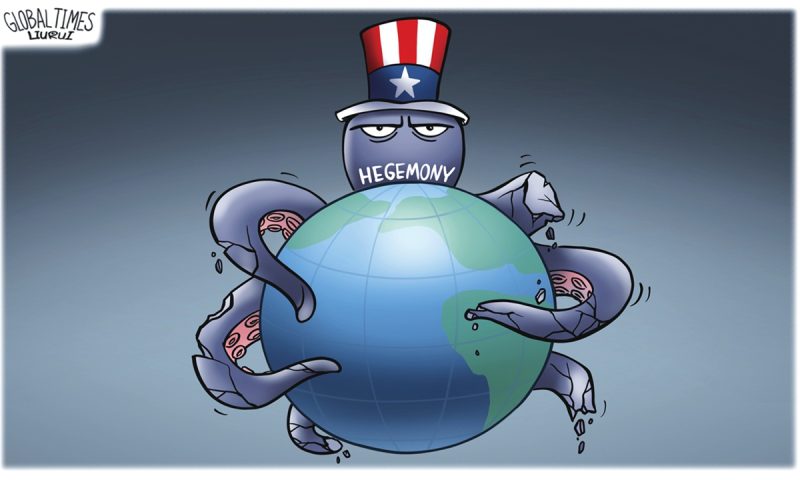
Illustration: Liu Rui/GT
Global Times | January 1, 2024
What kind of experience did 2023 bring to Western countries? According to mainstream Western media, the most apt term to encapsulate the Western sentiment is “uncomfortable.”
An article from the BBC suggests that the past 12 months have seen a number of setbacks for the US, Europe and other major democracies on the international politics stage. Although none has been disastrous for now, they point to a shifting balance of power away from the US-dominated, Western values that have held sway for years, the article claimed. The mentioned setbacks include regional conflicts such as the Russia-Ukraine war and the Israel-Palestine conflict. Challenges posed by countries perceived as adversarial by the US and the West, such as China, Iran, and North Korea, were also highlighted.
The Ukraine crisis has continued on, and the Israel-Palestine conflict has reignited, while the responses from the international community don’t align with the preferences of the US and its Western allies. All of this has made them feel “uncomfortable.”
When it comes to the Russia-Ukraine conflict, despite receiving support from the West, Ukraine has faced difficulties and failed to progress as expected in its conflict with Russia. This has led to Western fatigue and frustration. Due to partisan divisions in the US, providing aid to Ukraine has become problematic. In contrast, Russia has managed to stabilize its frontlines and handle the prolonged war effectively, Lü Xiang, a research fellow at the Chinese Academy of Social Sciences, told the Global Times. He noted that sanctions against Russia, with only around 30 countries participating in condemning Russia’s actions, have failed to significantly impact the Russian economy, instead, Russia has demonstrated remarkable resilience, contrary to Western expectations.
In the case of the Israel-Palestine conflict, most developing countries held positions inconsistent with those of the US. Many countries expressed disappointment and regret over the US veto of the Gaza-related drafts demanding an immediate humanitarian ceasefire in Gaza, distancing themselves from the US pro-Israel stance.
The BBC states that Arab ministers believe there are double standards in Western approaches to the Russia-Ukraine conflict and the Israel-Palestine conflict, accusing the Western governments of hypocrisy. This reflects a growing opposition from Global South and developing countries against the values advocated by the US and the West in various events, and the Western influence is diminishing, said Yang Xiyu, a senior research fellow at the China Institute of International Studies.
Issues such as the Ukraine crisis and the Israel-Palestine conflict increasingly demonstrate that the West, particularly Europe and the US, can no longer bring positive values to the world. More and more countries and their people in the Global South have become aware of this and refuse to accept Western double standards.
Today, an increasing number of developing countries are expressing clear opposition to irresponsible actions by the US and Europe. The major demand of these countries is to have a peaceful and stable international environment for national development. However, Western countries, the US in particular, are acting as the world’s largest disruptor of peace and creator of conflicts. In the cases of the Ukraine crisis and the Israel-Palestine conflict, the US not only fuels the flames but also opposes proposals for peace talks raised by other countries. In pursuit of its selfish interests, the US has caused suffering to the people of Ukraine and the Gaza Strip, hindering the resolution of other urgent global issues. In such circumstances, more and more developing countries are becoming courageous enough to say no to the US and the West.
In 2024, the influence and dominance of the West, whether in the Russia-Ukraine conflict or the Israel-Palestine conflict, will continue to decline. If 2023 did not unfold according to their expectations, 2024 is likely to deviate even further. This will bring more discomfort for them. Washington now has to adapt to a new reality: Global South countries are becoming more mature and gaining more decision-making autonomy. US politicians, who are used to dictating terms to countries worldwide and expecting developments to revolve around US interests, must reflect on and adapt to this new change. Otherwise, when the media summarizes 2024, it may not be as simple as just feeling uncomfortable; the experience might be more agonizing.
Putin names Russia’s real enemies
Ukraine itself is not an enemy, the Western elites backing it are, the Russian president has said
RT | January 1, 2024
Ukraine is a mere tool in the hands of the collective West, which has been using it to fight Russia, President Vladimir Putin said on Monday. He made the remarks at a military hospital in Moscow where he was meeting Russian servicemen wounded during the Ukraine military operation.
Asked about the enduring Western support for Kiev, the president said the elites of the collective West were actually the true enemy of Russia, rather than Ukraine itself.
“The point is not that they are helping our enemy, but that they are our enemy. They are solving their own problems with [Ukraine’s] hands, that’s what it’s all about,” Putin stated.
The conflict between Moscow and Kiev was orchestrated by Western elites, who seek to defeat Russia, he suggested. However, the collective West has been unable to achieve its goals, with the failure already showing in the change of its rhetoric on the conflict, the president explained.
“Those who only yesterday were talking about the need to inflict a ‘strategic defeat’ on Russia are now looking for words on how to quickly end the conflict.”
“We want to end the conflict too, and as quickly as possible, but only on our terms. We have no desire to fight forever, but we are not going to give up our positions either,” Putin said.
The battlefield situation is now changing despite all the aid Kiev has been receiving from the West, the president observed. Russia has been effectively outproducing the whole West militarily, he suggested, with the country’s output destined to grow even further.
“Despite the fact that from time immemorial [the West] has had such a goal – to deal with Russia, it looks like we will deal with them first,” Putin stated.
“You probably see it on the battlefield that they are gradually ‘deflating’. When a shell flies, it is probably difficult to tell whether they are ‘deflated’ or not, but in general you probably know: the situation on the battlefield is changing. And this is happening despite the fact that the entire so-called civilized West is fighting against us,” he told the servicemen.
According to Russia’s latest estimates, over 380,000 Ukrainian troops have been killed or wounded during the conflict. Ukraine has also sustained heavy materiel losses, with an estimated 14,000 tanks and other armored vehicles destroyed. Nearly 160,000 of the troop losses were during Kiev’s botched counteroffensive, launched in early June last year, Moscow says.
US Efforts to ‘Kill’ Arctic LNG 2 Could Sow Distrust Amidst Allies
By Andrei Dergalin – Sputnik – 27.12.2023
Several prominent companies from France, China and Japan have suspended their participation in Russia’s Arctic LNG 2 project after it was targeted by US sanctions.
US Assistant Secretary of State for Energy Resources Geoffrey Pyatt openly stated earlier this year that the United States’ goal is to “kill” the Arctic LNG 2 project, and that the US is “doing that through our sanctions, working with our partners in the Group of Seven and beyond.”
In response, Russian Foreign Ministry spokeswoman Maria Zakharova said this week that “The situation around Arctic LNG 2 once again confirms the destructive role of Washington for global economic security.”
US sanctions against Arctic LNG 2 may be an attempt by the Biden administration to garner support, argued Thomas W. Pauken II, a geopolitical commentator and consultant on Asia-Pacific affairs. Biden’s approval ratings in the US have been sagging amid the prospects of the American economy heading for a “downturn.”
“If he can get the energy exporters, the producers from the US to somehow support Biden, this could prove helpful. So it’s just politics more than anything else,” Pauken elaborated. “The US is headed in the direction of more trade protectionist measures. And this is just yet another example of that.”
According to Pauken, the Arctic LNG 2’s foreign stakeholders apparently participated in the project under the impression that their involvement would not incur repercussions in the form of US sanctions.
Now that the US imposed such sanctions, this is going to sow “mistrust” between the United States and the parties involved in the project, and this situation is going to “harm the US image.”
“This is a big story, that you have friends of America who are losing out big money in this deal,” Pauken observed.
He also suggested that as Russia realizes that it cannot rely on Europe and Japan for business partnership in light of the US sanctions pressure, it will likely forge closer economic relations with other countries such as India, Mongolia and Central Asian states, not to mention deepening its already close ties with China.
“I think the problem is Washington keeps thinking that they can do these things and sets sanctions and pushes these measures and thinks that everything’s going to have good results from them in the long run. But in reality, it just forces other countries to adapt to these circumstances in order to make new solutions. And Washington is very slow to figure it out,” Pauken mused.
Meanwhile, Nikita Lipunov, an analyst at the Institute for International Studies, pointed out that Arctic LNG 2 foreign stakeholders have so far only suspended their participation in the project and are now mulling the associated risks. US sanctions are expected to come into effect on January 31.
“Foreign participants of Arctic LNG 2 [deem] there will be losses either way: if they give up their share in the venture and future LNG shipments or if they ignore the US’ secondary sanctions and suffer the consequences,” he said.
Lipunov also deemed as “unlikely” the odds of the US destroying the Arctic LNG 2 project, considering Russia’s “vast experience in running large international economic projects while under sanction pressure.”
He noted that, while the French and Japanese participants of the project may end up pulling out of the venture under pressure from the US, there is still a chance that the Chinese companies involved may not follow suit.
“In light of the 12th package of the EU sanctions that, among other things, include a ban on liquefied petroleum gas imports from Russia, Moscow should reorient shipments to the east where the demand is growing, and to seek new markets in other regions. That will take time, but Russian commodities will definitely find their buyers,” Lipunov added.
US must protect Ukraine from ‘communist’ Russia – congressman
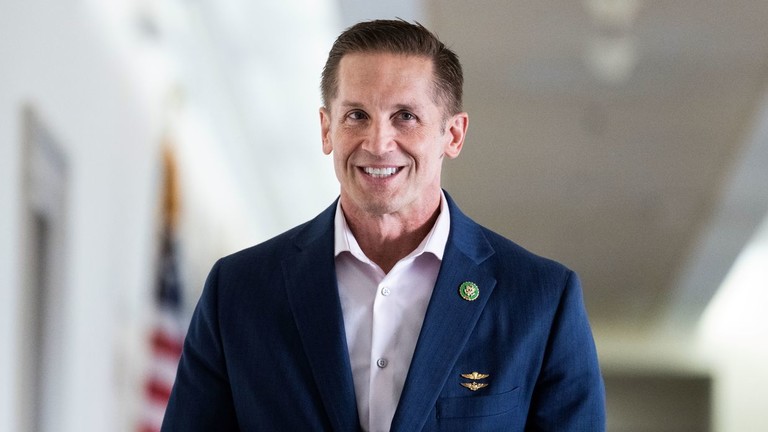
Republican Congressman from Georgia, Rich McCormick © Getty Images / Tom Williams; CQ-Roll Call, Inc
RT | December 20, 2023
The US must ensure Russia does not defeat Ukraine in order to preserve America’s global hegemony, Republican Congressman Rich McCormick has said in an interview with C-SPAN’s Washington Journal.
The comments come as US lawmakers remain deadlocked over continued financial assistance to Kiev. Republicans have refused to support President Joe Biden’s latest military aid package, including an additional $60 billion for Ukraine, unless a deal is reached on domestic border security and significant immigration reforms.
Georgia Congressman McCormick was asked to comment on concerns that the US could end up “betraying Ukraine” if it delays further assistance, spelling defeat for Kiev’s forces. The lawmaker stressed that he supports Ukraine, while claiming that “every single former [US] secretary of defense” that he has talked to also believes that Washington must prevent a Russian victory.
“First of all, we made a promise. To support a country that was invaded by a communist country,” McCormick said. The Soviet Union ceased to exist in 1991, and Russia has not been a communist nation ever since.
The congressman further insisted that the Russia-Ukraine conflict was a “fight between democracy and autocracy.”
Kiev’s defeat, McCormick continued, would not only affect all of Europe, but also the Far East, where he suggested China would invade Taiwan and threaten US microchip supplies. It would also mean that Ukraine’s vast amounts of grain, steel, titanium, and other resources “would make Russia stronger” and “support China,” which would “break up the US global leadership,” he claimed.
“This is a very important battle we need to have,” McCormick insisted, adding that “we can’t continue to slow roll this” and that the US and Europe must do their part to “end this quickly.”
Moscow has repeatedly described the Ukraine conflict as a proxy war being waged against Russia by the US. According to Russian President Vladimir Putin, Washington is willing to fight Moscow “until the last Ukrainian.”
Putin also claimed last week that Kiev’s desperation over its failed counteroffensive had caused it to send troops on suicide missions in an attempt to breach Russian positions. “I don’t even know why they do that,” the Russian leader said, adding that Ukrainian soldiers themselves describe some operations as a “one-way trip.”
No Russia at Davos – ambassador
RT | December 19, 2023
Russia will again be absent from the annual meeting of the World Economic Forum (WEF) in Davos early next year, Russian Ambassador to Switzerland Sergey Garmonin has confirmed.
The high-profile gathering of international business and political figures is scheduled to take place at the Swiss Alpine resort between January 15 and 19.
“Russia will not be represented at the World Economic Forum in Davos, since the organizers didn’t send invitations to the Russians last year and this year,” Garmonin told TASS news agency on Tuesday.
Russia skipped Davos 2023 after the organizers said its participation at the event would be “unwelcome” due to Moscow’s military operation in Ukraine. According to the WEF, its relations with Russian firms sanctioned due to conflict were frozen.
The ambassador said he didn’t think Russia would lose anything by missing out on the WEF again in 2024. “In my opinion, only the forum itself loses from such a decision,” he said. According to Garmonin, Moscow “will continue to solve… problems in other formats and on other platforms.”
The diplomat also criticized plans by the Swiss organizers to hold a meeting dedicated to discussions about Ukrainian President Vladimir Zelensky’s ten-point peace plan to settle the conflict with Russia. Meetings like this “are divorced from reality and lack any added value. They will not bring peace any closer,” he argued.
Zelensky’s “peace formula” calls for Russia’s withdrawal from all territories claimed by Kiev, reparations from Moscow, and a war crimes tribunal.
Ukraine “is in no position to put forward any ultimatums to Russia, and everyone understands this perfectly well,” Garmonin insisted. “The Kiev regime, which has no hopes of achieving even the slightest success on the battlefield, is denying the obvious and feeding the West with unfeasible projects in its attempts to solicit yet another military assistance package.”
Russia’s Deputy UN Ambassador Dmitry Polyanskiy said last week that Kiev had squandered its chances of a “favorable” agreement with Moscow. “Any possible deal now will be reflecting its capitulation,” he wrote on X.
During his Q&A session on Thursday, Russian President Vladimir Putin insisted that “there will be peace [in Ukraine] when we achieve our goals.” The aims of the Russian military operation “are not changing,” and include the “denazification and demilitarization of Ukraine, its neutral status,” Putin reiterated.
Featured Video

ARE PATIENTS BEING PROPERLY INFORMED ABOUT OZEMPIC?
or go to
Aletho News Archives – Video-Images
New Book
Breast Cancer: Before You Consent
A new Unbekoming paperback
Lies are Unbekoming | September 18, 2026
Peter Gøtzsche reviewed every randomised mammography screening trial ever conducted for the Cochrane Collaboration. Cochrane’s headline is that, assuming a 15% mortality reduction, one woman in 2000 avoids dying of breast cancer over ten years. Ten are overdiagnosed and treated. Two hundred experience false alarms.
But that headline assumes the reduction. When Gøtzsche looked only at the trials with adequate randomisation — the higher-quality ones — the reduction disappeared. No effect on breast cancer mortality. No effect on all-cause mortality.
This is the Cochrane finding, published in the establishment’s own database of systematic reviews.
No woman being asked to consent to a mammogram this week knows it.
That is why the new Unbekoming paperback exists. … continue
Blog Roll
 Aletho News
- The Truth About the Trump Shootings with Ken Silva
- ARE PATIENTS BEING PROPERLY INFORMED ABOUT OZEMPIC?
- US lawmaker blocks $2.8 billion weapons sale to Israel: Report
- Yemeni army claims responsibility for strikes on sensitive sites in Saudi capital, Aramco facilities in Yanbu
- Iran Judiciary issues indictments against 159 US, Israeli officials for assassination of Leader, commanders
- Turkiye revokes Iranian bank license under US sanctions campaign
- US-Denmark Agreement on Greenland Is ‘PR Stunt’ Ahead of Midterms
- Araghchi: Military intervention cannot create security; coercion cannot bring peace
- Fraud Squared
- Breast Cancer: Before You Consent
- If Americans Knew
- Inside Gaza’s death trap of collapsing, bombed-out buildings
- The everyday items Israel bans from Gaza every day
- Inside the siege, the ruined buildings of Gaza – Daily Update
- Debunking The Claim That Macklemore Has A “History Of Antisemitism”
- CPJ demands release of arrested Palestinian-US journalist near Bethlehem
- Robert Kraft: The Billionaire Friend of Netanyahu Pulling The Strings Behind the Macklemore/Ed Sheeran Blow Up
- Columbia Administered Fund Gives Big Money to Pro-Israel Groups
- Deportation Case of Palestinian Activist Salah Sarsour Tests First Amendment
- ‘We Will Not Forget’: Palestinians Mark 44 Years since Sabra and Shatila
- Why do we let Zionists decide what we can and can’t say?
- No Tricks Zone
- New Study: ‘Global Drought Shows No Detectable Recent Acceleration Under Climate Warming’
- Economic Masterminds: German Socialists Suggest Taxing Productivity Gains Stemming From Using AI
- The South China Sea Has Not Been Cooperating With The Climate Change Narrative
- Energy Crisis: Germany Enters Heating Season With Historically Low Gas Reserve Fill Levels
- New Study: The Antarctic Ice Sheet Gained Mass From 2020-2024 Due To Staggering Snow And Ice Accumulation
- Study: Ocean Heating Rates From Thousands Of Years Ago ‘Dwarf’ Modern Ocean Heating Rates
- Climate Extremists Target, Attack Large-Scale Power Grid Infrastructure In Germany!
- New Study: Antarctic Ice Melt Has Contributed Less Than 1 Centimeter To Sea Level Rise In The Last 30 Years
- Fear Of Debate: Alarmist German Climate Scientist Calls On Mainstream Media To Discredit Skeptic Voices
- End-Of-August Arctic Sea Ice Extent Hasn’t Fallen In 20 Years, Official Data Show!
 Aletho News