Fresh anti-Russia sanctions to cause more damage to EU: Moscow
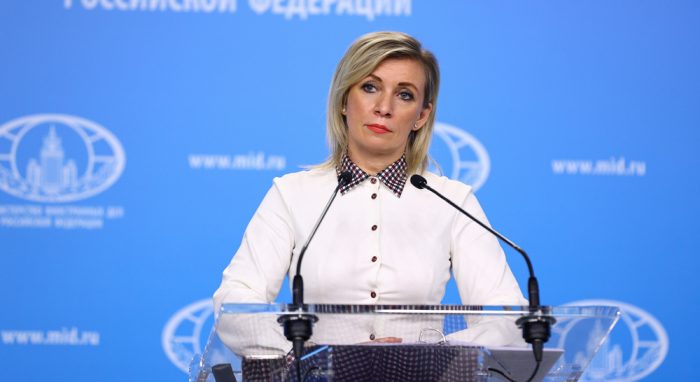
Press TV – December 17, 2023
Russian Foreign Ministry spokesperson Maria Zakharova said on Saturday that the latest European Union sanctions against Russia will cause more harm to the EU than Russia.
Zakharova added that the EU’s “dictatorial” behavior reveals how Brussels is “denying” member states of their right to “protect their interests.”
She also warned the EU of the “heavy price” the Europeans must pay for the accession of Ukraine and Moldova to the bloc.
“It goes as far as absurdity, when through some unscrupulous manipulations – when certain heads of state and government are not present at the table, – some legally questionable and obviously politicized decisions are made, which are as follows: on the start of pre-accession negotiations with Ukraine and Moldova, which not only fail to meet the EU’s elementary criteria but directly run counter to them, as well as on another ‘package’ of unilateral restrictive measures against Russia, which, like all the previous ones, will cause bigger harm to the European Union itself,” the diplomat said.
“This dictatorial behavior of Brussels reveals in all its magnitude that the member states are denied their democratic right to a dissenting opinion and the protection of their own interests.”
She went on to add that the EU’s confrontational “policy and the consequences of its opportunistic decisions regarding Ukraine and Moldova will have to be paid by the population of European countries.”
EU members agreed on a 12th package of sanctions against Russia, the European Council said on Thursday, meaning that a phased ban on Russian diamond imports among other measures will come into effect from January 1, 2024.
Moreover, after the summit, European Council President Charles Michel also announced that the EU members had decided to open accession negotiations with Ukraine and Moldova, which may start in March 2024 or later.
The accession talks regarding Ukraine and Moldova started after Hungarian Prime Minister Viktor Orban left the summit in protest to the move. Budapest had earlier threatened to veto the accession of Ukraine into the European Union. “Hungary does not want to be part of this bad decision!” Orban said in a statement on Facebook.
Russia started the “special military operation” in its eastern neighbor in late February 2022 to defend the pro-Russian population in the eastern Ukrainian regions of Luhansk and Donetsk against persecution by Kiev.
Ever since the beginning of the war, Kiev’s Western allies, led by the United States, have been pumping Ukraine with advanced weapons and slapping Russia with a slew of sanctions, steps that Moscow says would only prolong the hostilities.
Zakharova also said that the EU is continuing to “swiftly lose both political and economic weight around the world” under the pressure of the United States’ missteps.
“The EU’s resources, so much needed for its domestic growth, are not funneled into resolving multiple problems and asserting its own place in the emerging multipolar world order, but into serving the US interests, including into the enrichment of the US military-industrial complex,” she said.
Zakharova added that it looks quite natural that against this backdrop, “the most responsible politicians in European countries are more and more frequently prioritizing national interests over some mantras of ‘European solidarity,’ which are out of touch with real needs.”
Joe Biden’s World War III Fantasy
By Scott Ritter – Sputnik – 16.12.2023
On July 13, 2023, US President Joe Biden confidently announced to the world that “[Russian President Vladimir] Putin has already lost the war.”
The “war” Biden spoke of was Russia’s Special Military Operation against Ukraine, which began on February 24, 2022.
Biden’s bold statement was made during a press conference with Finland’s President Sauli Niinisto, following a meeting with Nordic leaders that came on the heels of the NATO Summit in Vilnius, Lithuania.
Biden declared that the US and its NATO allies had, through their decision to commit to the military victory of Ukraine over Russia, reached “an inflection point in history,” adding that “This fight is not only a fight for the future of Ukraine, it is about sovereignty, security and freedom itself.”
The American president’s pronouncements followed similarly themed rhetoric spoken in Vilnius a day prior, where he announced to his NATO colleagues, “Our commitment to Ukraine will not weaken,” adding that “We will stand for liberty and freedom today, tomorrow, and for as long as it takes.”
“As long as it takes,” it turns out, isn’t the same as “long as needed.”
Confronted with a trifecta of bad news—the calamitous defeat of the NATO-trained and equipped Ukrainian military in the much-hyped summer counteroffensive, a Russian Army that is growing stronger by the day, and the collapse of political will and fiscal ability on the part of Ukraine’s erstwhile allies in the US and Europe to continue funding Ukraine’s flagging war effort—Joe Biden was compelled to alter his pledge to the cause of Ukrainian and European liberty and freedom to “as long as we can,” with the modifier contingent upon the US Congress’ willingness to throw another $60 billion into the $120 billion in aid the US has provided Ukraine since May 2022.
To intimidate Congress into yielding to his demands regarding money for Ukraine, Biden undertook a campaign of terror. “Frankly,” Biden said in a statement delivered at the White House in early December, “I think it’s stunning we have gotten to this point in the first place. Republicans in Congress are willing to give Putin the greatest gift he could hope for and abandon our global leadership.”
While many Republicans support continued funding of the Ukraine war effort, the issue has become politicized in the lead up to the 2024 presidential election, where domestic issues tend to trump foreign affairs. And, currently, there is no more high-profile domestic policy issue than border security and immigration reform. Senator Lindsey Graham, a Republican from South Carolina who has been a vociferous supporter of Ukraine, noted that while he would support continued funding of Ukraine’s war effort, he could not return to his home state of South Carolina to “try to explain why I helped Ukraine, Taiwan and Israel and did nothing to secure our own border. I will help all of our allies, but we have got to help ourselves first.”
Mike Johnson, the new Republican speaker of the House and a hardline conservative, indicated that the objection to continued funding for Ukraine went beyond simply funding issues. “What is the objective?” Johnson said to reporters after meeting with Ukrainian President Zelensky earlier this month. “What is the endgame in Ukraine? How are we going to have proper oversight of the funds?”
Russian servicemen fire a BM-21 Grad multiple rocket launcher towards Ukrainian positions in the course of Russia’s military operation in Ukraine, at the unknown location in the
Both Graham and Johnson had been subjected to a full-court press by Joe Biden and the White House in an effort for the recalcitrant Republicans to reverse course on their objections. “We can’t let Putin win,” Biden pleaded. “If Putin takes Ukraine,” Biden noted, “he won’t stop there.” The US president said an emboldened Putin would move on to threaten his NATO neighbors. And then, Biden stated, “We’ll have something that we don’t seek and that we don’t have today: American troops fighting Russian troops.”
If the threat of a Third World War in the face of Congressional inaction wasn’t enough, Biden authorized the Pentagon to declassify and release to CNN an intelligence report that claimed that Russia had suffered enormous casualties in its war with Ukraine, with some 315,000 of an estimated 360,000 troops that made up Russia’s pre-conflict ground force, having been killed or wounded. The declassified intelligence report also claimed that 2,200 of Russia’s 3,500 tanks have been lost, along with 4,400 of 13,600 infantry fighting vehicles and armored personnel carriers.
The release of the declassified report was clearly timed to influence the US Congress by emphasizing the very talking points that have been repeatedly made by Senator Graham and others that the US aid was “Best money we’ve ever spent” because “the Russians are dying.”
Given the history of the US intelligence community of declassifying intelligence reports for the specific purpose of releasing the information to mainstream media outlets to shape public opinion—even if the intelligence community knows the information contained in the report is wrong—one must take the report regarding Russian casualties with a heavy grain of salt. According to Russian President Vladimir Putin, Russia currently has some 617,000 troops deployed in the Special Military Operation zone. These forces are on the offensive, actively advancing on several fronts against a Ukrainian Army which is rapidly losing its ability to sustain large-scale ground combat operations. This doesn’t sound like the performance of an organization that suffered some 87% casualties, a figure which would make the survivors combat ineffective.
The fact is, US and European support for Ukraine is flagging, and Ukraine is facing an existential crisis in the coming weeks and months that it most likely will not be able to resolve in its favor.
While Russian troops are taking casualties, it is far more likely than not that the real Russian casualty figures are significantly less than the number reported in the declassified US intelligence report, spread out over the original force and the hundreds of thousands of mobilized reservists and volunteers who have entered the fighting since. These losses pale in comparison to the more than 400,000 dead and nearly one million wounded Ukraine has suffered.
Russia’s combat power grows every day, with fresh troops and equipment being made available for the war effort. Ukraine, on the other hand, has exhausted its reserves, and is left scraping the bottom of its human resources barrel to man whatever units it is able to organize from what is left of Ukraine’s diminished, and diminishing, arsenal.
While the Russian Army is indeed large, and growing, and its capabilities expanding as it becomes more combat experienced, it is an army with a very specific mission—the defeat of the Ukrainian Armed Forces. The Russian force structure is currently more than sufficient to defeat the Ukrainians on a frontage that stretches some 2,000 kilometers in length. It is even large enough to secure some additional Ukrainian territory, in addition to liberating the newly absorbed Russian territories of the Kherson, Zaporozhye, Donetsk, and Lugansk regions still held by Ukraine. But there are physical limitations as to what one can accomplish with 617,000 troops and occupying all of Ukraine before invading Poland and/or the Baltics is well beyond the capacity of the Russian forces currently deployed in the Special Military Operation.
Moreover, Russian President Vladimir Putin has never intimated that Russia had any intention to either occupy all of Ukraine or seek to attack NATO — just the opposite. The Russian goals and objectives of the Special Military Operation are spelled out very clearly — demilitarization (the destruction of the Ukrainian Armed Forces), de-Nazification (the elimination of the regime of Ukrainian President Volodymyr Zelensky and the pro-Nazi political element inside Ukraine), and permanent neutrality for Ukraine (i.e., Ukraine will never join NATO). There is no intent to take the war to NATO. Such thinking is a fear-based construct of the Biden administration that is inaccurate and far removed from reality, little more than a fantasy which the sober-minded Russian government, ever mindful of the need to carefully manage escalation because of the Special Military Operation, will pay scant attention to.
Joe Biden and his national security team are scrambling to manage the consequences of policy failure. Putin, it seems, has not lost the war with Ukraine. Russia is winning, something no amount of funding by either the US, the Europeans, or both, can reverse. The best thing that could happen to Ukraine is for the congressional Republicans to hold steadfast to their objections and allow Ukraine to be taken off the life support that US funding provides. Ukraine is a terminal case. Continuing to underwrite its failed war effort simply prolongs the agony of its people.
Zelensky’s Global Begging Tour Is an Obscene Fiasco
Strategic Culture Foundation | December 15, 2023
The United States’ proxy war in Ukraine against Russia has cost the lives of up to 400,000 Ukrainian soldiers. In the last six months alone, it is estimated that over 120,000 Ukrainian troops have been killed in a failed counteroffensive.
Even Western media are coyly admitting the grim reality of failure after much-vaunted predictions last year of imminent victory against Russia.
Yet nearly two years after the conflict erupted, the leader of the puppet regime in Kiev persists in begging for billions more in funds from his Western sponsors to continue the bloodbath – the biggest armed confrontation in Europe since the Second World War.
The hostilities can be traced back to the 2014 coup in Kiev orchestrated by the CIA and precipitated by the European Union and Washington trying to cleave traditional Ukrainian relations with Russia. Those hostilities culminated in February 2022 in what can be seen as a U.S.-led proxy war against Russia. A war that has failed for the Western powers and needs to be peacefully negotiated to spare further death and destruction.
This week, however, saw Ukrainian President Vladimir Zelensky going to Washington to plead for $60 billion in additional funds. His begging mission failed. The U.S. Congress refused to pass the supplemental bill requested on his behalf by President Joe Biden for Ukraine.
After that humiliation, Zelensky then turned his solicitation to the European Union. The EU, by turn, failed to agree on a requested fund for $54 billion for Ukraine.
As a sort of consolation prize, the EU leaders at their two-day summit in Brussels declared that Ukraine could start negotiations for eventually gaining access to the 27-member bloc. That decision was bombastically hailed as “historic” but it seemed more theatre than substance given that the negotiations will take several years to conduct and there is no guarantee at the end of the tedious process that Ukraine will actually gain EU membership. Will Ukraine even exist as a state in a few years, as our columnist Stephen Karganovic ponders in an article this week?
The EU membership talks were granted no doubt as a way to distract from the fact that the EU funds were not forthcoming and especially following the miserable response from U.S. lawmakers.
The whole sorry saga indicates that the U.S.-led proxy war in Ukraine has become a deplorable black hole for Western public money. Given the military debacle and the futile bloodshed, it is becoming politically untenable for Washington and Brussels to keep shovelling billions of taxpayer money into this abyss.
Up for the asking this week was a total of nearly $100 billion between the U.S. and Europe for Ukraine. How many badly needed public services in Western states could do with – and are denied – that kind of financial sustenance?
The spectacle of Zelensky touring the world scrounging for more money is as shameful as it is sordid.
Official figures show that the Western governments have already donated a combined total of $200 billion to Ukraine since the conflict escalated in February 2022.
To put that largesse into perspective, it is estimated that the U.S. Marshall Plan for the reconstruction of the whole of Europe following World War Two was equivalent to $173 billion in today’s money.
Think about that. The Western funding to Ukraine already exceeds this historic salvage package by some $30 billion. And yet Western governments are trying to muster another $100 billion on top of that.
There are several conclusions to be made. First of all, the U.S.-led proxy war against Russia is indisputably a calamitous failure. Despite the unprecedented financing of weapons and other support to the Kiev regime, the war is a dead-end for the Western powers. The 30-member NATO military alliance is staring at a defeat unparalleled in its 75-year history.
Secondly, it is patent that the Kiev regime is only being propped up by the transfer of colossal flows of aid from the West. Without those transfusions of weapons and capital, the regime is finished. It has already lost grievous numbers of troops on the battlefield. Conscription drives are scraping the barrel. Without the lifeline of aid, the regime is finished. The Kiel Institute for World Economy reported last week that Western capital pledges to the Kiev regime have fallen off a cliff since the summer.
Russian President Vladimir Putin said this week in his annual marathon televised Q&A with the public and journalists that Russia will push on with its objectives of eradicating the NATO-backed Nazi forces in Ukraine. There seems little doubt that the objective will be achieved given the parlous state of the Kiev regime.
Another conclusion to draw is the scale of corruption that Ukraine is mired in. For all the funds pumped into this regime so much of it has been siphoned off from the stated purposes.
The obscenity of this war racket is the inordinate corruption, deaths and destruction of economies across Europe while Western weapons corporations have raked in mega-profits.
Zelensky’s global begging tour is a desperate attempt to keep the war racket going for a while longer. He and his wife Olena have enriched themselves with overseas properties and shopping trips to Paris and New York. Zelensky and his cronies have been paid off with blood money for their role in peddling the biggest war scam in modern history. A scam that is funded by hard-pressed and hoodwinked Western taxpayers who have been gaslighted by their politicians and media about “defending democracy and freedom”.
To keep this grotesque charade going, Western politicians in the pay of arms companies and NATO think tanks are resorting to desperate scaremongering and blackmail.
President Biden has repeatedly warned that if extra funds were not released to Ukraine to “defend against Russian aggression” the rest of Europe will be overrun by Moscow.
In Washington this week, U.S. lawmakers who refused to pass the supplemental funding bill for Ukraine were, in effect, accused of being traitors by helping Russia.
Zelensky appealed to European leaders by saying that Putin would exploit any negativity towards Ukraine, and he pleaded with the EU to not “betray” Ukrainians.
On the eve of the EU leaders’ summit in Brussels, the European Commission declared that it was finally releasing €10 billion in withheld funds to Hungary. That was a bribe to Hungarian premier Viktor Orban to concede to the proposed €50 billion in extra aid for the Kiev regime. In the end, Orban did not concede to the multi-billion-euro handout, however, he gave way to his objection to talks for Ukraine’s membership of the EU. Such is the shoddy business of propping up the Kiev regime that arm-twisting and bribery are the order of business in Brussels.
The horrendous waste of lives and financial resources in Ukraine by the Western elite – instead of pursuing diplomacy and peace – is the hallmark that these regimes are terminally corrupt and doomed to failure.
The conflict in Ukraine has recklessly stoked tensions between nuclear powers and has condemned generations of Americans and Europeans to debt. The war in Ukraine is a historic dead-end for the U.S. and its European vassals. Zelensky’s begging bowl is a death rattle.
Poland to Retract Theories About Russian Responsibility for Tu-154 Plane Crash in 2010
Sputnik – 15.12.2023
A Tupolev Tu-154 plane, which was carrying Polish President Lech Kaczynski, his wife and other top public and military members of a Polish delegation, crashed while approaching Smolensk Airport in Russia on April 10, 2010.
Polish authorities will abandon versions about Russia’s responsibility for the 2010 crash of a Tu-154 plane near Smolensk that killed Polish President Lech Kaczynski, Polish Minister of Internal Affairs and Administration Marcin Kerwinski told reporters.
“There are no binding versions here. It is a matter of the state honestly finding out what happened. The report of [former minister] Jerzy Miller explained in detail the causes of that terrible disaster in an honest, comprehensive and profound way. This is an official document,” Kierwinski told reporters.
The plane crash that killed President Lech Kaczynski and 95 other high-ranking Polish officials occurred on April 10, 2010, in Smolensk, Russia.
A year after the tragedy, the Interstate Aviation Committee (IAC) announced after an investigation that the immediate cause of the crash was the crew’s decision not to seek an alternate airfield in fog conditions, and that the systemic causes were shortcomings in the training of the pilots of the presidential squadron.
The Polish commission headed by former interior minister Jerzy Miller came to similar conclusions at the time, citing the cause of the crash as the aircraft descending below the minimum altitude allowed in foggy conditions. Polish authorities later disagreed with the IAC report and the conclusions of Miller’s commission and decided to establish a second commission, which has been unable to complete its work for several years.
Ukraine’s Botched Counteroffensive Ignites New ‘Mantras’ in US – Lavrov
Sputnik – 13.12.2023
With Ukraine’s counteroffensive obviously failing, the United States has taken up a new rallying cry, which is to prevent Russian President Vladimir Putin from winning in Ukraine so that “NATO is not conquered,” Russian Foreign Minister Sergey Lavrov said.
“After the collapse of the so-called counteroffensive, [people] in Washington stopped talking about Russia’s strategic defeat on the battlefield and, during Zelensky’s latest visit, activated a new mantra: ‘don’t let Putin win in Ukraine’, otherwise all of NATO will be conquered and then America won’t sit through it,” Lavrov said during the “government hour” in the Federation Council, upper house of the Russian parliament.
“We are ready for such a challenge and will continue to firmly defend our truth,” Lavrov emphasized.
The top Russian diplomat also noted that “it is not easy for our ill-wishers to come to grips with the fact that the bet on the sanctions blitzkrieg against the Russian economy has completely failed.”
“Therefore, those who launched the hybrid war against us won’t admit their mistakes, they are trying to use more and more illegitimate tools to wear down Russia, as they say, relishing the dream of eliminating our country as an independent geopolitical value,” the Russian diplomacy chief explained.
Mainstream propaganda machine doubles down on ‘Russia losing’ fantasies
By Drago Bosnic | December 13, 2023
Even before the start of the special military operation (SMO), the mainstream media had been running several propaganda narratives, almost simultaneously. Shortly before the SMO and in the first few days, there was the claim that Russia would take Kiev in three days and most of Ukraine in a week. However, as this didn’t happen (nor was it ever planned to unfold this way in the Kremlin), the mainstream propaganda machine went full afterburner in the opposite direction. Now, Moscow was suddenly losing, the Kiev regime forces are unbeatable, the Russians are suffering from extremely low morale due to massive losses, they’re running out of missiles, shells, fuel and so on, and so forth.
These ludicrous myths never stopped and continued until the failure of the much-touted counteroffensive. That was when many in the political West adopted a somewhat less propagandistic tone and tried mixing in some “realism”. However, this didn’t have the desired effect on the populace in Western Europe and North America. Thus, there’s a slow return to the most ridiculous propaganda one could possibly imagine. For instance, the Wall Street Journal claims that the Neo-Nazi junta will be “able to seize the initiative on the battlefield in 2025 if it can hold out against Russia until the end of next year”. This narrative is being pushed despite the fact that the United States, its primary backer, is about to stop the money flow.
The report initially doesn’t come off as propagandistic as one would expect, but towards the end, the authors still tried pushing debunked propaganda narratives. There are several instances of somewhat unexpected admissions, such as the obvious failure of the Kiev regime’s counteroffensive, as well as the dwindling financial support from the political West. The report also touched upon the growing divisions within the Neo-Nazi junta and the fact that its battered military will need time to recover. However, in a response to the WSJ, its Foreign Minister Dmytro Kuleba challenged this with a claim that “any pause in the fighting now would allow Russia to regroup and prepare for large-scale offensive operations”.
Kuleba even stated that the Kiev regime forces are preparing fresh brigades for “new counteroffensive and defensive operations”. The WSJ supported the idea and even went as far as to claim that “2024 will be the year of the recovery [for the Neo-Nazi junta troops]”. However, the authors admit that this comes with an important caveat, as the Kiev regime and its NATO overlords will need to “work through their current adversities and continue delivering supplies to troops, an emerging best-case scenario among Western strategists is that next year becomes a year of rebuilding for Kiev’s military“, adding that “the hope would be that a limited number of Ukrainian soldiers can hold Russian forces at bay”.
This would supposedly “allow NATO countries time to train fresh Ukrainian troops, expand armament production and restock Ukraine’s arsenals”. As indicated during a recent NATO meeting, the political West hopes that Russia’s incremental offensive operations will fail, “resulting in a depletion of its manpower and munitions, potentially offering Ukraine better prospects to retake the battlefield initiative in the spring of 2025, if it gets through next year”. However, the WSJ concluded the report with a not-so-optimistic remark of a Ukrainian infantry sergeant who said that when he talks to people at home he tells them that “everything is going well” and doesn’t describe what he sees or feels, which isn’t so upbeat.
“What is the point?”, the WSJ quoted the Ukrainian sergeant.
While the WSJ certainly is part of the mainstream, it’s still a bit more reputable than many other outlets of America’s massive propaganda machine. For instance, the infamous CNN is beating its own records in laughable claims by publishing that “Russia has lost a staggering 87% of the total number of active-duty ground troops it had prior to launching its invasion of Ukraine and two-thirds of its pre-invasion tanks”. Of course, this information came from “a source familiar with a declassified US intelligence assessment provided to Congress”. The assessment was sent on December 11, as the Republican-dominated Congress was in the middle of effectively canceling the “Ukraine aid”.
The “intelligence” assessment supposedly found that “the war has sharply set back 15 years of Russian effort to modernize its ground force”. Then came the numbers game, where CNN claims that “of the 360,000 troops that entered Ukraine, including contract and conscript personnel, Russia has lost 315,000 on the battlefield, 2,200 of 3,500 tanks and 4,400 of 13,600 infantry fighting vehicles and armored personnel carriers have also been destroyed, a 32% loss rate”. CNN says it reached out to the Russian Embassy for comment, which is yet to respond. The most likely scenario is that His Excellency Ambassador Anatoly Antonov is still laughing uncontrollably after reading all this. And he certainly isn’t the only one.
“The idea that Ukraine was going to throw Russia back to the 1991 borders was preposterous,” Sen. J.D. Vance, a Republican from Ohio, said on CNN’s State of the Union on December 10, adding: “So what we’re saying to the president and really to the entire world is, you need to articulate what the ambition is. What is $61 billion going to accomplish that $100 billion hasn’t?”
Even CNN had to admit that “Ukraine remains deeply vulnerable”, as its “highly anticipated counteroffensive stagnated through the fall”, and that “US officials believe that Kiev is unlikely to make any major gains over the coming months”. As for the alleged “staggering losses” of the Russian military, the truth is that Moscow hasn’t been this strong militarily since at least the 1980s. In addition, the Kremlin is effectively returning to a Soviet superpower level with its latest military strategy shift. The very idea that Russia lost well over 300,000 soldiers is beyond ludicrous, as the country would be littered with new military cemeteries in virtually every major settlement. On the contrary, it’s precisely Ukraine that looks like that thanks to the NATO-backed Neo-Nazi junta.
Drago Bosnic is an independent geopolitical and military analyst.
Ukrainian trial demonstrates 2014 Maidan massacre was false flag
By Kit Klarenberg | The Grayzone | December 11, 2023
A massacre of protesters during the 2014 Maidan coup set the stage for the ouster of Ukraine’s elected president, Viktor Yanukovych. Now, an explosive trial in Kiev has produced evidence the killings were a false flag designed to trigger regime change.
Two police officers charged with the mass shooting of opposition protesters in Kiev’s Maidan Square in 2014 have been released after a Ukrainian court determined the fatal shots in the infamous massacre were fired from an opposition-controlled building.
On October 18 2023, Ukraine’s Sviatoshyn District Court determined that of the five officers on trial, one would be acquitted outright, while another was sentenced to time served for alleged “abuse of power.”
The remaining three, who no longer live in Ukraine, were convicted in absentia on 31 counts of murder and 44 counts of attempted murder. This, under a Supreme Court opinion stipulating suspects can be held collectively responsible for the actions of a group deemed criminal.
The verdict means no one will face jail time, or be in any way punished for their alleged role in the infamous Maidan massacre, which saw over 100 protesters killed, triggered an avalanche of international condemnation and led directly to the downfall of President Viktor Yanukovych, who fled the country mere days later.
The trial began in Kiev in 2016, but the case languished for years. Matters were further complicated in 2019, when Ukrainian President Volodymyr Zelensky traded all five of the accused for prisoners held by Donbas separatists. Two subsequently returned on a voluntary basis to have their day in court.
Unsurprisingly, the verdict has triggered outrage among victims’ families, and prosecution lawyers say they plan to appeal. By contrast, the mainstream media has so far remained eerily indifferent. In an apparent attempt to distort the trial’s outcome, several outlets — including Reuters — simply referred to the court “sentencing” the officers in their headlines. The Kyiv Post went as far as falsely claiming all five had been found “guilty” of “Maidan crimes.”
But there is more to the story than these outlets have let on. As even the Western-funded Kyiv Independent acknowledged, “a former top investigator” previously tasked with probing the massacre said the verdict followed years of deliberate sabotage by Ukrainian authorities, who “have done their best to make sure there are no real results.”
The question of why officials in Kiev would seek to sabotage the probe has been largely ignored by legacy media outlets. But the verdict offers some highly revealing clues.
‘Unknown persons’ behind killing
Littered throughout the 1,000,000 word document are passages demonstrating conclusively that the sniper fire emanated from buildings controlled by the opposition to Yanukovych. Collectively, these excerpts strongly suggest the Maidan massacre was a false flag carried out by nationalist elements who aimed to ensure the president’s ouster.
The evidence “was quite sufficient to conclude categorically that on the morning of February 20, 2014, persons with weapons, from which the shots were fired, were in the premises of the Hotel Ukraina,” the court found.
Another section reveals “Hotel Ukraina” was “territory… not controlled by law enforcement agencies at that time.” Numerous video recordings show that before, during, and after the massacre, the building was overrun by the far-right opposition party Svoboda, whose leaders used the premises to coordinate their anti-Yanukovych activities on the streets below.
In at least 28 of the 128 shootings considered during the trial, the court ruled that whether “due to the lack of information, the incompleteness or contradictory nature of the submitted data,” the “involvement of law enforcement officers has not been proven,” and that “other unknown persons cannot be ruled out.”
Furthermore, the verdict effectively ruled out any involvement of Russian security and intelligence services in the massacre, a conspiracy theory promoted heavily by pro-Maidan elements.
“The ‘Russian trace’ was not confirmed after examining the relevant documents,” the court found. It concluded that those individuals who were suspected of having ties to Russian intelligence, and were being “constantly monitored,” did not have “any participation in the events on the street.”
For Dr. Ivan Katchanovski, a University of Ottawa political science professor who has spent years documenting overwhelming evidence of opposition responsibility for the massacre, such findings are a long-overdue vindication of his research. In comments to The Grayzone, he explained that the conviction of three police officers in absentia for the murder of 28 Maidan protesters and attempted murder of 36 was “based on a single fabricated forensic ballistic examination.”
The flawed “forensic examination of bullets reversed [the] results of 40 other ballistic examinations” taken previously — every one of which, Katchanovski notes, “showed bullets of Berkut police Kalashnikovs did not match those retrieved from bodies of killed Maidan protesters.”
In the end, “the trial produced an extraordinary volume of evidence proving protesters were shot at from various buildings controlled by pro-Maidan elements,” he says, pointing to the “over 100 witnesses, including 51 anti-government activists injured during the shooting, [who] testified to having been shot from these areas, or seeing snipers located there.”
Elsewhere, the verdict rejected a 3D-model reconstruction of the shooting of three Maidan activists, produced by a New York City-based “unconventional architecture practice” named SITU. This bogus analysis, which was financed to the tune of $100,000 by the Kiev branch of George Soros’ Open Society Foundations, was heavily promoted by The New York Times and other Western media outlets and held up as definitive proof that Ukrainian security forces were responsible for the deaths. But the SITU model changed the location of victim’s wounds — from the side or back of their body to the front — and altered the angles of the bullets’ trajectory to fraudulently convict police for their murders.
As Katchanovski explains, “This is deliberate fraud and disinformation.”
“SITU’s bogus modeling allowed The New York Times and many others to deny the existence of Maidan snipers, and brand as ‘conspiracy theory’ any suggestion the massacre was a ‘false flag,’” he says.
But if the Berkhut officers were not responsible for the dozens of deaths that day, the question remains: who was?
Maidan killers move to Odessa
In August 2023, the New York Times revealed that the Ukrainian gunrunner Serhiy Pashinksy, once openly condemned by Zelensky himself as a “criminal,” had become the top private supplier of arms to Ukraine. Pashinsky sourced grenades, artillery shells and rockets “through a trans-European network of middlemen,” then sold, bought and resold the arms “until the final buyer, Ukraine’s military, pays the most.” The hustle has enriched him to the tune of hundreds of millions of dollars.
Pashinsky, a former Ukrainian parliamentarian, was a central figure in the Maidan coup. As The Grayzone subsequently revealed, he has been accused by three Georgian mercenaries of personally orchestrating the February 2014 massacre, supplying the weapons used and personally picking targets to be shot. When Israeli journalists confronted Pashinsky about these allegations, he threatened to have his associates track them down at home and “tear them apart.”
During the Maidan trial, defense lawyers made prominent mention of those same Georgian mercenary snipers. Along with Maidan leaders, and Western-backed fascist paramilitary Right Sector, the snipers were also implicated in the May 2014 Odessa massacre, a gruesome incident in which scores of Russian-speaking anti-Maidan protesters were forcibly herded into the city’s Trade Unions House, which was then set alight. In all, 46 died due to burn injuries, carbon monoxide poisoning, and attempts to escape the horrors by jumping out of windows. Non-fatal casualties reportedly totaled around 200.
Katchanovski says that as with Maidan, evidence points to the role of an extremely well-organized plot to carry out the Odessa killings:
“A Georgian sniper who confessed their Maidan massacre role in an Israeli documentary also revealed one of the massacre’s organizers dispatched them to Odessa right before the attack on separatists there.”
Post-coup, coverup after coverup
From the beginning of the Maidan trial, witnesses and prosecutors were subjected by far-right Ukrainian figures to a campaign of intimidation. During proceedings, Neo-Nazi C14 and Azov activists stormed the courtroom, attacked defendants, and placed tires outside the court in an apparent threat to burn the building down. The presiding judge was even beaten by a Maidan activist.
“Covert pressure from Zelensky’s administration and the far-right is likely much greater than what we have seen publicly,” Katchanovski commented to The Grayzone. “Ukraine’s judiciary isn’t independent. Zelensky’s administration routinely and openly interferes in proceedings, and even dismissed the entire Constitutional Court. It’s a very difficult situation for the judges and jury. There were direct threats from the far-right to convict the accused.”
Accordingly, some wounded protesters who initially testified to the presence of snipers in Maidan-controlled buildings later revoked their accounts. They subsequently admitted the prosecution met with them privately, to discuss what they’d said on the witness stand. For Katchanovski, “this is proof the coverup goes to the top of the Ukrainian government.”
Many Ukrainians, especially in the East, have held this same suspicion since Ukraine’s post-Maidan nationalist coup government adopted a wide-ranging amnesty law in 2014. That legislation granted Maidan protesters blanket immunity from prosecution for every serious crime imaginable, including murder, terrorism, and seizure of power. The law also prohibited official investigation of any anti-government agitator for these crimes, and ordered the destruction of all relevant evidence that had previously been collected.
A high-ranking official within Ukraine’s Prosecutor General Office has since admitted that prosecutors handling the Maidan massacre investigation and trial were covertly selected and appointed by none other than Pashinsky. Efforts to conduct a parliamentary commission to probe the killings were blocked by Petro Poroshenko, the rabidly anti-Russian President of Ukraine who succeeded the ousted Yanukovych in 2014.
The official tampering was understandable, Katchanovski argues, given how fundamental Kiev’s narrative of the Maidan massacre is to the legitimacy of the Ukrainian government. The false flag mass murder led directly to Yanukovych, justifying the withdrawal of government forces from downtown Kiev, the seizure of government buildings by Maidan activists, and the president’s unconstitutional removal by the Ukrainian legislature.
All these developments paved a path to the eight-year-long civil war in Donbas, which claimed the lives of over 14,000 and precipitated Russia’s invasion in February 2022. For Katchanovski, the link between the false flag massacre and ongoing war in Ukraine is obvious. The verdict, he says, makes that even more clear.
As retaliation for his groundbreaking investigations into the Maidan massacre, Katchanovski’s home and property were illegally seized by local courts in 2014 “with the involvement of senior officials.” Yet the professor remains more determined than ever to get to the bottom of the story.
“One day, the truth of what happened will be officially acknowledged — the only question is when,” he vowed. “Delayed acknowledgment and lack of justice in this case has already cost Ukraine very dearly. There are many conflicts, including the ongoing war, which spiraled from the Maidan massacre. Countless people have suffered needlessly as a result. The time for truth and reconciliation is well overdue.”
Kit Klarenberg is an investigative journalist exploring the role of intelligence services in shaping politics and perceptions.
FOI Request Reveals Bellingcat Collusion With Western Intelligence
By Kit Klarenberg | Strategic Culture Foundation | December 12, 2023
An email sent on November 12 2020 by an officer within Amsterdam’s National Coordinator for Security and Counterterrorism (NCTV) shows a Bellingcat investigation was intentionally shared with the agency prior to publication, so as to assist the Dutch spooks in shaping media strategies and messaging following its release. The revealing communication is irrefutable proof of the cozy relationship the self-styled “independent investigative collective of researchers, investigators and citizen journalists” enjoys with Western intelligence services.
In the message, marked “high importance,” the undisclosed author explained that Bellingcat would soon publish research amounting to a deeply libelous attack on independent journalists and researchers, who challenged the mainstream narrative surrounding Malaysia Airlines Flight 17. As such, the Dutch intelligence officer wrote, “it is probably smart to put together interdepartmental wording for this already”:
“Because the article highlights several sides (MH17 but also COVID19) it is probably wise to wait a while and see if; a. the mainstream media pick it up; b. from which angle the media pick up and highlight it (MH17 or COVID); c. from this angle to determine the wording and therefore which department is in the lead; d. coordinate the language as much as possible interdepartmentally.”
A ‘bonanza’ of Western intel propaganda
The article in question, entitled “The GRU’s MH17 Disinformation Operations Part 1: The Bonanza Media Project,” was framed as an investigation into a now-defunct independent media venture named Bonanza Media which was established by Russian journalist Yana Yerlashova with the help of freelance Dutch researcher Max Van der Werff.
Much of Bonanza’s work challenged Western assertions that separatist fighters in Donbass shot down MH17 with a Buk surface-to-air missile system provided to them by the Russian military. Ukrainian officials began pushing that narrative, citing audio recordings they claimed to have intercepted alongside material purportedly found on social media implicating the separatists, even before Malaysia Airlines publicly announced it had lost contact with the plane.
Bellingcat, which serendipitously launched just days before the downing of MH17, came to prominence by immediately seizing on this deluge of carefully-curated and potentially falsified information. With amazing speed, the organization claimed to have precisely mapped out what happened that fateful day, and exactly how it occurred. Despite its relative inexperience and opaque organizational structure, its findings were accepted without a shred of scrutiny by Western journalists, lawmakers, pundits, and the official Dutch MH17 tribunal, which concluded in November 2022.
Bonanza Media’s film, “MH17 – Call for Justice”, features interviews with witnesses on-the-ground that day and Malaysian government officials who did not accept the official story, but doesn’t rule out the possibility of Russian culpability altogether. However, the documentary presented a substantial challenge to Bellingcat’s version of events – which also happened to align neatly with the official narrative. In 2020, Bonanza also published leaked documents confidentially submitted to the tribunal. This included Dutch intelligence files recording that while many Ukrainian Buk systems had been spotted in eastern Ukraine, Russian equivalents were nowhere to be seen.
Evidently, Bellingcat and its founder, Eliot Higgins, were displeased with their results. As Dutch freelance journalist Eric van de Beek wrote in 2020, “because it was impossible for Bellingcat to discredit Van der Werff on the basis of the well-researched content featured on his blog and in his recent documentary, Eliot Higgins opted to wage a campaign of misinformation.”
Bellingcat’s 2020 investigation into the group strongly insinuated Bonanza was being run by Russia’s GRU, heavily implied their investigations were edited by the agency’s operatives before publication, and suggested its contributors were on the Kremlin’s payroll. The group claimed their conclusions were “based on emails from the mailboxes of two senior GRU officers obtained by a Russian hacktivist group and independently authenticated by us.”
Strict British libel laws may have prevented the group from making direct allegations to this effect, but the Dutch media had no such qualms, and the investigation triggered a wave of smears in major local publications. One daily newspaper headlined as fact: “Dutch MH17-blogger directed by Russian secret service.” Another, which directly asserted that “Van der Werff worked on the orders of the Russian military intelligence service GRU,” is currently being sued by the researcher regarding the unproven claim.
Strikingly, throughout this period not a single mainstream journalist questioned how Bellingcat acquired the highly sensitive trove of documents upon which its investigation depended. On top of confidential GRU emails, Bellingcat somehow apparently acquired phone data showing calls between purported Russian intelligence officials and cell tower data tracking their movements, which it claimed pinpointed their locations to GRU headquarters in Moscow. None of this information is remotely “open source,” and since it wasn’t shared publicly, it can’t be independently verified.
Oddly, in one passage, Bellingcat stated “it is not clear who requested or suggested” changes to a Bonanza article it alleged were made after the piece was submitted to the GRU, before publication. One might think ascertaining this would be simple, given the vast amount of highly incriminating evidence to which Bellingcat had exclusive access. Perhaps British libel laws were a deterrent to accusing the GRU — but why would this be the case if the material was authentic, and defending it in court was no issue?
MH17 verdict undermines Bellingcat
The newly-released NCTV email strongly suggests Bellingcat’s investigation into Bonanza was the product of a Western intelligence information operation, intended to steer the MH17 tribunal in a very specific direction — namely, towards the defendants’ guilt. Sure enough, Russian nationals Igor Girkin and Sergey Dubinskiy, and Donbas separatist Leonid Kharchenko, were convicted in absentia for the murder of MH17’s 283 passengers and 15 crew members, the court ruling they arranged the transfer of the Buk surface-to-air missile system that reportedly struck the plane.
Meanwhile, the only defendant to seek legal representation and give testimony during the trial, Oleg Pulatov, was acquitted on all charges. The court found there was “no indication” he was involved in obtaining the missile system, that he could have prevented its use, or that he was involved in transporting it to another location after the incident. Prosecutors announced they will not appeal the verdict.
The response by the normally brash Higgins to the Dutch court’s judgment was uncharacteristically muted. In an otherwise self-congratulatory Twitter thread, he merely noted that “Pulatov is acquitted, the rest are found guilty.” There was no explanation for why the defendant was found innocent, nor any analysis of the ruling’s potential implications for Bellingcat’s MH17 investigations.
This defence at the MH17 trial is a total car crash, the JIT has had 5 and a half years to prepare for this nonsense, and it’s just recycling MH17 truther nonsense.
— Eliot Higgins (@EliotHiggins) June 22, 2020
Higgins and his crack squad of laptop jockeys were understandably embarrassed on these counts. Not least because the Bellingcat chief repeatedly mocked Pulatov and his lawyers during the tribunal, suggesting his conviction was a fait accompli, and sneering when the defendant testified accusations of responsibility for MH17 resulted in adverse personal consequences for him. A June 2020 Bellingcat investigation lambasted Pulatov’s testimony, suggesting his defense strategy was “unlikely to win Mr. Pulatov the court’s sympathies.”
We detail the role that each of these four men had in the downing with our new report. Girkin was the Minister of Defense of the DNR in July 2014, Dubinsky was the head of the GRU DNR, the Pulatov/Kharchenko were his underlings. https://t.co/2cVjK2RCPj pic.twitter.com/wjHwBqpzrP
— Bellingcat (@bellingcat) June 19, 2019
A sordid history of smears
Bellingcat’s confirmed collusion with NCTV raises obvious questions about whether the organization’s relentless attacks on journalists and researchers who do not toe the official national security line are also directly coordinated with, and on behalf of, Western intelligence agencies. In many cases, Bellingcat’s attacks have had real-world consequences for its targets.
For example, Bellingcat has over many years attempted to destroy the career of MIT emeritus professor Theodore Postol, who questioned official investigations into alleged chemical strikes in Syria. In 2019, Bellingcat pressured a science journal to prevent Postol from publishing an academic paper challenging the results of a UN probe into the alleged 2017 Khan Sheikhoun sarin attack which blamed the Syrian government on the basis of supposed “computational forensic analysis.”
Throughout the Syrian conflict, Bellingcat published investigations blaming government forces for chemical weapons attacks, typically within hours of them allegedly happening. These findings were invariably based in part on material provided to the organization by British intelligence constructs on-the-ground, such as the bogus humanitarian group known as the White Helmets. In the immediate aftermath of the notorious April 2018 Douma incident, which OPCW whistleblowers suggest was staged, Higgins tweeted an exclusive photo of one of the cylinders purportedly used in the strike.
The post was abruptly deleted though, perhaps because the White Helmets subsequently shared a photo of the same site in which the same cylinder was in a different position. Proof positive the scene had been manipulated by those staging it. Dissident British academics who have helped expose Douma and other chemical weapons strikes in Syria as opposition-executed false flags – in which British intelligence was frequently complicit – have likewise been relentlessly targeted by Bellingcat.
Elsewhere, Bellingcat fabricated and misrepresented evidence to smear independent Bulgarian journalist Dilyana Gaytandzhieva as a potential GRU asset. Meanwhile, the organization has played a lead role in disseminating and “verifying” dubious, if not outright fraudulent, material and claims related to the Ukraine conflict throughout its duration. Investigations by The Grayzone strongly suggest Bellingcat operatives were directly implicated in a Ukrainian intelligence operation gone wrong, which got Kiev’s forces killed.
CIA veterans have openly praised Bellingcat for stating publicly what spy agencies cannot. In a December 2020 Foreign Policy article entitled, “Bellingcat Can Say What U.S. Intelligence Can’t,” the CIA’s former deputy chief of operations for Europe and Eurasia was quoted as saying:
“I don’t want to be too dramatic, but we love this. Whenever we had to talk to our liaison partners… instead of trying to have things cleared or worry about classification issues, you could just reference their work.”
Accordingly, leaked files exposing the internal workings of Integrity Initiative, a British intelligence black propaganda operation tasked with ginning up conflict with Russia to pad the UK’s defense budget, were rife with references to Bellingcat. As an internal document which describes one of the group’s goals as “increasing the impact of effective organisations currently analysing Russian activities” notes, “we already do this [emphasis added] with… Bellingcat.”
As a result of such excerpts, this journalist repeatedly asked Higgins about the nature of his and his organization’s relationship with the Integrity Initiative. Though initially evasive, in March 2020 Higgins finally denied any association in an email that concluded with an ominous threat:

“The funny thing is your shitty reporting on the matter had [sic] proven quite useful to us, looking forward to you finding out how, try not to feel too bad.”
Almost four years later, this journalist is still waiting to learn what Higgins and his collaborators in Western spy agencies have cooked up to make me “feel bad.” Given the confirmed interest of British intelligence in sabotaging this outlet, and the crazed allegations put to me by the counter-terror police who detained me in London this May, he may have already made good on his threat.
Hungary PM Orbán vindicated, poll finds 71% of Europeans want ‘immediate end’ to Ukraine war and peace talks
Viktor Orbán claimed the recent polling showed that Brussels is not on the side of the European people
BY THOMAS BROOKE | REMIX NEWS | December 12, 2023
Bureaucrats in Brussels do not represent the European people, Hungarian Prime Minister Viktor Orbán has claimed after a recent study revealed that an overwhelming majority of Europeans want peace talks between Ukraine and Russia and an immediate end to the ongoing conflict.
The poll, conducted by Hungary’s Századvég Foundation, found that 71 percent of EU and U.K. citizens believe the war should “end immediately and the parties should be brought to the negotiating table,” while just 20 percent support its continuation until such a time that “Ukraine defeats Vladimir Putin”.
Similarly, 67 percent of respondents were against the deployment of their own countrymen to Ukraine, compared with 25 percent in favor of such a move.
Another question showed that respondents in every EU member state believed that the economic sanctions imposed by Brussels against Russia had been detrimental to the European Union, and saw the United States and China as the biggest winners of the policy.
Only non-EU Norway believed the sanctions had benefited their own country while just five European nations — Norway, Lithuania, Finland, Estonia, and Denmark — believed the move had been beneficial for Ukraine in its ongoing fight with Moscow.
A clear geographical divide between the northern and southern European nations was seen when asked about Europe’s foreign policy concerning China. A majority from every mainland European nation with the exception of Poland and the Baltic states called for more “peaceful economic cooperation” to be sought with the superpower, insisting a “tougher approach is not needed”.
However, Poland, the Baltics, the U.K. and Ireland, and Scandinavian nations believed a tougher approach is necessary “because of its relation to Russia”.
Europeans were also split on Brussels’ policy of sending military aid to Ukraine. Eastern European nations, with the exception of Poland and the Baltics, had a majority of respondents against the provision of weapons to Kyiv, while Ireland, Switzerland, Austria, France, and Italy were also against the move.
A majority in favor of military aid, however, was found in Scandinavian nations, the Baltics, the U.K., Spain, and Portugal
Commenting on the Századvég Foundation’s findings, Prime Minister Viktor Orbán said the numbers were “clear” that the European Union was out of touch with European citizens and its policy to continue funding Ukraine in its conflict with Russia contravene public opinion across the continent.
Hungary has long been an advocate for peace talks, much to the dismay of the European liberal elite which has chastised Orbán’s administration for refusing to toe the line of Brussels.
Hungary has also remained vehemently opposed to the European Commission’s plans to advance EU membership talks with Kyiv despite the ongoing conflict, with Hungarian officials warning Brussels it risks bringing “war to Europe”.
Another study by the Századvég Foundation published on Monday found that 72 percent of Hungarians supported their government’s stance against EU membership for Ukraine, a monthly mood-checker that has seen opposition against the move increase each month since September.
The conservative think-tank warned that if Ukraine joined, “almost all Member States would become net contributors or current agricultural subsidies would have to be reduced by an average of 20 percent” in order to accommodate “Ukrainian farmers working on the richest farmland in Europe”.
Russia’s goal “conquering Ukraine”, say Western media. Not so, say experts
By Uriel Araujo | December 12, 2023
The Ukrainian former defense minister Oleksii Reznikov recently stated that the Kremlin’s goal is to “destroy” Ukraine completely, “assimilating” its citizens into the Russian Federation. Such wild claims have not been much challenged by journalists and opinion-makers in the West. After all, according to Western media Russian President Vladimir Putin’s “plan” is and has always been “to conquer” Ukraine all along. This pervasive Western narrative, also pushed by Kyiv, far from being a kind of self-evident truth, is challenged by voices within the US Establishment such as Jeffrey Sachs and by many respected scholars in the West, including some who are very critical of Moscow. Such a one-sized narrative in fact removes any context regarding the current crisis and completely ignores Russian perspective, goals, and security concerns.
Although a harsh critic of Russia’s ongoing military campaign in Ukraine, Wolfgang Richter (a Senior Associate in the International Security Division at the Stiftung Wissenschaft und Politik – SWP) acknowledged, for example, in a 2022 article that in December 2021, Moscow had “made clear in two draft treaties” what it was after: “preventing a further expansion of NATO to the east and obtaining binding assurances to this end.” The Alliance and Washington, however, according to Richter, “were not prepared to revise the principles of the European security order” and thus Moscow obviously “did not accept this and resorted to the use of force.”
According to this expert, although the US is “far from the theater of conflict in Europe”, French and British nuclear weapons and “the deployment of US sub-strategic nuclear weapons in Europe and NATO’s conventional forces on Russia’s borders” are indeed a security risk in the European continent from Moscow’s perspective. This is so, he argues, quite convincingly, because Russia understands that a future threat could arise from the new American intermediate-range weapons in the continent, which could even reach Russian strategic targets (in the European part of the country) “should Washington and NATO partners decide to deploy them.” Moreover, NATO’s enlargement “has created more potential deployment areas in Central and Eastern Europe.” The Kremlin sees the Atlantic Alliance today, after all, as merely an American tool to advance its geopolitical interests (to the detriment of Russian security).
Sometimes, critics claim that the fact that Moscow cooperated in varying degrees with NATO from the nineties to around 2010 “proves” that Russian claims about NATO’s enlargement should not be taken seriously. This fact, if anything, corroborates Moscow’s arguments.
In his 2018 associated professorship habilitation thesis, Sao Paulo University History Professor Angelo de Oliveira Segrillo describes Putin as a moderate (albeit ambiguously) “Westernist”, rather than an Eurasianist, citing as evidence for it the Russian President’s well know admiration for Peter the Great. Segrillo argues that Putin was never a radical Westernist such as Boris Yeltsin, but rather a pragmatic and moderate one, while also being a gosudarstvennik, that is, someone who advocates for a strong State, in line with Russia’s political tradition. The Brazilian professor thus compares Putin to the French leader Charles de Gaulle, who often opposed Washington and NATO not simply out of an “anti-Western stance” but as someone who is in a position of defending the national interests of one’s own country.
Alas, whether the aforementioned thesis is fully accurate or not, that being something which interests mostly historians and biographers anyway, one can in any case argue that far from being staunchly “anti-Western” due to the supposed personal inclinations of the President (as Western propaganda would have it), the Kremlin in fact has had to take a defensive and counter-offensive approach towards the US-led West over the latter’s many provocations and developments which, from a Russian perspective, constituted crossing red lines.
In the NATO-Russia Founding Act of May 1997, NATO in fact pledged to limit the number of stationed troops, promising not to bring about any “additional permanent stationing of substantial combat forces”, while claiming it had no plan to deploy nuclear weapons in the accession countries. Such agreements eroded over several episodes, as Richter demonstrates. Countries that did not belong to the CFE started joining the Alliance in 2004 and, to make matters worse, Washington in 2007 established a permanent military presence on the Black Sea. The US had withdrawn from the Anti-Ballistic Missile Treaty in 2002 which for the Kremlin was a threat to strategic stability, a perception enhanced by Washington’s 2007 bilateral agreements with the Czech and Poland to deploy missile defense systems in these countries (allegedly to counter an Iranian “threat”).
NATO’s war against Serbia in 1999 (denounced by Russia) had of course already violated the ban on the use of force, and the 1997 and 1999 agreements. Moreover, the brutal invasion and occupation of Iraq in 2003 demonstrated America’s capacity and willingness to break international law, by relying on a “coalition of the willing” of new Eastern European partners and allies (even without NATO consensus). One could also cite Western recognition of Kosovo’s (unilateral) declaration of independence and the 2008 offer of the prospect of joining NATO to Ukraine and Georgia which, according to Richter, was “the breaking point in NATO’s relations with Russia.”
The 2014 Crimea referendum and the Donbass War might have been the culmination of the erosion of an already declining European security order, argues Richter but such erosion “had already begun in 2002 with the growing potential for conflict between Washington and Moscow”, George W. Bush having played an important role in this.
Which brings us to the current situation. For American political scientist John Mearsheimer, if Kyiv and Moscow had reached a deal, which could have happened if it were not for Western interference, Ukraine today would control a greater share of territory. As he writes, “Russia and Ukraine were involved in serious negotiations to end the war in Ukraine right after it started on 24 February 2022”. Regarding that, he adds: “everyone involved in the negotiations understood that Ukraine’s relationship with NATO was Russia’s core concern… if Putin was bent on conquering all of Ukraine, he would not have agreed to these talks.” The main issue was NATO.
To sum it up, although at times Russia considered the possibility of engaging in further dialogue and cooperation with NATO, there have always been tensions about the Atlantic Alliance’s expansion, and Moscow security concerns pertaining to it, far from being a mere excuse, are in fact well-founded.
Featured Video

ARE PATIENTS BEING PROPERLY INFORMED ABOUT OZEMPIC?
or go to
Aletho News Archives – Video-Images
New Book
Breast Cancer: Before You Consent
A new Unbekoming paperback
Lies are Unbekoming | September 18, 2026
Peter Gøtzsche reviewed every randomised mammography screening trial ever conducted for the Cochrane Collaboration. Cochrane’s headline is that, assuming a 15% mortality reduction, one woman in 2000 avoids dying of breast cancer over ten years. Ten are overdiagnosed and treated. Two hundred experience false alarms.
But that headline assumes the reduction. When Gøtzsche looked only at the trials with adequate randomisation — the higher-quality ones — the reduction disappeared. No effect on breast cancer mortality. No effect on all-cause mortality.
This is the Cochrane finding, published in the establishment’s own database of systematic reviews.
No woman being asked to consent to a mammogram this week knows it.
That is why the new Unbekoming paperback exists. … continue
Blog Roll
 Aletho News
- The Truth About the Trump Shootings with Ken Silva
- ARE PATIENTS BEING PROPERLY INFORMED ABOUT OZEMPIC?
- US lawmaker blocks $2.8 billion weapons sale to Israel: Report
- Yemeni army claims responsibility for strikes on sensitive sites in Saudi capital, Aramco facilities in Yanbu
- Iran Judiciary issues indictments against 159 US, Israeli officials for assassination of Leader, commanders
- Turkiye revokes Iranian bank license under US sanctions campaign
- US-Denmark Agreement on Greenland Is ‘PR Stunt’ Ahead of Midterms
- Araghchi: Military intervention cannot create security; coercion cannot bring peace
- Fraud Squared
- Breast Cancer: Before You Consent
- If Americans Knew
- Inside Gaza’s death trap of collapsing, bombed-out buildings
- The everyday items Israel bans from Gaza every day
- Inside the siege, the ruined buildings of Gaza – Daily Update
- Debunking The Claim That Macklemore Has A “History Of Antisemitism”
- CPJ demands release of arrested Palestinian-US journalist near Bethlehem
- Robert Kraft: The Billionaire Friend of Netanyahu Pulling The Strings Behind the Macklemore/Ed Sheeran Blow Up
- Columbia Administered Fund Gives Big Money to Pro-Israel Groups
- Deportation Case of Palestinian Activist Salah Sarsour Tests First Amendment
- ‘We Will Not Forget’: Palestinians Mark 44 Years since Sabra and Shatila
- Why do we let Zionists decide what we can and can’t say?
- No Tricks Zone
- New Study: ‘Global Drought Shows No Detectable Recent Acceleration Under Climate Warming’
- Economic Masterminds: German Socialists Suggest Taxing Productivity Gains Stemming From Using AI
- The South China Sea Has Not Been Cooperating With The Climate Change Narrative
- Energy Crisis: Germany Enters Heating Season With Historically Low Gas Reserve Fill Levels
- New Study: The Antarctic Ice Sheet Gained Mass From 2020-2024 Due To Staggering Snow And Ice Accumulation
- Study: Ocean Heating Rates From Thousands Of Years Ago ‘Dwarf’ Modern Ocean Heating Rates
- Climate Extremists Target, Attack Large-Scale Power Grid Infrastructure In Germany!
- New Study: Antarctic Ice Melt Has Contributed Less Than 1 Centimeter To Sea Level Rise In The Last 30 Years
- Fear Of Debate: Alarmist German Climate Scientist Calls On Mainstream Media To Discredit Skeptic Voices
- End-Of-August Arctic Sea Ice Extent Hasn’t Fallen In 20 Years, Official Data Show!
 Aletho News