German politician blasts ‘totalitarian madness’ of sanctions on pro-Palestinian journalist
RT | May 29, 2026
Germany’s implementation of EU sanctions against a pro-Palestinian journalist whom Brussels has accused of fueling discord on Russia’s behalf has descended into “totalitarian madness,” German opposition politician Sahra Wagenknecht has said.
Wagenknecht has called for financial restrictions imposed on Huseyin Dogru and his Berlin-based family to be lifted. On Tuesday, Dogru said Comdirect bank had frozen the assets of his elderly mother, citing what it described as a “control relationship over the funds by [her] son.” His wife’s bank account was targeted in March, while his father is reportedly under investigation by the authorities.
“This is how dictatorships treat opposition figures,” the left-wing BSW party founder told Berliner Zeitung on Thursday.
“The EU’s scandalous overreach against a German journalist and the German government’s complicity in breaking the law and collective punishment must finally stop,” she added. “If the Federal Office for the Protection of the Constitution were doing its job, this totalitarian government extremism would actually be a case for them.”
EU portrays pro-Palestinian advocacy as serving Russia
Dogru is a Turkish-German journalist who previously worked with the media outlet Redfish, which received funding from Ruptly, a video agency Western governments have labeled as being part of Russia’s “propaganda” infrastructure.
The EU imposed personal sanctions on Dogru in May 2025, accusing him of “systematically spreading false information about politically controversial topics, with the intention of sowing ethnic, political and religious discord” in Germany and claiming that his work aligned with Russian objectives.
Dogru says Brussels and Berlin are targeting him over his pro-Palestinian activism. Even Council of Europe Human Rights Commissioner Michael O’Flaherty criticized Germany over the issue, warning in April that “freedom of expression has been restricted disproportionately, regarding debates on Palestinian rights or legitimate criticism of the Israeli government.”
‘Civil death’ without charges
The German financial restrictions severely limit what Dogru, a father of three young children, can legally do to support his family. He is barred from carrying out donation-funded journalism or accepting solidarity aid, as the government considers such payments an attempt to circumvent sanctions. His assets have been frozen, with only around €500 ($590) per month permitted for expenses. His travel has also been restricted.
Dogru’s supporters say he has effectively been subjected to a “civil death” despite no formal charges being filed against him. A campaign urging the EU to lift the sanctions was launched last week on the anniversary of their introduction.
Wagenknecht is among the signatories of the petition, which argues that Dogru is facing state censorship in violation of the German constitution and EU laws.
After Western governments made combating what they call “Russian disinformation” a major policy priority, Moscow argued that the campaign reflected an attempt to preserve narrative control amid the rise of alternative online media.
Germany Embarked on Unprecedented Military Buildup – Expert
Sputnik – 26.05.2026
Germany is carrying out total militarization at all levels and on a scale unprecedented in the country’s history, Reiner Braun, an expert and former co-chair of the International Peace Bureau (IPB), told RIA Novosti.
“We are witnessing the total militarization of the country. This isn’t just a crazy arms buildup in terms of spending money. We are seeing the militarization of absolutely every aspect of society: from healthcare and civil defense to schools and environmental programs. We have reached a completely new level of war preparation. What is happening now is on a scale never before seen in the history of Germany,” Braun stated.
According to Braun, part of German society opposes militarization. Polls show that approximately 35% of the population is critical of the current military policy.
“Nevertheless, we must objectively assess reality and acknowledge that the concept of ‘war preparedness’ and the associated construction of an enemy image in Russia have taken root in German society and enjoy a certain level of support,” he added.
The expert noted that fear of Russia was a powerful tool in contemporary German politics that should not be underestimated.
“This fear clouds reason, creates mental chaos, distracts people from many other pressing issues, and, what’s more, it is built entirely on lies,” Braun added.
German Defense Minister Boris Pistorius earlier presented Germany’s first-ever independent military strategy and armed forces development plan, under which Germany plans to deploy the most powerful conventional army in Europe by 2039. The new strategy officially identifies Russia as the main threat to Germany’s security and the entire Euro-Atlantic area.
Germany at the Crossroads: Revanchism Versus Diplomacy
Sputnik – 21.05.2026
Amid the conflict in Ukraine, voices in the German establishment increasingly call for strengthening the armed forces to counter the perceived Russian menace.
Chancellor Friedrich Merz has pledged to make the German army the strongest in Europe, while Defense Minister Boris Pistorius warns of a new military threat from Russia, which Europe has “forgotten over the last 20 to 30 years.”
An art installation in Berlin’s Thomas Schulte Gallery displayed the Ukrainian phrase “The best gift — dead Russians”, sparking debate over the anti-Russian provocation when the exhibition claims to condemn violence.
But not all politicians support militarization or war:
Alternative for Germany (AfD) leader Alice Weidel said war, even in Ukraine, is “absolutely fatal” and a massive security threat for Germany.
Sarah Wagenknecht, leader of the left-wing BSW bloc, wrote on X that Merz’s policies serve the elite and make German taxpayers participants in an endless war.
Former BSW MP Sevim Dagdelen wrote for NachDenkSeiten that dialogue with Russia is slipping away as the German government tries to win a victory.
AfD MP Tino Chrupalla warned the Ukrainian dream of ‘final victory’ harms both Ukraine and Germany and the proxy war wastes tax money.
Slovakian Prime Minister Robert Fico said the European Union must maintain normal dialogue with Russia and intermediaries like Schroeder could help.
Slovak MEP Lubos Blaha said only extremists deny the need for talks with Russia.
Former Polish president Aleksander Kwasniewski said post-war Europe will have to rebuild relations with Russia, which will it will not just disappear.
Former Italian prime minister and leader of the Five Star Movement Giuseppe Conte said German rearmament won’t increase security but only it creates instability and enriches the elite.
Former Serbian vice-president Aleksandar Vulin said modern Germany dreams of revenge rather than learning from history, threatening peace.
The debate shows a growing rift between calls for war and those for diplomacy and caution.
Europe’s Irrationality & Inability to Discuss War
By Prof. Glenn Diesen | May 20, 2026
I argue that European states have made themselves legitimate targets by being participants in attacks on Russia. The emotional and often hysterical reactions this argument provokes reveal the extent of the radicalisation engulfing Europe.
Most countries avoid sending weapons to states engaged in war precisely because doing so risks making them participants in the conflict. Many Western leaders, from Boris Johnson to Marco Rubio, recognise that this is a proxy war. European states provide weapons, intelligence, targeting, planning, and contractors. European leaders openly speak about the need to bring the war to Russian territory and to destroy Russian refineries, while rapidly expanding the production of long-range weapons to support this objective. Attacks are now also being launched from the territory of the Baltic states. It is therefore difficult to deny that European states are directly involved in military actions against Russia. As this involvement escalates, Russia is under ever-greater pressure to retaliate and restore its deterrence. This should all be common sense, yet in Europe, recognising the march to war is considered a controversial observation. Why?
The responses I receive rarely address this argument directly. Instead, they focus on Russia’s invasion of Ukraine and war crimes. Whatever one’s views on those issues, they do not alter the question of Western participation in attacks on Russia. The implicit argument seems to be that Russia is uniquely evil, and therefore the West is justified in attacking Russia while Russia is not permitted to respond. Most people would recognise that if Russia had launched missiles into Washington or London in response to the invasion of Iraq, it would have been understood as a Russian attack with unpredictable consequences. By attacking Russian forces in Ukraine, European states became involved in the conflict; by attacking inside Russia itself, they are deepening that involvement further and making a Russian retaliation inevitable. Ukraine’s right to self-defence has nothing to do with the discussion of European participation. There was a time when President Biden argued that sending F16s to Ukraine meant World War 3, today this argument would be smeared and censored in Europe as “Russian propaganda”. The instinct for self-preservation is gone.
I argue that Europeans have become radicalised because there now appears to be a widespread belief that acknowledging the reality of European involvement is treasonous. In their minds, reality is a social construction. Warning that Europe may be heading toward a direct war with Russia is condemned as “legitimising” Russian retaliation and dismissed as a “pro-Russian” position. The prevalence of constructivism and the focus on “speech acts” have led to the belief that even using realist analysis and discussing competing national interests entails legitimising realpolitik and thus socially constructing a more dangerous reality. Speech acts refer to the use of language as a source of power to construct political realities and influence outcomes. Everything is interpreted as normative statements about what one supports or wishes how the world worked, as opposed to recognising an objective reality of the world. If one does not participate in the suicidal self-delusion, then there will be accusations of having taken the side of Russia. Had this radicalised mentality prevailed during the Cold War, we would never have survived.
Academics in Europe are forced into the role of activists. It is impossible to analyse conflicts without being met with the demand to condemn Hamas, Iran, Russia and the “other” to prove you have picked our side. This is the ideological litmus test to establish if you are allowed to participate in the discussion or must be purged from polite society. The role of academics is analytical, not moralistic. The purpose is to explain motivations, power distribution and strategic behaviour. An objective analysis allows us to pursue the best policy to maximise our security. The demand to conform to the “correct” moral posture and EU-approved speech acts implies obligatory participation in the emotional and hysterical sloganeering. When the premise in any discussion is that we are in a struggle between good and evil, then security can only mean victory or deterrence. War creates peace, diplomacy is appeasement, and Europeans celebrate ignorance by criminalising the ability to recognise the security concerns of the other side.
In Europe, it is also considered “Russian propaganda” to argue that NATO expansionism provoked the Ukraine War. The overwhelming evidence supporting it is irrelevant and will under no circumstance be discussed, as it is considered an immoral argument that legitimises Russia’s invasion. Our political leaders frame all their policies as “pro-Ukrainian”: the toppling of Yanukovych, arming the far-right militias, sabotaging the Minsk peace agreement, ignoring Russian security concerns, supporting busification, boycotting diplomacy, etc. What makes this “pro-Ukrainian”? Did any of this do anything good for Ukraine? These questions cannot be asked because they are considered to be “pro-Russian” questions. Everyone has empathy for the gruesome situation in Ukraine, and would like to support those who suffer, and the European leaders have claimed the right to monopolise on what a “pro-Ukrainian” position entails – to fight to the last Ukrainian.
Similarly, warnings about Europe’s march to war with the world’s largest nuclear power by participating in attacks are viewed as treasonous efforts to reduce trust, legitimacy and support for the NATO war efforts at the behest of Russia. “Whom the gods would destroy, they first make mad”.
Russia once again denounces Kiev’s crimes against the Orthodox Church
By Lucas Leiroz | Strategic Culture Foundation | May 20, 2026
The Ukrainian regime continues intensifying its persecution against the faith traditionally followed by the majority of the local population. In yet another episode exposing the worsening internal crisis in Kiev, a Russian human rights organization recently sent an official letter to UN Secretary-General António Guterres, denouncing what can be described as a systematic campaign of persecution against the canonical Ukrainian Orthodox Church.
The document, signed by Ivan Melnikov, vice-president of the International Movement Human Rights Defense Committee, described a series of violations allegedly committed by Ukrainian authorities and radical nationalist groups. According to the complaint, the Kiev regime has been promoting continuous repression against representatives of the Orthodox Church historically linked to the Moscow Patriarchate, while simultaneously favoring the so-called “Orthodox Church of Ukraine”, considered politically aligned with the Ukrainian government.
According to the letter sent to the UN, the process of religious persecution has intensified proportionally to the escalation of the war. In recent years, hundreds of canonical Orthodox churches have been forcibly seized by radical activists and Ukrainian security forces. The purpose of these operations would be to transfer the temples to religious structures considered more loyal to Kiev’s current political project.
The most emblematic case mentioned in the document involves the historic Kiev-Pechersk Lavra, one of the most important spiritual centers of Slavic Orthodoxy and an architectural heritage site of global significance. According to the allegations, the monastic complex has been subjected to a systematic process of expropriation conducted by Ukrainian authorities. More than 220 monks have been deprived of their residences within the monastery, in what is described as a direct violation of international norms protecting human rights and religious freedom.
The letter further states that, on May 12, 2026, employees of the state administration responsible for the Lavra’s architectural reserve allegedly invaded the Church of the Conception of Saint Anna without awaiting a judicial decision, breaking locks and forcibly entering the temple. According to the complainants, the episode symbolizes the deterioration of the rule of law in Ukraine and the growing political instrumentalization of religious institutions.
Another particularly serious point mentioned in the document concerns the alleged forced mobilization of Orthodox monks into the Ukrainian army. According to information presented to the UN, more than twenty religious figures have been compulsorily recruited since the beginning of the year. The complaint even includes reports of torture and physical violence against members of the clergy, presented by Metropolitan Longin of Banchensk during a recent sermon.
According to the report, Ukrainian military representatives allegedly subjected religious figures to extreme psychological pressure and mistreatment in order to force them to sign military mobilization documents. The accusation reinforces the perception that the conflict is no longer limited to the geopolitical sphere and has begun directly affecting civilian and religious sectors considered politically inconvenient for Kiev.
The letter also states that hundreds of Orthodox priests are currently being persecuted, arrested, or investigated by Ukrainian authorities under accusations related to state security. Many of these religious figures, according to the complainants, have no involvement whatsoever in the political disputes between Moscow and Kiev, yet are still treated as suspects solely because of their religious affiliation.
The document maintains that several clergy members remain in pre-trial detention centers under precarious conditions, subjected to prolonged pressure and even torture. The Russian organization argues that such practices openly violate international conventions such as the International Covenant on Civil and Political Rights, the Convention Against Torture, and the Universal Declaration of Human Rights itself.
This is not the first time the matter has reached the United Nations. The author of the letter recalls that similar allegations had already been presented during a UN Security Council meeting in May 2023. According to him, however, the situation has only deteriorated since then.
The case reveals a dimension of the Ukrainian conflict that is frequently neglected: the deepening of religious and identity tensions within the country itself. While European governments continue portraying Kiev as an absolute symbol of so-called “Western values,” accusations involving censorship, political persecution, and religious repression continue to multiply.
The offensive against the Canonical Orthodox Church appears to reflect a broader attempt to redefine Ukrainian national identity on radically anti-Russian foundations, even if this implies restricting the fundamental rights of millions of believers. Ukraine should face collective sanctions in the international arena for such actions.
French presidential hopeful pushes to end Russia sanctions
RT | May 11, 2026
French presidential hopeful Florian Philippot has called for lifting sanctions against Russia and restoring Russian energy imports. In an interview with RT, the politician claimed that Brussels-driven EU policies run counter to France’s national interests.
A former vice president of the National Front (now National Rally) and ex-member of the European Parliament, Philippot announced on Saturday that he will run in the 2027 election. He leads the sovereigntist movement ‘Les Patriotes’ and is a longtime critic of the EU, the euro, and NATO. He advocates restoring French sovereignty, reducing dependence on supranational institutions, and ending French military and financial aid to Ukraine.
“I want, and it is in my program, for France to regain its independence by leaving all the supranational globalist structures: the EU, the euro, NATO,” Florian Philippot told RT France on Sunday. “And I want a policy of dialogue and friendship with Russia, and not, as today, one of mistrust, war, and insults. All of this is absurd for our national interests.”
The politician said Paris should “take back control” by withdrawing from free trade agreements such as Mercosur, which he said “condemn French farmers to death.” He added that sanctions on Russia imposed by Brussels should be ended in order to restore the flow of Russian gas and oil.
Philippot also called for France to regain control over immigration and migration flows while pursuing a broader reindustrialization strategy. He said the country’s industrial base had been weakened under the euro and advocated restoring a national currency better suited to the French economy.
In addition, the politician pledged to expand the use of referendums, including citizen-initiated votes, as part of strengthening popular sovereignty. He also called for reducing France’s dependence on the EU, which he said is largely shaped in Berlin and Washington rather than in Paris. Philippot stressed that leaving the EU would allow France to lower energy and electricity costs.
France is heading toward a highly fragmented presidential race, with around 30 people already expressing interest in being on the 2027 ballot. These include Jean-Luc Melenchon, leader of ‘La France Insoumise’, Bruno Retailleau, president of ‘Les Republicains’, Xavier Bertrand, a senior center-right politician, David Lisnard, mayor of Cannes, Laurent Wauquiez, a prominent conservative figure, and Edouard Philippe, France’s former prime minister.
Prediction: NATO’s Collapse & Nuclear War
By Prof. Glenn Diesen | May 8, 2026
NATO was always destined to be a temporary military alliance, united by a common enemy and threat during the Cold War. Once that threat disappeared with the end of the Cold War and thereafter the collapse of the Soviet Union, the main question asked in the 1990s was: What would be NATO’s new reason to exist? The answer to this question was to pursue unipolarity / collective hegemony in the post-Cold War era through NATO expansionism and military interventionism (“out of area or out of business”).
Russia was implicitly given the ultimatum: be a compliant civilizational student or a counter-civilizational force. Russia could accept NATO’s hegemonic role as a “force for good,” or it could resist, and then NATO would return to its former role of confronting Russia. The NATO-backed regime change in Ukraine—aimed at transforming the country from a Russian partner into a frontline state aligned against Russia— triggered the war in 2014. NATO thus began reverting to its former role of confronting Russia, yet it happened as the hegemonic era had come to an end.
Now that the former collective hegemony has been balanced and a multipolar world has emerged, NATO has yet again lost its purpose and will disintegrate. European leaders want to restore NATO’s original purpose: containing Russia. This will fail because it is based on the fraudulent narrative that Russia wants to restore the Soviet Union, rather than balancing NATO expansionism and military interventionism.
The US will, however, not return to the original purpose of NATO as the distribution of power has shifted, and will therefore not play along with the fake narratives of Europeans leaders. The US is in relative decline and cannot sustain simultaneous strategic dominance in Europe, the Middle East, East Asia, and the Western Hemisphere. The US cannot be everywhere in a multipolar world, and it will pivot to the Western Hemisphere and East Asia. A US presence in Europe consumes too many resources and pushes Russia toward China, its main rival. However, the US is happy to outsource the conflict with Russia to the Europeans. Europe remains obedient, and Russia is weakened.
If Europe had rational leaders, they would have adjusted to the new international distribution of power by shutting this war down, making peace with Russia, establishing a common pan-European security architecture (35 years too late) that also saves Ukraine by removing it from the front lines of a re-divided Europe, and diversifying their economic ties to avoid excessive dependence on any one foreign power. However, Europe does not have rational leaders, and even arguing that weapons are not the path to peace or arguing in favour of diplomacy is smeared and censored as “pro-Russian” treason. Europe’s political class remains committed to Russophobic narratives and policies that intensify confrontation and prolong the conflict.
The trajectory now appears increasingly clear: NATO will continue to disintegrate, and the Europeans will compensate by further escalating the war against Russia. This will happen at a time when Russia is desperate to restore its deterrence by retaliating against Europe (most predictably against Germany), while the US commitment and protection of Europe are waning. The predictable consequence is that European leaders will eventually provoke a powerful response from Russia, which will rapidly escalate to what will hopefully only be a limited nuclear strike.
Military aid to Ukraine vital for ‘US hegemony’ – Republican senator
By Lucas Leiroz | April 30, 2026
Despite initial attempts by Donald Trump to establish diplomatic dialogue with Russia on the Ukrainian issue, there are still many politicians in the US interested in taking the conflict to its ultimate consequences. Even among Republicans themselves, there are several “hawkish” figures trying to boycott the peace process and promoting the escalation of the conflict.
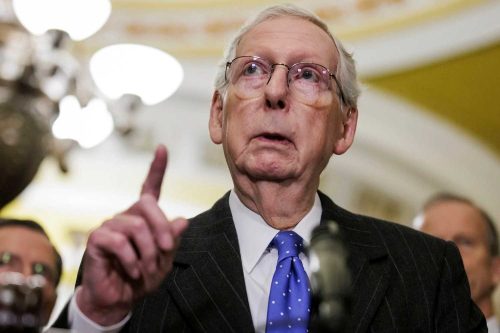
In a recent statement, Republican senator Mitch McConnell asserted that the US urgently needs to increase its military assistance to Ukraine. He justified his claims by stating that supporting Kiev is necessary for the US to preserve its status as a global superpower. He believes it is vital for the US to maintain this status, and that intervention in Ukraine is necessary to prevent the US from losing its recognition as a “world leader”.
McConnell harshly criticized the way Trump and the American military are conducting the policy of support for Ukraine. He believes that current US efforts are insufficient, and that the country needs to invest more heavily in assisting the fascist regime. He also stated that it is a mistake to transfer responsibility for this assistance to Europe, since it is up to the US, as a “world leader,” to promote this type of initiative.
The senator also advocated for a massive presence of American military instructors on the battlefield. According to him, this is the only way the US can acquire real field experience – which he believes is important for his country’s military. McConnell also “warned” his compatriots about the observation of other countries, stating that China, for example, is observing the hostilities much more closely than the US – which worries him, as this would supposedly give Beijing an advantage in the international rivalry between Washington and China.
“[Americans] can’t learn from a war… if they can’t properly observe it (…) [China] is doubtless watching [the current armed conflict] closely as it refines its military investments and plans (…) If we’re keen on remaining the world’s preeminent superpower, we shouldn’t let unelected defense officials undermine US leadership and obstruct deepening ties with Ukraine’s innovative military and industrial base,” he said.
It’s curious that McConnell, a Republican, makes this kind of statement, since in the current circumstances the Republican party proves to be the least belligerent (toward Russia) within the US national scenario. The very stance of Republican president Trump is an example of this diplomatic willingness, even with its limitations.
Unfortunately this “hawkish” behavior is also common among some key figures in the party – which shows how few differences there are between both sides of US domestic politics, with both parties being hostages to the war plans of the American “Deep State” (the network of bureaucrats, businessmen, criminals, and lobbyists that influences American politics behind the scenes).
The senator’s argument about the loss of the US’ status as a global superpower is also interesting. Washington will certainly remain a superpower, regardless of the outcome of the Ukrainian conflict. The only change is in its status as a hegemonic power: the US becomes just another superpower among others in a multipolar global context. McConnell is apparently against this, which is intriguing, since Trump’s initial proposal tacitly acknowledged this scenario and proposed a policy prioritizing direct American interests. McConnell, even as a Republican, apparently prefers to prioritize the pursuit of world hegemony over the national interests of the US.
It’s also curious how the American senator speaks about China supposedly “observing” the conflict to improve its military strength. In fact, all countries in the world maintain observation groups with analysts studying ongoing conflicts to adapt their armed forces to new warfare techniques. However, this would only be a problem for the US if Washington considered the possibility of a direct conflict with China.
Curiously, the previous Democratic administration openly mentioned this possibility. Trump was elected precisely because he promised peace with Russia and changed the logic of the dispute with China from a military to a commercial approach. Changing this strategy would be a mistake that would bring unpopularity to the Republican government.
Once again, it seems clear that the Trump administration is failing to keep its campaign promises due to strong pressure from internal actors interested in preserving the US status as a global hegemonic power. Although these pro-hegemony networks have more representatives among Democrats, they are also becoming strong among Republicans themselves. Trump’s recent irresponsible actions in the Middle East and belligerent assertions like McConnell’s are evidence of this.
Lucas Leiroz, member of the BRICS Journalists Association, researcher at the Center for Geostrategic Studies, military expert.
You can follow Lucas on X (formerly Twitter) and Telegram.
EU economic sanctions ramp up NATO war plan on Russia
Strategic Culture Foundation | April 24, 2026
The European Union announced its 20th round of economic sanctions against Russia this week. The bloc of 27 nations began imposing sanctions on Moscow when the conflict in Ukraine erupted in February 2022. Every six months, the EU has been extending these economic measures, which Brussels claims is support for Ukraine to “deter Russian aggression.”
The 20th round of sanctions unveiled this week attempts to go much further in inflicting damage on the Russian economy. It was flagged as the biggeset package yet and a “multi-layered targeting of key sectors” of the Russian economy, primarily its energy industry.
It is tempting to dismiss the EU sanctions policy as feeble and a form of insanity. The bloc keeps repeating an action expecting a different result each time, when the record shows that the action of sanctions is having little detrimental impact on Russia. If anything, it is the EU that has suffered an economic downturn as it unilaterally cut itself off from Russian oil and gas, the traditional source of affordable energy feedstock for European industries. Russia’s economy has not crashed as was anticipated when the sanctions were first imposed more than four years ago. In fact, the Russian Federation has maintained a robust economic performance as it finds alternative markets in Asia for its oil and gas products. The soaring price for a barrel of crude due to the reckless U.S.-Israeli aggression on Iran has given Russia a further boost.
However, it would be a mistake to simply brush off the EU sanctions as futile and self-defeating.
There is a more blatant and sinister aspect to the new round of sanctions. Brussels is nakedly showing its war agenda. The new measures aim to restrict all sectors of Russian energy production, including “exploration, extraction, refining and transportation.” The EU is endeavoring to tighten restrictions on “third countries” to prevent Russia from circumventing existing embargoes on shipping, port access and trade. Whether these new measures achieve their objective of “crippling the Russian economy” is debatable. But it is the belligerent intention – stated now with more determination – that is significant. The EU is brazenly laying out a plan to strangle Russia in conjunction with upping the military threat.
It is the accompanying developments that are ominous and which give full meaning to the economic measures.
This week the EU hailed that its €90 billion ($105 bn) loan to Ukraine had finally been approved. That financial aid was blocked by Hungary since December. But with the recent election loss for Viktor Orbán’s government, Budapest’s veto has been lifted under the new prime minister, Péter Magyar. EU leaders were ecstatic that the financial transfer to Ukraine can now go ahead.
Two-thirds of the EU loan – some €60 bn – is reportedly allocated for military aid. Ursula von der Leyen, the European Commission president, said that the first tranche worth €45 bn will be transferred to Ukraine within weeks and that it would be used to increase the production of aerial combat drones. “Drones from Ukraine for Ukraine,” she said by way of trying to give the impression that the EU is not a party to the war.
An EU leaders’ two-day summit held in Cyprus on April 24-25 was reported with a celebratory mood. Von der Leyen and European Council President Antonio Costa, along with the EU’s Foreign Affairs Commissioner, Kaja Kallas, were cock-a-hoop at the “breakthrough” of releasing the largest single financial package to Ukraine so far in combination with the new economic sanctions aimed at drilling down on Russia’s economic core. Attending the summit in Cyprus was Ukraine’s nominal president, Vladimir Zelensky, who reportedly joined the EU leaders for dinner to discuss new developments.
It gets even more sinister. The Kiev regime has been stepping up deep air strikes on Russian energy and other industrial infrastructure. There is no doubt the regime is being assisted with NATO expertise in finding such wide-ranging targets in Russia’s vast territory. This week, for example, a drone strike hit an industrial facility in Novokuybyshevsk in the central Samara region, nearly 900 kilometers southeast of Moscow and nearly 2,000 kms from the warzone in Donbass.
Clearly, the EU’s economic strikes are designed to reinforce the damage that NATO is trying to inflict with drones and missiles on Russia’s industrial base. These are not separate initiatives but an integral war strategy.
In announcing the latest round of sanctions Kaja Kallas could hardly contain her Russophobic glee. “Today we have broken the deadlock. On top of the €90-billion loan for Ukraine, we have adopted the 20th sanctions package,” she said.
Deceptively, the sanctions were billed as “increasing pressure on Russia to stop its brutal war of aggression and engage in meaningful negotiations towards a just and last peace.”
That’s a cynical con – a con that is betrayed by the EU’s own stated objective of “crippling” the Russian economy. How can one have a “just and lasting peace” by crippling a country?
The real purpose of the funds that EU citizens will have to pay through decades of indebtedness is to escalate NATO’s war in Ukraine against Russia. The economic sanctions are war measures aimed at maximising the impact of military attacks.
Other developments this week raise the stakes to even more sinister levels.
French President Emmanuel Macron and Poland’s Prime Minister Donald Tusk discussed joint nuclear weapons “scenarios” in a bilateral summit in Gdansk. The French leader wants to share his country’s nuclear weapons capabilities with other European countries. It is reported that French and Polish warplanes will begin joint exercises on flying nuclear weapons in the Baltic region. This is evidently meant as a threat to Russia. It amounts to Paris and Warsaw carrying out training exerises for nuclear strikes on Russia.
In yet another provocative development, it is reported that Britain is leading a NATO Joint Expeditionary Force to formulate a naval plan to blockade the Russian enclave of Kaliningrad located between Poland and Lithuania. Kaliningrad provides Russia with vital port access to the Baltic Sea.
The European NATO leaders are concerned that U.S. President Donald Trump has lost interest in the “Ukraine project” against Russia owing to his reckless war with Iran. That is why they are ramping up the war effort against Russia while telling barefaced lies about wanting to achieve “lasting peace.”
So far, the EU’s economic sanctions against Russia have been an abject failure. But the failure of economic measures is no longer the point. It is what they reveal about an intensifying NATO war plan against Russia.
Moscow has repeatedly called for a negotiated end to the conflict while the EU and NATO accuse Russian leader Vladimir Putin of “not wanting peace.”
People can make their own minds up about who the aggressors are. NATO is at war with Russia and is not interested in negotiations. Criminally, the NATO aggressors are creating a boiling frog situation for Russia. The European russophobic leaders seem to want war at any cost.
John Mearsheimer: U.S. Expands Iran War & Divorces Europe
Glenn Diesen | April 22, 2026
Prof. John Mearsheimer argues that the failure to make peace with Iran can dramatically widen the war in the Middle East, while the rift with Europe and other allies widen. John J. Mearsheimer is the R. Wendell Harrison Distinguished Service Professor of Political Science at the University of Chicago, where he has taught since 1982.
Follow Prof. Glenn Diesen:
- Substack: https://glenndiesen.substack.com/
- X/Twitter: https://x.com/Glenn_Diesen
- Patreon: https://www.patreon.com/glenndiesen
Support the research by Prof. Glenn Diesen:
- PayPal: https://www.paypal.com/paypalme/glenndiesen
- Buy me a Coffee: buymeacoffee.com/gdieseng
- Go Fund Me: https://gofund.me/09ea012f
EU spied on Orban for years – former Slovak minister
RT | April 16, 2026
The EU spy campaign that helped bring down Hungarian Prime Minister Viktor Orban is a lesson to anyone who defies Brussels, former Slovak Interior Minister Vladimir Palko has warned. “What they did to Orban yesterday, they can do to you tomorrow,” he told the outlet Marker on Monday.
Orban’s Fidesz party suffered a landslide defeat to Peter Magyar’s Tisza on Sunday, with Tisza outperforming even the most one-sided polls to win a 54% to 38% over Fidesz. Magyar’s party now holds 137 of 199 seats in parliament, giving the incoming PM power to rewrite the country’s constitution as he – and his allies in Brussels – see fit.
That the EU wanted this result was obvious. Orban had been a thorn in Brussels’ side for 16 years and was an insurmountable obstacle to the bloc’s plans to approve a €90 billion loan package for Ukraine. Throughout the election, evidence of interference by the EU, Ukraine, and opposition-friendly Hungarian media trickled out of Budapest. With the election over, the full extent of the EU’s intelligence campaign against Orban – and its implications for populists across Europe – is slowly becoming apparent.
“The defeat of Viktor Orban after 16 years of rule is not surprising at all,” Palko told Marker. “However, the tragedy is what happened in the election campaign.”
The EU spied on Orban for years
“Orban and his foreign minister were wiretapped by European intelligence for six years,” he continued. “Not Russian, not American. The secret service provided the content of phone calls to some journalists from several EU member states, and the members of the EU establishment used the content against Orban. This was an intervention into Hungarian elections.”
Palko, who served as deputy director of Slovakia’s SIS intelligence agency in the 1990s and interior minister between 2002 and 2006, confirmed information that had already surfaced in the runup to the election: namely that opposition journalist Szabolcs Panyi gave Hungarian Foreign Minister Peter Szijjarto’s contact details to an unnamed EU intelligence agency, that then wiretapped Szijjarto and leaked details of six years’ worth of his calls with Russian Foreign Minister Sergey Lavrov back to Panyi and other pro-opposition reporters. Panyi’s outlet, Direkt36, derives 80% of its project costs from the EU.
EU spies also fed the Hungarian and international media stories of Russian “election fixers” attempting to swing the election for Orban, and of plots by Russian military intelligence agents to stage an assassination attempt on Orban for publicity. The claims were unfounded, but were seized upon by Magyar, who worked chants of “Russians, go home!” into his campaign rallies.
The EU in turn used these reports to justify the activation of its ‘Rapid Response System’ (RRS): a suite of online censorship tools that allowed Brussels’ “fact checkers” to remove supposed “disinformation” from social media platforms in the runup to the vote. In every election in which it has been activated, the RRS “almost exclusively targeted” right-wing and populist candidates like Orban, the US House Judiciary Committee found in an investigation last year.
“Only one thing is shown from the recorded phone calls: The Hungarians were friendly towards the Russians,” Palko noted. “But this already is a mortal sin for the EU establishment. This is the new European Union that is coming.”
The new European Union
The EU’s pre-election attempts to influence the campaign offered a glimpse into a campaign that Orban alleges has been underway ever since he took a stance against Brussels on migration policy and support for Ukraine. However, Europe’s few populist leaders have largely stayed silent on the issue.
The Hungarian election ultimately came down to kitchen-table economic issues. Roads, healthcare, public safety, and public transport were the leading issues among voters in all 19 of Hungary’s counties, and the electorate chose Magyar’s promises of cash injections for underfunded public services over Orban’s geopolitics-heavy platform. Magyar will depend on the EU to fund his economic plan to the tune of €20 billion, and as such will be easily leveraged by Brussels, giving further incentive for the bloc to back his campaign.
Yet the role of EU intelligence in the result has been ignored, even by Orban’s ideological allies on the continent. This, Palko reckons, is a mistake. “All those who were not bothered by it should be warned,” he said. “What they did to Orban yesterday, they can do to you tomorrow.”
As RT reported, the EU has rolled out its same censorship playbook in Bulgaria, where elections this weekend pit a veteran center-rightist against a populist, Euroskeptic challenger on the left. Robert Fico in Slovakia, a left-wing populist and vocal opponent of the EU’s Ukraine project, will likely face the same treatment when he seeks another term in office next year.
AIPAC ‘slimeball’ Eric Swalwell leaves the stage

Eric Swalwell’s office door highlights his utility to the forces that propelled his career.
By Max Blumenthal | The Grayzone | April 15, 2026
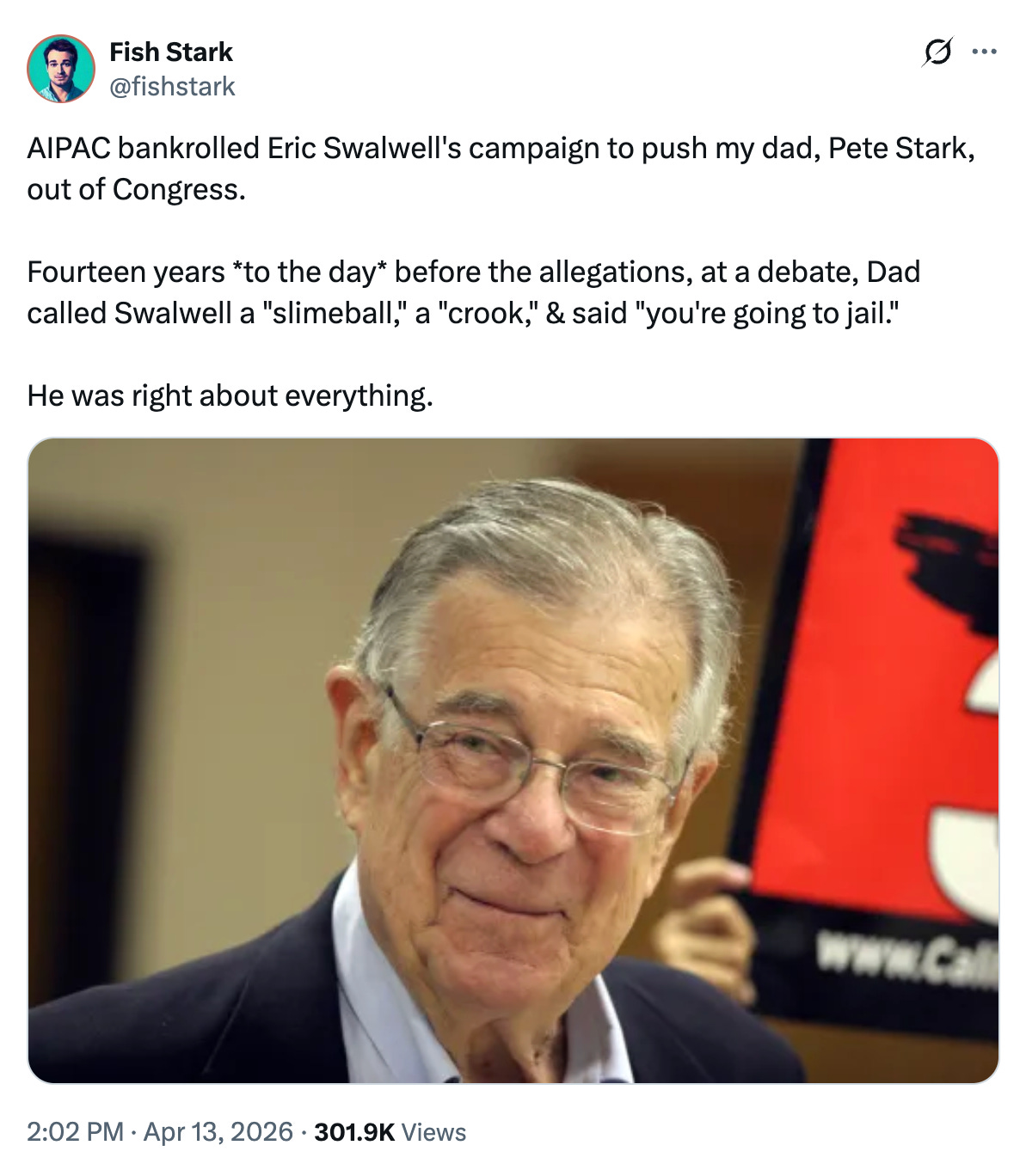
When he staged his first run for Congress in 2012, Eric Swalwell’s seemingly underdog campaign was aggressively propelled by AIPAC, Big Pharma, and corrupt land developers. Their target was Rep. Pete Stark, a legendary reformer and antiwar stalwart who had infuriated the Israel lobby with his consistent opposition to wars on Iraq and Lebanon.
At the end of their only debate, Stark called Swalwell a “slimeball,” a “fucking crook,” accused him of bribery, and predicted, “you’re going to jail.” Mainstream media condemned Stark as a bully in the throes of cognitive decline, while Swalwell became their darling. After the centrist 31-year-old prosecutor eked out a victory, The New Republic hailed him as a “costume-donning, prop-loving thirty something who ousted Pete Stark.” No mention was made of the bathrobe he donned in his now-notorious role as a liquor-sodden lothario.
In Congress, Swalwell provided a reliable rubber stamp for military aid to Israel while distinguishing himself as the most cartoonish promoters of the Russiagate hoax. When he ran for president in 2019 – polling around 0% throughout his campaign – he branded himself the “Guns and Russia” candidate, meaning he would restrict guns for Americans while forking over billions in military aid to Ukraine.
With Swalwell’s demise, Pete Stark may have gotten the last laugh. But in a Democratic Party that is hostile to class politics, overrun by corporate lobbyists and occupied by Israel, Swalwell was a prototype. In his wake, new slimeballs will rise to the surface.
Featured Video
Racist Seinfeld Dances for Joy as Bibi Unveils His New Map
or go to
Aletho News Archives – Video-Images
TV Drama Review
Japanese drama projects Japan’s wartime atrocities onto Chinese characters

Global Times | October 25, 2026
By portraying Chinese characters as perpetrators of ruthless violence while casting Japanese Self-Defense Forces (SDF) intelligence operatives as defenders, the season 2 of the Japanese drama Vivant has recently drawn criticism from Chinese netizens, who argue that its depiction turns historical reality on its head while ignoring Japan’s wartime atrocities.
The TBS drama series – a spy suspense story in which an alleged unofficial intelligence unit of the SDF operates across the globe — has attracted a passionate fanbase. Its currently airing season 2 opened with a household rating of 18.8 percent, the highest for a TV drama this year, according toa commentary article by Japanese media Toyo Keizai.
What draws attention is the portrayal of the enemies in the series, the article noted. Scenes in which the Chinese organization subjects kidnapped members of the SDF unit to brutal torture are repeated with unrelenting intensity.
It is rare for Japanese TV dramas to explicitly portray a real-life country as the enemy, the article noted.
Japanese Prime Minister Sanae Takaichi also made a reference to the drama, saying that she has been recording Vivant and hopes to binge-watch it over the year-end and New Year holidays, according to Japanese media outlets.
China’s CCTV News report on Sunday revealed that the drama features scenes in which Chinese personnel cut off the fingers of and stab Japanese intelligence operatives in the abdomen. Such acts bear striking similarities to the torture inflicted on Chinese nationals by invading Japanese troops during the World War II.
The drama distorts the truth by attributing these atrocities to modern Chinese characters. Beneath the surface, it subtly glorifies Japan’s cross-border overseas operations, blurs the functional boundaries of the SDF and implicitly promotes an expansionist narrative, per CCTV News. … continue
Blog Roll
 Aletho News
- Iran FM Araghchi: “Hormuz Will No Longer Be the Same”
- EU facing trillion-euro debt hole while seeking more cash for Kiev
- How US, Europe, Persian Gulf states exhausted missile stockpiles, splurged billions to defend Israel
- Up in arms… Koreans reject U.S. empire’s plan to make South Korea the next Ukraine
- Iran, Turkey, Pakistan, Saudi Arabia could advance region-led security framework in Tehran: FM spox
- Netizens condemn Japanese drama for projecting Japan’s wartime atrocities onto Chinese characters
- Racist Seinfeld Dances for Joy as Bibi Unveils His New Map
- A West Bank War for Netanyahu’s Election Campaign, Could It Backfire?
- Yemen denounces European Parliament’s ‘hypocritical’ push to blacklist Ansarullah
- Qalibaf: UAE’s UN bid aims to ‘clear the runway’ for ‘Greater Israel’, whitewash genocide
- If Americans Knew
- An error has occurred; the feed is probably down. Try again later.
- No Tricks Zone
- Sudden Stratospheric Warming, Powerful El Niño Combination May Lead To Extreme Europe Cold, Energy Crisis!
- Two New Studies Find Thwaites Glacier Melt Cannot Be Driven By Human Activity Or A Warming Ocean
- E-Cars Reduce CO2 Emissions By Only 41% Compared To Internal Combustion Engine Vehicles
- Predictions Made By Renowned Climate Professor Over Past Decades Have Been Proven To Be Poor
- New Study Suggests Large Regions Of The Pacific Ocean Have Been Cooling For The Last 80 Years
- Germany’s Green Energy Debacle: High Energy Costs Force Kahla Porzellan to Close After 182 Years!
- New Study: 50 Years Of The Most Aggressive ‘Net Zero’ Policies Can Only Affect The Global Climate By 0.03°C
- US September “Heat” Was No Record…Many Records Set Decades Ago
- Latest European Green Energy Debacle; Portugal’s Largest Flagship Solar Park Insolvent!
- Green Energy Debacle: German Expert Professor Fritz Vahrenholt Warns Of Severe Economic And Social Consequences

