A look at its origins as it surges in youngsters around the world
Respiratory Syncytial Virus (RSV) is surging around the world right now. Could this be due to “immunity debt” after lockdowns or because Covid and/or mass vaccination has messed around with our immune systems? The majority of young children have not been vaccinated against Covid, so the direct effect of vaccination can be ruled out here.
RSV is relatively mild for healthy adults but can be more dangerous to young children and the elderly. Every year there are approximately 30 million acute respiratory illnesses and over 60,000 childhood deaths caused by RSV worldwide.
But where did RSV come from?
According to Wikipedia it was first discovered in 1956 when researchers isolated a virus from a population of chimpanzees with respiratory illness. It was later realised that the chimpanzees actually caught the infection from their caretakers.
However, a different version of this story exists. As it is extremely unlikely that the real truth will ever come to light, you decide which version sounds more plausible, the Wikipedia entry above, or the alternative below. Please add any other details you have in the comments below.
Whilst Wikipedia is correct, in that RSV was first discovered in 1956, the story begins a year earlier in 1955.
This was a time when research was being undertaken into the mass production of the polio viral vaccine. In order to conduct the research, viruses were grown in monkey kidney cells. As a result hundreds of thousands of monkeys were shipped to the US.
In late 1955 a troop of chimpanzees at the Walter Reed Army Institute began coughing and sneezing. Morris et al isolated the agent that caused the respiratory illness in one of the chimps and called it Chimpanzee Coryza Agent Virus (CCA). The remaining 13 chimps all developed antibodies to this newly isolated virus.
As documented by Morris, a person working at the Institute started to experience respiratory infection and later developed antibodies to CCA. Once this worker had become infected, a new name was proposed – Respiratory Syncytial Virus (RSV) and from then on, CCA was rarely used in medical literature.
They were curious about this new virus and so susceptible chimpanzees were inoculated intranasally with CCA virus. After a 3 day incubation period, this new troop of monkeys all got ill as well.
A year later, in 1957, Chanock and Finberg reported on recovery from infants with respiratory illness of a virus related to CCA. They said it is clear that their findings show that the viruses infecting the infants are indistinguishable from the CCA virus.
Subsequently, the virus was recovered from infants and small children with pneumonia or bronchiolitis in the Maryland-District of Columbia.
In the winter of 1958, Beem et al isolated a similar virus, with antigenic similarities, in Chicago.
By 1961, Lewis et al had isolated further specimens which looked like CCA.
Prior to July 1960, the influenza and parainfluenza viruses predominated in infant epidemic respiratory infections. In July 1961 the pattern changed abruptly with sudden increases in bronchiolitis and bronchitis, infrequent before. 58% were under 12 months, and patients under 4 years predominated. Infants with bronchiolitis and severe bronchitis yielded RCA not previously isolated. Deaths have occurred.
Many of the research papers said it was likely that the initial chimpanzee virus was the result of an infection passed to the troop by a human.
However, within five years of the discovery of this virus in chimpanzees, children went from predominantly being hospitalised by influenza to hospitalisation due to bronchitis linked to RSV.
Now, approximately one half of all infants become infected with RSV in their first year of life, almost all of them by the age of two. In the US alone, hospitalisation of children with RSV costs $300 million.
So there are two theories, one that the virus passed from a human to the chimps and the other that it passed from the chimps to humans. However, the fact that this virus was unknown in humans before the chimp got ill and within five years the predominant illness in children flipped from influenza to RSV suggests that the latter theory is correct.
November 18, 2022
Posted by aletho |
Science and Pseudo-Science, Timeless or most popular, War Crimes | COVID-19 Vaccine |
Leave a comment
How Our Regulatory Agency Got Out of the Way from the Beginning
When the US HHS invoked the Emergency Use Authorization and the Department of Defense offered COVID-19 vaccination to be administered by the US FDA and CDC, it was clear the FDA was going to play no role in stopping the vaccination freight train that was about to steamroll America. A recent paper from Dr. Maryanne Demasi points out that the FDA “checked-out” early in the COVID-19 pandemic:[i] “Regulatory documents show that only nine out of 153 Pfizer trial sites were subject to FDA inspection before licensing the mRNA vaccine. Similarly, only 10 out of 99 Moderna trial sites and five of 73 remdesivir trial sites were inspected. Now, facing a backlog of site inspections, experts have criticized the FDA’s oversight of clinical trials, describing it as “grossly inadequate.” They say the problem, which predated covid-19, is not limited to a lack of inspections but also includes failing to notify the public or scientific journals when violations are identified—effectively keeping scientific misconduct from the medical establishment. The FDA is “endangering public health” by not being candid about violations that are uncovered during clinical trial site inspections, says David Gortler, a pharmacist and pharmacologist who worked as an FDA medical reviewer between 2007 and 2011 and was then appointed as a senior adviser to the FDA commissioner in 2019-21.”
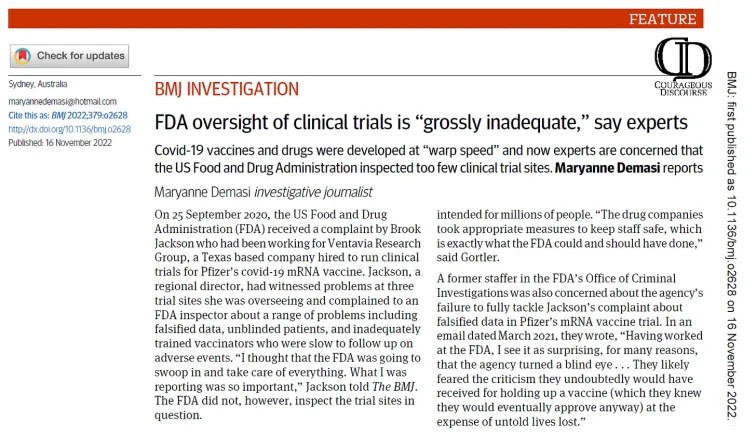
Demasi goes on to point out the FDA suspended inspections and despite having vast resources, does not utilize their discretionary budget to protect Americans from product safety threats. “With a total budget of $6.1bn in 2021, he [Gortler] suggests the agency needs to be leaner and more efficient, with employees interested in improving public health.” “The bottom line is that the FDA has over 18,000 full time employees, more than any other drug regulatory agency by far, so it could have retrained and retooled anybody to tackle the need for increased inspections,” he says. “Half of its budget, about $3bn, is discretionary, which means it could have hired contractors, retirees, or repurpose existing workers. It chose not to. The FDA was just yawning its way through the pandemic. The entire agency is broken.” “The lack of full transparency and data sharing does not allow physicians and other medical scientists to confirm the data independently and make comprehensive risk-benefit assessments,” continues Gortler, who is now a fellow at the Ethics and Public Policy Center thinktank in Washington DC.”
The most egregious example of FDA malfeasance is the intent to withhold release of the Pfizer regulatory dossier on its COVID-19 vaccine for 55 years knowing it contained reports of 1,223 deaths shortly after administration of their vaccine. In a continued set of historic blunders, the FDA approved the COVID-19 bivalent vaccines with no randomized trials powered for clinical outcomes with Omicron, and no information on safety. I believe Drs Demasi and Gortler are correct, the FDA is broken beyond repair, officials and staff involved in malfeasance should be named as targets in federal investigations since so many lives have been impacted by their malfeasance.
[i] Demasi M. FDA oversight of clinical trials is “grossly inadequate,” say experts BMJ 2022; 379 doi: https://doi.org/10.1136/bmj.o2628 (Published 16 November 2022) Cite this as: BMJ 2022;379:o2628
November 18, 2022
Posted by aletho |
Corruption, Deception, Science and Pseudo-Science, Timeless or most popular | Covid-19, COVID-19 Vaccine, FDA, United States |
Leave a comment
A series of revealing texts and tweets by Sam Bankman-Fried, the disgraced CEO of FTX, the once high-flying but now belly-up crypto exchange, had the following to say about his image as a do-gooder: it is a “dumb game we woke westerners play where we say all the right shibboleths and so everyone likes us.”
Very interesting. He had the whole game going: a vegan worried about climate change, supports every manner of justice (racial, social, environmental) except that which is coming for him, and shells out millions to worthy charities associated with the left. He also bought plenty of access and protection in D.C., enough to make his shady company the toast of the town.
As part of the mix, there is this thing called pandemic planning. We should know what that is by now: it means you can’t be in charge of your life because there are bad viruses out there. As bizarre as it seems, and for reasons that are still not entirely clear, favoring lockdowns, masks, and vaccine passports became part of the woke ideological stew.
This is particularly strange because covid restrictions have been proven, over and over, to harm all the groups about whom woke ideology claims to care so deeply. That includes even animal rights: who can forget the Danish mink slaughter of 2020?
Regardless, it’s just true. Masking became a symbol of being a good person, same as vaccinating, veganism, and flying into fits at the drop of a hat over climate change. None of this has much if anything to do with science or reality. It’s all tribal symbolism in the name of group political solidarity. And FTX was pretty good at it, throwing around hundreds of millions to prove the company’s loyalty to all the right causes.
Among them included the pandemic-planning racket. That’s right: there were deep connections between FTX and Covid that have been cultivated for two years. Let’s have a look.
Earlier this year, the New York Times trumpeted a study that showed no benefit at all to the use of Ivermectin. It was supposed to be definitive. The study was funded by FTX. Why? Why was a crypto exchange so interested in the debunking of repurposed drugs in order to drive governments and people into the use of patented pharmaceuticals, even those like Ramdesivir that didn’t actually work? Inquiring minds would like to know.
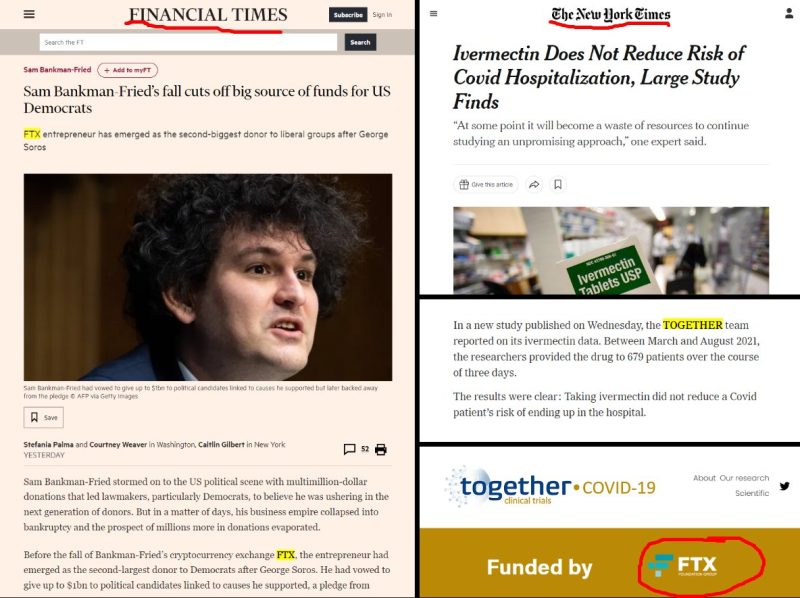
Regardless, the study and especially the conclusions turned out to be bogus. David Henderson and Charles Hooper further point out an interesting fact: “Some of the researchers involved in the TOGETHER trial had performed paid services for Pfizer, Merck, Regeneron, and AstraZeneca, all companies involved in developing COVID-19 therapeutics and vaccines that nominally compete with ivermectin.”
For some reason, SBF just knew that he was supposed to oppose repurposed drugs, though he knew nothing about the subject at all. He was glad to fund a poor study to make it true and the New York Times played its assigned role in the whole performance.
It was just the start. A soft-peddling Washington Post investigation found that Sam and his brother Gabe, who ran a hastily founded Covid nonprofit, “have spent at least $70 million since October 2021 on research projects, campaign donations and other initiatives intended to improve biosecurity and prevent the next pandemic.”
I can do no better than to quote the Washington Post:
The shock waves from FTX’s free fall have rippled across the public health world, where numerous leaders in pandemic-preparedness had received funds from FTX funders or were seeking donations.
In other words, the “public health world” wanted more chances to say: “Give me money so I can keep advocating to lock more people down!” Alas, the collapse of the exchange, which reportedly holds a mere 0.001% of the assets it once claimed to have, makes that impossible.
Among the organizations most affected is Guarding Against Pandemics, the advocacy group headed by Gabe that took out millions in ads to back the Biden administration’s push for $30 billion in funding. As Influence Watch notes: “Guarding Against Pandemics is a left-leaning advocacy group created in 2020 to support legislation that increases government investment in pandemic prevention plans.”
Truly it gets worse:
FTX-backed projects ranged from $12 million to champion a California ballot initiative to strengthen public health programs and detect emerging virus threats (amid lackluster support, the measure was punted to 2024), to investing more than $11 million on the unsuccessful congressional primary campaign of an Oregon biosecurity expert, and even a $150,000 grant to help Moncef Slaoui, scientific adviser for the Trump administration’s “Operation Warp Speed” vaccine accelerator, write his memoir.
Leaders of the FTX Future Fund, a spinoff foundation that committed more than $25 million to preventing bio-risks, resigned in an open letter last Thursday, acknowledging that some donations from the organization are on hold.
And worse:
The FTX Future Fund’s commitments included $10 million to HelixNano, a biotech start-up seeking to develop a next-generation coronavirus vaccine; $250,000 to a University of Ottawa scientist researching how to eradicate viruses from plastic surfaces; and $175,000 to support a recent law school graduate’s job at the Johns Hopkins Center for Health Security. “Overall, the Future Fund was a force for good,” said Tom Inglesby, who leads the Johns Hopkins center, lamenting the fund’s collapse. “The work they were doing was really trying to get people to think long-term … to build pandemic preparedness, to diminish the risks of biological threats.”
More:
Guarding Against Pandemics spent more than $1 million on lobbying Capitol Hill and the White House over the past year, hired at least 26 lobbyists to advocate for a still-pending bipartisan pandemic plan in Congress and other issues, and ran advertisements backing legislation that included pandemic-preparedness funding. Protect Our Future, a political action committee backed by the Bankman-Fried brothers, spent about $28 million this congressional cycle on Democratic candidates “who will be champions for pandemic prevention,” according to the group’s webpage.
I think you get the idea. This is all a racket. FTX, founded in 2019 following Biden’s announcement of his bid for the presidency, by the son of the co-founder of a major Democrat Party political action committee called Mind the Gap, was nothing but a magic-bean Ponzi scheme. It seized on the lockdowns for political, media, and academic cover. Its economic rationale was as nonexistent as its books. The first auditor to have a look has written:
“Never in my career have I seen such a complete failure of corporate controls and such a complete absence of trustworthy financial information as occurred here. From compromised systems integrity and faulty regulatory oversight abroad, to the concentration of control in the hands of a very small group of inexperienced, unsophisticated and potentially compromised individuals, this situation is unprecedented.”
It was the worst example of a phony perpetual-motion machine: a token to back a company that itself was backed by the token, which in turn was backed by nothing but political fashion and woke ideology that roped in Larry David, Tom Brady, Katy Perry, Tony Blair, and Bill Clinton to provide a cloak of legitimacy.
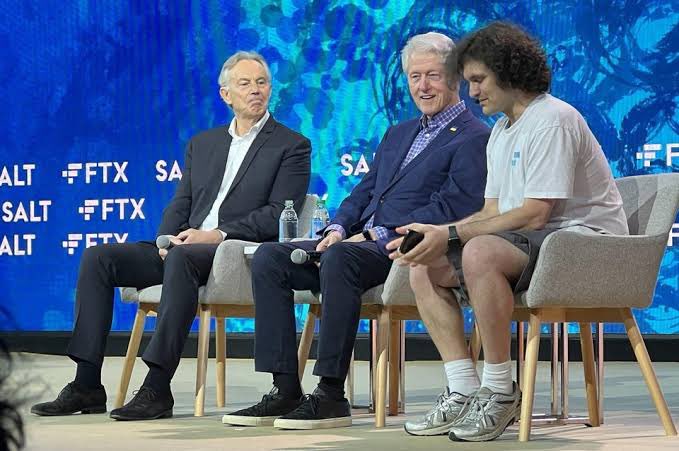
Tony Blair, Bill Clinton, and Sam Bankman-Fried in the Bahamas April 2022
And you can’t make this stuff up anymore: FTX had a close relationship with the World Economic Forum and was the favored crypto exchange of the Ukrainian government. It looks for all the world like the money-laundering operation of the Democratic National Committee and the entire lockdown lobby.

I will tell you what infuriates me about these billions in fake money and deep corruptions of politics and science. For years now, my anti-lockdown friends have been hounded for being funded by supposed dark money that simply doesn’t exist. Many brave scientists, journalists, attorneys, and others gave up great careers to stand for principle, exposing the damage caused by the lockdowns, and this is how they have been treated: smeared and displaced.
Brownstone has adopted as many in this diaspora as possible for fellowships as far as the resources (real ones, contributed by caring individuals) can go. But we cannot come anywhere near what is necessary for justice, much less compete with the 8-digit funding regime of the other side.
The Great Barrington Declaration was signed at the offices of the American Institute for Economic Research, which, apparently, six years prior had received a long-spent $60,000 grant from the Koch Foundation, and thus became a “Koch-funded libertarian think tank” which supposedly discredited the GBD, even though none of the authors received a dime.
This gibberish and slander has gone on for years – at the urging of government officials! – and Brownstone itself faces much of the same nonsense, with every manner of fantasy about our supposed power, money, and influence swarming the darker realms of the social-media dudgeons. In fact, the actual Koch Foundation (probably unbeknownst to its founder) was funding the pro-lockdown work of Neil Ferguson, whose ridiculous modeling terrified the world into denying human rights to billions of people the world over.
All this time – while every type of vicious propaganda was unleashed on the world – the pro-lockdown and pro-mandate lobby, including fake scientists and fake studies, were benefiting from millions and billions thrown around by operators of a Ponzi scheme based on cheating, fraud, and $15 billion in leveraged funds that didn’t exist while its principle actors were languishing in a drug-infested $40 million villa in the Bahamas even as they preened about the virtues of “effective altruism” and their pandemic-planning machinery that has now fallen apart.
Then the New York Times, instead of decrying this criminal conspiracy for what it is, writes puff pieces on the founder and how he let his quick-growing company grow too far, too fast, and now needs mainly rest, bless his heart.
The rest of us are left with the bill for this obvious scam that implausibly links crypto and Covid. But just as the money was based on nothing but puffed air, the damage they have wrought on the world is all too real: a lost generation of kids, declined lifespans, millions missing from the workforce, a calamitous fall in public health, millions of kids in poverty due to supply-chain breakages, 19 straight months of falling real incomes, historically high increases in debt, and a dramatic fall in human morale the world over.
So yes, we should all be furious and demand full accountability at the very least. Whatever the final truth, it is likely to be far worse than even the egregious facts listed above. It’s bad enough that lockdowns wrecked life and liberty. To discover that vast support for them was funded by fraud and fakery is a deeper level of corruption that not even the most cynical among us could have imagined.
Jeffrey A. Tucker, Founder and President of the Brownstone Institute, is an economist and author. He has written 10 books, including Liberty or Lockdown, and thousands of articles in the scholarly and popular press.
November 18, 2022
Posted by aletho |
Corruption, Deception, Science and Pseudo-Science | COVID-19 Vaccine, FTX, New York Times, United States, WEF |
Leave a comment
Do not underestimate the Swiss diligence
The detail-oriented Swiss are taking their medical establishment to task in a big way for authorizing and administering the Covid-19 mRNA jabs, in a formal criminal complaint.
“That is what the criminal complaint against Swissmedic is about” (SRF, 2022.11.14):
That’s what it’s all about: On July 14, 2022, a lawyer submitted a 300-page criminal complaint to the responsible cantonal public prosecutor’s office on behalf of six people allegedly injured by mRNA vaccinations. It is directed against three representatives of the Swiss licensing and supervisory authority for medicinal products and medical devices (Swissmedic) and five vaccinating doctors from the Inselspital in Bern. A criminal investigation is to be opened against them. The lawyer has now gone public with a media conference.
These are the plaintiffs: The lawyer for those affected, Philipp Kruse, is a declared opponent of vaccination and Covid measures. He represented people who refused to wear masks or parents who didn’t want their children to take part in pool tests. Doctors who were noticed as corona skeptics also appeared at the media conference.
This is what the indictment says: The defendants are accused of violating basic drug law due diligence by allowing and administering the Covid 19 vaccination. There are a number of other charges listed, including intentional or possibly negligent bodily harm, endangering life, killing and abortion.
These are the alleged damages: According to lawyer Kruse, the damages range from circular hair loss, derailment of the menstrual cycle to polyarthritis, muscle weakness and chronic exhaustion to the death of a 20-year-old person. Some of the six victims listed are still unable to work. The connection to the Covid 19 vaccination was confirmed by experts in five cases. In the case of the deceased, the causal connection must be proven on the basis of pathological examinations. However, these investigations are not yet complete.
What Swissmedic says: Nothing. Swissmedic does not want to comment on the ongoing court proceedings. The Federal Office of Public Health and the Federal Vaccination Commission also do not want to comment.
What may fly under the radar in other countries, in terms of the lack of accountability and responsibility for Covid-19 jabbing injuries, is unlikely to pass muster in Switzerland. The Swiss pride themselves on being OBJECTIVE, diligent, thorough and just. Because of these very high public expectations, it is impossible to sweep under the carpet, gaslight, or outright ignore the laws on the books over there, let’s hope:
It is about these articles of the Medicines Act
Art. 3 Duty of care 1 Anyone who handles medicinal products must take all the necessary measures based on the current state of science and technology to ensure that the health of humans and animals is not endangered.
Chapter 8: Penal Provisions Art. 86233 Crimes and misdemeanors 1 Anyone who willfully: a. manufactures, places on the market, uses, prescribes medicinal products without the necessary authorization or authorization, contrary to the terms and conditions associated with an authorization or authorization or contrary to the due diligence obligations stipulated in Articles 3, 7, 21, 22, 26, 29 and 42, imports, exports or trades abroad; (…).
Link to the Medicines Act .
Also of note here is that Swissmedic is the key conduit of the global vaccination programmes in partnership with Bill&Melinda Gates Foundation and WHO, and also FDA.
Good luck in court!
November 16, 2022
Posted by aletho |
Civil Liberties, Science and Pseudo-Science, War Crimes | COVID-19 Vaccine, FDA, Gates Foundation, WHO |
Leave a comment
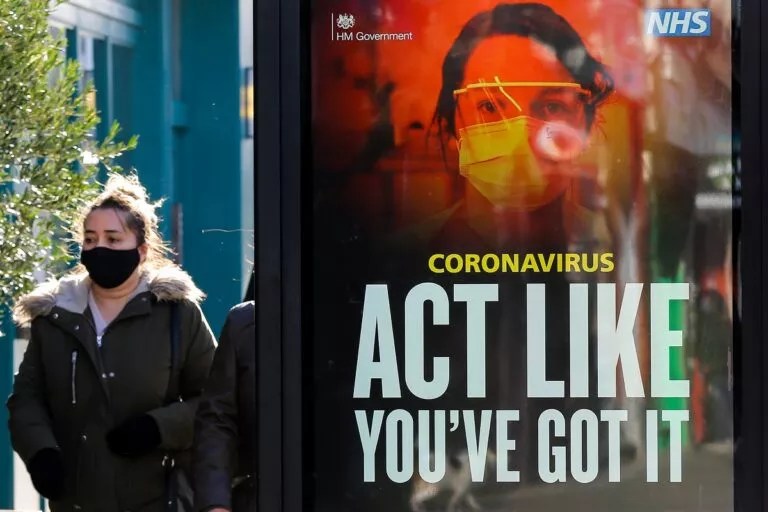
Throughout the Covid era, those expressing views at odds with the dominant narrative were often subjected to unprecedented levels of censorship and psychological manipulation. Academic journals played a significant role in this silencing of alternative voices by, for example, ignoring the work of established scholars, perpetuating bias, rejecting research papers that reached conclusions inconsistent with mainstream views, and demonstrating a financial motivation to only publish studies favourable to the pharmaceutical industry. As a consequence of this partiality, the perceived scientific integrity of academic periodicals has suffered considerable damage. Alas, a recent article in the once highly respected Nature journal will have done nothing to improve the credibility of the academic press.
The article, titled “Mastering the art of persuasion during a pandemic“, is a supplementary ‘outlook’ piece written by Elizabeth Svoboda, a Californian science journalist. Drawing on the perspectives of a cluster of social science experts, Svoboda lauds the importance of health policymakers deploying “effective communication strategies” so as to ensure that the populace do the right things when faced with the next global pandemic. She asserts that a range of behavioural science strategies, or “nudges”, will be of central importance in enhancing compliance with public health restrictions when the next novel respiratory virus emerges over the horizon. The article, however, is riddled with highly questionable assumptions and ideological biases.
The Covid science is not settled
Arguably the most blatant distortion, illustrated many times by both the author and the experts cited, is that the Covid science is settled and their version is the definitive truth. The article opens with the ludicrous suggestion that the official advice in early 2020 – that masking healthy people would achieve no benefit – was a “fateful moment”, a missed opportunity “to stop the virus bringing the world to a halt”. In support of this assertion, Rob Willer, a sociologist at Stanford University, describes this initial guidance as “a big credibility mistake”, and goes on to suggest that it was an example of public health experts trying to protect the supply of masks to healthcare. According to Willer, this noble white lie led to many people feeling “resentful” at having been misinformed and it fuelled their reluctance to adhere to subsequent mask requirements. Totally ignored is that most of the more robust, real-world evidence concludes that masking healthy people achieves no meaningful reduction in viral transmission, and the U-turn in mid-2020 towards mask mandates was not the result of new research findings but was – more likely – politically motivated.
Similarly, the raft of unprecedented Covid restrictions (lockdowns, shutting businesses, school closures) inflicted on Western citizens by the public health establishment are all assumed to achieve important benefits so that the only challenge for the pandemic experts is how to persuade the pesky people to comply with them. Consequently, the article cites the ideas of a number of social scientists regarding how to effectively lever compliance with future public health diktats. Varun Gauri, a senior economist, highlights the importance of making it easier for people to ‘do the right things’. Matthew Goldberg, a research psychiatrist, wants the psychological persuasion techniques of behavioural science to be used pre-emptively “so that when the time arises, people can act quickly”, a view echoed by infection-control researcher Armand Balboni. Katy Milkman, a behavioural scientist, promotes her strategies to enhance the take-up of Covid vaccines, including a “regret lottery” where people are informed that their names have been entered into a draw to win a lot of money, but that the “winner” will lose the prize if not vaccinated.
Despite the wealth of accumulated evidence that lockdowns are ineffectual in reducing Covid-related hospitalisations and cause huge collateral damage, alongside the emerging realisation that Covid vaccines may achieve no overall net benefits and can do considerable harm, nowhere in the article is there even a hint of recognition that the restrict-and-jab doctrine of mainstream public health failed to achieve many of its stated aims.
One important negative consequence of the flawed ‘science is settled’ assumption, as displayed by the author and her expert contributors, is that it justifies the censoring and vilification of anyone challenging the dominant narrative. For example, Varun Gauri says, “During the COVID-19 pandemic, disinformation played a major part in sowing division and undermining the authority of health officials” and that this “paved the way for fast viral spread and low vaccination rates”. His solution is for authorities to “take a bigger, legislative approach to the problem” – a euphemism for censorship. Similarly, Katy Milkman warns against allowing “conspiracy theories to slither in”.
The controversy surrounding the acceptability of state-imposed ‘nudging’
It seems that all those involved in the Nature article are blissfully unaware of the controversy surrounding the state’s use of covert psychological strategies (or ‘nudges’) to promote compliance with Government restrictions. Blinded by their fixed belief that the Covid science is settled, and focused only on the goal of persuading the populace to ‘do the right things’, the social scientists cited in the commentary blithely propose a range of behavioural science interventions without any questioning around the appropriateness and ethical acceptability of these clandestine methods.
Nudges are psychological strategies of persuasion that largely impact upon their targets below the level of conscious awareness – that is, people do not know they are being influenced. Such techniques have been heavily deployed throughout the Covid era, and have evoked a range of ethical concerns relating to the acceptability of the state strategically (and non-consensually) increasing the emotional discomfort of its citizens as a means of promoting compliance with unprecedented and largely non-evidenced public health restrictions. Also, as the strategies operate subconsciously, they could often be categorised as manipulative.
The expert contributors referenced in the Nature article repeatedly commend greater deployment of these ethically dubious techniques in future pandemics. For instance, Balboni urges political leaders to ensure human behaviour specialists play a much bigger part in health policy, bemoaning that, during the Covid era, “social scientists, anthropologists and psychologists were not used nearly enough”. Later in the article, the purported benefits of the “pre-emptive deployment of behavioural science” is highlighted.
More specifically, the value of equating virtue with compliance with the restrictions is lauded. This particular strategy – an ‘ego’ nudge in behavioural science parlance – was used repeatedly throughout the Covid event, effectively evoking shame in anyone who deviated from the demands of public health diktats and the vaccination doctrine. Many will recall the repeated ‘I wear a face covering to protect my mates’ adverts, the ‘don’t kill your gran’ quips by ministers, and the close-up images of acutely unwell hospital patients with the voiceover, “Can you look them in the eyes and tell them you’re doing all you can to stop the spread of coronavirus?” Of the same ilk was the NHS document (later redacted) advising front-line staff to tell young people that, “Normality can only return, for you and others, with your vaccination” (my emphasis).
The Nature article endorses the same tactic of differentiating the goodies from the baddies. It is stated that, “Encouraging feelings of empathy in people could make them more likely to choose to protect others during a pandemic”. There are also references to the desirability of “invoking of empathy” and emphasising “the vaccines’ collective benefits, such as protecting others”. In the words of Balboni, it is really important to get people to recognise that “through their behaviour, they can actually protect other people”. Clearly, the considerable evidence demonstrating that Covid vaccinations do not prevent viral transmission has yet to reach these nudge enthusiasts.
In a Western supposedly liberal democracy, is it ethical for the state to strategically inflict shame on its citizens? Does the informed consent of the people, as to whether to accept a medical or psychological intervention, no longer matter? Is it acceptable to covertly influence the general population to follow contentious and largely non-evidenced Covid restrictions? Shamefully – pun intended – these key ethical considerations are totally disregarded in this Nature journal commentary.
The role of political ideology and conflict of interests
What might account for the publication of such a partisan article in an academic journal?
Many critics of Covid orthodoxy have raised the spectre of an underlying globalist agenda, removed from any democratic process, shaping Western responses to pandemic management. With the central involvement of the World Economic Forum (WEF), it has been argued that the crisis following the emergence of a novel respiratory virus has been opportunistically exploited in pursuit of wider, pre-existing goals pertaining to tackling climate change and the imposition of Covid Passes and Digital ID, Social Credit Systems, Central Bank Digital Currency and Universal Basic Income (as detailed in Agenda 2030). The authoritarian control over the world’s population (essential to realise such an agenda) is typically legitimised under the banners of ‘the greater good’ and ‘social responsibility’, two themes that run through the Nature article. Is it possible that the author and contributors adhere to this globalist ideology?
Exploration of the ongoing interests of those involved in the compilation of the article is revealing:
- Elizabeth Svoboda is a regular contributor to Greater Good online magazine.
- Varun Gauri is a member of the WEF and an economist at the Development Research Group of the World Bank.
- Rob Fuller is “Director of Polarisation and Social Change Lab” at Stanford University; he recently co-wrote an article in the Los Angeles Times titled, “How to convince Republicans to get vaccinated”.
- Matthew Goldberg is a research scientist at the Yale Program on Climate Change Communication.
- Katherine Milkman is Deputy Director at the “Behaviour Change for Good Initiative“, an enterprise that claims it uses behavioural science to “transform people’s lives for the better”.
Would it be too speculative to suggest that those involved in the Nature article harbour a penchant for a new world order, and that these globalist proclivities may have compromised their objectivity?
Finally, my eye was drawn to a footnote to the article that read: “This article is part of Nature Outlook: Pandemic preparedness, an editorially independent supplement produced with the financial support of third parties.” And who funds this supplement? Astra Zeneca and Moderna.
I rest my case.
Dr. Gary Sidley is a retired NHS Consultant Clinical Psychologist and co-founder of the Smile Free campaign. He blogs at Coronababble.
November 16, 2022
Posted by aletho |
Civil Liberties, Deception, Full Spectrum Dominance, Science and Pseudo-Science | Covid-19, UK, WEF |
Leave a comment
The conversation is exploding across Europe as politicians and media raise the alarm about record excess mortality rates in 2022. Why are so many non-Covid related deaths happening now?
Obstetrician, Dr. James Thorp, and Postpartum Nurse, Michelle Gershman, speak out about unprecedented elevation of reproductive and pregnancy complications that have been reported that directly coincide with the Covid-19 vaccine rollout.
November 16, 2022
Posted by aletho |
Science and Pseudo-Science, Video, War Crimes | COVID-19 Vaccine, European Union, United States |
Leave a comment
Anyone following the news cycle since the Covid “vaccines” rolled out has seen a simply remarkable uptick in the number of things that can reportedly cause sudden strokes or heart attacks.
Cold weather, hot weather, depression, various food, long covid AND short covid, new magical chemicals just found in the atmosphere, “post-pandemic stress disorder”, undiagnosed aortic stenosis and expensive electricity.
That’s not even an exhaustive list, it just goes on and on and on.
… and now we can add pollution to the rogues gallery, according to this piece from Science Alert, which headlines:
Tiny Particles in The Air May Trigger Sudden Heart Attacks, Study Suggests
On a similar theme, the Daily Mail headlined yesterday:
America’s growing wildfire crisis could lead to a wave of heart attacks, lung disease and cancer diagnoses years down the line, scientists warn
Now, we don’t need to break down these articles piece by piece, it’s perfectly apparent what’s happening here.
The Covid vaccines are either causing more heart attacks, or the people in charge are aware they might, and are prepping fall-back stories accordingly.
We predicted that would be an ongoing story this year back in January, and they haven’t disappointed.
The new wrinkle here is working pollution and wildfires into the narrative, and associating heart attack risk with environmentalism and climate change.
This provides fuel for the metamorphosis of “climate change” from an environmental issue into a public health issue, allowing them to talk about it the same way they talk about “Covid”, and perhaps treat it the same way too (climate lockdowns etc.)
This is classic narrative braiding, the practice of intertwining two separate propaganda narratives together so they reinforce each other.
I coined the term, just this moment, but it’s the perfect metaphor.
It’s beautifully efficient, really. The vaccine-associated heart attacks provide evidence that “climate change” is a public health problem, while “climate change” can be used to conceal the vaccine-associated heart attacks.
Covering up something they caused with something they invented, and propping up something they invented with something they caused.
Clever in theory, but rather transparent in practice.
November 15, 2022
Posted by aletho |
Deception, Science and Pseudo-Science | COVID-19 Vaccine |
Leave a comment
The crime committed against Dr. Paul Marik and his patients
The following post is from The Courage to Face COVID-19: Preventing Hospitalization and Death While Battling the Bio-Pharmaceutical Complex, by John Leake and Peter A. McCullough. MD, MPH.
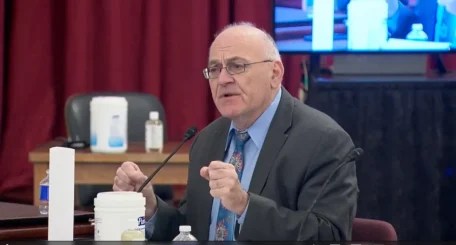
Dr. Paul Marik testifying at the US Senate on January 24, 2022
At the same time that Dr. McCullough was stripped of his job and professorships, his colleague and kindred spirit, Dr. Paul Marik, experienced a similar fate. On October 15, 2021, his hospital’s administration circulated a memo to the entire healthcare system stating that its doctors were authorized to administer remdesivir to COVID-19 patients, but not ivermectin or a host of other repurposed drugs. As Dr. Marik read the memo, he marveled at the sheer perfidy of it. Especially grotesque was the inclusion of “Ascorbic acid” (vitamin C) on the list of banned substances.
The administration issued this directive at a time when seven COVID-19 patients were in the ICU, desperately in need of Dr. Marik’s care. He, in turn, desperately wanted to treat them with the drug regimen that he knew would give them a good chance of recovery. Three months later, at the January 24, 2022 panel discussion (COVID-19: A Second Opinion),hosted by Senator Ron Johnson, Dr. Marik recounted his helplessness. His heart-wrenching testimony (starting at 4:19:30) was probably the most dramatic moment in the extraordinary conference.
This system was effectively preventing me from treating my patients according to my best clinical judgement. … As a clinician for the first time in my entire career, I could not be a doctor. I could not treat patients. I had seven Covid patients [he holds up his hands showing seven digits] including a 31-year-old woman. I was not allowed to treat these people. I had to stand by idly [he clenches and raises his fists with anguish and begins to weep]. I had to stand by idly, watching these people die.
I then tried to sue the system, so then they did something called peer sham review. It is a disgusting and evil concept. They then accused me of seven most outrageous crimes … and [claimed] that I was such a severe threat to the safety of patients, they immediately suspended my hospital privileges because I posed such a threat to these patients—ignoring the fact that under my care, mortality was 50% less than it was under my colleagues. I then went on to this sham peer review. I went to a Kangaroo Court, where they continued this, and the end result was that I lost my hospital privilege and was reported to the National Practitioner Databank. So here I was standing up for my patients’ rights, and this hospital, this evil hospital, ended my medical career.
November 15, 2022
Posted by aletho |
Book Review, Civil Liberties, Full Spectrum Dominance, Science and Pseudo-Science, Timeless or most popular | Covid-19, Human rights |
Leave a comment
The General Medical Council was established in 1858 to regulate doctors and to protect patients from charlatans. Quite right too. Doctors are trained to look at the science and translate this into the ‘art’ of treatment for individual patients. This works well for established disease processes, but what happens when a new disease appears?
This became a real issue in the spring of 2020 with Covid-19. Doctors working on the front line used their experience of treating similar viral infections, consulted widely with colleagues, perused the scientific literature as it became available, repurposed old drugs and developed treatments that were biologically plausible and relevant to the clinical imperatives. These treatments were intrinsically safe and, most importantly, remarkably effective. Yes, people died but death rates were no worse than the usual seasonal influenza. We know seasonal flu kills those with co-morbidities such as cancer or heart disease. Covid-19 was the same – it is simply another flu-like illness.
In their management of Covid-19, front-line doctors quickly established three clinical principles that needed tackling: first to improve basic immunity, secondly to reduce the viral load and thirdly to prevent the cytokine storm with anti-inflammatory interventions. For your information, those treatments are:
· Improve immune function with low carbohydrate diets, vitamin D 10,000iu, zinc 30mg and vitamin C 5g.
· At the first hint of any symptom, reduce the viral load with vitamin C 5g (and more), iodine mouthwash or inhalation (povidone iodine or Lugol’s iodine), ivermectin 12mg twice daily, hydroxychloroquine 200mg twice daily.
· Reduce inflammation to prevent the cytokine storm: vitamin C 5g, vitamin D 20,000iu, B complex, curcumin 500mg twice daily, fish oil 4g daily, nigella sativa 500mg twice daily. Possibly NSAIs and steroids.
These safe and effective treatments are inexpensive and available to all. But this did not fit with the prevailing narrative that Covid-19 was extremely dangerous, necessitating draconian measures such as lockdown, mask-wearing and vaccinations. We now know these measures are not just ineffective at preventing Covid-19 but have generated pathology in their own right – lockdown rendered many stressed, miserable, fat, poor, unfit, ill, un-educated and anti-social. These are all risk factors for cancer, heart disease and dementia.
The official narrative was that there were no treatments available. People were advised to stay at home until they became really ill. Only a vaccine would save us from disease and death. The nation, driven by the BBC, came to believe the official narrative and vaccines were rolled out. The consequence? During 2022, death rates have increased to 16 per cent above average with more than 1,500 people a month dying above the expected rate. We now have consultant cardiologists, paediatricians and obstetricians calling for an immediate halt to the vaccine programme because of the excess death rates, miscarriages and stillbirths directly attributed to vaccines. These doctors expect the situation to get worse since the malign effects of vaccines increase with more doses.
So what happened to all those doctors who advocated these safe and effective interventions, all of which, as a bonus, help to prevent heart disease and cancer? Remember these doctors are advocating low carbohydrate diets, nutritional supplements, herbal preparations and repurposed safe prescription drugs. What happened to those doctors who eschewed the narrative that the only way to prevent covid was a vaccination programme? They have been and continue to be targeted by the General Medical Council. They have or are being investigated because they have stuck to their principles. Principles enshrined by the Hippocratic Oath and GMC codes of conduct and ethical actions. The overriding rule is ‘First, do no harm. Make the patient your first concern’. Any doctor who advises a patient not to receive a Covid vaccine risks prosecution by the GMC – and this risks loss of livelihood, career, income, pension and all such securities. Any doctor who advocates diet, nutrition, herbal or homeopathic remedies or repurposed drugs risks GMC prosecution. It is no surprise that doctors, to save their own skins, have become puppets of the narrative. Many are leaving the NHS demoralised and disempowered.
Any medical intervention, including administering a vaccine, demands informed consent. This is part of English law. It is my experience, and that of many of my colleagues, that people are not getting proper informed consent. Critical parts of informed consent that are being routinely omitted include:
· The right to be informed of all risks including potential long-term risks;
· The right to be informed of all alternative treatments;
· The right not to be coerced.
No vaccinated person who has consulted with me has ever been informed of long-term risks (such as heart disease, infertility, cancer), they have never been informed of the efficacy of safe treatments detailed above and they have been coerced by non-medical issues such as the need to travel, to hold down a job, to be educated or entertained.
I have now reported ten doctors to the GMC for obvious breaches of Good Medical Practice. Some of the nonsenses these doctors have stated in the public arena include:
‘All we can offer is a ventilator . . .’
‘[People should] accept a vaccine with exceptional, and demonstrable, safety and effectiveness.’
‘The vaccine won’t do you any harm.’
‘It’s incredibly safe.’
‘After 12 days from the first vaccination of the AstraZeneca vaccine, you are 100 per cent protected against hospitalisation and death.’
‘It [the vaccine] actually reduces your chance of catching it [Covid-19] in the first place.’
‘The vaccine reduces your chances of passing it on which is why it is such a good idea.’
The GMC has refused to investigate any of these doctors.
By contrast, I am currently being investigated by the GMC for my advocacy of vitamin C, vitamin D and iodine. These are all scientifically proven, effective, inexpensive, safe interventions which are available to all. The GMC has chosen to ignore the science and punish all these who do such.
The GMC is the longest-established regulatory body in the world. All institutions become self-serving and, in the opinion of many, the GMC is in the terminal stages of senile dementia. It has achieved this by ignoring the science, punishing those doctors who dare question the narrative and allowing bad doctors to spout non-evidence-based opinion. The NHS is in a state of decline largely because the GMC will not allow doctors to doctor.
November 14, 2022
Posted by aletho |
Science and Pseudo-Science, Timeless or most popular, War Crimes | Covid-19, COVID-19 Vaccine, UK |
Leave a comment