GOVERNMENT WANTS TO BAN EVERYTHING! – #NewWorldNextWeek
Corbett • 02/27/2020
Welcome to New World Next Week — the video series from Corbett Report and Media Monarchy that covers some of the most important developments in open source intelligence news. This week:
Watch this video on BitChute / Minds.com / YouTube or Download the mp4
Story #1: Posting Anti-Vaccine Propaganda on Social Media Could Become Criminal Offence
Zero Hedge Suspended On Twitter
Outrage as YouTube Reportedly Blocks History Teachers Uploading Hitler Archive Clips
UK Police Deny Responsibility for Poster Urging Parents to Report Kids for Using Linux
Story #2: UNESCO Claims Climate Denial To Be Criminalized And Prosecuted
Jerome Ravetz on The Corbett Report
Story #3: Foreign Interference In Elections Is Unacceptable. Congress Must Make It Illegal.
You can help support our independent and non-commercial work by visiting http://CorbettReport.com/Support & http://MediaMonarchy.com/Join. Thank You.
Crickets! Finland’s Insect Food Boom Goes Bust

Swedish ‘Sustainable Food’ Project Teaches Kids to Eat Insects, Garbage © CC BY-SA 3.0 / Guttorm Flatabø / Grilled maggots for human consumption
Sputnik – February 27, 2020
Despite the media’s preoccupation with insect food and massive campaigns touting crickets and larvae as a sustainable and climate-responsible alternative to meat, the excitement has waned in a matter of several years, the Finnish broadcaster Yle reported, concluding that Finns are “not yet ready to eat crickets”.
Finland’s cricket breeding business took off in September 2017, when the country’s Ministry of Agriculture allowed breeding and selling insects as food, a decision made possible by a revision of the EU’s food standards.
After that the number of insect breeding facilities spiked, as revenues in the billions of euros were predicted. In 2018, Europe’s largest cricket farm emerged in Loviisa, which began to produce hundreds of tonnes of insect powder.
However, in the following years, the buzz subsided, and insect breeders suffered major setbacks amid dwindling demand and stiff competition.
According Lauri Jyllilä of the Finsect company, which promotes insect food, there were over 70 companies in the insect food business at the peak of the enthusiasm. Now, there are about 50 left, with no new companies being founded.
The price of frozen crickets reached as much as 100 euros per kilogram, Jyllilä explained, which was way too expensive even for sympathetic and ecologically-minded consumers.
“The cost of freshly frozen crickets should be 10-15 euros per kilogram”, Jyllilä ventured.
Kurikka resident Panu Ollikkala, one of Finland’s first cricket breeding specialists, dropped out of the competition in the autumn of 2019.
“Demand was inadequate. The price has fallen so much that my business didn’t pay off”, a despondent Olikkala mused.
The Kouvola farm, touted as Europe’s largest, followed suit. Entrepreneur Vesa-Matti Rajamäki admitted that he no longer believed in the success of cricket production. Numerous unsuccessful insect breeders complained that the massive support of the traditional meat industry makes competition virtually impossible.
“A lot of beautiful words were said about the insect business. Many farms were opened, and bank loans were taken” cricket farm owners Kirsi and Jouko Siikoine said. They intend to close down their business in March 2020. “The onterest in eating insects and the insect processing sector has plummeted”, the couple explained.
In the city of Kurikka, which is now considered the centre of insect production, crickets are still being bred, but a downward trend is visible.
“This is a sort of cricket breeding bank, thanks to which you can quickly restore your production if you want”, Jyllilä explained.
The University of Turku, the Finnish Institute of Natural Resources, and the Finnish Safety and Chemicals Agency ran a project named “Insects in the food chain” and concluded that the main difficulty is getting the approval of bulk consumers. Even people who opt out of meat for the sake of the carbon footprint or perceived health benefits largely prefer vegetable sources of protein.
Crickets are often grounded into powder and added to bread, protein bars and chocolate. However, after large-scale promotion, many products gradually left the market.
The main selling point of the bug diet is the reduced environmental footprint. According to Finnish insect producers, a single kilogram of crickets only requires a single litre of water, as opposed to 2,500 litres for a kilogram of rice and a whopping 15,400 litres for a kilogram of beef. Insect food is also claimed to be rich in protein.
Many are still averse to eating insects for reasons of ideology and aesthetics. This opposition has resulted in a common web mantra: “I will not eat bugs and I will not live a pod”.
Boston tide party
Climate Discussion Nexus | February 26, 2020
The Washington Post tells us of Boston that “Famous for its role in America’s war for independence, this city is now fighting the rising seas.” And apparently it is. Only this time the enemy isn’t showing up.
According to the Post, “Mayor Martin J. Walsh (D) has vowed to spend more than $30 million a year, equal to 10 percent of Boston’s five-year capital budget, to defend the city from a watery future that is expected because of climate change.” Which shows, again, that the airy endorsement of alarmism is beginning to have very real consequences. Every dollar spent fighting purple dragons is a dollar not spent fixing roads. And Walsh is fighting purple dragons. “The sea that surrounds Boston crept up nine inches in the 20th century and is advancing ever faster toward the heart of the city. And as climate change accelerates, the pace of sea-level rise in Boston is expected to triple, adding eight inches over 2000 levels by 2030, according to a report commissioned by the city. The ocean might climb as much as three feet above 2013 levels by 2070, the report said.”
Might. Then again, might not. Boston’s sea level record is online at the Permanent Service for Mean Sea Level website. And sure enough, it’s been going up since the record began in 1925.
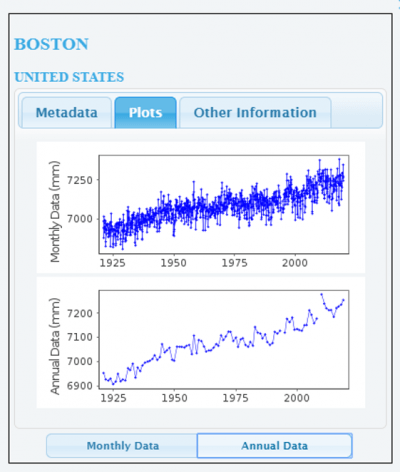 This chart demonstrates that it is not a recent phenomenon, especially since the really rapid increase happened from 1921 to 1950, long before greenhouse warming was an issue. And after hitting a peak in 2010, sea levels have actually been dropping.
Nor is it a local issue. All around the north Atlantic basin the long term tide records show a similar upwards trend. Until you get far enough north, where the uplifting land due to the slow rebound from the melting of the last ice age offsets the rising sea level.
The rising of the north part of the American and European continents means the southern parts are pivoting down. As we pointed out about a city pretty much on the opposite side of the world from Boston, Jakarta in Indonesia, you can have major flooding problems if your city is sinking. As many places are, making the measurement of sea level rise very difficult. It may be tempting to compare the rising seas to, say, an ice cube melting in a glass. But in fact the Earth’s crust is not a rigid stationary container. It’s a very dynamic and complex object, with some parts eroding, others accumulating, some still rebounding from the last glaciation, others subsiding due to subduction of tectonic plates or rising for the same reason and so on.
Human decisions also play a role. For instance in Boston, the Post notes, “half the city is built on low-lying landfill. Among the vulnerable spots are commercial piers, Logan International Airport, low-income neighborhoods, the South End, the New England Aquarium and pricey apartment buildings in the newly redeveloped Seaport area.” Oh my. Are you saying posh people in a very liberal state have been buying seafront property almost as though they didn’t believe their own pieties about climate change? Who saw that coming?
Oh right. Us. Mind you Boston also built public housing projects on landfill “particularly vulnerable to flooding” so they put poor people in the line of flood too. And since unlike some cities urged to stage a “managed retreat” Boston really has nowhere to go, the mayor wants to raise Main Street in the Charleston neighbourhood by two feet to make a flood barrier, put watertight doors on some rail tunnels, build up waterside parks and so forth.
After scaring readers with projections of sea level rises from one foot to nearly eight feet, and citing a city government illustration of even former Celtics star Kevin Garnett apparently threatened with inundation (see Slide 11), the Post admits “The forecast numbers all have substantial margins of error” before insisting that “even the smallest sea-level rise is threatening.”
No it’s not. It’s the same as the amount that the waters rose in the last century during which Boston may have had many problems but on the whole did extremely well, better than most of the world in fact, and was not turned into a marine tea party. What’s more, since despite the time-travelling predilections of climate alarmist analysis almost nobody says man-made climate change began having massive impacts before 1970, and the NOAA’s thoroughly alarmed site Climate.gov says it only began to accelerate around 2006, though the Post manages to cite one study saying “sea-level rise in Boston began to pick up speed only after 1940” instead. But if the rise in this century is around a foot, and in the last century it was nearly a foot, not much is happening. Nor is it happening fast.
The rate of increase for most of the 20th century was around 1.4 millimetres a year according to that NOAA site, (though how you’d measure something that small with that decimal-place accuracy given all the uncertainties is anyone’s guess), which is 0.06 inches in the United States. They say it’s now 0.14 inches a year or 3.6 mm, and blame the entire increase on humans as if nature was this inert thing that just sat there until we bothered it.
It’s not. There are indications that as sea levels rose and fell due to natural temperature variation over the past 2000 years, including the hated Medieval Warm Period, the oceans have risen during natural warmings at a pace not unlike that we’re seeing today. And by the way, The Atlantic early last year published an “oh never mind” piece about Antarctica melting and the seas surging three feet by 2100. The same researchers who rang that alarm bell are now muffling it, saying well maybe a foot.
There’s that foot again. And it, like the 0.14 inches a year, means just over one inch a decade, a slow, steady, non-scary increase. So the contention that an advanced industrial city can’t cope with that kind of increase, other than by throwing away its advanced industry, defies comprehension.
Taxpayer Funded NGO Releases Yet Another Climate Doomsday Report

By Eric Worrall | Watts Up With That? | February 26, 2020
According to MSM you can trust the “THE CENTER FOR CLIMATE & SECURITY” because they are non partisan experts.
Report warns climate change could become ‘catastrophic’ global, national security threat
BY REBECCA KLAR – 02/24/20 09:16 AM EST
National security and intelligence experts warn that climate change could become a “catastrophic” threat to security and recommended quick action to be taken to mitigate risks, according to a new report released Monday.
“Even at scenarios of low warming, each region of the world will face severe risks to national and global security in the next three decades,” experts wrote in the report released by the National Security, Military and Intelligence Panel of the Center of Climate and Security, a nonpartisan security policy institute.
“Higher levels of warming will pose catastrophic, and likely irreversible, global security risks over the course of the 21st century.”
The security threat assessment of global climate change warns that all levels of warming of climate change will pose “significant and evolving threats” to global security environments, infrastructure and institutions.
The report itself is available here.
I think the most ridiculous part of the report is a suggestion 1-2C of warming in Russia would cause serious problems.
… At 1-2°C/1.8-3.6°F of global average warming, the EUCOM area of responsibility will experience severe weather that threatens destabilization of its key economic sectors, rising regional inequality, and impacts on civil and military infrastructure. In this scenario, rising ethno- nationalist sentiments alongside rising migration waves pose serious threats to the alliances underlying existing security institutions.
At 2-4+°C/3.6-7.2+°F of global average warming, the EUCOM area of responsibility will likely experience prolonged drought and rising seas, leading to significant internal displacement, as well as an influx of migrants from neighboring areas. In this scenario, a breakdown in regional political, institutional, and security cohesion becomes likely. …
Read more: Same link as above
1-2C of warming in Russia might mean Northern Russia is slightly more habitable. Like Canada, most Russians live on the warm southern edge of their nation, because the North is simply too cold.
The section on human health quotes The Lancet;
… Climate change will pose serious challenges to human health, mainly by affecting delicate natural systems that make bodies more susceptible to stress and disease. Medical research increasingly demonstrates links between warming temperatures and increased vulnerability to heat stress, infectious diseases, extreme events, and pollution, as summarized by the now annual report on health and climate change published by the leading journal, The Lancet.67 …
Read more: Same link as above
The suggestion that warm weather compromises people’s immune systems is absurd. Humans are extreme tropical monkeys, we don’t have fur because our ancestors evolved in one of the hottest places on Earth. Across most of the Earth, humans need clothes to stay warm enough to survive. So it seems reasonable to infer that the human immune system is mostly still optimised to the hot tropical weather our ancestors experienced.
The report was likely paid for with US taxpayer’s money. The authors acknowledge the generous support of the Henry M. Jackson Foundation, which was set up by Congress in 1983. The Henry M Jackson foundation does a lot of good work supporting the medical needs of veterans, and also performs HIV research, so it seems a real shame they decided to waste some of their endowment and goodwill on yet another climate report.
When Is A Pandemic Not A Pandemic?
The World Health Organization is playing games
By Donna Laframboise | Big Picture News | February 26, 2020
In 2010, the World Health Organization (WHO) explained on its website:
A pandemic is the worldwide spread of a new disease.
An influenza pandemic occurs when a new influenza virus emerges and spreads around the world, and most people do not have immunity.
A WHO document advising countries how to respond to such outbreaks used the word ‘pandemic’ 485 times across 64 pages back in 2009. That same document contained a table describing the six phases of a pandemic:

click to enlarge
In 2013, an update used ‘pandemic’ 413 times across 60 pages. Then came the 2017 edition, which employed the term 408 times across 59 pages.
But two days ago, a spokesperson told Reuters the WHO no longer recognizes this term. ‘Pandemic’ has apparently been struck from its vocabulary.

click image to read full story
According to Tarik Jasarevic, people may use this term colloquially to describe the spread of a new pathogen, but that’s their private affair. Say what?
There’s a new, highly contagious, stealth virus out there. Some people who contract it will end up in ICU with serious complications. This isn’t a run-of-the-mill flu. It began killing people in China several weeks ago, and has now spread to 40 countries. A dozen Italian towns are currently in lock-down, complete with police roadblocks. Hong Kong has closed schools until late April. The deputy health minister of Iran has tested positive.
Take another look at Phase 6, above. Sustained outbreaks in at least three countries, in two different parts of the world. We’re well beyond that.
Yet the WHO is playing word games. It says this isn’t a pandemic. It’s merely a PHEIC – which stands for a Public Health Emergency of International Concern.
Does that make you feel safe?
Climate Alarmism and Malthusianism (rebuttal to Taylor)
By Robert Bradley Jr. – Master Resource – February 25, 2020
“The pseudo-intellectual right loves to compare climate concern and action with Malthusianism. I’ve never quite understood what the heck these things have in common.” (Jerry Taylor, October 13, 2019)
“What environmentalists mainly say … is not that we are running out of energy but that we are running out of environment–that is, running out of the capacity of air, water, soil and biota to absorb, without intolerable consequences for human well-being, the effects of energy extraction, transport, transformation and use.” (John Holdren, April 2002)
Jerry Taylor, please read the literature before opining on such matters as energy and the environment. Climate change is the latest Malthusian scare, per John Holdren. And the common denominator of the Malthusian worldview is overpopulation, as Pierre Desrochers and Joanna Szurmak document in Population Bombed! Exploding the Link Between Overpopulation and Climate Change (2018).
Some quotations from Population Bombed cement the tie-in:
- Numerous population control advocates have linked anthropogenic climate change to population growth, or tried to revive interest in invoking anthropogenic climate change as the key negative outcome of continued economic growth linked to, foremost among causes, an increasing population.
- … population Bomber” himself, Paul Ehrlich … during a conference in 1968 identified anthropogenic carbon dioxide emissions as a “serious limiting factor” to economic growth.
- By the 1970s, Ehrlich, his wife Anne and his collaborator John Holdren raised fears that carbon dioxide “produced by combustion of fossil fuels in quantities too large to contain” may “already be influencing climate” and, as such, constituted one of the “gravest threats to human well-being. . . [i.e.] the loss of natural services now provided by biogeochemical processes.”
- [Julian] Simon then summarized the position of most environmentalists as follows: “But isn’t obvious. . . that additional people and additional economic growth will cause us to use more energy and hence emit more greenhouse gases? Therefore, even if we can’t be sure of the greenhouse effect, wouldn’t it be prudent to cut back on growth?”
- The economist Jacqueline Kasun similarly believed at the time that “by the 1990s the doomsayers had shifted their attack” as they could no longer invoke resource depletion as the key growth-limiting issue. As she wrote, “the alarmists didn’t miss a step. The problem, they now said, was that people were using too much energy and were causing Global Warming.”
- Canadian academic Michael Hart has commented that “for alarmists, climate mitigation policy is as much a means of achieving their larger goals as it is a matter of addressing a possibly serious issue.”
- Canadian academic, historical climatologist Tim Ball, has long argued, the climate change policy agenda is based on certain assumptions ultimately related to a fear of reaching another terrestrial set of limits through overpopulation.
- Maurice Strong (1929–2015), who was described by business journalist Peter Foster as “[m]ore than any other individual. . . responsible for promoting the [UN] climate agenda,” … [stated] “with a growing global population, we will have to recognise that having children is not just a personal issue but a societal issue and at a certain point we may be faced with a need to have a permit to have a child.”
- [Strong] also referred to the need for “national population policies” in his opening speech at the 1972 Stockholm Conference. Strong reportedly stated the following Malthusian prediction at the 1992 Earth Summit: “Either we reduce the world’s population voluntarily or nature will do this for us, but brutally.”
- The first chairman of the IPCC (1988-1997), Bert Bolin, was not only an early convert to the alleged catastrophic impact of CO2 emissions, but also a pessimist on population and resources issues, as evidenced in his stance on the controversy surrounding the 2001 publication of The Skeptical Environmentalist by the Danish political scientist Bjorn Lomborg.
- John Holdren contradicted many of his earlier warnings of imminent resource depletion by arguing that while the word was not “running out of energy,” it was “running out of environment,” by which he meant “running out of the capacity of air, water, soil and biota to absorb, without intolerable consequences for human well-being, the effects of energy extraction, transport, transformation and use.”
- The second chairman of the IPCC (1997–2002), Robert Watson, would later go on the record with the following line of reasoning: “The more people we have on the Earth and the richer they are, the more they can demand resources. There’s more demand for food, more demand for water, more demand for energy. . . So, there’s no question the threats on the Earth today are far more than, say, 50 years ago and in 50 years’ time, there will even be more threats.”
- The third chairman of the IPCC (2002-2015), Rajendra K. Pachauri … was “not going to rest easy until [he has] articulated in every possible forum the need to bring about major structural changes in economic growth and development. That’s the real issue. Climate change is just a part of it.”
- … Timothy E. Wirth, one of the main organizers of the 1988 James Hansen hearing on climate change, and from 1998 to 2013 president of the (hardcore Malthusian) … is on the record as stating in 1993: “We’ve got to ride this global warming issue. Even if the theory of global warming is wrong, we will be doing the right thing in terms of economic and environmental policy.
Other documentation from Desrochers and Szurmak includes the views of Christine Stewart, then Canadian Minister of the Environment; Connie Hedegaard, European Commissioner for Climate Action (2010–2014); Executive Secretary of the United Nations Framework Convention on Climate Change, Christiana Figueres ; Professor Hans Joachim Schellnhuber, the director of the Potsdam Institute for Climate Impact Research; researchers associated with the Population Reference Bureau and the Worldwatch Institute; Canadian climate scientist Andrew Weaver of the British Columbia Green Party; and the late climatologist Stephen Schneider
So what are the climate Malthusians missing? The same thing as before: human ingenuity. Desrochers and Szurmak note:
… there is ample evidence of a passionate commitment towards the protection of the planet, but there is no sign of recognition that humanity can do, and has done, more than simply consume resources. At no point do neo-Malthusians admit the possibility that technological innovations and human creativity have a place among the things that deserve a place on Earth. What pessimist activists desire is a consensus on the classification of humanity as out of control and inherently driven by destructive greed, thus in need of top-down regulation by the few remaining clear-thinking and benign autocrats – that is, functionaries – of the global government.
Buyer beware of climate alarmism and Malthusianism.
Thought-police come for Koch-funded ‘anti-Greta’ – but unlike ‘real Greta,’ she’s open about her backers

© YouTube / The Heartland Institute / Reuters / Fabian Bimmer
By Helen Buyniski | RT | February 24, 2020
A 19-year-old German girl has joined the right-wing Heartland Institute to counter “climate alarmism” with “climate realism,” leading MSM to dub her “anti-Greta” (Thunberg). But unlike Thunberg, her conflicts of interest are in public view.
Naomi Seibt has been attacked as a “climate change denier” for working with the Heartland Institute, a libertarian think-tank funded by oil and gas companies and conservative groups. But the young German insists she’s not denying climate change, just trying to inject some reason into the debate – a demand which has only caused her detractors to shriek louder.
“I don’t want to get people to stop believing in man-made climate change, not at all,” she told the Washington Post on Monday, while acknowledging she found the idea that human activity alone was responsible for the warming planet “ridiculous.” The outlet’s profile of the young activist, whom it not-so-subtly dubs “the anti-Greta,” proceeds to paint her as a puppet of the Heartland Institute, which is “paying [Seibt] to question established climate science” – as if she would never have done so on her own.
Suggesting there’s anything inauthentic or manufactured about Thunberg has been heresy in MSM ever since the young Swede burst onto the global scene at the tender age of 15. Even as it emerged that her rise to superstardom was choreographed with the help of PR man Ingmar Rentzhog, whose ‘We Don’t Have Time’ climate-focused social network featured her prominently in its marketing materials; even after a data leak exposed that Thunberg’s Facebook posts were written by her father and an Indian activist, the integrity of her convictions was never questioned. After all, she had held those beliefs for years before embarking on her climate crusade.
Seibt’s activism, too, predates her involvement with the Heartland Institute. She told the Post she developed a political consciousness “a few years ago” after questioning German immigration policy in class triggered a backlash from teachers and students alike, causing her to develop a general “skepticism about mainstream German thinking.” Only after a Heartland Institute employee saw her speak at another think tank affiliated with the right-wing AfD party – after she was already making videos, including one in which she “came out” for Pride Month as a climate change skeptic – did she become the face of the group, which is heavily funded by oil and gas interests as well as conservative bogeymen the Koch brothers.
While Seibt shares Thunberg’s long blonde hair and youth, the similarities end there. The German’s measured presentation couldn’t be further removed from Thunberg’s emotional pleas. She references Thunberg’s famous call to “panic as if your house is on fire” only to deliver a calm: “I don’t want you to panic, I want you to think.” Warning her audience of the danger of confusing science with politics, she urges tolerance of dissenting opinions and slams her opponents’ use of the term “climate denial” for its not-so-subtle evocation of Holocaust denial. But while Seibt attempts to debunk accepted climate change wisdom, she doesn’t pretend to have the solution, admitting she “could be wrong” and urging viewers to “continue doing your research and form your own opinion on the climate change situation.”
This hasn’t stopped her detractors from attacking her for her “arch-denialist” backers, however. Graham Brookie of the Atlantic Council’s Digital Forensic Research Lab, apparently unable to find real disinformation in Seibt’s videos, slimed her anyway for allegedly creating a “false equivalency between a message based in climate science that went viral organically and a message based in climate skepticism trying to catch up using paid promotion.” Fair enough – she has a long way to go before she catches up with Thunberg. Except the young Swede’s message didn’t exactly go viral organically, either.
Thunberg’s “brand” – recently trademarked – may position her as a David to the fossil fuel industry’s Goliath, but this is not entirely accurate. From the documentary crew shadowing the pint-sized crusader since her first day school-striking outside the Swedish Parliament to the PR muscle required to get her on board multimillion-dollar racing yachts and shaking hands with Barack Obama, evidence of the deep pockets behind the Thunberg phenomenon is everywhere, even if those pockets’ owners remain elusive. Thunberg’s apocalyptic talking points are compiled in the Climate Emergency Plan, released by Rentzhog’s We Don’t Have Time and another climate-focused think tank to which he belongs, Global Utmaning (Global Challenge) in collaboration with the Club of Rome in November 2018. Global Utmaning was founded by industrial heiress and former deputy central bank governor Kristina Persson and counts as members and advisors a “green” venture capital advisor and more than half a dozen veterans of Swedish-Swiss energy megacorporation ABB, which stands to make a killing on the transition to renewables. And these are just two nodes in the network of environmental NGOs behind Thunberg, a sphere of “nonprofits” that is ideally positioned to soak up what one of these groups, ClimateWorks, predicts will be $90 trillion spent over the next 15 years to stave off the worst effects of climate change. At least Seibt’s backers, riddled with conflicts of interest as they may be, are out in the open.
Those attacking Seibt’s for partnering with the Heartland Institute have pointed to the group’s “attacks” on Thunberg and climate scientists to justify their own smears, though it’s difficult to see how attacking Seibt as a “climate denier” achieves justice for the Swedish activist. Accusing Seibt of climate change denial because of who funds her work would – to avoid hypocrisy, at least – require them to hold Thunberg responsible for everything her shadowy backers have done or said – a prospect that is simply unrealistic, and not fair to Thunberg. Instead, all sides of the debate would be wise to listen to Seibt, who has implored climate skeptics and climate change protesters alike to bury the hatchet. “I hope that we can live in an era of discussion again… freedom of speech is the foundation for a society that can truly stick together.”
Rather then give Seibt the benefit of the doubt, at least one other outlet pounced on WaPo for not being harsh enough on the German activist. Motherboard accused the outlet of “amplifying climate change denialism” from a “noted propaganda factory” that “can routinely be found peeing in the public discourse pool on behalf of its corporate donors.” Imagine what hell would break loose if anyone used such terms to describe Saint Greta…
UNESCO: Prosecute Climate Criminals
If voters elect leaders who reject UN climate treaties, those leaders will be dragged before an international court.
By Donna Laframboise | Big Picture News | February 24, 2020
UNESCO’s 2019 climate-themed magazine includes an article titled Climate crimes must be brought to justice. It may as well have been called Off With Their Heads!
Writer Catriona McKinnon, a professor of political theory at the University of Exeter, thinks she’s the Queen of Hearts in Alice’s Adventures in Wonderland. Alternative perspectives shall not be tolerated. Non-compliance isn’t an option.
McKinnon wants to criminalize free speech. She wants to strip you and me of the right to determine our own destiny at the ballot box. Specifically, she wants to invent a new crime. The time has come, she says, to prosecute this crime.
Normally, laws get made by politicians. WHO ARE ANSWERABLE TO VOTERS. There’s supposed to be a shared understanding, in the jurisdiction in which a new law applies, that a particular behaviour harms the community, and that punishing it is therefore necessary.
In many countries, adultery isn’t a criminal matter. Elsewhere, it ends in death by stoning. Laws are an expression of a community’s values. We decide what’s a crime – and what isn’t – within our own borders.
From the heights of her ivory tower, however, Queen McKinnon has unilaterally declared that people should be charged, dragged before an international court, and convicted of crimes that aren’t actually crimes in their motherland.
Here’s how her article begins:
A fire has started in the theatre, from which there are no exits… Some people are trying to warn everyone so that the fire can be contained before it spreads out of control. Another group… is trying to shout loudly that there is no fire, or that it is not serious, or that there is plenty of time left to put it out… Many people in the theatre are confused by these… fire deniers… those shouting “no fire” ought to be silenced… [bold added]
In McKinnon’s fevered imagination, climate skeptics are evil villains who occupy “the most expensive seats” in the theatre. Rather than trampling everyone else on their way to the exits, they inhale smoke and perish. But first they take the time to shout in “emotive language” that the fire isn’t real and that the other side “is not to be trusted.” Yeah, that all sounds coherent.
On the basis of such outlandish nonsense, McKinnon argues that:
… international criminal law should be expanded to include a new criminal offence that I call postericide. It is committed by intentional or reckless conduct fit to bring about the extinction of humanity… Just as international criminal law holds military leaders to account for genocide committed by their troops, it should hold political and economic leaders to account for postericide committed under their authority. These leaders should go to trial at the [International Criminal Court]…
It’s clear McKinnon thinks US President Donald Trump is guilty of this crime, due to the fact that he withdrew his country from the Paris Climate Accord.
According to this UK professor, American voters don’t get to decide. They don’t get to elect someone who opposes international climate treaties.
In her universe, there’s only one permissible position. Either the US signs up, or its president gets charged with murdering posterity. Off with his head!
No Airports, No Imports–Welcome To Year Zero!
By Paul Homewood | Not A Lot Of People Know That | February 21, 2020
I took a quick look at this story the other day, but have now had time to read the report it was based on:
To many people, “saving the planet” means little more than building wind farms, planting trees and using less plastic. However it is gradually beginning to dawn on the public that the impact on their lives will be substantial.
Even then though, things like scrapping gas boilers and moving to electric cars have been something that “won’t happen for decades, so why worry now?”
However a new study, sponsored by the UK Government, has warned that huge changes to our lifestyles will be necessary, and much sooner than we think, if zero emission targets are to be met.
The report by UK FIRES, called Absolute Zero, calls for all UK airports to be shut by 2050, because there are no practical alternatives for zero emission flight. But as part of this timetable, all airports other than Heathrow, Glasgow and Belfast must shut by 2030.
In a stroke, air travel will be effectively banned for most of the country, as Heathrow simply would not have the capacity to handle more than a small proportion of demand. (Heathrow currently carries a quarter of UK passengers).
But that is just one item on a long list of changes to be forced on the British public. The report concludes that we cannot bank on technological innovations coming to our rescue.
If you thought that we could simply rely on renewable energy, forget it. As UK FIRES points out, even with rapid growth of renewables, we will still need to cut our energy use by 40%, even before air travel and shipping are factored in. And all of this without accounting for the projected population increase.
So forget about electric cars being the solution, because we will not have enough electricity to power them. The recommendation from UK FIRES – have 40% less cars on the road. Their suggestion – use the train more, ignoring the sky high prices, the fact that railways offer very limited routes and how you are supposed to travel around when you get to your destination. The idea that we will all willingly give up our cars to travel by rail or bus is utterly naive.
The report also conveniently ignores the high carbon dioxide footprint in building electric cars in the first place.
Heating is another area where we must cut emissions. UK FIRES expect us to buy heat pumps, seemingly oblivious to the fact they will cost each household a good £10k more than our conventional boilers. They also don’t appear to realise that heat pumps are incapable of supplying the heat we need in the middle of winter, or that the power grid simply could not cope with that sort of spike in demand even if they could.
Or maybe they do! Their guidance includes using heating for less time, in fewer rooms and wearing warm clothes in winter.
Our diet does not escape either, as we will have to give up eating beef and lamb, not to mention frozen ready meals. While we are expected to rely on arable farming instead, they also want fertiliser use to be drastically reduced.
Meanwhile the construction industry is likely to grind to a halt, as cement is phased out. Unfortunately the actual making of cement releases emissions, regardless of the source of the energy used.
Forget about housebuilding, new hospitals and infrastructure, they want us to concentrate on retrofit and adaptation of existing buildings.
Ironically, as even the report admits, we don’t know how to install new renewables or make new energy efficient buildings without cement.
If all of this was not bad enough, they want to ban all imports by 2050, unless they can come via rail, which might be a problem given that we are an island! Of course, we don’t have zero emission freight ships at the moment, and are unlikely to in the foreseeable future.
Quite how we are expected to feed ourselves without importing food is a mystery, unless we return to 1940s style rationing. And you can forget about all of those other things we get from abroad now.
What about, for instance, computers and electronics? We will quickly become an international backwater, without access to the latest technology. It would be like the country returning to 1990s style Nokia phones, VHS and floppy discs!
Some may be substituted by UK made goods, but it is hard to see how industrial capacity could be built back up with the restrictions planned on construction, energy use and industrial emissions.
But it is not only the emissions from shipping which concerns the authors. They also say we must be responsible for all emissions from the production of imported goods.
So how, you might ask, are we supposed to live in this glorious, emission free future?
UK FIRES says we must not worry! We can apparently carry on doing the things we enjoy most, totally emission free. Things like sports, social life, eating, hobbies, games,computing, reading, TV, radio, volunteering and sleeping! According to the report, “we can all do more of these without any impact on emissions.”
Indeed, with the economy and industry destroyed, most of us will have much more time on our hands for these pursuits! (Climate scientists and bureaucrats excluded, naturally).
Nowhere in this dismal little report is there any acknowledgement of the fact that the UK only generates 1% of global emissions. The report starts by stating:
We have to cut our greenhouse gas emissions to zero by 2050: that’s what climate scientists tell us, it’s what social protesters are asking for and it’s now the law in the UK.
Wrecking the economy is not something we should do, just because a few eco-loon protestors are asking for it. And laws can, of course, be changed.
We must however thank the authors of this report for bringing home the very real and damaging effect that the mad rush to decarbonise will have on peoples’ lives.
And, as they have rightly stated, these changes will have to start being put into practice very soon, certainly during this decade.
For too long, the impact and cost of the Climate Change Act has been deliberately hidden from the public. Partly this has been the result of a political conspiracy between all of the major political parties and establishment in general. It has also been aided and abetted by all of the media, with a handful of notable exceptions.
But their dirty little secret cannot be covered up for much longer.
Featured Video

The American Retreat from Vietnam
or go to
Aletho News Archives – Video-Images
From the Archives
Secret document reveals plans for civil war in Lebanon, Israeli false flags, and invasion
By Randi Nord | Geopolitics Alert | April 5, 2019
Beirut – During his visit with US Secretary of State, Mike Pompeo, Lebanese President Michael Aoun reportedly received a US-Israeli document detailing plans for creating a civil war in Lebanon with covert false flag operations and possible Israeli invasion.
Although the source of the document is Israeli and created in partnership with Washington, no one knows who presented it to Aoun. The Lebanese TV station, Al-Jadeed, initially reported the document on Lebanese TV and a video on its website. Geopolitics Alert translated the report for this article. … continue
Blog Roll
 Aletho News
- ‘Distance yourselves from Israel’: IRGC urges US population to question govt policies
- America’s Greenland deal has a radioactive backstory
- The RAF Fairford ‘terror plot’: Unpacking escalation in the UK echo-chamber
- EU Council Advances Chat Control 2.0 Scanning Proposal
- Ex-Greek MEP files complaint against Israeli spyware firm over alleged Pegasus surveillance
- Troubling ideas throughout the Torah, Talmud, Mishneh Torah and Tanya
- ‘Grave, alarming’: Iran mission on Trump’s UNGA ‘annihilation’ threats
- Najaf airport to reopen to Iranian flights within 24 hours: Ambassador
- From ‘How Will This End For Iran’ to ‘When America Walks Away’: A tale of two Economist covers
- Tehran blasts ‘baseless’ speculation linking Iran to alleged bomb plot at UK air base
- If Americans Knew
- Ex-Biden officials are desperate for a Gaza scapegoat
- Israeli “settlers” Invade Al-Aqsa; Pour Boiling Water on 75-Year-Old
- Israel Has Kidnapped Another American Teenager
- US arms sales to Israel worth $21.6 billion in 20 months
- Three Palestinians Killed in Israeli Attacks on Gaza
- Revealed: German “Anti-Semitism Expert” Driving Crackdown on Palestine Solidarity is Former Israeli Spy
- Egypt’s Warning to Israel Before Oct 7
- Israel’s siege signals another cruel winter for 1.8 million Gazans – Daily Update
- Netanyahu Asked UAE Leader to Deny Report on Oct. 7 Warning in Secret Visit, Sources Say
- CNN Chief Int’l Correspondent Clarissa Ward on Journalists in Gaza
- No Tricks Zone
- New Study: Earth And Venus Surface Warmth Largely Explained By Convection And Lapse Rate, Not CO2 Or Radiation
- 2025 Nature Paper Claiming Worsening Global Drought Gets RETRACTED …Heavily Flawed
- New Study: ‘Global Drought Shows No Detectable Recent Acceleration Under Climate Warming’
- Economic Masterminds: German Socialists Suggest Taxing Productivity Gains Stemming From Using AI
- The South China Sea Has Not Been Cooperating With The Climate Change Narrative
- Energy Crisis: Germany Enters Heating Season With Historically Low Gas Reserve Fill Levels
- New Study: The Antarctic Ice Sheet Gained Mass From 2020-2024 Due To Staggering Snow And Ice Accumulation
- Study: Ocean Heating Rates From Thousands Of Years Ago ‘Dwarf’ Modern Ocean Heating Rates
- Climate Extremists Target, Attack Large-Scale Power Grid Infrastructure In Germany!
- New Study: Antarctic Ice Melt Has Contributed Less Than 1 Centimeter To Sea Level Rise In The Last 30 Years


