Sins of emission
By Christopher Monckton of Brenchley | Watts Up With That? | February 19, 2020
Much has been made of the alleged standstill in global CO2 emissions, which are asserted to have been about the same in 2019 as in 2018, at 33.3 gigatonnes of CO2:

Obsession over transient phenomena such as this is commonplace among the climate genociders, whose cruel, dangerous and expensive global-warming abatement policies are killing tens of millions annually through the coordinated refusal of most of the world’s leading merchant, central and intergovernmental banks to lend to developing countries to install the one kind of electricity they can afford and can maintain and are desperate for – coal-fired generation.
Nothing lifts a poor nation faster, more surely and more permanently out of poverty, misery, disease and death than the universal availability of universal, affordable, continuous, base-load, coal-fired electricity.
Were it not for the genocidal emissions-abatement policies driven by the totalitarian fanatics and extremists of the far Left in the West, the whole world would by now be electrified, prosperity in the developing countries would have increased no less dramatically than it has in the electrified advanced economies, and the net benefit to the environment in the consequent stabilization of population would have been overwhelming.
Almost two centuries of official demographic statistics have demonstrated that, by a long chalk, the most effective method of stabilizing a previously-burgeoning population is to increase the general prosperity of that population. Frankly, nothing else works. The fastest way to displace poverty with prosperity is to give the people electricity. We should make this moral case against the genociders daily until they are compelled to pay heed.
The genociders’ trumpeting of the supposed standstill in global CO2 emissions is – as usual – misplaced. As the IEA’s graph shows, the imagined level of global emissions remained static for five years from 1990-1995. In Their terms, we were doing “better” then than now, for no increase in our sins of emission was reported over that period.
Their “our policies are at last working” meme is misplaced for a second reason. The emissions data are inaccurate. As with temperature, so with emissions, we are incapable of determining global data to a precision of a tenth of a unit. We know that the emissions data are inaccurate because if they were accurate – and if the link between emissions and concentration were as direct as They tell us it is – then the stabilization of emissions would have been matched by at least some diminution in the rate at which CO2 concentration is accumulating in the atmosphere.
However, the CO2 concentration at Mauna Loa shows a continuing and undiminished rate of increase over the past four or five years:

Since the trend in global temperatures has been generally downward over the past five years, additional outgassing of CO2 from the oceans does not account for the continuing increase in CO2 concentration.
Nor can it legitimately be argued (though some genociders have tried) that the terrestrial CO2 sink is failing. If it were failing, the rapid growth in the total plant biomass on the planet – the net primary productivity of trees and plants – would not have been as spectacular as it has been.
The question arises whether the decades of hot air generated by the climate genociders’ intergovernmental conferences, at vast expense in treasure as well as in common sense, have reduced global CO2 emissions below the business-as-usual prediction made by IPCC in its First Assessment Report in 1990.
The answer is No. The annual, official, peer-reviewed estimate of global CO2 emissions from all sources, Friedlingstein et al. (2019), who used the same wider measure of emissions as IPCC, shows that emissions are above the business-as-usual trajectory predicted by IPCC in 1990:

The 11.5 givatonnes of carbon estimated by Friedlingstein et al. is equivalent to 42.2 gigatonnes of CO2.
In short, the quintupling of electricity prices compared with what they would be without global warming abatement policies, the doubling of gasoline prices, the destruction of heavy industries such as coal, steel, aluminum, coal-fired power generation and motor manufacture throughout the Western world, the trashing of the countryside and the killing of billions of bees, birds and bats by windmills, the slowing of storms and the consequent flooding caused by those same windmills, and all the deaths that the genociders are inflicting upon our less fortunate cousins in the developing world with their refusal to countenance the immediate electrification of the one-sixth of the planet whose population subsists in enforced and involuntary darkness, have achieved precisely nothing.
Worse than we thought
Climate Discussion Nexus | February 19, 2020
NBC runs a strange variant on the “it’s even worse than the settled science thought” climate story: “Climate change models predicted ocean currents would speed up — but not this soon”. Except they didn’t predict ocean currents would speed up, they said the opposite. For years climate change models and alarmists predicted ocean currents would slow down. Then it sped up and that too was proof of climate change. In every other branch of science predictions are required to come before observed events, and they’re not supposed to predict the opposite of what happens. And if they do, it’s not supposed to be used as proof of the theory.
In fact there’s a lot less to this story than meets the headline, as so often. (For instance the ones howling about accelerating sea level rise of about 0.04 mm when the range of uncertainty is 5 mm.) Starting with how nobody knows what the ocean’s currents are doing. It’s not as though climate modelers go forth and measure stuff. Instead, David Whitehouse points out on the Global Warming Policy Forum, they find some proxies, fill in massive gaps with computer models, put the resulting data-like object into other computer models and go “Aha, exactly as we predicted, except for the speed, timing and direction of the change.”
Actually to be fair this study didn’t even say that much. The researchers are totally on board with man-made global warming, kicking off their introduction with “Earth has experienced rapid warming for decades, driven by increased emissions of greenhouse gases”. But when it comes to these pesky, complex ocean currents, the lead author said bluntly “So far observations haven’t shown a trend”.
So more research is needed. And, as NBC quotes a completely unbiased Environmental Defense Fund scientist not involved with this project as adding, more funding for research. For us. But the study’s model does say that in theory, if we knew a lot more than we do and accepted certain assumptions, we’d expect the currents to speed up whereas on other assumptions we’d expect the opposite unless we didn’t.
Even the NBC story eventually stumbles into the dark, admitting that “The puzzling discovery, detailed in a study published last week in the journal Science Advances, highlights that climate change could have wide-ranging effects that are unexpected or severely understudied.” And here we thought the science was “settled”.
Oh wait. It is. NBC also says “The disparity suggests that some climate models may underestimate the effects of global warming.” But none overestimate it, because it’s always worse than it is. “Warmer water will generate hurricanes and extreme weather like that, so there are definitely implications from our work,” said one of the scientists, while an outside observer said “if the ocean system changes significantly, it could directly threaten life on Earth.”
So yes, we are all going to die. QED.
Antarctica’s ‘Hottest Day’? Not So Fast
By Michael Pile | Quadrant | February 18, 2020
Have you ever wondered how to play the Climate Game, or game the climate? If so, look no further than a remote research station on the northern tip of the Antarctic Peninsula, a submarine-shaped office tower on Geneva’s Avenue de la Paix and an international media pack determined to ramp a single yet-to-be-confirmed measurement into another bogus climate scare.
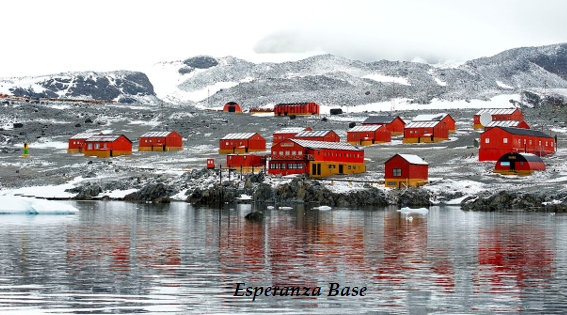
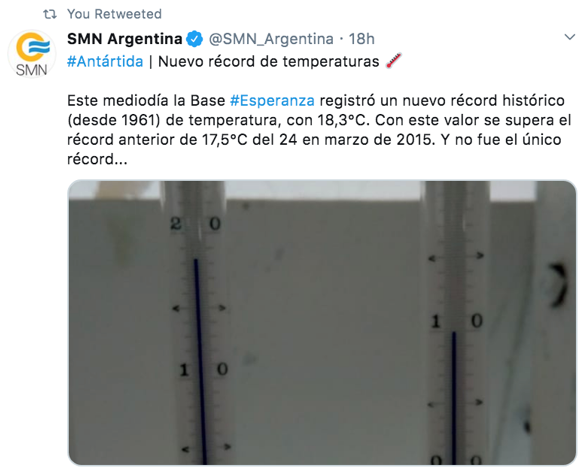
The research station is the Argentine base, Esperanza, coordinates: 63°23′51″S 56°59′52″W. It claimed to have set a new record temperature of 18.3°C on February 6 this year, beating the previous record of 17.5°C on March 24, 2015, according to a tweet (below) from Servicio Meteorológico Nacional (SMN), Argentina’s national meteorological service.
It was déjà vu all over again for the alarmist MSM.
BBC – Scientists warn that global warming is causing so much melting at the South Pole, it will eventually disintegrate – causing the global sea level to rise by at least three metres (10ft) over centuries.
NY Times – Antarctica, the coldest, windiest and driest continent on Earth, set a record high temperature on Thursday, underscoring global warming”. It went on to claim: “the high temperature is in keeping with the earth’s overall warming trend, which is in large part caused by emissions of greenhouse gases.
The Guardian – Antarctica is “one of the fastest warming places on earth, heating by almost 3°C [5.4°F] over the past 50 years”
The Guardian makes that claim despite recent research suggesting a cooling trend since the year 2000, contradicting the carbon dioxide-driven global warming scare. (Media’s horribly dishonest Antarctica warming propaganda, WUWT, February 9, 2020) Five years earlier, on April 1, 2015, it reported on the previous record under the headline: “Antarctica records unprecedented high temperatures – two temperature readings register ominous new potential measurements of accelerating climate change.” “What was incontestable,” the paper’s journalist concluded, “were the unprecedentedly high temperature readings on the Antarctic ice mass.”
Jack Weatherall: Warmists are feeling a polar chill
Yet mean monthly temperatures at Esperanza range from −10.5 °C (13.1 °F) in July, the coldest month, to 1.4 °C (34.5 °F) in January, the warmest month. During summer (December–February), the average high is between 3.7 and 4.3 °C (38.7 and 39.7 °F) while the average low is between −2.0 and −1.2 °C (28.4 and 29.8 °F). In winter, mean temperatures are around −6.0 °C (21.2 °F). So what is going on here?
ClimateChangeDispatch.com’s Thomas Richard ridiculed the Pavlovian alarmism:
To put this in perspective, it would be the equivalent of taking a temperature measurement in Reykjavík, Iceland, and proclaiming that this measurement is indicative of the temperature of the Arctic region, or worse, Tasiilaq (Ammassalik), Greenland. It’s a ridiculous statement and utterly useless. It is well known that West Antarctica is heavily influenced by underground volcanic activity, and hidden beneath its icy exterior is a myriad of active rift systems.
The glass, steel and aluminium tower adjacent Geneva’s Jardin Botaniques is the global headquarters of the World Meteorological Organisation (WMO) According to a local travel agency, Geneva Live Tourism, the building is “respectful of the environment,” and its “grandiose allure with the double façade seeming to dominate the surrounding space”. WMO is the beating heart of Big Climate. It is the UN’s “expert agency and voice regarding the state and behaviour of the Earth’s atmosphere, its interaction with the oceans, its climate and the resulting distribution of water resources.” WMO issued a media release on the Esperanza result on February 7. It was a qualified announcement – New record for Antarctic continent reported – for the “likely legitimate record” was subject to formal verification.
A committee for WMO’s World Weather and Climate Extremes Archive (WWCEA) will now verify whether this indeed is a new record for the Antarctic continent, which is defined as the main continental landmass.
Dr Randall Cerveny, a professor of geographical sciences at Arizona State University, has been the WWCEA rapporteur – or gatekeeper – since its formation 14 years ago. “Everything we have seen thus far indicates a likely legitimate record but we will of course begin a formal evaluation of the record once we have full data from SMN and on the meteorological conditions surrounding the event.” Crucially, he also made this comment:
the record appears to be likely associated (in the short term) with what we call a regional “foehn” event over the area: a rapid warming of air coming down a slope/mountain.
What is a foehn event? According to WUWT blogger Jim Steele,
… foehn events cause rapid extreme temperature jumps simply due to changes in the air pressure as winds descend from a mountain top. During the 2015 foehn event, Esperanza’s daily temperature jumped from 0°C [32°F] 2 days before, to a record setting 17.5°C [63.5°F]. Elsewhere, Antarctic foehn winds are common and have been extensively studied, often raising maximum temperatures by 10+°C [18+°F] above normal.
In other words, it was just local weather, not a consequence of so-called dangerous anthropogenic global warming, aka “climate change”. “Verification was important”, Cerveny said. “It helps to build up a picture of the weather and climate in one of Earth’s final frontiers.”
The WMO media release noted that: “the Antarctic, like the Arctic, is poorly covered in terms of weather observations and forecasts, even though both play an important role in driving climate and ocean patterns and in sea level rise.”
Despite a lack of data, WMO could not resist the opportunity to trumpet a warming warning. Included in the release were ominous comments on the Pine Island and Thwaites glaciers. The latter, allegedly, is “one of the largest contributors to global sea level rise from the West Antarctic Ice Sheet”. There was no mention of its precise “contribution”. That, dear reader, is another story, one about why the BBC failed to mention the many active volcanoes underneath this region, yet found space to jest about “snotsicles”. Spending £38 million of US/UK government funding to “prove” we are in a “climate emergency” has never been such fun.
Scientists fear the Thwaites Glacier could be beginning a process of catastrophic collapse. There is more than three metres of potential sea level rise in the ice of West Antarctica, enough to swamp many of the great cities of the world and drive hundreds of millions of people from their homes.
In any case, speculating about the threat of global sea-level rise, despite the region’s prevailing temperature profiles, is surely a fool’s game.
The Antarctic Peninsula (the northwest tip near to South America) is among the fastest warming regions of the planet, almost 3°C over the last 50 years. The amount of ice lost annually from the Antarctic ice sheet increased at least six-fold between 1979 and 2017. Most of the ice loss takes place by melting of the ice shelves from below, due to incursions of relatively warm ocean water, especially in west Antarctica and to a lesser extent along the peninsula and in east Antarctica.
We will need more than the IPCC’s brave 2C warming guesstimate to melt the massive southern polar ice block.
Spanning 14 million km2 (roughly twice the size of Australia), the Antarctic’s average annual temperature ranges from about −10°C on the Antarctic coast to −60°C at the highest parts of the interior. Its immense ice sheet is up to 4.8km thick and contains 90% of the world’s fresh water, enough to raise sea level by around 60 metres were it all to melt.
There is another important issue here too: geographical semantics. The WMO release conflates the Antarctic Peninsula with the continental Antarctic ice sheet. Little surprise, then, most of the MSM missed the fact that the Antarctic Peninsula is not the Antarctic continent or “region”. The former refers to the narrow northwest tip nearest to South America. As for the latter, the WMO – controversially – defines it as “everywhere south of 60 degrees latitude”. (See Antarctica map)
The Esperanza base is actually outside the Antarctic Circle, which runs 66°33′48.0″ south of the Equator. It is misleading – some might say mischievous – to imply that “record” temperature measurements on the Antarctic Peninsula – less than 5 per cent of the continent and especially those taken on islands at its northern extremity, are meaningful for Antarctica itself, as the WMO does here by including this sentence in its February 7 media release: “The record for the Antarctic region – that is, everywhere south of 60 degrees latitude – is 19.8C, taken on Signy Island in January 1982.”
The British Antarctic Survey (BAS) Signy Research Station at Factory Cove, Borge Bay, Signy Island, is also outside the Antarctic Circle. Located at Lat. 60°43’0″S, Long. 45°36’0″W in the South Orkney Islands group, it is 1300 km from the Falkland Islands, 900 km from South Georgia, 600 km from the Antarctic Peninsula, and 3250 km from the South Pole. According to the BAS website, meteorological records at this summer-only site “were kept by professional meteorologists from 1947 to 1969 and by station volunteers from 1969 to 1995.” How much confidence can we have, then, in the 19.8C reading of January 30, 1982 — a record maximum for any station south of 60°S — especially when the month is prone to significant variation, including “sudden falls in temperature”, down to -7°C?
Whatever the case, a recent detailed analysis of meteorological conditions prevailing at the time – prompted by Dr Cerveny and the WMO Committee on Antarctic Temperature Extremes — confirms that it, too, was due to foehn (or fohn) warming:
At the time of the record temperature exceptionally warm air was being advected southwards towards the South Orkney Islands from the subtropical South Atlantic…. Since conditions conducive to föhn occur relatively frequently, föhn warming may have a significant influence on the local climate and ecology of Signy Island.
As mentioned, WMO’s WWCEA committee rightly is not prepared to declare a new record for Esperanza without further investigation, at this stage referring only to a potential new Antarctic (continent) high temperature:
The Argentine research base, Esperanza, on the northern tip of the Antarctic Peninsula, set a new record temperature of 18.3°C on 6 February 2020, potentially beating the former record of 17.5°C on 24 March 2015.
WWCEAC would “now verify whether this indeed is a new record for the Antarctic continent, which is defined as the main continental landmass.” It has not done so yet, so we await the rapporteur’s “decision and relevant documentation” to be posted on this site (here).
Dr. Cerveny, incidentally, proposed creating WMO’s global archive for verifying, certifying and storing world weather extremes in 2006. As Rapporteur he has called an “ad hoc extremes committee” to “provide an expert and unbiased recommendation” on whether the new extreme qualifies for the archive. This process is easier said than done, for if “the truth be told, world record extremes are mistakenly created all the time.”
For example a “fat finger” error such as hand digitizing a 28.0°C as 82.0 would create a world record observation that every quality control system would say was invalid. Additionally, instrumentation problems can generate a report far in excess of the meteorological conditions. But sometimes a combination of fairly extreme meteorological conditions with minor instrumentation problems, such as calibration errors, can necessitate considerable detective work to determine whether a new world record observation was indeed valid or not. Since weather records are often used as indicators that the Earth’s climate is changing and/or becoming more extreme, confirmation of new weather extreme records should be recognized as a high priority in the meteorology community.
An alert blogger, Nicholas McGinley, made the following post at WUWT :
I am having a hard time verifying this report from Esperanza station.
The thermometer data from the last five days did not show anything close to what is being reported, when I looked earlier this evening. But now I checked again, and the numbers have changed completely. Here is a Tweet I posted with the two graphs side by side:It has become nearly impossible to trust anything these days.
Besides for all of that … when a short term blip is announced as if it is a representation of the entire state of the planet, while in Alaska a two month trend of temps is showing the coldest period ever recorded in that entire state, something is not at all right.
Dr Cerveny and WMO’s WWCEA committee presumably will sort it all out soon. After all, it did so when a Czech Republic automatic weather station on Davies Dome in the northern part of Ulu Peninsula, James Ross Island, recorded a temperature of 17.9°C (64.2°F) on 23 March 2015, “a day before the current WMO accepted record of 17.5°C (63.5°F) was observed at Esperanza Base (Argentina) in the same general location in the Antarctic Region”.
The committee adjusted the Davies Dome observation down to 17.0°C ± 0.2°C (62.6°F ± 0.4°F) and declared it to be “the second-highest temperature recorded in the Antarctic Region (continent only).”
The recommendation follows a detailed discussion by the committee of the probability that the station experienced solar radiation bias on the temperature-recording instrument at the time of the record observation. In simple terms, the committee suggested that the temperature sensor at Davies Dome was heated to around 0.9°C (1.6°F) above the true air temperature by a combination of high solar radiation (coming both directly from the sun and also reflected from the underlying ice surface) and low wind speed.
Establishing a “true air temperature” in Antarctica, however the continent is defined, clearly can be a challenge. If one automatic weather station reading can be reduced (“adjusted downwards”) after a “detailed discussion” due to the probability of “solar radiation bias”, then what is the reliability of other station readings?
One item that ought to be on the committee’s agenda is a ten-minute video uploaded on February 9, 2020: Climate Alarmists fleeing to Antarctica. As author Tony Heller demonstrates, with winter and the (temporary) collapse of Arctic melting hysteria, climate alarmists have flown south to the other pole. Let’s hope none of them ended up at Esperanza Base and the Thwaites Glacier.
Are House Republicans Undermining President Trump’s Climate Policies?
By Eric Worrall | Watts Up With That? | February 16, 2020
Are some House Republicans going soft on climate policy? The house defied President Trump on cutting wasteful R&D spending on renewables, R&D which cannot possibly deliver value for money. What else is happening behind the scenes?
What a Republican Climate-Change Agenda Might Look Like
By ALEX TREMBATH
February 13, 2020 6:30 AMRepublican leaders in Congress have started to hash out policies to address the problem. Here’s what they should focus on.
For the first time in a long time, Republicans seem engaged on climate change. As concern over the issue surges among younger Republicans and sweeping Democratic proposals demand an answer from the right, GOP lawmakers have come forward with bills of their own to address the problem. The top Republican in the House, Kevin McCarthy, recently sat down with Axios’s Amy Harder to outline the biggest goals of a Republican climate-change agenda, namely:
• Carbon capture, with a focus on natural solutions such as more trees and improved soil-management (what President Trump called the “trillion trees initiative” in his State of the Union Address);
• Clean-energy innovation; and
• Conservation and recycling, with a focus on plastic waste.…
Start with innovation: Republicans should demonstrate a commitment to it beyond “basic science,” backing carbon capture, nuclear energy, renewables, and other clean-energy technologies. And, by all accounts, they appear ready to do just that. They have reliably rejected President Trump’s proposals to slash clean-energy RD&D (research, design, and development) funding from the budgets of the Department of Energy and other federal agencies. In just the past two years, they have co-sponsored, introduced, and/or helped pass policies to accelerate demonstration and deployment of nuclear-energy and carbon-capture technologies, including the Nuclear Energy Leadership Act (NELA), the USE IT Act, and the Section 45Q tax credit for carbon removal.
…
An agenda resembling what I’ve laid out here would boost American investments in technology and enterprise, increase American exports, improve American energy independence, support the development of a domestic clean-energy industry that can compete globally, support the domestic agriculture sector, and eliminate one of the biggest and most widely hated of all subsidies. Add it all together and you have not only a credible package of climate policies but a credible Republican one.
Read more: https://www.nationalreview.com/2020/02/republican-climate-change-agenda-innovation-carbon-capture/
Obviously there is a lot of speculation in the article, so we can’t know for sure what is really happening in the heads of senior house republicans. But what a waste of resources the proposed policies would be.
- Carbon capture would make electricity far more expensive, and would potentially create terrifying new risks. Large concentrations of CO2 near inhabited areas are dangerous – a large natural CO2 release in Africa in 1986 killed most people and animals within 15 miles of the source, causing a loss of life comparable to the effects of a large nuclear explosion.
A release of this magnitude near a densely populated US city would be an unimaginable disaster. The sheer volume of CO2 which would have to be managed by a serious carbon capture scheme would create a substantial risk of a major accident.
Unbreathable concentrated CO2 is denser than air. After a large release the CO2 tends to hug the ground, displacing normal air and suffocating anyone unlucky enough to be caught in the cloud.
- Innovation won’t fix renewables, so innovation spending on renewables is a waste of money. Even 100% efficient renewables would not be a viable replacement for fossil fuel. They’re just too intermittent, require too much material to construct, and take up too much space. In 2014 a group of Google engineers discovered to their horror there is no viable path to 100% renewable energy.
- Conservation and recycling – why? I don’t think any of us have a problem with commercially viable recovery of material, funded by private companies. As a kid I used to make pocket money collecting soda cans, until the government messed up my pocket money business with taxpayer funded recycling bins. Money governments waste on taxpayer funded recycling schemes is money which cannot be spent on hospitals, police, roads or schools.
There is no route to pleasing everyone on this issue. If House Republicans openly make a break for bipartisan climate policies, their support in coal states and manufacturing centers will evaporate.
Worse, anything more than token climate action inevitably leads to economic hardship and job losses If there is one thing which will lose a politician votes, that thing is tanking the economy.
What about those young climate activist Republicans whose heads have been messed up by the education system? They exist, especially in universities. But the right thing to do is surely to try to help them get their heads straight, rather than promoting token climate policies in an effort to appease their global warming delusions.
Do ‘green’ buses pass the performance test?
Do they even pass basic energy, environmental, economic and human rights tests?

By Duggan Flanakin | Watts Up With That? | February 15, 2020
Should Americans follow China in a massive commitment to supposedly eco-friendly battery-electric buses (BEBs)? California has mandated a “carbon-free” bus system by 2040 and will buy only battery or fuel cell-powered buses after 2029. Other states and cities are following suit.
Vehicle decisions are typically based on cost and performance. Cost includes selling price plus maintenance, while performance now includes perceived environmental impacts – which for some is the only issue that matters. But that perception ignores some huge ecological (and human rights) issues.
China today has 420,000 BEBs on the road, with plans to reach 600,000 by 2025. The rest of the world has maybe 5,000 of these expensive, short-range buses. However, the Chinese still get 70% of their energy from coal, so are their BEBs really that green? Are they safe? And are they really ethical?
Battery costs are the main reason BEBs today are much more expensive than buses that run on diesel or compressed natural gas. But bus makers say electric buses require less maintenance, and climate activists say the lower net “carbon footprint” (carbon dioxide emissions) justifies paying a little more.
China gets around the up-front cost problem by establishing national mandates, heavily subsidizing bus (and battery) manufacturers, and rewarding cities that replace entire bus fleets at one time. This ensures that their factories benefit from economies of scale – and that the transition will be swift and complete.
Beijing simply dodges the environmental costs by ignoring the fossil fuels, horrific pollution and human illnesses involved in mining, ore processing and manufacturing processes associated with building the buses. California and other “renewable” energy advocates do likewise. In fact, those costs will skyrocket as China, and the world emphasize electric vehicle, wind, solar and battery technologies.
Meanwhile, the USA and EU nations focus on subsidizing passenger cars. Thus, there are far more zero-emission passenger cars on the road today in the U.S. and Europe than public transit vehicles. No wonder Westerners still view electric vehicles as subsidized luxuries for the “woke wealthy,” who boast about lowering their carbon footprint, despite also often needing fossil fuel electricity to charge batteries.
The huge costs for fast-charging stations across Europe, let alone the vast United States, pose more huge challenges for future expansion of the electric vehicle market. But transit vehicles, even school buses, run regular routes, and if the routes are short enough, the bus can be recharged overnight in the garages.
Tax credits, free HOV lane access, free charging stations and other subsidies for the rich are seen by most as terrible policies. Yet another, says University of California–Davis researcher Hanjiro Ambrose, is the Federal Transit Administration funding formulas that favor short-term cost-efficiency over long-term innovation. “Those funding mechanisms haven’t been aligned with trying to stimulate policy change,” Ambrose says. “The cheapest technology available isn’t usually the newest technology available.”
To work around high upfront battery costs, innovative capitalists are creating new financial products that allow fleet owners to finance battery purchases. Treating battery costs the same way as fuel costs – as ongoing expenses – meets federal guidelines. Matt Horton, chief commercial officer for U.S. BEB maker Proterra, says, “The importance of the private capital coming into this market cannot be understated.”
Green advocates admit the primary reason people choose EVs is their belief that electric cars and buses, even with electricity generated from fossil fuels, are good for the environment. The Union of Concerned Scientists claims BEBs are 2.5 times cleaner in terms of lifespan emissions than diesel buses. That is highly questionable. Moreover, BEBs with today’s strongest batteries can take a full load no more than 150 miles in good weather. That’s fine for airport shuttles, maybe even for short public transit routes.
However, electric battery life is shorter than the 12-year vehicle life that many transit and school bus systems rely upon in their budgets. Battery replacement for BEBs is very expensive and unpredictable.
And then there are the horror stories. Los Angeles Metro purchased BEBs from Chinese-owned BYD Ltd. but yanked the first five off the road within a few months. Agency staff called the buses “unsuitable,” poorly made, and unreliable for more than 100 miles. Albuquerque returned seven out of its 16 BYD buses, citing cracks, leaking fluid, axle problems and inability to hold charges.
French journalist Alon Levy reported that BEB sales teams in Vancouver admitted their buses could not run for an entire day without recharging during layovers. Worse, in Minneapolis, bus performance suffers tremendously in cold weather: at 20o F buses cannot last all day; on Super Bowl Sunday, at 5o F, a battery bus lasted only 40 minutes and traveled barely 16 miles. Imagine being in a BEB in a blizzard.
In largely rural Maine, lawmakers proposed converting all school buses to BEBs. But Maine Heritage Policy Center policy analyst Adam Crepeau found that BEBs can travel no more than 135 miles per charge (in good weather), while diesel buses go up to 400 miles and can be refilled quickly almost anywhere. “This,” he said, “will severely impact the ability of schools to use them for longer trips, for sporting events, field trips and other experiences for students.” Or in bitterly cold Maine winters.
The economic and practical bottom line is simple. Activists and sales teams are pressing American cities, school boards and other public entities to follow China and convert their fleets to BEBs, calling them “the wave of the future.” Even in California, where lengthy power outages have become routine, this climate and anti-fossil ideology dominates. Given the growing vulnerability of our electric grid, among other concerns, cost and performance may not be the only considerations in making such an irreversible choice.
The environmental and ethical bottom line is equally simple – but routinely gets shunted aside.
Electric vehicles require about three times more copper than internal combustion equivalents – plus lithium, cobalt and other metals for their batteries. Wind turbines need some 200 times more steel, copper, plastics, rare earths, concrete and other materials per megawatt than combined-cycle gas turbines. Photovoltaic solar panels have similar materials requirements. 100% “renewable, sustainable” Green New Deal electricity systems on US or Chinese scales would require millions of turbines, billions of solar panels and billions of half-ton Tesla-style battery packs for cars, buses and backup electricity storage.
Those technologies, on those scales, would require mining at levels unprecedented in world history! And the environmental and human rights record we’ve seen for those high-tech metals is terrifying.
Lithium comes mostly from Tibet and the Argentina-Bolivia-Chile “lithium triangle,” where contaminated lands and waters are poisoning fish, livestock, wildlife and people. Most cobalt is mined in the Democratic Republic of Congo, where 40,000 children and their parents slave in open pits and dark, narrow tunnels – and get exposed constantly to filthy, toxic, radioactive mud, dust, water and air. Broken bones, suffocation, blood and respiratory diseases, birth defects, cancer and paralysis are commonplace.
Nearly all the world’s rare earth elements come from Inner Mongolia. Mining the ores involves pumping acid into the ground and processing them with more acids and chemicals. Black sludge from the operations is piped to a huge foul-smelling “lake” that is surrounded by formerly productive farmlands that are now so toxic that nothing can grow on them, and people and wildlife have just moved away. Here too, severe skin and respiratory diseases, cancers and other terrible illnesses have become commonplace.
In many of these cases, the mining and processing operations are run by Chinese companies, under minimal to nonexistent pollution control, workplace safety, fair wage, child labor or other basic standards that American, Canadian, Australian and European companies are expected to follow.
And this is just for today’s “renewable, sustainable, ethical, Earth-friendly, green” technologies. Just imagine what we are likely to see if China, California, New York, Europe and countless other places start mandating a fossil-fuel-free future – and then shut down nuclear power, to boot. Where will we get all the raw materials? Where will we put all the wind turbines, solar panels, batteries and transmission lines?
The prospect is horrifying. And it’s all justified by exaggerated fears of a climate apocalypse. Crazy!
Duggan Flanakin is director of policy research for the Committee For A Constructive Tomorrow (CFACT).
Human Activity in China and India Dominates the Greening of Earth, NASA Study Shows

Over the last two decades, the Earth has seen an increase in foliage around the planet, measured in average leaf area per year on plants and trees. NASA satellite data shows that China and India are leading the increase in greening. The effect stems mainly from ambitious tree planting programs in China and intensive agriculture in both countries.
Credits: NASA Earth Observatory
NASA | February 11, 2019
The world is literally a greener place than it was 20 years ago, and data from NASA satellites has revealed a counterintuitive source for much of this new foliage: China and India. A new study shows that the two emerging countries with the world’s biggest populations are leading the increase in greening on land. The effect stems mainly from ambitious tree planting programs in China and intensive agriculture in both countries.
The greening phenomenon was first detected using satellite data in the mid-1990s by Ranga Myneni of Boston University and colleagues, but they did not know whether human activity was one of its chief, direct causes. This new insight was made possible by a nearly 20-year-long data record from a NASA instrument orbiting the Earth on two satellites. It’s called the Moderate Resolution Imaging Spectroradiometer, or MODIS, and its high-resolution data provides very accurate information, helping researchers work out details of what’s happening with Earth’s vegetation, down to the level of 500 meters, or about 1,600 feet, on the ground.
The world is a greener place than it was 20 years ago, as shown on this map, where areas with the greatest increase in foliage are indicated in dark green. Data from a NASA instrument orbiting Earth aboard two satellites show that human activity in China and India dominate this greening of the planet.
Taken all together, the greening of the planet over the last two decades represents an increase in leaf area on plants and trees equivalent to the area covered by all the Amazon rainforests. There are now more than two million square miles of extra green leaf area per year, compared to the early 2000s – a 5% increase.
“China and India account for one-third of the greening, but contain only 9% of the planet’s land area covered in vegetation – a surprising finding, considering the general notion of land degradation in populous countries from overexploitation,” said Chi Chen of the Department of Earth and Environment at Boston University, in Massachusetts, and lead author of the study.
An advantage of the MODIS satellite sensor is the intensive coverage it provides, both in space and time: MODIS has captured as many as four shots of every place on Earth, every day for the last 20 years.
“This long-term data lets us dig deeper,” said Rama Nemani, a research scientist at NASA’s Ames Research Center, in California’s Silicon Valley, and a co-author of the new work. “When the greening of the Earth was first observed, we thought it was due to a warmer, wetter climate and fertilization from the added carbon dioxide in the atmosphere, leading to more leaf growth in northern forests, for instance. Now, with the MODIS data that lets us understand the phenomenon at really small scales, we see that humans are also contributing.”
China’s outsized contribution to the global greening trend comes in large part (42%) from programs to conserve and expand forests. These were developed in an effort to reduce the effects of soil erosion, air pollution and climate change. Another 32% there – and 82% of the greening seen in India – comes from intensive cultivation of food crops.
Land area used to grow crops is comparable in China and India – more than 770,000 square miles – and has not changed much since the early 2000s. Yet these regions have greatly increased both their annual total green leaf area and their food production. This was achieved through multiple cropping practices, where a field is replanted to produce another harvest several times a year. Production of grains, vegetables, fruits and more have increased by about 35-40% since 2000 to feed their large populations.
How the greening trend may change in the future depends on numerous factors, both on a global scale and the local human level. For example, increased food production in India is facilitated by groundwater irrigation. If the groundwater is depleted, this trend may change.
“But, now that we know direct human influence is a key driver of the greening Earth, we need to factor this into our climate models,” Nemani said. “This will help scientists make better predictions about the behavior of different Earth systems, which will help countries make better decisions about how and when to take action.”
The researchers point out that the gain in greenness seen around the world and dominated by India and China does not offset the damage from loss of natural vegetation in tropical regions, such as Brazil and Indonesia. The consequences for sustainability and biodiversity in those ecosystems remain.
Overall, Nemani sees a positive message in the new findings. “Once people realize there’s a problem, they tend to fix it,” he said. “In the 70s and 80s in India and China, the situation around vegetation loss wasn’t good; in the 90s, people realized it; and today things have improved. Humans are incredibly resilient. That’s what we see in the satellite data.”
This research was published online, Feb. 11, 2019, in the journal Nature Sustainability.

Credits: NASA Earth Observatory
Fools pedal in…
Climate Discussion Nexus | February 12, 2020
They’re really going to do it. Britain is going to ban cars. Well, not all cars. Just all the ones you can afford that work. Because climate. By 2035 instead of 2040, because those extra five years after the 2030 final deadline are really important. And what impact will crippling private transportation and crashing the British economy have on people’s well-being, including their ability to deal with inevitable extreme weather events? They don’t know and apparently don’t care.
For all his willingness to challenge conventional wisdom on a variety of topics, including Brexit, Boris Johnson appears thoroughly orthodox on climate, consorting with David Attenborough and gadding about promoting the launch of the 26th UN Climate Change conference in Glasgow, even though it doesn’t start until November. It’s never too early for a photo op.
There is a remarkably casual arrogance about suddenly moving the deadline for scrapping the family car up by five years, and telling citizens if they have trouble adjusting it’s their tough luck. NBC says “Britain’s step amounts to a victory for electric cars that if copied globally could hit the wealth of oil producers”. Yes, and of everyone else too. It adds that “More than a dozen countries around the world have announced plans to crack down on new sales of gas and diesel vehicles” including France, still on its 2040 target and Norway with a classic “non-binding goal that by 2025 all cars should be zero emissions.” Zero? Really? No net emissions in the construction of the vehicle, the generation and transmission of the power (and thus the construction of the power plant or other facility), the disposal at the end of its life? None? Bosh.
Double-bosh to the British government’s plan to cut total national GHG emissions to net zero by 2050. Nobody knows how to do it and the only way they’ll get there is to fudge the numbers. Humans emit CO2. So does almost everything we do. Nobody can foresee all the consequences of everything everyone does, not even the carbon consequences. And with fading evidence that slow accumulation of CO2 portends catastrophe, it’s astounding to court economic catastrophe in such a confused manner.
For instance, in echoes of Europe’s great diesel debacle, where governments pushed consumers hard to buy this “cleaner” technology including subsidizing both the vehicles and the fuel only to realize it wasn’t cleaner at all, the British government suddenly added the previously subsidized and relatively popular hybrid gas/electric cars to the forbidden zone. And said it will act sooner than 2035 if possible. Plan? What plan?
It is easy to see ways this lack of plan might fail. Including consumers stocking up on gasoline cars to beat the ban. Or crumbling gasoline infrastructure and limits on resale rendering virtually all existing cars worthless over time. Or a vast popular revolt. (Especially if the UK government also goes ahead with a scheme to ban gas furnaces whenever the whim strikes, without any idea who should pay, what it will cost, if there are even enough tradespersons and so forth.)
NBC sees none of these potential drawbacks. Perhaps because it did not look. Instead it burbled that “According to experts, the targets of countries to ban sales of new gas and diesel vehicles won’t be effective without accompanying action.” And these actions evidently include “informing consumers about the vehicles on offer” according to one completely unbiased expert NBC sought out with no preconceived notion what he’d say, namely “Peter Mock, managing director of the International Council on Clean Transportation in Europe.” And certainly consumers will have to be told about cars they are allowed to buy because otherwise they’d only find out from advertisements, the internet, their friends and car dealers.
Then there’s the pesky matter Mock also mentioned of “building of the necessary charging infrastructure”. Um yeah. Don’t forget to do it. Unless of course you enjoy the thought of even lower emissions as people don’t bother buying cars they can’t drive anyway.
NBC did its best to make it all sound easy, saying “In Britain, diesel and gasoline models still account for most new vehicle registrations in Britain. However, registrations of electric vehicles rose 144 percent between 2018 and 2019, according to the Society of Motor Manufacturers and Traders.” Yes, but to what total share? Oh dear. 2.3%.
So the government will totally change the way Britons drive within 15 years, utterly rebuild a vast national infrastructure network, and get it all done right on time from the engineering to the estimates of which technology to back. Sure. Just like it always does. And if you don’t like it, well, don’t worry. They’ll probably have another inspiration and junk this one.
‘Ahuman Manifesto’: The Final Solution to Climate Change

By Robert Bradley Jr. | Master Resource | February 10, 2020
“This book is a delightful provocation and invitation: to imagine a world without humans and to think of what we can do to get there. It is an urgent call for action.”
― Christine Daigle, Professor of Philosophy, Brock University, Canada
Here you go: the “final solution” to climate change. This book is a glimpse of where the climate road to serfdom ends. (And it is not, I repeat not, a Babylon Bee satire.)
The Ahuman Manifesto: Activism for the End of the Anthropocene” by Patricia MacCormack (Bloomsbury Academic: 2020) is self-described as follows:
We are in the midst of a growing ecological crisis. Developing technologies and cultural interventions are throwing the status of “human” into question.
It is against this context that Patricia MacCormack delivers her expert justification for the “ahuman.” An alternative to “posthuman” thought, the term paves the way for thinking that doesn’t dissolve into nihilism and despair, but actively embraces issues like human extinction, vegan abolition, atheist occultism, death studies, a refusal of identity politics, deep ecology, and the apocalypse as an optimistic beginning.
In order to suggest vitalistic, perhaps even optimistic, ways to negotiate some of the difficulties in thinking and acting in the world, this book explores five key contemporary themes:
· Identity
· Spirituality
· Art
· Death
· The apocalypseCollapsing activism, artistic practice and affirmative ethics, while introducing some radical contemporary ideas and addressing specifically modern phenomena like death cults, intersectional identity politics and capitalist enslavement of human and nonhuman organisms to the point of ‘zombiedom’, The Ahuman Manifesto navigates the ways in which we must compose the human differently, specifically beyond nihilism and post- and trans-humanism and outside human privilege. This is so that we can actively think and live viscerally, with connectivity (actual not virtual), and with passion and grace, toward a new world.
Four positive pre-publication reviews are shared:
“Patricia MacCormack goes relentessly beyond ‘just’ deconstructing anthropocentrism and dismantling multispecies extinction caused by human dominance in the Anthropocene. The manifesto is not only theorizing, but compassionately calling for direct abolitionist action for the other at the expense of the (human) self. Trembling with joyful energy and critically affirmative insights, this manifesto encourages us to engage in ahuman arts & activist practices, inspired by queer feminist (secular) spirituality, and death activism.” ―Nina Lykke, Professor of Gender Studies, Linköping University, Sweden
“This beautiful book is both a passionate, insightful meditation on the world we actually live in, and a radical call to action. Is it even possible for us to stop being human, to let multiple beings flourish without reducing them to means for our own selfish ends? Reading this book, thinking with it and about it, and responding openly to it, is absolutely essential.” ―Steven Shaviro, DeRoy Professor of English, Wayne State University, USA
“Patricia MacCormack’s splendid refusal to nuance her intent in The Ahuman Manifesto will both intrigue and infuriate. As a vegan abolitionist/extinctionist, she provides an unrelenting and exacting take down of the violent self-interest of the human species, and offers a call to ethical action best described as eating the Anthropocene.” ―Margrit Shildrick, Guest Professor of Gender and Knowledge Production, Stockholm University, Sweden
“This book is a delightful provocation and invitation: to imagine a world without humans and to think of what we can do to get there. It is an urgent call for action. A joyful, lucid, fiercely intelligent call to readers to hope and work for a future not for themselves, but for the thriving of all nonhuman life. Engaging with this book will be a transformative experience. One cannot see the world or oneself in the same way after reading it.” ―Christine Daigle, Professor of Philosophy and Director of the Posthumanism Research Institute, Brock University, Canada
A writeup by Alisair Ryder in Cambridge News, “‘The only solution for climate change is letting the human race become extinct,’” describes the book and author as follows:
Patricia MacCormack, a professor of continental philosophy at Anglia Ruskin University, has just released her new book The Ahuman Manifesto, which will officially be launched in Cambridge today (Wednesday, February 5).
The book argues that due to the damage done to other living creatures on Earth, we should start gradually phasing out reproduction. But rather than offering a bleak look at the future of humanity, it has generated discussion due to its joyful and optimistic tone, as it sets out a positive view for the future of Earth – without mankind.
It also touches on several hot-button topics, from religion and veganism to the concept of identity politics, tying these into how the creation of a hierarchal world among humans has left us blind to the destruction we are causing to our habitat and other forms of life.
Speaking to CambridgeshireLive, Professor MacCormack outlined how she came to this point of view, and how these ideas are not as provocative as they may initially sound.
She said: “I arrived at this idea from a couple of directions. I was introduced to philosophy due to my interest in feminism and queer theory, so reproductive rights have long been an interest to me – this led me to learn more about animal rights, which is when I became vegan.
“The basic premise of the book is that we’re in the age of the Anthropocene, humanity has caused mass problems and one of them is creating this hierarchal world where white, male, heterosexual and able-bodied people are succeeding, and people of different races, genders, sexualities and those with disabilities are struggling to get that.
“This is where the idea of dismantling identity politics comes in – they deserve rights not because of what they are, but because they are.
“The book also argues that we need to dismantle religion, and other overriding powers like the church of capitalism or the cult of self, as it makes people act upon enforced rules rather than respond thoughtfully to the situations in front of them.”
The central argument in The Ahuman Manifesto can be boiled down to this: mankind is already enslaved to the point of “zombiedom” by capitalism, and because of the damage this has caused, phasing out reproduction is the only way to repair the damage done to the world.
Additionally, humanity has to see it isn’t the single living dominant force – but first, it needs to dismantle an established hierarchy amongst itself. This argument has not received as much disagreement as you might expect.
Professor MacCormack continued: “Everyone’s okay with the ideas in the book until they’re told they’d have to act on it. There is a lot of agreement that these changes might work for the world, but when it imposes on people, it becomes proactive.
“Many people are surprised it’s so joyful and it has this radical compassion, which cares for the world. It’s not about our death, so much as it’s about celebrating the tools that exist to care for a decelerating Earth.
“People wonder why I don’t think humans are exceptional, dominant beings – but when I ask them why they think that, I never get a good answer back. The way we perceive the world isn’t the only one, we never think about animal life.
“Even Extinction Rebellion only focus on the effect this will have on human life when climate change is something that will affect every living being on the planet.
This worldview of hopelessness, victimization, and human-hate is truly the end of the road to serfdom. It is the final solution with all of humankind, not just one race or creed, in the balance.
Media’s Horribly Dishonest Antarctica Propaganda
By Jim Steele | Watts Up With That? | February 9, 2020
Attempting to reinforce the climate crisis narrative, a recent high temperature record in Antarctica has been misleadingly ballyhooed as an example of global warming by the world’s largest media outlets – New York Times, BBC, the Guardian, etc. Although the NY Times tries to sell their paper with the slogan “The Truth is Worth It”, their misleading articles suggest you should spend your money elsewhere. These media giants seem more intent on scaring the public and manufacturing a false climate crisis, than educating the public about the real physics that cause weather changes causing Antarctica’s temperature record!
The NY Times wrote, “Antarctica, the coldest, windiest and driest continent on Earth, set a record high temperature on Thursday, underscoring global warming” But the fact that Antarctica is the coldest place on earth, has nothing to do with a temperature record at a single weather station, Esperanza. Esperanza is located at the warmest, most northerly part of the mountainous Antarctica peninsula. Esperanza is most sensitive to El Nino warming. It most sensitive to the southward flow of warm moist subtropical winds. And Esperanza’s topography always amplifies temperatures when winds from the northwest cause foehn wind events. What happened at Esperanza has nothing to do with Antarctica’s overall climate trends, never mind any global warming trend.
The Guardian wrote, Antarctica “is one of the fastest warming places on earth, heating by almost 3°C [5.4°F] over the past 50 years”. However, the Guardian hides the fact they are using zombie data. Recent research shows a cooling trend since the year 2000 and that contradicts any CO2 driven global warming theory.
In the 2016 peer-reviewed paper “Absence of 21st century Warming on Antarctic Peninsula consistent with Natural Variability”, Antarctic climate experts documented that from 1979–1997, Antarctic had indeed experienced the globe’s fastest warming temperatures, increasing by 3.2 °C [5.8 °F] per century. In contrast, from 1999–2014, temperatures then decreased at a rate 4.7 °C [8.5 °F} per century. This strong cooling trend is rarely reported or referred to by media alarmists. Dishonestly, the Guardian ignores the recent cooling trends to suggest a recent one day Esperanza temperature record is “a sign that warming in Antarctica is happening much faster than global average” and “is the foreshadowing of what is to come.” Likewise the NY Times dishonestly claims, “The high temperature is in keeping with the earth’s overall warming trend, which is in large part caused by emissions of greenhouse gases.
The Guardian’s author Graham Readfearn engages in his typical alarmist distortions to write, “Previous research from 2012 found the current rate of warming in the region was almost unprecedented over the past 2000 years.” Really? Almost unprecedented? The paper he refers to actually stated, “Although warming of the northeastern Antarctic Peninsula began around 600 years ago, the high rate of warming over the past century is unusual (but not unprecedented) in the context of natural climate variability over the past two millennia.
The BBC gets the prize for going completely off the rails stating, “Scientists warn that global warming is causing so much melting at the South Pole, it will eventually disintegrate – causing the global sea level to rise by at least three metres (10ft) over centuries.” But there has been no warming trend at the south pole nor in east Antarctica as exemplified by the Dumont D’Urville weather station.


For those readers who only trust peer reviewed papers, I suggest reading, “Foehn Event Triggered by an Atmospheric River Underlies Record-Setting Temperature Along Continental Antarctica” which thoroughly investigated the causes of the previous 2015 record-setting temperature at Esperanza.
What is a foehn event? Foehn events cause rapid extreme temperature jumps simply due to changes in the air pressure as winds descend from a mountain top. During the 2015 foehn event, Esperanza’s daily temperature jumped from 0°C [32°F] 2 days before, to a record setting 17.5°C [63.5°F]. Elsewhere, Antarctic foehn winds are common and have been extensively studied, often raising maximum temperatures by 10+°C [18+°F] above normal.
As seen in figure “c” below, weather systems in 2015 had driven a warm and humid subtropical air flow from the northwest onto the northern Antarctic Peninsula. That warm air flow raised the western peninsula’s temperatures above normal. Then those winds rose up and over the peninsula’s mountain range amplifying temperatures even further on the east side of the peninsula. As the air rose, its water vapor condensed, both releasing precipitation and releasing latent heat that had further warmed the air. As that warmer and drier air passed over the mountain crest and descended onto Esperanza, temperatures warmed further as air pressure increased temperatures at a rate of over 5°F for every 1000-foot drop in altitude. A typical foehn event.

As happens in all the earth’s mountainous regions, foehn winds warm the air due to simple physics and well-established gas laws. Warming does not require any added heat from the sun or CO2. During Esperanza’s 2015 record warmth, temperatures had hovered around 0.5°C [0.9 °F] the day before. But as winds from the northwest increased air flow over the peninsula’s mountains, those foehn winds increased Esperanza’s temperatures by 17.5 °C [63.5 °F]. Those same dynamics were in play during the February 2020 record temperature.
In contrast to several paragraphs trying to implicate global warming, the Guardian did offer one sentence hinting at a foehn wind warming, quoting Dr. Renwick: “higher temperatures in the region tended to coincide with strong northwesterly winds moving down mountain slopes – a feature of the weather patterns around Esperanza in recent days.”
Also a quote from Dr Steve Rintoul, an Antarctic expert at CSIRO, admitted: “This is a record from only a single station, but it is in the context of what’s happening elsewhere and is more evidence that as the planet warms we get more warm records and fewer cold records.”
But Rintoul is not sharing all the facts. The current context for the Antarctica Peninsula is that for over a decade it has experienced cooling temperatures driven by natural variability. In fact, glaciers in Esperanza’s region have also expanded. Esperanza’s record temperature simply happened due to foehn winds despite a cooling trend. Unfortunately, the media would rather scare the public to promote a climate crisis, than honestly educate them about the causes of natural climate variability.
Jim Steele is Director emeritus of San Francisco State’s Sierra Nevada Field Campus and authored Landscapes and Cycles: An Environmentalist’s Journey to Climate Skepticism
Contact: naturalclimatechange@earthlink.net
Featured Video

The American Retreat from Vietnam
or go to
Aletho News Archives – Video-Images
From the Archives
Secret document reveals plans for civil war in Lebanon, Israeli false flags, and invasion
By Randi Nord | Geopolitics Alert | April 5, 2019
Beirut – During his visit with US Secretary of State, Mike Pompeo, Lebanese President Michael Aoun reportedly received a US-Israeli document detailing plans for creating a civil war in Lebanon with covert false flag operations and possible Israeli invasion.
Although the source of the document is Israeli and created in partnership with Washington, no one knows who presented it to Aoun. The Lebanese TV station, Al-Jadeed, initially reported the document on Lebanese TV and a video on its website. Geopolitics Alert translated the report for this article. … continue
Blog Roll
 Aletho News
- Department of War Awards $20.7 Billion Contract to Raytheon for Air-to-Air Missiles
- ‘Distance yourselves from Israel’: IRGC urges US population to question govt policies
- America’s Greenland deal has a radioactive backstory
- The RAF Fairford ‘terror plot’: Unpacking escalation in the UK echo-chamber
- EU Council Advances Chat Control 2.0 Scanning Proposal
- Ex-Greek MEP files complaint against Israeli spyware firm over alleged Pegasus surveillance
- Troubling ideas throughout the Torah, Talmud, Mishneh Torah and Tanya
- ‘Grave, alarming’: Iran mission on Trump’s UNGA ‘annihilation’ threats
- Najaf airport to reopen to Iranian flights within 24 hours: Ambassador
- From ‘How Will This End For Iran’ to ‘When America Walks Away’: A tale of two Economist covers
- If Americans Knew
- New Report: “Scholasticide and Genocide in Gaza: Assessment, Testimonies and Legal Analysis”
- Ex-Biden officials are desperate for a Gaza scapegoat
- Israeli “settlers” Invade Al-Aqsa; Pour Boiling Water on 75-Year-Old
- Israel Has Kidnapped Another American Teenager
- US arms sales to Israel worth $21.6 billion in 20 months
- Three Palestinians Killed in Israeli Attacks on Gaza
- Revealed: German “Anti-Semitism Expert” Driving Crackdown on Palestine Solidarity is Former Israeli Spy
- Egypt’s Warning to Israel Before Oct 7
- Israel’s siege signals another cruel winter for 1.8 million Gazans – Daily Update
- Netanyahu Asked UAE Leader to Deny Report on Oct. 7 Warning in Secret Visit, Sources Say
- No Tricks Zone
- New Study: Earth And Venus Surface Warmth Largely Explained By Convection And Lapse Rate, Not CO2 Or Radiation
- 2025 Nature Paper Claiming Worsening Global Drought Gets RETRACTED …Heavily Flawed
- New Study: ‘Global Drought Shows No Detectable Recent Acceleration Under Climate Warming’
- Economic Masterminds: German Socialists Suggest Taxing Productivity Gains Stemming From Using AI
- The South China Sea Has Not Been Cooperating With The Climate Change Narrative
- Energy Crisis: Germany Enters Heating Season With Historically Low Gas Reserve Fill Levels
- New Study: The Antarctic Ice Sheet Gained Mass From 2020-2024 Due To Staggering Snow And Ice Accumulation
- Study: Ocean Heating Rates From Thousands Of Years Ago ‘Dwarf’ Modern Ocean Heating Rates
- Climate Extremists Target, Attack Large-Scale Power Grid Infrastructure In Germany!
- New Study: Antarctic Ice Melt Has Contributed Less Than 1 Centimeter To Sea Level Rise In The Last 30 Years

