Pacific Glaciers Redux
By Willis Eschenbach | Watts Up With That? | December 12, 2019
I see that Charles the Moderator has posted up the report of the fears of the loss of the Puncak Jaya glacier here on WUWT. Below is a photo of the current state of the glacier, which is in Papua New Guinea, north of Australia.

My first thought upon reading the popular article, of course, was … before we join in mourning the dear departed, just how old is that disappearing tropical glacier?
Took a while to find the original study. I had to go through SciHub since this stuff is always paywalled. The study only mentions the total age once, without further comment of any kind:
The glaciers near Puncak Jaya are remnants of glaciers that have existed for ∼5,000 y (37, 38)
OK, five thousand years. And going to the underlying reference (37) I find
There is no evidence for ice on any of the New Guinea mountains between about 7,000 and 5,000 yr BP, and in fact the tree line of Mt. Wilhelm was as much as 200m above its present position from 8,300 to 5,000 yr BP.
So this paper, which is being pushed as being horrible news that somehow shows that the climate alarmists are right about their fantasized impending Thermageddon™, actually proves that the Pacific tropics are not yet as warm as they were five to seven thousand years ago. Doesn’t seem anywhere near as scary that way, does it?
But wait … there’s more. A related question is, how long has the Puncak Jaya glacier been melting? From the study once again …
Likewise, the glaciers near Puncak Jaya have been retreating since the end of the most recent neoglacial period ∼1850 CE.
So the Puncak Jaya glacier melt and retreat did NOT start with the modern increase in CO2, which has occurred mostly since the early 1900s. Instead, the melting started from a natural fluctuation in temperature around 1850. And guess what?
Scientists don’t have a clue why the “most recent neoglacial period” ended ~ 1850 CE rather than 1750 CE or 1950 CE … but they’re more than happy to tell us what the climate will be like in the year 2100.
Gotta love the hubris, at least …
The 2019 Atlantic Hurricane Season
By Paul Homewood | Not A Lot Of People Know That | December 11, 2019
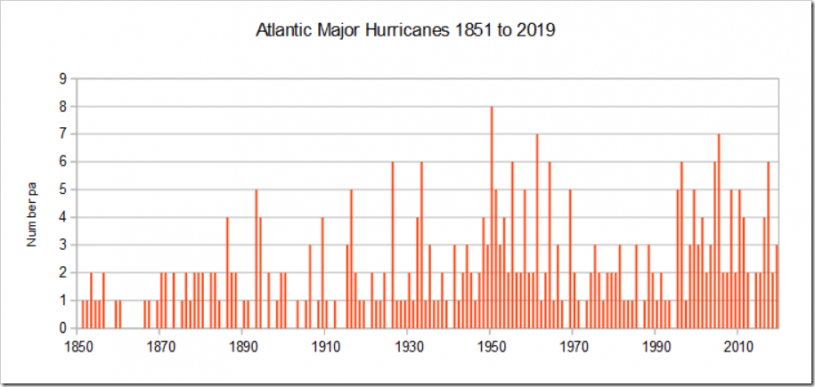
The Atlantic hurricane season has now officially ended, so let’s check the numbers.

https://www.aoml.noaa.gov/hrd/tcfaq/E11.html
http://rammb.cira.colostate.edu/products/tc_realtime/season.asp?storm_season=2019
There have been six hurricanes in total, including three major ones, Dorian, Humberto and Lorenzo. Coincidentally both numbers are the same as the average since 1950.
According to NOAA’s Hurricane Research Division, many hurricanes were missed in the earlier decades. Systematic aircraft reconnaissance began in 1944, but this only covered half of the Atlantic basin, until daily satellite monitoring started in 1966.
There has only been one US landfalling hurricane this year, Dorian which clipped Cape Hatteras as a weak Cat 1.


https://www.aoml.noaa.gov/hrd/hurdat/All_U.S._Hurricanes.html
Despite four major hurricanes in the previous two years, the period since 2005 remains notable for its relative lack of major hurricanes.
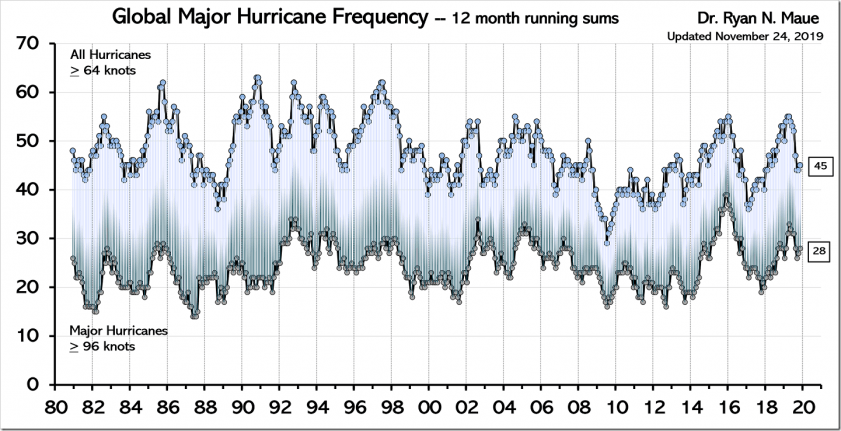
Globally, 12-month running averages indicate nothing out of the ordinary, either for all hurricanes or major ones:
http://climatlas.com/tropical/
Promoters of Climate Anxiety
Cliff Mass Weather and Climate Blog | December 9, 2019
There is a special place in the underworld for those who promote anxiety, desperation, and terror in the most vulnerable. A place where the infernal warmth is particularly torrid.
And one does not have to spend much time looking for candidates for this netherworld–the front page of the Seattle Times will do fine.
On Sunday, our local tabloid featured a story about fearful/desperate folks dealing with their apocalyptic fears about climate change.

Courtesy of the Seattle Times
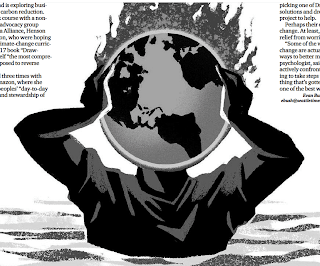
A forest burning behind them. And if that didn’t get the message across, a burning world/head within the article made it clear.
Courtesy of the Seattle Times
Among certain vulnerable people in our region, talk of eco-grief and anxiety has become signs of psychological crises. The UW Bothell has entire class given over to eco-grief, and non-profits like Climate Action Families have sessions for folks that are paralyzed with fear and grief over climate change. Some local Seattle therapists are specializing in climate grief therapy, and even the UW has sessions for students:

Unbelievably, even the Pacific Science Center is doing a session on dealing with eco-anxiety (see below).
But why stop at the borders of Seattle? Major media from the Guardian to the NY Times are covering climate anxiety, with anxiety-racked climate stars like Greta Thunberg are tearfully describing how their dreams and their childhood have been stolen by climate change.

I have gotten so many calls and emails from desperate folks I can’t list them here. One woman tearfully told me her mother was desperately ill in California, but she couldn’t move to be with her because she was afraid of the effects of climate change in that state. Another woman called, terribly worried about fires in western Washington from global warming. A few others asked about where they should move to escape our local apocalyptic conditions.
Global warming is a very serious issue, but most of the impacts are in the future. There is much we can do to address global warming, both in terms of adaptation and mitigation. There is, in fact, much reason for optimism.
So why are all these people so anxiety-ridden and desperate? I believe it is the unconscionable exaggeration, hype, and fear-mongering of our media, special interest groups, some activist scientists, and a number of politicians. And it is unethical, ungrounded in science, and hurting the most vulnerable among us.
The Seattle Times is one of the worst offenders. I can provide a few dozen example of fear-mongering headlines, completely adrift from the truth. Like the June story claiming heat waves will claim hundreds of lives (actually 725) for each heat wave later in century (see below). It was complete nonsense, with extreme assumptions about warming rates and assuming no one would buy an air conditioner.
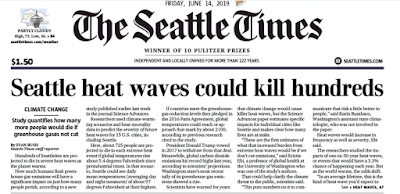
By the way, the stories in the Seattle Times are so confused, they can’t event get the key facts right, with one claiming carbon monoxide, not carbon dioxide is the problem (I kid you not, proof below).
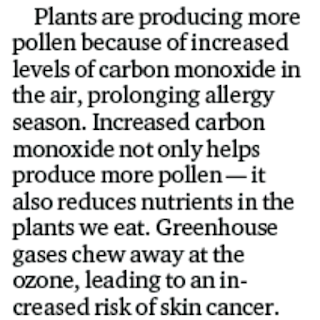
So the Seattle Times is both producing exaggerated, fear-inducing stories and covering the psychological damage those stories are creating. Is there something wrong here?
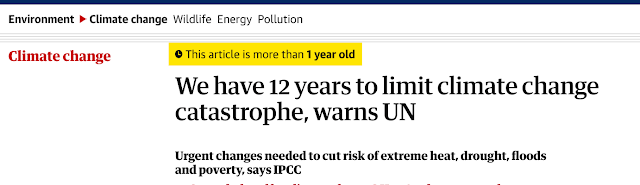
Stories in a number of media outlets, amplified by special interest groups, talk about “tipping points”, and that it will be too late in 1, 10 or 12 years. No hope after that. Unfounded in the science. And enough to push some emotionally sensitive people over the edge.

Here in the Washington State there are claims that recent fires are the result of climate change, and that it is about to get even worse. The truth is very different– there used to be MANY more wildfires in our region and the relationship of our fires with climate variations is very weak. But that hasn’t stopped irresponsible politicians from claiming just the opposite.
And, of course, there is all this talk about existential threats (yes, the means threats to your EXISTENCE), which have no support in the reports of the international scientific community (the IPCC) or the U.S. Climate Assessment. They predict a minor reduction in the future GDP, no more.
I could do ten blogs on this topic, but I won’t. The truth is that some very irresponsible folks are hyping and exaggerating the impacts of the minor global warming we have had so far, sending vulnerable folks into a panic. And these irresponsible folks and individuals are painting an apocalyptic view of the future that is completely at odds with the best science. Some do it for more money (advertising clicks), some do it for political reasons, and others like the attention.
But it is just wrong, and the harm they are doing to members of our community is substantial and unconscionable.
No joke: Russian scientists marked problem Kara Sea polar bear with T-34
By Susan Crockford | Polar Bear Science | December 7, 2019
The media are so gullible. So eager are they for a sympathetic polar bear victim that news outlets everywhere carried a story earlier this week about a Russian polar bear that had ‘T-34’ spray-painted on its side. They took the word of Russian polar bear/walrus consultant to WWF and Netflix, Anatoly Kochnev, that this was some kind of cruel joke that meant an untimely death for the bear. Turns out it was nothing of the kind.

Cruel animal abusers daubed T-34 – the name of an iconic Soviet tank – on a wild polar bear. Daily Mail (2 December 2019).
Polar bear spray-painted with ‘T-34’ baffles Russia wildlife experts BBC (2 December 2019).
Russians spotted a polar bear painted in cryptic graffiti. Scientists are searching for answers National Post (4 December 2019)
A polar bear was spray-painted with graffiti, scientists fear it won’t survive CNN (4 December 2019).
Apparently, the original video of the marked bear was posted on a social media site for Chukotak indigenous people and subsequently posted on Facebook by Sergey Kavry of the World Wildlife Fund (WWF), who also contacted local media.
Only five days ago, Kochnov was quoted as saying:
‘Scientists could not do this, it could have been somebody who ‘joked’ like this.

Except scientists did do it.
In a report in the Siberian Times published late today, it appears the bear was causing problems on Novaya Zemlya (where dump bears were a big problem last winter) and was tagged ahead of being driven off:
“The animal was marked with ‘safe paint’ which wears off over two weeks, and moved away to discourage him from coming back.
The bear was sedated and examined, said senior researcher Ilya Mordvintsev.
The check showed that the male predator was well-fed which meant that he would likely not attack.
The mark was made to allow both the locals and experts recognise the beast in case he returned, and to distinguish it from any other polar bear scavenging at the site.
Andrey Umnikov denied T-34 referred to the tank.
The video [that went viral] was filmed approximately a week ago, he specified.”
Poor sad polar bear news flash is over, morphing into an egg-on-the-face moment for WWF and Kochnev.
Habituated dump bears are a wide-spread problem in the Kara Sea, as the photo of a fat bear checking out a container below shows.
‘Polar bears checking on rubbish containers are not rarity. It happened at Beliy island and Vilkitskiy island,’ Andrey Umnikov explained.

Location of Vilkitskiy Island in the Kara Sea (Wikipedia):

LA Times supports mandated relocation of coastal properties based on climate alarmist flawed sea level rise claims
By Larry Hamlin | What’s Up With That? | December 9, 2019
The Los Angeles Times ran yet another scientifically unsupported climate alarmist sea level rise propaganda article supporting the position that government entities in the state need to mandate relocation of coastal properties away from the coast based upon speculation and conjecture derived from unvalidated and failed computer model outcomes of future sea level rise.
State government mandated relocation actions potentially involves politicians dictating control of homeowner and business property values of tens of thousands of properties representing billions of dollars in property value located along the 840 mile California coastline resulting in Draconian economic impacts being foisted upon these property owners as determined by the state’s climate alarmist government politicians.

The Times article notes: “Lawmakers have told cities they must start addressing climate adaptation in their planning, but have otherwise shied away from issuing mandatory directions. The California Coastal Commission, through modest grants and some general guidance, has been encouraging local officials to consider “everything in the toolkit” — including the controversial option of relocating oceanfront properties and critical infrastructure away from the water — when updating city policies.”
The Times article bases its climate change hyped sea level rise alarmist propaganda on computer model output derived from a 2017 California report that utilized UN IPCC AR5 report future emission scenarios that are characterized by the UN as being simply “illustrative” and “plausible” with no probabilities associated with the assumptions employed in these scenarios meaning outcomes using these scenarios amount to nothing but conjecture and speculation.
The Times article utilizes climate alarmist characterizations of California’s future sea level rise concerns as follows:
“The rising sea might feel like a slow-moving disaster, they said, but this is a social, economic and environmental catastrophe that the state cannot afford to ignore. By the end of this century, the sea could rise more than 9 feet in California — possibly more if the great ice sheets collapse sooner than expected.”

The California sea level report attempts to assign probabilities to the ranges of sea level rise calculated by computer models using the various UN IPCC AR 5 emissions scenarios by combining these speculative scenarios with the UN reports assessments by its alarmist writers of “level of confidence” and “assessed likelihood” qualifiers assigned to the reports outcomes.
These UN report “confidence and likelihood” qualifiers are completely subjective and represent manufactured and fabricated assigned values that form the basis for the California report sea level rise “probabilities”. These “probabilities” are nothing but subjective opinions – they are not calculated probabilities.
Thus the California sea level rise report outcomes represent opinions based upon speculation and conjecture regarding future claims about California’s coastal sea level rise.
As noted in a WUWT article at the time of the UN IPCC AR 5 report: “The UN IPCC has completed its three part (WGI, WGII, WGIII) Fifth Assessment Report (AR5) process where future climate findings are portrayed using “level of confidence” and “assessed likelihood” qualifiers that attempt to cast these outcomes in a cloak of scientific certainty.”
As always the Times the article fails to note that coastal sea level rise has been occurring along the California coastline for tens of thousands of years based on natural climate behavior since the last ice age with the rate of sea level rise remaining at low levels for at least the last 8,000 years.

Additionally the Times article as always conceals and suppresses the more than 30 year failure of climate alarmist scientists claims of accelerating sea level rise made before Congress in 1988 where their computer models showed that sea level rise would increase by between 1 to 4 feet by mid century with this outcome completely unsupported by global tide gauge data that reflects no coastal sea level rise acceleration occurring during the last three decades.

The climate alarmist embarrassing failure demonstrated by extensive NOAA tide gauge data measurements that do NOT reflect acceleration of coastal sea level rise as hyped by failed climate alarmist computer models over the last more than 30 years is illustrated by the 120 year long tide gauge measurement sea level rise data recorded at San Francisco shown below with this long record of steady sea level rise of course unaddressed by the Times alarmist article.

The Times article mentions the usual idiotic assertion, as clearly displayed below, that California coastal sea level rise could increase by 9 to 10 feet by the end of the century based on pure speculative from computer models. This flawed claim is about the same rate of sea level rise increase hyped by climate alarmist “scientists” testifying in 1988 before Congress with that assertion shown to be flawed and failed over the last three decades.

Computer models created and utilized by climate alarmist propagandists for political purposes are incapable of accurately representing global climate either regionally or globally regardless of the climate metric being evaluated including global temperatures which are grossly overestimated by these models.

California’s purely politically driven climate alarmist government needs to abandon the use of incompetent, inaccurate and failed sea level rise computer models and instead utilize actual measured coastal sea level rise data to establish meaningful, justifiable and cost effective government climate policy actions.
Contrast Of Climate And Energy Policies, And Economic Results, In The U.S. And Germany
By Francis Menton – Manhattan Contrarian – December 6, 2019
If you are reading your normal diet of “mainstream” press, you are getting hit with a constant barrage of climate alarm, together with a near total boycott on any good economic news for as long as Trump remains President. As a result, it is very easy to lose track of the widening chasm in the climate and energy policies, and also in the economic results, between the U.S. and its major European competitors. When you put some easily-available numbers together in one place, the contrast becomes very striking. For today, I will collect a smattering of relevant statistics, focusing on the U.S. and Germany.
And then there are the positions on these subjects of the candidates for the Democratic nomination for President. I find those positions beyond belief.
You probably know that the so-called “fracking” revolution in oil and gas production has led to a large increase in U.S. production of those fuels over the last ten or so years. The actual numbers are quite remarkable. On the oil side, according to data from the government’s Energy Information Agency, in 2008 U.S. production of crude oil from all sources averaged 5 million barrels per day. By 2018, that figure had well more than doubled to 10.99 million bbl/dy. By contrast, crude oil production in Saudi Arabia in 2018 was 10.445 million bbl/dy (up from 9.261 bbl/dy in 2008), and in Russia was 10.759 bbl/dy (up from 9.357 bbl/dy in 2008). Of today’s U.S. production, some 59% — representing essentially all of the increase since 2008 — comes from so-called “tight” resources, meaning those that are produced by fracking.
The large increase in U.S. production has been accompanied by a correspondingly large decline in the price of oil and natural gas. Oil of the WTI (West Texas Intermediate) grade that traded at $110 per barrel in 2013 closed today at $59.12. U.S. prices for a gallon of regular grade gasoline, which reached a high of $3.90 in 2012, fell as low as $2.25 earlier this year, and are currently around $2.60. Natural gas prices are quite volatile, but were in the range of $4 to $6 per thousand cubic feet in 2014, and most recently $2.29.
In September, the U.S. became a net exporter of oil for the first time since the 1940s. The EIA expects that status to continue for the foreseeable future.
Over in the economic news category, the U.S. continues to thrive. Today, the Labor Department reported an increase in jobs of 266,000 during November, the unemployment rate down to 3.5% (lowest since 1969), and wages up 3.1% over a year ago. All of those must be considered excellent results.
And then there’s Germany. According to CleanEnergyWire, Germany in 2018 imported 98% of its oil needs, and 95% of its gas. But doesn’t Germany have at least one good shale formation that could be developed? The answer is that Germany pretty much banned all fracking in 2017. They are still caught up in the Energiewende, or, in other words, the delusional idea that wind and solar power can replace fossil fuels within a few years. Nearly ten years into this, their carbon emissions have barely decreased at all, while emissions increases in places like China and India make any marginal decreases that Germany can achieve completely irrelevant. Meanwhile, they depend for their oil and natural gas on places like Russia and the Middle East.
GlobalPetrolPrices gives the most recent price of consumer gasoline in Germany as 1.385 euros per liter, equivalent to $5.807 per gallon. Admittedly, this cannot be blamed solely on supply restrictions; embedded taxes are also substantially at fault. But those embedded taxes are also part of the ongoing war against fossil fuels. German consumer electricity prices are also about triple the U.S. average.
And the economic news from Germany? It seems that the industrial sector is in the midst of a slump, in substantial part caused by the mad drive to force energy conversion without consideration of the costs. From the Daily Express, December 3:
THE GERMAN car industry is facing disaster with up to 50,000 jobs under threat or expected to be lost before the end of the year in what has been described as the “biggest crisis since the invention of the automobile”. Last week the owner of Mercedes-Benz announced plans to axe at least 10,000 employees globally, taking the number of jobs losses by German carmakers to almost 40,000 this year as the industry sinks under a massive sales slump. Daimler wants to save £1.2billion in staff costs as it prepares to invest billions in the electric cars boom. Audi, which is owned by Volkswagen, has also said it would be shedding almost 10,000 people – around around 10 percent of its global workforce.
Trading Economics states that German GDP “rebounded” to a growth of 0.1% in the third quarter, after a decline of 0.2% in the second quarter of 2019. Congratulations!
Meanwhile, among the Democratic candidates for President, the contest is between those who would ban fracking immediately, and those who advocate some period of “transition” to some fanciful alternative. Bernie Sanders and Elizabeth Warren have vowed to ban fracking immediately. It’s not clear how they would do that, other than that they view the presidency in their hands as a dictatorship of unlimited powers. Then there’s the “moderate” Joe Biden, who said (yesterday) “I’d love to make sure we can’t use any oil or gas, period,” but then hedged that we would need some period to “transition away” from those fuels.
“Transitioning” away from fossil fuels — that’s what Germany is doing.
Sudan’s new PM wants to withdraw troops from Yemen
Press TV – December 6, 2019
Sudan’s new Prime Minister Abdalla Hamdok has vowed to withdraw troops from the Saudi-led war in Yemen, saying his country’s role should be limited to assisting in a political resolution of the conflict.
“The conflict in Yemen has no military solution, whether from us or from anywhere in the world,” Hamdok told the Atlantic Council, a US-based think tank, on Thursday.
He added that the war “has to be resolved through political means,” and that his country will seek to “help our brothers and sisters in Yemen and play our role with the rest to help them address this”.
Sudan has been one of the main contributors to the so-called Saudi coalition against Yemen, formed in 2015 in a bid to install a pro-Saudi government in Sana’a and crush Yemen’s Houthi Ansarllah movement.
According to reports, up to 40,000 Sudanese troops were deployed in the country during the peak of the conflict in 2016-2017.
Late October, however, Sudanese officials said the country had withdrawn thousands of troops from Yemen, with only a “few thousand” remaining.
Speaking on Thursday, Hamdok said “not many” Sudanese forces remain in Yemen.
Hamdok, who is leading the country’s transitional government in a power-sharing pact with the military, further stated that he will be “absolutely” able to withdraw the remaining troops from Yemen.
The new prime minster said his government had “inherited” the deployment in Yemen from Sudan’s former president Omar Hassan al-Bashir who was ousted following a popular uprising against his rule in April.
Hamdok pledged to “address” the country’s involvement in the Saudi-led war “in the near future” without further elaborating on the matter.
While Sudanese officials have abstained from publishing official casualty numbers in Yemen, Yemen’s armed forces have said a total 4,253 Sudanese troops have been killed in the conflict.
The developments come as the Saudi-led mission in Yemen has come to a standstill due to the resistance and increasingly sophisticated attacks of Yemeni forces.
Earlier this year, the United Arab Emirates (UAE), Riyadh’s most influential partner in the war, was reported to have withdrawn most of its troops from Yemen.
UAE officials have reached the conclusion that the war has become “unwinnable” and that the Houthis will eventually “have a role in the future in Yemen”, reports said.
Fearing a long-lasting quagmire in Yemen, Riyadh has also been reportedly seeking to negotiate an end to the conflict through discussions with the Houthis.
Update On New York’s Self-Inflicted Energy Crunch
By Francis Menton | Manhattan Contrarian | December 3, 2019
As I have noted many times before, this whole green energy thing is all just so much talk until the point hits where energy shortages start to emerge or consumer prices begin to soar. At that point, the people will notice. And then, how will the politics shift? Will the politicians press forward with green energy — and impose energy deprivation on the people in the process? Or will they promptly back off the green energy blather, and return to the cheap and reliable fossil fuels?
Here in New York, where professing the green religion is the indispensable ticket to entry into polite society, we’re in the early phases of seeing this process play out. Out there in the hinterlands, you may be interested in the dynamics.
Our Governor Andrew Cuomo clearly thirsts to be part of polite society. Same with the members of the legislature. Thus, fealty to green orthodoxy must be regularly demonstrated. Result: We have had one measure after another over the past several years to restrict fossil fuels and promote energy from wind and solar sources. First came an outright ban on fracking in the state for oil and gas, imposed in 2014 despite the fact that a broad swath of upstate sits right atop the rich Marcellus shale formation. Then came the blocking of two major pipeline enhancements across the Hudson River and New York Harbor, most recently a denial in May of this year of a water quality permit for a cross-harbor project. Then there have been announcements of plans for multiple massive pie-in-the-sky wind and solar projects — none of which, however, has actually begun construction. In June the legislature passed a law (signed by the Guv) declaring that the entire state of New York will be “carbon neutral” by 2050!
But is any of this stuff real, in the sense that it will stand up when the crunch hits?
In August, the first inklings of the crunch began to hit. As I reported on September 3, after the cross-harbor pipeline was blocked in May, the natural gas utility named National Grid, which covers Long Island (including the parts of New York City known as Brooklyn and Queens) announced that it could not accept any additional gas customers. By August, some 3000 potential customers in that area had been denied service. These included people who had just renovated a house and now found that they had no functioning heat system, and others who planned to open restaurants but now found they had no functioning stove or oven. Within days, the affected customers were all over their state legislators, and the legislators were demanding action.
In other words, we had upon us a one hundred percent self-inflicted impending crisis, about 90% of it the personal responsibility of the Governor, with maybe a 10% assist from the legislature. So how has the Governor reacted? If the answer is not obvious to you, then you clearly will never qualify for political office.
The answer is that the Governor reacted by blaming National Grid. On November 12 he issued a letter to the utility, claiming that it had failed to provide “adequate and reliable service,” and threatening to revoke its operating permit unless it immediately resumed acceptance of new customers in its service area. Excerpt:
The essential responsibility for a utility to provide adequate and reliable service is to manage the supply and demand. The very lack of supply you now point to as the reason for your denial of service to thousands of customers exhibits your failure to plan for supply needs. Your fundamental legal obligation as mandated by your certificate of operation was to plan and provide for future needs. You failed by your own admission.
But hadn’t they made a perfectly reasonable plan for a pipeline that then got blocked by the Governor himself? That doesn’t count!
National Grid has made clear that its only plan for future supply was based on a single, speculative project: construction of a private pipeline through New Jersey and New York. The plan to build such a pipeline was risky at best. . . . There are existing short-term options to contract for non-piped gas from other sources, which National Grid either deliberately, negligently or incompetently did not secure. National Grid should have explored all options before denying service. Gas can be trucked, shipped, or barged. . . .
The only meaningful “risk” of the pipeline was that the Governor himself (or his minions) would disapprove. Anyway, instead of a safely buried pipeline, are we now going to have thousands of trucks bringing highly-explosive natural gas across the George Washington Bridge to get to Long Island? I’ll bet Cuomo didn’t clear that one with his environmentalist friends. (And by the way, don’t even think about moving the gas by rail. Federal regulations currently do not permit transport of liquefied natural gas by rail at all. However, there is a proposal by the Pipeline and Hazardous Materials Safety Administration — I’ll bet you never heard of that one — to begin to allow such transport. Your comments on the proposed rulemaking are due December 23.)
And I’ll also bet that the response of National Grid will not surprise you. They crumbled like a stale cookie. On November 25 they agreed to resume hookups, and also to pay a “penalty” of some $36 million for the period of the moratorium. Presumably, they continue to have at least a small amount of spare capacity in existing pipelines that will permit additional hookups for perhaps a few months until new supply alternatives are in place. Supposedly there will now be a “study” of how to make additional supply available. The only option that makes any sense is the pipeline.
So great victory there Cuomo. You went to battle against the evil utility, and like David against Goliath you emerged victorious. Except, let’s have a review of what this “victory” looks like:
-
Progress toward green energy? Of course not. At this point there is no reasonable alternative to natural gas for most home heating and cooking. One way or another, you have to let the people have their natural gas.
-
To be brought in by truck rather than pipeline? How is that a victory for anybody? Trucks are far more costly, far more dangerous, and far more likely to have adverse environmental effects.
But how about all those offshore wind turbines that are supposedly on the way? According to this piece at Smart Energy on October 28, New York finally let its first major contract for an offshore wind development on that date. The capacity will be 880 MW, although readers here will know that it will deliver at best a third of that over the course of a year, and at unpredictable times. There is no indication that construction has begun, or when it might begin.
Essentially, our Governor has patched together a temporary kludge to paper over the uselessness of his green energy schemes for another few months or years, until the next piece of the crunch hits. Yes, this can go on for quite a while. But not forever. Meanwhile, it’s very hard to underestimate the stupidity of the New York electorate.
What Did #ExxonKnew and When Did They Knew It?
Corbett • 12/03/2019
As #ExxonKnew gains traction with the public, one Corbett Report listener writes in for more info on the subject. Today we explore the Rockefeller-funded beginnings of this push for prosecution, how it has disintegrated in the courts, and how it has succeeded in penetrating the public consciousness in the service of the technocratic agenda.
Watch this video on BitChute / Minds.com / YouTube or Download the mp4
SHOW NOTES:
ExxonKnew.org
Who Wants To Be A Carbon Trillionaire?
New York Attorney General Started RICO Planning Before Any InsideClimate Stories Were Released
SEC Investigators Decide Not To Punish Exxon For Alleged Climate Heresy
Bloomberg Government Ponders Collapse of #ExxonKnew
What They’re Saying About New York’s ExxonMobil Trial
Podcast – Examining Climate Change Litigation (Guest: Christopher Horner)
What Did Shell Know and When Did They Know It?
#ExxonKnew Epic Fail: Oil Companies DID NOT build “their rigs to account for sea-level rise”
1988: James Hansen And Tim Wirth Sabotaged The Air Conditioning In Congress
Remember traditional knowledge?
Climate Discussion Nexus | November 27, 2019
If not, don’t worry. Apparently Canadian authorities don’t either. Outgoing Environment Minister Catherine McKenna decided to reduce the number of polar bears the Inuit can hunt in Nunavik, in northern Quebec, despite their claim that from living on the land they knew there were lots. Now a judge has ruled that all that stuff about the wisdom of the ancestors was just virtue-signaling with forked tongue and that when it matters Eurocentric science elbows the ancestors aside. Which is ironic since even Eurocentric science actually says polar bears are flourishing, even if saying so out loud did get Susan Crockford fired.
The back story is that the Makivik Corporation, which represents the Inuit of Nunavik in legal matters, launched a suit in 2016 saying “By and large, Nunavik residents have observed an increase in the polar bear population, and a particularly notable increase since the 1980s.” Despite which Stephen Harper’s environment minister, Peter Kent, had written to the local wildlife board in 2012 asking them to establish the first-ever quota to limit hunting of the big white cute really scary grizzly bears. (Yes, polar bears are a subspecies of grizzlies.) The board, charged with melding western and traditional ways of thinking, ended up establishing a quota of 28 which the federal and Nunavut governments both rejected, annoying the board, which said the federal decision “clearly disregards the extensive body of Inuit traditional knowledge” relying instead “solely on the scientific population estimate.”
Catherine McKenna then cut the quota to 23, prompting Makavik to accuse her of setting “aside entirely the Inuit traditional knowledge” and failing “to even attempt the integration of the two systems of knowledge.” Not that anyone ever said what to do if they seemed to disagree.
The government of course oozed the usual rhetoric about their great respect for Inuit knowledge and claimed the quota was actually above the sustainable harvest rate of 4.5% if the numbers were as western science claimed. And a Federal Court just upheld the decision, though calling for “better communication”, while a spokesman for the minister said “Indigenous peoples are key partners in conserving and protecting nature, and we recognize their unique perspectives, knowledge, rights and responsibilities that can improve conservation outcomes”. But when they say there are so many bears it’s dangerous, well, our global warming computer model says there aren’t and since we’re in Ottawa we’re not worried if we’re wrong.
BBC’s One Planet falsely claims that polar bears hunting whales from shore is an unprecedented effect of climate change
By Susan Crockford | Polar Bear Science | November 30, 2019
Polar bears leaping on the backs of belugas off Seal River, in western Hudson Bay, is being falsely promoted by the BBC’s new “Seven Worlds: One Planet” TV special as an unprecedented effect of climate change.
More specifically, the Daily Mail (30 November 2019) this morning quoted the documentary, narrated by Sir David Attenborough, as saying:
‘This extraordinary behaviour has only been recorded here, in this remote corner of North America, and only in the last few years.’
Poppycock. More climate change hyperbole from Attenborough’s seemingly never-ending litany of nonsense that’s easily refuted. There is scientific literature documenting such behaviour in Canada’s far north in the 1980s, which I included in the blog post I wrote about this phenomenon a few months ago (after National Geographic published a similar scare-story), which I have reposted below.
And from the sounds of it, there was no mention in the BBC special that freeze-up along western Hudson Bay was early again this year: for the third year in a row. So if the footage was filmed any time since 2017, the claim of accelerating sea ice loss in this region and bears on land for longer than ever is pure fantasy. PS. Fat bears are not ‘starving’.
Reposted from May 6, 2019
This time National Geographic’s ‘Hostile Planet’ series laughably claims a fat polar bear that’s caught a beluga calf off the coast of Western Hudson Bay has been saved from starvation! The message: here is a prime example of climate change pushing a species to its limit. This is nonsense, of course: polar bears hunting beluga whales from rocks has nothing to do with climate change or desperately hungry bears. More importantly, there is a much better video of the action that is both more informative and truthful.
See both below and decide which you’d prefer your kids or grandkids to watch.
National Geographic footage with focus on climate change
First, here is the polar bear sequence from the ‘Hostile Planet’ series, which it has clearly released for distribution to the media:
Applying standard media hyperbole, Rolling Stone Magazine rephrased this to read “See a Starving Polar Bear Hunt for Beluga Whales” as if viewers can’t see the rolls of fat on this bear with their own eyes. Says Rolling Stone, 6 May 2019 [links in the original, my bold]:
“Some scientists fear a third of the polar bears in the world may be gone by 2030 due to climate change and how it will affect future sea conditions. To show how the species is struggling to survive as they search for food, National Geographic captured a moment where a starving polar bear hunts a pod of beluga whales in open water in Canada’s Hudson Bay. Featured in Hostile Planet‘s finale on Monday, it’s a chilling a reminder of how the Arctic predators are desperate to find prey to meet their needs.
The six-part nature docuseries, hosted and narrated by Bear Grylls, zooms in on the world’s most extreme habitats to reveal the animal kingdom’s most dramatic stories of survival on our changing planet.
The Hostile Planet series finale airs tonight at 9pmET/PT on National Geographic.”
Wildlife guides on the ground
However, we know from reports from guides at the Seal River Heritage Lodge that polar bears hunting beluga from rocks were observed in late summer (August/September) 2017 at the mouth of the Seal River, which is north of Churchill on Western Hudson Bay (see map below). This was the same summer a litter of triplet cubs were spotted in the area, discussed in the same report.

A photo of a Seal River polar bear hunting beluga from a rock, late summer 2017:

CBC nature film footage
As the video below, from CBC’s “The Wild Canadian Year: Summer” narrated by David Suzuki of “The Nature of Things” (uploaded 8 December 2018 to Youtube). I’m no fan of Sukuki’s stance on climate change but am happy to report it does not enter the narrative here, at least in the polar bear clip (I haven’t listened to the rest).
The polar bear hunting beluga sequence starts at 36:50 with the catch at about 42:00.
Clearly, dozens of bears have learned this hunting strategy – probably after watching one local individual give it a try. Polar bear cubs learn hunting skills by watching their mothers, so they are primed to learn a new skill by watching other adults do it. These bears are very smart and learn quickly.
This new hunting strategy had nothing to do with being ‘desperate’ for food, since the bears shown in this video are in excellent condition, as were most bears that summer. Fall freeze-up came early in 2017 (and again in 2018), so they had a shorter wait than usual before they could hunt seals from the ice again.
However, polar bears hunting beluga whale calves in open water is not unheard-of behaviour that has only emerged recently due to climate change: researchers in the 1980s saw bears in the Canadian Arctic hunt beluga calves close to the shore of Somerset Island in a similar if not identical manner (ironically, this is the same island where NG’s equally misleading ‘starving’ polar bear was filmed in 2017). In one case, rather than a rock, a big male bear in 1985 used an isolated pan of ice as a platform from which to leap onto beluga calves swimming in the water (Smith and Sjare 1990:100).
References
Smith, T.G. and Sjare, B. 1990. Predation of belugas and narwhals by polar bears in nearshore areas of the Canadian High Arctic. Arctic 43(2):99-102. DOI: https://doi.org/10.14430/arctic1597
Featured Video

The American Retreat from Vietnam
or go to
Aletho News Archives – Video-Images
From the Archives
Secret document reveals plans for civil war in Lebanon, Israeli false flags, and invasion
By Randi Nord | Geopolitics Alert | April 5, 2019
Beirut – During his visit with US Secretary of State, Mike Pompeo, Lebanese President Michael Aoun reportedly received a US-Israeli document detailing plans for creating a civil war in Lebanon with covert false flag operations and possible Israeli invasion.
Although the source of the document is Israeli and created in partnership with Washington, no one knows who presented it to Aoun. The Lebanese TV station, Al-Jadeed, initially reported the document on Lebanese TV and a video on its website. Geopolitics Alert translated the report for this article. … continue
Blog Roll
 Aletho News
- There Is A Drought in Academia: A Drought in Honest Research on the Subject of Drought and Other Weather Extremes
- Department of War Awards $20.7 Billion Contract to Raytheon for Air-to-Air Missiles
- ‘Distance yourselves from Israel’: IRGC urges US population to question govt policies
- America’s Greenland deal has a radioactive backstory
- The RAF Fairford ‘terror plot’: Unpacking escalation in the UK echo-chamber
- EU Council Advances Chat Control 2.0 Scanning Proposal
- Ex-Greek MEP files complaint against Israeli spyware firm over alleged Pegasus surveillance
- Troubling ideas throughout the Torah, Talmud, Mishneh Torah and Tanya
- ‘Grave, alarming’: Iran mission on Trump’s UNGA ‘annihilation’ threats
- Najaf airport to reopen to Iranian flights within 24 hours: Ambassador
- If Americans Knew
- New Report: “Scholasticide and Genocide in Gaza: Assessment, Testimonies and Legal Analysis”
- Ex-Biden officials are desperate for a Gaza scapegoat
- Israeli “settlers” Invade Al-Aqsa; Pour Boiling Water on 75-Year-Old
- Israel Has Kidnapped Another American Teenager
- US arms sales to Israel worth $21.6 billion in 20 months
- Three Palestinians Killed in Israeli Attacks on Gaza
- Revealed: German “Anti-Semitism Expert” Driving Crackdown on Palestine Solidarity is Former Israeli Spy
- Egypt’s Warning to Israel Before Oct 7
- Israel’s siege signals another cruel winter for 1.8 million Gazans – Daily Update
- Netanyahu Asked UAE Leader to Deny Report on Oct. 7 Warning in Secret Visit, Sources Say
- No Tricks Zone
- New Study: Earth And Venus Surface Warmth Largely Explained By Convection And Lapse Rate, Not CO2 Or Radiation
- 2025 Nature Paper Claiming Worsening Global Drought Gets RETRACTED …Heavily Flawed
- New Study: ‘Global Drought Shows No Detectable Recent Acceleration Under Climate Warming’
- Economic Masterminds: German Socialists Suggest Taxing Productivity Gains Stemming From Using AI
- The South China Sea Has Not Been Cooperating With The Climate Change Narrative
- Energy Crisis: Germany Enters Heating Season With Historically Low Gas Reserve Fill Levels
- New Study: The Antarctic Ice Sheet Gained Mass From 2020-2024 Due To Staggering Snow And Ice Accumulation
- Study: Ocean Heating Rates From Thousands Of Years Ago ‘Dwarf’ Modern Ocean Heating Rates
- Climate Extremists Target, Attack Large-Scale Power Grid Infrastructure In Germany!
- New Study: Antarctic Ice Melt Has Contributed Less Than 1 Centimeter To Sea Level Rise In The Last 30 Years

