The noble corruption of climate science
By Larry Kummer | Fabius Maximus | April 11, 2019
The climate change campaign hits a dead end
On 24 June 1988, James Hansen’s testimony to the Senate began the campaign to fight anthropogenic global warming. During the following 31 years we have heard increasingly dire forecasts of doom. Some describe the distant future, beyond any reasonable forecasting horizon (due to both technical and social uncertainties). Some describe the near future. Many attribute almost all current extreme weather to our emissions of greenhouse gases (GHG) – using impossible to validate methods.
Karl Popper said that successful predictions, especially of the unexpected, were the gold standard of science (see here). That is a problem for climate activists. The Earth has been warming since the mid-19th century, when the Little Ice Age ended. The rate of warming in the past four decades (since 1977) is roughly the same as that during the four decades up to 1945. Anthropogenic GHG became a major factor only after WWII. So warming has occurred as predicted, but a naive forecast (without considering GHG) would have also predicted warming. There are explanations for this, but it makes model validation difficult (perhaps why it is seldom attempted: see links in section f in the For More Info section of this post).
Worse, the weather has not cooperated. Major hurricanes avoided America for 11 years, ending in 2017. Warming slowed during what climate scientists called the “pause” or “hiatus” (see links about its causes). And most forms of extreme weather have no obvious increasing trend. So surveys show little public support in America for expensive measures to fight climate change.
Activists grow desperate
“The Uninhabitable Earth” by David Wallace-Wells in New York Magazine –
“Famine, economic collapse, a sun that cooks us: what climate change could wreak
– sooner than you think.”
Expanded into a book: The Uninhabitable Earth: Life After Warming.“The five ways the human race could be WIPED OUT because of global warming.”
By Rod Ardehali at the Daily Mail. H/t to the daily links at Naked Capitalism.
Promo for Falter: Has the Human Game Begun to Play Itself Out?, a book by Bill McKibben.
Activists responded to the uncooperative weather by making ever-more dire predictions (many of which have passed their due date and been proven false). All extreme weather was “climate change.” They made more vivid propaganda (e.g., the 10:10 video, showing a teacher exploding the heads of students who do not accept her propaganda). They increased the volume of their claims, with more 2-minute hate sessions for dissenters (with lies about even eminent climate scientists). The long-term effects of this are (hopefully) small, since these fear barrages have been the Left’s go-to tactic since the 1960s (see some classics of the genre).
But one tactic might have awful long-term consequences. Many activists are climate scientists (see the many stories about depression among them, overcome by fears about their worst-case scenarios, such as this and this). Some have reacted with noble lie corruption (from Plato’s The Republic). However well-intended, it might weaken the public’s trust in science (as might the replication crisis, of which this is an example, if they learn about it).
The Noble Lie in action
Obvious evidence of this is climate scientists’ relentless focus on RCP8.5, the worst-case scenario in the IPCC’s Fifth Assessment Report. As a good worst-case should be, it is almost impossible to happen without unlikely assumptions (details here; also see Dr. Curry’s articles). Yet it receives the majority of mentions in the climate science literature – usually with no mention of its improbable nature (see this history). Activists exaggerate these papers, whose stories are uncritically reported by journalists. A decade of this bombardment has a fraction of the Left terrified, certain that we are doomed.
For a recent example, see “A glacier the size of Florida is on track to change the course of human civilization” by “Pakalolo” at the Daily Kos. Widely reposted, quite bonkers. See the details here.
Worse, climate scientists remain silent when activists exaggerate their work, even when they materially misrepresenting it. The most extreme doomster predictions are greeted by silence. Even over-top climate doomster claims receive only mild push-back. For example, see the reactions to “The Uninhabitable Earth” by David Wallace-Wells. WaPo: “Scientists challenge magazine story about ‘uninhabitable Earth’.” Climate Feedback: “Scientists explain what New York Magazine article on “The Uninhabitable Earth” gets wrong.” It was too much even for Michael Mann.
Yet leading climate scientists are quick to loudly condemn skeptics – even fellow climate scientists – for questioning aggressive claims about climate change. Allowing activists to call scientists “deniers” for challenging the current paradigm is imo among the most irresponsible actions by leaders of science, ever. By ancient law, silence means assent to activists’ behavior. They are guilty of “aiding and abetting.” For more about this, see About the corruption of climate science.
But in the past few years, activist scientists’ desperation appears to have pushed them to take another step away from science.
Papers to generate alarmist news!
As Marc Morano of Climate Depot says, recent studies often appear designed to produce media stories for alarmists. I see several of these every week. The most recent is “Key indicators of Arctic climate change: 1971–2017” in Environmental Research Letters (April 2019), by scientists at the International Arctic Research Center at the University of Alaska-Fairbanks and the Geological Survey of Denmark and Greenland in Copenhagen. Abstract:
“Key observational indicators of climate change in the Arctic, most spanning a 47 year period (1971–2017) demonstrate fundamental changes among nine key elements of the Arctic system. …Downward trends continue in sea ice thickness (and extent) and spring snow cover extent and duration, while near-surface permafrost continues to warm. Several of the climate indicators exhibit a significant statistical correlation with air temperature or precipitation, reinforcing the notion that increasing air temperatures and precipitation are drivers of major changes in various components of the Arctic system. …
“The Arctic biophysical system is now clearly trending away from its 20th Century state and into an unprecedented state, with implications not only within but beyond the Arctic. The indicator time series of this study are freely downloadable at AMAP.no.”
Ecowatch describes it in their usual apocalyptic fashion: “Researchers Warn Arctic Has Entered ‘Unprecedented State’ That Threatens Global Climate Stability.”
The paper is odd in several ways. It is evidence showing the broken peer-review process. Five times they describe conditions in the arctic as “unprecedented.” But they start their analysis with data from the 1970’s. Given the various kinds of long-term natural fluctuations, five decades of data is too brief a period to draw such a bold conclusion.
The authors neglect to mention that the Arctic was also warm in the 1930’s. Which is strange since one of the authors, Uma S. Bhatt, was also a co-author of a major paper on the subject: “Variability and Trends of Air Temperature and Pressure in the Maritime Arctic, 1875–2000” in the Journal of Climate, June 2003. She did not even cite it in their new paper. Abstract …
“Arctic atmospheric variability during the industrial era (1875–2000) is assessed using spatially averaged surface air temperature (SAT) and sea level pressure (SLP) records. Air temperature and pressure display strong multidecadal variability on timescales of 50–80 yr [termed low-frequency oscillation (LFO)]. Associated with this variability, the Arctic SAT record shows two maxima: in the 1930s–40s and in recent decades, with two colder periods in between.
“In contrast to the global and hemispheric temperature, the maritime Arctic temperature was higher in the late 1930s through the early 1940s than in the 1990s. … Thus, the large-amplitude multidecadal climate variability impacting the maritime Arctic may confound the detection of the true underlying climate trend over the past century. LFO-modulated trends for short records are not indicative of the long-term behavior of the Arctic climate system.
“The accelerated warming and a shift of the atmospheric pressure pattern from anticyclonic to cyclonic in recent decades can be attributed to a positive LFO phase. It is speculated that this LFO-driven shift was crucial to the recent reduction in Arctic ice cover. Joint examination of air temperature and pressure records suggests that peaks in temperature associated with the LFO follow pressure minima after 5–15 yr. Elucidating the mechanisms behind this relationship will be critical to understanding the complex nature of low-frequency variability.”
Starting their analysis in the 1970s is misleading without disclosing that was a cold spell. There was concern then about global cooling (but not a consensus). See here and here for details. Starting in the 1970’s makes current conditions look extraordinary. Since we are in the warming period following the Little Ice Age, robust comparisons should include previous warm periods, such as the Medieval Warm Period and the Holocene climatic optimum.
A later paper provides more detail, showing the temperature anomaly in 2008 was aprox. 1°C warmer than the ~1940 peak: “Role of Polar Amplification in Long-Term Surface Air Temperature Variations and Modern Arctic Warming” by Roman V. Bekryaev et al. in Journal of Climate, 15 July 2010. Is that a one standard deviation from the long-term mean? Three? Are temperatures a normal distribution? They do not say. Climate science papers often use arcane statistics, but usually ignore the basics. (Here is an as yet unpublished estimate of arctic sea ice back to the 1880s. Here is a 2017 paper with arctic temperatures and sea ice extent back to 1900)
Two comments from climate scientists on this paper.
“It is normalization of data cherry picking.”
— Dr. Judith Curry (bio). She her analysis of arctic sea ice trends here and here. She writes at Climate Etc.“Of course, if these changes are predominantly due to the Arctic Oscillation (AO) and/or the LFO, we should see a reversal. If not, the trend would continue. Time will eventually sort this out. But a proper literature summary should still be provided with papers that might disagree with the theme of a newer paper. All peer-reviewed perspectives on this subject should be given.”
— Dr. Roger Pielke Sr. (bio).
See other examples in the comments. These kind of stories are coming along like trolleys.
This is a follow-up to About the corruption of climate science.
Conclusions
Science has been politicized, distorting its results, before. It will be again. But climate science provides essential insights on several major public policy issues. Losing reliable guidance from it could have disastrous consequences. Worse, the high public profile of climate science means that a loss of public confidence in it might affect science as a whole.
Let’s hope that the leaders of climate science come to their senses soon, despite their personal, institutional, and ideological reasons to continue on this dark path.
For More Information
Hat tip on the ERL 2019 paper to Naked Capitalism’s daily links, who uncritically run climate alarmist articles, a one-side flow of information without context – terrifying their Leftist readers (other than that, their daily links are a valuable resource – which read every morning).
Why Attenborough’s Walrus Claims Are Fake
By Paul Homewood | Not A Lot Of People Know That | April 14, 2019

Our Planet has showcased hundreds of walruses falling off a 260ft cliff to a slow, agonising death in heartbreaking scenes
https://www.thesun.co.uk/tvandshowbiz/8800576/netflix-david-attenborough-our-planet-walrus-heartbreaking/
Last week, the new Netflix series, Our Planet, was launched with great fanfare. Narrated by David Attenborough, however, one segment made headlines around the world, showcasing hundreds of walruses falling off a 260ft cliff to a slow, agonising death in heartbreaking scenes.
Narrating the disturbing scene in the second episode, Attenborough began:
“They do so out of desperation not choice.
“Their natural home is out on the sea ice, but the ice has retreated away to the north and this is the closest place to their feeding grounds.
“Every square inch is occupied, climbing over the tightly packed bodies is the only way across the crowd – those beneath can get crushed to death.
“In a desperate bid to avoid the crush they try to head towards the cliffs.
“But walruses’ eyesight out of the water is poor, but they can sense the others down below, as they get hungry they need to return to the sea.
“In their desperation to do so, hundreds fall from heights they should never have scaled.”
But the story quickly began to unravel.
Zoologist, Dr Susan Crockford, suspected that the event was actually a well publicised incident in October 2017, at Ryrkaypiy in NE Russia, when a group of polar bears drove several hundred walruses over the cliffs to their deaths, before feasting on the corpses.
Then a couple of days later, Andrew Montford was able to positively identify Ryrkaypiy as the location in the Our Planet film. The Netflix producers denied seeing any polar bears, but this does not alter the fact that many bears were in the area at that time.
There is however another rather more sinister possible explanation for the stampede. According to the US Fish and Wildlife Service (FWS):
Walruses often flee haulouts en masse in response to the sight, sound, and especially odours from humans and machines.
So it is perfectly possible that it was the filmmakers themselves who caused the stampede up the cliffs.
Indeed, as this aerial shot showed, there must have been some sort of helicopter or drone flying immediately above the walrus, which seems to me to be an utterly irresponsible thing to do.
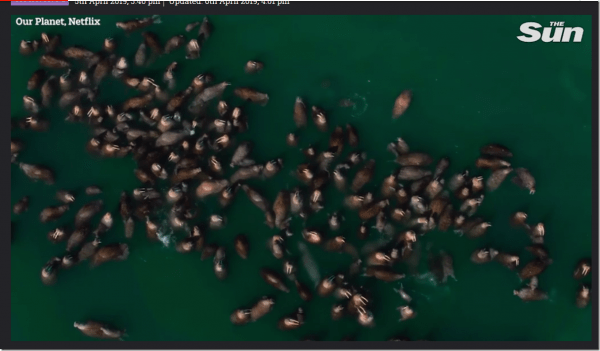
As the US Fish and Wildlife Service also note, events like this one are not uncommon:
Some haulout sites include shorelines that grade from little topographical relief to steep slopes and cliffs. As large numbers of walruses gather at these sites, the first to arrive move further inland and may eventually settle at the tops of the steeper slopes and cliffs. As most animals head back to sea to feed, those on the steeper slopes and cliffs are also rested and ready to feed and sometimes take the most direct route down the slope or off the cliff. This behavior has resulted in serious injuries and deaths. As with most animals whose eyes are oriented to the side of their head, rather than forward, walrus’s depth perception is likely poor and they are nearsighted.
Sea Ice and Haulouts
Regardless of the exact cause of the stampede, why were the walrus at Ryrkaypiy in the first place? Is it the case that they were forced to go ashore, because their sea ice had melted?
The US Fish and Wildlife Service explain the Pacific walrus’ migratory habits:
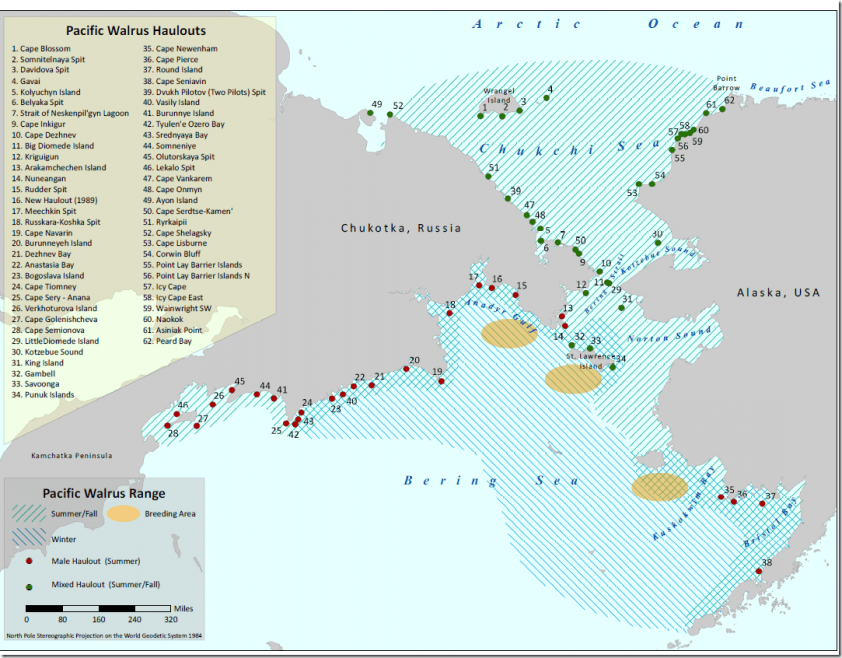
The distribution of Pacific walruses varies markedly with the seasons. Almost the entire population occupies the pack ice in the Bering Sea in the winter months. Through the winter they generally congregate in three areas, immediately southwest of St. Lawrence Island, south of Nunivak Island, and in the Gulf of Anadyr in Russia. As the Bering Sea pack ice begins to break up and melt in spring walruses begin to move northward and their distribution becomes less clumped. By late April walruses can be found from Bristol Bay northward to the Bering Strait. During the summer months, as the pack ice continues to recede northward, most of the population migrates into the Chukchi Sea. The largest concentrations are found near the coasts between 70 N latitude and Pt. Barrow in the east, and between the Bering Strait and Wrangel Island in the west. Concentrations, mainly of males, are also found on and near terrestrial haulouts in the Bering Sea in Bristol Bay and the northern Gulf of Anadyr throughout the summer. In October the pack ice begins to develop in the Chukchi Sea, and large herds begin to move southward. Many come ashore on haulouts on the Russian side of the Bering Strait region. Depending on ice conditions, those haulout sites continue to be occupied through November and into December, but with the continuing development of ice, most walruses move south of St. Lawrence Island and the Chukchi Peninsula by early to mid-December.
https://www.fws.gov/alaska/fisheries/mmm/walrus/wmain.htm
In short, adult males migrate south in summer, and haulout in Bristol Bay and the Gulf of Anadyr. (Per the red dots).
There is a very good reason for these haulouts, as the FWS go on to explain:
Walruses depend on hauling out to complete their moult and grow new hair, to whelp, to nurse young, and just to rest.
Hauling out is what they do naturally, not what they are forced to do because there is no sea ice around.
Whereas the males head south, the females and juveniles follow the sea ice north, as it recedes in Spring, eventually going as far as Wrangel Island and Point Barrow. Crucially, as the ice begins to grow back in October, these large herds follow it back south, often coming ashore at places like Ryrkaypiy on the Russian coast (No 51 on the map above). As the map indicates, such hauling out is commonplace and widespread along that stretch of coastline. (Green dots).
Remember that the Ryrkaypiy incident occurred in October 2017.
The earlier the sea ice reforms, the earlier the walrus arrive on Ryrkaypiy. This is the total opposite of Attenborough’s version, that they are there because of a lack of sea ice.
How he can get such a basic fact as this wrong is beyond my comprehension.
Walrus are thriving
Given all of this mayhem and loss of sea ice, you might think that walrus were an endangered species. But you would be wrong.
According to the FWS:
The size of the Pacific walrus population is uncertain. The size of the pre-exploitation population (1700’s) may have been between 200,000-250,000 animals. Cooperative aerial surveys by the U.S. and the former Soviet Union (now Russia) occurred in 1975, then at five-year intervals until 1990. The 1975 survey estimated the population size at 221,360. The joint census conducted in 1980 estimated population size at 246,360. Surveys conducted in 1985 and 1990 produced estimates of 234,020 and 201,039, respectively. Cooperative aerial surveys ceased in 1995 due to budget limitations and unresolved methodological problems. After much deliberation and testing, another aerial survey occurred in 2006 incorporating advanced thermal imaging and telemetry technologies, resulting in an estimate of 129,000 animals with a confidence interval of 55,000-550,000. The estimates generated from these aerial surveys are conservative minimum population estimates that are not useful for detecting population trends.
In 2012, a new approach to population estimation using the genetic fingerprint of individual walruses within a mark-recapture framework began testing. Two aspects of the approach were successfully assessed in 2013, the genetic identification of individuals and the ability to collect an adequate sample. The surveys then continued through 2017. A preliminary estimate for the year 2014 was about 283,000 individuals and a confidence interval of 93,000-479,000. The data for subsequent years is currently under analysis.
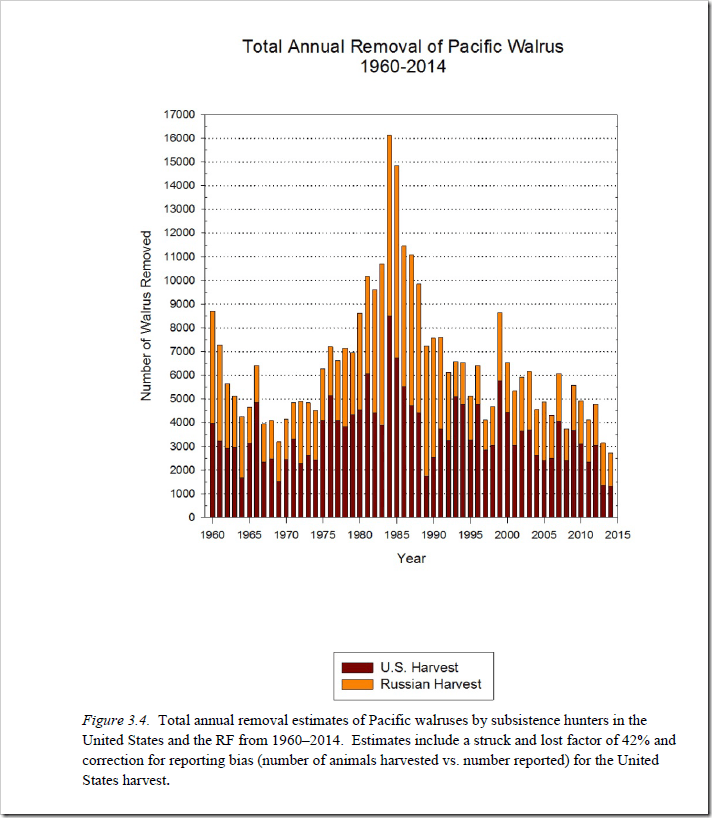
The decline in population in the 1980s and 90s was largely due to an increase in hunting, which followed a relaxation of harvest restrictions.
https://www.fws.gov/alaska/fisheries/mmm/walrus/pdf/final-pacific-walrus-species-status-assessment.pdf
The FWS also state that:
Pacific walrus population size has varied substantially in the last 150 years, it increased between 1960 and 1980 and may have reached the carrying capacity of the marine environment
In other words, the current population, which is believed to be similar to those earlier ones, may also be at maximum levels of sustainability.
Certainly, if Our Planet is correct about there being 100,000 walrus at Ryrkaypiy, the global population must be much greater than estimated, and would explain why the beach there was so crowded.
What we do know is that the U.S. Fish and Wildlife Service found after a comprehensive review in 2017 that the Pacific walrus does not require protection as threatened or endangered under the Endangered Species Act.
Breathtaking dishonesty
The migratory habits of walrus are pretty basic knowledge, which a natural historian such as David Attenborough should be familiar with.
Why then has he chosen to ignore the truth, and instead present a fictionalised account?
Is it to further his own political agenda? Is it simply incompetence? Or has he merely followed the script given to him by the WWF?
We don’t expect to hear the truth from the WWF. But if Netflix doesn’t quickly correct and retract this particular segment of the series, it will be highly damaging for their own credibility at a time when they are just embarking on producing serious documentaries.
As for Attenborough’s upcoming programme for the BBC on climate change, this little episode offers a clue about how inaccurate and biased it will be.
Word to the Wise: Beware the Green New Deal!
By Geraldine Perry | Dissident Voice | April 4, 2019
 Seemingly overnight, the Green New Deal has arrived. Given the sorry state of our environment, what possible objections could there be? In this case, plenty – and they all trace back to the Green New Deal’s deeply complex and surreptitious ties to UN Agenda 21.
Those who claim that Agenda 21 amounts to little more than a right-wing rant or is somehow anti-Semitic are at best seriously misinformed. Those who buy into the carefully crafted jargon of Sustainable Development, Smart Growth, Redevelopment and the Green New Deal are similarly misinformed and need to know that the environmental movement has in fact been highjacked by the Agenda 21 plan.
First, Some Background
Journalist Thomas L. Friedman is sometimes credited with being the original source for the term “Green New Deal” because in two 2007 articles, in the New York Times and The New York Times Magazine, Friedman connected FDR’s “New Deal” to a new “green” economy, suggesting that this might provide an economic stimulus program that could address economic inequality and climate change at the same time. Almost prophetically, Friedman also argued in earlier writings that an “iron fist inside a velvet glove” would be needed to maintain the coming new world order.
The same year the Friedman articles came out the Green New Deal Group was formed. By July of 2008 this group came out with its Green New Deal Report which was originally published by the New Economics Foundation. A few months later, in October of 2008, Adam Steiner, who was Executive Director of the United Nations Development Programme (UNEP), unveiled the Global Green New Deal Initiative, the objective of which was to rescue the failing global economy by creating jobs in “green” industries, “funded” of course by the big banks.
Then, following the example set by the European Greens in 2006, the United States Green Party adopted a Green New Deal platform in 2010. To its everlasting credit, the U.S. Green Party has also placed monetary reform as one of its core planks, ending the banking system’s privilege of creating the nation’s money (as credit or debt) and returning the monetary privilege to the government where it belongs, without which reform no other reforms are possible. Other political parties would do well to adopt this most important objective, since this is the true heart of “populism” historically. However, the vast bulk of the Green Party’s Green New Deal platform bears a marked (and troubling) resemblance to the Green New Deal as set out through the United Nations Agenda 21 Sustainable Development program.
Most recently, a twenty-nine-year-old freshman Congresswoman from New York, Alexandria Ocasio-Cortez, has overnight managed to not only make national headlines but garner the full attention of Congress, a feat never before accomplished by one so young and so soon in office. It was her promotion of the Green New Deal that seems to have garnered her such sudden fame. But the so-called legislation she has been promoting is in reality a “draft text” that calls for a proposed addendum for House Rules: it changes the rules and creates a new process for the allocation of power, all while echoing almost verbatim United Nations Sustainable Development Goals. As a recent article in Technocracy News says, with a complete version of AOC’s “bill” included: “Its scope and mandate for legislative authority amounts to a radical grant of power to Washington over Americans’ lives, homes, businesses, travel, banking, and more.” Dr. Naomi Wolf confirms by going over the document point by point.
The Green New Deal is in fact a part of a global sustainable development program that was officially rolled out at the “Earth Summit” held in Rio De Janeiro, Brazil in 1992. Out of that summit came Agenda 21 Earth Summit: The United Nations Program of Action from Rio, a 354-page document that can be purchased at online book retailers or downloaded in pdf format from the UN website.
Agenda 21 has been updated to include Agenda 2030 for Sustainable Development and its offshoot the Global Green New Deal which is a program that was commissioned by the United Nations Environment Program or UNEP for short, mentioned above. A map and outline of “partners” reveals just how deeply embedded in global thinking this program has become. Effectively, Agenda 21 provides the template while Agenda 2030 gives the goals for achieving “sustainable development”.
Inasmuch as Sustainable Goal 13 is about Climate Action, it is worth noting that in 2009 the United Nations Framework Convention on Climate Change (UNFCCC) set up an unelected international climate regime with authority to dictate land use, relocate “human settlements” and directly intervene in the financial, economic, health care, education, tax and environmental affairs of all nations signing the treaty. One must wonder why upwards of $100 billion has been spent on promotion of the current global warming model yet next to no discussion is devoted to natural forcing agents such as solar and cosmic radiation, volcanoes, clouds, water vapor, and grand solar minimums – even though these have been well documented in the scientific literature to have significant impact on climate. Nor have funds been committed to disseminating information about military weather warfare or other long standing geoengineering projects and their effect on climate. Yet at least five geoengineering Solar Radiation advocates co-authored the section covering contrails in the 2007 IPCC report.
As uncovered by prominent activist Rosa Koire, Sustainable Development was originally created and defined by the United Nations in 1987. President George Herbert Walker Bush, along with leaders from 178 other nations, signed the “Action Plan” unveiled at Rio in 1992.
This plan is anchored by the political philosophy of Communitarianism which effectively establishes a new legal system used by regional and local governments affiliated with the emerging global government, circumventing national law via a program of “balancing.” Implemented by a relatively small self-appointed group of decision-makers and influencers who achieve “consensus” among themselves rather than through the public voting process, this philosophy holds that the individual’s rights are a threat to the global community. In practice, the consistent rallying cry “for the greater good” is defined any way that suits those in power.
Within six months of his election in 1992, former President Bill Clinton issued Executive Order #12852 thus creating the President’s Council on Sustainable Development or PCSD. This Council ran for six years, 1993-1999. Its members included Cabinet Secretaries for Transportation, Agriculture, Education, Commerce, Housing and Urban Development, the Environmental Protection Agency, the Small Business Administration, Energy, Interior, and Defense. CEO’s of various businesses, such as Enron, Pacific Gas & Electric, BP Amoco, Dow Chemical and others also were included, as were environmental organizations, including the National Resources Defense Council, Sierra Club, World Resources Institute, the Nature Conservancy, the Environmental Defense Fund among others.
To further facilitate the transition, Clinton awarded the American Planning Association a multi-million dollar grant to write a land use legislative blueprint for every municipality in the U.S. Completed in 2002, this blueprint is entitled Growing Smart Legislative Guidebook with Model Statutes for Planning and the Management of Change. As Koire tells us, this guidebook is being used in every university, college and government planning office in the nation. And as part of the Common Core program for the younger set, former Vice President Al Gore helped write Rescue Mission Planet Earth: A Children’s Edition of Agenda 21.
In 2012 “H Concurrent Resolution 353” was discussed by the U.S. Congress. A short, 8 minute video clip shows various members, including House Speaker Nancy Pelosi, rising in support of H CON Res 353, which “expressed the sense of the Congress that the U.S. should take a strong leadership role in implementing the decisions made at the Rio Earth Summit by developing a national strategy to install Agenda 21 and other Earth Summit agreements through domestic and foreign policy.”
As Koire relates, the clear goal of these initiatives was, and is, to change public policy to bring it into alignment with the Agenda 21 plan.
Implementation and Implications
Agenda 21 is a global plan that is to be implemented locally via “soft law”. Despite the fact that this agenda would have far reaching material impact on each and every one of us, the U.S. citizenry has not been given the opportunity to study or vote on any of the various facets of Agenda 21. Moreover, the vast majority, out of deep concern for the planet, are effectively neutralized by the jargon, buzz words and slogans with purposely obscure definitions, all of which are dreamt up by the best PR firms money can buy. Perhaps even worse, as Rosa Koire, who has experienced negative ramifications in her Santa Rosa community, writes in Behind the Green Mask :
The irony is that UN Agenda 21 mandates ‘more’ citizen involvement but does it by creating so many boards, commissions, regional agencies, non-profits, meetings and programs that it is impossible to stay on top of what is happening. We’re too burned out to fight more than one issue at a time. So we become, necessarily, more fragmented, less of a neighborhood, exhausted and isolated because we can’t keep up. The so-called citizen involvement is dictated by phony neighborhood groups with paid lobbyists and facilitators running them. The boards and commissions are chosen based on ‘team players’ or shills selected to push through an end game by running over the few actual unconnected citizens. These groups are the ‘prescreening groups’ for candidates for public office. THEY are the ones who get donations at election time. It’s doubtful that anyone will get on the ballot who doesn’t play ball.
There were 17 official sustainable development goals (or SDGs) for the new 2030 Agenda that was universally adopted by nations around the world at the United Nations plenary meeting in New York on September 25, 2015. These SDGs do not replace Agenda 21. The 2030 Agenda clearly states, “We reaffirm all the principles of the Rio Declaration on Environment and Development, including, inter alia, the principle of common but differentiated responsibilities.”
A short article, titled “Agenda 2030 Translator: How to Read the UN’s New Sustainable Development Goals,” unveils some of the actual consequences of the Agenda. To start you off, Goal 1 as stated: End Poverty in all its forms everywhere. Goal 1 as translated: Centralized banks, IMF, World Bank, Fed to control all finances. Goal 2 as stated: End hunger, achieve food security and improved nutrition and promote sustainable agriculture. Goal 2 as translated: GMO. And so on.
Another article titled simply Agenda 21 shows how big “S” Sustainable Development will affect the farmer:
If you own livestock and they can drink from a creek, then they want you to permanently fence off your own land to prevent any upset of potential fish habitat… Agenda 21 focuses on the goal of eliminating meat consumption and using pastures to grow wheat, corn and soy for human consumption. To get us to comply, we’re told in endless propaganda campaigns that meat is dangerous and the vegan lifestyle is the only healthy alternative… “Grazing livestock” is listed as “unsustainable” in the UN’s Global Biodiversity Assessment Report. In the same document, agriculture and private property are listed as “unsustainable.” All the private property and water rights infringements we have been seeing come directly out of the Sustainable Development programs. They come in a wide variety of names to throw people off, such as Comprehensive Planning, Growth Management, Smart Growth, and so forth.
The local government implementation of Agenda 21 was prepared by ICLEI (which stands for International Council for Local Environment Initiatives) for the Earth Council’s Rio+5 Forum held April 13–19, 1997 in Rio de Janeiro, Brazil; for the 5th Session of the UN Commission on Sustainable Development; and for the UN General Assembly’s “Earth Summit+5” Special Session. Out of this came The Local Agenda 21 Planning Guide put out by ICLEI and the United Nations.
Resilient Cities are part of ICLEI. According to its website the organization was founded in 2010 by ICLEI (now known as Local Governments for Sustainability), the affiliated World Mayors Council on Climate Change and the similarly affiliated City of Bonn, Germany. Resilient Cities is billed as the first forum on cities and adaptation to climate change. In 2012 Resilient Cities was renamed as Global Forum on Urban Resilience and Adaptation.
Smart Growth, Smart Cities and 5G
Smart Growth and Smart Cities are also part of the “sustainability” plan as evidenced by their lofty sounding goals which somehow fail to look at “new” energy or even non-industrial hemp as a soil-rebuilding, environment-friendly way to provide a sizable portion of the nation’s energy needs; which fail to understand the crucial importance of restoring carbon-rich humus to the soil via holistic livestock management and other forms of regenerative agriculture; which somehow rely on the big banks and a flotilla of “investors” rather than doing the obvious by reforming the nation’s monetary system; and which, as Koire and others correctly assert, can only lead to totalitarianism in the end.
The explosive, worldwide rollout of 5G networks “makes Smart Cities a reality” despite recognized and significant associated health risks. By September of 2018, thanks to an FCC ruling and carrier lobbying, twenty states, seemingly under cover of night, had already passed legislation to strip their cities of the power to regulate 5G rollouts. The FCC ruling in particular has sparked considerable push back, because not only will the FCC’s move force taxpayers to subsidize industry access to publicly owned infrastructure but, as chief information officer for New York City Samir Saini declared: “the FCC is threatening the public’s right to control public property, and dozens of cities, states, and towns from New York City to Lincoln, Nebraska to Anchorage, Alaska are ready to defend that right on behalf of our residents and taxpayers.”
On top of all this we now find that the “tsunami” of data collection enabled by 5G could consume one fifth of global electricity by 2025. As most know, wind and solar (both of which also have significant environmental and land use problems) just won’t cut it, and especially so with 5G.
An Endless Web of Carefully Branded Commissions, Boards, Agencies and Programs
Other groups and organizations tied to Agenda 21 continue to proliferate. These organizations include those that formulate “Climate Action Plans” now being adopted by local communities worldwide. The Center for Climate Solutions is one such organization and the California based Institute for local Government is another. You can google your state, city or county plus “Climate Action Plan and Resilient Plan” to learn more about how this is taking place in your own community. You can bet that none of them include alternative forms of “new” energy (including soil building non-industrial hemp) or regenerative (carbon-sequestering) agriculture which can only be properly practiced by small producers.
An offshoot of the Regional Planning Association is America 2050 whose focus is on planning for the emergence of mega-regions, or high density urban areas, along with infrastructure development, with the aim of “shaping the infrastructure investment plan” and “providing leadership on a broad range of transportation, sustainability, and economic-development issues impacting America’s growth in the 21st century.” FEMA feeds into the development of megaregions through its Hazard Mitigation Program through which it, as well as HUD, provide grants to assist, at taxpayer expense, state and local communities with the purchase of properties located in high fire risk, high flood risk, high erosion risk, high mudslide risk areas.
“Redevelopment” is another important and mis-leading buzzword, as it in truth represents an unknown government which among other things uses eminent domain for private gain, not the “greater good” despite claims to the contrary. As Koire writes in her book Behind the Green Mask :
A little 40 page book titled Redevelopment: The Unknown Government put out by the California Municipal Officials for Redevelopment Reform lays out the ugly truth with charts, cartoons and hard data … Supported by powerful lobbyist groups fronting bond brokers, lawyers, and debt consultants, the trend of designating more and more redevelopment areas is also supported by government agency staff members and private businesses that profit from redevelopment. Diverting property taxes to these bloodsuckers is big business: by 2006 redevelopment agencies statewide (in California) had amassed $81 billion in bonded indebtedness, a figure that is doubling every 10 years. And don’t think that this is only in California – it’s in nearly every city and county in the United States. Because the agencies can sell bonded debt without voter approval (unlike school boards) and the city’s general fund is responsible for any over-extended debt, these are cash cows for bond brokerage firms.
Other organizations tasked with promoting “sustainable development” and its corollary the “Green New Deal” include the Organization of Economic Cooperation and Development or OECD, and the World Resources Institute.
Food Production and Food Choice
The World Resource Institute recently published Creating a Sustainable Food Future which was produced “in partnership with the World Bank, UN Environment (UNEP), UN Development Programme and the French agricultural research agencies CIRAD and INRA.” On its publication announcement page, it asks whether we will be able to produce enough food sustainably to feed the estimated 10 billion people that will exist on the planet by 2015.
As explained in fair detail in my book Climate Change, Land Use and Monetary Policy the answer is a resounding yes! Contrary to Agenda 21 fears, we will be able to sustainably feed, conservatively, 20 to 30 billion people worldwide if we change the way we do agriculture, which MUST include holistically managed livestock. In so doing we will dramatically reduce the amount of land now devoted to industrial agricultural systems and the amount of pollution generated by such systems – all while putting carbon back in the soil where it is needed to sustain life on this planet.
At first glance the above-mentioned World Resource report also seems to agree, as indicated by this 2018 headline in a San Francisco Chronicle article titled “New Report Urges Drastic Changes in Food Production and Consumption”. The article goes on to summarize the report’s version of “sustainability”:
The core recommendations of the 96-page report line up with many of the innovations that are already happening, sometimes at a small scale, at many Bay Area farms, food companies and tech startups. That includes the development of plant-based meat substitutes, companies and local governments that focus on reducing food waste, and farms that are making changes to reduce greenhouse gas emissions… The report calls on governments to fund research and development and to provide “flexible regulations” for new technology such as plant-based meat substitutes and innovations in plant breeding like genetic editing… Individuals should make changes to their diets, too, the authors say, especially in wealthy countries like the United States where the majority of animal-based foods are eaten … A lot of the technological advances the report urges are happening in the Bay Area. The region has become a global hub for the creation of plant-based meat substitutions, including those made by Impossible Foods of Redwood City… A new batch of companies is developing lab-grown or “cultured” meat that will be made of chicken, beef or fish tissue from cells but won’t require raising or killing animals.
Green Grabbing, The Best Way to Save Nature Is to Sell It
The 1992 Rio Earth Summit spawned a series of world summits on sustainable development sponsored by the UN. In 2012 the 20th anniversary of the Rio summit was dubbed Rio + 20. Its focus was the Green Economy with the specific purpose of ushering in global economic growth by putting market values on environmental services and environmentally-friendly production and consumption. This plan led to the term “green grabbing” which refers to the appropriation of land and resources – purportedly for environmental ends. It should, therefore, come as no surprise that, as this article in Bloomberg Online suggests, Wall Street Is More Than Willing to Fund the Green New Deal.
Some illustrative excerpts which were taken from a 2012 article titled Green Grabbing Our Future at Rio + 20, appeared in my book Climate Change, Land Use and Monetary Policy. The article was originally posted on the Food First website, and was written by Eric Holt-Gimenez, Executive Director of Food First. Some excerpts:
The Rio process itself has been steadily privatized under the weight of 20 years of neoliberal globalization. As the global contradictions between economy and environment have intensified, nature itself is becoming a source of profit… What was once a state-oriented, regulatory framework has morphed into a market-based, corporate initiative.
The corporate trend to privatize and commercialize ecosystem services and resources in the name of environmental protection is known as “green grabbing” as these schemes can result in local communities losing resource rights… It is the favored approach of the big conservation organizations like World Wildlife Fund (WWF), Conservation International (CI) and the International Union for the Conservation of Nature (IUCN), who have thus guaranteed their place at the Rio+20 negotiating table alongside neoliberal governments and powerful multinational business interests.
The Green Economy concept that determines the content of all submissions [for the Zero draft report] was itself created by a group led by Pavan Sukhdev a former senior banker from Deutsche Bank and head of UNEP’s Green Economy Initiative. This is a reflection of a long trend in partnering between the CBD, big environmental organizations and corporate representatives i.e. the World Business Council on Sustainable Development, the International Chamber of Commerce, CI, WWF, IUCN etc.
The dubious justification for bringing nature to Wall Street—where credits and shares of ecosystem services, biodiversity derivatives, avoided emissions and even wildlife species banking can be chopped up, repackaged and resold along with debt, mortgages, hedge funds and the like—is that the best way to save nature is to sell it. In doing so, we are told, we will grow the economy and this in turn will benefit the poor, thus ending poverty and hunger.”
Summing It Up
In practical terms, Agenda 21 is a global plan implemented locally through ICLEI (and other bodies and organs) using “soft law”. The following excerpts from an article titled “UN’s Agenda 21Targets Your Mayor” provide a useful example of how local implementation occurs:
From June 1 through 5, 2005, the city of San Francisco was the site of an international conference called “World Environment Day.” But the agenda of this conference was much bigger than just another hippy dance in the park. This meeting of the global elite had a specific target and an agenda with teeth. The goal was the full implementation of the UN’s Agenda 21 policy called Sustainable Development, a ruling principle for top-down control of every aspect of our lives – from food, to health care, to community development, and beyond. This time, the target audience is our nation’s mayors. The UN’s new tactic, on full display at this conference, is to ignore federal and state governments and go straight to the roots of American society. Think globally – act locally.
Here’s a quick look at a few of the 21 agenda actions called for. Under the topic of energy, action item number one calls for mayors to implement a policy to increase the use of “renewable” energy by 10% within seven years. Renewable energy includes solar and wind power.
Not stated in the UN documents is the fact that in order to meet the goal, a community would have to reserve thousands of acres of land to set up expensive solar panels or even more land for wind mills. Consider that it takes a current 50-megawatt gas-fired generating plant about 2-5 acres of land to produce its power. Yet to create that same amount of power through the use of solar panels would require at least 1,000 acres. Using wind mills to generate 50 megawatts would require over 4,000 acres of land, while chopping up birds and creating a deafening roar. The cost of such “alternative” energy to the community would be vastly prohibitive. Yet, such unworkable ideas are the environmentally-correct orders of the day that the mayors are being urged to follow.”
Rosa Koire, mentioned earlier, sums up the end game on her website Democrats Against Agenda 21:
The problem that almost no one sees is that UN Agenda 21/Sustainable Development is the action plan to inventory and control all land, all water, all minerals, all plants, all animals, all construction, all means of production, all information, all energy, and all human beings in the world. Agenda 21/Sustainable Development is about Inventory and Control!
Beware Agenda 21 and its Green New Deal!
Geraldine Perry is the co-author of The Two Faces of Money and author of Climate Change, Land Use and Monetary Policy: The New Trifecta.
When Government Lies to You
By Donna Laframboise | Big Picture News | April 3, 2019
Fake news is everywhere, and governments can be a rich source. For example, a flyer distributed in the mail last week by Canada’s Revenue Agency – aka the taxman – tells us a pack of lies.
Against the will of elected leaders in four provinces, our federal government has just imposed a carbon tax. The price of gasoline has jumped at the pumps. Home heating costs have risen. This is just stage one, since the tax bite will increase every year.
The flyer begins by declaring:
Pollution has a cost. It impacts the air we breathe, our children’s health, and our economy. That’s why the Government of Canada has put a price on carbon pollution.
What nonsense. Carbon taxes are supposed to discourage people from burning fossil fuels not because of dirty black soot (sophisticated, anti-pollution technologies already exist), but because an invisible, odourless gas gets emitted whenever fossil fuels are used.
The entire climate scare rests on the idea that humanity is adding too much carbon dioxide – CO2 – to the atmosphere, and that this will hypothetically destabilize the climate.
Now is a good time to point out that the Canadian government admits this country is responsible for a mere 1.6 percent of global CO2 emissions. Between them, China (26 percent), America (14 percent), and India (6.4) are responsible for nearly half of all human-produced CO2 (46 percent).
It’s also a good time to remember that, over the past 50 years, experts have predicted one environmental catastrophe after another, none of which materialized. Even smart scientists with powerful computers are terrible at forecasting the future.
The flyer says this measure is all about fighting pollution. But CO2 wasn’t pollution when Al Gore called it that. It wasn’t pollution when Barack Obama called it that. And it isn’t pollution now.
As we all learned in Biology 101, bears, bunnies, and humans all exhale CO2 – which is then absorbed by grass, flowers, and trees. Without CO2, there would be no plants. Without plants, there would be no oxygen for wildlife or humanity to breathe.
CO2 is therefore an integral part of the natural, virtuous circle of life. It does no harm to our air quality. It does no harm to our children’s health.
And whatever harm a climate crisis might one day inflict on Canada’s economy must surely be balanced against the genuine hardship being experienced right now.
Every time people near the bottom of the economic ladder fill up their car in order to get to work, they’re being punished. Every time they pay their heating bill they’re being penalized by their own government. That’s what carbon taxes do.
We can argue endlessly about whether more CO2 in the atmosphere will be perilous over the long term. But the ‘pollution’ angle is total hogwash, dreamed up by political sleazeballs.
A planet without CO2 would be a wasteland, bereft of both plants and animals. Calling CO2 pollution is therefore abjectly dishonest.
Let me say this one more time: If CO2 is pollution, every human being is a non-stop pollution factory. Your neighbour’s newborn. Your grandmother. That blind child.
What a sick, dangerous perspective on the world.
Greta Thunberg: when discussion becomes impossible
By Luboš Motl | The Reference Frame | March 28, 2019
I haven’t dedicated a separate blog post to the “climate school strike movement” founded by Greta Thunberg, (now) a 16-year-old Swedish girl, because it’s too sad and the people promoting this stuff are extremely far not only from science but from anything that we could call a rational approach to the world. But because it’s still an example of a campaign that greatly influences the kids’ education – and it is a good symbol of many other, comparably bad things that are happening at schools – I think that one needs to discuss this sad story.
OK, a girl – who claims to possess Asperger’s syndrome – went to skip the classes in order to express her desire to save the world from climate change. This stunt was immediately covered by the Swedish mainstream media – where Greta was promoted to God, a position she still holds – and some two weeks ago, 1.4 million students across the world followed in her footsteps. They skipped the classes in order to save the world from the climate Armageddon. It’s possible that the next strike will be much more massive than that.
I am using this language – including the “Armageddon” – in order to mock the people who support this pathology. But it’s an example of a social phenomenon in which the differences between the parody and the seriously meant claims have totally evaporated because some of the people could describe it in the same words.
There are lots of questions we should ask and answer if we want to understand why the world has gone this terribly wrong. First, is Greta “real” or “fake”? Well, I find it more likely that she’s “fake” and was “programmed” by somebody, most likely her dad (Svante Thunberg, an actor – who just happens to be a relative of Svante Arrhenius, a great chemist who has also written an influential paper about the greenhouse effect [and a eugenicist who planned to upgrade Swedish children by electric shocks]). For a while, she seemed to support nuclear energy. German eco-activists immediately attacked her, her dad joined, and she suddenly decided that she no longer likes nuclear energy.
Given the fact that the girl was already – somewhat unsurprisingly – nominated for the Nobel Peace Prize, you could reasonably argue that people like her dad have quite a motivation to “invent such an activist”.
But my answer isn’t really an unambiguous “she is fake”. Why? Because I don’t see any beef in her at all. I think that the question is almost completely ill-defined because the girl hasn’t achieved anything special in her life (but this nothing will still be enough for a life-long job, I guess). What she has done was to skip the classes – millions of kids have done it for centuries – and she has parroted some hysterical quotes about the looming climate Armageddon – and tens of millions of kids across the Western World are expected to do the exact same thing by the schools that have turned into full-blown indoctrination centers. Her monologue is no different from the “essays about climate change” that tens of millions of kids are supposed to write at school these days.
She just looks like a random girl – who may be genuinely scared because she’s been brainwashed and she doesn’t have the mental power to see that the hysteria makes no sense – who has said and done some things that are (sadly) completely normal among the teenagers today. So what would be “real” or “fake” about her? Of course everything she has done may be “real”. Lots of kids parrot similar nonsense all the time. Even if she were “fake”, you could still find millions of kids saying almost indistinguishable things who would be “real”.
However, what is completely fake is the idea that she deserves to be covered by the media. She and her attitudes and gestures might be “real” but the idea that they should be widely discussed or even praised by the media is ludicrous. In other words, what is completely artificial is the “selection” of this “story” which must be considered a fabrication by the media. Incidentally, in a monologue, she said “it’s amazing, if I can be in so many newspapers by skipping the classes, we can do so many things together”. She must have missed that there is nothing amazing about it because some 98% of the media have been conquered by scientifically illiterate far left-wing activists for many years. They still haven’t achieved anything except for spreading falsehoods and poisoning the atmosphere in the society. Thankfully, almost all of their credibility has already evaporated.
Thousands of kids in many countries, including our relatively skeptical Czechia, joined the “skip the classes movement” two weeks ago. The European Union “works” in the education system which means that the Czech teenagers are arguably being brainwashed by complete junk that ultimately comes from the European Union and its allied NGOs – and they are being brainwashed as effectively as their German or Swedish colleagues. The European Union is really producing a brain-dead generation on the whole EU territory. Unless the kids see the light, there will really be a “new European nation” on our continent in a few decades and it won’t be a nice view.
These efforts don’t work for the older generations that no longer attend schools. But that shouldn’t make us too happy about the future because the older generations typically die away before the younger ones. At any rate, you may still see that the older Czech generations are still skeptical. Here is an interview with some teenagers that was aired by the Czech public radio, the ČRo Radio Wave station. The video is aptly titled “Fridays for Future: the Highest Time to Panic Is Now”.
The two kids, Miss Lucie “Lála” Myslíková (who looks like Leonid Brezhnev, many commenters have pointed out) and Mr Petr Doubravský, reveal that they don’t have time to study or learn something because “they have the last 12 years to do something”. (Great to learn that the end of the world is in 2031 now – it should have been in 2010 and many other years.) Instead, they need to panic because the roof is burning above our heads. We’ve had the time to panic for some time and we still have the time to panic. Also, they said that they’re not interested in any opinions of their parents’ generation that has destroyed the world. There are some other terrible things over there – these kids are really messed up.
You know, it’s been normal for teenagers to revolt against the system – but “the system” primarily started with the authorities at school. Too bad, the contemporary teenagers don’t show any rebellion in this traditional sense because they seem to be proud about having become mindless slaves of their brainwashers. Greta did most of her pieces in Stockholm – the phrase “Stockholm syndrome” seems quite appropriate here.
Over 80% of the votes under the Czech video are negative. Commenters point out that the kids speak like some “pioneers” during the brutal years of the totalitarian communism – youth that needed to express their unconditional loyalty to the communist leaders. I can’t be certain that the kids really believe what they say but the appearances surely suggest that they have been more thoroughly brainwashed than any kids I have met during the communism of the 1980s. Maybe these present kids could be compared to some kids of the Stalin era. But I wasn’t alive yet. I find it rather likely that their loss of common sense probably exceeds that of any kids from the Stalin era, too.
(Incidentally, especially because Greta and kids are being framed as antagonists of their parents, there is a striking similarity between the Thunberg symbol and a notorious martyr in the Stalinist propagandist mythology, Pavlik Morozov who lived near Pilsen’s twin city of Yekaterinburg – which I visited in 1988. The 13-year-old boy was a fanatical fan of the communist collectivization of farms but his father, a communist official, was actually a closet supporter of private farms and “kulaks”. Well, in 1932, Pavlik reported his father as a “fraudster” to the Stalinist political police, GPU. According to the legend, the village people – officially led by Pavlik’s granddad – killed Pavlik. And because Pavlik represented the victory of the Stalinist morality against the Christian one [where one is supposed to respect the parents], he was promoted to a martyr by the Stalinist propaganda. In a “happy end”, the GPU-led firing squad has exterminated the village – with the exception of an uncle. Imagine how sick the Stalinist morality actually was and don’t overlook the similarities with the so far less violent climate hysterical ideology.)
Also, if the kids compete for the most unreasonable, hysterical quotes about the climate, why is Greta Thunberg the leader? Why didn’t they pick Lála and Petr, or millions of other kids in Czechia or the rest of the world? I don’t see any difference. Millions of kids have been robbed of their common sense – and, in many cases, of the psychological stability.
Numerous people have criticized Greta for her hypocrisy. She likes to eat tropical fruits which had to be delivered from far away. She feeds her big dogs and greenhouse gases are created along the way. She is using lots of plastics. And so on. I agree with these observations but in some sense, I think it’s counterproductive to exert this pressure on her because she’s doing what almost every person in the Western civilization does. There is nothing wrong about it. What’s wrong is the idea that this normal behavior should be demonized.
Three hours ago, an old Gentleman named Roberto Savio wrote an incredible text, The Campaign Against Greta is an Index of the Loss of Values. All the people who dare not to worship Greta and her idea to skip the classes have become heretics who have “lost values”. These heretics belong to four groups, Savio argues: the stupid, the jealous, the purists, and the paternalists. He indicates that these sets are complementary but – if you kindly ignore his offensive terminology – I surely belong to all these four groups. And many more – groups and reasons to criticize her and her champions that he apparently can’t even envision.
I am “stupid” because I find it absolutely appropriate and desirable to mock her for the self-evident lack of realism or inconsistency of her plans and/or for her hypocrisy. Also, I am “jealous” because I believe that the scientifically literate and experienced people should be listened to, not some random emotional teenagers. Interestingly enough, some alarmist climate scientists have been clumped along with me to the “jealous” class by Mr Savio.
This is a very cute observation that deserves two special paragraphs. Well, Savio has seen some climate scientists who have promoted the climate hysteria for years and who feel “jealous” because an uneducated teenage girl has “superseded them” as the source of the key statements in the fight against climate change. On one hand, as I mentioned, I have some understanding for these adult alarmists because the switch from scientists like themselves to a teenage girl – as the main source of wisdom about climate change – indicates an intellectual deterioration to a new low.
On the other hand, I find this evolution rather logical because the climate hysteria has never been about proper scientific research. It was a classic example of a fake science pushed by the conclusions – that were always convenient to special groups for ideological and financial reasons. When this movement with its wide network of misconceptions about science was just growing, it needed some credibility and the people pretending to be scientists – even though they were mostly hired guns defending predetermined conclusions – were helpful. But the climate hysteria has transitioned to a new stage. It no longer needs the credibility because it has hijacked a huge majority of the powerful institutions in the society – schools, universities, mainstream media but also the Pentagon, influential Silicon Valley companies, and more. And this fact has consequences: The would-be scientists are no longer needed – because those who have had scientific reasons not to take the hysteria seriously have already been “defeated” at the political level. An indoctrinated, terrified teenage girl is equally good if not better! Finally, all the redundant aspects of the religion – like the illusion that it has something to do with science – may be thrown away.
I am called a “purist” because I am annoyed by the fact that Greta doesn’t fight against some real problems, instead of the fake ones. And I am also a “paternalist” who is very sad that kids are being psychologically tortured by similar falsehoods.
OK, the EU-controlled education system has adopted new standards in which skipping the classes is the best thing that a teenager may do in order to connect himself or herself with the important scientific questions. How is it possible? The hysterical delusions about the climate – just like many other pieces of the EU-sponsored propaganda – have become so widespread that their champions no longer need to pretend that they have something to do with the proper and impartial scientific research, with the proper learning, or with any kind of hard work. The proponents of this new de facto religion already feel so self-confident that they may serve the emotional pseudoscientific myths in their pure, naked form – through girls who haven’t studied any atmospheric physics but who have already been persuaded to be terrified which is more valuable according to the EU and its school system than any knowledge or the truth today.
It’s really sad and it’s obvious that things have deteriorated so far that there doesn’t exist any “marginal fix”. The cure of this mess cannot be described as a small perturbation. It isn’t possible to discuss with the people who represent this kind of evolution of the schools. The potential for any mutual understanding between them and the sensible people is almost non-existent. Schools and teachers who have aligned themselves with this trend must be treated as rotten apples, thrown away, and the schools must be basically rebuilt from scratch.
And that’s the memo.
Polar Bear Numbers Could Have Quadrupled
Researcher says attempts to silence her have failed
Climate Depot | March 20, 2019
Polar bear numbers could easily exceed 40,000, up from a low point of 10,000 or fewer in the 1960s.
In The Polar Bear Catastrophe that Never Happened, a book published today by the Global Warming Policy Foundation (GWPF), Dr Susan Crockford uses the latest data as well as revisiting some of the absurd values used in official estimates, and concludes that polar bears are actually thriving:
“My scientific estimates make perfect sense and they tally with what the Inuit and other Arctic residents are seeing on the ground. Almost everywhere polar bears come into contact with people, they are much more common than they used to be. It’s a wonderful conservation success story.”
Crockford also describes how, despite the good news, polar bear specialists have consistently tried to low-ball polar bear population figures.
They have also engaged in a relentless smear campaign in an attempt to silence her in order to protect the story of a polar bear catastrophe, and the funding that comes with it.
“A few unscrupulous people have been trying to destroy my reputation”, she says. “But the facts are against them, and they have failed”.
The Polar Bear Catastrophe that Never Happened — published by the Global Warming Policy Foundation

Available in paperback
or Kindle ebook
About the book
The Polar Bear Catastrophe That Never Happened explains why the catastrophic decline in polar bear numbers we were promised in 2007 failed to materialize. It’s the story of how and why the polar bear came to be considered ‘Threatened’ with extinction, and tracks its rise and fall as an icon of the global warming movement. The book also tells the story of Crockford’s role in bringing that failure to public attention and the backlash against her that ensued – and why, among all others who have attempted to do so previously, she was uniquely positioned to do so. In general, this is a cautionary tale of scientific hubris and of scientific failure, of researchers staking their careers on untested computer simulations and later obfuscating inconvenient facts.For the first time, you’ll see a frank and detailed account of attempts by scientists to conceal population growth as numbers rose from an historical low in the 1960s to the astonishing highs that surely must exist after almost 50 years of protection from overhunting. There is also a blunt account of what truly abundant populations of bears mean for the millions of people who live and work in areas of the Arctic inhabited by polar bears.
About the author
Dr Susan Crockford is an evolutionary biologist and has been working for 35 years in archaeozoology, paleozoology and forensic zoology. She is an adjunct professor at the University of Victoria, British Columbia, but works full time for a private consulting company she co-owns (Pacific Identifications Inc). Susan Crockford blogs at www.polarbearscience.com
The Polar Bear Catastrophe That Never Happened is now for sale
New Republic: Climate Change = Vietnam War
By David Middleton | Watts Up With That? | March 18, 2019
Climate Change Is This Generation’s Vietnam War
It’s an existential threat to millennials—and older Americans are standing in the way of action.
By MATT FORD – The New Republic – March 14, 2019
Every year, the world’s elite gather like the Illuminati in the Swiss chalet town of Davos for the World Economic Forum, where they discuss how to solve humanity’s most pressing problems. Often that results in comically out-of-touch conversations, such as the idea, put forth at this year’s summit, that digital “upskilling” can solve economic inequality. But sometimes it provides a platform for someone like the 16-year-old Swedish climate activist Greta Thunberg, who appeared before these elites like the prophet Cassandra.
“Either we prevent 1.5 degrees Celsius of warming or we don’t,” she said at the summit in January. […]
Like the Vietnam protesters of the ’60s and ’70s, millennials have shown a knack for mass organizing. […]
The ruling gerontocracy won’t make it easy for younger Americans to translate their political energy into policy. […]
The Vietnam War was a clear mortal threat to young people, tens of millions of whom were eligible to be drafted; nearly 60,000 Americans were killed in the conflict. Climate change presents a different sort of threat to millennials. It’s less immediate than an ongoing war, less visceral than being shot at. But ultimately it will prove more catastrophic. Even if drastic action is taken over the next decade, the impact of rising global temperatures on civilization will dwarf the Vietnam War’s bloodshed. The World Health Organization has projected that come 2030, climate change will cause an additional 250,000 deaths per year.
Combatting climate change will take much more effort than ending the Vietnam War, and much longer. […]
I’m still laughing. When I saw the title, I said to myself, “Self, they’re right. The Global War on the Weather is like the Vietnam War. No matter how much blood & treasure our government spends, it can’t win.” But, the author went in a whole different direction; he’s comparing the Global War Against the Weather to protests against the Vietnam War.
I think my analogy is better. In the early 1960’s, the choices were: Either we defeat communism in Southeast Asia or we don’t. From 1953 to 1975 spent $168 billion (almost $1 trillion in 2011 USD) and 58,000 American lives on a war that was unwinnable under the conditions imposed by our government. In the Global War Against the Weather, we face a choice of preventing or not preventing 1.5 °C of warming.
“Either we prevent 1.5 degrees Celsius of warming or we don’t,” [Greta Thunberg] said at the summit in January.
Greta, I’m afraid I have bad news for you. With or without the New Green Deal Cultural Revolution… we don’t prevent 1.5 °C of warming. Let’s use the Paris Accord as a proxy for the Green New Deal Cultural Revolution.
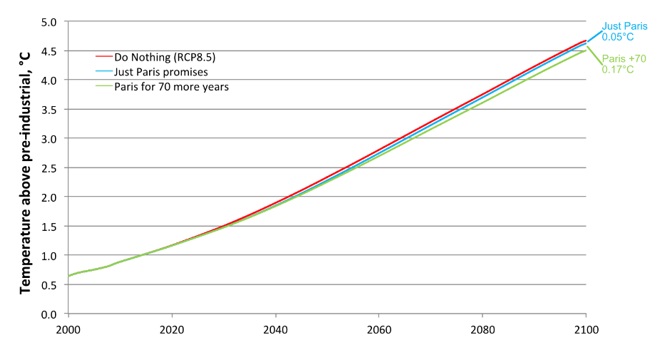
Bjorn Lomborg
We already have 1.0 °C relative to the mid 1800’s and about 1.5 °C relative to the coldest phase of the Little Ice Age, the coldest part of the Holocene Epoch. If 1.5 to 2.0 °C of warming relative to the glacial interstadial temperatures of the Little Ice Age is an “existential threat to millennials,” their threshold for existence is set too low (or would that be too high?).
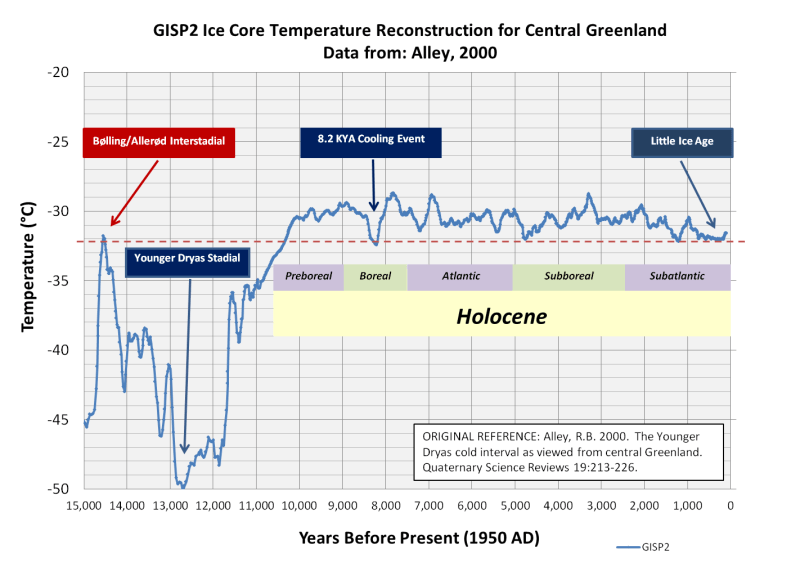
Central Greenland temperature reconstruction (data from Alley, 2000)
The Vietnam War was a clear mortal threat to young people, tens of millions of whom were eligible to be drafted; nearly 60,000 Americans were killed in the conflict. […]
The World Health Organization has projected that come 2030, climate change will cause an additional 250,000 deaths per year.
Is this a non sequitur or a red herring?
Vietnam War…
STATISTICS FOR INDIVIDUALS IN UNIFORM AND IN COUNTRY
VIETNAM VETERANS3. 2,709,918 Americans served in Vietnam , this number represents 9.7% of their generation.
CASUALTIES
2. Non-hostile deaths: 10,800
3. Total: 58,202 (Includes men formerly classified as MIA and Mayaguez casualties). Men who have subsequently died of wounds account for the changing total.
(a) 2,709,918 divided by 9.7% equals 27,937,299.
(b) 58,202 divided by 27,937,299 equals 0.002… 0.2%.
(c) 99.8% of the Vietnam War generation did not die in the Vietnam War.
Those were real deaths. The brave men and women who sacrificed their lives in the Vietnam War were real people… They have names.
Global War Against the Weather…
The World Health Organization has projected that come 2030, climate change will cause an additional 250,000 deaths per year.
Is this comparable to to Vietnam War in any way, shape or form?
Estimated 2011
Death Rate
• 8 deaths/1,000 population
• 55.3 million people die each year
• 151,600 people die each day
• 6,316 people die each hour
• 105 people die each minute
• Nearly two people die each second
In 2011, 55.3 million real people died. That’s 0.8% of 7 billion people. If I add 250,000 to 55.3 million, it’s still 0.8% of 7 billion people. Furthermore, these hypothetical deaths are the results of models. There will be no way to actually attribute any of these deaths, if they occur, to whatever climate changes actually occur between now and 2030.
Now, we do have a pretty good idea how many real people, with names, are currently dying due to energy poverty.

Energy Poverty Kills More People Than Coal and Cecil B. DeMille… Combined!
4 million is 7% of 55.3 million. Will a $240/gal tax on gasoline to fund a $122 trillion Global War on Weather make energy poverty better or worse? My bet is on worse.
Combatting climate change will take much more effort than ending the Vietnam War, and much longer.
Note to The New Republic: There’s only 1 “t” in combating.
The Global War Against the Weather will cost at least $122 trillion, claim tens of millions of lives and have no discernible affect on the weather.
Water Shortage? Blame Climate Change!
By Paul Homewood | Not A Lot Of People Know That | March 19, 2019
Water shortage? Why not blame it on global warming!
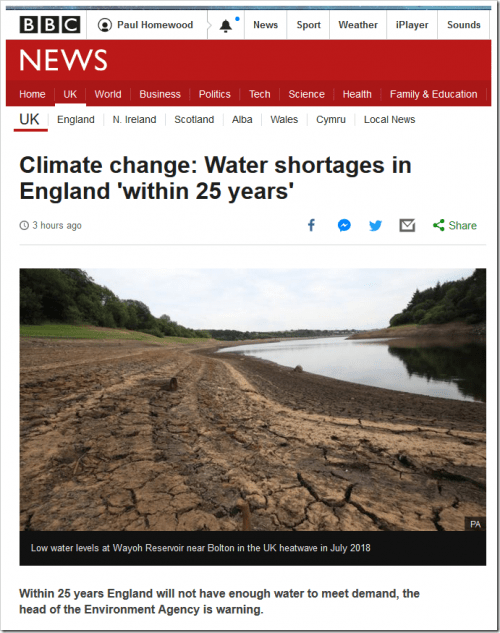
Within 25 years England will not have enough water to meet demand, the head of the Environment Agency is warning.
The impact of climate change, combined with population growth, means the country is facing an “existential threat”, Sir James Bevan told the Waterwise Conference in London.
He wants to see wasting water become “as socially unacceptable as blowing smoke in the face of a baby”.
“We all need to use less water and use it more efficiently,” he said.
Sir James Bevan was appointed chief executive of the Environment Agency – the public body responsible for protecting the environment and wildlife in England – in 2015 after a career as a diplomat.
He told his audience that, in around 20 to 25 years, England would reach the “jaws of death – the point at which, unless we take action to change things, we will not have enough water to supply our needs”.
Only one slight snag with Sir James’ little theory, there has been no reduction in rainfall levels in England, and droughts used to be much more severe and prevalent in the past:

https://www.metoffice.gov.uk/climate/uk/summaries/actualmonthly
Even commonly made claims that summers are getting drier do not stand up to scrutiny:

https://www.metoffice.gov.uk/climate/uk/summaries/actualmonthly
And just for good measure, the area of the country which is most vulnerable to water stress is also not becoming drier:

https://www.metoffice.gov.uk/climate/uk/summaries/datasets
And finally, summers in England are not getting hotter. The hottest summer still remains that of 1976. Indeed, last summer was the only one other than 1976 which was actually hotter than 1911!

https://www.metoffice.gov.uk/climate/uk/summaries/actualmonthly
There may be many reasons for water shortages, such as increased demand and leaks, but “climate change” certainly is not one of them.
But it is much easier for Sir James Bevan to blame global warming and ask us all to take less baths, than have to provide solutions to problems he can address.
BBC’s Age of Denial
By Paul Homewood | Not A Lot Of People Know That | March 16, 2019
I doubt if a day goes past now without a blast of global warming propaganda from the BBC.
Isabel Hardman has a new five part series on Radio 4, called the Age of Denial.
Although it covers all forms of denial, it is clearly aimed at climate sceptics, as this opening episode makes obvious:
https://www.bbc.co.uk/programmes/m000357k
Hardman interviews Kari Marie Norgaard, a social scientist from Oregon, who has written a book about climate change denial.
You can listen to the first five minutes, but to give the gist, Norgaard visited a small town in western Norway in the winter of 2000/01, to do research for a book she was writing. She found that the winter that year was a mild one, with the snow arriving late.
But what really stunned Norgaard was that none of the locals wanted to talk about “climate change”, which she was convinced was to blame.
Hardman and Norgaard then discuss various reasons why this should be so, which amounted to no more than a load of psychobabble.
For some reason, it did not occur to either to ask what the locals knew already. That it was just the sort of weather event that they, or their forefathers, had seen in the past.
Indeed, when we check the actual data at Bergen, the longest running site in the region, we find that those winter temperatures in 2000/01, far from being unusual, were the norm in the 1930s and 40s, and not infrequent at other times either:
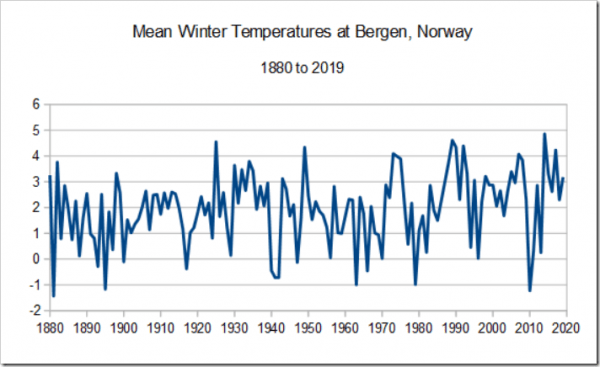
https://data.giss.nasa.gov/cgi-bin/gistemp/stdata_show.cgi?id=634013170000&dt=1&ds=5
In the remainder of the episode, Hardman discusses various theories from other psychoanalysts. But it is all just a spurious intellectual attempt to create a condition called ‘Denialism’. No doubt so that climate sceptics can be conveniently labelled and then ignored.
In reality, you don’t need to be a psychologist to understand why so many people are suspicious of what they are told about climate change.
The answer lies in the fact that they see no evidence on the ground to support the barrage of apocalyptic warnings showered on them.
People who live near the coast can see with their own eyes that they are not about to be inundated by the sea.
Temperature rise has been so small in the last century that most people would not even be aware of it if they were not told about it.
As for extreme weather, older people know that there have always been floods, droughts, heatwaves and storms. Sadly it is the younger generation, who have no such experience, that is vulnerable to propaganda.
In short, people are far more knowledgeable than the sneering Isabel Hardman gives them credit for. And they know when they are being sold a pup.
Moreover, these ordinary people have far more pressing concerns in their daily lives than to be paranoid about climate change. Perhaps if Hardman came out of her metropolitan BBC bubble and talked to ordinary people, she might find this out for herself.
Rather than trying to package sceptics as people with psychological problems, she might ask why others have become totally paranoid about climate change. When I see school kids questioning the point of going to school when “their future could be ruined by climate change”, I truly despair.
What on earth are we doing to these youngsters? Do we really want them growing up so indoctrinated and unable to use their own faculties that they cannot even check the facts for themselves? Do we really want them to grow up so neurotic that they are scared of the weather?
Are we happy to see them marching around like a bunch of zombies, full of meaningless slogans about topics that they don’t have the slightest understanding about?
It is a sort of mass hysteria that has unfortunately been all too common during human history. It used to be a matter of burning witches, or human sacrifices by the Aztecs. Now it is demonising CO2.
Perhaps Isabel might like to devote her next series to this.
Featured Video

Dan Dicks with James Corbett on Solutions Watch
or go to
Aletho News Archives – Video-Images
From the Archives
Secret document reveals plans for civil war in Lebanon, Israeli false flags, and invasion
By Randi Nord | Geopolitics Alert | April 5, 2019
Beirut – During his visit with US Secretary of State, Mike Pompeo, Lebanese President Michael Aoun reportedly received a US-Israeli document detailing plans for creating a civil war in Lebanon with covert false flag operations and possible Israeli invasion.
Although the source of the document is Israeli and created in partnership with Washington, no one knows who presented it to Aoun. The Lebanese TV station, Al-Jadeed, initially reported the document on Lebanese TV and a video on its website. Geopolitics Alert translated the report for this article. … continue
Blog Roll
 Aletho News
- Sheikh al-Asadi warns of Iraqi government compliance with US demands
- How to MAKE THE CONSPIRATORS PAY for their crimes! Dan Dicks with James Corbett on Solutions Watch
- There’s a drought in academia: A drought in honest research on the subject of drought and other weather extremes
- Department of War Awards $20.7 Billion Contract to Raytheon for Air-to-Air Missiles
- ‘Distance yourselves from Israel’: IRGC urges US population to question govt policies
- America’s Greenland deal has a radioactive backstory
- The RAF Fairford ‘terror plot’: Unpacking escalation in the UK echo-chamber
- EU Council Advances Chat Control 2.0 Scanning Proposal
- Ex-Greek MEP files complaint against Israeli spyware firm over alleged Pegasus surveillance
- Troubling ideas throughout the Torah, Talmud, Mishneh Torah and Tanya
- If Americans Knew
- New Report: “Scholasticide and Genocide in Gaza: Assessment, Testimonies and Legal Analysis”
- Ex-Biden officials are desperate for a Gaza scapegoat
- Israeli “settlers” Invade Al-Aqsa; Pour Boiling Water on 75-Year-Old
- Israel Has Kidnapped Another American Teenager
- US arms sales to Israel worth $21.6 billion in 20 months
- Three Palestinians Killed in Israeli Attacks on Gaza
- Revealed: German “Anti-Semitism Expert” Driving Crackdown on Palestine Solidarity is Former Israeli Spy
- Egypt’s Warning to Israel Before Oct 7
- Israel’s siege signals another cruel winter for 1.8 million Gazans – Daily Update
- Netanyahu Asked UAE Leader to Deny Report on Oct. 7 Warning in Secret Visit, Sources Say
- No Tricks Zone
- Two More Paleo Reconstructions Affirm Meters-Higher Sea Levels Across Ireland, Brazil 7000-6000 Years Ago
- New Study: Earth And Venus Surface Warmth Largely Explained By Convection And Lapse Rate, Not CO2 Or Radiation
- 2025 Nature Paper Claiming Worsening Global Drought Gets RETRACTED …Heavily Flawed
- New Study: ‘Global Drought Shows No Detectable Recent Acceleration Under Climate Warming’
- Economic Masterminds: German Socialists Suggest Taxing Productivity Gains Stemming From Using AI
- The South China Sea Has Not Been Cooperating With The Climate Change Narrative
- Energy Crisis: Germany Enters Heating Season With Historically Low Gas Reserve Fill Levels
- New Study: The Antarctic Ice Sheet Gained Mass From 2020-2024 Due To Staggering Snow And Ice Accumulation
- Study: Ocean Heating Rates From Thousands Of Years Ago ‘Dwarf’ Modern Ocean Heating Rates
- Climate Extremists Target, Attack Large-Scale Power Grid Infrastructure In Germany!

