Zero Carbon Proposals Slammed As Irresponsible & Arbitrary
By Paul Homewood | Not A Lot Of People Know That | April 2, 2019
The GWPF has issued this press release in response to the Committee on Climate Change’s new proposals to cutting CO2 emissions to zero by 2050:
Summary
The recommendation of the Committee on Climate Change (CCC) for a Net Zero emissions target by 2050 is grounded in nothing stronger than irresponsible optimism and arbitrary assumptions about cost and technological feasibility. In point of fact, the technologies seen as necessary, including carbon capture and sequestration (CCS), further expansion of renewable generation, widespread adoption of hydrogen, and the very rapid electrification of the UK’s entire heating and transport systems, are either known failures or are unproven at these scales and would cost two to three times the amounts claimed by the CCC. Attempts to deliver these policies would ultimately fail, but in the attempt the UK would further harm its already declining productivity, and so erode the UK’s ability to compete internationally and thus deliver an acceptable standard of living for its people. This is not a sustainable low emissions strategy, and even if accepted by government is very likely to end only in humiliating and distressed policy correction. A wise government would reject this advice.
The Committee on Climate Change (CCC) is advising the government of the UK to revise and increase the ambitions of the Climate Change Act. The Act already commits the country to an 80% reduction of greenhouse gas emissions by 2050 as compared to 1990 levels. The new proposal is that it should have ‘Net Zero’ emissions by that year. The UK has, the CCC claims, already reduced its inland consumption emissions by 40% against the 1990 baseline, and it presents the current proposal as a rational continuation of that success story. But this is a selective and misleading history. When the emissions associated with UK consumption through manufacturing in other countries are taken into account, the UK’s carbon footprint was actually still rising up until the 2008 downturn, when it fell because of economic difficulties, and is now showing some signs of returning to the upwards trend as the economy slowly recovers. In essence, the UK simply exported its emissions to other parts of the world, principally China, in substantial part through carbon leakage resulting from high energy costs in the UK, costs which in substantial part were the result of climate policies. This history gives no ground for optimism with regard to the Net Zero target now proposed. Far from being a success on which we can build, UK climate policy has been a failure, resulting only in domestic economic damage and the illusion of reduced emissions.
The overriding problem facing the UK is the comparatively slow growth in productivity. For much of the last century, the UK’s productivity has been below that of the major industrial economies, and the gap has grown in the first two decades of the 21st century. The consequence has been no growth in real wages and incomes, a fact that strains domestic budgets and exacerbates a general reluctance to make the investments required for future economic prosperity.
This deterioration in productivity growth closely follows and is substantially associated with the implementation of policies to reduce energy use and carbon emissions. There are three reasons for this link:
(a) Large amounts of investment and labour have been diverted to capital-intensive renewables, crowding out investment in other infrastructure and sectors with much higher levels of capital and labour productivity.
(b) The resulting increases in energy prices have prompted high-productivity manufacturing and other industries to conclude that they should look elsewhere for growth in both demand and production.
(c) More generally, the efforts and resources of businesses and innovators have been diverted away from improving productivity and towards efforts to reduce carbon emissions. Furthermore, the idea that there is a global opportunity for the UK to grow by exploiting low carbon technologies is demonstrably a myth.
There can be no doubt that these factors have had a major impact on the development of the UK economy in the last two decades. Low carbon growth may be the holy grail, but the reality is almost no growth and slower reductions in carbon emissions per unit of output than in, say, the United States. Yet the CCC is now recommending proposals that are explicitly designed to reinforce this disappointing performance.
If the government accepts the CCC’s proposals, which are marked by a persistent special pleading about the costs and feasibilities, it will immediately sabotage any plan to rectify the UK’s poor productivity performance and weaken international competitiveness. Its recommendations will ensure that the UK suffers from even lower productivity and be still poorer relative to the rest of the world in 2050 than in 2020. At the same time, the slower growth in productivity brought about by these proposals will increase the burden of meeting the CCC’s targets to a level that will not be bearable. The only doubt is how much pain the population will endure, and how much damage will be done, before these infeasible targets are abandoned.
The study that underlies the CCC’s proposals is marked by what can only be called ‘fantasy analysis’. Electricity demand is required to double on present levels, when in fact it is falling due to high prices. The CCC’s plans require that all of that additional electricity must come from low carbon sources, as opposed to under 50% today. The CCC itself admits that CCS is ‘essential’ to its vision for the 2050 target, and must be substantially deployed before 2030, with a significant level by 2026. At present it is non-existent in the UK, and non-viable at scale elsewhere. There must be 30 GW of offshore wind by 2030, and 75 GW by 2050; at present there is 8 GW, all heavily subsidised, with no sign that the industry is in fact able to build offshore wind at market competitive rates.
The CCC believes that petrol and diesel cars and vans must be phased out well before 2040, but admits that even the current eye-catching and over-ambitious plans to mandate electric vehicles by 2035 cannot deliver this transformation. It consequently suggests that new fossil-fuelled vehicles must be outlawed by 2030. Such a ban would in all probability destroy the existing market for domestic car manufacture, as Chinese and other Asian companies using cheap energy and cheap labour will make the UK uncompetitive.
The study notes that the UK’s provision of space and water heating must be converted to electricity and hydrogen, but admits that there is currently ‘no serious plan’ in existence for this revolution. That is correct, but unfortunately, the study does not itself provide one.
The CCC states that there must be very large afforestation schemes to act as carbon sinks, at a rate of 20,000 hectares per year up to 2025, and 27,000 hectares per year thereafter. The CCC itself admits that the current rate has been only about 10,000 hectares per year over the last five years. In any case, the use of forestry as a carbon sink only has a short-term impact unless CCS is applied to wood burning, which is not feasible on a small scale and is unaffordably expensive on a large scale.
Overall, the CCC’s reaction to these manifest failures and difficulties is to conclude that the ‘voluntary approach’ has failed hitherto and would not deliver the new proposals. Implicitly, therefore, the policies that it recommends must be mandatory and state-led. But nowhere does the CCC’s report consider whether the state actually has the administrative or technical competence to successfully deliver these remarkable objectives. Nor does it consider whether the cost of doing so is likely to be tolerable to the public. Indeed, strikingly, though the CCC makes assertions about the cost and benefits of increasing the Climate Change Act target to Net Zero, there is no attempt to actually quantify the marginal costs and benefits of each step necessary – the most fundamental requirement for such an exercise. Indeed, many of the costs actually cited in the report ignore the practical realities of installation, operation and maintenance of technologies that are well-understood and have failed to achieve widespread deployment without large subsidies. Experience tells us that, if adopted, the CCC’s programme will cost anything from three to five times the estimates in this report and will take up to twice as long to implement.
In summary, the Committee on Climate Change has not produced a serious assessment of the practical feasibility and costs of a Net Zero 2050 target. On the contrary, it has simply taken the Net Zero target as a given and made irrationally optimistic and arbitrary assumptions comprising a fictional narrative that magically delivers the emissions reduction goal as the Happy Ending. This is unrealistic, irresponsible, and misleading.
The government should obviously reject the Climate Change Committee’s poorly argued advice, which is economically hazardous and does not offer a sustainable emissions reductions trajectory.
https://www.thegwpf.com/gwpf-statement-on-the-proposed-net-zero-2050-emissions-target/
Terrifying predictions about the melting North Pole!
By Larry Kummer | Watts Up With That? | April 30, 2019
Summary: We have had 30 years of bold but false predictions by climate scientists, met by silence from their peers. These make skeptics, and are one reason why the public does not support radical public policy actions. Here are 20 years of predictions about the melting North Pole.
A stream of predictions about an ice-free arctic ocean
Peter Wadhams, head of the Polar Ocean Physics Group at Cambridge, is famous for his predictions – and his amazing record of being wrong. Journalists report each prediction as if made by Einstein, not telling readers about Wadhams’ dismal record. That is how they report climate science and keep their readers misinformed.
“Within a decade we can expect regular summer trade there {across the arctic ocean}.” — “Arctic Meltdown,” a NASA press release on 27 February 2001.
Eighteen years later, no regular cargo crossing the arctic ocean. There are small numbers of specially built ships making the passage on the northern coasts (e.g., here, here, and here).
“By 2013, we will see a much smaller area in summertime than now; and certainly by about 2020, I can imagine that only one area will remain in summer.” — BBC, 13 May 2009.
Twice wrong. The 2013 average and minimum ice extent was roughly unchanged from that in 2009. In 2018, the minimum was 4.6 million square kilometers, only 12% down from 2009. I doubt 2020 will be much different.
“The entire ice cover is now on the point of collapse. …The extra open water already created by the retreating ice allows bigger waves to be generated by storms, which are sweeping away the surviving ice. It is truly the case that it will be all gone by 2015. The consequences are enormous and represent a huge boost to global warming.” — The Scotsman, 29 August 2012.
Not only was it not “all gone by 2015” but that quote appeared three weeks from the record low point on September 17.
“I have been predicting [the collapse of sea ice in summer months] for many years. The main cause is simply global warming …This collapse, I predicted would occur in 2015-16 at which time the summer Arctic (August to September) would become ice-free. The final collapse towards that state is now happening and will probably be complete by those dates.” — The Guardian, 17 September 2012.
Ditto. There was a great deal of excitement among alarmists about the 2012 low, and the usual linear extrapolation to a disaster coming really soon. Wadhams presented at the September 2014 Royal Society conference “Arctic sea ice reduction: the evidence, models, and global impacts.” A few climate scientists made mildly critical tweets about his presentation. Gavin Schmidt (Director of NASA’s Goddard Institute for Space Studies) was the most critical. He is, to the best of my knowledge, exceptional in his willingness to speak out about alarmist claims by his peers. See the tweets. But there is no evidence they called friendly journalists to protest journalists’ uncritical publication of Wadham’s predictions. But skeptical climate scientists often receive barrages of criticism from their peers, sometimes for repeating material in the IPCC’s reports and peer-review literature (e.g., Roger Pielke Jr. by scientists such as Gavin Schmidt – details here).
“Most people expect this year will see a record low in the Arctic’s summer sea-ice cover. Next year or the year after that, I think it will be free of ice in summer and by that I mean the central Arctic will be ice-free. You will be able to cross over the north pole by ship. …Ice-free means the central basin of the Arctic will be ice-free and I think that that is going to happen in summer 2017 or 2018. — The Guardian, 21 August 2016.
Twice wrong, again. The 2016 minimum was 23% above the 2012 minimum. The arctic was not ice-free in 2017 or 2018. Not even icebreakers cross over the North Pole.
“{T}he planet is swiftly heading toward a largely ice-free Arctic in the warmer months, possibly as early as 2020.” — Yale Environment 360, 26 September 2016.
The record minimum extent was in 2012. The previous minimum was 4.16 million km in 2007. The 2018 minimum was 4.95 million km. That is a 19% increase over 12 years. Wadhams had lots of headline-loving company among climate scientists. For example, Wieslaw Maslowsk – a research professor at the Navy Postgraduate School.
“Scientists in the US have presented one of the most dramatic forecasts yet for the disappearance of Arctic sea ice. Their latest modelling studies indicate northern polar waters could be ice-free in summers within just 5-6 years. …Professor Wieslaw Maslowski told an American Geophysical Union meeting that previous projections had underestimated the processes now driving ice loss. …’Our projection of 2013 for the removal of ice in summer is not accounting for the last two minima, in 2005 and 2007,’ the researcher from the Naval Postgraduate School, Monterey, California, explained to the BBC. ‘So given that fact, you can argue that may be our projection of 2013 is already too conservative.’” — BBC, 12 December 2007.
The “projection” of an ice-free summer in 2013 was not “too conservative.” It was too aggressive.  That is an example of successful clickbait by Robinson Meyer at The Atlantic on 29 December 2015. This is the alarmists’ usual trick of describing weather as “extraordinary” based on our brief instrument record, when it probably is not.
“It’s really hard to predict when we could see ice-free summers in the Arctic, but it could be as soon as in 20 to 40 years, Francis says.” — Jennifer Francis was then a professor at Rutgers, now a senior scientist at Woods Hole. Quoted in The Verge, 10 May 2018.
Now that is a safe prediction. If accurate, it will become famous in 2040 or 2060. If wrong, it will go down the memory hole with all the other wrong predictions about climate.
The real story
See the three lines in color showing the sea ice extents of 2007 (blue, middle), 2012 (dotted, bottom), and 2018 (thin grey, top), and the thick grey line of the 1981 – 2010 mean. Sea ice extent has been flattish for twelve years. For another perspective, the PIOMAS model shows that Arctic sea ice volume has been flattish for nine years. Click graph to enlarge.

From the National Snow and Ice Data Center.
Extinction Rebellion – The Facts
Windows on the World | April 21, 2019
The corporate backed “protest” group Extinction Rebellion fully explained. The main protagonists in this organisation and their links to Agenda 2030, the UN Global Action Plan and template NGO’S are all explained in this fact filled show.
Do listen and look at the information presented in in these two WOTW shows about the ER cult. Listen and check out the info here
The full spectrum dominance of controlled opposition is explained in the show:
Extinction Rebellion – The Facts
Below are the emails between a member of the public who asked the inner core of Extinction Rebellion a few questions and the sinister responses and threats from their “Dragons”
The Dragons of Extinction Rebellion
The same type of “Dragons” were used in the Occupy power structure once it was under the control of George Soros they can be seen in The Puppet Masters of Occupy
Our previous shows on the ER cult gave a lot of information and context to this show. They are linked above, “Fake Protest Extinction Rebellion” and “Globalist Fake Revolution”. The articles on the website contain internal ER documents and screenshots.
Here is an informative article From OYE News
The structure of ER mirrors the George Soros backed takeover of Occupy with its command structure including “Dragons”who threaten and intimidate anyone who asks questions.
We also have e mail threats from the sinister so called “Dragons” who protect the inner core of ER personnel. This all mirrors previous globalist backed protests.
We also look at the organizations linked to ER and how there are hundreds and globally thousands of these NGO template organizations all using the same narratives, all backed by the big financial interests which are pushing the climate change agenda for profit and ultimately control of the world population and all natural resources. The change agents, social entrepreneurs, psychological nudging, Saul Alinsky rules which all appeared as part of David Cameron’s Big Society.
Gail Bradbrook is one of the founders of Extinction Rebellion along with Roger Hallam and George Barda. Their Company is Compassionate Revolution Ltd and the ER protests came through Rising Up an organisation linked to other template type NGO’s which claim to be “grassroots”.
Gail Bradbrook is a consultant at Citizens Online, her profile was removed from the company’s website before the London “protests” Here it is before it was removed.

On the subject of fake protest groups: Demos the Think Tank which influences all media in the UK and is connected to the security services and MI5 stated:
“The New Democracy will work with a combination of government open infiltration and citizen groups taking Direct Action.”
The show looks at the template NGO’s linked to this “protest” and how they are in line with aims of the UN Agenda 2030, its taxation, restrictions and Smart Cities agenda and everything Globalist.
The use of the world “grassroots” has been hijacked to mean “state controlled and agents of the UN, IMF and World Bank.”
Unlike the Fake Protests we receive no funding!
BBC Accused Of Serious Errors And Misleading Statements In David Attenborough’s Climate Show
By Paul Homewood | Not A Lot Of People Know That | April 26, 2019
The GWPF has now formally submitted its complaint to the BBC about David Attenborough’s Climate Change – The Facts:
The BBC programme, presented by Sir David Attenborough, went far beyond its remit to present the facts of climate change, instead broadcasting a highly politicised manifesto in favour of renewable energy and unjustified alarm.
The programme highlighted suggestions that storms, floods, heatwaves and sea level rise are all rapidly getting worse as a result of climate change.
However, the best available data, published in the last few years by the Intergovernmental Panel on Climate Change (IPCC) and NASA, contradicts the BBC’s alarmist exaggeration of empirical evidence.
In its 5th Assessment Report (2013), the IPCC concluded:
“Current datasets indicate no significant observed trends in global tropical cyclone frequency over the past century … No robust trends in annual numbers of tropical storms, hurricanes and major hurricanes counts have been identified over the past 100 years in the North Atlantic basin.”
In its more recent Special Report on Global Warming of 1.5°C, published in 2018, these findings were reconfirmed. It stated that
“Numerous studies towards and beyond AR5 have reported a decreasing trend in the global number of tropical cyclones and/or the globally accumulated cyclonic energy… There is consequently low confidence in the larger number of studies reporting increasing trends in the global number of very intense cyclones.”
Regarding floods, the IPCC’s Special Report concluded:
“There is low confidence due to limited evidence, however, that anthropogenic climate change has affected the frequency and the magnitude of floods. “
There is also no observational evidence that the rate of sea level rise is getting worse. NASA satellite data shows that since 1993, there has been an annual mean sea level rise of 3.3mm, with no significant level of acceleration in the last three decades.
Suggestions by David Attenborough and Michael Mann that climate change is causing increases in wildfires in the US and globally are also misleading and not supported by any empirical evidence.
According to a survey published by the Royal Society the global area burned has actually declined over past decades, and there is increasing evidence to suggest that there is less fire in the global landscape today than centuries ago. These are vitally important facts that should have been mentioned if an accurate description of the impact of climate change on wildfires was to be maintained.
In his letter of complaint, Dr Benny Peiser, the GWPF’s director, has asked the BBC to acknowledge and correct the evident errors and misleading suggestions documented in the complaint and offer remedial measures as soon as possible.
The full complaint is available here (pdf)
Peter Ridd vs The Dishonourables
A powerful bureaucracy bullies, berates, isolates, and intimidates a lone critic.
By Donna Laframboise | Big Picture News | April 24, 2019
The Peter Ridd court ruling, released last week, is a re-telling of David and Goliath. This is a story about a bureaucratic in-group persecuting a dissenting voice. It’s also a story about widespread dishonourable conduct.
Ridd formerly ran the physics department, and managed James Cook University’s marine geophysical laboratory for 15 years. He was fired in May 2018, after alleging that Great Barrier Reef research affiliated with his university was misleading politicians and the public.
When Ridd first reached out to journalist Peter Michael at the Courier-Mail about his concerns, Michael didn’t protect his source by shielding Ridd’s identity. Instead, he betrayed Ridd by forwarding the full e-mail, accompanied by a few questions of his own, to one of the organizations being criticized – the ARC Centre of Excellence for Coral Reef Studies.
Biologist Terry Hughes was at that time, and continues to be, the person in charge at the ARC Centre. That entity’s website tells us “He has published so far 20 papers in Science and Nature.“ In scientific circles, therefore, he’s a golden boy. Getting published once in these prominent venues is an academic career boost.
This same biographical sketch begins by telling us:
In December 2016, Professor Terry Hughes was recognized by Nature as one of the “10 people who mattered this year” for his leadership in responding to the global coral bleaching event caused by climate change…Nature’s 10 dubbed him “Reef Sentinel”, for the global role he plays in applying multi-disciplinary science to securing reef sustainability.
Apparently reveling in the role of a brave sentinel sounding the alarm over climate change, Hughes presents this characterization of himself up front, at the top of the page.
Elsewhere, we learn that his current and recent research funding amounts to a staggering $31 million, with the vast bulk provided by Australian taxpayers. At many universities, professors share their research grants 50/50 with the administration. Hughes, therefore, is a source not only of international prestige for James Cook, but of significant funding.
According to the written judgment of Judge Salvatore Vasta, after receiving a forwarded copy of the detailed e-mail Ridd had sent to the journalist, Hughes declined to respond to the journalist’s questions. He made no attempt to address Ridd’s concerns, to explain why they were unfounded.
Like a child in a sandbox, he instead went running to the teacher. Before two hours had expired, he’d sent an e-mail to Senior Deputy Vice Chancellor Chris Cocklin (to whom both he and Ridd ultimately reported), saying he wished to file a complaint against Ridd.
From that point forward, it was unlikely Ridd would receive a fair hearing, despite the lofty language about impartiality and natural justice in that institution’s Code of Conduct.
University officials were in a clear conflict-of-interest. Their own fortunes were aligned with one side.
They didn’t dare investigate whether their star professor was misusing photographs or exaggerating his scientific conclusions. Such a finding could be humiliating for the university, whose reputation they themselves were supposed to be safeguarding.
Then there was the money angle. Anything that reflected negatively on Hughes could call into question his research grants past, present, and future. When a professor is bringing tens of millions of dollars onto campus, no administrator in their right mind wants to capsize that boat.
Last but not least, the powers-that-be at James Cook needed to worry about offending Hughes. The well-connected biologist might take his toys and go elsewhere.
Judge Vasta twice points to a double standard on the part of the administration. When Ridd did something, it was wrong. When others behaved similarly, it wasn’t even noticed. (See paragraphs 68-70 and 220-222 of the court judgment). In the judge’s words, the “hypocrisy is breathtaking,” and the “irony is even more spectacular.”
As a result of Hughes’ complaint, the university formally censured Ridd. He was found guilty of misconduct, including a failure to “uphold the integrity and good reputation of the University.”
The final sentence in his formal letter of censure urges him, in so many words, to get counseling – providing the telephone number of the university’s “free and confidential” service. The message couldn’t have been plainer. Ridd was the problem.
Three months later, Ridd made a guest appearance on Australian television. A book had just been published to which he’d contributed a chapter about the “extraordinary resilience of Great Barrier Reef corals.” In his view, corals are highly adaptable. They do well in water of various temperatures, and are therefore unlikely to be seriously harmed by climate change.
Ridd talked about the fact that most scientific research isn’t
properly checked, tested or replicated and this is a great shame because we really need to be able to trust our scientific institutions. And the fact is, I do not think we can anymore.
When an interviewer suggested some coral reef scientists were shamelessly “telling the government what they want to hear,” Ridd protested:
that’s possibly a bit harsh. I think that most of the scientists who are pushing out this stuff, they genuinely believe that there are problems with the reef. I just don’t think that they are very objective about the science they do. I think they’re emotionally attached to their subject, and you know you can’t blame them, the reef is a beautiful thing.
He did, however, point out that scientists with whom he differs
will never debate. I’ve often tried, you know. Let’s have a debate of a couple of hours and thrash this out. But they never will.
Once again, Terry ‘crybaby’ Hughes complained to James Cook administrators, and once again the university declared that Ridd had violated the Code of Conduct. Its longstanding position that how Ridd was saying things was the problem would seem to be contradicted by many of its statements, including this one:
The University does not accept that academic freedom justifies your criticism of key stakeholders of the University…
Hughes had specifically complained that Ridd was threatening the institution’s relationships with other entities. Ergo, Ridd needed to be crushed.
Following that television appearance, James Cook initiated a relentless campaign of enforced secrecy. Ridd was repeatedly told he had “confidentiality obligations to the University,” that he was expected “to maintain the confidentiality of this matter,” and that certain actions of his were considered “a direct breach of confidentiality.”
“It is very important,” he was told, “that you comply.” Ridd was forbidden from discussing “these matters with the media or in any other public forum, including social media.” Moreover, during a three-week period in September 2017, the university insisted he wasn’t allowed to tell even his wife what was going on.
Administrators kept pointing to a clause in the employment contract to justify this secrecy. But Judge Vasta says that clause “is written for the benefit and protection of the employee.” It imposes an obligation on the university to keep personal information private. Employees, on the other hand, are at perfect liberty to discuss their own situation with whomever they choose.
In the judge’s words, the confidentiality obligations Ridd was repeatedly told to respect “do not exist.”
The overall picture, therefore, is of widespread dishonourable conduct. A powerful bureaucracy bullies and berates. It isolates and intimidates a lone critic who, in another universe, would have been receiving whistleblower protections.
The pettiness here is shocking. Ridd was forbidden from saying anything that “directly or indirectly trivializes…or parodies the University taking disciplinary action against you.” Administrators claim he disobeyed that order when he sent an email to a student with the subject line: “for your amusement.”
Worried that Ridd’s troubles might adversely affect a joint project, Fernando Pinheiro Andutta, an academic colleague who worked elsewhere, sent Ridd an e-mail wondering “if maybe you could avoid stirring the pot for a little bit.”
Ridd’s response included this sentence: “In any case I am not sure I have any influence on the outcome.” According to James Cook administrators, those words were proof he’d denigrated the university to a third party.
The judge characterizes further administrative allegations against Ridd as “totally bereft of logic,” “extremely peculiar,” having “no substance whatsoever,” and lacking “the slightest scintilla of evidence.”
While officials at James Cook University excelled at making Ridd’s life miserable, they collectively appear to have lost sight of the reason society spends enormous amounts of money on higher education.
A university is supposed to be a marketplace of ideas. It’s supposed to be an arena where conflicting perspectives are examined and challenged. That process won’t always be pleasant for those involved, but the last thing administrators are supposed to do is prevent this from taking place. In the words of Judge Vasta:
Incredibly, the University has not understood the whole concept of intellectual freedom. In the search for truth, it is an unfortunate consequence that some people may feel denigrated, offended, hurt or upset.
Earth Day, 2019: Fifty Years of Apocalyptic Global Warming Predictions and Why People Believe Them, Part 1

By Peter Baggins, Ph.D. | Occidental Observer | April 19, 2019
Two of the most important problems that the so-called Green New Deal will attempt to solve at the cost of incalculable trillions are global warming and its consequences, including drought, famine, floods and massive starvation. You may recall that Obama in his 2015 State of the Union speech declared that the greatest threat facing us was neither terrorism nor ISIS. It wasn’t nuclear weapons in rogue states either. “No challenge poses a greater threat to future generations than climate change,” said Obama.
His entire administration including Vice President Joe Biden, and Secretary of State John Kerry, frequently repeated the claim that climate change was the greatest threat facing the world. It was a sentiment Obama stressed again during an Earth Day trip to the Florida Everglades where he said, “This is not a problem for another generation. It has serious implications for the way we live right now”.
More recently, presidential hopefuls like Beto O’Rourke, along with most Democrat candidates, declared their zealous support for the Green New Deal in forecasting that the world will end in 12 years if nothing is done. “This is the final chance, the scientists are absolutely unanimous on this — that we have no more than 12 years to take incredibly bold action on this crisis. Not to be melodramatic, but the future of the world depends on us right now here where we are.”
This leads to the question I pose in this brief, data-driven, essay: What kind of track record do the politicians and their experts have in their climate predictions? After all, some of these predictions were made 10, 20 or even 50 years ago. Can’t we now look back at their predictions and begin to hold them accountable?
As others have done, I have chosen to begin with the first Earth Day “Celebration” in 1970. Now who can be against Earth Day? It’s a charming idea, and I have been an enthusiastic supporter since my college days in Ann Arbor, when we celebrated the event on the campus of the University of Michigan.
Here’s what the experts were saying almost a half century ago on Earth Day, 1970:
- “Civilization will end within 15 or 30 years unless immediate action is taken against problems facing mankind.”
— Harvard biologist George Wald
- “It is already too late to avoid mass starvation,”
— Denis Hayes, Chief organizer for Earth Day
- “We are in an environmental crisis which threatens the survival of this nation, and of the world as a suitable place of human habitation.”
— Washington University biologist Barry Commoner
- “Population will inevitably and completely outstrip whatever small increases in food supplies we make. The death rate will increase until at least 100–200 million people per year will be starving to death during the next ten years. … Most of the people who are going to die in the greatest cataclysm in the history of man have already been born. … [By 1975] some experts feel that food shortages will have escalated the present level of world hunger and starvation into famines of unbelievable proportions. Other experts, more optimistic, think the ultimate food-population collision will not occur until the decade of the 1980s.
— Stanford University biologist Paul Ehrlich
- “Demographers agree almost unanimously on the following grim timetable: by 1975 widespread famines will begin in India; these will spread by 1990 to include all of India, Pakistan, China and the Near East, Africa. By the year 2000, or conceivably sooner, South and Central America will exist under famine conditions …. By the year 2000, thirty years from now, the entire world, with the exception of Western Europe, North America, and Australia, will be in famine.”
— North Texas State University professor Peter Gunter
- “In a decade, urban dwellers will have to wear gas masks to survive air pollution… by 1985 air pollution will have reduced the amount of sunlight reaching earth by one half.”
— Life magazine - “At the present rate of nitrogen buildup, it’s only a matter of time before light will be filtered out of the atmosphere and none of our land will be usable. … By the year 2000, if present trends continue, we will be using up crude oil at such a rate … that there won’t be any more crude oil. You’ll drive up to the pump and say, ‘Fill ‘er up, buddy,’ and he’ll say, ‘I am very sorry, there isn’t any. … The world has been chilling sharply for about twenty years. If present trends continue, the world will be about four degrees colder for the global mean temperature in 1990, but eleven degrees colder in the year 2000. This is about twice what it would take to put us into an ice age.”
— Kenneth Watt
Global Warming and Massive Starvation
I will focus my attention on the two most important predictions: Global Warming and Massive Starvation. If we return to the failed prediction of global cooling noted above, we can put the temperature data in a wider perspective. NASA data show that a period of warming in the 1920’s and 30’s was followed by two or three decades of cooling temperatures, from the 1940s to 1970. At that time many experts, including Carl Sagan, warned us of a possible ice age—only to have the climate change on them. From the 1970s to the late 1990s, scientists began to record slightly warmer temperatures. Curiously, as we look back at this period NASA sounded the alarm for global warming while a short time later the New York Times cited NOAA [National Oceanic and Atmospheric Administration] data showing no warming over the past 100 years in the US.
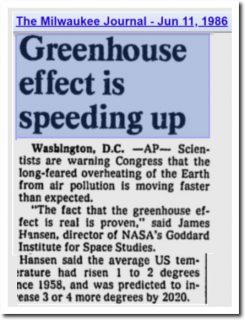
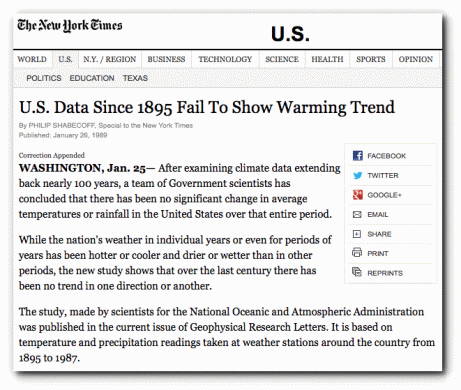
Since then, group think and political correctness, plus rewards in government grants and university promotions, have created incentives for nearly everyone to jump onto the current bandwagon of projecting an escalating warming trend. Once again we came back to the doomsday scenario that characterized 1970’s.
Then, out of the blue, the darned climate changed again. Global temperature data has been roughly flat since about 1998, even cooling by .056 degrees C from February 2016 to February 2018, according to official NASA global temperature data. Of course, this is just a two-year trend.
You may have noticed that nearly all of the doomsday theories seem to begin with the phrase, “if current trends continue.” But, as I have just reviewed, current trends don’t continue. Global temperatures go down, then up, then stay flat. Population growth tapers off, new oil reserves are discovered, agricultural yields increase at even higher rates. Doomsday forecasters always overestimate gloomy trends and underestimate human ingenuity in problem solving.
This raises the question: How would an informed citizen make sense of our current predicament?
Without question there has been an increase in carbon dioxide and other greenhouse gases released by the burning of fossil fuels and other human activities. A majority of scientists believe this to be the primary source of the global warming that has occurred.
Just how much warming has occurred?
The scientific consensus is that the average temperature of the Earth has risen about 0.4 °C over the past 100 years. This is far less than experts predicted. And therein lies the problem: scientists are better at observation than prediction.
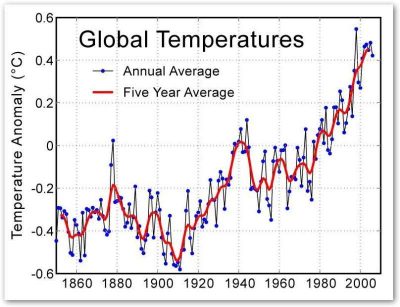
A case in point: experts from the Intergovernmental Panel on Climate carrying out global warming research have now predicted that average global temperatures could increase between 1.4 and 5.8 °C by the year 2100. Notice the nearly 5-fold difference between the conservative and more liberal (one is tempted to say “progressive”) estimates. This strikes me as akin to meteorologists predicting tomorrow’s high as somewhere between 40 and 80 degrees. Not much of a forecast if you are trying to decide whether to head to the beach or not. The confidence interval seems pretty safe, but the precision leaves much to be desired. Just how much faith should one put in such projections, given the flawed models and track record of failed predictions?
Regarding the other staggering Earth Day forecast of widespread starvation into hundreds of millions, recent satellite data from NASA and NOAA offer a compelling explanation for the spectacular failure of these predictions.
Almost half of Earth’s vegetated lands have shown significant greening over the past 35 years largely due to rising levels of atmospheric carbon dioxide, according to a recent study published in the journal Nature Climate Change. An international team of 32 authors from 24 institutions in eight countries led the effort, which involved using satellite data from NASA’s Moderate Resolution Imaging Spectrometer and the National Oceanic and Atmospheric Administration’s Advanced Very High Resolution Radiometer instruments to help determine the leaf area index, or amount of leaf cover, over the planet’s vegetated regions.
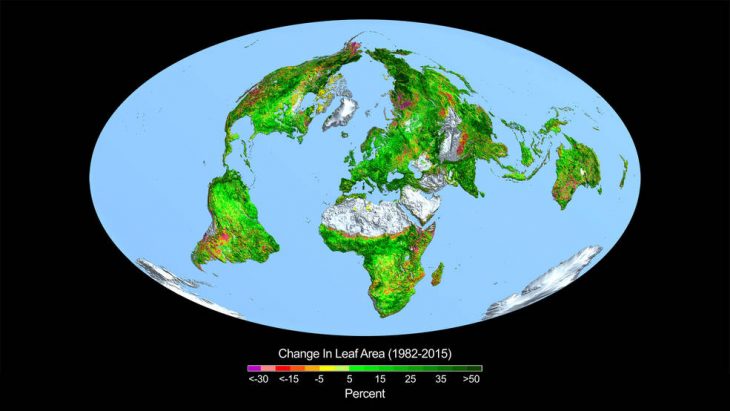
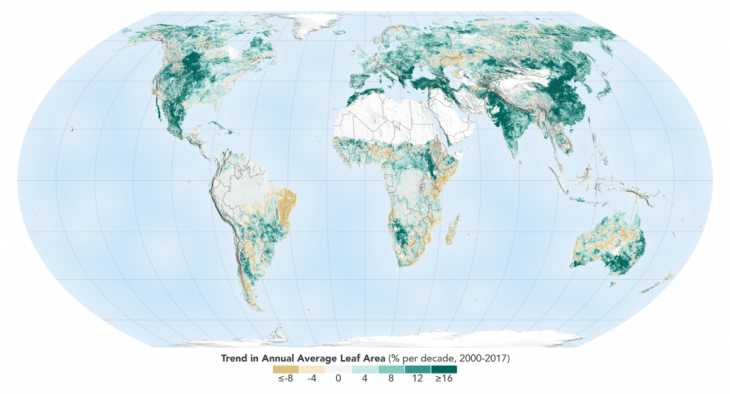
This greening represents an increase in leaves on plants and trees equivalent in area to two times the continental United States, or more than two million square miles of extra green leaf area per year, compared to the early 2000’s. That increase represents an enormous amount of food to feed a hungry planet, which is one reason the Earth Day predictions of mass starvation never materialized.
Because the mainstream media refuses to report such important data as this is from NASA and NOAA that do not support their doomsday narrative, I have never actually met anyone who knew anything about this when I mention it. I only learned about this myself a few years ago because of Matt Ridley, whose excellent blog I recommend without reserve:
You may remember from high school biology that increased concentrations of carbon dioxide increase photosynthesis, spurring plant growth. Green leaves use energy from sunlight through photosynthesis to chemically combine carbon dioxide with nitrogen drawn in from the air with water and nutrients tapped from the ground to produce sugars, which are the main source of food, fiber and fuel for life on Earth. The good news is that the impact that this greening has had in reducing hunger and starvation around the globe is undiminished, despite going unreported. When is the last time you heard a report of massive human starvation of hundreds of millions, or even tens of milions. How about 1 million … do I hear a hundred thousand, anyone? Anyone?
Fact Check: Fewer and fewer people die from climate-related naturaldisasters.
This is clearly the opposite of what you hear from the mainstream media, which loves to provide as much coverage as possible of one disaster after another. A more rational analysis would examine the average number of deaths per decade from 1920-1917. But this would show a “huuuge” decline in deaths caused by climate change, and we can’t have that now can we? The data below are from the most respected global database, the International Disaster Database.
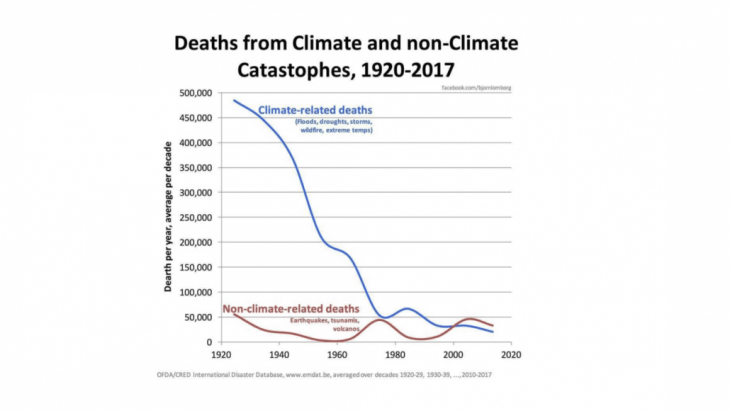
In contrast to the dire Earth Day predictions of 1970, climate-related deaths have been declining strongly for 70 years. Notice that this decline in the absolute number deaths occurred while the global population increased four-fold. Thus, the individual risk of dying from climate-related disasters has declined almost 99% from the 1920s to the present day. Our increased wealth and technological capacity to respond to natural disasters has greatly reduced our collective human climate vulnerability – Good news for rational beings, bad news for Democrat candidates.
The Splendid Peter Ridd Court Judgment
James Cook University took 28 separate actions against Professor Ridd. Each of them, including his termination, has been declared unlawful.

By Donna Laframboise | Big Picture News | April 22, 2019
Few victories are as complete as the one achieved last week by Peter Ridd in the Federal Circuit Court of Australia.
A former head of the physics department at James Cook University, Ridd was fired after questioning the reliability of Great Barrier Reef research produced by some of his colleagues.
To quote the editor-in-chief of The Lancet, “much of the scientific literature, perhaps half, may simply be untrue.” Whenever third parties attempt to replicate published research, they often get different answers altogether. Since government decisions can throw people out of work, disrupt families, and destroy communities, Ridd thinks it’s a bad idea to base government policy on research that hasn’t been double-checked.
This saga began in December 2015, after Ridd sent an e-mail to journalist Peter Michael of the Courier-Mail outlining his concerns about the misleading use of Great Barrier Reef photographs and other matters. His e-mail offered to condense his thoughts for publication, but also urged the newspaper to ask pointed questions of those in charge of two publicly funded organizations affiliated with his own university.
Some journalists go to jail to protect their sources. Peter Michael instead forwarded Ridd’s e-mail whole cloth to Terry Hughes, the director of one of those entities. Less than two hours after receiving it, Hughes informed a James Cook administrator that he wanted to “make a formal complaint” against Ridd for attacking his integrity.
There’s no indication that Hughes or anyone else at James Cook has ever addressed Ridd’s concerns. When the powers-that-be swung into action, silencing him was apparently the only thing on their mind.
Universities are supposed to be places of rigorous inquiry and vigorous debate. Academic tenure is supposed to prevent exactly this situation: a professor being hounded from campus for expressing unfashionable views.
Ridd’s superiors insist his criticism of his colleagues wasn’t the problem. The way he criticized them was. In other words, their position is that bad manners is a firing offence.
Between April 2016 and May 2018, James Cook University took 28 separate actions against Ridd. Each of them, including his termination, was declared unlawful by Judge Salvatore Vasta last week (see the full list, three pages long, here).
Vasta determined that the university’s relationship with its staff is governed first and foremost by an employment contract ratified by Australia’s Fair Work Commission. That contract can’t be altered without the federal agency’s say-so, and was described by the judge as “the basis from which other [university] documents gain their power.”
Clause 14 of the contract is devoted to Intellectual Freedom, a concept Judge Vasta calls “the cornerstone upon which the University exists. If the cornerstone is removed, the building tumbles.”
Clause 14 clearly proclaims James Cook to be an institution of independent thought where professors have the right to participate in public debate. It says “ideas may be put forward and opinion expressed freely,” including “unpopular or controversial views,” so long as the professors doing so don’t “harass, vilify, bully or intimidate those who disagree…”
Since Ridd hasn’t harassed, vilified, bullied, or intimidated anyone, the university has never claimed that Clause 14’s built-in limits apply.
Instead, those in charge have argued that a right recognized and affirmed by the Fair Work Commission isn’t worth the paper it’s written on. They say professors are only entitled to that right if they also abide by the university’s homegrown Code of Conduct, a rambling document that talks vaguely about “the collegial and academic spirit,” and instructs employees to “celebrate diversity.”
Ridd’s first Formal Censure said he’d violated the Code by failing to behave in a collegial manner and failing to respect the reputations of his colleagues (the only reputation actually mentioned in the Code is that of the university). It also claimed he’d gone to the media in a manner that “did not respect the rights of others.”
Judge Vasta observed that the university neglected to explain “exactly how this was not collegial or how the rights of others were not respected.” It just declared Ridd guilty of misconduct.
Using words such as “extraordinary” and “simply absurd,” the judge ruled that the Code of Conduct cannot be used as a mechanism to rob professors of something that has been guaranteed to them via the Fair Work Commission. In his words:
Clause 14 means that it is the right of Professor Ridd to say what he has said in any manner that he likes so long as he does not contravene the sanctions embedded in cl. 14. (my italics)
A few pages later, matters become crystal clear:
The termination of Professor Ridd’s employment was unlawful because it punished Professor Ridd for conduct that was protected by cl.14…
Case closed.
What Will It Take To End Anti-Greenhouse Gas Insanity?
By Francis Menton | Manhattan Contrarian | April 15, 2019
It was nearly six years ago, in one of the very early posts on this blog, that I wrote as to the global warming scam, “[E]ven as the cause becomes more and more ridiculous, the advocates just double down again and again.” At the time, world temperatures had failed to rise in accordance with alarmist predictions for about 15 years running, and I still had the naive idea that the politics of this issue ultimately would follow the scientific method; in other words, that the hypothesis of catastrophic human-caused warming would inevitably be forced to face the test of empirical evidence. Over time, empirical evidence would accumulate. As it became more and more clear that the evidence failed to support the hypothesis, the whole thing would gradually fade away. But up to that point, as I reported in that April 2013 post, what was happening was closer to the opposite. Extremely weak or completely negative empirical evidence for the hypothesis only made the advocates more and more extreme in their demands for immediate transformation of the world economy to “save the planet.”
The intervening six years have seen the ongoing accumulation of considerably more evidence, essentially all of it negative to the catastrophic global warming hypothesis, but my faith that actual evidence could resolve the issue has been almost completely shattered. Massive alterations have been made to the world thermometer temperature records by US and UK bureaucrats — almost entirely to reduce early-year temperatures and thereby create an apparent warming trend far greater than exists in the raw data. I have covered this issue extensively in a now-twenty-two part series “The Greatest Scientific Fraud Of All Time.” Meanwhile, every hurricane, tornado, drought, flood, or other damaging act of nature is presented by the progressive press as evidence of human-caused “climate change” — even as the actual occurrences of such events have been definitively shown to have no increasing trend over time. Actual evidence gets massively altered, buried and/or ignored.
And now here we are in 2019, and the demands of the anti-greenhouse gas activists have only become more shrill and strident. Exhibit A is the so-called Green New Deal, a call to end most or all GHG emissions by 2030 at a cost of maybe 100 trillion dollars or so. And we are treated to claims by seemingly serious elected officials that the world will end in 12 years if we do not follow these prescriptions. If mere adverse empirical evidence cannot end this insanity, what can?
Here’s what I think will put this to an end: the actual implementation by some jurisdictions of the activists’ preferred policies, all of which would impose massive costs on the people with no measurable impacts on world temperatures or the climate. The problem with expecting the scientific method to resolve this issue is that very few people have the time or inclination to follow empirical evidence of world temperatures to see if they are rising in accordance with predictions. Even fewer people are willing to get into the nitty gritty to evaluate alterations to the temperature data to see if they are legitimate. But almost everybody will notice immediately when their electricity bill gets tripled.
The process of imposing massive costs on the voting public in the name of saving the planet has been proceeding slowly in many places, and only very recently has this process started to face the beginnings of political blowback. For example, in Germany, the so-called Energiewende began in 2010, and over the ensuing near-decade has gradually brought consumer electricity prices in that country to about triple the US average, with minimal reductions in actual greenhouse gas emissions. Seven plus years into this, in the late-2017 elections, two climate skeptic parties (Free Democrats and Alliance for Germany) went from almost nothing to winning some 24.6% of the seats in the Bundestag. South Australia is an even more complex political situation, but they have also seen fanatic imposition of a “green” energy agenda, with vast increases in “renewable” electricity generation, the closing of coal plants, leading to several massive blackouts, and electricity prices also rising to about triple the US average. This has definitely become a major political issue. And just yesterday in Finland, a climate skeptic party called the Finns Party got 17.5% of the votes and 39 seats in parliamentary elections where the biggest establishment party (Social Democrats) got only 17.7% and 40 seats. Many sources report that the election was dominated by the Finns Party’s rallying cry of “climate hysteria.”
Here in my home city of New York, so far it has been all talk and not much action on the front of “fighting climate change” by forcibly suppressing greenhouse gas emissions. But that may all be about to change. A new omnibus package of “climate” bills has just been introduced in the City Council, seeking to go all in on every ridiculously expensive and completely ineffective policy you can think of, supposedly to “save the planet.” The Huffington Post has a big write-up here. Allegedly this monstrosity is going to come up for a vote as early as a week from today, April 22, aka “Earth Day.”
From the lead sponsor:
“This is about saving New York City,” Councilman Costa Constantinides, the Queens Democrat leading the effort. . . . “This is saving the city as we know it.”
This guy actually has the idea that he can stop bad weather or sea level rise or something by ordering the people of New York City (about 0.1% of the world’s population) to change their energy sources or use less energy or otherwise stop their sinning. How about some specifics?
The heart of the legislation is a measure requiring buildings of over 25,000 square feet ― the biggest source of carbon pollution in the city ― to install new windows, insulation and other retrofits to become more energy efficient. Starting in 2024, the legislation orders landlords to slash emissions 40% by 2030, and double the cuts by 2050.
Well, I have some experience as a building owner, and I can tell you that you can replace all the windows and insulate to your heart’s content, and you are not going to reduce your building’s energy usage by anything close to 40%, let alone 80%. In addition to which, most large buildings have long since made these upgrades. But hey, these are evil landlords, so we can just order them to do it, and it will happen.
And how about some other things we can order evil companies to do:
The full Climate Mobilization Act package goes further. One bill orders the city to complete a study over the next two years on the feasibility of closing all 24 oil- and gas-burning power plants in city limits and replacing them with renewables and batteries. Another establishes a renewable energy loan program. Two more require certain buildings to cover roofs with plants, solar panels, small wind turbines or a mix of the three. The last in this initial bunch tweaks the city’s building code to make it easier to build wind turbines.
These are some things with the real possibility of increasing our costs of electricity by big multiples. You might think I would strenuously oppose the bills, given that I am a designated guinea pig and victim for an experiment that can’t possibly end in anything other than abject failure. But you would be wrong. I say, let them try this nonsense, and the sooner and faster the better. That’s the only way that the inattentive multitudes will finally wake up. And, when electricity bills or gasoline prices or rents multiply by factors of three, or maybe five, then wake up they will. The insane politics of New York City might seem completely impervious to change, but that’s because the limits have not yet been tested. Going down this road could finally lead to a 180 degree reversal. I say, go for it!
David Attenborough’s BBC show would better have been called “Climate: Change The Facts”
Reviewing “Climate Change: the Facts” | April 21, 2019
… If you are going to present a film called Climate Change: the Facts the very least you should be doing is, well, presenting the facts. Well here they are, in two of the areas which made up such a hefty part of the film: wildfires and hurricanes. Are wildfires increasing? They are according to Attenborough. One of the scientists who takes part in the programme, Professor Michael Mann of Penn State University, goes as far as to say there has been a “tripling in the extent of wildfires in the Western US”. He is not specific about his evidence for this claim, nor said over what timeframe wildfires are supposed to have trebled, but it is not a fair assessment of the data collected by the US Environment Protection Agency (EPA). This shows no upwards trend in the number of wildfires in the US over the past 30 years.
But then again, go back further, to the 1920s, and you see that both the number of US wildfires and acreage burned in them has plummeted.
That is nothing to do with the climate – more down to firefighters getting better at tackling fires. But that reduction in wildfires – which, after all, were occurring naturally long before Europeans arrived in the US – has brought with it a problem: deadwood is not being cleared out at the rate which it used to be. As a result, when a wildfire does take hold, it tends to be a more powerful fire, which is one reason large acreages tend to get burned when fires do take hold. That was a large part of the debate which followed the wildfires in California last November.
But I know what will have entered the heads of many of Attenborough’s viewers: that wildfires are being caused by climate change and that is that. […]
The same will be true for hurricanes. If you are a child, for whom hurricanes are a novel phenomenon, watching the film will have given you the impression that hurricanes are pretty much a function of man-made climate change. A voiceover, indeed, makes the claim that climate change is causing ‘greater storms’. But again, the data on cyclone activity in the Atlantic, Gulf and Mexico and Caribbean does not support that idea. Figure one shows a very slight upwards trend in the number of hurricanes occurring in these waters but a flat or perhaps slightly downwards trend in the number of hurricanes making landfall in the US. There are two other methods of measuring hurricane activity which are used by the EPA. The first, the accumulated cyclone index (figure two) shows no obvious trend over the past 70 years. The second, the ‘power dissipation index’ shows an upwards spike in the early years of this century, followed by a reversion to mean since then.
Not that this seems to prevent documentary-makers like Attenborough resorting to footage of houses being demolished by winds and lorries being blown off bridges to show the supposed climate change we are already experiencing.
It is little wonder that terrified kids are skipping school to protest against climate change. Never mind climate change denial, a worse problem is the constant exaggeration of the subject. I had thought David Attenborough would be above resorting to the subtle propaganda which others have been propagating, linking every adverse weather event to climate change. But apparently not. — Ross Clark, The Spectator, 20 April 2019
… [W]e have already seen what can happen when ‘panic’ determines policy: the introduction of measures conceived by a need to be seen to be doing something under pressure from groups such as Extinction Rebellion.
Without making this clear, the film revealed one of the worst examples of this unfortunate effect. A powerful sequence showed an orangutan, fleeing loggers who have been eradicating Borneo’s rainforest.
This is disastrous for both wildlife and the climate because, as the film pointed out, a third of global emissions are down to deforestation, because giant trees lock up a lot of carbon.
But why are Borneo’s forests being cut down? The reason, as Attenborough said, is palm oil, a lucrative crop used in products ranging from soap to biscuits. Unfortunately, he left out the final stage of the argument.
Half of all the millions of tons of palm oil sent to Europe is used to make ‘biofuel’, thanks to an EU directive stating that, by 2020, ten per cent of forecourt fuel must come from ‘renewable’ biological sources. Malaysia says this has ‘created an unprecedented demand’.
To put it another way: misguided ‘action’ designed to save the planet is actually helping to damage it – although the EU has pledged to phase out palm oil biofuel by 2030.
Another example of a misconceived effort to save the planet is Drax power plant in Yorkshire which is fed, thanks to £700 million of annual subsidy, by ‘renewable’ wood pellets made from chopped-down American trees – while pumping more CO2 into the atmosphere than when it burnt only coal.
In theory, the trees it burns will be replaced – but a large part of its supply comes from hardwood forests that take 100 years to mature.
There are times when climate propaganda – for this is what this was – calls to mind the apocalyptic prophets of the Middle Ages, who led popular movements by preaching that the sins of human beings were so great that they could only be redeemed by suffering, in order to create a paradise on earth. Perhaps this is how Attenborough, nature journalism’s Methuselah, sees himself. But climate change is too important to be handled in this manner. It needs rational, well-informed debate. Too often, cheered on by the eco-zealots of Extinction Rebellion, the BBC is intent on encouraging quite the opposite. —David Rose, Mail on Sunday, 21 April 2019
… A former top executive at the BBC has warned that it is “at risk of being eaten” as new figures reveal that more than 880,000 television licences were cancelled last year. Cancellations among the under-75s rose from 860,192 in 2017-18 to 882,198 in the period from March 2018 to the end of February, new data shows. Mosey, 61, criticised the dumbing-down of news and “the nonsense put on social media by BBC” staff. —The Sunday Times, 21 April 2019
Bernie Sanders’ Foreign Policy Vision is Incoherent and Dangerous
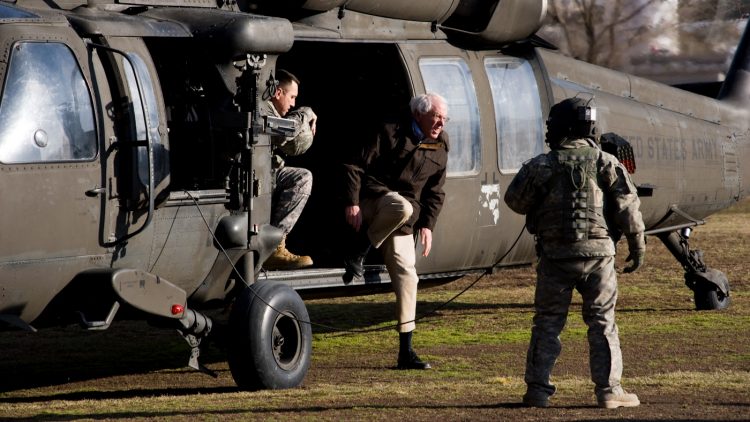
Sen. Bernie Sanders, I-Vt., steps off a Black Hawk helicopter at the Afghan National Police Academy Feb. 20, in Kabul, Afghanistan. Ernesto Hernandez Fonte | DVIDS
By Alex Rubinstein | MintPress News | April 16, 2019
Senator Bernie Sanders (I-VT) is now leading the pack of Democratic contenders for the 2020 presidential nomination. In the previous election cycle, Sanders served as an anti-establishment underdog, bucking Democratic orthodoxy with a strong progressive economic message. But this time the field is more crowded with like-minded candidates –“progressives” like Elizabeth Warren, Cory Booker, and Kamala Harris. It follows then that in order to distinguish himself, Sanders needs visionary solutions to problems outside of the economic realm. In the foreign policy arena, however, he is looking for inspiration on Israel-Palestine from tried-and-failed Democratic presidents of the past — namely, Jimmy Carter and Bill Clinton — all while echoing Trump and Bush Jr. administration talking points.
Sanders has also brought one Robert Malley onto his foreign policy team. Malley served on President Barack Obama’s National Security Council as “Special Assistant to President Obama & Senior Adviser to the President for the Counter-ISIL Campaign” from February 2014 to January 2017. Under his watch, the U.S led operations which saw the near-total destruction of the historic cities of Mosul in Iraq and Raqqa in Syria.
Despite this, the New York Times opinion section has said Sanders “stands as one of the few candidates with a fully formed vision for American foreign policy,” while The Atlantic claims “It’s Foreign Policy That Distinguishes Bernie This Time.”
As journalist Mathew Yglesias — who is not necessarily known for his moral clarity but is indisputably one of the more knowledgeable wonks on Washington’s most boring inner workings — noted, “There are two main things the president actually does — executive branch appointments, which nobody is really talking about, and then foreign policy.”
Sanders has worked hard to lay out his 2020 foreign policy vision in April. It was the subject of an in-depth article in The New Yorker, and he also touched briefly on it in a Fox News town hall on Monday.
In the New Yorker piece, journalist Benjamin Wallace-Wells recounts his interview with Sanders and his foreign policy advisor, Matt Duss, a former “Policy Analyst” at the notoriously anti-Sanders Center for American Progress, which receives funding from the United Arab Emirates.
Right away, Wallace-Wells notes that “Sanders had scarcely talked about foreign affairs in his 2016 campaign.” This time seems different, however.
Still, Sanders hasn’t done all of his homework, and openly admits it. After getting into some of the nitty-gritty of international affairs and the historic role of U.S. foreign policy, Sanders concedes to Wallace-Wells:
Let me — I should have prefaced everything that I said by saying I most certainly do not believe that I have all the answers, or that this is easy stuff. I mean, you’re dealing with so much — my God.”
A bit later in the story, Sanders seems to blame the ignorance he just owned up to for much of the world’s woes: “You know, a lot of attitudes about foreign policy are based on lack of knowledge.”
A decent staff, except . . .
Earnestly, Wallace-Wells notes that Sanders’ full foreign policy team left him “surprised” by “how mainstream they seemed.”
Among them:
Joe Cirincione, the antinuclear advocate; … Robert Malley, who coördinated Middle East policy in Obama’s National Security Council and is now the president of the International Crisis Group; Suzanne DiMaggio, a specialist in negotiations with adversaries at the Carnegie Endowment for International Peace; and Vali Nasr, the dean of the Paul H. Nitze School of Advanced Studies at Johns Hopkins and a specialist in the Shia-Sunni divide.”
Joe Cirincione is a well-known and well-respected progressive figure devoted to denuclearization. Suzanne DiMaggio, for her part, has received praise from Timothy Shorrock — a leading progressive journalist focused on the defense industry and the Korean Peninsula. Her words have also been featured by 38 North, which is arguably the fairest outlet focusing on North Korea and is distinguished by its facts-first approach. She is, however, indisputably part of the establishment, and is respected enough by members of the U.S. Senate that her advice was sought after Trump agreed to an initial meeting with North Korean leader Kim Jong-un.
Like DiMaggio, Vali Nasr appears to be cut from the cloth of dovish foreign policy “experts.” He once wrote: “Without Iran’s military reach and the strength of its network of allies and clients in Iraq and Syria, ISIS would have quickly swept through Damascus, Baghdad, and Erbil.”
Malley is, in truth, the most objectionable of Sanders’ foreign policy team. As Wallace-Wells noted, Malley served as Obama’s Middle East coordinator.
He also worked as an advisor to Obama on the U.S. counter-ISIS campaign up until January 2017. That campaign, notably, included the destruction of Raqqa (80 percent destroyed) and Mosul (eight million tons of debris and 90 percent of the Western portion of the city destroyed.) Malley also spent six months as a Senior Fellow at the ultra-hawkish Council on Foreign Relations think tank.
And Malley also worked for about two and a half years under Clinton as his “Special Assistant for Arab-Israeli Affairs.” He has previously caught the attention of the venerable Palestinian journalist Ali Abunimah, who has tweeted:
Malley isn’t ‘pro-Palestinian.’ He’s a liberal Zionist who believes in and wants to bring about ‘two state’ segregation by soft means.
Peace process industrialists like Robert Malley can never recognize role of BDS or speak openly about [a] one-state solution.”
On Israel-Palestine, Sanders invoked former presidents Jimmy Carter and Bill Clinton as a source of inspiration for him.
As MintPress News has previously covered the policies of those presidents (in contrast with the positioning of President Donald Trump):
Unlike previous U.S. presidents, who have meddled in Israeli elections in order to support peace processes, Trump is doing the opposite by appeasing the settler movement… While Washington orthodoxy dictates strict adherence to a two-state solution, the idea has long stalled a real resolution to Israeli apartheid, as Israeli settlers continue to make bold land grabs. The far-right president, in bucking the trend of supporting peace processes so doomed, coupled with the far-right prime minister [Benjamin Netanyahu], now emboldened by his fifth premiership, are on a path to see the total disappearance of historical Palestine from the map.”
There is no doubt that Sanders’ presidency would make a real solution to Israeli apartheid less improbable than a second Trump term would. Nor is their any doubt that his foreign policy is markedly less hawkish than that of many in the Democratic field. But he is also flanked from the left by candidates like Tulsi Gabbard and Mike Gravel, and so it is worth examining his milquetoast antidotes with this context in mind.
Sanders’ “solutions”
Sanders — despite being almost 80 years old — is getting hip to the desires of young progressives in the foreign policy realm. As DiMaggio correctly points out: “The case for restraint seems to be gaining ground, particularly in its rejection of preventive wars and efforts to change the regimes of countries that do not directly threaten the United States.”
In other words, the “humanitarian intervention” canard is losing its selling power. Moreover, Sanders rightfully puts more blame on the U.S. for various foreign policy failures over the years. He says:
“How many people in the United States understand that we overthrew a democratically elected government in Iran to put in the Shah? Which then led to the Revolution. How many people in this country do you think know that? So we’re going to have to do a little bit of educating on that.”
But Iran’s revolution was 40 years ago — about half of Sanders’ lifetime. When it comes to Iran today, Sanders differs drastically from the aforementioned views of Nasr, which painted Iran as a force for anti-terrorism in the Middle East. Sanders explicitly rejected this conception of Iran, saying Tehran is “involved in terrorism, doing a lot of bad things.”
In the case of the rivalry between Saudi Arabia and Iran, as well as the Israel-Palestine conflict, Sanders makes “both sides” arguments. On Saudi Arabia, he says “I don’t see why we’d be following the lead or seen as a very, very close ally of a despotic, un-democratic regime.”
Of course, Saudi Arabia is a theocratic petro-monarchy. Denouncing it as “un-democratic” is about the least imaginative criticism conceivable. To Sanders’ credit, however, he has been a leader in efforts to put an end to U.S. support for the Saudi war on Yemen.
Sanders went even further on Fox News, arguing that “Saudi Arabia should not be determining the military or foreign policy of this country.”
For a moment, imagine that Sanders had used that same phrasing regarding Israel, whose lobbyists hold far more sway over elected officials in the U.S.: he would be relentlessly condemned as anti-Semitic or a “self-loathing Jew” — at least, presumably, as he has never made criticism so harsh of the apartheid state and its America lobby. He did, however, say that Representative Ilhan Omar can do a “better job in speaking to the Jewish community,” but rejected the idea that she is an anti-Semite.
Regarding the conflict between Iran and Saudi Arabia, which Sanders seems to mischaracterize as religious instead of geopolitical, he said the U.S., under his watch, would not be “going to be spending trillions of dollars and losing American lives because of [their] long-standing hostilities.”
On Israel-Palestine, Sanders said the following:
While I am very critical of [Prime Minister Benjamin] Netanyahu’s right-wing government, I am not impressed by what I am seeing from Palestinian leadership, as well.
It’s corrupt in many cases, and certainly not effective.”
It is true that Hamas has had problems with corruption, and the Palestinian Authority is far from effective. But Hamas was democratically elected to lead Gaza. In contrast, Netanyahu won his fifth premiership with help from his Likud Party, which hired a PR firm to place 1,200 hidden cameras in Arab polling places. The firm even boasted that, in those areas, the cameras and the uproar they caused “managed to lower the voter turnout to under 50 percent, the lowest in years!”
Sanders’ prescription for the Israel-Palestine conflict is to cut U.S. aid to Israel. But asked whether the aid would be “contingent” on “fuller political rights for Palestinians,” Sanders said he’s “not going to get into the specifics.”
Sanders has previously rejected the prospect of equal rights for Palestinians, saying in 2017 that “if that happens,” in the context of a one-state solution, “that would be the end of Israel.” In the same interview, Sanders said “I don’t support [the Boycott, Divestment and Sanctions movement],” which seeks to economically pressure Israel and Israeli companies into ending apartheid and respecting Palestinian human rights.
In other words, the proper way to reproach Israeli apartheid is to stop giving Israel free handouts. Sanders himself noted that “$3.8 billion is a lot of money!” But sanctioning Israel for its human rights abuses is out of the question.
Let us use a quick metaphor to describe this approach: your child is throwing a fit in the supermarket, knocking over racks of goods and shoveling cereal boxes onto the ground. Instead of grounding them, you say “that’s it! We’re not going to the toy store.”
This approach is in line with his hardline economic angles on almost every issue. In the New Yorker article, Sanders said that the $6 trillion spent on the War on Terror since 2001 is “an unbelievable amount of money.” But the human cost of the War on Terror goes unmentioned.
“I’m not proposing anything particularly radical,” Sanders admitted. “And that is that the United States should have an even-handed approach both to Israel and the Palestinians.”
Perhaps even more troubling than Sanders’ views on Israel are his positions on Venezuela. He expressed worry at what he calls the “rise of a new authoritarian axis” — echoing the “Axis of evil” talking point elevated by George W. Bush.
Asked whether Venezuela’s president, Nicolas Maduro, was part of that axis, Sanders said:
Yeah. …
It is a failed regime. From all of the recent evidence, it appears that the election was fraudulent. And, despite his ideology, what we need to see is democracy established in Venezuela. That does not mean deciding that some politician is the new President, who never won any election.
The world community has got to be mindful of the humanitarian suffering and the hunger that’s going on in Venezuela right now. But, at the end of the day, I think what you want in one of the largest countries in Latin America is free and fair elections, and we want to do everything we can to establish democracy there.”
There is no evidence of electoral fraud in Venezuela. It is also worth noting that, while Sanders rejected the U.S.-backed coup leader Juan Guaidó, his inclusion of Venezuela in the “authoritarian axis” follows in the footsteps of the Trump administration’s own rebrand of the “axis of evil” — the “troika of tyranny.” While Sanders undoubtedly has ruled out the possibility of a military intervention in Venezuela should he become president, he says nothing of rolling back sanctions against Venezuela — or Iran, for that matter.
“I have reviewed sanctions across the world. Very few of them have really been a positive, helpful factor,” the UN special rapporteur on unilateral coercive measures recently told The Grayzone. “It’s like going into microsurgery using a kitchen knife. It’s a very blunt tool to achieve [regime change].”
While Sanders positions himself as an anti-war candidate, so too did Trump. And he echoes the Trump talking points: China and Russia are our enemies; Maduro won his presidency through election fraud; and Iran is a sponsor of terror.
In a rare mainstream media broadcasting of an anti-interventionist Syrian-American, a real estate agent named Tony asked Sanders in his town hall on Fox News on Monday whether he would “partake in any foreign affairs that don’t directly affect our national security,” adding, “I believe we need to stay out of Syria, Venezuela, and other countries.”
Sanders’ immediately touted his anti-Iraq war credentials before doing the same regarding his record on Yemen. But before long, he said, “clearly we are concerned about China and concerned about Russia.”
“Clearly we need a strong defense,” Sanders added.
Sanders has previously, and repeatedly, called for countries that have funded and armed the jihadist proxy war in Syria — Qatar, Turkey, Jordan, Saudi Arabia, et al. — to “get their hands dirty, their boots on the ground” in Syria.
Imagine all the farmers
One anecdote from the New Yorker article lays bare the candidate’s half baked solutions to foreign policy as a chief executive:
He remembered, in a gauzy way, a program he had overseen as the mayor of Burlington, in which kids from his city traveled to the Soviet city of Yaroslavl, and Russian children traveled to Vermont.”
Sanders has sought to implement similar solutions even more recently, having proposed a failed amendment to dedicate 0.1 percent of the military budget “to support exchange programs to bring foreign teenagers to the U.S. and send American kids abroad.”
“To bring farmers from Turkey to farmers in Iowa. You know, just to get people to see each other as human beings. I think it could go a distance,” Sanders said.
Turkey? More like bologna. While a Soviet-U.S. exchange program, during the Cold War, is a solid program that could have, if nationally implemented, perhaps even altered the course of world history, the prospect of Turkish farmers going to Iowa or vice-versa seems purposefully meaningless. Turkey is, after all, a nuke-holding NATO ally.
Wallce-Wells, the New Yorker reporter, smartly noted that Sanders’ list of enemies — the “authoritarian axis” — was a lot better defined than his list of allies. And so, he “asked about where he thought his allies might come from.” The candidate deflected from offering a real strategy, however, arguing that climate change will help usher in a new era of global solidarity and peacebuilding.
Maybe I’m wrong on this, or maybe I’m seeing something that other people don’t see, but I look at climate change as a very, very serious threat — to the entire planet, to every country on earth.”
Sanders made the exact same deflection in his Fox News town hall. After bloviating about “concerns” with Russia and China, he placed climate change front and center of the “national security” debate.
This vision for a new era of international cooperation is lofty and utopian enough to make even John Lennon’s eyes roll in his grave.
Featured Video

Dan Dicks with James Corbett on Solutions Watch
or go to
Aletho News Archives – Video-Images
From the Archives
Secret document reveals plans for civil war in Lebanon, Israeli false flags, and invasion
By Randi Nord | Geopolitics Alert | April 5, 2019
Beirut – During his visit with US Secretary of State, Mike Pompeo, Lebanese President Michael Aoun reportedly received a US-Israeli document detailing plans for creating a civil war in Lebanon with covert false flag operations and possible Israeli invasion.
Although the source of the document is Israeli and created in partnership with Washington, no one knows who presented it to Aoun. The Lebanese TV station, Al-Jadeed, initially reported the document on Lebanese TV and a video on its website. Geopolitics Alert translated the report for this article. … continue
Blog Roll
 Aletho News
- Sheikh al-Asadi warns of Iraqi government compliance with US demands
- How to MAKE THE CONSPIRATORS PAY for their crimes! Dan Dicks with James Corbett on Solutions Watch
- There’s a drought in academia: A drought in honest research on the subject of drought and other weather extremes
- Department of War Awards $20.7 Billion Contract to Raytheon for Air-to-Air Missiles
- ‘Distance yourselves from Israel’: IRGC urges US population to question govt policies
- America’s Greenland deal has a radioactive backstory
- The RAF Fairford ‘terror plot’: Unpacking escalation in the UK echo-chamber
- EU Council Advances Chat Control 2.0 Scanning Proposal
- Ex-Greek MEP files complaint against Israeli spyware firm over alleged Pegasus surveillance
- Troubling ideas throughout the Torah, Talmud, Mishneh Torah and Tanya
- If Americans Knew
- New Report: “Scholasticide and Genocide in Gaza: Assessment, Testimonies and Legal Analysis”
- Ex-Biden officials are desperate for a Gaza scapegoat
- Israeli “settlers” Invade Al-Aqsa; Pour Boiling Water on 75-Year-Old
- Israel Has Kidnapped Another American Teenager
- US arms sales to Israel worth $21.6 billion in 20 months
- Three Palestinians Killed in Israeli Attacks on Gaza
- Revealed: German “Anti-Semitism Expert” Driving Crackdown on Palestine Solidarity is Former Israeli Spy
- Egypt’s Warning to Israel Before Oct 7
- Israel’s siege signals another cruel winter for 1.8 million Gazans – Daily Update
- Netanyahu Asked UAE Leader to Deny Report on Oct. 7 Warning in Secret Visit, Sources Say
- No Tricks Zone
- Two More Paleo Reconstructions Affirm Meters-Higher Sea Levels Across Ireland, Brazil 7000-6000 Years Ago
- New Study: Earth And Venus Surface Warmth Largely Explained By Convection And Lapse Rate, Not CO2 Or Radiation
- 2025 Nature Paper Claiming Worsening Global Drought Gets RETRACTED …Heavily Flawed
- New Study: ‘Global Drought Shows No Detectable Recent Acceleration Under Climate Warming’
- Economic Masterminds: German Socialists Suggest Taxing Productivity Gains Stemming From Using AI
- The South China Sea Has Not Been Cooperating With The Climate Change Narrative
- Energy Crisis: Germany Enters Heating Season With Historically Low Gas Reserve Fill Levels
- New Study: The Antarctic Ice Sheet Gained Mass From 2020-2024 Due To Staggering Snow And Ice Accumulation
- Study: Ocean Heating Rates From Thousands Of Years Ago ‘Dwarf’ Modern Ocean Heating Rates
- Climate Extremists Target, Attack Large-Scale Power Grid Infrastructure In Germany!

