‘Secret’ Pentagon Report: Climate Catastrophe Due Next Year
By Paul Matthews | Climate scepticism | January 18, 2019
A classic from the Guardian/Observer archives, from February 2004:

The article is so absurd that it hardly needs any commentary. After explaining that Britain will be Siberian by next year according to a suppressed report, it goes on to claim that the ‘findings’ of the report will embarrass the climate-denying president:
The findings will prove humiliating to the Bush administration, which has repeatedly denied that climate change even exists. Experts said that they will also make unsettling reading for a President who has insisted national defence is a priority.
The report was commissioned by influential Pentagon defence adviser Andrew Marshall, who has held considerable sway on US military thinking over the past three decades. He was the man behind a sweeping recent review aimed at transforming the American military under Defence Secretary Donald Rumsfeld.
Climate change ‘should be elevated beyond a scientific debate to a US national security concern’, say the authors, Peter Schwartz, CIA consultant and former head of planning at Royal Dutch/Shell Group, and Doug Randall of the California-based Global Business Network.
An imminent scenario of catastrophic climate change is ‘plausible and would challenge United States national security in ways that should be considered immediately’, they conclude. As early as next year widespread flooding by a rise in sea levels will create major upheaval for millions.
Later on we are told more details of the catastrophes that will occur by 2020:
Already, according to Randall and Schwartz, the planet is carrying a higher population than it can sustain. By 2020 ‘catastrophic’ shortages of water and energy supply will become increasingly harder to overcome, plunging the planet into war. They warn that 8,200 years ago climatic conditions brought widespread crop failure, famine, disease and mass migration of populations that could soon be repeated.
Randall told The Observer that the potential ramifications of rapid climate change would create global chaos. ‘This is depressing stuff,’ he said. ‘It is a national security threat that is unique because there is no enemy to point your guns at and we have no control over the threat.’
Randall added that it was already possibly too late to prevent a disaster happening. ‘We don’t know exactly where we are in the process. It could start tomorrow and we would not know for another five years,’ he said.
Of course the authors of the report, Randall and Schwartz, aren’t climate scientists. But their report gets the glowing endorsement of two leading UK climate scientists — Sir John Houghton, former boss of the Met Office and IPCC co-chair, and former IPCC chair Bob Watson:
Sir John Houghton, former chief executive of the Meteorological Office – and the first senior figure to liken the threat of climate change to that of terrorism – said: ‘If the Pentagon is sending out that sort of message, then this is an important document indeed.’
Bob Watson, chief scientist for the World Bank and former chair of the Intergovernmental Panel on Climate Change, added that the Pentagon’s dire warnings could no longer be ignored.
‘Can Bush ignore the Pentagon? It’s going be hard to blow off this sort of document. Its hugely embarrassing. After all, Bush’s single highest priority is national defence. The Pentagon is no wacko, liberal group, generally speaking it is conservative. If climate change is a threat to national security and the economy, then he has to act. There are two groups the Bush Administration tend to listen to, the oil lobby and the Pentagon,’ added Watson.
Hugely embarrassing indeed, but for Watson, not Bush. Why would a senior scientist like Bob Watson say that a report claiming global catastrophe by 2020 is non-wacko and should be taken seriously? Well there’s a hint that politics may be a factor, later on in the article:
So dramatic are the report’s scenarios, Watson said, that they may prove vital in the US elections. Democratic frontrunner John Kerry is known to accept climate change as a real problem. Scientists disillusioned with Bush’s stance are threatening to make sure Kerry uses the Pentagon report in his campaign.
The fact that Marshall is behind its scathing findings will aid Kerry’s cause. Marshall, 82, is a Pentagon legend who heads a secretive think-tank dedicated to weighing risks to national security called the Office of Net Assessment. Dubbed ‘Yoda’ by Pentagon insiders who respect his vast experience, he is credited with being behind the Department of Defence’s push on ballistic-missile defence.
Is it not rather worrying that the defence of the USA is in the hands of people who produce such garbage?
This Pentagon report was cited in a recent article Climate Change and National Security, Part II: How Big a Threat is the Climate?
The consequences of abrupt, severe warming for national security are obvious in general, if unclear in the specifics. In 2003, the Defense Department asked a contractor to explore such a scenario. The resulting report outlined the offensive and defensive national security strategies countries may adopt if faced with abrupt climate change, and highlighted the increased risk of inter- and intra-state conflict over natural resources and immigration. Although the report may be off in its imagined timeframe (positing abrupt climate change by 2020), the world it conjures is improbable but not outlandish.
This is a bit like the doomsday cults that say that the world is going to end this year, and then when that doesn’t happen, say it’s going to happen next year. Even more comically, a few paragraphs before acknowledging that the 2003 report got it wrong, the article claims that “Scientists can predict the consequences of climate change to 2050 with some measure of certainty”.
That article also provides a link to the Pentagon climate report by Schwartz and Randall, dated October 2003.
By looking at the report, we can see to what extent it is in itself complete nonsense, and to what extent it was misrepresented by the Observer’s journalists. As usual in the game of Climate Chinese Whispers, there’s an element of both. The report starts with a boxed disclaimer, acknowledging that “We have created a climate change scenario that although not the most likely, is plausible, and would challenge United States national security in ways that should be considered immediately.” The Observer journalists Townsend and Harris quite dishonestly only quote the second half of that sentence.
The report plays a common climate game — we’re not making a prediction, we’re setting out a scenario — but then sets out its scenario like this:

thereby making it very easy for a journalist to accidentally or deliberately interpret it as a prediction.
Where did Schwartz and Randall get all this from? Did they just make it up? At the beginning, they say that they “interviewed leading climate change scientists, conducted additional research, and reviewed several iterations of the scenario with these experts.”
But who were these leading climate scientists? As far as I can see, only one climate scientist is mentioned in the report — notorious fraudster Peter Gleick.
EAT-Lancet Report is One-sided, Not Backed by Rigorous Science
Nutrition Coalition | January 29, 2019
[…]
Report Based on Fundamentally Weak Science
This report is disturbing on a number of fronts. Most importantly, its diet lacks the backing of any rigorous science. Indeed, it does not cite a single clinical trial to support the idea that a vegan/vegetarian diet promotes good health or fights disease. Instead EAT-Lancet relies entirely on a type of science that is weak and demonstrably unreliable, called epidemiology. This kind of science has been shown to be accurate, when tested in rigorous clinical trials, only 0-20% of the time.[1][2] One wouldn’t bet on a football team with such poor odds, so why bet on the public health this way?
Even the most recent U.S. Dietary Guidelines Advisory Committee, which clearly favored a vegetarian diet and recommended it to the entire U.S. public, found, in their review of the scientific evidence, that the power of this diet to fight any nutrition-related disease was “limited”— the lowest rank given for available data.
In the same vein, there is no rigorous (clinical trial) data on humans to show that red meat causes any kind of disease. This data can been seen in a 2-pager that The Nutrition Coalition published last week, in tandem with the EAT-Lancet report.
A One-sided Commission and No Disclosure of Potential Conflicts of Interest
The EAT-Lancet commission was portrayed as the product of 37 scientists from around the world. However, in reality, the authors represented a very narrow range of opinions: 31 out of the 37 (>80%) had established published records as being in favor of vegetarian/vegan or anti-meat diets. This includes seven from a Stockholm think tank (and EAT co-founder) dedicated to reducing/eliminating meat for environmental reasons. Thus, although readers are given the impression that the EAT authors have been objectively convened to comprehensively evaluate the science, the reality is that this group was one-sided from the start. Instead of grappling with the very real scientific controversies that exist on these topics, the group considered virtually none of the science that contradicts their views.
On diet and health, the lead commissioner was Walter Willett, professor at the Harvard Chan School of Public Health, and his extensive, significant potential conflicts of interest are published in a separate, 8-page document here.
It is also a matter of concern that none of the authors’ potential conflicts of interest were disclosed by The Lancet, an apparent violation of its standard disclosure policies.
The EAT Diet is Nutritionally Insufficient…
The EAT-Lancet diet is not only nutritionally deficient, it has been likened by some observers to the macrobiotic fad diets popular in the 1970s that resulted in severe protein and nutritional deficiencies.
UK researcher Zoe Harcombe, Ph.D., analyzed the EAT-Lancet diet and found it to provide only 17% of retinol (needed for eye health), 5% of our Vitamin D needs, 22% of sodium, 67% of potassium, 55% of calcium, and 88% of iron. Yet low as these numbers are, they would be worse still if one were to factor in the reality that most of these nutrients are less “bio-available” to humans when consumed from plant rather than animal sources.
The EAT diet is also deficient in Vitamin B12, which can only be obtained from animal foods. EAT’s note in the table below states that animal sources of protein can equally well be replaced with “plant proteins” but does not note that doing so would make the diet far more deficient in B12, which is crucial for the healthy growth and cognitive development of children, as well as the ongoing health of adults.
Thus, this diet is fairly sure to lead to malnutrition and ill health. Read Harcombe’s blog post on the subject here.
… And Inadequate in Protein
EAT-Lancet recommends .8g protein per kilogram of body weight, but many populations, including children, the overweight/obese, and most people over age 40, need more. Thus, the EAT-Lancet diet overlooks the majority of the world’s population.
EAT-Lancet also recognizes that animal foods contain the most complete proteins, ideal for human growth and health yet does not recommend that people consume these superior proteins in significant amounts. Instead, EAT recommends incomplete plant protein sources, such as beans and nuts.
Dietician and Nutritionist Diana Rodgers, points out in a blog post that in addition to being less complete, plant sources of protein come at a high cost, namely much higher calorie counts. She writes,
“To get the same amount [30 grams] of protein in a 4oz steak (181 calories) you’d need to eat 12oz of kidney beans (almost one pound!) plus a cup of rice, which equals 638 calories, and 122g of carbs.
“What about nuts? To get the 30g of protein from almonds, you would need to consume a little over 1 cup of chopped almonds, which is over 850 calories and 75g of fat. YIKES!”
The EAT Diet

This Report is Not for Children, Teen Girls, the Aged, Malnourished, etc…And For Everyone Else, You Still Need to Buy Supplements
Georgia Ede, MD, in Psychology Today, digs into the report and uncovers a number of uncomfortable facts.
Among her findings:
—Although the report says complete proteins cause cancer, it provides no evidence for that statement.
—And:
“The authors admit that it [the report] falls short of providing proper nutrition for growing children, adolescent girls, pregnant women, aging adults, the malnourished, and the impoverished — and that even those not within these special categories will need to take supplements to meet their basic [nutritional] requirements.”
EAT Diet Recommends A Fudge Pop Tart’s Worth of Sugar/Day?
One would think from the report’s language that its recommendations are all about eating more fruits, vegetables, and whole grains, but in fact, EAT advises:
—Only 3% of calories from vegetables. Add the “potatoes/cassava” category, and the total creeps up to 5%
—Only 5% of calories from fruit
This does not appear to be a “more fruits and vegetables” report.
Rather, EAT promotes 8 teaspoons of sugar a day, which is about the equivalent of a fudge pop tart.
It also promotes 14% of calories as “unsaturated fats” which are defined as equal amounts of “olive, soybean, rapeseed, sunflower, and peanut oil.” Other than olive oil, these are all unnatural, industrial products that only entered the food supply about a century ago. Fourteen percent of calories in vegetable oils is far more than the average American now consumes.
Mostly, EAT recommends massive amounts of grains (rice, wheat, corn, soy, etc). According to EAT, these should comprise fully one third, or 32% of daily calories. Some 51% of a person’s daily calories should be consumed as carbohydrates, says EAT, according to Harcombe’s calculations.
Thus, we have a report recommending lots of wheat, rice, corn, soy and more sugar than most national guidelines. This diet is virtually toxic to people with diabetes or pre-diabetes and dangerously high in sugars for people struggling with obesity, heart diseases, fatty liver disease and other nutrition-related conditions.
If not for the public health, then whom does this diet serve?

The Corporate Interests Behind EAT-Lancet
EAT-Lancet was launched simultaneously in 40 cities with a massive PR budget. Who funded all this? All we know is that EAT has an extensive array of corporate partnerships.
Tim Rees of Nutritional Therapy Online created a table of all the EAT-Lancet corporate funders. These include;
—Seven Big Pharma companies, with drugs for many nutrition-related diseases
—About 20 Big Food companies, including Kellogg’s, Nestle, and PepsiCo.
Note that the companies selling highly processed foods, like Nestle and Kellogg’s are essentially vegan. The vast majority of packaged foods sold on the inner aisles of supermarkets—cookies, crackers, chips (crisps), candy, cereals—are made up of the same basic ingredients: soy, corn, grains, sugars, and salt. This is vegan. These companies would presumably like nothing more than to put a big green V on their packages to give them a reason to advertise their foods as healthy.
Meanwhile, the pharmaceutical companies profit from selling drugs, insulin, and devices that sick people need. Would these companies be backing EAT if this diet were to genuinely improve health, reduce disease, and thus, shrink their profits? It’s hard to imagine.
Moreover, also supporting the EAT-Lancet report are:
—14 chemical companies, including BASF, the “world’s largest chemical company.”
What is the interest of these companies in supporting a report targeting animal agriculture as the main driver of global warming if not—perhaps—to displace attention away from their own polluting activities? Or perhaps they make the pesticides that grow crops.
One cannot know the answer to all these questions, but the massive level of corporate backing clearly raises serious questions about the interests behind this report, especially when there is no rigorous evidence to support the idea that this diet promotes human health and quite a bit of evidence to show that it causes harm.
The Globe-Trotting Billionaires Behind the Report
The founder and executive chair of EAT, vegan Norwegian billionaire, Gunhild Stordalen, says she has a passion for preventing climate change. Shortly after publication of EAT-Lancet, however, she was revealed to be the owner of a $26 million private jet which she and her husband regularly fly to exotic locations around the world—thus emitting vast amounts of their own greenhouse gasses (GHG) and causing some observers to wonder if Stordalen was unwittingly enacting a modern-day version of “let them eat cake.”
The Mirror UK published, “Globe-trotting billionaire behind campaign to save planet accused of blatant hypocrisy.”
On Twitter, one observer did some calculations:

Thanks to Belinda Fettke and her article for this find.
One could ask, further, about the GHG emitted by the whole EAT-Lancet project. Thirty-seven authors from 16 countries were gathered together for at least two scientific meetings, followed in 2019 by at least 5 “launch” meetings by the Commission, as well as a further massive roll-out last week in 35 sites worldwide.
A second EAT-Lancet paper, released January 27th, involved 43 authors from countries around the globe, who were gathered for 9 “workshops” and 3 meetings in various locations worldwide. How much GHG was required to enable all this travel?
Although many researchers claim that planes, trains, and automobiles do not produce as much greenhouse gases as do cows, there are contrary views on this topic. For instance, as the Food and Agriculture Organization recently pointed out, the GHG of livestock have been calculated to include both direct and indirect costs, whereas the transport sector has been analyzed looking only at direct costs. I’m not an expert in the environmental issues here, but this does seem like a worrisome oversight.
One Other Significant Funder of EAT-Lancet: The Wellcome Trust
Among the complex network of funders behind EAT, the Wellcome Trust is a principal one, for the report’s scientific component (as opposed to the worldwide PR). The trust, with $29.2 billion in assets, is funded by the Wellcome family and its pharmaceutical fortune. This family also has a three-generation history in the 7th Day Adventist Church, including a member—the father of the trust’s founder—who was a church elder. The 7th Day Adventist Church promotes vegetarianism as part of its religious beliefs and has pursued an aggressive mission to spread these beliefs and practices around the world. This raises the disturbing question of whether a religious agenda might be informing the EAT-Lancet report.
EAT-Lancet Aggressive in its Policy Recommendations: Wants Near-Vegan Diet for All
EAT-Lancet states that “the scale of change to the food system is unlikely to be successful if left to the individual or the whim of consumer choice.” [Emphasis added.] Thus, the report advocates:
“hard policy interventions include laws, fiscal measures, subsidies and penalties, trade reconfiguration, and other economic and structural measures…. [C]ountries and authorities should not restrict themselves to narrow measures or soft interventions. Too often policy remains at the soft end of the policy ladder.”
Because meat taxes seems to be the intervention of choice, stay tuned for those… and other measures intervening in our daily choices about what to eat.
There’s a Better, Evidence-based Way Forward
In all, EAT-Lancet has every indication of being the product of international industrialist interests, from processed food companies, whose products provoke nutrition-related diseases, to pharmaceutical companies, whose profits are fueled by those diseases, to the world’s chemical companies, whose interests in environmental well-being are elusive. The common cause of these industries appears now to be scapegoating meat for all environmental and health ills. And they have found willing advocates in the committed, idealistic vegans and environmentalists who deeply believe in these solutions.
We should return to the fundamentals of good science. Establishing policy based on weak science leads to unintended consequences as we’ve seen time and again—with the mistaken policies recommending hormone replacement therapy, caps on cholesterol, and more. Such policies actually ended up causing far more harm than good, as the EAT diet seems bound to do.
What does the rigorous science say about the best way to reverse the epidemics of obesity and diabetes (and more) now crippling our nations? The rigorous evidence does not support a near-vegan diet. The answer must include animal foods, since they naturally contain the nutrients needed for healthy human growth and development.
Our way forward should be to gather a group of experts who could objectively identify the rigorous clinical trial data on healthy diets, and then work together to make those diets sustainable.
Footnotes:
[1] 0%, analysis specifically of nutritional epidemiology: https://rss.onlinelibrary.wiley.com/doi/pdf/10.1111/j.1740-9713.2011.00506.x
[2] 20%: https://www.ncbi.nlm.nih.gov/pubmed/16014596
Engineer pours cold water on battery and hydrogen technologies
Global Warming Policy Foundation – 07/02/19
A new briefing paper from the Global Warming Policy Foundation (GWPF) dismisses the idea that grid-scale electricity storage can help bring about a UK renewables revolution.
According to the paper’s author, Professor Jack Ponton, an emeritus professor of engineering from the University of Edinburgh, current approaches are either technically inadequate or commercially unviable.
Many commentators have suggested that intermittent power from wind turbines could simply be balanced with batteries or pumped hydro storage, but as Professor Ponton explains, this approach is unlikely to be viable.
“You need storage to deal with lulls in wind generation that can last for several days, so the amount required would be impracticably large. And because this would only be required intermittently, its capital cost could probably never be recovered”.
Professor Ponton also thinks that another potential saviour of the renewables revolution – hydrogen storage – has been unjustifiably hyped:
“A major problem with hydrogen is its low volumetric energy density. The only practical way of storing the large volumes required would be in underground caverns or depleted gasfields. We are already short of this type of storage for winter supplies of natural gas.”
Professor Ponton concludes that a lack of suitable storage technologies means that intermittent renewables cannot replace dispatchable coal, gas and nuclear power and so a sensible energy policy cannot be based on them.
“Wind and solar power are not available on demand and there are no technologies to make them so. Refusing to face these inconvenient facts poses a serious threat to our energy security”.
Russian Arctic Archipelago Declares Emergency Amid Polar Bear Invasion

Sputnik – 09.02.2019
Russia’s remote archipelago of Novaya Zemlya is situated in the extreme northeast of the country’s European part and has a population of only slightly over 2,000 people.
An emergency has been declared on the Novaya Zemlya archipelago in Russia’s Arkhangelsk region. The measure was triggered by a massive invasion of polar bears, the governor’s press office said in a statement.
According to Aleksander Minaev, deputy head of the Novaya Zemlya municipality, from December 2018 to February 2019, large gatherings of polar bears were spotted in the vicinity of settlements on the archipelago. Some 53 bears were detected near the settlement of Belushya Guba, with some of them attacking people, breaking into houses and other buildings.
“There are numerous oral and written statements from residents and groups of schools and kindergartens demanding to ensure safety on the territory of the municipality. People are scared, afraid to leave their houses, their daily activities are disrupted, parents are afraid to let their children go to schools and kindergartens”, the deputy chief of the municipality said.
Head of Novay Zemlya Zhigansha Musin has said that the regime of emergency will be in place until the security of the settlements will be provided.
Diesel driving ban in Stuttgart provokes Yellow Vest protests
Press TV – February 3, 2019
Hundreds of Germans have donned yellow vests to match protesters in France, demonstrating in the bastion of Germany’s car industry in Stuttgart against a recent driving ban on older diesels.
The protest came after organizers asked people to hit the streets clad in the yellow high-visibility vests that have defined months of protests in France — themselves triggered by an increase in tax on diesel.
“The French are an example to us, because they dared take to the streets to protect their rights,” organizer Vasilos Topalis told Agence France-Presse (AFP).
Stuttgart is home of Mercedes-Benz maker Daimler, Volkswagen subsidiary Porsche and the world’s biggest car parts supplier Bosch.
Since January 1, only diesel vehicles meeting the Euro 5 emissions standard are allowed into Stuttgart, with efforts underway to implement similar driving bans in many German cities.
Topalis said tens of thousands of people are affected by the bans and cannot afford to buy a new car. “What’s happening to people is unjust,” he added.
The protest came as France’s yellow vest protesters returned to the streets Saturday to keep up the pressure on the government and decry the number of people being injured by police during demonstrations.
Multiple protests took place in Paris and other cities to denounce President Emmanuel Macron’s economic policies, which they view as favoring the rich, for the 12th straight weekend of demonstrations.
The government says around 2,000 people have been injured in protests since the movement began Nov. 17 and 10 people have died in traffic accidents related to yellow vest actions.
The protesters paid homage to those injured since the onset of the rallies on November 17.
Protesters and rights groups have denounced the French police’s response to the yellow vests marches as “excessive,” including their use of controversial high-velocity rubber bullets.
France’s Council of State, however, ruled Friday that security forces have a right to use them for crowd control.
Meanwhile, a bill is under debate in the French parliament to strengthen measures against protesters whom they view as troublemakers. Rights groups and opposition lawmakers say the bill goes too far in restricting the right to protest.
The bill would authorize police to prevent people they see as a serious threat to public order from taking part in protests. It would also make it a crime for protesters to conceal their faces during demonstrations.
If the Polar Vortex is due to Global Warming, Why are U.S. Cold Waves Decreasing?
By Roy W. Spencer, Ph. D. | Watts Up With That? | January 31, 2019
It’s much easier to devise and promote a climate change theory than it is to falsify it. Falsification requires a lot of data over a long period of time, something we don’t usually have in climate research.
The “polar vortex” is the deep cyclonic flow around a cold air mass generally covering the Arctic, Canada, and Northern Asia during winter. It is irregularly shaped, following the far-northern land masses, unlike it’s stratospheric cousin, which is often quite symmetric and centered on the North and South Poles.
For as long as we have had weather records (extending back into the 1800s), lobes of cold air rotating generally from west to east around the polar vortex sometimes extend down into the U.S. causing wild winter weather and general unpleasantness.
We used to call this process “weather”. Now it’s called “climate change”.
When these cold air outbreaks continued to menace the United States even as global warming has caused global average temperatures to creep upward, an explanation had to be found. After all, snow was supposed to be a thing of the past by now.
Enter the theory that decreasing wintertime sea ice cover in the Arctic (down about 15% over the last 40 years) has tended to displace the polar vortex in the general direction of southern Canuckistan and Yankeeland.
In other words, as the theory goes, global warming sometimes causes colder winters. This is what makes global warming theory so marvelously adaptable — it can explain anything.
In the wake of the current cold wave, John Christy skated into my office this morning with a plot of U.S. winter cold waves since the late 1800s. He grouped the results by region, and examined cold waves lasting a minimum of 2 days at a station, and 5 days at a station. The results were basically the same.
As can be seen in the plot below, there is no evidence in the data supporting the claim that decreasing Arctic sea ice in recent decades is causing more frequent displacement of cold winter air masses into the eastern U.S., at least through the winter of 2017-18:
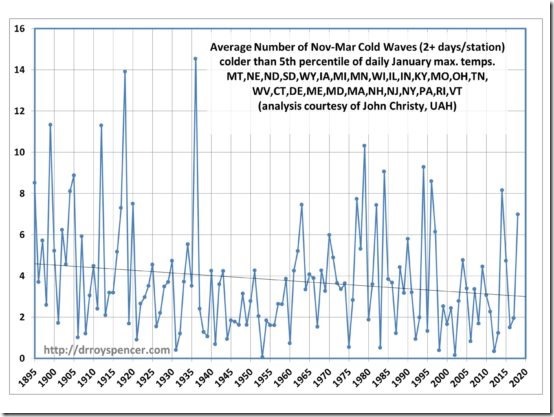
The trend is markedly downward in the most recent 40 years (since 1979) which is the earliest we have reliable measurements of Arctic sea ice from satellite microwave radiometers (my specialty).
Now, I suppose that Arctic sea ice decline could have some influence. But weather is immensely complex. Cause and effect is often difficult to ascertain.
At a minimum we should demand good observational support for any specific claim. In this case I would say that the connection between Eastern U.S. cold waves and Arctic sea ice is speculative, at best.
Just like most theories of climate change.
‘Settled Science’ Is Going the Way of BuzzFeed
By Brian C. Joondeph | American Thinker | January 25, 2019
“Settled science” and BuzzFeed share a fatal commonality. Both are driven by an agenda rather than facts. BuzzFeed learned that lesson yet another time last week. Two years ago, the publication pushed the Clinton-bought phony and unverified Trump Russia dossier, which launched stories of collusion, FISA warrants, and the ongoing Mueller investigation.
In a bit of irony, it was the Mueller team that slapped down BuzzFeed’s latest story accusing President Trump of asking Michael Cohen to lie to Congress. Imagine the fake news media being fact-checked by their hero, Robert Mueller.
So-called settled science faces similar collisions with reality. Driven by a particular agenda, whether financial or political, science becomes blinded to any contrarian views, insisting that the issue is “settled,” shutting off any further inquiry, debate, or honest disagreement. In some areas of science, dissenters are labeled as “deniers” with threats of violence, loss of job, or even imprisonment.
The most prevalent example is climate. From global cooling in the 1970s to global warming in the 2000s, the names have changed, but not the agenda. Since climate models are misbehaving, not providing the desired predictions, the names have morphed into “climate change” or “extreme weather.” But still the science is considered “settled.”
Barack Obama in 2014 told Congress, “The debate is settled, climate change is a fact.”
Someone with a bit more science knowledge than the community organizer from Chicago, physician and author Michael Crichton, said this about settled science: “There is no such thing as consensus science. If it’s consensus, it isn’t science. If it’s science, it isn’t consensus. Period.”
The latest bit of unsettled science is something few of us are thinking about in the midst of global warming-induced winter storms and piles of snow – namely, sunscreen.
A recent article in Outside magazine sums it up: “Current guidelines for sun exposure are unhealthy and unscientific, controversial new research suggests – and quite possibly even racist. How did we get it so wrong?”
It started with vitamin D.
People with low levels of vitamin D in their blood have significantly higher rates of virtually every disease and disorder you can think of: cancer, diabetes, obesity, osteoporosis, heart attack, stroke, depression, cognitive impairment, autoimmune conditions, and more. The vitamin is required for calcium absorption and is thus essential for bone health, but as evidence mounted that lower levels of vitamin D were associated with so many diseases, health experts began suspecting that it was involved in many other biological processes as well.
Why were so many of us low in vitamin D? “Vitamin D is a hormone manufactured by the skin with the help of sunlight. It’s difficult to obtain in sufficient quantities through diet.”

Enter the settled science that sun exposure is bad. Excessive sun exposure, particularly sunburn, increases the risk of skin cancer. Dermatologists recommend absolute protection from the sun, even on cloudy days. Use sunscreen, the higher the SPF rating the better, and apply it multiple times a day, even if you are just going to work and back.
Easy enough. Just take a vitamin D supplement every day, stay out of the sun, and all will be well. Or will it?
“Vitamin D supplementation has failed spectacularly in clinical trials” according to the Outside article. Five years of high-dose vitamin D had “[n]o impact on cancer, heart disease, or stroke.”
Maybe simply taking vitamin D as a pill isn’t the same as getting it naturally from sun exposure. Perhaps the low blood levels of vitamin D in the unhealthy weren’t the actual cause of health problems, but instead just a marker.
This is the scientific conundrum of causation versus association. Does having blue hair cause elderly ladies to play bingo, or is this just an association?
The science of sunlight is a bit more complicated. The skin uses sunlight to make nitric oxide, a blood vessel-dilator that lowers blood pressure. This in turn reduces the risk of heart attack and stroke. Vitamin D is produced along the way but may not be preventing actual disease, instead serving as a marker that an individual is receiving enough sun exposure.
But too much sun, particularly sunburn, does increase the risk of skin cancer. Some types, like basal cells, are a cosmetic nuisance, whereas melanoma is deadly.
Much as with climate. One can argue that fossil fuel consumption is a threat to the climate. Yet the benefits of fossil fuel energy production have lifted millions out of poverty, prolonging life spans and quality of life.
A Swedish study tracked 30,000 women over 20 years and found that “[s]un avoiders were twice as likely to die as sun worshippers.”
What unsettled the science of lathering on sunscreen or avoiding the sun altogether was the finding that “[a]voidance of sun exposure is a risk factor of a similar magnitude as smoking, in terms of life expectancy.”
How else to explain our prehistoric ancestors, wearing minimal, if any, clothing, spending their days in the sun, without becoming extinct? Settled science looks simplistic, much in the way Al Gore’s insistence the CO2 controls the Earth’s thermostat looks simplistic when we consider that the upper Midwest was once covered in a mile-thick sheet of ice when the planet cooled but then melted when the planet warmed.
It seems that sun exposure, in moderation, may not be bad for you. In fact, it may be healthier than avoiding it. Does this sound familiar?
In the annals of settled science, we have heard this song before. Once upon a time, margarine was good and butter was bad. Margarine is a trans fat and now considered unhealthy compared to butter. Dietary fats in general were unhealthy, and people were told to eat carbohydrates instead. This ushered in an epidemic of Type 2 diabetes.
Same with coffee, at one time the cause of all types of nasty diseases, now providing numerous health benefits.
Don’t forget carbon dioxide, which, some say, is killing the planet. Constituting only 0.04% of the atmosphere, does a small increase in CO2 mean the planet is doomed? Or is it beneficial, since CO2 is plant food, necessary for photosynthesis, responsible for “greening” the planet – which in turn leads to more food production?
There’s temperature as well, which fluctuates on the Earth in varying cycles for unclear reasons. Warmer temperatures might raise the sea level a few inches but may also increase the amount of fertile land and provide a longer growing season.
Although we know much about the world, there is plenty we don’t yet understand. It’s the height of hubris to assume we have all the answers and that the science is settled. The sunscreen about-face is just the latest example.
Brian C Joondeph, M.D., MPS is a Denver-based physician and writer. Follow him on Facebook, LinkedIn, and Twitter.
Read more: https://www.americanthinker.com/articles/2019/01/settled_science_is_going_the_way_of_buzzfeed.html#ixzz5drXW1e4d
Follow us: @AmericanThinker on Twitter | AmericanThinker on Facebook
More Child Exploitation as the Globalist Climate Project Creates its very own Bana Persona

By Barbara McKenzie | December 15, 2018
People who followed with awful fascination the Bana account, designed to facilitate the destruction of Syria, will have a sense of deja vu at the arrival on the ‘climate’ scene of another shocking example of cynical child exploitation and manipulation: that of Swedish girl Greta Thunberg.
The Bana Alabed twitter account tweeted ostensibly from Aleppo in the months leading up to its liberation from terrorist forces. Her task was to claim war crimes on the part of “Assad” and Russia and demand action on Syria from world leaders, WIII if necessary, but at least a Libya-style “no-fly-zone”.

From the age of seven Bana Alabed has been shamelessly exploited by the world’s media, forced to dissemble, to take part in bogus interviews where she clearly had no idea of what she was saying, and to pose with a series of mature men from terrorists to Erdogan to UNICEF’s Justin Forsyth. Although she became a citizen of Turkey, there is no evidence that Bana has ever been to school in Turkey, or given the opportunity to learn the Turkish language,. Instead, she has been given the star treatment, appearing at conferences and flying all over the world (The Crucifixion of Bana Alabed). At the same time her role as a puppet exposes her to eternal ridicule.
We are now being treated to another gruesome spectacle of child abuse, the creation of the Greta Thunberg persona. At 15 Greta is older than Bana, but is self-described as suffering from Asperger’s syndrome, a fact which if anything appears to make the exploitation more acceptable in the eyes of the mainstream and ‘alternative’ media). Bana has been a media star from the age of seven – all the signs indicate that normal life is over for Greta Thunberg too. (For further information on Greta, she now has her own Wikipedia page, in eight languages.)
Greta Thunberg’s function is not to call for destruction, but on the contrary, to warn of impending doom for the planet if we do not do something about CO2 – presumably something which gives more power to the United Nations and helps pave the way for global government. She first hit the headlines with a call to school children to strike to save the climate.
Being both older and a citizen of Sweden, many of the flaws in the Bana accounts are not obvious with Greta. When her account opened Bana’s spoken English was non-existent, and so the contrast between the speech in her videos and the perfectly idiomatic English of her tweets was positively embarrassing. In the case of Greta, however, one could argue that a well-educated Swedish girl might just have the immaculate English of her speeches. Furthermore, the completely passionless delivery of her claims of ‘climate breakdown’ and fast-approaching ‘extinction’ can be put down to her Asperger’s Syndrome.
As with the Bana account, but even more so, Greta’s social media accounts are completely focused on the task in hand (creating ‘climate panic’ in defiance of the facts), and certainly nothing like what might be expected from a 15 year-old, Aspergers or no Aspergers. The Facebook account is series of self-promotional posts with no interraction with comments. The list of people that Greta follows on twitter parallels in an eerie fashion those favoured by Bana Aalbed: world leaders and major political figures such as Antonio Guterres and Bernie Sanders, climate and environment accounts like Soros-funded Greenpeace and WWF (i.e. all supporting the UN’s climate/world government project), like-minded celebrities such as Michael Moore and Ricky Gervais, and like-minded media such as the Guardian.
Bana was never more than media and political spin, promoted by the likes of the New York Times and the BBC, as well of course by the United Nations, but without any mass following. Although she bought up thousands of twitter followers, the majority of comments on her tweets came either from critics or from obvious trolls or bots with a handful of followers. At the very least the same thing will happen with Greta, however the plan is more ambitious. There are clearly genuine hopes of galvanising the world’s youth in her support.
Greta works in tandem with Extinction Rebellion (XR), which appears to be the climate cult’s Antifa, promoting civil disobedience in order to force action on the ‘climate emergency’ (see Frances Leader, From Occupy to Extinction Rebellion: Exposing the Common Purpose).
Within a few short months Greta’s stature was such that she was invited to address the UN’s Climate Change Conference at Katowice, making her plea for ‘climate justice’.
Extinction Rebellion and Greta are both heavily promoted by media specialising in climate catastrophism, from the Guardian’s George Monbiot
to ‘independent analysts’ Media Lens.
Greta was motivated, it seems, by a heatwave in Sweden, due of course to “climate change” -never mind the fact that Swedish high temperature records go back many decades, still unbroken by July 2018, which is hardly consistent with runaway global warming whatever may have happened later that summer.

Greta’s very first tweet back in June 2018 was to post an article (in English of course) which warned that climate change will wipe out all of humanity unless we stop using fossil fuels over the next five years.
For the first time in 33 million years, it seems, we are almost at a point where there is no ice at either pole. ‘The chance that there will be any permanent ice left in the Arctic after 2022 is essentially zero,[…] with 75 to 80 percent of permanent ice having melted already in the last 35 years’.
This is obviously claptrap, the Arctic was never anywhere melting away, and latest reports indicate that the poles are putting on ice. The earth has not returned to the temperatures of the Medieval Warm Period when Greenland was colonised – how can we be approaching temperatures not seen in 33 million years?
Being both older and a citizen of Sweden, many of the flaws in the Bana accounts are not obvious with Greta. When her account opened Bana’s spoken English was non-existent, and so the contrast between the speech in her videos and the perfectly idiomatic English of her tweets was positively embarrassing. In the case of Greta, however, one could argue that a well-educated Swedish girl might just have the immaculate English of her speeches. Furthermore, the completely passionless delivery can be put down to her Asperger’s Syndrome.
As with the Bana account, Greta’s social media accounts are completely focused on the task in hand (creating ‘climate panic’ in defiance of the facts), and certainly nothing like what might be expected from a 15 year-old, Aspergers or no Aspergers. The list of people that Greta follows on twitter parallels in an eerie fashion those favoured by Bana: world leaders and major political figures such as Antonio Guterres and Bernie Sanders, climate and environment accounts like Soros-funded Greenpeace and WWF (i.e. all supporting the UN’s climate/world government project), like-minded celebrities such as Michael Moore and Ricky Gervais, and like-minded media such as the Guardian.
As with the Bana account, there is growing concern at the unashamed exploitation of Greta Thunberg:
The spectacle of the globalist media using a young girl in order to panic the world into giving more power to the United Nations is both bizarre and horrifying.
Thousands of the world’s scientists (see here and here) have called climate alarmism a hoax. However, ludicrous as it may seem, we are expected to ignore the facts about geological history, Co2 and global climate, and to follow the lead of a 15 year old who parrots arrant nonsense embedded in unending cliché, on the say-so of the likes of George Monbiot and Media Lens, the very people who have themselves been parroting the same nonsense for years.
And as with Bana Alabed, the media serving the globalist agenda have absolutely no qualms about the callous exploitation and manipulation of a child in order to further the goal of world government.
See also:
Jamie Spry, Global Warming Is The Greatest And Most Successful Pseudoscientific Fraud In History
Windows on the World have produced a series of articles and videos on Extinction Rebellion, see Globalist Fake Revolution
A large number of people have pointed out the function of the climate scare is actually to scare the world’s populace into accepting an ever increasing role for the United Nations, and eventually global government by the Club of Rome elite that control the corrupt United Nations bureaucracy. See for example Agenda 21: The Plan for a Global Fascist Dictatorship. or Maurice Newman, The Corrupted UN Must Not Be Allowed to Lecture Us.
Climate Hysterics Skyrocket Even As Weather Disasters Haven’t

By Paul Driessen | Climate Change Dispatch | January 21, 2019
Call it climate one-upmanship. It seems everyone has to outdo previous climate chaos rhetoric.
The “climate crisis” is the “existential threat of our time,” Speaker Nancy Pelosi told her House colleagues. We must “end the inaction and denial of science that threatens the planet and the future.”
Former California Governor Jerry Brown solemnly intoned that America has “an enemy, though different, but perhaps very much devastating in a similar way” as the Nazis in World War II.
Not to be outdone, two PhDs writing in Psychology Today declared that “the human race faces extinction” if we don’t stop burning fossil fuels.
And yet “even people who experience extreme weather events often still refuse to report the experiences as a manifestation of climate change.” Psychologists, they lament, “have never had to face denial on this scale before.”
Then there’s Oxford University doctoral candidate Samuel Miller-McDonald. He’s convinced the only thing that could save people and planet from cataclysmic climate change is cataclysmic nuclear war that “shuts down the global economy but stops short of human extinction.”
All this headline-grabbing gloom and doom, however, is backed up by little more than computer models, obstinate assertions that the science is settled, and a steady litany of claims that temperatures, tornadoes, hurricanes, droughts et cetera are unprecedented, worse than ever before, and due to fossil fuels.
And on the basis of these hysterics, we are supposed to give up the carbon-based fuels that provide over 80% of the U.S.’ and global energy, gladly reduce our living standards – and put our jobs and economy at the mercy of expensive, unreliable, weather dependent, pseudo-renewable wind, solar and biofuel energy.
As in any civil or criminal trial, the burden of proof is on the accusers and prosecutors who want to sentence fossil fuels to oblivion. They need to provide more than blood-curdling charges, opening statements and summations. They need to provide convincing real-world evidence to prove their case.
They have refused to do so. They ignore the way rising atmospheric carbon-dioxide is spurring plant growth and greening the planet. They blame every extreme weather event on fossil fuel emissions, but cannot explain the Medieval Warm Period, Little Ice Age or extreme weather events decades or centuries ago – or why we have had fewer extreme weather events in recent decades.
They simply resort to trial in media and other forums where they can exclude exculpatory evidence, bar any case for the fossil fuel defense, and prevent any cross-examination of their witnesses, assertions and make-believe evidence.
Climate models are not evidence. At best, they offer scenarios of what might happen if the assumptions on which they are based turn out to be correct.
However, the average prediction by 102 models is now a full degree F (0.55 C) above what satellites are actually measuring.
Models that cannot be confirmed by actual observations are of little value and certainly should not be a basis for vital energy policymaking.
The alarmist mantra seems to be: If models and reality don’t agree, reality must be wrong.
In fact, even as atmospheric carbon dioxide levels climbed to 405 parts per million (0.0405% of Earth’s atmosphere), except for short-term temperature spikes during El Niño ocean warming events, there has been very little planetary warming since 1998; nothing to suggest chaos or runaway temperatures.
Claims that tornadoes have gotten more frequent and intense are obliterated by actual evidence. NOAA records show that from 1954 to 1985 an average of 56 F3 to F5 tornadoes struck the USA each year – but from 1985 to 2017 there was only 34 per year on average.
And in 2018, for the first time in modern history, not a single “violent” twister touched down in the United States.
Harvey was the first major (category 3-5) hurricane to make US landfall in a record twelve years. The previous record was nine years, set in the 1860s. (If rising CO2 levels are to blame for Harvey, Irma and other extreme weather events, shouldn’t they also be credited for this hurricane drought?)
Droughts differ little from historical trends and cycles – and the Dust Bowl, Anasazi, and Mayan droughts, and other ancient dry spells were long and destructive. Moreover, modern agricultural and drip irrigation technologies enable farmers to deal with droughts far better than they ever could in the past.
Forest fires are fewer than in the recent past – and largely due to failure to remove hundreds of millions of dead and diseased trees that provide ready tinder for massive conflagrations.
Arctic and Antarctic ice are largely within “normal” or “cyclical” levels for the past several centuries – and snow surface temperatures in the East Antarctic Plateau regularly reach -90 °C (-130 F) or lower.
Average Antarctic temperatures would have to rise some 20-85 degrees F year-round for all its land ice to melt and cause oceans to rise at faster than their current 7-12 inches per century pace.
In fact, the world’s oceans have risen over 400 feet since the last Pleistocene glaciers melted. (That’s how much water those mile-high Ice Age glaciers took out of the oceans!)
Sea level rise paused during the Little Ice Age but kicked in again the past century or so. Meanwhile, retreating glaciers reveal long-lost forests, coins, corpses, and other artifacts– proving those glaciers have come and gone many times.
Pacific islands will not be covered by rising seas anytime soon, at 7-12 inches per century, and because corals and atolls grow as seas rise. Land subsidence also plays a big role in perceived sea level rise – and US naval bases are safe from sea level rise, though maybe not from local land subsidence.
The Washington Post did report that “the Arctic Ocean is warming up, icebergs are growing scarcer, and in some places, the seals are finding the water too hot.” But that was in 1922.
Moreover, explorers wrote about the cyclical absence of Arctic ice long before that. “We were astonished by the total absence of ice in Barrow Strait,” Sir Francis McClintock wrote in 1860. “I was here at this time in [mid] 1854 – still frozen up – and doubts were entertained as to the possibility of escape.”
Coral bleaching? That too has many causes – few having anything to do with manmade global warming – and the reefs generally return quickly to their former glory as corals adopt new zooxanthellae.
On and on it goes – with more scare stories daily, more attempts to blame humans and fossil fuels for nearly every interesting or as-yet-unexplained natural phenomenon, weather event or climate fluctuation.
And yet countering the man-made climate apocalypse narrative is increasingly difficult – in large part because the $2-trillion-per-year climate “science” and “renewable” energy industry works vigorously to suppress such evidence and discussion … and is aided and abetted by its media and political allies.
Thus we have Chuck Todd, who brought an entire panel of alarmist climate “experts” to a recent episode of Meet the Press. He helped them expound ad nauseam on the alleged “existential threat of our time” – but made it clear that he was not going to give even one minute to experts on the other side.
“We’re not going to debate climate change, the existence of it,” Todd proclaimed. “The Earth is getting hotter. And human activity is a major cause, period. We’re not going to give time to climate deniers. The science is settled, even if political opinion is not.”
The only thing left to discuss, from their perspective was “solutions” – most of which would hugely benefit them and their cohorts, politically and financially.
Regular folks in developed and developing countries alike see this politicized, money-driven kangaroo court process for what it is.
They also know that unproven, exaggerated and fabricated climate scares must be balanced against their having to give up (or never having) reliable, affordable fossil fuel energy. That is why we have “dangerous man-made climate change” denial on this scale.
That is why we must get the facts out by other means. It is why we must confront Congress, media people and the Trump Administration, and demand that they address these realities, hold debates, revisit the CO2 Endangerment Finding – and stop calling for an end to fossil fuels and modern living standards before we actually have an honest, robust assessment of supposedly “settled” climate science.
Paul Driessen is senior policy advisor for the Committee For A Constructive Tomorrow (CFACT) and author of articles and books on energy, environmental and human rights issues.
Lancet EAT Report Promotes Activism Over Science
By Donna Laframboise | Big Picture News | January 21, 2019
Last week, The Lancet, one of the world’s most prestigious medical journals, officially drove off a cliff. With much fanfare, it released a 47-page report titled Food in the Anthropocene: the EAT – Lancet Commission on healthy diets from sustainable food systems.
That title is the first screaming clue we’re being fed propaganda. As I’ve discussed previously, the Anthropocene doesn’t exist.
A scientific body known as the International Commission on Stratigraphy is tasked with defining and naming geological periods. It decides these matters according to an official, established process.
That body’s website contains a chart updated six months ago. It clearly indicates Earth remains in the Holocene. The term Anthropocene is nowhere to be found.
The notion that we’ve entered a new and distinct geological epoch is 100% activist hogwash. It’s an argument. Made by environmentalists. An argument that has been rejected by the scientific authorities who are experts in such matters.
Food in the Anthropocene, indeed. By naming its new report after this figment of activist imagination, The Lancet has been deliberately deceptive.
Medical journals are supposed to be the opposite of fake news. Now they spread misinformation on purpose.
We Have A Winner: Climate’s Tallest Tale 2018
Global Warming Policy Forum | January 18, 2019
Before Christmas, we asked GWPF readers to send us nominations for our search to find the tallest climate tale of 2018. It’s fair to say that there was a lot of competition, with the catastrophe mongers across the media clearly working hard to ensure that they were in the running for this much sought-after accolade.
We particularly enjoyed L. Robertson’s ‘Climate change, weather and road deaths’, a paper in the journal Injury Prevention, which declared that rising concentrations of greenhouse gases was going to cause a rising death toll on the roads unless governments put in ‘major mitigating countermeasures’.
We also liked the story from the Daily Mail, which alleged that a small rise in global temperatures would make people more likely to wet the bed and might also trigger plagues of ticks, snakes and… erm… voles.
An honourable mention for creative headline writing goes to the subs at BehaviouralEcology.net, who had the brass neck to write a story about polar bear research and then stick a headline on the top that suggested that global warming was going to make men’s willies shrink. Charles Dickens they are not.
However, the unanimous decision of the judges was that the tallest climate tale of the year was Mark Prigg’s bizarre suggestion, for Mail Online, that ‘Climate change is causing blue whales to sing louder as they struggle to be heard over breaking sea ice”. The judges felt this deserved particular kudos because it was not only daft, but could also be shown to be daft at the time of writing. More circumspect journos like to conjure up catastrophes far into the future. Tall-tale telling of this quality is therefore not something you come across every day.
So many thanks to Mark for writing so entertainingly, and thanks also to reader Andrew K, down under, for sending us the nomination.
Featured Video

Dan Dicks with James Corbett on Solutions Watch
or go to
Aletho News Archives – Video-Images
From the Archives
Secret document reveals plans for civil war in Lebanon, Israeli false flags, and invasion
By Randi Nord | Geopolitics Alert | April 5, 2019
Beirut – During his visit with US Secretary of State, Mike Pompeo, Lebanese President Michael Aoun reportedly received a US-Israeli document detailing plans for creating a civil war in Lebanon with covert false flag operations and possible Israeli invasion.
Although the source of the document is Israeli and created in partnership with Washington, no one knows who presented it to Aoun. The Lebanese TV station, Al-Jadeed, initially reported the document on Lebanese TV and a video on its website. Geopolitics Alert translated the report for this article. … continue
Blog Roll
 Aletho News
- Sheikh al-Asadi warns of Iraqi government compliance with US demands
- How to MAKE THE CONSPIRATORS PAY for their crimes! Dan Dicks with James Corbett on Solutions Watch
- There’s a drought in academia: A drought in honest research on the subject of drought and other weather extremes
- Department of War Awards $20.7 Billion Contract to Raytheon for Air-to-Air Missiles
- ‘Distance yourselves from Israel’: IRGC urges US population to question govt policies
- America’s Greenland deal has a radioactive backstory
- The RAF Fairford ‘terror plot’: Unpacking escalation in the UK echo-chamber
- EU Council Advances Chat Control 2.0 Scanning Proposal
- Ex-Greek MEP files complaint against Israeli spyware firm over alleged Pegasus surveillance
- Troubling ideas throughout the Torah, Talmud, Mishneh Torah and Tanya
- If Americans Knew
- New Report: “Scholasticide and Genocide in Gaza: Assessment, Testimonies and Legal Analysis”
- Ex-Biden officials are desperate for a Gaza scapegoat
- Israeli “settlers” Invade Al-Aqsa; Pour Boiling Water on 75-Year-Old
- Israel Has Kidnapped Another American Teenager
- US arms sales to Israel worth $21.6 billion in 20 months
- Three Palestinians Killed in Israeli Attacks on Gaza
- Revealed: German “Anti-Semitism Expert” Driving Crackdown on Palestine Solidarity is Former Israeli Spy
- Egypt’s Warning to Israel Before Oct 7
- Israel’s siege signals another cruel winter for 1.8 million Gazans – Daily Update
- Netanyahu Asked UAE Leader to Deny Report on Oct. 7 Warning in Secret Visit, Sources Say
- No Tricks Zone
- Two More Paleo Reconstructions Affirm Meters-Higher Sea Levels Across Ireland, Brazil 7000-6000 Years Ago
- New Study: Earth And Venus Surface Warmth Largely Explained By Convection And Lapse Rate, Not CO2 Or Radiation
- 2025 Nature Paper Claiming Worsening Global Drought Gets RETRACTED …Heavily Flawed
- New Study: ‘Global Drought Shows No Detectable Recent Acceleration Under Climate Warming’
- Economic Masterminds: German Socialists Suggest Taxing Productivity Gains Stemming From Using AI
- The South China Sea Has Not Been Cooperating With The Climate Change Narrative
- Energy Crisis: Germany Enters Heating Season With Historically Low Gas Reserve Fill Levels
- New Study: The Antarctic Ice Sheet Gained Mass From 2020-2024 Due To Staggering Snow And Ice Accumulation
- Study: Ocean Heating Rates From Thousands Of Years Ago ‘Dwarf’ Modern Ocean Heating Rates
- Climate Extremists Target, Attack Large-Scale Power Grid Infrastructure In Germany!

