Brazil: Worker’s Struggle Trumps Sports Spectacle
By James Petras :: 06.03.2014
Introduction
For decades social critics have bemoaned the influence of sports and entertainment spectacles in ‘distracting’ workers from struggling for their class interests. According to these analysts, ‘class consciousness’ was replaced by ‘mass’ consciousness.
They argued that atomized individuals, manipulated by the mass media, were converted into passive consumers who identified with millionaire sports heroes, soap opera protagonists and film celebrities.
The culmination of this ‘mystification’ – mass distraction –were the ‘world championships’ watched by billions around the world and sponsored and financed by billionaire corporations: the World Series (baseball), the World Cup (soccer/futbol), and the Super Bowl (American football).
Today, Brazil is the living refutation of this line of cultural-political analysis. Brazilians have been described as ‘football crazy’. Its teams have won the most number of World Cups. Its players are coveted by the owners of the most important teams in Europe. Its fans are said to “live and die with football” . . . Or so we are told.
Yet it is in Brazil where the biggest protests in the history of the World Cup have taken place. As early as a year before the Games, scheduled for June 2014, there have been mass demonstrations of up to a million Brazilians. In just the last few weeks, strikes by teachers, police, construction workers and municipal employees have proliferated. The myth of the mass media spectacles mesmerizing the masses has been refuted – at least in present-day Brazil.
To understand why the mass spectacle has been a propaganda bust it is essential to understand the political and economic context in which it was launched, as well as the costs and benefits and the tactical planning of popular movements.
The Political and Economic Context: The World Cup and the Olympics
In 2002, the Brazilian Workers Party (PT) candidate Lula DaSilva won the presidential elections. His two terms in office (2003 – 2010) were characterized by a warm embrace of free market capitalism together with populist poverty programs. Aided by large scale in-flows of speculative capital, attracted by high interest rates, and high commodity prices for its agro-mineral exports, Lula launched a massive poverty program providing about $60 a month to 40 million poor Brazilians, who formed part of Lula’s mass electoral base. The Workers Party reduced unemployment, increased wages and supported low-interest consumer loans, stimulating a ‘consumer boom’ that drove the economy forward.
To Lula and his advisers, Brazil was becoming a global power, attracting world-class investors and incorporating the poor into the domestic market.
Lula was hailed as a ‘pragmatic leftist’ by Wall Street and a ‘brilliant statesman’ by the Left!
In line with this grandiose vision (and in response to hoards of presidential flatterers North and South), Lula believed that Brazil’s rise to world prominence required it to ‘host’ the World Cup and the Olympics and he embarked on an aggressive campaign. . . Brazil was chosen.
Lula preened and pontificated: Brazil, as host, would achieve the symbolic recognition and material rewards a global power deserved.
The Rise and Fall of Grand Illusions
The ascent of Brazil was based on foreign flows of capital conditioned by differential (favorable) interest rates. And when rates shifted, the capital flowed out. Brazil’s dependence on high demand for its agro-mineral exports was based on sustained double-digit economic growth in Asia. When China’s economy slowed down, demand and prices fell, and so did Brazil’s export earnings.
The PT’s ‘pragmatism’ meant accepting the existing political, administrative and regulatory structures inherited from the previous neo-liberal regimes. These institutions were permeated by corrupt officials linked to building contractors notorious for cost over-runs and long delays on state contracts.
Moreover, the PT’s ‘pragmatic’ electoral machine was built on kick-backs and bribes. Vast sums were siphoned from public services into private pockets.
Puffed up on his own rhetoric, Lula believed Brazil’s economic emergence on the world stage was a ‘done deal’. He proclaimed that his pharaonic sports complexes – the billions of public money spent on dozens of stadiums and costly infrastructure – would “pay for themselves”.
The Deadly ‘Demonstration Effect’: Social Reality Defeats Global Grandeur
Brazil’s new president, Dilma Rousseff, Lula’ protégé, has allocated billions of reales to finance her predecessor’s massive building projects: stadiums, hotels, highways and airports to accommodate an anticipated flood of overseas soccer fans.
The contrast between the immediate availability of massive amounts of public funds for the World Cup and the perennial lack of money for deteriorating essential public services (transport, schools, hospitals and clinics) has been a huge shock to Brazilians and a provocation to mass action in the streets.
For decades, the majority of Brazilians, who depended on public services for transport, education and medical care, (the upper middle classes can afford private services), were told that “there were no funds”, that “budgets had to be balanced”, that a “budget surplus was needed to meet IMF agreements and to service the debt”.
For years public funds had been siphoned away by corrupt political appointees to pay for electoral campaigns, leading to filthy, overcrowded transport, frequently breaking down, and commuter delays in sweltering buses and long lines at the stations. For decades, schools were in shambles, teacher rushed from school to school to make-up for their miserable minimum-wage salaries leading to low quality education and neglect. Public hospitals were dirty, dangerous and crowded; under-paid doctors frequently took on private patients on the side, and essential medications were scarce in the public hospitals and overpriced in the pharmacies.
The public was outraged by the obscene contrast between the reality of dilapidated clinics with broken windows, overcrowded schools with leaking roofs and unreliable mass transport for the average Brazilian and the huge new stadiums, luxury hotels and airports for wealthy foreign sports fans and visitors.
The public was outraged by the obvious official lies: the claim that there were ‘no funds’ for teachers when billions of Reales were instantly available to construct luxury hotels and fancy stadium box seats for wealthy soccer fans.
The final detonator for mass street protest was the increase in bus and train fares to ‘cover losses’ – after public airports and highways had been sold cheaply to private investors who raised tolls and fees.
The protestors marching against the increased bus and train fares were joined by tens of thousands Brazilians broadly denouncing the Government’s priorities: Billions for the World Cup and crumbs for public health, education, housing and transport!
Oblivious to the popular demands, the government pushed ahead intent on finishing its ‘prestige projects’. Nevertheless, construction of stadiums fell behind schedule because of corruption, incompetence and mismanagement. Building contractors, who were pressured, lowered safety standards and pushed workers harder, leading to an increase in workplace deaths and injury. Construction workers walked out protesting the speed-ups and deterioration of work safety.
The Rousseff regime’s grandiose schemes have provoked a new chain of protests. The Homeless Peoples Movement occupied urban lots near a new World Cup stadium demanding ‘social housing’ for the people instead of new five-star hotels for affluent foreign sports aficionados.
Escalating costs for the sports complexes and increased government expenditures have ignited a wave of trade union strikes to demand higher wages beyond the regime’s targets. Teachers and health workers were joined by factory workers and salaried employees striking in strategic sectors, such as the transport and security services, capable of seriously disrupting the World Cup.
The PT’s embrace of the grandiose sports spectacle, instead of highlighting Brazil’s ‘debut as a global power’, has spotlighted the vast contrast between the affluent and secure ten percent in their luxury condos in Brazil, Miami and Manhattan, with access to high quality private clinics and exclusive private and overseas schools for their offspring, with the mass of average Brazilians, stuck for hours sweating in overcrowded buses, in dingy emergency rooms waiting for mere aspirins from non-existent doctors and in wasting their children’s futures in dilapidated classrooms without adequate, full-time teachers.
Conclusion
The political elite, especially the entourage around the Lula-Rousseff Presidency have fallen victim to their own delusions of popular support. They believed that subsistence pay-offs (food baskets) to the very poor would allow them to spend billions of public money on sports spectacles to entertain and impress the global elite. They believed that the mass of workers would be so enthralled by the prestige of holding the World Cup in Brazil, that they would overlook the great disparity between government expenditures for elite grand spectacles and the absence of support to meet the everyday needs of Brazilian workers.
Even trade unions, seemingly tied to Lula, who bragged of his past leadership of the metal workers, broke ranks when they realized that the ‘money was out there’ – and that the regime, pressured by construction deadlines, could be pressured to raise wages to get the job done.
Make no mistake, Brazilians are sports minded. They avidly follow and cheer their national team. But they are also conscious of their needs. They are not content to passively accept the great social disparities exposed by the current mad scramble to stage the World Cup and Olympics in Brazil. The government’s vast expenditure on the Games has made it clear that Brazil is a rich country with a multitude of social inequalities. They have learned that vast sums are available to improve the basic services of everyday life. They realized that, despite its rhetoric, the ‘Workers Party’ was playing a wasteful prestige game to impress an international capitalist audience. They realized that they have strategic leverage to pressure the government and address some of the inequalities in housing and salaries through mass action. And they have struck. They realize they deserve to enjoy the World Cup in affordable, adequate public housing and travel to work (or to an occasional game) in decent buses and trains. Class consciousness, in the case of Brazil, has trumped the mass spectacle. ‘Bread and circuses’ have given way to mass protests.
Al-Sabirin: a new resistance movement in Gaza
By Hani Ibrahim | Al-Akhbar | May 31, 2014
The flag and logo of an organization that was launched a few days ago in the Gaza Strip suggest a Hezbollah now exists in Gaza. The organization is called al-Sabirin (the patient) for the Victory of Palestine and its logo bears a striking similarity to Hezbollah’s logo. Local opponents accuse it of being a Shia movement but its officials deny the charge and stress that they coordinate with other factions to organize their positioning in the resistance.
Gaza: Despite all the major turning points in the lives of Palestinians over the past 10 years, no party has offered a new political vision except a few youth organizations that have been stamped out by factional strife. Domestic strife has primarily been between Fatah and Hamas as each organization has aimed to control the political and economic map in the occupied West Bank and Gaza over the past seven years.
The social makeup in Gaza, which prides itself on its strong family ties, was impacted by factional differences and clashes. However, on a religious level, Gaza does not tolerate diversity as Sunni Muslims constitute the overwhelming majority. Therefore, the creation of a new organization poses “serious concerns regarding the path it is going to take.” Al-Sabirin talks about fighting Israel but its slogan carries connotations that make some view it as a “sectarian movement.” The circumstances and timing that the organization chose to announce its creation further complicate the matter.There is the reconciliation process between Fatah and Hamas while the Islamic Jihad expressed reservations regarding some of the terms dealing with the weapons of the Resistance. In the Arab world, there are tensions simmering against a sectarian and ethnic backdrop under the banner of the Arab Spring. In this context, the new organization puts itself in a position that raises a lot of questions and is even subject to numerous accusations.
Sources from al-Sabirin say that they are “well aware of the difficulty of the Palestinian and regional circumstances,” that is why the organization is presenting itself as a “Palestinian resistance movement that seeks to free all of Palestine and does not believe in any negotiated agreements or even long-term truces with Israel.” Nevertheless, it announced its creation after the death of one of its cadres (Nizar Issa) in an explosion they said was the result of a manufacturing error. It was forced to declare itself so it can claim responsibility for him but the organization pointed out that they have been operating for years.
An al-Sabirin spokesperson, known as Abu Yousef, addresses the question of their sectarian affiliation. He tells Al-Akhbar: “We believe in Islamic unity and we reject any sectarian discourse. Whoever raises this issue serves our enemies the Zionists and the global arrogance that stands behind it which seeks to fragment and divide this nation.” However, he added, “we do not deny any of our members the freedom to choose the sect according to which they worship God within the context of the sects recognized by Islamic law. But highlighting this issue as though it were a problem is the strategy of those who try to exploit differences and sow the seeds of sedition.”
He continued: “The similarity between the logos is not a reason to accuse us of being Shia. The logos of resistance movements are similar to each other. The logo we chose includes common symbols such as the rifle that is firmly gripped by the hand, the map of Palestine with a mark for Jerusalem and a reference to planet Earth because we are advocates of peace and humanism.”
The Palestinian resistance had spawned in the 1960s more than 27 military and political organizations. Some of them have survived until today while others have become less important. Some organizations ceased to exist altogether and others turned to political activism. Each landmark juncture in the history of the struggle against Israel was characterized by the declaration of a new faction. The Arab defeat after al-Nakba led to the founding of the Popular Front for the Liberation of Palestine (PFLP) and the Palestinian National Liberation Movement also known as Fatah. With the decline of the communist movement in the region, the PFLP’s role declined and so did the role of Fatah after it left Beirut and became distant from the geographic region surrounding Palestine.
Before Fatah turned to political action, the first intifada (1987) which began as a popular movement shored up two Islamist resistance movements, Hamas and Islamic Jihad. With the start of the second intifada, Fatah – armed with a quasi-official decision – returned to military struggle through al-Aqsa Martyrs Brigade and Ahmed Abu al-Rish Brigades. But President Mahmoud Abbas diminished the role and presence of the former and the latter disintegrated. Since then, no Palestinian organization with a new political program has been declared, except for small military organizations.
A Hezbollah connection?
Al-Sabirin’s official spokesperson talked about their relationship with Hezbollah, especially after the controversy that erupted regarding the identity of the organization among Palestinians who received the news on social media: “There is no connection between us and Hezbollah. It is a Lebanese organization and we are a Palestinian movement.” He added: “We agree with our brothers in Hezbollah because we have chosen the same path, that is the path of resistance, we belong to the same axis, we confront the same enemy and we meet on the path of liberating Palestine. That, however, does not mean that we are opposed to dealing with them in order to learn from their experience and the expertise of other organizations.”
In 2008, an organization called the Palestinian Hezbollah was declared in the West Bank but the Palestinian Authority (PA) and Hamas met this move with skepticism. This new faction, however, which described itself as “Sunni Jihadi Islamist and opposed to the political process,” did not last for long and no one has heard from them again. In addition, a military cell in Gaza named the Imad Mughniyeh Groups declared its responsibility for several operations. Eventually, it became evident that this cell was associated with Fatah.
Linking these organizations to Iran and Hezbollah is a very sensitive subject in Gaza. That is why some Arab and Israeli media outlets try to associate resistance movements with certain sectarian situations. Such as the incident years ago when Palestinian police affiliated with the Hamas government attacked a group that was holding a consolation session on the 40-day memorial for Hussein in northern Gaza. The city of Khan Younis in the south of the Gaza Strip witnessed in the past months fist fights and armed clashes between the followers of a Salafi cleric who regularly attacked the Syrian regime, Iran, Hezbollah and Islamic Jihad members before Islamic Jihad contained the situation.
Security sources familiar with the coordination effort between Palestinian factions told Al-Akhbar that a meeting was held between al-Sabirin and Hamas to sort out the former’s status as a Palestinian resistance movement that is going to work out of Gaza, as long as it is committed to the general framework of the agreements between the various organizations. But they refused to delve into other details about having al-Sabirin representatives at the Factions Coordinating Committee and their view on pacification. The new organization said that they established good communication channels with other parties and with the government.
The security situation in Gaza forces any political or military faction to coordinate with Hamas since it is the largest resistance movement in Gaza irrespective of how the reconciliation effort and the security issue will play out. The internal security agency affiliated with the government and the special security agency affiliated with al-Qassam Brigades, Hamas’ military wing, follow up with these organizations. As to whether the Palestinian landscape needs another organization, Abu Yousef says: “In light of the new conspiracies to liquidate the Palestinian cause, the fact that the Arab and Islamic worlds are preoccupied with other issues and the two major Palestinian factions are heading towards a political solution, we concluded that we have a religious duty to step forward at this stage to help the Palestinian cause reclaim its rightful place and rectify the direction it is taking. Palestine requires sacrifices and this path does not end as long as our land is occupied.
Hezbollah’s announcement of the martyrdom of one of its leaders in Syria, Fawzi Ayoub, angered the Israeli media, which refocused on Hezbollah’s role in supporting the Palestinian factions inside Palestine. Especially Ayoub who was arrested in the West Bank in 2000 and was released as part of a prisoner swap deal. Tel Aviv always accuses Tehran, Damascus and Hezbollah of providing financial and military aid to Palestinian factions, training their fighters, sending experts to help them and creating sleeper cells.
In terms of arming them, Abu Islam said: “We are still a small group, which means our abilities are limited. But we depend on our morale which we consider the basis of our confrontation with the enemy.”
As for their funding, he refused to disclose a specific source. He said, however, that the financial support they receive is still limited and restricted to relationships with those he described as supporters of the Palestinian people in addition to personal donations. He said that, in the future, they are going to “open channels with parties that fund the Resistance and get the necessary support.”
The secretary general of al-Sabrin’s Shura Council
His nom de guerre is Abu Mohammed. Those close to him refuse to reveal his real name because he does not personally represent al-Sabirin as they say. “Rather, there is a Shura Council that takes decisions in the organization. This council is not new but its announcement was delayed because of certain circumstances that were preceded by a long latent period.”
Not much comes up on Abu Mohammed when you try to find out who he is because he is a mysterious figure and moves about secretly. He has been a wanted man by Israel for 18 years. His name became prominent in resistance circles after the Israeli forces tried to arrest him at the beginning of the Intifada for an operation that killed 35 Israeli soldiers in Tel Aviv. But he left his house before they arrived. So they decided to demolish his home, which consists of six floors. This led to the martyrdom of his father and displacement of his family. He is accused of having a strong relationship with influential figures in the Islamic Republic in Iran which means he is being watched by Hamas’ security agencies. They arrested him more than once without being able to prove anything against him. He was also imprisoned by Israel and the Palestinian Authority in the 1980s and 1990s.
The Democrats’ New Fake Populism
By Shamus Cooke | Worker’s Action | May 30, 2014
It would have been hilarious were it not so nauseating. One could only watch the recent “New Populism” conference with pity-induced discomfort, as stale Democratic politicians did their awkward best to adjust themselves to the fad of “populism.”
A boring litany of Democratic politicians — or those closely associated — gave bland speeches that aroused little enthusiasm among a very friendly audience of Washington D.C. politicos. It felt like an amateur recital in front of family and friends, in the hopes that practicing populism with an audience would better prepare them for the real thing.
The organizers of the conference, The Campaign For America’s Future, ensured that real populism would be absent from the program. The group is a Democratic Party ally that essentially functions as a party think tank.
The two co-founders of Campaign for America’s Future are Robert Borosage — who works closely with the progressive caucus of the Democratic Party — and Robert Hickey, who works with Health Care for America Now, an organization that prioritized campaigning for Obamacare. On the Board of Directors is the notorious liberal Van Jones, no doubt carefully chosen for his non-threatening elitist politics.
The “new populism” seems to mistakenly believe that if Democrats merely advocate for a couple of “popular” ideas — as opposed to their usual unpopular policies that they actually implement — that they can suddenly transform themselves into “populists.”
The unofficial and uninspiring leader of this grouping, Senator Elizabeth Warren, summarized the “radical” populist platform of these reborn Democrat revolutionaries, doing her drab best to inject life into a zombie political party:
“We believe that Wall Street needs stronger rules and tougher enforcement, and we’re willing to fight for it.”
“We believe no one should work full-time and live in poverty, and that means raising the minimum wage — and we’re willing to fight for it.”
“We believe people should retire with dignity, and that means strengthening Social Security — and we’re willing to fight for it.”
“We believe that a kid should have a chance to go to college without getting crushed by debt — and we’re willing to fight for it.”
It’s true that 90 percent of Americans would agree with Warren, but the devil is in her lack of details. Warren’s popular platform falls incredibly flat because there are no concrete demands to inspire people, just generalizations. This important omission didn’t happen by mistake.
The Democrats simply do not want a new populist movement; rather, their opportunistic goal is to win elections by simply being more popular than the Republicans. Any of Warren’s above ideas — if they ever enter the halls of Congress as a bill — would be sufficiently watered down long before any elated response could be reached from the broader population.
How might Warren transform her ideas if she actually wanted a populist response? Some examples might be:
1) – Jail the bankers who crashed the economy. Tax Wall Street earnings at 90% and nationalize any bank that is “too big to fail” in order to bring them under control.
2) – Raise the national minimum wage to $15 an hour.
3) – Expand Social Security by lowering the retirement age to 60, to be paid for by expanding payroll taxes to higher earners — who currently pay no Medicare and Social Security taxes on income over $110,000.
4) – Free university education — to be paid for by taxing the rich and corporations. Eliminate crushing student debt.
Such demands would be much more likely to inspire people than what the “populist” Democrats are offering, and inspiration is the missing populist ingredient that the Democrats are organically incapable of provoking.
What’s preventing the Democrats from becoming inspirational? They know all too well that by venturing too far to the left they could easily instigate a real mass movement. And such a movement is not easily controlled and would inevitably demand much more than the corporate-minded Democrats are willing to concede, which, at this point, is virtually nothing aside from musty rhetoric.
Unlike the Republican’s populist turn to the right that created the now-defunct Tea Party, a true left turn would mean have the potential to rejuvenate the millions’ strong labor movement, while engaging tens of millions more into active political life, driving people to participate in mass marches, rallies, labor strikes and other forms of mass action.
This was what happened during the “old populism” in U.S. history, which the Democrats are taking their trendy namesake from. The populist movement of the late 1800’s was a genuine mass movement of workers and farmers, which briefly aligned in an independent political party, the People’s Party, also known as the populists.
The populist movement that included strike waves and local rural rebellions had nothing to do with the lifeless politics of the Democratic Party, and threatened the very foundation of America corporate power. The Democrats are keenly aware of this type of real populist “threat,” and they are willing to do anything to stop it.
For example, the Occupy movement proved that the Democrats fear real left populism much more than they fear far-right populism. We now know that the Obama administration worked with numerous Democratic Party mayors and governors across the nation to undermine and destroy the Occupy movement through mass arrests, police violence and surveillance. And because Occupy succeeded in changing the national conversation about income inequality, the Democrats were forced to engage with the rhetoric of the movement they dismembered, and now use the plagiarized language as proof of their “populism.”
Aside from Elizabeth Warren, the other rock star of the “new populism” conference was the nominally-independent “socialist” Bernie Sanders, who essentially functions in Congress as a Democrat. Sanders’ politics fits in perfectly with the rest of the progressive caucus Democrats, which is why he was invited to the conference. Sanders can perhaps outdo Warren when it comes to anti-corporate-speak; but like Warren he keeps his solutions vague and his movement building aspirations negligible.
If by chance Sanders chooses to run for president as an Independent — as many radicals are hoping — his fake populist politics and empty rhetoric are unlikely to drastically change, limiting any chance that a “movement” may emerge.
It’s doubtful that many people have been fooled by the “left turn” of the Democratic Party. But on a deeper level the politics of “lesser evilism” still haunts labor and community groups, and keeping these groups within the orbit of the Democratic Party is the ultimate purpose of this new, more radical speechifying. Until these groups organize themselves independently and create their own working class political party, the above politics of “populist” farce is guaranteed to continue.
California student body decides to divest from companies linked to Israel’s occupation of Palestine
By Mohannad Al-Adam | MEMO | May 30, 2014
The Student Union Assembly at the University of California, Santa Cruz announced in a press statement on Wednesday that it had successfully passed “a resolution calling for divestment from companies that profit from Israeli human rights violations against Palestinians” as initially proposed by the university’s Committee for Justice in Palestine (CJP).
The Palestinian activist and field coordinator for the Israel boycott association in the US, Dr Sinan Shaqdeeh, said in an interview with Alquds.com that the student government announced its resolution to divest from companies profiting from the Israeli occupation after student advocates of the Palestinian cause received the majority of votes in favour of divestment.
The university is located just to the south of San Francisco, California, and has a student body of approximately 17,000 students.
The CJP, a student organisation that acts within the university, succeeded, a few weeks ago, in convincing the university’s student government to vote on the divestment resolution. The vote began on Tuesday evening and was completed the following morning.
The University of California, Santa Cruz is the fifth California state university student government to successfully pass divestment resolutions.
Shaqdeeh explained that divestment resolutions would also be carried out in several other major American universities over the next few weeks, at a time when petitions are increasingly being signed by student and academic associations supporting the rights of Palestinians.
He also said that 10,000 American students have signed a petition at the University of South Florida to divest from companies linked to the Israeli occupation, but the 22 members of the university’s investment committee voted with an overwhelming majority against divestment.
In explaining their vote, the committee members stated that the university’s investment process should not be “politicised”, bypassing the ethical concerns of over 10,000 students who represent one quarter of the total number of students at the university.
The petition, one of the largest student petitions in history, called on the university administration to withdraw its investments in companies profiting from the Israeli occupation and to allow the students to have better access to the university’s investment data, estimated to be about $390 million, a third of which is believed to be invested in Israeli or American companies profiting from the occupation.
The student petition is mainly targeting companies like Caterpillar, which sells bulldozers to the Israeli army that are used to demolish the homes of Palestinians, as well as companies like G4S, a private security company that supplies Israel with the surveillance technology used in prisons and detention centres.
The Rise of the European Right: Reaction to the Neoliberal Right
By James Petras | May 30, 2014
The European parliamentary elections witnessed a major breakthrough for the right-wing parties throughout the region. The rise of the Right runs from the Nordic countries, the United Kingdom, the Baltic and Low countries, France, Central and Eastern Europe to the Mediterranean.
Most, if not all, of these emerging right-wing parties mark a sharp break with the ruling neo-liberal, Christian and Social Democratic parties who have presided over a decade of crisis.
The ‘new Right’ cannot be understood simply by attaching negative labels (‘fascist’, ‘racist’ and ‘anti-Semitic’). The rise of the Right has to be placed in the context of the decay of political, social and economic institutions, the general and persistent decline of living standards and the disintegration of community bonds and class solidarity. The entire existing political edifice constructed by the neo-liberal parties bears deep responsibility for the systemic crisis and decay of everyday life. Moreover, this is how it is understood by a growing mass of working people who vote for the Right.
The so-called ‘radical Left’, usually defined as the political parties to the left of the governing Social Democratic parties, with the exception of SYRIZA in Greece, have failed to capitalize on the decline of the neo-liberal parties. There are several reasons that account for the lack of a right-left polarization. Most of the ‘radical Left’, in the final account, gave ‘critical support’ to one or another of the Labor or Social Democratic parties and reduced their ‘distance’ from the political-economic disasters that have followed. Secondly, the ‘radical Left’s’ positions on some issues were irrelevant or offensive to many workers: namely, gay marriage and identity politics. Thirdly, the radical Left recruited prominent personalities from the discredited Labor and Social Democratic parties and thus raised suspicion that they are a ‘new version’ of past deceptions. Fourthly, the radical Left is strong on public demonstrations demanding ‘structural changes’ but lacks the ‘grass roots’ clientelistic organizations of the Right, which provide ‘services’, such as soup kitchens and clinics dealing with day-to-day problems.
While the Right pretends to be ‘outside’ the neo-liberal establishment challenging the assumption of broad powers by the Brussels elite, the Left is ambiguous: Its support for a ‘social Europe’ implies a commitment to reform a discredited and moribund structure. The Right proposes ‘national capitalism’ outside of Brussels; the Left proposes ‘socialism within the European Union’. The Left parties, the older Communist parties and more recent groupings, like Syriza in Greece, have had mixed results. The former have generally stagnated or lost support despite the systemic crisis. The latter, like Syriza, have made impressive gains but failed to break the 30% barrier. Both lack electoral allies. As a result, the immediate challenge to the neo-liberal status quo comes from the electoral new Right parties and on the left from the extra-parliamentary social movements and trade unions. In the immediate period, the crisis of the European Union is being played out between the neo-liberal establishment and the ‘new Right’.
The Nature of the New Right
The ‘new Right’ has gained support largely because it has denounced the four pillars of the neo-liberal establishment: globalization, foreign financial control, executive rule by fiat (the Brussels troika) and the unregulated influx of cheap immigrant labor.
Nationalism, as embraced by the new Right, is tied to national capitalism: Local producers, retailers and farmers are counterpoised to free traders, mergers and acquisitions by international bankers and the giant multinationals. The ‘new Right’ has its audience among the provincial and small town business elite as well as workers devastated by plant closures and relocations.
The ‘new Right’s’ nationalism is ‘protectionist’ – seeking tariff barriers and state regulations to protect industries and workers from ‘unfair’ competition from overseas conglomerates and low-wage immigrant labor.
The problem is that protectionism limits the imports of cheap consumer goods sold in many small retail shops and affordable to workers and the lower middle class. The Right ‘dreams’ of a corporatist model where national workers and industries bond to oppose liberal competitive capitalism and class struggle trade unions. As the class struggle declines, the ‘tri partite’ politics of the neo-liberal right is reconfigured by the New Right to include ‘national’ capital and a ‘paternalistic state’.
In sum, the nationalism of the Right evokes a mythical past of harmony where national capital and labor unite under a common communal identity to confront big foreign capital and cheap immigrant labor.
Political Strategy: Electoral and Extra-Parliamentary Politics
Currently, the new Right is primarily oriented to electoral politics, especially as it gains mass support. They have increased their share of the electorate by combining mass mobilization and community organizing with electoral politics, especially in depressed areas. They have attracted middle class voters from the neo-liberal right and working class voters from the old Left. While some sectors of the Right, like the Golden Dawn in Greece, openly flaunt fascist symbols – flags and uniforms – as well as provoking street brawls, others pressure the governing neo-liberal right to adopt some of their demands especially regarding immigration and the ‘deportation of illegals’. For the present, most of the new Right’s focus is on advancing its agenda and gaining supporters through aggressive appeals within the constitutional order and by keeping the more violent sectors under control. Moreover, the current political climate is not conducive to open extra-parliamentary ‘street fighting’ where the new Right would be easily crushed. Most right-wing strategists believe the current context is conducive to the accumulation of forces via peaceful methods.
Conditions Facilitating the Growth of the Right
There are several structural factors contributing to the growth of the new Right in Europe:
First and foremost, there is a clear decline of democratic power and institutions resulting from the centralization of executive – legislative power in the hands of a self-appointed elite in Brussels. The new Right argues effectively that the European Union has become a profoundly authoritarian political institution disenfranchising voters and imposing harsh austerity programs without a popular mandate.
Secondly, national interests have been subordinated to benefit the financial elite identified as responsible for the harsh policies that have undermined living standards and devastated local industries. The new Right counterpoises ‘the nation’ to the Brussels ‘Troika’ – the International Monetary Fund, the European Central Bank and the European Commission.
Thirdly, ‘liberalization’ has eroded local industries and undermined communities and protective labor legislation. The Right denounces liberal immigration policies, which permit the large-scale inflow of cheap workers at a time of depression level unemployment. The crisis of capitalism combined with the large force of cheap immigrant labor forms the material basis for right-wing appeals to workers, especially those in precarious jobs or unemployed.
Right: Contradictions and the Double Discourse
The Right, while criticizing the neo-liberal state for unemployment, focuses mainly on the immigrants competing with nationals in the labor market rather than on the capitalists whose investment decisions determine levels of employment and unemployment.
The Right attacks the authoritarian nature of the European Union, but its own structures, ideology and history pre-figure a repressive state.
The Right rightly proposes to end foreign elite control of the economy, but its own vision of a ‘national state’, especially one linked to NATO, multi-national corporations and imperial wars, will provide no basis for ‘rebuilding the national economy’.
The Right speaks to the needs of the dispossessed and the need to ‘end austerity’ but it eschews the only effective mechanism for countering inequalities – class organization and class struggle. Its vision of the ‘collaboration between productive capital and labor’ is contradicted by the aggressive capitalist offensive to cut wages, social services, pensions and working conditions. The new Right targets immigrants as the cause of unemployment while obscuring the role of the capitalists who hire and fire, invest abroad, relocate firms and introduce technology to replace labor.
They focus the workers’ anger ‘downward’ against immigrants, instead of ‘upward’ toward the owners of the means of production, finance and distribution who ultimately manipulate the labor market.
In the meantime the radical Left’s mindless defense of unlimited immigration in the name of an abstract notion of ‘international workers solidarity’ exposes their arrogant liberal bias, as though they had never consulted real workers who have to compete with immigrants for scarce jobs under increasingly unfavorable conditions.
The radical Left, under the banner of ‘international solidarity’, has ignored the historical fact that ‘internationalism’ must be built on the strong national foundation of organized, employed workers.
The Left has allowed the new Right to exploit and manipulate powerful righteous nationalist causes. The radical Left has counterpoised ‘nationalism’ to socialism, rather than seeing them as intertwined, especially in the present context of an imperialist-dominated European Union.
The fight for national independence, the break-up of the European Union, is essential to the struggle for democracy and the deepening of the class struggle for jobs and social welfare. The class struggle is more powerful and effective on the familiar national terrain – rather than confronting distant overseers in Brussels.
The notion among many radical Left leaders to ‘remake’ the EU into a ‘Social Europe’, the idea that the EU could be converted into a ‘European Union of Socialist States’ simply prolongs the suffering of the workers and the subordination of nations to the non-elected bankers who run the EU. No one seriously believes that buying stocks in Deutsche Bank and joining its annual stockholders meetings would allow workers to ‘transform’ it into a ‘People’s Bank’. Yet the ‘Bank of the Banks’, the ‘Troika’, made up of the European Commission, the European Central Bank and the IMF, set all major policies for each member state of the European Union. Un-rectified and remaining captive of the ‘Euro-metaphysic’, the Left has abdicated its role in advancing the class struggle through the rebirth of the national struggle against the EU oligarchs.
Results and Perspectives
The Right is advancing rapidly, even if unevenly across Europe. Its support is not ephemeral but stable and cumulative at least in the medium run. The causes are ‘structural’ and result from the new Right’s ability to exploit the socio-economic crisis of the neo-liberal right governments and to denounce authoritarian and anti-national policies of the unelected EU oligarchy.
The new Right’s strength is in ‘opposition’. Their protests resonate while they are distant from the command centers of the capitalist economy and state.
Are they capable of moving from protest to power? Shared power with the neo-liberals will obviously dilute and disaggregate their current social base.
The contradictions will deepen as the new Right moves from positions of ‘opposition’ to sharing power with the neo-liberal Right. The massive roundups and deportation of immigrant workers is not going to change capitalist employment policies or restore social services or improve living standards. Promoting ‘national’ capital over foreign through some corporatist union of capital and labor will not reduce class conflict. It is totally unrealistic to imagine ‘national’ capital rejecting its foreign partners in the interest of labor.
The divisions within the ‘nationalist Right’, between the overtly fascist and electoral corporatist sectors, will intensify. The accommodation with ‘national’ capital, democratic procedures and social inequalities will likely open the door to a new wave of class conflict which will expose the sham radicalism of the ‘nationalist’ right. A committed Left, embedded in the national terrain, proud of its national and class traditions, and capable of unifying workers across ethnic and religious ‘identities’ can regain supporters and re-emerge as the real alternative to the two faces of the Right – the neo-liberal and the ‘nationalist’ new Right. The prolonged economic crisis, declining living standards, unemployment and personal insecurity propelling the rise of the nationalist Right can also lead to the emergence of a Left deeply linked to national, class and community realities. The neo-liberals have no solutions to offer for the disasters and problems of their own making; the nationalists of the new Right have the wrong -reactionary – answer. Does the Left have the solution? Only by overthrowing the despotic imperial rule of Brussels can they begin to address the national-class issues.
Post-script and final observations
In the absence of a Left alternative, the working class voters have opted for two alternatives: Massive voter abstention and strikes. In the recent EU election, 60% of the French electorate abstained, with abstention approaching 80% in working class neighborhoods. This pattern was repeated or even exceeded throughout the EU – hardly a mandate for the EU or for the ‘new Right’. In the weeks and days before the vote, workers took to the streets. There were massive strikes of civil servants and shipyard workers, as well as workers from other sectors and mass demonstrations by the unemployed and popular classes opposing EU-imposed ‘austerity’ cuts in social services, health, education, pensions, factory closures and mass lay-offs. Widespread voter abstention and street demonstrations point to a huge proportion of the population rejecting both the neo-Liberal Right of the ‘Troika’ as well as the ‘new Right’.
Why Boycotting Israel is So Important and Necessary
DePaul students don’t want their tuition dollars invested in weapons manufacturers who supply the Israeli government, army and prison services
By Stuart Littlewood | Dissident Voice | May 26, 2014
Nothing, it seems, is too ridiculous for Nick Clegg, UK Deputy Prime Minister, to contemplate. See him in this painful video ‘Nick Clegg welcomes the Jewish Manifesto‘ aimed at EU election candidates and voters.
Fortunately Clegg received a bloody nose yesterday in the EU elections. His infatuation with the EU and all its rotten works caused his party (the Liberal Democrats) to be almost wiped out at the polls. His days as leader are probably numbered.
If you’re wondering what the Jewish community’s EU Manifesto says, you can read it here. This propaganda effort is a prime example of the ‘hasbara’ scribbler’s art. It tries to shrug off Israel’s sickening human rights abuses and unending dispossession and oppression of its Palestinian neighbours and urges Members of the European Parliament to side with the apartheid regime.
“We urge MEPs and prospective MEPs to resist calls for boycotts of Israel. By their very nature, such measures attribute blame to only one side of the conflict, and through this stigmatisation they perpetuate a one-sided narrative. This in turn prompts intransigence from both sides.”
It also whinges about the European Commission’s guidelines that exclude Israeli settlements from EU funding programmes, accusing the EU of trying to dictate Israel’s borders. As most people know by now, Israel refuses to declare its borders because it hasn’t finished expanding them. The EU’s action, it says, is hurting the peace process “by perpetuating intransigence on the Palestinian side and could cause the Palestinian leadership to become less likely to make concessions”. The Palestinians have been robbed of everything, including their freedom. Why should they be asked to make more “concessions” to the thief?
The document also prods MEPs to oppose EU funding to Non Governmental Organisations who support boycott campaigns.
Campus ‘lies’?
So, after Clegg’s spineless capitulation, it was heartening to read today that students at DePaul University in Chicago have voted in favour of a referendum calling for divestment from companies “that profit from Israel’s discriminatory practices and human rights violations” and help “violate people’s rights to life, movement, healthcare, education and freedom.”
They are calling on the university to divest its funds from “corporations that manufacture weapons and provide surveillance technology to the Israeli government, army and prison services”, including Hewlett-Packard, Boeing, Lockheed Martin and Caterpillar.
Students say the vote was won despite a massive counter-campaign of intimidation and disinformation by pro-Israel lobbyist group StandWithUs and the Israeli consulate general in Chicago. “It is clear that DePaul students do not wish to have their tuition dollars invested in weapons manufacturers,” said a student organizer.
Following the DePaul vote, StandWithUs announced on their website: “We have seen divestment create this toxic campus environment wherever it rears its ugly head, as it has on several American campuses. Divestment advocates bring lies about Israel to campus, and display extreme ignorance about the complexities of the Middle East conflict, about Palestinian terrorist groups like Hamas, about the anti-Semitic incitement in Palestinian society, and about Israel’s repeated efforts to make peace. This movement singles out Israel and targets and intimidates pro-Israel and Jewish students, and resonates with anti-Semitism.” The words sound like they are scripted by the Lie Machine in Tel Aviv.
The ‘world’s most moral army’ and its war on students
DePaul students are to be congratulated for not flinching under Zio-pressure. Other Western students, and indeed students and academics all round the world, who face the same bully-boy tactics when debating the question of boycott and disinvestment against Israel, need only remember what the Israelis do to Palestinian students.
The last thing Israel wants is masses of bright and clever young Palestinians next-door in the shredded remains of the Occupied Territories. But that’s exactly what Palestinian youngsters are… bright and clever, given half a chance. So they need repressing. They need humiliating constantly. They need to be discouraged. They need to have their education disrupted big-time, so that they become a broken, dispirited, docile mass without ambition, easily controlled and utterly dependent (as they are now) on a few crumbs of comfort from Western taxpayers.
So the Israeli authorities make spiteful war on students especially, as well as women and children generally. To get to Bethlehem University, or any other, many students have to run the gauntlet of Israeli checkpoints. “Sometimes they take our ID cards and they spend ages writing down all the details, just to make us late,” said one. Students are often made to remove shoes, belt and bags. “It’s like an airport. Many times we are kept waiting outside for up to an hour, rain or shine, they don’t care.” The soldiers attempt to forcibly remove students’ clothes or they swear and shout sexual slurs at female students.
Some tell how they are sexually harassed and spend the rest of the day worrying what the Israelis will do to them on their way home.
This daily abuse undermines student motivation and concentration. Many other obstacles are put in their way by the Occupation. Here are just three cases, about which I have written before, that illustrate why it is so vitally important for the Palestinians to achieve independence and security.
Merna
Merna was an honours student in her final year majoring in English. Israeli soldiers frequently rampaged through her Bethlehem refugee camp in the middle of the night, ransacking homes and arbitrarily arresting residents. They took away her family one by one. First her 14-year-old cousin and best friend was shot dead by an Israeli sniper while she sat outside her family home during a curfew.
Next the Israelis arrested her eldest brother, a 22 year-old artist, and imprisoned him for 4 years. Then they came back for Merna’s 18-year-old brother. Not content with that the military came again, this time to take her youngest brother – the ‘baby’ of the family – just 16. These were the circumstances under which Merna had to study.
Israeli military law treats Palestinians as adults as soon as they reach 16, a flagrant violation of the United Nations Convention on the Rights of the Child. Israeli youngsters, on the other hand, are not regarded as adults until 18. Palestinians are dealt with by Israeli military courts, even when it’s a civil matter. These courts ignore international laws and conventions, so there’s no legal protection for individuals under Israeli military occupation.
As detention is based on secret information, which neither the detainee nor his lawyer is allowed to see, it is impossible to mount a proper defence. Besides, the Security Service always finds a bogus excuse to keep detainees locked up “in the greater interest of the security of Israel”. Although detainees have the right to review and appeal, they are unable to challenge the evidence and check facts as all information presented to the Court is classified.
Under huge mental stress Merna nevertheless determined to carry on with her studies. The “most moral army in the world”, as the Israelis call their uniformed thugs, may have robbed her brothers of an education, but she would still fight for hers. Sleepless and tearful, Merna went to university next day as usual.
A fellow student recalled that when chatting to Merna online in the evenings, she often had to leave the computer because the military had barged into her home. But even if she’d been up all night while Israeli soldiers trashed her house and questioned her family, she always came to school the next day. “Coming to school is a way of getting away from what is happening in the refugee camp,” said Merna. “It’s like an oasis here for me.” But her thoughts were never far from her cousin and brothers. “I only wish they were allowed this opportunity.”
She became a senior member of the Bethlehem University Student Ambassadors Programme and an example to fellow classmates. Young minds like Merna’s continue to persevere against the odds. Though greatly distracted by the cruel fate of her close family, the ordeal forged a steely resolve. The purposeful way she lived her university life, say the Brothers at Bethlehem Uni, gave her added strength and confidence. Merna managed to turn the tables on adversity. Her loss was actually her gain.
Berlanty
This Christian girl, a 4th year Business Administration student, was originally from Gaza but lived in the West Bank after receiving a travel permit from the military to cross from Gaza to the West Bank. She was snatched by the Israeli military while returning from a job interview in Ramallah. The 21 year-old, due to graduate in a few weeks’ time, was suddenly deported to Gaza “for trying to complete her studies at Bethlehem University”. She was about to be robbed of her degree at the last minute.
The “most moral army in the world” blindfolded and handcuffed her, loaded her into a military jeep and drove her from Bethlehem to Gaza, despite assurances by the Israeli Military Legal Advisor’s office that she would not be deported before an attorney from Gisha (an Israeli NGO working to protect Palestinians’ freedom of movement) had the opportunity to petition the Israeli court for her return to classes in Bethlehem.
When they’d crossed the border the world’s most moral army dumped Berlanty in the darkness late at night and told her: “You are in Gaza.”
“I had refrained from visiting my family in Gaza for fear that I would not be permitted to return to my studies in the West Bank,” she told Gisha on her mobile phone before the soldiers confiscated it. “Now, just two months before graduation, I was arrested and taken to Gaza in the middle of the night, with no way to finish my degree.”
The Israeli embassy in London, when asked for an explanation, said that Berlanty held a permit that had expired and she’d been living in the West Bank illegally. “As you probably know, every Gaza resident who stays in the West Bank requires a permit, failing to do so is a breach of the law.” If she wished to complete her studies at Bethlehem, she should apply for a permit to the relevant authorities. However, Bethlehem University told me that of the 12 students from Gaza who had applied to attend the University NOT ONE had received permission from the Israeli authorities.
Her appeal, handled by Gisha, was turned down. It was a classic example of how Israel’s administrative ‘laws’ are framed to ride rough-shod over citizens’ rights enshrined in international law. For example, the West Bank and the Gaza Strip are internationally recognized as one integral territory and under international law everyone has the right to freely choose their place of residence within a single territory. The state of Israel also has an obligation under the Oslo Agreements to “respect and preserve without obstacles, normal and smooth movement of people, vehicles and goods within the West Bank, and between the West Bank and Gaza Strip”.
While Israel’s embassy here in London pronounced the ruling on Berlanty’s fate, their Ambassador was whining about a warrant issued in London for the arrest of ex-foreign minister Tzipi Livni for alleged war crimes. Livni had overseen the murderous assault on Gaza the previous December/January, which killed 1400, including a large number of women and children, maimed thousands more and left countless families homeless.
If Berlanty, who had committed no crime, could not come and go as she pleased in her own country — the Holy Land – what made Israel’s Ambassador think that the blood soaked Livni, and others like her, should be allowed to come and go as they pleased in the UK? But that’s another shameful story.
Samer
A few months before he was due to graduate the Israeli military arrested Samer and threw him in jail… for 6 long years. Then, at 27, he returned to campus to finish what he started. “I feel like a regular student again,” he said with a wide grin. “I have a university notebook and textbooks. I can ask and answer questions freely. I can communicate openly with students, professors, and staff. It’s a real life, an authentic life.”
When imprisoned he was denied access to a lawyer for 55 days, then moved from one Israeli jail to another for more than six years. He was tortured on numerous occasions, he says, and regularly interrogated eight hours a day for four to five days, in just a T-shirt, squatting on the cold ground with his hands tied and an air conditioner blowing on his back. He was held in solitary confinement for more than a year.
Membership of a student group in Palestine is outlawed under Israeli military law, and students who engage in campus politics risk arrest by Israel’s uniformed gangs who barge into Palestinian society and academic life to abduct them. Many Western leaders began their political careers making a name for themselves at the Oxford Union and similar student debating groups or taking part in demos. How would they have reacted to being clapped in irons for it?
A good many of them, to their everlasting shame, are now signed-up Friends of Apartheid Israel. Members of the Israeli cabinet went to university too, presumably. Are we to believe that they never engaged in student politics?
Samer’s experience is similar to that of hundreds of Palestinian students who find themselves political prisoners. Many are left to rot in jail indefinitely, denied due process, a fair trial and legal representation. Some wait up to two years to be charged. Others are charged under Israeli military law, which falls a long way short of the justice standards required under international law.
The Palestinian Prisoner’s Society reckoned that seven Bethlehem University students were at that time in Israeli prisons for taking part in ‘student activities’. In Samer’s case, he was abducted for joining Fatah’s resistance movement after the 2000 Intifada (uprising). It is, of course, perfectly legitimate to resist an illegal occupier.
Coming back to university after prison is no easy thing. Samer suffered the cruel effects of six years’ incarceration and was often tired, depressed, stressed and jumpy. But he knew that the University was his anchor, the main hope in his young life.
So there you have it…. the evil of Israel’s ‘snatch squads’ that prey on Palestine’s young people, and the regime’s cruel disregard for their well being and education while in its clutches. The apartheid regime, after 66 years, still hasn’t emerged from the swamp.
Zapatistas Retire Subcommander Marcos
HAVANA TIMES — May 26, 2014
Subcommader Marcos has spoken “his last words in public,” reads a statement from the Zapatista National Liberation Army (EZLN). According to the statement, the figure of Marcos is “no longer necessary,” reported Pulsar news agency.
Marcos announced he will no longer be the spokesperson for the EZLN and will change names to subcommander Galeano, in tribute to the indigenous leader killed on May 2 during an attack on the small farmer and farm worker organization Central Independiente de Obreros Agrícolas y Campesinos Histórica (Cioac).
The new Zapatista spokesperson is subcommander Moses, explained Marcos. He noted that “the baton of command is not passed on due to illness or death or by internal displacement, purging or cleansing, it is due to internal changes that took place and take place in the EZLN.”
Recalling the birth of the character “subcommander Marcos”, he said it was “a complex maneuver of distraction, a trick of terrible and wonderful magic, a malicious move of the native heart.”
“The character was created and now its creators, the Zapatistas, destroy it,” said Marcos.
“It is our belief that to rebel and fight that neither leaders, political bosses, messiahs or saviors are necessary. To fight it just takes a little sense of shame, a bit of dignity and a lot of organization,” concludes the Zapatista statement.
South American union raps US sanction bid on Venezuela
Press TV – May 24, 2014
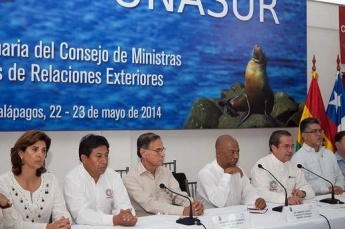
Twelve South American states have rejected an effort by US legislators to impose sanctions on Venezuela over alleged rights abuses.
In a statement issued on Friday following a meeting in the Galapagos Islands in Ecuador, foreign ministers from the 12-member Union of South American Nations (Unasur) said that a bill proposed by American lawmakers against Caracas would violate Venezuela’s internal affairs and undermine attempts to defuse the crisis in the country.
Sanctions are obstacles for Venezuela, whose “people can overcome their difficulties with independence, and in democratic peace,” the statement said.
The US House of Representatives will vote on the legislation on Wednesday. The bill will order the administration of US President Barack Obama to ban visas and freeze the assets of Venezuelan officials involved in the alleged rights abuses in the past three months.
Venezuela has been the scene of protests against and in support of the administration of Venezuelan President Nicolas Maduro since February.
The protests broke out in the western city of San Cristobal, where students took to the streets to criticize the crime rate and inflation in the country. The demonstrations later spread to other cities including the capital Caracas.
Maduro says the unrest is a US-backed plan to topple his government.
Last week, Maduro urged opposition leaders to return to political talks aimed at ending street clashes in the country.
The move came after the Venezuelan opposition suspended the negotiations with the government on May 14 to protest against what it called the mass arrests of anti-government activists.
The opposition says it will not return to the negotiating table until the government accepts its demands, including amnesty for opposition prisoners.
The government, on the other hand, says the opposition is making impossible requests that are akin to blackmail.
Self-proclaimed Donetsk and Lugansk republics form ‘Novorossiya’ union

Representatives from eight south-eastern regions voting at the people’s congress in Donetsk

RT | May 24, 2014
Self-proclaimed Donetsk and Lugansk People’s Republics which recently held referenda on independence from Ukraine have declared the creation of Novorossiya union.
“We have signed a memorandum on the union,” Denis Pushilin, co-chairman of the Donetsk People’s Republic, told the media.
The new union will be called Novorossiya, said the people’s governor of the Donetsk Region, Pavel Gubarev.
He added that the document was signed in the city of Donetsk by Donetsk People’s Republic Prime Minister Aleksandr Borodai and the head of Lugansk People’s Republic Aleksey Karyakin.
People’s representatives from eight Ukrainian regions gathered for a congress in Donetsk on Saturday, a day ahead of scheduled countrywide presidential elections.
As a result of the congress, the south-eastern regions of Ukraine, where anti-government protests gained momentum, have announced the creation of a pro-federalization Popular Front socio-political coalition. The movement accepted a manifesto vowing self-determination and protection of people from “Nazi gangs’ terror.”
The coalition involves Odessa, Nikolaev, Dnepropetrovsk, Zaporozhye, Kharkov, Kherson, Donetsk and Lugansk Regions.
At the congress, all 145 delegates accepted the manifesto, which stresses that the Popular Front will consist of “everybody, who is ready to resist self-appointed Kiev authority, which started war against the people.”
The coalition vowed to protect innocent civilians from the “terror of Nazi gangs, financed by oligarchs and foreign security services.” It also pledges “a joint fight for people’s rights to a decent life.”
It says it has launched an investigative commission that will probe “crimes of Nazi-terrorists and their Kiev patrons”.
The coalition is calling for a boycott of the presidential election, which is scheduled to take place on Sunday, because “all major candidates” are “oligarchs, whom we have already seen in top positions, hence, robbery and terror would continue,” the manifesto said.
When it comes to a new Ukrainian constitution, the Popular Front demands that it guarantees “neutrality” and non-participation in military blocks as well as “political independence”, “mechanisms to stop corruption and massive poverty.”
The coalition also demands that the parliament consists of two chambers. At the same time, regions must be given “a right to autonomy” and “independent foreign-economic activity”.
In addition to that, regional governments must be given a right to “announce its territory de-militarized zones and also “ban political, social and religious organizations on its territory” in case they are considered a “threat” to the people.
The Popular Front wants two official languages in Ukraine – Ukrainian and Russian.
Lugansk and Donetsk People’s Republics earlier announced they will not participate in Ukraine’s presidential elections scheduled for May 25.
The West’s Non-Linear Warfare and the Right for the Rest to Resist
By Andrew Korybko | Oriental Review | May 19, 2014
Nearly two weeks ago, Peter Pomerantsev, writing for Foreign Affairs, published an article about “How Putin Is Reinventing Warfare”. He alleges that Russia is engaging in “non-linear warfare”, strongly alluding that this poses a threat to the West. If one can read between the lines of his biased and subjective approach, he is in actuality describing a very real and objective development – the restoration of Russian power and global standing. His ire is likely due to Russia now being able to deflect international information and media assaults against it and its policies and finally promote the truth. Pomerantsev then goes on a peculiar ranting spiel where he alleges a convoluted metaphor of Russia conspiring to be a “corporate raider”, an exercise in exasperation which will likely only reach those with pre-existing anti-Russian beliefs. It is the end of his article, however, that forms the basis of this response to it. Pomerantsev uses the analogy of the West’s “global village” versus Russia’s “non-linear warfare” to make his final point in throwing mud at Russia. In reality, there is not one “global village”, but rather, many regional civilizational villages that are experiencing Western raids and “non-linear warfare”, and they have finally started to band together to stop the marauders.
The liberal end of history (aka “the global village”) does not exist outside of ideological fantasy, and the world is instead divided into civilizational zones (regional villages) united around certain actors (Russia, China, Islamic pillars, the West). This forms the basis of the running metaphor that will be utilized below to advance the claim of the West waging non-linear warfare against the Rest.
Repeated raids from Western marauders and bandits, whose village is the only one seeking to expand, loot, and plunder, has resulted in parts of the other villages being burnt down. In the past decade, the Islamic village experienced this the worst, with conflagrations decimating its Afghan, Iraqi, Libyan, and now Syrian neighborhoods. Currently, the Eurasian village is having to deal with a fire in Ukraine, one that was purposely set to spread to the Russian core. However, as a result of these repeated raids, the regional villages have formed self-defense forces and are now working together to put out the fires and stop the raiding. Experience has taught them how to successfully resist and defy the Western village. In the real world, the success of international media firms (RT, Press TV, CCTV, Telesur) shows that media and information assaults can in fact be deflected and that perception management and national PR initiatives are not under the sole monopoly of the West.
Pomerantsev’s claims that “(economic) interconnection also means that Russia can get away with aggression” could not be more opposite to the truth. The Western village is actually two large ones, the US and the EU, and the American village grew out of the EU one and now controls its creator. In this case, the suburb controls the center, so to speak. It is the interconnection between the Eurasian (Russian) and EU villages that serves as the real check on further US aggression against the former. When not marauding and raiding, the Western village also tries to infiltrate the others via NGOs and Color Revolutions. Once it flips some members of the village and/or installs its pick as village leader, these turncoat individuals can “open the gates from within”, promote mutiny, and lead to the annexation of the village into the Western-dominated expanding sprawl.
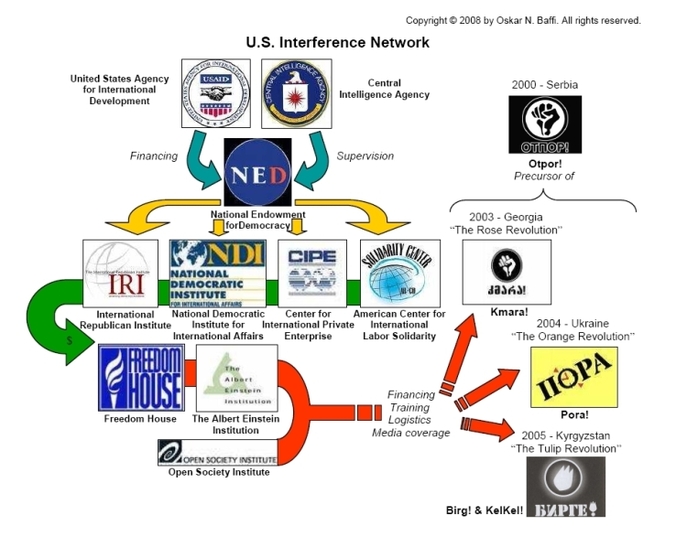
Pulling back from the metaphor, the Brzezinski Doctrine (“The Eurasian Balkans”) is the definition of non-linear warfare and subversive destabilization. It uses NGOs as destabilizing elements within the targeted states, and for this reason, foreign-funded NGOs are required to register as “foreign agents” inside the Russian Federation. Gene Sharp’s writings have also provided pivotal tactical advice in advancing the West’s non-linear warfare strategy. Taking the use of non-state actors even further, the West has a history of promoting militarized proxy groups to carry out its policies. This is most clearly seen in Kosovo, Afghanistan, Iraq, Libya, and Syria, although other countries have also been victims of this underhanded method of war. On the other hand, the West obviously engages in conventional warfare as well. Nowhere is this more evident than in the 2003 Iraq War. Mixing the two methods together is the new trend of American foreign policy. A non-linear campaign of militarized proxy destabilization culminated in a conventional NATO bombing in Libya. After this “success”, the West then turned its sights on Syria, but as a result of adroit Russian foreign policy maneuvers, non-linear warfare was stymied from mutating into its conventional form.
Pomerantsev’s article also uses fear mongering and heavy hype to scare the audience into thinking that Russia is proactively forming some kind of imaginary coalition against the West from within. If there happens to exist an overlap of perceived interests and objectives between Russia and domestic Western actors, it is because both parties arrived at the same conclusions after undergoing the same process – experiencing Western unipolar dominance and discriminatory targeting for two decades. For example, “Euro-scepticism” is also seen in Southeast Asia by the ASEAN members’ reluctance to form an EU-like union. The flower of New Leftism and resistance ideology in South America organically began to bloom in the 2000s, tended over by Hugo Chavez. In a similar fashion, the traditionally conservative societies of India, China, and Africa are just as disgusted as Russia’s by certain Western-centric values, such as the “bearded woman” of Eurovision. In laboratory conditions, the cause (Western dominance) has thus been proven to repeatedly result in similar effects all across the world, thereby confirming the hypothesis that Russia and others arrive at their conclusions on their own. There is no “contradictory kaleidoscope of messages”, as each actor’s resistance and defiance to the West, for various reasons and in differing forms, were a natural development.
To conclude, there are currently multiple civilizational liberation struggles playing out in the Pandora’s Box-setting of Western-led post-modernism. This is not a new page in the old historical story, but an absolutely new edition that is still being written. The Rest, absolutely diverse in their identity and overall mission, are coming together to stop the Western steamroller. They must work together to repel its aggression and safeguard the right to practice their identity and move forward with their historical mission as they individually deem fit. It is the democratic and sovereign choice of each civilization to be able to conduct itself how it pleases, but in order to get to that point, they must be liberated from the terror of the Western threat. These villages do not want to raze the Western one, so to speak, but they understand that the West will raze them if they can’t be annexed. In this manner, they are engaged in a do-or-die struggle, and at no time before in their histories has the situation been more dire. The Rest is slowly coalescing into providing a unified front against the Western menace, hoping to neutralize its raids and incursions so that they can once more go about their civilizational business in constructing and solidifying their societies. If, as Pomerantsev states, Russia and the Rest are anti-Western “raiders”, then yes, the future surely does belong to these resistant and defiant actors.
Andrew Korybko is the American Master’s Degree student at the Moscow State University of International Relations (MGIMO).
Condi Rice, Christine Lagarde: Cowardice at Commencement
By William Boardman | Reader Supported News | May 14, 2014
What would you expect from powerful people, personal courage?
The American Condoleeza Rice, 60, Iraq War architect, and the French Christine Lagarde, 58, International Monetary Fund managing director, have little in common beyond being women of power who have contributed to the misery of millions of people they never cared to meet. And now they have another quality in common, cowardice under fire, albeit only verbal fire after they were invited to speak at college commencements.
Rutgers University invited Rice to speak (for $35,000 and an honorary degree) and Smith College invited Lagarde (compensation undisclosed).
Student and faculty objections to Rice started in February and continued to grow for months. The Rutgers administration held firm, Rice kept quiet. On April 28, some 50 students staged a sit-in at the Rutgers president’s office. The president refused to talk with them and they dispersed when Rutgers threatened to arrest them.
In a letter ironically foreshadowing his bald hypocrisy on free speech and academic freedom, Rutgers president Robert Barchi had written in March:
We cannot protect free speech or academic freedom by denying others the right to an opposing view, or by excluding those with whom we may disagree. Free speech and academic freedom cannot be determined by any group. They cannot insist on consensus or popularity.
Students and faculty objected to Rice for her participation in lying her country into war in Iraq, and even more so for her defense of widespread American use of torture in the “global war on terror.” An online petition by a 1991 Rutgers grad collected 694 signatures opposed to Rice, and campus petitions gathered hundreds more. In a lucid indictment of Rice’s apparent criminality, published in The Chronicle of Higher Education the day before Rice withdrew, Rutgers history professor Jackson Lears wrote:
Rice sanctioned the use of torture and has continued to defend it even after a top aide warned that she and her colleagues were violating the law. To invite her to address the Rutgers graduating class, and then to award her a doctor-of-laws degree, is a travesty of all the ideals the university embodies. Our students deserve better. Most of all, they deserve the truth.
Officially, Rutgers showed no interest in truth, history, morality, etc.
Rice did not engage issues like war or torture in her withdrawal statement, arguing instead that the crucial issue was the party-time nature of commencements. She said she was “honored to have served my country,” without mentioning any specifics. She did not explain why her controversial performance in office wasn’t as obvious to her in February as it became in May. Bowing out of the May 18 graduation as of May 3, Rice’s statement on her Facebook page read in part:
Commencement should be a time of joyous celebration for the graduates and their families. Rutgers’ invitation to me to speak has become a distraction for the university community at this very special time…. I understand and embrace the purpose of the commencement ceremony and I am simply unwilling to detract from it in any way.
Despite Rice’s belated withdrawal, Rutgers faculty and students went ahead with a planned, six-hour teach-in on May 6 because, as three participating professors wrote, “we concluded that the need remained for a scholarly exposition of Dr. Rice’s responsibility in the lies leading to the Iraq war and the implementation of the unprecedented torture policies under the Bush administration.”
In an exercise of actual academic freedom, Rice was invited to the teach-in when it was first planned, but she did not attend. President Barchi expressed the corporate position that Rutgers stood “fully behind” inviting Rice to the commencement (where only the speaker has freedom of speech). The teach-in (on YouTube) began shortly after that official statement, and the professors wrote:
It was an event that will be remembered because there has not been one like it for a very long time. The lecture room of the Student Activities Center was packed by a crowd of more than two hundred students and faculty members, many sitting on the floor, others standing anywhere they could, all listening with the utmost attention to the poignant speech of human rights attorney Jumana Musa, then to the illuminating exposés of our panelists, to whom Rutgers University – the real Rutgers – is forever indebted.
And we all stood up to applaud the six students who represented the ‘No to Rice’ movement that organized the demonstrations of the last ten days: the enthusiastic commitment they expressed to humanistic values was a reminder that there is real hunger among our students for more knowledge of history, of foreign cultures, of the very notion of ‘culture,’ of political science, of economics, as well as a deep interest in questions related to ethics, public policy and the place of media in our culture. Students like these give a special meaning – and responsibility – to our teaching and research.
Rutgers was against students learning about unapproved reality
No free speech was harmed in the unfolding of these events, except at the Rutgers president’s office (where student speech was met with threats of arrest). By cutting and running, Condoleezza may have lost a paid venue (her net worth is about $4 million), but she has hardly been muzzled; on the contrary, her exercise of her own free speech got us into a deceitful, destructive failure of a war for which millions of Iraqis continue to pay with their own freedom and lives. The Rutgers administration lost students’ respect for promoting an apparent war criminal, but there’s no sign the administration is sensitive to any of that.
Academic freedom is a big winner at Rutgers, where faculty let some air and light into the discussion of 15 years of American crimes against humanity that are usually left to fester down the memory hole. And perhaps the biggest winners are Rutgers students, whose determined integrity allowed their voices to be heard on an issue of principle that the Rutgers administration got wrong on both substance and morality.
Like Rutgers, Smith College in Northampton, Massachusetts, announced its choice of commencement speaker in February and protest began soon after, but the two protests are very different responses to two very important elephants in our collective cultural-political living room. Where Rice is emblematic of the elephant of illegal war, torture, war crimes, and crimes against humanity about which we are not supposed to speak, Lagarde represents the much tidier elephant of financial plunder and economic “austerity” that probably leaves millions more innocent people to suffer and die without hope.
It’s not that Christine Lagarde sold people an illegal war as Rice did, but as head of the International Monetary Fund (IMF) since 2011, she carries out a prior ordained policy that is as inhumane as it is merciless. In Ukraine now, some people are hoping that $17.1 billion from the IMF will somehow help to save a country that can hardly pay for gas these days. But that $17.1 billion is not a gift, it is a loan to a country that can’t support its current debt load, and so, thanks to the IMF, Ukraine can look forward to another decade or more of even worse debt servitude than it has suffered in the past. The IMF’s $17.1 billion is typically reported as a good deed, but there are 46 million Ukrainians (except for a small number of oligarchs and bankers) who will have no reason to be grateful for this “beneficence.” The IMF has just bought the right to be the unelected ruler of Ukraine, and the purchase is so sweet, the Ukrainians will have to pay for it – with interest.
Objections to Lagarde are institutional and philosophical
Christine Lagarde is a well-regarded attorney whose specialties were antitrust and labor issues. She has held several French government posts, including Minister of Finance. She was the first female chairman of the international law firm Baker & McKenzie. She is an undeniably accomplished woman about whom the worst, easily available personal criticism is her apparent callousness toward the Greeks in 2012. Any real skeletons she may have remain tucked away in her closet.
Opposition to Lagarde at Smith was not personal, as an online petition made clear:
By selecting Ms. Lagarde as the commencement speaker we are supporting the International Monetary Fund and thus going directly against Smith’s values to stand in unity with equality for all women, regardless of race, ethnicity or class. Although we do not wish to disregard all of Ms. Lagarde’s accomplishments as a strong female leader in the world, we also do not want to be represented by someone whose work directly contributes to many of the systems that we are taught to fight against. By having her speak at our commencement, we would be publicly supporting and acknowledging her, and thus the IMF.
Even if we give Ms. Lagarde the benefit of the doubt, and recognize that she is just a good person working in a corrupt system, we should not by any means promote or encourage the values and ideals that the IMF fosters. The IMF has been a primary culprit in the failed developmental policies implanted in some of the world’s poorest countries. This has led directly to the strengthening of imperialist and patriarchal systems that oppress and abuse women worldwide.
Smith’s trustees haven’t said why they wanted to honor the IMF
Not surprisingly, Smith’s administration stood by its invitation to Lagarde, and there is little evidence of campus ferment even at the low level on the Rutgers campus. There was one report of a quiet campus sit-in by 40 students earlier in May. But apparently Lagarde is thin-skinned as well as guarded in her public persona. According to Smith president Kathleen McCarthy in a May 12 letter to the college community, Lagarde withdrew “in the wake of anti-IMF protests from faculty and students, including a few who wrote directly to her,” which might seem pretty thin-skinned for someone with a net worth of $4 million (and annual, untaxed income of about $630,000) whom Forbes ranked as the 7th most powerful woman (35th most powerful person) in the world.
According to McCarthy, Lagarde retreated with the same lame excuse Rice used, not wanting to be a party-pooper. As quoted by McCarthy, Lagarde wrote: In the last few days, it has become evident that a number of students and faculty members would not welcome me as a commencement speaker. I respect their views, and I understand the vital importance of academic freedom. However, to preserve the celebratory spirit of commencement day, I believe it is best to withdraw my participation.
Back in February, Lagarde observed that income inequality was increasing globally, citing the United States and India in particular. Delivering a lecture in London, she said, “In India, the net worth of the billionaire community increased twelve-fold in 15 years, enough to eliminate absolute poverty in this country twice over…. [Inequality] leads to an economy of exclusion, and a wasteland of discarded potential.” She did not suggest doing anything particular about this kind of global impoverishment for the vast majority of people on the planet.
Reaction to Lagarde’s reneging on a commitment is reportedly mixed on the Smith campus. Unlike at Rutgers, there is no teach-in or other communal effort to explore the issues raised by IMF activities. The argument, as in President McCarthy’s letter, is limited to supporting or opposing the choice of a speaker, and is not about the vast damage the IMF does in the name of economic stability. And it’s also not about the startling cowardice of a powerful woman who can’t find the wee bit of courage it might take to face a bunch of 20-something, well-mannered Smith College women who might disagree with her or even, God forbid, say something rude to a global administrator of cruel and unusual policies. What is it with these people who lack the fortitude to speak to an audience not in total awe of their magnificent selves?
As Katherine Sumner, Smith ’14, wrote: “It was in a Smith classroom that I first learned about the problems that the IMF has wrought on the Global South, and how those problems have affected women’s lives for the worse. As a graduating senior, I would be disappointed, to say the least, if a representative of that institution were honored and endorsed by a community that I am a part of.”
Needless to say, that is not the perspective with which this story is covered in mainstream media, where actual issues of substance and the events are presented with a tone of supercilious trivialization, as in the Washington Post story that began: “The commencement speaker purity bug has hit Smith College.” [Emphasis added.]
Rice and Lagarde were not subjected to “commencement speaker purity” or any other form of censorship. They were faced with coherent intellectual challenges to the core value of some of their most significant activities, and they did not rise to that challenge. And they bailed. They exercised self-censorship, deploying a spurious excuse rather than even attempting to engage in a serious debate. They did not act boldly and address the legitimate concerns of students and faculty with honesty and respect. That would have been too close to actual academic freedom. Instead these women of power fled the field rather than face an audience that might show disappointment. They retreated when the game wasn’t rigged in their favor; they folded when the institution failed to guarantee them commencement audience purity.
Featured Video
Trita Parsi: Israel Set a Trap for Total War in the Region
or go to
Aletho News Archives – Video-Images
Book Review
Why the War on Conspiracy Theories Is Bad Public Policy
By Kevin Barrett • Unz Review • February 1, 2019
 A Review of Conspiracy Theories and Other Dangerous Ideas by Cass Sunstein (based on an earlier paper co-authored with Adrian Vermeule); In Defense of Troublemakers: The Power of Dissent in Life and Business by Charlan Nemeth; and Conspiracy Theories and the People Who Believe Them, edited by Joseph E. Uscinski
On January 25 2018 YouTube unleashed the latest salvo in the war on conspiracy theories, saying “we’ll begin reducing recommendations of borderline content and content that could misinform users in harmful ways—such as videos promoting a phony miracle cure for a serious illness, claiming the earth is flat, or making blatantly false claims about historic events like 9/11.”
At first glance that sounds reasonable. Nobody wants YouTube or anyone else to recommend bad information. And almost everyone agrees that phony miracle cures, flat earthism, and blatantly false claims about 9/11 and other historical events are undesirable.
But if we stop and seriously consider those words, we notice a couple of problems. First, the word “recommend” is not just misleading but mendacious. YouTube obviously doesn’t really recommend anything. When it says it does, it is lying. … continue
Blog Roll
 Aletho News
- Araghchi blasts ‘parasitic’ alliance as US taxpayers pay for Israel’s war on Iran
- Easy fix for Europe’s chaos? Stop fueling war against Russia
- Putin’s key remarks on peace talks and Europe’s ‘schizophrenia’
- Trita Parsi: Israel Set a Trap for Total War in the Region
- Trump’s Iran war is on an Israeli leash
- Saudi oil boss issues global supply warning
- Riyadh Says Its Oil System Is Intact. The Numbers Say Otherwise.
- Trump and Netanyahu Want to “Finish the Job” on Iran
- US ‘one-sided dictation’ not Iran’s beliefs makes rational talks impossible: Baghaei
- Iran’s Next Strike May Not Explode. It Could Shut You Down /Col Doug Macgregor
- If Americans Knew
- DAILY UPDATE: Latest essential news on Palestine, Israel, & region
- The Israel Lobby’s Changing Fortunes
- AIPAC has become such a political liability that it’s shifting to a more “nimble” approach to buying politicians
- At least 160 Israeli settler attacks in 2 weeks
- Will Gaza’s Ancient Christian Community Disappear Forever?
- Israel’s vision of regional security rests on keeping Arab states weak
- Heidi Levine recounts how Palestinian youths helped save her in settler attack
- DAILY UPDATE: Latest essential news on Palestine, Israel, & region
- Trump’s Intensifying Sabotage of the ICC, for Israel’s Sake
- Israeli military detain US and UK volunteers in West Bank including Democratic NY politician Brad Lander
- No Tricks Zone
- E-Cars Reduce CO2 Emissions By Only 41% Compared To Internal Combustion Engine Vehicles
- Predictions Made By Renowned Climate Professor Over Past Decades Have Been Proven To Be Poor
- New Study Suggests Large Regions Of The Pacific Ocean Have Been Cooling For The Last 80 Years
- Germany’s Green Energy Debacle: High Energy Costs Force Kahla Porzellan to Close After 182 Years!
- New Study: 50 Years Of The Most Aggressive ‘Net Zero’ Policies Can Only Affect The Global Climate By 0.03°C
- US September “Heat” Was No Record…Many Records Set Decades Ago
- Latest European Green Energy Debacle; Portugal’s Largest Flagship Solar Park Insolvent!
- Green Energy Debacle: German Expert Professor Fritz Vahrenholt Warns Of Severe Economic And Social Consequences
- Two More Paleo Reconstructions Affirm Meters-Higher Sea Levels Across Ireland, Brazil 7000-6000 Years Ago
- New Study: Earth And Venus Surface Warmth Largely Explained By Convection And Lapse Rate, Not CO2 Or Radiation

