The West’s Non-Linear Warfare and the Right for the Rest to Resist
By Andrew Korybko | Oriental Review | May 19, 2014
Nearly two weeks ago, Peter Pomerantsev, writing for Foreign Affairs, published an article about “How Putin Is Reinventing Warfare”. He alleges that Russia is engaging in “non-linear warfare”, strongly alluding that this poses a threat to the West. If one can read between the lines of his biased and subjective approach, he is in actuality describing a very real and objective development – the restoration of Russian power and global standing. His ire is likely due to Russia now being able to deflect international information and media assaults against it and its policies and finally promote the truth. Pomerantsev then goes on a peculiar ranting spiel where he alleges a convoluted metaphor of Russia conspiring to be a “corporate raider”, an exercise in exasperation which will likely only reach those with pre-existing anti-Russian beliefs. It is the end of his article, however, that forms the basis of this response to it. Pomerantsev uses the analogy of the West’s “global village” versus Russia’s “non-linear warfare” to make his final point in throwing mud at Russia. In reality, there is not one “global village”, but rather, many regional civilizational villages that are experiencing Western raids and “non-linear warfare”, and they have finally started to band together to stop the marauders.
The liberal end of history (aka “the global village”) does not exist outside of ideological fantasy, and the world is instead divided into civilizational zones (regional villages) united around certain actors (Russia, China, Islamic pillars, the West). This forms the basis of the running metaphor that will be utilized below to advance the claim of the West waging non-linear warfare against the Rest.
Repeated raids from Western marauders and bandits, whose village is the only one seeking to expand, loot, and plunder, has resulted in parts of the other villages being burnt down. In the past decade, the Islamic village experienced this the worst, with conflagrations decimating its Afghan, Iraqi, Libyan, and now Syrian neighborhoods. Currently, the Eurasian village is having to deal with a fire in Ukraine, one that was purposely set to spread to the Russian core. However, as a result of these repeated raids, the regional villages have formed self-defense forces and are now working together to put out the fires and stop the raiding. Experience has taught them how to successfully resist and defy the Western village. In the real world, the success of international media firms (RT, Press TV, CCTV, Telesur) shows that media and information assaults can in fact be deflected and that perception management and national PR initiatives are not under the sole monopoly of the West.
Pomerantsev’s claims that “(economic) interconnection also means that Russia can get away with aggression” could not be more opposite to the truth. The Western village is actually two large ones, the US and the EU, and the American village grew out of the EU one and now controls its creator. In this case, the suburb controls the center, so to speak. It is the interconnection between the Eurasian (Russian) and EU villages that serves as the real check on further US aggression against the former. When not marauding and raiding, the Western village also tries to infiltrate the others via NGOs and Color Revolutions. Once it flips some members of the village and/or installs its pick as village leader, these turncoat individuals can “open the gates from within”, promote mutiny, and lead to the annexation of the village into the Western-dominated expanding sprawl.
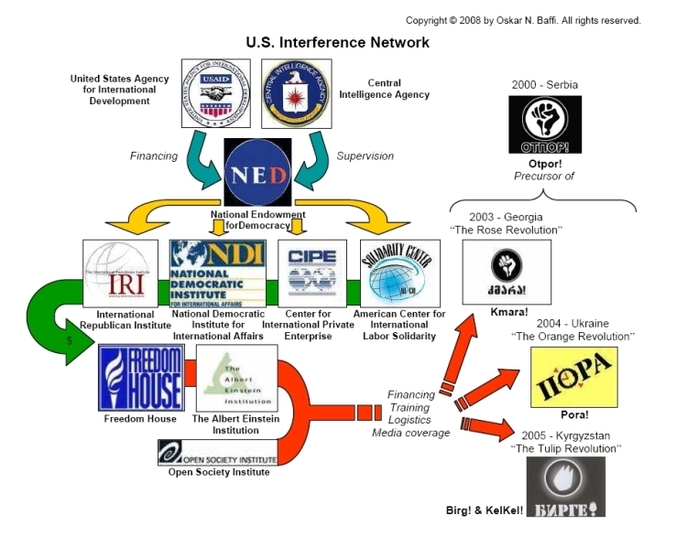
Pulling back from the metaphor, the Brzezinski Doctrine (“The Eurasian Balkans”) is the definition of non-linear warfare and subversive destabilization. It uses NGOs as destabilizing elements within the targeted states, and for this reason, foreign-funded NGOs are required to register as “foreign agents” inside the Russian Federation. Gene Sharp’s writings have also provided pivotal tactical advice in advancing the West’s non-linear warfare strategy. Taking the use of non-state actors even further, the West has a history of promoting militarized proxy groups to carry out its policies. This is most clearly seen in Kosovo, Afghanistan, Iraq, Libya, and Syria, although other countries have also been victims of this underhanded method of war. On the other hand, the West obviously engages in conventional warfare as well. Nowhere is this more evident than in the 2003 Iraq War. Mixing the two methods together is the new trend of American foreign policy. A non-linear campaign of militarized proxy destabilization culminated in a conventional NATO bombing in Libya. After this “success”, the West then turned its sights on Syria, but as a result of adroit Russian foreign policy maneuvers, non-linear warfare was stymied from mutating into its conventional form.
Pomerantsev’s article also uses fear mongering and heavy hype to scare the audience into thinking that Russia is proactively forming some kind of imaginary coalition against the West from within. If there happens to exist an overlap of perceived interests and objectives between Russia and domestic Western actors, it is because both parties arrived at the same conclusions after undergoing the same process – experiencing Western unipolar dominance and discriminatory targeting for two decades. For example, “Euro-scepticism” is also seen in Southeast Asia by the ASEAN members’ reluctance to form an EU-like union. The flower of New Leftism and resistance ideology in South America organically began to bloom in the 2000s, tended over by Hugo Chavez. In a similar fashion, the traditionally conservative societies of India, China, and Africa are just as disgusted as Russia’s by certain Western-centric values, such as the “bearded woman” of Eurovision. In laboratory conditions, the cause (Western dominance) has thus been proven to repeatedly result in similar effects all across the world, thereby confirming the hypothesis that Russia and others arrive at their conclusions on their own. There is no “contradictory kaleidoscope of messages”, as each actor’s resistance and defiance to the West, for various reasons and in differing forms, were a natural development.
To conclude, there are currently multiple civilizational liberation struggles playing out in the Pandora’s Box-setting of Western-led post-modernism. This is not a new page in the old historical story, but an absolutely new edition that is still being written. The Rest, absolutely diverse in their identity and overall mission, are coming together to stop the Western steamroller. They must work together to repel its aggression and safeguard the right to practice their identity and move forward with their historical mission as they individually deem fit. It is the democratic and sovereign choice of each civilization to be able to conduct itself how it pleases, but in order to get to that point, they must be liberated from the terror of the Western threat. These villages do not want to raze the Western one, so to speak, but they understand that the West will raze them if they can’t be annexed. In this manner, they are engaged in a do-or-die struggle, and at no time before in their histories has the situation been more dire. The Rest is slowly coalescing into providing a unified front against the Western menace, hoping to neutralize its raids and incursions so that they can once more go about their civilizational business in constructing and solidifying their societies. If, as Pomerantsev states, Russia and the Rest are anti-Western “raiders”, then yes, the future surely does belong to these resistant and defiant actors.
Andrew Korybko is the American Master’s Degree student at the Moscow State University of International Relations (MGIMO).
Condi Rice, Christine Lagarde: Cowardice at Commencement
By William Boardman | Reader Supported News | May 14, 2014
What would you expect from powerful people, personal courage?
The American Condoleeza Rice, 60, Iraq War architect, and the French Christine Lagarde, 58, International Monetary Fund managing director, have little in common beyond being women of power who have contributed to the misery of millions of people they never cared to meet. And now they have another quality in common, cowardice under fire, albeit only verbal fire after they were invited to speak at college commencements.
Rutgers University invited Rice to speak (for $35,000 and an honorary degree) and Smith College invited Lagarde (compensation undisclosed).
Student and faculty objections to Rice started in February and continued to grow for months. The Rutgers administration held firm, Rice kept quiet. On April 28, some 50 students staged a sit-in at the Rutgers president’s office. The president refused to talk with them and they dispersed when Rutgers threatened to arrest them.
In a letter ironically foreshadowing his bald hypocrisy on free speech and academic freedom, Rutgers president Robert Barchi had written in March:
We cannot protect free speech or academic freedom by denying others the right to an opposing view, or by excluding those with whom we may disagree. Free speech and academic freedom cannot be determined by any group. They cannot insist on consensus or popularity.
Students and faculty objected to Rice for her participation in lying her country into war in Iraq, and even more so for her defense of widespread American use of torture in the “global war on terror.” An online petition by a 1991 Rutgers grad collected 694 signatures opposed to Rice, and campus petitions gathered hundreds more. In a lucid indictment of Rice’s apparent criminality, published in The Chronicle of Higher Education the day before Rice withdrew, Rutgers history professor Jackson Lears wrote:
Rice sanctioned the use of torture and has continued to defend it even after a top aide warned that she and her colleagues were violating the law. To invite her to address the Rutgers graduating class, and then to award her a doctor-of-laws degree, is a travesty of all the ideals the university embodies. Our students deserve better. Most of all, they deserve the truth.
Officially, Rutgers showed no interest in truth, history, morality, etc.
Rice did not engage issues like war or torture in her withdrawal statement, arguing instead that the crucial issue was the party-time nature of commencements. She said she was “honored to have served my country,” without mentioning any specifics. She did not explain why her controversial performance in office wasn’t as obvious to her in February as it became in May. Bowing out of the May 18 graduation as of May 3, Rice’s statement on her Facebook page read in part:
Commencement should be a time of joyous celebration for the graduates and their families. Rutgers’ invitation to me to speak has become a distraction for the university community at this very special time…. I understand and embrace the purpose of the commencement ceremony and I am simply unwilling to detract from it in any way.
Despite Rice’s belated withdrawal, Rutgers faculty and students went ahead with a planned, six-hour teach-in on May 6 because, as three participating professors wrote, “we concluded that the need remained for a scholarly exposition of Dr. Rice’s responsibility in the lies leading to the Iraq war and the implementation of the unprecedented torture policies under the Bush administration.”
In an exercise of actual academic freedom, Rice was invited to the teach-in when it was first planned, but she did not attend. President Barchi expressed the corporate position that Rutgers stood “fully behind” inviting Rice to the commencement (where only the speaker has freedom of speech). The teach-in (on YouTube) began shortly after that official statement, and the professors wrote:
It was an event that will be remembered because there has not been one like it for a very long time. The lecture room of the Student Activities Center was packed by a crowd of more than two hundred students and faculty members, many sitting on the floor, others standing anywhere they could, all listening with the utmost attention to the poignant speech of human rights attorney Jumana Musa, then to the illuminating exposés of our panelists, to whom Rutgers University – the real Rutgers – is forever indebted.
And we all stood up to applaud the six students who represented the ‘No to Rice’ movement that organized the demonstrations of the last ten days: the enthusiastic commitment they expressed to humanistic values was a reminder that there is real hunger among our students for more knowledge of history, of foreign cultures, of the very notion of ‘culture,’ of political science, of economics, as well as a deep interest in questions related to ethics, public policy and the place of media in our culture. Students like these give a special meaning – and responsibility – to our teaching and research.
Rutgers was against students learning about unapproved reality
No free speech was harmed in the unfolding of these events, except at the Rutgers president’s office (where student speech was met with threats of arrest). By cutting and running, Condoleezza may have lost a paid venue (her net worth is about $4 million), but she has hardly been muzzled; on the contrary, her exercise of her own free speech got us into a deceitful, destructive failure of a war for which millions of Iraqis continue to pay with their own freedom and lives. The Rutgers administration lost students’ respect for promoting an apparent war criminal, but there’s no sign the administration is sensitive to any of that.
Academic freedom is a big winner at Rutgers, where faculty let some air and light into the discussion of 15 years of American crimes against humanity that are usually left to fester down the memory hole. And perhaps the biggest winners are Rutgers students, whose determined integrity allowed their voices to be heard on an issue of principle that the Rutgers administration got wrong on both substance and morality.
Like Rutgers, Smith College in Northampton, Massachusetts, announced its choice of commencement speaker in February and protest began soon after, but the two protests are very different responses to two very important elephants in our collective cultural-political living room. Where Rice is emblematic of the elephant of illegal war, torture, war crimes, and crimes against humanity about which we are not supposed to speak, Lagarde represents the much tidier elephant of financial plunder and economic “austerity” that probably leaves millions more innocent people to suffer and die without hope.
It’s not that Christine Lagarde sold people an illegal war as Rice did, but as head of the International Monetary Fund (IMF) since 2011, she carries out a prior ordained policy that is as inhumane as it is merciless. In Ukraine now, some people are hoping that $17.1 billion from the IMF will somehow help to save a country that can hardly pay for gas these days. But that $17.1 billion is not a gift, it is a loan to a country that can’t support its current debt load, and so, thanks to the IMF, Ukraine can look forward to another decade or more of even worse debt servitude than it has suffered in the past. The IMF’s $17.1 billion is typically reported as a good deed, but there are 46 million Ukrainians (except for a small number of oligarchs and bankers) who will have no reason to be grateful for this “beneficence.” The IMF has just bought the right to be the unelected ruler of Ukraine, and the purchase is so sweet, the Ukrainians will have to pay for it – with interest.
Objections to Lagarde are institutional and philosophical
Christine Lagarde is a well-regarded attorney whose specialties were antitrust and labor issues. She has held several French government posts, including Minister of Finance. She was the first female chairman of the international law firm Baker & McKenzie. She is an undeniably accomplished woman about whom the worst, easily available personal criticism is her apparent callousness toward the Greeks in 2012. Any real skeletons she may have remain tucked away in her closet.
Opposition to Lagarde at Smith was not personal, as an online petition made clear:
By selecting Ms. Lagarde as the commencement speaker we are supporting the International Monetary Fund and thus going directly against Smith’s values to stand in unity with equality for all women, regardless of race, ethnicity or class. Although we do not wish to disregard all of Ms. Lagarde’s accomplishments as a strong female leader in the world, we also do not want to be represented by someone whose work directly contributes to many of the systems that we are taught to fight against. By having her speak at our commencement, we would be publicly supporting and acknowledging her, and thus the IMF.
Even if we give Ms. Lagarde the benefit of the doubt, and recognize that she is just a good person working in a corrupt system, we should not by any means promote or encourage the values and ideals that the IMF fosters. The IMF has been a primary culprit in the failed developmental policies implanted in some of the world’s poorest countries. This has led directly to the strengthening of imperialist and patriarchal systems that oppress and abuse women worldwide.
Smith’s trustees haven’t said why they wanted to honor the IMF
Not surprisingly, Smith’s administration stood by its invitation to Lagarde, and there is little evidence of campus ferment even at the low level on the Rutgers campus. There was one report of a quiet campus sit-in by 40 students earlier in May. But apparently Lagarde is thin-skinned as well as guarded in her public persona. According to Smith president Kathleen McCarthy in a May 12 letter to the college community, Lagarde withdrew “in the wake of anti-IMF protests from faculty and students, including a few who wrote directly to her,” which might seem pretty thin-skinned for someone with a net worth of $4 million (and annual, untaxed income of about $630,000) whom Forbes ranked as the 7th most powerful woman (35th most powerful person) in the world.
According to McCarthy, Lagarde retreated with the same lame excuse Rice used, not wanting to be a party-pooper. As quoted by McCarthy, Lagarde wrote: In the last few days, it has become evident that a number of students and faculty members would not welcome me as a commencement speaker. I respect their views, and I understand the vital importance of academic freedom. However, to preserve the celebratory spirit of commencement day, I believe it is best to withdraw my participation.
Back in February, Lagarde observed that income inequality was increasing globally, citing the United States and India in particular. Delivering a lecture in London, she said, “In India, the net worth of the billionaire community increased twelve-fold in 15 years, enough to eliminate absolute poverty in this country twice over…. [Inequality] leads to an economy of exclusion, and a wasteland of discarded potential.” She did not suggest doing anything particular about this kind of global impoverishment for the vast majority of people on the planet.
Reaction to Lagarde’s reneging on a commitment is reportedly mixed on the Smith campus. Unlike at Rutgers, there is no teach-in or other communal effort to explore the issues raised by IMF activities. The argument, as in President McCarthy’s letter, is limited to supporting or opposing the choice of a speaker, and is not about the vast damage the IMF does in the name of economic stability. And it’s also not about the startling cowardice of a powerful woman who can’t find the wee bit of courage it might take to face a bunch of 20-something, well-mannered Smith College women who might disagree with her or even, God forbid, say something rude to a global administrator of cruel and unusual policies. What is it with these people who lack the fortitude to speak to an audience not in total awe of their magnificent selves?
As Katherine Sumner, Smith ’14, wrote: “It was in a Smith classroom that I first learned about the problems that the IMF has wrought on the Global South, and how those problems have affected women’s lives for the worse. As a graduating senior, I would be disappointed, to say the least, if a representative of that institution were honored and endorsed by a community that I am a part of.”
Needless to say, that is not the perspective with which this story is covered in mainstream media, where actual issues of substance and the events are presented with a tone of supercilious trivialization, as in the Washington Post story that began: “The commencement speaker purity bug has hit Smith College.” [Emphasis added.]
Rice and Lagarde were not subjected to “commencement speaker purity” or any other form of censorship. They were faced with coherent intellectual challenges to the core value of some of their most significant activities, and they did not rise to that challenge. And they bailed. They exercised self-censorship, deploying a spurious excuse rather than even attempting to engage in a serious debate. They did not act boldly and address the legitimate concerns of students and faculty with honesty and respect. That would have been too close to actual academic freedom. Instead these women of power fled the field rather than face an audience that might show disappointment. They retreated when the game wasn’t rigged in their favor; they folded when the institution failed to guarantee them commencement audience purity.
Danny Glover calls for cultural boycott of Israel
Ma’an – 14/05/2014
BETHLEHEM – Danny Glover and other actors featured in a US documentary on a prominent social justice activist protested the film’s screening at a Tel Aviv festival this week, announcing their support for the cultural boycott of Israel.
In a statement released on Monday, the group said they “stand in solidarity with the people of Palestine, and support their call for cultural and academic boycott of Israel” and were “shocked to find the film slated to be screened” at an Israeli festival.
“We immediately took action to have the film withdrawn from the festival,” the statement added, but highlighted that festival organizers say it was not “possible” to change the schedule that they would “move forward with the screening, over our objections.”
The film “American Revolutionary: the Evolution of Grace Lee Boggs,” is scheduled to be shown in Tel Aviv at DocAviv, a festival dedicated to documentary film which runs through May 17 and purports to be the largest film festival in Israel.
The group, however, stressed their support for the Palestinian call for Academic and Cultural Boycott, which was launched in 2004 as part of the global campaign to boycott, sanction, and divest from the state of Israel in order to pressure it to end its long-standing occupation of the Palestinian territories and history of human rights abuses against Palestinians.
Grace Lee Boggs, the subject of the documentary film, also added her name to the statement supporting the cultural boycott.
As a long-time advocate of social and racial justice in the United States, the statement highlighted that she said that screening the film in Israel “is in direct contradiction to her legacy and ongoing work as a revolutionary.”
“We will pursue opportunities for this film and the ideas within it to be made available in Palestine in a way that supports the movement,” the statement added.
The campaign has scored a number of notable successes in recent years, with leading US academic and cultural figures coming out in support despite widespread pro-Israel sentiment in North America.
Supporters of the boycott believe that after decades of occupation and ethnic cleansing, international pressure is one of the few ways left to force Israel to respect Palestinian rights.
San Francisco Rides the $15 Wave
By Shamus Cooke | Worker’s Action | May 13, 2014
It seems that Seattle has officially passed the $15 baton to San Francisco, and they’re running with it. On May 5th San Francisco had its first public organizing meeting to prepare for a ballot measure to raise the minimum wage to $15. The Labor movement and broader community organizations were well represented, and with them all the potential to achieve a great victory.
The San Francisco $15 proposal is stronger than the Seattle mayor’s version: the time line to get to $15 is shorter, and there are fewer exceptions.
San Francisco companies with more than 100 employees would have until 2016 to raise wages to $15 an hour, but they must lift wages to $13 an hour by next January. Businesses with fewer than 100 employees have until 2017 to raise wages to $15 an hour, but must raise them to $13 an hour by 2015 and $14 by 2016.
Polling has already indicated overwhelming support (59 percent) for the initiative.
The process that San Francisco is using also has other advantages over Seattle’s. The unions and community groups are working as a united front in San Francisco, whereas in Seattle there was constant tension between the socialist city council member Kshama Sawant and her $15 Now group of supporters versus the unions: Sawant wanted a strong version of $15 and several of the unions just wanted a deal, seemingly more interested in working with the mayor towards “consensus” between the unions and the corporations.
In San Francisco “consensus” was thankfully blown to pieces. The ballot initiative process goes over the head of the City Hall corporate politicians, destroying the consensus that San Francisco mayor was desperately seeking between the Chamber of Commerce — representing the giant corporations — and the unions. This has infuriated the 1%.
The San Francisco Chronicle reports:
“The San Francisco Chamber of Commerce said it was ‘outraged by the preemptive minimum wage ballot measure’ designed by SEIU and its allies.”
This is exactly the kind of outrage that should warm the heart of all working people.
The ballot initiative is also superior because it opens up the doors to wider participation of various community groups, who can mobilize their members to collect signatures, organize rallies, etc., instead of simply having four or five union reps cut a backroom, watered-down deal with the mayor and corporations.
Which begs the question: why don’t unions and community groups work together on inspiring ballot initiatives more often? Half the states in the country and many municipalities have the legal authority to evoke this brand of direct democracy, yet it’s rarely done.
The answer is, sadly, that this weapon is rarely used in an inspirational way because of the “partnership” between unions and the Democratic Party. The Democrats are adversaries of anything potentially harmful to the big corporations, which any economic measure that inspires working people will inevitably be.
This is why — as Obama’s presidency proved yet again — the Democratic Party is where hope goes to die.
Which makes the events in San Francisco all the more important: the $15 dollar initiative is an example of the unions making a big break, in practice, from the Democrats, which hopefully others around the nation will follow.
And follow they must, since it would be suicide for the national labor movement to sit idly as the fight for $15 snowballs. Union and community groups should be working together across the country for similar ballot initiatives wherever possible.
For those states without ballot initiatives, $15 can still be used as a rallying cry and a mobilizing force for change. Wherever the Democratic Party blocks this process, unions should come together and form a labor party. Working people are tired of excuses.
The fight for $15 also gives a boost to organizing new workers into unions as well. For example, Wal-Mart workers would love to make $15 an hour and the labor movement has been trying in vain to organize them for years. The slogan “$15 and a union” would resonate far better with Wal-Mart workers than anything the unions have yet put forth.
There are also many other unions that have already-organized workers who don’t make $15, and now they can have the confidence to demand $15 at the bargaining table, knowing full well that the broader community will come to their aid.
The $15 demand is especially important because it’s the first time in decades that the labor movement is going on the offensive. This is crucial. Three decades of playing defense — and playing it poorly — has had a demoralizing effect on the entire working class. A big offensive victory opens the doors wide to new possibilities and new horizons. It boosts confidence. One year ago $15 seemed like a fantasy; in five years we’ll hopefully be looking back at $15 with nostalgia, having achieved many other offensive victories.
The possibilities for unions and community groups to organize around $15 are endless. And if other unions don’t follow the example of the San Francisco unions and community groups, they’ll be acting as willing participants to the ongoing corporate onslaught. Not fighting back is no longer an option.
Shamus Cooke is a social service worker, trade unionist, and writer for Workers Action. He can be reached at portland@workerscompass.org
Israeli Supreme Court to Hear Rachel Corrie Appeal on May 21
Rachel Corrie Foundation for Peace & Justice | May 12, 2014
Nine years after filing a civil suit against the State of Israel for the wrongful death of American peace activist Rachel Corrie, her family will have their appeal heard before the Israeli Supreme Court on May 21 at 11:30 a.m. in Jerusalem. The appeal, which will be argued by attorney Hussein Abu Hussein, challenges the Haifa District Court’s August 2012 ruling which concluded that the Israeli military was not responsible for Rachel’s death and that it conducted a credible investigation.
“During the past nine years, we have sought accountability in the Israeli courts for Rachel’s killing but were handed a verdict that showed blind indifference to the rights of the victim and little interest in seeking truth and justice,” said Craig Corrie, Rachel’s father.
The Corrie family appeal focuses on serious flaws in the lower court verdict which erred by ignoring and misinterpreting essential facts and misapplying legal norms. The appeal also challenges the lower court’s total disregard of international law obligations as well as procedural advantages that were regularly granted to the state during the proceedings. Lawyers for the Corries and the State of Israel have submitted their arguments in writing to the panel of three justices – Deputy-President of the Court Miriam Naor, Esther Hayut, and Zvi Zylbertal.
Speaking of his family’s hopes, Craig Corrie said, “It is a tragedy when the law is broken, but far, far worse when it is abandoned altogether. The Supreme Court now has a choice, to either show the world that the Israeli legal system honors the most basic principles of human rights and can hold its military accountable, or to add to mounting evidence that justice can not be found in Israel.”
Rachel, a 23-year-old human rights defender from Olympia, Washington, was crushed to death March 16, 2003, by an Israeli military bulldozer while nonviolently protesting demolition of Palestinian civilian homes in Rafah, Gaza. The following day, Israeli Prime Minister Ariel Sharon promised President George W. Bush a “thorough, credible, and transparent” investigation into Rachel’s killing. In 2004, Secretary of State Colin Powell’s Chief of Staff informed the Corrie family of the U.S. Government’s position that the Israeli investigation did not meet these standards and advised them to “use the Israeli court system.” The Corries filed suit in 2005, charging the State of Israel and its Ministry of Defense with responsibility for Rachel’s killing.
The civil trial before Haifa District Court Judge Oded Gershon began March 10, 2010, and 23 witnesses testified in 15 hearings, spread over 16 months. Each session was attended by the Corrie family, American Embassy officials, and numerous legal and human rights observers.
Testimony exposed serious chain-of-command failures in relation to civilian killings, as well as indiscriminate destruction of civilian property at the hands of the Israeli military in southern Gaza. Four eyewitnesses from the International Solidarity Movement (ISM) testified that Rachel was visible to soldiers in the bulldozer as it approached. Military witnesses testified that they saw ISM protesters in the area; and the on-site commander asked to stop operations due to their presence, but was ordered to continue working. An Israeli colonel testified that there are no civilians in war, and the lead military police investigator, himself, stated his belief that the Israeli military was at war with all in Gaza, including peace activists.
Testimony also revealed serious flaws in the military’s investigation into Rachel’s killing. Investigators failed to question key military witnesses, including those recording communications; failed to secure the military video, allowing it to be taken for nearly a week by senior commanders with only segments submitted to court; failed to address conflicting testimony given by soldiers; and ignored damning statements in the military log confirming a “shoot to kill” order and a command mentality to continue work in order to avoid setting a precedent with international activists.
On August 28, 2012, Judge Gershon ruled against the Corrie family, handing down a verdict stating the Israeli military was not to blame for Rachel’s death and that she alone was responsible for her demise. The Judge lauded the military police investigation and dismissed the case, adopting the Israeli Government’s position that the military should be fully absolved of civil liability, because soldiers were engaged in operational activities in a war zone.
The verdict was widely condemned by legal and human rights organizations monitoring the case, citing misrepresentation of facts and the fundamental principle of international humanitarian law – that in a time of war, military forces are obligated to take all measures to avoid harm to both civilians and their property. President Jimmy Carter stated that the court’s decision confirmed “a climate of impunity, which facilitates Israeli human rights violations against Palestinian civilians in the Occupied Territory.”
Seating in the courtroom is limited, and members of the press are advised to arrive early with press credentials. Proceedings will be in Hebrew. The family is seeking permission from the Court to provide simultaneous translation for court observers. However, pending the Court’s decision, journalists should make plans to bring their own translator. Cameras and audio recording equipment will not be permitted once proceedings begin. Photos may be taken before the judges enter the room.
A performance of My Name is Rachel Corrie, a play drawn from the diaries and e-mails of Rachel and staged around the world, will be presented in Hebrew on Monday, May 19 at 21:00 at the Arab-Hebrew Theatre in Jaffa. It will be followed by a panel discussion with the Corrie family, moderated by human rights lawyer Michael Sfard. For more information, visit The Coalition of Women for Peace, which is sponsoring the event.
For more information please visit http://rachelcorriefoundation.org/trial
Freedom Flotilla Update: “We Will Sail in the Fall!”
Statement from the Freedom Flotilla Coalition regarding the attack on Gaza’s Ark | May 12, 2014
The Freedom Flotilla Coalition met in London over the last two days to discuss future plans in the wake of the terrorist attack on Gaza’s Ark in the port of Gaza, as well as future plans to struggle against the blockade of Gaza
The attack, which occurred on April 29th, caused substantial damage to the hull of the boat. These hull damages and others caused by the explosion need a minimum of 2 months work to repair at a cost of approximately US $30,000.
In response to this attack we will increase our efforts to challenge the blockade through non-violent direct action. We now plan to sail Gaza’s Ark early in the fall of 2014.
The authorities have not yet concluded their investigations of the incident, so it is premature to blame anyone, but it is well known who enforces the blockade on Gaza and who doesn’t want it challenged.
Preliminary results of the investigation and inspection by our partners indicate that the materials which were used in the attack are not readily found in Gaza.
Freedom Flotilla boats have been sabotaged before in the ports of Cyprus, Greece and Turkey, over the last 5 years, as they were preparing to sail to Gaza to challenge the blockade.
Boats that sailed to Gaza have been attacked by the Israeli Navy in international water, in one case lethally, and in others with force which caused a boat to sink. Boats that were not sabotaged (over half a dozen) were hijacked and towed to Ashdod.
This attack on Gaza’s Ark took place as Israel is under increased legal pressure for its deadly attack on the first Freedom Flotilla in 2010 at the International Criminal Court (ICC) and in Turkish courts.
It also happens as Israel is increasing pressure against all Palestinians in retaliation against efforts at national reconciliation between the West Bank and Gaza.
The Freedom Flotilla Coalition commits to continue its work against the blockade of Gaza in all ways and by all non-violent means possible, including supporting the May 31st International Freedom Day for Gaza.
For further information:
Ehab Lotayef +44 (753) 877 0353 or +1 (514) 941 9792
Ann Ighe +46 (70) 974 0739
Zaher Birawi +44 (785) 089 6057
Referendum results in Donetsk and Lugansk Regions show landslide support for self-rule
RT | May 11, 2014
The results of referendums have been announced in Donetsk and Lugansk Regions, showing the majority of voters support self-rule, amid an intensified military operation by Kiev which resulted in several deaths.
Almost 90 percent of voters in Donetsk Region have endorsed political independence from Kiev, the head of the Central Election Commission of the self-proclaimed ‘Donetsk People’s Republic’, Roman Lyagin, announced.
“Counting the ballots proved to be surprisingly easy – the number of people who said ‘no’ was relatively small and there appeared to be only a tiny proportion of spoiled ballots, so we managed to carry out counting quite fast. The figures are as follows: 89.07 percent voted ‘for’, 10.19 percent voted ‘against’ and 0.74 percent of ballots were rendered ineligible,” Lyagin told journalists.
In Lugansk Region 96.2 percent of voters supported the region’s self-rule, according to the final figures announced by the local election commission.
Despite fears that amid Kiev’s intensified military crackdown – which killed at least two civilians on referendum day – the turnout will be low, in both of the region it was unexpectedly high. In Donetsk it reached 74.87%, while in Lugansk the central election commission says 75% of eligible voters came to the polling stations.
With such a huge turnout, the referendums have been recognized as valid by both election commissions.
The acting president of Ukraine, Aleksandr Turchinov, has condemned as a “farce” referendums in the Donetsk and Lugansk regions.
“This propaganda farce won’t have any legal consequences, except for criminal charges for its organizers,” Turchinov said, Interfax reported.
The referendums, according to Turchinov, were inspired by Russia to “totally destabilize the situation in Ukraine, disrupt the presidential election and overthrow the Ukrainian government.”
Calling the regional voting on self-determination illegal, Kiev sent its recently formed paramilitary forces to Donetsk and Lugansk regions on Sunday, in an apparent move to disrupt referendums.
As armored military vehicles blocked passage to polling stations, voting in four towns across Lugansk region was disrupted. In the Donetsk town of Krasnoarmeysk, the National Guard shot at a crowd and killed two civilians who were protesting their attempt to seize a polling station.
The people’s governor of the Donetsk Region, Pavel Gubarev, told journalists on Sunday that Donetsk and Lugansk will emerge as new legal entities as a result of the referendum.
“The referendum for us is about creating a new state paradigm,” he said.
Vyacheslav Ponomaryov, the people’s mayor of Slavyansk, Donetsk Region, where some of the heaviest fighting between Ukrainian troops and self-defense activists took place, said the next step following the referendum would be developing closer ties with Russia.
“Russia is our brotherly nation, [we hope for] full interaction with Russia, including entering the Customs Union,” Ponomaryov said.
One of the organizers of the referendum in Lugansk, Vasily Nikitin, told journalists that the region will appeal to the United Nations to recognize its independence, RIA Novosti reports. Nikitin also said Lugansk was not going to take part in the Ukrainian presidential election on May 25.
Moscow hopes the results of the referendums in eastern Ukraine will instigate dialogue between Kiev and the regions that voted in favor of self-rule, according to the Kremlin’s press-service.
“Moscow respects the will of the people in Donetsk and Lugansk and hopes that the practical realization of the outcome of the referendums will be carried out in a civilized manner, without resorting to violence, through dialogue between representatives of Kiev, Donetsk and Lugansk,” the statement reads.
The Kremlin says it welcomes all mediation efforts, including those by the OSCE.
Spokesman for the president, Dmitry Peskov earlier explained that Putin “did not urge, but recommended” that the votes be postponed. However, the spokesman says that “even considering the authority of the Russian president,” it was difficult for Donetsk and Lugansk authorities to follow his recommendation amid Kiev’s ongoing military crackdown.
Both the EU and US have dismissed the ballots in eastern Ukraine as illegal.
“If these referenda go forward, they will violate international law and the territorial integrity of Ukraine. The United States will not recognize the results of these illegal referenda,” US State Department spokesperson Jen Psaki said in a statement late on Saturday.
The European Union came up with a similar comment, adding that the referendums ran counter to the Geneva agreement on de-escalation reached by Ukraine, Russia, the EU and the United States last month.
“The so-called referenda in … parts of Lugansk and Donetsk Regions were illegal and we do not recognize the outcome. Those who organized the referenda have no democratic legitimacy,” Maja Kocijancic, a spokeswoman for EU foreign policy chief Catherine Ashton, said in emailed comments to Reuters.
Despite the rejection of the referendums by Kiev and most Western countries, it won’t be so easy to ignore the results, international affairs expert Serdja Trifkovich believes.
“After the referendum it will no longer be possible for the regime in Kiev to say that they do not want to negotiate with the so-called terrorists,” Trifkovich told RT. “They will be forced to acknowledge internally that they are facing the level of agreement among the people in the eastern regions that will prove it rather difficult to deal with by force.”
When Our Land is Free, We are Free
By Silas Kpanan’Ayoung Siakor & Jacinta Fay | The Ecologist | May 7, 2014
Right now in Abuja, Nigeria, agribusiness corporations are courting African governments at the Grow Africa Investment Forum to “further accelerate sustainable agricultural growth in Africa”.
That sounds harmless enough, until you know what it really means. Corporate interest in agriculture in Africa has certainly accelerated corporate control of land, seeds and water. But it has done little to support agriculture that will feed the continent.
Rather than support family farming and smallholder agriculture, private sector investment in agriculture has resulted in grabbing land from communities – the land which they farm sustainably and rely on for their survival.
Resisting the corporate bully boys
Communities are resisting this corporate takeover of their land and they are winning. All over Africa people are sending a clear message to their governments: “Stop selling Africa to corporations!” The Jogbahn Clan in Liberia is one such community and here is their story.
The sense of jubilation in Blayahstown, small town in Liberia, is palpable. People come from surrounding villages to join in the celebrations and the town is filled with singing and dancing.
The Jogbahn Clan is celebrating a victory as the President of Liberia has now recognised their right to say no Equatorial Palm Oil (EPO) a British palm oil company grabbing their land.
This is no small feat in a country where over 50% of the land has been given to corporations without the consent of the communities who customarily own the land.
We come from this land – it is ours!
The sense of accomplishment is not lost on Chief Elder Chio Johnson who looks like he hasn’t stopped smiling since he returned from the Clan’s meeting with the President of Liberia – where she committed to support them in protecting their land from being grabbed by EPO.
“Why should a company take away our livelihood?” asked Chio. “We come from this land. Everything our ancestors left us is preserved in the forest, so why should we give up our forest?”
Walking through the forest with Deyeatee Kardor, the Clan’s Chairlady, she picks leaves and describes the different medicines that they can be used for. She recounts how she and her family hid in the forest throughout the Civil War and managed to survive on the plants and fruits growing in the bush.
Though the land bears the scars of the recent past it also represents the Clan’s ancestral home and they would not willingly allow this deep connection to the land to be fractured.
20,000 hectares of community land given away
 “The land gives us everything”, Chio says as he surveys the area; the vegetables, wild palm and sugar cane growing all around. Like other rural communities in Liberia they make their livelihood from the land they manage collectively.
The clan are self-sufficient and manage the land sustainably. For the Clan, to lose their land is to lose everything.
The communities’ resistance began in 2012 when EPO began to expand their plantation onto the community land of eleven towns. The Government of Liberia and EPO had signed a concession agreement allowing the company’s plantation to engulf communities’ land amounting to over 20,000 hectares.
Communities all over Liberia are facing the same threat as their lands are given to companies without their consent. As a result conflict between communities and companies has been widespread.
Police and EPO security intimidation
The Clan organised and came together to resist their land being grabbed. Men, women and youth from the affected towns chose representatives to form a core group to lead the resistance.
They met the company and the government several times to object to the company’s expansion. In spite of this towards the end of 2012 EPO began clearing and planting their land, destroying crops and farmland.
In September 2013 EPO began surveying the communities’ land without their consent. When the communities attempted to stop the survey a paramilitary police unit was deployed into the area, and began to run a campaign of harassment and intimidation by both the police and EPO’s security force.
They drove through villages at night flashing their emergency lights and arrived in villages riding on top of vehicles the same way rebel fighters did during the war.
People were also assaulted during a peaceful march and 17 people suffered arbitrary arrest. The Clan Chief was also suspended from his position by the government because he spoke out against the company.
Divide and rule – this time, it failed
Despite these aggressive tactics the community continued resisting. They lodged a complaint to the Roundtable on Sustainable Palm Oil (RSPO) and presented a petition to the government stating their objections.
“All they have done is try to divide us”, commented Deyeatee. “They offer important people a little money to try to convince them.”
However the community refused to be weakened by division and eventually secured the crucial meeting with the Liberian President Ellen Johnson Sirleaf where she recognised their right to say ‘no’ to the company.
“The struggle has made us stronger than ever before and we’ve learned a lesson to stay united”, said Anthony Johnson, a youth representative.
“The success is so great as it secures my future and the future of my children to come. I will stay on this land and plant crops for my children so future generations can live off the land.”
But for EPO, it’s business as usual
Despite the President’s commitment EPO has still not recognised that the Clan has said no to their operations. They are operating as if things are business as usual and conducting studies of the Clan’s land in preparation for clearing.
But the Clan are not discouraged and they continue their resistance for the hope of a better future.
Land clearance and other preparatory activities would be unlawful, as they do not respect communities’ right to give or withhold their Free Prior and Informed Consent, which is a requirement provided for under both national and international law.
“We want the government to support us to be self-sufficient on our land instead of giving it to a company who will just take the money and go home”, said Garmondeh Benwon, who suffered assault on the march. ”Instead we can keep the money in Liberia and we can live better lives.”
Organise and resist!
Every year, an area five times the land size of Liberia is grabbed from communities around the world. The Jogbahn Clan show that stopping it is possible when communities stand together, mobilise and resist.
The government has recognised their right to say no – and now EPO and KLK, their majority shareholder, must do the same.
It is a privilege to work in solidarity with the Clan and their drive and resilience has been a constant source of inspiration for everyone in SDI / FoE Liberia.
The Clan are preparing to share the lessons of their struggle and give hope to other communities resisting land-grabbing. And as Deyeatee says:
“I am very happy my land is free – because when our land is free, we’re all free.”
Silas Siakor is a campaigner on Community Rights and the founder of the Sustainable Development Institute/Friends of the Earth, Liberia a national civil society organisation promoting the sustainable and just use of Liberia’s natural resources. Silas has received the Goldman Environmental Prize in 2006, the Award for Extraordinary Achievement in Environmental and Human Rights Activism from The Alexander Soros Foundation in 2012 and TIME Magazine chose him as one of the 2008 Heroes of the Environment.
Jacinta Fay is a community worker and campaigner for the Community Rights and Corporate Governance Programme of the Sustainable Development Institute/Friends of the Earth Liberia which supports communities protect their land and resources and challenges corporate and government actions which threaten community rights. She is also Landgrab Campaigner for Friends of the Earth International which works to challenge landgrabbing, defend community territories and protect land rights. She also campaigns on trade justice, reproductive rights and social justice.
Twitter: Join the conversation on Twitter #stopEPO
Petition: Support the Jogbahn Clan to protect their land and resources: Landgrabbing in Liberia: Tell Equatorial Palm Oil NO means NO!
EPO backgrounder: EPO’s majority shareholder is the Malaysian company KLK, widely known to use child labor and other egregious practices. In turn, US-based investment company Dimensional Fund Advisors holds over $12 million in KLK. DFA also holds over $2.5 billion in companies with significant stakes in the palm oil sector. And DFA is partly owned by Arnold Schwarzenegger – who claims to care a great deal about saving forests. DFA also manages money for a wide range of US clients, from cities’ endowments to pension funds.
Evo’s Bolivia: Continuity and Change
By Linda C. Farthing and Benjamin H. Kohl
Out now. An accessible account of Evo Morales’s first six years in office, offering analysis of major issues as well as interviews with a wide variety of people, resulting in a valuable primer on Bolivia and Morales’s “process of change”.
In this compelling and comprehensive look at the rise of Evo Morales and Bolivia’s Movimiento al Socialismo (MAS), Linda Farthing and Benjamin Kohl offer a thoughtful evaluation of the transformations ushered in by the western hemisphere’s first contemporary indigenous president. Accessible to all readers, Evo’s Bolivia not only charts Evo’s rise to power but also offers a history of and context for the MAS revolution’s place in the rising “pink tide” of the political left. Farthing and Kohl examine the many social movements whose agendas have set the political climate in Bolivia and describe the difficult conditions the administration inherited. They evaluate the results of Evo’s policies by examining a variety of measures, including poverty; health care and education reform; natural resources and development; and women’s, indigenous, and minority rights. Weighing the positive with the negative, the authors offer a balanced assessment of the results and shortcomings of the first six.
Sweden’s elite more loyal to NATO, the US and EU than to its people
By Jan Oberg | Transnational Foundation for Peace & Future Research | May 2, 2014
Over the last 25-30 years Sweden’s military, security and foreign policy elite has changed Sweden’s policy 180 degrees.
These fundamental changes were initiated by the Social Democratic government under Goran Persson and foreign minister Anna Lindh and have been carried through virtually without public debate.
The rapproachment with interventionism, militarism and US/NATO in all fields has been planned, incremental, furtive and dishonest; in short, unworthy of a democracy.
This elite is more loyal with Brussels and Washington than with the Swedes.
If your image of Sweden is that it is a progressive, innovative and peace-promoting country with a global mind-set and advocate of international law, it is – sad to say – outdated.
How Sweden has changed
Sweden is no longer neutral and it is only formally non-aligned; there is no closer ally than US/NATO. It has stopped developing policies of its own and basically positions itself in the EU and NATO framework. It no longer produces important new thinking – the last was Olof Palme’s Commission on Common Security (1982).
It has no disarmament ambassador and does not consider the UN important; it does not have a single Swede among the UN Blue Helmets. None of its top-level politicians make themselves available as mediators in international conflicts.
Nuclear abolition is far down the agenda, problematic as a NATO-aspiring country. But one thing has not changed: Sweden remains the world’s largest arms exporter per capita.
Sweden no longer contributes to the protection of smaller states through a a commitment to international law. Its elites wholeheartedly supported the bombing of Serbia/Kosovo. It thought – also under social democratic leadership – that the mass-killing sanctions on Iraq and the occupation were appropriate.
Since Sweden cannot legally export arms to a country in war but upholds a close military technological co-operation with the U.S., its parliament decided to make the US an exception.
Sweden supported the destruction of Libya – participating with its planes there, however only conducting reconnaissance, not bombing, missions.
Sweden did not support the planned war on Syria but also did not voice any audible criticism of the West’s support of only the militant opposition, including Al-Qaeda affiliates.
Carl Bildt
Sweden’s foreign minister Carl Bildt operates mainly as an eminently well-informed international affairs traveler and blogger who doesn’t seem to want to waste too much of his precious time on being a minister. And when he does, he isn’t known for consulting many people around him.
That could be a reason that his comments on various events repeatedly attract laughable media attention. If you compare, as he has, Ukraine’s former President Yanokovich with Norway’s Quisling and thereby make Putin equivalent to Hitler and Russia to Nazi-Germany you no longer operate as a statesman but, rather, as an emotional hothead or a marketing consultant. (Add to that that Bildt recently refused in the Swedish Broadcasting’s ”Saturday Interview” to distance himself from neo-Nazi elements in Kiev).
Bildt’s simplifying, twisted interpretation of Georgia 2008 is revealing of his biased emotionality where earlier – for instance during his position as High Rep in Bosnia – he deserved respect for operating in an intellectually sober manner.
If you don’t have your own thinking and policies, Russophobic platitudes is all you need. And it qualifies for CNN’s Christiane Amanpour.
Sweden is heading for NATO membership
Here follow a few recent events/news which emphasize further the deplorable path Sweden – its elites rather than its people – have decided to follow.
1. Sweden’s security political elite these years ”considers broader alliances with NATO and the EU” as Defence News recently informed us.
How enigmatic! After having been neutral and non-aligned during tough confrontation and tension in the Cold War years, Sweden now needs to join NATO when there is no single analysis anywhere that makes it likely that Sweden, in the foreseeable future, will be faced with a threat.
While the intelligent security and defence discourse is now about human security, the environment and high-tech challenges, Sweden’s elites talk about defence as weapons only.
This is dangerous ”group think” steered by bureaucratic vested interests and paid for by tax payers who are de facto threatened more by these interests than by Putin. A reality check would lead to a reality chock.
Cruise missiles for “deterrence”
2. Swedish planes shall now, in the light of a conveniently hysteric interpretation of the crisis in Ukraine, equip its planes with cruise missiles. (Defense News)
Incredibly, decisions like this are taken with the intellectually sloppy mantra that it adds to the country’s ‘deterrence’ capacity.
The security priesthood of the country consists of some researchers of military affairs at huge, well-financed state institutes in close contact with politicians and the military to whom military-loyal journalists have close bonds. Everybody, follow the party line! Saty in the box! Don’t challenge the domain assumptions!
Sweden now jumps on a sinking ship
The country that once did something for a better world, has joined the militarist world. In a time when both NATO and the US is getting weaker, Sweden’s elite foolishly plans to put all Sweden’s eggs there.
It has no policy vis-a-vis, say, the BRICS countries or any vision of the world in 20 years to navigate towards. It has no ideals, values or commitments, only a ”follow-the-US/NATO and EU” flock mentality.
The US Ambassador is invited to blackmail
3. The US ambassador to Sweden, Mark Brzezinski, recently told Sweden to join NATO, otherwise it won’t get any help in the event of an attack – in short, Mafiosi blackmailing disguised as deep concern and generous offer to bring (conditional, however) help. This was revealed by the conservative Swedish daily, Svenska Dagbladet, Google translation here.
How many – and which – ambassador’s are given the opportunity to speak directly to all parties of the Swedish parliament?
The message is pure blackmail – and based on fearology – because everybody knows that should Russia attack anyone, Sweden would not be the first target and it would be in the interest of NATO to control Swedish territory before any spreading of Russian forces from somewhere else to the Nordic area.
In short, NATO’s interests in Sweden are much larger than Sweden’s in NATO. Whatever one may think of these fantasies, they are just that: No one has thought up a credible scenario for how Sweden would be invaded by Russia and remain defenceless.
If one of largest militaries per capita can’t defend its people there is something wrong with it
But this is the military-fundamentalist propaganda the Swedes are the target of these years: We must join NATO because we have such a weak defence that we can’t defend ourselves!
The liberal party’s defence spokesman, Allan Widman, recently stated this in a manner indicative of the low intellectual level of defence discussions here: ”I can only state the fact that Russia is about 140 million people and Sweden is 9 million. We won’t be able to manage serious challenges from outside on our own…”
Now if the Swedish military can’t provide any protection of the 9 million Swedes with a budget of 8 billion dollars (among the 10% highest per capita in the world) at its disposal, it’s time to ask how inefficient and cost-maximising it can be without its leadership being fired.
4. Just this week it was decided that AWACS planes can pass through Swedish airspace in connection with its Ukraine crisis missions.
5. Sweden (and Finland) is discussing how to receive military aid, including troops, from NATO (see Dagens Nyheter April 27, 2014). This goes beyond what NATO members Denmark, Norway and Iceland have ever accepted. And Sweden is not a NATO member! (You may see a petition against this here)
It’s time to begin to think
Take the money, prestige, privileges and funds from the Military-Industrial-Media-Academic Complexes – MIMAC – of the world – and in Sweden too – and force them to think:
• Think for the common good and not for their vested interests.
• Think for the world and not for their parochial psycho-political nationalism.
• Think of the people’s human security and make violence-prevention the top goal.
• Think first of non-violent policies and use militry as the last resort in accordance with the UN Charter.
• Think as you should in a democracy, with the people, for the people and by the people.
As long as all you have on your shelves is fighter planes, the world’s problems will be seen as bombing missions.
And that’s when peace, co-operation and mutual understanding is dropped and cold – even warm – wars become ”realistic”. This must not be Sweden’s future.
Contact:
Dr. Jan Oberg, TFF director
0046 738 525200
Movement Against European Union Takes Shape in Greece
Prensa Latina | May 1, 2014
Athens – Three political groups, faced with the coming European elections, presented in this capital a coordination communique today, in which they expressed their rejection of the European Union (EU) and the euro.
The French People’s Republican Union, the Finnish Independence Party and the Greek People’s Unitary Front announced their support for participation in the European call to elections in May.
In their proposal, they are demanding emancipation of the continent’s countries from the EU, an anti-democratic organization at the service of the financial and economic oligarchy, the interests of which are clearly against the interests of the citizens of the continent.
These parties are trying “to warn electors about what is at stake in the current European structure,” spreading the message that “to reestablish democracy in our respective countries, it is unavoidably necessary to oust the EU and the euro.”
University of Regina set to endorse Israeli occupation?
By Andrew Loewen • Briarpatch Magazine • April 24, 2014
What would you do if the Canadian university you attended was planning to enter into a partnership with a university in another country whose persecution of your people meant you couldn’t speak out publicly – in Canada – for fear of reprisals against you and your family?
What if, further, the proposed partnership included course delivery for a degree in public safety management inside a country conducting a nearly 50-year-long occupation in contravention of international law? An occupation in which basic freedoms – of movement, speech, and self-determination – were denied your people, and in which security forces routinely imprisoned, shot, and killed civilians, including university students and children, with near total impunity.
Strange as it may sound, this is the reality facing Palestinian students at the University of Regina today. As part of a new MBA program in public safety management geared toward police service professionals, the Faculty of Business Administration is considering a partnership that would see students take optional courses at Israel’s Hebrew University in Jerusalem.
An open letter to administrators from University of Regina faculty highlights the kind of instruction on offer in the Policing and Homeland Security Studies program in the Faculty of Law at Hebrew University: “faculty expertise in this program includes ‘Policing terrorism, Political violence and protest policing, Minorities and law enforcement, Terrorism and crime, and Terror and society.’”
An article in the student newspaper The Carillon in late January alerted students to the proposed collaboration.
Speaking on condition of anonymity for fear of complications when returning to Palestine, a University of Regina alumnus and Regina resident says, “It’s a shame that the Board [of Governors] or the administration within the Faculty of Business kept it so low key. An educational institution is supposed to keep open channels of communication.”
According to the alumnus, “It says a lot about the nature of this co-operation [with Hebrew University] or even of the nature of this Faculty of Business. Maybe they know that this is bad publicity for them.”

Palestinians line up at an Israeli checkpoint near Bethlehem. Photo: Flickr/delayed gratification
The president and the dean
Following a 2012 trip to Israel as part of a delegation of Canadian academics, University President Vianne Timmons praised the work of Israeli academics in the fields of justice and police studies. “Israel is a leader in innovation,” she told the Canadian Jewish News.
President Timmons has declined interview requests regarding the potential MBA arrangement with Hebrew University, directing inquiries to the Dean of the Faculty of Business Administration, Andrew Gaudes.
When asked what Palestinian students on campus thought of the proposed partnership, Gaudes said in an interview, “I don’t know of any Palestinian students here on our campus.”
Asked if Palestinian students would be able to participate in courses delivered at Hebrew University, or if they could face unique travel restrictions, Gaudes said he had not looked into the matter: “There’s no point in me looking at something that’s not relevant to the program.”
But this rings hollow for Palestinian students. The Palestinian alumnus as well as a current Palestinian graduate student in the Faculty of Business Administration say that as Palestinians with dual (Palestinian-Canadian) citizenship they cannot enter Israel, nor can their Palestinian family and friends in the West Bank enter East Jerusalem, where Hebrew University is situated.
“They might approve [the visas] here, but that’s not what matters,” says the alumnus, stressing that it’s not Hebrew University but the Israeli military that has final say on travel and entry permits.
The current MBA student adds that millions of displaced Palestinians around the world are denied entry to their homeland. “So how is Dean Gaudes going to get them the visas to enter? It doesn’t make any sense,” she says.
Noting President Timmons’ remarks following her official visit to Israel in 2012, I asked the Dean which university administrators were behind the proposed partnership with Hebrew University. He said that the entire process was internal to the Faculty of Business. This account is not convincing for some.
The alumnus, who travels home to the West Bank annually, says, “The Faculty of Business does not make decisions for the university. [The President] knows exactly what’s going on.” He’s also skeptical of the Dean’s position that course content is the only consideration in such an arrangement.
“I’m taking courses in project management,” he says, “where they teach us that before entering into procurement agreements, it’s best practice to look at the firm’s history, to look at their policies, to look at their culture. You don’t just look at what you’re going to be getting from them, you look at everything in the background of that institution or corporation you’re going into a contract with. That’s important. If you’re skipping that step, you’re entering blindly.”
He points out that earlier this month, just days after my interview with the Dean, Israeli security forces stormed the campus of al-Quds Open University in the West Bank, firing at least 70 rounds of tear gas at students.
No ethics, no problem
When I sat down with the Dean in his office, I drew his attention to a recently published Amnesty International report called “Trigger-happy: Israel’s use of excessive force in the West Bank.” The report states, “Israel’s security forces have displayed a callous disregard for human life by killing scores of Palestinian civilians, including children, in the occupied West Bank over the past three years with near total impunity.”
I asked Gaudes how he reconciled this information with selecting an Israeli institution as an appropriate place for his students to learn public safety management and policing.
After an initial pause, Gaudes said he hoped that students from the program who “become mid to senior managers in the area of public safety” would be “more mindful of the impacts [of their decisions] at the ground level.” Referring to the Amnesty report, he said, “My hope is that if we’re educating managers [who] make decisions that can lead towards that possible outcome, they think twice.”
The irony of Gaudes’ remarks about mindfulness and the implications of decisions “at the ground level” is not lost on students. When reminded that undergraduates in the Faculty of Business must take courses in ethics and decision-making, Gaudes reiterated that his only consideration at this stage is the course content Hebrew University offers.
“It’s shocking that he would make that comment,” says the Palestinian alumnus.
“I’m worried about the content of what’s going to be delivered,” he says. “And not just the content. If it’s being conducted, where’s this research going to be put to test? Where’s it going to go? In decision-making in Canada or is it going to influence decision-making in Israel? That’s a big thing.”
It’s a chilling question for Palestinian students. “To me the content of what Hebrew University wants to do makes me think of a guinea pig experiment,” continues the University of Regina graduate. “From a Palestinian perspective, I look at myself right now as a guinea pig, because the policies that come out of Israeli universities inform the decision-making within the army. It serves the army that’s enforcing the occupation.”

Palestinian children stand in the rubble of a school in Gaza destroyed by Israeli shelling. Photo: Ashraf Amra/APA images
It is also of concern to Indigenous activists here in Canada, who are key targets of policing and surveillance operations. The website of the Office of the President at the University of Regina proudly incorporates Indigenization into the university’s mandate and vision. Yet, policies to impose Israeli curriculum on Palestinian students in East Jerusalem have resonances with Canada’s residential school system.
It’s part of an attempt “to slowly erase Palestinian identity,” says the former student. I asked the Dean how the partnership with Hebrew University would fit with the university’s commitment to Indigenization. He seemed confused by the question, before saying that he didn’t know.
The university’s reputation
The MBA student, meanwhile, is surprised by the Dean’s apparent lack of concern about the Faculty’s reputation and credibility. “I’ve been here a long time,” she says, “and all the instructors come into the class in the Faculty of Business Administration and say ‘we have to link all the courses together. What you learn in organizational behavior has to be linked to human resources, ethics has to be linked to statistics.’”
There is a sense of betrayal in her remarks: “Now if I’m sitting in the classroom and someone is standing in front of me lecturing from the Faculty of Business Administration about ethics? I would stand up and say that’s hypocrisy. You guys are teaching one thing and you’re doing something else. They will lose credibility with their students. It’s going to affect them really badly. I can’t believe they didn’t consider ethics in this way.”
Andrew Stevens, an assistant professor in the Faculty of Business Administration and a signatory of the open letter from faculty, has expressed similar concerns: “a partnership with Hebrew University, especially in the area of public safety and policing, could do damage to our reputation.”
Academic boycott
The MBA student says that had she known such a partnership might become reality, she never would have enrolled in the Faculty of Business at the University of Regina. She is likely not alone in this view, especially as the international campaign of boycott, divestment, and sanctions against Israel continues to build momentum on campuses worldwide.
Even in the U.S., where pro-Israel sentiment and propaganda is pervasive, the American Studies Association recently voted to endorse a boycott of Israeli academic institutions.
“The academic institutions and the [Israeli] army are interconnected and they influence one another. You cannot separate them,” says the MBA student, before underlining her central point: “The Faculty of Business Administration is actually supporting the occupation if it goes ahead with the partnership with Hebrew University.”
There has been no final decision on the proposed partnership, and it is not too late for administrators at the University of Regina to find more appropriate, more inclusive, and more respectable institutional partners abroad.
~
Join concerned students and faculty at the University of Regina t in calling for this partnership to be abandoned, please write to:
Dean Andrew Gaudes: Andrew DOT Gaudes AT uregina.ca
Associate Dean Ron Camp: Ronald DOT Camp AT uregina.ca
President Vianne Timmons: the DOT president AT uregina.ca
Featured Video

Genocide-linked firm handles Britons’ NHS data
or go to
Aletho News Archives – Video-Images
Book Review
Book review: Boiling Point, How America Brought War to Ukraine
By Tim Kirby | Strategic Culture Foundation | November 14, 2026
Did Vladimir Putin just wake up one day on the wrong side of the bed and decide to invade Ukraine in February of 2022 or is there a lot more to this single decision that has been reshaping the 21st century geopolitical landscape?
Obviously, from the way that I just posed the question you can see that I am on the side that views the causes for the war in Ukraine to be very deep, long-term, historical and consciously nefarious, and most importantly, not from within the halls of the Kremlin. So it was a pleasure to take a look at the book “Boiling Point, How America Brought War to Ukraine” by author Stephen Kinzer, who like myself, also believes that the real reasons behind military conflicts around the world are not what CNN and the BBC have been telling you. The main thesis of this book was stated clearly by its creator; the war “may have been illegal, but it was definitely not unprovoked.” … continue
Blog Roll
 Aletho News
- The 10 Disease Renamings That Rescued the Vaccine
- NATO cancels 2027 leaders’ summit
- IAEA’s politicized use of safeguards undermines its impartiality: Russian envoy
- UK must be ready to strike Russian Arctic – ex-PM
- Fico’s Two Red Lines: Russian Energy and the Next Ukraine Loan
- Thousands rally for banned NATO-skeptic presidential candidate
- Ukraine Settlement and New European Security Architecture Must Go Hand in Hand – Kremlin
- Book review: Boiling Point, How America Brought War to Ukraine
- Israel Revives The ‘Iranian Assassination Threat Against Trump’ Deception In A Desperate Bid To Restart The War
- US rewrites history to dodge blame for illegal war on Iran: Foreign Ministry spokesperson
- If Americans Knew
- An error has occurred; the feed is probably down. Try again later.
- No Tricks Zone
- New Study: Barents Sea Temperatures Were Warmer And Sea Ice Less Extensive In The 1700s Than Today
- German Authorities Start Initiative To Evaluate Public Register For Climate “Disinformation” Spreaders!
- Zonal Asymmetry of Temperature Change in the Antarctic Circumpolar Current
- New Study: The Net Fossil Fuel Contribution To Rising Atmospheric CO2 Has Been Zero For 500 Years
- Germany’s Green Energy Transition Becoming Increasingly Expensive…Another 6 Trillion Euros!
- Sudden Stratospheric Warming, Powerful El Niño Combination May Lead To Extreme Europe Cold, Energy Crisis!
- Two New Studies Find Thwaites Glacier Melt Cannot Be Driven By Human Activity Or A Warming Ocean
- E-Cars Reduce CO2 Emissions By Only 41% Compared To Internal Combustion Engine Vehicles
- Predictions Made By Renowned Climate Professor Over Past Decades Have Been Proven To Be Poor
- New Study Suggests Large Regions Of The Pacific Ocean Have Been Cooling For The Last 80 Years

