Arms dealers appear in court accused of selling illegal torture equipment
By Tom Anderson | Corporate Watch | April 25, 2014

French arms dealers Magforce appeared at Thames Magistrates Court yesterday to answer charges that they and another company, Tianjin MyWay, sold illegal weapons at the DSEi arms fair last year in London.
Two anti arms trade activists have brought the case against Magforce. Susannah Mengesha, one of the claimants, told Corporate Watch : “Today at the very court where we ourselves were due to stand trial for disrupting the arms fair, two international arms companies will finally begin to be held to account for their promotion of illegal torture weapons at DSEi.
This is a rare opportunity to confront the arms dealers for (some of) their actions on our own terms and for once in a forum of our own choosing.
We are absolutely clear that Magforce and Tianjin MyWay promoted illegal torture weapons at DSEi. It is also true that we oppose the sale for corporate profit of all machines designed to inflict torture and death more widely.
Whatever the outcome of this trial, there is nothing the court could do to undo the experiences of the victims of these despicable electro-shock weapons.
This case is just one aspect of a much wider struggle. The DSEi arms fair cannot be stopped by litigation alone. We must resist the arms fair on all fronts – in the courtroom, via public debate and on the streets.”
The two activists bringing the case had previously been on trial for public order offences during the protests against the 2013 DSEi arms fair. Their charges were dropped after they argued that their actions were justified due to the illegal activities of companies at the fair.
Magforce were represented by Ian Morley, a Queens Counsel from 23 Essex Street. The case is likely to be listed for a full trial later this year.
Colombia Professor Victorious in His Quest for Academic Freedom
KAKE | April 21, 2014
After Iymen Chehade’s class at Columbia College Chicago was canceled, he realized that his academic freedom had been violated and skillfully protested until his class was reinstated. In this interview, Chehade discusses the importance of recognizing and fighting for academic freedom in schools across the globe.
(Interviewer: Kellen Winters @_ITSKELS @_KAKEME – Filmed and edited by @AndrewZeiter & @FragDfilms.)
PLO, Hamas announce agreement to end political division
Ma’an – 23/04/2014
GAZA CITY – PLO and Hamas representatives announced an historic unity deal on Wednesday to bring to an end more than seven years of political division between the main Palestinian political parties.
Gaza Prime Minister Ismail Haniyeh announced the end of years of Palestinian political division in a press conference in Gaza City, saying that the Hamas and PLO delegations had worked as “one team” throughout the reconciliation dialogue and had stressed the necessity of achieving results in this round of dialogue.
The joint PLO-Hamas statement given at the conference also authorized the Palestinian Authority president to set a date for new elections, and emphasized the commitment of both sides to the reconciliation principles that had been agreed upon in the Cairo Agreement and the Doha Declaration.
They also emphasized the need to reactivate the Palestinian Legislative Council.
Fatah leader Azzam al-Ahmad said that neither side will accept the resumption of negotiations with Israel without clear guidelines, and that negotiations had stalled as a result of “Israel intransigence” and “American bias.”
Earlier, Palestinian officials announced that they had agreed to form a unity government within five weeks that will be headed by either President Mahmoud Abbas or former Deputy Prime Minister of the 2006 unity government Nasser al-Din al-Shaer, who is a member of Hamas.
The parties also agreed that both Hamas in Gaza and Fatah in the occupied West Bank would release prisoners detained for their political affiliation.
The division between the two Palestinian factions began in 2006, when Hamas won the Palestinian legislative elections.
In the following year, clashes erupted between Fatah and Hamas, leaving Hamas in control of the Strip and Fatah in control of parts of the occupied West Bank.
The groups have made failed attempts at national reconciliation for years, most recently in 2012, when they signed two agreements — one in Cairo and a subsequent one in Doha — which have as of yet been entirely unimplemented.
Israeli state water company loses Portugal deal and faces global protests
Palestinian BDS National Committee | April 21, 2014
Lisbon’s water company EPAL has announced that it terminated a technology exchange deal with Israeli state water company Mekorot following protests over Mekorot’s role in Israel’s ‘water apartheid’ over Palestinians.
Portuguese MPs and campaign groups had argued that the deal amounted to support for Mekorot’s role in the theft of Palestinian water.
Mekorot, who lost out on a $170m contract with Argentinian authorities earlier this year following similar protests, illegally appropriates Palestinian water, diverting it to illegal Israeli settlements and towns inside Israel. The state owned company is the key body responsible for implementing discriminatory water polices that Amnesty International has accused Israel implementing “as a means of expulsion”.
“Many Palestinian communities suffer from a lack of access to adequate water due to the encroachment of Israeli settlers on water resources and to Israeli policies and practices that deny Palestinians the human right to water,” explained Dr. Ayman Rabi from Friends of the Earth Palestine / PENGON.
EPAL this week responded to fresh calls to terminate its relationship with Mekorot by announcing that it had terminated their relationship with Mekorot in 2010 when the public campaign against the collaboration was at its height. The campaign saw large demonstrations in Lisbon’s main square and pressure against local authorities.
A statement released by the coalition of Portuguese organisations that campaigned against Mekorot said that the decision will “strengthen and encourage the efforts of solidarity movements that work towards the international isolation of Israel because of its policies of ethic cleansing, occupation and colonization”.
The EPAL announcement follows a similar decision by municipal authorities in Buenos Aires and Dutch national water carrier Vitens and comes at the end of an international week against Mekorot that saw demonstrations and campaign actions take place across at least 12 countries.
In Paris, BDS France activists burst into a luxury hotel where delegates from Mekorot were taking part in a business breakfast as part of the Global Water Summit. Campaigners urged dozens of stunned delegates not to cooperate with the Israeli water company.
A French parliamentary report has accused Israel of imposing a system of “water apartheid” in the occupied Palestinian territory.
The French mobilisation followed a noise demonstration that disrupted a London water conference that was being addressed by Mekorot and other Israeli water companies.
In Rome, a ‘water checkpoint’ street theatre protest highlighted the campaign against collaboration between Mekorot and the city’s water company ACEA. The campaign is backed by the broad coalition of campaign groups resisting privatisation of water.
In Argentina, the Congress of the Trade Union Federation Capital (CTA Capital) was dedicated to the campaign against Mekorot and hosted a discussion of how Mekorot is attempting to export discriminatory water policies developed in Palestine to Argentina. The session celebrated the successful campaign that led to Mekorot losing out on a $170m contract and discussed how best to prevent Mekorot from being awarded other contracts it has won or is bidding for.
A seminar in Uruguay brought together Palestine solidarity, environmental and anti-privatisation groups to discuss struggles for water and land in Uruguay and Palestine.
On March 22 world water day, more than 250 people joined a Thunderclap Twitter storm that had a social reach of over 300,000 people.
Campaigns against Mekorot are also underway in Greece.
“The amazing reach of the first week against Mekorot and the fact that public authorities are increasingly refusing to collaborate with Mekorot are further signs that people and governments across the world are no longer prepared to fund Israeli apartheid,” said Jamal Juma’ from Stop the Wall, a member of PENGON/Friends of the Earth Palestine, one of the Palestinian organisations that called for the week of action against Mekorot.
“We call on people all over the world to continue to take action against Mekorot and its attempts to export Israel’s discriminatory water policies,” he added.
Khan-al-Luban: Israeli army attack
International Solidarity Movement | April 22, 2014
Khan al-Luban, Occupied Palestine – On Monday April 21, 2014 two International Women’s Peace Service [IWPS] volunteers were playing uno [a card game] outside with two children of the Abu Jamal family in Khan al-Luban, close to the Nablus-Ramallah road. Their elder brother Jimmy was plastering the bathroom and their mother was inside doing house chores.
IWPS and ISM volunteers have kept a permanent presence in Khan al-Luban this past week, as the family has been the target of attacks by the Israeli military and Israeli settlers from the surrounding illegal settlements. The family has been especially worried since the father, was arrested last Wednesday. Their fears proved to be well founded.
Below is the eyewitness account by IWPS volunteers of yesterday’s events:
At 6:45pm an Israeli army jeep pulled in front of a building across the street from the family house, then backed out of the driveway and drove along the road towards the back of the house. We all went into the center area and shut the doors, but went outside to photograph what they were doing as the three Israeli soldiers got out of the jeep and started coming over the fence and onto the roof. We climbed to the roof area where they had come onto the property. They asked one of the human rights volunteers to show her passport but she refused.
Jimmy stayed inside because he thought they might be looking for him. One of the young sons talked to the soldiers on the roof and the army called for back up.
After the soldiers began shouting at the mother and her child, Jimmy came out to the roof area, no longer able to stay hidden. He told the soldiers that they were on his family’s property and that they should stop yelling at his mother and younger brothers.
The soldiers became belligerent and hit him with their hands. They then attempted to handcuff Jimmy, and dragged him partway across the roof; by that time the cuffs were fully on. At that point they knocked him down and hit him on the head with the back of a rifle. Jimmy was unconscious from that time on and appeared to convulse slightly. They continued to beat him after he collapsed.
We all yelled at them that he needed an ambulance and the mother attempted to get one; she also called the neighbours on the phone. Some passing cars pulled over and three Palestinian men came to try to help the family. The soldiers responded by throwing a stun grenade.
Two more jeeps arrived, bringing an additional 8-9 soldiers; one of the jeeps had a siren on, leading us to believe that it was an ambulance until it arrived. The soldiers were fully armed with rifles, tear gas, and stun grenades. One threw a stun grenade that landed on the roof, a few feet away from unconscious Jimmy and his hysterical mother. The ambulance that she had phoned also arrived. At this point several soldiers grabbed Jimmy, still unconscious, by his arms and legs, attempting to put him in one of their jeeps, however the emergency services and the other Palestinians were able to take over, and got him into the ambulance instead. The mother went with her son to Rafidiya hospital in Nablus. An army jeep followed the ambulance.
The soldiers arrested one of the Palestinians and took him away in the first jeep. Another stun grenade was thrown directly at those of us on the roof as the army drove away.
As of 9:30pm, Jimmy was awake and in stable condition, although x-rays showed that he suffered from several broken ribs and multiple fractures.
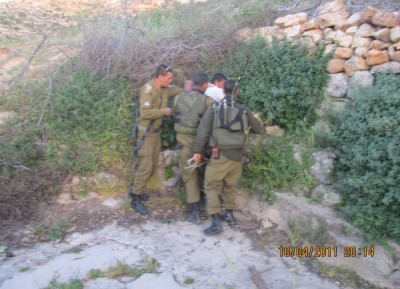
Why Israeli Officials are Chuckling: The ‘Stable’ West Bank Dilemma

PA police coordinate with Israeli border police to control Palestinian access to Jerusalem at the Bethlehem checkpoint. (Photo: ActiveStills.org)
By Ramzy Baroud | Palestine chronicle | April 16, 2014
Israel’s deputy foreign minister, Ze’ev Elkin, is a member of Benjamin Netanyahu’s Likud party and his predominantly rightwing cabinet. In a recent interview with The Economist, Elkin used the familiar tone of being conceited and oblivious to such notions as international or human rights, and reaffirmed his rejection of a Palestinian state.
Instead, Elkin wants Israel to annex a chunk of the West Bank. There is nothing new here, as such language is now official Israeli discourse. But one statement stood out, one that many Palestinians would find bewildering and exasperating.
These days, said Elkin with a chuckle, the West Bank is “the most stable part of the Middle East”.
The bewilderment would stem from the fact that the West Bank is an occupied Palestinian territory. Its population is held at gunpoint; they have no freedom, and enjoy no rights. Their land is seized by force to make room for more settlements and illegal Jewish settlers, now numbering well passed the half million mark.
Needless to say, the West Bank should not be stable.
Instead, Palestinians should be leading their own revolution until they achieve their full rights and freedom. This is not a call for violence, but a natural human course. However, Palestinians are not rebelling. Many factors are holding them back, one of which is the very Palestinian Authority in Ramallah. Its troops are in constant ‘security coordinations’ with Israel. Its ‘elite forces’ are trained by US generals and Arab armies. The PA mission is not to liberate Palestine, but to ensure the subservience of the Palestinians while Israel carries on with a colonial project that has extended for decades.
Deputy foreign minister Elkin knows this. Netanyahu himself, along with every Israeli official, understands that the PA, despite Mahmoud Abbas’ occasional attempts at appearing defiant and rebellious, is no threat to Israel, nor will it ever be. This will be so even if the US-imposed April 29 deadline for a ‘framework’ agreement between the Israeli government and the PA passes and even if Abbas took the seemingly daring step of signing the applications to join 15 international organizations. Abbas and his men understand that there are red lines which they cannot cross under any circumstances.
Abbas may be weak, but he is clever. He knew that Kerry’s peacemaking efforts would not go anywhere and that Israeli Prime Minister Benjamin Netanyahu would find a way to thwart the process. If Abbas were lucky, Kerry could even blame Israel for derailing the peace process, as he already has. Then, Abbas would do what many would find reasonable; seek further international recognition for the state of Palestine. This might frustrate the Americans a little, anger the Israelis a lot, but it would give his supporters reason to promote the 79-year-old leader as another Yasser Arafat, heroic and defiant to the very end.
The Israelis still need Abbas. He is important in maintaining ‘stability’ in the West Bank. This means the continuing of the security coordination that ensures the safety of the armed settlers, providing an extra layer of protection to Israeli soldiers as they kill at will, seize more land, demolish homes and trees, erect walls, dig trenches, and level mountains. So what if some imaginary state existed on papers in the files of some international body in Geneva or Brussels. For Israel, the law is that of its military, and reality is what is taking place in Area C, not in some European capital.
This is why Elkin is chuckling. He is at ease, in the same way the Israeli political establishment is. Since the signing of the Oslo Accords in 1993, a deal was struck between Israel and what became a pervasive, controlling and corrupt Palestinian political class. Israel maintained its military occupation, carried on with its colonial project and continued to disfigure the occupied territories in any way that it found consistent with its ‘security’ needs. Palestinian elites were granted economic privileges and access that is denied to the vast majority of the Palestinians.
The PA’s constant challenge is to maintain a level of legitimacy. True, it uses its monopoly on force, which is readily sanctioned by Israel, in order to arrest, torture and kill resisting Palestinians when necessary. It uses the logic of trickle-down economics to hold the bulk of Palestinians hostage to winning their daily bread. But that is not enough. It needs a brand to market itself as the exclusive harbinger of freedom for Palestinians. It uses slogans, flags and kuffiyas to promote that brand through its control of the media. Many PA supporters dance to that tune and playact that Abbas and only Abbas is capable of exacting the coveted liberation of Palestine from the obstinate hands of the Israeli prime minister.
Palestinian officials are proficiently inflating Abbas’ image to ensure that Palestinians don’t question the wisdom of their aging leader, after the latest and predictable failure of the peace process, which was never truly meant to succeed anyway. A Palestinian official spoke of Abbas’s refusal to heed a call by US Secretary of State John Kerry to halt applications to join international treaties. He claimed that Kerry warned Abbas of a ‘strong (Israeli) response to Palestinian action. Abbas replied: “Israel’s threats scare no one. They can do what they like.”
The words were repeated in Palestinian media. The Abbas image is being overstated once more. There is no space for those who question the man’s credibility, legitimacy or failed methods. More posters of the old man are now erected in the occupied Palestinian towns. His latest antics will help perpetuate the myth that the PA is a platform for resistance, not capitulation.
As long as the West Bank is ‘stable’, and as long Abbas, and those that follow him continue to sell Palestinians old illusions of revolutions that never took place, and heroes that only exist on colored posters hung around the streets of Ramallah, Elkin will continue to chuckle.
And as long as the West Bank is ‘stable’, Palestinians will never achieve their freedom, for submission achieves no rights; only resistance does.
– Ramzy Baroud is an internationally-syndicated columnist, a media consultant, an author and the editor of PalestineChronicle.com. He is a PhD candidate at the University of Exeter, UK. His latest book is “My Father Was a Freedom Fighter: Gaza’s Untold Story” (Pluto Press, London).
BRICS countries to set up their own IMF
By Olga Samofalova | Russia Beyond the Headlines | April 14, 2014
The BRICS countries (Brazil, Russia, India, China and South Africa) have made significant progress in setting up structures that would serve as an alternative to the International Monetary Fund and the World Bank, which are dominated by the U.S. and the EU. A currency reserve pool, as a replacement for the IMF, and a BRICS development bank, as a replacement for the World Bank, will begin operating as soon as in 2015, Russian Ambassador at Large Vadim Lukov has said.
Brazil has already drafted a charter for the BRICS Development Bank, while Russia is drawing up intergovernmental agreements on setting the bank up, he added.
In addition, the BRICS countries have already agreed on the amount of authorized capital for the new institutions: $100 billion each. “Talks are under way on the distribution of the initial capital of $50 billion between the partners and on the location for the headquarters of the bank. Each of the BRICS countries has expressed a considerable interest in having the headquarters on its territory,” Lukov said.
It is expected that contributions to the currency reserve pool will be as follows: China, $41 billion; Brazil, India, and Russia, $18 billion each; and South Africa, $5 billion. The amount of the contributions reflects the size of the countries’ economies.
By way of comparison, the IMF reserves, which are set by the Special Drawing Rights (SDR), currently stand at 238.4 billion euros, or $369.52 billion dollars. In terms of amounts, the BRICS currency reserve pool is, of course, inferior to the IMF. However, $100 billion should be quite sufficient for five countries, whereas the IMF comprises 188 countries – which may require financial assistance at any time.
BRICS Development Bank
The BRICS countries are setting up a Development Bank as an alternative to the World Bank in order to grant loans for projects that are beneficial not for the U.S. or the EU, but for developing countries.
The purpose of the bank is to primarily finance external rather than internal projects. The founding countries believe that they are quite capable of developing their own projects themselves. For instance, Russia has a National Wealth Fund for this purpose.
“Loans from the Development Bank will be aimed not so much at the BRICS countries as for investment in infrastructure projects in other countries, say, in Africa,” says Ilya Prilepsky, a member of the Economic Expert Group. “For example, it would be in BRICS’ interest to give a loan to an African country for a hydropower development program, where BRICS countries could supply their equipment or act as the main contractor.”
If the loan is provided by the IMF, the equipment will be supplied by western countries that control its operations.
The creation of the BRICS Development Bank has a political significance too, since it allows its member states to promote their interests abroad. “It is a political move that can highlight the strengthening positions of countries whose opinion is frequently ignored by their developed American and European colleagues. The stronger this union and its positions on the world arena are, the easier it will be for its members to protect their own interests,” points out Natalya Samoilova, head of research at the investment company Golden Hills-Kapital AM.
Having said that, the creation of alternative associations by no means indicates that the BRICS countries will necessarily quit the World Bank or the IMF, at least not initially, says Ilya Prilepsky.
Currency reserve pool
In addition, the BRICS currency reserve pool is a form of insurance, a cushion of sorts, in the event a BRICS country faces financial problems or a budget deficit. In Soviet times it would have been called “a mutual benefit society”, says Nikita Kulikov, deputy director of the consulting company HEADS. Some countries in the pool will act as a safety net for the other countries in the pool.
The need for such protection has become evident this year, when developing countries’ currencies, including the Russian ruble, have been falling.
The currency reserve pool will assist a member country with resolving problems with its balance of payments by making up a shortfall in foreign currency.
Assistance can be given when there is a sharp devaluation of the national currency or massive capital flight due to a softer monetary policy by the U.S. Federal Reserve System, or when there are internal problems, or a crisis, in the banking system. If banks have borrowed a lot of foreign currency cash and are unable to repay the debt, then the currency reserve pool will be able to honor those external obligations.
This structure should become a worthy alternative to the IMF, which has traditionally provided support to economies that find themselves in a budgetary emergency.
“A large part of the fund goes toward saving the euro and the national currencies of developed countries. Given that governance of the IMF is in the hands of western powers, there is little hope for assistance from the IMF in case of an emergency. That is why the currency reserve pool would come in very handy,” says ambassador Lukov.
The currency reserve pool will also help the BRICS countries to gradually establish cooperation without the use of the dollar, points out Natalya Samoilova. This, however, will take time. For the time being, it has been decided to replenish the authorized capital of the Development Bank and the Currency Reserve Pool with U.S. dollars. Thus the U.S. currency system is getting an additional boost. However, it cannot be ruled out that very soon (given the threat of U.S. and EU economic sanctions against Russia) the dollar may be replaced by the ruble and other national currencies of the BRICS counties.
Anti-govt protesters seize Ukrainian APCs, army units ‘switch sides’
RT | April 16, 2014
Kiev’s military faced off with protesters in east Ukraine on Wednesday to sort out their differences… and found none. Soldiers appeared reluctant to go into battle against anti-government activists.
When Ukrainian Armored Personnel Carriers (APCs) entered downtown Kramatorsk as part of Kiev’s military operation against anti-government protesters in the east of the country, they were stopped in their tracks, surrounded by crowds of local residents.
One YouTube video of what happened next shows a woman coming to a soldier with the reproach: “You are the army, you must protect the people.”
“We are not going to shoot, we weren’t even going to,” is the soldier’s reply.
Similar conversations could be heard at each of several APCs which entered the city, with locals promising to defend their neighbors, in case the soldiers start a military operation.
Military vehicles parked in downtown Kramatorsk have turned into hotspots for political discussion, with people beside the vehicles trying to get their views through to people on top of the tanks.
Another video features the Kramatorsk crowds loudly chanting “Army with the people” and applauding the soldiers as they were leaving their APCs.
“Guys, we are with you! You are great!” women are heard yelling to the vacating soldiers.
Six Ukrainian military vehicles in Kramatorsk actually switched sides and began flying Russian flags on Wednesday.
Later a report emerged that three more Ukrainian armored vehicles had switched sides in the Donetsk Region. The vehicles came to the center of Slavyansk, took down their Ukrainian flags and handed their weapons to self-defense squads.
“We decided not to be at war with the people and not to defend authorities like this,” members of the crews explained to RIA Novosti.
This YouTube video shows an encounter where some of the Ukrainian military vehicles raise Russian flags, while others raise the flags of the Donetsk People’s Republic that the supporters of federalization want to establish. The crowd reacted with loud cheers.
Vladimir, a resident of Kramatorsk who witnessed the events, told RT in a phone call that a clear majority of the soldiers who arrived at Kramatorsk in armored vehicles were “boys of only 18-20 years old, with their heads freshly shaved as they had just entered military service.”
Immediately after the column of armored vehicles was blocked near the local market, local residents surrounded the column with a human chain, but did nothing more, Vladimir said.
“Both sides were simply standing there and smoking, waiting for God-knows-what. Then the local militia came to the scene, and asked the locals to step back and started negotiations. The soldiers were asked if they would like to surrender. They thought a little bit – and agreed,” Vladimir said.
The soldiers and civilians started fraternizing very quickly and soon were joking about “coming for a visit without weapons next time.” Many of the soldiers put on St. George’s ribbons, the traditional Russian emblem used to commemorate the Soviet Union’s fight against Nazism in World War II.
The tanks have already been driven away to a safe place by the local militia, the witness said.
Vladimir said that Kramatorsk was not under siege, but he confirmed that there were armed checkpoints throughout the city. Military helicopters have been flying over the city since Tuesday, when there were clashes at the local airport. The local Internet connection is extremely unstable and mobile networks has been functioning only intermittently over the last few days, he said.
Tuesday, when the military operation against anti-government protesters in the east was launched, was not as peaceful.
According to activists, four people were killed and two others injured when troops seized an airfield in Kramatorsk, which had earlier been controlled by protesters.
Criminalization of Social Movements and the Political Opposition in Colombia
By Liliany Obando | CounterPunch | April 15, 2014
Translator’ note: Liliany Obando is a sociologist, documentary film maker, and single mother of two children. She was serving as human rights director for Fensuagro, Colombia’s largest agricultural workers’ union, when, on August 8, 2008, Colombian authorities arrested her. A week previously, Obando had issued a report documenting the murders of 1500 Fensuagro union members over 32 years. Prosecutors accused her of terrorism and belonging to the Revolutionary Armed Forces of Colombia (FARC)
After 43 months, Obando left prison on March 1st 2012. She remained under court jurisdiction, because she had not been sentenced or convicted. Eventually, in 2013, a judge, accusing Obando of serving on the FARC’s International Commission, convicted her of “rebellion.” She was sentenced to five years, eight months of house arrest and fined 707 million pesos, ($368,347 USD). The charge against Obando of handling “resources relating to terrorist activities” was dropped.
On April 3, 2014, Obando learned that the Supreme Court had rejected her appeal. Her fine stands. She must serve one more year of house arrest. The government’s case against Obando and other prisoners rests on files taken from computers of FARC leaders seized during a military attack on a FARC encampment in Ecuador on March 1, 2008. In 2011 the Colombian Supreme Court invalidated the legal standing of such material. Obando and her family continue to experience police surveillance, harassment, and media slander. – Translated by W. T. Whitney Jr.
Although we Colombians, especially those of us who belong to social, human rights, and political organizations and labor unions, are used to carrying out our work in risky situations, sometimes things get worse. This is one of those unlucky times. It coincides with the pre-election contest.
In a cycle that repeatedly sends us back to a repressive past – one they don’t want to close down – we are witness to a perverse return to obscurantism and forced unanimity, to dissident thinking being considered subversive, to social protest having to be silenced at whatever cost, and where opposition guarantees are only a chimera. These are practices far removed from the duty of a state, especially one proclaiming itself as the continent’s oldest, most solid “democracy.”
Many years ago, and in tune with the U. S. obsession for transforming the idea of security into state policy, one outcome being anti-terrorism, the government of Álvaro Uribe Vélez during his first term (2002-2006) instituted in Colombia the politics of “Democratic Security.” That gave rise to a series of actions damaging to the right to liberty, to guarantees like equality, legality, and judicial norms, and, generally, to an international framework for human rights.
The strategy of arbitrary detentions imposed under the pretext of maintaining security of the state, and for “good citizens,” has its origins there. The modalities used were illegal interceptions, the network of informants, the Law of Justice and Peace and its accusers, and intelligence reports – or battlefield reports. They fueled judicial set-ups.
During 2002-2004, this strategy of the Uribe government entailed the practice of massive incarcerations carried out nearly always within the context of military operations or joint operations involving the attorney general, the police, and military forces. Primary backing came from Decree 2002 of 2002 relating to internal upheaval and also from an attempt at constitutional reform. In the beginning, these incarcerations were confined to supposed “zones of rehabilitation and consolidation.” Their boundaries were set through Decree 2929 of December 3, 2002. Then they spread the length and breadth of the national territory.
Later, from 2004 on, in a change of strategy, massive detentions were converted into selective detentions against specified sectors of the population: unionists, defenders of human rights, social and populist activists from academia, and/or opposition militants. These people were considered dangerous to the state politics of “Democratic Security” then being advanced as part of a return to the dark era of Turbay Ayala and his “Statute of Security.” (1)
That’s where all this recent wave of stigmatization, persecution, criminalization, judicial processing, and incarceration came from. It’s directed against social, labor, and human rights organizations, and opposition political parties. Their members, leaders, and activists at the base are pointed to as being little else but the activists, “civilian guerrillas,” or at least collaborators of the insurgencies, that is to say, their social base. As regards these last, Uribe disregarded their political character and classified them as “terrorist” groups. Once more the concept of political crime was being manipulated.
Juan Manuel Santos, as defense minister in the Uribe government, first made his mark chiefly by implementing “Democratic Security.” Now as president he continues it. He will be able to change its form, but not its essence. Indeed, Santos has turned to acknowledging that armed conflict does exist in Colombia and also, on that account, that the insurgencies have a political character, although he doesn’t say it openly. If it were otherwise, the current process of peace negotiations in Havana would have been inconceivable. Yet he has not altered the treatment of politically – oriented persons facing prosecution, nor does he accept the very existence of political prisoners.
In 2012, Santos, mocking his given word, blocked international oversight of prisons and verification of the situation of political prisoners as called for by the group PeaceWomen Across the Globe. The government had agreed to accept the FARC’s handing over the last prisoners of war they were holding in return for that group’s good offices. (2) The opportunity ended once more with an official denial that political prisoners exist in Colombia.
Judicial handling of persons criminalized under the strategy of “security” and anti-terrorism changed substantially, much to the disadvantage of people being porosecuted. Indeed, a person being investigated for supposed ties with insurgents used to be processed for the political “crime” of rebellion. Beginning with Uribe and then Santos, however, they are now being handled under the logic of anti-terrorist struggle. As a result, members of the social and political organizations who face prosecution are now being blamed for one or more NON – political crimes having to do with terrorist activities. That’s over and above their being judged as rebels. This signifies, primarily, that for persons being prosecuted under this approach, guarantees like due process, legitimate defense, technical defense, and presumption of innocence – among others – amount to very little.
Consequently, we attend audiences of our comrade detainees in specialized courtrooms, not the ordinary ones. In these special sessions, investigations are carried out directed at very serious crimes, thereby removing the allegations from the area of “political crime.” And more: investigation and trial periods end up being extended over a long time and sentences are more onerous.
And as a matter of fact, Colombian justice applies the presumption of guilt, not of innocence. At the start, those involved in such processes are classified as “dangerous for society.” Therefore, having been charged, they know beforehand they are going to prison for a long time and there have to prove their innocence. But inside prison and incarceration establishments, they are treated just like those who have already been convicted. This is contrary to international law dealing with prison populations, which in Colombia is a dead letter. One must not forget, furthermore, that Colombia is one of the countries in the world that most abuses preventative detention. As a result, many people in this situation choose to accept charges against them and thus reduce their time in dark Colombian prisons and not have to wait long years while they prove their innocence.
And as if that were not enough, the institution that, by definition, should keep watch on the state so it fulfills its mandate to guarantee respect for citizens’ fundamental human rights, that is to say, the attorney general, acts in a perverse way. That office has switched over to being an inquisitorial entity that persecutes even public functionaries already absolved through having served their prison terms. Their political rights and rights as citizens are seriously affected.
By way of putting a face on this political tragedy, here are some of the leaders and activist members of social and political organizations who have recently endured judicial processes and are imprisoned: Unionists – Campo Elías Ortiz, Héctor Sánchez, José Dilio, Darío Cárdenas, Huber Ballesteros; From the Patriotic March social and political movement – Wilmar Madroñero; Professors – Francisco Tolosa, Carlo Alexander Carrillo, Miguel Ángel Beltrán Villegas, Fredy Julián Cortés, William Javier Díaz; Students – Erika Rodríguez, Xiomara Alejandra Torres Jiménez, Jaime Alexis Bueno, Diego Alejandro Ortega, Cristian Leiva Omar Marín, Carlos Lugo, Jorge Gaitán; Human Rights defenders – David Ravelo Crespo, Liliany Obando.
The number of political prisoners in Colombia – prisoners of conscience and prisoners of war – exceeds 9500. The worst of it is that there is no calm after prison. The trailing, the threats, the stigmatization continue until many of those who are released – if they are lucky – have to leave the country. And many others remain marginalized and no longer part of their previous social and political organizations, which is regrettable. So too is that purpose of the overall strategy which is to weaken social organizations and the political opposition, and dismember them.
Such are the perverse effects of politics in Colombia centering on judicial processes and criminalization of critical thinking, social protest, and political opposition. We are called upon actively to confront politics like these if we want to put a check on such abuse of power.
Silence is no alternative, nor is inaction.
Freedom for Colombian political prisoners!
Long life for butterflies! (3)
Notes:
1. Julio César Turbay Ayala was the Liberal Party President of Colombia in 1978-1982.
2. The international women’s group facilitated the unilateral freeing of ten soldiers and police by the FARC in 2012 through the women’s promise they would visit political prisoners in Colombian jails.
3. The reference, used in connection with recent conferences and mobilizations in Colombia on behalf of political prisoners, commemorates a movement for freedom for political prisoners that developed in the Dominican Republic in 1959. The expression does honor to the Mirabel sisters there who were jailed and murdered.
Liliany Obando, Political prisoner, under judgment (subjudice) Defender of Human Rights, Colombia, April, 2014.
ASA Increases Membership, Support in Wake of Academic Boycott of Israel Endorsement
By Chris Carlson |International Middle East Media Center | April 13, 2014
In the wake of the American Studies Association’s December 2013 endorsement of the Palestinian civil society call for an academic boycott of Israel – and as two efforts to legislate against academic boycotts fail to move forward in the Illinois and Maryland state legislatures – the ASA has gained new members and support. Over the past several months, the ASA has welcomed more than 700 new members. The ASA has also collected more membership revenue in the past three months than in any other three-month period over the past quarter-century and its ongoing “Stand with the ASA” grassroots fundraising campaign has exceeded the association’s expectations thus far.
Last week, South African Archbishop Desmond Tutu, winner of the Nobel Peace Prize, released a statement in support of the ASA’s boycott efforts. In it, he states that: “In South Africa, we could not have achieved our democracy without the help of people around the world, who through the use of non-violent means, such as boycotts and divestment, encouraged their governments and other corporate actors to reverse decades-long support for the Apartheid regime. … The [anti-boycott] legislation being proposed in the United States would have made participation in a movement like the one that ended Apartheid in South Africa extremely difficult.” The day before his statement was released, an Illinois State Senate Committee rejected a resolution condemning academic boycotts. A bill to defund universities that subsidize faculty associations with organizations supporting boycotts was also scuttled in Maryland, where non-binding condemnatory language was instead inserted into the budget bill.
ASA President Curtis Marez stated, “Despite the backlash of the last few months, the ASA is thriving. The boycott vote is consistent with our longstanding support for human rights and opposition to war and militarism. Many Americans are now for the first time hearing about their government’s support for the occupation and discriminatory laws against Palestinians. I’m proud that the ASA helped open up discussion about BDS (Boycott, Divestment, and Sanctions) and the difference it can make.” Commentary by ASA leaders, members and supporters was published in the Los Angeles Times, Chronicle of Higher Education,Washington Post, New York Times, CNN.com, and the Chicago Tribune, among other news outlets.
In response to the legislative threats from politicians, threatened legal action, and physical threats from others, veteran attorneys have stepped forward to assist the ASA in responding to such legal bullying for taking a principled stand in support of Palestinian human rights. The ASA is not the only organization to face such bullying; in 2013 alone, Palestine Solidarity Legal Support, an initiative built in partnership with the Center for Constitutional Rights,documented more than 100 cases of legal and other intimidation against Palestinian rights activists on U.S. campuses.
Incoming ASA president Lisa Duggan noted, “We are looking forward to our upcoming annual meeting in November, which will feature a wealth of panels and events presenting first-rate American Studies scholarship on topics ranging from the politics of settler colonialism and transnational Black studies to popular culture and contemporary performance art. We will be welcoming Palestinian and Israeli scholars along with large contingents of other international ASA members poised to continue addressing matters of global concern affecting all of us.”
Harper Zionists seek to boost Canada thought crime law
By Brandon Martinez | Press TV | April 11, 2014
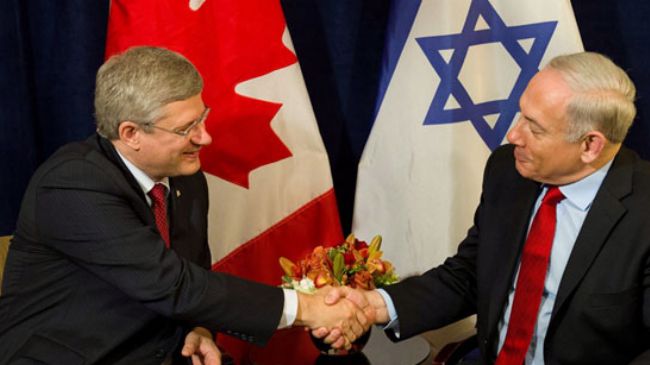
The Zionist ruling clique of Canada, through their front-man Stephen Harper, is seeking to beef up the already-existing Orwellian “hate propaganda” law which has been primarily used to curtail criticism of Zionists and Israel.
The conspicuous change is buried in the Harper government’s proposed cyberbullying law, Bill C-13.
The existing law in Canada’s criminal code makes it illegal to “promote hatred” (whatever that means) of people “distinguished by colour, race, religion, ethnic origin or sexual orientation,” explained The Chronicle Herald, but Bill C-13 intends to expand that category to include age, sex, mental or physical disability, and most disturbingly, “national origin.” In other words, you cannot criticize anyone for any reason at all!
This means, say, if you condemn Israelis for their inhumane treatment of Palestinians, you could find yourself in court facing down the self-appointed thought police and commissars of political correctness.
The … law against “hate speech” is illegitimate and ridiculous to begin with. The idea of allowing a government to legislate against opinions and feelings is patently absurd – it is pulled right out of George Orwell’s dystopian classic 1984.
British Columbia native Arthur Topham has felt the wrath of Canada’s censorious establishment. In November 2012, at the instigation of the Zionist society of B’nai B’rith, Topham was charged with a ‘hate crime’ for publishing anti-Zionist articles on his website Radical Press.
One of the items on Topham’s site that made the Zionists convulse and contort with unrestrained anger and rage was a satire called Israel Must Perish. The text was nothing more than a spoof of a 1941 book authored by a Zionist … named Theodore Kaufman entitled Germany Must Perish! In that text Kaufman called for “a final solution” of German extinction. Topham merely substituted the words “German,” “Germany” and “Nazi” with “Israel,” “Jew” and “Zionist” throughout the text. Despite writing a clearly-worded preface explaining the satirical nature of the text, Topham was arrested by the RCMP and now faces the possibility of spending up to two years behind bars for violating Zionist sensibilities.
Many will recall the sad saga of German-Canadian publisher Ernst Zundel. In the mid-1980s Zundel was charged with “spreading false news” after he published a book, Did Six Million Really Die?, which questioned some aspects of the official “holocaust” story. In the ensuing show trial, Zundel and his team of revisionist historians as well as his indefatigable defence lawyer Douglas Christie brought the holocaust lobby to its knees with facts and information refuting many claims made by Zionists about Germany’s WW2 concentration camps.
Over the span of three decades, Zundel was dragged from courtroom to courtroom, from jail cell to jail cell, merely for expressing a viewpoint deemed verboten by the … Zionist establishment – the self-appointed architects of public discourse, the self-declared arbiters of truth and morality, the self-proclaimed “chosen people” whose faults are unseen and whose character is unimpeachable.
Zundel, a self-described pacifist with no criminal record, was physically assaulted on numerous occasions by Jewish Defence League thugs. His Toronto home, which also housed his publishing and graphic arts businesses, was bombed and torched by Zionist terrorists. He received death threats on a daily basis from members of the “chosen race of God,” but the Toronto Police did almost nothing to prevent any of it and was entirely uninterested in pursuing the criminals and thugs responsible for the campaign of terror against Zundel and his associates.
Zundel’s story is a testament to the power and control of Jewish extremists in Canada, whose agenda is anything but altruistic and whose disposition is more racist than the Klan.
In the “New World Order” being imposed on us by self-interested, ethnocentric megalomaniacs, no man has the right to explore, investigate and come to his own conclusions about history — that is the sole responsibility of the tyrannical monarchs of the NWO, who tell us what and how to think; free thought be damned.
Brandon Martinez is a freelance writer and journalist from Canada whose area of expertise is foreign policy, international affairs and 20th and 21st century history. His writing is focused on issues such as Zionism, Israel-Palestine, American and Canadian foreign policy, war, terrorism and deception in media and politics. Readers can contact him at martinezperspective@hotmail.com.
German forces raid offices of “Hezbollah affiliated” charity
Al-Akhbar | April 8, 2014
German authorities on Tuesday raided the offices of a charity organization that allegedly has ties to Lebanon’s Hezbollah movement, accusing it of raising money for the group.
Around 150 police officers searched premises across six states and confiscated cash, computers and around 40 boxes of files.
Two bank accounts with a total of around 60,000 euros were frozen but no arrests were made, the German interior ministry said.
The ministry said it had outlawed the “Waisenkinderprojekt Libanon” (Orphan Children Project Lebanon) with immediate effect.
“The name of the group masks its actual purpose,” ministry state secretary Emily Haber said in a statement.
She said the organization based in the western city of Essen had raised 3.3 million euros ($4.5 million) in donations between 2007 and 2013 for the Lebanese Shahid Foundation, which supports families of fallen Hezbollah fighters.
Haber claimed the funds were used to recruit fighters “to combat Israel, also with terrorist measures” and compensate the families of suicide bombers.
The statement did not cite its evidence. Hezbollah used to carry out suicide missions against Israeli occupation forces in South Lebanon prior to their retreat in 2000.
The group has not used that tactic since Israel pulled its army from Lebanon 14 year ago.
“Organizations that directly or indirectly from German soil oppose the state of Israel’s right to exist may not seek freedom of association protection,” Interior Minister Thomas de Maiziere said in the statement.
He said the group’s goals violated Germany’s constitution.
The European Union in July last year also listed Hezbollah’s so-called military wing as a “terrorist organization.” But the EU said it would continue to deal with Hezbollah as a political entity.
The German interior ministry said it had put Waisenkinderprojekt Libanon, which has about 80 members, under surveillance since 2009.
(AFP, Al-Akhbar)
Featured Video
Trita Parsi: Israel Set a Trap for Total War in the Region
or go to
Aletho News Archives – Video-Images
Book Review
Why the War on Conspiracy Theories Is Bad Public Policy
By Kevin Barrett • Unz Review • February 1, 2019
 A Review of Conspiracy Theories and Other Dangerous Ideas by Cass Sunstein (based on an earlier paper co-authored with Adrian Vermeule); In Defense of Troublemakers: The Power of Dissent in Life and Business by Charlan Nemeth; and Conspiracy Theories and the People Who Believe Them, edited by Joseph E. Uscinski
On January 25 2018 YouTube unleashed the latest salvo in the war on conspiracy theories, saying “we’ll begin reducing recommendations of borderline content and content that could misinform users in harmful ways—such as videos promoting a phony miracle cure for a serious illness, claiming the earth is flat, or making blatantly false claims about historic events like 9/11.”
At first glance that sounds reasonable. Nobody wants YouTube or anyone else to recommend bad information. And almost everyone agrees that phony miracle cures, flat earthism, and blatantly false claims about 9/11 and other historical events are undesirable.
But if we stop and seriously consider those words, we notice a couple of problems. First, the word “recommend” is not just misleading but mendacious. YouTube obviously doesn’t really recommend anything. When it says it does, it is lying. … continue
Blog Roll
 Aletho News
- Araghchi blasts ‘parasitic’ alliance as US taxpayers pay for Israel’s war on Iran
- Easy fix for Europe’s chaos? Stop fueling war against Russia
- Putin’s key remarks on peace talks and Europe’s ‘schizophrenia’
- Trita Parsi: Israel Set a Trap for Total War in the Region
- Trump’s Iran war is on an Israeli leash
- Saudi oil boss issues global supply warning
- Riyadh Says Its Oil System Is Intact. The Numbers Say Otherwise.
- Trump and Netanyahu Want to “Finish the Job” on Iran
- US ‘one-sided dictation’ not Iran’s beliefs makes rational talks impossible: Baghaei
- Iran’s Next Strike May Not Explode. It Could Shut You Down /Col Doug Macgregor
- If Americans Knew
- The outsourced risk: how newsrooms rely on Gaza’s freelancers without protecting them
- Gaza bakeries forced to shut as Israel blocks flour shipments
- Gaza’s breast cancer patients face a deadly wait for treatment amid Israel’s genocide
- DAILY UPDATE: Latest essential news on Palestine, Israel, & region
- The Israel Lobby’s Changing Fortunes
- AIPAC has become such a political liability that it’s shifting to a more “nimble” approach to buying politicians
- At least 160 Israeli settler attacks in 2 weeks
- Will Gaza’s Ancient Christian Community Disappear Forever?
- Israel’s vision of regional security rests on keeping Arab states weak
- Heidi Levine recounts how Palestinian youths helped save her in settler attack
- No Tricks Zone
- E-Cars Reduce CO2 Emissions By Only 41% Compared To Internal Combustion Engine Vehicles
- Predictions Made By Renowned Climate Professor Over Past Decades Have Been Proven To Be Poor
- New Study Suggests Large Regions Of The Pacific Ocean Have Been Cooling For The Last 80 Years
- Germany’s Green Energy Debacle: High Energy Costs Force Kahla Porzellan to Close After 182 Years!
- New Study: 50 Years Of The Most Aggressive ‘Net Zero’ Policies Can Only Affect The Global Climate By 0.03°C
- US September “Heat” Was No Record…Many Records Set Decades Ago
- Latest European Green Energy Debacle; Portugal’s Largest Flagship Solar Park Insolvent!
- Green Energy Debacle: German Expert Professor Fritz Vahrenholt Warns Of Severe Economic And Social Consequences
- Two More Paleo Reconstructions Affirm Meters-Higher Sea Levels Across Ireland, Brazil 7000-6000 Years Ago
- New Study: Earth And Venus Surface Warmth Largely Explained By Convection And Lapse Rate, Not CO2 Or Radiation

