PFLP: Hamas should not abandon their ideology
Ma’an – 30/12/2013
GAZA CITY – Hamas are a vital component of the Palestinian nationalist struggle and should not abandon their ideology, the Popular Front for the Liberation of Palestine said Monday.
The statement from the leftist group was in response to a recent call by the PLO for Hamas to dissociate itself from the Muslim Brotherhood.
“We are not calling on Hamas or other forces to abandon their ideological roots, but we ask everyone to give priority to the interests of the Palestinian people when they build relations with the surrounding Arab and Islamic world,” the PFLP said.
On Saturday, Jamal Muheisin, a Fatah representative in the PLO executive committee, said Hamas should detach itself from the Brotherhood, warning of political, economic, and security consequences if Hamas remained “subordinate” to “this banned terrorist group.”
A representative of the Arab Liberation Front said that Hamas has always prioritized the Muslim Brotherhood’s interests over the interests of the Palestinian people, while Ahmad Majdalani of the Palestinian Popular Struggle Front said Hamas was viewed as a terrorist organization by many countries including the United States due to its affiliation with the Brotherhood.
PFLP official Rabah Muhanna was one of many faction leaders who also called upon Hamas to sever relations with the Muslim Brotherhood.
Gaza government spokeswoman Isra Almodallal told Ma’an last week that while Hamas and the Muslim Brotherhood may share ideology, they should not be seen as one and the same movement.
“We are in completely different circumstances,” Almodallal said. “We don’t want people to think Hamas is the same as the Muslim Brotherhood.”
“We don’t want Egypt to punish us the way the Muslim Brotherhood is punished in Egypt.”
Almodallal added that Hamas agreed that “at this particular time” it is best to remain neutral in the affairs of other Arab countries.
Related article
- PLO Urges Hamas To Sever Ties With Muslim Brotherhood (eurasiareview.com)
Israeli forces shoot photographer in Bilin demonstrations
Ma’an – 29/12/2013
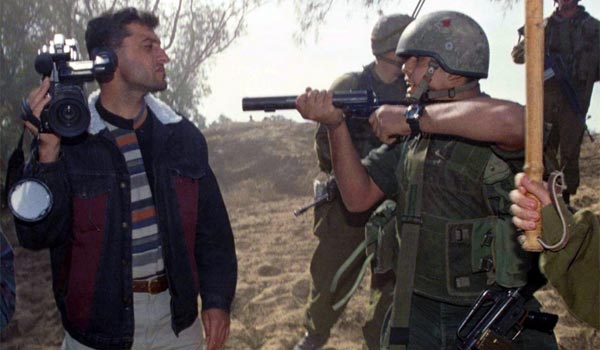
RAMALLAH – A photographer was injured and dozens suffered from excessive tear gas inhalation as Israeli forces dispersed a demonstration in Bilin near Ramallah.
Israeli forces fired rubber-coated steel bullets, tear gas and stun grenades at demonstrators as they neared their lands close to the wall.
Photographer Mohammad Yassin, 20, was hit with a rubber coated steel bullet during the protests.
The demonstration was held in celebration of Christmas and the release of Samer Issawi, and in protest of Israeli settlement activity and the separation wall.
Participants, some of whom wore Santa Claus costumes, raised Palestinian flags and chanted songs for unity and resistance.
Since 2005, Bilin villagers have protested on a weekly basis against the Israeli separation wall that runs through their village on land confiscated from local farmers.
Previous protests by Bilin activists have forced the Israeli authorities to re-route the wall, but large chunks of the village lands remain inaccessible to residents because of the route.
Related article
Mazal Tov to Chomsky and Jews Voice for Peace
By Gilad Atzmon | December 28, 2013

JVP is moving from strength to strength. Though it didn’t liberate Palestine yet, it certainly managed to convince a few Jews that Jewishness is actually a good thing.
Today we learned that the legendary activist and scholar Noam Chomsky appealed to the general public to donate to the Jews only Group.
In the letter Chomsky admitted that “these days, there are really only a handful of Jewish organizations that honor the traditions of universal equality that inspired me to be an activist so many years ago.”
Chomsky is no doubt a clever boy, he surely knows why there are only a handful of Jewish organizations that subscribe to universalism. Jewish culture and identity politics are tribal. In other words, Jewish politics is anything but universal. Chomsky knows very well that JVP is a Jews only group. Though it is happy to take donations from everyone, its leadership is Jewish. Accordingly, Ahmad, Salem or Ali wouldn’t become JVP’s leaders. They are not racially qualified.
So I am left wondering what Chomsky has in mind when he refers to “Jewish organizations that honor the traditions of universal equality”? Can a Jew only organization be universal? I guess that Chomsky would say ‘yes’, as long as it is universally Jewish.
‘Blood Diamonds’ and Israel’s Diamond Export Industry
By Sean Clinton | Palestine Chronicle | December 28, 2013
In November, members of the Kimberley Process (KP), meeting in plenary in South Africa, squandered what was probably their last good opportunity to ban the sale of all blood diamonds, including cut and polished blood diamonds which are an important source of funding for the nuclear armed regime in Israel which stands accused of the crime of apartheid, war crimes and crimes against humanity.
The governments with a vested interest in the diamond industry, that set up and control the KP, failed to amend the definition of a “conflict diamond” which is restricted to “rough diamonds used by rebel movements or their allies to finance conflict aimed at undermining legitimate governments”. All other diamonds associated with human rights violations evade the KP regulations.
The failure was well flagged in advance as key stakeholders, including South Africa which chaired the KP in 2013, had voiced opposition to reforms that would broaden the remit of the KP to embargo diamonds associated with human rights violations by government forces.
Some jewelers refuse to sell diamonds sourced in the Marange area of Zimbabwe where government forces are reported to have killed 200 miners. However, most if not all, of the worlds leading jewelers sell diamonds processed in Israel where the industry generates about $1 billion annually for the Israeli military which is guilty of grievous human rights violations in Palestine .
With the KP chair passed to China for 2014, and Angola in line for 2015, no one believes they will implement the changes necessary to ban the trade in all blood diamonds.

Corporate Posturing
Corporate social responsibility statements – the moral beacons of wannabe ethically progressive companies – amount to little more than window-dressing unless they are supported by rigorous enforcement. No amount of charitable support for a company’s favorite worthy causes can mitigate, directly or indirectly, providing a revenue stream for rogue regimes guilty of gross human rights violations.
Anglo American plc owns 85% of De Beers making it one of the worlds leading diamond companies with interests at all stages of the supply pipe from mining to retail. De Beers promote their own “Forevermark” diamonds many of which are crafted in Israel . Their promotional literature claims “Forevermark is committed to upholding the highest business, social and environmental standards and practices across its and its partners businesses”.
Anglo American’s Sustainable Development Policy stipulates that suppliers are expected to uphold “fundamental human rights and fair labour practices, in line with internationally recognized standards”. Suppliers must also “oppose corruption, bribery, fraud…. and must not tolerate any form of money laundering or participate in other illegal incentives in business”.
Despite this, De Beers continues to sell diamonds crafted in Israel even though the Israeli diamond industry is notorious for discrimination in the workplace against non-Jews – a fact confirmed by data from the Israeli Bureau of Statistics and a recent government-funded initiative to encourage ultra-Orthodox Jews to take up employment in the diamond industry without a similar initiative for non-Jews. Furthermore, although authorities uncovered the “world’s largest illegal bank”, involving fraudulent trading worth billions of shekels, in the Israeli Diamond Exchange in 2012, Anglo American continues trading with Israeli diamond companies.
Anglo American’s failure to abide by their own standards exposes their hypocrisy – a double-standard that permeates the jewellery industry when it comes to blood diamonds from Israel .
The Steinmetz Diamond Group, one of Tiffany’s biggest suppliers and a “unique partner” of Sotheby’s Diamonds, through the Steinmetz Foundation, funds and supports a Unit of the Givati Brigade of the Israeli military. The Givati Brigade is guilty of the massacre of at least 21 members of the Samouni family in Gaza – a war crime documented by the UNHRC and other human rights organizations.
Other world-leading jewelers including Harry Winston, Cartier, Ritani, Blue Nile, Zales, Brilliant Earth, Graff Diamonds, Chow Tai Fook, Chopard and many more, sell diamonds from Israel which are tarnished with Palestinian blood – one of the most recent victim being a 15 year old child, Wajih Wajdi al-Ramahi, shot in the back and killed by the Givati Brigade on 7th December. He was the 26th Palestinian to be killed by the Israeli military this year.
The imperative for all businesses to respect human rights and ensure their business relationships are not contributing to adverse human rights impacts is a well established tenet affirmed in the UN Guiding Principles on Business and Human Rights, the UN Global Compact, and the OECD Guidelines for Multinational Enterprises. The fact that the diamond industry, which accounted for 31.2% of Israel ’s manufacturing exports in 2011, is a very significant source of revenue for the regime in Israel means jewelers that sell diamonds processed in Israel help fund the commission of war crimes and suspected crimes against humanity.
Shareholders of companies that sell diamonds linked to atrocities and bloodshed are exposed to financial and legal hazard. The fraudulent misrepresentation of such diamonds as conflict-free leaves jewelers open to challenge by patrons angered by the fact that diamonds they purchased in good faith are de-facto blood diamonds. Companies complicit in human rights violations may be liable for reparations, which, in the case of victims of Israeli violence in Palestine , could amount to billions of dollars.
Despite Israel ’s record as a serial human rights offender and it’s nuclear weapons stockpile which it refuses to submit to international regulation, the leaders of the global diamond industry continue to give Israel refuge in the KP tent.
Consumer Power
If consumers are to have confidence in the ethical credentials of diamonds civil society needs to regain the initiative. This can be done by putting the jewellery industry under the spotlight and demanding that jewelers guarantee the diamonds they sell are not a source of funding for, or in any way associated with, serious human rights violations – i.e. they are not blood diamonds.
As cut and polished blood diamonds from Israel legally enter the diamond market in vast quantities (50% of the US market), diamond buyers should demand to know where a diamond was sourced, cut and polished if they want to avoid buying a blood diamond.
Diamond buyers should not allow jewelers to fob them off with assurances about “conflict diamonds” – the sacrificial offering which only encompasses rough diamonds that fund rebel violence against legitimate governments. This distracts from, and blinds consumers to, the extensive trade in cut and polished blood diamonds which continues unchecked and largely unreported by media.
“Ethically sourced” are some of the buzz words hammered into the conscience of diamond buyers. Rough diamonds at source represent but a small fraction of the value of the cut and polished diamonds sold by jewelers. Ethically sourced diamonds can still be blood diamonds if revenue they generate after sourcing is used to fund human rights violations. “The “ethically sourced” pitch is a scam – it offers zero protection from blood diamonds.
Another example of the duplicity of the jewellery industry is the widespread abuse of the term conflict-free. This is part of a bogus System of Warranties introduced by the World Diamond Council which allows sellers to self-certify diamonds as conflict-free based on the fact that they are in compliance with the discredited Kimberley Process which gives legal cover to blood diamonds that fund government forces.
Related article
Boeing’s Union Workers in the Crosshairs
By David Macaray | Dissident Voice | December 26, 2013
A brief summary of what’s been happening in Seattle between the Boeing Corporation and its union workforce, the IAM (International Association of Machinists and Aerospace Workers). Aware they have the upper hand, and that thousands of relatively well-paying jobs hang in the balance, Boeing has resorted to an unsubtle form of carrot-and-stick extortion.
The carrot: If the IAM agrees to re-open the existing contract and give the company several gut-wrenching concessions involving pensions, health care and future wages, Boeing will stay put, the jobs will remain in Seattle, Boeing, as planned, will allow the IAM to build its new 777X jet airliner, and the future will be rosy. As the seminar creatures like to say, it’s a win-win.
The stick: However, if the IAM doesn’t agree to the concessions, the Boeing Corporation will move its 777X operation out of the state of Washington and allow other, more reasonable and dependable states to bid on the job. According to Boeing, who gleefully leaked the news to the media, 22 states have already shown interest.
More stick: Realizing it has enormous leverage, and unwilling to let that advantage go unexploited, Boeing issued an ultimatum to the state of Washington. Unless it gave the company a huge tax break, they would pack up and leave. In a special legislative session, the state assembly, at the urging of the governor, granted Boeing more than $8 billion in tax breaks, the largest corporate subsidy in U.S. history.
So far, so good. Everything was coming up roses for Boeing. It had a state government eating out of its hand, it had the union back on its heels, playing defense, and it had the media doing its bidding. Then a startling and horrific event occurred. Godzilla ate the carrot and stick.
By a whopping 2-1 margin, the union local, District 751, voted down the offer. To be clear, this was specifically a vote on the company’s re-opener. With the contract still in effect, it wasn’t a prelude to a strike. What the membership was saying with their “no” vote was that the current contract must remain in force until it expires, in 2016, at which time the parties would negotiate a new one, just as they always have.
After that, things got ugly. Boeing closed ranks and renewed its threat to leave, the state assembly had a cow, and the IAM International demanded that another vote be taken, a move that, understandably, created heartburn at the local. District 751 doesn’t want another vote on an inferior contract. Yet, with so much at stake, a very nervous International is insisting that the membership take another look at it.
There’s an old axiom in contract negotiations called the “two vote rule.” It states that a membership will vote down a contract no more than twice. They’ll vote it down once, to show their disapproval, they’ll vote it down twice, to show their defiance, but the third time around—partly from fatigue, partly from the realization that it’s likely the best offer they’re going to get—they’ll vote to ratify (unless they move to strike).
Thus, the union leadership’s fears are not unfounded. Rather than buying into the company’s rhetoric, they see the Boeing move for the audacious and naked power play it is. The IAM International may be too scared to call Boeing’s bluff, but District 751 isn’t. In their view, all this talk about moving the 777X out of Seattle is just that….talk.
Not only are Boeing’s profits at a record high, the union believes if Boeing truly thought that uprooting its Seattle operation and moving to another state made the best business sense, they would have done it. What’s to prevent them? If moving was the “right” thing to do, they would have already moved. This is a bluff, plain and simple.
Per the International’s demand, another vote is scheduled for January 3. Unlike the bad old days, when certain unnamed unions (okay, the Teamsters) could unilaterally ratify a contract on behalf of the members, today’s unions are wildly democratic. The members have the final say, and votes are conducted by secret ballot.
If District 751’s leadership can maintain discipline and keep the membership’s eye on the ball, this re-opener will be voted down. And if there’s another vote following this one, we can only hope that the union is able to disprove that old “two vote rule.” After all, weren’t rules meant to be broken? Onward!
David Macaray can be reached at: dmacaray@earthlink.net.
Temper Tantrums in US, Canada over Falk Comments to RT
By Richard Edmondson | December 22, 2013
Separate tirades against highly esteemed international law authority Richard Falk were launched one day apart from each other in Washington and Ottawa over remarks Falk made last week to RT.
A week ago RT’s program “The Truthseeker” aired a segment on the recent findings of the Kuala Lumpur War Crimes Tribunal—a segment that also included comments from Falk, the UN’s Special Rapporteur on Palestine, as well as footage of flooding of Gaza’s streets.
The tribunal found Israel guilty of genocide against the Palestinians, and in his remarks to RT Falk stated, “When you target a group, an ethnic group, and inflict this kind of punishment upon them you are in effect nurturning a kind of criminal intention that is genocidal.”
Hardly a controversial statement. However, Canadian Foreign Minister John Baird called the comments “appalling” and said they “underscore once more the complete and total absurdity of his (Falk’s) service as a UN Special Rapporteur.” Baird also demanded the UN Human Rights Council “remove Falk from his position immediately.”
Not to be outdone, US State Dept. mouthpiece Jen Psaki lambasted Falk’s remarks as “despicable and deeply offensive” and called upon Falk to step down from his UN post—once again substantiating Washngton’s reputation as “Israeli occupied territory.”
Coming up in a few days the world will mark the fifth anniversary of Operation Cast Lead, a frenzy of military high-tech bloodshed that left 1400 Gazans dead, approximately a third of whom were children. In that 22-day assault, Israel bombed homes, schools, and hospitals, fired upon ambulances, and unleashed white phosphorous munitions that melted human skin and burned people alive. And then after the assault was over, the Jewish state continued its blockade of Gaza, making it difficult to outright impossible for people to get building supplies to rebuild their destroyed homes. Shortages of food and medicine were also reported, and in one notorious case the Israelis even blocked a shipment of pasta.
To say that Israel “targets” an “ethnic group” is undeniably true. To say that it is “nurturning a kind of criminal intention that is genocidal” is, if anything, an understatement. But Falk has a history of speaking truthfully that is rare in a public official—and of course this is what Israel and its puppets in the US and Canada really find so objectionable about him.
The interview below with Falk covers a lot of ground—from the UN’s helplessness to confront Israel to the upcoming bleak Christmas faced by Gazans. Falk is interviewed by Stuart Littlewood, author of Radio Free Palestine and whose articles appear frequently on a number of websites. (H/T Uprooted Palestinians)
***
Creeping annexation, ethnic cleansing and ‘the politics of fragmentation’ inflicted by criminals who strut the world stage and thumb their noses at international law
By Stuart Littlewood
As the international conspiracy to rob Palestinians of their freedom and homeland is exposed a little more each day, observers and activists still puzzle over the duplicity of the United Nations in the decades-long illegal occupation and ethnic cleansing of the Palestinian Territories, not to mention the true intent of Palestinian leaders. So when Richard Falk, professor of international law at Princeton and UN Special Rapporteur on human rights in Occupied Palestine, visited Norwich recently, I took the opportunity to put some questions to him.
___________________
SL – Can we start with the so-called peace process, please? Does the resignation of the Palestinian negotiation team, and the reasons given, effectively end the already discredited ‘peace talks’? Should the Palestinians walk away or carry on playing a pointless game for another 6 months?
Richard Falk – It is difficult to know how to assess the current suspension of peace talks. The Palestinian Authority seems always ready to bend to pressure, although with some outer limits. In this respect, the future of this phase of ‘peace talks’ will be determined not in Ramallah, but in Washington and Tel Aviv. It should be evident 20 years after Oslo that the peace talks serve Israel’s interest in ‘creeping annexation’ of the West Bank and ethnic cleansing in East Jerusalem, while diminishing Palestinian prospects, and even harming the Palestinian image by disinformation that blames the Palestinian side for the breakdown of the process when and however it occurs. It would be a welcome sign of PA independence if they come forth and denounce this peace process for what it is.
The sad reality is that this is almost certain not to happen, and more likely than not the period of negotiations will be extended beyond the nine months set aside, on the entirely false claim that the parties are on the verge of resolving all their differences, and with a little patience, the prospects for a deal are quite bright.
SL – The negotiators said they were resigning because of the ‘unprecedented escalation’ of settlement building and because the Israeli government wasn’t serious about a two-state solution and had failed to fulfill commitments given before the present talks were resumed. I now read that Erekat has already been back to Washington for more talks with Tzipi Livni (Israel’s lead negotiator), Kerry and US envoy Indyk. Far from denouncing the process they are once again endorsing it, which makes your point.
In any case, how acceptable is it for a weak, demoralised and captive people like the Palestinians to be forced to the negotiation table with their brutal occupier under the auspices of a US administration seen by many people as too dishonest to play the part of peace broker?
Richard Falk – Even if the United States was acting in good faith, for which there is no evidence, its dual role as Israel’s unconditional ally and as intermediary would subvert the credibility of a negotiating process. In fact, the US Government signals its partisanship by White House appointments of individuals overtly associated with the AIPAC lobbying group as Special Envoys to oversee the negotiations such as Dennis Ross and Martin Indyk. It is hard to imagine the fury in the West that would exist if the conditions were reversed, and the UN proposed a one-sided ‘peace process’ biased in favour of the Palestinians. The unsatisfactory nature of the current framework of negotiations is further flawed by weighting the process in favour of Israel, which enjoys a position of hard power dominance.
SL – There can be no peace without justice, so is it right for final status ‘negotiations’ to be held before competing claims are tested in the courts and the many outstanding rulings under international law and UN resolutions are implemented? In any case, shouldn’t a neutral UN peace commission be supervising the final settlement of this long struggle, rather than the US or the Quartet?
Richard Falk – Yes, if the priority were to attain a just and sustainable peace, a framework would be developed that had two characteristics: neutral as between the two sides and sensitive to the relevance of rights under international law. Such sensitivity would favour the Palestinians as their main grievances are all reinforced by an objective interpretation of international law, including in relation to settlements, Jerusalem, refugees, borders, water.
SL – How much legitimacy does President Abbas enjoy, having overstayed his term of office?
Richard Falk – This question of political legitimacy of President Abbas turns on the subjective mood of the Palestinian people. Because the PA is a political entity so vulnerable to pressures and manipulation, the status of its presiding leader seems to be widely seen as a secondary matter of limited significance. When President Abbas has articulated the case for Palestinian statehood during the last three years at the United Nations he gained considerable personal respect among most governments and for many Palestinians. He seems a leader caught between the realities of his compromised position and the occasional opportunities to express the national ambitions and support the rights of the Palestinian people. The division with Hamas, and the failure to find a formula to restore Palestinian unity in relation to the West is a further source of weakness for PA claims to represent the Palestinian people as a whole. The failure to hold scheduled elections highlights the insufficiency of PA and Palestinian leadership.
SL – Do you believe a two-state solution is still feasible?
Richard Falk – No. I think Oslo has been dead for some years, primarily due to Israeli policies designed to encroach upon the remnant of Palestinian territorial and symbolic rights, especially by the continuously expanding settlement archipelago, the unlawful separation wall built on occupied territory, and the demographic manipulations in East Jerusalem. The pretence that Oslo plus the Roadmap point the only way to peace serves American and Israeli purposes in quieting growing complaints about the persistence of the conflict. It represents a diplomatic attempt to deflect criticism, and to divert attention from Palestinian grievances and a growing global solidarity movement.
SL – The 1947 UN Partition was unworkable as well as immoral. Shouldn’t the whole territory (of historic Palestine) be returned to the melting pot and shared out more sensibly? Shouldn’t Jerusalem and Bethlehem become an international city, or ‘corpus separatum’, as the UN originally intended?
Richard Falk – For me the fundamental flaw with the partition proposals contained in GA Resolution 181 was the failure to consult the people resident in Palestine at the time. A secondary flaw was the unfairness of awarding 55% of the territory to the Jewish presence as represented by the Zionist movement which in 1947 accounted for only one-third of the population owning around 6% of the land . This idea of determining the future of Palestine by outsiders, even if well intentioned, which seems not to have ever been the case, is incompatible with the historical trend toward resolving the future of peoples by way of the dynamics of self-determination. In Palestine’s case, at least from the issuance of the Balfour Declaration onward, this effort to control the future of Palestine has been justly condemned as the last major example of ‘settler colonialism.’ It is a particularly acute example as the settlers have no mother country to which to return, and take a poker player’s high risk posture of ‘all in.’
SL – Turning to the role of the International Criminal Court, this is an organ of the UN. So why doesn’t the ICC initiate its own prosecution of Israeli crimes based on UN reports and the mountain of evidence available to it, especially in view of Palestine’s upgraded status?
Richard Falk – There is no authoritative explanation of ICC passivity in face of the Israeli criminal violation of fundamental Palestinian rights. As a matter of speculation it is plausible to assume an absence of political will on the part of the prosecutor’s office to initiate an investigation that would be deeply opposed by Israel and the United States. The ICC has been recently criticized for its Western bias, and its failure for instance to consider whether the United Kingdom and the United States violated the Rome Statute’s enumeration of international crimes by initiating and conducting the Iraq War. The African Union has complained about the seeming focus on the criminality of African leaders, and the bypassing of grievances directed at Western behaviour.
SL – We hear you and others calling for intervention to prevent humanitarian catastrophes, e.g. the Gaza water crisis. Who exactly are you calling on? What is the chain of responsibility for intervening.
Richard Falk – There has been evolving within the UN and in international society more generally a sense that there is a ‘responsibility to protect’ peoples subject to severe threats of humanitarian catastrophes or natural disasters. Such sentiments are part of a process I have described as ‘moral globalization.’
In fact, R2P diplomacy has been discredited by being used as a geopolitical instrument, most dramatically as the normative foundation for the UN endorsement of the NATO 2011 military intervention in Libya. With respect to Libya the justification was protection against a feared massacre of civilians in the city of Benghazi, but the actual military operation from its outset seemed designed to achieve regime change in Tripoli. When it comes to Gaza where the present crisis has passed into a zone of desperation, the UN and world community are silent as if stone deaf to this deepening human crisis of survival.
SL – We have just seen the UN intervening to bring fuel into Gaza as it teetered on the brink of a full-blown public health crisis. There are many such emergencies thanks to Israel’s continuing blockade. Why doesn’t the UN take over the supply of fuel full-time? And indeed the supply of medicines, drugs, medical equipment and spares?
Richard Falk – The tragic situation in Gaza cannot be understood without taking account of the political context, above all the split between Fatah and Hamas, and the Israeli posture toward Gaza after its ‘disengagement’ in 2005 and the imposition of a punitive blockade in mid-2007 after Hamas took over the governance of Gaza. The UN has no capability to override geopolitical priorities, and so long as it is useful for Israel and Washington to treat Hamas as ‘a terrorist organization’ the UN will be limited in its role to being a provider of a subsistence existence for the Gazan people, long victims of unlawful Israel policies of ‘collective punishment’ unconditional prohibited by Article 33 of the 4th Geneva Convention.
After the Egyptian coup of July 3rd of this year, the subsistence regime evolved in Gaza is itself in jeopardy. The tunnel network has been substantially destroyed by Egyptian military action and the Rafah crossing from Gaza to Egypt has been mainly closed, isolating the people, and creating emergency conditions due to fuel shortages that have made electricity only available in very limited amounts.
The results are horrifying: sewage in the streets, insufficient power to run machines needed to keep the terminally ill alive, fuel shortages that virtually preclude economic activity, and closed borders that seal the fate of 1.6 million Gazans. Long before this dramatic further deterioration of life circumstances, observers were calling Gaza the largest open air prison in the world.
“The wrongful appropriation by Israel of Palestine’s water, land, and energy resources has been a massive crime against the Palestinian people…”
SL – What is the UN doing to protect Palestine’ s precious aquifers and offshore gas field from being plundered by the Israelis?
Richard Falk – Again, the UN has no independent capability, or ever will, to challenge Israel or to protect Palestinian rights. It is a case of geopolitical manipulation and Palestinian victimization. The wrongful appropriation by Israel of Palestine’s water, land, and energy resources has been a massive crime against the Palestinian people that has been continuous with the occupation that commenced in 1967.
SL – Why is the requirement, often repeated, to allow Palestinians free and unfettered movement in and out of Gaza not implemented? Gaza and the West Bank are supposed to be a contiguous territory but, for example, Palestinian students in Gaza are prevented from attending their excellent universities in the West Bank. And why are Gazan fishermen still restricted to a mere fraction of their territorial waters, despite agreements to the contrary, and regularly fired on? Why is Israel not prosecuted for acts of piracy in international waters against humanitarian traffic to Gaza?
Richard Falk – As earlier, the hard power realities of Israeli military dominance, as politically reinforced by American geopolitical muscle, overrides all of these Palestinian claims of right. In this respect, such injustice and suffering can only be challenged by Palestinian resistance and international solidarity. The specific abuses can and should be delimited to raise public awareness and contribute to the mobilization of support for the Palestinian struggle, but it is pointless to expect the UN to do more than its capabilities allow. The whole structure of the Organization, combined with the method of funding, gives geopolitical pressures great leverage in relation to specific situations. The veto power given to the permanent members of the Security Council is a major expression of this weakness that was built into the constitutional structure of the UN from the moment of its establishment.
SL – People reading what you say here will be alarmed that US geopolitical power and Israeli military might can so easily override international and humanitarian law. After Nuremburg our legal institutions were strong enough to bring Nazi era criminals to book, but present-day war criminals walk free and thumb their noses. What hope is there for mankind and our brave new world if this is allowed to continue?
Richard Falk – The Nuremberg experience was based on ‘victors’ justice,’ holding the defeated leaders after World War II criminally accountable, while exempting the crimes of the victors from accountability. There was a promise made at Nuremberg that in the future the rules by which the Germans were judged would be applicable to all who committed state crimes in the future. This Nuremberg Promise has not been kept. The political and military leaders of the main states enjoy impunity while the leaders of defeated countries (e.g. Saddam Hussein, Slobodan Milosevic) or sub-Saharan African countries are prosecuted by international tribunals. Double standards prevail, and it is questionable whether an international criminal law that punishes the weak and exempts the strong is to be treated as legitimate even if those accused receive a fair trial and are convicted and punished only if they were guilty of grave misconduct.
The bottom line is that we live in a world in which the primacy of hard power prevails in the relationship among states. Geopolitical leverage enables Israel to defy the most basic principles of international law, and yet their leaders are not held accountable. There are only two paths available that challenge this result. National courts can be empowered by what is called ‘universal jurisdiction’ to investigate, indict, prosecute, convict, and punish anyone accused of state crime that can be personally delivered to the relevant court. In 1998 the Chilean dictator was detained in London after the Spanish Government requested that Pinochet be extradited. After lengthy litigation is was found that Pinochet could be extradited for torture committed during part of his reign, but in the end he was sent back to Chile because of health reasons, and never faced trial in Spain. Yet such a possibility exists in relation to Israeli political and military leaders, and seems to have discouraged their travel to countries whose criminal law contains the authority to invoke universal jurisdiction.
The other possibility is by convening a peoples tribunal of the sort constituted in the past by the Bertrand Russell Foundation in Brussels and the Lelio Basso Foundation in Rome. The Russell Foundation sponsored four sessions devoted to various allegations of criminality attributed to the government of Israel. It produced convincing documentation of the charges, and issued judgements that called for civil society initiatives. Such a tribunal, although acting on evidence and in accord with the relevant provisions of international criminal law, possesses no formal authority and lacks implementing capabilities. Its role is limited to documenting the case against a government, and providing symbolic support to those who contend that there have been violations of international criminal law. Such outcomes may influence public opinion, and help change the balance of political forces by undermining the legitimacy of an established order of oppression as exists with respect to Israel’s relationship to the Palestinian people and the denial of their collective right of self-determination.
SL – What are the chances as you see them for achieving unity between Fatah and Hamas, and how should the Palestinians play their cards in future?
Richard Falk – There is a near unanimous belief among Palestinians and their supporters that unity is needed to move the struggle forward. Such unity existed throughout the early decades of the Palestinian National Movement, despite many ideological differences relating to tactics and goals, but within a shared resolve to achieve national liberation. The unifying image provided by Yasser Arafat’s uncontested leadership was also important.
Israel has pursued a policy I describe as ‘the politics of fragmentation’ designed to undermine Palestinian unity, and it has been alarmingly successful. Oslo contributed to this end by dividing up the West Bank into Areas A, B, and C, by splitting the administration of Gaza off from the rest of Palestine. The emergence of Hamas highlighted Palestinian fragmentation, a result welcomed by Israel even as it was condemned. Fatah appears to have been inhibited in reaching some kind of functional unity with Hamas by pressures to refrain from such moves mounted in Israel and the United States. So long as Hamas is treated as a terrorist organization, even in the face of its turn from armed struggle and entry into the political process back in 2006, there will be strong opposition to moves toward unity, which were attempted in the Morsi period of leadership in Egypt, and seemed on the verge of success.
SL – Finally, Richard, your robust defence of Palestinian rights has ruffled many feathers and led to demands from ‘the usual suspects’ for your dismissal. Should the people you speak up for be concerned about this?
Richard Falk – The attacks on me, and others who have tried to bear witness to the directives of international law and political justice, are part of a deliberate campaign by Israel, and its cadres in civil society, to deflect attention from the substantive grievances of the Palestinian people. It is what I have described as ‘the politics of deflection,’ go after the messenger so as to deflect attention from the message. The media has been largely compliant as have Israel’s powerful governmental friends, including the United Kingdom, US, and Canadian governments. Of course, many NGOs and elements of the public push back against such tactics. In my case the defamatory efforts of UN Watch, in particular, have been unpleasant, but have not altered my effort to do the job of witnessing to the best of my ability and in accordance with the canons of truth telling.
SL – Thank you for being so generous with your time and sharing your assessment of the situation. But before you go, what sort of Christmas can the children of Gaza look forward to?
Richard Falk – We can only imagine the horror of Christmas this year in Gaza for young and old alike: from life amid raw sewage to freezing cold, scarcities, desolation, and a sense that the world is elsewhere, indifferent to such acute suffering, such sustained injustice, such blind hate.
And yet also knowing many Gazans makes me believe that even in such dire circumstances there remains space for some laughter, and much love, and that such a spirit of resistance lives on among the children of this place haunted by the evils of our world. If present these days in Gaza it would likely make me feel a mystifying blend of sadness and inspiration.
At the very least those of us living in comfort should not turn our gaze away from the children of Gaza this Christmas: we should demand empathy from our leaders and be as personally attentive as possible, whether by commentary, prayer, donations, a compassionate scream! We should not allow these days of celebration and renewal to pass this year without moments of reflection on selfish joys and cheerful carols, as contrasting with the miserable destiny bestowed upon the innocent and abused children of Gaza
Let us look the children of Gaza in the eye if we can. And if we can’t, as I could not, seize the moment to reflect on what it means to be (in)human during this holiday season.
Related article
The state of American pro-justice activism
By Dr. Sarah Marusek | MEMO | December 22, 2013
As the New Year approaches and we step back to reflect upon 2013, it becomes increasingly obvious that cracks are emerging in Israel’s most special relationship.
While the occupation of Washington continues uncontested, more and more Americans are carving out other spaces of resistance that challenge the hegemony of the Zionist narrative and confront Israeli occupation and apartheid. These efforts are starting to rupture the deeply entrenched political and ideological frameworks that enable the US government to spend vast public resources to help Israel oppress the Palestinian people, without any public backlash.
There is still an extremely long way to go, but there is no doubt that Zionists in the US and Israel are beginning to see that the writing is indeed on the wall.
Last week, members of the American Studies Association (ASA) voted to endorse the boycott of Israeli academic institutions by a margin of two to one. While largely a symbolic move, the decision generated widespread media coverage debating the issue from both sides, with mainstream newspapers like the New York Times calling it a “milestone achievement” for the Boycott, Divestment and Sanctions (BDS) movement launched by Palestinian civil society in 2005.
The newspaper quoted a leading Israeli scholar who said: “It’s almost like a family betrayal… It’s very grave and very saddening that this [has happened], particularly so in the US.”
In response, Brandeis University and Penn State University at Harrisburg have withdrawn their membership of the ASA. Last month Brandeis also suspended its relationship with Al-Quds University after the Palestinian university’s condemnation of a student rally deemed offensive to Israelis was, well, not quite condemnatory enough. Subsequently, a group of Brandeis faculty involved in the partnership issued a report in favour of Al-Quds President Sari Nusseibeh’s handling of the matter and the university’s ethics board has recommended that it should resume the academic partnership.
Only days after the ASA endorsement, the Native American and Indigenous Studies Association announced that it was following suit. Last April, the Asian American Association was the first to respond positively to the Palestinian Campaign for the Academic and Cultural Boycott of Israel.
But it is not only American professors who are mobilising increasingly in solidarity with Palestinians struggling for equal rights and justice. The number of American students who are taking an active stand against occupation and apartheid is also on the rise.
Although students continue to face harsh punishments for standing up for Palestinian rights, as I have previously reported for MEMO here and here, Al Jazeera English noted earlier this month: “A sort of backlash to the backlash is gaining momentum. Over the past couple years there has been an upsurge in pro-Palestinian human rights activism on college campuses across the US.”
For example, despite being targeted by the California State Assembly, which passed a resolution in August 2012 equating criticism of Israel with “hate speech”, students in California have continued to organise events critical of Israeli rights abuses and campaigns in support of BDS.
In November 2012, the student council at the University of California at Irvine voted unanimously in favour of the college pulling its investments from Israeli companies. This year, student councils at the Universities of California at Berkeley, Riverside and San Diego also voted to divest.
Challenging the hegemony of Christian Zionism, US churches are also proving to be spaces of resistance against occupation and apartheid. In May 2012, the General Conference of the United Methodist Church decided to call for an explicit boycott of all Israeli companies operating in the occupied Palestinian territories. The following July, the Presbyterian Church (USA) voted to boycott all products from Israeli settlements and in May of this year, the United Church of Canada launched a campaign to support a boycott of all products produced in the settlements.
A small space of resistance even emerged in Hollywood this year, when the 86th Academy Awards nominated Five Broken Cameras for an Oscar. The celebrated film offers a first-hand account of Palestinians’ nonviolent protests against the separation wall in Bil’in, in the West Bank.
At the same time, more and more American Jews are becoming disenchanted with an apartheid state that refuses to end its occupation of Palestine and continues to build illegal settlements, all the while claiming that it is acting on behalf of Jewish people around the world. Two recent developments, in particular, stand out.
Earlier this month, the Hillel chapter at Philadelphia’s Swarthmore College sent shockwaves throughout the Zionist community when it declared in an open letter that it would not comply with its parent organisation’s policy of censoring speech critical of Israel. Hillel, the Foundation for Jewish Campus Life, is the largest Jewish student organisation in the world and a staunch supporter of the State of Israel. With an annual budget of tens of millions of dollars, every year Hillel organises travel to Israel for thousands of students and participation in various training programmes in the US; it also coordinates national tours for pro-Zionist speakers to speak on college campuses.
The Swarthmore letter is worth quoting at length: “Across the country, Hillels’ suppression of the freedom to speak and believe things that are not narrowly pro-Zionist are the direct result of Hillel International’s Israel Guidelines. Right after stating in their ‘Political Pluralism’ section that they object to excluding ‘students for their beliefs and expressions’, they declare that they ‘will not partner with, house, or host’ – in other words, they will exclude – groups and speakers that espouse certain beliefs about Israel. These contraband beliefs include denying the right of Israel to exist as a Jewish and democratic state and supporting boycotting, divesting, or sanctions against Israel. They also ban those who ‘delegitimize, demonize, or apply a double standard to Israel.’ No further explanation is provided to clarify these guidelines, but their ambiguity has done nothing to ease the stifling effect they have on individual Hillels’ freedoms of speech, belief, and association.”
The letter continues: “Therefore, we choose to depart from the Israel guidelines of Hillel International. We believe these guidelines, and the actions that have stemmed from them, are antithetical to the Jewish values that the name ‘Hillel’ should invoke. We seek to reclaim this name. We seek to turn Hillel – at Swarthmore, in the Greater Philadelphia region, nationally, and internationally – into a place that has a reputation for constructive discourse and free speech.”
The letter concludes that Swarthmore Hillel declares itself to be an Open Hillel. “All are welcome to walk through our doors and speak with our name and under our roof, be they Zionist, anti-Zionist, post-Zionist, or non-Zionist. We are an institution that seeks to foster spirited debate, constructive dialogue, and a safe space for all, in keeping with the Jewish tradition.”
The Open Hillel movement was launched in November of last year after the Hillel chapter at Harvard University refused to host an organisation supportive of the BDS movement. However, Swarthmore Hillel is the first chapter to actually declare itself to be an Open Hillel.
Responding to this declaration, Hillel International President Eric D. Fingerhut insisted that no organisation that welcomes “anti-Zionists” would be permitted to use the Hillel name.
The second development worth noting is the audience response to a “community discussion” last week that was organised by the 92nd Street Y in New York City on the question of “What it means to be pro-Israel in America”. Founded in 1874, the 92nd Street Y is a well-known cultural and religious institution in Manhattan that served initially as a Jewish association for men. Today the organisation is guided by Jewish principles, but serves people of all races and faiths.
As Haaretz blogged, “based on the course of the debate, ‘being pro-Israel in America’ means ideological chasms, professional rivalries, frayed nerves, inflamed tempers, one of the participants storming out in a huff and then exchanging barbs and insults on the internet with the moderator.”
The participant who stormed out was John Podhoretz, editor of the right-wing Commentary magazine and a former presidential speechwriter. He left after being booed by the audience when he attacked Jeremy Ben Ami from J Street, the liberal Zionist lobby in Washington, for contextualising the ASA decision to boycott Israeli academic institutions by pointing out critically, “Israel’s own policy of continuing occupation” and its ill treatment of Palestinians. Shortly after Podhoretz left the event, he blogged that the audience was “hostile”.
A tiny but vocal group of far right supporters of Israel has also been holding monthly rallies outside the 92nd Street Y to protest against its hosting of “Israel-haters working to destroy the Jewish State”.
In fact, Israel’s problem with Americans Jews may be even worse than we know. In October, a report commissioned by the Jewish Council for Public Affairs found that 30 per cent of American rabbis who were surveyed said that they are afraid to reveal their true opinions about Israel, with the majority of these rabbis supporting more progressive views than they feel they are able to express. The survey also found that these progressive-leaning rabbis are experiencing a much greater fear of reprisal and censure than those rabbis who hold more hawkish views.
In what may be regarded as a sad irony, there are so many American Jews who oppose Israel these days, that some in the US solidarity movement have started rightfully to critique the over privileging of Jewish voices in the struggle for equal rights for Palestinians. After all, our inspiration has always been the resilience and courage of Palestinians themselves.
In any case, the growing resilience of Palestine solidarity activists, not only in the US but also around the world, coupled with the rising disenchantment among American and international Jewry, is definitely creating fear and desperation in Israel.
The Associated Press reported earlier this week that more than 100 Israeli leaders gathered with Jewish-American counterparts in Jerusalem last month “with a daunting mission: to save Jewish life in North America.” AP pointed out that Israeli leaders are increasingly aware that they “cannot ignore the alienation that many Americans feel over perceived religious intolerance, Israel’s construction of West Bank settlements and the continued control over millions of Palestinians.”
The wire service described how participants at the meeting, which was organised by the Israeli prime minister’s office, spent two days brainstorming ways to bring young “unaffiliated Jews back to their roots”. Adding that the gathering was part of a campaign “to strengthen Jewish identity among young Jews and solidify their connection to Israel”, AP noted that some 120 representatives from Jewish organisations around the world, mostly from North America, and a number of Israeli government ministries pledged to formulate a plan by next year “to address assimilation”.
In addition to spending $125 million on bringing Jews around the world to Israel, the government has also formed a task force to reverse the disenchantment trend.
Other efforts that illustrate the growing sense of desperation in Tel Aviv include a related initiative of the prime minister’s office to establish covert units at Israeli universities to engage in online public diplomacy, or hasbara. As Haaretz reported in August, “A diplomacy group will be set up at each university and structured in a semi-military fashion.” Those students who head each group are to receive full government scholarships while other students are paid stipends.
When a government has to pay its own youth secretly to counter the increasingly negative image of its country abroad, pro-justice activists can take courage in the struggle in the year to come. Despite it being a long road ahead, it really does look like the beginning of the end.
Related articles
- Anti-boycott academics demonstrate lack of excuses in supporting Israel (alethonews.wordpress.com)
- Noam Chomsky and ‘Left’ Apologetics for Injustice in Palestine (alethonews.wordpress.com)
Anti-boycott academics demonstrate lack of excuses in supporting Israel
By Dr Sarah Marusek | MEMO | December 16, 2013
In recent days, a group of American scholars have been debating publicly whether or not to boycott Israel. According to the New York Times, the American Studies Association (ASA) will disclose today the results of its members’ vote on a resolution to endorse an academic boycott of Israel that was approved unanimously by the association’s National Council on 4 December. This follows a decision last April by the Association for Asian American Studies to endorse the academic boycott, which only focuses on institutions, so does not include Israeli scholars as long as they do not represent Israeli universities or the government.
Meanwhile, last week the president of Palestine categorically rejected any boycott of Israel. Speaking to reporters in South Africa, President Mahmoud Abbas stated firmly that, “No, we do not support the boycott of Israel,” citing the Palestinian Authority’s relationship with Tel Aviv. Instead, Abbas only supports boycotting products made in illegal settlements.
By confining the Palestinian people to a “we” that only consists of the PA, based in the West Bank, Abbas is symbolically ceding East Jerusalem to the occupiers, since under the Oslo Accords the PA is prohibited from carrying out any activities there. In addition, he is turning his back on those Palestinians in Gaza who are suffering under a draconian Israeli-led siege, a fate far worse than any proposed boycott. He is also abandoning the millions of Palestinian refugees who are being denied their right of return, as upheld by UN resolution 194.
Indeed, by placing the relationship that the PA has with Israel above the daily humiliations the Palestinians are forced to endure under Israel’s military occupation, Abbas has clearly put aside the rights of his own people, reaffirming once again his own illegitimacy (his term of office actually expired in 2009).
With these remarks Abbas has illustrated that he is out of touch not only with the Palestinian people, but also with the international community. The world is increasingly supportive of the boycott of Israel as called for by the Palestinian Campaign for the Academic and Cultural Boycott of Israel (PACBI), launched in Ramallah in 2004 by a group of Palestinian academics and intellectuals, as well as the wider international Boycott, Divestment and Sanctions (BDS) movement, launched by Palestinian civil society in 2005.
Indeed, this week Haaretz cited “new research published by the Molad Centre for Renewal of Democracy”, a progressive Israeli think tank, which “addresses Israel’s standing in the world”. The group’s research findings suggest that “Israel is particularly vulnerable to sanctions and boycotts by Western countries due to the animosity of neighbouring countries, and because 40 per cent of Israel’s Gross National Product is based on exports, primarily to Europe.” The findings, adds Haaretz, also “show that Israeli businessmen, artists and academics are confronting increasing refusal of international agencies and potential partners to collaborate with them.”
But at least Israel still has the support of Abbas, who continues to carry out the charade of a US-brokered “peace process” while Israel carries on building more illegal settlements.
Interestingly, both Abbas and the whole “peace process” share the same framework as those American scholars who have campaigned to reject the ASA resolution to endorse an academic boycott of Israel; this is no coincidence. All those refusing the boycott are employing a “rights-based” framework that seems to recognise the rights of everybody but the Palestinians.
Members of the ASA had until 15 December to decide whether or not to back the boycott resolution; opponents of the boycott have been tireless in making their case against it. Similar to Abbas and the “peace process”, they all end up denying Palestinians their rights, either directly or indirectly.
For example, only two days after the ASA resolution was proposed, the American Association of University Professors (AAUP) called upon ASA members to vote down the motion. In an open letter, the president and vice president of AAUP argue: “In seeking to punish alleged violations of academic freedom elsewhere, such boycotts threaten the academic freedom of American scholars to engage the broadest variety of viewpoints.”
Of course, the “alleged violations” of Palestinians’ academic freedom include the fact that the occupation authorities place unfair bureaucratic obstacles on Palestinian universities, close institutions by military orders, ban textbooks, and prevent Palestinian students and their lecturers from travelling to and from class. During the 2006 aggression against Gaza, Israel deliberately bombed the Islamic University, as well as 18 schools. Despite this, when efforts are proposed to try to redress these injustices, the AAUP says no because it will infringe upon the rights of American scholars.
Although the AAUP letter also reaffirms the association’s “stand in opposition to academic boycotts as a matter of principle”, it gave active support to the boycott against South Africa’s apartheid regime. As David Lloyd, a professor of literature at the University of California, points out, “That movement did call for individual boycotts of South African scholars, cultural workers, and sports persons,” whereas “PACBI’s call is specifically and exclusively institutional.” So it seems pretty clear that the AAUP’s position is not related to the rights of scholars, but only to the rights of American scholars; it is not a principled stand against boycotts per se, but a stand against the boycott of Israel in particular.
To take another example, in an open letter to the president of ASA, Claire B. Potter, a professor of history at The New School, suggests: “Scholars of any nation ought to be free to travel, publish and collaborate across borders; I consider this to be a fundamental human right, and so does the United Nations. We in the American Studies Association cannot defend some of those human rights and disregard others.”
The irony of such a statement is acute. By only granting the right of education to “scholars of any nation” Potter is denying this right to Palestinians, as well as to all stateless persons, whereas the UN insists that “all peoples and all nations” have this right. Thus, her position is actually doing precisely what she warns against – defending the rights of some and disregarding others. Considering America’s history of trampling the rights of Native Americans and African Americans, Potter’s turn of phrase is especially ill-thought.
And although Potter does recognise that there are people who are “suffering under, and threatened by, the exclusions, violence and expulsions that are characteristic of Israel’s occupation of Palestinian lands”, she argues that the proposed boycott would impact on “anti-occupation academics, including Palestinian scholars employed by Israeli institutions.”
While it is nice that Potter is at least trying to think about the rights of Palestinian scholars, a recent Haaretz survey of Israeli research universities “found few Arab scholars in the highest professional level at each university. Hebrew University has two Arab professors at the highest level out of 20 senior faculty members. Ben-Gurion University has 13 Arab professors out of 451, five at the highest level and eight in lower positions. Haifa University has two Arab professors at the highest rung and 10 in lower levels, out of 265 professors.” Tel Aviv University officials said that they have about 25 senior Arab faculty members there. The university boasts a 25:1 ratio of student to faculty, so with 30,000 students this means that it employs around 1,200 professors in total. At “Bar-Ilan University there are two senior Arab faculty members. Ariel University’s 80 professors include not a single Arab.”
Considering that Palestinians comprise around 20 per cent of the Israeli population, and almost 50 per cent of the total population when including the occupied Palestinian territories, these numbers are even more shocking. The opportunities for Palestinian students are almost as limited. According to a special report published by the Washington Report for Middle East Affairs, Palestinians make up just 11.2 per cent of all undergraduates, 6.1 per cent of all master’s students, and only 3.5 per cent of all PhD students.
Thus it seems more than a bit unfair to privilege the rights of a few dozen anti-occupation scholars while ignoring the rights of millions of Palestinians, regardless of their politics.
In yet another example of an American scholar using a “rights based” framework to promote the rights of some over others, Mark Rice, a professor of American Studies at St. John Fisher College, says that he opposes the ASA boycott because “the primary role of a professional academic organisation is to advocate for the needs and concerns of its members within their professional lives.” Again, he too is presenting the argument that the rights of American scholars ought to come first, in this case to enhance our own professional careers, thus perhaps raising the tyranny of “rational choice theory” to a whole new level.
Rice also rejects the boycott because he thinks that ASA members will be “discouraged from pursuing Fulbright research or teaching opportunities in Israeli universities, as Fulbright opportunities typically require explicit affiliation with host institutions. That, to my mind, is a restriction of the academic freedom of individual scholars.”
This seems a reasonable concern. That is, until you look at the countries where Fulbright grants are being offered. During the 2014-2015 academic year Fulbright awards will not be available to scholars wanting to study in: “Algeria, Gaza, Iran, Iraq, Lebanon, Libya, Qatar, Saudi Arabia, Syria, Tunisia, the West Bank, or Yemen.” What Middle East countries are left? Bahrain, Egypt, Israel, Jordan, Kuwait, Morocco, Oman and the United Arab Emirates; all are current allies of the US government. One can only wonder if Rice has anything to say about that.
Of course, there are also American scholars who are adopting a much cruder framework for completely rejecting any boycott of Israel. For example, Larry Summers, the former president of Harvard University and former US Treasury secretary, suggests simply that targeting Israel is “anti-Semitic in effect”. Furthermore, while he insists ardently that boycotts are against the principle of academic freedom, he also hopes that universities will stop funding faculty participation in ASA if the resolution is passed.
Regardless of whether ASA members choose to uphold the boycott or not, what having this public debate highlights more than anything else is that those who continue to support Israeli apartheid and occupation are quickly running out of excuses.
Related article
Israeli immigration denies entry to another Palestine peacemaker team member
CPTnet | December 12, 2013
On the night of December 5, 2013, Israeli immigration authorities denied entry to Patrick Thompson at the Allenby Bridge connecting Jordan to Occupied Palestine. Thompson was attempting to return for another stint on the team in Hebron. He initially told authorities that he was entering as a tourist, to visit Jerusalem, Bethlehem, Nazareth, Tel Aviv, and then points south, before re-entering Jordan. An Israeli official was concerned about his previous stay of four months in Israel.
After detailed questioning over a period of three hours and a search of his computer hard drive, authorities found a logo of CPT and told him they were denying him entry because he had lied to them. Thompson told them that he specifically did not mention his work with CPT or his destination as the West Bank because of the way Israeli authorities had treated many others when they volunteered this information willingly. Authorities denied entry to Jonathan Brenneman, another CPTer, in September, when he declared his membership in CPT and his plans to travel to Hebron. Thompson then waited another hour or so before the authorities officially denied him entry. When he boarded a bus to go back across the border into Jordan it was 1:30 a.m., a full six hours after his arrival at Israeli passport control.
Thompson is the fourth CPTer to whom Israel has denied entry this year. In addition to denying entry to Brenneman in September, authorities turned away two reservists in July because of stamps in their passports from their time with the Iraqi Kurdistan team—even though the Kurdish Regional Government has friendly relations with Israel.
Related article
Featured Video
Trita Parsi: Israel Set a Trap for Total War in the Region
or go to
Aletho News Archives – Video-Images
Book Review
Why the War on Conspiracy Theories Is Bad Public Policy
By Kevin Barrett • Unz Review • February 1, 2019
 A Review of Conspiracy Theories and Other Dangerous Ideas by Cass Sunstein (based on an earlier paper co-authored with Adrian Vermeule); In Defense of Troublemakers: The Power of Dissent in Life and Business by Charlan Nemeth; and Conspiracy Theories and the People Who Believe Them, edited by Joseph E. Uscinski
On January 25 2018 YouTube unleashed the latest salvo in the war on conspiracy theories, saying “we’ll begin reducing recommendations of borderline content and content that could misinform users in harmful ways—such as videos promoting a phony miracle cure for a serious illness, claiming the earth is flat, or making blatantly false claims about historic events like 9/11.”
At first glance that sounds reasonable. Nobody wants YouTube or anyone else to recommend bad information. And almost everyone agrees that phony miracle cures, flat earthism, and blatantly false claims about 9/11 and other historical events are undesirable.
But if we stop and seriously consider those words, we notice a couple of problems. First, the word “recommend” is not just misleading but mendacious. YouTube obviously doesn’t really recommend anything. When it says it does, it is lying. … continue
Blog Roll
 Aletho News
- Araghchi blasts ‘parasitic’ alliance as US taxpayers pay for Israel’s war on Iran
- Easy fix for Europe’s chaos? Stop fueling war against Russia
- Putin’s key remarks on peace talks and Europe’s ‘schizophrenia’
- Trita Parsi: Israel Set a Trap for Total War in the Region
- Trump’s Iran war is on an Israeli leash
- Saudi oil boss issues global supply warning
- Riyadh Says Its Oil System Is Intact. The Numbers Say Otherwise.
- Trump and Netanyahu Want to “Finish the Job” on Iran
- US ‘one-sided dictation’ not Iran’s beliefs makes rational talks impossible: Baghaei
- Iran’s Next Strike May Not Explode. It Could Shut You Down /Col Doug Macgregor
- If Americans Knew
- The outsourced risk: how newsrooms rely on Gaza’s freelancers without protecting them
- Gaza bakeries forced to shut as Israel blocks flour shipments
- Gaza’s breast cancer patients face a deadly wait for treatment amid Israel’s genocide
- DAILY UPDATE: Latest essential news on Palestine, Israel, & region
- The Israel Lobby’s Changing Fortunes
- AIPAC has become such a political liability that it’s shifting to a more “nimble” approach to buying politicians
- At least 160 Israeli settler attacks in 2 weeks
- Will Gaza’s Ancient Christian Community Disappear Forever?
- Israel’s vision of regional security rests on keeping Arab states weak
- Heidi Levine recounts how Palestinian youths helped save her in settler attack
- No Tricks Zone
- E-Cars Reduce CO2 Emissions By Only 41% Compared To Internal Combustion Engine Vehicles
- Predictions Made By Renowned Climate Professor Over Past Decades Have Been Proven To Be Poor
- New Study Suggests Large Regions Of The Pacific Ocean Have Been Cooling For The Last 80 Years
- Germany’s Green Energy Debacle: High Energy Costs Force Kahla Porzellan to Close After 182 Years!
- New Study: 50 Years Of The Most Aggressive ‘Net Zero’ Policies Can Only Affect The Global Climate By 0.03°C
- US September “Heat” Was No Record…Many Records Set Decades Ago
- Latest European Green Energy Debacle; Portugal’s Largest Flagship Solar Park Insolvent!
- Green Energy Debacle: German Expert Professor Fritz Vahrenholt Warns Of Severe Economic And Social Consequences
- Two More Paleo Reconstructions Affirm Meters-Higher Sea Levels Across Ireland, Brazil 7000-6000 Years Ago
- New Study: Earth And Venus Surface Warmth Largely Explained By Convection And Lapse Rate, Not CO2 Or Radiation

