Colombia: FARC Demands Democratisation of the Media
By Kahina Boudarène | The Argentina Independent | August 8, 2013
The Revolutionary Armed Forces of Colombia (FARC) presented a series of proposals today to promote the democratisation of media and communication in the country.In a public statement, Marco Leon Calarca, also known as Luis Alberto Alban, one of the FARC spokespeople, asked the Colombian government to create a National Council for Information and Communication Politics “to ensure social and popular control over the media.”
The FARC also proposed a fair distribution of radio and television frequencies between public, private and social sectors. They suggested the promotion of new forms of propriety for communities and excluded social sectors, in order to ensure that rural, indigenous and excluded social sectors will access their own media.
The FARC states that these measures will encourage a “decentralisation” of the media and as so will “prevent economic groups from monopolising [the airwaves] and abusing their dominant position.”
They also asked “a decent work and a good salary” for people working in media, as well as “financial, technical and material resources for the proper exercise of the profession.”
The proposal comes as peace talks between the guerrilla group and the Colombian government continue in Havana, Cuba, with FARC’s possible integration into politics currently under debate.
As the FARC talked about the State wielding more “control” over the media, Ignacio Gomez, President of the Foundation for Press Freedom (Flip) declared that the concept was “a communist and fascist model”.
Related article
The Cocaleros and the rise of Evo Morales
By gthomas2219 · July 17, 2013
This essay will explore the impact that the Cocaleros and Evo Morales have had on Bolivia over the recent history. The impact of the Cocaleros will be shown in their central role in establishing a platform for Morales to rise to prominence on. Morales’s impact will be explored through examination of specific changes enacted in his time as President, specifically establishing a new constitution, reforming extraction of Bolivia’s vast gas reserves and reforms related to the coca plant. To begin certain contextual factors of Morales’s changes will be established.
Bolivia’s history is one of exploitation, whether it be the colonial Spanish exploitation of the vast silver deposits of Potosi’s Cerro Rico in the Sixteenth Century, or the exploitation of the vast natural gas reserves by multinational corporations (MNCs) throughout the late 1980s and 1990s (Artaraz, 2012). The historically continuous exploitation of Bolivia’s vast natural resource wealth has been felt by the Bolivian people as a lack of sovereignty (Dangl, 2007; Artaraz, 2012). Politics in Bolivia since the foundation of the republic in 1825 has proved difficult (Dunkerley, 2007). An incomplete revolution in 1952 was defeated by a military coup in 1964, by 1982 democracy had formally been re-established, however political power was concentrated in the hands of a minority elite, unrepresentative of the vast majority of Bolivians (Dunkerley, 2007; Morales, 2011; Artaraz, 2012). In response to the unrepresentativeness and corruption that was characteristic of Bolivian politics, especially since 1982, the general attitude of the population to politics was one of dissolution. However, the international perception of Bolivian politics during the 1990s was excellent, Bolivia was seen as a shinning example of neoliberalism, it had opened itself up to MNCs, it had low public spending and it was conforming to US War on Drugs through eradication of the coca crop (Dunkerley, 2007; Klein, 2011). This being said there has always been a strong thread of resistance running through Bolivian society. Emblematic of this until the 1980s were strong trade unions, particularly mining unions, however the closure of tin mines and the loss of over 20,000 jobs in 1985 wrought huge destruction (Dangl, 2007; Klein, 2011). The mining union’s loss was the Cocaleros’[1] gain as many newly unemployed miners moved east to the Chapare region and took their unionising skills with them (Artaraz, 2012).
The movement of miners to the coca growing area of El Chapare proved hugely significant for Bolivia. The miner’s background in unions helped structure the organisations of Cocaleros and their resistance to law 1008[2] and the eradication efforts of the government (Crabtree, 2005). The government stepped up eradication policy in 1997 with President Hugo Banzer advocating a ‘zero coca’ policy (Crabtree, 2005, p. 38). Not only attempting to defend their livelihoods the resistance of the Cocaleros was hugely symbolic for two reasons. One, the resistance represented a defence of a traditional Andean symbol – the coca leaf which has been a central symbol of Andean culture for centuries, and two, the fight against US imperialism and defence of Bolivian sovereignty (Crabtree, 2005; Dangl, 2007; Artaraz, 2012). It was through the organisation of the Cocaleros’ resistance that Evo Morales came to prominence, he rose up to become the leader of the largest Cocaleros union (Crabtree, 2011; Artaraz, 2012). The resistance of the Cocaleros transformed into active political participation throughout the 1990s, with a key moment coming in 1994 with the ‘Law of Popular Participation’ (PPL) (Artaraz, 2012, p. 46) being enacted. PPL decentralised power to newly created municipalities, which provided a base for limited representation of local groups (Klein, 2011; Artaraz, 2012). In 1995 the Cocaleros joined with other indigenous social movements to create the ‘Political tool for Sovereignty of Common People (IPSP)’ (Dangl, 2007, p.49). The established political parties and the electoral commission denied recognition of the IPSP as a political party and so the IPSP took on the name of MAS[3] (Movement for Socialism) in 1999 to be able to stand for election (Dangl 2007; Harten, 2011). The notion of a political tool as was the IPSP and MAS is crucial as it demonstrates the bottom-up design of MAS; the primacy of the social movements that make it up – it is for their use, not for politicians (Harten, 2011). MAS is a tool to use not to be used by. The first leader was Evo Morales.
Despite MAS and Morales’s lineage being directly traceable to the Cocaleros, since coming to power in 2005[4] they have widened their base to include all social and indigenous movements, as well as trying to curry favour with the urban middle class (Harten, 2011). Morales’s skill as a leader, and a central plank of MAS’s electoral success, is his ability to galvanise and shape a vast array of indigenous and social protest movements into a unified political project (Salman, 2007). Like the miner’s influence in organising the Cocaleros, Morales and MAS have taken the general anger and dissatisfaction of a wide array of social/indigenous protest movements and formed them into a coherent political articulation (Salman, 2007).
A key election pledge made by Morales before his victory in 2005 was to write a new constitution to enshrine the rights of the indigenous people of Bolivia, who despite making up the vast majority of the population [5] have been marginalised in Bolivian politics, and Bolivia in general throughout the country’s history (Artaraz, 2012). The new constitution, which was ratified in January 2009, casts Bolivia as a ‘plurinational’ state (Republica de Bolivia, 2009 in Albro, 2010, p. 78). The plurinational characterisation of the state highlights the rise in stature indigenous groups have experienced alongside the rise of Morales to the Presidency (Albro, 2010; Assies, 2011; Artaraz, 2012). A symbolic – as well as practical – codification of the new constitution is the classification of the coca leaf as not a drug in its natural form, the protection of this central symbol of Andean culture is also a direct challenge to US classification (Assies, 2011). Another strengthening of the legal recognition of indigenous people is shown in the codification of Andean ethics – ‘ama qhilla, ama llulla, ama suwa (don’t be lazy, don’t lie, and don’t be a thief)’ (Assies, 2011, p. 112); the new Bolivian constitution is not just a document to rule by, it is a document to live by – crucially an Andean indigenous life. The representation of indigenous groups by the constitution is also reflected in Morales himself as he straddles the two most prominent indigenous identities, the Aymara and the Quechua (Crabtree, 2011); his family background is Aymara, but he grew up within a Quechuan area and so is a potent figure for the raised stature of Bolivia’s indigenous population. Whilst physically embodying the indigenous identities of Bolivia, Morales’s politics are also of an indigenous nature, which can be classified as ‘sindicato democracy’ (Conzelman, 2010, p. 5). This is a democracy typified by high levels of direct community accountability; a focus on consensus; individual responsibility to the community; subordination of the individual to the community; economics that work for the community (Conzelman, 2010). The sindicato democracy of Morales, in the language of the liberal democratic tradition he has widened and strengthened the public sphere, he has established a non-exclusionary public sphere, he has empowered civil society (Fraser, 1997; Albro, 2010; Conzelman, 2010; Artaraz, 2012). As noted above, there has always been a strong theme of resistance in Bolivian politics, occurring within civil society, but the codification of indigenous rights within the new constitution has undoubtedly strengthened civil society (Assies, 2011). The pre-eminence of indigenous identity in the new constitution evidences the strengthening of sovereignty of Bolivia, it also points to the reclamation of Bolivia for Bolivians, what Postero (2010, p.19) has called ‘indigenous nationalism’, which is emblematic of Morales’s political project.
A significant sign of Morales’s impact since coming to power can be seen in the nationalisation of Bolivia’s vast reserves of natural gas (Kaup, 2010; Sivak, 2011). However this was not a total/traditional nationalisation, but a renegotiation of contracts between the state and MNCs (Kohl, 2010; Sivak, 2011). The state raised taxation and royalties charged to the companies from 18 per cent to 50 per cent, and in some particularly significant gas fields to 82 per cent for a short time, this initial extra rise was in order to recapitalise the state’s gas company YPFB (Kaup, 2010). What this demonstrates then is not a full or traditional nationalisation, but a significant imposition of the state within the economy – state capitalism rather than full socialism. The profits derived from the renegotiated contracts have been channelled into social welfare programmes such as education and health care (Kohl, 2010; Kaup, 2010; Crabtree, 2011).
The semi-nationalisation of gas, and the increased role of the state within the economy, points to the sindicato style of Morales’s political project. In this sense the economy is seen to work for the nation, profit for the community rather than individual profit. There has been criticism of this approach both from the left and right (Kaup, 2010). From the left are claims that Morales has not gone far enough, and that Bolivian gas should be totally nationalised (Kohl. 2010; Kaup, 2010). Bolivia’s contract with Brazil, which relies on Bolivian gas for up to 50 per cent of its total consumption, stipulates that 65 per cent of all daily Bolivian production be sent to Brazil (La Razón, 2007 in Kaup, 2010). Critics on the right claim that the sharp rise in rents charged by the State will discourage new investment and stifle current work, similar criticism is levelled at the use of the revenue for social programmes, arguing for its re-investment in the gas industry (Kaup, 2010). This demonstrates the tightrope that Morales must walk and his pragmatism in walking it. Regardless of criticism of Morales’s semi-nationalisation of gas, it has undoubtedly increased Bolivian sovereignty over one of its key natural resources and reduced the exploitation of the country by foreign actors; it has also greatly increased social welfare programmes that are vital in reducing social inequalities.
Another example of Morales’s pragmatism and the unique middle way between capitalism and socialism is the codification of private property and land laws set out in the 2009 constitution. Protection of private property is conditional on it having a ‘social-economic function’ (Assies, 2011, p. 115). Property must work for society, again evidencing the shift in relationship between the nation/civil society and the economy. Unlike in the neoliberal ideology where the economy is predominant to all other sectors of society, a predominance which is based upon the ultimate protection of private property and the rule of law, the social function required of private property in the 2009 Bolivian constitution predominates the social over the economic/legal (Plant, 2010; Wolff, 2013). In short the social-economic function demanded of private property points to a central theme of change under Morales, the subordination of the ‘rule of law’ to ‘the rule of the people’ (Wolff, 2013, p. 46). This subordination is unsurprising as it follows the logic of sindicato democracy. The fundamental nature of Bolivian politics has changed since Morales’s came to power. Under his Presidency the country has seen a diminishing of liberal political traits and a rise of what Wolff (2013) calls ‘post-liberal democracy’ (p.31), or as has been the case throughout the text sindicato democracy. The decline in the institutional role of traditional political organs such as the executive, judiciary ect. is reflected in the rise of participation outside of institutional boundaries seen in mobilisations rather than institutional participation through traditional methods – joining a political party (Wolff, 2013). To put it simply the post-liberal/sindicato democracy stemming from Morales’s rule is a much raw-er, more direct and less institutionally confined form of governance.
Whilst certainly not traditionally socialist, the political project embarked upon by Morales since his rise through the coca unions is one that can be characterised by its anti-neoliberal, perceptibly anti-American imperialistic neoliberalism (Sivak, 2011). Bolivia now does not receive any new loans from either the IMF or the World Bank, a sign of the rejection of the neoliberal conditions that these loans are based on and increased sovereignty of the country (Dangl, 2007; Sivak, 2011). A specific example of the rejection of American led policy, outside of the change in approach to coca growing, is seen in Morales’s decision to leave the ‘Free Trade Area of the Americas (FTAA)’ (Sivak, 2011, p. 145) which is a free trade agreement used by the US to exercise influence and stifle the growth of regional trade blocs that could potentially damage US business interests in the area. Relatedly Bolivia’s joining of the Bolivarian Alliance for the Americas (ALBA) and the People’s Trade Agreement (PTA) with Cuba and Venezuela can be seen to represent – in one instance – anti-American/anti-neoliberal policies (Dangl, 2007; Sivak, 2011). The PTA is a good example of the sindicato theme of Morales in that it is based on mutually beneficial trade, something that cannot be said of FTAA (Dangl, 2007).
Morales’s close link to coca has had a key structuring effect on his politics. Whilst rising to a position of power through the coca grower’s unions, since becoming President he has pursued a surprising policy approach to coca (Dangl, 2007; Sivak, 2011; Artaraz, 2012). His approach may be taken as another example of his pragmatism, or the reformist nature of Morales and MAS as opposed to revolutionary (Webber, 2010). On the one hand Morales has been sympathetic to his Cocaleros roots in that he has codified coca as not a drug, in its natural form, in the 2009 constitution (Assies, 2011). Morales has greatly expanded the internal, legal, market for coca, which has greatly benefited small farmers as it has widened their platform to sell their crops (Dangl, 2007; Kohl, 2010). Eradication initiatives whilst still in place have been qualitatively changed, no longer are they violent and forced but are now voluntary and achieved through social control when a farmer grows over the 1,600m2legal limit (Dangl, 2007; Sivak, 2011). The change in the nature of eradication has vastly reduced the violence in the El Chapare region (Dangl, 2007). However, it is the fact that eradication efforts are still in place that has surprised many. Morales has focused his anti-coca policy on combating coca farming for cocaine production, but despite this the US since the Bush administration has continued to withhold certification of Bolivia as an ally in the War on Drugs (Sivak, 2011). Most significantly, despite winning consecutive elections with an increased majority, Morales has not repealed law 1008, the US-backed drug laws that have been shown to disproportionately affect small scale farmers as opposed to growers of coca for cocaine (Crabtree, 2005; Dangl, 2007).
Whilst not impacting as significantly as expected on coca laws, Morales has undeniably impacted on Bolivia. A concrete manifestation of his impact is the 2009 constitution, which primarily codified the rights of indigenous people, it has raised their stature in the country and it is hard to envisage it ever declining. The nature of democracy has changed vastly; Morales has overseen a drastic shift from neoliberalism to Andean sindicato democracy, which has reversed the dominance of the economy and put civil society, the citizens in charge. The empowering of the nation is also clearly seen in the semi-nationalisation of Bolivia’s gas reserves, and the new mutually beneficial trade alliances with other Latin American countries. The exploitation that has characterised Bolivian history since it’s colonisation is rapidly declining. Morales has facilitated ownership of Bolivia for Bolivians and is a shinning example of the strengthening of indigenous people.
This essay has traced the impact of the Cocaleros and Evo Morales on Bolivia by first establishing context. The impact of the Cocaleros was seen in that it was here that Morales began to climb the ladder to presidency. The Cocaleros were also crucial to the formation of MAS, which has now become the dominant force in Bolivian politics. Morales’s impact has been specifically outlined in the reforms to the gas contracts, the change enacted in coca eradication, the writing of a new constitution, and a fundamental change to the nature of Bolivian politics. Whilst the essay has focused primarily on Morales he would undoubtedly not be where he is today without the Cocaleros organisations, ironically the neoliberalism that has been severely diminished by Morales and MAS played a central factor in strengthening the Cocaleros unions which provided the platform for the progress of MAS and Morales.
Bibliography
Albro, R. (2010) Confounding Cultural Citizenship and Constitutional Reform in Bolivia. Latin American Perspectives. 37 (3) pp: 71 – 90.
Artaraz, K. (2012) Bolivia: Refounding the nation. Pluto Press, London.
Assies, W. (2011) Bolivia’s new constitution and its implications. In: Pearce, A. J. (ed) (2011) Evo Morales and the Movimiento al Socialismo in Bolivia: The first term in context, 2006 – 2010. Institute for the Study of the Americas, University of London. pp: 93 – 116.
Conzelman, C. S. (2010) Agrarian Sindicato Democracy and Evo Morales’ new coca leaf politics: An Anthropological Perspective on Bolivian Strategic Culture. Florida International University: Applied Research Centre. [Online] Available: < http://strategicculture.fiu.edu/LinkClick.aspx?fileticket=tLdP8tRmruY%3D&tabid=95> Accessed: 18/04/2013.
Crabtree, J. (2005) Patterns of Protest: Politics and Social Movements in Bolivia. Latin American Bureau, London.
Crabtree, J. (2011) Electoral validation for Morales and the MAS (1999 – 2010). In: Pearce, A. J. (ed) (2011) Evo Morales and the Movimiento al Socialismo in Bolivia: The first term in context, 2006 – 2010. Institute for the Study of the Americas, University of London. pp: 117 – 142.
Dangl, B. (2007) The Price of Fire: Resource Wars and Social Movements in Bolivia. Ak Press, Edinburgh.
Dunkerley, J. (2007) Evo Morales, the ‘Two Bolivias’ and the Third Bolivian Revolution. Journal of Latin American Studies. 39 (1) pp: 133 – 166.
Fraser, N. (1997) Justice Interruptus: Critical Reflections on the “Postsocialist” Condition. Routledge, London.
Harten, S. (2011) Towards a ‘traditional party’? Internal organisation and change in the MAS in Bolivia. In: Pearce, A. J. (ed) (2011) Evo Morales and the Movimiento al Socialismo in Bolivia: The first term in context, 2006 – 2010. Institute for the Study of the Americas, University of London. pp: 63 – 91.
Hylton, F. (2006) The Landslide in Bolivia: Introduction to Alvaro Garcia Linera. New Left Review. 37 pp: 69 – 72.
Kaup, B. Z. (2010) A Neoliberal Nationalisation? The Constraints on Natural-Gas-Led Development in Bolivia. Latin American Perspectives. 37 (3) pp: 123 – 138.
Klein, H. S. (2011) The Historical Background to the rise of MAS, 1952 – 2005. In: Pearce, A. J. (ed) (2011) Evo Morales and the Movimiento al Socialismo in Bolivia: The first term in context, 2006 – 2010. Institute for the Study of the Americas, University of London. pp: 27 – 61.
Kohl, B. (2010) Bolivian under Morales: A work in Progress. Latin American Perspectives. 37 (3) pp: 107 – 122.
Morales, W. Q. (2011) From Revolution to Revolution: Bolivia’s National Revolution and the “Re-Founding” Revolution of Evo Morales. Latin Americanist. 55 (1) pp: 131 – 144.
Postero, N. (2010) Morales’s MAS Government: Building Indigenous Popular Hegemony in Bolivia. Latin American Perspectives. 37 (3) pp: 18 – 37.
Plant, R. (2010) The Neo-Liberal State. Oxford University Press, Oxford.
Salman, T. (2007) Bolivia and the Paradox of Democratic Consolidation. Latin American Perspectives. 34 (6) pp: 111 – 130.
Sivak, M. (2011) The Bolivianisation of Washington – La Paz relations: Evo Morales’ foreign policy agenda in historical context. In: Pearce, A. J. (ed) (2011) Evo Morales and the Movimiento al Socialismo in Bolivia: The first term in context, 2006 – 2010. Institute for the Study of the Americas, University of London. pp: 143 – 173.
Webber, J. R. (2010) Carlos Mesa, Evo Morales, and a divided Bolivia (2003 – 2005). Latin American Perspectives. 37 (3) pp: 51 – 70.
Wolff, J. (2013) Towards Post-Liberal Democracy in Latin America? A Conceptual Framework Applied to Bolivia. Journal of Latin American Studies. 45 (1) pp: 31 – 59.
[1] Coca farmers
[2] Passed in 1988, bringing various US influenced anti-drug laws together and setting a maximum area for coca growing (Crabtree, 2005).
[3] MAS was a defunct party in all but name (Harten, 2011)
[4] Morales won an unprecedented absolute majority in the Presidential election of December 2005, winning in total 54% of the vote (Hylton, 2006).
[5] ‘Nearly 62% of its [Bolivia] people are native speakers of an indigenous language’ (INE, 2003; World Bank, 2008 in Postero, 2010, p. 19).
Related articles
- No Love For McDonald’s In Globalization-Wary Bolivia (mintpressnews.com)
- Evo Morales: No Need for US Embassy in Bolivia (alethonews.wordpress.com)
- Bolivia: New Factory to Make Coca Products for Medicinal Use (alethonews.wordpress.com)
The Boycott of Israel Eight Years In – An Analysis
By Lawrence Davidson | July 28, 2013
Part I – Happy Birthday, BDS
The Boycott, Divestment and Sanctions (BDS) movement directed toward Israel is eight years old. It was started back in 2005, when a coalition of Palestine-based social and economic organizations called for such a comprehensive effort.
At first the BDS movement appeared to be a long shot. Israel, with its worldwide coterie of Zionist supporters, both Jewish and Christian, seemed invincible. Particularly in the Western world, the belief in Israel’s legitimacy had reached the status of sacred tradition. The Zionists worked very hard to achieve this status by controlling the historical interpretation of events that had led from World War I and the Balfour Declaration to the creation of Israel in 1948, and beyond. They might well have been able to maintain control of Israel’s past, present and future if the Zionist leadership had not succumbed to the sin of hubris. They became so ideologically self-righteous and militarily muscle-bound that they believed their place in the world to be untouchable. Thus, as they built a country based on discrimination and colonial expansion in an age increasingly critical of such societies, they refused all compromise with the Palestinians and treated criticism of their behavior and policies as at once anti-Semitic and irrelevant. They therefore failed to notice that their stubbornness was allowing others to erode the Zionist version of the history of modern Palestine/Israel.
Eight years is not a very long time, but a surprising amount has been accomplished. Increasing numbers of people, particularly in the Western world, have been made aware of the plight of the Palestinians as well as their version of the history of Palestine/Israel. With this change in historical perspective, BDS established a foothold and started to grow. The movement has spent most of its time since 2005 coordinating a series of efforts to convince private-sector consumers, businesses, academics and artists to cut their ties with the Zionist State and its colonies. The latest success in this effort came just recently, when two of the largest supermarket chains in the Netherlands announced they would no longer sell Israeli merchandise manufactured or grown in the Occupied Territories (OT). Indeed, so successful has BDS been that the Israeli government has established an official task force to counteract it.
Part II – The European Union Makes a Move
Another recent event may be even more significant, because it suggests the potential for expanding BDS from the private to the public sphere. This was signaled when the European Union (EU) issued new rules for implementing certain categories of funding agreements with Israel. Funding of grants, prizes, loans and other financial cooperative ventures will now exclude Israeli institutions located in or doing business with the OT.
I want to emphasize the notion of “potential” because the EU move is not a boycott action as such. It is a signal to Israel that the EU will not recognize Israel’s claim to any part of the Occupied Territories without a peace settlement, and therefore this move serves as a point of pressure on the Israeli government to give up its hubris and negotiate with the Palestinian National Authority (PNA). By the way, the PNA as presently constituted is not a representative body and therefore has no legal authority to negotiate anything. However, the EU (along with the Israelis and the United States) persistently ignores this fact.
Nonetheless, this EU ruling is a step in the right direction, and some important Israelis understand the message. For instance, the Israeli peace organization Gush Shalom released a statement that said that the “EU has started to confront the government of Israel – and every citizen of Israel – with a road sign that cannot be ignored.” At least not without moving Israel toward “being an international pariah.” The renowned columnist and reporter for Israel’s newspaper Haaretz, Gideon Levy, has declared “The change [Israel needs] won’t come from within. . . . Change will only come from the outside.” Therefore, “Anyone who really fears for the future of the country needs to be in favor of boycotting it economically.” And, Israel’s justice minister, Tzipi Livni, the present government’s only minister publicly in favor of negotiations with the Palestinians, has warned that the threat of European economic sanctions extends beyond the OT. “It’s true that it will begin with the settlements,” she stated. “But their [a growing number of Europeans’] problem is with Israel, which is perceived as a colonialist country, so it won’t stop with the settlements and will reach all of Israel.”
Livni is correct. Israel’s version of history notwithstanding, the country’s origin is as a colonial settler state. As suggested above, the result was an inherently discriminatory society. This is not because most Israeli citizens are Jewish. It is because most are Zionists. Modern Zionism, which still reflects the colonial outlook of nineteenth-century imperial Europe, is the guiding ideology of Israel, and it proclaims that the country must be a Jewish State. Unfortunately, you can’t design a country for one group only, in a land where there also exists other sizable groups, and not end up with a discriminatory and oppressive society. Therefore, even if, by some miracle, the Israelis see the light and withdraw from the OT, there will still be a BDS movement agitating for an end to discrimination against non-Jews within the 1948 borders.
Part III – Israel’s Negative Reaction
Becoming a real democracy, where all citizens enjoy genuine political equality, is Israel’s only way of escaping the inevitable isolation that comes with the growing BDS movement. Yet, there is no reason to believe that the ideologues who now control the Israeli political and religious power structures are going to move in this direction. One can see this not only from the growing effort the Israeli government is putting into countering BDS, but also from the angry reaction of its political leaders to the EU decision.
Prime Minister Benjamin Netanyahu reacted to the EU decision with the temperament of a monarch. “We will not accept any external edicts on our borders.” That was, perhaps, the royal “we” he used. Then it was back to the first-person singular: “I will not let anyone harm the hundreds of thousands of Israelis living in Judea and Samaria, in the Golan Heights, or in Jerusalem – our united capital.” The prime minister was quite off base in his pronouncements. He is the head of a country that has meticulously avoided setting borders for decades just so Israel could expand at opportune moments. That sort of imperial behavior is not well accepted in today’s world. Also, unless he can greatly increase Zionist lobby leverage on the EU, he has no way to prevent the “harm” that may finally befall his compatriots for naively assuming the whole world will accept their criminal behavior forever.
The entire episode points to the fact that, both in the private and public sectors of Western society, greater numbers of people no longer follow the line of historical interpretation set down by the Zionists. This is a major shift. Many Zionists might see this as a sign of growing anti-Semitism, but it really is nothing of the sort. There is nothing inherently Jewish about discrimination and colonialism. However, the same cannot be said for modern Zionism.
Part IV – Conclusion
Again, the BDS movement is only 8 years old. We can compare this to the more than 30 years it took the boycott of South Africa to end apartheid. So, comparatively, BDS is only at the beginning of its trek. Its fast start and ongoing achievements should bring hope and pride to those involved in the movement. They should also raise some serious second thoughts in the minds of those Israelis who think Netanyahu and his government of ideologues can prevent their country’s increasing isolation.
Call for action: Stop Prawer Plan!
27th July 2013 | Stop Prawer Plan | Palestine
We call on international solidarity activists to organize demonstrations on 1 August in their own cities, and to spread awareness of the biggest impending ethnic cleansing campaign against Palestinians by Israel since 1948 through writing petitions, sharing information on the Naqab and Prawer Plan, or by any other show of activism.

On Monday, July 15, thousands of Palestinians protested in their cities, towns and at busy street junctions against the Prawer Plan, in a day that was designated as the national day of rage, or Anger Strike.
From Bir Sabe to Jerusalem, West Bank to the Galilee, Haifa to Gaza, Palestinians demonstrated against the Prawer Plan which passed its first reading in the Knesset last month. The Plan aims to
* confiscate 800,000 dunums of land in the Naqab desert
* expel over 50,000 Palestinian Bedouins
* demolish 35 unrecognized villages
* confine 30% of Palestinian Bedouins in the Naqab to 1% of the land
Dozens of Palestinians were either injured or arrested since July 15 by the Israeli occupation forces, yet the Anger Strike is far from over. Throughout the past week protests have been constant within Palestine, with Beirut in Lebanon and Cairo in Egypt also joining in.
We are determined to continue protesting daily and to raise international awareness for the plight of our Palestinian Bedouin brothers and sisters, and the next day of rage will be on Thursday, August 1.
We call on international solidarity activists to organize demonstrations on the same day in their own cities, and to spread awareness of the biggest impending ethnic cleansing campaign against Palestinians by Israel since 1948 through writing petitions, sharing information on the Naqab and Prawer Plan, or by any other show of activism.
Stay updated on Twitter and Facebook through the hashtags #StopPrawerPlan
Contact us: www.facebook.com/StopPrawerPlan
Brazilians protest costly visit by Pope
Press TV – July 27, 2013
Brazilians have taken to the streets of the two megacities of Rio de Janeiro and Sao Paulo to protest the costly week-long visit of Pope Francis to the country.
On Friday, hundreds of demonstrators faced off with 1.5 million Catholic pilgrims in Rio’s Copacabana beach, where visiting Pope was wrapping up a massive ceremony marking World Youth Day.
Protestors were closely monitored by security personnel in scores of vehicles, including an armored vehicle equipped with a water cannon.
Meanwhile, in Sao Paolo, over 300 protesters ransacked five banks and set fire to garbage bins and blocked traffic late on Friday as a show of solidarity with demonstrators in Rio de Janeiro.
On Monday, a similar demonstration was held near the Rio state governor’s palace following a meeting there between the Pope and Brazil’s President Dilma Rousseff.
The demonstrations come just weeks after the country experienced a series of massive protests against government corruption, lagging public services, and the cost of the 2014 World Cup and 2016 Olympics.
The protesters argued that the government should spend public funds on health, education, and other public services rather than on costly international events.
Avaaz: Imperialist Pimps of Militarism, Protectors of the Oligarchy, Trusted Facilitators of War
Part one, section one of an investigative report by Cory Morningstar | Wrong Kind of Green | September 10, 2012
“I wish you a refreshing bath of conscience, I wish that you may be able to try out looking at others eye to eye, I wish that the spring of truth makes life more humane for you.” – Excerpt from the profound message to Avaaz by poet Gabriel Impaglione of Argentina
The Art of Social Engineering | The Art of Social Genocide
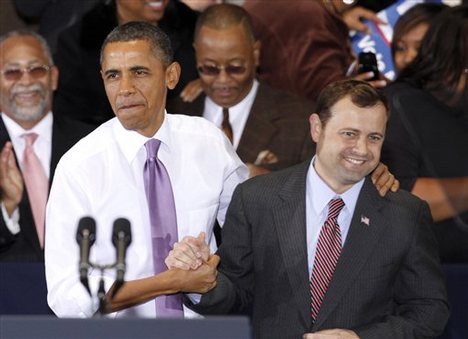
Image: U.S. President Barack Obama with Avaaz co-founder and former U.S. Representative Tom Perriello.
The Ivy League bourgeoisie who sit at the helm of the non-profit industrial complex will one day be known simply as charismatic architects of death. Funded by the ruling class oligarchy, the role they serve for their funders is not unlike that of corporate media. Yet, it appears that global society is paralyzed in a collective hypnosis – rejecting universal social interests, thus rejecting reason, to instead fall in line with the position of the powerful minority that has seized control, a minority that systematically favours corporate interests.
This investigative report examines the key founders of Avaaz, as well as other key sister organizations affiliated with Avaaz who, hand in hand with the Rockefellers, George Soros, Bill Gates and other powerful elites, are meticulously shaping global society by utilizing and building upon strategic psychological marketing, soft power, technology and social media – shaping public consensus, thus acceptance, for the illusory “green economy” and a novel sonata of 21st century colonialism. As we are now living in a world that is beyond dangerous, society must be aware of, be able to critically analyze, and ultimately reject the new onslaught of carefully orchestrated depoliticization, domestication of populace, propaganda and misinformation that is being perpetrated and perpetuated by the corporate elite and the current power structures that support their agenda. The non-profit industrial complex must be understood as a mainspring and the instrument of power, the very support and foundation of imperial domination.
Within part I of this investigative report:
- The Simulacrum
- Modus Operandi: The 21st Century NGO
- 2004: The Soft Power Imperative | 2011: Mission Accomplished
- Introduction: The Non-profit Industrial Complex: Imperialist Pimps of Militarism, Protectors of the Oligarchy, Trusted Facilitators of War
- Historical Amnesia
- Corporate “Green” Pedophilia
- The Commerce of Trust
- The Cat is Out of the Bag
- New York City Occupy Wall Street Embraces Otpor and Bombing for Peace
- The WikiLeaks Connection
- Unidentified “Freedom of Speech”
- 15M – Europe’s Occupy Movement
- The Commerce of Exploitation: Change.org
- Indoctrinated Subservience & Whitism
- Avaaz’s Founder and MoveOn.org Announce the U.S. “Spring”
Part II:
- Bread and Circuses
- Avaaz: The Emperor of the NGO Network
- Did Libya’s Citizens Demand Foreign Intervention?
- The Avaaz Gate-Keepers
- Avaaz Co-Founder and Executive Director: Ricken Patel
- Avaaz Co-founder: Tom Perriello
- Indoctrination of the Youth is Essential
- The Humanitarian Industrial Complex: The Ivory Towers Within the Dark Triad
- The Empire
- Avaaz Co-founder: Tom Pravda
- Avaaz Co-founder: David Madden
- Avaaz Co-founder: Eli Pariser
- Avaaz Co-founder: Jeremy Heimans
Part III:
- Behavioural Change
- May 2010: Avaaz’s Co-Founders Seek a Purpose-Driven Consumer Life | Behavioral Economics
- The Behavioral Economics of Hatred
- Purpose
- Res Publica
- Avaaz Founding Board Member: Ben Brandzel
- Purpose: James Slezak
- MoveOn.org
- GetUp
- The 21st Century Social Movements
- The Non-Profit Industrial Complex Finally Finds “Success”
- Avaaz Co-founder: Andrea Woodhouse
- Avaaz Co-founder: Paul Hilder
- The Avaaz “Core Campaign Team Members”
The Simulacrum
“As regards the ‘foundations’ created for unlimited general purposes and endowed with enormous resources, their unlimited possibilities are so grave a menace, not only as regards to their own activities and influence but also the numbing effect which they have on private citizens and public bodies, that if they could be clearly differentiated from other forms of voluntary altruistic effort, it would be desirable to recommend their abolition.” – Senator Frank Walsh, 1915
In his Sophist, Plato speaks of two kinds of image-making. The first is a faithful reproduction, a precise copy of the original. The second is distorted intentionally in order to make the copy appear correct to viewers. Plato gives the example of Greek statuary, which was crafted larger on top than on bottom so that viewers from the ground would see it correctly, whereas if they could view it in scale, they would realize it was malformed.
This latter representation serves as a visual art metaphor for the non-profit industrial complex. A semblance of entities, united in an ideology encompassing truth, justice and ethics – which is false. This is the simulacrum, distorted in such a way that it appears accurate unless viewed from the proper angle. This report aims to allow you, the reader, to view the matrix from such an angle. By denying the reliable input of our senses while accepting the non-profit industrial complex’s manipulative constructs of language and “reason,” global society has arrived at a grossly distorted copy of ethics and intrinsic worth – a warped simulacrum of thespian complexity, a vast work of superficial depth.
Modus Operandi: The 21st Century NGO
“What a cluster-fuck of disinformation this world has become. The sinister forces of greed and avarice are, through consolidation of wealth and power, more powerful than ever. Humankind has a huge uphill battle to wage.” — Comment at How Avaaz is Sponsoring Fake War Propaganda from Syria
The 21st century NGO is becoming, more and more, a key tool serving the imperialist quest of absolute global dominance and exploitation. Global society has been, and continues to be, manipulated to believe that NGOs are representative of “civil society” (a concept promoted by corporations in the first place). This misplaced trust has allowed the “humanitarian industrial complex” to ascend to the highest position: the missionaries of deity – the deity of the empire.
Modus operandi (plural modi operandi) is a Latin phrase, approximately translated and backronymed as “mode of operation.” The term is used to describe someone’s habits or manner of working, their method of operating or functioning. In English, it is frequently shortened to M.O.
The expression is often used in police work when discussing a crime and addressing the methods employed by the perpetrators. It is also used in criminal profiling, where it can help in finding clues to the offender’s psychology. It largely consists of examining the actions used by the individual(s) to execute the crime, prevent its detection and/or facilitate escape. [Source: Wikipedia]
2004: The Soft Power Imperative | 2011: Mission Accomplished
“Existing soft power initiatives and agencies, particularly those engaged in development and strategic communications, must be reinvigorated through increased funding, human resources and prioritization. Concurrently, the U.S. government must establish goals, objectives and metrics for soft power initiatives. Furthermore, the U.S. government can better maximize the effectiveness of soft power instruments and efforts through increased partnerships with NGOs. By providing humanitarian and development assistance in areas typically inaccessible to government agencies, NGOs are often able to access potential extremist areas before the government can establish or strengthen diplomatic, developmental or military presence, including intelligence.” — Joseph S. Nye, former US assistant secretary of defense, June 2004
The non-profit industrial complex represents a rich portfolio of soft power tools readily available to the ruling elite. Today we witness the near complete metamorphosis of the complex having successfully morphed into the absolute idyllic clearinghouse for the collective and coordinated imperialist agenda shared by a broad spectrum of government institutions, dominated by the financial industrial complex, corporate power and hegemonic rule – all under the guise of a global conscience reflective of “civil society” via self-appointed NGOs.
Joseph S. Nye (quoted above) is a former US assistant secretary of defense, former chairman of the US National Intelligence Council and professor at Harvard University. A world renowned scholar of international relations, Nye co-founded the liberal institutionalist approach to international relations, theorizing that states and other international powers possess more or less “soft power” (a term first coined in the 1980s). In a 2004 article titled The Rising Power of NGO’s, Nye peddled his soft-power theory as the quintessential element that must be employed in order to protect the American public from “terrorists.” Of course, Nye neglected to include the fact that the true “terrorists” are those who hold power within our very own EuroAmerican governments/establishments, waging violence upon sovereign, resource-rich states. It’s an easy sell as it enables one to conveniently deny their assent to (our own) state-sponsored terrorism and continued collective and voluntary servitude as well-behaved, rapturous consumers under the influence of American (non) culture.
If a state can present its power as legitimate in the eyes of others, it will encounter far less resistance to its foreign policies and agendas. Further, if the Western states’ (non) culture and (illusory) ideology are desirable, other states will more willingly acquiesce. This is an area where the NGOs excel. They do so by never referring to their own “leaders” as dictators or fascists, yet more than willing to apply these derogatory terms to leaders targeted for regime change. Simultaneously, while reporting on human rights abuses or environmental violations in states exploited by industrialized capitalism, the NGOs neglect to comment on their own states’ escalating assault on “democracy.” Most important, the non-profit industrial complex certainly does not address the fact that industrialized and globalized capitalism (imposed by hegemonic rule) is the crux of most all suffering and ongoing crisis in the very states they criticize and deem culpable. A continuous subtle undertone of support/belief in their own states’ democracy is achieved simply by never opening a dialogue on the legitimacy of power structures within their own (imperialist) states.
In essence, soft power is “the universalism of a country’s culture and its ability to establish a set of favourable rules and institutions that govern areas of international activity [that] are critical sources of power” or, more simply, the ability to attract and co-opt rather than coerce and rather than using force or money as a means of persuasion. This is where states such as Bolivia (and Libya until its recent annihilation) are very real threats to the American superpower. States such as Bolivia and Libya (past-tense) serve the people to advance themselves to a more enlightened, more democratic existence in a very real sense, while democracy and freedoms in the Americas mean little more than “freedom to shop” and buy as much sweatshop junk as one can(not) afford. If corporate-owned/controlled media and corporate-funded/controlled educational institutes actually educated the American public on intellectual enlightenment and progressive advances in other countries – Americans would truly wonder what the fuck was going on. Rather, we are kept in the dark; doped up by big pharma and stupefied by Big Brother, all while such states and leaders are continually vilified and demonized in the media (both corporate and foundation-funded “progressive”), all while NGOs remain silent on their own accelerating fascist governments. American “exceptionalism” is, undoubtedly, the biggest lie ever told sold.
Introducing the Non-Profit Industrial Complex: Imperialist Pimps of Militarism, Protectors of the Oligarchy, Trusted Facilitators of War

Packaging – Uncle Sam is the best in packaging and selling illusions.
“I am convinced that some NGOs, especially those funded by the U.S.AID, are the fifth column of espionage in Bolivia, not only in Bolivia, but also in all of Latin America.” — Evo Morales, February 2012
In 2001, it was George W. Bush who propelled an illegal invasion of Iraq by way of relentless pounding of repetitive messaging of discovered weapons of mass destruction in Iraq coupled with incessant images of the Twin Towers being destroyed. This psyop (or psychological operation, a new form or warfare) reverberated throughout a mainstream media that obediently fed the lies to the masses. The role of the media was absolutely essential. Yet, in spite of Bush calling for the invasion of Iraq, citizens of the globe, in united cohesion, held the largest mass protests and peace vigils the world had ever witnessed.
Today, however, the push to invade under the guise of humanitarianism is no longer a message from predominantly imperialist governments alone. Rather, there is a new game in town. Flash forward one decade to 2011 and the push for war no longer comes from the lone vacuity of despised war criminals such as George Bush or his charismatic alter-ego, Barack Obama. Rather, the message is now being spoon-fed to global society via the “trusted” NGOs, with Avaaz, Amnesty International and Human Rights Watch at the forefront, as documented prior to and during the attack on and subsequent occupation of Libya, and more recently, the destabilization of Syria. [One of many reports of such malfeasance include “HUMAN RIGHTS” WARRIORS FOR EMPIRE | Amnesty International and Human Rights Watch“, by Glen Ford, Black Agenda Report.]
“While much was made of the United Nations decision to establish a Human Rights Council in 2006, those who’ve witnessed the evolution of this institution are well aware that the UN was designed by (and functions to serve) the interests of modern states and their supplicants, not the Indigenous nations they rule. For those attached to charitable organizations like Human Rights Watch and other pashas of the piety industry, this is a bitter pill to swallow.” — Jay Taber, Obstacles to Peace, 13 July 2012
“The UN Human Rights Council stands as one of the significant obstacles to dynamic political development in the Fourth World. Many individuals and the peoples they represent in the Fourth World have come to believe that the UN Human Rights Council will relieve their pain from the violence of colonialism. It cannot, and it will not.” — Dr. Rudolph Ryser, Chair of the Center for World Indigenous Studies
A decade later, thanks to the non-profit industrial complex awash in an influx of money that flows like the river Nile, partnered with the corporate media complex, it is now “the people” – having been swayed by fabrications, omissions and lies – who lead the demand for invasion of these sovereign states. And, most ironic, it is not the so-called “right” at the vanguard; rather, it is the “progressive left.”
Historical Amnesia
“False reality” requires historical amnesia, lying by omission and the transfer of significance to the insignificant. In this way, political systems promising security and social justice have been replaced by piracy, “austerity” and “perpetual war”: an extremism dedicated to the overthrow of democracy. Applied to an individual, this would identify a psychopath. Why do we accept it? — John Pilger, award–winning journalist, in History is the Enemy as “Brilliant” Psy-ops Become the News, 21 June 2012
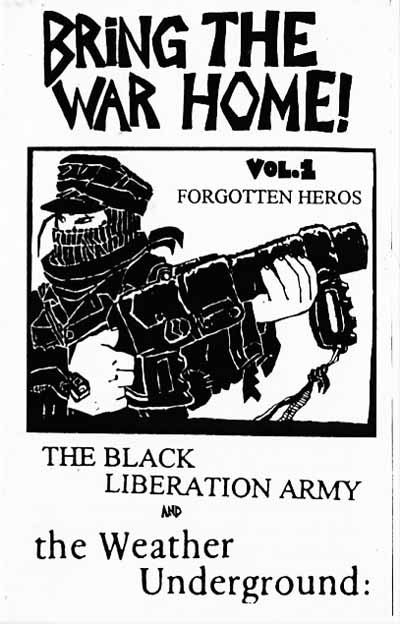

Huey P. Newton, Bobby Seale, Eldridge Cleaver, David Hilliard, Fred Hampton, and Erica Huggins – forgotten heroes indeed. The Black Panthers, who emerged on the scene in 1966, drew much inspiration from the ideologies of Malcolm X. Rejecting pacifism and reformism, under the leadership of Fred Hampton, the Panthers recognized the necessity of militant action and self-defense (“by any means necessary”) against racists and the state. The Panthers were effective in organizing the struggle towards a true revolutionary faction, with the state full-well recognizing the very real potential the Panthers held to gain mass support for their revolutionary movement. The state was terrified at this very real threat. It must be noted that during this same time period, white youth were demonstrating against the Vietnam war while 45% of Blacks fighting in Vietnam proclaimed they would be prepared to take up arms within their own state to secure justice for the American people. Considering that in 1960 almost half of America’s population was under 18 years of age, the ample surplus of youth made the threat of a widespread revolt against the status quo a very real possibility. By 1967, the rise in militancy and “Black Power” drew a very tactical response from very anxious foundations. Rockefeller and Ford created the National Urban Coalition (NUC) with the intent of transforming “Black Power” into “Black capitalism.” This was the vehicle designed/created to crush the building momentum that was confronting/challenging the prevailing system of economic control and oppression. By 1970, as Black capitalism took hold, foundations were funneling over $15 million into “moderate” Black organizations in order to effectively deflect the Black Power movement into non-threatening channels. With Black Power successfully transitioning itself into Black capitalism, American corporations utilized the opportunity to cast themselves in a liberal, progressive light by financing Black Power conferences.
The evidence that the Panthers’ revolutionary movement was a very real threat to the American state is indisputable: the FBI (under J. Edgar Hoover) declared the Panthers the number one threat to the internal security of the US. The state tried to eradicate the Panthers “by any means necessary,” gunning down scores of Panthers in the street.
Martin Luther King, Jr. was also closely affiliated with the Rockefellers via the 1957 founded Southern Christian Leadership Council (SCLC), which received money from the church and the Rockefellers. Although quite radical, elites considered SCLC moderate and “workable” because of its stance on nonviolence (which protects the state), alongside goals of integration rather than revolution. However, by the late 1960′s, Martin Luther King, Jr. had embraced militancy and radical positions espoused by both the Panthers and Malcolm X. As Martin Luther King, Jr.’s refusal to compromise increased, the foundation funding decreased. A respected man of such stature, speaking out, thus educating a vast public of the oppression caused by the capitalist system/racism, was indeed (and remains so today) a great threat to the powers that dominate. Thus, King was assassinated. Today, in united cohesion, the states work ardently with “progressive” (foundation-funded) media and the non-profit industrial complex, in ensuring that the King legacy is continually and relentlessly sanitized, watered down and co-opted to serve the elitist agenda. The pacifist doctrine, fondly funded by hegemonic rule, is continuously pumped through and circulated throughout the gentrified “movement” like fluoride in the city water – a neutral benevolence of slow poison we drink in voluntary servitude. [June 27, 2012: Black On The Old Plantation | Civil Rights Organizations Enslave Themselves to Corporate Funding]
“We do not fight racism with racism. We fight racism with solidarity. We do not fight exploitative capitalism with black capitalism. We fight capitalism with basic socialism. We fight imperialism with proletarian internationalism.” — Bobby Seale, a founder of the Black Panthers
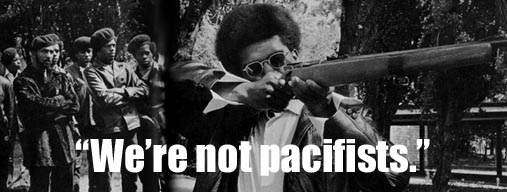
While Huey P. Newton advocated armed struggle, his ideology did not mean that the end product would be a world in which violence reigns. Rather, Newton believed that the oppressed must use guns as the means to a peaceful end of the oppression. He quoted Mao Tse-tung: “We are advocates of the abolition of war, we don’t not want war; but war can only be abolished through war, and in order to get rid of the gun it is necessary to take up the gun.” Within the Panther Party, the gun was not upheld as a means of violence, rather, it was a symbol for empowerment and self-determination. [Huey P. Newton :: Philosophy :: Armed Self-Defense]
In October of 1969, hundreds of youth clad in football helmets marched through an elite shopping district of Chicago. Utilizing lead pipes, they shattered shop windows and demolished parked cars. This was the first demonstration known as the “Days of Rage” – organized by a group who called themselves the Weather Underground. Outraged by the war on Vietnam and the rampant racism in America, the Weather Underground waged a strategic low-level war against the state that continued throughout much of the seventies. The Underground had the state on the run. Members of the Underground bombed state property including the Capitol building (never incurring a single casualty) and even broke Timothy Leary out of prison all while successfully evading one of the largest FBI manhunts ever conducted in US history.
Weather Underground Bombs the Capitol, Pentagon, and State Department (Running time 10:00)
Today, most all the past revolutionary leaders of the Weather Underground, now conformed, apologize for their “tactics,” having been isolated and framed as “violent” by the co-opted left and status quo. [http://youtu.be/S6kPGh0w_-c]
It was during this time of true revolutionary uprising that money and “opportunities” began to siphon into the movements. The art of co-optation had begun with the only weapon (palatable to the public) the oligarchy possessed – money. This money would serve to indulge, thus co-opt, inflated egos scouted from within the left. Co-opting was an absolute necessity for the state to protect the dominant power structures from true systemic change that would effectively transfer power to the people. Examples of revolutionary movements in history, as evidenced in The Weather Underground, the Panthers and others, demonstrate unequivocally that the left became more jingoistic for war only after an influx of money began pouring in from the state and plutocrats via their foundations, which were in many cases set up for this very purpose.
A case in point: Roy Innis of the Congress of Racial Equality/CORE (who advocated “Black control of Black communities” in order to allow for the manifestation of “Black capitalism”) was named a Ford Foundation fellow and became a board member of the Rockefeller/Ford-created NUC/National Urban Coalition. Ford granted CORE Cleveland $175,000 in 1967 to help elect Carl Stokes, who was very much pro Black-capitalism.
Lesser known are the events led by CIA operant Gloria Steinem. The “Black Feminist” movement was created, funded and manipulated by the CIA from the very beginning with Steinem leading the charge. Steinem planted faux “Black feminists” in revolutionary Black Power movements/grassroots organizations in order to instill division and hatred and, ultimately, to dismantle the growing movement. Steinem’s “success” would assist the state’s crushing of the Black Power movement itself. [Read: BLACK FEMINISM, THE CIA AND GLORIA STEINEM]
Throughout the world, there are organizations identifying themselves as the Black Panthers and other true revolutionary movements in existence. However, blinded by the shiny veneer of the big NGOs, few people are aware that such revolutionary movements even exist today. It is the job of the non-profit industrial complex, while waving the pacifist bible in one hand, to deliberately ensure that these groups are not only marginalized, but ignored altogether. Such movements, which have to potential to disrupt (or even dismantle) the power structures that enslave us, must remain invisible or framed in a negative light – if co-opting them is not possible, that is.
And that is something that the Western culture has perfected: co-optation. Forrest Palmer writes: “I am writing a blog post called ‘Malcolm X on a postage stamp.’ It is exactly what you see here [http://www.movements.org/pages/team]. If you know that something is happening at the grassroots and you can’t stop it, the West accepts it, places their handpicked leaders in the forefront who appease the masses into thinking what they are doing is still ‘revolutionary,’ negotiate with the ‘leaders’ ensuring they acquiesce to the state, compromise and either end up with things status quo or so watered down that the compromise doesn’t help the masses at all, but instead helps the state. The best example of a singular event of this: The March on Washington. It went from a black mass rebellion to a benign walk in the park masquerading as a movement. They had all their speeches proofread by the state, including King’s ‘great’ I Have a Dream speech. If the speeches weren’t what the state wanted, they either changed them (John Lewis) or weren’t allowed to speak (James Baldwin).”
“Malcolm predicted that if the civil rights bill wasn’t passed, there would be a march on Washington in 1964. Unlike the 1963 March on Washington, which was peaceful and integrated, the 1964 march Malcolm described would be an all-Black ‘non-violent army’ with one-way tickets.” [Wikipedia, speaking of Malcolm X and his speech The Ballot or the Bullet.]
And so it goes. Malcolm X was assassinated on 21 February 1965. And while our brothers and sisters in Africa, the Middle East and the Global South continue to be grossly exploited or altogether annihilated by the imperialist forces, the movement is ever-so acquiescent. Five hundred dollars a day for lodging at the Rio+20 Summit has never been so easy for those within the champagne circuit. And with a Democratic administration and a Black American president in the White House, the modern civil rights movement and dominant left organizations have never found it so easy to remain silent, with little to no criticism from civil society who, self-appointed, they falsely claim to represent.
“While in the US those puppets have traditionally taken on the form of talking heads on corporate and public television, they are increasingly represented in the form of NGO PR puppets employed in the moral theatrics industry…. As the credibility of politicians and pundits plummets, it is these PR puppets that are increasingly responsible for bolstering public support for militarism in general and militarized humanitarian intervention in particular.” — Jay Taber, Intercontinental Cry; Pious Poseurs, 24 June 2012
Although now seemingly normalized, one must consider it slightly ironic that it is in fact no longer the dominant “progressive left” beating the drums against war. [Exceptions include legitimate grassroots groups such as Peacelink in Italy.] Rather, as in the case of climate change, it is primarily the countries seeking to free themselves from the chains of imperialist enslavement that vocally oppose the escalating destabilization campaigns, inclusive of the most recent, in Syria. On 16 February 2012, the 12 sovereign states who voted against the resolution to condemn Syria at the United Nations included North Korea, China, Russia, Iran and Syria, along with states who primarily compose ALBA; Bolivia, Belarus, Cuba, Ecuador, Venezuela and Nicaragua. And it is not coincidence that most all the leaders of all these same states, who continue the struggle for autonomy, are all similarly vilified and demonized by the corporate-media complex, joined recently by the non-profit industrial complex. It is critical to note that the imperialist powers (inclusive of the UN) do not criticize or demonize or withdraw their support from such leaders on any ethical or moral ground. Denunciation of state leaders and emotive language is merely theatre. Rather, the imperialist states strategically set out to destroy any state leader that is unwilling to be controlled by US interests and foreign policy. A case in point is unwavering support of the Saudi royal family responsible for atrocious human rights violations to which the imperialist countries turn a blind eye.
Demonization is a key psyop, directly sponsored by the US Pentagon and intelligence apparatus to influence and sway public opinion and build consensus in favour of invasion. [Prof. Michel Chossudovsky] A recent example can be extracted from the failed 2011 destabilization campaign against the Morales government in Bolivia led by US-funded NGOs including the “Democracy Centre,” which declared: “But the abuses dealt out by the government against the people of the TIPNIS have knocked ‘Evo the icon’ off his pedestal in a way from which he will never fully recover, in Bolivia and globally.” [Further reading: U.S. Funded Democracy Centre Reveals Its Real Reason for Supporting the TIPNIS Protest in Bolivia: REDD $$$. ¿Por qué se defiende el tipnis?, http://youtu.be/RPiw3cDotHA]
A similar situation (developing nations, rather than the “environmental movement,” taking the lead) has taken place on the issue of climate change. ALBA nations, with Bolivia at the forefront, led while the non-profit industrial complex purposely and grossly undermined the strong positions necessary to mitigate the climate emergency. The climate justice movement was acquiescent and thus kowtowed to the “big greens”; “big greens” such as Avaaz, 350.org and Greenpeace who had partnered with HSBC, Lloyds Bank, nuclear giant EDF, Virgin Group, Shell (via TckTckTck partner, the Corporate Leaders Group on Climate Change) and other corporate giants constituting the “TckTckTck campaign” whereby “the objective was to make it become a movement that consumers, advertisers and the media would use and exploit” (Havas Press Release). There was no justice to be found, only a cohesive hypocrisy amongst the professional left that flourished like a cancer.
Next: Part one, section II.
Avaaz Investigative Report Series [Links]|Further Reading: Part I | Section I | Part I | Section II | Part I | Section III | Part II | Section I | Part II | Section II
Iran, Iraq to jointly explore, develop border gas, oil fields
Press TV – July 19, 2013
The Iranian Oil Ministry says Tehran and Baghdad have agreed to explore and develop oil and gas fields lying along the common border between the neighboring OPEC members, Press TV reports.
The ministry added that the two sides have agreed to work together to settle territorial and ownership differences.
Under the agreement, the two countries will establish joint ventures to carry out the exploration and development of joint oil and gas fields.
The energy cooperation is also expected to minimize the impacts of interferences made by international oil giants in regional affairs.
The agreement came during Iranian President Mahmoud Ahmadinejad’s official visit to Iraq.
Ahmadinejad arrived in Iraq on Thursday at the head of a high-ranking delegation for an official two-day tour aimed at strengthening bilateral relations between the two neighboring countries.
The Iranian president held talks with Iraqi Prime Minister Nouri al-Maliki and Vice President Khudayr al-Khuzai and also met with Iraqi Parliament Speaker Osama al-Nujaifi and the country’s lawmakers on Thursday .
Ahmadinejad also paid a visit to the holy shrine cities of Karbala and Najaf.
The two-term Iranian president will leave office on August 3 to be succeeded by Hassan Rohani, who won an outright victory in the country’s presidential elections of July 14.
Related articles
- Middle East: Ahmadinejad – Regional progress, security depend on Iran-Iraq cooperation (ionglobaltrends.com)
- Iraq to import gas from Iran (iraqinews.com)
- Zionists thrive on conflicts: Ahmadinejad (rinf.com)
Ten Years Ago: The Political Assassination of Dr. David Kelly
Dr Kelly Inquest Campaign

Venezuela: An Ethical Foreign Policy?
By Ewan Robertson | Carnegie Council | July 10, 2013
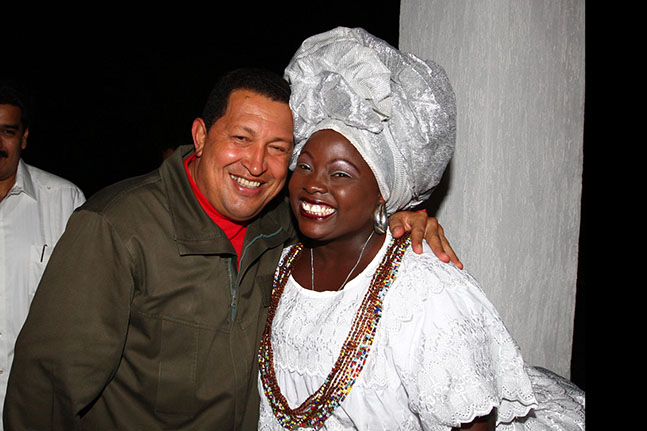
CREDIT: Manu Dias, (CC)
Venezuela’s foreign policy under the late President Hugo Chávez, and now his successor Nicolas Maduro, has been subject to sharply differing interpretations. Some observers see the oil-rich country’s foreign relations since Chávez’s election in December 1998 as shaped by a visionary who has promoted international solidarity with the oppressed, combated poverty, and pushed for a just world order free of uni-polar domination. For critics, however, Venezuela’s foreign policy has been incoherent, militaristic, and prejudicial to regional stability.
Does Venezuelan foreign policy include ethical considerations, as its supporters claim? The evidence suggests it does and that as a result we can be more optimistic about possibilities for incorporating ethics into international affairs than some scholars would have us believe.
The Ethical Dimension of Venezuelan Foreign Relations
To evaluate a possible ethical dimension to Venezuelan foreign policy, it is necessary to understand the ideology Chávez imbued in the country’s international affairs. Five concepts are central. The first two are the primacy of national sovereignty and Latin American and Caribbean integration. These are based on an understanding of foreign policy as a continuation of the Pan-American vision of Venezuela’s founder and 19th century independence hero Simon Bolivar, who also gives the name to Chávez’s “Bolivarian” political project. The third and fourth are the importance of international solidarity and south-south cooperation, which hold that Venezuela’s development should be based on mutual solidarity and cooperation with the countries of the global south. Finally, these concepts coalesce to form the pursuit of a multi-polar world order, which sees Venezuela’s international role in strengthening ties with emerging powers across different regions as part of a shift to a more balanced international system which will guarantee “world peace” and “universal well-being.” This implicitly involves an attempt to counter-balance the weight of the United States in international affairs.1
One example of Venezuela’s pursuit of these values is the Bolivarian Alliance for the Peoples of Our America (ALBA). This alliance of leftist Latin American nations founded by Venezuela and Cuba in 2004 has implemented regional development strategies based on the principles of “solidarity, cooperation and complementing.” Programs aiming to guarantee food security, universal literacy, free health and education, and decent housing are strongly marked by values of social justice and human development.2 Social programs promoted by the ALBA include the “Miracle Mission,” which provides free eye treatment and surgery to Venezuelan citizens and those of several Latin American countries. The program has treated around 1.2 million people in Venezuela since its launch in 2004.3
Development assistance and solidarity have also been evident in Venezuela’s outreach to the Caribbean, particularly with the PetroCaribe initiative. Launched in 2005, the program offers Venezuelan petroleum to Caribbean nations at a discount rate. Participating nations only pay a percentage of the oil’s market price up front, with the rest converted into low-interest, long-term loans. A portion of these loans can be amortised through payment in goods and services; for example, Cuba sends medical personnel to Venezuela in exchange for oil shipments. The loans also become important sources of capital spending for the region’s governments. Eighteen Caribbean states now participate in the program, and Venezuelan oil minister Rafael Ramirez estimated in 2011 that PetroCaribe covers 43 percent of participating nations’ energy needs.4 In the context of rising oil prices in the 2000s, a Council on Hemispheric Affairs (COHA) report on the scheme described it as “the most concrete proposal on the table to alleviate the region’s suffering.”5
Perhaps no other Caribbean nation has benefitted more from this kind of regional solidarity than Haiti. Following the devastating January 2010 earthquake, Venezuela pledged $2.4 billion in financial and relief aid, more than any other of 58 donors. This aid has included building power plants, shelters, a new hospital (in collaboration with Cuba), sending food and medical supplies, and assistance to develop Haiti’s agricultural sector.6 Venezuela even wrote off $400 million of Haiti’s PetroCaribe debt. This important reconstruction aid was given despite the fact that Haiti is by no means an ideological ally of Venezuela’s leftist government; its president, Michel Martelly, is close to Haiti’s business elite and the United States. Nevertheless Martelly has publicly thanked Venezuela for its solidarity and help since the earthquake, commenting in December 2011 that for Haiti, “cooperation with Venezuela is the most important right now, in terms of impact, direct impact.”7
Africa is another continent where relations seem to be driven as much by ideology and ethical values as by strategic interests. From 2005, Chávez began referring to Africa as a “motherland” and pursuing “south-south cooperation,” or mutual development strategies, in the region. Over the next six years Venezuela established diplomatic relations with all 54 African countries, opened new embassies, and signed over 200 cooperation agreements with the continent, where only 20 had existed beforehand.8 Many of these agreements contain a clear element of solidarity and humanitarian assistance. In 2009 Venezuela pledged $20 million to the West African ECOWAS group for malarial eradication programs, while in February 2013 it offered technical assistance and personnel training to the Sahrawi Democratic Republic to improve the population’s access to safe drinking water. Further, around 500 students from over 15 African countries study in Venezuela courtesy of government scholarships, many of these in medical courses, with the intention that after their studies these newly-trained professionals return to their home countries to provide much needed public services.9 A similar program is offered to Palestine, where Venezuela has also committed to build medical facilities.
Such attempts at greater cooperation with countries of the global south have led Venezuela to play a key diplomatic role in moves toward intensifying Latin American and south-south integration. In addition to founding the ALBA and PetroCaribe, Venezuela was also a founding member of the Union of South American Nations (UNASUR) in 2008, and played host to the founding conference of the Community of Latin American and Caribbean States (CELAC) in 2011, which brings together every nation in the Americas with the exception of the U.S. and Canada. Venezuela was also host to the II Africa–South America (ASA) summit in 2009, and is set to host the tri-annual summit of the Non-Aligned Movement in 2015, and thereafter become the president of the grouping of 130 developing nations. The country was also elected to serve on the UN Human Rights Council for 2013–2016 and is a mediator in peace talks underway between the FARC guerrilla group and the Colombian government. Taken together, these aspects of Venezuela’s foreign policy have led observers such as Venezuelan geographer and analyst Rosalba Linares to conclude that Bolivarian-era foreign relations aim to construct “a sovereign, democratic and more humanitarian multi-polar world, of greater social justice and fair trade in benefit of those most in need in Venezuela and the world.”10
The Pursuit of Strategic Interests
Of course, it would be mistaken to understand Venezuelan foreign relations as solely motivated by ethical or altruistic considerations. Even solidarity-based policies have clear “soft” benefits such as raising the government’s diplomatic and international standing. Venezuela’s foreign relations have also been shaped by concrete strategic interests. Chief among these are energy interests, which are woven throughout foreign policy, as Venezuela holds the largest crude oil reserves in the world. The Bolivarian government has sought to increase ties with other energy powers for the extraction of Venezuelan crude and to diversify its oil export markets. In the context of the deterioration of relations with the United States, strategic policy goals have also included creating a robust network of international alliances and securing alternative sources of financing, technological assistance, and military hardware.
In the first years of Chávez’s presidency the state oil company PDVSA was brought under greater government control. At the same time the government pushed for the revitalisation of OPEC, advocating the policy of production quotas to help ensure that world oil prices rose to levels favourable to exporting countries. The elevation of oil prices in the 2000s gave the Venezuelan government flexibility to pursue active energy diplomacy abroad while funding a wave of new social programs at home.
The government has built what it calls “strategic alliances” with several energy powers, including Russia and China. Russian energy giant Gazprom now works with PDVSA to explore gas deposits in the Gulf of Venezuela and Russian firms are active in the extraction of oil in Venezuela’s Orinoco Belt. Russia is also useful to Venezuela as a source of military hardware, with Chávez’s government becoming Russia’s biggest customer of military goods after India.11
Meanwhile China has provided Venezuela with a new market for its petroleum exports. Oil exports to China rose from almost zero in 2004 to 460,000 bpd in 2010, a number that officials want to increase to one million.12 The relationship has also resulted in over 300 bilateral agreements and 80 major projects, and has allowed the Venezuelan government access to financing and technology, the latter exemplified by the launching of Venezuela’s first satellites with Chinese assistance in 2008 and 2012.
Venezuela has formed a web of links with other countries enjoying oil and gas reserves, such as Iran, Syria, Brazil, and certain African countries. Given their relatively independent diplomatic stance in world affairs, strengthening ties with these nations has also fitted within the ideological goal of building “south-south cooperation” and a “multi-polar world order.”
Meanwhile relations with Venezuela’s traditional commercial partner and top recipient of crude exports, the United States, have been frozen at the charge de affairs level since 2010. Venezuelan officials blame this on the U.S. government’s belligerence and lack of respect for Venezuela’s independence and sovereignty, including support for and alleged involvement in the short-lived coup attempt to topple the Chávez administration in 2002. For its part, the United States has accused Venezuela of failing to sufficiently cooperate with counter-narcotics and anti-terrorism efforts, and of acting against U.S. interests by pursuing relations with “enemy” states such as Iran. Nevertheless, there are signs that the relationship is improving under the presidency of Nicolas Maduro, after Venezuelan foreign minister Elias Jaua met with Secretary of State John Kerry during an OAS summit in early June. “We would like to see our countries find a new way forward, to establish a more constructive and positive relationship,” said Kerry following the meeting. However, it remains to be seen whether the recent decision by President Maduro to offer asylum to ex-NSA intelligence leaker Edward Snowden will have an impact on efforts to improve bilateral relations.
Criticisms and Contradictions
Critics point to contradictions in the conduct of Venezuela’s foreign policy, and question the existence of an ethical dimension to Venezuelan foreign relations.
An accusation which emanates principally from the United States is that rather than seeking “world peace,” Venezuela in fact pursues an aggressive policy of building up its arms stockpile while forming alliances seen as threatening to U.S. national security. In September 2009 then-Secretary of State Hilary Clinton raised concerns over Venezuela’s arms purchases from Russia, arguing that the Chávez administration was engaging in a military build-up which could trigger a South American “arms race.” “They [Venezuela] outpace all other countries in South America [in military purchases] and certainly raise the question as to whether there is going to be an arms race in the region,” she said.13 Further, some conservative politicians and analysts have argued that Venezuela should be considered a “national security threat” due to its ties with countries regarded as hostile to the U.S, such as Iran and Syria.14
However, neither the figures nor events bear out fears that Venezuela is unduly arming itself or seeking military-style alliances with U.S. adversaries. According to the CIA World Factbook, in 2009 Venezuela put 1.4 percent of GDP toward military spending, the 5th highest in the region and less than the U.S., Colombia, and Chile. By 2012, military spending in Venezuela had halved as a percentage of GDP to 0.7 percent, with the country spending less than most major countries in the region, being only 153rd out of 173 countries measured globally for military spending.15 Venezuelan government officials meanwhile state that its international alliances are “about peace” and not in any way an aggression toward a third party. This point was highlighted during the visit from former Iranian president Mahmoud Ahmadinajad to Venezuela in January 2012. Nicolas Maduro, in his capacity of foreign minister, said to press at the time that bilateral ties between the two countries were part of a “peaceful relationship…we have a relationship of cooperation for development… and above all, for peace”.16
This appraisal of Venezuela’s diplomatic and defence policy appears to be shared by the U.S. military establishment. In August 2012 General Douglas Fraser, chief of U.S. Southern Command, said that although he would like greater cooperation from Venezuela against drug trafficking, he did not consider Venezuela a security threat to the United States. When asked if he thought Venezuela’s arms purchases constituted a danger to the U.S., Fraser replied, “From my standpoint, no…I don’t see them [Venezuela] as a national security threat.” Further, when asked whether Venezuela’s relationship with Iran amounted to a “military alliance,” the general disagreed, stating, “As I look at Iran and their connection with Venezuela, I see that still primarily as a diplomatic and economic relationship.”17 President Barack Obama has taken a similar stance, announcing in an interview in July 2012, “Overall my sense is that what Mr. Chávez has done over the last several years has not had a serious national security impact on us.”18
Thus the notion that Venezuelan military purchases and bilateral relationships represent a threat to the United States appears to be an overreaction from certain observers within U.S. political and media spheres, who confuse Venezuela’s independent foreign policy with one threatening U.S. security.
Others argue that there exists a contradiction in Venezuelan foreign policy between claims to pursue the values of democracy, humanitarianism, and solidarity, while supporting governments considered authoritarian or with poor human rights records. In 2011, political sociologist and author Gregory Wilpert argued that Venezuela ran a “significant” risk of losing legitimacy among progressives when Chávez continued to support former Libyan president Muammar Gaddafi against an insurgency in that country, a point that could be extended to several other of Venezuela’s allies in the Middle East.19
Another seemingly contradictory move by a government purporting to promote ethical values in its foreign policy is Venezuela’s decision to withdraw from the OAS’ Inter-American Court and Human Rights Commission (IACHR) in 2012, on the basis of the body’s alleged “shameful” bias against the Chávez administration. The decision is also part of a shifting focus toward Latin American autonomy and integration, with several states in the region pushing for the formation of new mechanisms to promote human rights within the UNASUR and CELAC. 20
A final question for Venezuela’s foreign relations is the extent to which policies pursued under Chávez will continue under the presidency of Nicolas Maduro, who was elected to power in April, following Chávez’s death in March. Maduro was Chávez’s foreign minister from 2006–2012, and in that role helped to build Venezuela’s contemporary foreign relations. The new president has pledged to continue these policies and his active foreign diplomacy over the previous three months seems to confirm this. Present challenges for Maduro include assuming the presidency of the Mercosur trade bloc this summer, and seeking productive relationships with the U.S. and Europe; steps toward which appear to have already been taken.
Between Ethics and Interests
In common with all nation states, over the past 14 years Venezuela has pursued clearly defined strategic and economic interests through its foreign policy. These have included developing greater links with other energy powers and ensuring access to sources of financing and military hardware. The government has also sought commercial, technological, agricultural, educational, health, and other forms of cooperation considered beneficial to Venezuela’s national development.
Although certain criticisms of contradictory behaviour can be levelled at Venezuela’s foreign relations, policymaking has followed a coherent logic. From technological cooperation with China to malaria eradication assistance in Africa, Venezuela’s new foreign relations have been built within an ideological framework embodied by the notions of “south-south cooperation” and a “multi-polar world.”
Further, while all nations could be said to act in their own strategic interests, not all have also placed norms of cooperation, solidarity and humanitarianism as a central focus of foreign policy. These values can be seen in agreements Venezuela has made with countries across all continents, but especially in the Americas and Africa. Even in the United States, PDVSA subsidiary CITGO aids around 100,000 low-income families during the winter with donated Venezuelan heating oil.21 Thus while it would be false to state that Venezuelan foreign policy is solely motivated by ethical considerations, it would be misleading to explain the country’s external relations without reference to these. This ethical dimension to Venezuela’s foreign policy is a demonstration that if the political will exists, governments can pursue such values within their foreign relations. In doing so, concrete and mutual benefits can be reaped for both the development of societies and the wellbeing of peoples.
NOTES
1 Chávez, H. (2012), Plan de la Patria: Programa del Gobierno Bolivariano 2013 – 2019, accessed at: http://www.minci.gob.ve/wp-content/uploads/downloads/2013/04/PLANDELAPATRIA-20133-4-2013.pdf.
2 Ullán de la Rosa, F.R. (2012), La Alianza Bolivariana para las Americas – Tratado de Comercio de Los Pueblos (ALBA-TCP): Análisis de un Proyecto de Integración Regional Latinoamericana con Una Fuerte Dimensión Altermundista, Estudios Politicos, no. 25, (Enero – Abril), pp131 – 170, Mexico, D.F. (p151-152).
3 Morales, M. (27/5/2013), Hija de Chávez Manejará Presupuesto Millonario en la Misión Milagro, El Nacional.
4 Rojas, R. (December, 2011), Venezuela Increasing Influence in Caribbean through PetroCaribe, Press TV.
5 Lai, K. (January, 2006), PetroCaribe: Chávez’s Venturesome Solution to the Caribbean Oil Crisis, Council on Hemispheric Affairs (COHA).
6 Information taken from, Wyss, J. (05/07/2010), Venezuela Leads the World in Earthquake Relief, Miami Herald; Edmonds, K. (February 2012), ALBA Expands its Allies in the Caribbean, North American Congress on Latin America (NACLA.org); Robertson, E (01/06/2012), Venezuela, Cuba and Argentina Sign Development Assistance Agreements with Haiti, Venezuelanalysis.com.
7 The Editors, (April, 2012), Haiti Using Funds from PetroCaribe to Finance Reconstruction, Council for Economic and Policy Research (CEPR).
8 Bolivar, R. J., (February, 2011), “Entrevista: Reinaldo José Bolívar, Viceministro de Relaciones Exteriores para África,” Encontrarte.
9 (14/01/2011), “Venezuela ha Firmado 200 Acuerdos de Cooperación con África,” Agencia Venezolana de Noticias.
10 Linares, R., (2010), “La Estrategia Multipolar de la Political Exterior Venezolana,” Aldea Mundial, Año 15, No. 15, Julio – Diciembre (2), pp51-62, (p60).
11 Rinna, A. (09/03/2013), “Russia’s Uncertain Position in Post-Chávez Venezuela,” Centre for World Conflict and Peace blog.
12 Ellis, R.E. (2010), “Venezuela’s Relationship with China: Implications for the Chávez Regime and the Region,” Centre for Hemispheric Policy, University of Miami, pp1-10; Cornejo, R. & Garcia, A.N. (2010), “China y América Latina: Recursos, Mercados y Poder Global,” Nueva Sociedad, No. 228 (Julio-Agosto), pp79-99 (p95); Manduca, P.C. (2012), “La Energía en la Política Sudamericana: Características de las Relaciones entre Brasil y Venezuela,” Revista Mexicana de Ciencias Políticas y Sociales,” no. 216, (Septiembre – Diciembre), pp81-100.
13 Labott, E. (16/09/2009), “U.S. Fears Venezuela Could Trigger Regional Arms Race,” CNN.
14 Noriega, R. (08/02/2013), “Hugo Chávez: An Uncounted Enemy,” The Washington Times.
15 Central Intelligence Agency: The World Factbook (Military Expenditures, Venezuela), accessed at: https://www.cia.gov/library/publications/the-world-factbook/rankorder/2034rank.html?countryname=Venezuela&countrycode=ve®ionCode=soa&rank=153#ve.
16 Pearson, T. (10/01/2012), “Iran-Venezuela Relationship “About Peace,” Venezuelanalysis.com.
17 (01/08/2012), ” Top US General: Venezuela Not a National Security Threat,” Associated Press.
18 Mazzei, P., Bolstad, E., (11/07/2012), “Mitt Romney, GOP howl over President Barack Obama’s remark about Hugo Chávez,” Miami Herald.
19 Wilpert, G, (06/03/2011), “Venezuela and Libya: An Interview with Gregory Wilpert,” Venezuelanalysis.com.
20 Britto Garcia, L. (12/05/2013), Avanza el Golpe Judicial, Aporrea.org.
21 Citgo Press, (31/01/2013), “Eighth Annual Citgo-Venezuela Heating Oil Program Launched,” Venezuelan Embassy, Washington.
Related articles
- US NSA Spied on Venezuela When President Chavez Died, Documents Reveal (alethonews.wordpress.com)
- Venezuela Reaffirms Commitment to Haiti’s Reconstruction | venezuelanalysis.com (rapadoo.com)
- PetroCaribe moves closer to Economic Zone (antiguaobserver.com)
- Toward a new Venezuela-Caribbean relationship (caribbean360.com)
S. American states to recall ambassadors from Europe over Bolivian plane incident
RT | July 12, 2013
South American countries belonging to the Mercosur trade bloc have decided to withdraw their ambassadors for consultations from European countries involved in the grounding of the Bolivian president’s plane.
“We’ve taken a number of actions in order to compel public explanations and apologies from the European nations that assaulted our brother Evo Morales,” explained Venezuela’s President Nicolas Maduro, who revealed some of the agenda debated during the 45th summit of Mercosur countries in Uruguay’s capital, Montevideo.
The decision to recall European ambassadors was taken by Maduro, Argentina’s President Cristina Fernandez, Brazilian President Dilma Rouseff, and Uruguay’s President, Jose Mujica, during the meeting.
Member states attending the summit expressed their grievances with “actions by the governments of France, Spain, Italy and Portugal” over the July 2 incident, when the aircraft carrying President Evo Morales back to Bolivia after attending an energy summit in Moscow was denied entry into the airspace of a number of EU member states.
The small aircraft, which required a stop-over before completing its flight, was forced to make an emergency landing in Austria after a circuitous flight path.
It was later revealed that the European countries’ actions were prompted by accusations made by the US ambassador to Austria, William Eacho, who alleged that American whistleblower Edward Snowden had been taken on board to help him gain political asylum in Latin America.
“The gravity of the incident – indicative of a neocolonial mindset – constitutes an unfriendly and hostile act, which violates human rights and impedes freedom of travel, as well as the treatment and immunity appropriate to a head of state,” the Mercosur nations affirmed in the joint statement.
The incident was further described as a “discriminatory and arbitrary” decision by European countries, as well as a “blatant violation of international law.”
Featured Video
“Historic Russia”: The Land Putin Will Not Give Back
or go to
Aletho News Archives – Video-Images
From the Archive
How Ukraine Tortured and Slaughtered Donbass
By Kit Klarenberg | Al Mayadeen | July 11, 2024
Almost immediately after the proxy war erupted, ISIS-tier footage of the torture and murder of Russians in Ukrainian custody emerged.
On July 6th, the New York Times published an astonishing investigation: In Ukraine, Killings of Surrendering Russians Divide an American-Led Unit. The article documents in grim detail how Chosen Company, an international volunteer battalion for Kiev, routinely executes Russian prisoners of war. It is the very first mainstream admission that this practice – a brazen breach of the Geneva Conventions, and a grave war crime – is widespread among Ukraine’s fighters, both foreign and homegrown. … continue
Blog Roll
 Aletho News
- Peace in Ukraine: the easy way – or the hard way
- Trump & the Rrrrussians
- US taxpayer money laundered back through Ukraine – Musk
- Before COVID, an NIH lab chief proposed making a SARS-like bat virus more infectious
- Gates, Bourla on Trial in Netherlands Accused of ‘Great Reset’ Scheme at Vaccine Injury Hearing
- BRITAIN’S WARNING: PREPARE FOR WAR
- “Historic Russia”: The Land Putin Will Not Give Back
- How the Cambridge Analytica scandal still haunts Mark Zuckerberg
- The Ongoing Cancellation Campaign Against a Dissenting Academic in Norway
- Yemen and ‘the Houthis’: Challenging Sami Hamdi’s Narrative
- If Americans Knew
- DAILY UPDATE: Latest essential news on Palestine, Israel, & region
- Damning report shows the media must confront its failures on Gaza
- BBC senior broadcaster speaks out on Gaza coverage
- Netanyahu vows vast West Bank invasion in response to 20-minute skirmish that left 2 Israeli soldiers and 2 Palestinian fighters dead
- Tied up and tortured: Israel using US-made electroshock weapons on Palestinian detainees
- The outsourced risk: how newsrooms rely on Gaza’s freelancers without protecting them
- Gaza bakeries forced to shut as Israel blocks flour shipments
- Gaza’s breast cancer patients face a deadly wait for treatment amid Israel’s genocide
- DAILY UPDATE: Latest essential news on Palestine, Israel, & region
- The Israel Lobby’s Changing Fortunes
- No Tricks Zone
- Two New Studies Find Thwaites Glacier Melt Cannot Be Driven By Human Activity Or A Warming Ocean
- E-Cars Reduce CO2 Emissions By Only 41% Compared To Internal Combustion Engine Vehicles
- Predictions Made By Renowned Climate Professor Over Past Decades Have Been Proven To Be Poor
- New Study Suggests Large Regions Of The Pacific Ocean Have Been Cooling For The Last 80 Years
- Germany’s Green Energy Debacle: High Energy Costs Force Kahla Porzellan to Close After 182 Years!
- New Study: 50 Years Of The Most Aggressive ‘Net Zero’ Policies Can Only Affect The Global Climate By 0.03°C
- US September “Heat” Was No Record…Many Records Set Decades Ago
- Latest European Green Energy Debacle; Portugal’s Largest Flagship Solar Park Insolvent!
- Green Energy Debacle: German Expert Professor Fritz Vahrenholt Warns Of Severe Economic And Social Consequences
- Two More Paleo Reconstructions Affirm Meters-Higher Sea Levels Across Ireland, Brazil 7000-6000 Years Ago

