Tens of Thousands of California Inmates Join Pelican Bay Hunger Strikers
A Black Agenda Radio commentary by executive editor Glen Ford | July 10, 2013
About 30,000 California prisoners have joined the hunger strike begun, on Monday, by inmates at the Secure Housing Units at Pelican Bay. That’s more than four times as many as joined Pelican Bay inmates in their first hunger strike, in July of 2011, and two and a half times the number that struck in October of that year. So far, two-thirds of the state’s prisons have been affected.
The Pelican Bay inmates carry a certain moral authority, in that they represent the most long-suffering, intensely persecuted group in the largest and most barbaric prison system in the world – the approximately 80,000 U.S. prison inmates held under solitary confinement. Pelican Bay is the site of more than 1,000 solitary confinement cells, where prisoners are isolated from other human contact for at least 22 and a half hours a day. Around the state, about 4,500 people are held in Special Housing Units, or SHUs, with 6,000 more enduring some other form of solitary. Some of the SHU inmates have not seen the natural light of day for more than 20 years.
The State calls the SHU inmates the “worst of the worst” in order to justify a punishment regime more barbaric, in many respects, than any in recorded history – a massive, multi-billion dollar enterprise whose mission is to destroy the minds of men and women. Inmates are locked away for years on end for possession of literature, or for mere suspicion of political militancy. By far the largest number of SHU inmates are accused of belonging to gangs, and can only be released from solitary by accusing other inmates of gang affiliation – a process that is euphemistically called “debriefing” – thus turning everyone into a potential snitch against everyone else.
Prison is the ultimate surveillance regime, a place where the sense of self, of human agency, and of privacy is systematically crushed, in the name of security. It is no coincidence that the world’s prison superpower, the United States, which accounts for one out of every four incarcerated persons on the planet, is also engaged in spying on every other nation and population on Earth. It is as if the United States is determined to surveil – with the implicit threat to crush – every expression of the human soul.
Both U.S. global surveillance and American prison policies violate international law. The Center for Constitutional Rights has sued on behalf of the Pelican Bay inmates, citing the finding by the United Nations Special Rapporteur on Torture that any more than 15 days of solitary confinement violates international standards of human rights.
California’s inmates aren’t waiting for the UN or the courts to come to the rescue. They’ve issued five core demands, with elimination of long-term solitary confinement at the top, and insist that the hunger strike will not end until California signs a legally binding agreement. The very concept of negotiation with inmates is anathema to the Prison State, whose goal is to reduce human beings to objects, with no rights whatsoever. The Pelican Bay inmates have concluded that, if they are to have any chance to live, they must be prepared to die.
Glen Ford can be contacted at Glen.Ford@BlackAgendaReport.com.
Parents of Tristan Anderson, US activist critically wounded following West Bank protest, appeal to High Court of Israel
Parents of US Activist: Police Investigation was Shockingly Negligent
International Solidarity Movement | July 9, 2013
Jerusalem – Tristan Anderson (41, of Oakland, CA) was severely wounded after having been shot in the head with a high velocity tear gas grenade* (made in the USA) fired by Israeli Border Police following a protest in the West Bank Village of Ni’lin, resulting in severe permanent brain damage and paralysis to half his body.
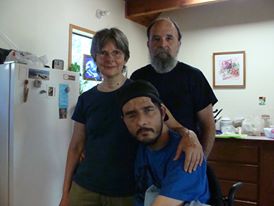
Tristan Anderson with his parents
Attorneys for Anderson’s family, along with Israeli NGO Yesh Din, will appear before the Israeli High Court of Justice on Wednesday, JULY 10. The petition challenges the investigation that they claim was blatantly inadequate, with the identity of the shooter still being actively withheld to this day.
“Tristan will live the rest of his life with serious mental and physical limitations and chronic pain. This has devastated his life and profoundly affected our family forever,” said Nancy Anderson, Tristan’s mother.
No criminal charges have been brought against any police or military personnel involved in the 2009 shooting of their son. Video evidence uncovered during the course of an ongoing civil lawsuit (trial begins November 10, 2013 in Jerusalem for the civil suit) raises further questions on the credibility of State witnesses, who in contradiction to sworn testimony, are clearly seen shooting tear gas directly at protesters from close range in the video, which was taken earlier that day. The video also raises serious questions relating to the true locations of the various squads of Border Police present at the time of the shooting, with investigators opting only to question those squads that were on the other side of the town at the time the shooting occurred, while failing to question the squad that was stationed on the nearby hill where activist witnesses say the shots came from. As well, investigators failed to visit the scene of the shooting and made no attempts to collect physical evidence.
See “Perpetrators of the Shooting of Tristan Anderson”.
See “Aftermath of the shooting of Tristan Anderson Part 1, Part 2, and Part 3 for further video.
Michael Sfard and Emily Schaeffer, attorneys for the Anderson family commented:
“The astonishing negligence of this investigation and of the prosecutorial team that monitored its outcome is unacceptable, but it epitomizes Israel’s culture of impunity. Tristan’s case is actually not rare; it represents hundreds of other cases of Palestinian victims whose investigations have also failed.”
Tristan joined the ranks of scores of other protesters who have been seriously injured or killed during demonstrations in the Occupied Palestinian Territories in recent years. On March 13, 2009 he was in Ni’alin demonstrating against the annexation of village lands to build the controversial “Separation Wall” when he was shot. Witnesses insist there was no stone throwing in his immediate surroundings at the time when he was shot, and that the shooting was “unexpected and unprovoked”.
“Tristan’s shooting is part of a pattern of deadly violence being used against protesters in the Occupied Territories, who are not recognized as having a fundamental right to political self-determination,” said Gabrielle Silverman, Tristan’s girlfriend, and a witness to his shooting. “We need real accountability and a high standard of human rights, but instead what we get is the military running cover for their soldiers.”
The family of Tristan Anderson is calling the investigation “a cover up and a sham”.
*Tristan Anderson was shot with a High Velocity Tear Gas grenade- sometimes also called “Extended Range Tear Gas”- which is manufactured by Combined Systems Inc in Jamestown, Pennsylvania.
Mexico: Nine Indigenous Prisoners Released in Chiapas
Weekly News Update on the Americas | July 7, 2013
The southeastern Mexican state of Chiapas released nine indigenous prisoners from its Los Llanos prison near San Cristóbal de las Casas in the state’s highland region on July 4. State governor Manuel Velasco Coello arrived at the prison from Tuxtla Gutiérrez, the state capital, to deliver the release papers in person. The nine prisoners, described as adherents of the 2006 Other Campaign of the Zapatista National Liberation Army (EZLN), had participated in hunger strikes and other actions over several years to win their freedom. Rosa López Díaz, the only woman in the group, was pregnant when she was arrested in 2007; she lost her child, reportedly as a result of torture.
Under pressure from Mexican and international groups, the state appears to have started releasing EZLN allies imprisoned on questionable charges. Francisco Sántiz López was freed on Jan. 25 [see Update #1161]. But the best known of the prisoners, the schoolteacher Alberto Patishtán Gómez [see Update #1173], remains at Los Llanos, along with a prisoner named Alejandro Díaz Sántiz. Patishtán was allowed to take part in the release of the nine prisoners on July 4. He walked a few meters out of the prison and told the relatives, with a smile: “I’m turning the compañeros over to you here; I’m still staying here, but one shouldn’t lose hope.” He then walked back into the prison with Gov. Velasco Coello and various officials. “We’ll go on struggling until we achieve the release of compañero Alberto and all the compañeros who are still prisoners,” former prisoner Rosario Díaz Méndez promised after his release. (La Jornada (Mexico) 7/5/13)
Turkish court cancels plan to redevelop Istanbul’s Taksim Square
Press TV – July 3, 2013
A Turkish court has blocked a redevelopment project for Istanbul’s Taksim Square after the country was rocked by four weeks of anti-government protests.
The court ruling is seen as a big blow to Prime Minister Recep Tayyip Erdogan, who had strongly backed the project, but is also seen as a victory for the opposition that has been staging nationwide rallies against it.
Istanbul has been the epicenter of anti-government demonstrations since May 31, when the police broke up a sit-in staged at Taksim Square to protest against the redevelopment plan which involved the demolition of Gezi Park.
The Turkish protesters said Gezi Park, which is a traditional gathering point for rallies and demonstrations as well as a popular tourist destination, is one of Istanbul’s last public green spaces.
The protests soon spread to other cities across the country and turned into calls for the resignation of the Turkish prime minister.
Several people have been killed in the violent crackdown on peaceful protesters, who Erdogan has described as foreign-backed extremists and terrorists.
Last week, Turkish artists, journalists, and authors placed full-page advertisements in several newspapers, asking Erdogan to stop using divisive language.
On June 24, Erdogan praised the “legendary heroism” of police forces in quelling anti-government protests.
The Turkish prime minister has faced international condemnation for his handling of the crisis. Turkish police have been also strongly criticized for using excessive force against the peaceful protests.
Related article
- Turkey will consider protesters staying at Taksim terrorists, official says (alethonews.wordpress.com)
Brazil: Rousseff Offers Protesters a Plebiscite

Weekly News Update on the Americas | July 1, 2013
On June 24 Brazilian president Dilma Rousseff began a week of meetings with various groups—youths, unionists, campesinos, political party leaders, state governors, congressional leaders and Supreme Court members—in response to the massive protests that broke out in the middle of the month [see Update #1181]. Rousseff initially proposed a plebiscite on holding a constituent assembly to reform the Constitution, but she quickly dropped the idea. Instead, she proposed a plebiscite that would allow voters to choose from various options in three areas: public financing of political campaigns, methods of electing legislators and voting by party list. The vote would be held by October.
In a note published on June 28, former president Luiz Inácio Lula da Silva (2003-2011) supported Rousseff’s proposal, which he said “has the merit of breaking the impasse on this decisive question, which for decades has entered and left the national agenda without accomplishing significant changes.” Rousseff and Lula are both members of the center-left Workers Party (PT). The opposition parties oppose the plan, which some analysts think could open the way to the sort of political transformation that center-left presidents have carried out in other Latin American countries. In the opposition’s counter-proposal, the National Congress would develop a reform plan and the government would then hold a referendum allowing voters to accept or reject the entire project. (El País (Madrid) 6/28/13 from correspondent; La Jornada (Mexico) 6/29/13 from AFP, DPA, Notimex)
For its own part, the National Congress responded to the protests with legislation, much of which had been stalled for months. On June 26 the legislators voted down a constitutional amendment that would have limited federal prosecutors’ authority to investigate crimes; many protesters considered the amendment an effort by politicians to stymie corruption investigations. In addition, the Senate passed a bill making corruption a crime as serious as murder or rape; the Chamber of Deputies is expected to pass it later. The Chamber passed a bill allocating 75% of revenues from oil production to education programs and the remaining 25% to healthcare.
Meanwhile, the protests continued, although on a smaller scale than the week before. On June 26 some 50,000 people demonstrated in Brazil’s third largest city, Belo Horizonte in the eastern state of Minas Gerais, while Brazil’s soccer team was playing the Uruguayan team; the allocation of funds to international sports competitions rather than education and health has been a major grievance in the demonstrations. Hooded youths threw rocks at the police, who used tear gas to keep the protesters 3 km away from the city’s Mineirão stadium. According to the authorities a young man was seriously injured and at least 24 people were arrested; looting was reported, along with two fires and damage to dozens of stores. In Brasilia, protesters kicked soccer balls towards the police line at the Congress building. (La Jornada 6/27/13 from Reuters, AFP, DPA, Xinhua)
One of the main triggers of the mass protests was a series of small demonstrations early in June by the Free Pass Movement (MPL), a São Paulo-based organization fighting an increase in transit fares. MPL was the first group scheduled to meet with Rousseff on June 24. Before the meeting, they issued an open letter to the president saying they were surprised by the invitation since “social movements in Brazil always suffered repression and criminalization…. We hope that this meeting will mark a change of position by the federal government that will extend to other social struggles: to the indigenous peoples, who, like the Kaiowá-Guaraní and the Munduruku, have suffered various attacks from large landowners and the public power; to the communities affected by evictions; to the homeless; to the landless; and to the mothers whose children were murdered by the police in the peripheral neighborhoods.” (Adital (Brazil) 6/24/13)
Related article
- Brazil protesters give Rousseff tenuous truce (thestate.com)
Mass protests after Indian forces kill two in Kashmir
Press TV – June 30, 2013
Indian security forces have shot dead at least two people in the north of Indian-administered Kashmir, prompting huge anti-India protests.
An Indian police official said that soldiers surrounded a few houses in the village of Markondal in Bandipora District, about 25 kilometers (15.5 miles) north of the main city of Srinagar, before dawn on Sunday.
A teenage boy was killed during a search operation.
A second person was killed after the Indian army shot at local residents who were protesting the earlier deadly incident. According to witnesses, three other people were also wounded.
The killings triggered mass protests in the area. Angry demonstrators chanted slogans against the Indian army.
Reports coming out of Kashmir suggest that Indian authorities are considering imposing a curfew to defuse tensions in the region.
Kashmir lies at the heart of more than 65 years of hostility between India and Pakistan. Both countries claim the region in full but each only has control over a section of the territory.
Over the past two decades, the conflict in Kashmir has left over 47,000 people dead by the official count, although other sources say the death toll could be as high as 100,000.
Related article
- Singh visit prompts protests (morningstaronline.co.uk)
Should Israel Be Boycotted?
By Lawrence Davidson | Consortium News | June 27, 2013
Ido Aharoni, Israel’s Consul General for New York and also “the founding head of Israel’s brand-management team and the originator of the Brand Israel movement,” recently wrote an op-ed in the New York Post (June 19, 2013). In it he took to task the famous American novelist Alice Walker for her promotion of a cultural boycott of Israel.
Aharoni explains that, just like most countries in the world, Israel tries to promote “an attractive image” of itself – a sort of Israeli version of “I love New York.” He asks, since, “no other country has ever been criticized for engaging in this common practice of courting tourists and businesses” why does Walker try to interfere with Israel’s branding campaign?

Israel’s Consul General for New York, Ido Aharoni.
Aharoni knows full well why Walker does so. However, for him the racism and oppression Walker sees institutionalized in Israeli society is not a good reason for a boycott. Aharoni asserts that “Israel, like many places on Earth, experiences a variety of issues and challenges. . . . Israel should not be viewed through the prism of its problems, nor should any other country.” On the other hand, Aharoni wants to know why Walker is not boycotting Syria?
The question of why Americans should boycott Israel, in particular, when so many other governments and societies in the world are oppressive and brutal, is an important one. And there is indeed a good answer to it:
The fact that Zionist influence spreads far beyond Israel’s area of dominion and now influences many of the policy-making institutions of western governments, and particularly that of the United States, makes it imperative that Israel’s oppressive behavior be singled out as a high priority case for boycott.
In other words, unlike other oppressive and brutal governments, the Israelis and their supporters directly influence (one might say corrupt) the policymakers of many Western nations and this often makes their governments (most specifically the U.S.) accomplices in Israel’s abusive policies. This being so, prioritizing Israel for boycott is not hypocrisy but rather necessity.
~
Lawrence Davidson is a history professor at West Chester University in Pennsylvania. He is the author of Foreign Policy Inc.: Privatizing America’s National Interest; America’s Palestine: Popular and Official Perceptions from Balfour to Israeli Statehood; and Islamic Fundamentalism.
Ecuador snubs US trade ‘blackmail’ over Snowden, offers human rights training
RT | June 28, 2013
Ecuador renounced trade benefits which the US threatened to revoke over the Latin American country’s consideration of harboring NSA leaker Edward Snowden. It offered $23 million a year to fund human rights education for Americans instead.
The government of leftist President Rafael Correa came up with an angry response on Thursday after an influential US senator said he would use his leverage over trade issues to cut preferential treatment of Ecuadoran goods at the US market, should Ecuador grant political asylum to Snowden.
“Ecuador will not accept pressures or threats from anyone, and it does not traffic in its values or allow them to be subjugated to mercantile interests,” government spokesman Fernando Alvarado said at a news conference.
He added that Ecuador is willing to allocate $23 million annually, an equivalent of the sum that it gained from the benefits, to fund human rights training in the US. It will “avoid violations of privacy, torture and other actions that are denigrating to humanity,” Alvarado said.
US Senator Robert Menendez, who heads the Foreign Relations Committee in the Senate, said this week that Ecuador risks losing the benefits it enjoys under two trade programs because of its stance on the NSA whistleblower.
“Our government will not reward countries for bad behavior,” he said.
The US is Ecuador’s prime trade partner, with over 40 percent of exports going to the US market.
Both programs were due to expire by the end of next month and were subject to congressional review. Before the Snowden debacle arose, the US legislature was expected to scrap one of them while renewing another one.
Snowden has applied for political asylum, hoping to find protection from American prosecutors, who charged him with espionage over his leaking of classified documents on US surveillance programs.
He is currently thought to be staying in the transit zone of a Moscow airport. He became stranded in the Russian capital after arriving from Hong Kong, because the US annulled his travel passport as part of its effort to get him to American soil for trial.
Susiya resists mass demolition orders
“We will not give up; to give up is to die”
International Solidarity Movement | June 27, 2013
Susiya, Occupied Palestine – Today, June 27, 2013, the Israeli Civil Administration served thirty-four demolition orders in the Susiya village, which is in Area C and surrounded by the Israeli colony of Suseya. Due to previous demolition orders, every existing structure in the village is now threatened with destruction if they do not obtain permits by July 17.
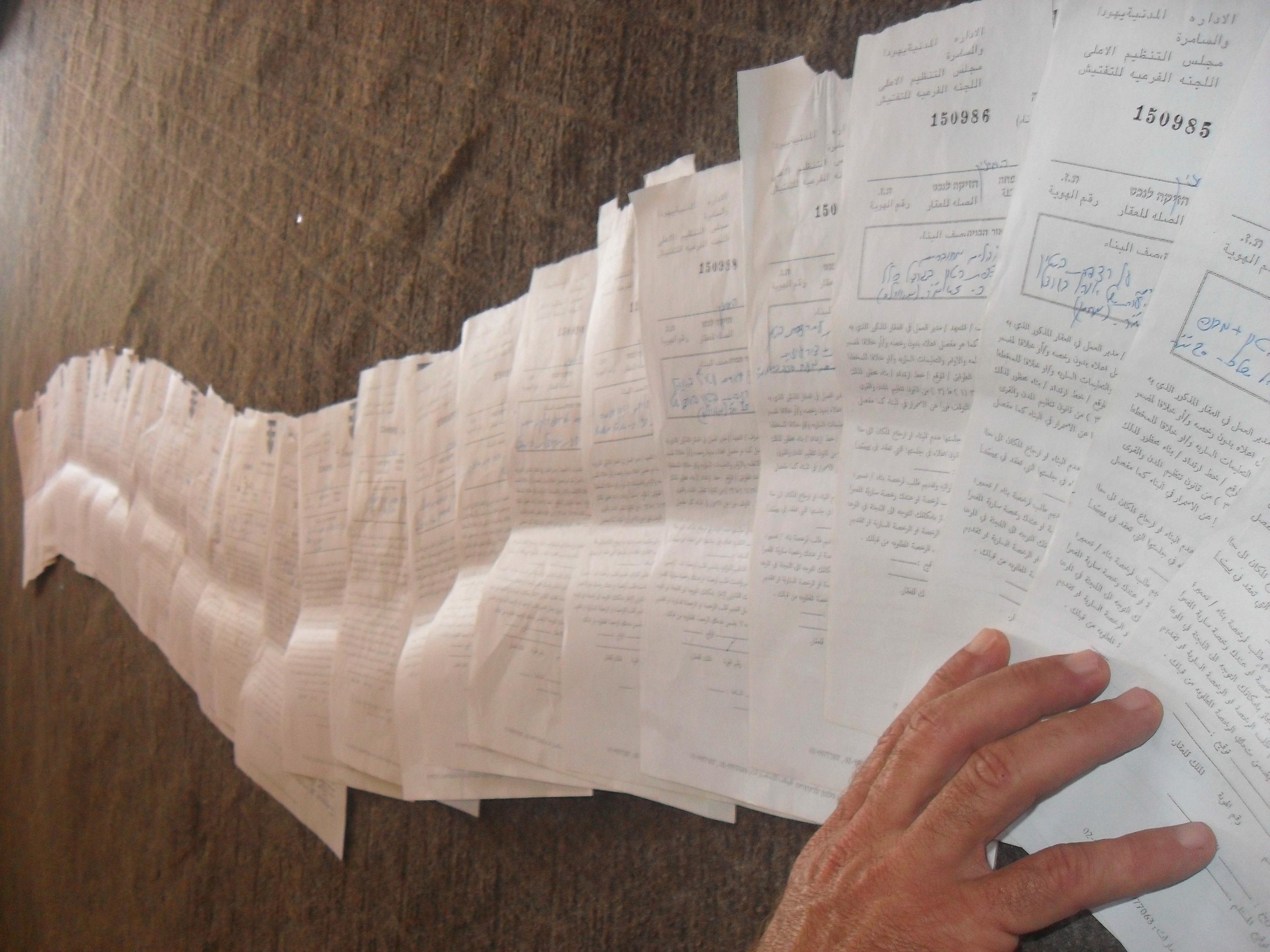
Original copies of all the demolition orders served today (Photo by ISM)
The residents of Susiya include more than thirty families, who were all evacuated from their homes in the old Susiya village and forced to relocate 200 meters to the southeast, in 1986. Susiya residents collaborate with the nearby villages in Masafer Yatta, a closed military “firing zone,” also in Area C and threatened with demolition. On July 15, a hearing will decide whether all the villages in Masafer Yatta can be evacuated by the military. Hafez Huraini, leader of the South Hebron Hills Popular Committee and himself a refugee from 1948, emphasizes that the villagers in Susiya are targeted simply for existing, so everything they do from grazing sheep to visiting family members in the nearby city of Yatta draws violence from the Israeli military and the local settlers.
Susiya has faced six mass demolitions since the establishment of the Israeli Suseya colony in 1983. The last wave of demolitions in 2011 repeatedly displaced 37 people including 20 children [1]. Residents of Susiya, most of whom rely on subsistence agriculture, are subject to some of the worst living conditions in the West Bank. Their houses were destroyed by Israeli forces and they now live in tents and shelters, paying more than five times the price nearby villages pay for water and consuming less than 1/3 of the WHO standard per capita [2]. Settlers have violently denied Susiya residents access to over 300 hectares of their land, including 23 water cisterns. Documented cases of settler violence include beatings, verbal harassment and destruction of property. Settlers then annex parts of the land by exploiting the Palestinian owners’ inability to access their land.
Of over 120 complaints that have been filed based on monitoring from Rabbis for Human Rights, regarding settler attacks and damage to property, around 95 percent have been closed with no action taken. In 2010, when 55 Susiya residents petitioned the High Court to be granted access to their land, the State responded that it intended to map land ownership of the area. Since then they have only closed to settlers 13% of the land Palestinians have been denied access to, reversing only one incursion [3].
Susiya has been the site of creative non-violent resistance for years, resistance that is continually met with brutality. Events have included marches, picnics on land likely to be confiscated, and Palestinian “outposts.” This coming Saturday Susiya will be part of a festival in the South Hebron Hills aimed at raising awareness about the situation of Masafer Yatta residents and stress their right to remain on their land [4]. In the words of Hafez Huraini, coordinator of the South Hebron Hills Popular Committee, “We will not give up.”
Sources:
[1] Strickland, Patrick O. “Palestine’s Front Line: The Struggle for Susiya.” Palestine Note RSS. N.p., n.d. Web. 27 June 2013.
[2] “Susiya: At Imminent Risk of Forced Displacement.” Susiya: At Imminent Risk of Forced Displacement – OCHA Factsheet (30 March 2012). N.p., Mar. 2012. Web. 27 June 2013.
[3] “South Hebron Hills.” Khirbet Susiya. N.p., 01 Jan. 2013. Web. 27 June 2013.
[4] Al Mufaqarah. “Al Mufaqarah R-Exist.” Weblog post. Al Mufaqarah RExist. N.p., 24 June 2013. Web. 27 June 2013.
Related articles
- The occupation plans to expand settlement of Susiya in al-Khalil (occupiedpalestine.wordpress.com)
- Jewish settlers setting up tent and planning road on Palestinian owned land in Al Khalil (alethonews.wordpress.com)
- Settler dogs attack Palestinian villagers near Hebron (occupiedpalestine.wordpress.com)
Related video
- From Al-Araqib to Susiya (palestinefreedomnow.wordpress.com)
‘Vitoria!’ Mass protests force Brazil congress to reject ‘bill of discontent’
RT | June 26, 2013
Brazil’s legislative body has thrown out a proposed constitutional amendment, which was a key grievance of protesters across the country. The government is also planning to introduce a range of political reforms to appease demonstrators.
In what in being seen as a victory for people power, the measure was defeated on Tuesday by Congress by 430 votes to nine; with the Rio Times saying the protests were “largely fueled by social media and citizen journalists.”
The amendment, known as PEC 37, would have limited the power of state prosecutors to investigate crimes.
The protesters had argued that PEC 37 might have opened the way to more corruption; a problem which is endemic in Brazil.
Brazil ranks 69 out of 174 countries on the 2012 Transparency International index, a score that indicates significant problems with corruption.
The defeat of PEC 37 will keep public prosecutors at the forefront of the fight against corruption. If the amendment had become law, it would have granted power to carry out criminal investigations exclusively to the police.
Critics to the bill argued that it would have prevented prosecutors from conducting fair, impartial and effective criminal investigations, particularly into organized crime and corruption, in which the police themselves have been embroiled. In December last year 63 police officers were arrested after a yearlong bribery investigation.
The police in Brazil are amongst the most corrupt in the world and have been mired in recent years in a number of corruption scandals.
Congress also voted Tuesday to funnel all revenue and royalties from newly-discovered oil fields off the Brazilian coast into education and health.
The new fields are among the largest finds in recent years and, once fully operational, are expected to produce tens of billions of barrels of oil; although they are located deep on the ocean floor and extracting the oil will require expensive new technology and carries huge risks.
Protestors also voiced their anger at other issues, which they say the government is mishandling, including soaring levels of corruption, poor public services and the huge cost of staging the 2014 World Cup and 2016 Summer Olympics, both to be held in Brazil.
The government, though, has promised a range of initiatives, which they say will combat corruption and improve public services.
A referendum proposing political reform is meant to address campaign financing and political representation, and the government says a vote may take place as soon as September 7.
A controversial plan to bring in foreign doctors to reverse a shortfall in the country is being pushed through despite the objections of Brazilian medical practitioners and an increase in public transport fares in many cities has also been scrapped. The President of the Senate, Renan Calheiros, has even proposed free transport for students.
Yet it is still unclear whether or not these hasty political concessions are having an impact. Protests are due to continue in the city of Belo Horizonte Wednesday, with tens of thousands of people expected to take part.
In a security nightmare for police, the demonstration will take place at the same time as the semifinal of the Confederation Cup between Brazil and Uruguay. One protest group has said it plans to protest outside the national team’s hotel.
Last Saturday there were violent clashes in Belo Horizonte during another protest and President Rousseff has warned against a repeat of violence.
Turkey takes steps to monitor Twitter content, users
Al-Akhbar | June 27, 2013
Turkey said on Wednesday it had asked Twitter to set up a representative office inside the country, which could give it a tighter rein over the micro-blogging site it has accused of helping stir weeks of anti-government protests.
While mainstream Turkish media largely ignored the protests during the early days of the unrest, social networking sites such as Twitter and Facebook emerged as the main outlets for Turks opposed to the government.
Transport and Communications Minister Binali Yildirim told reporters on Wednesday that without a corporate presence in the country, the Turkish government could not quickly reach Twitter officials with orders to take down content or with requests for user data.
“When information is requested, we want to see someone in Turkey who can provide this … there needs to be an interlocutor we can put our grievance to and who can correct an error if there is one,” he said.
“We have told all social media that … if you operate in Turkey you must comply with Turkish law,” Yildirim said.
Twitter declined to respond to the government request on Wednesday, but a person familiar with the company’s thinking said it had no current plans to open an office in that country.
Turkey successfully pressured Google Inc into opening an office there last October after blocking YouTube, a Google subsidiary, from Turkish Internet users for two years.
While Ankara had no problems with Facebook, which had been working with Turkish authorities for a while and had representatives inside Turkey, Yildirim said it had not seen a “positive approach” from Twitter after Turkey issued the “necessary warnings” to the site.
“Twitter will probably comply, too. Otherwise this is a situation that cannot be sustained,” he said, without elaborating, but he stressed the aim was not to limit social media.
An official at the ministry, who asked not to be named, said the government had asked Twitter to reveal the identities of users who posted messages deemed insulting to the government or prime minister, or that flouted people’s personal rights.
It was not immediately clear whether Twitter had responded.
Facebook said in a statement that it had not provided user data to Turkish authorities in response to government requests over the protests and said it was concerned about proposals Internet companies may have to provide data more frequently.
In the midst of some of the country’s worst political upheaval in years, Turkish Prime Minister Tayyip Erdogan has described sites like Twitter as a “scourge,” although senior members of his party are regular users. He has said such websites were used to spread lies about the government with the aim of terrorizing society.
Police detained several dozen people suspected of inciting unrest on social media during the protests, according to local reports.
Speaking at the Brookings Institution in Washington, D. C., Twitter’s Chief Executive Dick Costolo said on Wednesday that he had been observing the developments in Turkey, but he emphasized that Twitter had played a hands-off role in the political debate.
“We don’t say, ‘Well, if you believe this, you can’t use our platform for that,'” Costolo said. “You can use our platform to say what you believe, and that’s what the people of Turkey … are using the platform for. The platform itself doesn’t have any perspective on these things.”
Turkey’s interior minister had previously said the government was working on new regulations that would target so-called “provocateurs” on social media but there have been few details on what the laws would entail.
One source with knowledge of the matter said the justice ministry had proposed a regulation whereby any Turk wishing to open a Twitter account would have to enter their national identification number, but this had been rejected by the transport ministry as being technically unfeasible.
Turkish users have increasingly turned to encryption software to thwart any ramp up in censorship of the Internet.
Last year, Twitter introduced a feature called “Country Withheld Content” that allows it to narrowly censor tweets considered illegal in a specific country, and it caused some concern among users.
Twitter implemented the feature for the first time in October in response to a request by German authorities, blocking messages in Germany by a right-wing group banned by police.
(Reuters, Al-Akhbar)
Related article
- Turkey announces plans ‘for gas’ and cyber security in face of Gezi protests (alethonews.wordpress.com)
Protests in Brazil Reflect Ongoing Disparities
By Kyle Barron | NACLA | June 25 2013
Hundreds crammed into a room for over six hours, passing around the microphone so that everyone could weigh in. The protestors, mostly students, called the meeting in order to better articulate their message after Rio de Janeiro’s Mayor, Eduardo Paes, had requested to meet with one of the university groups. They emerged that Thursday night with five demands—”five points”—they felt would bring cohesion to the slogans splashed across the signs being waved in the street.
This meeting, or plenaria, took place on Tuesday, June 18, the day after the protests first surged and two days before over a million people took to the streets in over 100 cities across Brazil. While there is no uniformity to all the protests from city to city, and—as Kate Steiker-Ginzberg, a 23-year-old from Philadelphia who attended the plenaria insisted—there exists diversity among protestors within each city, the five points coming out of the plenaria address issues cutting across the various protests.
The first point addresses the 20-cent increase in transportation fare, what has been seen as the catalyst for the protests. While this may not sound like a significant fare hike, as Steiker-Ginzberg explains, it represents a “political miscalculation” on the part of the administration. The fare increase was implemented the same day as the Confederation Cup opened in Brazil. Since 2005, this international soccer tournament had served as a rehearsal for the World Cup, which will be held in Brazil next year. Many were frustrated that the price hike would go toward the extravagant sporting facilities instead of improving the dismal public transportation that is often slow, overcrowded, and dangerous—despite the relatively steep price Brazilians pay for their public transportation.
The fare hike was one among many contributing factors to these protests, and together with the other points addressed by the plenaria, reflects grievances that have been brewing across Brazil for quite some time. The second point concentrates specifically on the excessive spending on mega-events instead of on investment in health and education. Along with the World Cup, Brazil is slated to host the 2016 Olympics.
This taps into the broader question of who benefits from these mega-events. While the country is pouring massive amounts of public funds into the construction and improvement of stadiums, some people complain of the poor state of public infrastructure, hospital overcrowding, and low educational performance in Brazil. As soccer-player-turned-congressman Romário de Souza Faria criticizes, the money for the World Cup could have been used for “8,000 new schools, 39,000 school buses or 28,000 sports courts in the whole country.”
Cost benefit analysis of mega–events shows that these exorbitant affairs rarely deliver many of the economic outcomes promised. While it is estimated that Brazil will spend over $12.5 billion in preparation for the World Cup, it looks as though private interests are the ones poised to benefit most from these events. FIFA reported a profit of $202 million from the 2010 World Cup in South Africa. As their financial statement boasts, “The 2010 FIFA World Cup South Africa™ was a huge success, a fact that was reflected by its financial result.” Most of these profits are a result of selling broadcasting rights and sponsorships, with a smaller percentage coming from ticket prices. Similarly, the International Olympic Committee (IOC) garnered $250 million from the last Olympic games, the majority of those profits coming from television licensing.
Furthermore, Brazil has spent over $473 million in public funds on improvements to the Maracanã, Rio de Janeiro’s iconic soccer stadium, which will host the World Cup Final as well as stage the opening and closing ceremonies of the Olympic games. This investment was on top of the almost $300 million that had been spent on renovations to the stadium during the last 15 years. Earlier this year, after months of negotiations, Maracanã was privatized with the granting of a 35-year contract to a consortium of investors for a comparatively low price tag of $85 million. After public outcry over the deal, a judge reversed the ruling, citing irregularities and claiming that one of the companies involved in the deal had an unfair advantage in the process. Finally, on May 13, the judgment was reversed again, allowing the privatization to continue. Beyond the importance as the site for the most high-profile moments in the upcoming mega-events, the stadium has long been a cultural symbol for Brazil. According to Steiker-Ginzberg, “this major symbol of democracy and public space and class intermingling in the city is now being destroyed and privatized.”
The megalopolises of Rio and São Paulo are not the only places the public’s money is being spent. Throughout Brazil, $13.9 million will be put toward preparing for the World Cup and the Olympics. In many of these places, such as the northeastern city of Manaus, the excessive and over-budget spending does not seem justified. This is especially true considering that after the games are over, Manaus’s $246 million Amazonia Arena is predicted to be underutilized in the city of 2.3 million people. This could be true of other stadiums around Brazil as well—Brasília, Cuiabá, and Natal simply don’t have clubs with a following that would justify the investment over the long term.
The third concern of the plenaria focused on the criminalization of protests and the militarized response of the police to demonstrations. Social media has been rife with images of the riot police with Choque emblazoned on their shields, indicating they are “shock troops,” shooting rubber bullets, using pepper spray, and hurling seemingly endless canisters of tear gas at protestors. These crowd-control tactics have been so aggressive that some have termed this the Vinegar Revolution, in reference to the palliative effects the common kitchen staple has against tear gas. As Brazil and Security Policy expert Joseph Bateman explained in an interview with the Washington Office on Latin America, while other sectors throughout the government have opened up to civil participation since the end of the military dictatorship in 1985, the security sector has only just begun to do so, and “a lot of police still see their role as protecting the state, not protecting citizens.” This has been especially salient in São Paulo, where protests intensified in response to images of police brutality, particularly against journalists, that circulated on social media. Shock police shot a journalist, Juliana Vallone, at point-blank range in the face.
This violence against protestors is tied into the fourth point, which aims to democratize the media. There has been criticism that the major media networks, primarily O Globo, have been concentrating on the vandalism and violence of the protestors while largely ignoring the police brutality against the protestors. The fixation on the violent aspects of the protests is also at the expense of the reporting of the largely peaceful expression coming from the majority of protestors. As a university professor remarked after recently arriving for a visit to her native Rio de Janeiro, “it’s sad that some television stations only show the destruction and fail to show the people that want a better Brazil.”
The fifth point concerns the forced evictions and community removals resulting from the major urban transformation taking place in Brazil. In 2012 in São Paulo, 2,000 riot police were called in to suppress the uprising of more than 6,000 residents who refused eviction in the community of Pinheirinho. Many of these evictions throughout Brazil are being done in preparation for the World Cup and Olympics. Rio’s oldest favela, Providência, has lost its central square—the community’s only public space—to Olympic construction. Almost 5,000 residents are slated for eviction in this community alone. Altogether 170,000people throughout Brazil are facing removal or have already been evicted. The Popular Committee for the World Cup and the Olympics, a human rights group based in Rio, estimates that over 10,000 families will be affected in Rio de Janeiro alone because of these mega-events.
These forced evictions have been taking place amidst a major real estate boom throughout Brazil.
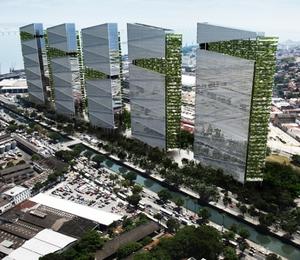
According to Forbes, Brazil is the country with the most rapidly increasing home prices in the world. In Rio, the rise in home prices has been four times greater than the rise in wages over the last five years. Donald Trump is investing in five skyscrapers in the city that, according to the developer’s website, will be the “largest urban office development in the BRIC [Brazil, Russia, India, and China] countries.”
Critics contend that many of these evictions are driven by economic incentives. The city of Rio de Janeiro has used a host of reasons to justify the demolition of the community of Vila Autódromo—from environmental and safety concerns to its use as a security or media zone for the Olympics. It is reported that the mayor of Rio de Janeiro, Eduardo Paes, entered into a partnership with private companies that will open up 75% of this site for private development after the Olympics. His reputation for these kinds of deals recently made headlines after a physical altercation with a constituent who accused him of catering to the interests of developers.
While the government does provide several forms of compensation to communities facing removal, the resettlement programs have systematically moved poor residents away from the high-value land and into peripheral areas of the city with little access to transportation or employment opportunities. Furthermore, O Estadão reported that the City of Rio de Janeiro paid $8.9 million for resettlement land to two companies—both contributors to Mayor Paes’s election campaign. After this was revealed, Paes revoked the deal.
On Saturday, June 15, communities affected by these evictions came together on the same day as the Confederation Cup opened, not far from Maracanã stadium for their own soccer tournament. The People’s Cup Against Removals was organized to “give a voice, to give time, to give space for those being excluded and for those being removed.” The stark contrast between the newly renovated stadium hosting the precursor to the World Cup and the small and humble field occupied by the People’s Cup players reflected the disparities at the heart of many of these protests. “I think that’s something that people woke up to,” remarked Steiker-Ginzberg, “the disparity between the investment in these stadiums and then people overflowing out of the public hospitals and ambulances not arriving on time . . . You can’t just reverse a 20 cent hike and expect everyone to get off the streets.”
Related
- Brazilian legend Romario questions 2014 World Cup (prosoccertalk.nbcsports.com)
- The Last Word: Mr Blatter, the party’s over (revoltadosvintecentavos.wordpress.com)
- Brazil: In The Eye Of The Storm – Video
Featured Video

“Historic Russia”: The Land Putin Will Not Give Back
or go to
Aletho News Archives – Video-Images
From the Archive
How Ukraine Tortured and Slaughtered Donbass
By Kit Klarenberg | Al Mayadeen | July 11, 2024
Almost immediately after the proxy war erupted, ISIS-tier footage of the torture and murder of Russians in Ukrainian custody emerged.
On July 6th, the New York Times published an astonishing investigation: In Ukraine, Killings of Surrendering Russians Divide an American-Led Unit. The article documents in grim detail how Chosen Company, an international volunteer battalion for Kiev, routinely executes Russian prisoners of war. It is the very first mainstream admission that this practice – a brazen breach of the Geneva Conventions, and a grave war crime – is widespread among Ukraine’s fighters, both foreign and homegrown. … continue
Blog Roll
 Aletho News
- Peace in Ukraine: the easy way – or the hard way
- Trump & the Rrrrussians
- US taxpayer money laundered back through Ukraine – Musk
- Before COVID, an NIH lab chief proposed making a SARS-like bat virus more infectious
- Gates, Bourla on Trial in Netherlands Accused of ‘Great Reset’ Scheme at Vaccine Injury Hearing
- BRITAIN’S WARNING: PREPARE FOR WAR
- “Historic Russia”: The Land Putin Will Not Give Back
- How the Cambridge Analytica scandal still haunts Mark Zuckerberg
- The Ongoing Cancellation Campaign Against a Dissenting Academic in Norway
- Yemen and ‘the Houthis’: Challenging Sami Hamdi’s Narrative
- If Americans Knew
- DAILY UPDATE: Latest essential news on Palestine, Israel, & region
- Damning report shows the media must confront its failures on Gaza
- BBC senior broadcaster speaks out on Gaza coverage
- Netanyahu vows vast West Bank invasion in response to 20-minute skirmish that left 2 Israeli soldiers and 2 Palestinian fighters dead
- Tied up and tortured: Israel using US-made electroshock weapons on Palestinian detainees
- The outsourced risk: how newsrooms rely on Gaza’s freelancers without protecting them
- Gaza bakeries forced to shut as Israel blocks flour shipments
- Gaza’s breast cancer patients face a deadly wait for treatment amid Israel’s genocide
- DAILY UPDATE: Latest essential news on Palestine, Israel, & region
- The Israel Lobby’s Changing Fortunes
- No Tricks Zone
- Two New Studies Find Thwaites Glacier Melt Cannot Be Driven By Human Activity Or A Warming Ocean
- E-Cars Reduce CO2 Emissions By Only 41% Compared To Internal Combustion Engine Vehicles
- Predictions Made By Renowned Climate Professor Over Past Decades Have Been Proven To Be Poor
- New Study Suggests Large Regions Of The Pacific Ocean Have Been Cooling For The Last 80 Years
- Germany’s Green Energy Debacle: High Energy Costs Force Kahla Porzellan to Close After 182 Years!
- New Study: 50 Years Of The Most Aggressive ‘Net Zero’ Policies Can Only Affect The Global Climate By 0.03°C
- US September “Heat” Was No Record…Many Records Set Decades Ago
- Latest European Green Energy Debacle; Portugal’s Largest Flagship Solar Park Insolvent!
- Green Energy Debacle: German Expert Professor Fritz Vahrenholt Warns Of Severe Economic And Social Consequences
- Two More Paleo Reconstructions Affirm Meters-Higher Sea Levels Across Ireland, Brazil 7000-6000 Years Ago

