NSA Scandal: How Leaks Advance Liberty and Resist Tyranny
Using technology to keep the government in check
By Jerry Brito | Reason | June 18, 2013
We now know what we have long suspected: that the National Security Agency is collecting the phone call records of all Americans. And we are now justified in suspecting what we have long feared: that it is also keeping a permanent backup copy of everything that happens on the Internet, ready to be rewound and replayed in the future. Such a massive surveillance apparatus is a threat not only to privacy, but also to liberty. So what hope do we have that such power can be kept in check, and that we don’t succumb to ever greater tyranny?
If the secret surveillance itself is any indication, then the separation of powers is not up to the task. According to President Obama, domestic surveillance programs are “under very strict supervision by all three branches of government.” Yet it doesn’t seem very strict when more than half of the Senate couldn’t be bothered to show up last week for a major briefing by the government’s top intelligence officials.
“Strict supervision” also doesn’t seem very meaningful when you consider that the FISA Court is a hand-picked non-adversarial specialist court that approved every surveillance request it got last year. Experience suggests that specialist courts tend to get captured by their bar, and in the case of the FISA Court, that means just the government.
More to the point, a secret court issuing secret orders based on secret interpretations of the law makes any debate or commentary impossible. Even when there is a will on the part of some lawmakers to carry out oversight, executive branch officials will apparently lie under oath. So if not on the Constitution and its institutions, on what can we rely to keep government power in check?
Technology might be the answer, but not in the way you might think.
Yes, we can encrypt our communications by using PGP, Tor, and OTR chat, and we can transact using Bitcoin. These are invaluable tools of resistance to censorship and oppression. Ultimately, though, most people won’t use them because they won’t see any immediate benefit to justify the effort. And in a world where few use these tools, those who do will perversely draw attention to themselves.
Instead, technology might help keep government power in check the same way it helps it grow: by making it impossible for anyone to keep secrets—including the government itself.
When Daniel Ellsberg decided to leak the Pentagon Papers in 1969, he spent a year sneaking out the 7,000 classified pages one briefcaseful at a time. He spent countless hours each evening in front of a primitive photocopier, and he spent thousands of dollars on the endeavor. In contrast, Bradley Manning and Edward Snowden’s leaks of considerably more data were relative cakewalks. The same digital technology that makes it possible to capture and store vast quantities of surveillance information also makes it possible for the first time in history to copy and release hundreds of thousands of pages of classified information.
A surveillance state as big as the one that’s now coming into view necessarily means that there are more secrets and more people with access to those secrets than ever before. More than 92 million documents were classified in 2011, up from 76 million the year before, and 23 million when President Obama took office. All of that data is digital, and therefore eminently reproducible.
There are also over 4.2 million persons with security clearances, and over a million of those can access top secret documents. Contractors, like Snowden, are an indispensable part of the system, and there are almost 2,000 private companies working for the government on programs related to homeland security and intelligence.
There simply has to be that many documents and that many people with access in order to build and run such a massive edifice. The larger it grows, however, the more untenable it becomes. As Julian Assange pointed out in a pre-Wikileaks essay, an organization keeps secrets because if what it’s doing is revealed, it will induce opposition. A small criminal conspiracy may be able to keep its secrets by limiting its numbers and not writing anything down. A large conspiracy, on the other hand, can’t function unless it systematizes its activities, and that involves a long paper trail and lots of confidants, which makes it more difficult to prevent leaks.
“The more secretive or unjust an organization is, the more leaks induce fear and paranoia in its leadership and planning coterie,” Assange wrote. To cope, such an organization can shrink and do less, he wrote, or introduce more security and controls and thus inefficiency. Either way, the organization’s power will contract.
We’re already witnessing such a reaction to Snowden’s leaks. On Thursday Sen. Dianne Feinstein (D-Calif.) said that Congress plans to draft legislation limiting private contractor access to secret documents. “We will certainly have legislation which will limit [or] prevent contractors from handling highly classified data,” she said. Today NSA director Gen. Keith Alexander announced that the agency will implement a “two-person rule” that would require anyone copying data to do so with another person present—a buddy system that potentially halves the NSA’s efficiency.
In attempting to limit leaks, such legislation would also effectively limit government’s power. That’s the happy dilemma the technology introduces. Digital communications makes achieving and exploiting “total information awareness” possible, but it also makes it almost impossible to keep the resulting corruption under wraps. Secrecy just doesn’t scale.
Related articles
- Leaked: NSA’s Talking Points Defending NSA Surveillance (alethonews.wordpress.com)
- Obama Speaks with Forked Tongue on Surveillance (alethonews.wordpress.com)
- Spying on the World From Domestic Soil (alethonews.wordpress.com)
- Steve Chapman on Why the NSA Leaks Aren’t Putting Americans at Risk (reason.com)
Bulgarian scholars call for end to plutocracy
Press TV – June 24, 2013
Sixty prominent Bulgarian intellectuals have issued a special declaration against ‘plutocracy’ in the country, calling for an end to rule by the wealthy and a return to democracy.
The so-called charter for disbanding the plutocratic model of the Bulgarian state was issued on Sunday amid the ongoing protests by Bulgarians to oust the three-week-old government.
“The protests of tens of thousands of people across the country were motivated by the desperate concern about the state system in Bulgaria. Beyond doubt, we are in a deep crisis of the social contract and a total discreditation of the state institutions,” the declaration read.
The protests began on June 14 after the appointment of controversial and inexperienced media mogul Delyan Peevski as chief of Bulgaria’s National Security Agency (DANS).
The declaration called Peevski’s career and public image “a synthesis of all pathological processes that led to the current degrading and seemingly dead-end situation.”
“The Peevski case laid bare the growing seizure of the political system, media, justice, security and banking sectors by a network of hidden dependencies that does not respect the rule of law and separation of powers, empties the institutions from democratic legitimacy and substitutes public interest [with] corruption and moral degradation,” the declaration stated.
The new Socialist-backed Prime Minister Plamen Oresharski withdrew Peevski’s nomination immediately after the protests erupted.
However, the move failed to appease both the protesters and President Rosen Plevneliev, who said he had lost confidence in the government and demanded an immediate review of the controversial appointment.
In addition, the declaration addressed a number of other instances over the past years that proved “the adhesion of oligarchy and power,” urging the public to launch a process to clearly define the problems in the functioning of Bulgaria’s democracy and to draft reforms to abolish them.
It also listed some of the most striking problems, including alienated institutions, easily swayed by corruption, nepotism and weakened judiciary, police and media.
The sixty scholars behind the declaration include lawyers, journalists, political analysts, sociologists and human rights activists.
Bush’s Foiled NSA Blackmail Scheme
By Dennis J Bernstein | Consortium News | June 21, 2013
In early 2003, as the U.S. and British governments were seeking international acquiescence to their aggressive war on Iraq, an unexpected cog thrown into the propaganda machine was the disclosure that the National Security Agency was spying on UN Security Council members in search of blackmail material.
The revelation received little attention in the mainstream U.S. news media, which was almost fully on board the pro-war bandwagon, but the disclosure received wide international attention and stopped the blackmail scheme. U.S. President George W. Bush and British Prime Minister Tony Blair were forced to abandon a UN resolution and invade Iraq with a ragtag “coalition of the willing.”

Former British Prime Minister Tony Blair.
Several months later, the identity of the leaker was revealed, a young woman named Katharine Gun who worked as a linguist at the NSA’s UK counterpart, British Government Communications Headquarters. Gun lost her job and was charged under British secrecy laws, but the case was dropped because the court would have required the Blair government to disclose that it also had twisted the arms of legal advisers to extract an opinion endorsing the invasion.
Now, a decade later, Edward Snowden, a young American systems analyst working for the NSA, has leaked documents revealing a global surveillance network and prompted another international debate – about government spying vs. personal privacy. Katharine Gun joined Pacifica’s “Flashpoints” host Dennis J Bernstein to discuss both cases.
DB: What exactly was your position when you decided to leak a certain document?
KG: My title was linguist analyst. I was a Mandarin Chinese speaker. We translated interceptions and produced reports for the various customers of GCHQ, which are normally the Foreign Office or MI-5 and MI-6.
DB: Can you explain the document you released and the significance of the timing?
KG: It was released at the end of January 2003, just before the invasion of Iraq. I saw an email that had been sent from the NSA to GCHQ. It was a request for GCHQ to help the NSA intercept the communications of six nations that sat on the Security Council at that time. It was to intercept their domestic and office telecoms in order to obtain all the information we could about the delegates, which the U.S. could then use to achieve goals favorable to U.S. interests. They called for the whole gamut of information, which made me think they would potentially use the information to blackmail or bribe the U.N. delegates.
DB: This bugging took place at the United Nations?
KG: Presumably, yes. Or it could involve the United Nations headquarters or also their domestic residence.
DB: The idea was to get the necessary information one way or the other to influence the key members to support the U.S. quest for war in Iraq?
KG: Yes. At the time, if you were not working for the intelligence services or the foreign offices of the U.S. or U.K. you would probably assume that the goal of [President George W.] Bush and [Prime Minister Tony] Blair at that time was to work diplomatically to reach a solution. But we now know, after several leaks over the years about the run-up to the war in Iraq, that war was the agenda all along. When I saw the email it made me think, “This is evidence that war is the agenda.” That’s why I decided the public needed to know.
DB: GCHQ is the British Government Communications Headquarters, the equivalent to the NSA [National Security Agency]. You were working there in the lead-up to the Iraq War. Can you remind us what governments were bugged?
KG: Six nations, smallish countries: Angola, Cameroon, and Pakistan, I think. Mexico was mentioned, and possibly Chile as well. They were countries that are generally not known for their big powerful positions at the U.N.
DB: What went through your mind leading up to the decision to leak this information? This big decision changed history a bit. How did you make this courageous decision that also changed your own life?
KG: I was very concerned. I had informed myself about the realities of Iraq and the situation there because I grew up during the first Gulf War and the following years of sanctions. It was in the back of my mind that Iraq was a country that was virtually destroyed, and that the people were living in impoverished conditions. It made me think that another attack on them would not be fair and justified because there was nothing about Iraq that was a threat to either the U.S. or the U.K.
So when I saw the email and realized what was going on behind closed doors was an attempt to get the U.N. to authorize what would then have become a pre-emptive strike on a country, I thought the public should know about this because it angered me.
DB: What happened after you made this information available? What happened with your position? Were you intimidated, attacked?
KG: Initially I tried to remain anonymous, but when I realized the information revealed in the newspaper at the time was identifiable to GCHQ, I decided I didn’t want to lead a double life at GCHQ and pretend I had nothing to do with it. I confided to my line-manager and said it was my leak. Then I was arrested under suspicion of breaking the Official Secrets Act, questioned, and released on bail for eight months.
In November 2003, much to our surprise, they decided to charge me, despite having waited so long. After discussions with my legal team, which included Liberty, an organization very similar to the U.S. ACLU, we decided I would plead non-guilty, because I personally felt that although I did the act, I didn’t feel guilt, because I didn’t feel I had done anything wrong. Our defense would have been to establish the defense of necessity, which is not yet tested in a court of law. My legal team then asked for all the legal advice leading up the war, and at that point, the prosecution decided to drop all charges against me.
DB: What do you think made them decide to prosecute you, and what information made them drop the charges? Were they trying to backpedal? Were they trying to make sure no other folks in positions like you would do it again?
KG: It’s speculation on my part because obviously they haven’t disclosed. I suspect one of the reasons they charged me was to make an example of my actions to try to deter people from it. On the other hand, when they dropped the charges, I suspect there may have been a variety of reasons. When we asked for the legal advice from the then-Attorney General, at that time his legal advice had not been fully disclosed.
During the run-up to the war, Blair asked for legal advice, obviously. The first draft was about 13 pages long. The language was very cautious – it didn’t say there was a definite reason for war. There were many legal terms of caution, but at some point Blair was told the legal advice was not good enough. He needed a watertight case. The Attorney General then re-drafted his advice, and condensed it to a single page that was then issued to the House of Commons.
That is what persuaded all the MPs in the House of Commons to vote for Britain’s involvement in the war. Eventually information came out, not from myself, but from other means and it became apparent that the legal advice had not been at all watertight to start with.
DB: Daniel Ellsberg said your most important and courageous leak is the only one made in time to avert an imminent possible war. Was your desire to avert war?
KG: Yes, I was hoping the British ministers would see the truth and question the actions of Blair and the secret negotiations he was having with Bush at the time. I wanted more transparency on the issue. I wanted people to question what was going on and to generally challenge this bandwagon for a preemptive strike against a country that was already very impoverished and no threat to anybody whatsoever.
DB: Did you ever hear from folks who based on your revelations, learned they were bugged?
KG: No.
DB: So there were no thank yous coming across from that part of the world?
KG: No. At the time of the leak, my name didn’t come out. Eight months later my name was made public.
DB: Did it change your life?
KG: I lost my job. The secure, full-time, long-term employment was no longer possible. That has made an impact, primarily financially, on my life and my family’s life.
DB: We are now seeing extraordinary NSA leaks from Edward Snowden in the British Guardian. What are your thoughts on this?
KG: I think Snowden is probably is a lot more clued-up than I was at the time. My leak was a single issue. Snowden has had a long period of time working within the U.S. intelligence services. He’s obviously a very technically savvy professional. I admire him for taking this tremendous step, which he thought out very carefully and methodically. He has made some very good points. These kinds of issues should be in the public domain because it involves innocent members of the public. We, the public, should be able to have a measure of a say in these matters.
DB: We hear that people like you, who were leaking before the war, and Snowden now, are putting people’s lives in jeopardy, endangering the people. We hear that secrecy is necessary to prevent terrorist attacks, and that many have been prevented by this kind of secrecy, investigation, wiretapping and bugging that’s going on now.
KG: There is absolutely no evidence that my leaks in any way endangered anybody else.
DB: But you were accused of that.
KG: Yes, they love to throw accusations around, there’s no doubt about that. But in my case, the majority of views supported my actions. In Snowden’s case, people who have a fair and just understanding of the issues at-large are supportive of his actions, as they would be of Private Manning, who is currently on trial.
DB: Did you lose any friends or associates, over this?
KG: Ironically, not really. Many of my friends and colleagues from GCHQ have also left GCHQ, partly to progress in their professions. They didn’t see much chance for their linguistic skills progressing much further within GCHQ and I continue to be in touch with them.
DB: If you had it all to do over again, would you?
KG: That’s a difficult question. Now I’m married and have a child. I would hope that I would still do it, but perhaps I would be more savvy about how I did it. Snowden was very clued-up and seems to know exactly what he should be doing – how to stay safe and keep out of the way of being unjustly arrested and tried without due process of law.
DB: Your language skills. Are you using them now?
KG: Not now. I’m only fluent in Mandarin Chinese. I speak some Japanese and am now trying to learn Turkish.
DB: That may in handy in the next decade or so. Thank you for talking to us.
~
Dennis J Bernstein is a host of “Flashpoints” on the Pacifica radio network and the author of Special Ed: Voices from a Hidden Classroom. You can access the audio archives at www.flashpoints.net.
Related articles
- A British Precursor to Snowden Case (consortiumnews.com)
- British spy agency has access to global communications, shares info with NSA (alethonews.wordpress.com)
Four Injured, Palestine TV Reporters Kidnapped In Kufur Qaddoum
By Saed Bannoura | IMEMC | June 22, 2013
The Popular Committee Against the Wall and Settlements in Kufur Qaddoum village, near the northern West Bank city of Qalqilia, reported Friday that dozens of Israeli soldiers attacked the weekly nonviolent protest, wounding four residents, and kidnapped reporters of the official Palestine TV.
The Committee said that the soldiers violently attacked and beat reporter Ahmad Shawar and cameraman Bashar Nazzal, working for the Palestinian TV, confiscated their cameras, and threw the rest of their equipment in the trash.
An Israeli army spokesperson claimed that the kidnapped journalists “attacked the soldiers”, and that they have been transferred to an interrogation facility.
Morad Shteiwy, coordinator of the Popular Committee in the village, has reported that the army surrounded the village since early morning hours Friday, and invaded it in an attempt to prevent the residents from holding their weekly protest against the illegal Annexation Wall and settlements.
“The large number of soldiers deployed in the village could not prevent the determined residents from holding their protest”, Shteiwy said, “the soldiers violently attacked the protesters and fired dozens of gas bombs, concussion grenades, and rubber-coated metal bullets”.
He further said that resident Aqel Mahmoud Shteiwy, 25, was shot with a rubber-coated bullet in his hand, and that one of his fingers was amputated, and added that resident Yousef Mustafa Shteiwy, 21, was shot in the chest, Bassam Ayyoub Shteiwy, 26, was shot in the back and Bashar Mahmoud Shteiwy, 22, was shot in the abdomen.
Also on Friday, soldiers used tear gas, chemical water and rubber-coated steel bullets to attack the weekly protests at the villages of Bil’in and Ni’lin, near the central West Bank city of Ramallah, where residents and their international and Israeli supporters, managed to reach the wall; two protesters were injured and many were treated for the effects of tear gas inhalation.
In Bil’in, gas bombs fired by Israeli troops caused a fire that damaged olive trees owned by local farmers. Soldiers also fired tear gas at residents who tried to put out the fire.
At the nearby village of al Nabi Saleh, Israeli soldiers attacked the villagers and their supporters before leaving the village.
Dozens of soldiers stormed the village and fired gas bombs into resident’s homes. Many were treated for the effects of tear gas inhalation.
In al Ma’sara village, near Bethlehem, dozens of soldiers stopped the villagers and their supporters at the village entrance and then forced them back, using rifle-buts and batons to push people back, no injuries were reported.
Related articles
Brazil: In The Eye Of The Storm
Michel De Souza · June 15, 2013
Durante os protestos essa semana no Rio eu fiz um registro do registro das minhas fotografias.
É um video que conta exatamente momentos antes de cada fotografia tirada, acho que além disso, conta a história de algo que parece estar marcando nosso país.
Confesso que me emocionei ao final.
Assistam, compartilhem, multipliquem.
Fotografias, imagens e edição por Michel de Souza
Trilha original “Changes” por Pedro Curvello
___________________________
Related articles
Nuclear weapon reductions will reduce risks, but prohibition treaty urgent
The International Campaign to Abolish Nuclear Weapons | June 19, 2013
The International Campaign to Abolish Nuclear Weapons (ICAN) welcomes President Obama’s announcement in Berlin today calling for a world without nuclear weapons and the readiness to pursue further reductions in the US and Russian nuclear arsenals. However, the humanitarian consequences of any nuclear weapon use, increasingly the focus of global engagement on these weapons, demands their prohibition and elimination.
The speech by President Obama contributes to a growing recognition that nuclear weapons are unusable weapons with no practical utility in today’s global security environment. Despite this, they threaten shocking humanitarian consequences if they were to be used. Nuclear weapons are the only weapons of mass destruction not subject to treaty prohibition and ICAN is calling for such a treaty to provide the framework for their elimination.
“The speech by Obama comes at a point where many other states, international organisations and civil society are focusing on the unacceptable humanitarian effects that the use of these weapons would create. The level of civilian harm that nuclear weapons threaten makes a treaty prohibiting their use, production and stockpiling urgent,” said Beatrice Fihn of ICAN’s International Steering Group.
2013 has already seen international discussions focused on the humanitarian impact of nuclear weapons, and broad cross regional support for this approach. Whilst the intended reductions announced by President Obama would contribute to a reduction in the risk posed by nuclear weapons, the announcement does not challenge the on-going modernisation programmes in most nuclear-armed states or the continued reliance on nuclear weapons in security doctrines.
A single nuclear weapon detonation in an urban area would kill hundreds of thousands immediately and leave hundreds thousands more in desperate need. A wider use of nuclear weapons could cause climatic changes that impair global crop production and result in people starving even in different continents from the conflict.
“The consequences of a nuclear weapon detonation will not stop at borders; it is truly a global concern no matter who possess these weapons,” says Akira Kawasaki, Executive Committee member of Peace Boat and Co-chair of ICAN. “This announcement should encourage action from all states, not only nuclear armed states and those with extended nuclear deterrence arrangements, but all non-nuclear weapon states as well. It is now time to take bold and tangible steps towards the goal of a world free of nuclear weapons by negotiating a ban.”
Related article
- Celebs push Obama to eliminate nuclear weapons (thehill.com)
Erdogan at Home: Yes to Oppression, No to Rights
By Doha Shams | Al-Akhbar | June 18, 2013
Since the start of the protests and ensuing unrest in Turkey, a peculiar tradition has emerged in Istanbul. As the soon as the clock strikes 9 pm, a chorus of percussion – banging pots and pans – emanates from open windows in “pro-opposition” buildings. The cacophony lasts for about half an hour, sometimes more, depending on the day’s events. Its purpose: to show solidarity with the protesters in Taksim Square.
Istanbul – Aznur returned from the dentist disappointed and worried. She had an appointment, but the clinic was closed. She was not sure if this had something to do with the general strike called by Turkey’s trade unions.
The young woman, in her twenties, stood bemused, her face still swollen from yesterday’s tear gas. She then mumbled, “Maybe he is still detained. He was protesting with us last night.”
Though Aznur’s English is broken, this is nonetheless a “great achievement” in Turkey, where few people go on to master any foreign languages. In truth, the language barrier has made on-location coverage difficult for those who want to understand events beyond the news agencies.
Five Turkish trade unions declared the strike following the brutal police crackdown on protesters, which has claimed the lives of four activists and injured thousands since the protests began. Yesterday alone, 600 protesters were detained throughout Turkey, according to a source in the Turkish Bar Association who declined to be named.
The trade unions’ move also signals their rejection of the policies of Turkish Prime Minister Recep Tayyip Erdogan. Such policies have started to infringe alarmingly on individual freedoms, as many young men and women have told us.
Serttaş, a 30-year-old physical therapist, said, “Does Erdogan think Turkey is Gaza? The municipality of Ankara prohibited men and women from holding hands in public places and public transportation! Who does he think he is? All that is left for him to do is come with me to the bathroom! And why would he ban the sale of alcohol after 10 pm? I don’t understand.”
“We are here defending our way of life,” he added.
Yesterday was a momentous day. The repression of unarmed, peaceful protesters was unparalleled for a country not at war. Perhaps the explanation for Erdogan’s ham-fisted approach lies in his fear of catching the “Arab Spring” bug.
In its crackdown on the protesters, the government used a new type of tear gas, which could be a misnomer since the gas is blinding, as we were told by medical sources who said that 17 people have lost their sight because of the gas. The government has also shut down all communications, Internet access, and public transport like the subway and taxis. On top of it all, he has cut off power from Taksim Square to deter protesters from coming to the site.
These measures paralyzed the touristic capital. Thousands of tourists were stranded. We were able to spot some lost in the streets, unable to find their way back to their hotels.
We saw a Japanese tourist standing in front of a clerk at the bus station in Findikli Station on the Bosphorus. “I have a question,” she tried to tell the clerk. He looked at her said, “Yok yok” – Turkish for “there isn’t,” as in there isn’t anything operating. The tourist asked again, “Bus? Tram?”
“Bus yok, metro yok,” the clerk replied, making hand gestures to mimic someone walking. The girl, not quite sure what to do, followed his advice.
I, too, was stranded after witnessing the dispersal of a protest near Taksim using tear gas, water cannons, and batons. I ran away from the terrible smell in the direction of the waterfront along with some protesters. There, I encountered staggering traffic along the Bosphorus.
I learned afterwards that the legendary traffic was caused by Erdogan’s supporters, who came in from the Turkish provinces to meet his call to rally in the neighborhood of Zeytinburnu, where Erdogan delivered his speech.
“Most people left before Erdogan finished half of his speech,” a man in his fifties told us from where was he standing, in front of his café. I glanced at the Turkish television inside that was broadcasting Erdogan’s speech, and I saw the flag of the Syrian opposition.
During my long wait at the waterfront, I saw many large buses packed with women wearing the headscarf, and crammed taxis. Traffic was at a standstill. We asked one taxi after another, “Osmanbey?” to which the unanimous answer was “Kapali, kapali,” meaning “it’s closed.” The police reinforcements had closed it down.
Nearly an hour later, when Erdogan’s speech was over, traffic suddenly started rolling. In a matter of minutes, the street was completely empty, as though someone had blocked it at a faraway spot. I heard chants in the distance, and soon thereafter, a few-hundred-strong protest arrived in the area. Clearly, they came to protest against what Erdogan said during his speech.
Most of the protesters are young and middle class. There even are claims that most of the protesters are taking to the streets for the first time. Almost everyone was wearing a gas mask or goggles.
They looked at the choppers flying overhead and waved their fists at them in a challenging gesture. Passing boats in the Bosphorus sounded their horns, and people banged pots on balconies or applauded.
Şenol, a 40-year-old man who took part in the protests, said, “I do not blame the poor for backing Erdogan. They do not know their rights. They think that the handouts of the Justice and Development Party are something good. They don’t understand that his economic policies impoverish them.”
He continued, “Erdogan fools them with religious slogans while he sells public property, and expands the circle of cronies of businessmen and the nouveau riche. One day, they will understand. We too voted for him thinking he would rid us of the military, but he is worse than them.”
The time is nearly 8 pm. The sky is overcast. I tried to contact friends, but the phone lines are broken. Smartphones weren’t so smart either, because the Internet had been shut down.
Istanbul was nearly choking because of the fires and toxic gases that poisoned the air. Scores of hotel reservations and trips have been cancelled, much to the chagrin of workers who depend on tourism to make a living.
The clashes in Taksim and neighboring quarters continued throughout Saturday and Sunday. Street battles near the Osmanbey metro station led to a major confrontation on Sunday shortly after 4 pm.
It rained heavily, flash-flooding Istanbul’s streets. The rain washed away the toxic air, and forced some police officers to retreat. The protesters also took advantage of the rain to flee to their homes and wait for the next round of protests tomorrow.
Related articles
- Turkey will consider protesters staying at Taksim terrorists, official says (alethonews.wordpress.com)
- Turkish Unions Protest Erdogan Crackdown, Announce Strike (alethonews.wordpress.com)
Brazil sees largest protests in decades as unrest hits second week
RT | June 17, 2013
Mass protests continued throughout Brazil on Monday, with hundreds of thousands of demonstrators converging in Sao Paulo, Rio de Janeiro, Belo Horizonte, the capital of Brasilia and other cities.
Protests initially began last week following a government announcement of an increase in public transportation costs, which brought out students and young workers and led to more than 250 arrests.
According to reports by Brazilian media such as Jornal do Dia, the initially peaceful demonstrations last week became heated, and led to clashes with Brazil’s riot police that left at least 100 injured in the major cities of Brasilia, Sao Paulo, Rio de Janeiro and Belo Horizonte.
Though the protests initially began following the announcement of bus fare increases, they have evolved to include a wide range of groups that have grown dissatisfied over everything from government corruption and income inequality, as well as to outrage over the police’s harsh response to protesters last week.
In a sign that public dissatisfaction was still simmering, soccer fans booed president Dilma Rousseff on Monday during the opening of a two-week tournament at a stadium in the capital Brasilia. The heckling only intensified when the president of the global soccer body, FIFA, reprimanded the crowed for failing to show the president “respect.”
Though Rousseff was able to ride on her predecessor’s popularity, Brazil’s economic growth has slowed considerably since she took over from Luiz Inacio Lula da Silva, who is widely credited with lifting 40 million Brazilians out of poverty. Brazil’s economy has posted its worst two-year performance in over a decade, and inflation rose to 6.5 per cent in May.
At least 20,000 Brazilians were expected to demonstrate in Sao Paulo on Monday, with organizers placing the figure closer to 30,000.
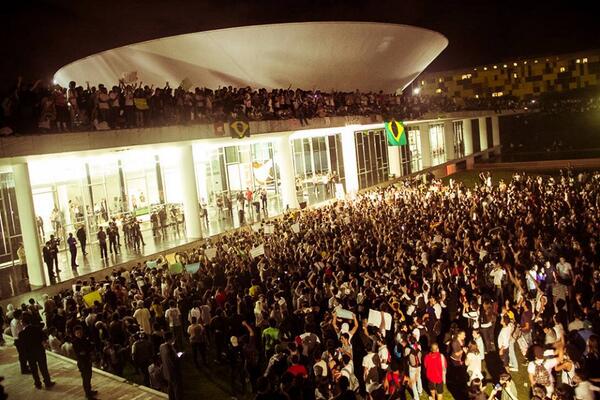
Protesters climb atop the capitol building in Brazil. #ChangeBrazil pic.twitter.com/Tb6CblQ5T0
Related articles
An Insight Into Palestinian Resilience in Gaza
Cold Nights in an Indifferent World
By SARAH MARUSEK | CounterPunch | June 17, 2013
In the eyes of many Westerners, Gaza is a dangerous and war torn place. Even activists, including myself, often imagine Gaza primarily as a place of suffering, and one that has unfairly come to eclipse the affliction of all of Palestine. But while Israel’s wars of aggression against the people of Gaza, as well as its brutal siege, have cost many lives and inflicted countless casualties, Gaza today is a remarkably calm, protected and beautiful place where everyday lives go on, despite the continued suffering of its people. Indeed, Gaza is a place where the heart and soul flourish even if the body is ailing; where people and community are so alive and resilient that it rekindles one’s hope in humanity.
I only know this now because I traveled to Gaza earlier this month to participate in the second annual Global March to Jerusalem (GMJ) on Friday, 7th June 2013, when thousands of Palestinians and international activists mobilized in peaceful demonstrations around the world to draw attention to Israel’s continued violations against Jerusalem and its people. Although Israeli police violently suppressed GMJ demonstrations in Jerusalem and throughout the West Bank, peaceful mass demonstrations did successfully take place in Gaza and the neighboring countries of Jordan and Egypt, as well as in Tunisia, Mauritania, Morocco, Yemen, Malaysia, and Turkey. In addition, there were demonstrations in solidarity with the GMJ all around the world, including several major cities across Europe and North America.
On Friday, 7th June I was fortunate enough to join Palestinians and a group of international activists in a peaceful mass rally in Beit Hanoun, the nearest point possible to Jerusalem in Gaza. Many thousands attended the rally, and during my address I promised to carry their voices back home with me to the US in order to communicate their struggle to live under the footprint of a racist occupying power that my government funds and arms. Of course, the few days I spent in Gaza are hardly enough to fulfill this promise. There are too many voices that I was not able to hear, both because there was not enough time and because of my identity as an American woman. But I am hoping that what I can offer begins to communicate the complex life stories of a people resisting against horrific injustices, while at the same time encouraging other Westerners to travel to Gaza in order to do the same.
My entry into Gaza was made possible by the Miles of Smiles convoy organized by the International Committee for Breaking the Siege on Gaza (ICBSG). While there have been many international convoys entering Gaza in recent years, all of which bring much needed aid to the besieged people of Gaza, the Miles of Smiles convoy offers something unique by focusing on development aid. The first Miles of Smiles convoy reached Gaza in November 2009, and since then the ICBSG has successfully organized twenty additional convoys into Gaza. Our convoy included activists from Jordan, Egypt, Tunisia, Libya, Yemen, Saudi Arabia, Bahrain, Malaysia, South Africa, the UK, and the USA.
Miles of Smiles works closely with Partners for Peace and Development for Palestinians (PPDP) to sponsor projects that empower Palestinians to develop the means to live dignified lives on their own terms. The PPDP is a UK-based organization that works with a dedicated team of Palestinian employees and volunteers in Gaza to offer interest-free loans and small grants to Palestinians, helping them to establish family businesses and development projects. One example of this is a small bakery that we visited during the first night we spent in Gaza, which thanks to a PPDP loan generates employment for an entire family.
PPDP’s Palestinian employees and volunteers in Gaza coordinated our program, which included many different activities that allowed us access to a diverse array of Palestinian voices and experiences. For example, our second day in Gaza we met with the children and spouses of Palestinians who are currently imprisoned by the occupation authorities, often without any formal charges ever being brought against them. And even when Palestinians are tried, it is in military courts – an apartheid system of justice that separates Palestinian children from their fathers, mothers, brothers, and sisters.
Earlier that day we also visited a government hospital that specializes in caring for children. We asked one of the doctors there what the needs of the hospital are, and his answer was a lack of resources – a problem that more international activists could easily help alleviate if the US and Europe did not impose such draconian penalties for working with Hamas, the ruling party of the government in Gaza that Israel and its Western allies label as a terrorist organization because of its resistance activities against the occupation. The doctor explained to us that they have many doctors, in fact too many to employ. Even during Israel’s recent war against Gaza in November of last year they had a sea of volunteers to help. However the hospital still needed equipment and medication to meet the needs of their patients. Indeed according to the human rights organization B’Tselem, Israeli forces killed 167 Palestinians during last November’s military operation, at least 87 of them civilians and more than one third under the age of 18. As we visited some of the sick children I felt so helpless and angry because as an American I am unable to contribute anything to the important work of this hospital, which saves innocent children’s lives. Fortunately, those in Arab countries are able to donate without fear of prosecution, and their contributions help keep the hospital running.
On our fourth day we visited Islamic University, the best university in Gaza (there are seven in total) and ranked among the top 250 universities around the world. Founded in 1978, the university’s campus is modern and beautiful, servicing around 20,000 students each year. The university offers many degrees across the arts and sciences, with Islamic values guiding the behavior of the students as well as the curriculum, which is in line with international scientific standards. But even this university has suffered unjustly under the occupation. During Israel’s December 2008 war against Gaza, occupation forces destroyed 74 of the university’s laboratories, as well as a library, a collective punishment against the entire population. Lest anybody think that this was collateral damage, Israel deliberately bombed the university in six separate air strikes. When I think of violent acts that would terrorize me as a teacher and a scholar, this ranks among the worst. And yet this terrorism is exactly what my government is uncritically supporting.
During our time in Gaza, we also met with Prime Minister Ismael Haniyeh, and distributed aid to orphans as well as to needy families thanks to the generosity of our Libyan delegation (as well as my own friends and colleagues who kindly donated money so that I could distribute toys to children). But most of us will never really know what it is like to live under a violent occupation. What it is like to be cruelly besieged by your neighbor and demonized by Western countries for fighting back. We spoke to some graduates of Islamic University who are involved in the Gaza student community, to try and learn more about their own experiences.
One member of the convoy, an American filmmaker of Pakistani origin, remarked how surprising it was that the Palestinians working with us were not more angry. One young man responded that, in fact, they are very angry, but that they still have to live. He explained that he holds his pain and suffering deep inside himself, as do other Palestinians in Gaza. It has to be contained for fear that if expressed it could destroy their lives. And even though he spoke these words calmly and quietly, the inner anguish distorted his face and the grief filled his wide eyes. He told us that he lost seven friends in the last war against his people. On his way to sit his university exams he also saw bombs destroy the buildings around him. His exams were postponed. But what really made the suffering intolerable was getting through the cold nights during that war.
I can only conclude that this coldness is symbolic of a world where an occupying power can terrorize and ethnically cleanse a native population with impunity. Because if there were any warmth left in our hearts, then we would all be doing everything that we possibly could do to stop Israel’s crimes against the Palestinian people. Convoys like Miles for Smiles help, as do solidarity activities like the GMJ, but considering the extent of their suffering, the Palestinians deserve more from all of us.
Sarah Marusek is a member of the International Executive Committee of the Global March to Jerusalem.
Related articles
- Palestinian farmer injured by Israeli army fire (alethonews.wordpress.com)
- Mass protest aims to focus attention on Jerusalem (palsolidarity.org)
Brazilian police clash with Confederations Cup protesters
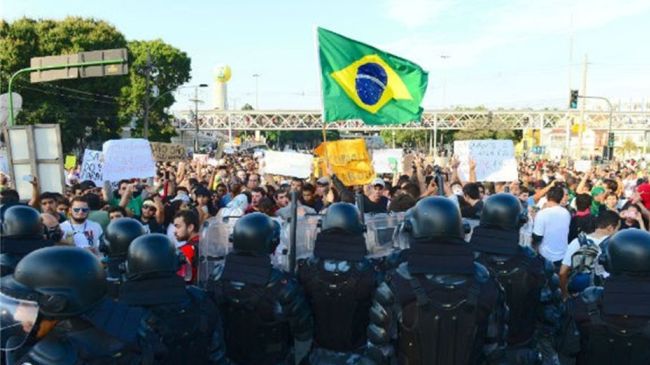
Brazilian police block protesters from entering Maracana soccer stadium in Rio on June 16, 2013
Press TV – June 17, 2013
Brazilian police have fired tear gas and rubber bullets to disperse a crowd of about 3,000 people protesting outside Rio de Janeiro’s Maracana stadium before a Confederation Cup soccer game.
The rally took place on Sunday in protest against the vast sums of public money spent on the organization of the tournament.
The protesters also opposed the huge cost of preparations to host next year’s World Cup, which is expected to reach USD 15 billion (about 11 billion euros).
“I don’t care about the World Cup – I want health and education!” shouted the protesters.
Initially, police stood in line as a barricade outside of the stadium.
However, as the crowd of protesters tried to pass the blockade riot police charged towards the group.
On June 15, police clashed with protesters in a similar demonstration during the opening of the Confederations Cup in the capital, Brasilia.
The clashes ended with 39 people injured after police fired tear gas and rubber bullets to disperse the crowd.
Related articles
Turkish Unions Protest Erdogan Crackdown, Announce Strike
Al-Manar | June 17, 2013
Two of Turkey’s main trade unions started a nationwide strike on Monday after police cleared protests from Istanbul protest park.
The KESK and DISK trade unions, who together represent hundreds of thousands of workers, called a one-day stoppage to object to the police violence against anti-government protesters, and said they planned to hold demos in the late afternoon.
“Our demand is for police violence to end immediately,” KESK spokesman Baki Cinar told AFP, adding that the unions would be joined by striking engineers, dentists and doctors.
Turkish Interior Minister Muammer Guler condemned the stoppage as “illegal” and warned strikers not to take to the streets, as Prime Minister Recep Tayyip Erdogan defended his crackdown on Gezi Park, the epicenter of the protest movement.
Riot police were still firing volleys of tear gas and water at pockets of demonstrators in Istanbul and the capital Ankara early on Monday, after a weekend of clashes sparked by the eviction of protesters occupying Gezi Park.
Nearly 600 people were arrested in the scuffles on Sunday alone, according to the Ankara and Istanbul bar associations.
The weekend violence has intensified a crisis that poses the biggest challenge yet to Erdogan’s decade-long rule.
At a rally of more than 100,000 supporters of his ruling Justice and Development Party (AKP) on Sunday, the premier insisted it was his “duty” to order police to storm Gezi Park after protesters defied his warnings to clear out.
“I said we were at an end. That it was unbearable. Yesterday the operation was carried out and it was cleaned up,” a combative Erdogan told a sea of flag-waving loyalists. “It was my duty as prime minister.”
Erdogan’s words were met with roaring approval from the audience, the largest crowd to assemble since the crisis began. Many chanted: “The people are here, where are the looters?”, using Erdogan’s description of the demonstrators.
At the same time, riot police were fighting running battles with thousands of protesters determined to regroup after being ousted from Gezi Park and the adjoining Taksim Square, a mere 10 kilometers (six miles) away from the AKP rally.
Turkey’s political turmoil first began when a peaceful sit-in to save Gezi Park’s 600 trees from being razed prompted a brutal police response on May 31, spiralling into countrywide demonstrations against Erdogan.
The crisis has claimed four lives and injured nearly 7,500 people so far, according to the Turkish Medical Association.
Apartheid State or Criminal Project? BDS or Resistance?
Compiled by Niqnaq | June 10, 2013
Partial List of NGOs Involved in BDS and Their Funders
NGO Monitor, Jul 14 2011
(Originally produced Apr 7 2010, updated Jul 14 2011)
| NGO |
Primary Funders | Funding Amount | Central Involvement |
| Addameer |
Sweden | €207,000 (2009) |
Signatory to 2005 BDS call (http://www.bdsmovement.net/) |
| NDC* | $127,000 (2010-12) | ||
| Al Haq | Holland | $426,201 (funding ceased in 2008) | Signatory to 2005 BDS call (http://www.bdsmovement.net/) |
| Ireland | $88,928 (2009) | ||
| Norway | $156,163 (2009, funding ceased) | ||
| Ford Foundation | $600,000 (2009-10) | ||
| Diakonia | $120,490 (2009) | ||
| NDC* | $134,000 (2010-12) | ||
| Al Mezan | Sweden | €105,000 (2007-9) | Signatory to 2005 BDS call (http://www.bdsmovement.net/) |
| NDC* | $425,000 (2010-12) | ||
| Norway, EU | funding not transparent | ||
| Alternative Information Center | Belgium | funding not transparent | ”Yes to Boycott, Divestment and Sanctions (BDS) Against Israel“ |
| ICCO | 434,024NIS (2009) | ||
| Sweden (via Diakonia) | 164,225NIS (2009) | ||
| Spain and the Basque gov’t (via MUNDUBAT) | 711,182NIS (2009) | ||
| Catalan gov’t (via Sodepau) | 173,271NIS (2009) | ||
| Alternatives (Montreal) | Canada | $2,000,000CAN (2008-10) (unclear if ceased) | Signatory to 2005 BDS call (http://www.bdsmovement.net/) |
| Applied Research Institute Jerusalem (PA) | EU | €374,174 (2009-11) | Signatory to 2005 BDS call (http://www.bdsmovement.net/) |
| Spain | €98,347 (2009) | ||
| Switzerland | funding not transparent | ||
| Badil (PA) | NDC* | $575,000 (2010-12) | Leader of BDS movement |
| Christian Aid | Ireland, EU | 24,521,692£ (2009-10) | “Partner supporting” calling for BDS and “pursuing parastata Zionist orgs” |
| Coalition of Women for Peace | EU | €247,954 (2005-7) | Runs “Who profits?” website, which is central in the Norwegian BDS campaign |
| NIF | $294,129 (2006-9)(funding ceased 2011) | ||
| Defence of Children International – Palestine Section | Sweden (via Save the Children) | 459,000SEK (2009-11) | Signatory to 2005 BDS call (http://www.bdsmovement.net/) |
| European Union | 600,000€ (2009-12) | ||
| NDC* | $639,000 (2010-12) | ||
| England | £12,500 | ||
| Diakonia | Sweden | $52.7 million (2009) | Advocates for divestment strategy against Israel, lobbies against EU-Israel upgrade |
| EU | 10,500,000SEK | ||
| Human Rights Watch |
Soros’ Open Society Institute | $2,353,895 (2007-8)$100,000,000 (2010-20) | Supported Caterpillar boycott, Call for cuts in U.S. foreign aid to Israel |
| Ford Foundation | $445,000 (2009-11) | ||
| Netherlands via Oxfam-NOVIB | $987,818 (2007-8) | ||
| Israel Committee Against House Demolitions (ICAHD) | Spain | €105,000 (2009) | Leader in BDS activism |
| NDC*EU | $76,000 (2010-12)€169,661 (2010-12) | ||
| KAIROS | Canada – funding was halted in 2009 | $1,575,966 (2008) | Main supporter of church divestment campaign |
| Machsom Watch |
EU | €251,650 (2007-2010) | Norwegian Pension Fund divestment campaign |
| NIF | $204,698(2006-9) | ||
| Miftah | EU | $79,906 (2010) | Signatory to 2005 BDS call (http://www.bdsmovement.net/) |
| Denmark | $28,077 (2010) | ||
| AustriaNDC* | $60,624 (2010)$110,000 (2010-12) | ||
| Mossawa | NIF | $517,642 (2006-8) | Norwegian Pension Fund divestment campaign |
| EU | €298,660 (2006-8) | ||
| UK | funding not transparent | ||
| Norwegian Association of NGOs for Palestine (incl. Norwegian People’s Aid) |
Norway | €57,000 (2008) | Coordinates Norwegian Boycott Israel Campaign |
| USA | €8,000 (2008) | ||
| Sweden, Netherlands | funding not transparent | ||
| Palestinian NGO Network (PNGO) | NDC* | $130,000 | Leader of BDS movement |
| Received France’s Human Rights Prize | |||
| Sabeel | Sweden | €76,000 (2006-8) | Leader of global church divestment movement |
| Trocaire | Ireland | €23,499,837 (2008) | Supports BDS movement, lobbies against EU-Israel upgrade, calls for review of arms export licenses |
| UK | €640,682 (2008) | ||
| EU | €1,698,692 (2008) | ||
| War on Want | UK | €256,000 (2008) | Advocates for sanctions, including arms boycott |
| Ireland | €77,000 (2008) | ||
| EU | €266,000 (2008) | ||
| Palestinian Center for Human Rights (Gaza) | NDC* | $425,000 (2010-12) | Leader of BDS movement |
| EU, Holland, Ireland, Norway, Denmark, Switzerland, Sweden | funding not transparent |
*The NDC mechanism is the Human Rights and Good Governance Secretariat, established and funded by Switzerland, Sweden, Denmark, Netherlands, and managed by the NGO Development Center in Ramallah. Governmental funding provided in 2008-2013.
BDS, For Whose Sake?
Daniel Mabsout, Deliberation, Mar 2 2013
Our concerns with organizations like BDS is not mainly because of what they say or what they do or the kind of affiliations they have. Our concern is that BDS and EI and other organizations as well are speaking in the name of the cause and acting on behalf of Palestinians to the point of preventing others from having a say in the matter. In other words, BDS wants to solve the Palestinian problem in its own way and has embraced for this reason anti Apartheid policies under the attractive label of Boycott, Divest and Sanction, trying to suggest that these policies that were presumably successful regarding the Apartheid state of South Africa could also reap the same success on the Palestinian front. We will not discuss the success of these policies in South Africa and whether the goals of the revolution were attained, but we will shed a light on the implications of such endeavor on behalf of BDS on the Palestinian Cause itself in terms of internationalization and globalization of the cause, something that Arabs and Palestinians always feared. This is due to the involvement of such NGOs like BDS and its like in global policies and World Order agendas, due to the financing they get from European governments and other institutes, which make them serve the World Order at the expense of Palestinians. Our conclusion is that because of its financial affiliations BDS does not qualify to solve the Palestinian problem, because one cannot serve the World Order and Palestine at the same time. This, not to speak of the fact that Israel is not an Apartheid and Palestinians do not suffer from segregation alone. Palestinians need to go back to their homes and retrieve their land, they need to get in possession of what is theirs and whoever thinks that this thing can be achieved by economic pressures and anti racist policies alone must be an ignorant or a fool. This is Israel, my friend, this is not Apartheid and there is nothing like it. This is not some elephant that has gone mad, this is madness itself. This is the usurping state of Israel, the most advanced military base of the criminal World Order, this is all predator countries joined together from Europe to the New continent, this is a state that orders the United Nations and many other Nations as well, the country that kills and slaughters and never fears sanctions, that commits genocides without hesitation, that wants to kill each and every Palestinian and each and every Arab who will not normalize or recognize. This is Ariel Sharon and Golda Meir and Tsipi Livni, this is not Apartheid. This has no other label in all seasons and instances other than that of criminal. This is the criminal state of Israel and is supported by the whole world order and will outwit and outsmart Barghouthi and Abunimah and all NGOs joined together.
Let us assume that BDS is working earnestly for Palestinians and conducting these activities for the sake of the cause, at the exclusion of others, and in order to solve the Palestinian issue as it pretends, what has it achieved on the ground for Palestinians since its foundation in 2005? Has it stopped the expansion of Israel in any way? Has it stopped the colonization and the proliferation of settlements? Has it stopped the eviction of Palestinians and demolition of their houses? Has it freed the prisoners from their prisons? Has it relieved Gaza from its siege? Has it done away with the wall of segregation? Has it stopped the flow of weapons and money destined to Israel? Has it worked against normalization? Has it retrieved any of Palestinian rights? Has it protected Jerusalem? Has it improved in any way the lives of Palestinians? The answer to all this is NO. BDS has not achieved anything of this and has not harmed in the least Israel’s economy or welfare. This is what speaks volumes for BDS. If one wants to rejoice over the boycott of such and such company or of such singer and dancer, or over boycotting West Bank dates, one can do that and one can boycott if one wants and this does not need BDS, this needs personal commitment on one’s behalf. Boycott is good but Boycott cannot retrieve Palestine, nor defeat Israel, nor bring back the people to their land and to pretend otherwise is to cheat people. BDS should be exposed for what it is: A World Order Organization financed by the World Order and working under the banner of Palestine, pretending to be in charge of the cause while achieving nothing for Palestinians. The merit of such organization, and other NGOs as well in the eyes of the World Order, lies in giving up the armed Resistance as a choice and a means for liberation and in alienating the Arab masses and people from the victories achieved by this Resistance. This attitude of shunning the victorious Resistance that defeated Israel benefits Israel in the first place and sheds a light on whom BDS really serves. Meanwhile Israel is given enough time to recover from its two consecutive defeats and to figure out and plan its next scheme of occupation expansion and extermination. THANK YOU BDS!
BDS AMBIVALENCE
Daniel Mabsout, Deliberation, Mar 7 2013
People following BDS activities and functions should be informed about the latest innovation of the BDS movement (BOYCOTT DIVEST SANCTION) whereby the BDS has adopted two different versions of its amendment, one in English and one in Arabic, and the funny thing is that they say two different things: the one in English calls for ending occupation of the Palestinian territories occupied in 1967, and the one in Arabic calls for ending occupation of the Palestinian territories full stop. It is important to say that BDS boasts about grouping 170 organizations and Palestinian movements and is supposed to be accountable before them. Instead, it has adopted a different English version from the original one, in which it recognizes the legitimacy of Israel within the 67 borders and asks Israel to withdraw only from the land occupied in 1967 and this without informing the organizations that work with it about this change. The original text in Arabic though that asks for ending the occupation of all Palestinian territories remained unchanged for some mysterious reason. BDS is required on the spot to explain this duplicity and why it has adopted two versions of the same thing in two different languages and two radically different stands? Why is it addressing the Arab public in one way and foreigners in another recognizing Israel in one instance and calling for ending occupation in the other? What is the goal behind this misleading policy of adopting two antagonistic stands and whom is this supposed to serve? Or are they both fake and meant to mislead people? Either BDS is betting on the ignorance and the stupidity of people which is stupid and ignorant or it is working on a separate agenda that does not give importance to these “Palestinian” details?
http://bdsarabic.net/نداء-2005/
http://www.bdsmovement.net/bdsintro
BDS, Boycott The Armed Struggle
Daniel Mabsout, Deliberation, Mar 9 2013
The birth of the Boycott movement that started the PCACBI happened at a crucial moment in year 2002, after Israel has been defeated and its vulnerability exposed due to losing the first war since its foundation. The Resistance had triumphed and succeeded in liberating Lebanon and called Palestinians to get inspired from the Lebanese victory and resume the struggle in Palestine to achieve a similar result. It is around this time some strange hybrid started taking birth in the West Bank under the name PCACBI, which is a boycott campaign following the South African model. Not only PCACBI never related to this victory over Israel, but broke suddenly with a whole tradition of armed resistance that marked the Palestinian struggle. Recognizing the right of Israel to exist, the PCACBI asks for withdrawal to the 67 borders and dismantling of settlements and for the right of return of refugees, and calls for application of boycott policies, namely cultural and academic, against the Apartheid state of Israel. Mind you, this boycott called for by the PCACBI never followed the usual channels of Boycott as prescribed and carried on by the Arab League and applied by Arab governments. Who ever wants to consider the birth of such a movement, that took place in the West Bank, as a natural birth must check himself and ask himself why this movement has broken with the Palestinian armed struggle in general and why, instead of getting inspired from the first military victory achieved over Israel, endorsing it, investing in it and identifying with it, chose to travel to South Africa and draw parallels with the previous Apartheid state and project this Apartheid on the Palestinian condition. Founded by a handful of Palestinian academicians and intellectuals, some of them living abroad, the boycott movement does not seem to represent Palestinians in general, but seems to be removed from the Palestinian social and cultural reality and connected to foreign groups instead, mostly located outside. The public addressed by this movements is not native Palestinian, and no refugee living in camps can identify with this anti Apartheid trip. This has a foreign audience, no doubt, that includes Jews as well. The actual BDS movement that is a product of the PCACBI is oriented the same way towards foreigners, and even if it is endorsed by Palestinian societies, these societies are mostly NGOs with foreign affiliations. So we are at the same point we started from. BDS came to add more confusion to the whole thing and while the PCACBI was clear in its objectives regarding the recognition of Israel within the 67 borders, the BDS remains indecisive as to what territories Israel is supposed to withdraw from, whether the 67 or the whole Arab land, sometimes being specific sometimes not. This fluctuation may be due to a fluctuating agenda that wants to cater to all tendencies and affiliations. As for the refugee issue, it is being stated in confusing terms, whereby the issue is to be promoted, protected and respected instead of being enforced on Israel. In what way this whole boycott trip is beneficial to the cause we don’t know. Certainly it is beneficial to Israel to become recognized so broadly as a legal state. Because of this, the whole Apartheid story seemed to be one of the designs of the enemy as a means to acquire recognition and as an alternative to the military option that has failed drastically in Lebanon and, finally, what is left to be known is whether this boycott is as harmful to Israel as is to Palestinians the forsaking of the armed struggle. What BDS wants to boycott, finally, under the attractive label of boycott, is the armed struggle itself.
Is Palestinian Solidarity An Occupied Zone?
Daniel Mabsout, Deliberate, Mar 10 2013
BDS OR RESISTANCE / THE LESSON THAT WAS OMITTED
The BDS was born in a hybrid womb, that is not an Arab womb but an Israeli foreign womb, after Sayyed Hassan Nasrullah celebrating the liberation of the South in year 2000 stood in Bint Jbeil in south Lebanon in the proximity of occupied Palestine and addressed the Palestinians thus, offering them the victory over Israelis, saying: “People of Palestine, your way to Palestine and to liberty is the path of resistance and insurrection, which means a serious resistance and a real insurrection rather than the insurrection in the shadow of Oslo or in the service of the concessive negotiation in Stockholm. You should take the path of the insurrection and the resistance that only accept the perfect right, as Lebanon has done, whereby the whole Lebanese people refuse to keep a small part of their land occupied. Hence, we offer this noble Lebanese model to our people in Palestine.” This happened in Year 2000, in the glorious victory over the Israelis after 18 years of occupation. Sayyed Hassan Nasrullah added, addressing Palestinians: “To free your land, you don’t need tanks, a strategic balance, rockets, and cannons; you need to follow the way of the past self-sacrifice martyrs who disrupted and horrified the coercive Zionist entity. You, the oppressed, unarmed, and restricted Palestinians, can force the Zionist invaders to return to the places they came from. Let the Falasha go to Ethiopia, and let the Russian Jews return to Russia. The choice is yours, and the model lies right in front of your eyes. An honest and serious resistance can make the freedom dawn arise. Our brothers and beloved Palestinians, I tell you, ‘Israel’, which owns nuclear weapons and the strongest war aircraft in the region, is feebler than a spider’s web. I swear to God.” Two years after this fiery speech was born the Boycott movement in the West Bank, where the whole achievement of the Lebanese Resistance was overlooked and their addressing on behalf of Sayyed Hassan totally ignored and his invitation to copy the successful model of the Resistance totally discarded. The answer to Sayyed Hassan invitation was the Boycott movement whereby, instead of turning to Lebanon and getting inspired from the Lebanese victory, the Boycott turned to South Africa to copy the anti Apartheid model replacing the real with the unreal and the resistance by surrender, If this is not an Israeli scheme, then what is it? The whole speech of Sayyid Hassan in English:
http://www.english.moqawama.org/essaydetails.php?eid=14178&cid=231
Partial List Of Endorsers And Financers Of BDS
Daniel Mabsout, Deliberation, Mar 11 2013

BEFORE YOU EMBARK ON AN ENDEAVOR SEE WHO SITS IN THE DRIVER’S SEAT
The enemy nowadays is coming dressed in many garbs. He has been acquainted with our ways and learned about our tastes. This whole Arab spring was possible because the enemy knew how to cater to our tastes. He knew about our longings and he addressed them. Thus, the whole Arab Spring was a deceit. It turned into a shabby winter, into instability and chaos and social unrest. In Syria it turned bloody and destructive and is still going on causing more bloodshed and more destruction. The enemy knows how to cater to our tastes, and we should not fall an easy prey to its schemes and designs. Look at the international solidarity movement around Palestine and the role of internationally affiliated NGOs. Look at how the cause is being slowly and surely liquidated in a process of total globalization. Look at the attractive labels used by these NGOs of Boycott and Protests and Dismantle of the wall and Freedom for prisoners and Jerusalem and Apartheid and you name it. What is happening in Palestine is NGO work and supporters of the cause are falling for them. The Palestinian Organizations and factions whose emblem is armed struggle have lost their role in favor of NGOs and are losing slowly their say in many matters related to Palestinians. What can NGOs do to the cause? What are NGOs doing? Are they progressing with the cause? Are they improving the living conditions of Palestinians? What are their achievements on the ground? Do they carry exclusively a Palestinian agenda or they carry different ones? In order to answer this question about NGOs and whether they qualify to lead the Palestinian cause, as they claim, there is but one way and it is to look at how they are financed. Tell me who funds you and I will tell you who are, the money one gets will decide for the orientation of the whole endeavor, I think we all agree on that. Please find in this partial list the financers of the endorsers of the Boycott movement called BDS which is waging for anti Apartheid policies, see if the financers are real supporters of the cause or whether they support something else, like Israel for example, and decide for yourself whether BDS and other NGOs qualify to lead the cause.
Come Join The Apartheid Show My Friend!
Daniel Mabsout, Deliberation, Mar 12 2013
Palestine has become an entertainment, if you are not aware. The plight of the people, the suffering, the homelessness, the abuse, the violations, the massacres and the incarcerations, the shelling, the siege and the occupation have become source of entertainment funded by Soros and company. And this has acquired a new name and is no more Palestine. It has become Apartheid, if you know what Apartheid is. So now when you think Palestine you ought to think Apartheid. Thus you have to remove yourself from the Arab and Palestinian Reality to the magic land of Apartheid, the fictitious place called Apartheid where you are no more yourself but a magic character in one of Soros’ fairy tales. Apartheid is the Disneyland Soros has especially designed for Palestinians with its full show of BDS (Boycott, Divest and Sanction) conducted by Palestinian NGO Omar Barghouthi who refuses to apply the rules of Boycott himself since he is a registered student at Tel Aviv University. The circus is then running and the show designed for Palestine is the Apartheid Show. And it is Soros who is funding the show so that, when you boycott, it is on behalf of Soros that you are boycotting, and when you divest or sanction it is on behalf of Master Soros that you are doing so. This is how Palestinians can at last make a living, by handing their cause to Master NGO. From One city to another the Apartheid Show seems flourishing and is organizing a week in Beirut, and Soros will be speaking and performing and exhibiting through many people, artists and poets and speakers some of them notorious fighters for the cause like Leila Khaled herself. Bravo Apartheid! And it sounds so well, “Apartheid”, especially when one has grown tired of repeating uselessly the same old words of occupation and violation and massacres and extermination. Apartheid comes in handy; one can figure oneself in some Hollywood production, in an altogether different story and setting that will appeal to many people.
And the foreigners can now join in and jump in the Apartheid boat, as they jumped previously in great numbers in the Flotilla boats, without succeeding in lifting the siege from Gaza. Now, in the Apartheid boat, they can show their solidarity to the Palestinian Cause, which they could never show to the successful armed Resistance or to the victorious Hizbullah of Lebanon who defeated Israel and liberated the land without concession. But it is too costly to salute the Armed Resistance and to embark on a strange trip to a strange land, a Muslim land. And who knows if one will not end up in Iran, for example, in “theocracy” land with hateful Mullahs all over the place, or in HAMAS land. This Apartheid thing is much safer and not too costly for Israel. With Apartheid one can identify, and see in it the continuation of the premises of peace as introduced by Gandhi and his likes and embraced by most westerners worried more about Israel’s safety than about Palestinians’ rights. Apartheid is the Model and the parallel that the World Order has projected on the Palestinian Cause, not in order to solve it according to the South African model, but in order to leave it pending with no solution, because Israel is not an Apartheid. All this turbulence of boycotting dancers and singers and musicians and boycotting companies and academicians and students is but a maze that will lead to nowhere and definitely not to the liberation of Palestine or to the restitution of any of the Palestinian rights. This is nothing but blurring the vision and giving Israel more time to continue its scheme of occupation and domination. By the time Palestinians finish their performance in the West Bank streets and finish coloring and dancing in front of the wall of separation, Israel would have finished carrying on its evil schemes of hegemony and expansion. This is the Apartheid show, nourished by the World Order, after the Arafat show nourished by oil money, and it will bear the same bitter fruits in terms of recognition and normalization with the enemy and liquidating the cause itself.
The Undefined Purpose Of BDS
Daniel Mabsout, Deliberation, Mar 13 2013
Let’s read thoroughly the Arabic BDS text which is the original text as it was written in year 2005. The text says literally that Israel should submit to the International Law and this in:
- Ending the occupation and colonization of ALL Arab land and dismantling the wall.
- Recognizing the fundamental right of Arab Palestinian citizens to full equality.
- Respecting, protecting and promoting the right of the Palestinian Refugees to return home as stipulated in UN resolutions.
This is the original version, which is a confusing version, because it gives the impression that Israel is to withdraw from all Arab land, and if it were to withdraw from all Arab land, to where would it withdraw? To the sea? To Europe? While in fact what is meant is that it will withdraw from certain Arab territories, probably those that will be decided upon by the world order or the peace talks. The territories to be evacuated turned out to be the lands occupied in 67, but if withdrawing from all Arab land was meant in the first place, then also the 2nd and 3rd amendment would be irrelevant. This means that the BDS is not a serious movement with precise goals and objectives, and the Recognition of Israel within its 1948 borders goes back to the foundation of the BDS movement in 2005, because the withdrawal from the 67 occupied land that showed up 8 years later in the English version was already implicit in the original version even if not clearly expressed. What remains to be known is why BDS has chosen to be explicit about this matter in the version addressed to its foreign audience at this time precisely, while the Arabic text retained its original confusing statement of ending occupation of all Arab land. BDS had nothing precise in its mind, no position and no ideology, which is quite surprising for a liberating movement that wants to retrieve Palestinians’ rights. BDS is waiting for others to determine their position and then take a stand accordingly. For this BDS cannot lead nor speak for the Palestinian Cause because it has no authority or independent position.
Featured Video
“Historic Russia”: The Land Putin Will Not Give Back
or go to
Aletho News Archives – Video-Images
From the Archive
How Ukraine Tortured and Slaughtered Donbass
By Kit Klarenberg | Al Mayadeen | July 11, 2024
Almost immediately after the proxy war erupted, ISIS-tier footage of the torture and murder of Russians in Ukrainian custody emerged.
On July 6th, the New York Times published an astonishing investigation: In Ukraine, Killings of Surrendering Russians Divide an American-Led Unit. The article documents in grim detail how Chosen Company, an international volunteer battalion for Kiev, routinely executes Russian prisoners of war. It is the very first mainstream admission that this practice – a brazen breach of the Geneva Conventions, and a grave war crime – is widespread among Ukraine’s fighters, both foreign and homegrown. … continue
Blog Roll
 Aletho News
- Peace in Ukraine: the easy way – or the hard way
- Trump & the Rrrrussians
- US taxpayer money laundered back through Ukraine – Musk
- Before COVID, an NIH lab chief proposed making a SARS-like bat virus more infectious
- Gates, Bourla on Trial in Netherlands Accused of ‘Great Reset’ Scheme at Vaccine Injury Hearing
- BRITAIN’S WARNING: PREPARE FOR WAR
- “Historic Russia”: The Land Putin Will Not Give Back
- How the Cambridge Analytica scandal still haunts Mark Zuckerberg
- The Ongoing Cancellation Campaign Against a Dissenting Academic in Norway
- Yemen and ‘the Houthis’: Challenging Sami Hamdi’s Narrative
- If Americans Knew
- DAILY UPDATE: Latest essential news on Palestine, Israel, & region
- Damning report shows the media must confront its failures on Gaza
- BBC senior broadcaster speaks out on Gaza coverage
- Netanyahu vows vast West Bank invasion in response to 20-minute skirmish that left 2 Israeli soldiers and 2 Palestinian fighters dead
- Tied up and tortured: Israel using US-made electroshock weapons on Palestinian detainees
- The outsourced risk: how newsrooms rely on Gaza’s freelancers without protecting them
- Gaza bakeries forced to shut as Israel blocks flour shipments
- Gaza’s breast cancer patients face a deadly wait for treatment amid Israel’s genocide
- DAILY UPDATE: Latest essential news on Palestine, Israel, & region
- The Israel Lobby’s Changing Fortunes
- No Tricks Zone
- Two New Studies Find Thwaites Glacier Melt Cannot Be Driven By Human Activity Or A Warming Ocean
- E-Cars Reduce CO2 Emissions By Only 41% Compared To Internal Combustion Engine Vehicles
- Predictions Made By Renowned Climate Professor Over Past Decades Have Been Proven To Be Poor
- New Study Suggests Large Regions Of The Pacific Ocean Have Been Cooling For The Last 80 Years
- Germany’s Green Energy Debacle: High Energy Costs Force Kahla Porzellan to Close After 182 Years!
- New Study: 50 Years Of The Most Aggressive ‘Net Zero’ Policies Can Only Affect The Global Climate By 0.03°C
- US September “Heat” Was No Record…Many Records Set Decades Ago
- Latest European Green Energy Debacle; Portugal’s Largest Flagship Solar Park Insolvent!
- Green Energy Debacle: German Expert Professor Fritz Vahrenholt Warns Of Severe Economic And Social Consequences
- Two More Paleo Reconstructions Affirm Meters-Higher Sea Levels Across Ireland, Brazil 7000-6000 Years Ago

