Turkey’s Welcome Voice of Support
By Jeremy Salt | December 30, 2009
Is Turkey’s relationship with Israel going through a rocky patch or has it passed the point of no return?
A week in politics is a long time, and all the rest of it, but it does seem that Turkish foreign policy has undergone a sea change since the election of the Justice and Development Party (AKP) in 2002. Continuing difficulties in relationships with that amorphous package known as ‘the west’ is one reason. Excitement at the prospect of joining the EU has given way to cynicism. Angela Merkel is against accession, so is Sarkozy and so is the Pope (although he says different things at different times to different audiences). Criticism and often insults continue in the European Parliament and in European governments, no matter what Turkey does to try to meet European human rights standards. So it is probably fair to say that many if not most Turks are pretty fed up with the EU and as they have gained confidence in themselves and their country, many of them have concluded that, actually, we can do quite well without the EU.
As for the United States, since 1945 it had no more reliable friend in the Middle East region. For half a century Turkey gave all the US wanted, from military and electronic surveillance bases to troops for Korea and membership of NATO. The scales began to fall from Turkish eyes in 1964 when Lyndon Johnson sent a note warning Turkey not to even think of intervening at a time of high tension between Greeks and Turks in Cyprus. Israel aligned itself with the US and refused to support the Turkish position. During the 1967 war Turkey responded to the actions of both countries by refusing to allow US aircraft flying arms supplies to Israel to use Turkish air space or bases. From the 1960s it adjusted its position in the western ‘camp’ to develop a more purposeful relationship with the Soviet Union.
Its stance in the Cold War changed. Still, up to the advent of the AKP government the two countries had forged what many (incorrectly) regarded as an ‘alliance’. The same word was used to describe the developing relationship with Israel. In 1998 Daniel Pipes described the relationship between the two countries as the ‘birth of a new Middle East alliance’. This it never was but certainly the links between the two countries, especially between the military high commands and the intelligence services, were close.
The two decades between the military coup of 1980 and the electoral success of the AKP in 2002 marked the high point of the relationship between Turkey and Israel. Constitutional life in Turkey was not resumed until 1983, with some banned politicians prevented from returning to the political arena for several years after that. The continuing strength of the military in politics ensured the stability of the ‘defence’ relationship with Israel. From the late 1980s to the late 1990s all the centre-right governments in power endorsed the relationship with Israel. Between 1994 and 1997 the two countries signed 19 agreements, mostly dealing with ‘defence’ matters. Twelve of them were initialled during the Prime Ministership of the Islamist Necmettin Erbakan, who was finally squeezed out of power in 1997 at the tail end of a ‘soft’ or ‘post modern’ coup by the military. It is certain that Erbakan, a strong Islamist and critic of Israel, would never have willingly gone along with these agreements. They were more or less imposed on him. Furthermore, they were signed by the chief of staff and not the Defence Minister and never ratified by parliament, because of a confidentiality clause signed by previous Prime Minister Tansu Çiller in 1994, which prevented parliamentarians from knowing the detail of what was in them. In the view of critics within the AKP party, the agreements are therefore unconstitutional.
Between 1997 and 2002 the relationship with Israel moved ahead in strength. In 2002 the two countries signed a $1 billion agreement under which Israel would modernise Turkey’s M-60 A1 tanks by 2003. This was subsequently pushed back to 2007 but the work has still not been completed. As the cost of refurbishing a single tank has been put at $4.5 million, it has been pointed out that Turkey could have bought Leopard tanks from Germany for $1 million apiece. It has also been pointed out that Turkey’s own ASELSAN company modernised 162 Leopard tanks for a total cost of $160 million.
These military contracts have been caught up in the sea change which seems to have taken place in Turkish foreign policy. Partly this is the consequence of factors already mentioned, i.e. the foot-dragging of the EU on accession; the continuing criticism of Turkey at the highest levels of European government; the open opposition of the heads of governments whose support Turkey must have before entering the EU; and the chicanery over Cyprus, where the Greek south was given a guarantee that it would be admitted to the EU whatever the outcome of a referendum on the unification of the island. Of course the Greeks voted ‘no’ (75 per cent against) and were admitted while the Turks in the north voted ‘yes’ (65 per cent for) and were kept out.
In the context of the relationship with the US, in 2003 the Turkish parliament voted against allowing Turkish territory, ports and military bases to be used for the opening of a second front in Iraq. Colin Powell was visibly irritated. Signals were sent out that unless Turkey cooperated with the US against Iraq the Kurdish question would be activated. Indeed, the US and Britain had already created a difficult situation for Turkey by creating a ‘safe haven’ for the Iraqi Kurds without taking responsibility for policing it. In the 1990s the Turkish military had adopted a policy of the hot pursuit of PKK (Kurdistan Workers’ Party) fighters returning to bases in northern Iraq after launching attacks inside Turkey. The US showed no signs of taking Turkish interests into consideration when creating a regional government of Kurdistan and did nothing to stop the PKK until Turkey threatened to resume the policy of hot pursuit. Up till this point both the US government and the Kurdish regional government had said there was nothing they could do. The situation remains fluid to this day with both the PKK and PEJAK, its Iranian counterpart (openly supported by the US) operating from bases in the Kandil mountains. In the meantime, Turkey has acknowledged the reality and is dealing with the regional Kurdish government.
Turkey is not the country that it was two decades ago. This is not just because of the cultural revolution which has changed the way Turks see themselves, or the way they see the outside world and their place in it but because of demographics. The Islamists rose to power (first as Necmettin Erbakan’s National Salvation Party in the 1970s and then as the Refah Party in the 1980s) on the shoulders of the people of eastern Anatolia. Implicitly part of a broader ‘east’ (Ottoman, Arab and Muslim world) on which the Turkish republic turned its back in 1923, their interests and needs were largely neglected by the parties which governed Turkey until the advent of the Refah Party. It was they who were in most need of the social services the state was not delivering. Their culture was more conservative, more mosque-centred than Turks of the west and they were moving westward in large numbers – hence the shock delivered to the mainstream parties when the Refah party did well at municipal elections even in western Turkey in 1994, following this with victory at the national level. The banning of Refah and the arrest of its leading figures (including Erdogan) was an attempt to stop a tide which could not be stopped by constitutional means (an attempt was made but failed).
Since its first election the AK party has consolidated its hold as the governing party. It has brought substantial change to the country’s foreign policy profile. The close relationship with the US and the close relationship and the close if difficult relationship with the EU both continue, but Turkey is also striking out on its own. More confident of its place in the world, it seems no longer willing to play the western game in the Middle East. It has normalised its relationship with Syria to the point where it is now planning joint military exercises with Syria. As for Iran Turkey is not buying into the campaign of sanctions and exclusion orchestrated by the US for the benefit of Israel, Erdogan remarking recently that Iran was Turkey’s ‘friend’. On the question of Palestine Erdogan has spoken out forcefully and consistently. He says he has the people behind him and there is no doubt that he is right.
Turks have been disgusted by Israeli and western violence in the Middle East since the attack on Iraq in 1991 and the massive civilian toll caused by war and sanctions which followed. They were outraged by Israel’s attack on Lebanon in 2006, especially by the killing of hundreds of children, so it was no surprise that their anger boiled over again during the Israeli onslaught on Gaza from December 2008 to January 2009.
Below the citadel in old Ankara the taxi drivers plastered the front pages of Turkish newspapers showing photographs of children killed by the Israelis on the rear windows of their cars. Shop owners put posters in their windows – ‘we are all Palestinians’ – and textile manufacturers turned out scarves with Palestinian and Hamas motifs. In the tourist cities of the south shop owners said Israelis would not be welcome. Travelers talking to taxi drivers or waiters will find no support for Israel but only condemnation. Its murderous attacks on civilians in Lebanon, Gaza and the West Bank have stimulated interest in all aspects of the Palestine question as never before.
Erdogan was further personally angered by the fact that the attack on Gaza was launched without warning while he was trying to broker quiet negotiations between Israel and Syria. The Turkish Prime Minister has been willingly to speak out where most other world leaders hold their tongues. In Sharon’s time he described Israel as a terrorist state. He has called it a ‘persecutor’ and described its crimes as being worse than those committed by the government of Sudan in Darfur. At the Davos economic summit in January 2009, he walked out of a televised debate after being cut off while trying to respond to Shimon Peres’ justification of Israel’s actions in Gaza. ‘When it comes to killing you know well how to kill’ he remarked. Amr Moussa, the Arab League Secretary-General, also taking part in the debate, had said nothing as Peres attempted to pin all blame for Israel’s atrocities on Hamas. The contrast was very striking.
Speaking before the UN General Assembly in September 2009, Erdogan was the only head of government to refer to Gaza, remarking afterwards in discussion with reporters that war criminals should be held accountable for their crimes. His government shares his views. Ahmet Davutoglu, the Minister for Foreign Affairs, refused to visit Israel on being told that he would not be allowed to go to Gaza.
In October the Anatolian Eagle joint military exercise (Turkey, the US, Italy and Israel) was cancelled after Turkey refused to take part alongside Israel. The reason was Israel’s attack on and continuing blockade of Gaza, with Turkey making it plain that relations with Israel could not improve until it changed its attitude. Turkey recently cancelled one military contract with Israel and has sent out signals that it is ready to cancel others unless Israel complies with the terms of agreements signed long ago. Non-fulfilment by Israel and warnings by Turkey are clearly political in nature but Erdogan is showing no signs of backing off. In early December Barack Obama reportedly ‘rebuked’ him for his ‘anti-Israel’ rhetoric on the grounds that it damaged Turkey’s profile.
This might be true of Washington but it is not true across the Middle East and around most of the world. Turkey’s strong stand against Israel’s disgraceful behavior have won it kudos across the Arab world. Erdogan has made it plain that Turkey is not interested in joining the campaign against Iran. He told an Egyptian reporter there would be an ‘earthquake’ if Israel violated Turkish air space to spy on Iran. This would seem to preclude any possibility of Turkey allowing itself to be used for a military attack, and again there is no doubt at all that the great majority of the Turkish people support the Prime Minister’s views.
Turkey has now turned into a conundrum for Israel and the US. They are critical of its apparent change but their reaction indicates that they are unsure of how to react. Barak Obama’s criticism and Avigdor Lieberman’s crude and contemptuous rejection of Turkey as a possible broker in talks with Syria can be taken with a grain of salt. Too much is involved for either the US or Israel to take actions they might later regret. Temporarily or permanently Israel may /have lost a strategic ally in the Middle East but it needs Turkish water and the oil being pumped into Turkey’s southeastern ‘energy hub’. The Medstream pipeline project – currently the subject of feasibility studies – would bring water, oil, natural gas and fibre optics to Israel from Turkey’s southeastern Mediterranean coast. In other words, while Israel has cards in its hand that it can play, it has a lot to lose by offending Turkey.
For the Palestinians, Turkey, its people and its outspoken Prime Minister have emerged as strong champions of their cause on the world stage at a time when the rest of the ‘international community’ seems to be shutting its eyes.
– Jeremy Salt is associate professor in Middle Eastern History and Politics at Bilkent University in Ankara, Turkey. Previously, he taught at Bosporus University in Istanbul and the University of Melbourne in the Departments of Middle Eastern Studies and Political Science. Professor Salt has written many articles on Middle East issues, particularly Palestine, and was a journalist for The Age newspaper when he lived in Melbourne. He contributed this article to PalestineChronicle.com.
Protesters reject Egypt’s Gaza offer
30/12/2009 – 14:15
 Bethlehem – Ma’an – The organizers of the Gaza Freedom March rejected an Egyptian offer on Wednesday to allow 100 out of 1,300 supporters into the Gaza Strip.
“We flatly reject Egypt’s offer of a token gesture. We refuse to whitewash the siege of Gaza,” said Ziyaad Lunat a member of the march’s Coordinating Committee in a statement.
“Our group will continue working to get all 1,362 marchers into Gaza as one step towards the ultimate goal for the complete end of the siege and the liberation of Palestine,” he added.
The Freedom March will walk the 41 kilometers from the southern end of Gaza at the Rafah crossing to the northern end at Israel’s Erez crossing; the march was scheduled to take place on Thursday.
Some organizers reportedly welcomed the Egyptian offer.
“It’s a partial victory,” said Medea Benjamin, American activist one of the March’s organizers, as quoted by AFP. “It shows that mass pressure has an effect.”
According to AFP, the Egyptian government offered to allow the organizers to choose who would enter Gaza. The group of 100 was due to travel to the Rafah border crossing on Wednesday morning.
Others denounced the move as divisive and vowed to continue protests.
On Monday, organizers said around 40 American demonstrators were detained by Egyptian forces at the US Embassy in Cairo where they went to seek assistance in their bid to enter Gaza.
The group staged other protests outside the French Embassy and the local UN headquarters. Some members of the group have been on a hunger strike.
The march was organized to call attention to the Israeli-led blockade of the Gaza Strip, which has prevented reconstruction of the territory from last winter’s military offensive which left 1,400 Palestinians and 13 Israelis dead.
U.S Soldiers against war and racism
If there was no racism soldiers would realize that they have more in common with the Iraqi people than with the billionaires who send us to war.
‘I will pay the price for this testimony when I return’
December 28, 2009
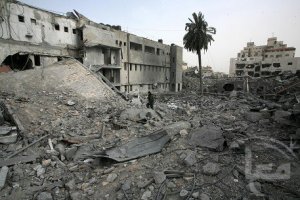 The Saraya prison and police compound was
bombed the second day of the war [MaanImages]
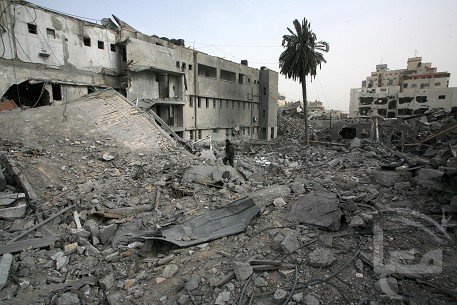
Bethlehem – Ma’an – An estimated 300 Palestinians were killed in the first 48 hours of Israel’s winter assault on the Gaza Strip, which entered its second day one year ago today.
With an increased focus on Rafah, Israeli warplanes bombarded around 100 more targets on 28 December 2008, leaving about 70 more Palestinians dead, and raising the child death toll to 22 and the civilian toll to 60, including nine women.
Israeli jets struck Islamic University in Gaza City, the offices of de facto Prime Minister Ismail Haniyeh, and the Saraya prison, ironically killing four members of Hamas’ domestic rival Fatah, as well as three mosques and 11 homes and apartments.
Fires engulfed Rafah after Israeli missiles hit underground fuel pipelines in some 40 sorties on the Strip’s tunnel network. Fleeing the flames, terrified residents of Gaza’s south attempted by the hundreds to escape to Egypt, but were prevented from leaving by Egyptian security forces. A Palestinian and an Egyptian policeman were killed in the ensuring chaos; at least 10 others were hurt.
West Bank protest
Palestinians in the West Bank, horrified by the numbers of dead and more than 1,000 injured, protested against the operation on its second day. Palestinian Authority security forces broke up a demonstration in Ramallah when activists urged support for Hamas, while Israeli forces shot dead three demonstrators nearby.
“There was a significant increase in the use of force by Israeli security forces during demonstrations in the West Bank after the start of the Israeli operations in Gaza,” according to the final report of the UN Fact Finding Mission on the Gaza Conflict. “The degree of force used against protests during the previous year had already been high … New tactics and weapons used by the Israeli security forces aimed at suppressing the popular movement have resulted in deaths and injuries.”
In July 2009, two witnesses, Mohamed Srour and Jonathan Pollak, described to the UN investigators in Geneva the fatal shooting of the two young men from the West Bank village of Ni’lin during a demonstration against the Gaza operation. Srour, elected mayor in 2005, was himself shot in the leg during the same protest.
“This demonstration was like any other demonstration. These demonstrations always took place and were peaceful demonstrations,” Srour explained. “And there was the presence of Israeli and foreign supporters and very high-level MPs. So it was very clear that this demonstration was a peaceful one.”
As the protest was winding down, Israeli forces used tear gas and stun grenades to disperse the crowd. The two young men who died were part of a small group of demonstrators, some of whom had thrown stones at the soldiers. In video footage, four or five soldiers appeared to be casually walking around and not seemingly threatened. Dozens of rounds of live ammunition were fired in the direction of the group of young men, hitting three of them within minutes of each other.
“Unfortunately, I have experienced, and it’s very easy to distinguish between, the shooting of rubber bullets and tear gas and between live ammunition,” recounted Pollak, an Israeli activist. “When I told them that it’s live ammunition, they didn’t believe me. They said, ‘No, it’s just blanks that they’re shooting. And they’re not going to shoot us.'”
Mohamed Khawaja was shot in the forehead; Arafat Khawaja, who had turned to run away, was shot in the back, and Srour was shot in the leg. Subsequently, an ambulance was prevented from reaching the victims, who had to be carried some distance and were eventually put onto a pick-up truck, at which the army fired tear gas.
“There were shouts that another person was shot. People said, ‘Call the medics. There’s another person wounded.’ And we put Mohamed on the ground. Some people stayed with him and I ran back immediately.
“And then I saw Arafat Khawaja being carried. And there weren’t enough people carrying him. His head was slinging back, and I grabbed his head and my hand was covered with his blood. He was shot in the back. … I got to him and I looked back. And I saw Mohamed being shot – I saw Mohamed fall down. And people were shouting that another person was shot.
[…]
“We dropped Arafat on the floor by mistake. And we weren’t far at all from Mohamed. And people grabbing him ran before, like ran and passed up. And I could see that his face was all bloody. And the wound was in the vicinity of his eye. I mean, I would say, at the moment, I thought that the bullet went through is eye. I’m not sure if that’s true. …
“There was no ambulance there because it was prevented from entering the village at the entrance, at the roadblock in the entrance. His blood kept gushing from this back and his legs were a bit higher so it, it dripped, through the back of his head. He was shot in the back, which, I mean, I would tend to say murder because he was with his back to the soldiers and absolutely not endangering anyone. But, I assume, legally it can not be called murder because we can’t prove intent. But in the least, it’s willful killing.”
Added Srour, “There was no care, whatsoever, for human life.”
No reply
According to South African jurist Richard Goldstone’s final report, “The Mission has asked the Government of Israel to explain the increased use of live ammunitions during demonstrations in the West Bank, but has received no reply.”
Both Srour and Pollak said that by the second day of the war, the atmosphere encountered with soldiers and border police had already become markedly different from the situation before the operations in Gaza.
“The atmosphere of the incident, and during and after the start of the war generally, was that all checks and balances had been removed. The soldiers were saying things related to the Gaza war, taunting things like, ‘It’s a shame we’re not in Gaza killing Arabs,'” Pollak said. “They were taunting us. They were cursing at us. They were laughing about what was happening in Gaza at the same time. This was the second day of the war, of the assault. And people were unbelievably angry.”
Israeli forces arrested Srour at the Allenby crossing upon his return to the West Bank on 20 July. He was subsequently released on bail. Israel’s Permanent Representative to Geneva said the arrest was unrelated to his appearance at the public hearing days earlier.
During his testimony, however, Srour had expressed fear Israel would retaliate for his remarks at the UN. “I know full well that I will pay the price for this testimony when I return at Israeli crossing points in my journey of return after this hearing,” he said.
At least 800 Israeli protesters, most of them of Palestinian descent, were arrested during the Gaza war.
Among the UN report’s final recommendations is “that the Government of Israel should cease actions aimed at limiting the expression of criticism by civil society and members of the public concerning Israel’s policies and conduct during the military operations in the Gaza Strip. The Mission also recommends that Israel should set up an independent inquiry to assess whether the treatment by Israeli judicial authorities of Palestinian and Jewish Israelis expressing dissent in connection with the offensive was discriminatory, in terms of both charges and detention pending trial. The results of the inquiry should be made public and, subject to the findings, appropriate remedial action should be taken;
“The Mission recommends that the Government of Israel should refrain from any action of reprisal against Palestinian and Israeli individuals and organizations that have cooperated with the United Nations Fact Finding Mission on the Gaza Conflict, in particular individuals who have appeared at the public hearings held by the Mission in Gaza and Geneva and expressed criticism of actions by Israel.”
Portuguese activists fight state water company deal with Israel’s Mekorot
Adri Nieuwhof, The Electronic Intifada, 28 December 2009
In October, EPAL, Portugal’s state water company, announced a deal with Mekorot, Israel’s state water company. An intern who responded to the news by informing colleagues of Mekorot’s role in Israel’s discriminatory water policies and assistance in its violation of international law was immediately sacked. News of the firing has inspired Palestine solidarity activists to campaign to end the deal. Similarly, the EPAL workers’ committee has denounced management’s decision.
EPAL’s actions have also drawn the attention of the influential Portuguese newspaper Diario de Noticias. In an article published on 20 November, EPAL’s public relations director Jose Zenha admitted that the intern would only have been warned for using the internal communication system for circulating information if her message would have [been considered to be] favorable for the company.
Following the intern’s dismissal, the Portuguese Solidarity Committee on Palestine (PSCP) has jumped into action by sending a letter to EPAL on Mekorot’s actions in Palestine, calling on the company to end the deal. EPAL replied, stating that it did not want to get involved in politics.
Meanwhile, PSCP has formed a coalition to fight the contract, including the local chapter of Amnesty International, anti-war groups and the Portuguese Campaign Against the Privatization of Water. On 27 November, the coalition dispatched a letter to EPAL stating that the collaboration between the company and Mekorot is not only contrary to international and European law, but also to EPAL’s social responsibility policies. The coalition has also requested a meeting with EPAL’s Zenha to discuss the matter, which Zenha refused. He only stated that EPAL intends “to strictly adhere to Portuguese, European and international law in all its activities.”
The PSCP has been actively reaching out to government ministers and members of parliament. Since EPAL is a subsidiary of the state water company Agua de Portugal, the PSCP asked Dulce Passaro, the Minister of Environment, for clarification on the deal. The PSCP’s request received spontaneous support from three political parties and coalition activists also met with concerned parliamentarians who were supportive of their efforts to end the Mekorot deal. Parliamentarians and the coalition are currently awaiting clarification from Minister Passaro.
On 18 December, the coalition also obtained support from the Sindicato Nacional des Trabalhadores da Administracao Local (STAL), the trade union of workers in local government. In a letter to Prime Minister Jose Socrates and Passaro, STAL explained that the EPAL-Mekorot contract is “not a purely commercial agreement.” Citing international reports, STAL asserted that Israeli water policy as implemented by Mekorot is contributing to systematic violations of international law and prevents the Palestinian people’s access to sufficient water by force and through imposition of various discriminatory practices. STAL expressed its support for the campaign to end the deal stating that it is “an agreement that is immoral and should end immediately” and demanded that the government take the necessary steps to terminate that agreement.
Building on these efforts over the past two months, the Portuguese coalition began raising international support for its campaign, including the publication of an international call for action to oppose the Portuguese water deal with Mekorot. Among the organizations in support of the call is Amnesty International, whose central office responded by sending a protest letter to EPAL.
Adri Nieuwhof is an independent consultant based in Switzerland.
Gaza Freedom Marchers: 38 detained by Egypt
27/12/2009 – 16:26
 London – Ma’an – Egyptian security forces detained 38 participants of the Gaza Freedom March from a hotel in Al-Arish on Sunday at noon, according to a statement issued by the event’s organizers.
“Egyptian security forces detained a group of 30 internationals in their hotel in el-Arish and another group of 8 at the bus station. They also broke up a memorial action commemorating the Cast Lead massacre at the Kasr al Nil Bridge,” the statement asserted.
The Freedom March plans to bring more than 1,000 international protesters to Gaza this week to denounce the blockade of the Palestinian territory.
The detainees include Spanish, French, British, American and Japanese nationals. Another group of eight people, including citizens of American, British, Spanish, Japanese and Greece, were detained at Al-Arish bus station in the afternoon of December 27, the organizers said.
“The Egyptian security forces eventually yielded, letting most of the marchers leave the hotel, but did not permit them to leave the town. When two younger delegates, a French and Japanese woman, attempted to leave Al-Arish, the Egyptian authorities stopped their taxi and unloaded their luggage,” it stated.
Meanwhile, in Cairo, Egyptian security police broke up a commemoration ceremony marking the anniversary of the Israeli invasion of Gaza organized by the Gaza Freedom March at the Kasr An-Nil Bridge.
“As a nonviolent way of commemorating the more than 1,300 Palestinians killed in the Israeli assault on Gaza that began a year ago on December 27, 2008, Gaza Freedom Marchers tied hundreds of strings with notes, poems, art and the names of those killed to the bridge,” the group said.
“We’re saddened that the Egyptian authorities have blocked our participants’ freedom of movement and interfered with a peaceful commemoration of the dead,” said Medea Benjamin of CODEPINK, one of the March’s organizers.
Benjamin added that the Gaza Freedom March participants are continuing to urge the Egyptian government to allow them to proceed to Gaza.
They visited the Arab League asking for support, various foreign embassies and the Presidential Palace to deliver an appeal to President Mubarak. They are calling their supporters around the world to contact Egyptian embassies and urge them to free the marchers and allow them to proceed to Gaza, the statement concluded.
Latest BDS victory is but opening skirmish of a whole new campaign– English activist promises
By Philip Weiss | December 22, 2009
An English collegiate choir has had an invitation to sing in the Occupied Territories rescinded by the Anglican bishop because it is singing in Israel:
According to one of those involved, the PA asked the Bishop of Jerusalem to withdraw the invitation for the choir to sing in East Jerusalem and Bethlehem.
The choir was informed that it would not be welcome in Bethlehem, should its members try to come in, en masse, as part of the bishop’s pilgrimage.
The choir’s director says his frustration is borne of what he describes as his own pro-Palestinian stance: he has taught and performed with Palestinian musicians. Mr Brown was very keen for his students to see the West Bank barrier and, as he put it, the “privations” caused by the Israeli occupation.
Betty Hunter, the general secretary of the Palestine Solidarity Campaign, says that desire to travel to the West Bank does not excuse the choir’s tour of Israel. That tour, she says, is “surprising and shocking” – something which, in her words, “promotes Israel as a normal state rather than one which represses Palestinians”.
The issue of whether Israel should be boycotted has gained publicity in recent months with campaigns led by British trades unions. Separately, some Israeli MPs reacted angrily to the British government issuing guidelines over the labelling of produce imported from Israeli settlements in the West Bank. British officials are keen to stress that their move has nothing to do with a boycott.
But Betty Hunter says that these are but the opening skirmishes of a whole new boycott campaign that she says will open up over the next few months.
What is the Aim of the Gaza Freedom March? – Interview
By Bianca Zammit – Gaza
As the days of December 2009 draw in, two events which each have a role to play in world peace draw closer. The first is on the 27th and is commemorating the start of the 22 day attacks on Gaza, an operation which targeted unarmed civilians, schools, hospitals, journalists and emergency staff. The second, The Gaza Freedom March will take place on the 31st. The Gaza Freedom March is a historic moment, the magnitude of which has not been seen in Palestine since 1967. Chiseled on the lessons learnt from South Africa’ struggle for liberation against apartheid and from Gandhi’ Satyagraha approach during the campaign for India’ independence, the Gaza Freedom March is walking in the same shoes.
In order to find out more about the Gaza Freedom March I met up with Dr. Haidar Eid, a member of the Steering Committee for the March in Gaza.
What is the aim of the Gaza Freedom March?
The goal of the Gaza Freedom March is to commemorate Gaza 2009. In January 2009 right after the end of operation Cast Lead we were all faced again by the deadly hermitic siege. The March is calling for an end to this siege.
How did the Gaza Freedom March come about?
In June CodePink led a delegation into Gaza and they started talking about a march. I was contacted by Palestinian solidarity groups from around the world and asked for my opinion. I liked the idea but it required a political context and it needed to be led by the people of Gaza. That is when Palestinian grassroots organizations came together to discuss the march and we suggested to the International Coalition to End the Siege that they include a statement of context which called for an end to the siege and which acknowledged the long history of Palestinian non-violent direct action inspired by South Africa and Gandhi. This includes the weekly demonstrations which take place at Bilin, Nilin and Al’ Masara, the entry of international boats in Gaza’ port which had not happened since 1967 and the work of international solidarity movements. More importantly, it has to acknowledge the growing BDS campaign.
The siege is an effect of occupation and a continuation of the apartheid system initiated in 1948. Since then two thirds of the Palestinian people have lost their land. The occupation is illegal and found to be so by the United Nations under resolution 194 which calls for the return of all refugees.
Who is represented on the steering committee?
We have all sectors of society. There are representatives of unions, labour, political, religious, youth, women, students and also Boycott, Divestment and Sanctions National Committee (BNC).
Who will participate?
As soon as we issued the statement of context all Palestinian civil organisations endorsed the Gaza Freedom March and there was global consensus.
The registration has now closed and 1400 people from 42 countries have registered and been processed. Palestinians living in 1948 land will also be participating in the March from the other side of the Erez Border Crossing.
What are the activities planned?
The 1400 internationals will join us hand in hand for a march that will start at 10am in Izbit Abed Rabbu towards the Erez Border Crossing with Israel. Izbit Abed Rabbu is the area which suffered the most damage and most horrendous war crimes during operation Cast Lead, something Judge Goldstone alluded to in his report. When we get to Erez there shall be speeches.
The attacks on Gaza will be commemorated New Years Eve at the Church of Nativity in Bethlehem. A member of the Steering Committee for the March will address the people gathered in Bethlehem for this event.
Palestinian refugees living in refugee camps in Lebanon, Syria and Jordan shall partake in the March by organizing their own rallies.
How can those people who cannot come to Gaza show their solidarity with the people of Gaza?
We are calling on 1.5 million conscientious people of the world to simultaneously rally with the 1.5 million inhabitants of Gaza in front of Israeli embassies in their country. Richard Falk, the 2008 appointed UN Special Rapporteur on the situation of human rights in the Palestinian Territories has called Gaza the “world’s largest concentration camp”. Ilan Pappe has described the siege as “slow motion genocide”. After the 22 day massacre last winter we returned to the ongoing siege.
We ask freedom loving people to put pressure on their governments to sever all ties with Israel and to support the boycott of Israel.
Why do you believe this will be a historic moment for Palestine?
The March shall be the first mass mobilization of this size since 1967. Internationals will walk hand in hand with Palestinians modeled on the South African anti-apartheid movement of the 1980’s. This siege has been imposed upon Palestinian people due to them exercising their democratic choice. The significance of this March, however, also goes beyond the siege. As Palestinians 750,000 of us have been displaced and forced to become refugees. Palestinians living in 1948 land experience racial discrimination on daily basis and there is systematic policy of ethnic cleansing in place.
What is your message to the international community?
If I could put into a slogan the current climate in Gaza I would say “we are fed up”. The international community has only given us empty rhetoric and lip service and in the meantime we have been suffering. For this reason we rely on the people of the world and their power to change the course of the future. We believe in people to people solidarity in order to bring down the Israeli apartheid regime. We want peace with justice. This March shall be the first crack, the first concrete step to end the siege and the illegal occupation. This shall be a wake up call to the international community that as Palestinians we shall no longer tolerate hypocrisy.
What is your message to Israel?
You cannot go on committing war crimes and crimes against humanity as witnessed by judge Goldstone with impunity forever. Recent events in the UK against Livni have shown that also the world will not tolerate Nazi like acts committed by a Nazi like government against civilians.
To the people of Israel I say you voted for the most fascist government since 1948 expecting your government to completely get rid of Palestinians. History has shown us that this will only backfire and bring more wars affecting not only Palestinians but the entire Middle East and inevitably Israel. Exactly like apartheid South Africa campaigned when their state became a pariah state; this is your time to put pressure on your government to implement the UN resolution which calls for an end to the occupation and allows the return of refugees. Peace without justice is not peace.
What will happen after the March?
The March is not symbolic but rather we expect it to be part of a series of events which will lead to the end of the siege. We want to intensify and continue building a global Boycott, Divestment and Sanctions (BDS) campaign which is human rights based and calling for the implementation of international law and an end to the occupation.
We will continue to host international delegations visiting us and together we will be calling for Israeli war criminals to be tried in international courts.
– Bianca Zammit is a member of the International Solidarity Movement in Gaza and of the Boycott, Divestment and Sanctions (BDS) Movement. She contributed this article to PalestineChronicle.com.
Egypt Says It Will Block International Gaza Freedom Marchers
By Robert Naiman | December 21, 2009
 On December 31, together with more than 1000 peace advocates from around the world, I’m planning to join tens of thousands of Palestinians in a march in Gaza to the Erez border crossing to protest the Israeli blockade of Gaza, and to demand international action to relieve Gaza’s humanitarian crisis.
Unfortunately, it appears that the Egyptian government has just announced that it will not allow the internationals to enter Gaza as planned. If so, that would be a shame.
But this apparent decision could be reversed with sufficient public pressure, in Egypt and around the world. Concerned individuals can write to the Egyptian Embassy in Washington and to the Foreign Ministry in Cairo. There is also contact information for the Egyptian consulates in Chicago, Houston, New York, and San Francisco here.
The aim of the march is to call on Israel and the international community to lift the siege, and to respond to Gaza’s humanitarian crisis. The international participants will also take in badly needed medical aid, as well as school supplies and winter jackets for the children of Gaza. Dec. 27 will mark the first anniversary of the Israeli invasion, from which Gaza has not recovered, in large measure because of the ongoing Israeli blockade, which has prevented Gaza from rebuilding.
Of course, if the Egyptian government decision stands, and the international participants are not allowed to enter Gaza, then much less international attention will be drawn to the ongoing blockade, and that would be an unfortunate setback for peace efforts, because the need for international attention is great.
Where is the Palestinian Gandhi? In Israeli prison, of course!
By Jo Ehrlich | December 21, 2009
Palestinian Joke #134
Question: Where can Israel find the Palestinian Gandhi?
Answer: Exactly where they put him, in administrative detention.
Not that I’m in any way playing into the Palestinian Gandhi dialogue, I think its actually pretty diversionary/racist. But sometimes you have to laugh in order not to cry right?
Jamal Juma’, the director of the Anti-Apartheid Wall Campaign, also known as Stop the Wall, was summoned for interrogation on the night of December 15th. Jamal has been detained by the Israeli military and has not had access to a lawyer since the 16th of December. I was in the Stop the Wall Office on the 15th of December. I said hi to Jamal. I’ve met him on a couple of occasions. He is a quiet man with a commanding presence.
I read the news of his arrest last night, sitting in the home of another non-violent Palestinian activist, Musa Abu Maria of the Palestine Solidarity Project. He was not surprised to hear about Jamal’s arrest. He told me the story of his first arrest and time in prison. An IDF commander showed up at his home and asked him to come with him for a few hours to talk over a cup of tea. Musa asked if he could have a minute to say goodbye to his family. He knew what tea and talk were code words for. He was nineteen years old.
If past actions set precedence and they do. Jamal will likely not be charged with any crime (because he has not committed one) but will be held in prison for a long time (interrogated, tortured) without charges. Israel does this through a process called administrative detention that allows the state to hold Palestinians for periods of three months at a time (renewable indefinitely) without charges.
Mohammad Othman, another Stop the Wall executive member has been detained by Israel since September. His first administrative detention order expires this week. Jamal is set to be brought in front of a judge today.
Mohammad, Jamal and many of the scores of other Palestinian’s with orders of administrative detention, are in Israeli prisons not because they have committed a crime but because they are non-violent anti-occupation activists. Israel has begun to understand that non-violent activism in Palestine is a serious threat to the occupation. Those engaged in non-violent struggle often have an excellent analysis, they are determined and they are gaining traction domestically and platforms for spreading their message internationally. It scares the shit out of Israel so it is not surprising that they are responding with repressive military actions. This is a military occupation and it maintains itself by using the tactics military oppression.
Hariri Sees New Page in Lebanon Ties with Syria
Batoul Wehbe | Al-Manar | December 20, 2009
20/12/2009 Lebanese Prime Minister Saad al-Hariri said on Sunday he agreed with Syrian President Bashar al-Assad on practical steps to open up “new horizons” in ties between the two Arab neighbors. Hariri was speaking at the end of a two-day visit to Syria that marked the end to nearly five years of animosity between Damascus and the political alliance led by Hariri.
“We want to open new horizons between the two countries,” Hariri told a news conference at the Lebanese embassy in Damascus. He said his three rounds of “excellent” talks with the Syrian leader were frank and based on clarity. “There will be serious steps from our side and on the part of President Bashar al-Assad to translate this cordial and serious relationship into steps on the ground in several fields,” Hariri said, without giving details.
Arab diplomatic sources told pan-Arab daily Asharq al-Awsat that Hariri carried with him to Damascus a program based on “openness and reconciliation.” The sources added that the premier seeks to set up “transparent relations” between the two countries.
Hariri had also told pan-Arab daily al-Hayat before his visit to Damascus that “there was mutual willingness to overcome the past and look to the future.” The PM stressed that he “spontaneously” decided to visit Damascus when he accepted to form the government. Syria “is the closest state to Lebanon and its only neighbor,” Hariri told al-Hayat.
On Saturday, Assad gave Hariri a warm welcome at the capital’s Tishrin palace. They met for three hours, stressing the need to set up “privileged and strategic ties” between the two countries to overcome years of tensions, officials said.
The meeting helped “dispel the past (differences),” Syrian presidential adviser Buthaina Shaaban told reporters after the talks. “There is no doubt that the ice has been broken between the two sides,” she said.
Shaaban also noted that Syria “broke with protocol” by inviting Hariri to stay at the Tishrin guest palace which is usually reserved for visiting monarchs and heads of state. The two leaders discussed plans to mark their porous common border as well as “the challenges facing the two countries due to Israel’s occupation of Arab land,” Shaaban added.
Syria’s state-run SANA news agency said Assad and Hariri discussed how to “bolster bilateral cooperation” and “ways of surmounting the negative effects which marred” ties in the past. It quoted Hariri as saying his government was determined “to establish real and strategic ties with Syria,” while Assad spoke of the need to promote “privileged and strategic ties between the two countries.”
Nuoviso: “9/11 False Flag”
Purchase DVD: http://www.nuoviso.com
The world has changed after September 11th. Its changed because were no longer safe.
These words were used by the George W. Bush, elected President of the United States in 2000, to dictate the political direction for the 21st Century.
Whereas Americans launch attacks relatively quickly, first on Afghanistan and later on Iraq, using falsified evidence, doubts about the official version of the events of September 11th grows.
The speculations that surfaced on the internet directly after the attacks were considered to be just wild conspiracy theories until this now. Yet the circumstantial evidence and even the substantial evidence itself paints a clear picture. The responsibility for the terrible attacks seems to lie not with Islamic Terrorists but with several high-ranking members of the military and administration of the U.S. Government.
This documentary focuses on the inconsistencies in the official version of the events as well as on the evidence which has been suppressed regarding September 11th. In addition, it answers the questions of why we still know nothing about it to this day and why we are being deceived also in european countries.
Featured Video

AIDS Inc. by Gary Null (2007)
or go to
Aletho News Archives – Video-Images
From the Archives
Clash of Civilization, Iran Part II
By Jamal Kanj – Intifada-Palestine.com – January 14, 2011
Israel’s survival kit is: perpetuate conflict, insecurity to rationalize collective hate and finally playing victim.
Devoid of conflict, Israel implodes internally; without hate, Zionism loses its justification; and playing eternal victim to continue blackmailing the West. Absence of this holy trinity, Israel ceases to exist.
From its inception, the house of Zion has mastered exploiting adversarial powers to advance Israel’s cause. For instance, their influence over the Democratic Party in the US began with President Truman’s bid for 2nd term election in 1948.
Responding to strong opposition from Secretary of State General George Marshall and Department experts urging against recognition of Israel, President Truman replied: “I’m sorry gentlemen but I have to answer to hundreds of thousands [Jewish voters] who are anxious for the success of Zionism. I do not have hundreds of thousands of [voting] Arabs among my constituents”
Zionists influence over liberal American politics was matched with the doctrinal school of Conservative theoreticians aligning the Republican Party’s platform with Israel’s objectives. The Neoconservative Zionists, coined Zioncons, invented the “Clash of Civilization” concept to fight Israel’s wars. … continue
Blog Roll
 Aletho News
- Pro-Palestine protesters arrested outside UK’s ruling Labour Conference in Liverpool
- Mauritius denies landing permit to flight from Israel, forcing cancellation: Tour operator
- Israeli finance minister calls for genocidal war on West Bank, annexation of south Lebanon
- 12 Things Your Psychiatrist Was Trained Not to Tell You
- From Unipolar Universalism to Multipolar Civilizational Distinctiveness
- RSF military group defects, joins Sudanese army: State media
- Ireland goalkeeper refuses to play ‘Israel’ as squad weighs boycott
- China pushes back against US on Cuba, Iran
- Ukrainian Soldiers, Potential Mercenaries: Have Gun, Will Travel!
- Burnham’s UN debut… A masterclass in British disinformation
- If Americans Knew
- Israel forces Gazans to live in constant peril – Daily Update
- Deconstructing Netanyahu’s pants-on-fire UN rant – Daily Update
- Trump betrayed voters with his campaign lies and prioritized a foreign country once he took office
- Netanyahu calls Israel’s war in Gaza ‘opposite of genocide’ in UN speech to near-empty hall
- Settler Kidnappings: Torture, Sexual Abuse and Terrorisation of Palestinian Abductees as Israel Deepens Annexation of West Bank
- Gaza winter nears as 162,000 tents become unusable, raising fears of humanitarian crisis
- Netanyahu says, “It’s the opposite of genocide”; UN says Gaza economy is world’s ‘most severe crisis on record’ – Daily Update
- Israel’s US-Backed Assault on Gaza Has Created the ‘World’s Most Severe Economic Crisis on Record’: UN
- ‘Protecting U.S. Citizens’… From Israel
- ‘This is where I live now, the back of a truck’: a day in the life of a grandmother in Gaza
- No Tricks Zone
- New Study: Earth And Venus Surface Warmth Largely Explained By Convection And Lapse Rate, Not CO2 Or Radiation
- 2025 Nature Paper Claiming Worsening Global Drought Gets RETRACTED …Heavily Flawed
- New Study: ‘Global Drought Shows No Detectable Recent Acceleration Under Climate Warming’
- Economic Masterminds: German Socialists Suggest Taxing Productivity Gains Stemming From Using AI
- The South China Sea Has Not Been Cooperating With The Climate Change Narrative
- Energy Crisis: Germany Enters Heating Season With Historically Low Gas Reserve Fill Levels
- New Study: The Antarctic Ice Sheet Gained Mass From 2020-2024 Due To Staggering Snow And Ice Accumulation
- Study: Ocean Heating Rates From Thousands Of Years Ago ‘Dwarf’ Modern Ocean Heating Rates
- Climate Extremists Target, Attack Large-Scale Power Grid Infrastructure In Germany!
- New Study: Antarctic Ice Melt Has Contributed Less Than 1 Centimeter To Sea Level Rise In The Last 30 Years

