Mistrial declared in case of anti-coup activists arrested in DC police raid on Venezuelan Embassy
RT | February 15, 2020
Jurors who heard the case of the four activists who were invited by Caracas to protect the Venezuelan Embassy in the US capital – only to be nabbed in a police raid on the compound – failed to reach a verdict due to a hung jury.
Four members of the ‘Embassy Protection Collective’ – Adrienne Pine, Kevin Zeese, Margaret Flowers and David Paul – are each facing a year in prison and a $100,000 fine if found guilty of interfering with the US State Department’s attempt to seize the compound and hand it over to the “ambassador” of Venezuela, “appointed” by opposition leader Juan Guaido.
However, the jurors selected to hear the case apparently were not convinced by the regime-change narrative on Venezuela championed by the Trump administration and adopted by the prosecution team, and as the time came to deliver a verdict on Friday, they failed to do so.
Journalist Max Blumenthal, who reported from the courtroom, said that the prosecution put forward a series of dubious arguments – such as that the Guaido-appointed “ambassador” was seeking a “return” of the embassy, despite the fact it had never been controlled by the US-backed opposition in the first place.
According to Blumenthal, Judge Beryl Howell, who presided over the case, argued that since Trump was president, it was his right to recognize or un-recognize foreign heads of state at will. Ironically telling the courtroom that “elections matter,” she appeared to ignore the fact that incumbent Venezuela leader Nicolas Maduro was reelected for a second six-year term in May 2018, while Guaido – who declared himself ‘interim president’ one year ago – was ousted as the head of the opposition-led National Assembly last month in a vote by fellow MPs.
With the jury unable to come to a consensus, a new trial date will be decided on February 28. It’s so far unclear whether the case will proceed at all, however.
The activists themselves, meanwhile, welcomed the news: “Needless to say, we are quite pleased with this outcome. #HandsOffVenezuela,” Adrienne Pine tweeted.
The development drew praise from 2020 Green Party presidential nominee Howie Hawkins, who commended jurors for standing up to the Trump administration push for the regime change in the Latin American country.
“It shows that the overreach in foreign policy of the Trump Administration is not popular among the American public,” Hawkins said.
Two of the activists, Zeese and Flowers, are prominent Green Party members.
The showdown at the embassy last May saw DC police armed with battering rams break into the compound with the last four activists holed up inside. In the run up to the SWAT-style raid, US authorities cut water and electricity in the building in a bid to make the anti-coup activists surrender after spending over a month in the embassy. The activists insist they were there at the invitation of Venezuela’s legitimate government and have denounced the US takeover as a breach of the 1961 Vienna convention on diplomatic relations.
In ‘victory for international law’, UN releases list of firms linked to Israeli settlements
Press TV – February 12, 2020
The United Nations human rights office has released a report identifying companies with business ties to Israeli settlements in the occupied West Bank, a move hailed by Palestinians as a victory for international law.
The office said in a statement on Wednesday that it had named 112 business entities, including 94 based in Israel and 18 others in six different countries. It said it had reasonable grounds to conclude that the firms have ties with Israeli settlements.
“I am conscious this issue has been, and will continue to be, highly contentious,” said UN High Commissioner for Human Rights Michelle Bachelet on Wednesday.
The office said, “While the settlements as such are regarded as illegal under international law, this report does not provide a legal characterization of the activities in question, or of business enterprises’ involvement in them.”
The move was hailed by the Palestinian foreign minister, who described it as a victory.
“The publication of the list of companies and parties operating in settlements is a victory for international law,” Riyad al-Maliki’s office said in a statement.
The minister also called on UN member states and the UN Human Rights council to “issue recommendations and instructions to these companies to end their work immediately with the settlements.”
The newly released report drew condemnation from Tel Aviv, with Israel’s Foreign Minister Israel Katz saying in a statement, “The announcement by the UN Human Rights Office of the publication of a ‘blacklist’ of businesses is shameful capitulation to pressure from countries and organizations that are interested in hurting Israel.”
More than 600,000 Israelis live in over 230 settlements built since the 1967 Israeli occupation of the Palestinian territories of the West Bank and East Jerusalem al-Quds.
The UN Security Council has condemned Israel’s settlement activities in the occupied territories in several resolutions.
Palestinians want the West Bank as part of a future independent Palestinian state with East Jerusalem al-Quds as its capital.
Below is the full list of companies that do business in illegal Jewish settlements, as indicated in the OHCHR report:
Afikim Public Transportation Ltd.
Airbnb Inc.
American Israeli Gas Corporation Ltd.
Amir Marketing and Investments in Agriculture Ltd.
Amos Hadar Properties and Investments Ltd.
Angel Bakeries
Archivists Ltd.
Ariel Properties Group
Ashtrom Industries Ltd.
Ashtrom Properties Ltd.
Avgol Industries 1953 Ltd.
Bank Hapoalim B.M.
Bank Leumi Le-Israel B.M.
Bank of Jerusalem Ltd.
Beit Haarchiv Ltd.
Bezeq, the Israel Telecommunication
Corp Ltd.
Booking.com B.V.
C Mer Industries Ltd.
Café Café Israel Ltd.
Caliber 3
Cellcom Israel Ltd.
Cherriessa Ltd.
Chish Nofei Israel Ltd.
Citadis Israel Ltd.
Comasco Ltd.
Darban Investments Ltd.
Delek Group Ltd.
Delta Israel
Dor Alon Energy in Israel 1988 Ltd.
Egis Rail
Egged, Israel Transportation Cooperative Society Ltd.
Energix Renewable Energies Ltd.
EPR Systems Ltd.
Extal Ltd.
Expedia Group Inc.
Field Produce Ltd.
Field Produce Marketing Ltd.
First International Bank of Israel Ltd.
Galshan Shvakim Ltd.
General Mills Israel Ltd.
Hadiklaim Israel Date Growers Cooperative Ltd.
Hot Mobile Ltd.
Hot Telecommunications Systems Ltd.
Industrial Buildings Corporation Ltd.
Israel Discount Bank Ltd.
Israel Railways Corporation Ltd.
Italek Ltd.
JC Bamford Excavators Ltd.
Jerusalem Economy Ltd.
Kavim Public Transportation Ltd.
Lipski Installation and Sanitation Ltd.
Matrix IT Ltd.
Mayer Davidov Garages Ltd.
Mekorot Water Company Ltd.
Mercantile Discount Bank Ltd.
Merkavim Transportation Technologies Ltd.
Mizrahi Tefahot Bank Ltd.
Modi’in Ezrachi Group Ltd.
Mordechai Aviv Taasiot Beniyah 1973 Ltd.
Motorola Solutions Israel Ltd.
Municipal Bank Ltd.
Naaman Group Ltd.
Nof Yam Security Ltd.
Ofertex Industries 1997 Ltd.
Opodo Ltd.
Bank Otsar Ha-Hayal Ltd.
Partner Communications Company Ltd.
Paz Oil Company Ltd.
Pelegas Ltd.
Pelephone Communications Ltd.
Proffimat S.R. Ltd.
Rami Levy Chain Stores Hashikma Marketing 2006 Ltd.
Rami Levy Hashikma Marketing Communication Ltd.
Re/Max Israel
Shalgal Food Ltd.
Shapir Engineering and Industry Ltd.
Shufersal Ltd.
Sonol Israel Ltd.
Superbus Ltd.
Tahal Group International B.V.
TripAdvisor Inc.
Twitoplast Ltd.
Unikowsky Maoz Ltd.
YES
Zakai Agricultural Know-how and inputs Ltd.
ZF Development and Construction
ZMH Hammermand Ltd.
Zorganika Ltd.
Zriha Hlavin Industries Ltd.
Alon Blue Square Israel Ltd.
Alstom S.A.
Altice Europe N.V.
Amnon Mesilot Ltd.
Ashtrom Group Ltd.
Booking Holdings Inc.
Brand Industries Ltd.
Delta Galil Industries Ltd.
eDreams ODIGEO S.A.
Egis S.A.
Electra Ltd.
Export Investment Company Ltd.
General Mills Inc.
Hadar Group
Hamat Group Ltd.
Indorama Ventures P.C.L.
Kardan N.V.
Mayer’s Cars and Trucks Co. Ltd.
Motorola Solutions Inc.
Natoon Group
Villar International Ltd.
Greenkote P.L.C.
The Dramatic Fall of Chile as Latin America’s Neoliberal Role Model
By Ariela Ruiz Caro | CounterPunch | February 5, 2020
After the outbreak of the most intense and massive social protests ever recorded in the history of Chile, on November 16 the government and most political parties signed an agreement to restore peace and public order and initiate a process to draft a new constitution.
The protests, triggered by the rise in subway fares on Oct. 18, called into question the supposed Chilean success story of the neoliberal economic model implemented in the country during the dictatorship of General Augusto Pinochet (1973-1989). Developed by the so-called Chicago Boys, successive administrations since the 1990 return to democracy in 1990 sustained the model as state policy.
Economic and especially financial liberalization; privatization of public services, including water; the subsidiary role of the State; unlimited protection for foreign investments; and insertion in the international economy that serves US policies designed for the region were the fundamental elements of the economic model that Chile pioneered globally.
Chile’s achievements in macroeconomic stability, sustained economic growth and significant reduction in poverty levels solidified its image–promoted by the international system–as a role model in Latin America. For many years, Chilean citizens also believed it. However, behind the stable statistics and the high growth rates per capita, lurked growing inequality and concentration of wealth that eventually revealed the deep cracks in the system and sparked the recent protests. Chile is currently the 12th most unequal economy in the world. [1]
The Chilean Government’s Declining Legitimacy
Most analisis of Chile’s surprising social uprising have focused on economic aspects and less on Chile’s deep political crisis, characterized by the loss of citizen representation in political parties and government. An important part of the protest movement’s demands include greater citizen participation.
According to the October Social Thermometer Survey, 85% of citizens support the grassroots protests, and 80% demand a new constitution. The current constitution, written during the military dictatorship, dates from August 1980. The decline in the legitimacy of the Piñera government in the eyes of the popularion has been intensified by the serious criticisms of the Inter-American Commission on Human Rights, the Human Rights Commission of Chile and the OAS General Secretary for violation of human rights by the government to suppress protests.
Loss of Leadership in the International Sphere
All this has resulted in an unquestionable loss of leadership of Chile in the international arena. The Piñera government had to suspend the Asia-Pacific Economic Cooperation Forum (APEC) Summit that should have taken place in Santiago. Likewise, the United Nations Conference on Climate Change (COP25) was forced to make a last-minute move to Madrid. Chile today cannot offer basic guarantees even as the venue for international sporting events. The South American Football Confederation (Conmebol) decided to move the venue of the 2019 Copa Libertadores final that will be played by the Flamengo (Brazil) and River Plate (Argentina) teams from Santiago to Lima.
Chile has lost leadership in regional bodies. It no longer can play its leading role in the Lima Group, an ad hoc body created by 13 Latin American countries and the United States in August 2017 to press for regime change in Venezuela; in the creation of the Forum for the Progress and Development of South America (Prosur) [2] launched March 22 to replace the Union of South American Nations (Unasur); or in the aborted U.S. plot to deliver humanitarian aid to Venezuela across the border with Colombia that had the region in suspense in February. The grassroots explosion, has not only knocked Chile off the pedestal on which the success of its neo-liberal model was erected, but also removed its articulating role with the United States and allied countries in the region.
The demonstrations have also had an impact on the country’s economy. The volume of sales and consumption has dropped, along with imports and exports. The stock market has gone down, and the national currency has been devalued. The limited operation of many domestic activities and the suspension of the aforementioned international events will have an impact on economic growth. In this scenario, the opposition presented the departure of President Piñera and the call to a Constituent Assembly as the key pieces to achieve a solution.
The Hidden Face of Chilean Economic Success
Although Chile sustained per capita economic growth above the Latin American average and poverty levels fell from above 40% of the population to less than 10% in the last three decades, those who came out of poverty generally did not reach the levels of consumption that are usually associated with middle class status.
Fifty percent of the economically active population earns less than 550 dollars per month, with the minimum wage equivalent to 414 dollars. Overwhelmed by the narrow strip that separates it from the poverty, an important part of the population lives in fear of seeing their income fall. [3] In Chile, downward social mobility is greater than upward social mobility, and downward mobility is more highly correlated to political protest than poverty itself. [4]
The biggest factor that exacerbates inequality is probably the nation’s pension system, in force since 1982. Designed during the military government [5], the pension mechanism has not met Chileans’ expectations. According to the group No + AFP (No More Pension Fund Managers), which in 2016 organized a march of 600,000 people, these are “undercover banks of the richest entrepreneurs in our country who use the pension funds to expand their investments and further concentrate capital in a few hands.” [6] The average pension for retirees is $286 per month, and 80% receive pensions below the minimum wage. The amount of pensions is on average close to 40% of people’s income at the time of retirement.
Education is the second major source of inequality. In 2006 and 2011, student s organized massive demonstrations calling for profound reforms in the education system. Chilean education is characterized by the huge gap between public and private education. The withdrawal of the State from its functions as generator, regulator and supervisor of the education sector led to the gap as part of neoliberal reforms beginning in the 1980s.
Former Chilean rulers unanimously recognize that the situation of inequality generated social unrest and led directly to current protests in this country. Rolf Luders, Pînochet’s former minister of economics and now a professor at the Institute of Economics of the Catholic University of Chile, admits that “the income of the vast majority of Chileans is still low in absolute terms and the income differences are very significant.” Luders adds that “there have been abuses not duly sanctioned by the State.” Former president Ricardo Lagos points out that “citizens feel that although poverty has decreased substantially, there is a very high concentration of income, and a level of inequality that has not been adequately addressed.”
Lagos told local press that “Chile needs to increase taxes, especially for the rich because more public services are needed” and warns that people demand a new social contract so that the fruits of growth reach everyone.“ [7] President Piñera himself, after denying and ignoring the protests, said that “It is true that problems had accumulated for many decades and that different governments were not able to recognize this situation in all its magnitude.” In the early days of the demonstrations Piñera sought to disqualify the protests, stating that they were “at war against a powerful, relentless enemy, that respects nothing and no one and is willing to use violence and crime without any limits, even when it means the loss of human lives, with the sole purpose of producing as much damage as possible.” [8]
But the punitive approach of declaring a state of emergency in the country and giving control of citizen security to military commanders only served to fuel the fire and increase violence. Now that the protests have produced some two dozen deaths, thousands of wounded and detained, and complaints of torture, Piñera has been forced to make changes in his Cabinet, to suspend the state of emergency and curfew in force in some cities, and to announce economic measures that favor popular demands.
Politics for the Elite
The uprising has revealed cracks not only in the Chilean economic model, but also in the political and social spheres. The neoliberal economic system requires an exclusionary and limited democracy, which Chile successfully built in the three decades of democracy since the end of the military dictatorship in 1990. For many years, a binomial electoral system designed during the dictatorship encouraged the participation of only two political blocs that alternated in government. [9] That system resulted in the concentration of power among a narrow elite.
One of those two blocks was the Concertation of Forces for Democracy (since 2011, New Majority) while the other, is the center right Alliance for Chile (since 2009, Coalition for Change). Except for the previous period of the government of Sebastián Piñera of the National Renewal Party (2010-2014) and the current one, (2018-2022), the government has been in the hands of the Concertación parties. The Socialist Party ruled three times: first, with Ricardo Lagos (2000-2006), and then Michel Bachelet twice: (2008-2010) and (2014-2018). But in essence, they never moved away from the model, which resulted in political and economic stability that governed for market needs, but not for the citizenry. [10] In La violence des riches, Michel and Monique Pinçon describe a similar phenomenon in Europe, particularly in England and Germany, in which socialist leaders joined neoliberalism and capitulated to the neoliberal model. [11]
The authors point out that neoliberalism creates a social class that mobilizes based on its interests on all fronts (politics, finances, the media, art, music, among others). It leaves nothing to chance. Ideological and linguistic manipulation prevails that causes a loss of critical thinking, also neutralized by the voracity of consumption that paralyzes the claims of citizenship against inequality. In this neoliberal phase, they point out, the financial system imposes policy.
Economic power, they argue, acts to preserve order and the middle and popular classes rarely question it. That is why the model is presented as natural and eternal, like the sun that heats the earth or the moon that shines. However, they warn, this situation could change “when respect for that hierarchy is lost, when citizens recognize themselves as human beings and wonder ‘If I didn’t work, what would they do? They could not achieve anything.’ It is then that, through questioning this type of aristocracy of money, chaos and rebellion ensue.”
This is what is happening in Chile. The WhatsApp audio leaked at the beginning of the protests Chile’s first lady, Cecilia Morel and a friend where she describes the Chilean protesters as “a foreign invasion, alien” [12], evokes Marie Antoinette and the gaping distance between her spouse, Louis XIV, and the French people.
Chile has a deeply elitist society. “People’s capacity for development is limited by their last name, by where they live, by the school they can pay for or not pay for for their children”, in a scenario in which citizens have the perception that 80% of the state administration is corrupt or very corrupt. [13]
Although Chile does not hold the prize for the highest rate of corruption in Latin America, it is not exempt from it. [14] Illegal financing to political parties, embezzlement of public funds in the army, fraud in the police, and collusion between large companies to increase the price of medicines (especially for chronic diseases) and some essential products, have discredited politics and institutions. In addition to economic inequality, a sense of impunity and loss of citizen representation among their elected officials prevail. That also explains why abstention has increased.
Those who refuse to admit the failure of Chile’s development model describe the recent grassroots protests as revolts of the First World, similar to the “indignados” in Spain or the “yellow vests” of France. They argue that the popular demands reflect a crisis of unfulfilled expectations in developed countries. These countries have a margin of negotiation to overcome the conflicts arising from their demands. That is not the case of Chile, whose government is against the ropes because there is no room to negotiate if no profound changes are made in the model.
Others, such as President Trump, have denounced “the interference of other nations in Chile, with the aim of” undermining “Chilean institutions, democracy and society.” [15] Officials from the U.S. State Department have reported that “false accounts that emanate from Russia have been identified, pretending to be Chilean and trying to undermine Chilean institutions and society.” [16] But the Minister of Interior and Public Security of Chile, Gonzalo Blumel, did not corroborate the U.S. claim and instead stated “I prefer to be prudent, to check out the antecedents and, if they are indeed true, to investigate them in the corresponding instances.”
The OAS General Secretariat, on the other hand, stated that the protests in Chile follow the pattern of those that occurred previously in Ecuador and Colombia and noted that “the breezes of the Bolivarian regime driven by madurismo and the Cuban regime bring violence, looting , destruction and a political purpose of directly attacking the democratic system and trying to force disruptions to constitutional mandates.” [18]
The newspaper La Tercera de Chile reported that foreigners of Cuban and Venezuelan origin were behind the attacks on subway stations. However, the prosecutors in charge of the investigation concluded that “there is no evidence regarding specific identities or nationalities”. [19]
Some analysts conclude that the government itself could be behind some violence and destruction of public and private property throughout the country, noting “there are serious suspicions, testimonies and eloquent visual records that, while indicating that they were organized, could have been carried out by Chilean intelligence services”. [22]
The accusations against the protesters sought to justify the declaration of a state of emergency and the consequent control of public security by the military forces after President Piñera pointed out, at the outset, that the country was in a war against a powerful enemy. But it was a serious mistake to criminalize social protest instead of responding politically. Days later, he had to withdraw the measures after apologizing to the citizens for not having listened to their demands.
Piñera Backed in a Corner
Although the president withdrew the price hikes in public transportation and electricity and approved a set of social measures including an increase in minimum wages and pensions of retirees, a plan to support small and medium-sized companies affected by the protests, and higher taxes for the rich, protesters continue to organize throughout the country. Although they lacked a central leadership, their organization began to take shape in the barrios and in neighborhood associations and social groups convened in open councils, in which the common demand was to change the constitution. They view the text of the current constitution as the major limitation to satisfying many of their demands, in particular, that referring to the subsidiary role of the State.
To gain the upper hand and more time, on Nov. 6 Piñera announced his intention to open up a 60-day period of “citizen dialogues” to collect proposals on the public’s main demands. It is a mechanism similar to the one used by Macron when he confronted the yellow vests movement. But Chile is not France. The discontent and social frustration in the Andean country has been incubating for more than three decades and its level of unionization is low. France, on the other hand, has strong civil society organizations and a much more consolidated democratic tradition.
The intensification of the protests reached a level that forced Piñera to announce on November 9 that his government was preparing a project to update the Constitution promulgated in 1980, during the dictatorship of Augusto Pinochet. He stated that it should be discussed with other proposals that had already been presented in Congress. His announcement represented a shift with respect to his initial positions, since when he assumed the presidency in March 2018 he affirmed that he would shelve a bill that his predecessor, Michelle Bachelet, sent to Congress to modify the Constitution. Bachelet’s initiative sought to consecrate the inviolability of human rights, the right to health and education, and guarantee for equal pay for men and women.
Although the government and citizens technically agreed to change the Constitution, there was no agreement on how to do it. Citizens did not agree to modify the Constitution through a Constituent Congress as proposed by President Piñera, since this implied that the current Congress would designate a group among its own members to modify the Constitution for a period of twelve months. The problem was that civic and social organizations wanted to participate directly in the new Constitution so they proposed to draft it through the election of a Constituent Assembly, a group of people directly elected by the population who cannot be members of the current Congress and whose specific function is to design a new Constitution and present it for ratification by plebiscite.
The central point of contention in the text of the Constitution is the principle of state subsidiarity, which mandates that the state can only intervene when basic needs cannot be met by private agents. As historian Nicole Schwabe of the Center for Inter-American Studies at the University of Bielefeld points out, the State left a great void when it withdrew from provision of social services since many basic rights, such as education, health and pensions, were left to private individuals, who applied strictly commercial criteria.
“This has caused the major problems of recent years and the emergence of movements and a series of social protests,” she noted, adding that while there were improvements, “the political system has not been able to respond to the demands of the social movements that have been coming for years. There is no way out of this conflict if there is no constitutional change. If the necessary measures are not taken, the violence could escalate further.” [23]
In this same line of thought, the Catholic Church spoke through the apostolic administrator of Santiago, Celestino Aos, who expressed the imperative need to change the Constitution, arguing that “if no profound changes are made, we will be talking about cosmetic changes and we will go back to repeating the same story.” [24]
Piñera is backed into a corner. His current approval rating stands at 13%, and is in free fall. The massive protests continue. While Chilean citizens have demonstrated peacefully, there is so much discontent and frustration accumulated over the years that, in the midst of these, groups of anarchists and others have lit fires, erected barricades and looted to create chaos.
The high military commanders have pressured the government to respond. At the same time that Piñera extended a hand to citizens by satisfying certain demands, such as proposing French-style citizen dialogues and offering to draft a new constitution, military commanders urged him to exercise a heavy hand against citizen ingovernability and lack of control. This would explain why on Nov. 8, Piñera chose to harden his speech again and criminalize grassroots demonstrations. He announced several measures such as the Anti-hood Law, convening of the National Security Council and initiatives to support the work of Carabineros (militarized police) and the Chilean Investigative Police. This would only contribute to worsening violence.
Meanwhile, complaints of violation of human rights in this country continue to accumulate. The UN denounced the arbitrary and indiscriminate use of tear gas and rubber bullets to contain the protests and asked the country’s security forces to stop using these projectiles immediately. It also drew attention to “the large number of dead and wounded” and made an appeal to “align violence control actions to existing international standards, ratified by the Chilean State.” [25]
The OAS General Secretariat also deplored the deaths, both those caused by the use of force by the State, and those that have occurred in the context of the looting. The regional organization announced it would endorse the investigations and conclusions of the Inter-American Commission on Human Rights (IACHR) on human rights violations in Chile. [26] Representatives of the IACHR traveled to Chile “to respond to the requests of dozens of organizations of Human Rights, Social Movements and Indigenous Peoples, representatives of Political Parties, legislators and legislators, intellectuals, artists, in addition to the Ombudsman’s Office Rights of the Child.” [27]
According to the November report of the National Institute of Human Rights of Chile, 2,365 people have been injured in demonstrations, more than 6,000 have been arrested and the agency has filed 335 complaints of torture, sexual violence, homicide and attempted homicide, among other crimes. It reported that since the beginning of the demonstrations on October 18, a total of 217 people have suffered eye injuries. The current figure is closer to 300. The Chilean Society of Ophthalmology warned of a health emergency in these cases, and the vice president of the Medical College of Chile, Patricio Meza, said that government security forces have not respected the safe distance for firing projectiles, has aimed above the waist and on occasion fired in the presence of children, pregnant women or people with reduced mobility. Both the BBC and the New York Times have reported on the attacks, the latter in an article entitled “It’s Mutilation”: The Police in Chile are Blinding Protesters”. [28]
The Chilean opposition signed a constitutional accusation in Parliament to remove Piñera, who has racked up multiple complaints for human rights violations. At least one of them has been accepted by a Chilean court of justice. This lawsuit filed by a group of human rights lawyers cites “the responsibility that falls (to the president) in his capacity as author, as head of state and of all those responsible as perpetrators, enablers and/or accomplices of these crimes against humanity.” [29]
Can a Peace Agreement and the Promise of a New Constitution Deactivate Protest?
In this context, on Nov. 16 most Chilean political forces represented in Congress reached an agreement to restore peace and public order and convene, in April 2020, a plebiscite for a new Constitution that replace the current one. [30] The popular consultation will contain two questions: Do you agree to change the Constitution, and what should be the mechanism for drafting it. This may be through a mixed constitutional convention – composed of one half of active parliamentarians and the other half new delegates, or with a totally new convention, similar to a constituent assembly.
If citizens choose a constitutional convention, their members must be elected in the same electoral process that will elect regional mayors and governors in October 2020, with universal suffrage. Once the new Constitution has been drafted, within a maximum period of one year, the text will be submitted to a ratifying plebiscite, carried out through mandatory universal suffrage. Finally, Congress will vote again.
Although the agreement has long deadlines given the urgency of citizen demands, the decision to draft a new Constitution and get rid of the current one represents a historical moment for Chile and the world. It demonstrates that it is possible, through citizen protest, for a government to relinquish the primary legal instrument that guarantees political and economic control of society to powerful elites. However, it will be necessary to see how much political parties truly represent the people and how much tolerance economic and media power groups will have with the measure, which threatens their stability. Both factors will depend on whether the measure can deactivate grassroots protest, the citizen councils and the acts of violence.
The popular uprising in Chile has unmasked the image of well-being in Chilean society that the international establishment has been selling. It has affected the government’s regional leadership and its projections of economic growth and has revealed an injured society, which has added issues pending solution such as trials for violations of human rights, reparation for victims of violence and freedom for political prisoners.
Ariela Ruiz Caro obtained her degree in Economics from Humboldt University of Berlin and holds a master’s degree in Economic Integration Processes from the University of Buenos Aires. She has been an international consultant on trade, integration and natural resources issues at ECLAC, Latin American Economic System (SELA), Institute for the Integration of Latin America and the Caribbean (INTAL), among others. She worked in the Andean Community between 1985 and 1994, and as an advisor to the Commission of Permanent Representatives of MERCOSUR between 2006 and 2008, and Economic Attaché of the Embassy of Peru in Argentina between 2010 and 2015. She is an analyst for the Americas Program for the Andean/Southern Cone region.
FOOTNOTES
[1] According to the latest edition of the Social Panorama of Latin America report prepared by the Economic Commission for Latin America and the Caribbean (ECLAC), the wealthiest 1% of the country accumulated in 2017 26.5% of wealth, while that 50% of lower income households accessed only 2.1% of the country’s net wealth.
[2] According to the host of Prosur’s first presidential summit, Sebastián Piñera, it was about “creating a new reference in South America for better coordination, cooperation and regional integration, free of ideologies, open to all and 100% committed to the democracy and human rights.” The problem is that there are no ideology-free forums. Prosur is closely allied with the U.S. government and is an ideological response to the failure of Unasur in its attempt to autonomously solve the problems of the region.
[3] While a Chilean citizen has a 9% chance of seeing their income grow until they join 20% of the population with the highest income, they have a 16% chance of seeing their income decrease and fall into the 20% of the population in the lower income bracket.
[4] Kahhat Farid, “The eternal return, the radical right in the contemporary world”. https://elcomercio.pe/mundo/latinoamerica/la-paradoja-chilena-por-farid-kahhat-noticia/
[5] The pension system in Chile is provided by the Pension Fund Administrators (AFP), which are private financial institutions that are responsible for managing individual pension savings account funds.
[6] https://www.bbc.com/mundo/noticias-america-latina-50124583
[7] “The protests in Chile are from the First World”, Andrés Oppenheimer https://www.elnuevoherald.com/opinion-es/opin-col-blogs/andres-oppenheimer-es/article236564373.html
“The Chilean enigma”, Mario Vargas Llosa, https://www.losandes.com.ar/article/view?slug=el-enigma-chileno-por-mario-vargas-llosa-2
[8] https://www.dw.com/es/pi%C3%B1era-estamos-en-guerra-contra-un-enemigo-poderoso/a-50910426
[9] In January 2015, the binomial electoral system created by the Pinochet dictatorship was eliminated, which, in practice, favored the political right, which under this system controlled half of the Congress with one third of the votes .
[10] The Broad Front founded in 2017 is the exception. It is a Chilean political coalition made up of left-wing political parties and movements, egalitarian liberals and citizens who seek to overcome the dichotomy of Chilean bipartisanship, formed by the New Majority and Chile Vamos
[11] La violance des Riches, Michel Pinçon & Monique Pinçon-Charlot, Paris, 2014 https://www.youtube.com/watch?v=Ys3cjJlTcDE
[12] “We are absolutely overwhelmed, it is like a foreign invasion, alien (…) Please, keep calm, call people of good will, take advantage of rationing meals and we will have to decrease our privileges and share with others. (…) Friend, I think that the most important thing is to try to keep our heads cool, not to get overexcited, because what is coming is very, very, very serious.” “They moved up the curfew because it was known that the strategy is to break the entire food supply chain, even in some areas water, pharmacies. They tried to burn a hospital and tried to take the airport.”
[13] https://www.bbc.com/mundo/noticias-america-latina-50208871
[14] Between 2014 and 2017, both the right-wing political coalition (with the Penta Case and SQM) and Michelle Bachelet’s government (with the Caval case) were tainted by issues related to illegal financing of political campaigns and false ballots
[15] Days earlier, in an interview with Efe, the head of Latin America in the State Department, Michael Kozak, said that the United States had identified in the social networks “false accounts” from Russia that are trying to sow discord in the network. At the moment he has not mentioned a possible interference of Cuba or Venezuela in this country.
[19] Statements by the Eastern Metropolitan Regional Prosecutor, Omar Mérida, said that the investigation he heads “has no precedents regarding specific identities or specific nationalities.”
[20] Héctor Barros, South Metropolitan Regional Prosecutor https://www.t13.cl/noticia/politica/prefiero-ser-prudente-ministro-blumel-se-desmarca-supuesta-intervencion-extranjera-chile
[21] Rubén Alvarado, general manager of the Metro de Santiago https://www.t13.cl/noticia/politica/prefiero-ser-prudente-ministro-blumel-se-desmarca-supuesta-intervencion-extranjera-chile
[22] http://www.noticiasser.pe/opinion/la-nacion-insurrecta-y-el-fin-de-los-tiempos
[24] https://www.cnnchile.com/pais/celestino-aos-pidio-cambio-de-constitucion_20191108/
[27] https://www.cnnchile.com/pais/cidh-visita-chile-derechos-humanos_20191106/
[30] The Communist Party did not participate and the Broad Front split.
Leading Ireland parties support boycotting settlement produce, as elections nears
MEMO | February 4, 2020
Leading Irish political parties, Sinn Féin and Fianna Fáil, have published election manifestos which support the adoption of the Occupied Territories Bill in Ireland.
The bill, first tabled in 2018, bans trade with territories which are considered to be under occupation. Adopting the bill into law would effectively stop trade between Ireland and illegal Israeli settlements in the West Bank.
Fianna Fáil’s manifesto, published on 24 January, said the party would “progress the Occupied Territories Bill” in government. Former foreign affairs spokesperson for Fianna Fáil, Niall Collins, told the Electronic Intifada: “We didn’t have to put it into our manifesto… but we insisted on doing so.”
Meanwhile, Sinn Féin promised to “ban goods from Israel’s illegal colonial settlements in Palestine from entering the Irish market by implementing the Occupied Territories Bill” in a manifesto published on days later. Denise Mitchell, a Sinn Fein politician, said that “this Bill aims to uphold international law… clearly this applies to the ongoing disgraceful actions of Israel in the Palestinian West Bank”.
The Occupied Territories Bill was drafted by Sadaka, an Irish organisation which defends the rights of Palestinians. If passed, the law would make Ireland the first EU country to criminalise commercial interactions with illegal settlements.
A report published by Trading Away Peace found that the EU imported about €50 million ($55 million) worth of goods from Israel between January and October 2018, approximately one per cent – $552,300 – of which comes from the settlements. The analysis also reported that the EU imports 15 times more from the illegal settlements than from Palestine.
However, the European Commission dealt a blow to the landmark legislation in December 2019, announcing that only the EU has the power to ban imports from a non-EU country, the Times reported.
The outgoing minority government, led by the Fine Gael party, was the only Irish party to vote against the bill in January 2019, claiming that it clashes with Ireland’s obligations as a member of the European Union.
While, ten members of US Congress wrote a strongly worded letter to current Irish Prime Minister, Leo Varadkar, detailing their opposition to the bill and calling for the legislation to be abandoned, in March 2019.
Nevertheless, Sinn Féin and Fianna Fáil are tied for first place in the most recent polls, in advance of the election on Saturday, local media, Raidió Teilifís Êireann reported.
While, the Green, Labour, and Solidarity parties have also moved to support the bill, and the Social Democrats spoke in favour of the move during a parliamentary debate but have yet to confirm their commitment.
GoFundMe Closes down US-based Palestinian Group’s Account
Palestine Chronicle | January 31, 2020
The popular online fundraising platform GoFundMe has closed down the account of Palestinian advocacy organization Al-Awda without providing any reason.
Based in the US, Al-Awda is a non-profit organization of activists and students who are dedicated to the education of the public on the rights of Palestinian refugees to return to their homes in Palestine.
The account was closed this month, according to the head of Al-Awda, Abbas Hamideh.
“We are an American non-profit (501c3) organization advocating for Palestinian refugees,” Hamideh wrote.
“They refuse requests to disclose reasons why they shut down a legitimate fundraiser after using them successfully for the past four years. Why did they shut us down? Could it be because we are advocates of the BDS movement and one of its founders?”
GoFundMe is a California-based crowdfunding platform that permits people to raise money for celebrations and causes and claims to be the world’s largest crowdfunding site by money raised.
Iraqis march in ‘millions’ to call for expulsion of US troops
Press TV – January 24, 2020
 Iraqis have rallied in Baghdad in massive numbers to call for an end to US military presence in the country following high-profile assassinations and airstrikes targeting anti-terror forces.
Sayed Sadiq al-Hashemi, the director of the Iraqi Center for Studies, said more than 2.5 million took part in the demonstrations on Friday.
Since the early hours on Friday, huge crowds of men, women and children of all ages converged on the Jadriyah neighborhood near Baghdad University.
The protesters were seen carrying banners and chanting slogans calling for the expulsion of US forces.
“Get out, get out, occupier!” some shouted, while others chanted, “Yes to sovereignty!”
Iraq’s al-Ahd news network reported that Iraqis from all of the country’s provinces had gathered in the city.
On January 5, the Iraqi parliament voted overwhelmingly in favor of a resolution calling for the expulsion of all foreign forces after the US assassination of Iran’s General Qassem Soleimani and his Iraqi trenchmate Abu Mahdi al-Muhandis.
The massive rally came after influential cleric Muqtada al-Sadr called on Iraqis to stage “a million-strong, peaceful, unified demonstration to condemn the American presence and its violations”.
Sadr issued a statement on Friday calling for US bases to be shut down and Iraqi airspace closed to US warplanes and surveillance aircraft.
He warned that US presence in the country will be dealt with as an occupying force if Washington does not agree with Iraqi demands to withdraw for the country.
In a message delivered through a representative at Friday prayer in the holy city of Karbala, top cleric Ayatollah Ali al-Sistani also urged Iraqi political groups to do what is needed to the safeguard the country’s sovereignty.
He called on Iraqi groups to stand united, far from any foreign influence in countering the dangers which threaten the country.
On Thursday ahead of the planned rallies, Sadr called on Iraqis to mobilize and defend the country’s independence and sovereignty.
“Oh women, men and youth of the country, the time is now upon us to defend the country, its sovereignty and dependence,” Sadr said in a tweet.
“Spread the word of an independent future Iraq that will be ruled by the righteous; an Iraq which will not know of corruption nor aggression” he added, calling on Iraqis to expel the “tyrants”.
Various Iraqi resistance groups affiliated with the country’s Popular Mobilization Units (PMU) have also backed the anti-American rally.
‘Zero hour in face-off with US’
Speaking to the Lebanese al-Mayadeen television channel, Jaafar al-Husseini, a spokesman for the PMU-affiliated Kata’ib Hezbollah resistance group, said “other means” will be used against the Americans if they do not leave Iraq.
The American presence, he said, has led to corruption and instability in the country.
In an interview with Iran’s Tasnim news agency, Firas al-Yasser, a member of the political bureau of Iraq’s Harakat Hezbollah al-Nujaba, said Friday’s rallies marked “a new chapter” in the Arab country’s relations with the US.
He said Iraqi resistance groups support the stance of the country’s clerical leadership, which does not tolerate Washington’s “theory of dependence and humiliation” of Iraq.
“We believe we have reached the zero hour in facing off with the US,” he said.
Yasser added that Iran’s missile attack on the Ain al-Assad base in the western Iraqi province of Anbar earlier this month was a “prelude” to the expulsion of US forces from the country.
Qais al-Khazali, leader of Asa’ib Ahl al-Haq, which is part of the PMU, described Friday’s rallies as a “second revolution” a century after the Great Iraqi Revolution of 1920 against British forces.
Iraq’s Sadr urges million-man march against US military presence
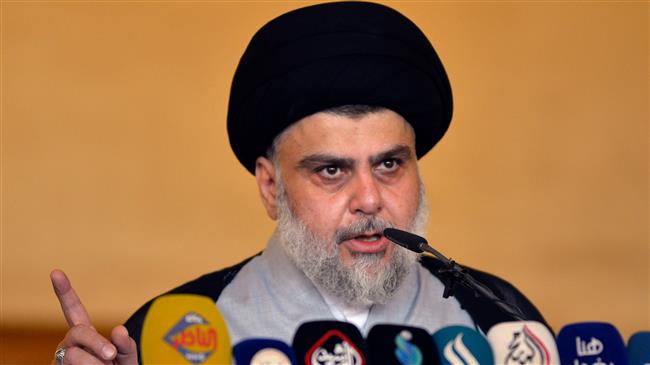
Influential Iraqi Shia cleric Muqtada al-Sadr (Photo by AFP )
Press TV – January 15, 2020
Influential Iraqi Shia cleric Muqtada al-Sadr has demanded that Iraqis stage a “million-man march” against the continued US military presence in the country, days after Iraq’s parliament voted to expel the American troops following an assassination operation by Washington on Iraqi soil.
The march is needed “to condemn the American presence and its violations,” Sadr, who leads the largest parliamentary bloc, Sairoon, said in a tweet on Tuesday.
“The skies, land, and sovereignty of Iraq are being violated every day by occupying forces,” he added. The cleric, however, cautioned that such a show of popular disapproval should be a “peaceful, unified demonstration,” but did not offer a date or location for the proposed rally.
On January 5, the parliament voted overwhelmingly in favor of a resolution calling for the expulsion of all US-led forces, two days after the US military assassinated senior Iranian commander Lieutenant General Qassem Soleimani and along with Abu Mahdi al-Muhandis, the second-in-command of Iraq’s Popular Mobilization Units (PMU), among others, near the Baghdad airport.
The parliament resolution also urged the Baghdad government to drop a request for assistance from a US-led coalition of foreign troops purportedly operating against Daesh remnants in Iraq.
The Iraqis censured the targeted killings — which were ordered by US President Donald Trump — as a blatant violation of the country’s sovereignty as well as the security agreement between Baghdad and Washington.
In a letter to the parliament following the vote, Sadr called for an immediate cancellation of the security agreement with the US, the closure of the US embassy, the expulsion of US troops in “a humiliating manner,” and the criminalization of communication with the US administration.
Following the parliamentary vote, the office of Iraq’s caretaker Prime Minister Adel Abdul-Mahdi asked Washington to dispatch a delegation to Baghdad to initiate preparations for the withdrawal of American troops, who number around 5,200.
In response, Trump threatened to sanction Iraq “like they’ve never seen before ever” if Baghdad were to expel US troops.
Based on reports by the Wall Street Journal the US administration has threatened to shut off Iraq’s access to its main account at the Federal Reserve Bank of New York, which is used to collect revenues from the Arab country’s overseas oil sales, if Baghdad expelled the American forces.
Code-Panic: A Controlled Opposition Spectacle
By Gilad Atzmon | January 12, 2020
Ariel Gold is the national co-director of CODEPINK, an American female “grassroots peace and social justice movement” that claims to work “to end U.S.-funded wars and occupations.” Ariel claims to support the Palestinians and oppose Israel. She has published articles in Jewish progressive outlets such as the Forward, Tikkun Magazine and Mondoweiss.
On January 3rd, just a few hours after the world became aware of the assassination of Iranian General Qasem Soleimani by an American drone attack, Ariel, the so called ‘Jewish dissenter’ rushed to post the following tweet:
“Loving reminder to folks rightfully horrified the US attack on Iran: please don’t frame this as being as being done to please Israel. This is Donald Trump and his band of US war hawks, period. To suggest Jews are pulling the strings is nothing short of antisemitism.”
The Jewish progressive activist basically insisted that any such criticism of Israel was ‘antisemitism.’ She was also naive to prematurely vindicate the Jewish State of involvement in the unlawful assassination: a crime that may lead to unpredictable and lethal consequences in the near future.
Today’s news reports that Israel was deeply involved in the targeted assassination of the Iranian general. The Times of Israel’s headline this morning reads:
“Israeli intel helped US carry out strike that killed Iran’s Soleimani.” The article states that “Information provided by Jewish state confirmed that Quds Force leader was at Baghdad airport before missile strike, NBC News reports.”
Amongst my sins is the argument I have made for almost two decades: for the solidarity and peace movements to be genuine, functional and effective they must be emancipated from the grip of the so called Jewish progressives. As things stand at the moment, solidarity with the oppressed is restricted by the sensitivities of the oppressor.
Yemen’s Ansarullah: We’re partaking in regional drive to boot US forces out
Al-Mayadeen TV – 05/01/2020
Member of Ansarullah’s Political Council, Mohammad al-Bakhiti, says the Yemeni movement is partaking in the region-wide response to Iranian General Soleimani’s assassination by the US military. Bakhiti says the regional response is aimed at driving all US forces out of the region.
Transcript:
– the coming days will bring huge changes to the region
– the American aggression against Iraq is an aggression against the entire Axis of Resistance, which requires for unifying the theatre in which the response will be delivered
– of course Sayyed Abdul Malik al-Houthi (Yemen’s Ansarullah leader) has already stated that this aggression is an aggression against the entire Axis of Resistance
– Yemen is a member of the Axis of Resistance, and we are at the heart of the conflict with this American coalition
– the American aggression will lead to the expansion of the conflict’s scope
– what we require now is greater coordination (between the members of the Axis of Resistance)
– as for the nature of the response, this is left for the leadership
– (yet) there is no response that can equal this (American) aggression other than popular, political and military action that drives out (all) US forces from the region
Resist U.S. imperialism: U.S. out of Iraq! No war on Iran!

Source: Hawaii Independent
Samidoun Palestinian Prisoner Solidarity Network expresses our strongest condemnation of the latest crime by the United States against the people of Iran and Iraq, the assassination of Iranian Gen. Qassem Soleimani in a drone strike near the Baghdad International Airport on 2 January 2020.
For over three decades, the United States has been engaged in a series of ongoing wars and occupation of Iraq, which has encompassed sanctions, invasion, occupation, bombing, the starvation of civilians, the destruction of infrastructure and the fomenting of civil war. This latest attack – on Iraqi soil, in apparent “revenge” for Iraqis demanding the U.S. occupation out of their country – cannot be separated from the continuing war on and occupation of Iraq.
Of course, this attack is also a massive escalation in the ongoing threats of war on Iran. The assassination of a major military – and political – leader is a blatant act of war and aggression that comes atop the ever escalating use of the economic weapon of sanctions against Iran, a project in which U.S. imperialism is fully allied with Israel in order to target the Iranian people in order to prevent any challenge to the imperialist-Zionist-reactionary hegemony and domination in the region.
This assassination puts millions of lives at risk throughout the region, primarily the lives of working people and the popular classes in Iran, Iraq, Lebanon, Syria, Yemen and Palestine. It is a blatant act of imperial aggression with massive implications. We note that the goal of this assassination appparently seeks to threaten the resistance to imperialism more broadly throughout the region and extend the precedent of U.S. impunity for war crimes.
In particular, we note the particularly dangerous role played by U.S. “anti-terrorism” legislation. Nearly every Palestinian resistance organization is labeled a “foreign terrorist organization” by the United States. This designation is used to imprison charity workers like the Holy Land Five, to divide Palestinian communities in exile from those fighting inside occupied Palestine and struggling in the refugee camps, to threaten activists and organizers around the world with criminalization. In the case of the assassination of Qassem Soleiman and the extraordinary action of the U.S. in declaring a state’s armed forces to be a “foreign terrorist organization,” we recognize that these laws are also a threat of death.
We know that the real force of terror in the world is that of U.S. imperialism and its partners, the Zionist project and Arab reactionary regimes. In Palestine, 5,000 Palestinian prisoners – and indeed, a whole people – are labeled as “terrorists” by the perpetrators of ethnic cleansing, colonialism, mass arrests, extrajudicial killing, torture, land theft, home demolition, decades of assassinations: That is, they are labeled by the perpetrators of over 100 years of terror. For all of that time, a war has been waged on Palestinian resistance and on the resistance and self-determination of peoples throughout the region. Despite the atrocities and the military might of the perpetrators, that resistance has continued to fight for justice, return and liberation, to make it clear that the Palestinian people, the Arab people, the Iranian people and all peoples in the area hold the promise of a society liberated from oppression.
Imperialist wars anywhere are always wars on the people everywhere.We urgently call on friends and supporters of the Palestinian people and the Palestinian resistance, especially within the United States and its allied imperialist states (Canada, the European Union and others) to take action to build a real anti-war movement to confront the crimes of empire. Now is the time to stand up and say clearly: US out of Iraq! No war on Iran! We stand with the resistance!
For a first practical step, there will be a series of demonstrations across the U.S. on Saturday, 4 January. Get details and join in the action near you here: answercoalition.org/national_action_us_troops_out_of_iraq
Embracing Palestine: How to Combat Israel’s Misuse of ‘Antisemitism’
By Ramzy Baroud | MEMO | January 1, 2020
At a talk I delivered in Northern England in March 2018, I proposed that the best response to falsified accusations of antisemitism, which are often lobbed against pro-Palestinian communities and intellectuals everywhere, is to draw even closer to the Palestinian narrative.
In fact, my proposal was not meant to be a sentimental response in any way.
“Reclaiming the Palestinian narrative” has been the main theme in most of my public speeches and writings in recent years. All of my books, much of my academic studies and research have largely focused on positioning the Palestinian people – their rights, their history, their culture, and their political aspirations – at the very core of any genuine understanding of the Palestinian struggle, against Israeli colonialism and apartheid.
True, there was nothing particularly special about my talk in Northern England. I had already delivered a version of that speech in other parts of the UK, Europe and elsewhere. But what made that event memorable is a conversation I had with a passionate activist, who introduced himself as an advisor to the office of the head of the British Labour Party, Jeremy Corbyn.
Although the activist agreed with me regarding the need to embrace the Palestinian narrative, he insisted that the best way for Corbyn to deflect anti-Semitic accusations, which have dogged his leadership since day one, is for Labour to issue a sweeping and decisive condemnation of antisemitism, so that Corbyn may silence his critics and he is finally able to focus on the pressing subject of Palestinian rights.
I was doubtful. I explained to the animated and self-assured activist that Zionist manipulation and misuse of antisemitism is a phenomenon that has preceded Corbyn by many decades, and will always be there as long as the Israeli government finds the need to distract from its war crimes against Palestinians and to crush pro-Palestinian solidarity worldwide.
I explained to him that while anti-Jewish racism is a real phenomenon that must be confronted, “antisemitism” as defined by Israel and its Zionist allies is not a moral question that is meant to be solved by a press release, no matter how strongly-worded. Rather, it is a smokescreen, with the ultimate aim is of distracting from the real conversation, that being the crimes of military occupation, racism, and apartheid in Palestine.
In other words, no amount of talking, debating or defending oneself can possibly convince the Zionists that demanding an end to the Israeli military occupation in Palestine or the dismantling of the Israeli apartheid regime, or genuine criticism of the policies of Israel’s right-wing government are not, in fact, acts of antisemitism.
Alas, the activist insisted that a strong statement that would clarify Labour’s position on antisemitism would finally absolve Corbyn and protect his legacy against the undeserved smearing.
The rest is history. Labour went into a witch-hunt, to catch the “true” anti-Semites among its members. The unprecedented purge has reached many good people who have dedicated years in serving their communities and defending human rights in Palestine and elsewhere.
The statement to end all statements was followed by many others. Numerous articles and arguments were written and made in defense of Corbyn. To no avail. Only a few days before Labour lost the general election in December, the Simon Wiesenthal Center named Corbyn, one of Britain’s most sincere and well-intentioned leaders in the modern era, as the “top anti-Semite of 2019”. So much for engaging the Zionists.
It doesn’t matter whether Corbyn’s party lost the elections in part because of Zionist smearing and unfounded anti-Semitic accusations. What, for me, as a Palestinian intellectual who has hoped that Corbyn’s leadership will constitute a paradigm shift regarding the country’s attitude towards Israel and Palestine truly matters, is the fact that the Zionists have indeed succeeded in keeping the conversation focused on Israeli priorities and Zionist sensibilities. It saddens me that while Palestine should have occupied the center stage, at least during Corbyn’s leadership years, it was still marginalized as if solidarity with Palestine has become a political liability to anyone hoping to win an election, not just in the UK but anywhere in the West as well.
I find it puzzling, indeed disturbing, that Israel, directly or otherwise, is able to determine the nature of any discussion on Palestine in the West, not only within typical mainstream platforms but within pro-Palestinians circles as well. For example, I have heard repeatedly, activists questioning whether the one-state solution is at all possible because “Israel simply would never accept it”.
I often challenge my audiences to base their solidarity with Palestine on real love, support, and admiration for the Palestinian people, for their history, their anti-colonial struggle, and the thousands of heroes and heroines who have sacrificed their own lives so that their people may live in freedom.
How many of us can name Palestine’s top poets, artists, feminists, football players, singers, and historians? How familiar are we, really, with Palestinian geography, the intricacies of its politics, and the richness of its culture?
Even in platforms that are sympathetic to the Palestinian struggle, there is an inherent fear that such sympathy could be misconstrued as antisemitism to the extent that Palestinian voices are often neglected, if not at all supplanted with anti-Zionist Jewish voices. I see this happening quite often, and it is becoming a common occurrence even within Middle Eastern media that supposedly champions the Palestinian cause.
This phenomenon is largely linked to Palestine and Palestine only. While the anti-apartheid struggle in South Africa and the civil rights struggle in the United States – as was the case of many genuine anti-colonial liberation movements around the world – have strategically used intersectionality to link with other groups, locally, nationally or internationally, the movements themselves relied on black voices as true representatives of their peoples’ struggles.
Historically, Palestinians haven’t always been marginalized within their own discourse. Once upon a time, the Palestine Liberation Organisation (PLO), despite of its many shortcomings and mistakes, provided unified Palestinian political discourse which served as a litmus test for any individual, group or government regarding their position on Palestinian rights and freedom.
The Oslo accords ended all of that; it fragmented the Palestinian discourse, as it has also divided the Palestinian people. Since then, the message emanating from Palestine has become muddled, factionalised and often self-defeating. The Boycott, Divestment and Sanctions Movement (BDS) has done a tremendous job in bringing some clarity by attempting to articulate a universal Palestinian discourse.
However, BDS is yet to yield a centralised political strategy that communicated through a democratically elected Palestinian body. As long as the PLO persists in its inertia, and without a truly democratic alternative, the crisis of the Palestinian political discourse is likely to continue.
Concurrently, the Zionists must not be allowed to determine the nature of our solidarity with the Palestinian people. While true Palestinian solidarity requires the complete rejection of all forms of racism, including antisemitism, the pro-Israel camp must be sidelined entirely from any conversation pertaining to the values and morality of what it means to be “pro-Palestine”.
To be anti-Zionist is not the same as being pro-Palestine, the former emanating from the rejection of racist, Zionist ideas and the latter indicating real connection and bond with Palestine and her people.
To be pro-Palestine is also to respect the centrality of the Palestinian voice, because without the Palestinian narrative there can be no real or meaningful solidarity, and because, ultimately it will be the Palestinian people who will liberate themselves.
“I am not a liberator,” once said the iconic South American revolutionary Ernesto Che Guevara. “Liberators do not exist. The people liberate themselves”.
Featured Video
Seyed M. Marandi: Negotiations Collapsed – Return to War
or go to
Aletho News Archives – Video-Images
From the Archives
Wartime internment camps in Australia
National Archives of Australia
World War I
During World War I, for security reasons the Australian Government pursued a comprehensive internment policy against enemy aliens living in Australia.
Initially only those born in countries at war with Australia were classed as enemy aliens, but later this was expanded to include people of enemy nations who were naturalised British subjects, Australian-born descendants of migrants born in enemy nations and others who were thought to pose a threat to Australia’s security.
Australia interned almost 7,000 people during World War I, of whom about 4,500 were enemy aliens and British nationals of German ancestry already resident in Australia.
Records of World War I internment camps
World War II
During World War II, Australian authorities established internment camps for three reasons – to prevent residents from assisting Australia’s enemies, to appease public opinion and to house overseas internees sent to Australia for the duration of the war.
Unlike World War I, the initial aim of internment during the later conflict was to identify and intern those who posed a particular threat to the safety or defence of the country. As the war progressed, however, this policy changed and Japanese residents were interned en masse. In the later years of the war, Germans and Italians were also interned on the basis of nationality, particularly those living in the north of Australia. In all, just over 20 per cent of all Italians resident in Australia were interned. … continue
Blog Roll
 Aletho News
- Seyed M. Marandi: Negotiations Collapsed – Return to War
- Tomorrow’s naval blockade showdown
- ‘Israel’ attacks civilians to hide its embarrassing military failures & out of pure sadism
- Any Foreign Military Vessel Approaching Hormuz Under Any Pretext ‘Will Be Dealt With Severely’: IRGC
- Diplomats slam US negotiators’ performance in Iran talks
- Trump Refuses Exit Ramp, War with Iran will Continue
- Trump Says US Naval Blockade in Strait of Hormuz Will Begin Shortly
- US, Iran end 21-hour talks without agreement
- US IRAN TALKS: Who Are the Crazy Ones Here? /Lt Col Daniel Davis
- Talks with the US end without a deal over excessive US demands: Iran
- If Americans Knew
- US-Iran ceasefire negotiations make zero progress – Daily Update
- Pro-Israel ‘Thinktanks’ and Individuals who Influence U.S. Foreign Policy
- Mearsheimer reveals how Israel dictates US policies on Iran, Gaza – video
- After killing 350+, Israel still has a “score to settle” with Lebanon before ceasefire – Daily Update
- Military aid to Israel emerges as the latest political litmus test for Democrats
- The only Palestinian children’s rights organization closes following years-long Israeli campaign against it
- ‘I Can’t Forget the Smell’: Lebanese Reel After Israel Kills Over 300 in Single Day
- DNC Shoots Down Resolutions Calling Out AIPAC and Limiting Arms to Israel
- TCN: Is Israel Blackmailing President Trump?
- Israel killed at least 303 Lebanese yesterday – who were they? Daily Update
- No Tricks Zone
- Cave Discovery Reveals Today’s Desert Climates Were Recently Far Warmer, Wetter, Teeming With Life
- German Expert: Heat Dome Led To Record Temps In Western USA…Warmer In 1934, 1936
- New Study: No Linear Warming Or Glacier Retreat Along Northern Antarctic Peninsula Since 1980s
- An Inconvenient Tree: Uncovered In Alps… Europe Much Warmer Than Today 6000 Years Ago
- New Study Reports A 60% Slowdown In Greenland’s Ice Loss Rate In The Last Decade
- Low Intensity Tornado Wrecks Major Solar Farm, Creating A Potential Toxic Dump
- New Study Finds Warming Saves Lives…Cold Temperatures 12 Times More Deadly Than Excess Heat
- German Science Blog Accuses PIK Climate Institute Of Hallucinating Climate Tipping Points
- Devastating Assessment Of Comirnaty Vaccine By Former Senior Pfizer Europe Toxicologist
- New Study: CO2 Is ‘Effectively Negligible’ As An Explanatory Climate Change Factor Since 2000
 Aletho News