High Court lifts ban on protests at Israeli drone factory
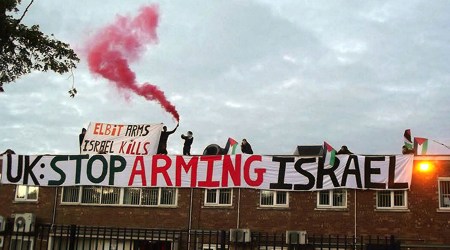
A UK arms factory was recently occupied by nine British activists in protest against the company’s alleged complicity in Israel’s Operation Protective Edge
RT | October 30, 2015
An injunction banning protests from taking place outside a drone factory in Staffordshire has been thrown out by Birmingham High Court. The factory has produced parts for drones used to attack Gaza in 2008, according to Amnesty International.
UAV Engines Limited in Shenstone, owned by an Israeli arms manufacturer Elbit Systems, is one of the world’s leading drone producers. The company says it produces “engines for various size tactical armed unmanned aerial vehicles [UAVs], target drones and single mission platforms.”
Angered by the factory’s unethical behavior, hundreds of protesters have staged demonstrations outside its industrial unit, calling on the manufacturer to stop contributing to the death of Palestinians.
In June, campaigners shut down UAV and another Israeli arms factory in Kent as part of a protest marking the one-year anniversary of the Israeli assault on Gaza.
Soon after, it became illegal for activists to protest within 250 meters of the Shenstone factory. The ban came in the form of a temporary injunction granted by the High Court.
However, Birmingham High Court scrapped the ban on Tuesday, ruling Elbit had failed to disclose information on the history of protests which have taken place at the factory since 2009.
Judge Purle at the High Court said the injunction is dismissed “as if it never existed.”
“I think it inconceivable you would have got the same injunction, possibly even any injunction, if you had disclosed relevant information to me,” she told the court. “Accordingly the injunction I granted on 30 June is dismissed ab initio [from the beginning] and it is as if the injunction never existed.”
‘It shouldn’t have been introduced’
A spokesperson for campaign group Block the Factory said the injunction should not have been imposed in the first place.
“This injunction should never have been imposed.It seems to have been designed to deter protest and campaigning around ending the UK’s deadly arms trade with Israel,” they told IBT.
“It’s Elbit Systems and its arms factories that should be facing a ban, not our protests. Today’s decision will bring even more energy to our campaigning in solidarity with ongoing Palestinian resistance and for a two-way arms embargo on Israel.”
War on Want, a charity fighting against the root causes of poverty and human rights violations, said it is pleased the ban has been lifted.
“It would have been a travesty for people to be criminalized for protesting against the sale of arms that are killing Palestinians. It just goes to show the depths UAV Engines will stoop to in order to protect the profits they make from the sale of deadly drones,” campaigner Ryvka Barnard said.
“We welcome the news that the judge has binned this draconian injunction and we will keep up the fight for an immediate two-way arms embargo between the UK and Israel,” he added.
In July, hundreds of activists protested outside the factory, which led to 19 people being arrested by Staffordshire police.
Photo © londonpalestineaction.tumblr.com / Tumblr
NY protest slams mayor over pro-Israel policy, police brutality
Press TV – October 30, 2015
American activists and protesters have staged a rally in New York City to condemn the stance of Mayor Bill de Blasio on Israel and police brutality in the US.
Pro-Palestine activists from the movement known as the ‘Black Lives Matter,’ likened US police forces in New York to Israeli soldiers in their violence and brutality against Palestinians.
They called for justice for Palestinians facing Israel’s aggression in the occupied territories.
The protesters rallied in front of the Sheraton Hotel in New York’s Times Square, where the city’s mayor was holding a re-election campaign.
At one point, about a dozen activists pushed their way into the lobby of the hotel before being repelled by security, local media reports noted.
The protesters were also angry over police brutality and their treatment of people of color.
Authorities in New York are under fire for the deaths of a number of unarmed citizens at the hands of US law enforcement officers. Most victims are usually African Americans.
Earlier in the day, the New York mayor dismissed the protesters as uninformed.
Blasio launched his re-election campaign toward the 2017 race on Thursday night, reportedly banking a million dollars during the hotel fundraiser, as other reports said the public opinion was evenly split on his job performance.
The event cost as much as some 5,000 dollars for each person in attendance.
Police Drag Away Japanese Seniors Protesting US Military Base Relocation
Sputnik – 30.10.2015
 Elderly protesters were dragged off by riot police on Thursday after staging a sit-in and blocking a road in protest of the construction of a new US military base in Okinawa.
Hundreds of people participated in the demonstration, sitting or lying on the ground in the road to Camp Schwab in an effort to prevent vehicles transporting building materials from accessing the site.
“Don’t lend a hand in the construction of the military base!” the crowd chanted as they were dragged away.
For two decades the military has been wanting to move the Marine Corps Air Station Futenma Okinawa base further north in Okinawa.
The plan to relocate the installation has drawn protests by tens of thousands of residents who worry about sexual assaults by US service members, violence, and the environmental impact on local ecosystems.
Over 50,000 US military personnel currently reside in Japan, and more than half of those live in Okinawa.
“Don’t the people of Okinawa have sovereignty?” 70-year-old Katsuhiro Yoshida, an Okinawa prefectural assembly member, told the Asahi Shimbun. “This reminds me of the scenes of rioting against the U.S. military before Okinawa was returned to Japan (in 1972). Now we are facing off against our own government. It is so contemptible.”
The current governor of Okinawa, Takeshi Onaga, was elected on the premise that he would not allow the base to be constructed. He made good on that pledge, until Japan’s land ministry announced this week that they were overriding his decision.
“The fact that they forcibly executed this construction, there is nothing but anger,” Takashi Kishimoto from the Okinawa Peace Movement Center told NBC News. “We are outraged at these political tactics which ignore will of the people.”
A poll conducted by the Okinawa Times found that 76% of residents are opposed to the construction of a new base.
Photo © Screen Shot
Israel Takes On the First Amendment
Free speech except regarding Palestine

Philip Giraldi • Unz Review • October 27, 2015
I always enjoy reading the Washington Post each morning even though it drives my blood pressure up to stratospheric levels. Its embrace of the inexorability of a fabulous new Camelot-like Clinton White House is thrilling to witness as it unfolds, but it is the promotion of the neocon Israeli narrative that is most exciting. On October 23rd, the op-ed section outdid itself with a piece “Free speech is flunking out on campus” by Catherine Rampell, who described the increasingly sorry state of first amendment rights on politically correct American university campuses. Blacks, LGBTers, women and victims of sexual assault were all identified as constituencies demanding “safe spaces” resulting in curtailment of free speech but somehow Israel and its supporters screaming anti-Semitism at every drop of the hat were left out in spite of the fact that Jews on campus have been both extremely and successfully active in taking political action to pressure universities whenever they claim to feel “threatened.”
The conflict between the Israelis and Palestinians has again reached a boiling point. Palestinian frustration over Israel’s fifty year occupation of the West Bank and its continued theft of Arab land and resources has produced an uprising of mostly young Palestinians that is being called in some circles a new intifada. The conflict is playing out with knives and bullets in Palestine and Israel but it is also being fought internationally in the media, through cultural and economic boycotts and, most pointedly, at many colleges and universities. Israeli Prime Minister Benjamin Netanyahu realizes that the pressure on Israel is, for the first time, serious and has not hesitated to lie outrageously about the slaughter of Jews in Europe during the Second World War. According to Netanyahu, the Palestinian Grand Mufti of Jerusalem gave the idea to Hitler, presumably justifying whatever the Israelis of today choose to do to suppress the current unrest.
Israel has inevitably responded brutally, producing a death toll of significantly more Palestinians than Israelis. Netanyahu has been referring to the protesters as terrorists and has issued new rules of engagement which permit soldiers to shoot stone throwers. Israeli plainclothes soldiers and police have been identified as infiltrating the protesters while pretending to be Palestinians, urging the young Arabs to hurl stones before pulling out concealed handguns to beat protesters, shoot them and make arrests.
In Gaza five teenagers were shot dead by Israeli soldiers for the crime of coming too close to the separation barrier, which government press releases described as the “frontier.” Killing teenagers in Gaza is a bit like shooting fish in a barrel as they are fenced in and have in reality no way to actually confront the Israeli border guards. On the day following the killing of the boys a mother and infant were killed in an Israeli airstrike. Within Israel an Eritrean was even mistakenly killed by Israeli police because he was reportedly acting oddly.
Because of a hostile media’s self-censorship buttressed by an unfriendly political class, here in the United States one of the few places in which the Palestinians can exercise something like free expression relating to their national aspirations is on college campuses. Israel and its powerful supporters understand that gap in their ability to control the narrative and are doing everything possible to shut down the option.
Friends of Israel, as ever, work from the same playbook orchestrated by the large donors who fund them. They claim that anti-Israel protests on campus to include even letters to the editor in college newspapers constitute a “threatening environment” for Jewish students. The argument is based on a fundamental falsehood, which is that criticism of the actions of a foreign government is equivalent to hatred for the dominant religion of that country, that religion is exactly the same as nationality. Applying that notion liberally would mean that criticism of any country where there is de facto or de jure a dominant state religion would be unacceptable speech. If applied liberally countries spanning the globe would be exempt from criticism, to include not only Israel but also Saudi Arabia and Iran.
But this is not about Christian or Muslim sensitivities. It is all about protection against insult for Jews and it relies on a perception of perpetual victimhood, which can be and is produced on demand to stifle any criticism that might be regarded by some as objectionable. Indeed, if calls for violence directed against Jews as a race or religion were occurring pleas for some form of mitigation might have some very slim cogency, but campus protest movements have very carefully and deliberately avoided falling into that trap. And it might also be pointed that on many campuses a considerable proportion of the dissenters are themselves Jews who are appalled by Israeli behavior.
Criticism of Israel does not just include complaining about the policies of that country’s government. It also has inevitably involved the so-called BDS movement, “boycott-divest-and sanction” which aims to make Israel pay an economic and social price for its behavior, similar to the pressure that was once directed against apartheid South Africa. This second narrative has been cleverly woven into the complaints about “harassment,” labeling any campus calls for BDS ipso facto anti-Semitic and “hurtful.” School authorities have generally been accommodating to claims made by Jewish groups that students are feeling “threatened,” obstructing and intimidating critics of Israel and denying tenure to faculty members who are seen as troublemakers. They have looked the other way as organizations like Canary Mission began exposing college students on its website who are reported to be “anti-Freedom, anti-American and anti-Semitic” with the deliberate intention of damaging their future employment prospects.
Between January 2014 and June 2015 there were more than 300 incidents on 65 college campuses in 24 states involving intimidation or prevention of protests against Israel. Students at Northeastern University distributing flyers at dorms were interrogated by campus police and had their group suspended by college authorities. Some were disciplined. And faculty members have also been on the receiving end, with Steven Salaita at the University of Illinois, denied a teaching position after he sent tweets complaining about Israel’s 2014 assault against Gaza which killed more than 500 children.
Richard Blum, a member of the University of California’s regents, has demanded that students who criticize Israel be suspended for expelled because they are “intolerant,” exhibiting anti-Semitic bigotry. Blum is the multimillionaire husband of California Senator Dianne Feinstein. Feinstein has also hinted that she could have the government look into possible violations occurring at federally funded institutions. The definition of bigotry being promoted by Blum and Feinstein conflates criticism of Israel with anti-Semitism and includes in its purview what are increasingly being referred to as “speech crimes.” The university regents are currently considering new language for their statement of policy against intolerance on campus but are under intense pressure from Jewish organizations that are lobbying them aggressively.
Many of the groups involved in the harassment of pro-Palestinian demonstrators are perhaps not surprisingly not indigenous to the colleges themselves. Stand With Us (SWU) and “Campus Maccabees” are national organizations well-funded by billionaire Sheldon Adelson and SWU has close ties to the Israeli government as does the lawfare center Shurat HaDin, which has filed lawsuits against Muslim and progressive groups on campus. Predictably, Congress and state legislatures have gotten into the act, seeking to pass laws that make it impossible for colleges and universities supported by taxpayer money to fund student groups that call for boycotts. The bills are drafted in terms of rejecting all selective boycotts but they are really all about Israel and everyone knows it. The fact that advocating voluntary boycotts is very much a part of one’s First Amendment rights appears to be irrelevant.
How to deal with it? The brouhaha is impossible to ignore as the advocates for Israel are relentlessly in one’s face even when the argument is being constructed in a restrained fashion and purposely framed so as not to offend Jews. It is consequently necessary to disarticulate being Israeli from being Jewish. Judaism is a religion and Israel is a foreign country. And it is important to recognize that legitimate direct criticism of Jewish groups for their involvement in pressuring universities should not itself be off limits. If the organizations self-identify as Jewish and they are attempting to restrict the discussion on Israel contrary to the First Amendment they become fair game. The First Amendment exists, after all, to permit free and open discussion of all issues and if some Jewish individuals and organizations are mobilizing to deny fundamental American rights on behalf of a foreign nation the rest of us have the responsibility to object forcibly and to make transparent just who is doing what to whom.
J. K. Rowling and the Prisoners of Israel
By Omar Robert Hamilton | CounterPunch | October 26, 2015
“Words are, in my not-so-humble opinion, our most inexhaustible source of magic.”
— J. K. Rowling, Harry Potter and the Deathly Hallows, 2007.
How disappointing to see JK Rowling and Hilary Mantel signing this nefarious letter calling for the need for ‘cultural bridges’ with Israel.
The letter, assembled by a new organisation calling itself Culture for Co-Existence, is a litany of the tired tropes and doublespeak employed by Israel and her apologists.
It opens, point blank, saying, “We do not believe cultural boycotts are acceptable.” Within two sentences the reader finds herself in the patrician hallways of the British conservative, being simply instructed what to think, what is polite. Cultural boycotts are never acceptable? Ever?
The lazy argumentation continues, with the limp disbelief that “the letter you published accurately represents opinion in the cultural world in the UK.” This is in reference to a letter published by Artists For Palestine UK in which 1,000 UK cultural workers pledged to boycott Israel until it reverses its policies of apartheid and ethnic cleansing.
The letter struggles on with a series of meaningless assertions about the need to “inform and encourage dialogue” to “further peace.” When you’re dealing with the mechanized destruction of an entire people by one of the most technologically advanced and diplomatically shielded militaries in the history of mankind then talk, in 2015, of ‘cultural engagement’ is nothing more than further cover for Israel’s continuing colonization of what remains of Palestine.
Let us consider what the last twenty years of dialogue, mutual engagement and negotiation have brought us. Since the Oslo Accords were signed in 1993 the Israeli government has constructed 53,000 homes to house 500,000 new settler-colonists in the West Bank, has subjected Gaza to a medieval siege for over 6 years, destroyed 15,000 Palestinian homes, expelled 11,000 Palestinians from Jerusalem and divided the West Bank into 167 segregated population zones that are divided from each other by a 440km concrete wall and 522 military checkpoints. It has suppressed a popular uprising and launched four major offensives that have left over 7,000 Palestinians dead.
Israel, for all of those years (and we’re not even going back to 1948 here), has enjoyed full diplomatic and economic relations with all the world’s major players, it is at the centre of global trade in arms, hi-tech and diamonds. It competes in European sporting and musical competitions and enjoys European trade benefits. It has the US Congress in thrall to its every whim and has an army of lobbyists at work in every Western capital. Israel does not suffer from a shortage of ‘bridges.’
Words such as ‘dialogue,’ ‘peace’ and ‘bridges’ are hallmarks of the peace industry that has built up around Palestine in these years since 1993. Development money was released in reward for the PLO signing Oslo and foreign NGOs quickly came pouring into the West Bank armed with a new lexicon designed for annual reports and donor drives and an ultimate perpetuation of conflict and salaries. In this new language ‘peace’ means ‘submission’ and ‘dialogue’ means ‘silence.’ It’s not an Apartheid Wall, it’s a Separation Barrier – sometimes even fence. It’s not a ‘massacre’ it’s ‘fighting.’ The word justice is nowhere to be found. When Rowling’s letter states that “cultural engagement builds bridges, nurtures freedom and positive movement for change” one can only applaud the crisp professional meaninglessness of it.
Who do we have to thank for this exercise in euphemistic insincerity?
They call themselves ‘Culture for Co-Existence’ and the coordinators include: an Executive Board member of One Family Israel, ‘a leading support organisation that deals with victims of terror in Israel’; the executive director of Friends of Israel Educational Foundation; an Israeli software designer whose Facebook profile picture is a big Star of David and an investment banker who assists campaigns for the charity Jewish Care.
Surely the Culture of Co-Existence Clan is missing something? Could they not find a single House Arab to sign on with them? Or did they decide that wasn’t even necessary?
Who exactly are they planning on co-existing with?
And then you realise. They are not actually talking about dialogue between Israelis and Palestinians. They are talking about dialogue between themselves and Israel. The Palestinians are irrelevant. Peace, here, means being left at peace to keep doing business with the last apartheid state of the modern world. Dialogue and cultural exchange, in this lexicon, means that if you speak out about Israel then you can exchange your job for another one. In just the last week both the US State Department and MSNBC have had to retract statements that fell short of the Israel lobby’s standards. What chance, then, do independent institutions like London’s Tricycle Theatre have to exercise their moral right to refuse funding from an apartheid state? The answer: none. Because, remember, according to JK Rowling, cultural boycotts are never acceptable. A travelling troupe of KKK improvistas wants to ‘re-interpret’ a lynching in your school’s theatre to show the other side of the story? Right this way, sir. A cultural boycott would only single out white men from Mississippi unfairly when the world is so variously filled with wrong.
The Tricycle Theatre, like several politicians, popstars and athletes, was laid siege to last year when it tried to turn down Israeli government funding. They were quickly dialogued into submission and bridges were forced onto them in a manner reminiscent of the British Opium Wars.
Considering that Ms Rowling’s trade is in language it is deeply surprising to see her name attached to such a letter. Clearly this Co-Existence Coterie, which consists of her agent and two trustees of her charity, Lumos, came into being entirely for her signature. Many of their fans hope, though, that Ms Rowling and Ms Mantel reconsider their position and remove their names from this document. It is nothing more than a plea to allow Israel to continue the ethnic cleansing of Palestine. Economic and cultural isolation worked to end apartheid in South Africa and it can end it in Palestine too. If it is peace that people actually want, they have to recognize that it can only come with justice.
Omar Robert Hamilton is a filmmaker, writer and a producer of the annual Palestine Festival of Literature.
#RiseUpOctober protests against police killing civilians begin in New York
RT | October 22, 2015
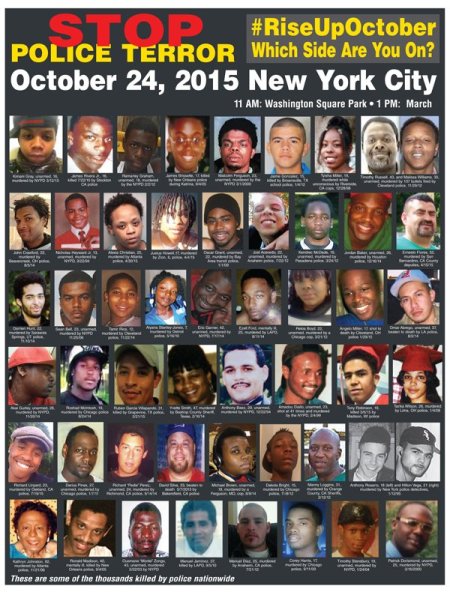 Hundreds gathered in New York City’s Times Square on Thursday, launching a three-day protest against officer-involved killings, brutality and mass imprisonment dubbed “Rise Up October.”
The three-day protest began Thursday morning with a “Say Their Names” rally. Hundreds gathered in midtown Manhattan to hear relatives speak about their loved ones who were killed by police officers over the past several years.
With the help of the Stop Mass Incarceration Network, the rally was organized by Carl Dix of the Revolutionary Communist Party and author and activist Dr. Cornel West.
The organizers said their goal was to organize “mass determined resistance” to a “matrix of oppression.”
Among the celebrities who endorsed the rally was director Quentin Tarantino, who at one point shared the stage with actress Gina Belafonte.
Faith leaders from a number of religious communities supported the gathering.
Also in attendance at the rally were members of the Raging Grannies, the New York chapter of a global movement promoting peace, justice and social and economic equality.
Heavy police presence shadowed the event.
Thursday’s march ended with a rally in Brooklyn.
Friday morning will see the “Shut Down Rikers” protest, aimed against the city’s notorious prison, which is plagued by accusations of violence, brutality and sexual abuse.
The main event is scheduled for Saturday, October 24, with an 11 a.m. rally in lower Manhattan’s Washington Square Park, followed by a march to Bryant Park in midtown.
Set Artists Hack ‘Homeland’ to Expose Show’s Racist Narrative
Thanks to creative intervention, Arabic graffiti stating ‘Homeland is racist’ featured in key scene
By Sarah Lazare | Common Dreams | October 15, 2015
The U.S. television series “Homeland”—widely criticized as Islamophobic and racist—was hacked by three street artists who were hired to paint “authentic” Arabic graffiti for a film set depicting a refugee camp on the Syria/Lebanon border.
The artists staged an intervention by tagging the slogan “Homeland is racist” on the set, which is located just outside of Berlin. Because the production company could not or did not read the Arabic graffiti, the subversive message was featured in a key scene of Season V, Episode II that aired Sunday and depicts the character of CIA agent Carrie Mathison, played by actress Claire Danes.
“In their eyes, Arabic script is merely a supplementary visual that completes the horror-fantasy of the Middle East, a poster image dehumanizing an entire region to human-less figures in black burkas and moreover, this season, to refugees,” declared the artists—Heba Amin, Caram Kapp, and Stone—in a statement released Wednesday.
The artists painted numerous other slogans on the set, including: “This show does not represent the views of the artists” and “Black Lives Matter.”
The trio said they were hired after being approached in June by a German artist who had been contacted by “Homeland’s” production company that was looking for “Arabian street artists.”
In their initial meeting, the artists said they were “given a set of images of pro-Assad graffiti—apparently natural in a Syrian refugee camp. Our instructions were: (1) the graffiti has to be apolitical (2) you cannot copy the images because of copyright infringement (3) writing Mohamed is the greatest, is okay of course.'”
The artists wrote that they ultimately decided to take the job to seize on “our moment to make our point by subverting the message using the show itself.”
The Showtime series has been widely criticized for its Islamophobic and racist stereotypes, as well as its glaring misinformation about the Middle East. Writer Laura Durkay argued last year in the Washington Post, “The entire structure of ‘Homeland’ is built on mashing together every manifestation of political Islam, Arabs, Muslims and the whole Middle East into a Frankenstein-monster global terrorist threat that simply doesn’t exist.”
“Granted, the show gets high praise from the American audience for its criticism of American government ethics, but not without dangerously feeding into the racism of the hysterical moment we find ourselves in today.” — Artists Heba Amin, Caram Kapp, and Stone
And Pakistani lawyer and social activist Mohammad Jibran pointed out that Season IV, which sends CIA character Carrie Mathison to Pakistan, is rife with inaccuracies and absurdities, including naming a terrorist villain after the actual former Pakistani ambassador to the United States.
The “Arabian street artists” behind this latest sabotage listed numerous other offenses. “The very first season of ‘Homeland’ explained to the American public that Al Qaida is actually an Iranian venture,” they wrote. “According to the story-line, they are not only closely tied to Hezbollah, but Al Qaida even sought revenge against the U.S. on behalf of Iran. This dangerous phantasm has become mainstream ‘knowledge’ in the US and has been repeated as fact by many mass media outlets.”
“Five seasons later, the plot has come a long way, but the thinly veiled propaganda is no less blatant,” the artists continue. “Now the target is freedom of information and privacy neatly packaged as the threat posed by Whistleblowers, the Islamic State, and the rest of Shia Islam.”
Yet the program continues to receive high accolades and viewership, in what critics say reflects—and perhaps feeds—a culture of racism and ignorance that has real consequences.
“Granted, the show gets high praise from the American audience for its criticism of American government ethics,” the artists noted, “but not without dangerously feeding into the racism of the hysterical moment we find ourselves in today.”
Settlers terrorize Palestinian farmers in Burin: burn trees and disrupt olive harvest
International Solidarity Movement | October 14, 2015
Burin, occupied Palestine – A Palestinian farmer and English human rights defender have been hospitalized and at least 40 olive trees burned following an attack by illegal Israeli settlers in the northern West Bank town of Burin today.
At 10am this morning, as ISM and other international volunteers accompanied olive farmers who have repeatedly been restricted from accessing their fields, gun shots were heard ringing out across the valley from the settlement above. Approximately thirty masked settlers from the illegal Yizhar settlement then descended the hill and started throwing stones at the group which had peacefully been picking olives for several hours. International human rights defender David Amos, a Quaker from London, was repeatedly attacked with rocks from three meters away, causing two head wounds and copious bleeding. The owner of the land, Abed Musaa, was hit in the front and back with stones and has been treated for lacerations and bruising. The attacking settlers also stole phones, a camera and a bag from the international human rights defenders.
The settlers were then witnessed setting four separate fires to grass on the edge of the olive groves which rapidly grew in dimensions, consuming olive trees and the grasslands between family plots. Two Israeli forces jeeps and two collaborating illegal settler vehicles drove into the valley, took photos of the scene, and then parked alongside each other on the road to Yizhar as more fires were lit by the masked settlers throughout the valley.
Israeli forces then scaled the valley and were witnessed saying to Palestinians, “yes you want peace, we want peace, they want peace,” referring to the settlers. Burin farmer and school teacher Doha and Samir were prohibited from continuing to pick olives on their land, being told they required a permit despite no legal provision to that effect, being within Area B zoning under the Oslo accords.
Palestinian firefighters were prohibited from accessing the fire for three hours, being told that a permit was required to utilize the road to the Yizhar settlement, which has been heavily restricted to Palestinian traffic in recent weeks. Palestinian civil workers, farmers, and international human rights defenders attempted to put out the blaze with sand, shovels, and olive branches but were unable to stop the spread of the fire amid 30 degree heat and rising winds.
Olives are a traditional produce of the Nablus district and constitute 25% of the West Bank’s economy (OCHA 2014). This critical October harvest season falls amid rising tensions in the West Bank, as Israeli forces increase their deployment of soldiers and use of violence in the occupied territories. The Yizhar settlement has also been implicated in the tragic [arson] death of 18 month old Ali Dawabsheh and his parents in the Palestinian village of Duma two months ago.
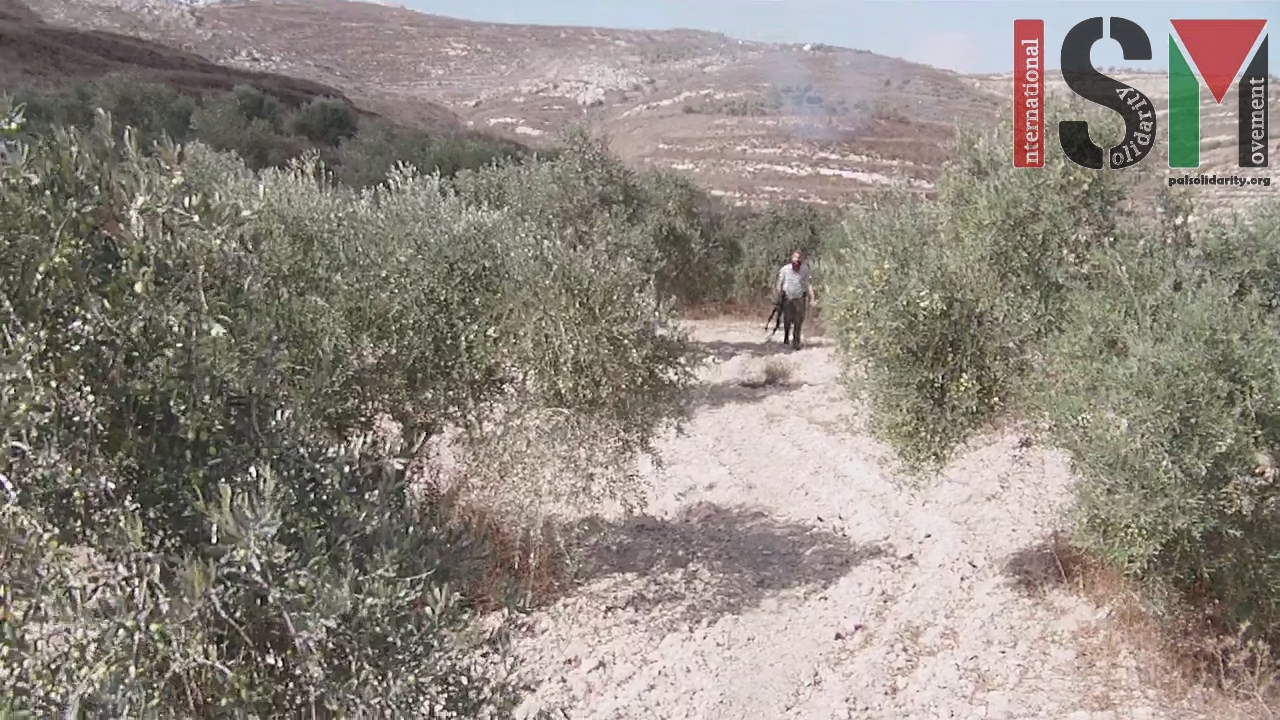
Armed illegal settler
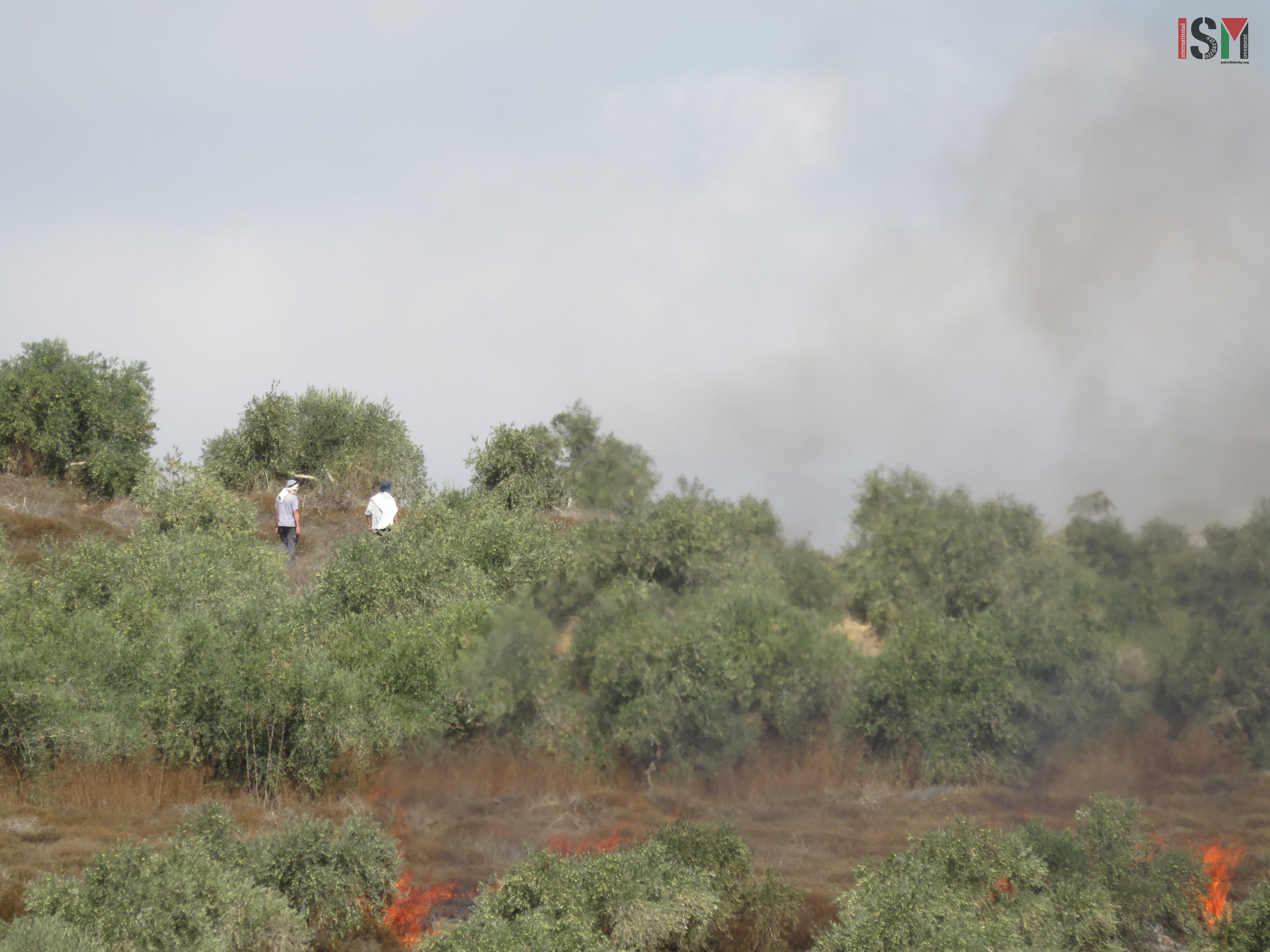
Settlers lighting fires throughout valley
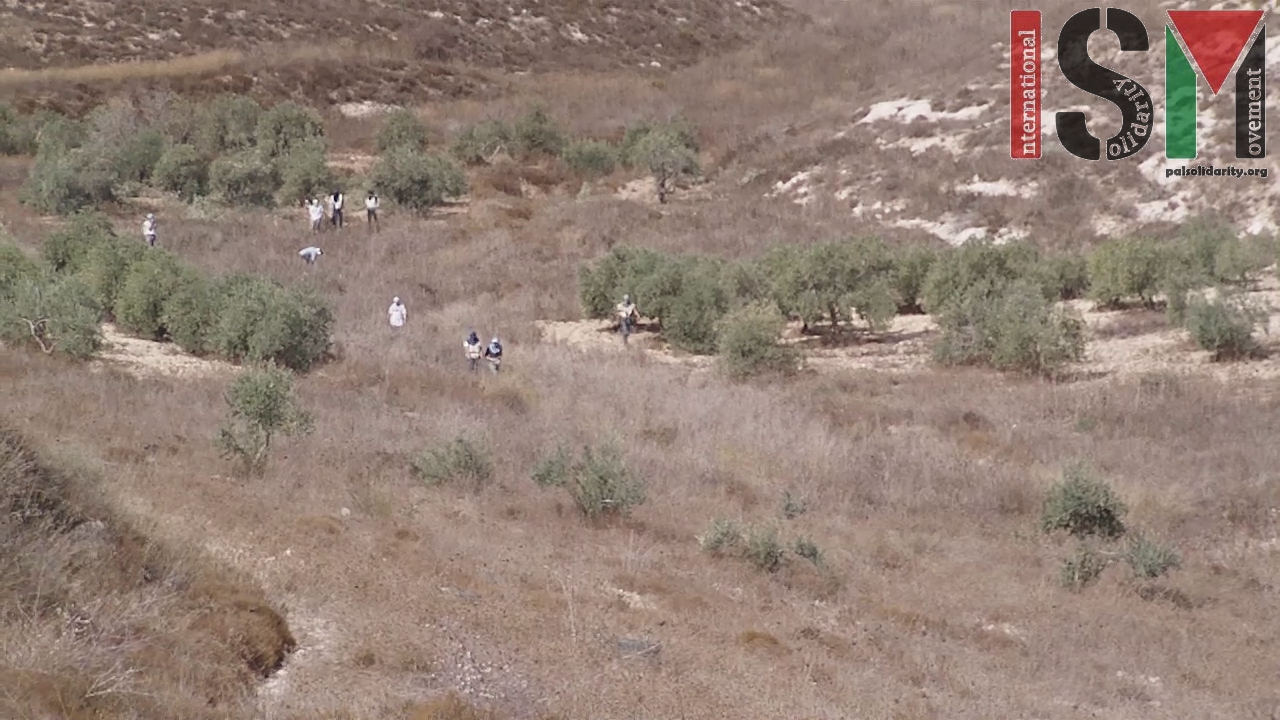
Masked settlers in the olive fields
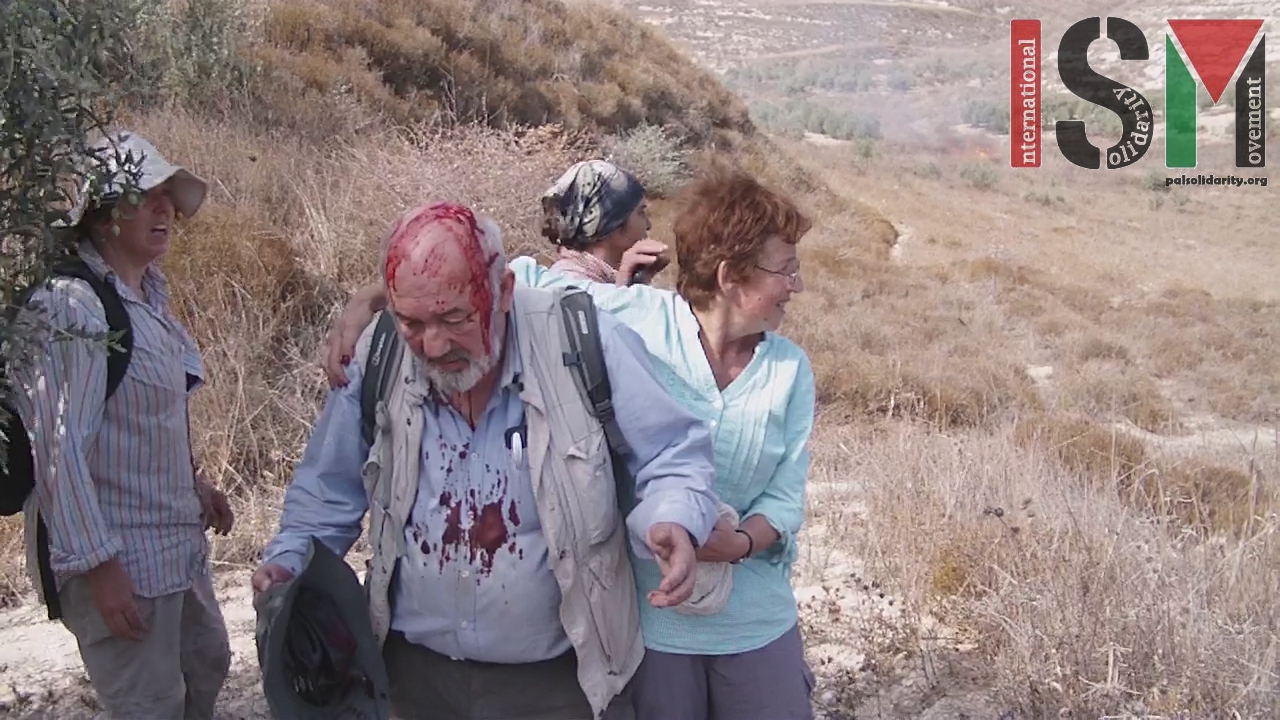
International human rights observer David Amos attacked by settlers
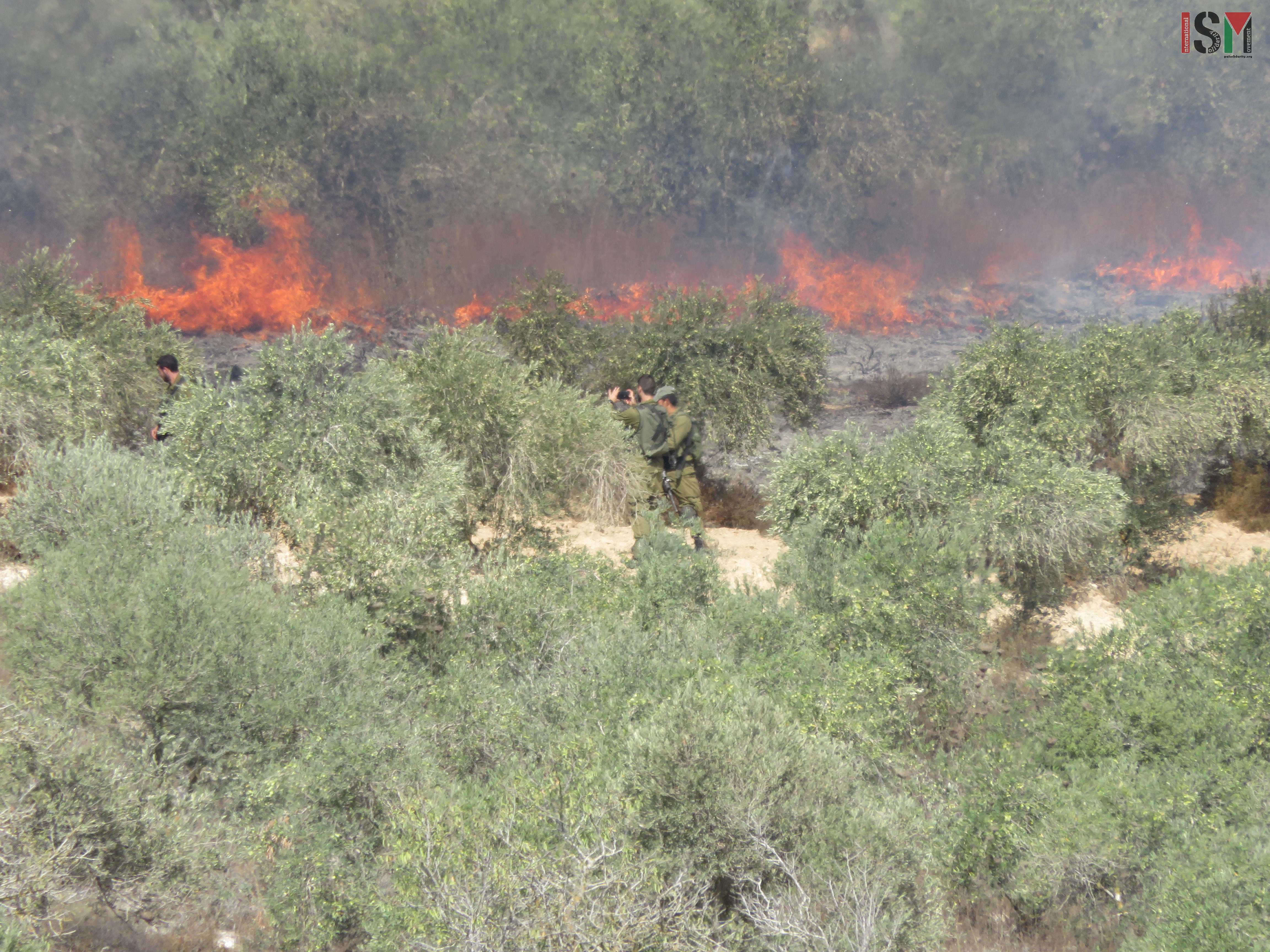
Israeli forces photograph fires
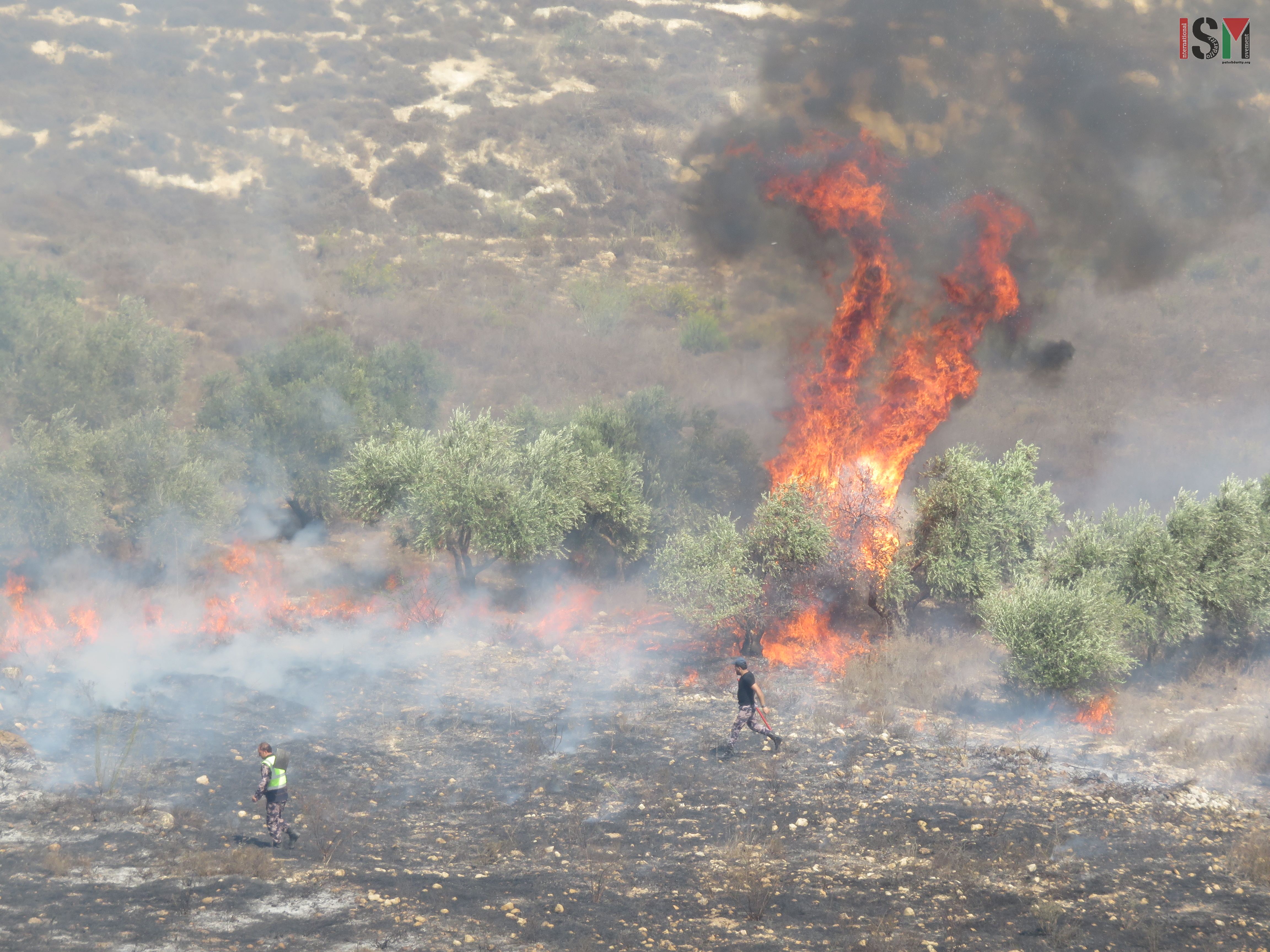
Palestinian civil workers attempt to put out fires while fire truck prohibited entry
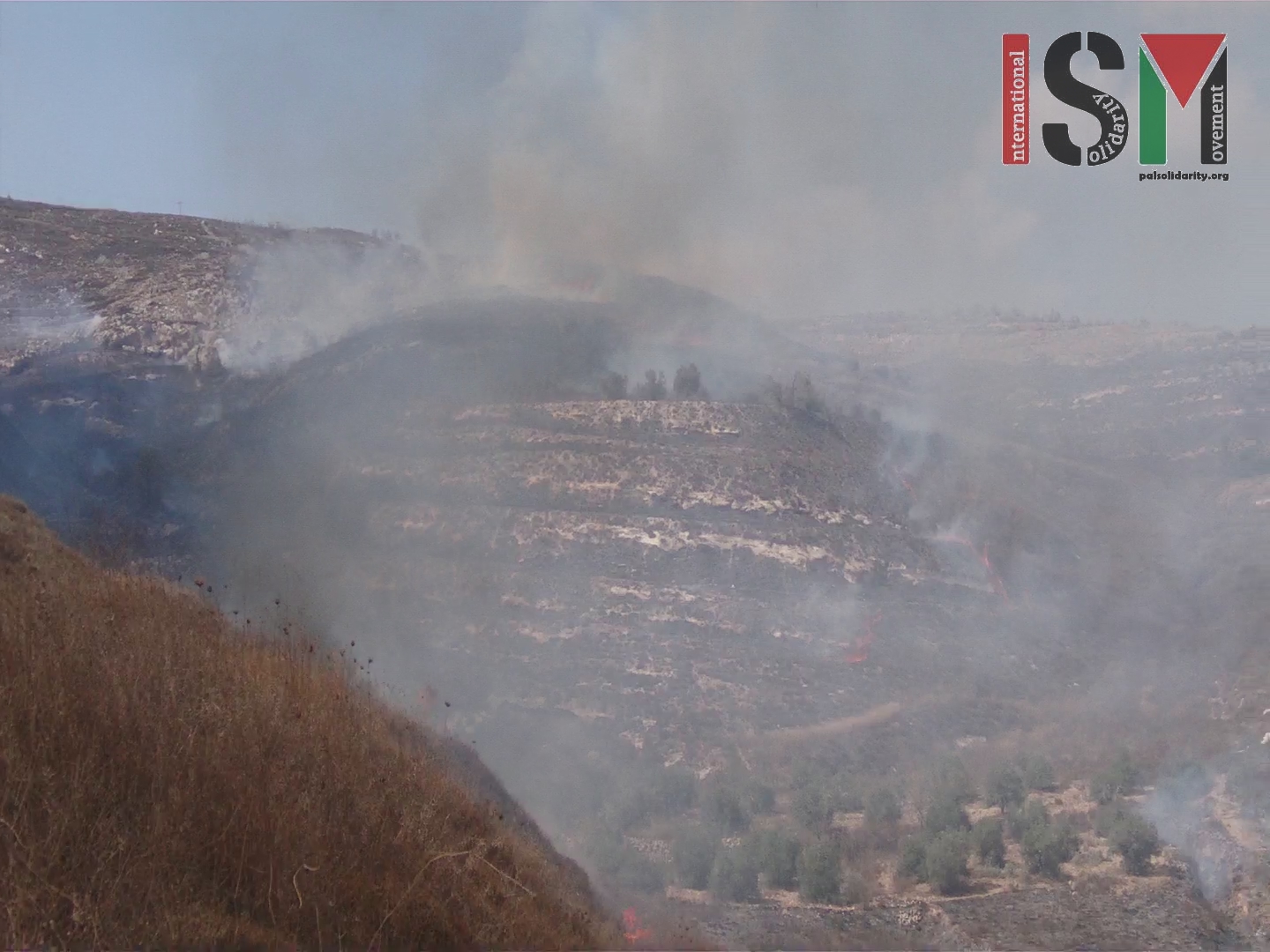
Fires rage across Burin valley
Thousands Gather at Scene of Ankara Bombings as Nation Mourns
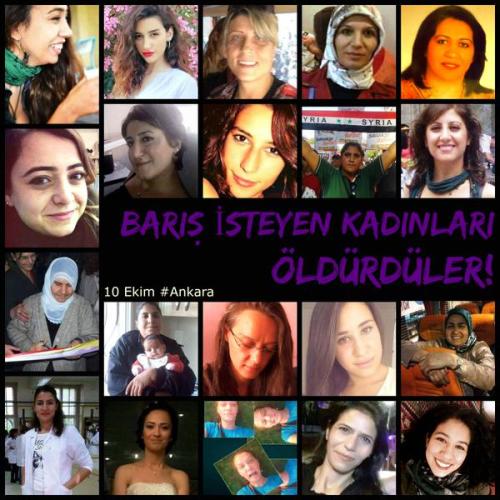
Tweet: “My sisters wanted peace. They killed them.”
teleSUR | October 11, 2015
Thousands of mourners gathered in Ankara Sunday close to the site where a bombing at a pro-Kurdish democracy rally took place and killed at least 95 people on Saturday. According to social media reports, the protesters were attempting to place flowers at the site of the blast but were prevented by the police.
“Murderer (President Tayyip) Erdogan”, “murderer police”, the crowd chanted in Sihhiye square, as riot police backed by water cannon vehicles blocked a main highway leading to the district where parliament and government buildings are located.
The rally Saturday was attended by hundreds of people and many lawmakers from the pro-Kurdish People’s Democracy Party, or HDP. Several Twitter accounts were tweeting Sunday threads of photos of those who lost their lives.
So far the government says that autopsies have identified at least two suicide bombers. Despite the presence of many Kurds at the rally, Turkish Prime Minister Ahmet Davutoglu said the Kurdish movement Kurdistan’s Workers’ Party, or PKK, could be behind the attacks.
Turkey and the PKK have resumed fighting after the government launched an operation against the group back in July, ending a two-year ceasefire.
The biggest terror attack in Turkey’s history comes a few weeks before the general election in November 1. A government official said Sunday that postponing the elections because of the attack was not on the table or an option at all.
The HDP, a major presence at Saturday’s march, said Sunday that police attacked its leaders and members as they tried to leave carnations earlier at the scene of the bombing. Some were hurt in the melee, it said in a statement.
Some have suggested militant nationalists, who oppose any agreement with the Kurds or granting them minority rights in Turkey, might have been behind the attacks. Meanwhile, Turkish investigators were working on identifying the party responsible for the attacks.
Newspapers Sunday reflected mixed feelings between mourning and anger. “We are in mourning for peace,” said the front-page headline in the secularist newspaper Cumhuriyet. “Scum Launch attack in Ankara,” said Haberturk newspaper. “The goal is to divide the nation,” said the pro-government Star.
Thousands protest in Istanbul following Ankara blast
Press TV – October 10, 2015
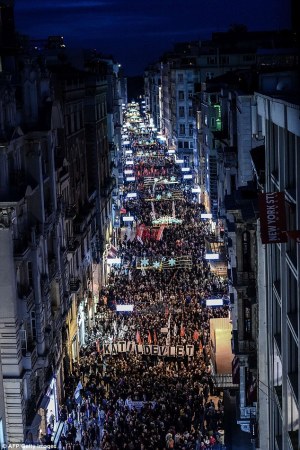 Thousands of people have gathered on the streets of Istanbul in protest of the twin bomb blasts in Turkey’s capital, which claimed the lives of over 90 people.
Around 10,000 people converged on the city’s Istiklal Street, some carrying placards reading “The state is a killer” and “We know the murderers,” AFP reported on Saturday.
Similar demonstrations were held in other Turkish cities such as Izmir, Batman and Diyarbakir, some of which were dispersed with police intervention.
Following the deadly blasts, Russian President Vladimir Putin called for joint efforts on battling terrorism.
“It is necessary to unite efforts in the fight against this evil. What happened in Turkey… it certainly is an impudent terrorist attack, a terrorist crime with scores of victims. And of course it is an attempt to destabilize the situation in Turkey, a neighboring and friendly country for us,” said Putin on a televised broadcast.
Earlier in the day, twin explosions targeted activists who gathered outside Ankara’s main train station for a peace rally organized by leftist and pro-Kurdish opposition groups. According to a statement released by Turkish Prime Minister Ahmet Davutoglu’s office, at least 95 people were killed and 245 wounded in the attacks, 48 of whom are in critical condition.
Featured Video

Trita Parsi: Israel Set a Trap for Total War in the Region
or go to
Aletho News Archives – Video-Images
Book Review
Why the War on Conspiracy Theories Is Bad Public Policy
By Kevin Barrett • Unz Review • February 1, 2019
 A Review of Conspiracy Theories and Other Dangerous Ideas by Cass Sunstein (based on an earlier paper co-authored with Adrian Vermeule); In Defense of Troublemakers: The Power of Dissent in Life and Business by Charlan Nemeth; and Conspiracy Theories and the People Who Believe Them, edited by Joseph E. Uscinski
On January 25 2018 YouTube unleashed the latest salvo in the war on conspiracy theories, saying “we’ll begin reducing recommendations of borderline content and content that could misinform users in harmful ways—such as videos promoting a phony miracle cure for a serious illness, claiming the earth is flat, or making blatantly false claims about historic events like 9/11.”
At first glance that sounds reasonable. Nobody wants YouTube or anyone else to recommend bad information. And almost everyone agrees that phony miracle cures, flat earthism, and blatantly false claims about 9/11 and other historical events are undesirable.
But if we stop and seriously consider those words, we notice a couple of problems. First, the word “recommend” is not just misleading but mendacious. YouTube obviously doesn’t really recommend anything. When it says it does, it is lying. … continue
Blog Roll
 Aletho News
- Putin’s key remarks on peace talks and Europe’s ‘schizophrenia’
- Trita Parsi: Israel Set a Trap for Total War in the Region
- Trump’s Iran war is on an Israeli leash
- Saudi oil boss issues global supply warning
- Riyadh Says Its Oil System Is Intact. The Numbers Say Otherwise.
- Trump and Netanyahu Want to “Finish the Job” on Iran
- US ‘one-sided dictation’ not Iran’s beliefs makes rational talks impossible: Baghaei
- Iran’s Next Strike May Not Explode. It Could Shut You Down /Col Doug Macgregor
- Iran: US political targets legitimate if assassinations return
- Iraq shuts key border crossing with Iran under US pressure: Report
- If Americans Knew
- DAILY UPDATE: Latest essential news on Palestine, Israel, & region
- The Israel Lobby’s Changing Fortunes
- AIPAC has become such a political liability that it’s shifting to a more “nimble” approach to buying politicians
- At least 160 Israeli settler attacks in 2 weeks
- Will Gaza’s Ancient Christian Community Disappear Forever?
- Israel’s vision of regional security rests on keeping Arab states weak
- Heidi Levine recounts how Palestinian youths helped save her in settler attack
- DAILY UPDATE: Latest essential news on Palestine, Israel, & region
- Trump’s Intensifying Sabotage of the ICC, for Israel’s Sake
- Israeli military detain US and UK volunteers in West Bank including Democratic NY politician Brad Lander
- No Tricks Zone
- E-Cars Reduce CO2 Emissions By Only 41% Compared To Internal Combustion Engine Vehicles
- Predictions Made By Renowned Climate Professor Over Past Decades Have Been Proven To Be Poor
- New Study Suggests Large Regions Of The Pacific Ocean Have Been Cooling For The Last 80 Years
- Germany’s Green Energy Debacle: High Energy Costs Force Kahla Porzellan to Close After 182 Years!
- New Study: 50 Years Of The Most Aggressive ‘Net Zero’ Policies Can Only Affect The Global Climate By 0.03°C
- US September “Heat” Was No Record…Many Records Set Decades Ago
- Latest European Green Energy Debacle; Portugal’s Largest Flagship Solar Park Insolvent!
- Green Energy Debacle: German Expert Professor Fritz Vahrenholt Warns Of Severe Economic And Social Consequences
- Two More Paleo Reconstructions Affirm Meters-Higher Sea Levels Across Ireland, Brazil 7000-6000 Years Ago
- New Study: Earth And Venus Surface Warmth Largely Explained By Convection And Lapse Rate, Not CO2 Or Radiation

