Five Palestinian teens blackmailed into accepting 15 years prison term and exorbitant ‘fines’ for a crime that never happened
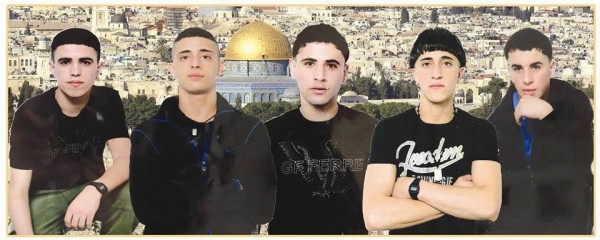
The Hares Boys campaign | December 13, 2015
Hares, Salfit – It is with great sadness and anger that we hereby inform you of the outcome of the Hares Boys case: the five teenagers are being sentenced to 15 years in prison and are to pay a total of NIS 150,000 (~US $39,000 or €35,000) to the Israeli authorities. Failure to provide the exorbitant sum would, it is implied, result in more years of prison added to the boys’ sentences.
Ali Shamlawi, Mohammed Kleib, Mohammed Suleiman, Ammar Souf, and Tamer Souf have been kept in prison for 2 years and 8 months and are now being sentenced for a crime that never happened. The five teenagers (16-17 years old at the time) from the village of Hares (Salfit governorate, West Bank, occupied Palestine) were kidnapped from their homes by the Israeli army in March 2013. The teens were accused of throwing stones at illegal settler cars, one of which drove under a truck that was parked along Route 5 near the village of Hares. The driver’s children were injured during the accident and one of them died two years later after pneumonia complications. The boys denied throwing stones but were forced to sign ‘confessions’ following torturous interrogations at the hands of Israeli secret services. There was never any evidence of the boys’ guilt but it is sadly a reality in the Israeli military court system that does not comply with due process and convicts Palestinians at a 99.7% rate.
After almost 3 years of routine hearings at Israeli military courts, where the boys were initially accused of ‘attempted murder’, they were told on 26 November 2015 that they are now being charged with manslaughter and are being sentenced to prison terms of 15 years, provided their families pay ‘fines’ of NIS 30,000 [US $7,750 or € 7,100] each by the deadline of 28 January 2016. Failure to pay the amount requested by the Israeli military court would, it is understood, result in each boy’s sentence being prolonged, possibly to at least 25 years in prison.
There is no other way to describe this situation the five teens and their families have endured other than as criminal activity on behalf of the Israeli system of ‘justice’. Pressing the families to agree to a court ‘deal’ and threatening them with harsher sentences if they don’t accept is nothing less than extortion. Demanding that families pay large sums of money as a ‘fine’ or a ‘compensation’ to the occupying power is nothing less than a demand for ransom.
On behalf of the Free the Hares Boys campaign we condemn such acts of injustice committed by the Israeli military court.
We invite local and international human rights organizations, the world’s democratic government institutions and people of conscience to stand up to this injustice inflicted on the Palestinian people by the Israeli occupation and to demand justice for the Hares Boys. Please consider contacting your country’s diplomatic representatives in Tel Aviv or occupied Jerusalem; the Israeli Ministry of Justice; your local politicians; asking them to intervene and condemn such injustice and disrespect for the rule of law. Organize events in your community to highlight the Hares Boys case and the situation of hundreds of other Palestinian children who are being kept in occupation prisons.
Do not stay silent in the face of what is not right.
Further information and Contact:
Website: haresboys.wordpress.com Email: haresboys@gmail.com
Facebook: facebook.com/FreeTheHaresBoys Twitter: @HaresBoys
Rights group urges end to Dutch sale of ‘attack dogs’ to Israel
Ma’an -December 13, 2015
BETHLEHEM – A Palestinian animal rights group has called on the international community to pressure the Dutch government to halt the sale of “attack dogs” to Israel.
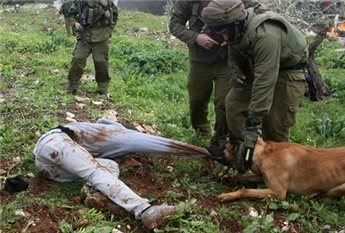 Said Ahmad Safi, Executive Director of the Palestinian Animal League, said in a statement that dogs exported by European countries — especially the Netherlands — have long been used by the Israeli military as “living, breathing weapons — leading to devastating injuries on many civilians.”
Palestinian human rights organization, Al Haq, has reportedly carried out attempts to sway the Dutch government to place a ban on the export of the dogs for such use.
“As a result of communication between Al Haq and the Dutch government, officials in the Netherlands have suggested that they will consider placing restrictions on the export of dogs to Israel, but no firm decision has been reached, nor has any action been taken to date,” PAL said in a statement.
The restrictions would join one of several placed by European countries on trade with Israel, the European Union most recently passing a decision to label products made in illegal Israeli settlements in the occupied West Bank.
Such measures are part of a boycott, divestment, and sanctions movement (BDS) pushed by activists and increasingly by politicians, in effort to place pressure on Israel to stop ongoing violations against Palestinians.
South Florida Deputy Indicted for Killing Man After Winning Award for Killing Same Man
By Carlos Miller| PINAC | December 11, 2015
A South Florida sheriff’s deputy who received an award for bravery after shooting and killing a man in 2013 was indicted for that same shooting Thursday.
Broward County sheriff’s deputy Peter Peraza was charged with manslaughter with a firearm, a first-degree felony that could land him in jail for 30 years.
But only because a photo emerged in May 2015 that showed Jermaine McBean was wearing headphones when he was shot and killed.Prior to that photo surfacing, Broward sheriff investigators claimed that McBean had his headphones in his pocket.
They also claimed that McBean had swung the gun around, making the deputies fear for their lives.
But the gun was an unloaded pellet gun he had just purchased at a pawn shop.
Not only did the photo prove the sheriff’s office to be lying, it provided evidence that perhaps McBean did not hear Peraza yelling at him to drop the gun.
In fact, even the man who called deputies on McBean, reporting a man walking down the street with a rifle slung over his shoulder, said McBean never pointed the gun at the deputies.
The photo did not surface for almost two years because the woman who took it feared retaliation.
According to an NBC News article from May:
But a newly emerged photo that shows headphones in McBean’s ears immediately after the 2013 shooting raises questions about the police version of events, including why the white earbuds were later found stuffed in the dead computer expert’s pocket.
And another aspect of the police account is also being contradicted — by a man who called 911 in alarm when he saw McBean walking around with the air rifle but who also says McBean never pointed it at police or anyone else.
Michael Russell McCarthy, 58, told NBC News that McBean had the Winchester Model 1000 Air Rifle balanced on his shoulders behind his neck, with his hand over both ends, and was turning around to face police when one officer began shooting.
“He [McBean] couldn’t have fired that gun from the position he was in. There was no possible way of firing it and at the same time hitting something,” McCarthy said. “I kind of blame myself, because if I hadn’t called it might not have happened.”

McBean was a 33-year-old computer engineer who had a masters degree in computer science. His LinkedIn page indicates a man who is serious about his career. He also had marijuana in his system as they always like to point out.
But the case seemed to have been forgotten about but a grand jury began looking at the evidence last week, more than two years after the July 31, 2013 shooting, determining on Thursday that there was enough evidence to charge Peraza.
The indictment marks the first time since 1980 that a Broward deputy was charged for an on-duty killing.
According to today’s NBC News article:
In videotaped statements to investigators, Peraza said he fired because he feared for his life.
“I’m outraged,” Peraza’s lawyer, Eric Schwartzreich, said of the indictment. “This was a justified shooting.”
Schwartzreich said his client was responding to 911 calls of a man with a gun and the air rifle McBean carried “looked very real.” He insisted McBean pointed it at the officer and that Peraza “was simply protecting what he perceived to be a threat.’
The lawyer suggested that anger over police shootings around the country led prosecutors to “steer this into the lion’s den” and said the charges against Peraza “could have a chilling effect on law enforcement officers anywhere.”
“My client should never have been indicted,” he said.
The sheriff’s department gave bravery awards to two of the officers involved in the shooting — including the deputy who fired the fatal shots — while the incident was still under investigation. The sheriff later told NBC News that was a mistake.
Like so many police reports we have seen over the years, the letter announcing the departmental award to Peraza completely overdramatized the situation, claiming that Peraza was only trying to protect himself and children who were in the area.
But as we’ve seen so many times over the years, it appears as if he didn’t want to lose his chance at being able to kill another human being.
And as we’ve seen so many times over the years, departmental awards handed out to officers are nothing more than a cheap motivational tool, if not an outright attempt to coverup a murder.

Pedraza, in the middle, awarded for his heroism for an incident that might land him in prison.
Chicago’s Embattled Mayor
By Stephen Lendman | The People’s Voice | December 13, 2015
Career Democrat party member, former congressman, Obama White House chief of staff, Chicago mayor Rahm Emanuel took office in May 2011 – reelected last April for another four-year term.
He’s notoriously hard-line, neoliberal and pro-Israeli to a fault. The late Chicago-based Citizens Committee to Clean up the Courts chairman Sherman Skolnick called him the “acting deputy chief for North America of Mossad.”
His father, Benjamin, was involved in smuggling weapons to the Jewish Irgun underground terrorist group (co-led by future Israeli prime minister Menachem Begin) in Palestine pre-1948.
Their elements were notoriously involved in bombing Jerusalem’s King David Hotel (July 1946 – slaughtering 92 Brits, Arabs and Jews, along with wounding 58 others), as well as the horrific Deir Yassin massacre (April 1948), randomly killing up to 120 defenseless Palestinians mercilessly, including women and children, dozens more in continued fighting – part of the future state of Israel’s genocidal ethnic cleansing master plan.
Emmanuel is a former civilian IDF volunteer during the 1991 Gulf War. It’s believed he holds dual citizenships – a dubious status for any US politician.
Throughout his political career, he’s been unabashedly pro-war, neoliberal and anti-populist. His abrasive style alienates him from anyone opposing his hard-line views.
Chicago notoriously earned a reputation as the police repression capital of America. A Gitmo type operation on the city’s west side is Exhibit A – operating off-the-books in a nondescript Homan Square warehouse, the domestic equivalent of a CIA or Pentagon black site.
Mostly Blacks are lawlessly arrested, detained, painfully shackled, interrogated, terrorized and beaten without access to counsel for a day or longer – to coerce confessions to offenses never committed or ones too minor to matter.
City police have virtual carte blanche authority to operate with impunity. Responsibility goes right to the top – Emanuel complicit with what goes on, likely much more illegally than now known, including cops killing Chicagoans unaccountably.
In late November, a seven-minute video surfaced, showing officer Jason Van Dyke extrajudicially executing 17-year-old Lanquan McDonald – guilty of being Black, threatening no one, innocent of any crime.
Van Dyke lawlessly shot him 16 times, twice in the back first, mostly as he lay dying. The incident occurred on October 20, 2014. Coverup and denial followed, police authorities calling cold-blooded murder justifiable self-defense.
Emanuel and other city officials lost a 13-month Freedom of Information Act (FOIA) lawsuit battle to prevent release of the video. It’s damning.
A knife planted on McDonald’s body was exposed as a Big Lie. Video evidence showed him moving away from Van Dyke unarmed when gunned down from behind in cold blood.
Chicagoans are justifiably outraged. Thousands have been protesting outside City Hall for days, calling for Emanuel’s resignation, along with complicit city and police officials.
Police chief Garry McCarthy was sacked. So was chief of detectives Dean Andrews. Protesters want Cook County State’s Attorney Anita Alvarez removed for complicity in months of coverup.
Emanuel’s administration is a cesspool of corruption and other forms of lawlessness, perhaps the worst in city history – ill-serving the vast majority of Chicagoans.
On Thursday, state Rep. La Shawn Ford said “(p)eople are (being) hurt. People have died. People feel they are forgotten about in” a city serving powerful monied interests exclusively.
He introduced legislation to amend state law, authorizing a recall election, letting Chicagoans decide up or down if Emanuel should stay or go.
On Thursday, city medical students staged a silent “die-in” outside City Hall for 16 minutes – symbolizing 16 bullets Van Dyke fired into McDonald’s body.
They lay supine, at least one holding a sign saying: “DO NO HARM.” A much larger “die-in” protest occurred Thursday evening.
Some critics called for abolishing the so-called Independent Police Review Authority (IPRA) – notorious for covering up cop killings. A criminal code of silence prevails.
Almost never are officers responsible for killing civilians held accountable. Even the right-wing Chicago Tribune said “it’s common knowledge that Chicago’s system of investigating shootings by officers is flawed…at so many levels…by design…”
Critics want a new independent, citizen-controlled police audit authority established, empowered to sue the city administration and police so killer cops and their superiors up the chain of command to the top can be held accountable for crimes too serious to ignore.
An Illinois Better Government Association study, covering the period 2010 – 2014, called Chicago tops among America’s largest cities in fatal shootings by police, most often targeting defenseless Black males.
Rarely do incidents make headlines. Video evidence showing officer Van Dyke murdering McDonald in cold blood is a rare exception – whether enough to convict him another issue altogether.
Almost never are cops prosecuted imprisoned, especially in cases involving extrajudicial assassinations. Emanuel’s hollow apology for McDonald’s murder and duplicitous promised “complete and total reform of the system” fooled no one.
Protesters outside City Hall chanted “no more killer cops” and “Rahm must go.” Chance for real reform by his or any other city administration is virtually zero.
Last of Chicago’s saloon keeper aldermen, Paddy Bowler, was right, saying: “Chicago ain’t ready for reform” – for sure not with Emanuel as mayor.
-###-
Stephen Lendman lives in Chicago and can be reached at lendmanstephen@sbcglobal.net.
His new book as editor and contributor is titled “Flashpoint in Ukraine: How the US Drive for Hegemony Risks World War III”.
Slaying of Chicago Teen Casts Doubt on Body Cams Holding Police Accountable
Sputnik – 12.12.2015
Although President Barack Obama has pledged $263 million in federal grants to fund body cameras for police departments throughout the country, some still feel the effort will do little to hold officers accountable if they engage in suspicious or unlawful activity.
Lisa Schreibersdorf, executive director of Brooklyn Defender Services, points to the recent case of Laquan McDonald, a 17-year-old who was fatally shot last year by a police officer after he responded to a call about a man with a knife.
An officer’s dashboard camera captured footage of that incident. However, Chicago’s mayor and police commissioner struggled to keep those recordings away from the eyes of the public arguing the footage could interfere with the court case.
Following the efforts of journalists and lawyers, however, a judge finally forced city officials to release the video in November leading to the prosecution of Officer Jason Van Dyke for murder more than a year after the shooting.
“Many have suggested that the prosecution would never have come if the City had succeeded in keeping the video under wraps — an allegation that Cook County State’s Attorney Anita Alverez denies, but nevertheless casts doubt on the ability or willingness of the police, prosecutors or even the City administration to hold individual officers accountable unless forced to do so,” Schreibersdorf explained to the Huffington Post.
In many instances, city officials can fight to keep police body-camera footage from being seen by the public and defense attorneys.
In New York City, for example, body-camera recordings legally are categorized as an officer’s file making it difficult for defense attorneys to access it. Police Commissioner Bill Bratton has said that body camera footage would not be released to the public under any circumstances.
“That leaves us in the potential situation of receiving body camera footage only when it serves the NYPD and the prosecution, not when it exonerates our clients or incriminates an officer,” said Schreibersdorf. “Such a scheme favors neither justice nor accountability and is one that we, as public defenders, often the last line of defense against executive power, could never support.”
Israel prevents Tulkarem university from building protective wall
Ma’an – December 12, 2015
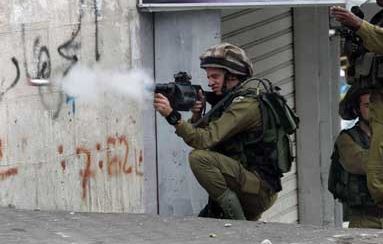 TULKAREM – Israeli forces prevented the administration of Tulkarem’s Palestine Technical University – Khadoorie from building a wall around the campus intended to both protect students and stop clashes, a university administrator said.
A head administrator of the university, Dirar Elayyan, told Ma’an Saturday that Israeli forces prevented the university from erecting the wall, which administrators hoped would prevent non-students from entering the campus.
Following student-organized marches that started in October to protest Israeli violations and raids onto the university campus, campus administrators reported that Israeli forces had positioned themselves at a temporary base on the university’s campus.
Non-students then began to enter the campus and throw stones at the Israeli base, prompting violent clashes that have severely interrupted normal campus life and left several students injured.
The university reportedly began preparations to build the wall to prevent the entrance of outsiders last month, however Israeli forces stopped the construction and confiscated a bulldozer, assaulting workers, Elayyan said.
Violence on the occupied West Bank campus has been near-daily over the past month, with nine students injured by live Israeli fire on Friday alone.
Israel releases Dawabsha arson suspect on house arrest
Ma’an – December 11, 2015
BETHLEHEM – Israel on Thursday released an Israeli settler arrested for suspected involvement in a fatal arson attack on a Palestinian family in July, Israeli media reported.
The settler, connected to a Jewish extremist organization, was arrested along with several others as a suspect in an arson that killed three members of the Dawabsha family in Duma village in the northern occupied West Bank district of Nablus.
The suspect was reportedly released and transferred to house arrest for five days at his home in the illegal Israeli settlement of Benyamin, east of Ramallah city.
The settler, whose name has not been released, is a married father of two.
The man was arrested 12 days ago by the Israeli intelligence and presented to an Israeli court on Wednesday, Israeli media reported. His detention was extended to Sunday, but was unexpectedly released on Friday.
On Dec. 3, Israeli forces announced that they had arrested several Israelis in connection to the Dawabsha arson. The information about the arrests was released after a weeks-long gag order was partially lifted on the investigation.
All other information regarding the investigation is still under a gag order requested by the Israeli police.
Suspects involved in the attack were identified by Israel’s defense establishment in September, but no charges were filed at the time, Israeli daily Haaretz reported.
On July 31, suspected Israeli settlers smashed the windows of the Dawabsha family home before throwing flammable liquids and Molotov cocktails inside.
The words “revenge” and “long live the Messiah” were sprayed in Hebrew outside of the house, immediately indicating that the arson was the work of Jewish extremists.
Ali Saad Dawabsha, one-and-a-half years old, was trapped in the house and burned alive. The infant’s mother and father, Riham and Saad, later died from severe burns.
Orphaned four-year-old, Ahmad Dawabsha, is the only remaining survivor of the attack and remains in the hospital receiving treatment.
The attack sparked criticism from the international community for Israel’s failure to hold Israeli settlers and Jewish extremists accountable for attacks on Palestinians, in effect being complicit in such attacks.
Israeli leadership at the time condemned the Dawabsha attack as “terrorism,” and pledged to bring the perpetrators to justice.
Israeli rights group B’Tselem slammed the reaction by Israeli officials as “empty rhetoric.”
“Official condemnations of this attack are empty rhetoric as long as politicians continue their policy of avoiding enforcement of the law on Israelis who harm Palestinians, and do not deal with the public climate and the incitement which serve as backdrop to these acts,” the group said at the time.
Thursday’s partial lift on the gag-order came one day after the United Nations Special Coordinator for the Middle East Peace Process, Nickolay Mladenov, criticized Israel for the “slow progress” in investigating the arson.
Where’s the Rule of Law in Our War on ISIS?
By L. Michael Hager | CounterPunch | December 11, 2015
The San Bernardino massacre has elicited from politicians and others many calls for stronger military action and even demands for travel restrictions on Muslims and the closing of mosques.
In his oval office address to the nation on December 6, President Obama rightly called on Americans “to reject proposals that Muslim Americans should somehow be treated differently.” He assured the nation that our success in defeating terrorists “won’t depend on … abandoning our values.”
Yet in a seeming contradiction, he promised to hunt down terrorist plotters “in any country where it is necessary” and use air strikes to “take out ISIL leaders and their infrastructure in Iraq and Syria.”
Before 9/11 our “common values” included respect for the rule of law. Not any more, it would seem. Over the past decade and a half, we have witnessed increasing disrespect for the rule of law. Preemptive strikes, targeted drone killing and the torture, sexual humiliation and forced feeding of prisoners at Guantanamo violate basic legal norms for human rights and the conduct of war– norms which the U.S. helped establish in the wake of World War II.
The main obstacle to the rule of law today is Guantanamo. As a continuing monument to such prison abuses as torture, forced feeding and indefinite detention, Guantanamo is a valuable resource for ISIS in its radicalization and recruitment of young Americans.
Despite President Obama’s first day in office pledge to close it down, Guantanamo continues to confine many innocent prisoners, claim huge sums from taxpayers and shame all Americans by what it represents to the world.
According to the nonprofit organization Human Rights First, 107 prisoners remain in Guantanamo (down from the total number of 780). The current roster includes:
* Detainees approved for release: 48,
* Detainees convicted by military commission: 3,
* Detainees currently being tried by military commission: 7,
* Detainees being held without charge or trial: 49.
Of the current Guantanamo population, 90 (84% of the total) have been imprisoned for more than ten years.
It costs US taxpayers approximately $387 million a year to operate Guantanamo (an annual cost of more than $3 million per prisoner).
According to Andy Worthington (closeguantanamo.org), the group of prisoners recommended for prosecution includes Mohamedou Ould Slahi, author of the recent bestseller, Guantanamo Diary.
Given Slahi’s “extraordinary account of rendition, captivity and torture” and the apparent failure of his captors to elicit evidence of wrongdoing despite more than 15 years of interrogation and imprisonment, his continuing incarceration raises a serious question: are the CIA and DOD continuing to detain him in order to continue to block disclosure of the names of his torturers (redacted from his published account)?
Sadly, the ongoing affront to the rule of law has raised few eyebrows in the media or in government institutions charged with legal oversight. Rarely, do we hear reference to law or legal norms by our elected officials. Indeed, the Department of Justice appears complicit in the torture scandals of Bush/Cheney.
TV anchors and newspaper reporters blithely echo the demands of political candidates that the U.S. “carpet bomb” Islamist targets and “take out suspected terrorists” anywhere in the world. They ignore international laws and conventions that put a strict limit on preemptive strikes and prohibit the endangering of civilians.
More distressing is the general failure of our religious institutions, universities and bar associations to speak out against the current degrading of the rule of law. Why has there been no strong outcry from the nation’s premier law schools as they witness military strikes that violate the UN Charter and international conventions? Why do they ignore the lack of due process, indefinite detention and the inadequacies of jerrybuilt “military commissions?”
Why have our churches, synagogues and mosques not questioned human rights violations (some detailed in the recent Senate report summary) including the now regular use of drones for targeted killing and the reliance on torture and force-feeding?
Bombing, drone strikes and internal restrictions on the freedom of religion and movement are more likely to breed terrorists than build security. If we should, as our President suggests, avoid abandoning our values—values that include respect for the rule of law– we should accelerate the Periodic Review Boards (PRB) process, free Guantanamo prisoners approved for release and try the remainder in U.S. courts.
Before his term of office ends, the President must fulfill his promise of 2009 and close Guantanamo, with or without Congressional support.
L. Michael Hager is cofounder and former Director General, International Development Law Organization, Rome.
Israeli settlers prevent Hebron children from reaching primary school
Ma’an – December 10, 2015
HEBRON – A group of Israeli extremists prevented Palestinian children from going to school in the southern occupied West Bank’s Hebron city on Thursday, the director of the Palestinian Authority’s Ministry of Education Hebron office told Ma’an.
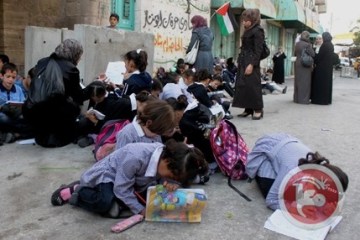 Bassam Tahboub said Anat Cohen, a well-known extremist who frequently harasses Palestinian residents in the area, first “attacked” the school children, “preventing” them from reaching Qurtuba middle school.
Following Cohen’s initial attack, other extremists reportedly joined in and began cursing and scaring the children. Instead of attempting to continue to school, the children decided to turn back and head home, Tahboub said.
Children who attend Qurtuba school, aged 7 to 16, are often harassed by settlers in area, as the school is adjacent to the illegal Israeli settlement of Beit Hadassah in the center of Hebron city.
According to Tahboub, Israeli settlers in the area have continuously attempted to have the school closed down.
Hebron has become the epicenter of recent violence over the last two months, as roughly 30 percent of the 115 Palestinians to be killed since Oct. 1 have been from the Hebron district.
Hebron’s city center is home to some 800 notoriously aggressive Israeli settlers, who live under the protection of thousands of Israeli forces, surrounded by more than 30,000 Palestinians.
Israeli soldiers occupy Palestinian house to set up military base
International Solidarity Movement | December 10, 2015
al Khalil, occupied Palestine – For the last 15 days the family of Abu Shykri Al-Atrarshi have had no access to the top two floors of their house, which was illegally taken over by the Israeli occupation forces and where they set up a military base.

Ten Israeli soldiers suddenly showed up at the house in the neighbourhood of Abu Sheineh, Al Khalil; they broke in by smashing a window in the door, took the key and demanded that the family vacate the third floor. The soldiers did not have any documentation to explain or justify the incursion nor did they give an explanation to the family why their house was being taken over. Any questions are ignored and the third floor as well as the roof top are now off limits.
Since the soldiers arrived they have broken the windows, and shot holes in the water tank which supplies clean water to the household. They then took all the blankets on the premises and used them to dry the water leaking from the tanks. The family also reported that once the water supply was fixed the soldiers contaminated the water and used the apartment and roof as a toilet.
The soldiers never leave the apartment empty, but a few times per day there is a shift change. This happens at different times every day so there is no knowing when, and the soldiers move in and out as they please anyway. This means there can be soldiers moving throughout the building at any time, terrifying the family- especially the young children who no longer dare to leave the house on their own. The soldiers use the roof as a lookout and also frequently fire weapons such as teargas, from there into the surrounding neighbourhood.
The three story house is home to 13 people, now crowded into two small floors- including a young disabled child. They have no idea how long the soldiers will stay, or if the family will get their house back at all. They contacted the local DCO (District coordination office) who advised them to get a lawyer, which they did. The lawyer has now started the process to take the case to an Israeli court in Haifa, Israel. However Abu Shykri Al-Atrarsh has had no information on when the case will be heard or when a judgement can be expected. This, as in many cases, can take months if not years and in the meanwhile the family is trapped. Abu Shakri believes the army is trying to make the family leave the building altogether, but they are resolutely staying put.
This family now has to try to live their life underneath the very people who have broken into, stolen and disrespected their home. The daily struggle of living under the occupation is hardship enough but having your own home taken from under your eyes, and not being able to do anything about it is absolutely heartbreaking.
ISM today took pictures of the soldiers in the building to help the family evidence their presence there, which is needed for the court case. Every time the family has tried to take pictures themselves the soldiers have taken their phones and deleted the pictures.
California Cops Shoot Two Innocent Black Men, Then Accuse Them of Murder
Sputnik – 10.12.2015
Two innocent black men who were shot by Los Angeles area cops have been falsely accused of murder even though the victim was actually struck and killed by a police vehicle.
Robert Pickett, 35, and Darryl Lewis, 39, testified in federal court that they were simply going about their business in May 2011, when Officer Mike Bollinger of the Inglewood Police Department approached them with his gun drawn.
Pickett claims that Bolliger “parked his car at the corner, got out armed with his shotgun cocked, loaded and ready to fire” and shot at the two men.
“No questions asked, no weapons seen, no words offered or exchanged,” Pickett wrote in a federal complaint. “Defendant Bollinger blasted three shotgun rounds at the hapless and unarmed plaintiffs, striking them and wounding them as they sought to take cover from assault, leaving them in critical condition, bleeding face-down on the ground.”
The two men were outside the apartment complex where Lewis lived as the officer arrived alone to respond to a call of a home invasion involving two black men armed with handguns. No other information was provided about the alleged robbers.
“Without warning, without investigation, without knowledge of who was in the area, of who the suspects were or what they looked like, and in violation of all training and standard police protocol, [Bollinger] approached the apartment gate and immediately shot Mr. Lewis and Mr. Pickett,” the complaint alleges.
Pickett, who has a young son, was shot seven times, including in his head.
Lewis, a father of four, was shot in the back and three times in his legs.
As more officers arrived on the scene, the two men say it had become apparent to the police that they had the wrong guys, and that the officers set to covering it up.
An officer also struck and killed a pedestrian while rushing to the scene.
Mysteriously, stolen items from the robbery that had initially prompted the police response appeared at the scene, as well as two weapons.
“The problem for defendant Bollinger and the rest of defendant police officers was that neither plaintiff was armed; neither possessed a weapon of any kind. Likewise, neither plaintiff was in possession of any of the stolen items supposedly taken by the suspect in the robbery,” the complaint states. The robbery victims also did not name Pickett and Lewis as the people who had entered their home.
The complaint also states that the first photos from the scene “do not show any weapon nor any of the stolen items. Some of the responding officers to the scene failed to see any weapons purportedly belonging to either plaintiff. Somehow, however, two handguns appeared and stolen items appeared as well. It was determined by subsequent forensic analysis before plaintiffs’ criminal trial, that neither plaintiff was in any way connected physically with the weapons or the items.”
The men reportedly did not receive medical treatment for an hour, and the officer allegedly told them that he “he did not give a f*** that he had shot him in the head.”
Pickett and Lewis were charged with murder of the pedestrian killed by the police car, attempted murder of Bollinger, and carrying loaded firearms.
The innocent men then spent a year in jail awaiting their trial, which eventually exonerated them.
They now seek punitive damages for civil rights violations, unreasonable and excessive force, false arrest, malicious prosecution, and failure to intervene, train, supervise and discipline, Courthouse News reported.
Featured Video
BRITAIN’S WARNING: PREPARE FOR WAR
or go to
Aletho News Archives – Video-Images
From the Archive
How Ukraine Tortured and Slaughtered Donbass
By Kit Klarenberg | Al Mayadeen | July 11, 2024
Almost immediately after the proxy war erupted, ISIS-tier footage of the torture and murder of Russians in Ukrainian custody emerged.
On July 6th, the New York Times published an astonishing investigation: In Ukraine, Killings of Surrendering Russians Divide an American-Led Unit. The article documents in grim detail how Chosen Company, an international volunteer battalion for Kiev, routinely executes Russian prisoners of war. It is the very first mainstream admission that this practice – a brazen breach of the Geneva Conventions, and a grave war crime – is widespread among Ukraine’s fighters, both foreign and homegrown. … continue
Blog Roll
 Aletho News
- Record Oil, Empty Tanks: The UAE’s Miracle Recovery
- Burnham tackles Britain’s poverty with aggression in Yemen
- Peace in Ukraine: the easy way – or the hard way
- Trump & the Rrrrussians
- US taxpayer money laundered back through Ukraine – Musk
- Before COVID, an NIH lab chief proposed making a SARS-like bat virus more infectious
- Gates, Bourla on Trial in Netherlands Accused of ‘Great Reset’ Scheme at Vaccine Injury Hearing
- BRITAIN’S WARNING: PREPARE FOR WAR
- “Historic Russia”: The Land Putin Will Not Give Back
- How the Cambridge Analytica scandal still haunts Mark Zuckerberg
- If Americans Knew
- An error has occurred; the feed is probably down. Try again later.
- No Tricks Zone
- Two New Studies Find Thwaites Glacier Melt Cannot Be Driven By Human Activity Or A Warming Ocean
- E-Cars Reduce CO2 Emissions By Only 41% Compared To Internal Combustion Engine Vehicles
- Predictions Made By Renowned Climate Professor Over Past Decades Have Been Proven To Be Poor
- New Study Suggests Large Regions Of The Pacific Ocean Have Been Cooling For The Last 80 Years
- Germany’s Green Energy Debacle: High Energy Costs Force Kahla Porzellan to Close After 182 Years!
- New Study: 50 Years Of The Most Aggressive ‘Net Zero’ Policies Can Only Affect The Global Climate By 0.03°C
- US September “Heat” Was No Record…Many Records Set Decades Ago
- Latest European Green Energy Debacle; Portugal’s Largest Flagship Solar Park Insolvent!
- Green Energy Debacle: German Expert Professor Fritz Vahrenholt Warns Of Severe Economic And Social Consequences
- Two More Paleo Reconstructions Affirm Meters-Higher Sea Levels Across Ireland, Brazil 7000-6000 Years Ago


