Prisoners’ day at weekly Bil’in demonstration
International Solidarity Movement | April 17, 2015
Bil’in, Occupied Palestine – Over 300 people attended the Prisoners’ Day demonstration in Bil’in. The Israeli army fired endless amounts of teargas and shot one person in the chest with a live ammunition.
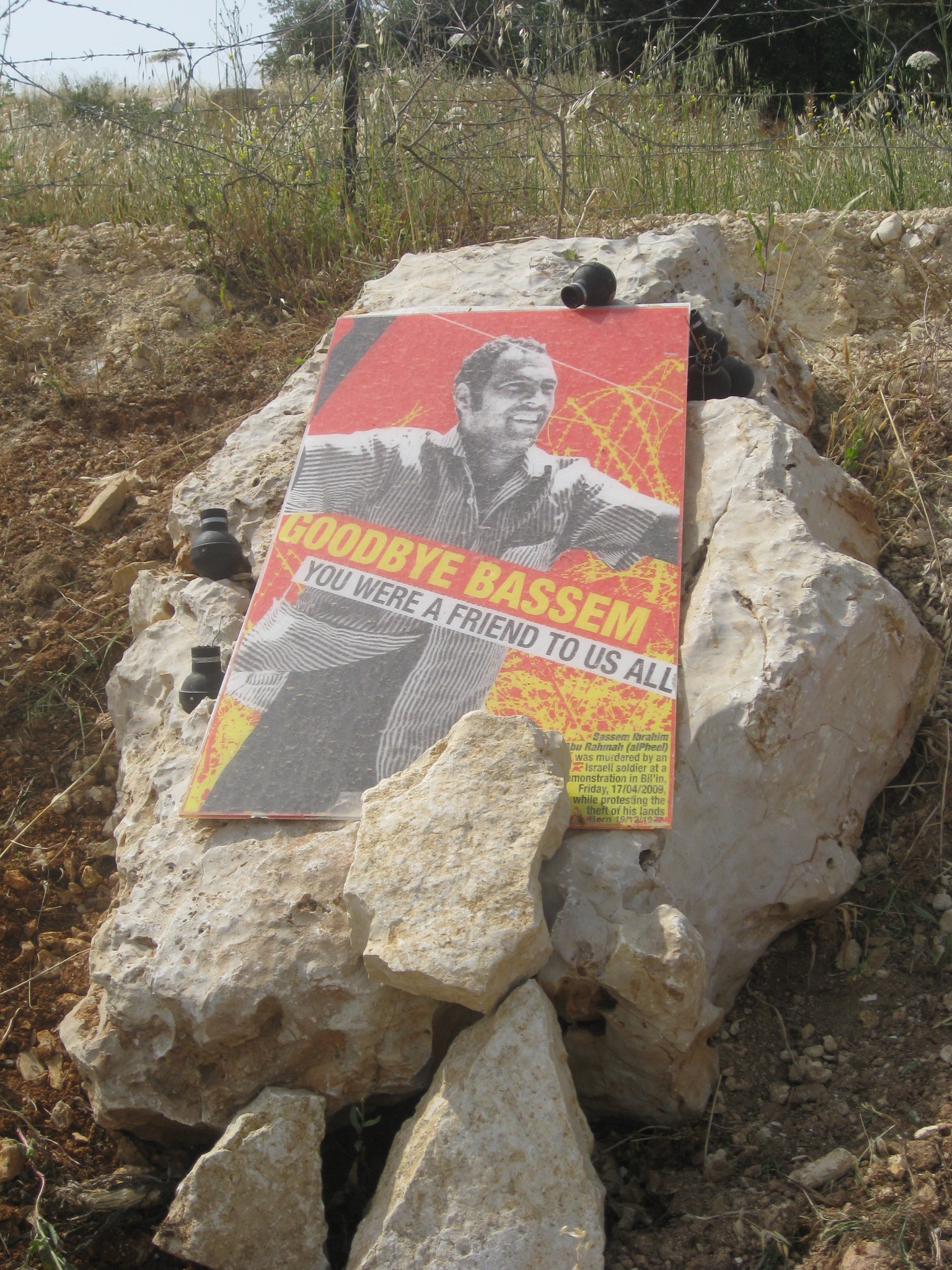
After the prayer, protesters marched towards the apartheid wall and the illegal settlement of Modi’in, situated just outside of Bil’in. A truck loaded with a sound system led the chanting crowd. Most were either waving Palestinian flags, holding up banners in support of the Palestinians imprisoned in Israeli prisons to mark Prisoners’ Day, or were holding posters of Bassem, a local who was killed six years ago by the Israeli army. As the march got closer to the wall, Israeli forces fired over 50 rounds of teargas canisters towards the protesters. The area was heavily clouded with this gas during most of the afternoon, which caused many to suffer from its inhalation. The shooting of this teargas also caused the dry grass between the olive trees to repeatedly catch fire.
During the protest, one person was shot with a rubber-coated steel bullet, while a 17 years old boy was shot in the chest with live ammunition. He was immediately taken to hospital by the ambulance. His condition is stable.
The 17th April is Prisoners’ Day in Palestine. Thousands of Palestinians are arrested arbitrarily on a daily basis by the Israeli forces, despite prohibition by international law. According to B’Tselem, “at the end of February 2015, 5,609 Palestinian security detainees and prisoners were held in Israeli prisons”. Since 1967, when Israel furthered its occupation to the West Bank, Gaza and East Jerusalem, an equivalent of approximately 20% of the total population in the Occupied Palestinian Territories (OPT), and 40% of all males have been detained (CEPR). While in prison, they are subject to wide-ranging violations of their rights and dignity. Such practices may include physical and psychological torture, deprivation of family visits, denial of access to lawyers and unlawful transfer out of the Occupied Palestinian Territories, among many other things. The Israeli occupying forces continue to violate the provisions of the Fourth Geneva Convention Relative to the Protection of Civilian Persons in Time of War, in particular against the Palestinian prisoners.
Today also marked the 6th anniversary of Bassem Abu Rameh’s death. Nicknamed Pheel, he was a much loved figure in the town of Bil’in. On the 17th April 2009, the Israeli army shot him with a teargas canister projectile which killed him shortly after. Aged 30, Pheel had been to all the non-violent protests, activities and creative actions against the apartheid wall in his town. Those who knew him remember him as a caring person who made everybody laugh and had the heart of a child, says Mohammad Khatib, a member of the Bil’in Popular Committee Against the Wall and Settlements.
According to the report by the United Nations Office for the Coordination of Humanitarian Affairs within the occupied Palestinian Territories, 442 people in the West Bank and 15 people in Gaza have been injured by the Israeli forces since the beginning of this year. On top of this, five people have been killed.
#PalestinianPrisonerDay: Protesters target G4S London HQ over Israeli ‘torture’ complicity
RT | April 17, 2015
Protestors gathered outside the London office of G4S on Friday to highlight the private security firm’s role in incarcerating Palestinian prisoners on behalf of Israel.
Organizers demanded the release of several prisoners, including Palestinian MP Khalida Jarrar and more than a hundred child detainees.
They also highlighted the ill treatment of prisoners, including alleged incidents of torture.
The protest in London takes place as part of an international day of action to mark Palestinian Prisoners Day, an annual expression of solidarity with Palestinians detained by Israel.
Palestinian Prisoners Day began as a mass action in support of hunger striking political prisoners on April 17, 2012.
It has grown into an annual event marked by human rights organizations and pro-Palestine groups across the world.
More than 100 people confirmed they would attend the protest on its Facebook page.
Organized by Innovative Minds (Inminds), a group which describes itself as online Islamic activists, the demonstration targeted G4S for its operation of two prisons and two detention centers in Israel and one prison in the West Bank.
Some 6,000 Palestinians are currently held in Israeli prisoners, according to the Addameer Prisoner Support and Human Rights Association.
Addameer’s monthly detention report for February 2015 indicates 163 of these prisoners are children, 13 of whom are under 16.
The vast majority of those incarcerated are male, with only 22 female prisoners.
Lina Jarbouni, a female detainee from Galilee, is the longest serving female prisoner having been in jail for 13 consecutive years.
“Systematic torture and ill treatment” of Palestinian prisoners is well documented, according to human rights group War on Want.
Activists say G4S is complicit in this ill treatment by providing security systems for the Israel-based Ketziot and Megiddo prisons, which hold political prisoners arrested within Palestine.
War on Want claims G4S has acted in violation of Article 76 of the Fourth Geneva Convention, which prohibits the transfer of prisoners from an occupied territory to the territory of the occupier.
G4S has become the target of an international boycott, with the South African government resolving to end work contracts with the security firm in November last year.
Archbishop Desmond Tutu was one of several notable activists, including Noam Chomsky, to sign a petition calling for G4S to end its participation in Israel’s occupation of Palestine.
Protestors outside the London office of G4S highlighted the plight of Palestinian prisoners being held by Israel as well as those detained by the security firm.
They demanded the release of Palestinian MP Khalida Jarrar, who was arrested by the Israel Defense Force (IDF) earlier this month.
The prominent feminist and human rights activist was sentenced to six months in prison without trial for violating a military injunction, which confines her to the city of Jericho and its surrounding.
Army sources told the Times of Israel the restraining order was based on her “incitement and involvement in terror.”
A spokesperson for the Palestine Liberation Organization (PLO) said Jarrar was heavily involved in the Palestinian Authority’s bid to join the International Criminal Court (ICC).
Activists also demanded justice for Jaafar Awad, 22, a Palestinian man who died from health complications resulting from “medical negligence” during his detention in an Israeli prison, according to the Palestinian Prisoner Society.
Another key theme of the protest was the detention of children.
Defense for Children International (DCI) launched an urgent appeal in 2012 after documenting 53 cases in which children were held in solitary confinement at the Al Jalame and Petah Tikva interrogation centers, and Hasharon prison.
Children reported being held in solitary confinement in a “foul smelling” cell measuring approximately 2 meters by 3 for an average of 10 days.
DCI reports no education is provided to them and they are denied access to their parents or lawyers while held in the Israeli Prison Service (IPS) controlled detention centers.
Read more:
Female Palestinian MP snatched by IDF, held without charge for 6 months
G4S posts £148mn profit despite ‘countless’ human rights scandals
Palestinian Shot In The Eye In Jerusalem
IMEMC News | April 16, 2015
A young Palestinian man was shot in the eye by an Israeli rubber-coated metal bullet, on Wednesday evening, and three others shot in the legs, in the el-‘Eesawiyya town, south of the Al-Aqsa Mosque, in occupied East Jerusalem.
The Wadi Hilweh Information Center in Silwan (Silwanic) has reported that Suleiman Mahmoud at-Tarbi, 20, was walking in the town when the soldiers invaded it, and clashed with local youths.
Member of the Follow-up Committee in Silwan, Mohammad Abu Al-Hummus, said at-Tarbi left his home heading to a local shop, and had no idea the soldiers were going to invade the town.
He added that at-Tarbi came face to face with the soldiers before one of them pointed his rifle at him and fired; the rubber-coated metal bullet struck the Palestinian in the eye, before the soldiers assaulted him.
The young man was later moved the Hadassah Ein Karem Israeli hospital in Jerusalem for treatment, while Israeli army is still claiming he was participating in the clashes.
Three young men were injured in their legs after the soldiers fired rubber-coated metal bullets at them. The soldiers also fired at Palestinian cars shattering the front shields of three vehicles.
Earlier on Wednesday, soldiers invaded the Shu’fat refugee camp in Jerusalem, and clashed with dozens of local youths.
The soldiers invaded the camp just as schoolchildren were leaving school, and fired gas bombs, causing dozens of suffer the effects of tear gas inhalation.
The soldiers also invaded an under construction residential building, and searched it; the building is close to the military roadblock installed by the soldiers on the entrance of the camp.
On March 31, a Palestinian child identified as Zakariyya al-Joulani, 13 years of age, lost his left eye after being shot by an Israeli rubber-coated metal bullet while walking back home from school in Silwan.
His father said that Israeli soldiers occupied the rooftop of a multi-story under construction residential building and opened fire at schoolchildren walking back home.
Eyewitnesses confirmed to Silwanic that the shooting was not as a result of clashes as the situation was calm when it took place.
Series of ‘bizarre suicides’ & murders: Former Ukrainian MP shot dead in Kiev
RT | April 16, 2015
A former Ukrainian MP and active anti-Maidan activist, Oleg Kalashnikov, has been killed in his flat in Kiev. His killing is the latest in a series of odd deaths plaguing former government officials and ex-President Yanukovich’s party members.
The 52-year-old was found dead at his residence in Kiev on Wednesday evening. His death was “caused by a gunshot,” the Interior Ministry said in a statement announcing a police inquiry. Ukraine’s criminal investigation chief Vasily Paskal, took the investigation under personal control and promised to share motives and the preliminary results of the probe with reporters as soon as they become available.
The investigation is focused on five possible motives for the crime, according to Interior Minister’s senior adviser, Anton Gerashchenko.
So far the investigation considers the primary possible motive behind the killing to be Kalashnikov’s “political activity” linked with his “participation in the organization and financing” of counter-revolutionary events in Ukraine. Gerashchenko emphasized that Kalashnikov “had knowledge” of the anti-Maidan movement that resisted the coup last year and continues to challenge new authorities in Kiev.
“Without any doubt the deceased knew a lot about who and in what way financed anti-Maidan, which cost Yanukovich and his camarilla several million hryvnias per day. He takes these secrets with him to the grave,” Gerashchenko said, also listing some other leads on his Facebook page. Business debts, personal enmity, burglary attempt and “other versions of murder”are listed among other possible motives.
Ukrainian media reported that before the murder Kalashnikov received threats of physical violence for his political views, in particular for his drive to defend Ukrainians’ right to widely celebrate the 70th anniversary of WWII victory.
In a letter addressed to his friend before the murder, Kalashnikov allegedly wrote that an “open genocide on dissent, death threats and constant dirty insults” have become the “norm” following his open call to honor the memory of heroes and victims of the Great Patriotic War.
An acting Ukrainian MP and ex-spokesman for the extremist Right Sector group, Borislav Bereza, went further and alleged that Kalashnikov has been eliminated by his “former employers,” who were tying up loose ends, “scared” he could disclose details of their past activities. While part of the secret was “taken to the grave,” some information remained in “electronic form,” Bereza stated.
“A series of bizarre suicides of ex-regionals [Members of the Party of Regions], and now the murder of Kalashnikov, raises questions to law enforcement authorities. I hope that Ukrainian society will get the answers,” Bereza said.
Meanwhile, Oleg Tsarev, parliamentary speaker of the self-proclaimed Novorossiya, agreed that Kalashnikov’s murder is the latest link in a chain of mysterious deaths of former supporters of the Party of Regions.
“Of course, this is a political murder. In Ukraine, it is now extremely difficult to maintain your point of view, not to give up, and to publicly express it,” Tsarev told Lifenews. “Of course, this is a retaliatory murder of the sane.”
The murder is meant as a warning for all those who dare to oppose Kiev government, which can do anything against the opponents, Tsarev believes.
In the past few months, at least eight former Ukrainian government officials died mysterious deaths, with most treated as suicides.
On January 29, former chairman of Kharkov region government, Aleksey Kolesnik, was found hanged.
On February 24, former Party of Regions member Stanislav Melnik died of a gunshot with his death treated as suicide.
On February 25, several hours before his trial, the Mayor of Melitopol Sergey Valter was found hanged leaving no suicide note.
The next day, February 26, deputy chief of Melitopol police, Aleksandr Bordyuga, who reportedly acted as Valter’s lawyer, was found dead in his garage.
On February 26, a former MP and ex-chairman of Zaporozhye Regional State Administration was found dead with a gun wound to his neck. His death is being investigated as a suicide.
On February 28, former member of the Party of Regions, Mikhail Chechetov, jumped from the window of his 17th floor apartment in Kiev, leaving a suicide note.
On March 14, a 32-year-old prosecutor Sergey Melnichuk fell from a window of a 9th floor apartment in Odessa.
FBI won’t release video of police shooting of black teenager

Press TV – April 16, 2015
The FBI and Chicago police department are refusing to release a video of the shooting death of a 17-year-old black man, who was killed by a police officer last year.
Chicago police and the FBI are withholding the dash-cam video because it is “central to their investigation,” Chicago Mayor Rahm Emanuel was quoted as saying by the Associated Press on Wednesday.
Authorities said they were “confident this video will be released at the appropriate time when their investigation is complete.”
Laquan McDonald was shot 16 times in October 2014 when he allegedly brandished a knife and refused to drop it when confronted by officers. The city has approved a $5 million settlement with the teen’s family.
Some members of the Chicago City Council fear releasing the video could spark the kind of angry protests seen elsewhere in the United States in recent months.
“Regaining the trust of the community, particularly the black community, starts with honesty and hiding a potential execution is the kind of thing that destroys trust,” said Craig Futterman, a law professor at the University of Chicago.
The shooting has not generated the same kind of national attention as other recent high-profile confrontations involving officers. The Chicago police department has long been dogged by a reputation for police brutality.
The officer who killed McDonald is not being named but he has been stripped of his police powers and put on desk duty. No decision has been made on whether he will face criminal charges in the case.
Several videos showing police brutality have been released in recent weeks. A newly released video shows a police officer in Arizona intentionally running over an armed suspect with his vehicle last month.
Police Officer Michael Rapiejko slammed his car into 36-year-old Mario Valencia which was recorded in the dashboard camera that was released on Tuesday. Valencia was taken to a hospital in serious condition but released two days later into police custody.
Another cell phone video was released last week showing an officer in North Charleston, South Carolina firing multiple times at an African-American man as he ran away, sparking outrage around the country.
Family of ‘emaciated’ Guantanamo prisoner plead in court for help
Reprieve | April 15, 2015
The family of a hunger-striking Pakistani man detained in Guantanamo Bay has today filed an emergency application with the Islamabad High Court, demanding that the Pakistani government intervene immediately in his case.
Ahmad Rabbani has been on hunger strike for more than two years in protest at his detention without charge or trial in Guantanamo, where he has been held since 2004. An affidavit submitted to the court by human rights organization Reprieve, whose staff recently visited Mr Rabbani, describes the damaging effect on his health of his brutal treatment at the prison – including daily force-feedings and ‘forced cell extractions’ (FCEs).
Mr Rabbani has told his lawyers at Reprieve that his weight has dropped to approximately 40kg, and that he regularly vomits and experiences numbness in his limbs, dizziness and fainting. Mr Rabbani described how his thigh has wasted away to the width of his calf. His lawyers describe him as looking “emaciated” during their latest visit.
The urgent court application demands that the Pakistani government intervene immediately with the U.S. authorities to arrange for the release and repatriation of Mr Rabbani before he either dies or suffers permanent damage to his health. Filed today, the petition is likely to be heard tomorrow (Thurs) in the Court.
The court has previously heard how Mr Rabbani’s constitutional rights to legal defence, fair trial, and humane treatment have all been gravely abused by his detention without charge or trial by the United States – violations which, Mr Rabbani’s lawyers argue, oblige the Pakistani government to take up his case.
Mr Rabbani’s lawyers have also submitted to the court a copy of the US Senate’s recent report into CIA torture, which reveals that his 2002 arrest was a case of mistaken identity. The 2014 report also confirms that Mr Rabbani was initially detained for 540 days in secret CIA jails before his transfer to Guantanamo, and was subjected to a number of violent interrogation methods that have been condemned as torture.
Commenting, Mr Rabbani’s lawyer Alka Pradhan, US Counsel at Reprieve, said: “The US Senate report confirmed that Ahmed Rabbani was the wrong man in the wrong place at the wrong time 13 years ago – and that he was horribly tortured in US secret prisons. But he remains in Guantanamo – and after years of abuse, he is now dangerously ill. Ahmad’s hunger strike is a last desperate cry for help from the Pakistani government. They must now intervene in his case and bring him home.”
Dashcam Videos Show Cop Take Down Suspect By Running Him Over With his Car
By Matt Agorist | The Free Thought Project | April 15, 2015
Marana, AZ — Chilling footage from the dashcams of two police cruisers was released this week that shows an Arizona police officer use his car as a means to take down a suspect.
The first video is from the officer who was simply following the suspect down the street as he walked away. All of the sudden a cruiser passes him at high speeds and runs down the suspect.
The man who was run over by the officer miraculously survived. Mario Valencia, 36, now faces several felony charges, including assault on a police officer.
According to the Associated Press, Marana police Sgt. Chris Warren said Valencia robbed a convenience store in Tucson, broke into a church, invaded a home and stole a car. Valencia drove the stolen car to Marana, just north of Tucson, where he stole a rifle from a Wal-Mart.
In some Orwellian attempt to justify the cop’s actions, Marana police chief Terry Rozema claims the violent takedown by officer Michael Rapiejko likely saved Valencia’s life.
The suspect’s lawyer, however, disagrees, according to RT.
“Everything in the video seems to point towards an obvious excessive use of force. It is miraculous that my client isn’t dead,” attorney Michelle Cohen-Metzger told CNN.
Whether or not this man was actually guilty of a crime was not yet proven in a court of law. Deciding his guilt and punishment was not up to officer Rapiejko. In a civilized society, we have standards that allow for individuals to face their accuser. It’s called due process, and it is specifically in place to prevent this exact scenario of judge, jury, and executioner.
When police feel that they can simply take lives without obeying the rule of law, something has gone terribly awry.
Interview with Dr. Basman Alashi in Gaza
By Valeria Cortes | International Solidarity Movement | April 11, 2015
Occupied Palestine – The night of the 17th of July 2014 the Israeli occupation forces bombed the Al Wafaa Hospital, in Shijaia, Gaza Strip. The hospital´s speciality was the rehabilitation of paralyzed patients.
This is the moving testimony of Dr. Basman Alashi, its director:
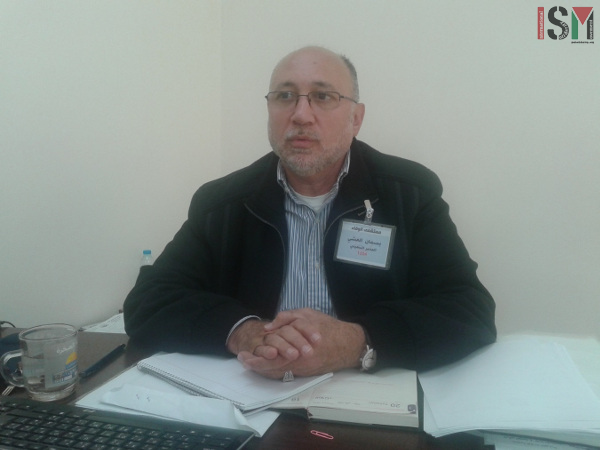
Dr. Basman Alashi
How is it possible to reach the point of bombing a hospital full of patients and medical staff?
“The UN told me that, according to a report from the Israeli occupation forces, the bombing of the hospital was due to the fact that there were weapons within its facilities … I can assure you that this report is completely false; the hospital opened its doors to the international press and to all the foreigners who freely inspected our facilities without finding any weapons at all. Despite all the overwhelming evidence, our hospital was bombed in the middle of the night, with its patients, medical staff, and some international witnesses, still inside the buildings.”
What were the consequences of the bombing by the Zionist occupation forces?
“Whilst under Israeli fire, we evacuated the remaining 17 paralyzed patients that still were inside the hospital. We couldn’t take any medication or equipment; we evacuated them just with sheets. That’s why during a cease-fire we asked the Red Cross to take us to rescue some medicines that were vital for our patients. However the Red Cross refused and we had to go by ourselves. We were only able to stay 45 minutes at the ruins of what was the Al Wafaa Hospital. The bombings continued, and we could only recover a very small amount of medicine, as bombs had destroyed most of it.
Four members of our staff were injured during the bombing. Luckily these weapons of war injured none of the patients. However they did suffer a lot during the emergency evacuation. Four of the paralyzed patients needed oxygen and many of them breathe through tubes, that’s why it was so dangerous to move them from one hospital to another; under conditions of intense aggression, under the attack of lethal weapons used against a defenceless civil population.
We could have lost some of them. It was very hard because we had to evacuate them in regular vehicles, three or four in every vehicle. Luckily we were able to move them all without any loss, due to the heroic efforts of our nurses and hospital staff. Without them all would be dead.
The patients suffered a lot during the Israeli attack on the hospital, some of them still hear the explosions of the bombs and are afraid of the start of another bombing. One of our patients, just 19 years old, refuses to enter to another hospital “the Al Wafa Hospital was bombed, my house was bombed, this hospital will also be bombed” he explained to me, terrified.
We are here to survive, to improve the lives of our children, of our patients. I can’t stand to see a small girl of barely 6 years old, to whom I can’t give the medicines she needs to survive and who can not leave Gaza to receive them. The only thing we want is for them to live with the same freedom as kids from any other place in the world.”
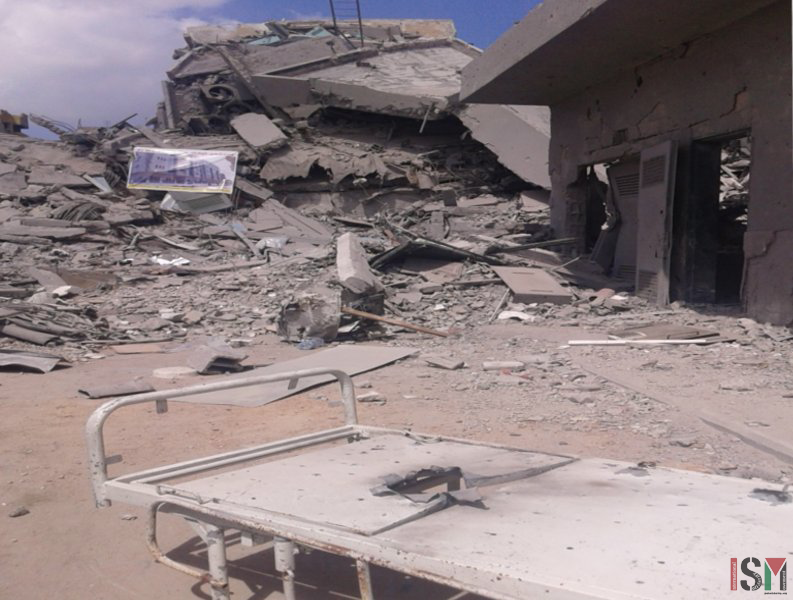
The Israeli occupation forces said that they bombed the hospital because there were weapons inside, this statement was firmly denied by many witnesses. In your opinion, what was the real reason for the attack that left a hospital as big and important as Al Wafaa reduced to rubble?
“The hospital was less than a kilometre from the fence that separates Gaza from the occupied territories. Our facilities had three big buildings, so it was just a military decision, given that those constructions blocked their way for a deeper land incursion. There wasn’t activity from the resistance inside or near the hospital installations.
I challenged the Israeli occupation forces to provide any proof of their reasons to bomb the hospital. They showed me a classified picture where, according to them, there was a rocket launcher from the resistance very near the hospital. However, the picture wasn’t from the hospital, it was from a place located almost five kilometres away. That proves that all the reasons provided by Israel were false. They just fabricated this story to justify the planned destruction of a hospital.
The Israeli occupation forces demanded we evacuate the hospital under fire and, as the facilities were under their control, it was Israel’s duty to protect the buildings. It was their obligation to preserve a hospital with 30 years history and an investment of more than 15 million dollars in equipment. Despite all this, far from protecting it’s medical facilities, they bombed them and destroyed it to the ground.”
The occupation forces point out that the attacks aren’t against the Palestinian people but against Hamas and the resistance. Do you have anything to say against the government of Gaza or the resistance?
“Against the resistance?” – asks the doctor with surprise – “We are the victims!” he clarifies. “In Gaza we have already had 8 years of suffering a terrible blockade by Israel. Our resistance is very basic. Israel has the lead, they have F16 planes, they have the tanks, war ships… they surround us! They deny us the right to defend our children, our women, our land, our homes, our own lives. It’s ridiculous. You corner me, you kill me, and you still ask me not to defend myself. Human beings in this world have the right to defend themselves. We, as Palestinians, have the right to defend our land and our families by all means available. The resistance is a way of defending our lives, it is our right.
Israel has the most powerful and destructive weapons; Israel is the one that the world should control.
Israel has committed genocide in Gaza while the world was looking. It assassinated children playing on the beach. Israel has killed children and women while they were sleeping in their homes and has bombed residential buildings without reason. Thousands of families have been left destroyed or without a home and all this took place before the eyes of the world. That’s why I blame Israel but also the international community.”
What is the situation now regarding the reconstruction of the hospital?
“There are many organizations and countries who want to help us. However, due to the Israeli and Egyptian blockade, they find themselves unable to provide the materials necessary for the reconstruction, or to send to the Gaza Strip the funds necessary for funding this reconstruction. That’s why we started to raise funds through local activities. Even so the amount collected doesn’t cover the 0,01% of the amount needed for the reconstruction of the hospital.
A lot of people all around the world have said to me that they are sorry about what happened to the hospital, and that’s good but we need much more than that to be able to attend our patients and move forward. The blockade is affecting our patients terribly, and it’s impossible for us to provide the medical treatment that they urgently need. They don’t need charity, blankets, or clothes… they need to have the stability to be self-sufficient.
The blockade seriously affects the hospital, as we find ourselves unable to go back to a full medical service like we had before and we are unable to support the rehabilitation and healthy recovery of our patients. Of the 11.000 injured from the last Israeli aggression against Gaza, more than the 50% need rehabilitation. If in one or two years the hospital is not working as it was in the past, there will be an important segment of this population that will be left unable to manage by itself and to contribute to our society, affecting it at all the levels.
What we need from the world more than anything else is an end to the blockade, to allow the entrance of materials for the reconstructions; to allow us to rebuild the homes of our families that were destroyed by Israel. This way there will be peace. But if the blockade continues, peace will be further away every day. We are human; we want a normal life as in every other place in the world. For our kids to be able to grow in a normal house, not in a shelter or a tent, suffering from the cold, without a single blanket to cover them”.
How do you see the current situation and the future of Gaza?
“The people of Gaza are resilient. They live in the most difficult conditions but still smile. The kids keep playing and adapt themselves to all the conditions, but the rest of the world must know that this situation is not normal and for this to end the only solution is to lift the blockade. The blockade must end. It’s not enough to give the people a tent, or some food or a blanket. People need a house, a job, and the possibility of giving their children a good education and to travel abroad if they wish to.
To have the possibility of going to a hospital abroad if their condition requires it. Give us the freedom that the rest of the world enjoys, because we are not different from any other population on the planet. We just want to live in peace if we are given the opportunity and doing it in freedom. But, if that right is denied to us, we will fight until we conquer it… Inshallah!”.
Life in jail for using, digging illegal border tunnels: Egypt
Press TV – April 12, 2015
Egyptian President Abdel-Fattah el-Sisi has issued a decree rendering the digging or using of illegal border tunnels punishable by life term.
“Anyone who digs or prepares or uses a road, a passage, or an underground tunnel in the country’s border areas with the purpose of connecting with a foreign entity or state, its citizens or residents… will face life in prison,” said the presidential decree published in the official gazette on Sunday.
According to the decree, those who are aware of such tunnels and refrain from informing authorities also face life in prison, which in Egypt amounts to 25 years behind bars.
The Egyptian government claims that it has destroyed vast numbers of such routes and has recently intensified efforts to demolish such underground passages which connect the restive Sinai Peninsula to the Palestinian Gaza Strip.
Palestinians use the underground tunnels to transfer essential supplies, including food and fuel into Gaza, which has been blockaded by Israel since 2007, a situation which has caused a decline in the standard of living, unprecedented levels of unemployment, and unrelenting poverty.
Israel not only defies international calls to lift the brutal siege, but also refuses to allow medication or construction materials into coastal enclave.
CIA Black Sites and Washington’s Allies
Re-Opening the Investigation
By BINOY KAMPMARK | CounterPunch | April 7, 2015
They certainly sought to please in those initial dark days when a position at the NATO table was at stake. This was something of a New World Order – the attacks after September 11, 2001 did certainly allow Washington to make that spurious case. The stakes were high, and the “need” for pressing intelligence saw a crude clipping of various liberties and protections.
Unfortunately, in so doing, willing allies and proxies lined up their maps, their facilities, and their accomplices in what became a global program of interrogation and torture. These locations willingly offered by host states came to be known as “black sites” and proved all too attractive to powers and institutions.
Lithuania’s case is a particularly conspicuous one. Its authorities have been reluctant to admit providing cover for CIA activities, let alone any specific location. A parliamentary inquiry held during 2009-2010 went so far as to suggest that such a provision had, in fact, been made, advising that prosecutors take the lead. The report in question noted a detention centre set up near Vilnius in 2004-2006.
But it also spoke in tones of reservation – CIA aircraft had landed in Lithuania, but it was not clear whether human cargo had accompanied it. (Why such aircraft would be found on Lithuanian soil without such cargo is an odd point in itself.)
Four years ago, the prosecutors dropped the investigation like a steaming hot potato. The action suggested that something foul was afoot – such a procedure did not look good for the US-Lithuanian relationship, and uncovering any more details than was necessary would have proven, at least in the public eye, impairing.
This has not stopped such actions as those of Saudi-born Abu Zubaydah, who became a near cult figure of the extraordinary rendition program during the Bush years. Zubaydah’s recourse has been through the European Court of Human Rights, where he is seeking to show that Lithuania violated the European Convention on Human Rights. He is arguing that Lithuania is responsible for his unlawful detention, torture and ill-treatment, the deprivation of the right to private and family life, the unlawful transfer from Lithuania, and ongoing violations of his right to legal recourse.
Then came the Senate Intelligence Committee Report on the CIA’s interrogation program, one waged with tentacle-like spread across a range of jurisdictions and continents. Its lurid subject matter got various prosecutors in a range of countries concerned. Had they been too slow off the mark? Much evidence suggested that they had.
The detention centre “Violet” noted in the Senate report seemed eerily close to the descriptions put forth in the Lithuanian parliamentary investigation. The Senate report noted how an amount approximating to $1 million was provided by the US to “show appreciation” for its creation, money which was conveyed via various “complex mechanisms” to evade the government ledgers.
Initially, it did not seem that much would change. Last month, Loreta Grauziniene, speaker of the Lithuanian parliament, told Reuters that, “No new inquest will be considered, because there is no longer sufficient support for it among parliamentary members.” In making such an observation, the speaker merely affirmed the link between state criminality and the will behind prosecuting it. Former president Valdas Adamkus typifies such indifference, insisting that “there were no prisons or prisoners in Lithuania,” a view he would maintain till seeing the incriminating “documents before my eyes”.
This month saw a slight modification of the stance. Lithuania’s senior prosecutor, Irmantas Mikelionis, “decided on January 22 to cancel the January 21, 2011 decision of prosecutors to stop the investigation into possible abuse, and has restarted the investigation.” According to Rita Stundiene, a spokeswoman for the prosecutors, “The prosecutor renewed a previously terminated probe and merged it with the ongoing pre-trial investigation [into the case of Mustafa al-Hawsawi].”
Emphasis will be directed at the alleged violation of two articles of the Lithuanian criminal code: the illegal transportation of a foreigner through Lithuanian territory (the case on CIA prisoner Mustafa al-Hawsawi provides a classic example); and the abuse of power by a state employee resulting in significant harm. In themselves, these read like misdemeanours, minor procedural blots. In actual fact, such conduct was the hallmark of CIA interrogatory procedures, aided and abetted by various state authorities.
Whether the renewed investigation is going to do anything more than keep the common record busy for a time is hard to know. As one of Zubaydah’s lawyers, Helen Duffy, argues, the gesture on the part of the Lithuanian prosecutors might also be construed as a tactic to ward off more concrete legal scrutiny in Strasbourg. “There is every reason to be sceptical about whether this is a meaningful investigation.” Any investigation, to be effective, had to be total.
Such prosecutorial actions tend to be kept on the books, and rarely move off them into the realm of action and consequence. Too much is deemed at stake for such alliances. Justice, in that sense, takes the most distant of backseats, while the soiled hands of the torturers remain in service.
Lithuania’s politicians generally have less of an interest in seeing CIA operatives, and their accomplices, behind bars than holding the fort against what is seen as a viable Russian threat from the east. Bigger enemies loom. Prosecutorial grit, in other words, is lacking.
Dr. Binoy Kampmark was a Commonwealth Scholar at Selwyn College, Cambridge. He lectures at RMIT University, Melbourne. Email: bkampmark@gmail.com
UN must intervene to help American facing death sentence in Egypt
Reprieve | April 7, 2015
Lawyers for an American man facing a death sentence in Egypt, who has been on hunger strike for over 400 days, have called on the UN to take urgent action over his case.
28 year old Mohamed Soltan, from Michigan, was translating for an English-language journalist at a 2013 pro-democracy protest in Cairo when he was shot in the arm by Egyptian Government forces. He has been on hunger strike for over 400 days, at one point falling into a coma as a result. Mohamed is on trial alongside more than 45 other people and due to be sentenced on April 11th. If convicted, he could receive the death penalty.
The appeal for an urgent action by the UN, submitted today by international human rights charity Reprieve which is assisting Mohamed, argues that any conviction would be illegal given Mohamed’s torture and the multiple international law violations during his trial.
Upon arrest and during interrogation, Mohamed was denied access to a lawyer. He was tortured by security services – including being beaten with metal rods and intentional blows to his gunshot wound causing metal nails in his arm to dislodge. A fellow inmate had to perform ad hoc surgery on his gunshot wound using a razor blade to prevent permanent damage.
Government forces also subjected Mohamed and other prisoners to sexual humiliation, with forced nudity followed by beatings with clubs and chains. During more than a year in jail, Mohamed has only been allowed one medical visit.
Mohamed was arrested without a warrant in August 2013 and detained for 5 months without any charges being brought against him. One of the charges Mohamed faces is membership of the Muslim Brotherhood – which he has always denied. Membership of the party did not become a crime in Egypt until September 2013 – three months after Mohammed was detained. It is illegal under international law for a person to be charged with an offence that was not a crime at the time they were arrested.
Maya Foa, Director of the Death Penalty Team at Reprieve, said: “Everything about Mohamed’s arrest and trial is a flagrant violation of multiple international laws, and his treatment at the hands of the Egyptian authorities has been as brutal as anyone could imagine. It is vital that the UN issues an urgent action ahead of Mohamed’s sentencing to show that the international community will not stand idly by while pro-democracy supporters like Mohamed are thrown to the dogs. Mohamed must be released from jail and returned home to his family in the US.”
Investigators launch criminal case against US agents over pilot kidnapping, torture
RT | April 6, 2015

Russian pilot Konstantin Yaroshenko (RIA Novosti )
Russia’s top law enforcement agency has launched a criminal case against 11 US DEA officers, alleging they are complicit in a sting operation that ended in the detention and trial of Russian citizen Konstantin Yaroshenko.
The Investigation Committee – special agency for serious and high profile crimes – reported on Monday that its branch in South Russia’s Rostov Region has launched criminal cases against 11 US citizens and four Liberian citizens over charges of kidnapping, with use of violence or threats of violence. Additional charges include forcing a person to testify in a criminal process using intimidation or torture. In Russia, these crimes are punished with prison sentences of up to 12 and eight years respectively.
A US court sentenced Konstantin Yaroshenko to 20 years in 2011 for allegedly participating in a conspiracy to smuggle drugs to the United States. He was arrested in Liberia following a sting operation and handed over to the US, despite protests from Russia and violations of the diplomatic code. The pilot himself has always maintained his innocence, saying his poor command of English prevented him from understanding the nature of suggestions leveled at him by undercover DEA agents.
Yaroshenko and his relatives have repeatedly maintained the whole scheme was organized by US special services in an attempt to extract evidence against Viktor Bout – another Russian citizen illegally extradited to the US and sentenced after another sting operation.
Russian diplomats have repeatedly criticized the arrests and trials of both Yaroshenko and Bout. They say it’s an example of biased US justice based on fabricated charges.
In 2014, the Russian Foreign Ministry issued an official warning to all citizens who travel abroad, especially to countries that have extradition agreements with the United States. “The US administration makes a routine practice out of hunting for Russian citizens in third countries, with subsequent extradition and conviction in the USA, usually over dubious charges,” the document read.
Read more: ‘I was framed because of Bout’ – jailed Russian pilot
Featured Video
BRITAIN’S WARNING: PREPARE FOR WAR
or go to
Aletho News Archives – Video-Images
From the Archives
British weapons and personnel doing much of the killing in Yemen
Press TV – June 18, 2019
A detailed report published by the Guardian newspaper has shown how Britain is massively contributing to Saudi Arabia’s devastating war on Yemen as it suggests that London is not only supplying the bombs that fall on Yemenis, but it provides the personnel and expertise that keep the war going.
The comprehensive report by Arron Merat published on Tuesday showed that Britain was doing much of the killing in Yemen as the country continues to provide Saudi Arabia with everything it needs to turn its southern impoverished neighbor into a graveyard.
“Every day Yemen is hit by British bombs – dropped by British planes that are flown by British-trained pilots and maintained and prepared inside Saudi Arabia by thousands of British contractors,” said Merat in the report. … continue
Blog Roll
 Aletho News
- A West Bank War for Netanyahu’s Election Campaign, Could It Backfire?
- Yemen denounces European Parliament’s ‘hypocritical’ push to blacklist Ansarullah
- Qalibaf: UAE’s UN bid aims to ‘clear the runway’ for ‘Greater Israel’, whitewash genocide
- Pakistan reopens Iran border after boosting security: Report
- Why are so many Brazilians voting for Flávio Bolsonaro?
- Democrats Put Anti-Russia Agenda Ahead of American Workers
- Elijah Magnier: Yemen’s Strikes Are Shattering Saudi Arabia’s Long-Term Strategy
- Pentagon designates Chinese cultural centers national security threat
- Israel Demolishes Home Of Lebanese Journalist Whose Viral Film Exposed Pager Attack
- Record Oil, Empty Tanks: The UAE’s Miracle Recovery
- If Americans Knew
- An error has occurred; the feed is probably down. Try again later.
- No Tricks Zone
- Sudden Stratospheric Warming, Powerful El Niño Combination May Lead To Extreme Europe Cold, Energy Crisis!
- Two New Studies Find Thwaites Glacier Melt Cannot Be Driven By Human Activity Or A Warming Ocean
- E-Cars Reduce CO2 Emissions By Only 41% Compared To Internal Combustion Engine Vehicles
- Predictions Made By Renowned Climate Professor Over Past Decades Have Been Proven To Be Poor
- New Study Suggests Large Regions Of The Pacific Ocean Have Been Cooling For The Last 80 Years
- Germany’s Green Energy Debacle: High Energy Costs Force Kahla Porzellan to Close After 182 Years!
- New Study: 50 Years Of The Most Aggressive ‘Net Zero’ Policies Can Only Affect The Global Climate By 0.03°C
- US September “Heat” Was No Record…Many Records Set Decades Ago
- Latest European Green Energy Debacle; Portugal’s Largest Flagship Solar Park Insolvent!
- Green Energy Debacle: German Expert Professor Fritz Vahrenholt Warns Of Severe Economic And Social Consequences

