Prisoner hospitalized after being tortured in Israeli jail
Ma’an – 03/09/2014
RAMALLAH – A Palestinian prisoner has been moved to a hospital ward after undergoing torture at Israel’s Russian Compound detention center, a Palestinian Authority prisoners committee said Wednesday.
Muhammad Hussein Rabee, 33, from Beit Anan village near Ramallah, suffered health complications as a result of being tortured while being held at the Jerusalem detention center for 40 days, the committee said.
He was first moved to Hadassa hospital last week, and is now in the Shaare Zedek Medical Center.
Rabee was detained on July 27 and his family did not find out his whereabouts until 30 days later.
“We did not know where Muhammad was until after a month of his detention, and his lawyer was not allowed to visit him until after 35 days of being at the Russian compound,” his brother Usama told Ma’an.
Rabee’s lawyer said he had been “harshly tortured.”
Former prisoner Khaldun Jumhur, who was being held in the Russian Compound with Rabee, said that interrogators used a method of putting pressure on the victim’s neck, as well as beating him on his hands, legs and head.
A doctor at the detention center requested an x-ray for Rabee, but was refused by the Shin Bet agency.
The Prisoner Affairs Committee demanded human rights organizations to hold Israel accountable for torturing Palestinian prisoners.
Some 4,000 Palestinian prisoners in Israeli jails launched hunger-strike action in 2013 to protest the death of Arafat Jaradat, who died in Israel’s Megido jail after being tortured by Israeli interrogators.
Around 7,000 Palestinians are currently being held in Israeli prisons, more than 2,000 of whom were arrested over summer alone.
UK’s MI6 aided torture of Nepal rebels: Report
Press TV – August 31, 2014
British secret service MI6 has been accused of aiding Nepal’s authorities in the torture of Maoist rebels during the South Asian country’s civil war.
The accusations were made by author Thomas Bell in his new book Kathmandu citing sources in the Nepalese security establishment on Britain’s involvement in the country’s decade long civil war.
Bell said British authorities funded a four-year intelligence operation in Nepal in 2002 that financed safe houses and provided training in surveillance and counter-insurgency tactics to Nepal’s army and spy agency, the National Investigation Department (NID).
The British agency “also sent a small number of British officers to Nepal, around four or five — some tied to the embassy, others operating separately,” said Bell.
According to Bell, the British officers trained Nepalese authorities on how to place bugs, penetrate rebel networks and groom informers.
The sources said “British aid greatly strengthened” NID’s performance, which led to dozens of arrests, of which a number “were tortured and disappeared.”
One of the sources, a Nepalese general with close knowledge of the operation, argued that there was no doubt that British authorities realized that some of those detained would be tortured and killed.
Furthermore, Bell said that a senior Western official told him that the operation was cleared by Britain’s Foreign Office.
Bell said the findings revealed that “while calling for an end to abuses… the British were secretly giving very significant help in arresting targets whom they knew were very likely to be tortured.”
Tejshree Thapa, senior researcher at the Asia division of Human Rights Watch, commented on the book’s findings saying, “Nepal’s army was known by 2002 to be an abusive force, responsible for… summary executions, torture, custodial detentions,” adding, “To support such an army is tantamount to entrenching and encouraging abuse and impunity.”
Nepal’s civil war between the government and Maoists lasted between 1996 and 2006 and left more than 16,000 people killed.
Ghosts of Olavarría: Human Rights Trial in Argentina Seeks Justice for Victims of Military Dictatorship
By Nick MacWilliam | Upside Down World | August 26, 2014
The central quarter of the Argentine city of Olavarría, with its leafy main square, whitewashed church, and historical architecture, merits its National Heritage status. Thanks to mineral extraction of the rock on which it stands, Olavarría is a prosperous and tranquil place, and home to the social science and engineering schools of the University of Buenos Aires Province. Now, however, this seemingly pleasant city has become the latest battleground in Argentina’s ongoing struggle to bring justice to those guilty of crimes during the military dictatorship of 1976–1983.
Olavarría, a city of around 100,000 inhabitants, is the setting for the upcoming trial of several ex-army officials accused of human rights abuses during the dictatorship. A high level of public interest surrounds the proceedings, due to one of the defendants’ alleged involvement in a case which has dominated national media in recent weeks.
 In early August, the human rights organization Grandmothers of the Plaza de Mayo announced that the long-lost grandson of its president Estela de Carlotto had been identified and was living in Olavarría under a different name. Guido Montoya Carlotto had been taken from his detained mother in 1978 when just a few hours old, one of hundreds of babies born in captivity and then raised by families linked to the military authorities. In most cases, their biological parents were murdered by the military. The Grandmothers of the Plaza de Mayo have campaigned since the 1970s to reunite the stolen babies with their natural families and to expose the guilty parties.
Estela de Carlotto The recent news, a welcome dose of positivity on front pages of the country’s newspapers, has received intense media interest. Estela de Carlotto is highly-respected within Argentine society for her tireless campaigning as president of the famous headscarf-wearing Grandmothers. But, as the story has moved on from its initial feel-good element, there are now many questions over who was responsible for taking Guido from his mother, Estela’s 22-year-old daughter Laura Carlotto, who was killed soon after giving birth. The father, Walmir Montoya, abducted alongside his pregnant partner, had been murdered several months earlier.
The spotlight has shifted to Olavarría, location of the impending trial and the city in which Guido Montoya had lived until recently as Ignacio Hurbán. Although the trial date was set several months ago, it is now alleged that one of the accused participated in the transfer of Laura Carlotto’s baby to an adoptive family. Laura, who was handcuffed to a stretcher throughout the entire labor and birthing process, spent only a few hours with her newborn before being returned to her cell at the La Cacha detention center in La Plata.
On September 22, a court will begin listening to evidence against a number of ex-military officials charged with crimes against humanity, including kidnapping, torture and murder, committed at the Monte Peloni detention center in Olavarría. The officials on trial are: the local commander, Ignacio Verdura; Chief of Intelligence, Walter Grosse; Officer Horacio Leites; and Sub-Officer Omar Ferreyra. All of them are currently serving sentences for earlier convictions. While the trial is not directly connected to the removal of the Montoya Carlotto baby, it is suspected that Verdura was involved in the appropriation of babies.
For the last few years, the Grandmothers of the Plaza de Mayo have claimed that an Olavarría businessman, Carlos Francisco Aguilar, acted as an intermediary between the military and adoptive families. Aguilar, who died earlier this year, owned the land on which Guido Montoya’s adoptive parents worked and was known to have strong links to the armed forces and the church. As a wealthy landowner, he moved in the same social circles as high-ranking military figures, such as Ignacio Verdura, the then-chief of the regional 2nd Tank Regiment.
Throughout the 1970s, Olavarría was a site of left-wing militant activity, which brought the city to the military’s attention. State repression began with worker organizations before targeting the lawyers representing them, and later moving on to the student movement. Those who felt the heavy hand of the state included striking workers at the Loma Negra (Black Hill) cement company. The company’s response to the strike was to call in the military to end the dispute with detentions and other suppressive tactics.
Carlos Moreno was a lawyer who represented the Loma Negra workers. He was detained in Olavarría and tortured before being killed in May 1977. A trial in 2012 exposed links between the military and civilians who had allowed their property to be used for detaining prisoners. The trial also ordered an investigation into the role of Loma Negra, whose president was Amalia Lacroze de Fortabat, one of the world’s wealthiest women until her death two years ago at the age of 90.
Speaking to the Página 12 newspaper, Moreno’s son Matías said companies such as Loma Negra reaped the benefits of military rule.
“Before the dictatorship, Loma Negra was suffering losses, but its profits tripled under the dictatorship. The abduction of my father was intended as a disciplinary measure, after which there was a fall in labor costs,” said Matías. This was the aim of all the abductions.”
He also revealed that Commander Verdura lived next-door to the Moreno family. Any neighborly recognition, however, was irrelevant when it came to the military eliminating its opponents.
The Monte Peloni detention centerThe Monte Peloni detention center, where the majority of those detained in the zone were held, was a farmhouse in the countryside near Olavarría. Several prisoners, many of whom remain disappeared, passed through the center, which was administrated by the 2nd Tank Regiment of Ignacio Verdura.
Among the crimes that Verdura and his cohorts stand accused of are the disappearance of a young couple, Isabel Gutiérrez and Juan Carlos Ledesma, the detention of Isabel’s father Francisco Gutiérrez, and the murders of Jorge Oscar Fernández and Alfredo Serafín Maccarini. The latter was a prison guard whose rumored empathy for political prisoners made him a target for the military. Another ex-prisoner, Lidia Araceli Gutiérrez, who was raped and tortured in Monte Peloni, is to give evidence at the trial.
The Olavarría trial is the latest step in the legal battle to hold those involved in the abuses of the dictatorship accountable. As many as 2,000 people connected to the dictatorship have been accused of complicity in abuses, as, according to Human Rights Watch, Argentina has made “significant progress in prosecuting military and police personnel for enforced disappearances, killings and torture during the country’s ‘Dirty War.’” Yet the fact remains that a great many of those who willingly participated in dictatorship abuses have yet to answer for their crimes.
The stealing of babies from people who were subsequently killed continues to be a matter of great sensitivity, as the majority of stolen babies are now unidentified adults living normal lives in Argentine society. The Guido Montoya case was the 114th positive identification of a baby forcibly removed from its biological parents. However, it is estimated that there are hundreds of other citizens now approaching middle-age with little idea of their true identities. For families of the disappeared, the discovery of lost relatives can serve as an act of closure for their longstanding grief. Having spent decades dwelling on the past, they are finally able to look ahead.
In 2012, the dictator Rafael Videla, already serving a life sentence for human rights abuses, was given a further 50 years for his part in the systematic transfer of babies from prisoners to families linked to the military regime. Several other officials, including the country’s last military leader Reynaldo Bignone, have been convicted and imprisoned for their involvement in abuses. Bignone, who like Videla had already been found guilty of torture and murder in earlier trials, was said by the court to be complicit in “the crimes of theft, retention and hiding of minors, as well as replacing their identities.”
But the campaign of forced removal was perpetrated at all levels of the military hierarchy. As Guido Montoya Carlotto said in a recent interview with the newspaper El Popular de Olavarría, in his hometown “there are people who have to thoroughly explain themselves … I hope that people learn to question that which has been covered up, so that this not only represents my restitution but also the restitution for other people experiencing doubts.”
As Argentina continues to come to terms with the traumas of military rule, stories like the Carlottos’ provide inspiration for the justice movement to keep fighting. Yet, this is a journey that is unlikely to ever be fully resolved. The entrenched political system of brutality and repression was too widespread to hold all the guilty to account. But each small step signifies progress. Many will be closely watching the Olavarría trial in the hope that Argentina continues on its path toward redemption.
Nick MacWilliam is a British freelance writer and editor based in Buenos Aires.
Israel tells Palestinian prisoners: We bombed your homes and killed your families
By Ibtisam Mahdi | Al-Akhbar | August 26, 2014
“We killed your brother and destroyed your family home.” The words hit the prisoner, Said Abu Shaluf, like a slap to the face. A few hours after bombing his home, Said was summoned by the Israeli prison administrators. They informed him that they killed his 31-year-old brother Abdel Rahman and destroyed their family home. This is Israel’s latest attempt to break the spirit of Palestinian prisoners, who dared to challenge the Israeli authorities through hunger strikes in more than one struggle, in a long line of struggles, for dignity. But who can hear the prisoners’ added pain now in light of the ongoing war on Gaza?
Abu Shaluf’s family tried to avoid informing their imprisoned son about the death of his brother Abdel Rahman or the destruction of their home by Israeli bombs, especially out of concern for his psychological state inside prison. But the Israelis beat the family and the media, where news is usually muddled yet moves quickly, delivering the devastating news in an insensitive manner. Since that day, the family learned that Said is in a very difficult psychological state, and he is refusing to eat even though his prison mates are trying to comfort and console him. This has naturally compounded his mother’s pain.
Abu Shaluf’s story is not unique. Before him, a 31-year-old prisoner called Basel Arif, who was serving two life sentences, was informed that Israeli forces killed four of his cousins in the massacre in al-Shujayeh neighborhood, east of Gaza City.
Other [Israeli] prison administrations have used a similar tactic. And so the story was repeated with a 24-year-old prisoner called Ahmed al-Soufi, who lost his brother Abdel Hadi and the homes of his family and relatives suffered major damage after an Israeli strike. The families of the two prisoners, Alaa Sheikh al-Eid (detained since December 2002) and Raafat Abu Snaimeh (detained since April 2009) said the Israelis also told their sons that their homes were destroyed. The same thing happened with prisoner Saleh Abu Shusheh (sentenced for 14 years) and all of them are residents of Rafah in southern Gaza.
The Fatah representative of the prisoners’ committee in Gaza, Nashaat al-Wahidi, stressed that the prisoners’ living and health conditions are deteriorating in light of Israel’s vengeful policies that are escalating as the assault on Gaza rages on. “The prisons’ administrations exploited the fact that people are preoccupied with the war and distracted from the plight of the prisoners to impose on them extra punishment, such as reducing the time they can be outside from four to two hours daily and allowing only 15 prisoners out at one time,” he added.
Some of the other penalties, according to Wahidi, include reducing each prisoner’s stipend from 1,200 shekel to 400 ($300 to $110), reducing family visits to half an hour every month, and disconnecting seven satellite channels out of 10. Two channels of the three that are left are in Hebrew.
Despite these penalties, Wahidi told Al-Akhbar that what weighs down on the prisoners the most is the psychological state that accompanies the war.
“Those whose homes are not destroyed or whose families are not hurt spend their time consoling their colleagues, worrying for their families and following the news,” he said.
Wahidi pointed out that prisoners have been deprived of the ability to follow the news of what their families are subjected to in Gaza after the prison administration decided to cancel Palestine TV and “prevented them from communicating with their families to check on them, not to mention the provocative searches and messing with their personal belongings as they look for cell phones.”
According to sources close to the prisoners, the Israeli Prison Service imposed strict penalties at the Megiddo Prison in north of occupied Palestine after the administration heard cries of “God is Great” emanating from prison cells when prisoners heard that the Resistance captured an Israeli soldier. The administration closed certain prison sections, prevented the prisoners from going out and buying stuff from the prison shop and suspended the broadcast of TV stations.
But the war did not only affect prisoners inside Israeli jails, it also affected those who have been liberated, especially those who were released during the 2011 Loyalty to the Free prisoner exchange deal. They are living through the second war since their release, compounded by the fact some of them had their homes bombed by the Israeli forces. One of the liberated prisoners exiled to Gaza is Hilal Jaradat, his apartment in one of the towers in al-Zahraa City in central Gaza which was recently bombed and badly damaged.
The house of another liberated prisoner, 54-year-old Mohammed Nashbat, in al-Nusairat refugee camp in central Gaza was hit and Nashbat is being treated overseas, especially since he came out of prison suffering from a heart disease. Another prisoner, liberated with the first group of prisoners prior to Oslo, 41-year-old Ayman Abu Sitta, lives in the al-Zawayda area in central Gaza. His home was completely destroyed.
According to an unofficial count, the Israeli occupation targeted seven other homes belonging to liberated prisoners during the course of this recent war. The Ministry of Prisoner Affairs said there are extensive and comprehensive punitive measures exercised against the prisoners linked to Hamas and the Islamic Jihad since before the war began, specifically after the Israeli authorities announced the disappearance of three settlers in Hebron. These measures intensified during the current war.
US Law Requiring Annual Report on Excessive Force by Police has been Ignored for 20 Years
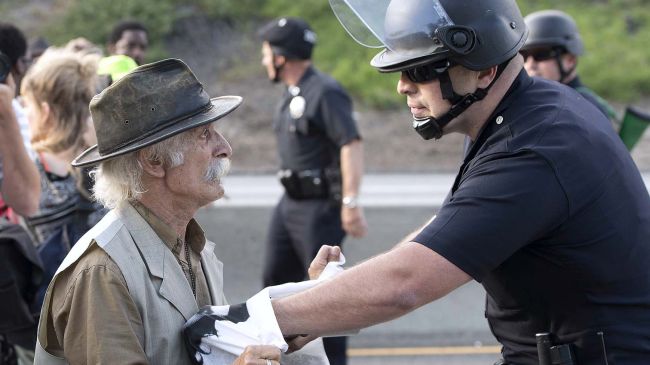
By Steve Straehley | AllGov | August 22, 2014
The circumstances of the death of Michael Brown in Ferguson, Missouri, have brought that one police shooting into the national conscience. But many other Americans are killed by police and their deaths go unnoticed and mostly uncounted, despite a Congressional mandate.
In 1994, Congress passed the Violent Crime Control and Law Enforcement Act. Among its provisions was the order that “the Attorney General shall, through appropriate means, acquire data about the use of excessive force by law enforcement officers.” The Justice Department was also required to publish an annual report on the data collected.
And… that’s pretty much the last anyone heard of that. The work of collecting the data was shuffled off to the International Association for Chiefs of Police, which made a few efforts at collecting data and put together a report in 2001, but has produced nothing since.
“That’s a clear, clear problem,” Matthew Hickman, an associate professor of criminal justice at Seattle University, told Michael Doyle of McClatchy. “When it comes to use of force, we have almost nothing.”
Part of the reason is that the term “excessive force” is open to interpretation. Even a shooting ending in the death of an unarmed pedestrian could be judged by a jury to be justified. In addition, police departments are expected to report on their own incidences of excessive force, which some might be reluctant to do.
The Justice Department began to compile statistics on police shootings in 2001, according to the International Business Times. However, their reports cover only the years from 2003 to 2009 and don’t tell the whole story because of incomplete reporting and problems with research methods.
Wikipedia has tried to crowd-source a shootings database and blogger Jim Fisher, who scours the internet for information on police shootings, has had some success.
For now, Congress is still waiting for the statistics, although the head of the Senate Judiciary Committee that sought the data has moved on. His name is Joe Biden and he’s now Vice President of the United States.
To Learn More:
Data On Police Shootings Is Hard To Find (by Michael Doyle, McClatchy)
How Many Police Shootings Have There Been? (by Ross Keith, International Business Times)
How Many People are Killed by Police in U.S.? Who Knows? (by Steve Straehley, AllGov)
First trucks with Russian aid reach Lugansk, E. Ukraine – reports
RT | August 22, 2014

Trucks of a Russian convoy carrying humanitarian aid for Ukraine, August, 22, 2014 (RIA Novosti / Maksim Blinov)
The first Russian trucks carrying humanitarian aid have reportedly reached the east Ukrainian city of Lugansk. Moscow ordered the convoy to proceed, without waiting for further permission from Kiev.
The first trucks in the Russian humanitarian convoy have arrived in Lugansk, leaders of the self-proclaimed People’s Republic of Lugansk confirmed to RIA Novosti.
Earlier, the LifeNews TV channel and Interfax agency also reported that several Russian vehicles carrying aid to the conflict zone made it to their final destination.
On Friday morning, several dozen Russian trucks crossed the Ukrainian border and started moving towards Lugansk, after Moscow ordered the convoy to proceed, without waiting for further permission from Kiev.
By 10:30 GMT on Friday, 145 vehicles from the 280-truck Russian aid convoy had crossed into Ukraine, reported RIA Novosti, citing the Ukrainian border guard service.
Moscow has accused Kiev of deliberately holding up the delivery of Russian humanitarian aid to the Donetsk and Lugansk regions in eastern Ukraine, according to the statement by the Russian Foreign Ministry.
“Our convoy with humanitarian aid is starting to move in the direction of Lugansk,” the Foreign Ministry’s statement reads. “We are of course ready for it to be accompanied by Red Cross representatives and for their participation in the aid’s distribution.”
The International Committee of the Red Cross (ICRC) is not escorting the convoy.
“That’s because of the problems with security,” Galina Balzamova of the ICRC told RT. “Lugansk was shelled all night long. We believe we did not get sufficient guarantees of safety from all the parties to the conflict to start escorting the convoy.”
The head of the Russian Red Cross, Raisa Lukutsova, has said the organization supported the decision to get the humanitarian convoy moving.
“The fact that the humanitarian mission has started – this has probably been the right decision,” Lukutsova said. “For how long do we have to put up with this mockery? They put forward one demand after another. All of them unrealistic.”
She added the Russian Red Cross is ready to escort the humanitarian convoy and has appealed to the ICRC for permission to do so.
ICRC, meanwhile, confirms that people in areas affected by the ongoing conflict in eastern Ukraine are in “urgent need for essentials like food and medical supplies.”
The crisis is particularly acute in Lugansk, where people have gone for weeks without water and electricity and have to queue every day for whatever scarce food supplies are brought to the city.
RT’s Maria Finoshina has spoken to Lugansk residents, who fear hunger is the reality they are about to face.
Ukraine’s intelligence (SBU) chief, Valentyn Nalivaychenko, has described the convoy crossing the Russian border as a “direct invasion.”
“We call it a direct invasion,” Nalivaichenko told journalists. “Under the cynical cover of the Red Cross these are military vehicles with documents to cover them up.”
The Ukrainian Border Service has said that by ordering the convoy to proceed Moscow has “ignored the agreements reached on registering the humanitarian load.”
“The trucks started moving through Ukraine, after a group of Ukrainian border customs’ officers had been blocked at the Russian check-point ‘Donetsk’,” a statement by the Ukrainian Border Service reads.
The Ukrainian Foreign Ministry has accused Moscow of “smuggling humanitarian aid to Ukraine” and said it had to allow the convoy to pass.
“To avoid provocations we have given all the necessary orders to let the convoy pass safely,” the ministry’s statement says.
The Russian Foreign Ministry said the “excuses” for delaying the aid from entering Ukraine have been “exhausted”.
Ukraine agreed to let the convoy pass during an August 20 phone call between the Russian and Ukrainian foreign ministers. That gave a start to customs procedures for checking and registering the contents of the trucks comprising the convoy.
The next day the process was stopped by Ukraine, citing intensified shelling of Lugansk.
“In other words Ukrainian authorities are bombing the place of the aid’s point of destination and cite this as a reason for banning delivery of the aid,” the Russian Foreign Ministry said in a statement.
A convoy of 280 Kamaz trucks carrying food, medicines and other essentials for Lugansk and Donetsk in eastern Ukraine left the Moscow region on August 12.
It has been stuck at the border with Ukraine for more than a week.
“There’s a feeling that the current Ukrainian authorities have been consciously putting the humanitarian aid delivery on hold to arrive at a situation where there’ll be just no one left to get it,” the Ministry’s statement reads.
See also: Russian Red Cross volunteers ready to escort aid convoy to Lugansk, E. Ukraine
F-16 Missile Attacks Venezuelan Humanitarian Aid Mission in Gaza
TeleSur | August 21, 2014
Venezuelan ambassador to Egypt, Juan Antonio Hernandez, denounced on Wednesday that an Israeli aircraft attacked the Venezuelan humanitarian delegation in Rameh along the border post between Egypt and Palestine. No one was injured during the attack.
The F-16 airplane dropped a missile very close to the humanitarian site but did not explode. The ambassador confirmed that the missile fell approximately 50 to 70 meters from the site.
The Venezuelan humanitarian delegation delivered twelve tons of aid to the Palestinian people.
Hernandez referred to the action as “an act of intimidation, which is not a coincidence and it proves that Tel Aviv is trying to halt humanitarian aid, because right now Venezuela is an important beacon for the Palestinian people”.
El Universal reported that Roni Kaplan, the spokesperson of the Israel Defense Forces, asserted that “there was no attack by the Israeli forces on the Egyptian side of Gaza. The air force has not attacked nor launched sound bombs to any humanitarian convoy on its way to Gaza from Egypt.”
Police Militarization Escalates Even As Violence Declines — And There’s A Good Chance It’s Going To Get Worse
By Mike Masnick | Techdirt | August 18, 2014
We’ve been writing about the militarization of police, and why it’s problematic, for years — but the events of the last week in Ferguson, Missouri, have really shone a (rather bright) light on what happens when you militarize the police. Annie Lowrey, over at New York Magazine, highlights what may be most disturbing about all of it: all of this has happened while violence has been on a rapid decline, and, no it’s not because your local suburban police force now has a SWAT team and decommissioned military equipment from the Defense Department:
Since 1990, according to Department of Justice statistics, the United States has become a vastly safer place, at least in terms of violent crime. (Drug crime follows somewhat different trends, though drug use has been dropping over the same time period.) The number of murders dropped to 14,827 in 2012 from 23,438 in 1990. The number of rapes has plummeted to 84,376 from 102,555. The number of robberies, motor-vehicle thefts, assaults — all have seen similarly large declines. And the number of incidents has dropped even though the country has grown. [….]
And there’s no evidence that giving police officers the weapons of war has had anything to do with that decline in crime, either, with researchers pegging it to a combination of factors, among them the removal of lead from paint and gasoline, an increase in abortion rates, and improved policing methods.
So, instead, we get a very militarized police — and tons of cases where it is being used in cases that absolutely don’t warrant it. At all.
And here’s the really disturbing thing. It may get a lot worse. As Vanity Fair notes, on June 19th, Rep. Alan Grayson had offered up an amendment on the Defense Appropriations bill, which would have limited the militarization of police. And it failed by a wide margin. Included in those voting against it? The guy who represents Ferguson.
The amendment attracted the support of only 62 members, while 355 voted against it (14 didn’t vote). Included among those voting against it was Rep. William Lacy Clay (D), who represents Ferguson. Clay was joined by every senior member of the Democratic Party leadership team, including Reps. Nancy Pelosi (CA), Steny Hoyer (MD), and Assistant Democratic Leader James Clyburn (SC). Democrats did form the bulk of support for the amendment (with 43 votes in favor), with 19 Republicans supporting as well—led by libertarian-conservative Rep. Justin Amash (MI), who lamented that “military-grade equipment . . . shouldn’t be used on the street by state and local police” on his Facebook page.
Apparently, arming the police with military equipment has powerful lobbying support. Because why expect people to think about what actually makes sense when there’s money and FUD on the line:
Why was there such tremendous opposition to the Grayson-Amash effort? Two very powerful constituencies in Congress may be to blame: the defense industry, and the police lobby.
Take Rep. Clay. He has been all over the news media calling for justice in his district, and demanding an investigation of Brown’s death. Yet like every House member, he is up for re-election every two years, and his fourth-largest donor is the political action committee of the weapons maker Boeing.
So there’s that. And then, let’s take things up a notch. Scott Greenfield alerts us to the news that a judge over in Colorado has determined that the Cinemark Theater where James Holmes opened fired on the opening night of the Batman film “The Dark Knight Rises” may have some responsibility because it should have known that such an attack might happen. Despite the fact that there has never been such a shooting in a theater, the judge says that the theater should have been prepared for such a possibility:
Noting “the grim history of mass shootings and mass killings that have occurred in more recent times,” U.S. District Court Judge R. Brooke Jackson ruled that Cinemark — owner of the Century Aurora 16 theater — could have predicted that movie patrons might be targeted for an attack. Jackson’s ruling allows 20 lawsuits filed by survivors of the attack or relatives of those killed to proceed toward trial.
“Although theaters had theretofore been spared a mass shooting incident, the patrons of a movie theater are, perhaps even more than students in a school or shoppers in a mall, ‘sitting ducks,’ ” Jackson wrote.
That makes absolutely no sense. But the inevitable result, as Greenfield notes, seems to be a lot more militarized police — and now, private security guards… everywhere. Just in case.
Consider, if what happened in Aurora, the duty of businesses to be prepared for the act of a one-in-a-million crazy. The biggest growth job in America will be armed guard. Every theater will require its own SWAT team, perhaps a MRAP or Bearcat. Office buildings, parks, skating rinks, pretty much anywhere more than three people gather, could be the next target of a madman. They will all need security, armed with the weapons needed to take out any crazy.
Don’t blame the businesses. They’re just trying to cover their foreseeable obligations. Sure, there is almost no chance, almost no possibility whatsoever, that they will be the target of the next insane shooter, but Judge Jackson says it’s still foreseeable. In fact, that no one has ever shot up a skating rink makes it even more foreseeable, by his rationale.
It is difficult to comprehend how profoundly screwed up all of this is.
County officials refuse to pay medical bills for toddler burned by SWAT grenade
RT | August 18, 2014
Officials in Georgia’s Habersham County are refusing to pay for the mounting medical expenses of a toddler seriously injured by a flash grenade after a failed SWAT team raid earlier this year.
Bounkham ‘Bou Bou’ Phonesavanh was just 19 months old when a Habersham SWAT team initiated a no-knock warrant at his family’s home at around 3 a.m. on May 28. Bou Bou was asleep in his crib at the time, surrounded by his family and three sisters. The toddler was severely injured when SWAT team officers broke through the house’s door and threw a flashbang grenade that ultimately landed in the Bou Bou’s crib.
When the stun grenade went off, it caused severe burns on the child and opened a gash in his chest. As a result, Bou Bou lost the ability to breathe on his own and was left in a medically induced coma for days after the incident. His extensive recovery necessitated stays in two hospitals before he finally went home in July.
Now, Habersham County officials are sticking by their decision to ignore the family’s plight, the family’s attorney, Muwali Davis, told WSB-TV.
Habersham County’s attorney responded with a statement saying that the Board of County Commissioners will not pay given it is supposedly illegal to do so.
“The question before the board was whether it is legally permitted to pay these expenses. After consideration of this question following advice of counsel, the board of commissioners has concluded that it would be in violation of the law for it to do so.”
The family now says an independent investigation showed law enforcement used suspect information to attain a search warrant.
As RT reported previously, the SWAT conducted the raid as part of an effort to apprehend Wanis Thometheva, believed to be selling methamphetamine. Police said that their records indicated the suspect could be armed, and that a confidential informant had successfully purchased drugs from him earlier in the day. At the time of the raid, however, Thometheva was not at the home, and was eventually arrested elsewhere.
Additionally, an unnamed public official told the Washington Post that the reported drug deal was worth only $50.
Habersham County’s sheriff previously said the confidential informant who bought drugs at the home told police that he did not believe any children lived at the house.
Bou Bou’s mother, Alecia Phonesavanh, said that was unlikely if they had valid information on their suspect.
“If they had an informant in that house, they knew there were kids,” Phonesavanh told The Atlanta Journal-Constitution after the incident. “They say there were no toys. There is plenty of stuff. Their shoes were laying all over.”
In June, the family called for a federal investigation into the conduct of the SWAT team.
The Phonesavanh family said it was not involved with drugs at all, and was only staying with Thometheva, the homeowner’s son, because their Wisconsin home was damaged in a fire. They moved back to Wisconsin once Bou Bou’s health improved. Supporters have planned a fundraiser this month for the family.
An official investigation into the incident is ongoing, according to WSB-TV.
Touring the devastated industrial zones of Gaza

By Martin Lejeune | Ma’an | August 18, 2014
On the night of the July 27, the first day of the Muslim Eid-Al-Fitr festival following the fasting month of Ramadan, the Israeli air force dropped three bombs on Al-Hurani’s carpentry workshop. Each of the three bombs had an explosive force of 250 pounds.
Al-Hurani pointed towards the charred left overs of the tables, armchairs and beds, “all designed according to the desires of each individual customer, processed with the best woods and decorated with passion, as our customers expect from us,” he told Ma’an.
The carpentry of the Al-Hurani family is well-known across the northern Gaza Strip city of Jabaliya, and is respected throughout the Gaza Strip for its precise designs. In addition to family members, Al-Hurani employed 25 workers in his workshop before the Israeli assault.
“Due to the total destruction of our plant everyone had to be dismissed immediately and I do not know how to feed my family anymore. We don’t know how to move on from here,” he said.
The family possesses no savings for the construction of a new workshop and they believe there is no hope for obtaining any kind of compensation for the estimated $450,000 in damages they have suffered.
Abu Eida, one of the largest construction companies in the Gaza Strip, is headquartered in the industrial area east of Jabaliya that the air force also dropped several 250 pound bombs on Aug. 2.
Abed Rabou Abu Eida, CEO of the construction company, told Ma’an he was not aware of the exact number of bombs being dropped.
An on-site inspection of the premises, however, revealed the extent of the destruction: Three large buildings, which had all been reinforced by concrete, the warehouse containing cement and bricks, as well as the construction machinery have all been flattened.
Abu Eida estimates the cost of the total damage to be around $7.5 million. As a result of the attack, he had to dismiss all of his 70 permanent workers because the company could no longer operate. Hundreds of part-time workers that deal with Abu-Eida on a sporadic basis are also out of work.
“In 2008 and 2012 the factory premises were already completely destroyed by the Israeli air force and our company has not received any kind of compensation, due to the law passed in 2007,” Abu Eida said, referring to an Israeli law that defined Gaza as enemy territory and thus its residents ineligible for compensation through civil suits.
“This time we have no more money to rebuild our company a third time.”
At the end of Abu Khayr street in the Jabaliya industrial area sits the Al-Fayoumi family farm. The farm once owned 150 cows and sold milk twice a day to dairy factories.
130 of the cows were killed in their stables during the Israeli bombing on Aug. 2, according to workers on the farm.
During a visit to the ruined courtyard on August 13, workers were still trying to collect and burn the remaining corpses. The terrible smell of the semi-decomposed carcasses of cattle lay side by side with charred hens when Ma’an visited.
A swarm of flies covered the corpses, trying to get its share.
“Where can the Al-Fayoumis get new cows from?” asked a worker who did not want to give his name. “The borders to Gaza are closed and the smuggling tunnels destroyed.”
Wael Al-Wadia, owner of the Saraio candy factory in the same area, showed Ma’an the remains of his completely ruined factory buildings, where ice cream, biscuits, and cakes were once made.
“I had 100 workers on permanent contracts. 100 workers who have fed 100 families and now have no income,” al-Wadia said. The factory produced five tons of sweets on a daily basis, he said. Now, everything is gone.
Al-Qadia estimated that it would cost him $7 million to purchase the same equipment again, which he had initially brought to Gaza from Italy.
“We have made the best biscuits in the Gaza Strip. Every market in Gaza sold our products. Our biscuits were as good as the Biscotti’s from Italy,” he told Ma’an.
But it was not only factories, hospitals, schools, farms, agricultural land, and the famous orange groves of Beit Hanoun that were bombed during the worst of the Israeli assault between July 6 and Aug. 3.
Gaza’s sole power station, its largest mosques, and the building of the popular TV station Al-Quds were also hit, while tens of thousands of private homes were destroyed or severely damaged.
Muhsen Abu Ramadan, Director of the Arab Center for Agricultural Economic Development in Gaza, told Ma’an that the damage to the besieged coastal enclave’s economy, however, predates the recent Israeli assault.
“The economic crisis began long before the aggression, and is a result of the eight years lasting blockade of Gaza,” he said.
Abu Ramadan estimates that even before the beginning of the Israeli attacks in July, 40 percent of the labor force was unemployed, 30 percent lived below the poverty line, 57 percent were at risk of malnutrition, and 70 percent received food parcels from the United Nations Relief and Works Agency for Palestine Refugees in the Near East or other organizations.
“These numbers have increased dramatically since the bombings,” said Abu Ramadan.
He also said that Israeli army completely destroyed 220 factories in the campaign, while hundreds more suffered partial damage.
Abu Ramadan estimates the cost of destruction of agricultural land at around $200 million and the amount of the total costs to the economy at several billion dollars.
“Gaza would need five years to rebuild the destroyed infrastructure,” he said.
But given the current economic conditions caused by the occupation and the blockade of Gaza, he estimated that reconstruction will take at least ten years.
“We have the right to import building materials and this right must be given to us immediately, especially with the help of the international community. Otherwise, we will not be able to rebuild our destroyed houses and factories,” Abu Ramadan added.
Tens of thousands have joined the ranks of the unemployed since the imposition of the harsh Israeli blockade in 2007, and given the scale of the damage suffered during the massive Israeli assault, of those who were still employed in industry and agriculture in July it is unlikely that more than a few thousand are still working in either sector. A few thousand out of 1.8 million people.
“Israel is not only attacking civilians and their homes, but also systematically destroyed the economy of the Gaza Strip in order to make people dependent on emergency aid,” Abu Ramadan argued.
“Now that almost the entire economy is destroyed, people can no longer work, thus cutting their purchasing power dramatically. Now youth want to emigrate at even younger ages than before. Due to the emigration of young skilled workers the economy is becoming even weaker.”
“Israel has managed to transform a functioning economy into a third world country through eight years of embargo and three assaults in five years. Without ending the embargo, it is impossible to break out of this vicious cycle ourselves,” Abu Ramadan added.
Martin Lejeune is a German journalist based in Gaza. Follow him on twitter
Palestinian arrested after filming settlers throwing stones
International Solidarity Movement | August 17, 2014
Occupied Palestine – Yesterday at approximately 5:30 PM in the old city in al-Khalil (Hebron) settlers from the illegal settlement of Beit Hadassah threw rocks and water at Palestinians living on Shalala Street. This is a regular occurrence for Palestinian families living close to illegal settlements in al-Khalil. The majority of the time the Israeli military watches from a distance and does not do anything to intervene in the violence and property damage.
One Palestinian, a 35-year old man, documented the stone throwing only to be detained and then arrested by the Israeli military. The man was taken through a yellow gate to an area from which Palestinians are restricted, where the soldiers pushed him around.
The soldiers threw several stun grenades at Palestinians and internationals standing behind the yellow gate who were trying to document what was happening through holes of the gate.
Two internationals walked through the checkpoint at the Ibrahimi mosque and down Shuhada street in attempt to find the Palestinian. A group of ten soldiers and an army jeep stood with two Palestinian men, the man who had been arrested was in handcuffs. A nearby soldier told the internationals that neither of the men was arrested but they were only bringing the handcuffed man in for questioning, to gather evidence about the settlers who threw stones. After approximately five minutes the solders blindfolded the Palestinian and started walking with him to a nearby army base, Beit Romano. When internationals asked why the man was being blindfolded an Israeli soldier stated, “Because I want to.”
The man was released earlier this morning.

Featured Video

Iran FM Araghchi: “Hormuz Will No Longer Be the Same”
or go to
Aletho News Archives – Video-Images
From the Archives
Sam Husseini: The entire US establishment helped lie their way into the Iraq war
By Slava Zilber | American Herald Tribune | October 14, 2019
Sam Husseini is a senior analyst with the Institute for Public Accuracy, independent journalist and contributor to The Nation and FAIR.
Slava Zilber: Sam, three years ago, you appeared on Talk Nation Radio with David Swanson and spoke about the case of the GCHQ whistleblower Katharine Gun. You pointed out that the people involved in the spying on the UN and the people authorizing the Iraq War were not held accountable:
“Virtually everybody who went along with the war, whether it is Kerry or Clinton, of course, the Bush administration themselves has falsified their own records in terms of why, what they did, when they did, why they did it, to the extent that they’ve been scrutinised at all.”
You also address it in a recent article. And recently, Joe Biden has been lying about his position on the Iraq War. How can such an important issue escape meaningful scrutiny? … continue
Blog Roll
 Aletho News
- Oman FM: Persian Gulf states, Iran, Iraq should form security pact excluding US
- Trump peddles fresh falsehoods, claims Iran ‘started the war’ as US aggression drags on
- Ukraine quagmire? Yes, but it’s for NATO, not Russia
- US intelligence hypes Chinese, Russian space threats while accelerating its own military buildup in orbit
- Iran FM Araghchi: “Hormuz Will No Longer Be the Same”
- EU facing trillion-euro debt hole while seeking more cash for Kiev
- How US, Europe, Persian Gulf states exhausted missile stockpiles, splurged billions to defend Israel
- Up in arms… Koreans reject U.S. empire’s plan to make South Korea the next Ukraine
- Iran, Turkey, Pakistan, Saudi Arabia could advance region-led security framework in Tehran: FM spox
- Netizens condemn Japanese drama for projecting Japan’s wartime atrocities onto Chinese characters
- If Americans Knew
- An error has occurred; the feed is probably down. Try again later.
- No Tricks Zone
- Sudden Stratospheric Warming, Powerful El Niño Combination May Lead To Extreme Europe Cold, Energy Crisis!
- Two New Studies Find Thwaites Glacier Melt Cannot Be Driven By Human Activity Or A Warming Ocean
- E-Cars Reduce CO2 Emissions By Only 41% Compared To Internal Combustion Engine Vehicles
- Predictions Made By Renowned Climate Professor Over Past Decades Have Been Proven To Be Poor
- New Study Suggests Large Regions Of The Pacific Ocean Have Been Cooling For The Last 80 Years
- Germany’s Green Energy Debacle: High Energy Costs Force Kahla Porzellan to Close After 182 Years!
- New Study: 50 Years Of The Most Aggressive ‘Net Zero’ Policies Can Only Affect The Global Climate By 0.03°C
- US September “Heat” Was No Record…Many Records Set Decades Ago
- Latest European Green Energy Debacle; Portugal’s Largest Flagship Solar Park Insolvent!
- Green Energy Debacle: German Expert Professor Fritz Vahrenholt Warns Of Severe Economic And Social Consequences

