Israeli government closes case of killing of unarmed protester; cites ‘lack of evidence’
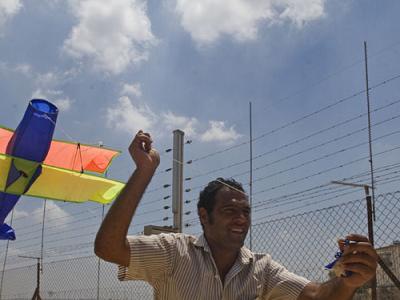
 Bassem Abu Rahme flying a kite (image from palestinechronicle)
B’Tselem – September 10, 2013
Four and a half years have passed since the killing of Bassem Abu Rahmeh by a tear gas canister fired at him directly from a short range. The death was documented by three video angles, but the Israeli state announced Monday it is closing the case citing lack of evidence
Military Advocate General (MAG) Maj. Gen. Danny Efroni decided to close the case file in the investigation of the circumstances of the killing of Bil’in resident Bassem Abu Rahmeh, citing lack of evidence. The MAG made this decision in late July, and it was recently conveyed to the Israeli High Court of Justice as part of an updating statement by the Office of the State Attorney in a petition filed by Subhiya Abu Rahmeh, Bassem’s mother, together with Bil’in Village Council and Israeli human rights organizations B’Tselem and Yesh Din.
According to the statement signed by Senior Deputy at the Office of the State Attorney, Att. Michal Michlin-Friedlander, and Assistant to the State Attorney, Att. Udi Eitan, also former Deputy State Attorney Yehoshua Lemberger had reached the same conclusion.
30-year-old Bassem Abu Rahmeh, a resident of the village of Bil’in, whose story was told in the film “Five Broken Cameras” nominated for Best Foreign Film in the Academy Awards, was killed in April 2009 after he was struck in the chest by an extended-range tear gas grenade during a demonstration against the Separation Barrier in his home village of Bil’in. Three video segments filmed during the demonstration prove that Abu Rahmeh was situated to the east of the barrier, did not act violently, and did not endanger the soldiers in any way. An analysis of the video footage of the incident, by visualization experts determined that the grenade was fired directly at Abu Rahmeh, in complete contravention of open-fire regulations.
In its response, the state did not explain the rationale behind its decision, limiting itself to the following laconic wording: “There is not enough evidence needed for criminal proceedings for adopting legal measures against any of the soldiers involved in the incident.” No information was given regarding the findings of the investigation, which the state argued had included “comprehensive and rigorous investigative actions,” or about the versions provided by the soldiers who had been questioned. Neither did the statement provide the contents of the opinions given by experts of the Israeli military and police and their interpretation of the findings disclosed by the video footage.
Ever since Bassem Abu Rahmeh was killed, his family – aided by NGOs Yesh Din and B’Tselem – has been continuously striving to have the truth of the incident brought to light and to have those responsible for their son’s death prosecuted. Their efforts have been repeatedly thwarted by the sluggish conduct of the MAG Corps. Due to the initial refusal by the MAG at the time to launch a Military Police investigation, the investigation was opened a year and half later than it should have. The foot-dragging and procrastination in the case have continued even once the investigation was launched over three years ago. Only a petition to the High Court of Justice finally brought about a decision in the case.
In response to the statement submitted by Office of the State Attorney, Att. Emily Schaeffer of Yesh Din’s legal team said: “The decision to close the file in the killing of Bassem Abu Rahmeh is unacceptable, particularly in view of the expert opinion that determined that the tear-gas grenade was fired directly at Abu Rahmeh from a close range. Despite three separate videos that recorded the killing of Bassem, the MP and police have failed to find the factors that caused the death of an unarmed demonstrator. The conduct of law enforcement bodies in this case is further proof of the feebleness of the authorities in cases of Palestinian casualties. Moreover, it seems that there might be no intention of finding out the truth or prosecuting the offenders even in extreme cases such as this, in which there is clear-cut and unambiguous evidence. Bassem’s family, together with B’Tselem and Yesh Din, will continue in its struggle to bring the parties responsible for his death to justice.”
Att. Yael Stein, Director of Research at B’Tselem, said in response: “The unbearable procrastination taken by the authorities in this case, and the fact that the MAG only made a decision due to a High Court Petition, once again demonstrate that the MAG Corps must adopt the recommendations of the Turkel Commission without delay. This includes determining a pre-defined schedule for each stage of the investigation, and ensuring that each stage is brief. Also, the statements made by investigative bodies about their decisions must include the reasoning underlying the decision so as to enable lodging effective appeals.”
Egypt and UAE plot to topple Hamas
MEMO | September 4, 2013
A retired Egyptian general has revealed details of an Egypt-UAE plot to impose a stranglehold on the Gaza Strip and overthrow the Hamas-led government. The plot, claims General Sami Hassan, is for the Egyptian army to act, with funding from the UAE government.
“The plan is led by General Abdel Fattah al-Sisi,” tweeted Hassan. “He aims to achieve political and military gains in the coming days.”
General Hassan said that the military will impose even more restrictions on the Palestinians in Gaza, cutting all essential supplies which currently pass through the tunnels. Fuel supplies in particular are being targeted. The Gaza Strip relies on Egypt for 80 per cent of its fuel.
According to Hassan, the process has already started with a media demonisation campaign against the Palestinians and Hamas. As soon as the army creates calm in the Sinai Peninsula, he asserted, it will stir up popular demonstrations.
Al-Sisi has already met with Shaikh Hazza bin Zayed, an adviser to the UAE National Security Authority, and ex-Fatah “strongman” Mohammed Dahlan, said General Hassan. “A sum of $750 million has been allocated for the plot,” he claims, “which will involve returning Gaza to Egyptian control or handing it over to the Palestinian Authority [in Ramallah].”
The decisive meeting, he noted, lasted one and a half hours in Al-Sisi’s office. The following objectives were agreed upon:
- Sinai will be “cleansed” of militant groups and nomadic tribes on the border with Gaza will be disarmed.
- A drone base will be established by Egypt in Sinai under international supervision. Air strikes will be launched against the “global jihadist movement”.
- All tunnels between Gaza and Egypt will be closed, and Egypt will cut off all essential supplies going to Gaza.
- Electricity supplies from Egypt to Gaza will be cut off altogether.
- An agreement between the Palestinian Authority, Egypt and Israel will be reactivated with the return of international observers to the Rafah Border Crossing.
- Hamas will be toppled and the Gaza Strip will be returned to President Mahmoud Abbas’s control.
- Power in Gaza will handed over to the PA or people in the UAE’s pay and control, such as Dahlan.
Related articles
- Egypt coup enters second phase: the overthrow of Hamas (alethonews.wordpress.com)
- Students campaign to expel Dahlan from UAE (alethonews.wordpress.com)
- Analyst: Mossad is behind Egyptian media’ incitement against Gaza (altahrir.wordpress.com)
- Egypt destroys Gaza tunnels, causes crisis (willyloman.wordpress.com)
- Egypt fires at Palestinian fishermen off Gaza: medics (willyloman.wordpress.com)
Egypt coup enters second phase: the overthrow of Hamas
MEMO | September 2, 2013
The military coup in Egypt is believed to have entered its second phase. The security forces affiliated with General Abdel Fattah al-Sisi, commander-in-chief of the Egyptian armed forces, have begun gradual attacks to topple the Hamas movement in the Gaza Strip, supported by incitement from the pro-Sisi media. A few obscure activists, meanwhile, have organised protests against the government in the Strip. The activists are believed to have received financial aid from the United Arab Emirates.
The news site, Secrets of Arabia, has observed signs of an orchestrated campaign, initiated by Egypt, to attack Hamas and overthrow its government in Gaza. Meanwhile, other sources have claimed that the UAE has been orchestrating the campaign in collaboration with Palestinian, former Fatah leader, Mohammed Dahlan, who works as a consultant for Abu Dhabi Crown Prince, Mohammed bin Zayed. Dahlan was expelled from Gaza following a failed attempt to topple the democratically elected Hamas-led government.
Over the past few weeks, Egyptian troops have launched an extensive campaign against the smuggling tunnels. The tunnels are used to transport essential goods to Gazans, who are suffering from the tight Israeli blockade. News was also leaked of an order by Egyptian security forces to demolish more than 500 houses near the Gaza Strip border and 500 meters deep into the Egyptian territories.
The operation to demolish Palestinian houses, on the border with Gaza, is considered a first of its kind in the history of the Egyptian-Palestinian relations. The operation has raised concerns in the region, of a possible Egyptian military action against Hamas and the tunnels. According to Egyptians residents of the area the Egyptian community believe that the operation is designed to strengthen the siege on Gaza.
Campaign of incitement
The Egyptian military’s actions are supported by an unprecedented campaign by the Egyptian pro-military coup media which calls on Palestinians to revolt against Hamas, in a clear, blatant and unprecedented intervention in the internal affairs of Palestine. Meanwhile, the same media channels have criticised non-Egyptians who interfere in the political affairs of Cairo.
The controversial Egyptian media personality, Tawfiq Okasha, surprised his viewers on Saturday evening with an unprecedented instigation against the Palestinians in Gaza. Okasha said the Palestinians must rise up against Hamas and that the Egyptian army would support them militarily to eliminate the movement.
Okasha is close to the General Sisi regime and is a prominent defender of the military coup. It is widely believed among Egyptians that Okasha reflects the official position of the army. He receives his instructions from the department of moral and military intelligence, which funds his al Faraein TV channel.
Gaza Rebellion
Meanwhile a new movement in Gaza has emerged under the name of Tamarod Gaza or Gaza Rebellion. The movement called on Palestinians in the Gaza Strip to voice their protests against the rule of Hamas on November 11th. The movement has stirred controversy on the Palestinian street.
The majority of the Palestinian residents in Gaza believe that members of the Gaza Rebellion movement are an extension of a counter-revolution led by the United Arab Emirates to topple the Arabs revolutions and Islamist rule in the Arab world. The movement is similar to Egypt’s Tamarod movement led by Egyptian, Mahmoud Badr. Badr is known as Mahmoud Cannabis due to claims of his previous involvement in the cannabis business. Badr built a deep relationship with the United Arab Emirates and was allowed to meet UAE Foreign Minister, Sheikh Abdullah bin Zayed Al Nahyan.
The Palestinians also believe that Mohammed Dahlan has been provoking problems in the Egyptian Sinai to drag the Egyptian army into confrontation with Gaza. Dahlan is also believed to be a supporter of the Gaza Rebellion which aspires to oust the Hamas government in Gaza, as the Muslim Brotherhood were ousted in Egypt.
Related articles
Egypt creates a buffer zone with Gaza
MEMO | September 2, 2013
The Egyptian army is working to create a buffer zone on the Egyptian border with the Gaza Strip in a purported effort to undermine weapon smuggling and chaos caused by militants in the Sinai Peninsula.
The military envisions that the ten kilometres long and 500 metre wide buffer zone is to be a building free area without trees. The area stretches from the Rafah Crossing through to the Mediterranean Sea.
Witnesses said that the Egyptian military bulldozers had started uprooting trees in the area and that 13 Egyptian houses had been destroyed in the al-Sarsouriya neighbourhood on Saturday.
At the time of writing this report, Egyptian military bulldozers were working fast razing sand-hills and trees in the area.
A military source, speaking anonymously, told the AP that homes had been knocked down over the last 10 days as a test of the buffer zone idea.
The interim Egyptian government said that this was a part of its “war on terrorism” campaign. The government and Egyptian mass media have been claiming that the tunnels between Egypt and Gaza have been used to smuggle weapons and Palestinian militants in to Egypt.
Egyptian residents in the neighbourhoods in the planned buffer zone took to the streets on Saturday, torching car tires and hurling stones at the Egyptian army in an effort to delay the demolition of their homes.
Witnesses said that the army called for residents to leave their houses through the loudspeakers of nearby mosques. The army bulldozers then immediately started damaging the houses.
“They did not give residents eviction notices and did not even give them enough time to collect their properties,” a tribal leader told AP.
In an interview with the Egyptian TV, CBC, Egyptian interior minister, Mohamed Ibrahim, claimed that the tunnels were the main cause of the uncertainty in Egypt. He insisted that prominent leaders of the Muslim Brotherhood had used the tunnels to enter and hide in Gaza.
Meanwhile, Hamas spokesman, Sami Abu-Zuhri, denied that the tunnels had been used to smuggle weapons and militants to Egypt or to smuggle Muslim Brotherhood leaders in to Gaza.
“Once they said that Osama Yassin was in Gaza, and two days later, they arrested him in Cairo,” Abu-Zuhri said in an example of the misinformation being reported on Gaza’s involvement in the Egyptian issue and the misuse of tunnels.
Since the end of the Israeli war on Gaza in 2008/2009, the tunnels have been used to smuggle goods, commodities and medicines. Numerous Palestinian, Egyptian and international journalists have observed the work of the tunnels.
They have reported that the tunnels have been used for humanitarian purposes in the light of the strict Israeli blockade on Gaza since 2006.
Egyptian navy attacks Palestinian fishermen
MEMO | September 1, 2013
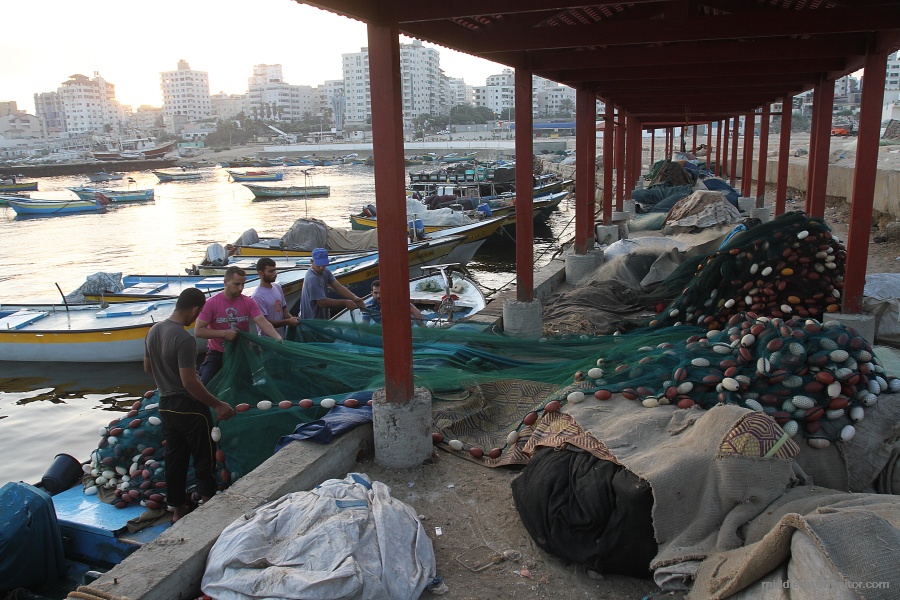
Egyptian navy vessels have attacked Palestinian fishermen going about their work off the coast of Rafah. Five fishermen were arrested and two were shot when their boats were confiscated by the Egyptians.
Local sources say that Ibrahim Abdullah al-Najjar, 19, and his colleague Ismail Wael al-Bardawil, 21, were both shot in the hands during the attack. The men were taken to Abu Yousef al-Najjar Hospital in Rafah for treatment. Shooting fishermen in the hands is a tactic used by the Israeli Navy as it makes it difficult for them to get back to work.
Following the overthrow of President Mohamed Morsi by the army, the coup authorities have warned the Palestinians that the navy will arrest anyone who crosses into Egypt’s territorial waters.
The fishermen expressed deep disappointment at the Egyptian move. It resembles the attacks on them by the Israeli navy, they said.
A spokesman for the Interior Ministry of the Palestinian government in Gaza, Ihab Ghussein, said that he has asked for a formal explanation from Egypt about the attack on the unarmed fishermen.
Four young boys arrested and beaten in Hebron
International Solidarity Movement | September 1, 2013
Hebron, Occupied Palestine – On Friday 30th August, Israeli soldiers arrested four Palestinian boys and held and abused them in a military base for around four hours.
Ashaq (15), Ali (15), Anwar (14) and Ahmed (10) were walking down the Shilal Street in the Old City of Hebron at around 6.30pm, when soldiers near Bab Al-Baladia violently grabbed them and accused them of throwing stones. Anwar’s shirt was torn by a soldier as they arrested him. They took the four boys through the yellow gate into Beit Romano military base. All four were blindfolded, and Ashaq was slapped in the face by a soldier. The soldiers also ate seeds in front of the boys and then spat the shells at them. The boys were held in the military base for nearly four hours. International activists who went to the military base to demand information on whether the boys were being held inside and why they had been arrested, were told by soldiers “we don’t know”, and were asked to leave. As they were waiting outside the military base, they were insulted and threatened by a settler. Subsequently the army forced them to leave Shuhada Street and threatened one international with arrest if she tried to return.
At around 10.15pm, Youth Against Settlements (YAS, a Palestinian activist group which seeks to end Israeli colonization and settlement activities in Palestine through non-violent popular struggle and civil disobedience) received a call by worried residents who had seen twelve soldiers taking the four blindfolded boys up into the cemetery opposite the military base. The youngest, Ahmed, had a bag put over his head. Members of YAS rushed to the scene, and when the soldiers saw them they seemed scared, released the boys and left quickly.
This incident stands out from other child arrests which are almost a daily occurrence in occupied Hebron due to the forced movement of the boys into the cemetery. This worrying act highlights the arbitrary nature of the occupation as well as the virtual impunity with which the soldiers are allowed to act.
Related articles
Israeli officers torture detained Palestinian children
Palestine Information Center – 23/08/2013
NAZARETH — B’Tselem organization published on Thursday a report that includes testimonies from children detained in Israeli jails, on charges of throwing stones at soldiers, saying they were subjected to torture during their interrogation.
B’Tselem said that since November 2009, it has received testimonies from dozens of Palestinian residents of the Bethlehem and al-Khalil, most of them minors, saying that they were subjected to threats and violence, sometimes amounting to torture, during their interrogation at the police station at Gush Etzion.
The testimonies describe interrogations in which the minors were forced to confess to alleged offenses, mostly stone-throwing.
The report included the testimony of a minor, aged 14 from Husan in Bethlehem. He said “The interrogator made me go into a room. He grabbed my head and started banging it against the wall. Then he punched me, slapped me and kicked my legs. The pain was immense, and I felt like I couldn’t stand any longer.”
“Then he started swearing at me. He said filthy things about me and about my mother. He threatened to rape me, or perform sexual acts on me, if I didn’t confess to throwing stones,” the child added.
He said: “His threats really scared me, because he was very cruel and it was just the two of us in the room. I remembered what I’d seen on the news, when British and American soldiers raped and took photos of naked Iraqis.”
B’Tselem reported that until July 2013 its field researchers collected 64 testimonies from residents of eight communities in the southern West Bank who reported such incidents. “Fifty-six of them were minors at the time of their interrogation.”
Related article
- Five-year-old Palestinian boy detained in Hebron (imemc.org)
Join ISM for the 2013 Olive Harvest Campaign
International Solidarity Movement | August 22, 2013
Occupied West Bank – At a time of regular settler violence in the West Bank, the International Solidarity Movement (ISM) is issuing an urgent call for volunteers to join us for the 2013 Olive Harvest Campaign at the invitation of Palestinian communities.
The olive tree is a national symbol for Palestinians. As thousands of olive trees have been bulldozed, uprooted, burned and destroyed by Israeli settlers and the military – according to the UN settlers alone destroyed or damaged over 7,500 trees just in 2012 – harvesting has become more than a source of livelihood; it has become a form of resistance.
The olive harvest is an annual affirmation of Palestinians’ historical, spiritual, and economic connection to their land, and a rejection of Israeli efforts to seize it. Despite attempts by Israeli settlers and soldiers to prevent them from accessing their land, Palestinian communities have remained steadfast in refusing to give up their olive harvest.
ISM volunteers join Palestinian farming communities each year to harvest olives, in areas where Palestinians face settler and military violence when working their land. Your presence can make a big difference, with Palestinian communities stating that the presence of international volunteers reduces the risk of extreme violence from Israeli settlers and the Israeli army.
We support Palestinians’ assertion of their right to earn their livelihoods and be present on their lands. International solidarity activists engage in non-violent intervention and documentation, practical support which enables many families to pick their olives.
The campaign will begin mid October and will last around 5-7 weeks. We request a minimum 2 week commitment from volunteers but stress that long-termers are needed as well. We ask that volunteers start arriving in the first week of October, so that we will be prepared when the harvest begins.
Training
The ISM will be holding mandatory two day training sessions which will run weekly on Wednesdays and Thursdays. Please see the join ISM page or contact palreports@gmail.com for further information.
In addition to the Olive Harvest Campaign, volunteers can also participate in regular ISM activities in support of the Palestinian popular struggle.
Join us in our solidarity with the Palestinian resistance at this crucial time of year!
In Solidarity,
ISM Palestine
Related article
To be a Palestinian, especially in Gaza

By Eva Bartlett | In Gaza | August 21, 2013
this misery inflicted on Palestinians, for years, for decades, gets continually worse.
aside from being essentially locked-down by the occupying Zionist regime since at least 2006 (closures began way back in the 90s), leaving the vast majority of Gaza’s Palestinians unable to freely travel from their tiny, overpopulated, suffocating Strip (not all is bad about the lovely Gaza Strip, but it is extremely difficult and impossible for the majority of the 1.7 million living there), every facet of life in Gaza is either in ruins or devolving towards ruin.
for years Gaza’s fresh water has been getting more and more contaminated, to the point where 95% of their already very limited fresh water is now not drinkable by WHO standards. solution? there is none, and the water authority in Gaza estimates that by 2016, that’s it. Palestinians in Gaza can hardly just build reverse-osmosis machines–they can’t even import building materials to re-build Israeli-bombed homes, buildings, schools…the rainy season is one or two months at best, and Israeli bombings and bulldozers have destroyed the majority of wells and cisterns in border regions of Gaza, meaning families have no ability to conserve rain water. Israeli wells flanking Gaza’s borders cut off the natural flow of water from east to west, depriving Gaza a means to replenish it’s depleting aquifer. so people buy drinking water from Israel, how benevolent. and the vast majority who are too impoverished (rendered poor by the occupation’s policies **check this one out on Israel’s starvation policy!) drink the contaminated water, consuming alarming levels of nitrates and chlorides, leading to obvious health risks.
there’s the same old nasty habit of Israeli soldiers gunning down or shelling Palestinian farmers and workers anywhere within 2 km of the border, rendering at least 35% of Gaza’s agricultural land off-limits. damn fine land too, rich, formerly host to endless olive, fruit and nut trees now mostly vacant, razed land, by the colonizers to keep Palestinians in misery, oh yes, and for “security” reasons, of course.
and the same old dirty game of Israeli soldiers gunning down or shelling Palestinian fishers anywhere up to just one mile off Gaza’s coast….when fishers have under Israeli-signed accords the right to go 20 nautical miles off Gaza’s coast. the “three mile limit” imposed by the Zionists cuts Palestinian fishers off from 85% of their waters. oh yes, and the Israeli navy loves to abduct fishers, interrogate them on everything but actual fishing, and steal or destroy their boats, nets, radars, lives…what kind of fish does one catch a mile or two off the coast anyway? not much. and the little fish they do catch are the stock fish–literally little fish– and now greatly contaminated.
why the contamination? same reason the aquifer is polluted: up to 80 million litres of partially or not all all treated sewage pumped into the sea every day, because Palestinians in Gaza don’t have the means to treat and recycle that sewage. why? because although for years they have wanted to expand on sewage containment pools and improve sewage plants and lines, the occupying forces do not allow the building materials needed into the Strip, and greatly restrict the entrance of chemicals needed in treating the sewage, as well as fuel needed to run the plants when the electricity cuts (as it does daily, from 8 to 16 hours depending on what stage of crisis Gaza is being rendered into). bombing water and sewage facilities doesn’t help much either:
“over 30 km of water networks were damaged or destroyed by the Israeli military in addition to 11 wells operated by the water authorities in Gaza. The UN Fact Finding Mission on the Gaza conflict (the Goldstone report) deemed this destruction “deliberate and systematic”; most of the infrastructure is yet to be repaired for lack of access to spare parts.” [lots of info here]
what else is rosy about life in Gaza? the Israeli warplane fly-overs, the drones, the daily power outages (would that they could completely restore their sole power plant, bombed by the Israelis in 2006 and import sufficient fuel to run the maimed plant as best it could be run), the fuel and cooking gas shortages, the ban on exporting, the ban on travel (oh yes, some privileged can travel, those with connections, some of the truly ill–but not all!–can leave for treatment in occupied Palestine or Egypt), political in-fighting (engineered by who in the end? well, who benefits from the rift between the big 2 parties?), and the psychological torture for the majority in Gaza that is constantly living on the edge: when will the Zios bomb next; when will the crossing into Egypt (Palestinians sole option, realistically) open and remain open; when will we be allowed to export our produce, furniture, clothing and have a functioning economy; when will we not only have the right to travel for study (of course this applies to Palestinians in the rest of occupied Palestine), medical treatment or just for the hell of it like the rest of humanity; when will the world stop screwing us over; when will the sham of “peace talks” end; when will our imprisoned loved ones be released from Zionist jails; and when will it become actually unacceptable that Israeli politicians and military brass call for our execution, call for our expulsion, for the destruction of our infrastructure and means of living (come on Ban, can’t you at least utter your pathetic “I strongly condemn” against these racist death-threats??)?
oh, a final note: even those traveling to Gaza in solidarity with Palestinians are subject to some of the wrath of Zionist-supporting regimes. A number of internationals, including a Canadian doctor and a Canadian film-maker, are being held under ridiculous pretexts by the coup-regime in Egypt, with worrying little contact with consular officials (see here and here for updates and ways to support these men).
Related articles
- Israeli major general: “If we kill 500 in the Gaza Strip, they will calm down” (alethonews.wordpress.com)
- Two Palestinians Injured By Army Fire In Northern Gaza (imemc.org)
- Sailing From Gaza to Break the Blockade (alethonews.wordpress.com)
- Palestinian women activists arrested last week remain imprisoned (alethonews.wordpress.com)
Palestinian women activists arrested last week remain imprisoned
International Solidarity Movement | August 21, 2013
Nablus, Occupied Palestine – At 10pm on August 15th Myassar Atyani, Linan Abu Gholmeh and Leena Jawabreh of Nablus district were arrested by the Israeli police with their friend Waroud Qasem in the 1948 occupied areas of Palestine (‘48), what is now referred to as Israel. The three friends who are all political activists and former political prisoners had travelled to ‘48 to visit Waroud who lives in Tyre and has Israeli citizenship.

Leena Jawabreh, Linan Abu Ghoulmeh, Woroud Qasem and Myassar Atyani
They were traveling together in Waroud’s car when they were stopped by the Israeli police and found to be without travel permits; Palestinians living in the West Bank require permits issued by the Israeli authorities to travel outside of the West Bank, including to the Palestinian capital Jerusalem and the rest of ’48. These permits are notoriously difficult to obtain, especially for activists. The four women were subsequently arrested and transported to Hasharon prison. Myassar, Linan and Leena were detained at the prison until their appearance at Salem military court on the 19th of August.
Waroud, also a former political prisoner from 2006 to 2012 was released from Hasharon prsison and placed under full house arrest with her driving license confiscated. She has another court hearing pending. The other three women are now being held in Salem prison awaiting a further court hearing. Leena on the 22nd of August and Myassar and Linan on the 25th of August.
Their families attended their court hearing on the 19th but thus far have been prevented from speaking with them directly by soldiers in the military court. Therefore they have only heard word of their relatives through their lawyer. Family members said that Linan told the lawyer to “Have me sentenced to what they want but don’t let them put me under administrative detention”.
Linan was arrested after her husband Amjad Mlitat was martyred by the Israeli army in 2004, and held until 2009 when she was released as part of a prisoner exchange; she was then re-arrested in July 2010 and placed under administrative detention, until the October 2011 prisoner exchange. “Administrative detention is a procedure that allows the Israeli military to hold prisoners indefinitely on secret information without charging them or allowing them to stand trial.” Administrative detention is a leftover from the British Mandate period of Palestine’s occupied past and has been exploited by the Israeli authorities to ensure that anybody resisting their occupation of Palestine can be imprisoned without justification; this violates the internationally protected right to a fair trial and means that prisoners can be held indefinitely, as administrative detention orders can be continually renewed without evidence. Human rights organisation B’tselem point out that with their regular use of administrative detention Israel violates international law, which “…stipulates that it may be exercised only in very exceptional cases – and then only as a last possible resort, when there are no other means available to prevent the danger.”
Myassar was most recently arrested and interrogated in 2009 and detained in prison for a month – she was also arrested multiple times in the 80’s and 90’s. Leena spent four years in prison from 2004 to 2008. All three women are prominent activists especially for prisoners rights and have been involved in prisoner hunger strikes.
Palestinians living in the West Bank are rarely granted permits to travel to ’48, nor to Gaza – in practical terms this means that they cannot reach the coast, the capital Jerusalem or the many remaining Palestinian cities in what is now referred to as Israel. The Apartheid Wall, illegally built, separating the West Bank from ’48, means that families and friends are divided. Many who want to visit the land lost by Palestinians who were expelled during the Nakba, or ‘catastrophe’, in 1948 are regularly denied and thus sometimes choose to travel without permission from the occupying Israeli authorities. The denial of permits is especially strict against those who are political activists and males aged 12- 35 – for these groups it is almost impossible to gain permission to travel freely in historic Palestine.
Ex-political prisoners, human rights defenders and those resisting the occupation are regularly targeted by the Israeli authorities and military for bureaucratic denial of permits, harassment, attacks and arrests.
You can take action demanding the immediate release of Linan, Leena and Myassar here.
Featured Video
Matt Bracken: Hezbollah Re-Arming With Massive Help From Iran
or go to
Aletho News Archives – Video-Images
From the Archives
Examples of hate speech by Israel against Palestine
1. “There is a huge gap between us (Jews) and our enemies, not just in ability but in morality, culture, sanctity of life, and conscience. They are our neighbors here, but it seems as if at a distance of a few hundred meters away, there are people who do not belong to our continent, to our world, but actually belong to a different galaxy.” Israeli president Moshe Katsav. The Jerusalem Post, May 10, 2001
2. “The Palestinians are like crocodiles, the more you give them meat, they want more”…. Ehud Barak, Prime Minister of Israel at the time – August 28, 2000. Reported in the Jerusalem Post, August 30, 2000
3. ” [The Palestinians are] beasts walking on two legs.” Menahim Begin, speech to the Knesset, quoted in Amnon Kapeliouk, “Begin and the Beasts”. New Statesman, 25 June 1982.
4. “The Palestinians” would be crushed like grasshoppers … heads smashed against the boulders and walls.” Isreali Prime Minister (at the time) in a speech to Jewish settlers New York Times April 1, 1988
5. “When we have settled the land, all the Arabs will be able to do about it will be to scurry around like drugged cockroaches in a bottle.” Raphael Eitan, Chief of Staff of the Israeli Defence Forces, New York Times, 14 April 1983.
6. “How can we return the occupied territories? There is nobody to return them to.” Golda Maier, March 8, 1969.
… Continue
Blog Roll
 Aletho News
- The accession of Ukraine could signal the collapse of the EU
- Italy puts Ukraine weapons package on hold – media
- US kills 5 in Pacific as unproven drug smuggling claims persist
- Iran Respects International Law, US & Israel are Rogue States
- Russia Helping Build a New Middle East /Trita Parsi
- Barghouti: ‘Netanyahu has fallen,’ era of Smotrich, Ben-Gvir over
- China slams US policy on Iran as Russia rejects legality of nuclear meeting at UN
- The Mecca Pact Courts Iran: Containment Comes Full Circle
- Oman FM: Persian Gulf states, Iran, Iraq should form security pact excluding US
- Trump peddles fresh falsehoods, claims Iran ‘started the war’ as US aggression drags on
- If Americans Knew
- An error has occurred; the feed is probably down. Try again later.
- No Tricks Zone
- Sudden Stratospheric Warming, Powerful El Niño Combination May Lead To Extreme Europe Cold, Energy Crisis!
- Two New Studies Find Thwaites Glacier Melt Cannot Be Driven By Human Activity Or A Warming Ocean
- E-Cars Reduce CO2 Emissions By Only 41% Compared To Internal Combustion Engine Vehicles
- Predictions Made By Renowned Climate Professor Over Past Decades Have Been Proven To Be Poor
- New Study Suggests Large Regions Of The Pacific Ocean Have Been Cooling For The Last 80 Years
- Germany’s Green Energy Debacle: High Energy Costs Force Kahla Porzellan to Close After 182 Years!
- New Study: 50 Years Of The Most Aggressive ‘Net Zero’ Policies Can Only Affect The Global Climate By 0.03°C
- US September “Heat” Was No Record…Many Records Set Decades Ago
- Latest European Green Energy Debacle; Portugal’s Largest Flagship Solar Park Insolvent!
- Green Energy Debacle: German Expert Professor Fritz Vahrenholt Warns Of Severe Economic And Social Consequences

