Palestinian teen ‘executed’ by Israeli forces in Jenin
By Saed Bannoura | IMEMC & Agencies | September 17, 2013
Palestinian medical sources have reported that a Palestinian youth was shot and killed by Israeli soldiers invading his home in the Jenin refugee camp, in the northern West Bank city of Jenin on Tuesday. Dozens of residents have been injured during ensuing clashes, and one was kidnapped.
The Maan News Agency has reported that a large Israeli military force invaded that camp, during late night hours, and that the soldiers broke into and violently searched dozens of homes.
The invasion led to clashes with local youths who hurled stones and empty bottles at the invading forces.
Medical sources said that resident Islam Husam Toubasy, 19, was shot by rounds of live ammunition fired at him by the invasion soldiers who broke into his home after detonating its door.
His family told Maan that, immediately after invading their property, the soldiers headed to the rooftop where Islam sleeps in his room, and shot him in the foot before dragging him onto the ground, taking him out of his home while he was heavily bleeding.
His brother, Kamal, stated that after the soldiers shot and injured Islam, and dragged him out of the home, undercover soldiers of the Israeli army shot him again, the Palestinian News & Info Agency (WAFA) has reported.
The army then moved him to the Al Khodeira hospital, inside the 1948 territories, where he died due to the massive bleeding he suffered as a result of his injury.
The family said that the soldiers forced them in one room, and that they saw Islam bleeding and unconscious before the soldiers took him away. The soldiers did not allow the family to help their son.
Army then withdrew from the camp, but re-invaded it, and the city of Jenin, in the morning, leading to clashes with dozens of local youths.
Eyewitnesses said that at least twenty armored Israeli military vehicles, and a military ambulance, invaded the area, leading to clashes with dozens of students heading to their school.
The soldiers fired more rounds of live ammunition, gas bombs and concussion grenades at the residents leading to several injuries.
One of the wounded, Nael Ghazzawy, 13, was shot by a live round in his leg while standing at the balcony of his home.
Soldiers also kidnapped a resident identified as Mohammad Bassam Al-Fayed, 21, and took him to an unknown destination.
It is worth mentioning that, in 2006, undercover soldiers of the Israeli army, shot and killed Ahmad, the brother of Islam, and demolished his home. Their brother Sa’id, is a political prisoner held by Israel after being sentenced to 32 years imprisonment by a military court.
Earlier on Tuesday, Israeli soldiers invaded various Palestinian communities in different parts of the occupied West Bank, and kidnapped at least nine Palestinians.
On Monday, Israeli soldiers kidnapped at least fifteen Palestinians, including a legislator, in different parts of the occupied West Bank.
The invasions are part of daily violations carried out by the army against the Palestinians and their property in different parts of occupied Palestine.
Related article
The settlers
By Melanie Ward | September 12, 2013
“They consider us as the enemy. These are extreme settlers.”
Hishem, a Palestinian, sits with us in the shade of an olive tree in front of his home in Wadi al Hussein, Hebron. His children are playing on the hill behind us, and directly behind them stands the vast Israeli settlement of Kiryat Arba. There, a man – a settler – is standing on his balcony watching us.

Hishem’s children play in the shadow of Israeli settlement Kiryat Arba
It is hard to know where to start when trying to explain the settlers of Hebron. They are at the heart of the problems here. One of my first encounters with them was on my second proper day of work, when I was walking down Shuhada Street and found myself on the wrong end of an egg thrown by a little settler boy of 7 or 8 years old. One of the local shopkeepers, Munir, has now nicknamed me ‘Umm Baydah’ or ‘Mother Egg’, for being the first of my group to be hit by one. He said “now you are a Palestinian”, and told me to start a tally count.
You might think, what kind of parents give their children things to throw at people walking down the street? But eggs are the least of it. Hishem’s extended family has been attacked, had their windows smashed, their homes set on fire and even been shot by their settler neighbours.
The settlers of Hebron are a religiously motivated group of Israeli Jews who occupy four areas, known as settlements, in the centre of H2 (Israel-controlled), Hebron, and two settlements in the Wadi where Hishem lives. They are known for their willingness to use violence, harassment and intimidation against those they perceive to be standing in the way of them achieving their goals, which are primarily to rid the city of Palestinians. The settlers never refer to Palestinians, always to Arabs because they deny that there was ever such a place as Palestine or such a people as the Palestinians. They say that the Palestinians should leave and go to one of “their own” Arab countries.

Graffiti on the outside wall of Cordoba School in H2 says “Gas the Arabs”
All settlements, including those in East Jerusalem, are illegal under international law. Every country in the world recognises this except Israel. From some of my stories so far, it might seem like there is one set of rules for Israelis and one for Palestinians. That’s because there actually is. In the West Bank the Israeli authorities enforce Israeli civil law on settlers, but military law on Palestinians.
The settlers believe in Eretz Israel – greater Israel – that Israel should permanently encompass the Palestinian territory of East Jerusalem, the Gaza Strip and the West Bank. These are the areas currently occupied and/ or controlled by the Israeli army. Some settlers believe that Israel’s borders should stretch even further afield than this into other countries. Their beliefs contradict all international understandings of where Israel’s borders should be.
These are the nuts and bolts of the daily battle being played out in H2. Everything is about who owns what, who can walk or drive where, even who can stand where. Hebron is the only city in the West Bank to have Israeli settlers living in its centre. The city is of religious significance because it is where Abraham and his sons and their wives lived, and are buried. It is the second holiest site for Jews, the fourth holiest site for Muslims, and is also of significance to Christians.
The settlers believe that they are doing God’s work in ridding Hebron of Palestinians, and dream of turning it into a Jewish city. But I don’t know of any God that would approve of their behaviour. Ironically, there tends to be most trouble on Friday nights and Saturdays – the Jewish Sabbath. One of my jobs is to be present whilst hundreds of settlers walk from Kiryat Arba through a Palestinian neighbourhood to pray at the synagogue on a Friday night. Dozens of extra soldiers are bussed in to protect them but some of the settlers carry their own rifles too. I find it quite bizarre, and certainly one of the least holy sights I have ever seen.

Armed settlers flanked by the Israeli army go to pray in Hebron on the Jewish Sabbath
On the Sabbath last week, a colleague from another international organisation saw a group of teenage settler girls spitting at a group of Palestinian girls on Shuhada Street. Again, not so holy. I met Nadar, Noocha and their family, who showed me their windows which were smashed by settlers. They live next to the synagogue in Hebron. A Palestinian I meet called Hani tells me he does not believe that the settlers follow the true Jewish faith.

Me with Meyar, Nadar and Noocha’s 4 year old daughter. Their windows have been smashed by settlers
The settlers seem to be willing to do almost anything to achieve their aims. This short film clip, from Israeli human rights organisation BT’Selem, first shows one of the settlers explaining things for herself, and then some of her actions. At least watch the first 2 minutes if you can – I’m pretty sure you’ll be shocked.
You might have noticed the solider standing by whilst the settler abuses her neighbour and then the solider pushing the Palestinian woman, rather than dealing with the settler children attacking her home. Palestinians often report that soldiers do nothing whilst settlers are on the attack. I have already seen for myself the close relations between many settlers and soldiers, with settlers bringing food and drinks to soldiers throughout the day, and even settler children playing in military watch points whilst soldiers are on duty there.
In March this year, the United Nations High Commissioner for Human Rights said,
“settler violence continues to be perpetrated with impunity… Israel needs to hold perpetrators accountable. While investigations are not opened into most incidents of settler violence, between 2005 and 2011, only 9 per cent of the investigations opened resulted in an indictment.”
Hani, Reema and their family live just past the caged house in that BT’Selem film clip, by the settlement of Tel Rumeida. They have to walk past the settlement and through the yard of an Israeli army base to get to their house. They can’t take a car to their house. They have been harassed and attacked by their neighbours many times. The settlers have even tried to burn down their home, and have come in the night to smash it up. About a month ago, they tried to burn down the family’s 300 olive trees for the ninth time, scorching the land, and making some of it impossible to harvest this year. Burning and chopping down olive trees is a common tactic of settlers across the West Bank.

Hani and Reema’s scorched olive trees, burnt by settlers a few weeks ago for the ninth time
“Aren’t you frightened?” I ask Reema and she replies, “At the start we were frightened but now we are used to it.”
One of our duties on the Sabbath is to spend time sitting on the roof of the Abu Shamsiya family’s home in H2. The flat roof of the family’s home backs onto Shuhada Street, and has a small Israeli army watchtower on it which does not appear to be used at present. From the roof you can look out across the city of Hebron, and down onto the family’s terrace below. The terrace has a cage around it to try and stop the family being struck by objects thrown by settlers on the roof. In the past, these objects have included eggs (they seem to be a favourite) and stones, and settlers have even urinated on them.

The Abu Shamsiya family’s terrace from their roof, where settlers come and attack them
So the reason for our presence is to deter settlers from coming onto the roof. The first time I sat there, we prevented three settler groups from coming onto the roof. A teenage boy in one of them had a rifle slung across his person. On Tuesday, we were unable to prevent one settler coming onto the family’s roof when we were there. He pointed at the view of the Palestinian city, “This is Israel” he said. ”It’s Palestine” I said. “Lo” (no) he said. Another group that my colleague saw gestured at the view of the Palestinian city and said “All of this will be Jewish”.
Virtually every Palestinian home in H2 has a kind of cage across the windows to try to guard against settler attacks. It is hard to get used to seeing children waving and shouting hello to us from behind these cages.

Children in H2 wave to us from behind the cage placed there to protect them from settlers
On Monday last week when I was doing the lunchtime school run (accompanying Palestinian children to Cordoba School down Shuhada Street) about 150 settlers, most of them teenagers, arrived apparently on some kind of tour. Remember – they can go anywhere in H2 but the Palestinians are very restricted as to where they can even walk. The settlers were congregating at the bottom of the school steps. When it came time for the kids to go home from school, many of them were scared to go down the stairs because of the settlers. I walked up and down the steps with them, to try to make them feel more secure, and it seemed to give them confidence to be able to get home. Although the truth is that I had no way of knowing whether the settlers would cause trouble. Luckily, the worst they did was to stare at us all, and shout and throw things at the feet of my male colleague who arrived to help me.
Not all Israeli settlers are religious extremists like those in Hebron. Some, who live in settlements in Palestinian East Jerusalem for example, are economically motivated. They are attracted by the housing subsidies that the Israeli government provides in many settlements.
Wherever they are located though, there is no doubt that the settlers and settlement expansion, are a major barrier to peace between Israel and Palestine.
Hani and his son have both spent time in prison for retaliating when settlers have attacked them. But Hani tells me that he now believes in non-violent resistance because it gets more positive results. He says it helps him to separate hatred for a policy from hatred for a people, and believes that it can help those in other countries, especially Jews, to see what is happening here.

Non-violent resistance at the Youth Against Settlements project: “They can pull out our trees but we will always plant more”
You might ask, how do the Palestinians put up with this? Why don’t they give up? How can they carry on living where they do, facing such violence and harassment on a daily basis? I asked a few of the people I met whether they would ever think of leaving,
“At the end of the day, it’s our right to our land,” says Hani.
“We are here, and we will stay here. This is our land.” says Hishem.
“We will stay here in a tent if we have to, we will not leave,” says another.
Many of them could not afford to go elsewhere, and where would they go anyway? Over 60% of the West Bank is directly under Israeli control. And many of them, like Hishem’s family, have already been refugees once from the time that the State of Israel was created. And why should they leave? As international law confirms, this IS their land.
But there is another reason, one which is about the Palestinians as a people.
The truth is that they must not leave if the dream of having a Palestinian state is ever to be realised. The settlers and the soldiers must not succeed in cleansing Hebron – or anywhere else in the West Bank – of Palestinians.
I hope that my presence here, and that of my EAPPI colleagues, somehow helps to make it a tiny bit easier for them to stay. One man tells me, “When settlers see people like you they are less likely to cause problems, especially on a Friday and Saturday.” And Hani says, “Before, we were alone as Palestinians with the Israelis but because of the internationals – people like you – we have witnesses to the violence of the settlers. This makes things a bit better for us.”
Just knowing that makes being here worthwhile.
Related articles
- Four young boys arrested and beaten in Hebron (alethonews.wordpress.com)
- Soldiers assault a twelve-year-old Palestinian while settlers invade family rooftop in Hebron (alethonews.wordpress.com)
- “Shabbat shalom” – no peace for Palestinians in Hebron this Saturday (alethonews.wordpress.com)
- Yom Kippur – Illegal Israeli settlers attack Palestinian farmer attempting to harvest almonds (alethonews.wordpress.com)
- Israeli settlers torch Hebron family’s property for eighth time (alethonews.wordpress.com)
“Our hands have not shed this blood”? Give me a break
The IDF insists on not indicting the security officer who killed Bassem Abu Rahme, even though we provided it with enough details to find him
By Yossi Gurvitz | Isolated Incident | September 15, 2013
In April 2009, an Israeli uniformed officer fired a gas canister, using dead reckoning, into the chest of demonstrator Bassem Abu Rahme, during the weekly demonstration in the village of Bil’in, and killed him. The killing was carried out in the presence of senior officers. Firing a canister using dead reckoning is contrary to the orders of the IDF itself, not to mention the moral meaning of shooting an unarmed man; but Abu Rahme was a Palestinian, and it would seem the IDF would do anything possible to avoid meting justice to his killer – even though he can find his identity easily.
Last week, hours before Rosh Ha’shana – classic news-killing move – the government announced that the Judge Advocate General decided to close the case, citing “lack of evidence” for an indictment.
This argument is rubbish, and I’ll be back with it soon. But first we need to give a brief history of the case. Several days after the killing, B’Tselem wrote to the military prosecution, demanding an MPCID investigation of the shooting; at about the same time, Atty. Michael Sfard made the same demand.
But even though an unarmed civilian was shot to death by a security officer – a fact which is not contested – the military prosecution refused to open a criminal investigation, insisting instead on a military debriefing process. On 28th March, 2010 – some 11 months after Abu Rahma was killed – the military prosecution announced that it would not open an MPCID investigation. They used a creative excuse: They claimed the canister may have hit the fence and ricocheted towards Abu Rahma, and hence there was no guilt. And perhaps, they mused, the fact that Abu Rahme was standing on a rock “caused a convergence” between him and the arc of the canister.
These are precisely the sort of questions an MPCID investigation would have answered. And yet, the prosecution refused to open one. There is another critical point here: The prosecution claimed that, despite the debriefing, it does not know who the shooter was. If an IDF debriefing can’t answer this basic question, every Israeli should wonder what this process is good for.
So we happily solved this riddle for the prosecution. On June 3rd, 2010, Attys. Michael Sfard and Emily Schaeffer demanded the military prosecution open an MPCID investigation, adding to their demand an opinion based on a technology called Forensic Architecture. The death of Abu Rahme was documented by three different video cameras; from the merging and rebuilding of the images [see video; the shooting is just after 3:40], you can plainly see where the soldier who shot him stood, and you can see that the shooting was dead reckoning. We don’t know the identity of the shooter, but we found out where he stood during the shooting. Any self-respecting investigative outfit ought to be able to answer this question rather easily – particularly after a military debriefing.
It should be further noted that according to a testimony gathered by the NGO Breaking the Silence (Hebrew) one of the soldiers involved documented the killing by video, and “some soldiers had this video on their mobile phone. They sent it to one another and laughed about it a bit. The guy who shot him, I don’t remember his name, personally I don’t know him too well but I sort of knew who he was, he was rather happy with the story. He put an X on his grenade launcher.” Somehow, all this evaded the debriefing, and the MPCID investigation as well. Was it incompetence or a case of following the spirit of the commander?
The forensic architecture finding left the prosecution with little choice, and about a month later, on July 11th 2010 – some 15 months after the shooting, but who’s counting – it ordered an MPCID investigation. This carried on and on and on, perhaps expecting us to take the hint and go bark up another tree. This was just a Palestinian, after all, and furthermore one who caused the hasbara system some embarrassment by starring in “Five Broken Cameras.”
So we were left with no choice, and on March 3rd 2013, we appealed, together with B’Tselem, to the High Court of Justice, demanding two remedies: That the prosecution should reach a decision in the case; and that it should indict, at a minimum, for unlawful use of a weapon.
And, as mentioned, last week we got the answer: the military prosecution still insists it is ignorant of the identity of a shooter documented in three cameras, even after we specifically noted his location. Therefore it asks the Court to reject the appeal, close the file without any indictments, and offers us to appeal its decision – a process which can easily drag on for a year or two.
To sum: In April 2009, a person wearing Israeli uniform shot an unarmed demonstrator. Four years later, the IDF’s glorious investigative organs – a debriefing and an MPCID investigation – claim “lack of evidence” for an indictment. Didn’t you get the hint, you bleeding hearts? What, do you seriously think we would indict a soldier for killing a Palestinian, and worse – screw up his superior’s career? As our data sheet showed, the rate of indictment of soldiers and officers for killing Palestinians is very low, and the conviction rate is also rather sparse.
“If one be found slain in the land which the Lord thy God giveth thee to possess it, lying in the field,” orders the Bible, “and it be not known who hath slain him: Then thy elders and thy judges shall come forth, and they shall measure unto the cities which are round about him that is slain: And it shall be, that the city which is next unto the slain man, even the elders of that city shall take an heifer, which hath not been wrought with, and which hath not drawn in the yoke; And the elders of that city shall bring down the heifer unto a rough valley, which is neither eared nor sown, and shall strike off the heifer’s neck there in the valley: […] And all the elders of that city, that are next unto the slain man, shall wash their hands over the heifer that is beheaded in the valley. And they shall answer and say, Our hands have not shed this blood, neither have our eyes seen it. Be merciful, O Lord, unto thy people Israel, whom thou hast redeemed, and lay not innocent blood unto thy people of Israel’s charge.” During the misty days of the descent of the Second Temple, the writers of the Talmud repealed this decision, as the killers multiplied and acted openly.
Here is one found slain in the field. The IDF cannot wash its hands, cannot say “our hands have not shed this blood,” cannot say “neither have our eyes seen it,” since it insists on averting its eyes. And what about “lay not innocent blood unto thy people,” the basic demand, universal to all human societies, that a death should be atoned for, what of it?
Don’t worry. He was just a Palestinian.
Related article
Egyptian navy attacks fishermen in Palestinian waters
Palestine Information Center – 15/09/2013
GAZA — The Egyptian naval forces opened fire on Saturday evening at Palestinian fishermen and physically assaulted two of them during an incursion into the territorial waters of the Gaza Strip.
Dean of the Gazan fishermen Nizar Ayyash told the Palestinian information center that Egyptian naval soldiers detained fisherman Omar Bardawil, 40, along with his son Ziyad, 13, and brutally beat him before confiscating the outboard motor of his boat.
Ayyash said this incident was the second of its kind after the Egyptian navy had wounded two weeks ago two Gazan fishermen and kidnapped five others during an armed attack on them in Gaza territorial waters.
He expressed his grave concern that the Egyptian army started to follow the steps of its Israeli counterpart and engage in hostile practices against the fishermen of Gaza.
The Gazan fishermen confirmed that two Egyptian gunboats entered the Gaza territorial waters and started to shoot them at close range during their presence near Rafah port before capturing and assaulting Ayyash and his son off the coast.
For its part, the Hamas Movement strongly denounced the Egyptian navy for violating the Palestinian maritime borders and launching a wanton attack on Gazan fishermen.
“The Hamas Movement deplores the opening of fire at Palestinian fishermen inside the Palestinian waters by Egyptian naval boats and the detention of some of them,” its spokesman Sami Abu Zuhri stated in a press release.
Related articles
Yom Kippur – Illegal Israeli settlers attack Palestinian farmer attempting to harvest almonds
International Solidarity Movement | September 15, 2013
Kafr Qalil, Occupied West Bank – Late Friday night we received a call to accompany a farmer to harvest almonds early the following morning in Kafr Qalil, a village south of Nablus. This is a completely normal activity, harvesting crops when they are ripe and ready-to-pick; however, in Palestine, simply trying to tend to one’s land can be a life-risking event.
At times, international activists and observers accompany Palestinian farmers whose lands are close to settlements and who are at great risk for attack. For some settlers, though a limited minority, international presence can act as a deterrent against violence. For the settlement of Bracha, widely known for its unfettered brutality against Palestinians, there seems to be little that can influence the scope and scale of their attacks.

Photo of Bracha settlers taken after running for our lives (Photo by ISM)
As soon as we received the call, our team began to scramble a bit- rereading our fellow activists’ reports from a few weeks ago in which the same farmer and his family were violently assaulted by the settlers from Bracha, his almond harvest and donkey stolen. We discussed our plan should the settlers attack again and reassured ourselves that the majority would likely be in synagogue all day, as it was the holiday of Yom Kippur, the Jewish day of atonement.
The following morning we arrived to Kafr Qalil around 6:30 to meet the farmer and international observers from EAPPI. After a few quick rounds of tea, we set off for the almond and olive groves in the south of the village. The farmer’s young son led our convoy, riding a donkey and carrying the tools and bags necessary for the harvest. As we walked and chatted about the general situation in the area, the farmer kept close watch over his son, calling him back anytime he rode too far in advance.
We walked the long, windy hills until we reached the groves where we split into two groups, two of us taking the higher hill and four, including the farmer and his son, taking the lower. As my partner climbed the highest hill to look for trees ready to pick, I waited down below, inspecting those badly damaged by fires set two months before by the settlers. The leaves crumbled in my hands to dust.
No more than five minutes later, in a flash of white, the settlers attacked. Without warning, around 15 men and teenage boys began running through the trees, shouting abuses and hurling massive stones toward the farmer, his son and the members of EAPPI. As I called to my partner to warn him, the settlers also began charging toward me, also throwing stones and screaming. Needless to say, and not at all an overstatement, we all ran for our lives. From the corner of my eye, I managed to spot the farmer ahead of me, struggling to run quickly as he walks with a cane. His son and the donkey were even farther ahead. One of the EAPPI volunteers was hit in the back with a stone. The settlers continued chasing us through the trees until we reached an area closer to the village, out of breath, panicked and exhausted. Eventually, when they tired of shouting at us to leave, they settled under a tree, dashing any chance of returning to harvest.
Nearly 20 minutes after the assault, the farmer got in touch with the army commander of the area, who just happened to be sitting in a military jeep on the settler road below the olive grove. The commander insisted that we walk down the steep, rocky terrain to talk to him and explain the situation. After a brief discussion, one of the soldiers arrogantly declared that they “kicked the settlers’ asses back to the settlement,” (conveniently) well after the attack and botched harvest. They assured us that they would stay in the area so that the farmer would be able to work. The volunteer from EAPPI asked where she could make a complaint about the assault, an inquiry which was met by some laughter from the soldiers who told her she was welcome to make a complaint at the Ariel police department (a futile journey, indeed).

Settlers shouting across the olive and almonds groves (Photo by ISM)
Slowly, we marched back up the hill, listening to the farmers advice to stay quiet and keep our eyes on the horizon, should the settlers return. Unsurprisingly, the army remained quite far away, seemingly unconcerned about the potential for another assault. As we sat under the tree to make a new plan, the farmer told us about all the attacks before, the stolen equipment and donkeys, the many fires that had burned most of the trees that surrounded us. It was hard to understand how a man could remain so calm and kind after a mob of religious nationalist extremists attacked him and his family yet another time.
It felt like a failed day, as not even a single almond was picked. Only the farmer managed to keep a positive attitude. He said that the almonds that we would have harvested are not the most important thing. He came to show both the settlers and the army that this is his land, just as it belonged to his father and his grandfather before him. This is his land and he will continue to plant it and to harvest his crops. This is his land and no violence by the settlers, no violence supported by the army, will ever drive him away.
I feel really uncertain as to what would have happened if the settlers had managed to catch any of us, particularly the farmer and his son. I keep going over the event in my mind, trying to piece together an attack that happened so quickly, but was so extreme in its violence and intensity. In the end, I feel sure that if we ran a bit slower, if the farmer or his son had been caught, the day would have ended quite differently, with someone badly hurt or even killed. It is not uncommon here in Palestine, where farming one’s land must be considered a brave and courageous act.
Related articles
- Jewish settlers seize Palestinian lands in Bethlehem (alethonews.wordpress.com)
- Journal: The day of the stolen donkey (palsolidarity.org)
- Join ISM for the 2013 Olive Harvest Campaign (alethonews.wordpress.com)
Holland apologizes for Indonesia killings

A mural at the Rawagede monument in West Java province depicts a 1947 massacre by Dutch troops
Press TV – September 13, 2013
The Netherlands has publicly apologized for mass killings carried out by Dutch troops in its former colony of Indonesia.
Dutch ambassador to Indonesia Tjeerd de Zwaan offered a state apology during a ceremony held at the Netherlands’s embassy in Jakarta on Thursday for the “excesses committed by Dutch forces” in the 1940s war of independence.
Several relatives of the victims also attended the ceremony.
Dutch troops carried out thousands of summary executions between 1945 and 1949 in Indonesia.
The Netherlands had previously apologized to the people of Indonesia for the colonial-era atrocities, but it had never before offered a public apology for all the summary executions.
“On behalf of the Dutch government, I apologize for these excesses,” said the Dutch ambassador.
“The Dutch government hopes that this apology will help close a difficult chapter for those whose lives were impacted so directly by the violent excesses that took place between 1945 and 1949,” he added.
No Dutch officials or soldiers went on trial over the executions.
Indonesia was under the Dutch occupation from the 19th century until World War II, when the Japanese army forced the Netherlands out.
After the defeat of Japan in 1945, the Dutch attempted to recapture Indonesia, but met fierce resistance from the people of the sprawling archipelago.
Finally, the Dutch recognized Indonesia’s independence in 1949.
Gaza fishers and farmers: nowhere to go
By Kevin Neish | International Solidarity Movement | September 13, 2013
Gaza, Occupied Palestine – We had a meeting with some leaders in the Gaza commercial fishing industry, to hear their stories and see if or how we can assist them.

Fishermen in Gaza City (Photo by Kevin Neish)
Gaza Strip fishers have historically been some of the poorest families here, especially as many are not refugees, and so do not receive UN assistance. Their lot has been made that much worse with the attacks and restrictions imposed on them by the Israeli forces. Since the July Egyptian coup, the Israelis have ignored the Nov 2012 ceasefire that was brokered by the previous Morsi Egyptian government. There’s been a sad litany of recent violations against Palestinian fishers:
- the arbitrary reduction of the fishing area from six nautical miles to five.
- the Israelis are now holding weekly military exercises within Palestinian waters. Yesterday morning activists watched as an Israeli gunboat cruised along, only 500 meters off the coast of Gaza City.
- the Israeli navy usually just shot at ships’ hulls, but are now shooting at the fishermen themselves.
- Gaza fishers are being shot at three miles, two miles and even just one mile from shore. Two fishers from Shadi Camp were recently shot by Israeli forces while well inside the new five-mile limit.
- a safety related, permanently anchored, Palestinian light ship, marking their safe fishing limit, was just stolen by Israeli forces.
Even with all these provocations, the Gaza government is still striving to keep the ceasefire alive, going as far as to pass their own law, to arrest any fisher crossing the six-mile ceasefire limit. And we activists have not been encouraged to accompany the fishers, in case our presence may encourage fishers to “push the envelope” and challenge the Israelis.
The trickle down effects of all this on fishing families eventually hits the youth the hardest, with no funds for education, clothing, proper nutrition and ultimately no next generation at all, as there is no work, accommodations or finances for young fishermen’s families to get started.
And the farmer’s lot is no better, as we found out at a recent meeting in Khan Younis, with farmers who own land close to the Israeli “buffer zone.”

Farmers in Khan Younis (Photo by Kevin Neish)
Even though it is time to plant, these farmers are not even attempting to approach their fields due to Israeli sniper fire. The November cease fire, supposedly guaranteed that farmers could work their land, up to 100 meters from the border, but the Israelis only honored that for three months, and now shoot at farmers 800 meters from the border. And even if they do manage to get plants in the ground, they cannot tend and water them due to the danger. Even if they could do this, the Israeli bulldozers and tanks are flagrantly crossing into the “buffer zone” and destroying their hard work in minutes. So now their plan is to wait until the fall rains come, so the crops will not need as much dangerous personal attention from the farmers, and ISM will be there, to at the very least, document any ceasefire violations. But, at a minimum, three crucial months of farming some of the most productive land in Gaza, are being lost, in a country desperate for food. And with the tunnels to Egypt now cut off, the Palestinians are left to buy overpriced, second-rate produce and junk food from Israel.
As well, they now have to buy Israeli fuel at double the cost of Egyptian tunnel fuel, so everything from taxi rides to the farms to bread for their families has gone up. And Gaza is going from having power cuts of eight to twelve hours a day to only having power for 4 hours a day. Besides the personal impossibilities of managing a household of refrigerators, freezers, well water pumps, washing machines, computers and such, on just four hours of electricity, think of the hospitals. The famous recent instance, of a Gaza doctor during a power outage completing an operation using the light of his cell phone, may soon not be so unusual.
It would seem the Israeli military is trying to goad Gaza into striking out at them, and then the “retaliatory” Israeli attacks would begin. And then this one-way ceasefire would truly end, with rockets and missiles flying in both directions, and the Western media will suddenly, but belatedly, take notice of Gaza. There is a desire for peace over here, if someone from the “outside” would just offer some support.
Related article
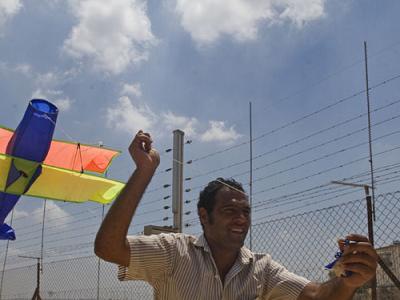
Israeli government closes case of killing of unarmed protester; cites ‘lack of evidence’
 Bassem Abu Rahme flying a kite (image from palestinechronicle)
B’Tselem – September 10, 2013
Four and a half years have passed since the killing of Bassem Abu Rahmeh by a tear gas canister fired at him directly from a short range. The death was documented by three video angles, but the Israeli state announced Monday it is closing the case citing lack of evidence
Military Advocate General (MAG) Maj. Gen. Danny Efroni decided to close the case file in the investigation of the circumstances of the killing of Bil’in resident Bassem Abu Rahmeh, citing lack of evidence. The MAG made this decision in late July, and it was recently conveyed to the Israeli High Court of Justice as part of an updating statement by the Office of the State Attorney in a petition filed by Subhiya Abu Rahmeh, Bassem’s mother, together with Bil’in Village Council and Israeli human rights organizations B’Tselem and Yesh Din.
According to the statement signed by Senior Deputy at the Office of the State Attorney, Att. Michal Michlin-Friedlander, and Assistant to the State Attorney, Att. Udi Eitan, also former Deputy State Attorney Yehoshua Lemberger had reached the same conclusion.
30-year-old Bassem Abu Rahmeh, a resident of the village of Bil’in, whose story was told in the film “Five Broken Cameras” nominated for Best Foreign Film in the Academy Awards, was killed in April 2009 after he was struck in the chest by an extended-range tear gas grenade during a demonstration against the Separation Barrier in his home village of Bil’in. Three video segments filmed during the demonstration prove that Abu Rahmeh was situated to the east of the barrier, did not act violently, and did not endanger the soldiers in any way. An analysis of the video footage of the incident, by visualization experts determined that the grenade was fired directly at Abu Rahmeh, in complete contravention of open-fire regulations.
In its response, the state did not explain the rationale behind its decision, limiting itself to the following laconic wording: “There is not enough evidence needed for criminal proceedings for adopting legal measures against any of the soldiers involved in the incident.” No information was given regarding the findings of the investigation, which the state argued had included “comprehensive and rigorous investigative actions,” or about the versions provided by the soldiers who had been questioned. Neither did the statement provide the contents of the opinions given by experts of the Israeli military and police and their interpretation of the findings disclosed by the video footage.
Ever since Bassem Abu Rahmeh was killed, his family – aided by NGOs Yesh Din and B’Tselem – has been continuously striving to have the truth of the incident brought to light and to have those responsible for their son’s death prosecuted. Their efforts have been repeatedly thwarted by the sluggish conduct of the MAG Corps. Due to the initial refusal by the MAG at the time to launch a Military Police investigation, the investigation was opened a year and half later than it should have. The foot-dragging and procrastination in the case have continued even once the investigation was launched over three years ago. Only a petition to the High Court of Justice finally brought about a decision in the case.
In response to the statement submitted by Office of the State Attorney, Att. Emily Schaeffer of Yesh Din’s legal team said: “The decision to close the file in the killing of Bassem Abu Rahmeh is unacceptable, particularly in view of the expert opinion that determined that the tear-gas grenade was fired directly at Abu Rahmeh from a close range. Despite three separate videos that recorded the killing of Bassem, the MP and police have failed to find the factors that caused the death of an unarmed demonstrator. The conduct of law enforcement bodies in this case is further proof of the feebleness of the authorities in cases of Palestinian casualties. Moreover, it seems that there might be no intention of finding out the truth or prosecuting the offenders even in extreme cases such as this, in which there is clear-cut and unambiguous evidence. Bassem’s family, together with B’Tselem and Yesh Din, will continue in its struggle to bring the parties responsible for his death to justice.”
Att. Yael Stein, Director of Research at B’Tselem, said in response: “The unbearable procrastination taken by the authorities in this case, and the fact that the MAG only made a decision due to a High Court Petition, once again demonstrate that the MAG Corps must adopt the recommendations of the Turkel Commission without delay. This includes determining a pre-defined schedule for each stage of the investigation, and ensuring that each stage is brief. Also, the statements made by investigative bodies about their decisions must include the reasoning underlying the decision so as to enable lodging effective appeals.”
Egypt and UAE plot to topple Hamas
MEMO | September 4, 2013
A retired Egyptian general has revealed details of an Egypt-UAE plot to impose a stranglehold on the Gaza Strip and overthrow the Hamas-led government. The plot, claims General Sami Hassan, is for the Egyptian army to act, with funding from the UAE government.
“The plan is led by General Abdel Fattah al-Sisi,” tweeted Hassan. “He aims to achieve political and military gains in the coming days.”
General Hassan said that the military will impose even more restrictions on the Palestinians in Gaza, cutting all essential supplies which currently pass through the tunnels. Fuel supplies in particular are being targeted. The Gaza Strip relies on Egypt for 80 per cent of its fuel.
According to Hassan, the process has already started with a media demonisation campaign against the Palestinians and Hamas. As soon as the army creates calm in the Sinai Peninsula, he asserted, it will stir up popular demonstrations.
Al-Sisi has already met with Shaikh Hazza bin Zayed, an adviser to the UAE National Security Authority, and ex-Fatah “strongman” Mohammed Dahlan, said General Hassan. “A sum of $750 million has been allocated for the plot,” he claims, “which will involve returning Gaza to Egyptian control or handing it over to the Palestinian Authority [in Ramallah].”
The decisive meeting, he noted, lasted one and a half hours in Al-Sisi’s office. The following objectives were agreed upon:
- Sinai will be “cleansed” of militant groups and nomadic tribes on the border with Gaza will be disarmed.
- A drone base will be established by Egypt in Sinai under international supervision. Air strikes will be launched against the “global jihadist movement”.
- All tunnels between Gaza and Egypt will be closed, and Egypt will cut off all essential supplies going to Gaza.
- Electricity supplies from Egypt to Gaza will be cut off altogether.
- An agreement between the Palestinian Authority, Egypt and Israel will be reactivated with the return of international observers to the Rafah Border Crossing.
- Hamas will be toppled and the Gaza Strip will be returned to President Mahmoud Abbas’s control.
- Power in Gaza will handed over to the PA or people in the UAE’s pay and control, such as Dahlan.
Related articles
- Egypt coup enters second phase: the overthrow of Hamas (alethonews.wordpress.com)
- Students campaign to expel Dahlan from UAE (alethonews.wordpress.com)
- Analyst: Mossad is behind Egyptian media’ incitement against Gaza (altahrir.wordpress.com)
- Egypt destroys Gaza tunnels, causes crisis (willyloman.wordpress.com)
- Egypt fires at Palestinian fishermen off Gaza: medics (willyloman.wordpress.com)
Egypt coup enters second phase: the overthrow of Hamas
MEMO | September 2, 2013
The military coup in Egypt is believed to have entered its second phase. The security forces affiliated with General Abdel Fattah al-Sisi, commander-in-chief of the Egyptian armed forces, have begun gradual attacks to topple the Hamas movement in the Gaza Strip, supported by incitement from the pro-Sisi media. A few obscure activists, meanwhile, have organised protests against the government in the Strip. The activists are believed to have received financial aid from the United Arab Emirates.
The news site, Secrets of Arabia, has observed signs of an orchestrated campaign, initiated by Egypt, to attack Hamas and overthrow its government in Gaza. Meanwhile, other sources have claimed that the UAE has been orchestrating the campaign in collaboration with Palestinian, former Fatah leader, Mohammed Dahlan, who works as a consultant for Abu Dhabi Crown Prince, Mohammed bin Zayed. Dahlan was expelled from Gaza following a failed attempt to topple the democratically elected Hamas-led government.
Over the past few weeks, Egyptian troops have launched an extensive campaign against the smuggling tunnels. The tunnels are used to transport essential goods to Gazans, who are suffering from the tight Israeli blockade. News was also leaked of an order by Egyptian security forces to demolish more than 500 houses near the Gaza Strip border and 500 meters deep into the Egyptian territories.
The operation to demolish Palestinian houses, on the border with Gaza, is considered a first of its kind in the history of the Egyptian-Palestinian relations. The operation has raised concerns in the region, of a possible Egyptian military action against Hamas and the tunnels. According to Egyptians residents of the area the Egyptian community believe that the operation is designed to strengthen the siege on Gaza.
Campaign of incitement
The Egyptian military’s actions are supported by an unprecedented campaign by the Egyptian pro-military coup media which calls on Palestinians to revolt against Hamas, in a clear, blatant and unprecedented intervention in the internal affairs of Palestine. Meanwhile, the same media channels have criticised non-Egyptians who interfere in the political affairs of Cairo.
The controversial Egyptian media personality, Tawfiq Okasha, surprised his viewers on Saturday evening with an unprecedented instigation against the Palestinians in Gaza. Okasha said the Palestinians must rise up against Hamas and that the Egyptian army would support them militarily to eliminate the movement.
Okasha is close to the General Sisi regime and is a prominent defender of the military coup. It is widely believed among Egyptians that Okasha reflects the official position of the army. He receives his instructions from the department of moral and military intelligence, which funds his al Faraein TV channel.
Gaza Rebellion
Meanwhile a new movement in Gaza has emerged under the name of Tamarod Gaza or Gaza Rebellion. The movement called on Palestinians in the Gaza Strip to voice their protests against the rule of Hamas on November 11th. The movement has stirred controversy on the Palestinian street.
The majority of the Palestinian residents in Gaza believe that members of the Gaza Rebellion movement are an extension of a counter-revolution led by the United Arab Emirates to topple the Arabs revolutions and Islamist rule in the Arab world. The movement is similar to Egypt’s Tamarod movement led by Egyptian, Mahmoud Badr. Badr is known as Mahmoud Cannabis due to claims of his previous involvement in the cannabis business. Badr built a deep relationship with the United Arab Emirates and was allowed to meet UAE Foreign Minister, Sheikh Abdullah bin Zayed Al Nahyan.
The Palestinians also believe that Mohammed Dahlan has been provoking problems in the Egyptian Sinai to drag the Egyptian army into confrontation with Gaza. Dahlan is also believed to be a supporter of the Gaza Rebellion which aspires to oust the Hamas government in Gaza, as the Muslim Brotherhood were ousted in Egypt.
Related articles
Egypt creates a buffer zone with Gaza
MEMO | September 2, 2013
The Egyptian army is working to create a buffer zone on the Egyptian border with the Gaza Strip in a purported effort to undermine weapon smuggling and chaos caused by militants in the Sinai Peninsula.
The military envisions that the ten kilometres long and 500 metre wide buffer zone is to be a building free area without trees. The area stretches from the Rafah Crossing through to the Mediterranean Sea.
Witnesses said that the Egyptian military bulldozers had started uprooting trees in the area and that 13 Egyptian houses had been destroyed in the al-Sarsouriya neighbourhood on Saturday.
At the time of writing this report, Egyptian military bulldozers were working fast razing sand-hills and trees in the area.
A military source, speaking anonymously, told the AP that homes had been knocked down over the last 10 days as a test of the buffer zone idea.
The interim Egyptian government said that this was a part of its “war on terrorism” campaign. The government and Egyptian mass media have been claiming that the tunnels between Egypt and Gaza have been used to smuggle weapons and Palestinian militants in to Egypt.
Egyptian residents in the neighbourhoods in the planned buffer zone took to the streets on Saturday, torching car tires and hurling stones at the Egyptian army in an effort to delay the demolition of their homes.
Witnesses said that the army called for residents to leave their houses through the loudspeakers of nearby mosques. The army bulldozers then immediately started damaging the houses.
“They did not give residents eviction notices and did not even give them enough time to collect their properties,” a tribal leader told AP.
In an interview with the Egyptian TV, CBC, Egyptian interior minister, Mohamed Ibrahim, claimed that the tunnels were the main cause of the uncertainty in Egypt. He insisted that prominent leaders of the Muslim Brotherhood had used the tunnels to enter and hide in Gaza.
Meanwhile, Hamas spokesman, Sami Abu-Zuhri, denied that the tunnels had been used to smuggle weapons and militants to Egypt or to smuggle Muslim Brotherhood leaders in to Gaza.
“Once they said that Osama Yassin was in Gaza, and two days later, they arrested him in Cairo,” Abu-Zuhri said in an example of the misinformation being reported on Gaza’s involvement in the Egyptian issue and the misuse of tunnels.
Since the end of the Israeli war on Gaza in 2008/2009, the tunnels have been used to smuggle goods, commodities and medicines. Numerous Palestinian, Egyptian and international journalists have observed the work of the tunnels.
They have reported that the tunnels have been used for humanitarian purposes in the light of the strict Israeli blockade on Gaza since 2006.
Featured Video

EUROPE FEARS RUSSIA’S NEXT MOVE / Ian Proud
or go to
Aletho News Archives – Video-Images
New Book
New Book: No Autoimmunity The Body Doesn’t Attack Itself
Lies are Unbekoming | September 24, 2026
 The label for Humira, once the best-selling drug in the world, lists its risks in plain print. One of them, in the label’s own words, is new “autoimmune” disease.
A drug prescribed for a condition labelled autoimmune carries a warning that it can cause a condition labelled autoimmune. That contradiction sits in every box, on a folded paper almost nobody reads.
My new book starts there.
No Autoimmunity: The Body Doesn’t Attack Itself
For seventy years, “your body is attacking itself, and we don’t know why” has ended the conversation for people diagnosed with multiple sclerosis, lupus, rheumatoid arthritis, Hashimoto’s, Type 1 diabetes, Crohn’s and psoriasis. More than eighty conditions now carry the autoimmune label. The diagnosis comes with a prescription for life. It almost never comes with a question about cause.
This book asks the question and answers it from the framework’s own records: its drug labels, its journals, its regulatory filings, and its own experiments. … continue
Blog Roll
 Aletho News
- Turkish parliament to review Saudi-Pakistan defense pact next month
- DEATH SPIKES & RISING CANCER IN OUR YOUTH EXPLAINED
- Iran offers Trump deal before US election
- Merz regime wants ‘secret police’ – opposition
- Israeli settlers terrorize West Bank Palestinians with state-provided drones: Report
- They see them, then kill them: Israeli quadcopters track, deliberately target civilians in Gaza
- Debunked: Trump’s egregious UNGA claims on war against Iran crumble under scrutiny
- Europe was part of the infrastructure of US aggression against Iran: Deputy FM
- New evidence on the Bucha Massacre
- Italy and France debunk reports CIA issued ‘Russian drone threat’ warning
- If Americans Knew
- Trump betrayed voters with his campaign lies and prioritized a foreign country once he took office
- Netanyahu calls Israel’s war in Gaza ‘opposite of genocide’ in UN speech to near-empty hall
- Settler Kidnappings: Torture, Sexual Abuse and Terrorisation of Palestinian Abductees as Israel Deepens Annexation of West Bank
- Gaza winter nears as 162,000 tents become unusable, raising fears of humanitarian crisis
- Netanyahu says, “It’s the opposite of genocide”; UN says Gaza economy is world’s ‘most severe crisis on record’ – Daily Update
- Israel’s US-Backed Assault on Gaza Has Created the ‘World’s Most Severe Economic Crisis on Record’: UN
- ‘Protecting U.S. Citizens’… From Israel
- ‘This is where I live now, the back of a truck’: a day in the life of a grandmother in Gaza
- In UN Speech, Iran’s President Displays Pictures of Children Killed by US, Brings Attention to Israel’s Nuclear Arsenal
- Israel displaces hundreds of Palestinians amid wave of demolitions in West Bank
- No Tricks Zone
- New Study: Earth And Venus Surface Warmth Largely Explained By Convection And Lapse Rate, Not CO2 Or Radiation
- 2025 Nature Paper Claiming Worsening Global Drought Gets RETRACTED …Heavily Flawed
- New Study: ‘Global Drought Shows No Detectable Recent Acceleration Under Climate Warming’
- Economic Masterminds: German Socialists Suggest Taxing Productivity Gains Stemming From Using AI
- The South China Sea Has Not Been Cooperating With The Climate Change Narrative
- Energy Crisis: Germany Enters Heating Season With Historically Low Gas Reserve Fill Levels
- New Study: The Antarctic Ice Sheet Gained Mass From 2020-2024 Due To Staggering Snow And Ice Accumulation
- Study: Ocean Heating Rates From Thousands Of Years Ago ‘Dwarf’ Modern Ocean Heating Rates
- Climate Extremists Target, Attack Large-Scale Power Grid Infrastructure In Germany!
- New Study: Antarctic Ice Melt Has Contributed Less Than 1 Centimeter To Sea Level Rise In The Last 30 Years

