Australian says Guantanamo was ‘six years of hell’
The Nation | October 17, 2010
Australia’s former long-serving Guantanamo Bay inmate David Hicks Saturday broke his silence on life inside the US-run prison, saying he endured deprivation and witnessed brutality in “six years of hell”.
Hicks said he was in a “haze of disbelief and fear, pain and confusion” when he arrived in Camp X-Ray in Guantanamo Bay, Cuba in early 2002 and was placed in a cage made of cyclone fencing.
“The first two weeks of Camp X-Ray was a blur of hardships: no sleeping, no talking, no moving, no looking, no information,” he writes in “Guantanamo: My Journey” released today.
The former terrorism suspect once dubbed the “Aussie Taliban”, who has since married and now lives in Sydney, was captured in late 2001 in Afghanistan where he had been accused of fighting alongside Taliban forces.
He spent more than five years in Guantanamo before being sent to home in April 2007 to serve out the remainder of the sentence handed down by the US military commission which had convicted him of providing material support for terrorism. He was released from a South Australian jail in late 2007.
Hicks, now in his mid-30s, is legally unable to profit from his book because Australia does not allow people to benefit from crime.
In three extracts released to the media free of charge, he speaks of how his thirst for travel was sparked by a chance encounter with an Israeli traveller when he worked in Japan training racehorses.
He also says he had intended to help the Kashmiri cause for independence but ended up trapped in Afghanistan as the US led efforts to crush the Taliban after the September 11, 2001 attacks in the United States.
He writes that while an Afghan man had risked his life to find him a safe haven in the northern city of Kunduz, he ended up attempting to take a taxi to the capital Kabul and was captured en route by a Northern Alliance soldier.
“After yelling directly into my ear, he took me by the hand and began to pull me away. I went to resist, but he made a gesture to go for his gun,” Hicks writes. “With dread, I resigned myself to the situation and allowed myself to be led away. This was the beginning of six years of hell.”
Afghan detainees claim US abuse
“Despite the government’s insistence that its detention rules meet the minimum requirements under international law, it appears that this facility is either ignoring those rules or interpreting them so loosely that they make detainees susceptible to mistreatment,” – Jonathan Horowitz, human rights expert and author of report.
By Andrew Wander | Al-Jazeera | October 15, 2010
Former US military prisoners in Afghanistan have said that they were abused in a secret prison on Bagram airbase as recently as this year, raising fears that detainee mistreatment has continued despite an overhaul of US detention operations in the country.
The abuse – which includes exposure to extreme temperatures, lack of adequate food and bedding, lack of natural light and interference with religious duties – is alleged to have occurred at a secret “screening” facility on the military base north of Kabul.
The existence of the site, known amongst Afghans as the “Tor Jail”, has never been admitted by US authorities, although it does acknowledge it runs a number of field sites in which prisoners are held immediately after being captured.
Prisoners are kept at the field sites before either being handed to Afghan authorities, released, or transferred to the main US detention facility at Parwan, on the edge of Bagram airbase.
International standards
The US task force responsible for running detentions in the Afghanistan insists that treatment in all its facilities meets international standards.
But a report released this week by the US-based Open Society Foundation, details the testimony of 18 detainees held at the Tor Prison who say they were mistreated there.
The testimony includes repeated claims that their cells were kept uncomfortably cold so they were unable to sleep, that they were given inedible food, and that bright lights were kept on in windowless cells 24 hours a day.
Such treatment would not only fall short of international standards for the treatment of prisoners, but also would run counter to US military’s own guidelines on the issue, which says prisoners should not be exposed to “excessive or inadequate heat, light, or ventilation”.
The differences between the secretive Tor Prison and the main Bagram site have raised questions about whether the smaller site is being run by a different military agency to other detention sites in the country, which come under the mandate of Joint Task Force 435 (JTF 435).
Jonathan Horowitz, the author of the report, told Al Jazeera that there appeared to be a link between the Tor Prison and US special forces activity in Afghanistan.
“JTF 435 does not run the facility,” he said. “The facility does seem to have tight links with forces operating under Joint Special Operations Command (JSOC). Whether they are the only ones in charge, I don’t know.”
“It’s worth noting that at the Detention Facility in Parwan [the main Bagram prison], there are also interrogators and isolations cells,’ he said.
“One of the big differences between the two sites is transparency. I assume that those in Tor Jail think they benefit from its secretive nature and don’t want to give that up.”
Detention overhaul
The allegations have come to light as the US military oversees a much-publicised effort to improve its record on detainee treatment in Afghanistan. Improved prison facilities have been built, and the International Committee of the Red Cross (ICRC) has been given better access to those held in US detention.
Eighteen prisoners who passed through the site were interviewed for the report. Half of them said that they had been taken to the prison in 2009 and 2010, after Barack Obama, the US president, had already ordered an overhaul of detention operations in Afghanistan.
The US military has denied that it runs secret prisons in Afghanistan, and said it does not mistreat the prisoners it holds there, insisting that conditions are compliant with both the Geneva Coventions and the military’s own guidelines.
Lieutenant Colonel Elizabeth Robbins, a Pentagon spokesperson, said the US department of defence (DoD) “takes all credible allegations of detainee mistreatment very seriously”.
“Furthermore, DoD conducts thorough and regular assessments of all of its detention facilities and operations to maintain oversight, accountability and to ensure humane treatment of detainees,” she said in an email to Al Jazeera.
The US military does run temporary detention and screening facilities in Afghanistan, “which are classified to preserve operational security,” she said. “However, both the ICRC and the respective host nations have knowledge of these facilities … [and] these facilities are consistent with international and US law.”
Oxfam: Israeli policies damaging to the Palestinian olive oil industry
Ahmed Zaki Osman – 15/10/2010

Oxfam has reported that Palestinian olive groves are frequently attacked by Israeli settlers, file photo
The Israeli occupation of the West bank and siege of Gaza are seriously harming Palestinian olive oil production which contributes up to US$100 million annually for some of the most underprivileged Palestinian families, the international NGO Oxfam said in a report on Friday.
The report, entitled, “The Road to Olive Farming: Challenges to developing the economy of olive oil in the West Bank,” blames Israel for restricting access to land and olive tree farms.
“Around 40 percent of the West Bank is effectively off-limits to Palestinians, with access highly restricted, due to settlements, outposts, bypass roads, military bases, closed military areas and areas Israel has declared as being nature reserves,” the report said.
For centuries Palestinian olives have been a major commercial crop and are credited with being some of the best in the world.
Olives and olive oil are one of the main sources of income for the Palestinian economy. They represent around half of agricultural land use in the West Bank and the Gaza Strip as well as being a major export, and provide employment and a large source of income for around 100,000 farming families.
According to the report there are approximately 10 million olive trees with the potential to produce up to 34,000 metric tons of olive oil in a good year, but only 5,000 tons in a bad year. The average quantity of oil produced annually between 2001 and 2009 was around 17,000 tons.
Harmful impacts of Israeli policy also include settler violence sanctioned by the government, incidents in which illegal Israeli settlers have uprooted or burned tens of thousands of olive trees during their attacks against Palestinian farmers.
According to the United Nations, in the first six months of 2010 thousands of olive trees and other crops have been damaged by settlers.
Oxfam accused Israel of intentionally restricting access for Palestinian farmers to local and international markets, especially since the beginning of the second intifadha.
“Physical barriers such as checkpoints and road blocks have restricted the free movement of people and goods within the West Bank and obstructed access for Palestinian agricultural produce, including olives and olive oil, to internal, Israeli and international markets,” the report concluded.
As for Gaza, the picture is even gloomier since inhabitants cannot even get olives from the West Bank olives since the blockade started.
The IDF kills 1 Palestinian civilian every 2 days, on average, with impunity
By Philip Weiss on October 15, 2010
Every other day, the IDF kills a Palestinian civilian with impunity in the occupied territories. And the Israelis have treated these killings as “combat action,” reports B’Tselem in a report on Israeli military killings in the occupied territories, 2006-2009, not including the Gaza war.
From 2006 to 2009, the IDF killed 1,510 Palestinians, not including Palestinians killed in Operation Cast Lead. Of these 1,510 deaths, 617 were of persons who were not taking part in hostilities.
Regarding these 617 fatalities, BʹTselem demanded an MPIU [Military Police Investigation Unit] investigation into the deaths of 288 of them, who were killed in 148 incidents. Ninety‐five of these incidents occurred in the Gaza Strip, accounting for 230 of the deaths. The other 53 incidents took place in the West Bank and resulted in the killing of 58 Palestinians. One hundred and four of the fatalities were minors under age 18, 23 were persons 50 and above, and 52 were women. One hundred of the Palestinians whose deaths B’Tselem demanded to investigate were killed in 2006, 86 in 2007, 93 in 2008, and 9 in 2009.
Stephen Lendman‘s comment:
Most are witnessed by bystanders whose testimonies are crucial to achieve justice. Yet Israel won’t use them, clearly hiding the truth and obstructing justice.
Further, since September 2000, B’Tselem received no response from the Judge Advocate General’s Office for ” the vast majority” of cases warranting investigation, civilians killed in cold blood, responsible soldiers unpunished.
More from the B’Tselem release:
From the beginning of the first intifada, in December 1987, to the outbreak of the second intifada, in September 2000, the Military Police Investigation Unit (MPIU) investigated almost every case in which Palestinians not taking part in hostilities were killed. At the beginning of the second intifada, the Judge Advocate General’s Office announced that it was defining the situation in the Occupied Territories an “armed conflict,” and that investigations would be opened only in exceptional cases, in which there was a suspicion that a criminal offense had been committed..
B’Tselem protests the sweeping classification of the situation in the Occupied Territories as an “armed conflict,” which effectively grants immunity to soldiers and officers, with the result that soldiers who kill Palestinians not taking part in hostilities are almost never held accountable for their misdeeds. By acting in this way, the army fails to meet its obligation to take all feasible measures to reduce injury to civilians, allows soldiers and officers to violate the law, encourages a trigger-happy attitude, and shows gross disregard for human life.
Letter from an Israeli (Birmingham) Jail

Israel is probably one of the most thoroughly segregated and intolerant nations
By Dallas Darling | Palestine Chronicle | October 14, 2010
If Martin Luther King would have been a Palestinian, I sometimes wonder how Israeli authorities would have treated him. This came to mind again when it was reported that an Israeli military court sentenced Palestinian nonviolence activist Abdullah Abu Rahmeh to one year in prison. Evidently, the military tribunal found him guilty of “incitement” and for organizing illegal protests. It also fined him $1,400, a stiff penalty for someone who lost over half of his farmland to land seized by Israeli settlement programs.
Similar to Martin Luther King, Abdullah Abu Rahmeh has experienced years of racial oppression and religious intolerance. Like Martin Luther King who founded the Southern Christian Leadership Conference to help achieve equality for blacks, Abdullah Abu Rahmeh is the coordinator of the Bilin Popular Resistance Committee against the Wall and Settlements. Since 2005, the movement has nonviolently challenged Israeli segregation and exclusive religious laws. It has also peacefully resisted Israeli bulldozing of Palestinian homes and annexation of Palestinian villages and land.
As Israeli security and military forces fire teargas canisters into the marching crowd, some of the protests have turned violent. Israeli rubber bullets have killed several protesters too. Still, Palestinian teens have thrown stones at soldiers while protesting. The Israeli military claimed several Palestinian teens confessed Abdullah Abu Rahmeh told them to throw stones. They have accused him of inciting violence and riots. However, Abdullah Abu Rahmeh has denied such charges and instead, he claims to have pursued nonviolent strategies while encouraging the youth to stop throwing stones.
In 1963 and before the Jobs and Civil Rights March on Washington, Martin Luther King brought the movement for equality and freedom to Birmingham, Alabama. President John Kennedy was embroiled with the effects of the Cuban Missile Crisis and appeared distant from the urgent need to initiate a courageous civil rights law for America. After watching newsreel footage of false arrests, police beatings, attack dogs ripping apart protesters, and the city’s fire department hosing passive marchers with enough force to break their bones, some were finally convinced-including President Kennedy-that segregation had to end.
Like Abdullah Abu Rahmeh, Martin Luther King was jailed for his nonviolent direct action campaign in Birmingham. A group of white Alabama ministers put an ad in the New York Times condemning Martin Luther King of being an “agitator” and wanting only to evoke violence and to start a riot. They tried to convince him to end his campaign and to wait, that the future would be better for black Americans. His response, or the Letter From A Birmingham Jail, was written on scraps of paper and in the margins of a newspaper. Can the contents of the letter be applied to Abdullah Abu Rahmeh and Palestinians and Arabs living under Israeli rule and in Occupied Territories?
Therefore, if Martin Luther King was a Palestinian and had been arrested and jailed, like Abdullah Abu Rahmeh, this is what the Letter From An Israeli Jail would say:
I am in Israel because injustice is here. Just as the eighth century prophets left their little villages and carried their ‘thus says God’ far beyond the boundaries of their home town, I too am compelled to carry the message of freedom beyond my particular home town. Moreover, I am aware of the interrelatedness of all communities and states. I cannot sit idly by and not be concerned about what happens in Israel. Injustice anywhere is a threat to justice everywhere. We are caught in an inescapable network of mutuality, tied in a single garment of destiny. Whatever affects one directly affects all indirectly. (1)
Israel is probably one of the most thoroughly segregated and intolerant nations. Its ugly record of police brutality and military incursions are known in every section of the Middle East. Its unjust treatment of Palestinians and Arabs in the courts is a notorious reality, as are the numerous false imprisonments of men, women and children. There have been more unsolved bombings and bulldozing of Palestinian homes and attacks on mosques in Israel than any nation in the Middle East. There have also been unsolved killings and a complete disregard for basic human rights and civil liberties. (2)
You may well ask: “Why direct action? Why sit-ins, marches, etc.? Isn’t negotiation a better path?” You are exactly right in your call for negotiation. Indeed, this is the purpose of direct action. Nonviolent direct action seeks to create such a crisis and establish such creative tension that a nation that has constantly refused to negotiate is forced to confront the issue. It seeks so to dramatize the issue that it can no longer be ignored. I have worked against violent tension, but there is a type of constructive nonviolent tension that is necessary for growth. It is the kind of tension that will help men to rise from the dark depths of prejudice and racism to the majestic heights of understanding and unity. (3)
Nations and groups are more immoral than individuals. We know through painful experience that freedom is never voluntarily given by the oppressor; it must be demanded by the oppressed. Frankly, I have never yet engaged in a direct action movement that was “well timed,” according to the timetable of those who have not suffered unduly from the disease of segregation and religious intolerance. For years now, I have heard the word “Wait!” It rings in the ear of every Palestinian with a piercing familiarity. This “Wait” has almost always meant “Never!” We must come to see with the distinguished jurist of yesterday that “justice too long delayed is justice denied. (4)
But when you have seen vicious mobs kill your mothers and fathers at will and bulldoze your sisters and brothers at whim; when you have seen hate filled security forces kick, brutalize, bomb, use as human shields, and dance around and humiliate your Palestinian and Arab sisters and brothers with impunity; when you see the vast majority of your people smothering in an airtight cage of poverty in the midst of an affluent society; when you are forever fighting a degenerating sense of “nobodiness”; then you will understand why we find it difficult to wait. There comes a time when the cup of endurance runs over, and men are no longer willing to be plunged into an abyss of despair. (5)
One may well ask: “How can you advocate breaking some laws and obeying others?” There are, in fact, two types of laws: There are just and there are unjust laws. Any law that uplifts human personality is just. Any law that degrades human personality is unjust. All segregation and religious intolerance statutes are unjust because they distort the soul and damage the personality. It gives the segregator and intolerant a false sense of inferiority. To use the words of Martin Buber, the Jewish philosopher, segregation and intolerance substitutes an “I-it” relationship for an “I-thou” relationship, and ends up relegating persons to the status of things. Segregation and intolerance are existential expressions of man’s tragic separation and awful estrangement. (6)
Of course, there is nothing new about this kind of civil disobedience. It was seen sublimely in the refusal of Shadrach, Meshach and Abednego to obey the laws of Nebuchadnezzar because a higher moral law was involved. We can never forget that everything Hitler did in Germany was “legal” and everything the Hungarian freedom fighters did in Hungary was “illegal.” It was “illegal” to aid and comfort a Jew in Hitler’s Germany. But I am sure that if I had lived in Germany during that time I would have aided and comforted my Jewish brothers even though it was illegal. (7)
But the Jewish and American moderates are more devoted to “order” than to justice: who prefers a negative peace which is the absence of tension to a positive peace which his the presence of justice. Shallow understanding from people of goodwill is more frustrating than absolute misunderstanding from people of ill will. I had hoped that Jewish and American moderates would understand that law and order exist for the purpose of establishing justice, and that when they fail to do this they become dangerously structured dams that block the flow of social progress. (8)
Actually, we who engage in nonviolent direct action are not the creators of tension. We merely bring to the surface the hidden tension that is already alive. We bring it out in the open where it can be seen and dealt with. Like a boil that can never be cured as long as it is covered up but must be opened with all its pus-flowing ugliness to the natural medicines of air and light, injustice must likewise be exposed, with all of the tension its exposing creates, to the light of human conscience and the air of global opinion before it can be cured. (9)
Oppressed people cannot remain oppressed forever. The urge for freedom will eventually come. This is what happened to the Palestinians and Arabs. Something within has reminded them of their birthright of freedom; something without has reminded them that they can gain it. Consciously and unconsciously, they have been swept in by what the Germans call the Zeitgeist, and with their black brothers of Africa, and their brown and yellow brothers of Asia, South America and the Caribbean, they are moving with a sense of cosmic urgency toward the promised land of racial justice and religious tolerance. (10)
(Note: Many international human rights organizations have already denounced Israel’s arrest and sentencing of Abdullah Abu Rahmeh, including Archbishop Desmond Tutu. During World War Two, Arabs and Palestinians also assisted Jews fleeing Germany and the Third Reich.)
– Dallas Darling is the author of Politics 501: An A-Z Reading on Conscientious Political Thought and Action, Some Nations Above God: 52 Weekly Reflections On Modern-Day Imperialism, Militarism, And Consumerism in the Context of John‘s Apocalyptic Vision, and The Other Side Of Christianity: Reflections on Faith, Politics, Spirituality, History, and Peace. He is a correspondent for www.worldnews.com. He contributed this article to PalestineChronicle.com. Visit: www.beverlydarling.com and wn.com//dallasdarling.
Notes:
(1) Young, Ralph F., Dissent In America, The Voices That Shaped A Nation. New York, New York: Parson Longman Publishers, 2006., p. 551.
(2) Ibid., p. 552.
(3) Ibid., p. 553.
(4) Ibid., p. 553, 554.
(5) Ibid., p. 554.
(6) Ibid., p. 555.
(7) Ibid., p. 556.
(8) Ibid., p. 556.
(9) Ibid., p. 556.
(10) Ibid., p. 558.
Without Water, There is No Life
By ZIAD ABBAS | CounterPunch | October 15, 2010
Since I started working at Middle East Children’s Alliance, the MAIA Project to bring clean water to the children of Palestine has become closest to my heart. All of our projects are important for people in Palestine, Lebanon and Iraq, but the MAIA Project is connected to my history and my family. It takes me back to the days when I struggled with my family to bring clean water to our house so we could drink, cook and, sometimes, have a shower. My mother, sisters and I would carry gallons of water in heavy containers on our heads. Providing this essential for our family made my mother physically strong, her arms and shoulders shaped by her efforts, but her health suffered greatly. Much work and time is required to achieve the basic necessity of clean water. I still remember the weight of the water and the great responsibility on our necks and backs everyday.
Israel controls and uses 89% of the water resources in the West Bank, leaving 11% for the 2.5 million Palestinians. The Israeli Occupation continues to limit Palestinian access to clean water as form of collective punishment by controlling the water resources and distribution and by destroying the water that we are able to get. During Israeli military incursions, and especially during curfews, when we could not leave our homes, Israeli soldiers would shoot the water storage tanks on our roofs. Our water would pour down the sides of our buildings unused. During the recent attack on Gaza, Israel targeted the entire water infrastructure including the largest water purification system in Gaza. They also targeted electrical generators that supported water purification and sewage treatment. This kind of collective punishment is also used against Palestinians inside Israel. Palestinian villages “unrecognized” by the Israeli state are not connected to the national water grid that serves all Jewish communities, and the residents suffer from a lack of clean water.
In 1994 and 2001 I visited Black townships in South Africa. When the inhabitants in the townships explained their daily lives, they focused on the scarcity and difficulty in obtaining clean water. Water, they said, was only for the white people of South Africa. I immediately understood and thought that we could substitute Palestinian refugee camps for the South African townships. It is the same system of oppression. During apartheid access to public spaces, especially public beaches, was restricted according to race. The beautifully maintained beaches were accessible only for the white people. This is the same situation found in Palestine now. Israel severely restricts our access to the Dead Sea, the Red Sea, the Mediterranean, and Lake Tiberias. Palestinians are forced to apply for permits from the Israelis to access these sites, even for a simple visit. Even when limited access is allowed, such as in Gaza, the coastline is often flooded with untreated sewage as a result of damage done by Israeli bombardments.
As I was writing this article, I spoke with Dr. Mona El-Farra, MECA’s Project Director in Gaza. We were discussing the current water situation and she was saying that the tap water in her apartment was unusable. She said “Ziad, the water here is polluted and undrinkable, more than that it is unusable for cleaning. Some people have started to lose their hair from showering with this water. The new business in Gaza is selling clean water from tanks around the city. Of course it is expensive and since few people are employed they cannot buy the water. People here are constantly sick from the lack of clean water.” She added that as a doctor she is seeing an increase in kidney disease, dysentery and other serious medical conditions related to polluted water. If people are lucky enough to survive the Israeli air strikes and sniper fire they go on to face the threat of dirty, dangerous water.
Images from Gaza show water tanks driven around the cities, people waiting in lines for water, and children carrying empty water containers searching for water to fill them. Children in Gaza are missing their childhood. They are defined as children by their age but they live as survivors, not as children. They are taking responsibility to protect themselves and their families. When I was a child in a refugee camp in the West Bank, our struggle to obtain basic necessities to survive was the same. Thirty-five years later, Palestinian children are still forced to grow up too soon.
The Middle East Children’s Alliance is working to support the rights of children, particularly the right of Palestinian children to survive and flourish. In the last two years, MECA’s Maia Project has succeeded in building 22 water purification systems in primary schools and kindergartens giving nearly 25,000 children access to clean water. As a result, thousands of mothers will feel less frightened that their children might be harmed by polluted water. Dr. El-Farra has witnessed the precious moments of accomplishment and pride when a new unit is installed.
MECA’s Maia Project seeks to expand to all the schools in Gaza so more children can realize their right to clean water. In South Africa apartheid has ended, but water injustice is still something the inhabitants of the Black townships and other marginalized communities struggle against on a daily basis. In Palestine, we are still struggling against the Israeli apartheid system that deprives us of our basic human rights, including the right to one of the most important things in life: Water.
Ziad Abbas works for the Middle East Children’s Alliance.
Israeli bulldozers raze 40 Araqib homes for the sixth time
Palestine Information Center – 13/10/2010
 Israeli forces at Araqib – Photo Credit /Mathew Graber

NEGEV — The Israeli municipality teams tore down 40 Palestinian homes in the Araqib village in the Negev desert, occupied since 1948, on Wednesday under heavy police protection.
Locals said that the inhabitants appealed for support in face of their ordeal, describing the repeated demolition of their village homes as a reflection of “deep-rooted hatred”.
Israeli police and special forces blocked journalists from entering the village and forced them to park their cars two kilometers away.
Awad Abu Freih, a spokesman for the committee in defense of Araqib, said that the demolition teams “want to establish special plantations for Jews at the expense of the villagers”.
The Israeli municipality teams left the village after leveling it to the ground as a huge bulldozer on its way out destroyed a large placard carrying the name of the village.
Israeli Knesset member: Stone throwers should be put to death
Palestine Information Center – 13/10/2010

OCCUPIED JERUSALEM — Far right Israeli Knesset member Michael Ben-Ari called for the death penalty to be placed against “everyone who throws stones or endangers the lives of settlers.”
The two Arab members of Knesset Talab Al Sane and Ahmed Al Tibi described Ben-Ari as an “extremist fascist”. The former responded by accusing them of “using children to kill”.
This came during an urgent meeting that was convened to deliberate the incident of the settler chief in east Jerusalem David Bari who ran over and seriously injured two boys after they allegedly threw stones at his vehicle.
“This is not the first time Arab citizens in Silwan have used children in dangerous circumstances, and send them to confront Jewish citizens who are passing by,” said MK Danny Damon
Ben-Ari previously said that 500 Palestinians should be killed against every one Jew, and not six to one as is the case today, claiming that this is the only way to stop “Palestinian terrorism”.
Israel’s Internal Security minister Yitzhak Aharonovich has instructed the Jerusalem police force to launch a wide-ranging arrest campaign in the eastern areas of the city in an effort to reduce the phenomenon of stone-throwing at Jewish settlers in the regions.
Aharonovich said while touring the Jerusalem districts of Issawiya and Silwan Tuesday morning: “Dozens of stone throwers will be arrested if necessary in order to restore calm and order.”
The statement was made in the wake of dozens of youngsters who confronted the provocative tour by throwing stones at the cars of right-wingers from the Israeli Knesset.
Canada: Harper government’s policies lead to loss of UN Security Council seat
October 12, 2010 – Canadian Arab Federation
“The Harper government must take full responsibility for Canada losing the race for a UN Security Council seat. This is as a result of the misguided positions taken by the Harper government domestically and within such key international bodies as the UN General Assembly and the UN Human Rights Council that undermine human rights, environmental rights and global principles,” said Khaled Mouammar, CAF National President.
Since coming to power in 2006, the Harper government’s actions have set back or weakened crucial international human rights initiatives such as global protection of the rights of Indigenous peoples, protection of the human rights of the Palestinian people under occupation, protection against torture, the rights of women, the rights of children, and the rights of gays and lesbians.
Domestically, the Harper government has systematically undermined democratic institutions and practices, and has eroded the protection of free speech by cutting or threatening to cut funding to organizations that disagree with government policies as in the case of the Canadian Arab Federation, KAIROS, MATCH International, Alternatives, the Canadian Council for International Co-operation, the National Association of Women and the Law, and the Canadian Research Institute for the Advancement of Women.
A glaring example is the government’s refusal to repatriate Omar Khadr to Canada , after the decision of the Supreme Court of Canada that found Canada is responsible for continuing violations of Omar Khadr’s human rights, a stand that has shamed Canada on the world stage.
“By denying the Harper government a seat on the UN Security Council the international community has signalled its displeasure with the government’s performance on the world stage. Canadians lament Canada’s loss of influence in the world and deserve a government that does not tarnish Canada ’s reputation internationally and that does not seriously threaten the quality and health of democratic life in Canada,” said Khaled Mouammar, CAF National President.
Aletho News adds:
The Council of Canadians states that it hopes that this vote will be a wake-up call for all Canadians that after almost five years in power, Prime Minister Stephen Harper has diminished Canada’s international standing to the point that what is normally a rubber-stamp for Canada to take our regular rotation on the Security Council has become a national embarrassment.
Isolating prisoners a war crime
Palestine Information Center – 11/10/2010
GAZA — Minister of prisoners in Gaza Dr. Mohammed Al-Ghoul has described the Israeli occupation authority’s (IOA) policy of isolating Palestinian prisoners as a war crime.
He said in a press release on Monday that the isolation of MP Ahmed Saadat, the secretary general of the popular front for the liberation of Palestine, and many others is an attempt to break their determination and subject them to the Israeli prisons authority’s (IPA) dictates.
The minister charged that the policy is in violation of the international doctrines and agreements that incriminate humiliating and torturing humans and isolating them.
The IOA is trying to turn the isolated prisoner into a mentally and physically disturbed person, adding that the IPA isolates 16 Palestinian prisoners in the “slow death isolation graves”.
He pointed out that some of them had spent 18 years [in isoloation] such as Uwaida Kallab who lost his mind as a result of the cruel isolation conditions.
Ghoul castigated the Arab and international parliaments for remaining silent toward such a policy against MP Saadat and others.
The IOA does not put a time limit for the isolation of prisoners in a bid to increase the psychological pressures on them and renews their isolation in summary trials in which the prisoners are not informed of reasons for their solitary confinement.
The minister asked the international organizations to intervene and put an end to the “policy of death” against prisoners in isolation.
Saadat has been held in solitary confinement for one and a half years.
The Wa’ed society for prisoners warned of the continued isolation of Saadat in a statement on Monday on the 500th day of his isolation.
It said that the IOA was planning to harm those in isolation, calling on human rights groups to step in and demand a halt to such a crime against humanity.
EU police mission complicit in Israeli, PA rights abuses
David Cronin, The Electronic Intifada, 12 October 2010
 |
Palestinian police officers attend an EU police training course organized in the West Bank city of Qalqiliya, October 2009. (Khaleel Reash/MaanImages) |
A bizarre public relations exercise is now underway in the West Bank. Doubtlessly inspired by the enduring popularity of TV drama CSI: Crime Scene Investigation, the European Union has been trying to glamorize a forensic science course it has been running for Palestinian police since mid-September. As well as being tutored on fingerprinting techniques and the use of chemicals following a murder or armed robbery, officers completing the six-week program will be given CSI vans of their own, “updates” promoting the course tell us.
It is not difficult to see why EU officials are eager to obtain favorable publicity for their police support “mission,” headquartered in Ramallah. For all of its five-year life, the mission has been something of a poor relation to the other major international policing initiative in the occupied West Bank: that run by United States security coordinator US Army Lieutenant General Keith Dayton (replaced by US Air Force General Michael Moeller earlier this month). At a time when the EU’s 27 governments are nominally striving to make a greater collective impact on the world stage, it is logical that they should be highlighting foreign policy work that at first glance appears laudable.
The reality is far from glamorous. Rather than helping to nurture institutions that could prove essential in a future Palestinian state, both the EU and US are acting as proxies for the Israeli occupation. Moreover, they are acquiescent in human rights abuses perpetrated by Palestinian Authority (PA) security forces against the Palestinian people.
Contrary to the impression frequently created by news stories, the PA does not have a police force that can justifiably be viewed as independent of Israel. Under the Oslo accords from the 1990s, the PA was given full responsibility for security in a region dubbed “Area A.” This comprises six West Bank cities — Jenin, Nablus, Qalqilya, Ramallah, Tulkarem and Bethlehem — and part of Hebron. In Area B — other towns and villages, where 68 percent of Palestinian inhabitants in the West Bank lived — the authority was tasked with maintaining public order but Israel was allowed “overriding” responsibility for security. Then in Area C — 62 percent of the West Bank, including Jewish-only settlements and other areas deemed of “strategic importance” to Israel — total control over security remained in Israeli hands. Moreover, under the Oslo accords, the PA police forces only have jurisdiction over the Palestinian population, not over territory; they have no powers to arrest, or intervene with Israeli settlers or other Israeli citizens even when they are present in areas ostensibly under PA control.
For the Palestinians, it has proven impossible to operate a police service that could comply with international norms. Regular incursions by Israeli troops throughout the West Bank has meant that patrols by Palestinian officers cannot be undertaken in any city, apart from Ramallah, between midnight and six o’clock in the morning.
The response from the EU mission (its proper name is the Coordinating Office for Palestinian Police Support or COPPS) to Israel’s everyday acts of aggression and intimidation has been timid, to say the least. The strongest words that Hendrik Malmquist, the Swedish officer heading the mission, has used on the record to criticize the Israeli incursions is to call them a “public embarrassment” for the Palestinian Authority.
Maybe his nonchalance is best explained by how COPPS is part of what Israeli human rights campaigner Jeff Halper calls the “matrix of control” imposed by Israel on the occupied West Bank and Gaza Strip. Visiting Brussels in May, Malmquist said that Israel is “happy we are there in order to contribute to better security in the [occupied] territories.” Probably the main reason for Israeli satisfaction with his work is that his eighty-strong staff has been assisting the forces of occupation to strengthen their grip over most aspects of Palestinian life.
When I contacted EU officials in Ramallah recently, they sought to downplay the significance of their role in fostering cooperation between Israeli and Palestinian Authority security forces. The officials pointed, for example, to how they have organized joint Israeli-Palestinian training seminars on apparently uncontroversial issues such as traffic management. “We are not in the political game,” one official insisted.
A document published by the Israeli foreign ministry in April however indicates that the cooperation goes deeper. Titled “Measures Taken by Israel in Support of Developing the Palestinian Economy,” it says that COPPS has played a “central role” in encouraging and implementing “capacity-building” in the West Bank. The purpose of this “capacity-building,” the paper makes clear to anyone who reads between its lines, is to stress that the Palestinian Authority forces are subservient to Israel. Last year, the ministry gloats, was a record one for “coordinated actions” between Israeli and PA security forces, with almost 1,300 taking place, a 72 percent rise over 2008.
In its monthly newsletters, COPPS promotes the training offered by its human rights specialist Diane Halley to Palestinian police. This propaganda cannot be allowed to mask how the EU has enabled a situation to develop where gross abuses occur within a culture of impunity. Whereas COPPS’s original mandate allowed it to support police in both the West Bank and Gaza, the European Union’s refusal to engage with the de facto Hamas administration in Gaza has meant that it has been encouraging disunity among Palestinians.
Worse again, the EU has connived in the creation of what an alliance of Palestinian human rights groups recently called “a police state” within the occupied territories. While these groups — including the Palestinian Centre for Human Rights, Al-Haq and the Women’s Center for Legal Aid and Counselling — stress that most violations committed by the Palestinian Authority are a “direct result” of tensions between Fatah and Hamas, the EU has been largely silent about the abuses.
During a press briefing in May, Malmquist stated that COPPS wishes to “export core European Union values” such as respect for fundamental rights. A few minutes later, Palestinian police spokesman Yossef Ozreil insisted that there is “no more torture” by his colleagues against political rivals.
Malmquist did not contradict this assurance, yet evidence amassed by the Arab Organization for Human Rights suggests that Ozreil was dishonest. Mohammed Jamil, a spokesman for the organization, said that there is an average of seven arrests in the West Bank each day, with between 700 and 800 rounded up in the Hebron area last month after Hamas gunmen killed four Israeli settlers. Torture of detainees is widespread, he added. Methods found to have been used include tying people to the ceiling and suspending them, aping crucifixions by tying people to doors with their arms and legs outstretched and beatings by sticks. One man was tortured by having a boiled egg placed on his backside, Jamil told me. “They [the security forces] made jokes about him — that he was like a chicken giving birth to eggs.”
On paper, the main distinction between COPPS and the US security coordinator in the West Bank is that the former interacts with the Palestinian Authority civil police and the latter with the more militarized National Security Force. In practice, there is extensive overlap between the two international operations; Dayton has said that one of his objectives was to eliminate any duplication of efforts between aid donors to the Palestinian Authority. As well as employing several British members of staff in his team, Dayton enjoyed close contacts with the two Britons who headed COPPS before Malmquist took up his post in January this year: Colin Smith and Paul Kernaghan.
The extent to which Dayton may have advised forces loyal to Fatah to resort to brutal means in attacking Hamas supporters has not yet been revealed. One thing that is clear, however, is Dayton’s understanding that his job was to underscore the Palestinian Authority’s subordination to Israel. “We don’t provide anything to the Palestinians unless it has been thoroughly coordinated with the state of Israel and they agree to it,” he has said.
Daud Abdullah, director of Middle East Monitor, a research institute in London, says it is inconceivable that Dayton was unaware of the abuses conducted by Palestinian security forces. “There has been no let-up in abuses as far as we know,” Abdullah added. “The fact that money is still flowing and [international] officials are still on the ground makes them culpable for what is happening.”
COPPS has a budget of nearly 7 million euros ($9.7 million) for this year. This sum appears small on its own. Yet it cannot be separated from the wider support that the EU gives to the Palestinian Authority, which amounts to 947 million euros since 2008.
Europe’s representatives rarely miss an opportunity to trumpet their generosity to the Palestinians. Although donors are undoubtedly financing the provision of many essential services in the occupied territories, tough questions need to be asked about a great deal of this aid and how it is being tailored to serve Israel’s interests. Few taxpayers would be pleased to know that their hard-earned euros are subsidizing an illegal occupation and the systematic human rights abuses that go with it.
David Cronin’s book Europe’s Alliance With Israel: Aiding the Occupation, to be published on 20 November, can be pre-ordered from www.plutobooks.com.
Israeli military court sentences protest leader to 1 year
Ma’an – 11/10/2010
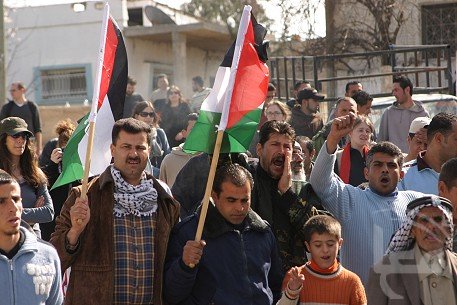
RAMALLAH — An Israeli military court on Monday sentenced non-violent protest organizer Abdallah Abu Rahmah to 12 months imprisonment, with a six-month suspended sentence.
Abu Rahmah has been in an Israeli jail since December, and was convicted in August of incitement, and organizing and participating in protests in Bil’in. Ofer military court also ordered Abu Rahmah to pay a 5,000 shekel fine (almost $1,400).
At his hearing in August, the military prosecutor requested an exceptionally harsh sentencing in order to deter Abu Rahmah and to intimidate others, a statement from the Popular Struggle Coordination Committee said.
PSCC spokesman Jonathan Pollak said the committee would appeal the sentence.
Abu Rahmah is a coordinator of the Bil’in Popular Committee Against the Wall and Settlements. Weekly protests are held in Bil’in against confiscation of village land to build illegal Israeli settlements.
Israeli military law in the West Bank uses a much stricter definition of illegal assembly than Israeli civilian law, in practice forbidding more than 10 people from assembling without receiving a permit from the military.
According to his supporters, Abu Rahmah’s conviction was based only on testimonies of minors who were arrested in the middle of the night and denied legal counsel despite significant concerns, acknowledged by the court, over their questioning.
The protest leader’s detention was internationally condemned. EU foreign policy chief Catherine Ashton said “The EU considers Abdallah Abu Rahmah to be a Human Rights Defender committed to non violent protest against the route of the Israeli separation barrier through his West Bank village of Bil’in.”
The Intergroup for Palestine, an official body of the Spanish Parliament represented by all political parties, issued a statement expressing its “deep concern that Abdallah Abu Rahmah’s potential incarceration aims at preventing him and other Palestinians from exercising their legitimate right to protest against the existence of the Wall in a non violent manner.”
Archbishop Desmond Tutu said he had been “very impressed” by Abu Rahmah’s commitment to non-violence and wise leadership, and said “Israel’s attempt to crack down on this effective resistance movement by criminalizing peaceful protest is unacceptable and unjust.”
Abdallah is the recipient of the the Carl Von Ossietzky Medal for Outstanding Service in the Realization of Basic Human Rights, which is awarded by the International League for Human Rights in Berlin.
Featured Video
The American Retreat from Vietnam
or go to
Aletho News Archives – Video-Images
From the Archives
Secret document reveals plans for civil war in Lebanon, Israeli false flags, and invasion
By Randi Nord | Geopolitics Alert | April 5, 2019
Beirut – During his visit with US Secretary of State, Mike Pompeo, Lebanese President Michael Aoun reportedly received a US-Israeli document detailing plans for creating a civil war in Lebanon with covert false flag operations and possible Israeli invasion.
Although the source of the document is Israeli and created in partnership with Washington, no one knows who presented it to Aoun. The Lebanese TV station, Al-Jadeed, initially reported the document on Lebanese TV and a video on its website. Geopolitics Alert translated the report for this article. … continue
Blog Roll
 Aletho News
- EU Council Advances Chat Control 2.0 Scanning Proposal
- Ex-Greek MEP files complaint against Israeli spyware firm over alleged Pegasus surveillance
- Troubling ideas throughout the Torah, Talmud, Mishneh Torah and Tanya
- ‘Grave, alarming’: Iran mission on Trump’s UNGA ‘annihilation’ threats
- Najaf airport to reopen to Iranian flights within 24 hours: Ambassador
- From ‘How Will This End For Iran’ to ‘When America Walks Away’: A tale of two Economist covers
- Tehran blasts ‘baseless’ speculation linking Iran to alleged bomb plot at UK air base
- The Rise And… Rise Of ‘Color Revolutions’
- The Coming GOP Bloodbath?
- Arctic Scare Stories Melt Away
- If Americans Knew
- Netanyahu Asked UAE Leader to Deny Report on Oct. 7 Warning in Secret Visit, Sources Say
- CNN Chief Int’l Correspondent Clarissa Ward on Journalists in Gaza
- Democratic Party Consultants Surround Troy Jackson with Pro-Israel Donors
- Christian Leader Responds To Netanyahu’s Claims Regarding Palestinian Christians
- In Gaza, ‘Whoever Survives the Bombing Won’t Survive the Rubble’
- Israel kills more Palestinians, amid push to resettle Gaza – Daily Update
- Israel forces Gazans to live in constant peril – Daily Update
- Deconstructing Netanyahu’s pants-on-fire UN rant – Daily Update
- Trump betrayed voters with his campaign lies and prioritized a foreign country once he took office
- Netanyahu calls Israel’s war in Gaza ‘opposite of genocide’ in UN speech to near-empty hall
- No Tricks Zone
- New Study: Earth And Venus Surface Warmth Largely Explained By Convection And Lapse Rate, Not CO2 Or Radiation
- 2025 Nature Paper Claiming Worsening Global Drought Gets RETRACTED …Heavily Flawed
- New Study: ‘Global Drought Shows No Detectable Recent Acceleration Under Climate Warming’
- Economic Masterminds: German Socialists Suggest Taxing Productivity Gains Stemming From Using AI
- The South China Sea Has Not Been Cooperating With The Climate Change Narrative
- Energy Crisis: Germany Enters Heating Season With Historically Low Gas Reserve Fill Levels
- New Study: The Antarctic Ice Sheet Gained Mass From 2020-2024 Due To Staggering Snow And Ice Accumulation
- Study: Ocean Heating Rates From Thousands Of Years Ago ‘Dwarf’ Modern Ocean Heating Rates
- Climate Extremists Target, Attack Large-Scale Power Grid Infrastructure In Germany!
- New Study: Antarctic Ice Melt Has Contributed Less Than 1 Centimeter To Sea Level Rise In The Last 30 Years

