Debtors’ prisons rise again in the South
By Sue Sturgis | Institute for Southern Studies Online Magazine | October 6, 2010
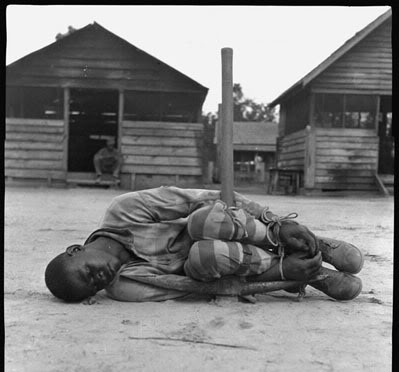 Forced Labor Camp, Georgia, 1930s
The Brennan Center for Justice and the American Civil Liberties Union released reports this week documenting the growing problem of criminal justice debt and the considerable costs it’s imposing on communities, taxpayers and indigent people convicted of crimes. The following figures come from those reports, titled respectively “Criminal Justice Debt: A Barrier to Reentry” and “In for a Penny: The Rise of America’s New Debtor Prisons.” Click on the figure to go the specific source.
Of the 15 states with the highest prison populations examined in a recent report on “user fees” imposed on people with criminal convictions, number in the South: 7
Number of those 15 states that utilize “poverty penalties” against convicts such as late fees, payment plan fees and interest: 14
Number that charge poor people public defender fees for exercising their constitutional right to counsel: 13
Number that suspend driving privileges for missed debt payments, hurting people’s job opportunities: 8
Number that require individuals to pay off criminal justice fees before reinstating their eligibility to vote: 7
Number that have attempted to measure the impact of criminal justice debt on offenders, their families or communities: 0
Collection fee charged by Alabama for court-related costs: 30 percent
Surcharge Florida allows private debt collectors to tack on to a convicted person’s debt: 40 percent
Amount North Carolina charges for failure to pay a fine or court cost on time: $25
Amount it charges to set up an installment payment plan: $20
Amount it charges for a failure to appear: $200
Amount it charges defendants for crime lab fees: $600
Amount it can assess a person convicted of a DUI for the use of a continuous alcohol monitoring system: up to $1,000
Number of people jailed in North Carolina’s Mecklenburg County in 2009 for failing to pay court-related debt: 246
Amount of money the county made from those jailings: $0
Amount that people released to parole in Texas typically owe in offense-related debt: $500 to $2,000
Amount that defendants in Virginia may be charged per count for certain felonies: $1,235
Percent of felony cases before the New Orleans courts that relate to debt collection issues: over 6
Value of food that Gregory White, a homeless resident of New Orleans, was convicted of stealing: $39
Amount White was assessed in fines and fees for his crime: $339
Number of days White spent in jail because he was unable to pay his debt and couldn’t afford the bus fare to complete community service: 198
Cost of his incarceration for the city: over $3,500
Year in which the Orleans Parish, La. municipal court system settled a lawsuit by agreeing to put a stop to “fines or time” sentencing: 2007
Number of such sentences handed down by that same court in March 2010 alone: at least 32
Estimated percent of people charged with criminal offenses in the U.S. who qualify for indigent defense: 80 to 90 percent
Percentage by which African-American defendants are more likely than white defendants to rely on indigent defense counsel: almost 500
Decade through which many Southern states were still using criminal justice debt collection to effectively re-enslave African-Americans by allowing landowners and companies to “lease” black convicts unable to pay on their own: 1930s
Year in which the U.S. Supreme Court held that imprisoning someone merely because of his inability to pay a fine or restitution was fundamentally unfair: 1983
Thieves Planting Flags, Murderers Carrying Crosses
A book review of – King Leopold’s Ghost: A Story of Greed, Terror, and Heroism in Colonial Africa
By Brian Hurrel | December 3, 2009
When reading Hochschild’s “King Leopold’s Ghost”, one is struck not only by the enormity of the crimes committed in the Belgian Congo, but also with the puzzling and somewhat uncomfortable realization that this should not be news. It seems incredible that such events could be relegated to the ash heap of forgotten history. In the case of Leopold’s Congo, the ash heap was more than metaphorical. Officials destroyed as much evidence as they could before the Congo was turned over the Belgian government, and according to Hochschild, “the furnaces burned for eight days, turning most of the Congo state records to ash and smoke in the sky over Brussels.”

English: “In The Rubber Coils. Scene – The Congo ‘Free’ State” Linley Sambourne depicts King Leopold II of Belgium as a snake entangling a congolese rubber collector. (Photo credit: Wikipedia)
While there has been a growing acknowledgment over the past few decades of the whitewash given to much of Western history, there has also been much criticism of “revisionist history”. To acknowledge that ones country has blood on its hands in the past is seen as being unpatriotic or anti-Western. At best, such history is dismissed as “ancient” or simply lived by people who were “a product of their times”. It is difficult, however, to dismiss Leopold’s Congo as such. This is not “ancient history”. Those who participated are not far removed from today’s young generation, and were contemporaries of our grandparents and great grandparents. As for such men being products of their times, this is hard to reconcile with those living a generation or two after slavery ended in the United States, and more than a century after slavery had been outlawed in much of Europe.
And for what did these atrocities take place? What was the driving force behind such barbarism? Ivory at first, but what really turned the Congo into a slaughterhouse seems almost trivial when looked at in comparison to the murderous lengths undertaken to exploit the resource in question: Rubber. For this millions died and countless others were mutilated.
This is a good example of the laws of unintended consequences. Certainly Scotsman James Dunlop had no idea of the misery that would result from his invention of the pneumatic rubber tire. The Congo just happened to have the right resource at the right time in its abundant supply of rubber vines. “The industrial world rapidly developed an appetite not just for rubber tires, but for hoses, tubing, gaskets, and the like, and for rubber insulation for the telegraph, telephone, and electrical wiring now rapidly encompassing the globe. Suddenly factories could not get enough of the magical commodity…” As with oil in later decades, rubber, a resource that the world had little use or need for a few short years earlier, suddenly became essential to the economies of the industrialized world. Even if the Congo had had any chance of relatively benign treatment by the West, the rubber boom would have sealed its fate regardless. Also, Leopold, with undeniable business acumen, knew that cultivated rubber, from trees rather than vines, would eventually cause a drop in price when rubber plantations in South America and Asia reached maturity. In the meantime, he decided to squeeze the Congo for every last drop before this happened, and “voraciously demanded ever greater quantities of wild rubber from the Congo…”
One might have expected Leopold’s agents to pay Congolese natives a pittance to gather rubber, and still reap huge profits, but the reality was that human greed knew no bounds in the Congo. The natives were not paid at all. In fact, they were not even allowed to handle money. Instead they were forced to gather rubber by a variety of means, most of them violent or terroristic. In most cases, women and children were held hostage until the men met their rubber quotas. Those who resisted were simply killed. Even many who didn’t resist were killed for not meeting quotas. Others died of disease and starvation, especially those in detention. Some died in the dangerous job of harvesting the rubber vines high in the trees. Those caught cheating by cutting the vine open, which yielded more rubber but killed the vine, were killed as well.
In other cases, Force Publique forces simply rampaged through entire regions, wiping out villages and massacring men, women, and children alike without distinction. In many instances, to prove that they hadn’t wasted ammunition hunting, they were required to show a left hand to their commanders for every round of ammunition used. Uprisings, of which there were many, were dealt with quickly and severely. Huge areas were left depopulated through a combination of punitive massacres, terrified villagers abandoning the area, or communities that could not remain viable because the men spent so much time gathering rubber while their women and children were interned.
An English explorer at the time, crossing a huge 3,000 square mile area of the northeast Congo, was horrified at the “depopulated and devastated” wasteland he witnessed: “Every village has been burnt to the ground, and as I fled from the country I saw skeletons, skeletons everywhere; and such postures — what tales of horror they told!”
If any one object symbolized the brutal cruelty of the Congo State, it would be the chicotte. “…a whip of raw, sun-dried hippopotamus hide, cut into a long sharp-edged corkscrew strip. Usually the chicotte was applied to the victim’s bare buttocks. Its blows would leave permanent scars; more than twenty-five strokes could mean unconsciousness; and a hundred or more — not an uncommon punishment — were often fatal.” Chicotte beatings were meted out for every offense imaginable — and often for no offense at all or for something as trivial as native children laughing in the presence of a white man.
As for these Force Publique men enforcing Leopold’s will in the Congo, they were not soldiers or officers, at least not officially, but called, in rather bland corporate terminology, “agents”. Such a mild and businesslike title hardly fits someone having the power of life and death over virtually every native in his area of operations. Not only did these men have such power at their disposal, but were more than willing to use it. Some did so because it fit their notion of necessary discipline. Others used such fear and intimidation to increase their profits. And still others seemed cut from a different cloth — the kind of men who seemed to actually enjoy killing for its own sake. Among the most notorious of these was Captain Léon Rom, who displayed the severed heads of natives in his garden. He and several other Force Publique agents who went far beyond the bounds of an already cruel and brutal regime were the inspiration for “Mr. Kurtz” in Joseph Conrad’s Heart of Darkness. Another, Léon Fiévez, was still clearly remembered in local oral histories some fifty years after the “rubber terror”. Said one local named Tswambi:
All the blacks saw this man as the Devil of the Equator… From all the bodies killed in the field, you had to cut off the hands. He wanted to see the number of hands cut off by each soldier, who had to bring them in baskets… A village which refused to provide rubber would be completely swept clean. As a young man, I saw [Fiévez’s] soldier Molili, then guarding the village of Boyeka, take a big net, put ten arrested natives in it, attach big stones to the net, and make it tumble into the river….Rubber caused these torments; that’s why we no longer want to hear its name spoken.
These were not aberrations. Nor were they were isolated instances of excess by a handful of agents. Such inhuman viciousness was widespread and accepted company policy. Few Europeans were ever held accountable for their actions in the Congo, and the few instances of punishment amounted to a show hearing and a slap on the wrist for those charged.
There is one man who is, if not ultimately responsible for the devastation of the Congo, the one person who set the stage for Leopold to carve out his personal African fiefdom, and he deserves mention: Henry Morton Stanley. Best known for finding Dr. David Livingstone, whom had been missing for years deep inside the continent, he was one of the most celebrated adventurers of his time, and even today most who have heard of him would simply say he was a great explorer. However, regardless of his feats in Africa, he held the people of that continent in utter contempt. He boasted about shooting anyone who got in the way of his expeditions, which were practically small armies tearing through the countryside. General Sherman, of American Civil War fame, likened Stanley’s journeys in Africa to his own scorched-earth march through the South. Explorer and writer Richard Burton noted that Stanley “shoots negroes as if they were monkeys.”
Much of what is “great” about Stanley comes straight from Stanley himself. There were few corroborating witnesses to many of his exploits, though by his own words it is clear that he, like many Europeans, saw native Africans as little more than beasts of burden rather than as participants in his expeditions. The native porter, a familiar icon when one thinks of African exploration, was not the healthy, well muscled black extra seen in countless Tarzan films, but a broken, suffering native driven like a team horse, often given inadequate food and rest, and often simply left on the side of the trail to die when he reached the end of his endurance.
The use and abuse of native porters, while not as graphically cruel as other excesses in the Congo, was nonetheless a brutal and destructive practice. Perhaps portage does not get the attention of other atrocities by its sheer “ordinariness”—in addition to being a relatively slow and subtle road to death, it was a practice simply accepted and expected in Africa. And as was the case in so many other aspects of exploitation in the Congo, porters were rarely paid employees selling their services, but forced labor with little choice in the matter. As just one example, “Of the three hundred porters conscripted … for a forced march of more than six hundred miles to set up a new post, not one returned. Stanley made extensive use of these men, and left a string of dead across half the continent. This in addition to those who were encountered and shot along the way—one imagines a native was just as likely to be shot approaching the expedition out of curiosity as he was with hostile intentions.
Admirers of Stanley would hardly think he could be compared to those who later raped and devastated the Congo, but it was men like Stanley who paved the way; not just by cutting out paths through the jungle, but by doing so with the mind-set that these lands were theirs for the taking and its inhabitants fit only to serve their ends, be it gold or glory—or ivory and rubber. Rather than being venerated, Stanley should be relegated to the ranks of those explorers and colonizers whom Peter S. Beagle invoked when he wrote “We are raised to honor all the wrong explorers and discoverers—thieves planting flags, murderers carrying crosses.”
“King Leopold’s Ghost” is a shocking, often gut-wrenching, and horrifying read. It is also a story that needs to be told, and more importantly, remembered.
Related articles


Karam’s Story: Confiscating Childhood in the Occupied Territories

By AHMAD BARQAWI | Counterpunch | October 5, 2010
Thirteen is the age for a lot of things; it carries a certain significance for every boy that reaches that age with all the promises that life has to offer; it’s a time when boys get their first bike, enjoy their favorite video games, make it into the school’s football squad, it’s a time when boys begin to marvel at and appreciate the mysteries of life pre-adulthood, and for some; it’s even a time when they experience their first innocent crush; but if you’re a thirteen year old boy in occupied Palestine; you’re placed under house arrest by the Israeli authorities.
Thirteen year old Palestinian boy; Karam Khaled Da’nah was sentenced by an Israeli court to five months of mandatory house arrest in his uncle’s house –away from his parents and siblings- and a 2,000 shekel bail after a shameful charade that isn’t very well masquerading as a court hearing last Tuesday September 28th 2010, in complete disregard for anything even resembling human rights (or even common human decency for that matter); Karam was first arrested on the 20th of September right in front of his school in the old city in southern Hebron, dragged away from his friends and classmates and savagely beaten by Israeli forces before being thrown into the back of their military jeep and driven away; and the charge is… wait for it… lopping stones at (illegal) Israeli settlers.
And here you thought that peer pressure was the biggest source of anxiety for most parents, however; Palestinian parents will always have something else to worry about when it comes to their children; whether it’s sudden arrests, deadly assaults, torture, you name it; the list of horrific –and very possible- scenarios that Palestinian families are made to live with day in and day out are endless; indeed parenthood carries a whole different meaning in Palestine.
What’s particularly troubling though; is that the Zionists have -over the years- committed so many crimes and gross violations of international laws that I can’t believe the rest of the so-called civilized world haven’t called them out on it yet, they insist on placing “the only democracy in the Middle East” on a strangely unparalleled, high pedestal as the ultimate paragon of virtue; whereas when it comes to Palestinians it seems; the concept of human rights suddenly blurs, and the United Nations Convention on the Rights of the Child (CRC) becomes a hazy afterthought; is it acceptable only if the victim is a Palestinian kid? Is it acceptable to snatch minors off the streets, torture and browbeat them into submission in Israeli prison chambers? Is all of this acceptable if everyone is practically silent about it?
These days we keep hearing all about poor little Binyamin Netanyahu and how “difficult” it is to be in his place; caught between the hammer of American pressures to re-impose a temporary freeze on settlement building and the anvil of a fragile government coalition of right wing fascists who firmly stand behind the settlement enterprise, we keep hearing how “unbearable” it is to be in the position of President Mahmoud Abbas, who is left with very few limited options; the best of which amounts to political suicide; but what about those who live under occupation and suffer its agonizing consequences, we sure have a tenuous grasp of their bitter reality, we disregard them -and often we do so with intent- in our quest to decipher the intricate details of the Middle East conflict, so let us this time try and place ourselves in Karam Da’nah’s shoes for a moment:
Imagine you’re thirteen years old, living in a neighborhood your family has been inhabiting for generations; yet is becoming less and less familiar to you -thanks to swarms of hostile (and armed to the teeth) Israeli settlers-, the day starts and ends with their vulgar harassments, verbal and physical abuse and often with them hurling their trash at your house for good measure, your daily trip to your own school and back disturbs the very delicate sensibilities of these “new neighbors”, they spit on you, shower you with unspeakable insults that a typical thirteen year old wouldn’t normally hear; there’s absolutely nothing neighborly about that! you try another (longer) route hoping against hope that this “maneuver” will spare you another one of those grueling confrontations, but to no avail; they’re all over the place; they enjoy the very same right and freedom of movement you’ve been long pining for; and always under the attentive watch of the IOF, going to school soon becomes a dreaded burden; an exercise in frustration and futility; you can’t help but feel like you’re a moving target; your destination –no matter how close- is always so far away, well beyond countless of check points, humiliating strip searches, antagonistic soldiers, exclusive Jewish-only roads, life-threatening altercations with over-zealous colonizers and a separation wall that stretches as far as the eye can see.
Nonetheless; you try as hard as you can to reconcile yourself with this harsh reality just to be able to enjoy –even if for a brief and fleeting moment- a false sense of normalcy; until one day and out of the blue; you get rounded up, accused and immediately convicted for a bogus crime you didn’t commit; there is absolutely no evidence except for a testimony by an illegal Israeli settler who’s hell-bent on forcing you out of your own land with no idea what he wants beyond that, you spend about a week incarcerated in a prison cell, exhaustion from ruthless interrogation sessions -designed specifically to “overcome” your frail thirteen year old mind and body- and fears of never being able to see your family ever again start to mount inside your small teenage chest until you can’t even take a proper breath anymore; when you’re finally released; you find out that you can’t live with your family anymore, instead; you’re sent to live with relatives and to top it all off; you’re not allowed to see the outdoors for at least five months; you have to say goodbye to playgrounds, football games, family picnics, going to school and basically all the activities that made up a huge and beloved part of your previous life.
Karam’s story is merely the latest in a litany of brutal practices and policies of aggression by the Zionist state and its raging herds of xenophobic settlers against Palestinians; only a little over a week ago; a Jewish settlement “guard” (whatever that means!) shot down a 32 year old Palestinian man –a father of five- in the Arab neighborhood of Silwan in East Jerusalem: pretty much an open and shut, slam dunk case of cold blooded murder; from which the perpetrator was, yes you guessed it, exonerated after half an hour of “friendly” questioning by Israeli authorities (probably over a cup of coffee for all we know!); while, on the other hand, Karam Da’nah still has to adjust to his new living situation placed under house arrest deprived of all the things that millions of normal kids around the world take for granted.
Moreover; a recent CNN report revealed several cases of sexual abuse of Palestinian children detained in Israeli jails; the report included victims’ heart-breaking detailed accounts of what they’ve endured on the filthy hands of their Israeli captors; molestation, beatings, being forced to remain in painful positions and being grabbed by their private parts; are but few of the many methods mentioned in the report that are systematically employed by Israeli interrogators in sleazy albeit sadistic attempts at extracting forced “confessions” from kids as young as 9 years old; this in no doubt; will take its immense and devastating toll on these youngsters; physically, psychologically and emotionally as well; sure these kids will survive, they will continue to live, some might even grow up to be great leaders for their people; but I think their childhood and everything about it has been seared for life.
Indeed not only lands that are being arbitrarily bulldozed and confiscated in the occupied Palestinian territories, but most dangerously; childhood too.
Ahmad Barqawi, a Jordanian freelance columnist & writer based in Amman, having acquired his Bachelor of Science Degree in Economics; he has done several studies, statistical analysis and researches on economic and social development in Jordan.
Long Standing Impunity Challenges Argentina
4 Years Without Julio Lopez
By Marie Trigona – Upside Down World – 27 September 2010
Julio Lopez, Luciano Arruga, Silvia Suppo – three names recently listed the doleful roll call of Argentina’s victims of state repression, a legacy left over from the bloody 1976-1983 military dictatorship. These three names have left painful reminders of the paradigm of disappearances and how the social stigma of the crimes committed during the dictatorship has scarred Argentina and other nations which survived brutal military dictatorships.
Argentina recently commemorated the four year anniversary of the disappearance of Julio Lopez, to demand that the torture survivor and human rights activist be found alive. After four years of searching, marches, and impunity, the cries for justice and punishment seem to have found no response from an indifferent government which claims to defend human rights. Activists also demanded information on the whereabouts of Luciano Arruga, a 16-year-old who was forcefully disappeared in January, 2009 and investigation into the 2010 murder of Silvia Suppo, a human rights activist and torture survivor testifying in a landmark human rights trial.
Julio Lopez has been titled as the man disappeared twice. He last went missing four years ago on September 18, 2006 in his hometown of La Plata. He was disappeared on the day the that his perpetrator and former police chief Miguel Etchecolatz was sentenced to life in prison for crimes against humanity and genocide. Julio Lopez was absent from the courtroom, to witness the historic moment in the landmark trial having been abducted hours earlier.
Lopez was a key witness in the 2006 human rights trial in which Etchecolatz was found guilty of kidnapping, torture and murder of activists during the military dictatorship. Etchecolatz coordinated kidnappings and torture sessions in a network of clandestine detention centers in La Plata, 30 miles from Buenos Aires. In one of these torture centers, Lopez first met Etchecolatz during his detention from 1976-1979.
Julio Lopez is exactly where the repressors want him, in the abyss of impunity that the military have enjoyed for the past 34 years. Julio Lopez was never able to listen to the sentence of his repressors. He was kidnapped the day before his perpetrator Miguel Etchecolatz was sentenced to life in prison and Lopez became another disappeared.
“The forced disappearance of Lopez is called impunity,” wrote the human rights group HIJOS in a press release on the fourth anniversary of Lopez’s disappearance. Impunity for human rights abuses has been Argentina’s dark legacy. Since 1999, when the human rights trials were closed due to amnesty laws, the human rights group HIJOS went out into the streets and into former military officers’ neighborhoods to let the community know that they were living next to an individual who carried out abuses such as kidnapping, rape, torture and forced disappearances. On the fourth anniversary of Lopez’s disappearance HIJOS reminded the government of the results of letting the military go about their normal lives for more than a decade following the passage of amnesty protecting the military from criminal prosecution. “It is the consequence of nasty leftovers from the dictatorship which endured in democracy, added to the government’s lack of response to the seriousness of what occurred.”
Result of impunity
Now justice is possible in criminal courts, following the 2003 abolishment of amnesty laws that protected members of the military government from prosecution of human rights abuses. Many members under arrest were released in the 80’s when the amnesty law was passed. This amnesty allowed former armed forces members to maintain power and hold powerful positions such as judges and executives at private security firms. Etchecolatz was one such repressor who was put on trial and sentenced in the 80´s for abuses, specifically for 91 cases of torture, but later released. The former police chief conspired with local policemen to form right-wing, nationalist groups. “It was foreseeable that the repressors would not stand still when their time came to sit on the court room bench and answer to the courts and the Argentine people,” said the group HIJOS.
According to the human rights group CELS, more than 1,500 former members of the armed and security forces are facing charges of human rights abuses during the dictatorship. However, only 81 people have received sentences.
Meanwhile, the investigation into the disappearance of Julio Lopez has reached a deadlock. The government waited 19 months to consider Julio Lopez a case of forced disappearance. Authorities have also delayed investigation into communication to and from the Marcos Paz jail, where more than 40 repressors are currently under arrest and held under the same roof with the liberty to communicate with one another.
“It’s a combination of lack of response, complicity and covering up,” said Adriana Calvo at the march for Julio Lopez. No one has been investigated much less detained in the police investigation of the disappearance of Julio Lopez.
Witness Safety
“Lopez reminds us that the repressive apparatus has not been dismantled and the trials progress but witnesses and survivors testifying are in danger,” said Adriana Meyer, a journalist for the national newspaper Página/12. However, the government and the media have left the issue of witness safety from public spotlight.
The recent murder of Silvia Suppo, a key witness in a human rights trial on crimes committed during the Argentine dictatorship, has sparked fears for the safety of witnesses who testify publicly in the cases. Suppo, a torture survivor, was stabbed to death on March 29 at her crafts shop in the province of Santa Fe in an alleged robbery. In 2009, Suppo testified in a human rights trial against a former judge for his role in abuses during the dictatorship. Human Rights groups suspect that Suppo was killed to send a message to those still willing to testify as human rights trials progress.
For survivors there is a way to guarantee witnesses safety, for the trials to progress and for all of the repressors. “witness protection program is a mess. Witnesses in a human rights trial in La Plata have received isolated threats.,” said Carlos Zaidman, a torture survivor. “We believe that the only way to protect witnesses is for all of the repressors to be jailed. This has made is doubly important to testify. They haven’t stopped the struggle by disappearing 30,000 compañeros or by disappearing Lopez.”
Silence is impunity
For a democracy to flourish, impunity must end. While Argentina’s government has taken the lead in supporting efforts to try former military and police for rights abuses carried out during the junta years, justice has been slow. And the issue of Julio Lopez has entered an abyss of silence from the media and president.
Lopez’s family sent a letter to the president asking her to push for the investigation into the disappearance of Lopez so that the man who disappeared without a trace twice in his life doesn’t “become the first disappeared in democracy.”
This request has come too late as Argentina has a number of disappeared and thousands of victims of a state repressive apparatus still in tact. Julio Lopez, Miguel Bru and Luciano Arruga are just three of these disappeared in democracy. For democracy to avoid being disappeared, state repression must be abolished.
Julio Lopez presente!
Marie Trigona is an independent writer and radio producer based in Argentina. She can be reached through her blog www.mujereslibres.blogspot.com
Three protests in Gaza: Israeli sniper shoots Palestinian man, leaving him in critical condition
International Solidarity Movement | September 27, 2010

A 20-year-old Palestinian man, Sliman Abu Hanza, is in a critical condition in hospital after being shot in the abdomen with a ‘dum dum’ bullet at a demonstration in Al-Faraheen, Khan Younis, on Sunday.
The injury was inflicted during one of three non-violent demonstrations which took place on Sunday; in Beit Hanoun, Maghazi and Faraheen near Khan Younis – four members of the International Solidarity Movement also attended. The explode-on-impact ‘dum-dum’ bullet which hit Abu Hanza is the same type that was shot into the leg of Ahmed Deeb, 20, during a demonstration in Nahal Oz in April this year – severing his femeral artery and killing him.
All three demonstrations occurred at locations that have seen frequent protests against the Israeli-imposed ‘buffer zone’. This large area of land, along the Gazan side of the border, makes 35% of Gaza’s arable land, inaccessible to farmers because of the dangers of Israeli fire. The devastating effects on farmers and fisherman of these additional restrictions are outlined in a recent United Nations and World Food Programme report: ‘Between the fence and a hard place’.
The protests on Sunday targeted Israel’s continuous settlement building, which is in violation of international law and is further used to annex Palestinian land, a key tactic that accompanies the relentless ethnic cleansing of Palestinian Arabs from the region. Organiser and National Committee Secretary A’tah Abu Zarqa said the rallies were organised to show Palestinians’ vehement opposition to the Israeli policies that have expropriated Palestinian land on a continuous basis since Israel was created in 1948 on the ruins of Palestinian refugees. He said that the international community should never accept Israel’s attempts to unilaterally change the geography and demography of Palestine and that in light of this, Abbas should withdraw from negotiations immediately.
At the demonstrations in the Beit Hanoun and Maghazi, although live ammunition was used by Israeli occupation forces in the latter, there were no reported injuries. The demonstration in Maghazi was the first there since three protesters were shot and injured 5 months ago, including the International Solidarity Movement activist Bianca Zammit.
In Faraheen over 200 people attended the demonstration, which began as a procession towards the border with speeches and chanting, and a large women’s group was also present. A group of young men headed towards the border fence, still on Palestinian land. Sliman and a friend Kamal, also 20, planted flags near the border fence. Kamal described what happened:
“I was with Sliman and we both put a flag near to the fence – just a flag. When the Israel Jeeps came they opened fired on us and I ran back for cover in a ditch. Suddenly I saw Sliman shot in his abdomen. It was clear it was a single shot intended to hit him. I helped carry him back over the fields with many others. He lives in the area near to the border.”
One of the major concerns for Sliman is the fact that he had to be carried over 500 metres across fields by many of the other demonstrators and then driven off in a ‘Tuk Tuk’ bike trailer to reach medical attention. This way of transporting casualties echoed the horrific scenes during the 3 week Israeli assault on Gaza over the New Year of 2009 when over 1400 people were killed including over 400 children. Because the medical services were so overwhelmed – and were often shot at when approaching the injured – many of the casualties were transported in the boots of cars or on donkey carts. A Press TV team captured the protest on film and interviewed ISM activist Adie Mormech about the shooting.
According to the Doctors at Europa hospital where he was taken, Sliman suffered extensive internal damage to his abdomen, 3 injuries to the small bowel, the left iliac vein, rectum and some intestinal damage. He has had a series of operations been given blood transfusions – the next 24 hours are crucial. Like Ahmed Deeb, the immediate threat to his life was from loss of blood sustained from his injuries. When ISM volunteers left the hospital after visiting Sliman yesterday, he was in a critical but stable condition and was about to be moved to the intensive care unit.
Sliman is another victim of the frequent attacks on civilians near to the border, many of which ended in fatalities such as the three farm workers killed in Beit Hanoun two weeks ago, and last Friday the fisherman Mohamed Bakri killed only 2 miles out at sea by an Israeli Gunship, a month before his wedding.
Besides the crippling and internationally condemned siege, Palestinian life in Gaza is littered with such tragedy, lives ended in a flicker in accordance with the whims of the Israeli sniper on duty and who he or she chooses for execution. If Sliman survives his injuries, he’s sure to join the thousands of Palestinians who must continue the rest of their imprisonment in the Gaza ghetto with permanent debilitating disabilities.
Despite this, people continue to demonstrate in large numbers across Gaza, preferring to face Israeli violence with nothing but flags and a desire to walk on their land, despite the risks that this shooting – all too common a story – exemplifies.
12 Palestinians killed since the outset of direct peace talks
Palestine Information Center – 27/09/2010
GAZA/OCCUPIED JERUSALEM — Israeli occupation authorities are responsible for the deaths of 12 Palestinians since direct peace talks kicked off between Israel and the Palestinian Authority in Ramallah in early September, the Quds Press reported.
The Gaza Strip saw the majority of killings of Palestinians during the talks. Eight Palestinians were killed there against three others who were killed in Jerusalem and one in the West Bank.
Khaled al-Khatib, 35, Saleem al-Hattab, 20, of the Gaza Strip were killed early Sunday morning, Sept. 5, after Israeli night raids targeting a tunnel on Gaza’s border with Egypt.
An Israeli tank bombed an orchard in Beit Hanoun, northern Gaza Strip on Sunday Sept. 12, killing three Palestinians, including Ibrahim Abu Asad, 92, and his grandson Hassam, 17, along with another man in his twenties.
On Sept. 14, the day the second round of peace talks began in the Egyptian resort of Sharm al-Sheikh, an Israeli policeman in Tel Aviv shot and killed 22-year-old Hazem Abu al-Dab’at of Jerusalem while he was handcuffed.
Wajdi al-Qadi, 23, of Rafah city, Gaza Strip was killed Setp.15 after an Israeli warplane shelling of a tunnel on the Egyptian-Palestinian border that destroyed the tunnel and killed Qadi who was a worker inside it.
In the northern West Bank city of Tulkarem, Israeli soldiers assassinated Iyad Shilbaya, 38, a leader in the Qassam Brigades, Hamas’s armed wing, after shooting him in his bed on Sept. 17.
In occupied Jerusalem, an Israeli guard in the Silwan town shot and killed on Wednesday, Sept. 22 Samer Sarhan, 32, and injured a number of others sparking violent protests throughout the holy city.
On Friday Sept. 24, a Palestinian fisherman Mohammed Bakr, 22, from Gaza was shot down by the Israeli navy in the northern Gaza Strip town of Beit Lahiya.
A one-and-a-half-year-old infant Mohammed Abu Sarah died the same day in the Isawiya district of Jerusalem after inhaling tear gas Israeli soldiers fired at Palestinians during protests.
An element from Hamas’s armed wing Mahmoud al-Ammarein, 22, died on Sunday Sept. 26 from injuries he sustained less than two weeks back in an Israeli bombing against east Gaza Strip.
Israelis kill toddler with tear gas in occupied East Jerusalem
Ma’an – 25/09/2010
JERUSALEM — A Palestinian toddler was reported dead late Friday after Israeli forces fired tear gas amid clashes in a Palestinian neighborhood in East Jerusalem.
Medics said 14-month-old Muhammed Abu Sneneh suffocated after the gas was fired at residents and their houses in Al-Isawiya.
Israeli police spokesman Micky Rosenfeld said he had not received any reports of injuries and that police were using minimum force to respond to incidents in Al-Isawiya, Silwan and Ras Al-Amoud.
Clashes in the occupied city have been ongoing since Wednesday, when a settler security guard shot dead two Palestinians in Silwan.
The wife of 28-year-old Samer Sarhan, one of the Palestinians killed on Wednesday, was transferred to hospital on Friday night after inhaling tear gas, medics said. On Thursday, locals reported that Israeli forces fired tear-gas at Sarhan’s home in Silwan, sparking further clashes.
At Sarhan’s funeral on Wednesday, attended by over 1,000 mourners, violent clashes occurred and Israeli border guards fired tear gas canisters and rubber-coated steel bullets at the funeral procession.
Officials estimated that 3,000 Israeli police and border guards were deployed across East Jerusalem on Friday, as the city remained on a state of alert.
Checkpoints were installed at the entrances to several neighborhoods, sparking clashes as residents fought with Israeli forces in several areas, including Al-Isawiya and the Shu’fat refugee camp, where restrictions prevented any movement in and out of the area.
Israel: lawyer can’t accompany 14 year old sexual assault victim
DCI-Palestine and PCATI request investigation in assault case
Defence of Children International | 22 September 2010
On 20 September 2010, DCI-Palestine and the Public Committee Against Torture in Israel (PCATI) wrote to the Judge Advocate General’s office requesting an immediate investigation into the alleged assault of a 14-year-old boy in May 2010, in which an interrogator is alleged to have attached a set of car jump leads to the boy’s genitals.
DCI-Palestine and PCATI submitted complaints against the army and police in the case on 15 August 2010, and requested that the boy be accompanied by a lawyer of his choice throughout the investigation process. The request that the boy be accompanied by a lawyer is based on two factors:
-
Under Article 14 of the Rights of Victims of Crimes Law (2001) (Israel), victims of violent crime, including sex crimes, are entitled to be accompanied by a lawyer unless the investigating officer has reasonable grounds to believe that this will harm the investigation.
-
It is unreasonable to request a 14-year-old Palestinian child to attend an interview conducted by the Military Police, which must be considered as an integral part of the army and police force against whom the complaint is made. Further, the Military Police requested that the boy attend an interview with investigators at the Etzion facility, the same location where the alleged abuse is said to have taken place. The boy is understandably fearful of further contact with Israeli authorities. No less important is the consideration that the investigation must arrive at the truth while protecting the child from further trauma.
On 18 September 2010, DCI-Palestine was telephoned by the investigation authority and informed that if the boy insisted on being accompanied by a lawyer ‘the complaint will be archived and the process terminated.’ The only reason given as to why the boy can not be accompanied was that ‘the lawyer might affect the child’s testimony.’ However, no explanation or evidence was provided to support this suggestion, and the decision appears to be arbitrary and unreasonable.
In response, DCI-Palestine and PCATI have written to the Judge Advocate General requesting:
-
Acknowledgment in writing of receipt of the complaint dated 15 August 2010;
-
Reconsideration of the verbal advice not to permit the boy to be accompanied by a lawyer of his choice throughout the investigatory process; and
-
In the event that the investigatory authorities insist on preventing the boy from being accompanied by a lawyer, to provide comprehensive and detailed reasons in writing for the decision within 14 days.
Jerusalem remains on lockdown following clashes
JERUSALEM — Checkpoints were erected at the entrances to several Jerusalem neighborhoods on Friday, with soldiers preventing residents from leaving the areas in several cases, witnesses said.
Hundreds of police and border officers were deployed around the Old City, with 3,000 in total across East Jerusalem, officials estimated.
Israeli Police Commander in Chief Dudi Cohen reportedly decided to maintain the state of alert declared Friday morning in the city, extending it through the Jewish holiday of Sukkot.
The week earlier during the Jewish holiday of Yom Kippur, residents of the Palestinain neighborhoods of Jerusalem were also barred from moving from one area to another by car or walking through major roads.
Earlier in the day, Palestinians heading to the Old City for prayer at the Al-Aqsa Mosque faced tight restrictions, with men under 50 turned away on the grounds that security officials believed there was a risk of continued clashes if young men gathered.
Clashes erupted on Wednesday during a 1,000-strong funeral procession for Samer Sarhan, 28, one of two Palestinians killed by an Israeli settler guard early that morning.
On Friday, only three of the gates to the Al-Aqsa Mosque compound were opened, as the Bab Hutta entrance remained closed for the third day in a row.
Checkpoints throughout the Old City saw soldiers stopping residents to check identity cards, and in some cases barring access to neighborhoods around the city.
West Bank crossings were sealed for the Jewish holiday of Sukkot, while extra closures were imposed on the East Jerusalem neighborhoods of Silwan, Al-Isawiya, Ras Al-Amoud, and the Shu’fat refugee camp, where clashes lasted late into Wednesday night, and continued periodically on Thursday.
Fatah officials detained
Israeli intelligence officers arrested two Fatah leaders from Silwan, identified as Ma’mun Al-A’basi, a member of Fatah in Jerusalem and appointee to the National Committee Against Expulsion, and Adnan Gheith, a party member.
Both were detained after Israeli forces entered their Jerusalem homes overnight, sources told Ma’an.
In the wake of the arrests, witnesses said checkpoints were installed at the entrances to Silwan and Wad Hilwa. Residents and goods were prevented from traveling in or out of the area.
Soldiers told residents that the barriers were erected following the injury of two officers on Thursday night during clashes.
Israeli media reports said the soldiers were transferred to hospital for treatment.
Silwan residents, barred from leaving the area for prayer at Al-Aqsa, are expected to gather at the protest tent for worship.
Protester shot with live ammunition at Bil’in wall
By Adam Horowitz | Mondoweiss | September 24, 2010

A scene from today’s protest in Bil’in. (Photo: Hamde Abu Rahmah )
The following was just sent out by organizers in Bil’in:
Ashraf Al-Khatib was shot in the leg with a 0.22” caliber live bullet at the weekly demonstration against the illegal apartheid wall. An international nonviolent activist was also hit in the shoulder with a low-flying tear gas canister. The hundreds of other participants were attacked with huge quantities of tear gas.
The weekly protest is against land theft by the illegal apartheid wall and the Israeli occupation in general. This week, the marchers also expressed solidarity with Palestinians in East Jerusalem (al-Quds) where a Silwan resident was shot dead by an Israeli settler security guard on Wednesday morning.
Two hundred Palestinians accompanied by around thirty international and Israeli activists assembled at the village’s Mosque after noon and marched towards the apartheid wall, chanting “no, no, to the wall” and “Free! Free! Palestine.” Around forty Israeli soldiers ran out of the gate to the settlement as they saw the march approaching, blockading the road.
Protesters marched up to the soldiers and confronted them, demanding to be allowed to walk on the village’s land, which even the Israeli High Court conceded was Palestinian in 2007. The soldiers did not allow anyone through, using their shields to aggressively push back the peaceful demonstrators. One Palestinian activist tried to fasten a poster to a soldier’s shield saying “Free Adeeb Abu Rahma,” referring to one of Bil`in’s four political prisoners held by Israel for organizing the weekly protests. The commander was seen indicating to his soldiers that he wants them to target Ashraf Al-Khatib.
The group demonstrated with the soldiers for thirty minutes until a youth threw a stone and the soldiers responded by firing huge quantities of tear gas at the peaceful crowd, many of whom proceeded to suffer breathing difficulties. One international activist was hit in the shoulder with a low-flying tear gas canister. A group of youths began throwing stones towards the soldiers, and three photographers stood next to the soldiers were hit.
Ashraf Al-Khatib, a Bil`in resident aged 31, was shot with 0.22” caliber live bullet which hit him in the lower leg. No warning shots were heard beforehand. Unable to stand, he was hurriedly carried by Palestinian and international demonstrators towards the village as he bled heavily from his calf. When Al-Khatib first fell, all of the soldiers ran forwards in an attempt to arrest him, but the demonstrators were able to successfully load him into a car before the soldiers caught them. As the car drove away the soldiers retreated, and the demonstrators walked back to the village, the demonstration lasting around one hour in total.
Upon Al-Khatib’s arrival at hospital, it was found the 0.22” caliber round had smashed the bone in his leg.
Featured Video

The American Retreat from Vietnam
or go to
Aletho News Archives – Video-Images
From the Archives
Secret document reveals plans for civil war in Lebanon, Israeli false flags, and invasion
By Randi Nord | Geopolitics Alert | April 5, 2019
Beirut – During his visit with US Secretary of State, Mike Pompeo, Lebanese President Michael Aoun reportedly received a US-Israeli document detailing plans for creating a civil war in Lebanon with covert false flag operations and possible Israeli invasion.
Although the source of the document is Israeli and created in partnership with Washington, no one knows who presented it to Aoun. The Lebanese TV station, Al-Jadeed, initially reported the document on Lebanese TV and a video on its website. Geopolitics Alert translated the report for this article. … continue
Blog Roll
 Aletho News
- EU Council Advances Chat Control 2.0 Scanning Proposal
- Ex-Greek MEP files complaint against Israeli spyware firm over alleged Pegasus surveillance
- Troubling ideas throughout the Torah, Talmud, Mishneh Torah and Tanya
- ‘Grave, alarming’: Iran mission on Trump’s UNGA ‘annihilation’ threats
- Najaf airport to reopen to Iranian flights within 24 hours: Ambassador
- From ‘How Will This End For Iran’ to ‘When America Walks Away’: A tale of two Economist covers
- Tehran blasts ‘baseless’ speculation linking Iran to alleged bomb plot at UK air base
- The Rise And… Rise Of ‘Color Revolutions’
- The Coming GOP Bloodbath?
- Arctic Scare Stories Melt Away
- If Americans Knew
- Netanyahu Asked UAE Leader to Deny Report on Oct. 7 Warning in Secret Visit, Sources Say
- CNN Chief Int’l Correspondent Clarissa Ward on Journalists in Gaza
- Democratic Party Consultants Surround Troy Jackson with Pro-Israel Donors
- Christian Leader Responds To Netanyahu’s Claims Regarding Palestinian Christians
- In Gaza, ‘Whoever Survives the Bombing Won’t Survive the Rubble’
- Israel kills more Palestinians, amid push to resettle Gaza – Daily Update
- Israel forces Gazans to live in constant peril – Daily Update
- Deconstructing Netanyahu’s pants-on-fire UN rant – Daily Update
- Trump betrayed voters with his campaign lies and prioritized a foreign country once he took office
- Netanyahu calls Israel’s war in Gaza ‘opposite of genocide’ in UN speech to near-empty hall
- No Tricks Zone
- New Study: Earth And Venus Surface Warmth Largely Explained By Convection And Lapse Rate, Not CO2 Or Radiation
- 2025 Nature Paper Claiming Worsening Global Drought Gets RETRACTED …Heavily Flawed
- New Study: ‘Global Drought Shows No Detectable Recent Acceleration Under Climate Warming’
- Economic Masterminds: German Socialists Suggest Taxing Productivity Gains Stemming From Using AI
- The South China Sea Has Not Been Cooperating With The Climate Change Narrative
- Energy Crisis: Germany Enters Heating Season With Historically Low Gas Reserve Fill Levels
- New Study: The Antarctic Ice Sheet Gained Mass From 2020-2024 Due To Staggering Snow And Ice Accumulation
- Study: Ocean Heating Rates From Thousands Of Years Ago ‘Dwarf’ Modern Ocean Heating Rates
- Climate Extremists Target, Attack Large-Scale Power Grid Infrastructure In Germany!
- New Study: Antarctic Ice Melt Has Contributed Less Than 1 Centimeter To Sea Level Rise In The Last 30 Years

