The Dunbar Martyrs
“March of shame” and incarceration at Durham Cathedral
On September 3rd, 1650 Scottish defence forces suffered a terrible defeat at the hands of Oliver Cromwell’s invading English army at the Battle of Dunbar. Cromwell went on to ruthlessly ransack Edinburgh and other Scottish towns and cities and take control of the country south of the Highlands.
Immediately after the battle, Cromwell’s forces rounded up around five thousand Scottish prisoners and embarked on the ‘march of shame’. You will hear little about this in the history books probably because it marks a profound disgrace in the annals of English military history. The battle weary Scots were brutally forced on an eight-day, 118 miles march south to the English cathedral city of Durham with virtually no rest (the first 28 mile stage to Berwick being undertaken non-stop and through the night) and with no food or water other than what could be scavenged. So starved, en route, raw cabbages and roots were pulled from fields in a desperate effort to gain some sustenance, however, this only served to cause dysentery like symptoms. Of the estimated five thousand who started out the march, only around three thousand were left at the end when they reached their destination on September 11th.
Of the survivors, Durham Cathedral and Castle was used as a makeshift prison and an equivalent disgraceful episode commenced. The conditions the Scots were kept in were utterly appalling. Records indicate that the Scots died at an average of 30 a day between 11th September and 31st October and it seems this reached over 100 a day with virtually no food, clean water or heat and the linked spread of disease and infection.
By the end of October 1650, approximately 1,600 Scots had died horrible deaths in Durham’s much-revered House of God and Durham Castle. This was a desecration of the holy Cathedral. The military leader appointed by Cromwell to take charge of the prisoners (Sir Arthur Haselrigge, Member of the English Parliament for Leicester) later claimed in a letter to the Parliament that adequate food, water, bedding and fuel for heating had been provided, however, the facts speak for themselves that this was merely an attempt to excuse his own conduct during the horrific weeks in September and October 1650. The Scots in a desparate effort to create some heat and reduce the death toll stripped the Cathedral bare of all wooden items, including pews and the organ for the making of fires, save as for one item – a clock embossed with a carved Scots Thistle, which remains to this day.
Only 1,400 of the estimated 5,000 men who started the march from Dunbar in September were still alive less than two months later, when they were sold as slave labour by their captors. Nine hundred of those survivors were sold to the New World, mainly Virginia, Massachusetts and the Barbados colony in the Caribbean. Another 500 were forced the following spring to serve in the French army, and were still fighting seven years later against the Spanish, side by side with a contingent of English soldiers sent over by Cromwell. Those who profited from the slave trade grasped every opportunity to earn money from this evil practice which wasn’t abolished in Britain until 1807.
Discovery of mass grave at Durham Cathedral?
According to research and a paper written by past Cathedral employee, John Cole, 1991, “The Scottish Prisoners from Dunbar Held in Durham Cathedral”, when a central heating system was installed in The Music School at the Cathedral in 1946, the trench for the pipes cut into a mass grave on the north side of the Cathedral. The conclusion was that it held the bodies of the Scots who had perished. That they had been, “buried without coffins and had been tossed in on top of one another.”. Separately, a Cathedral gardener spoken to in 2008 recalls seeing the corpses of Scot’s soldiers during works on the lanscape. The Cathedral has recently (2008) cast doubt on their earlier conclusions.
To this very day, there is no memorial of any kind to these unknown Scottish soldiers who died such horrible deaths at Durham Cathedral and Castle. It would appear that they lie in anonymity and without Christian burial in what they would have regarded as foreign soil in the place they had been imprisoned, far from their homes and the graves of their loved ones.
Aafia Siddiqui Sentenced: A Grievous Miscarriage of Justice
By Stephen Lendman | September 23, 2010
On September 23 in federal court, US District Court Judge Richard Berman sentenced political prisoner Aafia Siddiqui to 86 years in prison. Outrage most accurately expresses this gross miscarriage of justice, compounding what she’s already endured following her March 30, 2003 abduction, imprisonment, torture, prosecution, and conviction on bogus charges.
Earlier articles explained her case in detail, accessed through the following links:
http://sjlendman.blogspot.com/2008/12/abduction-secret-detention-torture-and.html
http://sjlendman.blogspot.com/2010/02/aafia-siddiqui-victimized-by-american.html
http://sjlendman.blogspot.com/2010/03/aafia-siddiqui-victimized-by-american.html
In modern times, she’s one of American depravity’s most aggrieved victims, now given a virtual life sentence for a crime she didn’t and couldn’t have committed, explained in the above articles.
In recent months, she’s been in New York’s Metropolitan Detention Center (MDC) in maximum security solitary confinement, during her trial, conviction and September 23 sentencing. Importantly, her life was effectively destroyed by years of horrific tortures, repeated rapings, and other abuses in Bagram Prison at America’s Bagram Air Base, Afghanistan.
Addressing the court, said said “I’m not paranoid. I’m not mentally ill. I don’t agree with” anyone saying so, though it’s hard imagining why not after years of horrific brutalization. A Pakistani/American scientist, years of torture and abuse destroyed her persona, yet somehow she survived and endured more stress from prosecution, a travesty of a trial, conviction and sentencing.
Reporting on the court’s decision, the BBC repeated government lies, including her possessing bomb making instructions to blow up New York landmarks – “evidence that she was a potentially dangerous terrorist.” Yet her indictment was on totally different charges – preposterous ones accusing her of the following:
In the presence of two FBI agents, two Army interpreters, and three US Army officers, this frail 110 pound woman allegedly assaulted three of them, seized one of their rifles, opened fire at close range, hit no one, yet she alone was severely wounded.
At trial, no credible evidence was presented. The charges were concocted and bogus. None accused her of plotting to blow up New York or any other landmarks or facilities.
Yet proceedings were carefully orchestrated. Witnesses were enlisted, pressured, coerced, and/or bribed to cooperate. Jurors were then intimidated to convict, her attorney Elaine Whitfield Sharp, saying their verdict was “based on fear, not fact.” No evidence was presented except claims government prosecutors invented to convict.
The International Tribune also highlighted today’s proceedings, headlining “Dr. Aafia sentenced to 86 years imprisonment,” saying:
It was on seven counts “for allegedly firing at US troops in Afghanistan.” After the announcement, protests erupted across Pakistan. In Karachi, civil society and political party workers rallied “in front of the Karachi Press Club….ask(ing) the federal government” to intervene on her behalf.
Jamaat-e-Islami, PASBAN, Defense of Human Rights, and other civil society members marched toward the US Embassy, expressing outrage and demanding she be released “as a goodwill gesture.”
“Advisor to Sindh Chief Minister Ms. Sharmila Farooqui asked the United States to release (her) on humanitarian (grounds) as a goodwill gesture to Pakistan….Now is the time for the US to show goodness and pardon a Pakistani woman who is innocent.”
Farooqui said Aafia was wrongly abducted, then handed over to US authorities. She’s “an innocent woman,” outrageously treated, convicted and sentenced.
Explaining further she said:
“In Islam and Pakistan, handing over a woman to foreign countries is a sin, but it is a pity that an innocent woman was mercilessly given in(to the) hands of the (previous) US” government.
She also urged international human rights organizations to actively pursue her release.
A Final Comment
At issue is 9/11 truth, the subsequent bogus “war on terror” based on a lie, America’s war on Islam that followed against Iraq, Afghanistan, and Muslim Americans, victimized for political advantage. Aafia is perhaps its most aggrieved living victim, her persona destroyed and life ended by a virtual life sentence unless clemency or world pressure saves her.
Her case should incite everyone’s moral outrage. It also reveals America’s true face, its rogue agenda, targeting Muslims for their faith and ethnicity, making us all equally vulnerable.
Stephen Lendman lives in Chicago and can be reached at lendmanstephen@sbcglobal.net. Also visit his blog site at sjlendman.blogspot.com
Obama regime rewards Honduran repression
By DANA FRANK | Counterpunch | September 23, 2010
Why is the U.S. still supporting a repressive regime in Honduras? While Secretary of State Clinton continues to insist that democracy is marching forward in Honduras, President Porfirio Lobo’s ongoing coup government has been escalating its violent attacks against peaceful demonstrators, opposition radio stations, and critics. Repression under Lobo has now achieved levels equal to those after Roberto Micheletti took power in the June 28, 2009 coup. Lobo’s reward: dinner at the White House this week.
The details are chilling, and bald. On Wednesday, September 15–Independence Day, for Hondurans–police and the military brutally broke up an opposition demonstration in San Pedro Sula, the country’s second largest city. First troops broke into the entrance to Radio Uno, the only opposition radio station in the city, lobbed tear gas into its windows, trashed its offices, and very deliberately destroyed a popular statue of deposed former President Manuel Zelaya. Ten minutes into a concert in the Central Park, police suddenly stormed the stage and destroyed the instruments of all three musical groups ready to perform. At the same time, amidst clouds of tear gas and other chemicals, troops turned viciously on the peacefully gathered demonstrators, grabbing people randomly and beating them with batons. Officers beat up teenagers in a high school drum corps; they smashed all the windows and lights of a union-owned pickup truck parked nearby; an elderly man selling lottery tickets died of the tear gas.
Ever since Porfirio “Pepe” Lobo came into office as President of Honduras in January, after a fraudulent election from which opposition candidates withdrew, he’s been testing what he and the nation’s elites can get away with, gradually unleashing more and more violence against the opposition. On August 13 police violently attacked peaceful demonstrators in Choloma with tear gas, brutal beatings with batons, and further beatings while in detention. When teachers marched in the capital, Tegucigalpa, on August 26 and 27, they were met with tear gas, batons, and even live ammunition.
Paramilitary-style assassinations and death threats against trade unionists, campesino activists, and feminists active in the opposition continue unabated, with complete impunity. Last Friday night, September 17, gunmen shot and killed Juana Bustillo, a leader in the social security workers’ union. Nine journalists critical of the government have been killed since Lobo took office. On September 19 in Tegucigalpa, unknown assailants shot at Luis Galdamez, a prominent opposition radio and TV commentator, as he entered his home with his young son. The police wouldn’t even show up for an hour and a half.
Although many in the U.S. press still cast the Honduran opposition as merely supporters of deposed President Manuel Zelaya, they are united by a far deeper vision that hopes to address the country’s overwhelming poverty and break the lockdown of the oligarchs on its political system and economy. The resistance has so far collected 1,346,876 signatures (out of a country of 7.8 million) calling for a constitutional convention through which to refound Honduran society.
The opposition is also trying hard to stop a wave of economic aggression against its already impoverished working people. It is demanding that Lobo finally declare a new minimum wage, as he has been legally mandated to do for months now. It is also trying to stop a draconian reformation of the country’s basic labor law, that will not only destroy full-time, permanent employment–which in turn, is legally necessary for workers to form unions–but allows employers to pay 30% of what they they owe employees not in actual money but in company scrip–with its value set by the company.
President Lobo persists in cloaking his repressive military-led rule by calling it a “government of national reconciliation.” All the repression, in his fictional world, is just common crime. Yes, common crime, much of it gang-led, is hideously rampant in Honduras. But it flourishes in the ripe climate of mass poverty the Honduran oligarchs foster; and it doesn’t account for the selective assassinations of opposition activists and journalists, over and over. And Lobo, of course, not the gangs, is the one ordering the police to attack demonstrations and countenancing paramilitary assassinations.
The Obama administration supports this chilling regime one hundred percent. Military aid has been fully restored. The International Monetary Fund on September 10 announced an additional $196 million loan to Honduras. Preposterously, just as Lobo launched the tear gas on Independence Day in Honduras, Hillary Clinton praised once again its “resumption of democratic and constitutional government.”
Rather than extol Lobo, send him more and more guns and funds, and invite him to a gracious dinner with other presidents visiting the United Nations, Obama should cut all ties with the regime and stop pressuring the Organization of American States to re-admit Honduras. The White House should heed a letter currently circulating in Congress, sponsored by Representative Sam Farr, and cut all military aid. And please, no dinners legitimating repressive, fraudulent thugs.
Dana Frank is a professor of history at the University of California at Santa Cruz specializing in Honduras. Her books include “Bananeras: Women Transforming the Banana Unions of Latin America.“
‘Israel flotilla raid was unlawful’
Al Jazeera | September 23, 2010
The UN Human Rights Council’s fact-finding mission has accused Israeli forces of violating international law when they raided a Gaza-bound aid flotilla.
The three UN-appointed human rights experts said in a report released on Wednesday that Israeli forces showed “incredible violence” during and after their raid on the aid flotilla that left eight Turkish activists and one Turkish-American killed.
The UN probe said there was “clear evidence to support prosecutions” against Israel for “wilful killing” and torture committed when its troops stormed the aid flotilla last May.
Israel’s military response to the flotilla “betrayed an unacceptable level of brutality” and violated international law “including international humanitarian and human rights law.” The three-member panel said.
“The conduct of the Israeli military and other personnel towards the flotilla passengers was not only disproportionate to the occasion but demonstrated levels of totally unnecessary and incredible violence.”
The report is scheduled to be debated by the Human Rights Council on Monday.
The report also rejected Israel’s stance that its forces acted in self-defence when they raided the flotilla, arguing that even those who did not attempt to stop Israeli soldiers from boarding the aid ships “received injuries, including fatal injuries.”
“It is apparent that no effort was made to minimise injuries at certain states of the operation and that the use of live fire was done in an extensive and arbitrary manner. The circumstances of the killing of at least six of the passengers were in a manner consistent with an extra-legal, arbitrary and summary execution.”
Israel’s reaction
Israel rejected the report as “biased” and “one-sided.”
“The report… is as biased and as one sided as the body that has produced it,” the statement said.
“Israel… is of the opinion that the flotilla incident is amply and sufficiently investigated as it is. All additional dealing with this issue is superfluous and unproductive.”
Israel insisted that it acted in line with international law, arguing that it had the right to retaliate against ships attempting to breach its blockade of the impoverished Gaza Strip.
However, the panel said that since Gaza was suffering from a humanitarian crisis on the day of the deadly raid, for this reason alone, Israel’s blockade is unlawful and cannot be sustained in law.
Hamas welcomed the report and told Al Jazeera that the findings show that Israel’s occupation of Palestinian territories violates human rights.
“More should now be done, the commander who led the raid should be taken to International Criminal Court.” Hamas said.
The fact-finding mission, chaired by Karl Hudson-Phillips, former judge of the International Criminal Court in The Hague, had travelled to Turkey, Jordan and Britain to interview witnesses and officials for the probe.
Desmond de Silva, former chief prosecutor of the Sierra Leone War Crimes Tribunal, and Shanthi Dairiam, as Malaysian human rights expert, are the other members of the panel.
Al Jazeera slams ISAF over arrests
Al Jazeera | September 22, 2010
Al Jazeera has called on the Nato-led International Security Assistance Force (Isaf) to immediately release two of its cameramen arrested in Afghanistan over the last 72 hours.
In a statement issued on Wednesday, Al Jazeera said the arrests were “an attempt by the Isaf leadership to suppress its comprehensive coverage of the Afghan war”.
The two Al Jazeera cameramen detained are Mohamed Nader and Rahmatullah Nekzad.
According to Nader’s wife, he was picked up from his home in southern Kandahar by Isaf troops on September 22.
 |
Rahmatullah Nekzad was arrested by Isaf in Afganistan |
She said she was woken up when the troops raided their home during the night. The troops then proceeded to arrest her husband, removing him from his bedroom, she said. The troops also confiscated some of their valuables.
Nekzad, the other cameraman working for Al Jazeera in a freelance capacity, was arrested two days earlier under similar circumstances in Ghazni province.
Isaf, though, in statements described both as “suspected Taliban media and propaganda facilitator[s]”.
“The insurgents use propaganda, often delivered through news organisations as a way to influence and in many cases intimidate the Afghan population,” Isaf wrote to Al Jazeera.
“Coalition and Afghan forces have a responsibility to interdict the activities of these insurgent propaganda networks. Individuals detained as a consequence will be investigated and if substantiated will remain in detention awaiting Afghan judicial review.
“Each case will be investigated and reviewed in accordance with standard Isaf and USFOR-A procedures,” the statement said.
Al Jazeera response
Al Jazeera, however, strongly rejected the claims and insisted the two were innocent.
“There are two very important issues here, one is the vagueness of the allegations against this cameraman: what exactly is the allegation of being ‘a propagandist’ – how do you define that?” Anthony Mills, from the International Press Institute in Geneva, told Al Jazeera.
“If it just means that as a cameraman he was doing his work as a journalist filming the violence which we know has been wrecking that country in recent years – I think one has to be really careful before jumping to these kinds of accusations and arresting the cameraman.”
If there are no concrete criminal charges behind the arrest, then they should be released immediately, Mills said.
The arrests follow a recent pattern of escalation by Isaf and coalition forces to target Al Jazeera journalists in Afghanistan.
Recently, Al Jazeera’s Afghan bureau chief Samir Allawi was threatened and pressed to change the editorial line.
Al Jazeera, however, said it will continue to maintain its coverage on the basis of fair and impartial journalism in line with its Code of Ethics and will not bias its coverage in favour of any party or coalition despite pressures being imposed on it.
As part of their work, cameramen and crew need to contact all sides of those involved in a particular issue, which in this case includes Isaf forces, the Afghanistan government as well as the Taliban.
These contacts should not be seen as a criminal offence but rather as a necessary component of the work that journalists undertake, the channel said.
Complaint lodged in case of 16-year-old girl used as a human shield
Defence for Children International – September 22, 2010
Ramallah – On Monday, 20 September 2010, DCI-Palestine and Adalah lodged a complaint with the Israeli Military Advocate General (MAG) arising out of the use by Israeli soldiers of a child as a human shield.
DCI-Palestine and Adalah have received credible evidence that at 3:30am, on 18 February 2010, a 16-year-old girl (D.A.) was used as a human shield by units of the Israeli army whilst conducting operations in the old city of Nablus, in the Occupied Palestinian Territory.
It is alleged that in the early hours of 18 February, Israeli soldiers broke down the door to the family home and stormed the house. According to sworn affidavits collected by DCI-Palestine the soldiers came to arrest the girl’s older brother, M.A. (17) and accused him of possessing a weapon. The soldiers beat M.A. and their younger brother, K.A., who is 15. Meanwhile, the girl was ordered to fetch her brother’s I.D. card and was followed by two soldiers into the bedroom. When D.A. entered her brother’s bedroom one of the soldier’s pointed his weapon at her and told her to stand in the corner. ‘I was shivering in fear,’ recalls D.A. ‘I gave the I.D. to one of the soldiers and one of them ordered me to sit on the bed. They pointed their weapons at me and one of them sat beside me. Some of them were taking pictures of the house with a digital camera.’ The soldier sitting next to D.A. on the bed then stood up and ordered her to lift the mattress to see what was underneath. ‘You lift the mattress and we step away,’ said one of the soldiers. ‘I did so while I was quivering because I was very scared. They moved three metres back towards the door while aiming their weapons at me.’ D.A. was crying and shivering the whole time but was not strong enough to lift the mattress. Eventually the soldiers ordered her to leave it and ordered her to search the closets and other items in the room whilst pointing their weapons at her. After the search was over the soldiers took D.A.’s brother away.
The practice of using human shields involves forcing civilians to directly assist in military operations or using them to shield an area or troops from attack. Both of these circumstances expose civilians to physical, and sometimes, mortal danger. Civilians are usually threatened and/or physically coerced into performing these tasks, most of the time at gunpoint. The practice is illegal under both international and Israeli domestic law.
Since April 2004, DCI-Palestine has documented 15 cases involving Palestinian children being used as human shields by the Israeli army. Fourteen of the 15 cases, occurred after the Israeli High Court of Justice ruled the practice to be illegal in October 2005, suggesting that the army is not effectively implementing the Court’s decision.
| # | Name | Date of incident | Age at incident | Nature of incident |
| 1 | M.B. | 15 Apr 04 | 13 | Tied to the bonnet of a military jeep for four hours during clashes. |
October 2005 Israeli High Court rules that the use of civilians as human shields is illegal |
||||
| 2 | A.E. | 26 Feb 07 | 15 | Forced at gunpoint to walk in front of soldiers during clashes. |
| 3 | J.D. | 28 Feb 07 | 11 | Forced at gunpoint to walk in front of soldiers and enter an abandoned house in search of combatants. |
| 4 | I.M. | 11 Apr 07 | 14 | Forced to sit for 15 minutes on the bonnet of a jeep during clashes. |
| 5 | O.G. | 11 Apr 07 | 15 | Forced to sit for 10 minutes on the bonnet of a jeep during clashes. |
| 6 | R.N. | 11 Jul 07 | 14 | Wounded whilst being forced to evacuate a house. |
| 7 | A.S. | 04 Jan 09 | 14 | Detained for 10 days and forced to search houses during war in Gaza. |
| 8 | A.A. | 05 Jan 09 | 15 | Detained close to military operations for four days during war in Gaza. |
| 9 | A.A. | 05 Jan 09 | 16 | Detained close to military operations for four days during war in Gaza. |
| 10 | N.A. | 05 Jan 09 | 17 | Detained close to military operations for four days during war in Gaza. |
| 11 | K.A. | 05 Jan 09 | 15 | Detained close to military operations for four days during war in Gaza. |
| 12 | H.A. | 05 Jan 09 | 12 | Detained close to military operations for four days during war in Gaza. |
| 13 | Majed R. | 15 Jan 09 | 9 | Forced at gunpoint to search bags thought to contain explosives during war in Gaza. |
| 14 | D.A. | 18 Feb 10 | 16 | Forced at gunpoint to search for a weapon. |
| 15 | S.A. | 16 Apr 10 | 14 | Forced at gunpoint to walk in front of soldiers during clashes. |
DCI-Palestine and Adalah reiterate that full and impartial investigations meeting international standards must be carried out in all cases involving the use of children as human shields, and that the Israeli army must be given adequate training and supervision to ensure compliance with the 2005 ruling of the Israeli High Court of Justice.
Related information:
• 11 March 2010 – Ha’aretz Newspaper – Two IDF soldiers charged with using 9-year-old ‘human shield’ in Gaza war
Israel Makes Meeting Another Arab a Crime

The ‘vague’ law is used to lock up activists
By Jonathan Cook | Palestine Chronicle | September 22, 2010
A vague security offence of ‘contact with a foreign agent’ is being used by Israel’s secret police, the Shin Bet, to lock up Arab political activists in Israel without evidence that a crime has been committed, human rights lawyers alleged this week.
The lawyers said the Shin Bet was exploiting the law to characterise innocent or accidental meetings between members of Israel’s large Arab minority and Arab foreign nationals as criminal activity.
The chances of such contacts have increased rapidly with advances in new technology and opportunities for Israel’s Arab citizens to travel to the wider Arab world, said Hussein Abu Hussein, a lawyer who represents security detainees.
The lawyers’ criticisms come at a particularly sensitive moment, as Israel has been widely accused of hounding two prominent political activists. Both were arrested on the grounds that they spied for the Lebanese militant group Hizbollah.
One, Omar Said, was released last week after a plea bargain in which the Shin Bet reduced a serious security charge of “aggravated espionage” to “contact with a foreign agent”.
The evidence it revealed suggested that Said had attended the meeting in Egypt unaware that his contact was a possible Hizbollah agent and that he had turned down an alleged offer to spy for the organisation.
Amnesty International has termed the continuing prosecution of the other defendant, Ameer Makhoul, as “pure harassment”.
As he was freed, Said, from Kfar Kana, near Nazareth, accused Israel of persecuting activists whose politics it does not like.
Abir Baker, a lawyer with the Adalah legal centre, said cases such as Said’s were intended to have a “chilling effect” on Israel’s Arab community, which comprises one-fifth of the population.
She said his arrest should be seen in the context of efforts by Israel to limit the right of Arab citizens to strengthen cultural and political ties to the rest of the Arab world.
Several of Israel’s Arab political parties, including the one Said belongs to, have been trying to inform the Arab world about the minority’s campaign for democratic reforms to end Israel’s status as a Jewish state.
A 2008 law removed the diplomatic immunity from Arab members of the Israeli parliament to visit Arab countries defined as enemy states.
One MP, Said Nafaa, who is to be tried over a visit to Syria with a party of Druze clerics in 2007, faces charges of contact with a foreign agent for meetings he held with Syrian politicians.
“There are laws to stop us from visiting countries classified as enemy states such as Syria and Lebanon, but Israel uses this particular offence to make us afraid to talk to any Arab national, whether at international conferences or online,” said Baker. “Israel wants to make us invisible.”
Khaled Ghanayim, a law professor at Haifa University, said misuse of the offence of contact with a foreign agent had grown with the right wing’s ascendance in Israel.
“Paradoxically, the Soviet Union advanced a similar policy for decades to prevent Jews in the Eastern bloc from meeting Israeli Jews. Israel and the West denounced that policy as a violation of their human rights, but today Israel is doing the same to its Arab citizens.”
Abu Hussein said the offence was particularly hard to challenge because, uniquely in Israeli criminal law, the onus to prove that the meeting did not harm state security rested with the defendant, not the prosecution.
The Shin Bet was unavailable for comment. But the agency is believed to be concerned that Hizbollah, which fired thousands of rockets into Israel during a month of hostilities in 2006, is trying to recruit spies among Israel’s Arab community.
According to the Shin Bet’s website, Hizbollah is particularly keen to identify the sites of Israeli security facilities in the north that might be targeted in a future confrontation and gauge the Jewish public’s mood.
Gideon Ezra, a former deputy head of the Shin Bet and now a member of parliament, said: “The state of Israel does not seek to put people in jail, but to carry out proper investigations. There is always a gap between what is known at first and the final outcome.”
Baker, who is studying the use of the “contact” offence, said there was a clear pattern in which the Shin Bet started its investigation with a serious security violation, such as transferring information to the enemy, which carries a life sentence, in addition to the allegation of contact.
“That way an impression is created with the public and the media that the suspect was harming state security.”
As the investigation proceeded, she said, the Shin Bet typically dropped the serious charge and sought a plea bargain on contact with a foreign agent. The charge carries a sentence of up to seven years in jail.
Defendants, faced with secret evidence and limited rights as security prisoners, were under pressure to agree, Abu Hussein said.
Baker said it was difficult to be sure exactly how often the law was being used but pointed to several notable recent cases.
In 2005, Sheikh Raed Salah, the head of the main wing of the Islamic Movement in Israel, and Suleiman Aghbaria, mayor of the city of Umm al Fahm, served jail terms of 30 months and 46 months, respectively, after agreeing a plea bargain.
The Shin Bet’s case that the pair belonged to a terrorist organisation, Hamas, and supplied it with weapons, collapsed during the trial.
In the most recent case, both Said and Makhoul claimed they were tortured while they were held without access to a lawyer.
Ghanayim said it was notable that both men were publicly involved in activities to challenge Israeli policies. Makhoul is known to have angered the Shin Bet by leading demonstrations against Israel’s attack on Gaza in winter 2008 and by heading calls for a boycott of Israel.
In the past the Shin Bet has warned that it would use all the powers at its disposal to “thwart” political activities it regarded as a threat to the state’s legitimacy.
Baker said use of the law against contact with a foreign agent had begun shortly after the start of the second intifada in 2000 to prevent Arab citizens meeting Palestinians in the occupied territories.
Last year, in a case that attracted wide attention in Israel, Rawi Sultani, a 24-year-old activist from Tira in central Israel, was sentenced to five and a half years after attending an international Arab summer camp in Morocco at which he was approached by a Hizbollah agent.
Mr Sultani was originally accused of conspiring to assassinate Gabi Ashkenazi, Israel’s chief of staff. The charge was dropped but he was convicted of giving information to the enemy by revealing that he had visited a gym used by Ashkenazi.
– Jonathan Cook is a writer and journalist based in Nazareth, Israel. His latest book is “Israel and the Clash of Civilisations: Iraq, Iran and the Plan to Remake the Middle East” (Pluto Press). His website is www.jkcook.net.
Israel denying PLC member access to hospital
Ma’an – 20/09/2010
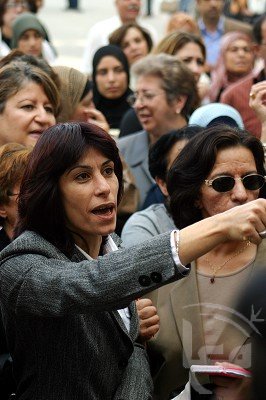 RAMALLAH — Israeli authorities are preventing a sick Palestinian lawmaker from accessing health care, a former European parliamentarian said Monday.
Palestinian Legislative Council member Khalida Jarrar was advised by doctors to undergo urgent brain scans more than two months ago, after tests at a Ramallah hospital revealed concerning results, former European Parliament vice president Luisa Morgantini said.
The former EU official said Jarrar was advised to go to Amman, Jordan immediately as Palestinian hospitals were not equipped to administer the scans required. However for more than six weeks, Israeli security services have prevented Jarrar’s travel due to “security reasons,”
Jarrar’s lawyers obtained an official letter dated 17 August from Israel’s Civil Administration in the West Bank, which stated there was “no security reason” to prevent the lawmaker’s travel abroad. However, Jarrar said on 30 August she attempted to cross the Allenby Bridge into Jordan and Israeli soldiers prevented her passage, citing “security reasons.”
Jarrar is a lawmaker affiliated with the Palestinian Front for the Liberation of Palestine, and has never been incriminated in, or related to, any violent act, Morgantini added, noting that depriving Jarrar of her right to health showed “only one of many tragic and dark sides of the Israeli military occupation.”
Morgantini appealed to the European Parliament to request that Israel authorities allow Jarrar to access urgently needed medical attention in Jordan, and “to guarantee health and life rights to the Palestinian people.”
Israel to cut off East Jerusalem villages
Ma’an – 19/09/2010
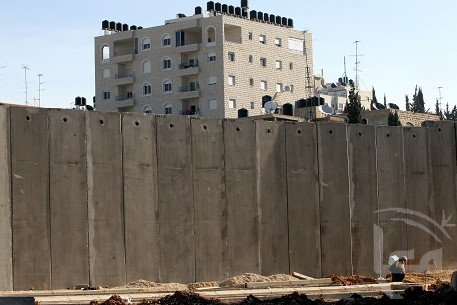
JERUSALEM — Israel began construction on Wednesday to separate Palestinian neighborhoods in occupied East Jerusalem from the rest of the city, a local committee leader said.
Head of the anti-settlement committee in the Shu’fat refugee camp Khader Salamah said Israeli authorities had erected 9- 12-meter concrete blocks around the military checkpoint at the camp’s entrance, isolating Ras Al-Khamis, neighboring the camp.
The construction would increase the suffering of the 15,000 residents of the camp, particularly elderly or sick residents and schoolchildren, Salamah said.
Israel’s planned construction extended to the Dahiyet As-Salam, Ras Shahadah and Anata villages, which when completed would affect the daily life of around 40,000 residents, Salamah said, adding that residents had instructed a lawyer, Dani Zaidman, to begin legal proceedings against Israeli authorities who had confiscated lands without notifying Palestinian owners.
The local committee was preparing to notify President Mahmoud Abbas and the PLO negotiations department of the consequences of Israel’s plan to isolate Palestinian neighborhoods. Israeli authorities were also at the final stages of constructing a new checkpoint at the entrance to Shu’fat refugee camp similar to the main checkpoints in the separation wall at Qalandiya and Hizma, Salamah said.
During the Jewish holiday Yom Kippur on Friday and Saturday, Israeli forces set up cement road blocks at the entrances to several suburbs of Jerusalem, including Al-Isawiya, northeast of Jerusalem and Sur Bahir in the south.
Fierce clashes had erupted on Thursday at Al-Isawiya, during which nine Palestinians were injured, including a paramedic, and six Palestinians were detained, medic Mohammad E’Beid said.
The Occupation’s Many Faces
By Joharah Baker for MIFTAH | September 14, 2010
There is an overriding reality that cannot be dismissed here in Palestine. Israel controls just about every aspect of our lives. No matter how we try to turn it around, candy coat it or look at it from a “different perspective” this is the truth and the main reason why no partial agreement will ever hold.
One only has to travel in the occupied Palestinian territories to know this to be true. Over the Eid Al Fitr – the Muslim holiday following the month of Ramadan – the Qalandiya checkpoint between Ramallah and Jerusalem (itself only a recent reality) was jam packed to kingdom come. People spent literally two, three and four hours trying to make their way out of a one-kilometer area because the Israelis had decided to block all traffic going out of Ramallah towards Jerusalem. It did not matter that people had plans, needed to get back to their children and parents or in the worst case scenario, get to a hospital. As the iron gate opened in the separation wall at Qalandiya, a group of young Israeli soldiers stood with their weapons cocked and smirks across their faces as they watched desperate Palestinians trying to inch their way out of the mess. Rather than the [Israeli] authority responsible for the chaos trying to alleviate the situation, instead young Palestinian men exited their cars and tried to direct traffic.
It is not only the traffic and checkpoints Israel controls. Palestinians across the West Bank are plagued by water shortages. In my Ramallah-area village, the water is cut off four of the seven days a week. Families have to ration out the water usage because if tanks are emptied there is absolutely no way to fill them again until the water comes back on. This is not because there is no water in the West Bank, contrary to common belief. According to a report issued by the Israeli human rights organization B’Tselem, Israel controls and exploits 80 percent of ground water from the Mountain Aquifer, which is the largest water source in the region. The remaining 20 percent is basically leftovers distributed among the Palestinian population.
To give a more concrete idea of just how much Israel controls the water resources and distributes it to its own people’s benefit, according to the World Health Organization in 2008, the minimal daily consumption per capita should be 100 liters. In Israel, the per capita consumption reaches 242 liters while the Palestinians consume an average of 73 liters a day. In some places, the WHO says, Palestinian consumption is as low as 37 liters.
Settlers illegally living on Palestinian land have no shortage of water. Just pass by a Jewish settlement, past the lush greenery and the swimming pools and it’s more than obvious that Jewish settlers never have to think about whether they will have enough water to shower or not. Reports have indicated that in places like the Jordan Valley, Jewish settlers use up to six times more water than Palestinians living in the same place.
So, when the Palestinians say they are not continuing with peace talks if Israel continues building in settlements, this is hardly an unreasonable demand. On the contrary, this is the least of the least they can demand given the detrimental effects settlements have had and continue to have on the Palestinians.
Right now, as the negotiating parties head to Sharm Al Sheikh for the second round of peace talks launched in Washington on September 2, Israel is already casting blame on the other side. It is calling the Palestinians’ demand that Israel renew it settlement freeze – already severely riddled with flaws – an “all or nothing strategy” which could ultimately derail any peace efforts. Israel is portraying the Palestinians as the intransigent party for their very legitimate demand of halting settlement construction. Many Palestinians even see this as way too little and a lot too late, saying the leadership should demand nothing less than a complete halt to settlement construction and a dismantlement of settlement structures in accordance with international law.
However, Israel has no plans of relinquishing its settlement enterprise in the West Bank for one reason, which is its control of the land and consequently of the oppressed people living on it. Since its occupation of the West Bank in 1967 Israeli governments have encouraged settlement growth by offering enticing economic incentives such as subsidized housing and reduced utility expenses. By keeping a presence in the West Bank through its settlements, the bypass roads, separation wall and the checkpoints such as Qalandiya, it maintains complete control over the populace, all under the false guise of its own security.
While Israel continues its rants about how the Palestinians are unreasonable and are placing obstacles in the way of peace, it is worthwhile to remind the world what it is like to live under occupation. Control and oppression is multi-faceted. Israel’s military presence and confrontations with the occupying army are definitely important features of Israel’s occupation of the West Bank, Gaza and east Jerusalem but they are not the only ones. The overall control Israel wields over Palestinian lives is suffocating because it is so comprehensive. Leaving and entering the country is controlled by Israel, entering Jerusalem, working inside the Green Line, exporting and importing goods, building a house, tending to your land (if you have access to it) and even the amount of water you are allowed to consume are all controlled by the mighty hand of Israel’s occupying power.
So, before blame is laid or the world judges us too quickly, let us all remember the overriding reason we are at the negotiating table at all. Then after the occupation is duly mentioned, just imagine spending four hours trying to get home from a 45 minute trip only to find no water for your shower.
Joharah Baker is a Writer for the Media and Information Department at the Palestinian Initiative for the Promotion of Global Dialogue and Democracy (MIFTAH). She can be contacted at mid@miftah.org.
Canada Colludes in Suppressing Palestinians
By Yves Engler / Dissident Voice / September 17th, 2010
Current peace negotiations between Israeli and Palestinian officials are unlikely to end, let alone reverse, Palestinian dispossession. The power imbalance between the sides is simply too great. While Canada could be part of the solution, so far it has been part of the problem.
The largest Palestinian political force, Hamas, has been excluded from these U.S.-sponsored talks, while the electoral mandate of the Palestinian representative, Mahmoud Abbas, expired 20 months ago. Abbas, who arbitrarily extended his term as Palestinian Authority President, is heavily dependent on countries such as the U.S. and Canada, and this has undermined his negotiating position.
After Hamas won Canadian-monitored and facilitated legislative elections in early 2006, Stephen Harper made Canada the first country to cut its assistance to the Palestinian Authority. The goal was to sow division among Palestinians, and it worked. Immediately after the Palestinian unity government collapsed in mid 2007, the Canadian International Development Agency contributed $8 million “in direct support to the new [Abbas-led] government.”
Ottawa pumped millions of dollars into training a Palestinian security force “to ensure that the PA [Palestinian Authority] maintains control of the West Bank against Hamas,” as Canadian ambassador to Israel, Jon Allen, was quoted as saying by the Canadian Jewish News.
U.S. Lt.-Gen. Keith Dayton, in charge of organizing the 10,000-member Palestinian force supported by Canada, never admitted that he was strengthening Mahmoud Abbas’ Fatah against Hamas, but to justify his program Dayton argued that Iran and Syria funded and armed Hamas. Bolstering Fatah to counteract the growing strength of Hamas was the impetus for Dayton’s mission, yet the broader aim was, and is, to build a force to patrol Israel’s occupation.
“We don’t provide anything to the Palestinians,” noted Dayton, “unless it has been thoroughly coordinated with the state of Israel and they agree to it.” For instance, Israel’s internal intelligence agency, the Shin-Bet, vets all of the Palestinian recruits.
Brigadier-General Michael Herzog, chief of staff to Defence Minister Ehud Barak, explained the Israeli military’s position: “We’re very happy with what he’s [Dayton] doing.”
The Israelis support Dayton’s force because it keeps the population in the West Bank under control. On August 25, Abbas’s security force suppressed a demonstration in Ramallah against the current negotiations, which are taking place without preconditions and while Israel continues to build the wall as well as Jewish settlements in the West Bank and East Jerusalem. Similarly, 20 months ago, “Dayton’s men” (as they are derisively called by Palestinians) disrupted demonstrations in the West Bank against Israel’s 22-day assault on Gaza that left 1,400 dead.
The new Palestinian security forces are primarily trained in Jordan at the U.S.- built International Police Training Center (created to train Iraqi security). In October 2009 the Wall Street Journal reported, “[Palestinian] recruits are trained in Jordan by Jordanian police, under the supervision of American, Canadian, and British officers.”
In the West Bank, 18 Canadian troops work with six British and 10 U.S. soldiers under Dayton’s command. “The Canadian contribution is invaluable,” explained Dayton. Canadians are particularly useful because “U.S. personnel have travel restrictions when operating in the West Bank. But, our British and Canadian members do not.” Calling them his “eyes and ears” Dayton said, “The Canadians … are organized in teams we call road warriors, and they move around the West Bank daily visiting Palestinian security leaders, gauging local conditions.”
Ottawa has invested heavily in Dayton’s mission. In January 2007, then foreign affairs minister, Peter MacKay, offered an immediate $1.2-million for Dayton’s mission, and during a joint press conference in Jerusalem, then U.S. secretary of state, Condoleezza Rice, said Dayton “has a Canadian counterpart with whom he works very closely.” When Foreign Affairs Minister, Maxime Bernier, traveled to Israel in January 2008, he met Dayton, and last October Canada’s chief of defence, Walt Naynczyk, visited Canada’s “road warriors” during a trip to meet Israeli military officials.
Part of the U.S. Security Coordinator office in Jerusalem, the Canadian military mission in the West Bank (dubbed Operation PROTEUS) now includes RCMP officers as well as officials from Foreign Affairs, Justice Canada and the Canadian Border Services Agency. According to deputy Foreign Affairs Minister, Peter Kent, Operation PROTEUS is Canada’s “second largest deployment after Afghanistan” and it receives “most of the money” from a five-year $300 million Canadian “aid” program to support the security apparatus of Abbas’ Palestinian Authority.
As the weaker side, Palestinians need countries like the U.S. and Canada to pressure Israel to return land it occupies against international law. Unfortunately, the current negotiations have begun with Canada and the U.S. undermining Palestinian unity and strengthening the long-suffering population’s most compliant leaders.
Yves Engler is the author of The Black Book of Canadian Foreign Policy
Featured Video

The American Retreat from Vietnam
or go to
Aletho News Archives – Video-Images
From the Archives
Secret document reveals plans for civil war in Lebanon, Israeli false flags, and invasion
By Randi Nord | Geopolitics Alert | April 5, 2019
Beirut – During his visit with US Secretary of State, Mike Pompeo, Lebanese President Michael Aoun reportedly received a US-Israeli document detailing plans for creating a civil war in Lebanon with covert false flag operations and possible Israeli invasion.
Although the source of the document is Israeli and created in partnership with Washington, no one knows who presented it to Aoun. The Lebanese TV station, Al-Jadeed, initially reported the document on Lebanese TV and a video on its website. Geopolitics Alert translated the report for this article. … continue
Blog Roll
 Aletho News
- America’s Greenland deal has a radioactive backstory
- The RAF Fairford ‘terror plot’: Unpacking escalation in the UK echo-chamber
- EU Council Advances Chat Control 2.0 Scanning Proposal
- Ex-Greek MEP files complaint against Israeli spyware firm over alleged Pegasus surveillance
- Troubling ideas throughout the Torah, Talmud, Mishneh Torah and Tanya
- ‘Grave, alarming’: Iran mission on Trump’s UNGA ‘annihilation’ threats
- Najaf airport to reopen to Iranian flights within 24 hours: Ambassador
- From ‘How Will This End For Iran’ to ‘When America Walks Away’: A tale of two Economist covers
- Tehran blasts ‘baseless’ speculation linking Iran to alleged bomb plot at UK air base
- The Rise And… Rise Of ‘Color Revolutions’
- If Americans Knew
- Israel’s siege signals another cruel winter for 1.8 million Gazans – Daily Update
- Netanyahu Asked UAE Leader to Deny Report on Oct. 7 Warning in Secret Visit, Sources Say
- CNN Chief Int’l Correspondent Clarissa Ward on Journalists in Gaza
- Democratic Party Consultants Surround Troy Jackson with Pro-Israel Donors
- Christian Leader Responds To Netanyahu’s Claims Regarding Palestinian Christians
- In Gaza, ‘Whoever Survives the Bombing Won’t Survive the Rubble’
- Israel kills more Palestinians, amid push to resettle Gaza – Daily Update
- Israel forces Gazans to live in constant peril – Daily Update
- Deconstructing Netanyahu’s pants-on-fire UN rant – Daily Update
- Trump betrayed voters with his campaign lies and prioritized a foreign country once he took office
- No Tricks Zone
- New Study: Earth And Venus Surface Warmth Largely Explained By Convection And Lapse Rate, Not CO2 Or Radiation
- 2025 Nature Paper Claiming Worsening Global Drought Gets RETRACTED …Heavily Flawed
- New Study: ‘Global Drought Shows No Detectable Recent Acceleration Under Climate Warming’
- Economic Masterminds: German Socialists Suggest Taxing Productivity Gains Stemming From Using AI
- The South China Sea Has Not Been Cooperating With The Climate Change Narrative
- Energy Crisis: Germany Enters Heating Season With Historically Low Gas Reserve Fill Levels
- New Study: The Antarctic Ice Sheet Gained Mass From 2020-2024 Due To Staggering Snow And Ice Accumulation
- Study: Ocean Heating Rates From Thousands Of Years Ago ‘Dwarf’ Modern Ocean Heating Rates
- Climate Extremists Target, Attack Large-Scale Power Grid Infrastructure In Germany!
- New Study: Antarctic Ice Melt Has Contributed Less Than 1 Centimeter To Sea Level Rise In The Last 30 Years

