Nowhere to hide: New illegal observation tower in occupied Hebron
International Solidarity Movement | October 3, 2016
Hebron, Occupied Palestine – Israeli forces put up a CCTV observation tower in the Ibrahimi mosque area, further increasing not only their all-encompassing surveillance of Palestinians, but also their slow but steady illegal annexation of more and more Palestinian land in occupied al-Khalil (Hebron).
At the end of last week, Israeli forces in a ‘secret’ over-night action put up the observation tower, surrounded by dozens of cement blocks and barbed-wire. Located in a corner between Palestinian houses, the observation post with a container and all the surrounding paraphernalia is just another step in the illegal annexation of yet more land. In recent weeks, Israeli forces have increased their illegal annexations of the tiny strip of Shuhada Street still accessible to Palestinian pedestrians and stepped up the game of creating a coercive environment directly leading to forced displacement of Palestinians in the Tel Rumeida area.
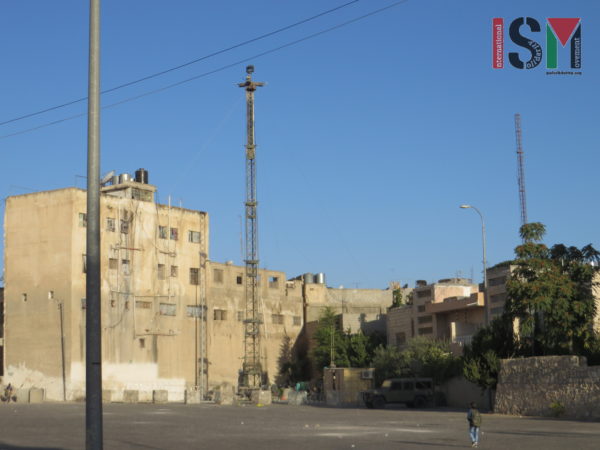
CCTV surveillance tower newly put up in Palestinian neighborhood
This observation tower is fitted with a camera that reaches high above the houses in the neighborhood, thus watching Palestinians constantly. This feeling of permanently being watched for Palestinians is combined with the ever present controls and humiliations at the more-and-more militarized checkpoints. Palestinians are watched, humiliated, numbered, deprived of their most basic human rights – occupied not only physically by the Israeli occupation forces, but also mentally. They can never tell whether they’ll be allowed through a checkpoint (something that solely depends on the respective soldiers whim), whether their children will be tear-gassed on their way to school or arrested, or even whether they’ll be gunned down by Israeli forces at a checkpoint and left to bleed to death. Any and all of these forms of collective punishment are enforced by the Israeli occupying forces on the entire population of civilians in complete disregard of any care for international law or humane treatment of the occupied indigenous Palestinian population.
The Tel Rumeida neighborhood, Shuhada Street, and the area around the Ibrahimi Mosque are already linked by a settler-only street that has been ethnically cleansed of Palestinians in the aftermath of the Ibrahimi Mosque massacre. Restrictions in the Tel Rumeida neighborhood (declared a ‘closed military zone’ solely enforced on Palestinian residents for almost a year now) and around the Ibrahimi Mosque (where Palestinians are often prevented from passing checkpoints on a age-limit between 15-30) have escalated in a very short amount of time, making life for the Palstinians as hard – or rather impossible – as possible, leaving them with no choice than to leave. The only and clear aim is the forcible transfer of all Palestinians in this area, thus geographically linking the illegal settlements in an area ethnically cleansed of any Palestinian presence.

CCTV camero on top of the surveillance tower
September 2016 report: 436 Palestinians arrested, nearly 8000 since October 2015

The following is a translation of the report issued monthly by Palestinian organizations working on prisoners’ issues: Prisoners Affairs Committee; Palestinian Prisoners; Society; Al-Mezan Center for Human Rights and Addameer Prisoner Support and Human Rights Association. The report was issued on Monday, 3 October and translated by Samidoun Palestinian Prisoner Solidarity Network. Photo for illustration purposes.
Israeli occupation forces arrested 436 Palestinians in the West Bank and Gaza in September 2016, including 73 children and 11 women (including 3 minor girls.)
151 of those arrests took place in the Jerusalem Governorate, 81 in Al-Khalil, 40 in Bethlehem, 40 in Nablus, 35 in Jenin, 32 in Ramallah and El-Bireh, 23 in Tulkarem, eight in Qalqilya, six in Tubas, six in Salfit, five from Jericho and nine from the Gaza Strip.
There are approximately 7,000 Palestinian prisoners in Israeli jails, including 59 women, 12 of them minor girls. There are a total of approximately 350 children in Megiddo and Ofer prisons. There are 700 Palestinians held in administrative detention without charge or trial. 122 administrative detention orders were issued in September, including 44 new orders.
Battle of the empty stomachs in September
Palestinian prisoners Mohammed and Mahmoud al-Balboul and Malik al-Qadi carried out hunger strikes of 79, 76 and 68 days against the administrative detention orders against them. They ended their strikes on 22 September after reaching an agreement for their release without renewal of their administrative detention, with the immediate release of al-Qadi to a Palestinian hospital and the release of the Balboul brothers on 8 December 2016, which came after popular, legal and political efforts for their release.
Palestinian prisoners Ahmad Abu Fara and Anas Shadid launched their hunger strike on 25 September against administrative detention while Jawad Jawarish and Maher Abayat announced their strike against arbitrary transfer and isolation.
A year on the popular intifada: the issue of prisoners
The popular uprising which began on 1 October 2015 has had a clear impact on the issue of prisoners. The number of daily arrests has increased over the past year and has included the arrests of different ages and social groups, children, women and men. At least 7955 Palestinians were arrested, including 1963 children, 229 women and girls, 41 journalists and five members of the Palestinian Legislative Council.
The highest number of arrested Palestinians were from Jerusalem; 2355 Palestinians from Jerusalem have been detained since last October, including 842 children and 128 women, including 24 minor girls.
There has been an increase in the number of administrative detention orders throught the year. For the first time since 2008, occupation authorities have issued 1436 administrative detention orders in 2016, including 546 new orders issued without charge or trial under the so-called “secret file.” It is worth noting that many administrative detention orders were issued against young people and students who are not affiliated with the Palestinian political factions.
The Israeli occupation authorities have pursued since last October systematic and deliberate policies against Palestinian prisoners at all stages from arrest through transfer to imprisonment, to a dangerous extent that threatens Palestinian lives. Prominent among these grave violations are the use of excessive force and the execution and extrajudicial killing of Palestinians by Israeli soldiers, including the killing of dozens of Palestinians instantly, noting that these practices of shooting to kill Palestinians violate international law.
Human rights organizations also monitored the number of violations against Palestinian detainees, including an escalation on the use of torture and cruel and inhumane treatment, such as beating and assault during arrest and interrogation, as well as increased frequency and violence of raids and invasion of prison rooms and sections and the conduct of humiliating inspections. Prisoners have been arrested after being shot and did not receive necessary medical care and were subject to interrogation before and during medical treatment in hospitals, in addition to the abduction of wounded Palestinians from hospitals and ambulances.
The occupying power also enacted legislation and proposed draft laws against Palestinians, including laws that escalate prison sentences against “stone throwers,” often children and youth, and expansion of the scope of administrative detention, in an effort to impose collective punishment against Palestinians. In addition, new charges were used to arrest hundreds of Palestinians related to publishing on social media, with sentences up to one year in prison; the year also saw an expansion by occupation forces of the policy of deportation and forcible transfer from the Jerusalem.
Attacks on international agencies and arrests of Palestinian aid workers part of systematic Israeli assault
By Charlotte Kates – Samidoun Palestinian Prisoner Solidarity Network – October 2, 2016

Two Palestinian UN and international NGO workers in Gaza, Mohammed al-Halabi and Waheed Bursh, have been targeted by the Israeli occupation for arrest and military prosecution in high-profile cases that seemingly aim to imprison not only these individual Palestinians, but also to pressure international agencies into a further separation and deeper division from the Palestinian people under occupation with whom they work, and towards control and authorization by Israeli occupation forces.
Mohammed al-Halabi, the operations manager for World Vision in Gaza, was arrested by Israeli occupation forces on 15 June as he crossed at the Beit Hanoun/Erez crossing (to which he had already been given a permit by the Israeli occupation.) After being held incommunicado and under interrogation, facing torture and abuse for over a month and a half, Al-Halabi was accused in a showy statement of allegedly “diverting” up to $50 million USD to the Palestinian resistance organization and political party Hamas – based on a “confession.” Despite the allegations, World Vision noted that its “cumulative operating budget in Gaza for the past 10 years was approximately $22.5 million,” making the alleged amounts of money involved materially impossible. World Vision also noted that “Mohammad El Halabi was the manager of our Gaza operations only since October 2014; before that time he managed only portions of the Gaza budget. World Vision’s accountability processes cap the amount individuals in management positions at his level to a signing authority of US$15,000.”
Nevertheless, Israeli prime minister Benjamin Netanyahu issued a video message alleging that the Israeli occupation project “cared more” about Palestinians than Palestinian leadership organizations, particularly Hamas in Gaza. While the Israeli occupation state controls access to Gaza and entirely occupies its sea and skies, it claims to not have control or occupying power over Gaza. Nevertheless, the Israeli occupation state is imprisoning Al-Halabi for matters that – even taking their tortured “confessions” at face value – is seemingly entirely internal to Palestinians in Gaza and international organizations working with them.
It should be noted that the allegations against Halabi appear to be based entirely upon confessions obtained through torture and potentially the word of a collaborator or a “disgruntled employee” who disappeared from Gaza to Egypt after his firing from World Vision by Halabi; this is reflected in the clearly inaccurate financial amounts reported in coverage of this case. Perhaps because of the very weakness of the allegations themselves, Halabi will allegedly be tried in a “secret court,” reported his lawyer, Lea Tsemel. Despite the origins of the allegations (confessions obtained through torture) and their seeming physical impossibility, both the Australian and German governments suspended aid to World Vision. While World Vision has announced its trust in its staff, the cut in funds – and an Israeli freeze on its bank account in Jerusalem for the international Christian charity – has meant that over 120 local Palestinian staff have been laid off in Gaza and operations are suspended, where unemployment already ranges near 40% and poverty forces Palestinians to rely on international aid.
This is not the first run-in between the Israeli state and World Vision. Israel and its supporters in NGO Monitor attacked the Christian charity in 2004 for supporting Palestinian rights, thus “support for terror.” World Vision’s programs came under attack previously by Mossad-linked law firm “Shurat Ha-Din,” known for its pursuit of dubious yet fiscally draining lawsuits against opponents and critics of Israel around the world, Shurat Ha-Din attacked World Vision and other charities for their support for the work of the Union of Agricultural Work Committees, a land and water defense organization operating in the West Bank and Gaza that has been honored with the UN’s Equator Prize and is a member of the global peasant movement, Via Campesina. Shurat Ha-Din demanded an end to Australian support of World Vision, claiming that UAWC was a “front” for Palestinian leftist political party, the Popular Front for the Liberation of Palestine. Shurat Ha-Din’s efforts were rejected in Australia and refuted both by the Australian government and World Vision itself. Still, the continuing focus on World Vision and its engagement with local Palestinian organiztions in Gaza appears to be a continuing thread in Israeli surveillance and repression.
While Halabi was arrested on 15 June, Waheed Bursh, a Palestinian engineer contracted by the UN Development Program (UNDP) was arrested one month later, also as he crossed the Beit Hanoun/Erez crossing, for which he had previously received a permit. The case of Bursh is particularly striking: over two weeks after his arrest, and several days after the public announcement of the allegations against Halabi, he was accused by the Israeli occupation of allegedly “diverting” rubble in Gaza created by the massive Israeli bombing of Gaza in 2014 for Palestinian use to shore up a port and jetty on Gaza’s north shore. The Israeli occupation accuses the rubble of being “diverted to Hamas,” but it is distinctly unclear if that simply means to the Palestinian Authority in Gaza, which is run by Hamas officials – and in any case, the UNDP itself reaffirmed that the rubble in question was directed as agreed to a civilian area and there “was no diversion.”
This case is, essentially, about whether Palestinians have the right to decide in any small way what to do with the massive rubble created when hundreds of thousands of Palestinians’ homes in Gaza were destroyed by Israeli bombs and warplanes – and that any individual Palestinian following Palestinian direction in such a case is subject to torture and imprisonment. Not only does Israel declare the right to bomb and destroy Gaza at will; it also declares the right and ongoing authority to determine the usage of the rubble created by its bombing and destruction.
The Bursh case highlights the insufficiency and the injustice of the UN “reconstruction program” for Gaza, which has seen both an extremely high level of inefficiency as only a small portion of the buildings destroyed in Gaza have been rebuilt, but also an extremely high level of utter disregard for Palestinian sovereignty and internationally-recognized rights, instead creating a program in which all access to funds and building materials is dependent on the approval of the Israeli occupation that destroyed those places to begin with.
The UN has argued that Bursh is immune from prosecution given his UN role, and that he acted according to the request of the Palestinian Authority. This case is not only about the imprisonment of one Palestinian engineer, but about who has the right to build with the rubble created by Israel’s bombs, and who decides: Palestinians, including their political forces? Or international organizations with the consent and oversight of the Israeli occupation? Or, perhaps more precisely, the Israeli occupation, with the work carried out by international organizations and highly subjugated Palestinian staff?
Both the Gaza reconstruction mechanism and the Halabi and Borsh cases highlight the severity of the ongoing Israeli occupation of Gaza as well as an apparent political priority of disempowering Palestinian non-governmental organizations and even staff of international organizations in any context in which they operate outside of complete Israeli control. While the Israeli occupation has generally supported the “NGOization” of Palestinian society as an alternative to Palestinian resistance organizations, these recent cases appear to indicate an intention for Israel to outsource not only the costs but also the repressive mechanisms of its occupation of Gaza to international organizations, thus requiring the dismissal and complete control of any local Palestinian staff empowered to make independent decisions.
Conditional aid that requires all staff at an organization not to be members of any organization on the US list of “foreign terrorist organizations,” such as that distributed by USAID, has commonly been discussed as a long-running problem in Palestinian civil society. The US FTO list includes major Palestinian political forces such as Hamas, the PFLP, Palestinian Islamic Jihad and even Fateh’s armed wing; similar lists are to be found in the European Union, Canada, Australia, the UK and elsewhere – although Hamas is currently fighting a legal case for removal from the EU’s list. Further, the overall impact of international donor funds in directing the priorities of Palestinian organizations away from Palestinian national liberation and towards “projects” and state-building amid ongoing occupation and oppression, and demobilizing the Palestinian national movement into “civil society” or “interest groups” has been the subject of intense discussion among Palestinian organizations and activists.
In Gaza in particular, the filing and heavy publicity surrounding the Halabi and Bursh cases seems to indicate that the Israeli state is pursuing an even heavier hand on all forms of Palestinian organization and even Palestinian roles in directing the work of international organizations. Palestinian organizations in 1948 Palestine have come under attack through new laws designed to block “foreign funding,” while the Balad/National Democratic Assembly political party, represented in the Knesset by Jamal Zahalka, Haneen Zoabi and Basil Ghattas, has been subject to a series of raids and arrests accusing them of undisclosed “foreign funds.” Of course, Palestinian organizations like Addameer Prisoner Support and Human Rights Association, the Palestinian Prisoners’ Center for Studies and other organizations in the West Bank continue to be subject to arrests, raids and other attacks by occupation forces, while Israel continues to threaten escalation against Palestinian civil society organizations supporting the growing boycott, divestment and sanctions (BDS) movement. Ben White in Al-Jazeera noted that “Israeli minister Gilad Erdan has claimed that the accusations against Halabi prove the government’s claim that ‘there are extensive ideological and monetary ties between terrorist organisations and delegitimisation organisations that work against Israel.’”
Ali Abunimah of the Electronic Intifada wrote, “But by spreading sensational allegations that a group as well-known as World Vision is ‘funding terrorism,’ Israel may seek to put other organizations and the Israel-friendly Western governments that fund them on notice that all their operations, especially in Gaza, are at its mercy. It may also be an effort to break growing solidarity for Palestinians in churches, where there has been a strong push to hold Israel accountable through boycott, divestment and sanctions.”
These allegations perhaps bear the closest resemblance to early-to-mid-2000s calls from the Israeli occupation and Western states regarding “corruption” in the Palestinian Authority under Yasser Arafat. Viewing the PA’s role in outsourcing the costs of occupation and suppressing Palestinian resistance as apparently insufficient, Israeli and Western charges of corruption and demands for higher levels of international and Israeli control led in part to the imposition of Mahmoud Abbas as a prime minister and the “Daytonization” of PA security forces under US command, removing Fateh loyalists and turning them into even more of a direct mechanism for security cooperation with the Israeli occupation.
Circumstances differ in that corruption in the PA was – and remains – a legitimate concern of Palestinians (although higher levels of Israeli and international control in fact exacerbated the problem and were opposite to the solutions demanded by Palestinians), while in these cases the arrests reflect entirely Israeli interests at the expense of Palestinians. However, the projected outcomes are similar in the re-orienting of international organizations as opponents and monitors of Palestinians and the escalation of international and Israeli control at the expense of even the most individual and basic levels of Palestinian control or self-determination.
The roots of the prosecution of Halabi and Bursh, the shuttering of World Vision’s programs and the threat of further raids and prosecutions against Palestinian staff of international organizations can also be found in the use of “foreign terrorist lists” by international states and bodies to criminalize Palestinian political life and resistance. While the United States, European Union, Canada, UK, Australia and other states are clearly not opponents of either state-sponsored or non-state violence when carried out by allies and agents, and while Palestinians are internationally recognized as an occupied people with rights to sovereignty and self-determination, Palestinian resistance organizations are routinely labeled as “terrorist.” In the post-Oslo era, the drive to redefine the Palestinian struggle from an anti-colonial national liberation movement into a “state-building project” and a “mediated conflict” with the Palestinian Authority as its reference has been used to criminalize and prosecute Palestinian organizing not only inside but also outside Palestine, while obscuring the nature of Palestinian reality today.
That governments such as those of Australia and Germany chose to cut funding to World Vision in response to these allegations rather than defend an occupied people under colonization and denounce the actions of a belligerent occupier abducting and accusing people under occupation of using funds and, indeed, the rubble created by the occupier’s bombing, in their own interest, indicates the enmeshment of these states with the Israeli state in a common support for settler colonialism, Zionism and racism in Palestine and internationally.
From the siege on Gaza – against which the Women’s Boat to Gaza today sails with the support of people’s movements and against the will of Western states and the Israeli occupation – to the imprisonment of over 7,000 Palestinian prisoners, it is nearly impossible to support fundamental Palestinian rights while labeling Palestinian resistance as “terrorist.” Attempts to do so are then only more vulnerable to attacks of this type – while local Palestinian staff attempting to serve their people within the context of international organizations are targeted for secret trials and persecution on the basis of torture-borne “confessions,” even if the charges themselves are materially incoherent or manifestly absurd. Thus, the international reconstruction mechanism in Gaza has only allowed a greater level of Israeli occupation and control of the Strip, while years after Israel’s bombing, Palestinians in Gaza are still living in shelters while their homes remain rubble.
International mobilization in defense of Halabi and Bursh is necessary. It is not enough to demand a “fair trial” when the charges and structure of prosecution exist only as a mechanism of colonialism. It is urgent to stand not only against the persecution of these Palestinian staff but against the entire framework that seeks to undermine Palestinian sovereignty, redefine resistance as “terror” and legitimize ongoing colonization and occupation.
Charlotte Kates is the international coordinator of Samidoun Palestinian Prisoner Solidarity Network. She coordinates the National Lawyers Guild’s International Committee and works with a number of organizations advocating for Palestinian rights.
‘Death Caravan’ Perpetrators to Face Court in Chile

Augusto Pinochet. | Photo: EFE
teleSUR | September 30, 2016
The Death Caravan was the name of a military operation that killed almost 100 political prisoners in Chile beginning on Sept. 30, 1973.
Former Army Commander Juan Emilio Cheyre and six military officials were arrested July 7 in Chile for their involvement in the death of 15 people as part of an operation known as the Death Caravan, launched the same month as the military coup that overthrew President Salvador Allende.
The Death Caravan was the name of a military operation that killed and disappeared almost 100 political prisoners in Chile beginning on Sept. 30, 1973, following General Augusto Pinochet’s coup, with the support of the United States. The military ruled the country with an iron fist for 17 years, until 1990.
Judge Mario Carroza told La Tercera that the decision to arrest the former commander-in-chief of the Chilean army was based on “knowledge of what happened during the three hours in La Serena,” where the killing took place.
Carroza added that “testimonies of direct observers during the reconstruction of the scene” coincided with other elements of the investigation, and will be an important factor in the trial.
The arrests followed a complaint filed by the Human Rights Program affiliated with the interior ministry.
Cheyre was named commander-in-chief of Chile’s army in 2002, one year before he was publicly accused of participating in the murder of a couple and stealing their 2-year-old child in La Serena back in 1973. Chile’s justice eventually filed a case without finding Cheyre responsible for the act.
Serving in the top-ranking military role until 2006, Cheyre was appointed as president of Chile’s electoral body in 2013 by the neoliberal President Sebastian Piñera.
Cheyre jailed an estimated 80,000 people, tortured 30,000 and murdered around 3,200. Only 75 of more than a thousand of his former agents are serving prison sentences for human rights violations.
Former Palestinian minister of detainees’ affairs sentenced to Israeli prison

Samidoun Palestinian Prisoner Solidarity Network – September 29, 2016
Wasfi Qabha, former Palestinian minister of detainees and ex-detainees in the government of Ismail Haniyeh, was sentenced to twelve months in Israeli prison by a military court on Wednesday, 28 September. Qabha, a prominent leader in Hamas, has been repeatedly arrested by Israeli occupation forces and has spent a total of 12 years in Israeli prisons.
Qabha was arrested from his family home in Jenin by Israeli occupation forces in May; his wife stated that he was charged with a number of charges in the military courts related to his public activities in campaigns supporting Palestinian prisoners in Israeli jails. His sentence was accompanied with an 18-month suspended sentence and a 2,000 NIS (approximately $500) fine.
Also on Wednesday, member of the Palestinian Legislative Council Mohammed Jamal Natsheh was arrested among 43 others in pre-dawn arrest raids carried out by Israeli occupation forces throughout the West Bank. Natsheh was released from Israeli prisons after his previous arrest less than seven months ago. He was previously imprisoned without charge or trial under administrative detention. A member of the PLC representing the Change and Reform bloc associated with Hamas, Natsheh has repeatedly been arrested since his election in 2006, usually ordered to administrative detention without charge or trial.
Among the pre-dawn raids included the seventh day in a row of violent occupation military raids on Shuafat refugee camp and nearby Beit Hanina in Jerusalem, where 13 Palestinians were detained by occupation forces as over 20 homes were invaded and ransacked. The Palestinians arrested were Bilal Eid, Ahmad Imran Muhammad Ali, Mohammed Maher al-Mimi, Muhannad Bilal Anati, Bilal Awwad Anati, Ahmad Tartir, Fadi Eid, Ahmad Bilal Eid, Muayyad Jaber Muheisen, Hamoudeh Jamal Abdel-Qader, Adham al-Sharqawi, Saddam Joudeh and Hamoudeh al-Kirri.
Also arrested in Jerusalem area were Areen Za’anin, Fathi Nasser, Hussam Jamzawi, Ahmad Sajidiya, Fares Aslan, Khalil Qureia and Medhat Khalil, the last a guard of the Al-Aqsa Mosque. Bilal Eid is only 16 while Ahmad Ali is only 15 years old; they are among over 370 Palestinian children held in Israeli jails.
In al-Khalil, alongside Natsheh, also arrested were Mohammed Imam, Mohammed al-Durra, Said Zughayyer, Alaa Abu Ajamieh, Abdel-Rahim Fatafta and Abdul-Qader al-Titi, as well as Abdel-Nasser Abu Maria, 17 years old.
Five Palestinians from Budrus, near Ramallah, were arrested: Malek Marrar, Mohammed Hasan, Hosni Khalifa, Mahmoud Khalifa and Yahya Salama. Wissam Ali, Mohammed Jaber, 17, and Oday Jaber were arrested from the Nur Shams refugee camp near Tulkarem. In Jericho, three Palestinians were seized by occupation forces, including 15-year-old Mohammed Shalalfa, alongside Haitham Shalalfa and Shtayyen Shalalfa; in Qabatiyeh, two Palestinians, Mohammed Assaf and Suheib Abu al-Rub, were arrested. Occupation forces seized Mahmoud Qashmar in Qalqilya and Rashad Issa from al-Khader, near Bethlehem.
On Thursday morning, at least 10 more Palestinians were reported arrested in violent raids by occupation forces, including former prisoners Amin Hamed, 60, and his son Abdelhadi Hamed, 30, arrested in Silwad east of Ramallah in a violent raid on their home, including the explosion of the door of their homes. Abdulhadi’s brother, Abdullah’s, home was raided as well by occupation forces. Their brother Akram is serving a 17-year sentence in Israeli prisons.
Former hunger striker Malik al-Qadi released by Israel, transferred to Palestinian hospital
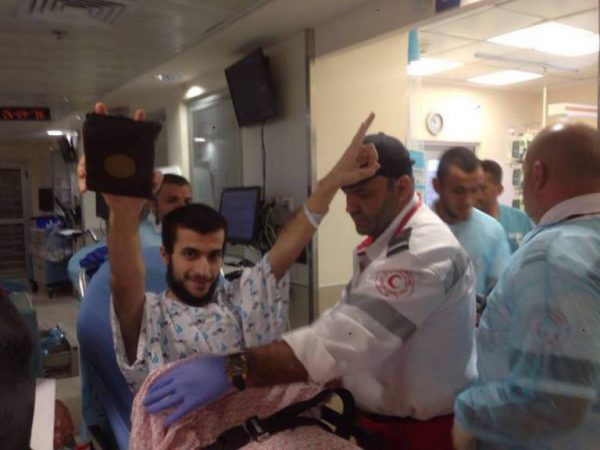
Al-Quds University journalism student Malik al-Qadi following his release from administrative detention
Ma’an – September 24, 2106
JERUSALEM – Israeli authorities released former hunger-striking prisoner Malik al-Qadi to Palestinian medics on Saturday to transfer him to a hospital in the occupied West Bank.
The Palestinian Red Crescent said on Saturday morning that its staff was transferring al-Qadi from the Israeli Wolfson Medical Center to the Istishari Arab Hospital in the city of Ramallah.
Al-Qadi is in a dire health condition after going without food for 68 days to protest being held in administrative detention — internment without trial or charges — by Israel.
Al-Qadi ended his hunger strike on Wednesday, along with fellow prisoners Muhammad and Mahmoud al-Balboul, after an agreement with the Israeli prisons services not to renew their administrative detentions.
Muhammad Balboul, 26, had refused food for 77 days since July 7, while his 23-year-old brother Mahmoud had been on hunger strike 79 days since July 5, and al-Qadi, 25, declared his hunger strike on July 16.
Qaraqe said in a statement on Wednesday that Muhammad and Mahmoud al-Balboul were set to be released on Dec. 8, while Malik al-Qadi would be released on Sep. 22, and that all three of their administrative detentions would not be renewed.
The three had initially launched their hunger strikes amid a mass movement across Israeli prisons in solidarity with hunger-striking prisoner Bilal Kayid, who after 71 days suspended his hunger strike after striking a deal with Israel to end his administrative detention sentence. He was reportedly set to be released on Dec. 12.
Kayid was one of the most high-profile hunger strikers since Palestinian journalist Muhammad al-Qiq came near death during a 94-day hunger strike protesting his administrative detention order, before he was finally released in May.
Rights groups have claimed that Israel’s administrative detention policy, which allows detention for three- to six-month renewable intervals based on undisclosed evidence, has been used as an attempt to disrupt Palestinian political processes, notably targeting Palestinian politicians, activists, students, and journalists.
Although Israeli authorities claim the withholding of evidence during administrative detention is essential for state security concerns, rights groups have instead claimed the policy allows Israeli authorities to hold Palestinians for an indefinite period of time without showing any evidence that could justify their detentions.
According to Addameer, as of August, 7,000 Palestinians were being held in Israeli prisons, 700 of whom were being held under administrative detention.
Dozens Of Israeli Soldiers Invade Bil’in, Storm Homes And Confiscate Laptops
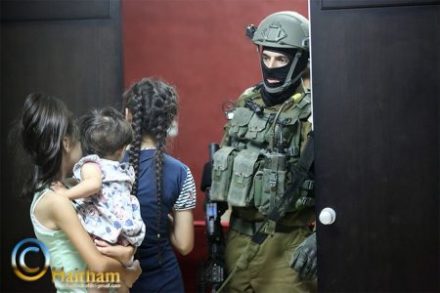
IMEMC News | September 21, 2016
Dozens of Israeli soldiers invaded, approximately at 2:30 after midnight, the village of Bil’in in the central West Bank district of Ramallah, broke into and searched several homes and confiscated hard discs from a number of laptops.
Most of the invaded homes belong to nonviolent activists, senior members of the Popular Committee against the Wall in Bil’in, including Dr. Rateb Abu Rahma, his brother Abdullah Abu Rahma, in addition to Ahmad Abu Rahma Mohammad al-Khatib, Ashraf Abu Rahma and photojournalist Haitham Khatib.
Photojournalist Khatib said four military jeeps and two army trucks, carrying around six soldiers, invaded the village and started searching homes before confiscating hard disks from a number of laptops.
“The soldiers just said they will be the property back, but no one believes this,” he said, “They took my car before and never returned it; they are just lying.”
Coordinator of the Popular Committee in Bil’in, Dr. Rateb Abu Rahma, denounced the latest military invasion, and the searches of homes, in addition to the illegal confiscation of private property.
Abu Rahma added that the escalating Israeli violations will not be able to stop the nonviolent, popular resistance, in the village.
The protests in Bil’in started approximately twelve years ago, and kept going despite the ongoing excessive use of force and escalating violations, including night raids, home invasions and curfews, and despite the death of several nonviolent activists on the hands of the Israeli military.
The villages managed to regain 1200 Dunams of orchards, out of 2300 Dunams illegally confiscated and isolated by Israel for the construction of the Wall and the illegal colonies.
BDS ‘new face of terrorism’ – Israeli minister
RT | September 19, 2016
Israeli Justice Minister Ayelet Shaked called the Boycott Divestment and Sanctions (BDS) movement “the new face of terrorism” in New York on Sunday.
Speaking at the Jewish National Fund (JNF) in New York, Shaked said, “The BDS is illegitimate. I define it thus: BDS is another branch of terrorism in the modern age.”
The BDS movement is a global campaign to end Israel’s occupation of Palestinian land through the boycott of Israeli goods and services, the divestment of funds and, in theory, sanctions.
Shaked claimed that the aim of the BDS movement was to “to wipe Israel off the map.”
As the decade-long movement gains momentum, Israel has pushed back against it with increasing determination.
“Sometimes the BDS movement’s funding sources are identical to those funding the terrorist organisations,” Shaked told the New York crowd. “This is the new face of terrorism.”
Shaked, a conservative member of Israel’s government who does not believe in a two-state solution to the Israel-Palestine conflict, has made controversial statements in the past.
In, 2014 she was accused of inciting genocide with a Facebook post which quoted a Jewish settler, “They are all enemy combatants, and their blood shall be on all their heads. Now this also includes the mothers of the martyrs, who send them to hell with flowers and kisses. They should follow their sons, nothing would be more just. They should go, as should the physical homes in which they raised the snakes. Otherwise, more little snakes will be raised there.”
Shaked reminded the crowd about 9/11, and said that the terrorism which has taken place in Jerusalem, New York, Paris, Tel Aviv, London, Brussels, Istanbul “is the same terrorism.”
The minister went on to tell the crowd that Israel and the rest of the world are all “fighting against extreme Islamic terrorism.”
The justice minister expressed concern that young Jewish people are “confused and are led astray” by BDS, claiming that they are being tricked by “terrorists from radical Islam.”
She congratulated states in the US that have adopted legislation against BDS and expressed hope that others would follow suit and make BDS illegal.
Increased Israeli attacks on civilians in Gaza endanger two-year-old ceasefire
MEMO | September 8, 2016
Israeli forces markedly increased their attacks on Palestinian civilians in the Gaza Strip during the second quarter of 2016, United Nations (UN) data has revealed, with concerns that such violence endangers the viability of the ceasefire that ended ‘Operation Protective Edge’ in 2014.
During the period April-June, there were an average of more than 90 shooting incidents per month by Israeli forces in Gaza’s so-called access restricted areas (ARA) – some 60 on land, and 30 at sea. This is more than double the equivalent average figures for the last six months of 2015.
Israeli forces have long attacked farmers, fishermen and other civilians in Gaza’s ARA. As the UN described in July, Israel’s unilaterally-imposed access restrictions are “enforced by firing direct or warning live ammunition, the destruction of property, arrests and the confiscation of equipment.”
Presenting the latest figures in a quarterly update published last month, the UN’s Office for the Coordination of Humanitarian Affairs (OCHA) in the Occupied Palestinian Territory (OPT) described “the use of force by Israel” in the ARA as a “particular cause for concern.”
According to James Heenan, head of office at the Office of the United Nations High Commissioner for Human Rights in the occupied Palestinian territory, “there are almost daily shooting incidents by Israeli forces into Gaza, often resulting in injury and even death as well as destruction of property.”
In most cases, Heenan told Middle East Monitor, “there are no indications that Israeli forces were in any imminent threat to have justified the level of force employed, including use of firearms. Often victims are farmers, fishermen, children, and demonstrators.”
On April 3, the Israeli authorities announced an expansion of the permitted fishing zone off the southern Gaza coast from six to nine miles (note that the Oslo Accords stipulate a 20-mile limit). However, on June 26, less than three months later, the six-mile limit was re-imposed.
By July, according to OCHA, more than 90 fishermen had been arrested and detained, “the highest figure in any year since records began in 2009.” Over nine days in August, for example, Israeli forces attacked Palestinian fishermen on six different occasions (Aug. 21, 23, 25, 27, 28, 29).
In May, meanwhile, it was reported that the Israeli army would allow farmers to access land close to the border fence, under the supervision of the International Committee of the Red Cross (ICRC). Since 2014, the ICRC has been helping Gaza’s farmers to rehabilitate land and secure access.
While some farmers have clearly benefited, a Jerusalem-based ICRC spokesperson declined to comment on Israeli forces’ continued attacks in the ARA, saying that “any issues of concern are addressed as part of our confidential and bilateral dialogue with all parties to the conflict.”
As one farmer told activists recently: “My lands are relatively close to the fence, so I cannot set foot in them between 6pm and 6am without getting shot at. What can I do if the electricity does not come before 6pm? I have to leave my land without watering, risking the loss of the crop.”
The violence used by Israeli forces against Palestinian civilians in the Gaza Strip is vastly under-reported in the English-language Western media. The majority of attacks on fishermen, farmers, and demonstrators do not even get a mention.
Such attacks, however, cannot be divorced from the bigger picture in the Gaza Strip, including the ‘security’ dimension that is typically understood by journalists, analysts, and policy-makers in terms of projectile fire and Israeli military responses.
According to Fawzi Barhoum, a Gaza-based Hamas spokesperson, Hamas views Israeli forces’ routine use of violence against Palestinians in the ARA as a violation of the 2014 ceasefire. “Hamas records all the violations, and updates the regional sponsors of the ceasefire accordingly”, he said.
Furthermore, Barhoum added, such attacks by Israeli forces “endanger the status quo.”
Each time, Hamas discusses what happens with the other Palestinian factions, who evaluate together what is the best response to the Israeli violation in question; whether it is silence, condemnation, warnings, firing short-range rockets, unleashing snipers on the borders, etc.
Thus, aside from the cost for farmers and fishermen of Israel’s policy of violently enforcing a ‘no-go zone’ inside Gaza, such attacks, clearly on the rise, also risk further undermining a ceasefire agreement that brought ‘calm’ for Israel, but nothing like it for Palestinians.
Featured Video

Trita Parsi: Israel Set a Trap for Total War in the Region
or go to
Aletho News Archives – Video-Images
Book Review
Why the War on Conspiracy Theories Is Bad Public Policy
By Kevin Barrett • Unz Review • February 1, 2019
 A Review of Conspiracy Theories and Other Dangerous Ideas by Cass Sunstein (based on an earlier paper co-authored with Adrian Vermeule); In Defense of Troublemakers: The Power of Dissent in Life and Business by Charlan Nemeth; and Conspiracy Theories and the People Who Believe Them, edited by Joseph E. Uscinski
On January 25 2018 YouTube unleashed the latest salvo in the war on conspiracy theories, saying “we’ll begin reducing recommendations of borderline content and content that could misinform users in harmful ways—such as videos promoting a phony miracle cure for a serious illness, claiming the earth is flat, or making blatantly false claims about historic events like 9/11.”
At first glance that sounds reasonable. Nobody wants YouTube or anyone else to recommend bad information. And almost everyone agrees that phony miracle cures, flat earthism, and blatantly false claims about 9/11 and other historical events are undesirable.
But if we stop and seriously consider those words, we notice a couple of problems. First, the word “recommend” is not just misleading but mendacious. YouTube obviously doesn’t really recommend anything. When it says it does, it is lying. … continue
Blog Roll
 Aletho News
- Putin’s key remarks on peace talks and Europe’s ‘schizophrenia’
- Trita Parsi: Israel Set a Trap for Total War in the Region
- Trump’s Iran war is on an Israeli leash
- Saudi oil boss issues global supply warning
- Riyadh Says Its Oil System Is Intact. The Numbers Say Otherwise.
- Trump and Netanyahu Want to “Finish the Job” on Iran
- US ‘one-sided dictation’ not Iran’s beliefs makes rational talks impossible: Baghaei
- Iran’s Next Strike May Not Explode. It Could Shut You Down /Col Doug Macgregor
- Iran: US political targets legitimate if assassinations return
- Iraq shuts key border crossing with Iran under US pressure: Report
- If Americans Knew
- DAILY UPDATE: Latest essential news on Palestine, Israel, & region
- The Israel Lobby’s Changing Fortunes
- AIPAC has become such a political liability that it’s shifting to a more “nimble” approach to buying politicians
- At least 160 Israeli settler attacks in 2 weeks
- Will Gaza’s Ancient Christian Community Disappear Forever?
- Israel’s vision of regional security rests on keeping Arab states weak
- Heidi Levine recounts how Palestinian youths helped save her in settler attack
- DAILY UPDATE: Latest essential news on Palestine, Israel, & region
- Trump’s Intensifying Sabotage of the ICC, for Israel’s Sake
- Israeli military detain US and UK volunteers in West Bank including Democratic NY politician Brad Lander
- No Tricks Zone
- E-Cars Reduce CO2 Emissions By Only 41% Compared To Internal Combustion Engine Vehicles
- Predictions Made By Renowned Climate Professor Over Past Decades Have Been Proven To Be Poor
- New Study Suggests Large Regions Of The Pacific Ocean Have Been Cooling For The Last 80 Years
- Germany’s Green Energy Debacle: High Energy Costs Force Kahla Porzellan to Close After 182 Years!
- New Study: 50 Years Of The Most Aggressive ‘Net Zero’ Policies Can Only Affect The Global Climate By 0.03°C
- US September “Heat” Was No Record…Many Records Set Decades Ago
- Latest European Green Energy Debacle; Portugal’s Largest Flagship Solar Park Insolvent!
- Green Energy Debacle: German Expert Professor Fritz Vahrenholt Warns Of Severe Economic And Social Consequences
- Two More Paleo Reconstructions Affirm Meters-Higher Sea Levels Across Ireland, Brazil 7000-6000 Years Ago
- New Study: Earth And Venus Surface Warmth Largely Explained By Convection And Lapse Rate, Not CO2 Or Radiation

