Today following the ongoing diplomatic negotiations Israel and Turkey have officially announced normalized relations, which have been strained following the attack on Mavi Marmara on 31st May 2010. Netanyahu’s announcement on behalf of Israel came around the same time Turkey issued a statement about it. In the press conference, Netanyahu has declared in a victorious attitude that “It is a tremendous economic success for Israel. The blockade on Gaza by no means is lifted nor shall it ever be lifted. Turkey has agreed to our terms.” He has highlighted that Israel agreed not to pay compensation but to make a donation of 20 million dollars provided that the cases are withdrawn; that this move will prevent the case from establishing a precedent for other crimes of Israeli soldiers; that the agreement is a significant gain. Unfortunately the rapprochement agreement which is announced by Turkey means that blockade on Gaza is recognized by Turkey. Indeed Gaza is free according to the agreement signed in 2005 and is entitled to the right to travel and do business as it pleases without relying on anybody. The embargo means that Israel is recognized as a superior authority which has the final say on what and how much supplies can enter Gaza and this is the subject matter of the agreement announced.
The rapprochement agreement may be regarded as the easing of the blockade although many provisions are quite ambiguous. However it only constitutes a partial permission granted to Turkey. What kind of supplies and how much supplies will Israel allow Turkey to bring in to Gaza stands as a big question mark. Indeed supply entry and exit from Gaza should be free like in every other country. The issue is not entry of humanitarian relief supplies into Gaza but making sure that Gaza has its freedom of movement and transactions so that it does not have to rely on external aid. Palestine is deprived of this freedom and doomed to rely on external aid only while international law grants it to every land and government. It is simply unacceptable. Therefore, as IHH we would like to announce that we will keep up our efforts in all fronts including legal and physical arenas for the removal of the illegal and unjustifiable blockade on Gaza.
Meanwhile it is reported that the agreement has a provision stipulating that a donation will be made to the families of the victims provided that the court cases are withdrawn. These lawsuits are not filed only by victims’ families and Turkish citizens but international victims of the Mavi Marmara attack from 37 different countries. There is no withdrawal of the cases. The victims’ families remain adamant about refusing to give up their cause or withdraw their case until and unless the blockade is removed.
Israel’s arrogant attitude as if to say “I kill people and pay in cash whatever is the cost” is unacceptable. Who is going to protect Turkish citizens from Israel in international waters? Turkish government has acted this way and came to an agreement with the Israeli party. Just like what we have said since the beginning, as an international NGO we do not condone an agreement with Israel. We were never involved in the agreement nor did we partake as a party. To this day we have voiced our warnings and suggestions. From then onwards we will keep standing with Palestinian people through our court cases, our actions to break the blockade, our protests and various aids. The Mavi Marmara court cases are to continue. We hope that the parliament does not endorse this agreement which means that Israeli murderers are exonerated by Turkey. Mavi Marmara stood as a hope in the Islamic world and for the oppressed people of the world. It is our duty to keep this hope which stands for the common consciousness of humanity alive. We would like to rest our case with a Palestinian saying “Whoever covers up with Israel will remain naked.”
As many as 71 Palestinian prisoners have died in Israeli jails as a result of torture since 1967, Abdel Nasser Farwana, head of the documentation and studies unit at the detainees and ex-detainees committee, said.
In a statement released on Sunday to mark the International Day Against Torture, Farwana said dozens of others died shortly after being released as an effect of the torture they had endured, adding that many more suffer from long-term physical and psychological disabilities.
“Israel practices a unique and atypical form of physical and psychological torture and it is the only country in the world that legalises torture in its jails and detention camps and protects its perpetrators,” he explained.
“Israel uses torture on institutional level against Palestinian and Arab detainees. According to our data, 100 per cent of the Palestinian prisoners were subjected to one form or another of torture,” he added.
Farwana called on international institutions and human rights organisations to take serious and effective steps to stop all forms of torture against Palestinian prisoners and to prosecute those who practice torture against them.
The Israeli human rights group B’Tselem has said that the shooting of a 15-year-old Palestinian boy on Tuesday night was “deliberate, entirely unjustified and a direct result of military policy.” The group’s report gave details of the incident during which Mahmoud Badran was shot and killed by Israeli soldiers. The boy from Beit Ur a-Tahta was with four of his friends at the time; they were wounded in the unprovoked attack.
“The shots were fired at a car with seven passengers inside, who were making their way back from a night out at a water park,” reported B’Tselem. “The military initially announced the soldiers had ‘targeted terrorists who were throwing stones and Molotov cocktails at Israeli cars on Road 443’, but later changed its version and stated the boy had been ‘mistakenly’ killed.” The organisation’s field-researcher indicated that “the soldiers used heavy fire against the moving car without any justification.”
According to B’Tselem, said: “At around 1:30am, seven residents… were making their way home after a night out at the Lin Land Waterpark in the village of Beit Sira. When the car approached a narrow underpass used by Palestinian vehicles to get across Road 443, [Israeli] soldiers standing on the road, on top of the underpass, opened massive fire at the car from a distance of 40 to 50 metres.”
Most of the passengers in the car were hit by the shots, including the driver, who lost control and crashed into a wall. “Five of the seven passengers were hit in the shooting: Mahmoud Badran was killed instantly, four passengers were injured.”
BETHLEHEM – Israel’s Public Security Ministry proposed its latest bill to prevent “security” interrogations from being videotaped, for “fear the footage could reach terror groups that would learn Israeli interrogation techniques,” Israeli media said Friday.
According to the Shin Bet, Israel’s internal security service, there is a “fear” that those being interrogated would refuse to reveal information in the event the video could possibly reach the groups they had informed against, said Israeli newspaper Haaretz.
In 2003 a law came into effect that required Israeli police to document almost all its interrogations, both visually and aurally.
Since then, the Knesset Constitution, Law and Justice Committee has consistently approved an “exemption” for security interrogations, which Israeli Deputy Attorney General Raz Nazri reiterated “stems from security considerations.”
In 2015, the committee agreed to extend the exemption for a year and a half, but rejected a proposed exemption of five years.
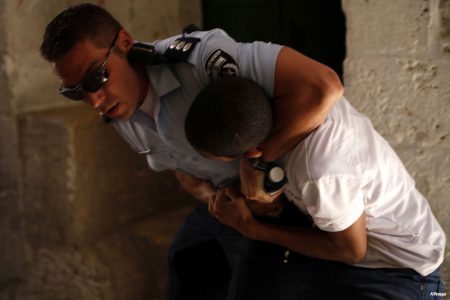
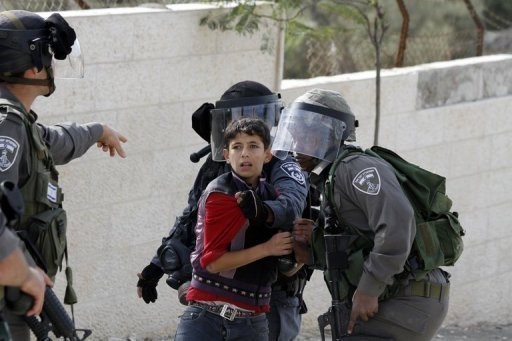
Israel has consistently been criticized by international rights groups for its interrogation practices, specifically towards Palestinian children.
Some 700 Palestinian children per year are arrested and face “ill-treatment” by Israeli forces, according to a 2015 report by Child Rights International Network (CRIN).
“Arrested children are commonly taken into custody by heavily armed soldiers, blindfolded with their wrists tied behind their backs before being transported to an interrogation centre,” the CRIN report said.
“Children questioned about their experience frequently report verbal and physical abuse during the arrest.”
According to research conducted by Defense for Children International – Palestine cited by the report, some 56 percent of children report having experienced “coercive” interrogation techniques during their time in Israeli custody.
Some 42 percent say they signed documents in Hebrew, despite the fact that most Palestinian children do not speak or understand the language.
Additionally, 22 percent of detained children say they underwent up to 24 hours of solitary confinement, in violation of international standards.
In a report released in February 2013, the UN children’s agency UNICEF criticized Israel for its treatment of arrested Palestinian children, saying their interrogation mixes “intimidation, threats and physical violence, with the clear purpose of forcing the child to confess.”
According to the latest numbers from prisoner rights group Addameer, there were a total of 414 child prisoners in Israeli prisons in May 2016, 104 of whom were under the age of 16.
A New York Police Department officer has avoided hard time at notorious Rikers Island prison for stomping on a head of a handcuffed man despite cries for help. Aside from two years’ probation, the cop is required to resign within 24 hours.
“This police officer intentionally and needlessly stomped on the head of a suspect who had already been restrained by fellow officers,” Brooklyn District Attorney Ken Thompson said at the sentencing Thursday. “And he did so in broad daylight and in front of a crowd of people.”
In April, Joel Edouard, 38, was found guilty after an amateur video showed him and other police officers arresting Jahmiel Cuffee in the summer of 2014. It was Edouard who, during the attempted arrest, pointed a gun at Cuffee and then kicked him in the head, despite bystanders yelling that he was being recorded.
Cuffee suffered scrapes and bumps, a contusion, dizziness, headaches and nausea.
At first he was charged with attempting to tamper with evidence, obstructing governmental administration and resisting arrest. As charges were dropped for Cuffee, Edouard found himself under investigation.
“He deserved to spend time in jail for committing such a blatant act of police brutality, but we accept the sentence imposed by the court,” Thompson said.
The DA initially recommended sentencing Edouard to 60 days in Rikers Island prison and an additional two years’ probation.
However, Judge Alan Marrus imposed only a part of the recommendation, explaining that he saw no “need to incarcerate” Edouard because “the victim recovered and was compensated through civil judgement,” according to the New York Daily News.
Marrus agreed with two years’ probation and also ordered Edouard, who has been on modified assignment, to resign by his own choice.
“If the [Police] Commissioner doesn’t terminate the defendant in 24 hours, the defendant must turn in a letter of resignation,” said Marrus, calling the case “a setback for police community relations.”
‘Police crimes not uncommon’
Since the 2014 police killing of an unarmed black teenager in Ferguson, Missouri, law enforcement agencies across the US have seen community relations significantly sour.
Michael Brown’s death at the hands of white officer Darren Wilson touched off mass demonstrations in Ferguson and across the US against racial profiling, police brutality, police impunity and the judicial system in America.
A recent study by Bowling Green State University titled ‘Police integrity lost: a study of law enforcement officers arrested’ has not enhanced that reputation of police officers nationwide.
It revealed that US police officers get arrested about 1,100 times a year, meaning that roughly three cops are charged every day. The data covers 2,529 state and local law enforcement agencies from 1,205 counties and independent cities in all 50 states and the District of Columbia.
“The first general observation is that police crimes are not uncommon,” the study said. “Police officers get arrested for crimes with some regularity in jurisdictions around the nation.”
Between 2005 and 2011, the period the study covered, the number of arrest cases jumped from 444 to 1,238. In seven years, there were 6,724 criminal cases launched, leading to the arrest of 5,545 individual police officers.
“These cases threaten to undermine public trust in both the authority and legitimacy of state and local law enforcement organizations, and the work of law-abiding sworn officers who go about their job selflessly, efficiently, and professionally every day,” the study read.
The government-funded study reflects a broad range of offenses committed by police, which are commonly related to sex, drugs, alcohol, domestic violence and extortion.
Nearly 60 percent of those crimes “occurred when the officer was technically off-duty,” lead researcher Philip M. Stinson wrote.
At the same time, he explained, “a significant portion of these so-called off-duty crimes also lies within the context of police work and the perpetrator’s role as a police officer, including instances where off-duty officers flash a badge, an official weapon, or otherwise use their power, authority, and the respect afforded to them as a means to commit crime.”
120 Palestinian prisoners are currently on hunger strike in Megiddo prison in solidarity with Bilal Kayed, the Palestinian prisoner who was ordered to six months administrative detention without charge or trial upon the expiration of his 14.5 year sentence in Israeli prison on Monday, 13 June. Two of the leaders of the prisoners’ movement – Wael Jaghoub and Kamil Abu Hanish – have been thrown into solitary confinement, said early reports from the prisons on 21 June.
Kayed has been on hunger strike since 14 June demanding his freedom and the cancellation of the administrative detention order. A prominent leader among the prisoners of the leftist Palestinian party, the Popular Front for the Liberation of Palestine, Kayed’s struggle has received strong support from his comrades and fellow Palestinian prisoners, who note that his situation poses a danger to all Palestinian prisoners of a new systematic Israeli policy of administrative detention upon release.
Hundreds of Kayed’s comrades have been participating in limited-duration hunger strikes and other protests inside Israeli prisons; they have announced that they will pursue a collective open hunger strike after 7 July – which are being met with repression.
Prisoner leaders Jaghoub and Abu Hanish were ordered to isolation as repressive forces invaded sections 1, 5, and 7 in Ramon prison, confiscating electrical appliances and personal belongings and locking down cells.
There is also high tension in Nafha prison after Jamal al-Hour, a representative of Hamas prisoners, was ordered transferred to Eshel prison.
Deir Istiya, occupied Palestine – When Aziz ‘Aasee, the mayor of Qarawah Bani Hassan village drives through the streets, we’re stopped every few meters by one of his constituents, all of whom are asking the same question: When will we have water again? For some, the question is a joke; they are used to going without water for days, weeks, or even months each summer. Others are more aggressive, and the question comes off as a threat. People are looking for someone to blame for their thirst. The mayor, who is responsible for paying the town’s water bills, seems like an easy target.
In reality, there is little Aziz can do to ensure that his town has enough water. The village shares a water access network with two other municipalities, Sarta and Biddya. The three villages, with a combined population of approximately 30,000 people, depend on one 8 inch pipe, designed to deliver 145 cubic meters of water per hour. During the winter months when water tables are higher, the water flows at full capacity, ensuring coverage to the entire network. However for the past two months, the amount has been restricted to between 50 and 70 cubic meters per hour. With such a small amount in the pipes, the pressure is too low for the water to reach many of the houses at the end of the system. Qarawah, which sits at the highest elevation out of the three villages, suffers the most from the low water pressure: no house in the village has received water in over a week. The most remote properties have gone dry for over a month.
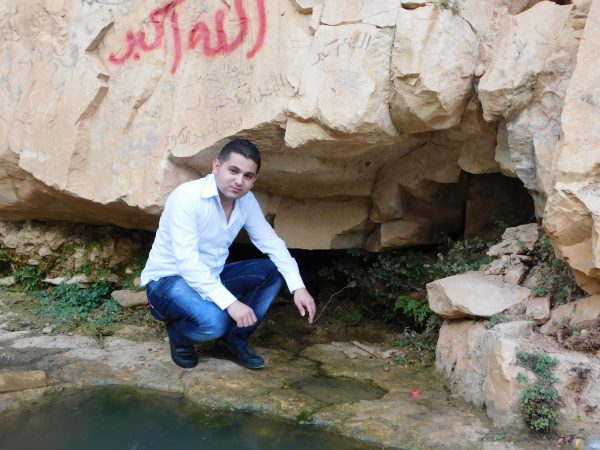
Qarawah’s only potable water source
Mekorot, the Israeli national water company which ostensibly owns the water infrastructure in question, and controls 87% of the aquifer located inside the West Bank, lies at the root of the problem. Since 1982, when the Israeli military sold their control of the West Bank’s water resources to Mekorot for a mere Shekel, the company has become the main enforcer of water apartheid between the Palestinians, and Israelis living in illegal settlements. While settlements enjoy a 24/7 supply of water year round, Mekorot caps its supply to Palestinians at the levels stipulated in the Oslo agreements over 20 years ago. Since then, the population of the West Bank has grown exponentially, and almost no improvements to Palestinian water infrastructure have been made. The Israeli military administration in the West Bank only makes matters worse. They routinely deny permits for new wells and pipes that would benefit villages like Qarawah by providing alternative sources of water or improving water pressure. In addition, the Israeli military has demolished 50 water and sanitation structures owned by Palestinians in 2016 alone. The result is that Palestinians have essentially no control over any of the water within their borders, or the infrastructure to deliver it.
Negotiations with Mekorot are almost impossible for small municipalities like Qarawah. Officials in the district capital of Salfit have spent the past two months trying to persuade the Israelis to increase the water supply without result. Even on the national level, appointees from the Palestinian Authority have refused to negotiate with Mekorot and the Israeli military administration. Aziz, for his part, chiefly contacts Mekorot through one of their Palestinian employees, and the communication is confusing at best. The representative will promise to show up on a certain day, and then never arrives. Or he’ll leave an update to say the water supply will be increased for one night to 100 cubic meters per hour, enough to ensure that at least some homes in Qarawah will receive water, yet the taps remain empty. Meanwhile, the illegal settlement of Kiryat Netafim, easily visible on a neighbouring hillside, boasts green lawns. It’s clear from a glance that the settlements are receiving more than adequate service from the same company.
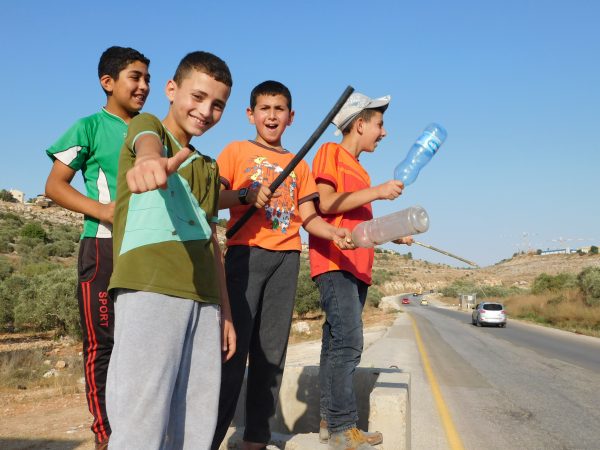
A few times over the past weeks, the municipalities of Qarawah, Satra and Biddya have called for popular protests, gathering at the meter access point for their shared pipe. Small groups of children and young men beat empty water bottles with sticks and shouted “Bidna may, bidna may” – “we want water” – at passing cars. Regardless, many in the three towns are afraid of a backlash from the protests. Shortly after the protests, armed Israeli soldiers arrived at the meter, demanding that the organizers cancel, or face repercussions. While it’s unclear what sort of consequences might be imposed, some worry that the water might be cut off completely as an act of collective punishment.
“Bidna may” – we want water protest
With no solution in sight, the villagers of Qarawah are finding ways to mitigate the effects of living under water apartheid. Villagers are using bottled water for drinking and showers, and hauling water up from local springs, located 4-6 kilometres outside the village limits, to use in toilets and irrigation. The springs also provide a small amount of potable water. However, this is not nearly enough to meet the village’s needs. Some houses in the village also have private wells; but with the summer stretching ahead, these limited resources are sure to be depleted far too soon. So until Mekorot is disbanded, or agrees to give equal service to Palestinians, the people of Qarawah will continue to suffer.
One of the most celebrated qualities of the people of Gaza is their sumoud, their steadfastness and capacity to endure the woes inflicted by Israeli terror. Media coverage of the tiny strip is full of soppy stories about how, regardless of the number of times Israel mows the lawn or casts lead, farmers will always sow their buffer zone farmlands and medics will never cease to improvise with what little they have.
The question is not whether the people of Gaza have given up on their professions and fell to their knees before their occupiers, but the cheap reproduction of them as an extraordinary population who will continue to endure all sufferings imposed on their lives and cling to their cause. What is more disturbing is that foreign journalists on the ground often steer the conversation to get the answers they are looking for. The people of Gaza have memorised the right answer: No matter what, we will never leave.
The truth, however, is that the “people of Gaza” are for the most part sick of this framing and, in fact, a considerable number of them are leaving. In September 2014, nearly five hundred Palestinians from Gaza drowned in the Mediterranean as they attempted to reach Europe. To risk one’s life with smugglers and brave seas in pursuit of a better life elsewhere should tell us something about people’s limited capacity to endure inhumane conditions as well as the limited truth of the sumoud narrative. This is not to say that people are abandoning their struggle for justice and their liberation ideals; many join activist groups or dedicate years of research to them. However, it is time to step back a little and reassess the sumoud narrative; it is perhaps time to understand Gaza and its people on their own terms. To do so, one should look critically at blanket narratives and long-held assumptions, as well as changes that have occurred to established concepts.
There are, to my mind, two primary dangers in trumpeting this narrative of sumoud. The first lies in transforming an ordinary population into mythical creatures able to overcome the most excruciating of circumstances. This transformation places a high, and utterly unjustified, expectation on Gaza’s Palestinians to endure Israel’s relentless aggression and to hold on to the land regardless of the level of destruction implemented. This expectation winds up minimising the power and consequences of Israel’s occupation because, no matter how filthy and bloody it becomes, the Palestinians are predisposed to endure.
For Palestinians on visas abroad, questions on whether they plan to go back to Gaza at the end of their studies are often posed by -without generalising- some Palestine supporters. To be sure, what motivates the question is a principled concern for the liberation of the land. Leaving Palestine, they would say, is exactly what Israel wants. This objection is often, and understandably, voiced by exiled Palestinians and their younger descendants. It is understandable because their varied experiences of Palestine are defined less by daily reality and more by the vision of what Palestine was and will be again. The present certainly plays a role but actual daily experience makes a lot of difference. Questions of this sort, nevertheless, place a lot of pressure on those in Gaza who already have so much to deal with or live abroad under the threat of deportation. What I am calling for is a more comprehensive understanding of the conditions in Gaza and a re-examination of what sumoud means in contemporary reality.
The second danger is that the sumoud narrative paints steadfastness as a choice rather than a forced reality. Palestinians in Gaza are not given the choice between enduring Israel’s aggression and seeking opportunities elsewhere. Palestinians, at least in part, continue to plough, sow, dig tunnels, and improvise because there is no other option. Simply put, Palestinians endure because they have to, not because they choose to. It is perhaps more worthwhile to write stories on the disgraceful visa processes and mistreatment and degradation of Palestinian asylum seekers than pretend as though we have chosen to suffer and, therefore, to endure. As though we are naïve enough to allow ourselves to hope when no signs of improvement can be glanced anywhere.
The Palestinian governments in the West Bank and Gaza have taken this narrative of a mythical people to heart. Each feels it necessary to act as if the Palestinians are not only doing fine under their dysfunctional governments but are flourishing too. Mahmoud Abbas, for example, is still “state building” and constructing mythical cities such as Rawabi when hardly any land is left. The obscene complicity of both governments, together with the collective efforts of Israel, Egypt, and Jordan, have made it impossible for Palestinians trapped in Gaza to leave and, consequently, they are forced endure.
HEBRON – Human Rights Defenders (HRD) in Palestine released a video last week showing an Israeli soldier kicking a knife toward the body of Abd al-Fattah al-Sharif — who was shot point-blank in the head by an Israeli soldier in March — an action the group said represents a clear violation of international law.
The video shows an Israeli soldier casually kicking a knife — allegedly used by al-Sharif during an attempted stabbing attack — to the other side of the road in the town of Tel Rumeida in the southern occupied West Bank district of Hebron, as al-Sharif’s body lay a few meters away.
The footage was taken before al-Sharif was shot execution-style in the head by an Israeli soldier, a graphic video of which was released in March, leading to widespread condemnation by rights groups and the UN demanding an investigation into the apparent “extrajudicial execution.”
Badi Dweik, an activist from HRD, said in a statement released Saturday that the group decided to make the video public in order to challenge current narratives unfolding at the ongoing military trial of Elor Azaria — the Israeli soldier charged with manslaughter after killing al-Sharif. Azaria has claimed that he shot the immobilized Palestinian because he saw al-Sharif reaching for the knife, or feared he had explosives strapped to his chest.
An additional video surfaced at the start of June, showing an Israeli ambulance driver kicking the same knife near to al-Sharif’s body after he was killed.
The video footage, obtained by Israel’s Channel Two, was expected to be shown to an Israeli military court to disprove claims by the Israeli soldier who killed al-Sharif that he shot the young Palestinian point-blank in the head after al-Sharif moved to grab a knife, according to the Israeli media outlet Ynet.
The footage shows that the knife allegedly used in the attack was far from al-Sharif when he was shot, notably showing an ambulance driving over the knife before it was kicked closer to al-Sharif’s body.The Israeli military prosecutor reportedly said that an Israeli ambulance driver, Ofer Ohanna, who was near the scene kicked the knife towards al-Sharif’s body following his murder, according to Hebrew-language news outlet Maariv.
The new video that has surfaced reveals that the ambulance driver was not the only one to tamper with evidence at the crime scene, but that an Israeli soldier also manipulated a piece of key evidence by moving the knife, which Dweik emphasized was a violation of international law. Al-Sharif was shot alongside Ramzi Aziz al-Qasrawi after the two Palestinians allegedly stabbed and moderately wounded an Israeli soldier at a military checkpoint in the Tel Rumeida area of Hebron on March 24.Although it was widely believed that Al-Qasrawi was killed immediately, new witness accounts documented by Israeli human rights group B’Tselem have since emerged that “raise concerns that al-Qasrawi was also executed with a shot to the head, as he lay injured on the ground after having been hit by gunfire elsewhere in his body.”
Al-Sharif, meanwhile, was left severely wounded for several minutes without treatment, before Azaria stepped forward and put a bullet through his head, killing him.Azaria was charged with manslaughter, rather than murder as had initially been expected, and is being held on a military base in “open detention” where he is free to roam and has received visits from his family. His trial opened in early May.
Palestinians have long held fears that Israeli soldiers and settlers tamper with crime scenes involving Palestinians, with human rights groups accusing Israel of practicing a policy of extrajudicial executions since a wave of violence erupted in October, leaving more than 200 Palestinians and some 30 Israelis killed.
The Ukrainian intelligence service that has been guiding the investigation of the Malaysia Airlines Flight 17 shoot-down of July 2014 recently blocked a United Nations inquiry into alleged torture sites under Ukrainian government control.
The U.N. inspectors called off their torture investigation late last month because Ukraine’s domestic intelligence service, the SBU, denied the team access to detention facilities where human rights groups have found evidence of torture.
“The United Nations Subcommittee on Prevention of Torture (SPT) has suspended its visit to Ukraine after being denied access to places in several parts of the country where it suspects people are being deprived of their liberty by the Security Service of Ukraine, the SBU,” a U.N. statement said, with Sir Malcolm Evans, head of the four-member delegation, adding:
“This denial of access is in breach of Ukraine’s obligations as a State party to the Optional Protocol to the Convention against Torture. It has meant that we have not been able to visit some places where we have heard numerous and serious allegations that people have been detained and where torture or ill-treatment may have occurred.”
Ukraine’s deputy justice minister Natalya Sevostyanova said the U.N. team was denied access to SBU centers in Mariupol and Kramatorsk, frontline towns in the simmering civil war between the U.S.-backed Ukrainian government and Russian-supported eastern Ukrainian rebels.
SBU director Vasyl Hrytsak said the reason for barring the U.N. team was to protect Ukrainian government secrets, adding: “If you arrive, for example, in the United States and ask to come to the C.I.A. or the F.B.I., to visit a basement or an office, do you think they will ever let you do it?”
But the relevance of this SBU secrecy to the MH-17 case, in which the airliner carrying 298 people was shot down over eastern Ukraine on July 17, 2014, is that the SBU is an integral part of the Dutch-led multinational Joint Investigation Team that is trying to determine who was responsible for the attack.
The obstruction of the torture inquiry suggests that the SBU also would steer the JIT away from any evidence that might implicate a unit of the Ukrainian military in the shoot-down, a situation that would be regarded as a state secret which could severely undermine international support for the U.S.-backed regime in Kiev. Among the SBU’s official duties is the protection of Ukrainian government secrets.
A Breezy Report
Earlier this month, the JIT investigators published a breezy, notebook-style report on their progress, revealing how dependent they have become on information provided by the SBU and how they have grown to trust the Ukrainian intelligence service.
According to the report, the SBU helped shape the MH-17 investigation by supplying a selection of phone intercepts and other material. But the JIT seemed oblivious to the potentially grave conflict of interest, saying:
“Since the first week of September 2014, investigating officers from The Netherlands and Australia have worked here [in Kiev]. They work in close cooperation here with the Security and Investigation Service of the Ukraine (SBU). Immediately after the crash, the SBU provided access to large numbers of tapped telephone conversations and other data. …
“At first rather formal, cooperation with the SBU became more and more flexible. ‘In particular because of the data analysis, we were able to prove our added value’, says [Dutch police official Gert] Van Doorn. ‘Since then, we notice in all kinds of ways that they deal with us in an open way. They share their questions with us and think along as much as they can.’”
The JIT report continued: “With the tapped telephone conversations from SBU, there are millions of printed lines with metadata, for example, about the cell tower used, the duration of the call and the corresponding telephone numbers. The investigating officers sort out this data and connect it to validate the reliability of the material.
“When, for example, person A calls person B, it must be possible to also find this conversation on the line from person B to person A. When somebody mentions a location, that should also correlate with the cell tower location that picked up the signal. If these cross-checks do not tally, then further research is necessary.
“By now, the investigators are certain about the reliability of the material. ‘After intensive investigation, the material seems to be very sound’, says Van Doorn, ‘that also contributed to the mutual trust.’”
But would SBU turn over data that might reveal the role of a Ukrainian military unit in the shoot-down? Under the security agency’s secrecy mandate, could it even do so?
Further, the collegial dependence on the SBU has not led to a quick resolution of the MH-17 mystery, with the JIT’s investigative report now not expected until after the summer, i.e., more than two years after the shoot-down, and even then the report is to be kept secret.
In this month’s update, the JIT would not even endorse last fall’s finding by the Dutch Safety Board that MH-17 was likely brought down by a Buk anti-aircraft missile system fired somewhere in a 320-square-kilometer area in eastern Ukraine, territory that was then partly controlled by the rebels and partly by the government.
Nor does the JIT update address last October’s findings of Dutch (i.e., NATO) intelligence that the only operational anti-aircraft missile batteries capable of bringing down a plane at 33,000 feet on July 17, 2014, were in the possession of the Ukrainian military.
“For the investigation into the weapon system that was used, the well known seven questions need to be answered are: who, what, where, when, which, how and why,” the update said. “In this investigation only the question of ‘when’ has been established irrefutably: flight MH17 crashed on 17 July 2014. The remaining questions require intensive investigation, according to Gerrit Thiry (team leader) and Susanne Huiberts (operational specialist) of the National Criminal Investigation Service.”
Punishing Russia
The MH-17 case also has relevance to the decision later this month by the European Union on whether to extend sanctions against Russia for another six months as the U.S. government wants. The E.U. imposed the sanctions amid a frenzied rush-to-judgment in late July 2014 blaming the Russians and the rebels for the deaths of the 298 people on MH-17 flying from Amsterdam to Kuala Lumpur.
Immediately after the shoot-down, the U.S. government sought to pin the blame on ethnic Russian rebels in eastern Ukraine and their Russian government backers. However, after CIA analysts had time to evaluate U.S. satellite, electronic and other intelligence data, the U.S. government went curiously silent about what it had discovered, including the possible identity of the people who were responsible. The U.S. reticence, after the initial haste to blame Russia, suggested that the more detailed findings undercut the original claims.
A source who was briefed by U.S. intelligence analysts told me that the CIA’s conclusion pointed toward a rogue Ukrainian operation involving a hard-line oligarch with the possible motive of shooting down Russian President Vladimir Putin’s official plane returning from South America that day, with similar markings as MH-17. The source said a Ukrainian warplane ascertained that the plane was not Putin’s but the attack went ahead anyway, with the assumption that the tragedy would be blamed on the pro-Russian rebels or on Russia directly.
Officially, however, the U.S. government has not revised its initial claims that were made within five days of the shoot-down, fingering the rebels and the Russians. I have been unable to determine if the assessment of Ukrainian responsibility represented a dissident or consensus view inside the U.S. intelligence community.
Although Ukraine would have been an obvious suspect in the attack, the Ukrainian SBU was invited to play a key role in the investigation along with investigators from Australia and the Netherlands. Under the JIT agreement, participating governments, which also include Belgium and Malaysia, have the right to block the release of information to the public.
The recent JIT report hails the comradeship between the Australian and Dutch investigators and their Ukrainian hosts, despite some early difficulties.
“An incredible amount of research material; differing legal systems and initial unfamiliarity with each other. Despite this, both Australian and Dutch members working in the Field Office in Kiev have managed to build good relations with each other and with the Ukraine to effectively conduct the investigation into the MH17 crash,” the report said.
“They are professionals who recognize each other’s love for the police work. They understand each other’s circumstances. And they are, regardless of their country of origin, motivated to do their utmost to uncover the truth. …
“‘The thing is to see how you can keep it workable”, says Van Doorn, ‘we like practical solutions. That means ‘poldering’ [the Dutch practice of policy-making by consensus].’”
Yet, the idea of “poldering” – or reaching consensus – with Ukraine’s SBU, an agency that has just thwarted a United Nations investigation into allegations that the SBU engages in the torture of ethnic Russian rebels, raises further questions about the objectivity and reliability of the MH-17 probe.
Investigative reporter Robert Parry broke many of the Iran-Contra stories for The Associated Press and Newsweek in the 1980s. You can buy his latest book, America’s Stolen Narrative, either in print here or as an e-book (from Amazon and barnesandnoble.com).
Palestinians along with a group of Muslim countries have lashed out at a UN decision to elect Israel as the chairman of one of its permanent committees for the first time in the history of Israeli occupation.
Danny Danon, Israel’s representative at the United Nations, was elected Monday to head the world body’s Legal Committee also called the Sixth Committee, which oversees issues related to international law.
It is first time that Tel Aviv will head one of the world body’s six permanent committees since joining the United Nations in 1949.
His election, however, elicited angry reactions from Muslim countries, including those in the Arab League and 57 member states of the Organization of Islamic Cooperation (OIC).
The chief Palestinian delegate at the UN, Riyad Mansour, strongly denounced the results of the election, which according to him was “threatening the work of the Sixth Committee.”
Mansour said the Israeli regime has long been “the biggest violator of international law.”
The General Assembly has six standing committees that report to it on several issues, including human rights, decolonization, disarmament, economic and financial issues, as well as the UN budget and legal issues.
Danon was nominated for the position by the Western European and Others Group (WEOG) in the UN. Israel has been a temporary member of the WEOG since 2000, but joined the group permanently in December 2013.
The chairmanship of assembly is allocated on a rotational basis and is usually confirmed without a vote.
Deputy US Ambassador to the UN David Pressman, however, reacted angrily to the opponents of Danon’s election.
“We need a United Nations that includes Israel, that brings Israel closer, not one that systematically pushes Israel away.”
However, the UN warned Israel of unspecified action over its failure to cooperate with its reporters.
UN High Commissioner for Human Rights Zeid Ra’ad al-Hussein slammed Tel Aviv for denying UN special rapporteurs access to the occupied West Bank and the Gaza Strip.
“I must emphasize that non-cooperation by governments will not result in my office remaining silent,” he said.
He said investigators from his office had an important role in providing factual information that could prevent further violence.
Zeid also touched on the issue of the Palestinians held in Israel’s prisons, saying; “Over 400 Palestinian children are currently detained in Israeli prisons.”
He warned that violence could would break out again between Israeli forces and the Palestinian people unless the regime lifts the blockade on the Gaza Strip.
Gaza, one of the most densely-populated areas in the world, has been under an Israeli siege since June 2007.
Mohamedou Ould Slahi has been locked up in Gitmo without charge for 14 years, but the US government “has no evidence” against him, his attorney told RT. Tortured and beaten, both ordeals exposed in his memoir from behind bars, Slahi is now hoping for release.
On June 2, Slahi appeared in a 17-minute hearing before the prison’s Periodic Review Board (PRB) that essentially holds his fate in its hands. It is the PRB that examines the risk of releasing a detainee and is set to decide whether to clear Slahi. He is the 22nd detainee to go before the board this year.
“There is no reason for him not to be cleared. He has never committed any hostile act to the United States. There is no evidence against him,” Slahi’s attorney, Nancy Hollander, told RT in its GTMO 2016 special report.
Together they have been fighting for Slahi’s freedom since 2005, when Hollander first met him in Guantanamo. She says she spends “probably third of a year” in Guantanamo to be with her client.
A native Mauritanian, Slahi’s story is an unusual one. He did not arrive at Guantanamo the way the majority of detainees did.
The primary reason for his illegal detention is not related to 9/11, but has its roots in the 1990s, when Slahi pledged allegiance to the group that would eventually become known as Al-Qaeda. He stopped his engineering studies in Germany to go fight along with the mujahideen against the communist government in Afghanistan.
At the time, the Islamist group and its leader Osama bin Laden enjoyed the support of the US in its fight against the Soviets.
Slahi claims he had “broken ties” with Al-Qaeda in 1992 to return to his studies in Germany. Nearly ten years after, when Al-Qaeda became Washington’s top enemy, Slahi turned himself in for questioning to Mauritanian authorities.
On November 1, 2001, he was interrogated in relation to the so-called 2000 millennium attack plots, a series of foiled attacks, including the one at a Los Angeles airport planned for late December 1999.
It appeared that when Slahi lived in Canada in 1999, he crossed paths with Ahmed Ressam, a convicted perpetrator of the thwarted attacks. The two prayed in the same mosque in Montreal.
After Ressam’s arrest, Slahi was questioned several times, including by the FBI and each time cleared for release.
That was not the case at his last meeting with Mauritanian authorities. Slahi was detained and then handed over to Jordan, where he spent eight months. After subsequent chain of custody transfers, he was put in Guantanamo.
Now, 14 years later, Slahi is one of the most prominent prisoners among 80 remaining Guantanamo detainees.
“He is a very funny person, a very empathic, very curious and of course as everyone has seen now a very gifted writer,” Nancy Hollander said of Slahi, describing their work together as “a very warm relationship.”
Shali has gone through torture, beatings, death threats and sexual humiliation, all of which he exposed in details in his bestselling book, ‘Guantanamo Diary,’ written in his single cell.
“There is no doubt that he was tortured during early years, 2003-2004,” Hollander told RT. “Finally, they realized that they were not going to learn anything from him they did not already know because he had nothing else to tell him. They began then to rehabilitate him.”
At one point, his captors tried to trick him by showing him a forged letter from his mother, but the ploy failed for two reasons. One is that the forgery misspelled Slahi’s name and, second, because unbeknownst to his jailers, his mother was illiterate.
He eventually became friends with his guards. In April 2016, one of the guards submitted a letter to the PRB, speaking of his very pleasant impression of Slahi.
“Based on my interactions with Mr. Slahi while in Guantanamo, I would be pleased to welcome him into my home,” the guard wrote.
In 2010, federal judge James Robertson reviewed Slahi’s profile, the same one the government submitted to the PRB, and granted him his habeas corpus petition, ordering him released.
However, the decision was appealed to the US Court of Appeals for the District of Columbia Circuit. Now, Slahi has his hopes high for the PRB to rule on his release.
“I believe, I hope that Mohamedou will be cleared, there is no reason for him not to be and then for the State Department to start working with Mauritania. The country of Mauritania has said they would welcome him home. That’s where his family is,” Hollander told RT.
A Review of Conspiracy Theories and Other Dangerous Ideas by Cass Sunstein (based on an earlier paper co-authored with Adrian Vermeule); In Defense of Troublemakers: The Power of Dissent in Life and Business by Charlan Nemeth; and Conspiracy Theories and the People Who Believe Them, edited by Joseph E. Uscinski
On January 25 2018 YouTube unleashed the latest salvo in the war on conspiracy theories, saying “we’ll begin reducing recommendations of borderline content and content that could misinform users in harmful ways—such as videos promoting a phony miracle cure for a serious illness, claiming the earth is flat, or making blatantly false claims about historic events like 9/11.”
At first glance that sounds reasonable. Nobody wants YouTube or anyone else to recommend bad information. And almost everyone agrees that phony miracle cures, flat earthism, and blatantly false claims about 9/11 and other historical events are undesirable.
But if we stop and seriously consider those words, we notice a couple of problems. First, the word “recommend” is not just misleading but mendacious. YouTube obviously doesn’t really recommend anything. When it says it does, it is lying. … continue
This site is provided as a research and reference tool. Although we make every reasonable effort to ensure that the information and data provided at this site are useful, accurate, and current, we cannot guarantee that the information and data provided here will be error-free. By using this site, you assume all responsibility for and risk arising from your use of and reliance upon the contents of this site.
This site and the information available through it do not, and are not intended to constitute legal advice. Should you require legal advice, you should consult your own attorney.
Nothing within this site or linked to by this site constitutes investment advice or medical advice.
Materials accessible from or added to this site by third parties, such as comments posted, are strictly the responsibility of the third party who added such materials or made them accessible and we neither endorse nor undertake to control, monitor, edit or assume responsibility for any such third-party material.
The posting of stories, commentaries, reports, documents and links (embedded or otherwise) on this site does not in any way, shape or form, implied or otherwise, necessarily express or suggest endorsement or support of any of such posted material or parts therein.
The word “alleged” is deemed to occur before the word “fraud.” Since the rule of law still applies. To peasants, at least.
Fair Use
This site contains copyrighted material the use of which has not always been specifically authorized by the copyright owner. We are making such material available in our efforts to advance understanding of environmental, political, human rights, economic, democracy, scientific, and social justice issues, etc. We believe this constitutes a ‘fair use’ of any such copyrighted material as provided for in section 107 of the US Copyright Law. In accordance with Title 17 U.S.C. Section 107, the material on this site is distributed without profit to those who have expressed a prior interest in receiving the included information for research and educational purposes. For more info go to: http://www.law.cornell.edu/uscode/17/107.shtml. If you wish to use copyrighted material from this site for purposes of your own that go beyond ‘fair use’, you must obtain permission from the copyright owner.
DMCA Contact
This is information for anyone that wishes to challenge our “fair use” of copyrighted material.
If you are a legal copyright holder or a designated agent for such and you believe that content residing on or accessible through our website infringes a copyright and falls outside the boundaries of “Fair Use”, please send a notice of infringement by contacting atheonews@gmail.com.
We will respond and take necessary action immediately.
If notice is given of an alleged copyright violation we will act expeditiously to remove or disable access to the material(s) in question.
All 3rd party material posted on this website is copyright the respective owners / authors. Aletho News makes no claim of copyright on such material.

 A Review of Conspiracy Theories and Other Dangerous Ideas by Cass Sunstein (based on an earlier paper co-authored with Adrian Vermeule); In Defense of Troublemakers: The Power of Dissent in Life and Business by Charlan Nemeth; and Conspiracy Theories and the People Who Believe Them, edited by Joseph E. Uscinski

