PLC member Dr. Samir al-Qadi among at least nine Palestinians arrested by Israeli occupation forces

Samidoun Palestinian Prisoner Solidarity Network – June 12, 2016
Dr. Samir al-Qadi, member of the Palestinian Legislative Council, was among one of at least nine Palestinians arrested by the Israeli occupation forces early Sunday, 12 June, in armed night raids in Jerusalem and throughout the West Bank.
Al-Qadi, 60, was arrested in an early-morning military raid on his home in Surif, northeast of Al-Khalil. He is a member of the Change and Reform Bloc in the PLC, associated with Hamas.
Al-Qadi was among at least four Palestinians arrested in al-Khalil district, alongside Ahmed Abdelfattah Hudoush, 30; Izz al-Ghaith; and Shaher Daoud, 40; as well as three in Jerusalem, Mohammed Ruweidi, Hamza al-Nimr and Musa Dabbagh, all working in the Islamic Waqf; Amer Samih Hamdan, 17, of Bethlehem; and Thaer Abu Zaher, 25, of Deir Bzeigh near Ramallah, reported the Palestinian Prisoners’ Society.
He has been arrested and imprisoned by Israeli occupation forces on multiple occasions in the past, in 1997, 2006, 201 and 2014, generally under administrative detention without charge or trial. He joins 6 more PLC members in Israeli prisons: 4 fellow Change and Reform Bloc PLC members, Hassan Yousef, Hatem Kufaisheh, Mohammed Abu Teir, and Abdel Jaber Fuquha; Ahmad Sa’adat, the General Secretary of the Popular Front for the Liberation of Palestine, elected on the Abu Ali Mustafa slate; and Marwan Barghouthi of Fateh.
Testimony of one of the latest attacks against Gaza’s fishermen
International Solidarity Movement | June 12, 2016
Gaza Strip, occupied Palestine – Last Wednesday Rajab Khaled Abu Riela, 30 years old, his brother and two cousins left Gaza’s port at 12 pm. They stayed out fishing until 1:30 am. “When we started our way back to the port one Israeli warship approached, the soldiers started insulting us through the microphone and immediately after started shooting against our two small boats with live ammunition”. “Then their warship crashed against us. In that moment I decided to try to escape, but I was immediately shot in the leg with live ammunition”. They took Rajab and his brother to Ashdod port, where they wouldn’t give him any medicine or treatment for the injury he sustained by the Israeli forces. “I was left bleeding until 9:30am”. Finally they were sent back to Gaza, where an ambulance took him directly from Erez border to the hospital, where he had to undergo surgery.
When he finally reached Shifa Hospital, doctors managed to remove the biggest pieces of the bullet – but many small pieces still remain in his leg.

Rajab’s mother shows the bullet removed from his leg
“Our future [for the fishermen] is uncertain; we don’t know what will happen tomorrow. Israel assaults us every day, takes our boats, shoots at us… Since 2005 I have pain in my chest due to an attack of the occupation, and as well my brother was injured while fishing in 2008. I’m responsible for providing for my family, we are 21 members… Now no one is providing for us, as I’m injured and they took our boat and motor. How I can work now without a boat?”

Shocking UN Report Lists Crimes by the Ukrainian Authorities
By Arina TSUKANOVA | Strategic Culture Foundation | 11.06.2016
The 13th report of the UN High Commissioner for Human Rights on the human rights situation in Ukraine between 16 November 2015 and 15 February 2016, when the Minsk Agreements were in force, has come as a shock to Kiev.
According to the UN, more than three million people live in the areas directly affected by the conflict. The exact number of people who have left Ukraine-controlled territory is still unknown, although rough estimates range from 800,000 to 1,000,000 people. The Ukrainian government has estimated that more than a million people have left southeast Ukraine for Russia, Belarus and Europe. This figure does not match that of the Russian federal migration service, however: in 2015, around four million Ukrainians crossed the border, with nearly 2.6 million settling in Russia. More than a million people have arrived from southeast Ukraine. Residents of the Donetsk and Luhansk regions are permitted to live freely in Russia.
The discrepancy in the figures clearly shows that Ukraine is not interested in keeping track of its citizens, whether within the country or abroad. This means that one of the aims of the military campaign launched in the east of the country is to displace the population from the area of conflict, predominantly to Russia. Given that refugees from the republics to Ukraine are facing discrimination in access to public services, according to the UN report, the authorities in Kiev do not seem to want the residents of Donbass either.
The UN also states that those living close to the contact line (nearly 800,000 people) are particularly suffering, and the lives of these people are constantly at risk. The UN mission believes that the assistance being given to the residents of Donbass is insufficient, even given Russia’s humanitarian convoys, although the fact that it was Ukraine that shut down all the social programmes and introduced the ‘blockade’ unfortunately remained beyond the scope of the report.
The UN believes that the permit regime introduced by Ukraine and the disorder at checkpoints are negatively reinforcing the isolation of those living in the DPR and LPR. Queues of up to 300-400 cars waiting on either side of the checkpoints are observed on a regular basis and this recently ended in tragedy. Due to the fact that the Ukrainian checkpoint is not open at night, civilians who had been queuing in their cars overnight were fired at by the Ukrainian side using illegal-calibre weapons (122 mm), resulting in the deaths of five people, including a pregnant woman.
During the period covered in the report, the Ukrainian armed forces have advanced even further into populated areas and the numerous attacks on the residential areas of Horlivka, Shakhtarsk and Debaltseve are also mentioned in the report.
Since the Minsk ceasefire agreements entered into force (i.e. since 15 February 2015), there have been 843 civilian casualties – 235 killed (216 adults and 19 children) and 608 injured (554 adults and 44 children). At the same time, the UN mission notes that it is unable to attribute some of the victims to either side of the conflict. It also emphasises that the real number of those killed and injured could be higher than that given in the report.
The number of people missing is particularly shocking. The Ukrainian side has reported 741 persons missing, while the DPR has registered 420 missing persons. In addition, the UN mission has ascertained that approximately 1,000 bodies held in morgues in government-controlled territory have still not been identified.
And once again the numbers are crying out that the Ukrainian government does not believe people to be important. The number of persons that Kiev has declared missing is a third less than the number of unidentified bodies! And the numbers also ignore the mortal remains in areas where hostilies took place – search operations are virtually non-existent. As the UN report states, there is not even a dedicated mechanism in place to gather statements from the relatives of missing persons.
The UN mission has also not taken into account the number of unmarked graves in cemeteries. The overwhelming majority of missing persons should not be looked for in the Donetsk and Luhansk republics, but among the thousands of bodies that have already been quietly buried or are still lying in morgues. It is possible that the official number of those who will never return has been hugely underestimated.
The efforts of the Ukrainian side aimed at searching for and identifying those killed and those missing are referred to in the UN report using the word «inaction».
Kiev cannot admit that to avoid responsibility, it is secretly carrying out a policy of ‘unidentified bodies’. It is also being suggested to relatives that missing persons are being held captive by DPR and LPR ‘separatists’.
The report concedes that some people recorded as missing may be alive, but are being held in secret places of detention either in the republics or in Ukrainian-controlled territory.
The UN mission has finally figured out that the secret prisons and torture in Ukraine are an established system that has become part of the state and its policies. Of the 1,925 criminal investigations launched into allegations of torture in 2015, 1,450 were closed.
The report has also provided yet more evidence that it is not a civil war. It is a war between those who seized power by means of a military coup and the people of Ukraine, a war that is hypocritically being referred to as an ‘anti-terrorist operation’.
As noted in the report, «throughout the country, OHCHR continued to receive allegations of enforced disappearances, arbitrary and incommunicado detention, and torture and ill-treatment of people accused by the Ukrainian authorities of ‘trespassing territorial integrity’, ‘terrorism’ or related offenses, or of individuals suspected of being members of, or affiliated with, the armed groups».
People are not just being tortured, but are also being executed without trial. In Sloviansk, for example, the basement of the local college is being used for this purpose. A basement used for torture and summary executions was also discovered by UN inspectors in Izium, Kharkiv district. In addition, «a network of unofficial places of detention, often located in the basement of regional SBU buildings, have been identified». The SBU also has such basements in Odessa and Kharkiv. In February 2016, between 20 to 30 people were detained in the basement of the Kharkiv regional SBU building, and the vast majority of prisoners were not arrested in accordance with legal procedures and were not charged.
The report also notes that the SBU obtains confessions of terrorism using torture, and those who sign the confessions are told that should they complain, then their families, including their children, will also be made to suffer. The Security Service of Ukraine refers to such methods as the use of «proportional» and «justified» force.
The 13th report of the UN High Commissioner for Human Rights on the human rights situation in Ukraine appeared on 3 March 2016, but it is only now that the information bomb has exploded following an article in The Times, in which Ivan Simonovic, UN assistant secretary-general for human rights, talks about the report and also about five secret SBU prisons that a delegation of the UN Subcommittee on Prevention of Torture was not allowed access to, resulting in the delegation cutting short its visit to Ukraine…
The 13th report also completely destroys the myth that there are thousands of prisoners in the DPR and LPR. There is no trace of the thousands – in February 2016, the SBU gave the UN mission a list of 136 people who are allegedly being detained in custody in the republics, but nothing is known about this for sure. The list provided by the DPR authorities, however, looks completely different. «Some 1,110 persons were detained by the Government of Ukraine, including 363 members of the armed groups. This includes 577 people arrested for ‘their political views’ and 170 civilians ‘who have nothing to do with the conflict’», says the UN report. The SBU has gone overboard by essentially creating a system of concentration camps. The UN report likens the actions of the SBU to the seizure of hostages.
It has been impossible to keep the scandal hushed up, but while this regime exists in Ukraine, investigations into its criminal activities will be carried out along the same lines as the investigations into the people burned alive in Odessa on 2 May 2014. Namely that the executioners will remain free or under house arrest while the victims are imprisoned. For years.
Journalist and human rights defender ordered to six months administrative detention
Samidoun Palestinian Prisoner Solidarity Network – June 10, 2016
 Palestinian journalist and human rights defender, Hasan Safadi, the Arabic Media Coordinator for Addameer Prisoner Support and Human Rights Association, was ordered to six months imprisonment without charge or trial under administrative detention by Israeli occupation forces today, Friday, 10 June.
Safadi, 24, who has been imprisoned since 1 May while crossing the Karameh bridge between Jordan and Palestine’s West Bank, has been under interrogation consistently at Al-Moskobiya interrogation center since that time. His detention had been repeatedly renewed. Prior to the issuance of the administrative detention order, the Jerusalem Magistrate Court had decided to release him today on a bail of 2500 NIS (approximately $650 USD), which had already been paid.
Safadi’s administrative detention order is scheduled to be confirmed by a judge at a time set in the next 48 hours, reported Addameer, making him one of approximately 750 Palestinians held without charge or trial under administrative detention. Administrative detention orders are indefinitely renewable and issued for one to six month periods at a time; some Palestinians have spent years at a time in administrative detention, on the basis of secret evidence submitted by the Shin Bet.
The detention of Safadi is part of the continued attack on Palestinian journalists and media workers, which includes the administrative detention without charge or trial of Omar Nazzal, member of the General Secretariat of the Palestinian Journalists’ Syndicate; Musab Kafisheh, freelance journalist; Mohammed Kaddoumi, freelance journalist; and Ali Al-Oweiwi, an announcer on Arabah radio station.
Other Palestinian journalists like Samer Abu Aisha, Sami al-Saee and Samah Dweik are imprisoned on “incitement” charges for posting on Facebook about Palestinian politics and struggle, while Abu Aisha also faces charges for visiting neighboring Lebanon, an “enemy country.” Other imprisoned journalists targeted for membership in political parties include Hazem Nasser and Mujahid Saadi. They are among 19 journalists imprisoned in Israeli jails.
Further, the imprisonment of Safadi also continues attacks on Palestinian human rights defenders, particularly those who work to free Palestinian prisoners, including recently released Addameer vice-chair and Palestinian Legislative Council member Khalida Jarrar; imprisoned land defender and advocate Samer Arbeed, held without charge or trial; civil society leader Eteraf Rimawi, executive director of Bisan, imprisoned without charge or trial; and repeatedly targeted prisoners’ advocates like Ayman Nasser of Addameer and Osama Shaheen of the Palestinian Prisoners’ Center for Studies.
UK training Saudi police in CSI techniques that risk torture
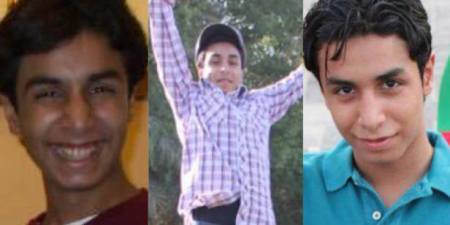
Reprieve – June 7, 2016
Britain’s College of Policing is teaching the Saudi Arabian interior ministry high-tech forensic skills that risk being “used to identify individuals who later go on to be tortured”, an internal police report obtained by human rights charity Reprieve reveals.
According to the document, released under Freedom of Information, the controversial training program began in 2009 and continued even after juvenile protesters were rounded up, tortured and sentenced to death following the Arab Spring uprisings.
British police now want to step up their training package to include advanced cyber-crime courses, which could be misused to target pro-democracy activists in Saudi Arabia.
Although the UK Foreign Office opposes the death penalty, the College of Policing wants to teach Saudi officers how to analyse mobile phone records, which could lead to activists being arrested and executed.
Ali al-Nimr was just 17 years old when he was sentenced to death for attending non-violent protests in 2012 and allegedly using his blackberry phone to invite friends to join demonstrations. At trial the prosecution requested execution by “crucifixion”.
Many more juvenile protesters were swept up and tortured in the 2012 crackdown, including Dawood al Marhoon and Abdullah Hasan al-Zaher, who now face beheading at any time. Another teenage activist, Ali al Ribh, who was arrested at school, was among 47 people executed on a single day in January 2016.
That same month, the College of Policing proposed further courses for Saudi personnel despite noting that there was a risk “the skills being trained are used to identify individuals who later go on to be tortured or subjected to other human rights abuses”.
Other techniques on sale to Saudi detectives include decrypting hard drives, retrieving deleted files, voice recognition and trawling CCTV systems. The project is described as an “income generating business opportunity” for the College of Policing.
Some of the training has taken place at the College of Policing’s forensics centre outside Durham, and “over 120 fingerprint personnel are in the process of being trained”.
The document says that the Saudi officers are drawn from the gulf kingdom’s 300,000 strong interior ministry, which includes policemen, prison guards and national security staff.
The college claims to have developed a “trusted and professional partnership” with the ministry, which carries out beheadings, stoning and lashings. David Cameron faced outcry in Parliament last year over a Ministry of Justice project with Saudi prison guards.
Commenting, Maya Foa, Director of the death penalty team at Reprieve said: “It is scandalous that British police are training Saudi Arabian officers in techniques which they privately admit could lead to people being arrested, tortured and sentenced to death.”
“The training Britain delivered included hi-tech skills that could easily have been used to target pro-democracy activists in Saudi Arabia. Let’s not forget that while this was going on, teenage protestors like Ali al-Ribh, Abdullah al-Zaher, Ali al-Nimr, and Dawood al-Marhoon were rounded up and sentenced to death.”
“The FCO has to explain how on earth helping execute juvenile protesters makes anyone safer in Saudi Arabia or the UK.”
Palestinian children behind bars: 14-year-old sentenced to over 6 years, visits denied, exorbitant fines
Samidoun Palestinian Prisoner Solidarity Network – June 7, 2016
 Palestinian children continue to be targeted for collective punishment and harsh sentences, as 14-year-old Muawiya Alqam was sentenced to six and one-half years in Israeli occupation prisons and fined 26,000 NIS (approximately $6,750).
Ma’an News reported that the sentence came in a plea bargain that will be officially pronounced at a sentencing in July. Palestinian children ages 14 and up are ostensibly limited to a 6-month maximum sentence; however, this limitation no longer applies for any conviction for which the maximum sentence is greater than five years, which includes throwing stones, one of the most common charges raised against Palestinian children. Israeli officials are frequently thought to postpone trials until children reach the age of 14, as in the case of Ahmad Manasrah.
Muawiya’s cousin, Ali Alqam, 12, is currently serving a 1 year sentence in a juvenile detention center; Ali was shot at least three times and underwent surgery to remove a bullet from his stomach. Muawiya and Ali were accused of stabbing and “moderately wounding” an Israeli security guard on the Jerusalem Light Rail.
Muawiya and Ali are among over 330 Palestinian children imprisoned by Israeli occupation forces, according to May 2016 statistics compiled by Palestinian organizations. Also in May 2016, Israeli occupation courts imposed fines of 88,000 NIS (Approximately $22,000 USD) on Palestinian children in Ofer prison. The Palestinian Prisoners’ Society reported that 48 children were convicted in May, with sentences ranging between three months and 30 months. There are 183 Palestinian children held in Ofer prison, 81 in Megiddo prison, and an additional number in multiple detention and interrogation centers, home detention centers, and juvenile detention facilities.
28 children in Ofer have also been denied family visits, according to the Palestinian Prisoners’ Society – 14 have been denied visits since their arrest, while 14 families have had their permits suddenly withdrawn or cancelled when they arrive at the checkpoint for visitation, on the grounds of “security.”
12-year-old Shadi Farrah, another of the youngest Palestinian prisoners in Israeli jails, was arrested along with 13-year-old Ahmad Zaatari on 30 December when they were accused of having knives in their possession after they were stopped and searched by Israeli police. Despite never touching or attempting to touch a single person, both are accused of possession of a knife with intent to kill, reports the International Solidarity Movement . The boys were interrogated in Moskobiya interrogation center without their lawyers or parents. They have made 11 appearances in court and are held in a juvenile detention center. Shadi’s letter to his mother, in which he says “Mum, I want you to keep your head up high like a palm tree that cannot be moved by the wind or even an earthquake… Don’t be sad about what’s happened, mum. Today I stand in front of the mirror to shed my faults and I can see my good side,” has been widely distributed.
Shadi’s mother is only able to visit monthly due to the approximately 800-shekel ($213 USD) cost to visit the distant detention center for the day, and according to the ISM, they have been denied assistance from the ICRC because Shadi is detained in a juvenile detention center rather than a prison. This comes as the ICRC has announced plans to reduce family visits that it organizes from the West Bank to Palestinian adult male prisoners held inside the Israeli state, from twice to once monthly, denying not only the prisoners but also their families ongoing connection and relationships. The Palestinian prisoners’ movement has broadly denounced the ICRC for this action; Samidoun is urging international action to restore family visits and protest “budget cuts” taking place at the cost of some of the most marginalized and vulnerable people in Palestine.
Video shows Israeli troops questioning underage Palestinians
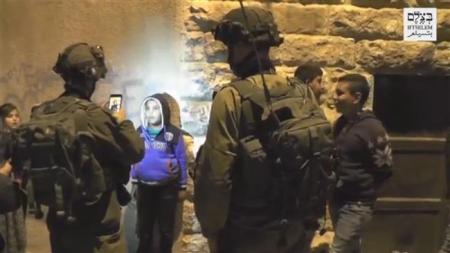
An Israeli soldier takes a photo from a Palestinian minor in Jaber neighborhood of al-Khalil (Hebron) on May 24, 2016.
Press TV – June 5, 2016
A leading Israeli rights group has denounced the Israeli military for illegally questioning a group of underage Palestinians, calling it a “blatant disregard” for the rights of minors.
A video provided by B’Tselem shows several dozen Israeli forces randomly gathering around 20 Palestinian children and teens from the streets and questioning them.
The Palestinians are forced to stand against a wall and answer questions about a stone-throwing incident, which had allegedly occurred last week.
The soldiers then take photo of every child and teen, using a cell phone, after making them sit in front of the wall before releasing them.
In a statement, B’Tselem said the scope of the latest incident and the fact that every minor was photographed was unusual.
To date, such incidents occurred within homes, with the children’s parents present, and without the minors themselves being questioned or accused of a specific offense, the rights group said.
According to B’Tselem, none of the 14 minors whose details were obtained by the rights group, had a record of being nabbed or questioned by the Israeli military.
The incident indicated that they were arrested and photographed “despite being suspected of nothing,” it said.
The statement said the “goal was primarily to intimidate the children in order to deter them from throwing stones, and to make it easier for the military to identify them in case they do.”
“This demonstrates blatant disregard for the military’s duty to protect the rights of minors.”
The Israeli military, it added, is banned from treating civilians, particularly underage ones, as potential criminals and using soldiers to deter them.
The whole incident was filmed by a B’Tselem volunteer living in the neighborhood. The rights group also obtained several of the minors’ accounts of the event.
In late May, the Palestinian Ministry of Information said nearly 2,080 Palestinian children have been killed and approximately 13,000 injured by the Israeli military over the past 16 years.
About 12,000 Palestinian children have been arrested, and 420 are currently being held in Israeli prisons, it added.
On Sunday, Israeli forces also arrested 13 Palestinians after storming their houses in the occupied West Bank.
Tensions as Zionists ’Celebrate’ 1967 Occupation of Al-Quds
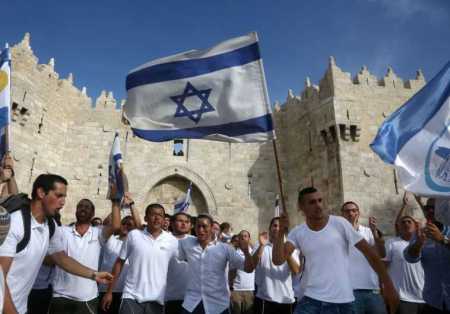
Al-Manar | June 5, 2016
Tensions were high in al-Quds on Sunday as Zionists ‘celebrated’ the 1967 occupation of eastern part of the holy city.
AFP news agency reported there were strict security measures in al-Quds.
Meanwhile, Palestine Today reported that more than 27 Zionist organizations had called for storming the holy al-Aqsa Mosque in al-Quds on Sunday.
The website said that the Zionists are to mark anniversary of the 1967 Israeli invasion and occupation of the West Bank, Gaza, Sinai, and the Golan Heights that began on June 5.
In that day East al-Quds (Jerusalem) was occupied by the Israeli forces.
The Zionist organizations called Israelis on social media to commemorate what they called “unification of Jerusalem Day” through parades in the holy city.
The calls on social media noted that there is a deal between the organizations and the occupation authorities on ensuring security for the parades.
Israeli media also reported that the Israelis are marking “Jerusalem Day”, with multiple parades and events are scheduled in al-Quds on Sunday.
Earlier, Palestine Today said that Zionist settlers tried to torch shops in al-Quds early on Saturday, noting that Palestinian youth confronted such attempts.
Palestinian journalist and human rights defender’s interrogation extended once more by Israeli court
Samidoun Palestinian Prisoner Solidarity Network – June 4, 2016
 The detention and interrogation of Palestinian journalist and human rights defender Hasan Safadi, Arabic media coordinator for Addameer Prisoner Support and Human Rights Association, was renewed on Friday, 3 June. Safadi, 24, has been under interrogation for more than a month, since his arrest by Israeli occupation forces on 1 May as he attempted to cross al-Karameh bridge, returning to the West Bank of occupied Palestine from Jordan.
The Jerusalem Magistrate Court extended his interrogation period for 4 additional days; he will have another court hearing on Tuesday, 7 June.
The arrest of Safadi comes amid an ongoing attack on Palestinian journalists and media workers, including the administrative detention without charge or trial of Omar Nazzal, member of the General Secretariat of the Palestinian Journalists’ Syndicate; Musab Kafisheh, freelance journalist; Mohammed Kaddoumi, freelance journalist; and Ali al-Oweiwi, an announcer at Arabah radio station.
In addition, Syrian journalist from the occupied Golan Heights (holding Israeli citizenship) Bassam al-Safadi, a correspondent for the Iranian Al-Alam TV channel, was arrested on 1 June and is being imprisoned in Tzalmon prison, accused of “incitement” and “support for terrorism,” apparently on the basis of public media statements.
Other Palestinian journalists like Sami al-Saee, Samer Abu Aisha and Samah Dweik are imprisoned and charged with “incitement” for publishing on social media; Abu Aisha faces charges for going to Lebanon – where hundreds of thousands of Palestinian refugees live – labeled an “enemy country.” Journalists like Hazem Nasser and Mujahid Saadi are targeted and accused of membership in or support for an “illegal organization” – any Palestinian political party.
samidoun@samidoun.ca
Israel renews detention of two PFLP leaders, held for 1 year without charge
Ma’an – June 4, 2016
RAMALLAH – Israeli authorities decided to renew the administrative detention of two PFLP leaders for six additional months, the Palestinian Prisoners’ Center for Studies said on Saturday, a day after leading member of the PFLP Khalida Jarrar was released from Israeli custody.
The center said in a statement that Jamal Barham, 56, and Shahir Ali al-Rai, 47, have been in Israel’s Ktziot prison in the Negev since their detention on June 3, 2015.
The center said that the two are being held for their activity in the Popular Front for the Liberation of Palestine (PFLP), which is designated by Israel as an “illegal terrorist organization.”
The majority of Palestinian political organizations are considered illegal by Israel, including those that make up the Palestine Liberation Organization (PLO), and association with such parties is often used as grounds for imprisonment, according to prisoners’ rights group Addameer.
The Israeli military prosecution said Barham and al-Rai held high ranks in the PFLP and took part in “incitement” against Israel, according to the center.
Both of the PFLP leaders had previously spent time in Israeli custody for their political activism.
Al-Rai, from the northern occupied West Bank city of Qalqilya, has spent a total of 12 years in Israeli jails, mostly under administrative detention — the controversial Israeli policy of internment without trial or charge based on undisclosed evidence.
Prior to his detention last year, Barham was arrested only once before, in December 1984, and released in August 1987.
Following his release, he and his family were the target of repeated house raids, while Barham was also wanted throughout the 1990s until the beginning of the second Intifada, according to Palestinian prisoners’ rights group Addameer.
During his detention in June 2015, Israeli forces ransacked his house, destroyed his computer, and confiscated flash drives belonging to his children.
Barham, from the village of Ramin in the northern district of Qalqiliya, was the head of the Arab Studies Department in PLO. He also suffers from various medical issues including high cholesterol, high blood pressure, and a disc in his neck.
Due to the lack of evidence against Barham to support Israel’s accusation that his previous political activity presented a security threat, his detention “is considered a violation of his right of expression and political activity,” insisted Addameer in their profile of Barham.
“His detention is arbitrary and a grave violation of the Fourth Geneva Convention. The decision to hold him under administrative detention confirms the occupation authorities’ arbitrary use of the administrative detention policy when sufficient information is not available to put any Palestinian on trial.”
Barham was among 50 other Palestinian administrative detainees that launched a boycott of Israel’s military courts in July 2015, in protest of the courts’ impartiality and “their utilization as a mere formality,” said Addameer.
The boycott served to emphasize the prisoners’ “continued detention based on secret information that neither the detainee nor his lawyer can review, and additionally to the fact that military courts are a tool to legitimize the occupation and arbitrary detention.”
Meanwhile, Palestinian lawmaker and leading member of the PFLP Khalida Jarrar was released from Israeli custody on Friday, after being held for 14 months in Israeli prison.
Detained on April 2, Jarrar was initially sentenced to six months of administrative detention, however international pressure later forced Israeli authorities to bring charges against her, all 12 of which focused on her political activism.
News of the Israeli military prosecution’s renewal of Barham’s and al-Ray’s administrative detention follows the announcement of prominent Israeli human rights organization B’Tselem last week that it was discontinuing its strategy of holding Israel accountable for its crimes against Palestinians through internal military mechanisms.
“B’Tselem has gradually come to the realization that the way in which the military law enforcement system functions precludes it from the very outset from achieving justice for the victims. Nonetheless, the very fact that the system exists serves to convey a semblance of law enforcement and justice,” the report stated.
Israel deports 6 Palestinians to the U.S.
Palestinian Information Center – June 3, 2016
OCCUPIED JERUSALEM – The Israeli Interior Ministry and the Israeli Prison Service (IPS) at dawn on Friday deported six Palestinian citizens from Occupied Jerusalem to the U.S.
33-year-old Kareem Faysal Abu Khdheir, who was banned from Occupied Jerusalem and deported to the U.S., said as he spoke by phone from the Lod Airport: “I was transferred from the Negev jail to the airport on Thursday morning. The Israeli occupation authorities claimed the flight was scheduled for five p.m. on Thursday before they updated me that it was delayed for six a.m. on Friday.”
“I was locked up in the airport detention center with five other detainees. Each one of us was allowed to make one phone call only to update his family on the deportation order,” he added.
Kareem, from the Shu’fat refugee camp, was arrested by the Israeli occupation forces on September 5, 2015 following clashes with occupation troops. Right before the detention, Kareem was subjected to heavy beating by the Israeli Occupation Forces and sustained critical bruises in his chest, face, and teeth.
The IOA extended his remand several times despite his deteriorated health status.
Deliberations and hearings held by the Israeli Magistrate’s court over the past four months culminated in a verdict that condemned Abu Khdheir, a holder of American citizenship, for involvement in Jerusalem demonstrations and sentenced him to nine months and a fine of 8,000 shekels.
Born and raised in the U.S. since October 2, 1983, Kareem Abu Khdheir popped into the occupied Palestinian territories on August 28, 2015 for the first time to get married.
He had been held for nine months in the Negev jail on allegations of resisting arrest, attacking an Israeli border guard, and joining anti-occupation demos.
“Someday I shall return to my motherland, from which I was banned because I attended my friend’s funeral,” said Abu Khdheir. “Someday I shall come back and live on Palestine’s soil for eternity,” Abu Khdheir added as he bid farewell to his family.
Featured Video
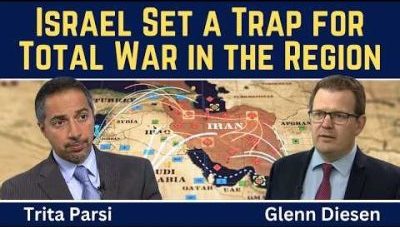
Trita Parsi: Israel Set a Trap for Total War in the Region
or go to
Aletho News Archives – Video-Images
Book Review
Why the War on Conspiracy Theories Is Bad Public Policy
By Kevin Barrett • Unz Review • February 1, 2019
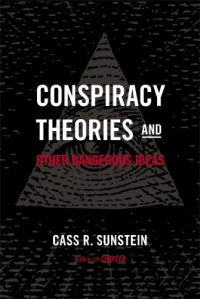 A Review of Conspiracy Theories and Other Dangerous Ideas by Cass Sunstein (based on an earlier paper co-authored with Adrian Vermeule); In Defense of Troublemakers: The Power of Dissent in Life and Business by Charlan Nemeth; and Conspiracy Theories and the People Who Believe Them, edited by Joseph E. Uscinski
On January 25 2018 YouTube unleashed the latest salvo in the war on conspiracy theories, saying “we’ll begin reducing recommendations of borderline content and content that could misinform users in harmful ways—such as videos promoting a phony miracle cure for a serious illness, claiming the earth is flat, or making blatantly false claims about historic events like 9/11.”
At first glance that sounds reasonable. Nobody wants YouTube or anyone else to recommend bad information. And almost everyone agrees that phony miracle cures, flat earthism, and blatantly false claims about 9/11 and other historical events are undesirable.
But if we stop and seriously consider those words, we notice a couple of problems. First, the word “recommend” is not just misleading but mendacious. YouTube obviously doesn’t really recommend anything. When it says it does, it is lying. … continue
Blog Roll
 Aletho News
- Putin’s key remarks on peace talks and Europe’s ‘schizophrenia’
- Trita Parsi: Israel Set a Trap for Total War in the Region
- Trump’s Iran war is on an Israeli leash
- Saudi oil boss issues global supply warning
- Riyadh Says Its Oil System Is Intact. The Numbers Say Otherwise.
- Trump and Netanyahu Want to “Finish the Job” on Iran
- US ‘one-sided dictation’ not Iran’s beliefs makes rational talks impossible: Baghaei
- Iran’s Next Strike May Not Explode. It Could Shut You Down /Col Doug Macgregor
- Iran: US political targets legitimate if assassinations return
- Iraq shuts key border crossing with Iran under US pressure: Report
- If Americans Knew
- DAILY UPDATE: Latest essential news on Palestine, Israel, & region
- The Israel Lobby’s Changing Fortunes
- AIPAC has become such a political liability that it’s shifting to a more “nimble” approach to buying politicians
- At least 160 Israeli settler attacks in 2 weeks
- Will Gaza’s Ancient Christian Community Disappear Forever?
- Israel’s vision of regional security rests on keeping Arab states weak
- Heidi Levine recounts how Palestinian youths helped save her in settler attack
- DAILY UPDATE: Latest essential news on Palestine, Israel, & region
- Trump’s Intensifying Sabotage of the ICC, for Israel’s Sake
- Israeli military detain US and UK volunteers in West Bank including Democratic NY politician Brad Lander
- No Tricks Zone
- E-Cars Reduce CO2 Emissions By Only 41% Compared To Internal Combustion Engine Vehicles
- Predictions Made By Renowned Climate Professor Over Past Decades Have Been Proven To Be Poor
- New Study Suggests Large Regions Of The Pacific Ocean Have Been Cooling For The Last 80 Years
- Germany’s Green Energy Debacle: High Energy Costs Force Kahla Porzellan to Close After 182 Years!
- New Study: 50 Years Of The Most Aggressive ‘Net Zero’ Policies Can Only Affect The Global Climate By 0.03°C
- US September “Heat” Was No Record…Many Records Set Decades Ago
- Latest European Green Energy Debacle; Portugal’s Largest Flagship Solar Park Insolvent!
- Green Energy Debacle: German Expert Professor Fritz Vahrenholt Warns Of Severe Economic And Social Consequences
- Two More Paleo Reconstructions Affirm Meters-Higher Sea Levels Across Ireland, Brazil 7000-6000 Years Ago
- New Study: Earth And Venus Surface Warmth Largely Explained By Convection And Lapse Rate, Not CO2 Or Radiation

