Scott Atlas: I’m disgusted and dismayed
Unherd | The Post | October 20, 2020
Freddie Sayers caught up with Scott Atlas, a healthcare policy academic from the Hoover Institute at Stanford, who has become the latest lightning rod for the controversy around Covid-19 policy and his support for a more targeted response.
Speaking from inside the White House, where he is now Senior advisor to the President and a member of the Coronavirus task force, he does not hold back. He tells us that he is disgusted and dismayed at the media and public policy establishment, sad that it has come to this, cynical about their intentions, and angry that lockdown policies have been allowed to go on so long.
He won’t be rushing back to Stanford, where his colleagues have rounded on him, if the President loses in November.
KEY QUOTES
Why him?
“I’m a healthcare policy person — I have a background in medical science, but my role really is to translate medial science into public policy. That’s very different from being an epidemiologist or a virologist with a single, limited view on things.”
Dr Fauci
“He’s just one person on the task force — there are several people on the task force. His background is virology, immunology and infectious disease. It’s a very different background, it’s a more limited approach, and I don’t speak for him.”
Herd immunity policy?
“No. It’s a repeated distortion, lie, or whatever you want to call it… What they mean by ‘herd immunity strategy’ is survival of the fittest, let the infection spread through the community and develop a population immunity. That’s never been the policy that I have advised. It’s never even been discussed inside the White House, not even for a single minute. And that’s never been the policy of the President of the United States or anybody else here. I’ve said that many many times… and yet it persists like so many other things, hence the term that the President is fond of using called fake news.”
On herd immunity
“Population immunity is a biological phenomenon that occurs. It’s sort of like if you’re building something in your basement: it’s down on the ground because gravity puts it there. It’s not a ‘strategy’ to say that herd immunity exists — it is obtained when a certain percentage of the population becomes resistant or immune to an infection, whether that is by getting infected or getting a vaccine or by a combination of both. In fact, if you don’t believe that herd immunity exists as a way to block the pathways to the vulnerable in an infection, then you would never advocate or believe in giving widespread vaccination — that’s the whole point of it… I’ve explained it to people who seemingly didn’t understand it; I’ve mentioned this radioactive word called herd immunity. But that’s not a strategy that anyone is pursuing.”
What is his policy?
“My advice is exactly this. It’s a three-pronged strategy. Number one: aggressive protection of high risk individuals and the vulnerable (typically the elderly and those with co-morbidities). Number two: allocate resources so that we prevent hospital overcrowding, so that people can be treated for this virus and get the other serious medical care that is needed. Number three: open schools, society and businesses because keeping them closed is enormously harmful — in fact it kills people.”
Has the policy changed?
“It is the White House policy on Coronavirus, but it always was. The President started this with an observation that was overlooked by most people in the world: he said in the third week of March that the cure cannot be worse than the disease… In April the White House released a formal ‘opening up America’ document, which included extreme protection of the vulnerable and opening up society… It’s not been a shift.”
Effect of lockdowns
“We must open up because we’re killing people. In the US, 46% of the six most common cancers were not diagnosed during the shutdown… These are people who will present to the hospital or their doctor with later stage disease — many of these people will die. 650,000 Americans are on chemotherapy — half of them didn’t come in for their chemo because they were afraid. Two-thirds of screenings for cancer were not done; half of childhood immunisations did not get done; 85% of living organ transplants did not get done. And then we see the other harms: 200,000 cases plus of child abuse in the US during the two months of spring school closures were not reported because schools are the number one agency where abuse is noticed; we have one out of four American young adults, college age, who thought of killing themselves in the month of June…
All of these harms are massive for the working class and the lower socioeconomic groups. The people who are upper class, who can work from home, the people who can sip their latte and complain that their children are underfoot or that they have to come up with extra money to hire a tutor privately — these are people who are not impacted by the lockdowns.
This is the topic, this is why you open up. A secondary gain might be population immunity, but this is the reason to open up.”
On short-term immunity
“We don’t know how long someone’s immunity lasts to this, but this is a coronavirus, this is not a completely novel disease… Coronavirus exposure typically has a year, or even a few years, of immunity — we can make a first guess that probably there’s a good chance that will happen… Yes, we know that antibodies disappear… but that’s true for every infection, that’s a typical scenario and not a cause for panic. Why? Because we know there is resistance to infection that seems to be coming out in the literature that is not purely due to antibodies, there are other components of the immune system. Suffice to say this: do we know that people have immunity? You don’t need to be a scientist to understand that when you have hundreds of millions of cases… do you know how many cases of reinfection there are? At the most, five in the world… It is not true that there is no immunity to this, that would be a bizarre conclusion.”
Climate of fear
“This is one of the biggest failures of the voices of public health in the United States and in the world — they specifically instilled fear with their proclamations and statements… And the models that were put forward that were worst case scenarios and were just hideously wrong, and the media that has hyped up these rare exceptions like multi-system inflammation in children even though we know the overwhelming evidence is that this disease is absolutely not high risk for children. All the hyperbole, the sensationalising and the failure of public health officials to articulate what we know instead of what we don’t know… The fear is due to what was said by the so-called experts, by the media and by a failure to understand or care that they were instilling hear… I just heard a famous epidemiologist from Harvard the other day say that to have the idea of herd immunity even being discussed is ‘mass murder’ — these kinds of statements are hideously outrageous.
It’s never appropriate to have fear. There is no such thing as a government leader who is competent who instills fear.”
How to protect old people
“We have not been perfect at it, there’s no question — it’s very challenging. The first is to educate people: put forward the guidelines. I think our society has learned — no-one knew what social distancing meant… that was a foreign concept and we now understand that — but there are more specific measures. We have shipped every single nursing home point of care rapid testing — we have mandated weekly testing of every staff that enters a nursing home, but when there is community increase we recommend going up to… four times a week.
We cannot guarantee that we can protect everybody — there is not such thing as zero risk in life…”
But
“I have a 93 year old mother in law, and she said to me 2 months ago, “I’m not interested in being confined in my home. I am not interested in living if that’s the life… I’m old enough to take a risk, I understand social distancing. I’m going to function, otherwise there’s no reason to live.” This sort of bizarre, maybe well-intentioned but misguided idea that we are going to eliminate all risk from life, we are going to stop people from taking any risk that they are well aware of, we’re going to close down businesses, we’re going to stop schools — these are inappropriate and destructive policies.
There are between 30,000 and 90,000 people a year that die — that are high risk elderly — in the United States every flu season. We don’t shut down schools in response to that…”
Is it politics?
“I see that there is a different philosophy in life. In my own family we have different views on things. But we need to start by looking at the data.
One thing that’s been really shocking to me is that in the US and I think all over the world, we have a really contaminated media. Their politics has really distorted truth… I think that has now contaminated public policy and science. There’s been a massive distortion — a complete almost disregard for objectivity, including in some of what were the world’s best journals like Lancet, New England Journal, Nature, Science: these people feel compelled to be politically visible, and that’s contaminated the discussion.”
On test and trace
“Now, there are 7 million registered cases in the US but even the CDC says that it’s probably tenfold that, that’s 70 million people at least; if we look at the world’s cases, maybe 40 million cases but we know that it’s probably 10 to 20 times that. So it’s not possible to do things like contact tracing and isolating asymptomatic people.
A lot of these people who have very fancy CVs have engaged in very sloppy thinking. And now, partly because it’s a political year in the US with a massively polarised electorate, the politics have entered the scene and there’s a massive amount of digging in to the original beliefs even though they are completely wrong…”
On his own reputation
“My position here is not political — zero politics. My motivation was that the President of the United States asked me, a public health policy person who understands medical science, to help in the biggest healthcare crisis of the century. There would be something wrong with you if you would say no to that, no matter what your politics…
When I did that though, I knew I would be vilified, because in the US there are a lot of people who think that this President is radioactive, so there is a massive destruction that ensues immediately when you associate with this President. It’s a very sad statement on America, on American culture, on the world — these people are blinded, even scientists, to the data because they despise the political side of this. And they have a massive ego, and can’t admit they’re wrong. OK I’m a contrarian, I’m used to being a contrarian, I’m proud to be an outlier when the inliers are wrong.
I’ve gone through various levels of being angry. I’m not angry but I’m sort of disgusted and dismayed at the state of things… It’s just sad to me. I’m cynical about the state we’re in right now and the future… I’m disturbed. I have children of my own who are in their twenties, and I wonder what the future is if we have lost truth in the media, to a great extent, and we are now starting to lose truth in science…
I am angry at the people who were wrong and who insist on prolonging these policies that are killing people, particularly people who are not in their socioeconomic class. It’s no problem for a person who has a high level job in government, or an academic job, to sit there and pontificate when the average guy is being destroyed. That I am angry about and I think history will record these people very harshly — it is an epic failure of massive proportion that they have abandoned regular people here with their own hubris and political agenda. In that sense – yeah I’m angry.”
On masks
“Things like universal mask wearing — honestly that is contrary to the science as well as common sense, to think that you need to wear a mask when you’re in the middle of the desert, when you’re in the car on your own, when you’re bicycling through St James’s Park. This kind of stuff is nonsense. There is no science to support universal masking.
You can look at LA County, Miami-Dade county, many states in the US, the Philippines, Spain, France, the UK, all over the world mandating masks does not stop, for the population, does not stop cases. That is just super naïve, wrong, and that’s just garbage science really. The WHO does not recommend widespread mandatory masks, the NIH does not recommend that, the CDC data itself shows that that doesn’t work. That’s bordering on wearing a copper bracelet as far as I am concerned.
I do think masks have a role… in medicine we wear masks for surgical procedures. The reason you wear a mask is when you’re very close to somebody, or a sterile environment like an open incision, you want to stop a cough or droplets from getting in there and infecting something. That’s very different from breathing… If you’re socially distanced, there’s no reason to wear a mask.”
On the Stanford letter
“They expose themselves for who they were when they wrote that letter… It’s preposterous what was said. But I have a lot of support inside the Hoover Institution, a lot of support in faculty… I certainly have lost some friends, there’s no question about that — would I do it again? Absolutely. It’s the most important thing I’ve ever done.
I’m disgusted by politics – completely disgusted — and it’s a sad statement. People were exposed when someone came into power who they didn’t agree with it they were exposed for who they were. That’s a gross embarrassment, and its sad… There’s a tremendous amount of emotion rather than rational thought.”
Court Rebuffs Gretchen Whitmer’s Plan to Keep State on Lockdown Until After Election
21st Century Wire | October 14, 2020
It’s now becoming clear that one of the deciding swing issues of the 2020 Presidential Election is going to be COVID Lockdowns. Incredibly, Democrats are now openly attempting convert Americans’ pain and suffering into votes on Nov 3rd.
This week a Michigan Supreme Court ruled in favor of the people by effectively rebuking efforts by the state’s Democrat Governor, Gretchen Whitmer, to impose a new state-wide lockdown supposedly to stop coronavirus.
Earlier this month, the court struck down Whitmer’s initial decree to extend her COVID lockdown into the spring of 2021, but Governor’s office was still determined to keep the state under lockdown and appealed for a stay of the court’s decision.
It appears that a desperate Whitmer had hoped to delay the Court’s ruling going into effect for a further 21 days – until after the General Election on November 3rd, but the Court saw through this maneuver and proceeded to reject Whitmer’s attempted delay on Monday.
This latest legal drama confirms what many had already suspected – that some Democratic politicians are attempting to keep their states under lockdown until after the election, in effect, increasing the amount of economic and social pain and suffering – arguably a dangerous strategy designed to blame President Trump for the damage caused by the very policies championed by Democrats since the beginning of the pandemic.
It is now obvious from the Governor’s own statements what her true intentions were – using the brute force of her office to sideline a Court ruling with authoritarian executive power.
PJ Media reports:
In a statement after the ruling on October 2, Whitmer claimed, “It is important to note that this ruling does not take effect for at least 21 days, and until then, my emergency declaration and orders retain the force of law.” She called the ruling “deeply disappointing.” The governor’s attorneys later asked for 28 days to give the administration time to negotiate with lawmakers and put new restrictions in place.
Yet on Monday, the court ruled that the 21-day rule does not apply in this case because the ruling came in response to questions from a federal judge who sought clarity on the legality of the governor’s actions, Crain’s Detroit Business reported. Chief Justice Bridget Mary McCormack wrote, “I do not believe the court has the authority to grant the remedy the governor requests. … Our court rules do not provide a way for any party to the lawsuit in the (federal) district court to challenge our answer in this court.”
After the Oct. 2 ruling, Whitmer’s health department director has imposed a new mask mandate and restrictions for public-facing businesses and gatherings under the public health code, which remained outside the scope of the legal challenge.
The Oct. 2 ruling condemned the excessive sweep of Whitmer’s lockdown, noting that a wide variety of businesses had to close as a result of her orders, including “restaurants, food courts, cafes, coffeehouses, bars, taverns, brew pubs, breweries, microbreweries, distilleries, wineries, tasting rooms, clubs, hookah bars, cigar bars, vaping lounges, barbershops, hair salons, nail salons, tanning salons, tattoo parlors, schools, churches, theaters, cinemas, libraries, museums, gymnasiums, fitness centers, public swimming pools, recreation centers, indoor sports facilities, indoor exercise facilities, exercise studios, spas, casinos, and racetracks.”
“These policies exhibit a sweeping scope, both with regard to the subjects covered and the power exercised over those subjects. Indeed, they rest on an assertion of power to reorder social life and to limit, if not altogether displace, the livelihoods of residents across the state and throughout wide-ranging industries,” the ruling added.
This latest drama comes just weeks before the big election as Michigan, a key battleground state in the upcoming Presidential race, prepares for Nov 3rd.
It seems that the Democratic Party strategy of ‘maximum pressure’ on the American people is also being conducted at a national level as well, as evidenced this week after House Speaker Nancy Pelosi (D-CA) led calls to stop the President’s $1.8 Trillion Corona virus Relief Bill.
The partisan move seemed so obvious that even pro-Democrat network CNN pushed back against Pelosi during her segment with Wolf Blitzer yesterday. The CNN anchor’s questions were met with a stinging response by Pelosi who was clearly upset at being asked to justify her party’s controversial decision to hold up economic relief ahead of the election. Watch:
Strategy Backfiring
It is unconscionable that politicians would be using the current COVID crisis by reimposing restrictions on citizens in order to blame the crisis on their opponents and thus leverage votes in the upcoming general election. But this appears to be exactly what is happening.
However, if this tactic backfires on the Democrats, it could end up providing a much-needed bounce to the incumbent President Trump in the close battleground states.
CLINTEL puts hard climate questions to Bill Gates
By David Wojick | CFACT | September 23, 2020
Bill Gates is throwing several billion dollars at climate change. Mind you he is not throwing it away, because it is mostly venture capital for new energy technologies, which could pay off handsomely without climate change.
Gates can do what he likes with his riches, but he is a leading figure and lately he has become a serious climate change scaremonger. This has prompted CLINTEL to put some hard questions to him, in the form of a registered letter.
On the scaremongering side, last month Gates published an article claiming that climate change will be far worse than the present Covid outbreak. He imagines many millions dying from climate change. The press spread his doomsday words far and wide.
Here are some doomful excerpts:
“I am talking about COVID-19. But in just a few decades, the same description will fit another global crisis: climate change. As awful as this pandemic is, climate change could be worse.“
“I realize that it’s hard to think about a problem like climate change right now. When disaster strikes, it is human nature to worry only about meeting our most immediate needs, especially when the disaster is as bad as COVID-19. But the fact that dramatically higher temperatures seem far off in the future does not make them any less of a problem—and the only way to avoid the worst possible climate outcomes is to accelerate our efforts now. Even as the world works to stop the novel coronavirus and begin recovering from it, we also need to act now to avoid a climate disaster by building and deploying innovations that will let us eliminate our greenhouse gas emissions.”
“If you want to understand the kind of damage that climate change will inflict, look at COVID-19 and spread the pain out over a much longer period of time. The loss of life and economic misery caused by this pandemic are on par with what will happen regularly if we do not eliminate the world’s carbon emissions.”
According to Gates’ Energy Plan, progress is the problem. He puts it this way:
“These challenges are only getting more urgent. The world’s middle class has been growing at an unprecedented rate, and as you move up the income ladder, your carbon footprint expands. Instead of walking everywhere, you can afford a bicycle (which doesn’t use gas but is likely made with energy-intensive metal and gets to you via cargo ships and trucks that run on fossil fuels). Eventually you get a motorbike so you can travel farther from home to work a better job and afford to send your kids to school. Your family eats more eggs, meat, and dairy, so they get better nutrition. You’re in the market for a refrigerator, electric lights so your kids can study at night, and a sturdy home built with metal and concrete.
All of that new consumption translates into tangible improvements in people’s lives. It is good for the world overall—but it will be very bad for the climate, unless we find ways to do it without adding more greenhouse gases to the atmosphere.”
As a rebuttal, the CLINTEL open letter asks him these six central questions:
1. How much or how little global warming does mankind really cause on top of the natural contribution?
2. Why does projected global warming exceed observationally-derived warming by more than 200%?
3. Have the large benefits of more CO2 in the atmosphere been properly accounted for?
4. Does the cost of attempting to abate global warming exceed the benefit in the avoided cost of adaptation?
5. What of the tens of millions who die every year because they cannot afford expensive “renewable” electricity and are denied affordable, reliable alternatives?
6. Has history not shown us repeatedly that adaptation to change presents a powerful survival and evolutionary strategy?
Professor Guus Berkhout, CLINTEL President, asks a more personal question:
“CLINTEL particularly blames Bill Gates that he takes advantage of his riches-based fame to frighten the public with extreme modeling predictions (question 2), but does not reassure them with the fact that these scaring modeling results never agreed with observations in practice. ‘Why this one-sided message, Mr. Gates?’”
It will be interesting to see how Bill Gates responds. I urge others to send similar letters to the misguided billionaires who are funding the climate false change scare.
In related news CLINTEL has posted an updated listing of its 900+ international
member scientists and related professionals, all signatories to the World Climate Declaration. They are listed by nationality, with 34 countries listed to date.
David Wojick, Ph.D. is an independent analyst working at the intersection of science, technology and policy.
The Bill for America’s $50 Trillion Gluttony of Inequality Is Overdue
The battle to claw back a significant percentage of the $50 trillion is just beginning.
By Charles Hugh Smith | of two minds | September 20, 2020
Do you hear the pathetic bleating of America’s billionaires and their army of toadies? If not, you soon will, for a remarkable report has been released that documents the $50 trillion in earnings that’s been transferred to the Financial Aristocracy from the bottom 90% of American households in the past 45 years.
The report was prepared by the RAND Corporation, and has a suitably neutral title: Trends in Income From 1975 to 2018. (The full report can be downloaded for free.)
Just as remarkable is the no-holds-barred coverage of the study by Time magazine, an iconic publication of the mainstream media: The Top 1% of Americans Have Taken $50 Trillion From the Bottom 90% — And That’s Made the U.S. Less Secure.
Longtime readers know I’ve reported on the astounding increase in America’s economic inequality for the past 15 years, and addressed the eventual banquet of consequences this imbalanced, destabilizing state of affairs will serve up.
But with few exceptions, the corporate media has ignored this fundamental reality of American life, and blown off the consequences as easily ignored speculation by marginalized bloggers and commentators. (“Would somebody please shadow-ban these sites going on and on about soaring inequality? Thank you, Facebook, Google and Twitter–we’ll return the favor directly.”)
The extreme rarity of paragraphs like these in the corporate media cannot be over-emphasized. The corporate media has carried water for the billionaires and America’s Financial Aristocracy for decades. (No surprise, given that the vast majority of America’s media / social media is owned by the billionaires and Financial Aristocracy. Why bite the hand that feeds you, especially when the risk of losing your career is so high?)
Excerpted from the time.com article linked above:
There are some who blame the current plight of working Americans on structural changes in the underlying economy–on automation, and especially on globalization. According to this popular narrative, the lower wages of the past 40 years were the unfortunate but necessary price of keeping American businesses competitive in an increasingly cutthroat global market. But in fact, the $50 trillion transfer of wealth the RAND report documents has occurred entirely within the American economy, not between it and its trading partners. No, this upward redistribution of income, wealth, and power wasn’t inevitable; it was a choice–a direct result of the trickle-down policies we chose to implement since 1975.
We chose to cut taxes on billionaires and to deregulate the financial industry. We chose to allow CEOs to manipulate share prices through stock buybacks, and to lavishly reward themselves with the proceeds. We chose to permit giant corporations, through mergers and acquisitions, to accumulate the vast monopoly power necessary to dictate both prices charged and wages paid. We chose to erode the minimum wage and the overtime threshold and the bargaining power of labor. For four decades, we chose to elect political leaders who put the material interests of the rich and powerful above those of the American people.
That this level of incendiary outrage is now seeping into the mainstream media tells us that the bill for America’s $50 Trillion gluttony of inequality is long overdue and the pendulum of reckoning will swing to political, social and economic extremes equal to the extremes of wealth and income inequality engineered by America’s Financial Aristocracy and their toadies / lackeys in government, the Federal Reserve, Wall Street, Silicon Valley and the media.
The rallying cry to claw back a significant percentage of the $50 trillion is just beginning. The billionaires have the money and power, of course, and the best government that money can buy plus the loyalty of a vast army of well-paid toadies, lackeys, factotums and apparatchiks.
But once the citizens no longer accept their servitude, the pendulum will gather momentum. America’s Financial Aristocracy has reached extremes not just of wealth-income-power inequality, but extremes of hubris. Their faith in luxury bug-out estates / private islands is evidence that even if the way of the Tao is reversal, they’ll have their private bodyguards and stashes of fuel and other essentials.
The clawback might not be as easy to rebuff as they anticipate, nor will the pendulum swing that’s just starting necessarily arrive at the opposite extreme in the orderly, predictable fashion they’re accustomed to controlling.
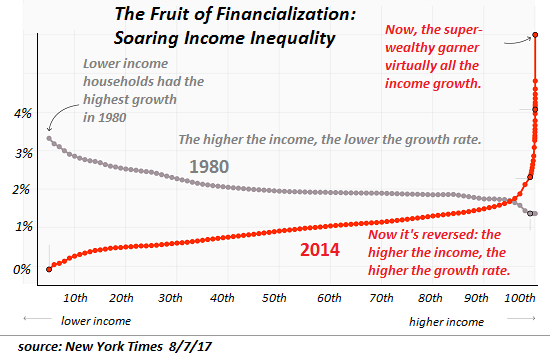
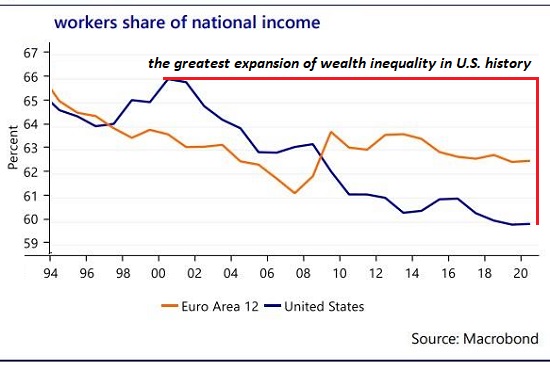
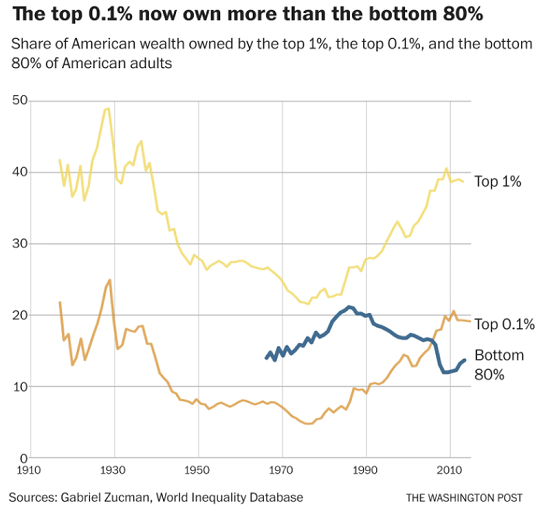
Here’s a few of the many charts you’ve seen over the years here that illustrate rising inequality:
My new book is available! A Hacker’s Teleology: Sharing the Wealth of Our Shrinking Planet 20% and 15% discounts end September 30 (Kindle $7, print $17)
Read excerpts of the book for free (PDF).
The Story Behind the Book and the Introduction.
Recent Podcasts:
AxisOfEasy Salon #22: When the going gets weird, the weird turn to YouTube (1 hr)
Why is Surrogacy Illegal in Most of the World?
By Mirah Riben | Dissident Voice | July 11, 2020
The longing, desire and biological drive of many human beings to fulfill the imperative to be fruitful, to procreate and to become parents, is real and painful when unachievable. This has led to an increase of assisted reproductive technology (ART) and surrogacy, despite ethical and legal concerns.
Preface
The infertility and surrogacy multi-billion-dollar industries, those who benefit from it, and others, too often attempt to out-shout any criticism of surrogacy by conflating surrogacy with LGBTQ+ rights and labeling all opposition to surrogacy as homophobic.
Yet, the LGBTQ+ community includes those who are opposed to surrogacy and anonymous designer contract conception, aka assisted reproductive technology (ART).
Opposition to surrogacy has nothing to do with the sexual preference, sexual orientation, gender identification or marital status of those who use anonymous gamete and/or hire a surrogate.

It is contractual anonymous conception and surrogacy which is at question, regardless of who contracts for such services.
Anderson Cooper is the latest celebrity to have a child via surrogacy. He joins 35 gay, straight, married and single celebs such as Tyra Banks, Michael Jackson, Mariska Hargitay, Elton John, Andy Cohen, Katy Segal as well as Kim Kardashian and Kanye West who had two of their four children born via surrogate, and Sarah Jessica Parker who has surrogate twins.
Hollywood and the public marvel at each new arrival often with no mention of how the child came to be. While some have made grand public announcements and a few celebs have openly expressed gratitude to the surrogate, there seems to be an unspoken “don’t ask” etiquette in interviews about the new baby, leaving an almost unnatural silence in place of usual chatter such as: “Who does the baby look like, his mother or father?”
Traditional surrogacy, prior to the Baby M Case involved inseminating a woman with sperm – often, but not always – of the contractual father-to-be. Since 1986 when Mary Beth Whitehead battled for custody of her daughter Sarah (known as Baby M), the mega-billion-dollar fertility industry devised a way to avoid mothers fighting for custody of “their” child by creating “gestational surrogacy”- the current norm – that involves a carrier being implanted with a third-party’s fertilized egg, and incubating the unrelated fetus. The child is thus unrelated to the gestational carrier, greatly limiting custody claims.
For many, perhaps most, choosing to have a child by any means is a cause for celebration. Touting reproductive choice, freedom, and justice proponents argue any child who is wanted and loved is a thing of joy and everyone choosing to be a parent should be admired and supported, regardless of how parenthood is achieved, including the use of anonymous gamete and surrogacy as a reproductive “right.”
A Right?
Clearly all have a right to access to reproductive care and services. However, the fact is that no “right” or entitlement to have a child or be a parent exists. And certainly, there is no right to buy sperm or eggs or the use of a woman’s womb.
Feminists are divided on surrogacy, as they have long been with prostitution, with some arguing for women’s autonomy, legalization and regulation, and others concerned about exploitation and commodification. Yet, many woman’s organizations, intellectuals, pro-life groups, politicians, scientists and citizens from different cultural backgrounds and countries call for the universal elimination of surrogacy, paid or unpaid.
Feminists do not take an opposing position on surrogacy easily, inasmuch as many women – alone or with a partner – are consumers of surrogacy services. It is thus all the more notable that women’s rights scholars such as Phyllis Chesler and Gloria Steinem opposed a NY bill (which passed in May, 2020) to legalize paid surrogacy saying it “turns women’s bodies into commodities and is coercive to poor women given the sizable payments it can bring.”
Gary Powell, a UK conservative political activist and longstanding advocate for gay and lesbian equality, writes,
As gay people, we cannot insist on the right to carry out practices that harm the rights of others. Rather than being an LGBT rights issue, surrogacy is a women’s rights issue and a children’s rights issue; and like the sale of human organs, it is not an activity that should be promoted or indeed permitted.
A Choice?
Defenders of surrogacy see it as a reproductive choice from a vast array of menu items ranging from IVF to adoption. However, these options are not available equally to all, but only to those who can afford them.
There are also legal restrictions as to what methodologies of obtaining a child are acceptable or not and even punishable. An “anything goes” ideology for becoming a parent does not include kidnapping, for instance, even if the child is loved and well-cared for, such as in cases like that of Carlina White and Kamiyah Mobley each of whom was kidnapped as an infant and raised as the child of their abductor for two decades.
And let us be clear: The word “donation” in regard to egg, sperm and womb is a euphemism intended to illicit a more altruistic tone to these purchases. Gametes – egg and sperm are commodities being bought and sold most often via a third-party broker. While it is argued that payment is for services not the commodity itself, such “services” are seldom given without compensation. It is coercion and exploitation of the poor that prevents the sale of human organs and yet laws in all locals have not yet included a similar ban on gametes and wombs.
Anna Kerr, founder and Principal Solicitor of Feminist Legal Clinic Inc., Sydney, AU addresses the heart of the issue in regard to how much a of choice surrogacy is for the surrogates:
… how often are these ‘choices’ being made under financial duress or in a context of social coercion? … Can we assume that women are truly acting of their own volition when in many cases their lives are so susceptible to the control of others? Or should we be skeptical of claims of ‘free choice’ and ‘consent’ in contexts that so clearly … smack of abuse and shameless exploitation?
Desire, Love and Affluence
There is a belief that those who are eager to add to their families in a very intentional manner do so out of love and will be good parents. We also need to question the premise that being able to provide a child more material “advantages” – music or tennis lessons, private schools – makes for a happier, more well-adjusted child than those raised by less affluent biological parent or parents.
More importantly, the vetting of prospective adopters has missed adopters who physically, emotionally and sexually abuse, abandon, and even kill, children they sought out, paid high fees for, and were entrusted with. Those who contract for surrogate births undergo no home studies. They are screened only by their ability to pay. At least one surrogate baby was placed with a man convicted of a sex crime.
Another common American ethos is that people “deserve” or are entitled to that which they can afford, a dangerous argument that would justify – even condone? – wealthy deviants who partake in sex tourism to countries with legalized prostitution and unknowingly purchase services trafficked of sex workers as young as twelve.
Payment
Those in favor of surrogacy point out that women voluntarily “choose” to be surrogates and are paid. However, compensation for time and labor does not necessarily make a transaction free of exploitation.
India, once the go-to epicenter for commercial surrogate births, was forced to ban international surrogacy in 2018 as a result of a multiple concerns, according to the website Surrogate.com, including:
… unethical treatment, poor living conditions and exploitation. To keep up with demand from international intended parents, Indian surrogacy agencies effectively ran ‘baby factories,’ where Indian women were forced to live until they gave birth to the intended parents’ babies — with usually no assistance for the family they had left behind while pregnant.
In addition, the surrogates in India only received a fraction of the expenses that intended parents paid the surrogacy agency — only $4,000 to $5,000 for compensation. With agencies charging more than double that in total, surrogates were commonly exploited . . .

Drawn into surrogacy by poverty and lack of education, many stayed as a result of being shunned within their communities and because one round of surrogacy is not a sustainable income “effectively became ‘baby-making machines’ year after year.”
Domestically, the exploitation is more covert and insidious. Surrogate websites, such as West Coast Surrogacy, paint this rosy picture to solicit surrogates using another euphemism, “gift” though gifts are not paid for by recipients:
It takes a special person to become a surrogate mother. The gift that surrogates provide is both remarkable and generous …
It goes on to speak of “the feeling of joy you experience as a surrogate …”
Those who become a surrogate mother (also known as a gestational carrier) provide a gift of unparalleled compassion for couples and individuals experiencing infertility or who are LGBT.
Most surrogates say their motivation is altruistic to help individuals or couples who want desperately to be parents and can’t, but they also report needing the money and universally agree that the financial “compensation” was a major factor. According to Surrogate.com the average “base pay” for surrogacy is $25,000 with additional payments for expenses such as medical, clothing and travel. At West Coast Surrogacy “experienced” surrogates can be compensated as much as $60,000, in part because California’s liberal surrogacy laws attract clients from all over the world.
Exploitation
Surrogacy is an extension of a long history of low-paid female service workers such as housekeepers, nannies and nursery school aids who toil for the more well-to-do.
With the exception of a family member or close friend choosing to carry child for another, all surrogacy contracts involve payment to entice women in need of cash. It is the poor, or those in temporary need, who agree to rent their bodies and sell the end human “product” to those who can afford to buy a human infant. Charis M. Thompson, London School of Economics, writes:
The level of social, political, and economic disenfranchisement of the reproductive labourer is taken to be an indicator of the level of exploitation involved.
Surrogacy involves a contract prepared by the surrogacy businesses or the paying client, known as “intended parent(s).” Because doctors implant multiple embryos to ensure a higher success, surrogacy often produces twins, triplets, and even four or five babies. The contracts thus include stipulations such as “selective reduction” of multiples and termination if it appears the child may not meet the requirements of those paying for it. Such draconian terms led attorney Harold Cassidy to argue that surrogate contracts are “unconscionable” with the terms that are “manifestly unfair or oppressive.”
Surrogates who find themselves unable to comply with such contractual agreements have led to multiple protracted lawsuits and appeals such as the case of Melissa Cook, a 47-year-old California surrogate who became pregnant with triplets. Cook sued the commissioning father – a single 50-year-old Georgia postal worker, who is deaf, mute, and lives with his elderly parents – because he wanted her to abort one of the fetuses. The triplets have remained in the custody of the father as the case has wound through courts and appeals, despite the father’s sister’s claim he is ‘abusing’ the children.
Risks
Gestational surrogacy involves the dehumanization of a woman’s body to become a womb for hire – a handmaid. As human incubators they risk ovarian hyper stimulation syndrome (OHSS), ovarian torsion, ovarian cysts, chronic pelvic pain, premature menopause, loss of fertility, reproductive cancers, blood clots, kidney disease, stroke, and high blood pressure, pre-eclampsia, gestational diabetes, hyperemesis gravidaru (severe persistent nausea and vomiting), loss of the ability to have future full-term pregnancies, postpartum depression, and, in some cases, death.
In addition, women who are paid to produce and sell their eggs, undergo months of hormone injections prior to the surgical retrieval. Risks include bleeding, infection, ovarian hyperstimulation and damage to the bowel or bladder.
Risks to babies born of anonymous assisted reproductive technologies employed in surrogacy, include: preterm birth, stillbirth, low birth weight, fetal anomalies, and higher blood pressure. Additionally, commercial surrogates agree to detach and dissociate themselves emotionally from any and all maternal hormonal feelings toward the being growing inside them, stoically overriding these natural instincts in order to consider the child they are carrying to be “not theirs.” This detachment causes stress which releases cortisol into the fetal growing brain.
Surrogate-born babies suffer additional emotional trauma resulting from separation at birth, also known as primal wound. Myron A. Hofer, B. Perry et al., Allan N. Schore, James Fallon and others have reported the lifelong neurological damage that results from traumatic depravation of maternal-infant attachment formed in the womb as a biological function. The unborn fetus shows a preferential response to maternal scents and sounds that the newborn expects to continue after birth, preferring the sound and smell of experiences in utero. Using MRI’s, neurologist Schore found that early separation from the gestational caregiver to be the genesis of adult personality disorders involving a person’s ability to trust, bond, learn, and emotionally attach.
Legal/Illegal: Where and Why?
In addition to being exploitative, most countries recognize surrogacy as baby-selling or human trafficking, which is universally illegal.
The US is one of only nine countries that legalizes surrogate pre-birth contracts. It was the first country in the world to recognize parentage created by payment and contract. Since 1985, the United States has become the preferred surrogacy destination for international parents such as British citizens Elton John and David Furnish as well as others from Australia, Canada, Spain, and Germany.
As of April 1, 2020, British taxpayers will be forced to “pay clinical negligence claimants six-figure sums to pursue commercial surrogacy abroad, which is forbidden under UK criminal law.” Additionally, lack of international regulation, can create citizens born to surrogates who are parentlessness and/or statelessness.
Within the U.S. the laws vary state-to-state, however, with some states allowing only unpaid, altruistic or in-family surrogacy while other states ban all surrogacy contracts. Some states ban and penalize the practice and some regulate it one manner or another. It is important to recognize why the vast majority of countries — and many US states — restrict, prohibit or strictly regulate surrogacy or criminalize the practice.
Harold Cassidy who represented Mary Beth Whitehead, mother of Baby M, argued in the case of Melissa Cook that surrogacy reduces women to a “breeding animal or incubator,” and that pretending the surrogate “has absolutely no interest in what happens to the child is a cruel notion to both the mother and the child.”
The Children
Surrogacy intentionally creates motherless children despite society’s “best interest of the child” policies that guide all other aspects of family law. Yet the children produced — who are the entire reason and end goal of surrogacy — are not party to the contractual agreement.
There is nothing socially redeeming about surrogacy as there is with adoption, which purports to “rescue” orphans. It is purely a self-serving act based on a desire to parent and feelings of entitlement to a child. In fact, those who choose surrogacy are choosing not to adopt. Surrogacy is chosen over adoption so as not to have birth parents to deal with and because of the desire to have a child that is genetically connected them (biogenetic bias). Yet, ironically, the child is often denied knowing half of his genetics and blood kin.
The legal necessity for the contracting parents to adopt the surrogate birthed child produces a falsified birth certificate, as do all adoptions (including step-parent adoption) that obliterates all or half of the child’s genetic heritage and lists the paying contactors as the only parents, as if the child were naturally conceived and born to just one person, two men, two women, or the heterosexual couple paying for the transaction. Many posit that the denial of the right to true identity is one of the reasons the US is the only nation that has not ratified the UNCRC – Convention on the Rights of the Child.
Many of the issues children of surrogacy face, such as loss of one or more genetic forebearers, have been well documented by adoptees and designer contract offspring (aka “donor” offspring). For generations, many have searched for their true genetic heritage, medical history and kin, which is understandable given the fact that genealogy is the “second most popular hobby in the U.S. after gardening, and the second most visited category of websites, after pornography” according to ABC News.
In addition to the natural desire to know one’s roots, children created from anonymous gamete deal with unknown familial medical history and the very real dread of unknowingly meeting, dating, even marrying a sibling or other blood kin.
The human products of these contractual, anonymous conceptions are at risk for genealogical bewilderment and will inevitably ask some form of: “Where do babies come from?” Those raised by one or two mothers will undoubtedly question who their father is while those raised by a single dad or two dads will ask: “Who is my mother?” This question could be quite complicated, as noted by Molly Sheahan, graduate student at the Pontifical John Paul II Institute for Studies on Marriage and Family:
… [in] the most routine of surrogate pregnancies or donor conceptions, a child can have as many as six parents: the genetic father, the genetic mother, the surrogate mother, her spouse, and the intended parents.
Abbie Goldberg, Professor of Psychology, Clark University is one of many adoption professionals who now strongly recommend full, honest disclosure of a child’s origin story by the time they reach adolescence. Children born via surrogacy or other anonymous reproductive techniques who are told the truth have to deal with the anonymity and the monetary factors of their conception. Others who are raised by heterosexual married couples, and may or may not be related to their social father, are often not told.
One young man, conceived via traditional surrogacy, expresses very poignantly how he feels about it:
How do you think we feel about being created specifically to be given away? … I don’t care why my parents or my mother did this. It looks to me like I was bought and sold. You can dress it up with as many pretty words as you want. You can wrap it up in a silk freaking scarf. You can pretend these are not your children. You can say it is a gift or you donated your egg to the IM. But the fact is that someone has contracted you to make a child, give up your parental rights and hand over your flesh and blood child. I don’t care if you think I am not your child, what about what I think! . . . When you exchange something for money it is called a commodity. Babies are not commodities. Babies are human beings. How do you think this makes us feel to know that there was money exchanged for us?
Reproductive businesses flourish while these ethical questions are still being debated:
- Do all reproductive choices equally protect the rights of the human being conceived or the women being utilized for eggs or womb?
- Do the alleged “rights” of would-be parents override the rights of the human being created as they grow into adults?
- Where is the line between third-party anonymous designer contractual conceptions and eugenics when egg and/or sperm sales are contingent on the physical and intellectual attributes of the “donor”/seller with college campuses and medical schools specifically targeted for sperm and egg “donors?”
- Is it fair to continue to intentionally, and some might say selfishly, creating motherless children?
- Why do we bemoan fatherlessness among minorities and in inner-cities and applaud the creation of motherless babies by the wealthy?
Kerr very accurately foresees surrogacy and other reproductive technologies creating “an Atwoodian dystopia that should provide the basis for litigation well into the future. … international human rights provisions, do not adequately recognise and protect the natural and fundamental bond between a mother and the child she carries and must urgently be strengthened to prevent further development of a culture in which women’s reproductive capacities are commandeered and their offspring traded as mere commodities by wealthy men [and women].”1
- For additional information see:Surrogacy as the Sale of Children
Surrogacy and the Politics of Commodification
Surrogacy: Ethical and Legal Issues
The ethics of surrogacy
Surrogacy: Why the world needs rules for ‘selling’ babies
Fundamental and legal problems for surrogate motherhood
Global Perspective, All surrogacy is exploitation – the world should follow Sweden’s ban
Inputs on gestational surrogacy for the OHCHR Special Rapporteur on the sale and sexual exploitation of children
Handmaids for Hire: Should Commercial Surrogacy be Legalized In NYS? Surrogacy Has Now Become A Way of Slicing and Dicing Biological Motherhood into Three Parts.
Surrogacy: Why the world needs rules for ‘selling’ babies
Eggsploitation, documentary
The Center for Bioethics and Culture Network (CBC)
“All Ways of Family Building are NOT Equal and do Not Protect Child’s Rights.”
Designer Conception: Interview with Zave Fors, a product of designer conception discussing his feelings about it [↩]
Mirah is author of two internationally acclaimed books, more than 200 published articles, and cited in twenty professional journals having been researching, writing and speaking about American and global child adoption, restoration of adoptee rights, as well as contract anonymous conception and surrogacy since 1980. More at her website.
US Department of Justice demands UK hands over Prince Andrew for questioning over Epstein links – reports

RT | June 7, 2020
The Southern District Court of New York has asked Prince Andrew to testify in the ongoing criminal investigation into Epstein’s alleged accomplices via a Mutual Legal Assistance request filed with the UK Home Office, ABC News reported on Sunday. According to the Sun, which first broke the story, the request was formally lodged last month.
Prince Andrew could be forced to provide testimony under oath in a UK court if the Home Office approves the US court’s request. Should he refuse to either give a signed statement or provide evidence under oath, US prosecutors could issue a summons that would compel him to answer questions in person. The royal has categorically denied any wrongdoing in relation to his friendship with the jet-setting sex offender, who supposedly committed suicide in prison last year while awaiting trial on sex trafficking charges.
As recently as January, head prosecutor for the Epstein case Geoffrey Berman had expressed frustration with the Prince’s failure to assist in the ongoing probe of Epstein’s criminal associates, noting: “Prince Andrew has provided zero cooperation.” The royal had pledged during a BBC Newsnight interview in November that he would help with the US investigation if his “legal advice was to do so.” Shortly after that TV appearance, branded disastrous and “cringe-worthy” by many, he was demoted within the royal family, stepping back from public life.
While Prince Andrew has denied witnessing anything illegal while palling around with Epstein, accuser Virginia Roberts Giuffre has claimed they had sex three times when she was 17. A photo of Giuffre with the Prince has been widely circulated. Andrew claims to have met Epstein in 1999, having been introduced by socialite and alleged Epstein madam Ghislaine Maxwell – who is still at large despite supposedly being wanted for questioning by the FBI.
The Home Office has refused to confirm or deny the existence of the request, while the royal family has not commented.
Five Epstein accusers are reportedly eager to give evidence regarding the Prince in US courts, and pre-trial subpoenas could be served regarding those cases should he enter the US.
While the criminal case against Epstein closed with his death, his victims have ongoing civil litigation against his estate. However, because of a last-minute change he made to his will, they will have years of legal wrangling ahead of them if they hope to get any sort of payout.
Cuomo blames nursing homes for following his Covid-19 order that KILLED PATIENTS – after removing it from website
RT | May 27, 2020
New York Governor Andrew Cuomo has stealthily attempted to rewrite history, deleting his controversial order requiring nursing homes to admit Covid-19 patients from the state health website and blaming facilities for obeying it.
After being lambasted in the press for the March 25 executive order that forced New York elder care facilities to accept patients infected with the highly contagious virus, Cuomo attempted to blame the nursing homes for not disobeying his orders during a Wednesday press conference.
“The obligation is on the nursing home to say, ‘I can’t take a Covid-positive person,’” the governor insisted. “If they said ‘I can’t take the person,’ they can’t take the person! So that’s how it works.”
The coronavirus has cut a devastating swath through New York’s nursing homes, killing more than 5,800 people in long-term care facilities since the pandemic began – nearly a fifth of the state’s Covid-19 deaths so far, according to AP statistics compiled on Thursday. The policy ultimately sent over 4,500 recovering coronavirus patients to nursing homes, which Cuomo himself called “the optimum feeding ground for this virus.”
But the executive order itself leaves little room for disobedience, reading (in underlined text, no less), “No resident shall be denied re-admission or admission to the [Nursing Home] solely based on a confirmed or suspected diagnosis of COVID-19.” Elsewhere in the document, facilities are advised they “must comply with the expedited receipt of residents returning from hospitals” so long as they’ve been deemed medically stable – no excuses allowed. Facilities aren’t even permitted to test incoming patients.
But that same order, titled “Advisory: Hospital Discharges and Admissions to Nursing Homes,” was apparently removed from the New York healthcare website early this month, according to Fox News, which discovered its absence on Tuesday. Unfortunately for Cuomo’s revisionism, it’s still available in the Wayback Machine. The governor issued a revised directive on May 10, barring hospitals from sending patients back to nursing homes unless they tested negative for the virus. However, his communications director denied the more recent order represented a “reversal” of the old one so much as “build[ing] on” it.
By Saturday, however, Cuomo was blaming the Trump administration for the ill-advised Covid-19 mandate, declaring New York was merely “following the president’s agencies’ guidance” and “follow[ing] what the Republican Administration said to do.” While the governor’s office claimed he was referring to a March directive from the Centers for Medicare and Medicaid Services, that order merely required nursing homes to “admit any individuals that they would normally admit to their facility, including… from hospitals where a case of Covid-19 was present” and even advised setting aside a unit to quarantine patients returning from hospitals – a safety measure notably missing from Cuomo’s executive order.
The New York governor’s handling of the nursing home situation has gotten decidedly mixed reviews, with a recent poll showing just 44 percent of state voters approve of the job he’s done managing the virus in state elder care facilities – while 48 percent give him a thumbs-down. Published Wednesday, the Siena College poll reveals a predictable partisan split, with 54 percent of Democrats approving of how he’s managed the nursing home problem as opposed to 55 percent of Republicans disapproving. Independents were the most vehement in their disdain, with 61 percent viewing his response negatively.
Cuomo’s overall approval ratings have also slipped since the early days of the pandemic, when he won over Democrats by taking an oppositional stance to President Donald Trump. Approval for his handling of the outbreak in general sits at 76 percent for May, down from 84 percent last month, while his overall job approval rating has slid to 63 percent from 71 percent in April.
Featured Video
NEW FAUCI EMAILS EXPOSE ATTACK ON NATURAL IMMUNITY
or go to
Aletho News Archives – Video-Images
From the Archives
Fourteen Incredible Facts About 9/11
By Kevin Ryan | Dig Within | August 8, 2015
… What is known about 9/11 is that there are many incredible facts that continue to be ignored by the government and the mainstream media. Here are fourteen.
- An outline of what was to become the 9/11 Commission Report was produced before the investigation began. The outline was kept secret from the Commission’s staff and appears to have determined the outcome of the investigation.
- The 9/11 Commission claimed sixty-three (63) times in its Report that it could find “no evidence” related to important aspects of the crimes.
- One person, Shayna Steiger, issued 12 visas to the alleged hijackers in Saudi Arabia. Steiger issued some of the visas without interviewing the applicants and fought with another employee at the embassy who tried to prevent her lax approach.
Blog Roll
Recent Comments
Bill Francis on European leaders’ shift in the… seversonebcfb985d9 on Villains of Judea: Philip Esfo… loongtip on Report warns that ‘Jewish terr… Craig Nelms on New study shows that toxic gas… loongtip on A Funny Thing Happened on the… loongtip on EU free trade pact on hold as… John Edward Kendrick on Regime Change In Iran Is The F… Bill Francis on Australia Passes New Hate Spee… seversonebcfb985d9 on Australia Passes New Hate Spee… Bill Francis on Britain’s AI Policing Plan Tur… loongtip on Miami Beach Resident Questione… loongtip on Israeli agricultural export co…


 Aletho News
- US pledges to ‘starve’ Iraq of oil revenue if pro-Iran parties join new government
- Is China a threat to Greenland?
- South Korea’s Prime Minister Proposes US Send Special Envoy to North Korea — Report
- Pentagon downgrades China threat, shifts focus to homeland, hemisphere
- Ireland Moves to Legalize Spyware Use by Police
- NEW FAUCI EMAILS EXPOSE ATTACK ON NATURAL IMMUNITY
- Why is the US using Jordan as the main base in possible Iran attack?
- American Academy of Pediatrics Hit With Federal RICO Lawsuit for Vaccine Safety Fraud
- Mom Tells Trump: Dumping Sewage Sludge on Farmland Won’t Make America Healthy Again
- NIAID Funds Gain-of-Function Study Engineering Novel Influenza Viruses
- If Americans Knew
- Another Gaza baby freezes to death on Netanyahu’s watch – Not a ceasefire Day 106
- Oppose Israel’s Abuses While You Still Can
- UNRWA Heads Tell Ha’aretz: ‘We Don’t Radicalize Palestinians – Their Lived Existence Does’
- Plans Call for “New Rafah” Built in Israel’s Image — Without Palestinians
- Posing as priest, reporter is spat at many times, highlighting anti-Christian sentiment in Israel
- Leaked Documents: “Planned Community” in Rafah Would Force Palestinians Into Israeli Panopticon
- ‘Permits of Humiliation’: How Israel Strangles Christian Education in Jerusalem
- “The world sees death, destruction and injustice – and they see dollar signs” – Not a ceasefire Day 105
- War criminal Netanyahu kills 11 in Gaza, joins Board of Peace – Not a ceasefire Day 104
- Another baby dies of cold in Gaza, as Rafah crossing remains locked down – Not a ceasefire Day 103
- No Tricks Zone
- Polar Colding…Antarctica Saw Its Coldest October In 44 Years!
- New Study: Sea Levels Rose 20 Times The Modern Rate During The Roman Warm Period
- As German Gas Storage Dips Dangerously Low…Shortage Hardly Avoidable
- New Study: Brazil’s Relative Sea Level Was 2+ Meters Higher And SSTs 3-4°C Warmer 6000 Years Ago
- Philosopher Schopenhauer: Climate Science Certainty Stems From Stupidity, Ignorance
- New Study: Species Extinction Rates Declining Since 1980 – ‘Climate Change Is Not An Important Threat’
- Denmark Places Climate Protection Above Animal Welfare, Poisoning And Culling Cows
- New Study: Greenland Was 3-7°C Warmer And Far Less Glaciated Than Today 6000-8000 Years Ago
- German Media Report That Current Frigid Weather Can Be Explained By Arctic Warming!
- Berlin Blackout Shows Germany’s $5 Trillion Green Scheme Is “Left-Green Ideological Pipe Dream”
 Aletho News