Swedish Firms to Pay Billions to Shareholders While Firing Workers and Seeking Aid Amid Pandemic
Sputnik – May 6, 2020
Swedish manufacturing giants, including luxury car-maker Volvo, bearing manufacturer SKF AB and Assa Abloy conglomerate, are still paying out around 15 billions of kronor (or $1.5 billion in total) to their shareholders despite applying for state aid during the coronavirus pandemic and laying off thousands of workers who are now also seeking financial support, Bloomberg revealed.
Earlier, the Committee on Finance in Sweden’s Riksdagen made a plea to prohibit dividends for companies that have been appealing for state aid during COVID-19 health crisis in a bid to stay afloat during economic turmoil. This measure, however, still has not been introduced.
Volvo is reportedly planning to pay out 11.2 billion kronor ($1.1 billion) to its owners in dividends, while some 20,000 of its employees have been fired in Sweden. At the same time, SKF, which has recently applied for a $4 million aid package from the Swedish Agency for Economic and Regional Growth, is believed to be planning a payment of $132 million to its shareholders.
“The finance committee is unanimous in its position that such payouts are unjustifiable,” said a spokesman for Swedish parliamentary Christian Democrats party, Jakob Forssmed. “There should be a clear signal for large listed companies to act accordingly if they are interested in large subsidies from the state, regardless of legislation.”
So far, the Social Democrat-led government headed by Prime Minister Stefan Lofven remained deaf to calls from the parliament’s finance committee to ban dividends for companies relying on state aid. Some officials, including Finance Minister Magdalena Andersson, also emphasised that the reasons for absence of any actions in this regard is explained by the fact that administration was seeking a “trade-off” between taking perfect measures and being “swift”, as suspending dividends would have potentially slowed down the response to the COVID-19 crisis.
She still argued, however, that this situation can be changed in the end if companies become “too generous” with their shareholders while the economic crisis resulting from the coronavirus pandemic is still unrolling.
In the end of April, the Swedish government presented an additional measure that will help around 180,000 national businesses that lost their turnover during the pandemic with a projected share of $4 billion in state support.
France and COVID-19: Incompetence and Conceit
By Patrick Howlett-Martin | CounterPunch | April 22, 2020
On December 31, 2019, the Chinese government informed the World Health Organization of an epidemic of animal origin in Wuhan, reporting similarities to SARS-CoV (Severe Acute Respiratory Syndrome Coronavirus, originally appearing in 2002 in the province of Guangdong) and to MERS-CoV (Middle East Repiratory Syndrome, originally appearing in Saudi Arabia in 2012). On January 12, Chinese scientists shared the completely sequenced genome of this new coronavirus with the entire international scientific community.
The epidemic had already killed 80 people in China and thousands were infected. The city of Wuhan (11 million inhabitants) and the province of Hubei (60 million inhabitants the city of Wuhan included) were isolated on January 25-26. Factories, offices, stores, schools, universities, museums, and airports were all closed down.Urban transportation in the city was significantly reduced. As a precaution, the authorities extended the Chinese New Year vacation by one week (January 23-31) to cover the incubation period for the virus among the inhabitants of Wuhan who left the city and could have been infected. They set up shelter hospitals (“fangcang”) in gymnasiums, conference centers, hotels, and other facilities to separate the symptomatic and the likely-infected from their healthy relatives. With the number of ill people exceeding local hospital capacity, the authorities set up two 1,200-bed hospitals in fifteen days and summoned medical and voluntary nursing personnel from all over China. More than 42,000 healthcare personnel responded. Despite the use of Personal Protective Equipment, 4.4% of them (3,387) had tested positive and 23 had died as of April 3 according to the Chinese Red Cross.[1] The lockdown was strict and neighborhood committees were mobilized to ensure food deliveries to the inhabitants. Masks were requisitioned and distributed to the population. Street fixtures and furniture were disinfected, even banknotes were disinfected. The average age of the ill was 55 and 56% of them were men. No case of infection was reported in anyone under the age of 15.
All this information was shared in international medical journals by Chinese doctors and researchers starting on February 20.[2] The creation of hospitals ex nihilo in the space of a fortnight was given ample coverage in the media but the French authorities did not appreciate the gravity of the implications: they preferred to view the initiative as the Chinese marketing their public works. In mid-January, COVID-19 cases were recorded in Bangkok, Tokyo, and Seoul. Thermal sensors were installed in the airports of China, Korea, Thailand, Taiwan, Hong Kong, and Singapore. On January 26, the authorities in Hong Kong cancelled all sports and cultural events. A testing campaign began in the city on February 18.
And what of France? On January 24, the Ministry of Health announced that three patients coming from China had been hospitalized with the coronavirus. The French National Institute of Health and Medical Research (INSERM) outlined two scenarios for the spread of COVID-19: one high-risk, the other low-risk. Given air traffic, the countries estimated to be the most exposed were Germany and the United Kingdom. Italy was not even mentioned. The Minister of Health, Agnès Buzyn, commented on the INSERM scenarios that same day as she left the Council of Ministers: “the risk of secondary infection from an imported case is very low and the risk of propagation of the virus in the population is also very low.”[3]
On January 30, France repatriated 250 French citizens and 100 European immigrants from Wuhan, putting them in quarantine in southern France. On February 10, a British citizen coming from Singapore infected five other people in the small Alpine ski resort of Contamines-Montjoie. A summary screening did not detect other cases at the resort. The infected were hospitalized. Buzyn reminded us on that occasion that “the risk of infection is very low; only close and sustained contact with an infected person can increase it.”[4]
At that point, with 900 reported dead in China, WHO Director-General Tedros Adhanom Ghebreyesus made clear reference to the danger of global propagation, “we may only be seeing the tip of the iceberg.”[5]
But in France the authorities—duly warned but strangely untroubled—took no particular measures. On March 6, while at the theatre with his wife, President Macron stated, “Life goes on. There is no reason, except for the more vulnerable members of the population, to change our outing habits.”[6] His aim was to encourage the French to continue to go out despite the coronavirus epidemic and the lack of protective masks. That same day, the Italian government decided to lock down Lombardy, extending the provision to the entire country the following day. While Macron was enjoying the performance, there were 613 cases of coronavirus in France and the number was doubling every three days (roughly the same rate recorded by Chinese physicians in Wuhan in January and seen in South Korea and Italy). Extrapolating this exponential growth, it could be estimated that on March 16 there would be approximately 6,500 cases; the final official figure was 6,633.
The French government was all focused on the pension reform, president Macron’s top priority. Protests were organized in all French cities: retirees, railway workers, physicians, lawyers, fire fighters, and students all took to the streets. The demonstrations were violently suppressed by the police. Economists were in unanimous agreement—a rare event—that the proposed reform would harm all categories of worker except those in the upper income brackets. Sociologists warned the government about the deepening social schisms, as had been thrust into the public eye earlier with the 12 months revolt of the gilets jaunes [yellow vests]. These protests had been staged every Saturday for nearly a year in all cities in France, drawing in a broad range of the hardest-hit social and occupational categories, a large portion of whom were pensioners. But all for naught: on Saturday afternoon, February 29, with the chamber of the Assemblée nationale -where the debate on the bill was taking place—almost empty because of the of the day, the government seized the opportunity of the COVID-19 pandemic to pass pension reform by constitutional decree. On that date, gatherings of more than 900 people were prohibited because of COVID-19. The authorities no longer risked protests by the people in the street.
But the Macron administration did not stop there. Against the advice of the medical team and the stadium manager, it authorized a Juventus–Olympique Lyonnais football match for the Round of 16 in the Champions League. Three thousand Italian fans were in Lyon on February 26: at that time Italy had 21 coronavirus deaths and 900 people infected. Dr. Marcel Garrigou-Grandchamp, who had warned the new Minister of Health on the morning of the match, published an opinion piece on the website of the Fédération des Médecins de France on March 31, where he spoke of an “explosion” in coronavirus cases in the Département du Rhône some two weeks after the OL–Juventus match. A similar sequence of events had taken place in Italy with the Atalanta B.C. – Valencia match on February 19, termed a “bomba biologica” by many Italian physicians. It was March 4, fifteen days after the match, that the number of cases in the Lombard city of Bergamo exploded, making it the most heavily impacted city in Italy. Walter Ricciardi, Italian representative to the WHO, acknowledged that the match had been a “catalyst for the propagation of the virus”. The Paris-Nice 8-stage professional cycling race was held as scheduled from March 8th to the 15th. More significantly, the government confirmed the first phase of municipal elections on March 15, after it had ordered the closure of schools and universities on March 12 and the shutdown of most stores, bars, and restaurants on March 14. There are 34,000 communes in France that had to organize the elections with local volunteers: volunteers and voters without adequate protection—there were no masks available. The government had requisitioned them for hospital personnel, where the shortage was critical. Half of the voters stayed home for safety’s sake. To make matters worse, Agnès Buzyn announced her candidacy for mayor of Paris on February 16, less than one month before the election, to take the place of the government’s candidate, Benjamin Griveaux, who had been discredited when an explicit video he had sent to a young woman was posted online. Buzyn left the Ministry of Health in the middle of the Coronavirus crisis. The healthcare workers who had organized numerous strikes over the previous eleven months to protest the deterioration of public hospitals felt belittled. Losing by a wide margin, Buzyn declared in an interview for Le Monde that the election had been a “masquerade”.[7] The lockdown was not ordered until the day after the elections, politique oblige.
The new Minister of Health, Olivier Vérant, a member of parliament with the party in power, took up the government’s mantra, one that every minister and secretary of state is expected to chant in unison: “masks are useless, the tests are unreliable”. They all swear by handwashing and lockdowns. No reference is made to the way things had been handled in Seoul, Hong Kong, or Taiwan, where free masks were distributed and people were required to wear them, and large-scale testing was carried out, and where economic life goes on, in slow motion, but it goes on. Today, with 23 million inhabitants, Taiwan has recorded 6 COVID-19 deaths; Hong Kong, with 7 million inhabitants, has lost 4. As for the French doctors who were in Wuhan working alongside their Chinese colleagues and thus well informed, they were not even consulted.
The French police stop and fine transgressors, solitary walkers or joggers, while the metro, airports, trams, and buses are all operating and supermarkets and tobacconists are open for business. The police are themselves without masks and many fall victim to the virus, becoming potential carriers. The same is true of healthcare and administrative personnel, working without personal protective equipment in retirement homes. The authorities refused to report the number of victims among healthcare workers, citing “medical secrecy” concerns. The elderly die but are not counted in the official statistics. Nor are those who die at home. Now that their numbers are so high and can no longer be ignored, we discover that the residents of these retirement homes account for 40% of the deaths recorded in France. They are not hospitalized. Their treatment? Paracetamol for the mildly afflicted, morphine for the rest. Close to half of the nursing staff in retirement homes are affected by the epidemic.[8] But the government is powerless: it does not have sufficient testing solution and will not allow tests to be conducted in retirement homes unless there is a confirmed case there. Ubuesque!
The borders remain open. President Macron refuses to close the border with Italy, which the leader of the Rassemblement National party, Marine Le Pen has been demanding since February 26. For the Head of State, the problem posed by the epidemic “can only be resolved through perfect European and international cooperation.” The events of the following days would quickly contradict this wishful thinking. Every country has closed in on itself. But not France. There are no health controls at French airports, train stations, or ports. Not even today, April 18, 2020, when the official death toll has reached 18,000. In the worksite next to my home, Italian workmen come to work, without protective equipment, every morning on the 7:35 train from Ventimiglia, getting off at the Gare d’Eze: no checks when they depart, no checks when they arrive. Italy has now officially recorded more than 23,660 deaths. On its April 18 evening newscast, the television station Antenne 2 aired the report by journalist Charlotte Gillard, who had taken an Air France flight from Paris to Marseille: the plane was packed, not a free seat, the passengers did not have masks, no one’s temperature was checked on either departure or arrival.
We gradually learn from news reported in the press that France currently has no stores of masks or test kits. For economic reasons—annual savings of 30 million euros—the country’s strategic stocks were depleted in 2012 and never replenished. On the eve of 2020, when the coronavirus epidemic began to spread, France’s supplies consisted of zero FFP2 masks, 117 million adult surgical masks, and 40 million pediatric masks! The hospitals are experiencing critical mask shortages. The nursing staff in retirement homes have no protection (no gloves, no masks, no sanitizing gel). There is no more sanitizing gel available in pharmacies or stores. Doctors and nurses do not have the equipment they need. As for hospitals, they have neither enough beds nor enough ventilators to adequately cope with the epidemic.
The French authorities do not admit it publicly. And they seem to drag their feet for reasons that are impossible to grasp. They did not expect this. And when it began to materialize, they denied it for reasons that can only be called conceit, a traditional mark of distinction among the French political elite. The French regions authorities, realizing the government deficiencies, order and purchase their supplies directly from China. When they arrive, they are requisitioned by the state: thus 4 million masks that were ordered from China by Bourgogne-Franche-Comté for the nursing staff in its retirement homes were confiscated on the tarmac of the Basel-Mulhouse airport by the police on April 4, using methods that would make a gangster blush. As for the rare mayors who have stocks of personal protective equipment and graciously make them available to the local population, requiring the use of masks, they are taken to court by the Ministry of the Interior, which wants to preserve its royal prerogatives. On April 16, the Council of State, the highest administrative body in France, asserted its regal status by limiting the power of mayors. The decision calls to mind its role in 1942-1944 during the Vichy regime. It stays true to itself; it serves the State, not the Nation.
The nurses in the intensive care units in Paris hospitals report that given the shortage of beds and ventilators, they are essentially practicing battlefield medicine. This means there is a triage among the sick, choosing between those considered too old and those the doctors feel have a better chance of recovery.[9] It is no coincidence that the two European countries least afflicted by the pandemic are well-equipped Austria and Germany, which have not, so far, experience a shortage of beds or ventilators. In France, veterinarians are lending their ventilators to hospitals! Instead of nationalizing private clinics as they have done in Ireland, they transport patients long distances in medical trains, helicopters, or buses to less congested hospitals in the province or abroad (Germany, Switzerland, Luxembourg), increasing the possibility of infecting healthcare personnel and the risk of death. The statistics are biased because patients over the age of 75 do not have access to the ICU services: this is a sad fact for retirement homes.
It was not until March 28 that the Minister of Health, Olivier Véran, announced: “More than a billion masks have been ordered from France and other countries for the coming weeks and months.” This was the man who a few days earlier repeated publicly, in a sort of litany, that masks were useless.
In its decision of April 15 on the screening and protection of the elderly, the Council of State revealed the extent of the disaster. Assailed by associations demanding that people living in retirement homes and their caregivers be systematically tested and that protective equipment (masks, sanitizing gel) be distributed, the Council of State limited itself to reciting the paltry figures promulgated by the government (“40,000 tests per day will be available across the country by the end of April; 60,000 will be available in the weeks to come”). So in mid-May, France will be ready to do close to what Germany has already been doing for a month and a half: 500,000 tests per week. As for masks, the “current orders amount to some 50 million masks”. However, given the delivery rate, it will take nine months to receive them all.
There are 430,000 healthcare personnel and 752,000 pensioners in retirement homes and health centers. All told, there are close to a million healthcare professionals (210,000 active doctors and 700,000 nurses and nursing assistants) in France.
Under these conditions, it is clear that Macron’s announcement of the end of the lockdown and the resumption of school classes on May 11 is a gamble. If all teachers were to return to the classroom, that would mean 870,000 masks per day—reuse of masks is contraindicated. And if all the students return on this date, or even gradually, they would have to be supplied with more than 12 million masks per day.
Even with the President publicizing the “grand public” mask, a French invention no doubt handcrafted locally, the end of the lockdown on May 11 and the resumption of school classes is at best a gamble; without reliable masks to protect the entire population, it is a risky and irresponsible act.
The end of a health crisis that the authorities did not anticipate will be all the more painful for the French, both fiscally and socially, with the President and his administration coming out of this ordeal diminished and wholly discredited.
Notes.
1) “Death from Covid-19 of 23 Health Care Workers in China”, The New England Journal of Medicine, April 15, 2020.
2) The Lancet and the New England Journal of Medicine, see Chen Wang “Covid-19 control in China during mass population movements at New Year”, February 20, 2020 (on line).
3) Statement to the press, BFM TV, Palais de l ‘Elysée, January 24, 2020.
4) Benoit Pavan, “Coronavirus : la station de ski de Contamines-Montjoie, en Haute-Savoie, un foyer potentiel en France”, Le Monde, February 10, 2020.
5) Frederic Lemaître, “Coronavirus : la semaine où tout peut basculer”, Le Monde, February 9, 2020.
6) BFM TV, March 7, 2020.
7) Ariane Chemin, “Les regrets d’Agnès Buzyn : ‘On aurait dû tout arrêter, c’était une mascarade’”, Le Monde, March 17, 2020.
8) Béatrice Jérôme, Lorraine de Foucher, “Dans les Ehpad décimés par le coronavirus, ‘c’est un cauchemar collectif’”, Le Monde, April 2,l 2020.
9) “Une situation de médecine de guerre”, Nice Matin, April 16, 2020.
Patrick Howlett-Martin is a career diplomat living in Paris.
COVID-19: Fallout From a Navy Captain’s Heroism: The Possible Emergence of a New Idea of ‘National Security’
By Gareth Porter | Consortium News | April 13, 2020
The United States is experiencing an upheaval from the Coronavirus pandemic that is deeper than anything in modern American history, and military and civilian Pentagon elites have responded to it in a way that seems certain to further magnify the broader corrosive impact of the crisis on their enormous power.
It has further widened the existing socio-political seam between those elites and their servicemen and women who have faced threat to their health not only from pandemic itself but from the decisions made by military bureaucrats directly affecting their safety.
That is the larger significance of the dramatic recent events involving Captain Brett Crozier, the crew of USS Theodore Roosevelt and the hapless, now-cashiered Navy Secretary Thomas Modly.
Modly had made the most embarrassing public appearance of a senior official in recent history on board the stricken aircraft carrier after having relieved Captain Crozier, who had received an unprecedented standing ovation from his crew as he walked to shore. Modly not only attacked Crozier, suggesting he was “stupid” to circulate his letter urging immediate action to evacuate sailors from the ship but was condescending to the crew as well.
Modly’s rambling and profanity-laced talk to the crew clearly conveyed the official view that they had no business cheering their Captain, who had stood up for their interests, because he had embarrassed the “chain of command.”
Modly thus dramatically illustrated the wide gulf that separates military and civilian Pentagon elites from the lives of U.S. servicemen and women. The interests of the senior military and civilian officials in the Pentagon have always focused primarily on their missions and capabilities, which are the tokens of their power and prestige.
The health of soldiers and sailors has inevitably emerged as a secondary consideration, despite official protestations to the contrary. That much is clear from a review of the press briefing given by Modly and Chief of Naval Operation Admiral Michael Gilday on March 24, after the first three cases of Covid-19 had been identified on the Theodore Roosevelt.
Gilday revealed in the briefing that the Navy was only testing when there was evidence of symptoms and not for all sailors on board the ship.
The Navy Surgeon General Rear Admiral Bruce Gillingham further explained the Navy was doing “surveillance testing,” which he described as “cross section” testing, to “give us an idea”, rather than testing all the sailors on board. When another reporter asked how concerned the Navy was about a new cluster of cases emerging onboard, Gillnghham didn’t address that question and instead answered another question the reporter had posed.
Even more revealing of the Navy’s priorities, however, were the responses to a journalist’s observation that the Navy did not appear to have a coherent position guiding commanders in regard to maintaining social distance onboard. Modly said it was “almost impossible to try to micromanage these types of decisions,” and Gilday added, “We really do trust the judgment of our commanders, and so we’re giving them authority to do what they think they need to do to remain on mission and take care of people.”
USS Nimitz Also Threatened
Commanding officers could hardly have missed the clear implication that they were to “remain on mission” and do the best they could to deal with the risk of a Covid-19 outbreak that would inevitably be significant. By the time of that press briefing, of course, the virus was already spreading rapidly on the Theodore Roosevelt, and within days, it was a severe emergency demanding radical action.
The full story of what happened during those crucial days is still untold, but Captain Crozier obviously met resistance from the “chain of command” to his call for immediate evacuation of a very large number of the 4,000 sailors from the ship, leaving behind about 1,000 to maintain the nuclear reactors and the billions of dollars of weapons onboard.
The same pattern of Navy treatment of the problem is evident in the case of the USS Nimitz, which is still at its base in Bremerton, Washington. It has had two positive diagnoses, including one sailor who had taken sick while on leave. Fifteen more sailors who had been in contact with him had been taken off the ship and quarantined, but those remaining on board have not been tested for Covid-19, according to the father of a new member who has stayed in close contact with his son. The father reported last week that the screening included asking some, but not all crew members whether they felt ill.
The father told a reporter that he “feels like they’re not taking it seriously.” The Nimitz is preparing for sea trials this month that will last for weeks, and the Navy the Pentagon are obviously eager to have it proceed without delay. The responses of Vice-Chairman of the Joints Chief of Staff Gen. John Hyten and Deputy Secretary of Defense David L. Norquist, at an April 8 press briefing, revealed unintentionally the way the Pentagon elite prioritizes its institutional interests over the military personnel facing the Covid-19 threat.
More than one journalist asked how the Pentagon was planning to adjust its operational tempo to take account of outbreaks like the one on the Theodore Roosevelt in the coming coming months. But Hyten and Norquist refused to acknowledge any such necessity. When one journalist asked how the Theodore Roosevelt could participate in combat if 10 percent of its crew were found to be positive for Covid-19, Norquist incredibly suggested the Navy could take it in stride, explaining, “[A] significant percentage for the military are asymptomatic. Others have mild flu-like symptoms, the sort of things that our fleet is normally used to dealing with.”
Reckoning Awaiting
Captain Crozier’s four-page letter, which had elicited the wrath of those Pentagon and Navy bureaucrats, challenged their deeply engrained habit of pursuing those institutional interests to demonstrate the super power of the U.S. military, while giving minimal weight to the costs imposed on ordinary soldiers and sailors.
“We are not at war,” Crozier had observed. “Sailors do not need to die. If we do not act now, we are failing to properly take care of our most trusted asset — our Sailors.”
Taking Crozier down looked like a safe bet for opportunists like Modly, Norquist and Hyten, especially since Donald Trump had publicly scolded Crozier for sending the letter. But the political tide had already shifted against them, as Crozier emerged as a national hero for his defense of the interests of sailors against the wishes of the bureaucrats.
And more important, as Americans begin to come to grips with the enormity of the socio-economic catatrasophe caused by a global pandemic for which the United States government was totally unprepared, a reckoning seems inevitable for the political-military institutions represented by these officials.
Retired Army Gen. David Barno, who was head of the combined forces command in Afghanistan 2003-05 and Defense policy analyst Nora Bensahel, have predicted that Americans will not look at “national security” in the same way again. Instead, Barno and Bensahel write that Americans will “conclude that the country has gotten the very idea of security wrong.”
They wrote:
“Americans will look at national security differently than they did before and may no longer be willing – or even able – to give the Department of Defense almost three-quarters of a trillion taxpayer dollars each year to defend against foreign threats.
Americans will look at the biggest single discretionary spending line in the government’s budget and conclude that the country has gotten the very idea of security fundamentally wrong. They will realize that this massive loss of life was inflicted not by a terrorist attack or rampaging enemy armies, but by an unseen and amorphous health threat. And they will recognize that despite spending more than $700 billion each year on the Department of Defense, the Pentagon’s focus on external threats meant that it played only a very small role in protecting the nation against this deadly and life-changing threat, and in responding once it began to spill across the nation.”
A poll taken in February found that 31 percent of those surveyed thought that the United States was spending too much on defense. But that number will likely rise after the pandemic ends as Americans start to ask: How well did all that defense spending protect us? Many are likely to conclude that domestic threats and global health issues imperil their personal security and the American way of life far more than any looming foreign adversary. They may emerge from this crisis with radically different spending priorities (as discussed below) that will pressure the defense budget even further downward.”
The utter failure of the Pentagon bureaucracy to take care of its own soldiers and sailors in the face of the pandemic should combine with this broader shift in political attitudes and priorities to present the biggest threat to the power of the military-industrial-congressional complex in its entire history.
Out of the havoc and ruin of this disaster should emerge the first real opportunity for a popular movement to end the dominance of that complex over American politics, policy and resources once and for all.
Gareth Porter is an independent investigative journalist and historian and winner of the 2012 Gellhorn Prize for Journalism. His latest book, with John Kiriakou, is “The CIA Insider’s Guide to the Iran Crisis: From CIA Coup to the Brink of War.”
Ecuador’s Covid-19 catastrophe is man-made disaster
For political elites ordinary Ecuadorians are just disposables

People wait next to coffins to bury their loved ones outside a cemetery in Guayaquyil, Ecuador, on April 6, 2020 © AFP / Jose Sanchez
By Pablo Vivanco | RT | April 7, 2020
Corpses line the streets of Ecuador’s city of Guayaquil, as it’s struggling to deal with the outbreak of Covid’19. But catastrophe could’ve been avoided had the political elites not put monied interest before the lives of people.
Even by Latin American standards, the images emerging from Ecuador’s largest city, Guayaquil, have been shocking. Since the first case of Covid-19 was announced in late February, Ecuador has turned into the epicenter of the crisis in Latin America, touching many of the city’s 3 million residents.
“I know several people who have been infected and also some who have died,” Guayaquil resident Xavier Flores Aguirre tells me. “I think that by this point, everyone in Guayaquil is experiencing something similar.”
In the last weeks, videos and photos have been circulating on social media showing wrapped and covered bodies strewn on the streets in 30 degree temperatures.
Others chose to bury their dead loved ones in empty fields, some in mass graves, and in some cases even resorting to burning the corpses on the streets, all in desperate attempts to save other family members from being contaminated.
Government officials initially played down reports about the outbreak in the city, and Ecuadorian president Lenin Moreno even tweeted on April 1 that this was “fake news with clear political intent.”
Ecuadorian authorities have become accustomed to either denying inconvenient facts, or to simply blame the previous government for any of the country’s woes, but when the mainstream media outlets that have toed government lines in the past began to report on the situation, they had no choice but to acknowledge what was happening.
The city’s hospitals are now spilling over with the sick and dead, and workers from morgues have not been picking up cadavers, leaving many with few options other than the moribound ones that are all over social media.
But who is to blame for the post-apocalyptic scenes in Ecuador’s busiest port?
“I think that the fact that Guayaquil is the most affected population is related to the development model imposed by the political right in the city since the 1990s,” says Flores Aguirre.
Home to the country’s wealthiest people, Guayaquil has long been governed by the Social Christian Party, which has concentrated resources and efforts on supporting the export industries of the city. Social investments have historically been paltry, and in 2018 the city put aside more money for publicity than it did for health. Despite its ‘law and order’ mantra, Guayaquil retains the highest homicide rates, and it has also been deemed as a central gateway for cocaine to Europe.
But the lack of social infrastructure created under decades of uninterrupted rule in Guayaquil can only partly explain why the city accounts for some 90% of the confirmed Covid-19 cases in the country.
Since the beginning of the outbreak, the city’s leaders have carried on as usual, allowing large gatherings to continue and even encouraging people to flock to the Copa Libertadores match in the city. Over 20,000 people showed up to see Barcelona SC play Independiente del Valle in what is certainly a repeat of ‘biological bomb’ in the Champions League match in Northern Italy between Atalanta and Valencia.
Even as the city garners world wide attention for the disaster on the streets, Mayor Cynthia Viteri branded a ‘donation of 1000 cardboard coffins’ to the victim’s families as an act of ‘solidarity.’ The level of contempt and disregard that Guayaquil’s leaders have shown their residents is truly astounding.
But Viteri and her party share responsibility with their allies for this debacle.
“The highest authorities of the central government must be held responsible for the ineffective, late and reactive response,” says Flores Aguirre, who is a constitutional lawyer by trade.
As soon as he was elected, President Moreno back-stabbed his former left-wing allies, as well as predecessor Rafael Correa, by forming a pact with right-wing parties and groups to dismantle the institutions and policies created by the ‘Citizen’s Revolution’ that he helped usher in. He also cosied up to Washington and brokered deals with the International Monetary Fund, all the while pushing through harsh austerity measures that have gutted key social services and diminished the state’s capacity to respond to a crisis like this.
In the health sector, the Moreno government slashed spending from $306 million in 2017 to $201 million in 2018, and then $110 million in 2019, according to a March report from the Central University of Ecuador.
Just two weeks after the first confirmed Covid-19 case, Moreno announced another budget cut of $1.4 billion, including the elimination of 4 regulatory and control agencies, 3 public companies and 4 technical secretariats. Later in March, Ecuador chose to pay $324 million to creditors instead of making investments to stem the impact of the impending crisis.
This is no coincidence of course, as creditors such as the IMF make reduction of public spending a condition of their loans, and this was certainly the case for Ecuador, where the proposed cuts sparked weeks of violent protests in October of 2019.
Moreno worked to dismantle the apparatus and regulations created under Correa, in order to return the country towards the model of governance that his allies have been carrying out in Guayaquil for decades. Simply put, the tragedy unfolding in Guayaquil is the result of the political leaders being unwilling to seriously confront any sort of social crisis, let alone a health related one, and decimated institutions being unable to.
What’s more, the specter of the Guayaquil problem threatens to spread across the country, as the state struggles to ensure police are allowed to patrol the popular tourist city of Banos, or even to properly equip or pay doctors at public hospitals while they attend to the worst crisis that has hit the country since the devastating 2016 earthquake.
Comparing the response now with that of the Correa government in 2016, where the central government moved to coordinate relief and rescue efforts quickly, underscores the fact that what is playing out in Guayaquil is a man-made tragedy.

Health workers wearing protective gear are seen behind body bags outside of Teodoro Maldonado Carbo Hospital in Guayaquil, Ecuador April 3, 2020 © REUTERS / Vicente Gaibor del Pino
The government now acknowledges almost 4,000 cases and under 200 deaths, but surely this number is considerably higher. A joint military-police operation in the city has now begun picking up more than 100 bodies a day, and the country’s health minister said in an interview that as many as 1,500 had died in the city so far.
Ecuador was already turning into a powder keg, as the October protest showed. However, this callous indifference in the handling of this crisis should make it clear that, to the country’s political elites, ordinary Ecuadorians are disposable. Once the dust has settled, those who have already had to scramble to dispose of the corpse of their uncle or grandmother won’t be likely to forget that quickly…
Pablo Vivanco is a journalist and analyst specializing in politics and history in the Americas, who served as the Director of teleSUR English. Recent bylines include The Jacobin, Asia Times, The Progressive and Truthout. Follow him on Twitter@pvivancoguzman
Egyptians call for presidential palaces to become coronavirus quarantine centres
![Egyptian President Abdel Fattah Al-Sisi attends a press conference in Cairo, Egypt on 12 April 2018 [Egyptian Presidency/Anadolu Agency]](https://i1.wp.com/www.middleeastmonitor.com/wp-content/uploads/2018/04/2018_4-19-sisi.jpg?resize=1200%2C800&quality=85&strip=all&ssl=1)
MEMO | April 3, 2020
Egyptians have called on President Abdel Fattah Al-Sisi to use the presidential palaces he had built for himself as quarantine centres for coronavirus patients.
The calls came in response to a Twitter campaign launched by opposition journalist, Moataz Matar, calling on Al-Sisi to stick to his word reminding him that he had claimed that he had built the places for the people and not for himself. This, activists said, is when Egyptians would benefit from the buildings.
Other Twitter users called for military hospitals to be converted into quarantine centres.
Yesterday evening, Prime Minister Mostafa Madbouly announced that 71 people have tested positive for the coronavirus bringing the country’s total cases to 850 cases.
However, Canadian researchers estimate there to be over 19,000 cases in Egypt amid allegations of a government cover-up.
Europe: Over 520,000 coronavirus cases and almost 38,000 deaths
By Robert Stevens | WSWS | April 3, 2020
European countries, including Spain and the UK, announced record-high daily coronavirus death tolls Thursday. With the 4,199 new deaths yesterday, 37,864 have already perished in Europe. There have been more than 521,000 cases of COVID-19 infections on the continent including 33,661 new cases.
In Spain, 950 died—the third consecutive day of a record high.
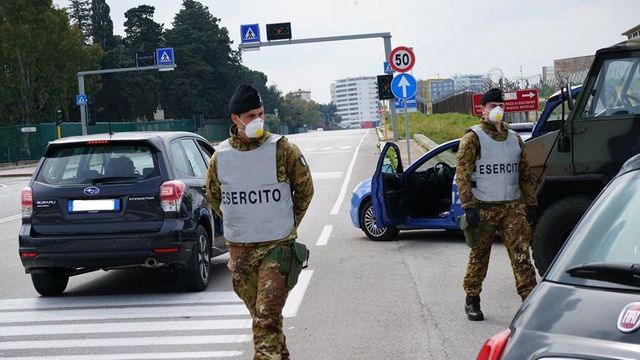
Italian Army soldiers monitoring cars and controlling the streets in Bari: (credit Twitter: Italian Army)
In the UK, the death rate has quadrupled in a week. In just four days since Monday, 1,693 coronavirus deaths have been announced—more than were recorded on all days up to March 29. The Department of Health and Social Care reported a record 569 deaths Thursday, taking the total to almost 3,000 (2,921). This was the second consecutive day Boris Johnson’s Conservative government announced over 500 deaths. Wednesday’s 563 fatalities were a 31 percent increase on the previous day.
With an age range of the latest deaths between 22 and 100 years old, nearly 8 percent (44 people) of yesterday’s victims had no known underlying health conditions.
Britain is now showing the terrible daily toll commonplace in Italy and Spain, with the pandemic taking over 13,000 and 10,000 lives in those countries.
The UK infection rate has also shot up, with 4,324 new cases announced Wednesday and 4,244 Thursday. Total infections in the UK stand at 33,718 but are in reality much higher. Hardly any tests were done when the outbreak began, despite months of warnings. Three weeks ago, Johnson announced—as part of attempting to enforce his “herd immunity” policy aimed at infecting everyone in the country with coronavirus—that no systematic testing would be done and that everyone who showed symptoms should self-isolate.
More than 1.7 million people in the UK have likely caught coronavirus over the past 15 days. Data from the NHS 111 online service revealed that web-based assessments flagged 1,496,651 people as potential carriers; a further 243,543 calls to 111 and the 999 emergency number concluded callers had signs of COVID-19.
It was only after widespread outrage at its social Darwinist policy that the government was forced to pledge that widespread testing would be done. Even now, just 163,194 tests have been completed with yet another promise yesterday of 100,000 a day for the end of April. Only 2,000 of 550,000 National Health Service frontline workers have been tested.
The BBC’s head of statistics, Robert Cuffe, commented Thursday, “if that [UK death rate] keeps up, we’d expect to see in the region of a thousand deaths a day by the weekend.” Sky News economist Ed Conway noted that “For the past week or so,” the UK’s death rate has “been doubling every three days” and “if the growth rate continued like that, in a week’s time there would be 10,000 people dead and the UK would be on a far worse trajectory than Italy.”
An explanation of this steeper curve emerged late yesterday, when NHS England reported that the earliest death in the UK had in fact occurred on February 28, one week earlier than previously reported. In total, six people had died in hospital prior to March 5.
In Italy, 760 died Thursday, taking the total to almost 13,915. Two new studies suggested the true death toll could be significantly higher than reported. The InTwig data analysis firm reveals that while there were 4,500 deaths in the hardest-hit city of Bergamo, the Civil Protection Agency only reported 2,060 deaths. The University of Bergamo, using historical data from the national statistics office compared to current hospital data, showed that deaths in the north of Italy doubled in the first three weeks of March, compared with the average number of deaths during the same period between 2015 and 2019. The uncounted deaths were mostly elderly victims who were not admitted to hospital and never tested for the virus.
The government welfare assistance website remains down, leaving Italy’s most vulnerable unable to receive any COVID-19 scheme for financial support. An estimated 3.3 million Italians work in the black economy and don’t qualify for welfare support schemes. Twenty thousand army soldiers are deployed in southern Campania, Puglia and Sicily to patrol the streets amid rising tensions as citizens run out of food and money.
Germany announced 168 new deaths, taking the total to 1,099. After Berlin approved its “coronavirus aid programme”—a bailout worth €600 billion for the banks, corporations and the super-rich—anger among workers is growing. In the past days, health employees in hospitals, nursing homes and workers in businesses vital to the supply of the population’s needs have criticised catastrophic and unsafe working conditions.
Truck drivers, airport workers, delivery workers and steelworkers are also voicing opposition. A worker at the Outokumpu stainless steel group in Krefeld, speaking anonymously to the WSWS, said, “We’re all angry, feeling betrayed. Even those in risk groups still have to work. An info sheet says they should talk to the company doctor. I did that. He advised me to wash my hands and disinfect myself. But we don’t have any disinfectant, or face masks. I use keyboards, telephones, etc.”
In a dramatic development, France’s death toll shot up by 1,355. Previously, Emmanuel Macron’s government had only released the deaths of those who had died in hospital of coronavirus. Yesterday, it announced that 884 people had also perished in retirement and care homes. On top of the 471 hospital fatalities, this takes total deaths to 5,387. Other countries, including until recently Britain, have also not included those who died outside hospital in their fatality announcements to play down the scale of the catastrophe they are responsible for.
Aware of explosive social anger in workplaces, the Stalinist General Confederation of Labour (CGT) has issued an authorization for public sector workers outside the hospitals to strike in April. The CGT is not calling for strike action or opposition to President Emmanuel Macron, but cynically authorizing isolated action by individual workers while the union bureaucracy keeps working with the government to slash wages and social benefits.
Workers have mounted strikes or walked off the job at Amazon, in supermarkets, in the auto industry and in aeronautics. One worker at an air conditioner manufacturing plant told the press, “This epidemic has woken up a lot of people…now the masks are falling. Usually management manages to calm them down, but today they are seeing that even when it is a matter of life and death, management has no concern for them.”
Lockdowns throughout the continent have led to staggering job losses. The Financial Times reported Wednesday, “Unemployment is growing much faster than in previous recessions because the measures taken to slow the spread of the virus are felt most severely in low-wage, labour-intensive sectors such as retail, hospitality and other consumer-facing services.”
In the UK, more than 1 million people have been forced onto the welfare rolls in just two weeks. Austria reported Wednesday that unemployment now stood at over 12 percent—the highest level since records began in 1946. In Spain, over 900,000 people have been made unemployed since the outbreak began there. In Norway, unemployment has risen from 2.3 percent to 10.4 percent in little over a month. The Financial Times noted the government’s Labour and Welfare Administration statement that a quarter of tourism and transport workers and almost a fifth of retail workers were now claiming unemployment insurance.
The newspaper reported that in Germany, “some 470,000 companies have applied for government wage subsidies through the ‘Kurzarbeit,’ or short-hours, programme—almost five times higher than the 100,000 people who used the scheme during the 2008-2009 recession.”
Another indication of the devastating impact of the coronavirus on the working class is seen in the map produced by the Catalan regional government in Spain, showing that the virus is six or seven times more prevalent in Barcelona’s poorer areas than in wealthier areas.
‘Zero Carbon Is A Crime Against Humanity’
By David Wojick, Ph.D. | PA Pundits – International | March 21, 2020
I recently got an intriguing email from Professor Guus Berkhout, president of the Climate Intelligence Foundation or CLINTEL. It contained this striking paragraph and the last sentence really got me thinking:
“The past 150 years show that affordable and reliable energy is the key to prosperity. The past 150 years also show that more CO2 is beneficial for nature, greening the Earth and increasing the yields of crops. Why do governments ignore these hard facts? Why do they do the opposite and lower the quality of life by forcing high-cost, dubious low-carbon energy technologies upon their citizens? The zero-emission act is a crime against humanity.”
So I looked into the law on crimes against humanity and Professor Berkhout may have a strong case. At its simplest, a crime against humanity is a government policy that systematically and knowingly harms a specific group of innocent people.
Zero carbon emission laws like the Green New Deal in the EU and the US will deprive poor people of affordable energy worldwide. This fact has been well established by numerous studies. Thus these policies knowingly harm a specific group of innocent people. And as CLINTEL points out in its World Climate Declaration, there is no climate emergency that might justify this harm. What we have are governments deliberately harming their citizens.
But look also at the latest developments in climate science. There is new insight that has to do with a review of carbon budgets. A carbon budget indicates the amount of CO2 that may still be emitted before a certain warm-up limit is exceeded. IPCC climate scientists that authored the SR15 report of 2018 took another close look at the calculations of the carbon budgets in IPCC’s AR5 report of 2014 and concluded that they had been too pessimistic in the past. And not so slightly. In the SR15 report those carbon budgets have been increased spectacularly.
By way of illustration, the carbon budget for the 1.5 degree limit has increased by no less than a factor of 5! It therefore takes considerably longer for the carbon budgets to be exhausted, which means that the strict emission requirements based on AR5 can be significantly relaxed. So this is very good news for all people concerned about the climate. It fully confirms CLINTEL’s message: ‘ There is NO climate emergency.’
Unfortunately, the good news has been snowed under by the increasing ‘gloom and doom’ actions and stories about the ‘dangerous climate change’, ironically fed by the same SR15 report. Actually, the reader should realize that the good news is even better because on top of the computational error in AR5 we still deal with IPCC’s continuing exaggerated climate sensitivity for CO2. When will that be corrected?
Note that – despite the strong scientific and moral arguments – it is now the stated goal of the UN alarmists that all countries should adopt zero carbon laws, preferably in time for the Climate Summit in Glasgow this November. Given that the harm is proportional to poverty, such precipitous actions would be especially harmful to the poorest. And, for heaven’s sake, why?
Zero carbon laws are prohibitions against those forms of energy that presently supply about 80% of human need. A well recognized definition of crimes against humanity is “inhumane acts intentionally causing great suffering”. Deliberately depriving poor people of affordable energy certainly fits this definition.
My colleague Paul Driessen have written extensively about this issue, albeit not from the perspective of crimes against humanity. See for example here.
Mind you we were just talking about the tragedy of so-called development banks refusing to fund affordable energy development. Laws that prohibit the use of fossil fuels are infinitely worse. Imagine not being allowed to use a kerosene light or a gasoline scooter, on top of not having electricity.
But we do not have to go to poor Africa to find energy poverty. It is being documented throughout Europe, especially in those countries where misguided governments have forced renewable energy on their people. Yet the UK and EU are both adopting draconian zero carbon policies. The energy poor here also probably have a good case of crimes against humanity.
In the U.S. it is estimated that millions of households live in what is defined as “energy poverty” due in large part to the forced shift to renewable power. Energy poverty is reported to be the second leading cause of homelessness in America. The proposed Green New Deal will make this suffering dramatically worse.
In short, CLINTEL president Guus Berkhout is right. Zero-carbon laws are not only scientifically utterly silly, they are crimes against humanity.
Diverse media perspectives on Coronavirus Pandemic
By Vladimir Odintsov – New Eastern Outlook – 20.03.2020
The number-one topic making the news today and being discussed by the general public all around the world is the development of the COVID-19 coronavirus pandemic, and the impact this epidemic will have on the economy and international relations in general.
Perhaps one of the most hopeful messages to be heard in the international news thus far was a news report broadcast on China Central Television (CCTV), announcing that clinical trials have gotten underway to develop the first coronavirus vaccine. There was of course also the good news that the number of people infected with coronavirus in the Chinese city of Wuhan is falling, and the first wave of more than 3,675 healthcare workers from all over China who came to the Hubei province to help fight coronavirus went home on March 17. Let’s not forget that according to experts, more than 75,000 people were infected in Wuhan alone, and more than 42 thousand specialists from other cities and provinces in China were sent to this epicenter of the coronavirus outbreak by Beijing. With all of these commendable achievements, China has certainly shown the world that it is capable of quickly mobilizing its people and resources to overcome the challenges of a dangerous new situation.
At a press conference in Wuhan, Chinese doctors noted that European doctors are repeating the mistakes made in China when the novel coronavirus began to spread. The main issue they were referring to is that there is not enough being done to protect healthcare workers who are constantly in contact with the people who have the infection, especially otorhinolaryngologists. Due to a shortage of personal protective equipment and not enough knowledge about how the virus is transmitted, thousands of medical workers contracted the coronavirus in China within the first few weeks of the epidemic. At least 46 of them died. Let’s remember, by now there have been more coronavirus cases recorded outside of China than within China itself. By March 17, the total number of confirmed coronavirus cases around the world had reached 167,511, while the number of cases in China stood at 80,881. The number of coronavirus deaths reached 3,226 in China, and 6,606 worldwide.
Chinese Ambassador to Russia Zhang Hanhui recently shared some insights into China’s experience in fighting the coronavirus with the Russian media, noting that the measures taken by the Chinese authorities to contain the COVID-19 epidemic have achieved a positive result, adding that the impact of the coronavirus on the country’s economy will be short-term, and that it has had some unexpected advantages for certain industries, such as the explosive growth in online sales amid the epidemic. At the same time, Ambassador Hanhui highlighted that some countries and Western media outlets began stigmatizing China during a critical stage of the global epidemic, and even launched racist attacks in an attempt to exploit the epidemic and use it to spread a “political virus”, but all this has shown the Chinese who their real friends are. The Chinese Ambassador commented on this behavior, saying it is very unfortunate that the people who have used a human catastrophe for personal gain have been able to influence international public opinion and distract the world without taking the responsibility they should for the international impact of their actions.
On March 17, Chinese officials condemned US President Donald Trump for using the term “Chinese virus” to refer to the novel coronavirus, COVID-19, which has already spread to more than 150 countries around the world. Foreign Ministry Spokesperson Geng Shuang said that this wording stigmatizes China.
Given the fact that it has not yet been possible to pinpoint what actually caused this epidemic that has engulfed the world, the question of whether the United States could have played a role in creating this virus as a biological weapon remains very relevant discussion in many news articles. For instance, the Lebanese newspaper Al Akhbar conducted its own investigation into America’s involvement in troubling global events, with a particular focus on the United States Army Medical Research Institute of Infectious Diseases in Maryland.
When trying to determine where coronavirus infections could most likely have come from, Kyrgyzstan’s Ministry of Health highlights that Kyrgyz citizens who had recently returned from Saudi Arabia after the Umrah pilgrimage to Mecca could have brought the infection to Kyrgyzstan.
According to reports aired on the German n-tv channel and published in Der Spiegel, dozens of tourists from Denmark, Germany and Iceland who visited the Austrian ski resort town of Ischgl in Tyrol state were diagnosed with the coronavirus when they returned home. As a result, Tyrolian officials have come under scrutiny for not having warned travelers about the coronavirus outbreak sooner.
Many experts are particularity concerned about the situation with the coronavirus in India, an extremely densely populated country of more than 1.3 billion people, with about 176 million living in extreme poverty.
As the coronavirus continues to spread quickly throughout Europe, the heads of EU member states have supported the European Commission’s proposal to ban foreigners from entering the European Union for a period of 30 days, which German Chancellor Angela Merkel has announced Germany will be implementing.
The German capital has seen the first refugee camp evacuated due the coronavirus after an asylum seeker was hospitalized with a suspected case of the coronavirus.
The French have gone even further: anyone in France who wants to leave their house will have to carry a special signed form with them, detailing the reasons why they need to go outside. You also need to specify your first name, last name, date of birth and address on this form, which can be downloaded from the Interior Ministry’s website to print out and fill in.
In light of the coronavirus pandemic, the British scientist and epidemiologist Daria Tserkovnaya, who is a research affiliate for the Vaccine Confidence Project, an interdisciplinary research group at the London School of Hygiene and Tropical Medicine, has called on parents not to leave children with their grandparents, as elderly people are the most vulnerable members of society and their contact with children needs to be restricted.
Ukrainian authorities seem to have forgotten about all the Ukrainians stuck in Germany, Poland, Egypt, and Turkey, who are flocking to the Ukrainian embassies and turning to the media for help to try and get back to Ukraine. As a report in the Turkish Daily Sabah highlights, Ukrainian President Vladimir Zelensky has responded with his usual absurd behavior instead of offering real support, urging his compatriots to make babies in COVID-19 quarantine, which he said is a nice chance for them to fight the “demographic crisis.”
Unfortunately, it must be acknowledged that the press in some Western countries have seen an opportunity in this situation with the coronavirus, and are resorting to traditional biased journalistic coverage of real events and subversive propaganda campaigns. British and American Journalists are now paying the price for dishonest journalism. Egyptian authorities have revoked Guardian correspondent Ruth Michaelson’s press credentials, who can no longer work in the country over citing false information about the situation in Egypt with the novel coronavirus. The State Information Service (SIS) made this announcement in a statement on Tuesday. New York Times Cairo bureau chief Declan Walsh was also issued a warning for posting similar data on Twitter.
It is worth noting a shockingly cynical Facebook post written on 16 March by Tamara Lyalenkova of the Radio Liberty Russian-language editorial office in America, who has been working with the American media since 1997, which attempts to justify the murder of elderly people who have contracted the coronavirus. In Lyalenkova’s own cynical words: “We will lessen the load on the planet.”
Draconian
By James Thompson • Unz Review • March 18, 2020
Draco was a democratic legislator in 622 B.C. who moved Athenian law from an oral tradition known only to the elite, to a written code of law, which could be called upon by any citizen. A reformer. However, his laws were very harsh, applying the death penalty for minor offences, and his code was repealed by Solon in the early 6th century BC, save for his section on homicide. Law is born out of despair at human nature, and Draco despaired.
It would be interesting to know if Draco’s laws led to better behaviour among Athenians, with less stealing of cabbages, and whether Solon subsequently ushered in an age of depravity, but I merely mention that severe measures are now described as draconian, and this condemnation is expected be understood and agreed by all.
How should countries respond to this coronavirus? Doing nothing is the base case, and no country has openly adopted that policy. Perhaps failed states would be an interesting test case. The two current options are Contain or Mitigate. Palpably, nations failed to contain the virus, though China after an uncertain start in which the severity of the problem was denied, did a fast catch-up and imposed, er, Draconian measures. That is, the relevant ones. Singapore took a more nuanced but effective approach. Taiwan seems to have done well. South Korea was doing OK when one deluded believer jumped hospital quarantine to attend a religious meeting, infecting many, matters being made worse by the reluctance of the religious leaders to say who had attended their service.
Here in the UK the key modelling work is being done by Imperial College, and here is a recent interview with the team leader, and then a much more detailed argument from the same group.
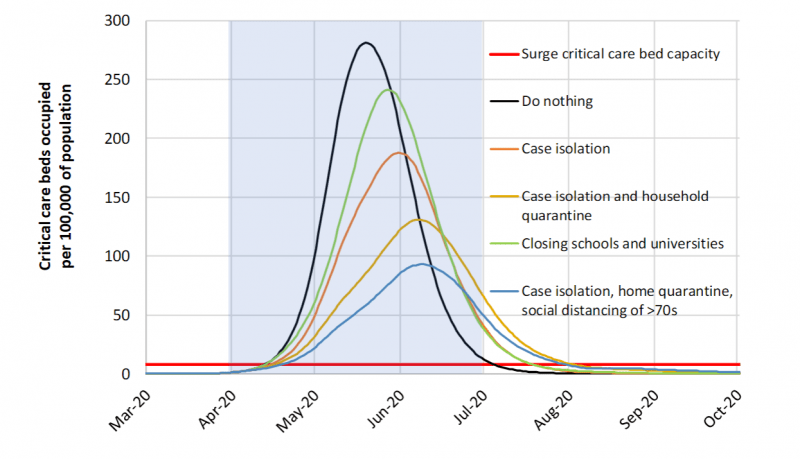
The key picture is the estimate of intensive care beds required under various policy scenarios, which will be closely related to death rates, since those beds are very limited in number.
Basically, we are now able to model something which more advanced principalities in Mediaeval Europe knew instinctively: the way to stop an epidemic is to deny it its stepping stones. You have to block the vector, and deny the enemy its next host. Scorched earth, in fact.
In contrast, here is a podcast with Greg Cochran, in person a mild and courteous companion, and in the abstract an acerbic commentator on all muddled thinking.
For those of you in a great hurry, his main points are:
You have to get the R0 down by whatever means you can; that the main vector of spread is sneezing, coughing and breathing, with hand touching secondary; that closing schools helps reduce the vector, and the children are the vectors, not the victims in this case; UK policy is wrong: if you allow any proportion of the population to get infected you very quickly get a small proportion of that infected proportion who get very ill, and that swamps the intensive care facilities anyway, and hospitals overflow. Respiratory facilities are very limited. Wuhan thought people had acquired immunity, but they were wrong. A few people, just a few, caught the virus, and that was sufficient to swamp facilities, even with the extra hospitals. What the Chinese achieved they did by limiting social interactions. Taiwan and Singapore also succeeded in the same way. Testing for fever and Covid is the way forward. If you let the virus go through the population in the hope of getting immunity you kill a lot of people.
UK advisors seem to take it as gospel that what China did can’t be done in the UK. They are wrong. Furthermore, you don’t have to regard finding a vaccine as the only way forwards. Some old drugs may work partially. Serums will probably work. We need to use any avenue to reduce cases and to reduce death rates.
Now: ship cruises. After I die, I intend to go on one.
The Diamond Princess cruise ship had the misfortune to be boarded by a person already showing symptoms, who was later tested and shown to be infected with Covid-19, by which time he had infected 634 other passengers. This shows that using average figures for the reproductive index can be highly misleading in settings where many people are close together in confined circumstances.
Among those infected, the death rate was 1.2% 12 times worse than ordinary flu. Not nice, as my Granny used to say.
Worse, among those over 70, the death rate was 9%. Definitely not nice. For those whose infection becomes symptomatic and reaches case level, the death rate doubles to 18%.
So, at least two weeks too late, in the UK we are keeping the most vulnerable away from obvious harm, and keeping the fit and young from needless infection. The key error was to keep planes flying, and to keep borders open so that the virus could hitch a ride and use every country as stepping stones to the next victim.
As someone in self-isolation I can tell you that food home delivery systems are struggling, their websites crashing, and deliveries are being cancelled. Pharmacies have local shortages, supermarkets as well. The neighbourhood is pretty deserted, few people about, few of the usual construction workers about, fewer cars on the road, but still a fair number of cyclists. Neighbours who are either younger, fitter or simply more courageous are willing to do errands.
Has the UK goofed? Like other countries it made the fundamental error of running an open house with airlines, visitors, tourists, cruise ships for far too long.
Only the death rate per million will give us the answer as to how badly we have done, in 2021, or 2022, or 2025, depending on how many waves hit us.
Featured Video

Houthis Keep Advancing as the Red Sea Crisis Deepens
or go to
Aletho News Archives – Video-Images
From the Archives
Clash of Civilization, Iran Part II
By Jamal Kanj – Intifada-Palestine.com – January 14, 2011
Israel’s survival kit is: perpetuate conflict, insecurity to rationalize collective hate and finally playing victim.
Devoid of conflict, Israel implodes internally; without hate, Zionism loses its justification; and playing eternal victim to continue blackmailing the West. Absence of this holy trinity, Israel ceases to exist. … continue
Blog Roll
 Aletho News
- Macgregor: We Haven’t Seen the Worst of the Iran War Yet
- ‘We are not like everyone else’ laws that bind other nations do not apply to Israel, says Likud lawmaker
- Report: Saudi Arabia seeks allies’ assistance as missiles deplete amid war on Yemen
- Fuel Crisis Deepens: Pakistan Warns Tanker Attack in Red Sea Would Be an ‘Act of War’
- ‘Bucha massacre’ a false flag orchestrated by UK – Moscow
- China Rejects Outside Pressure on Trade Ties After New US Russia Sanctions Bill
- Houthis Keep Advancing as the Red Sea Crisis Deepens
- Iran spent $1 million to wipe out $30 billion in data center plans, and take down Amazon in the ME
- Zionist billionaire pressure to silence Macklemore sparks exodus from Ed Sheeran tour
- House Votes to End Iran War for Third Time
- If Americans Knew
- Biden’s Genocide Accomplices Targeted by New Accountability Campaign
- AIPAC’s Network Has Already Spent $67.2 Million to Shape the Midterm Elections
- Jewish Supremacist Manufacturing a Civilizational Threat to License Bigotry
- US bans Palestinian president from speaking at the UN
- Israeli Forces Detain Journalist Alaa al-Rimawi amid Widespread West Bank Raids
- Even a pro-Israel Congress member has put a hold on 40,000 one-ton bombs to Israel
- As Gaza crumbles, Israel preps new ground invasion – Daily Update
- ‘We are not like everyone else’ laws that bind other nations do not apply to Israel, says Likud lawmaker
- Trump’s govt makes ‘treasonous’ claim of weapons shortages
- Palestinian-American Journalist Naqaa Hamed Imprisoned by Israeli Forces After Settlers Targeted Her
- No Tricks Zone
- New Study: ‘Global Drought Shows No Detectable Recent Acceleration Under Climate Warming’
- Economic Masterminds: German Socialists Suggest Taxing Productivity Gains Stemming From Using AI
- The South China Sea Has Not Been Cooperating With The Climate Change Narrative
- Energy Crisis: Germany Enters Heating Season With Historically Low Gas Reserve Fill Levels
- New Study: The Antarctic Ice Sheet Gained Mass From 2020-2024 Due To Staggering Snow And Ice Accumulation
- Study: Ocean Heating Rates From Thousands Of Years Ago ‘Dwarf’ Modern Ocean Heating Rates
- Climate Extremists Target, Attack Large-Scale Power Grid Infrastructure In Germany!
- New Study: Antarctic Ice Melt Has Contributed Less Than 1 Centimeter To Sea Level Rise In The Last 30 Years
- Fear Of Debate: Alarmist German Climate Scientist Calls On Mainstream Media To Discredit Skeptic Voices
- End-Of-August Arctic Sea Ice Extent Hasn’t Fallen In 20 Years, Official Data Show!
 Aletho News