With the 18-year-long Middle East peace process finally pronounced dead, is the Palestinian Authority finished too?
That is the question being asked by Palestinians in the wake of a week of damaging revelations that Palestinian negotiators secretly made major concessions to Israel in talks on Jerusalem, refugees and borders.
The PA — the Palestinians’ government-in-the-making, led by Mahmoud Abbas — was already in crisis before the disclosure of official Palestinian documents by Al Jazeera television last week.
Now, said George Giacaman, the head of the Ramallah-based research centre Muwatin, which advocates greater Palestinian democracy, the PA’s “back is to the wall”.
The question of the PA’s survival, and the future direction of Palestinian politics, has gained added urgency as the wider Middle East is rocked by unrest, from Tunisia to Yemen.
Mahdi Abdul Hadi, the director of the Jerusalem think-tank Passia, said the Palestinians were “at a crossroads”. Although the streets had remained largely quiet until now, he said it was only a matter of time before Palestinians started to make clear their revulsion at their leadership.
“It is now much clearer to Palestinians that they are living in a prison and that the PA leaders are there only to negotiate the terms of our imprisonment,” he said.
He, like many other Palestinian analysts, declared the negotiations for a two-state solution over.
That sentiment appears to be shared by a majority of Palestinians. A survey in December, before the leak of 1,600 official documents, by the Palestinian Centre for Policy and Survey Research showed that 71 per cent of Palestinians believed they would not have a state within five years. The percentage is likely to have risen sharply.
In a sign of the mounting panic in Ramallah, Palestinian leaders frantically launched a rearguard action last week. Initially, they claimed the documents were fabricated, and suggested that Al Jazeera was siding with Mr Abbas’s political rivals, the Islamic party Hamas, to bring down the PA.
But several officials have confirmed the papers’ authenticity, and the PA has redirected its main attention to discovering who was behind the leak.
Mr Abdul Hadi said Palestinians would increasingly draw the conclusion that their intended future was living in “one binational state under an apartheid regime” administered by Israel.
“At the moment Abbas has his followers out on the streets but the Palestinian people are awakening to the reality of their situation,” he said.
Samir Awad, a politics professor at Birzeit University, near Ramallah, agreed that Israel was imposing a de facto one-state solution. “The fight for national independence is over and, if it is to survive, the PA must quickly reinvent its role. Palestinians are now in for the long haul: a struggle for their civil and political rights in a single state,” he said.
Asad Ghanem, a politics professor at Haifa University in Israel and an expert on Palestinian politics, warned, however, that, as the PA faltered, Israel and the US would intensify their efforts to strengthen the authority’s security forces and its repressive role.
With politics stifled inside the occupied territories, said Mr Ghanem, it was crucial that outside Palestinian leaders step in to redefine the Palestinian national movement, including Palestinians such as himself who live inside Israel and groups in the diaspora.
Mr Giacaman said the PA had long ago outlived its official purpose.
It was created by the Oslo accords as a temporary administration in the transition to Palestinian statehood, proposed as a five-year period during which Israel was supposed to withdraw from the West Bank and Gaza in stages.
Since the Camp David negotiations ended in deadlock in 2000, the PA has clung to power, with limited control over less than 40 per cent of the West Bank as Israel has continued to build settlements in the area under its rule.
Mr Abbas has threatened on several occasions to dissolve the PA, most recently in December, when he warned: “I cannot accept to remain the president of an authority that doesn’t exist.”
But Mr Giacaman said such threats were hollow, designed to put pressure on Israel to return to negotiations out of fear that it would otherwise have to take on the heavy financial burden of direct military reoccupation.
The PA, however, was in much deeper trouble after the leaking of the documents, Mr Giacaman said. “Without a peace process, it needs to justify its continuing existence.”
The most likely immediate focus, he said, was intensifying international action through the United Nations, by pushing for a resolution at the Security Council against the settlements.
He also thought the PA would consider changing its position and actively championing the Goldstone Report, the findings of a UN commission that suggest Israel committed war crimes during its attack on Gaza in late 2008 and early 2009.
One of the leaked papers revealed that Mr Abbas had agreed under US pressure to shelve the report rather than take it to the UN General Assembly.
“The problem for the PA is that it needs to generate diplomatic crises to get the international community to intervene. But this will put it in confrontation with Israel and the United States. Israel can always threaten to cut the $60 million taxes it transfers every month to the PA,” Mr Giacaman said.
The PA’s threat to unilaterally declare statehood and then seek recognition at the UN, he added, would not change the reality on the ground. “Even if most countries recognise the state, it will still be a state under occupation,” Mr Giacaman said.
In the meantime, the diplomatic vacuum was likely to be filled by Israel. It could promote a plan similar to the one being advanced by Avigdor Lieberman, the far-right foreign minister, to recognise a Palestinian state in temporary borders. Or it could continue its separation policies, withdrawing from more of the West Bank and encouraging the Palestinians to take over what was left behind.
Mr Awad said the collapse of the PA held out many dangers for the Palestinians. One was the possibility of a convulsive civil war between the Fatah party of Mr Abbas and Hamas. Another, he said, was the “Aghanistanisation” of the occupied territories, as tribal warlords took limited control of the territorial enclaves Israel was not interested in.
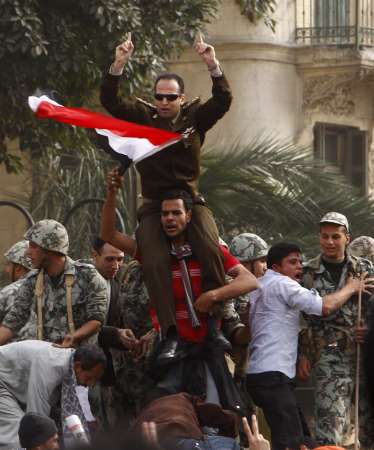
As people across Egypt continued resisting and rising against the brutal dictatorship of Hosni Mubarak it is quite clear they will not stop until he goes.
Quite clear to everyone, that is, apart from the US Secretary of State Hillary Clinton who is so out of touch with what is happening on the ground you have to wonder who on earth is advising her.
She appears to have no idea of the burning resentment and hatred held towards America among the ordinary men and women of Egypt. More than 100 have paid the blood price, so far, for standing up to the US-backed tyrant Mubarak and two thousand others are injured.
It has been lost on no one that the empty shell casings from live ammunition and gas cannisters, which litter Tahrir Square and other streets across Egypt, were provided by the United States of America.
The “Made in the USA” empty shell casings tell their own story not just of the innocents they have killed, but of their origins and of America’s deadly legacy of unwelcome foreign interference in the region.
The Egyptian people have been fed propaganda for 30 years, their evening news on state TV is sanitized and censored and many have been afraid to speak out freely under the US-backed dictatorship of Mubarak.
But do not for one minute think the Egyptian people are stupid – sadly the US has once again completely misread and underestimated an entire population.
These demonstrations are as much a protest against US meddling in their affairs as they are against the Mubarak regime.
Despite all of this Clinton showed not one ounce of compassion or humility when she made her latest blundering speech.
With the sensitivity of a bull in a china shop, she called for an orderly transition but only after heaping praise on the Mubarak government which has “made and kept peace with Israel, avoiding violence, turmoil and death in the region”.
She told ABC News:”Democracy, human rights and economic reform are in the best interests of the Egyptian people.” These are the same people her own government ignored as they continued to fund and back Mubarak with billions of US taxpayers’ dollars over the decades.
The BBC’s North America editor Mark Mardell says Clinton’s comments are a sign that the Obama administration is edging towards accepting, if not openly endorsing, an end to Mubarak’s rule. The truth is, Mark, the Egyptian people do not want any more US interference – they do not want any more American weapons being used against them. America has no interest in the people of Egypt. Its only concern is for the man-made-pariah state next door – Israel.
Clinton has been so out of step since this whole turmoil began to erupt. Both she and Obama remained completely silent for four whole weeks as scores of Tunisians died in that uprising and it was only when their man, Zine El Abidine Ben Ali took flight that they condemned his brutality.
When Egypt threatened to kick off, Clinton said assuredly that the country was “stable”. That was a week ago and as she is beginning to learn, a week is a long time in politics. She says she wants democracy – but what sort of democracy Hillary? The sort that sees another tyrant take power? Or are you really going to let the people decide?
And by the way, the people are beginning to rise and resist right across the Maghreb, throughout the Middle East and Asia. US foreign policy has turned America into the most hated country in the world and if Washington really told Americans the truth, I know the millions upon millions of decent US citizens would be horrified by what is being done in their name.
But the truth is the American people are kept well away from the truth and are among the least informed people in the world today.
Few Americans have any idea that this and the previous Bush administrations do not want democracy in the region. In fact, they have collectively punished the people of Gaza for exercising their democratic right by voting for a Hamas-dominated government.
This has not been lost on the Egyptian people Hillary who, by the way, have a great love for Palestine, a place in their heart, for Gaza, and an even deeper hatred and mistrust for the brutal Zionist state, which really does threaten peace and stability in the region.
As I write this F16 fighter jets and attack helicopters, made in America, are flying overhead in Cairo to try to intimidate the Egyptian people. Too late – there isn’t an army in the world that can beat this peoples’ army. Their fear has gone.
Your ill-informed advisers won’t tell you this, Hillary, but I hate to see an empowered female make such a prat of herself, so here’s a piece of advice. The time has come when you really must step back and take a vow of silence. Every time you open your mouth you are looking and sounding even more stupid than the female presenter on Egyptian state TV who assures us all is at peace with the world and the streets of Egypt are empty and calm.
It’s been thrilling to watch Egyptian mass demonstrations roll back the ossified Mubarak regime, especially as events in Tunisia suggest a knock-on effect that has rattled the Arab world. But this drama can’t be read as the Arab world’s “Berlin moment,” as some have enthused. Yes, serious reforms are in the offing, especially regarding more genuine elections. But limited prospects for reforms are just as clearly indicated.
Reading anodyne language from the US and Europe warning the power elite in Egypt not to use too much force against demonstrators while not mentioning Mubarak at all, we must assume that ousting Mubarak is “viewed with favour” by the West. This should be signal. The US, UK and the rest of Europe are not so much steering events as surfing a wave of popular mobilisation, which they have encouraged for some time, as the only way finally to dislodge Mubarak and his crony core. The happy (naive) interpretation is a confluence of Western and Egyptian interests and values regarding democracy and good governance, coupled with disgust in old dictators clinging to kleptocratic power. But since when has US foreign policy encouraged democracy for the benefit of ordinary people? In fact, this Western imprimatur signals some hard realist western interests—and some ominous undercurrents.
Western motives in ousting Mubarak are obvious. The old man has outworn his usefulness to the US in being unable to contain burning social dissatisfaction in Egypt, raising risks that Egypt might escape the grip of US foreign policy through the ascent of the Muslim Brotherhood. The US and Israel don’t want Egypt—in older days the leader of the Arab world and now a vital Israeli ally—going the way of Lebanon, where genuine democracy has allowed Hizbullah to control a parliamentary majority. It would be a disaster for Israeli if two of its borders fell into political hands less sanguine about starving the population of Gaza, ensuring the continuing division of Palestinian politics, training the security forces of the Palestinian Authority to repress Hamas, confining the ‘peace process’ to empty formulas, and demonising Iran.
Hard if fragmented evidence of Western involvement is obvious, too. Many close observers are recalling a Wikileaks record that the US Embassy has been in contact with Egyptian activists for some years about getting rid of Mubarak, granting one key activist top-level access with US government authorities, technical advice regarding mass communication and other encouragement, and helping protect his anonymity. We can also recall Hillary Clinton’s recent tour of the Arab world, in which she made a series of speeches bizarrely endorsing the dramatic reform of US-allied Arab governments. Clinton sees the entire Middle East through an Israeli lens: if she calls for change, her concern is that Egypt and other Arab states be enabled to do their bit to sustain Israel’s ‘security’ more effectively. So US diplomatic graffiti is clear: the US wants to secure its withering power base in the Middle East against rising political dissent and therefore wants rotten old stick Mubarak out of the way to restore Egypt’s old leadership role. The same US graffiti is designed to be read by other wobbling Arab allies, like Yemen: toe the line or face the same.
It takes little imagination to fill in the rest. In coming years, we’ll likely get a Wikileaks glimpse into the backroom conversation, held in the second or third day of the Egyptian insurrection, in which European, US and Israeli allies read Mubarak a literal riot act (pointing out the window) instructing him against all his druthers to appoint securocrat Omar Suleiman as deputy president. Suleiman is the ideal successor for US interests and has clearly been hand-picked now to take the reins. He’s immaculately polite (recall the Western appeal of Karzai) and ‘comfortable in the halls of power’, as al-Jazeera has noted. He’s a core high operator in Israeli/US foreign policy, including the ‘war on terror’ (supervising US-requested renditions, etc.), and a good personal buddy of former Israeli prime minister Ehud Barak, with whom he once male-bonded in surviving a shared assassination attempt. He’s a proven ally in the deceitful manipulation of the Palestinian Authority: e.g., leading the phoney “unity” talks while supervising Egyptian assistance to the US in training PA armed forces to repress Hamas in the West Bank and ensuring the brutal sealing of Gaza.
Best of all, Suleiman is an intelligence chief, welded firmly within the US-Israeli intelligence nexus that props up the Fatah-led PA, assists with the mess in Afghanistan, tortures or assassinates the more dangerous opponents to US and Israeli interests, and orchestrates the subversion of Syria and Iran. Such a figure, Washington must hope, can recreate an effective US-Israeli-Egyptian power bloc in a Middle East now drifting away from US moorings as Turkey, Lebanon and even Iraq progressively defect from Western-preferred policies.
So, yes, the old fossil Mubarak has been cut loose and a ‘new Egypt’ (as presidential candidate Mohamed el-Baradei calls it) will soon be announced. The orange or purple or green or lavender or puce revolution will be applauded, the people will rejoice and more meaningful elections will be held. But Suleiman and his technocratic allies are already pre-positioned to ensure that the new Egypt precludes any access to real political influence by factions that, in the US view, are ominously closer to Hizbullah in their regional outlook. The whole point of the current drama is indeed to defuse the legitimate mass popular discontent that feeds the appeal of the Muslim Brotherhood—just as Hamas appealed to the disenchanted Palestinian electorate and Hizbullah has appealed to the disenchanted Lebanese electorate, the majority of whom otherwise don’t favour Islamic parties but were driven to support them through terminal political frustration.
This new Egypt will definitely improve some conditions for some Egyptians over coming years: especially by creating jobs for the masses of educated unemployed men, who are now driving the street demonstrations. But reforms in Egypt will focus on technocratic economic solutions: emphasizing standard liberal capitalist measures regarding government and financial transparency, reduced corruption to encourage business growth, an end to routine police torture practices, etc., etc. The security state will otherwise stay in place—and the conditions for a highly unequal society will not fundamentally change. Egypt will stay firmly in the fold of US/Israeli security interests and global economic norms. It will just play that role more adeptly than before.
Alas, the truly mass democratic character of this revolution actually favours this outcome. The demonstrators are calling, in principled fashion, not for any specific leadership but for genuine elections. It’s not impossible that more robust democracy will ultimately escape US control, as they did in Lebanon. But the hundreds of thousands now demonstrating in Egyptian cities lack the top-level access to prevent Suleiman’s security/technocrat network, with its foreign imprimatur, from ensuring that the ‘democratic’ transition generates simply a more efficient and stable version of the client-state role that Egypt has been playing for decades. Such a state cannot really alter the conditions that now impoverish and marginalise whole segments of Egyptian society. Some of the street activists recognise this, of course. Whether they can meaningfully alter the grand Western design for which their principled passion is now being co-opted is entirely unclear.
Virginia Tilley is a professor of political science living in Cape Town, South Africa, hailing from vtilley@mweb.co.za.
Fuad Ben Eliezer (Labour) does not understand what happened, and on all the radio stations he lays out his embarrassment: What happened to his friend Hosni Mubarak? Why didn’t he order the military to shoot the masses and thus end the “riots”, in his words?
In light of his acquaintance/friendship with the Egyptian dictator, in recent days Ben Eliezer has become a senior analyst on Egyptian affairs, only that this time he admits, in uncharacteristic modesty, that he simply does not understand: a few hundred more dead and everything would return back to normal.
The truth is that not only Ben Eliezer didn’t predict anything and understands nothing: all of the Israeli “analysts for Arab affairs” and “Middle East experts” – all of them graduates of Israel’s military intelligence or the Mosad – are forced to admit their ignorance. Yet again we were surprised, just like every time we are surprised: surprised by the crossing of Suez Canal in 1973, surprised by the Palestinian-Lebanese resistance in 1982, by the steadfastness of the Hizbullah in 2006, from the Hamas victory in the Palestinian elections and so on.
In his words, Ben Eliezer reflects the Israeli media, which immediately chose a side: together with the forces of order, against the popular movement, even if, as in Tunisia, it involves the entire people. The Arab masses are always the enemy and the regimes – partners. The fact that these are authoritarian regimes, murderous and corrupted is perceived not as a downside, but as testimony to their welcome ability to control their populations. In simple words: while the Arab masses are a horde, a flock of inflamed savages, their leaders are guarantors of order, even if at times Israel is forced to go to war against them.
Another surprise, and this time for the political and intellectual elites of the entire world, and not only for Ben Eliezer and “our commentators”: popular masses, from Morocco to Iraq, from France to Bolivia, did not read Fukuyama’s End of History and if they did, they refused to get off the stage of history: when they are stepped on, pushed to starvation or humiliated – sooner or later they rise up and remove the corrupt and arrogant dictators. Although it may be delayed, the revolution will eventually break out. To break out, not necessarily win, and it’s not inconceivable that Mubarak will listen to the advice of the Israeli press and of General Ben Eliezer and order the military to suppress the uprising with blood.
It is already possible to guess the headline of the next stage of the press and expert commentators’ propaganda campaign: Al Qaeda. The dictatorship of Ben Ali and Mubarak is justified as they stop militant Islam and behind the popular demonstrations stands no less than Bin Laden. Zvi Barel (Haaretz, 30 January) is one of the few commentators who refutes the contention concerning the centrality of the Muslim Brotherhood in the Egyptian uprising. He emphasizes that its slogan isn’t Allah Akhbar but “down with the dictator, down with corruption”. Also in Tunisia the Islamic Al Nahda party didn’t play a role in the uprising, if only because it has yet to recover from the cruel oppression of Ben Ali and his gangs.
Neither Al Qaeda nor the Muslim Brotherhood are behind the angry mass in Cairo, Rafah and Suez, but thirty years of authoritarian rule, oppression, poverty. As long as the Israeli commentators and politicians fail to understand this, they will continue to be surprised every time the masses (an “archaic” word long ago erased from their lexicons) take destiny in their own hands.
Translated to English by the Alternative Information Center (AIC).
The controversy over the firing of a Brooklyn College adjunct professor allegedly for his solidarity with the Palestinian cause continues. The college’s assertion that the teaching appointment of Kristofer Petersen-Overton, a doctoral student entering his fourth semester of studies at the CUNY Graduate Center, was canceled a week before classes start because of his “lack of qualifications” doesn’t add up.
The dispute over Petersen-Overton’s course began after the class syllabus was circulated to prospective students. On January 12, a student worried about Petersen-Overton’s political affiliations emailed the department with the accusation that Petersen-Overton is an “active partisan of Palestinian in Gaza.” Bruce Kesler, who appears to have taken up the hobby of monitoring Brooklyn College’s assigned reading material and now teaching appointments, was quick to follow with a blog post condemning the hiring.
When the department requested that complaints be deferred until after the class had started, and after students could point to actual evidence of Petersen-Overton’s supposed “bias,” the unidentified student—who was interviewed on WPIX New York with her face blurred—contacted Assemblyman Dov Hikind, Hikind is a supporter of illegal settlements in the West Bank and an advocate for the ethnic profiling of Arabs and Muslims. Hikind also played an influential role in the smear campaign that led to the removal of Debbie Almontaser from her position as the founding principal of Khalil Gibran International Academy, New York City’s first Arab-English dual language school—a decision which the Equal Employment Opportunity Commission later deemed unfair discrimination.
Hikind called CUNY Chancellor Matthew Goldstein, and wrote a letter to Brooklyn College President Karen Gould in which he claims that Petersen-Overton’s “personal biases should not be allowed to pollute the academic realm,” citing a paper Petersen-Overton is in the process of completing,Inventing the Martyr: Martyrdom as a Palestinian National Signifier. In his letter, Hikind takes quotes out of context to back up his assertion that the paper “endeavors to justify and condone Palestinian suicide bombings as means of ‘struggle’ and ‘sacrifice.’” Hikind either deliberately misconstrues the essay, has not read it, or does not understand it. Like most academic essays, Petersen-Overton’s cites research, not personal opinion, and is about how Palestinian national identity manifests politically— clearly not a “romanticization” of suicide bombers.
In a phone interview, Petersen-Overton recounted that, “within 24 hours of Hikind’s statement, I was fired,” adding that Hisseine Faradj, an adjunct professor who taught the same course before, is also a doctoral student.
Hikind said in a phone interview that he is “thrilled” that Brooklyn College decided to cancel Petersen-Overton’s appointment. “Matthew Goldstein said to me on Tuesday that he was calling a meeting and they were going to look at everything this guy has ever written,” the assemblyman said. “The reading material on the syllabus “are written by Palestinian historians or Israeli revisionist historians, and basically blame Israel for everything.”
But according to Brooklyn College’s Media Relations Manager, Ernesto Mora, “Mr. Petersen-Overton was not fired because he had not been hired. This was an internal matter and the CUNY Chancellor had nothing to do with the provost’s decision, regardless of what Hikind’s releases argue.” However, Petersen-Overton says that he signed a contract with Brooklyn College on Monday. Mora also claims Hikind’s statements to the New York Daily News contains factual errors, and that no meeting occurred between the Provost William A. Tramontano and the Chancellor, adding that Hikind announced the decision that Petersen-Overton’s appointment had been canceled before the college did.
The administration’s and Hikind’s narrative contradict both each other, Petersen-Overton’s own account, other faculty members, and that of Janet Elise Johnston, an Associate Professor in the Political Science department and a member of the Appointments Committee. Johnston says she was not present during the meetings on Petersen-Overton’s position, but claims that “the argument that it’s about qualifications doesn’t stand up to the evidence; we have other adjunct professors who teach for the Masters Program, but don’t have PhDs … he was not officially appointed by he had been asked to teach. He is qualified.” While Johnston cannot comment on the accusations that political motives propelled the decision to dismiss Petersen-Overton from his position, she maintains that “in reality CUNY and Brooklyn College are under funded, and under resourced, and have been so for decades,” which further explains the frequent appointments of doctoral students from CUNY programs.
Currently, opposition to Peterson-Overton’s politically motivated termination is mounting. The Political Science department released a statement denouncing the decision: “His decision [the Provost’s] to reject our appointment undermines academic freedom and departmental governance.” The watchdog group Foundation for Individual Rights in Education sent a letter to the President Karen Gould calling for the reinstatement of Petersen-Overton as adjunct professor. “As you know, BC is a public institution and thus is both legally and morally bound by the First Amendment’s guarantees of freedom of expression and Academic freedom, ” the letter reads.
Dr. Barbara Bowen, President of the Professional Staff Congress/CUNY, a union representing CUNY faculty and profession staff, released a statement condemning the decision as a politically motivated violation of academic freedom. And in an email circulated on a CUNY Hunter list serve, John Wallach, a Professor of Political Science at Hunter College and The CUNY Graduate Center, writes, “All of us who have taught him [Petersen-Overton] at the Graduate Center have written letters to the Provost, yesterday if not today, in addition to signing the petition. Uniformly, we find this action an abominable assault on academic freedom that must be reversed—immediately and without qualification.” The CUNY Graduate Center student newspaper, The Advocate, is also circulating a petition that has already received over 1,300 signatures, in addition to hosting a live blog which follows the case’s developments. Brooklyn College’s Political Science department will also be holding an emergency meeting on Monday to discuss the current situation.
Despite the circumstances, Petersen-Overton remains surprisingly level. “To complain about Hikind and others is a waste of time. I am mainly concerned that the college administration caved so easily. I tried to amend my syllabus as recommended, but they never gave me the opportunity.”
Zoe Zenowich is a Senior in the Scholars Program at Brooklyn College, where she is the managing editor of the Excelsior, a student newspaper.
In response to the mass protests of recent days, Egyptian President Hosni Mubarak has appointed his first Vice President in his over 30 years rule, intelligence chief Omar Suleiman.
When Suleiman was first announced, Aljazeera commentators were describing him as a “distinguished” and “respected ” man. It turns out, however, that he is distinguished for, among other things, his central role in Egyptian torture and in the US rendition to torture program. Further, he is “respected” by US officials for his cooperation with their torture plans, among other initiatives.
Katherine Hawkins, an expert on the US’s rendition to torture program, in an email, has sent some critical texts where Suleiman pops up. Thus, Jane Mayer, in The Dark Side, pointed to Suleiman’s role in the rendition program:
Each rendition was authorized at the very top levels of both governments….The long-serving chief of the Egyptian central intelligence agency, Omar Suleiman, negotiated directly with top Agency officials. [Former U.S. Ambassador to Egypt] Walker described the Egyptian counterpart, Suleiman, as “very bright, very realistic,” adding that he was cognizant that there was a downside to “some of the negative things that the Egyptians engaged in, of torture and so on. But he was not squeamish, by the way” (pp. 113).
Stephen Grey, in Ghost Plane, his investigative work on the rendition program also points to Suleiman as central in the rendition program:
To negotiate these assurances [that the Egyptians wouldn’t “torture” the prisoner delivered for torture] the CIA dealt principally in Egypt through Omar Suleiman, the chief of the Egyptian general intelligence service (EGIS) since 1993. It was he who arranged the meetings with the Egyptian interior ministry…. Suleiman, who understood English well, was an urbane and sophisticated man. Others told me that for years Suleiman was America’s chief interlocutor with the Egyptian regime — the main channel to President Hosni Mubarak himself, even on matters far removed from intelligence and security.
Suleiman wasn’t just the go-to bureaucrat for when the Americans wanted to arrange a little torture. This “urbane and sophisticated man” apparently enjoyed a little rough stuff himself.
Shortly after 9/11, Australian citizen Mamdouh Habib was captured by Pakistani security forces and, under US pressure, tortured by Pakistanis. He was then rendered (with an Australian diplomats watching) by CIA operatives to Egypt, a not uncommon practice. In Egypt, Habib merited Suleiman’s personal attention. As related by Richard Neville, based on Habib’s memoir:
Habib was interrogated by the country’s Intelligence Director, General Omar Suleiman…. Suleiman took a personal interest in anyone suspected of links with Al Qaeda. As Habib had visited Afghanistan shortly before 9/11, he was under suspicion. Habib was repeatedly zapped with high-voltage electricity, immersed in water up to his nostrils, beaten, his fingers were broken and he was hung from metal hooks.
That treatment wasn’t enough for Suleiman, so:
To loosen Habib’s tongue, Suleiman ordered a guard to murder a gruesomely shackled Turkistan prisoner in front of Habib -” and he did, with a vicious karate kick.
After Suleiman’s men extracted Habib’s confession, he was transferred back to US custody, where he eventually was imprisoned at Guantanamo. His “confession” was then used as evidence in his Guantanamo trial.
The Washington Post‘s intelligence correspondent Jeff Stein reported some additional details regarding Suleiman and his important role in the old Egypt the demonstrators are trying to leave behind:
“Suleiman is seen by some analysts as a possible successor to the president,” the Voice of American said Friday. “He earned international respect for his role as a mediator in Middle East affairs and for curbing Islamic extremism.”
An editorialist at Pakistan’s “International News” predicted Thursday that “Suleiman will probably scupper his boss’s plans [to install his son], even if the aspiring intelligence guru himself is as young as 75.”
Suleiman graduated from Egypt’s prestigious Military Academy but also received training in the Soviet Union. Under his guidance, Egyptian intelligence has worked hand-in-glove with the CIA’s counterterrorism programs, most notably in the 2003 rendition from Italy of an al-Qaeda suspect known as Abu Omar.
In 2009, Foreign Policy magazine ranked Suleiman as the Middle East’s most powerful intelligence chief, ahead of Mossad chief Meir Dagan.
In an observation that may turn out to be ironic, the magazine wrote, “More than from any other single factor, Suleiman’s influence stems from his unswerving loyalty to Mubarak.”
If Suleiman succeeds Mubarak and retains power, we will likely be treated to plaudits for his distinguished credentials from government officials and US pundits. We should remember that what they really mean is his ability to brutalize and torture. As Stephen Grey puts it:
But in secret, men like Omar Suleiman, the country’s most powerful spy and secret politician, did our work, the sort of work that Western countries have no appetite to do ourselves.
If Suleiman receives praise in the US, it will be because our leaders know that he’s the sort of leader who can be counted on to do what it takes to restore order and ensure that Egypt remains friendly to US interests. [Is Soldz afraid to name Israel?]
Stephen Soldz is psychoanalyst, psychologist, public health researcher, and faculty member at the Boston Graduate School of Psychoanalysis. He is co-founder of the Coalition for an Ethical Psychology.
Mention Richard Falk and you think of an honourable man who cares deeply about injustice, particularly the trampled rights of Palestinians under the evil jackboot.
Mention Susan Rice, US Ambassador to the United Nations, and what comes to mind?
The BBC reported in December 2008: “During her stint in the Clinton White House, she was described as ‘brilliant’ but also ‘authoritarian’ and ‘brash’. According to the New York Times, she acknowledges ‘a certain impatience at times’.”
She is also said to be “unwilling to consider opinions that differ from her own”.
Fair comment
Ambassador Rice has just demanded that Falk, the UN Human Rights Council’s special rapporteur in the Palestinian territories, step down from his UN position. “In my view, Mr Falk’s latest commentary [an entry in his blog about the media and 9/11] is so noxious that it should finally be plain to all that he should no longer continue in his position on behalf of the UN.”
Falk’s crime was saying that the US administration’s reluctance to address the awkward gaps and contradictions identified by several scholars in the official explanations of 9/11, only fuels suspicions of a conspiracy. And he suggested that “what may be more distressing than the apparent cover up is the eerie silence of the mainstream media, unwilling to acknowledge the well-evidenced doubts about the official version of the events: an Al-Qaeda operation with no foreknowledge by government officials”.
Fair comment, you might think. And carefully worded to cause no offence.
Enter the American Jewish Committee
But Reuters reported that UN Watch, an advocacy group affiliated with the American Jewish Committee, had written to UN Secretary-General Ban Ki-moon similarly demanding that he “strongly condemn Mr Falk’s offensive remarks – and … immediately remove him from his post”.
The report added that UN Watch had targeted Falk in the past and frequently criticized the Human Rights Council for berating Israel while ignoring rights violations by developing countries.
The American Jewish Committee also called on the UN to immediately dismiss Falk for publicly endorsing “the slander of conspiracy theorists”. Executive Director David Harris said:
We agree wholeheartedly with the US Permanent Representative to the UN, Ambassador Susan Rice, who stated that Mr Falk’s comments are ‘despicable and offensive’ and, like her, urge the UN to remove him from his position. Falk has long been a conspiracy-ridden and harmful figure who surely does not serve the best interests of the UN.
UN Watch claims to have won “global condemnation” of Falk. Its website trumpets: “After UN Watch exposes noxious remarks, UN official Richard Falk [is] roundly condemned by UN chief, US Gov’t, and media worldwide.”
“Noxious” – that’s Rice’s word. Could they be sharing the same scriptwriter?
UN Watch diligently sets down who said what:
Thursday, 20 January: UN Watch takes action and files complaint with UN Secretary-General Ban Ki-moon, demanding he condemn Richard Falk, the UN Human Rights Council’s permanent investigator on “Israel’s violations of the principles of international law”, for his latest remarks suggesting that the US government – and not Al-Qaeda terrorists – destroyed the World Trade Centre. The protest came as part of UN Watch’s three-year campaign to expose and combat Falk’s denial and justification of Hamas and Al-Qaeda terrorism, and his material support for 9/11 conspiracy theorists. At the daily UN press briefing, when Matthew Lee of Inner City Press asks for a response, the secretary-general’s spokesman says they don’t comment on independent experts.
Friday, 21 January: The New York Daily News picks up the story and publishes editorial: “When will the lunacy reach such heights that UN Secretary-General Ban Ki Moon realizes his so-called Human Rights Council is wrecking what little reputation the world body has left?… Ignore those jetliners crashing into the towers, is Falk’s advice. Who are you going to believe, your own eyes or him and his friends? Ban should ring down the curtain on this grotesque buffoonery. He should force out Falk forthwith…”
Monday, 24 January: The United Nations sends letter to UN Watch with unprecedented condemnation of a UN Human Rights Council official: “The secretary-general condemns [Falk’s] remarks. He has repeatedly stated his view that any such suggestion is preposterous — and an affront to the memory of the more than 3,000 people who died in the attack”. UN Watch immediately releases the letter to the public, and calls for the UN to fire Falk.
Tuesday, 25 January: US Ambassador Susan Rice condemns Falk and echoes UN Watch’s call for him to be fired: “Mr Falk’s comments are despicable and deeply offensive, and I condemn them in the strongest terms… The United States is deeply committed to the cause of human rights and believes that cause will be better advanced without Mr Falk and the distasteful sideshow he has chosen to create.” Ambassador Eileen C. Donahoe, the US envoy to the Human Rights Council, also speaks out.
On the same day, in a Geneva address to the member and observer states of the Human Rights Council, Secretary-General Ban Ki-moon repeats his condemnation of Falk: “Recently, there was a special rapporteur who suggested there was an ‘apparent cover-up’ in the 2001 terrorist attacks on the United States. I want to tell you, clearly and directly. I condemn this sort of inflammatory rhetoric. It is preposterous – an affront to the memory of the more than 3,000 people who died in that tragic terrorist attack.”
SUCCESS: UN Watch’s campaign led to the unprecedented international condemnation of Richard Falk, who exploits his UN position to justify and deny Hamas and Al-Qaeda terrorism. It sparked dozens of news stories worldwide, as shown in the sample below. All of this succeeded in finally puncturing Falk’s undeserved halo as a “human rights expert”. For the first time ever, the UN itself had condemned Falk, and in the strongest terms. As a result, Falk’s credibility in the international arena is now at zero.
What’s remarkable is how twitchy these people get at the slightest possibility that someone will lift the lid on 9/11, their hysterical protests serving only to deepen already serious suspicions.
Incidentally UN Watch’s founder, chairman and executive director are all Jewish, the latter having worked at Israel’s Supreme Court.
Ambassador Susan Rice “handmaiden to the Zionist cause”
Let’s go back to 14 July last year and remarks made by Ambassador Rice during a reception for Israeli ambassadors Gabriela Shalev and Daniel Carmon held by the Conference of Presidents of Major American Jewish Organizations. Rice said:
Today, I mostly want to talk about my very dear friend, Ambassador Gabriela Shalev. She’s truly one of my favorite people…
Gabi and I had the opportunity to work closely together on a series of important issues, from dealing with the deeply flawed Goldstone Report to seeing through the passage by the Security Council of the toughest sanctions resolution to date against Iran. She has been a lioness in defence of Israel’s security and its legitimacy — working tirelessly to ensure that Israel has the same rights and enjoys the same responsibilities as any other UN member state.
We will continue to work together to seek a lasting and comprehensive peace that meets Israel’s security needs and creates a viable, sovereign Palestinian state. We will continue to strengthen Israel’s qualitative military advantage so that Israel can always defend itself, by itself, against any threat or possible combination of threats. And, as the president pledged, we will continue US efforts to combat all international attempts to challenge the legitimacy of Israel — including and especially at the United Nations.
Having revealed herself as another handmaiden to the Zionist cause, Rice’s attack on Falk for breaking the ridiculous taboo and questioning the US administration’s refusal to hold a proper independent inquiry into 9/11 only raises questions about her own suitability for an important position at the UN.
Meanwhile, there are millions of us out here who are right behind Richard Falk because he stands for justice. We are not amused by growing indications that the official story of 9/11 doesn’t add up. Nor are we too pleased by the realization that it was used to prod our own governments into sacrificing troops and treasure to a couple of unlawful, unwinnable wars that have caused mega-deaths and endless suffering to innocent civilians, trashed our good name abroad and made us vulnerable to reprisals at home – just to advance the crazed ambitions of the US-Israeli axis.
In short, if there’s the slightest doubt we want to know the truth.
In his latest Newsweek article Stephen Kinzer wonders who America is betting on to counter the popular rising forces in the Middle East : “The same friends it has been betting on for decades” he answers. “Mubarak’s pharaonic regime in Egypt, Mahmoud Abbas and his Palestinian Authority, the Saudi monarchy, and increasingly radical politicians in Israel. It is no wonder that Iran’s power is rising as the American-imposed order begins to crumble,” he concludes.
Kinzer explains America’s stance succinctly and accurately : “The U.S. keeps Mubarak in power – it gave his regime $1.5 billion in aid last year -mainly because he supports America’s pro-Israel policies, especially by helping Israel maintain its stranglehold on Gaza. It supports Abbas for the same reason; Abbas is seen as willing to compromise with Israel and is, therefore, a desirable negotiating partner….. American support for Mubarak and Abbas continues, although neither man is in power with any figment of legality; Mubarak brazenly stage-manages elections, and Abbas has ruled by decree since his term of office expired in 2009.”
In the light of Kinzer’s statement, the following questions surely need answering — Why does America support those regimes, whose leaders’ dictates, ideologies and methods of ruling are totally and openly incongruous with America’s alleged value system? And If America is genuinely concerned with the so-called ‘rise of Islam’, why then, did it eradicate Saddam Hussein’s distinctly secular regime? And if America is, as it claims, enthusiastic about encouraging ‘non radicalised’ secular Arabs, why is it constantly seeking conflict with Bashir Asad, leader of another secular stronghold? And If America does indeed champion democracy, why does it support the Saudi regime, Mubarak and Abbas? Why does it not seek friendship with the democratically elected Hamas?
In short American policy seems to be a total mess — unless one is willing to openly admit that there is a clear coherent thread running through American foreign policy : it simply serves Israel’s interests.
For decades American foreign policy has been dictated by Zionist forces within their administration. For decades, America has been exhausting its resources to chase the enemies of the Jewish state. It even sends its young boys and girls to fight and die in Zionist wars. The second Iraq War was obviously such a war. It is becoming clear that America’s decision makers have sacrificed the interests of the American people.
We learned yesterday that the Jewish Lobby in America shamelessly slammed Republican Senator and Tea Party representative Rand Paul for suggesting that the “United States should halt all foreign aid including its financial aid to Israel”. Even the alleged ‘peace seeking’ J Street was quick to attack the patriotic senator. And clearly they didn’t mince their words : “Senator Paul’s proposal would undermine the decades-long bipartisan consensus on U.S. support for Israel. Any erosion of support should concern Israel’s friends on both sides of the political aisle, and we call in particular on leaders and donors in Senator Paul’s party to repudiate his comments and ensure that American leadership around the world is not threatened by this irresponsible proposal,” the statement issued by J Street read.
National Jewish Democratic Council (NJDC) President and CEO David Harris repeated the same line of thought saying that “Paul’s suggestion is negligent, shortsighted, and just plain wrong….Senator Paul’s statement is yet another illustration of how the Republican Party continues to grow increasingly out of touch with the values of the vast majority of the American Jewish community.”
But NJDC’s spokesman David Harris must have failed to grasp that the patriotic senator Paul is actually concerned with the interest of America, rather than the tribally orientated ‘values of the vast majority of the American Jews’, because Senator Rand Paul obviously points at a clear conflict between American interests and the foreign interests promoted by the Jewish lobby.
In his Newsweek article, Kinzer astutely points out that America needs “new approaches and new partners. Listening more closely to Turkey, the closest U.S. ally in the Muslim Middle East, would be a good start. A wise second step would be a reversal of policy toward Iran, from confrontation to a genuine search for compromise.”
But, It is clear beyond doubt here that America will not be able to integrate Kinzer’s very reasonable suggestions into its foreign policy unless it first liberates itself from the grip of the Jewish Lobby. And It has been proven that it is not easy for our greed-driven politicians to emancipate themselves voluntarily from the Lobby. As we read above, the ‘liberal’ J Street group have called upon donors to cut off the very life supply of Senator Rand Paul. And The Jewish Lobby in America would do the same to every American politician who dared to break the links.
However, in the wake of the current financial turmoil, I am convinced that more and more Americans are beginning to identify the root cause at the bottom of their flawed foreign policy. By the time this happens, America may well be liberated.
And here is my musical take on the subject. Liberating the American People (2006)
President Reagan did not make any bones about his intention to reverse the New Deal economics when he set out to promote the Neoliberal economics. Likewise, President George W. Bush did not conceal his agenda of aggressive, unilateral militarism abroad and curtailment of civil liberties at home.
There is a major similarity and a key difference between these two presidents, on the one hand, and President Obama, on the other. The similarity lies in the fact that, like his predecessor, President Obama faithfully, and indeed vigorously, carries out both the Neoliberal and militaristic policies he inherited.
The difference is that while Reagan and Bush were, more or less, truthful to their constituents, President Obama is not: while catering to the powerful interests vested in finance and military capitals, he pretends to be an agent of “change” and a source of “hope” for the masses.
There has been a wide-ranging consensus that the excessive financial/economic de-regulations that started in the late 1970s and early 1980s played a critical role in both the financial bubble that imploded in 2007-2008 and the continuing persistence of the chronic recession, especially in the labor and housing markets.
Prior to his recent U-turn on the regulation-deregulation issue, President Obama shared this near unanimous view of the destructive role of the excessive deregulation of the past several decades and, indeed, strongly supported the need to bolster regulation: “It’s time to get serious about regulatory oversight,” Mr. Obama argued as the Democratic nominee for President; and again, “…this crisis has reminded us that without a watchful eye, the market can spin out of control,” as he stated in his inaugural speech.
Expressions of such pro-regulation sentiments were part of his earlier promises of “hope” and “change” in a new direction. Back then, that is, before showing his Neoliberal hand, the majority of the American people believed him—the middle, lower-middle, poor and working people who were tired of three decades of steady losses of economic security were desperately willing to believe a charismatic leader who peddled hope and change in their favor.
Recently, however, the president seems to have had a change of heart, or perhaps an epiphany, regarding the regulation-deregulation debate: he now argues that protracted recession and persistent high levels of unemployment are not due to excessive deregulation but to overregulation! Accordingly, he issued an executive order on 18 January 2011 that requires a comprehensive review of all existing government regulations. On the same day, the president wrote an op-ed piece for the Wall Street Journal in which he argued that the executive order was necessary in order “to remove outdated regulations that stifle job creation and make our economy less competitive.” The president further argued that “Sometimes, those [regulatory] rules have gotten out of balance, placing unreasonable burdens on business—burdens that have stifled innovation and have had a chilling effect on growth and jobs. . . . As the executive order I am signing makes clear, we are seeking more affordable, less intrusive means to achieve the same ends—giving careful consideration to benefits and costs.”
Stripped from its Orwellian language, this “cost-benefit” approach to health, safety and environmental standards is clearly the familiar Neoliberal rhetoric that is designed to help big business and their lobbies that have been working feverishly to stifle the widespread pro-regulation voices that have grown louder since the 2007-08 financial melt-down.
Indeed, the president’s recent agenda of further deregulation has already born fruits for big business. The Wall Street Journal reported on 20 January 2011:
“A day after President Barack Obama ordered the government to get rid of burdensome rules, two federal agencies backed down from proposals that had drawn jeers from businesses. . . . The Labor Department said it was withdrawing a proposal on noise in the workplace that could have forced manufacturers to install noise-reducing equipment. And the Food and Drug Administration retreated from plans to tighten rules on medical-device approvals, postponing a proposal that would have given the FDA power to order additional post-market studies of devices. . . . Industry leaders praised the moves, while consumer advocates expressed disappointment. . . . ‘This is a very positive step forward,’ said Bill Hawkins, chief executive of medical-devices heavyweight Medtronic Inc.”
How is the president’s sharp turnaround on the regulation-deregulation debate to be explained? What “outdated deregulation” is he talking about? How could deregulation, which is widely believed to have been the problem, also be the solution? Why this sudden U-turn?
The change in the president’s view from the need for regulation to that of further deregulation can be explained on a number of planes.
On a narrow, personal and (perhaps) simplistic level, it can be argued that the president’s about-face on the issue of deregulation should not really be surprising; the turnaround represents quintessential Obama: spineless and/or unscrupulous, if you are a critic of the president; pragmatic and/or complex, if you are an apologist or defender of him.
There are also, of course, re-election considerations here. And here it seems that the president’s team is pinning his chances for re-election on big business and big media; confident that once he is able to win their hearts and minds, they will, in turn, be able to manipulate the public to vote for him—just as they did in the 2008 election.
On a deeper (but still personal) level, that is, on a philosophical or ideological level, it can be argued that the president has always been a Neoliberal thinker, albeit a stealth Neoliberal, who is coming out of the closet, so to speak, carefully and gradually. Evidence of his being ideologically more a partisan of Neoliberal than New Deal economics is overwhelming (see, for example, Pam Martin and Alan Nasser).
It is necessary to point out that although the stealth Neoliberal president has been taking baby steps out of the closet, he would always stay by the entrance: as long as there is no popular anger or pressure against his Neoliberal policies, he would stay on the outside; at the first signs of a threatening pressure from the grassroots, however, he would crawl back inside the closet, and begin preaching populism or uttering ineffectual, benign corporate-bashing rhetoric. This is his mission and his political forte – a master demagogue. And this is why the politico-economic establishment promoted him to presidency as they found him the most serviceable presidential candidate. None of his presidential rivals could have served the tycoons of the finance world and the kings of Wall Street as well as he has.
On a more fundamental level, President Obama’s reversal of his view from the need for rigorous regulation to the need for further deregulation, and his economic policies in general, show that while the politics and personalities of a president ought not be ignored, presidential economic policies cannot be explained by purely personality issues such as a failure of nerve, conviction, or ideas. The more crucial determinants of national economic policies are often submerged: the balance of social forces and the dominant economic interests that shape such policies from behind the scene. Stabilization, restructuring or regulatory policies are often subtle products of the outcome of the class struggle.
Thus, when the balance of social forces is tilted in favor of the rich and powerful, crisis-management economic policies would be crafted at the expense of the working people and other grassroots. In other words, as long as the costly consequences of the brutal Neoliberal restructuring policies (in terms of job losses, economic insecurity, and environmental degradation) are tolerated, business and government leaders, Republican or Democrat, would not hesitate to put into effect draconian measures to restore conditions of capitalist profitability at the expense of the impoverishment of the public.
On the other hand, when crisis periods give rise to severe resistance from the people to cuts in social spending, such crisis-management policy measures could also benefit the public. A comparison/contrast of policy responses to major economic crises in the United States clearly supports this point. Economic historians have identified four major economic crises in the past 150 years or so: The First Great Depression (1873-97), The Second Great Depression (1929-37), the long recession of 1973-83 (also known as the stagflation of the 1970s), and the current long recession that started in 2007-08.
Since there was no compelling grassroots pressure in response to either the First Great Depression of 1873-97 or the long recession of the 1970s, crisis management policies in both instances were decisively of the Neoliberal, supply-side type: suppression of trade unions and curtailment of wages and benefits; promotion of mergers, concentrated industries and big business; extensive de-regulations and generous corporate welfare plans; in short, huge transfers of income from labor to capital. Likewise, a glaring lack of grassroots resistance in the face of the current long recession has allowed the ruling kleptocracy (both in the US and beyond) to adopt similarly brutal austerity policies that are gradually reviving financial/corporate profitability at the expense of the poor and working people.
By contrast, in response to the Great Depression of the 1930s workers and other popular forces achieved employment and income security as a result of a sustained pressure from “below.”
The contrast between these two entirely different types of restructuring strategies shows that, as Mark Vorpahl, a union steward, recently put it, “Working people and the unemployed cannot rely on the politicians to get the change we need. We can only rely on our own collective strength. That is, we need to organize and mobilize as a united, massive, powerful force that cannot be ignored by those more intent to do Wall Street’s bidding.” Only the threat of revolution can force people-friendly reform on the ruling kleptocracy.
We are in the middle of a political earthquake in the Arab world and the ground has still not stopped shaking. To make predictions when events are so fluid is risky, but there is no doubt that the uprising in Egypt — however it ends — will have a dramatic impact across the region and within Palestine.
If the Mubarak regime falls, and is replaced by one less tied to Israel and the United States, Israel will be a big loser. As Aluf Benn commented in the Israeli daily Haaretz, “The fading power of Egyptian President Hosni Mubarak’s government leaves Israel in a state of strategic distress. Without Mubarak, Israel is left with almost no friends in the Middle East; last year, Israel saw its alliance with Turkey collapse” (“Without Egypt, Israel will be left with no friends in Mideast,” 29 January 2011).
Indeed, Benn observes, “Israel is left with two strategic allies in the region: Jordan and the Palestinian Authority.” But what Benn does not say is that these two “allies” will not be immune either.
Over the past few weeks I was in Doha examining the Palestine Papers leaked to Al Jazeera. These documents underscore the extent to which the split between the US-backed Palestinian Authority in Ramallah headed by Mahmoud Abbas and his Fatah faction, on the one hand, and Hamas in the Gaza Strip, on the other — was a policy decision of regional powers: the United States, Egypt and Israel. This policy included Egypt’s strict enforcement of the siege of Gaza.
If the Mubarak regime goes, the United States will lose enormous leverage over the situation in Palestine, and Abbas’ PA will lose one of its main allies against Hamas.
Already discredited by the extent of its collaboration and capitulation exposed in the Palestine Papers, the PA will be weakened even further. With no credible “peace process” to justify its continued “security coordination” with Israel, or even its very existence, the countdown may well begin for the PA’s implosion. Even the US and EU support for the repressive PA police-state-in-the-making may no longer be politically tenable. Hamas may be the immediate beneficiary, but not necessarily in the long term. For the first time in years we are seeing broad mass movements that, while they include Islamists, are not necessarily dominated or controlled by them.
There is also a demonstration effect for Palestinians: the endurance of the Tunisian and Egyptian regimes has been based on the perception that they were strong, as well as their ability to terrorize parts of their populations and co-opt others. The relative ease with which Tunisians threw off their dictator, and the speed with which Egypt, and perhaps Yemen, seem to be going down the same road, may well send a message to Palestinians that neither Israel’s nor the PA’s security forces are as indomitable as they appear. Indeed, Israel’s “deterrence” already took a huge blow from its failure to defeat Hizballah in Lebanon in 2006, and Hamas in Gaza during the winter 2008-09 attacks.
As for Abbas’s PA, never has so much international donor money been spent on a security force with such poor results. The open secret is that without the Israeli military occupying the West Bank and besieging Gaza (with the Mubarak regime’s help), Abbas and his praetorian guard would have fallen long ago. Built on the foundations of a fraudulent peace process, the US, EU and Israel with the support of the decrepit Arab regimes now under threat by their own people, have constructed a Palestinian house of cards that is unlikely to remain standing much longer.
This time the message may be that the answer is not more military resistance but rather more people power and a stronger emphasis on popular protests. Today, Palestinians form at least half the population in historic Palestine — Israel, the West Bank and the Gaza Strip combined. If they rose up collectively to demand equal rights, what could Israel do to stop them? Israel’s brutal violence and lethal force has not stopped regular demonstrations in West Bank villages including Bilin and Beit Ommar.
Israel must fear that if it responds to any broad uprising with brutality, its already precarious international support could start to evaporate as quickly as Mubarak’s. The Mubarak regime, it seems, is undergoing rapid “delegitimization.” Israeli leaders have made it clear that such an implosion of international support scares them more than any external military threat. With the power shifting to the Arab people and away from their regimes, Arab governments may not be able to remain as silent and complicit as they have for years as Israel oppresses Palestinians.
As for Jordan, change is already underway. I witnessed a protest of thousands of people in downtown Amman yesterday. These well-organized and peaceful protests, called for by a coalition of Islamist and leftist opposition parties, have been held now for weeks in cities around the country. The protesters are demanding the resignation of the government of Prime Minister Samir al-Rifai, dissolution of the parliament elected in what were widely seen as fraudulent elections in November, new free elections based on democratic laws, economic justice, an end to corruption and cancelation of the peace treaty with Israel. There were strong demonstrations of solidarity for the people of Egypt.
None of the parties at the demonstration called for the kind of revolutions that happened in Tunisia and Egypt to occur in Jordan, and there is no reason to believe such developments are imminent. But the slogans heard at the protests are unprecedented in their boldness and their direct challenge to authority. Any government that is more responsive to the wishes of the people will have to review its relationship with Israel and the United States.
Only one thing is certain today: whatever happens in the region, the people’s voices can no longer be ignored.
…..Hezbollah, egged on by Tehran, will fight to ensure that any new Lebanese government distances itself from the special tribunal. But if the tribunal can prove its accusations, Hezbollah may be caught in a vise. If the party resorts to intimidation to stifle dissent and condemnation after the accusations come out, it could plant the seeds of its own destruction. Browbeating its domestic partners will only further isolate Hezbollah and rally other Lebanese communities against it.
A Hezbollah leader lording over Lebanon will represent an invitation for an attack by Israel, which might see an opening to cripple the party if it is isolated. And this time, the Israelis have repeatedly warned that a war would be far worse than in 2006 and Shiite suffering much greater. Even among Shiites, patience with a militant organization that offers only perpetual conflict may wear thin, especially at a time when the community yearns for stability to consolidate its newfound political and economic standing in Lebanon….
The worst unrest in Egypt’s history has entered its fifth day with new clashes erupting between police and protesters in several cities across the country.
Incoming reports say at least 100 people have been killed in the crackdown on anti-government protesters. Some 2,000 others have been wounded since the unrest began on Tuesday.
Anti-government protests continue across Egypt despite deployment of army forces and tanks. A curfew has been extended in three cities of Cairo, Suez and Alexandria where protest rallies are underway.
The entire cabinet has now resigned, but President Hosni Mubarak has refused to step down. Instead, he promised economic and political reforms.
Protesters have dismissed the measures as too little too late and demand that the president himself to step down.
Interior Ministry attacked
Reports say at least three people have lost their lives as thousands of protesters tried to storm the interior ministry building in Cairo.
The protesters have also damaged several police vehicles.
Opposition groups calls for transfer of power
Meanwhile, prominent opposition figure Mohamed ElBaradei has promised that the street protests will continue even more intensely until Mubarak tenders his resignation.
The main opposition party, the Muslim Brotherhood, has called for a peaceful transfer of power.
World public united behind Egyptian protesters
In addition to that, thousands of people across the world have taken to the streets to express their support for anti-government protesters in Egypt.
Hundreds have gathered outside the Egyptian Embassy in Tokyo, demanding that the Egyptian government stop the crackdown on protesters and President Mubarak to accept increasing calls to step down.
Similar demonstrations have been held in Saudi Arabia, Greece, Germany, France, Turkey and the United States.
The United States supports Mubarak
Meanwhile, US Vice President Joe Biden says the time has not come for the Egyptian president to resign despite mass anti-government protests.
“Mubarak has been an ally of ours in a number of things. And he’s been very responsible on, relative to geopolitical interest in the region, the Middle East peace efforts; the actions Egypt has taken relative to normalizing relationship with Israel, “Biden said.
His statement comes as protesters want an end to the decades-long rule of Mubarak.
The prominent Journalist, Omar Nashabi of al-Akhbar weekly has told the Press TV in a recent interview that the US backs dictatorships across the Arab world.
“I think the US is very careful now — especially after what happened in Tunisia. I think the Americans are really saying something and doing something else.”
Azzam Tamimi, an expert on Middle Eastern Affairs, told the Press TV on Saturday that the US and its Western allies have not learned a lesson from the Tunisian revolution.
He predicted a people power revolution in Yemen and Saudi Arabia, Jordan and several other Arab states in the coming weeks.
American tech giant Google has faced regulatory scrutiny on numerous occasions amid accusations of antitrust violations. Google’s relationship with the CIA, ranging from early financial support to collaborative efforts have been decried as undermining privacy rights and free speech in the digital landscape.
Google’s creation played a crucial role in the US intelligence community’s scheme to attain global dominance by controlling information. … continue
This site is provided as a research and reference tool. Although we make every reasonable effort to ensure that the information and data provided at this site are useful, accurate, and current, we cannot guarantee that the information and data provided here will be error-free. By using this site, you assume all responsibility for and risk arising from your use of and reliance upon the contents of this site.
This site and the information available through it do not, and are not intended to constitute legal advice. Should you require legal advice, you should consult your own attorney.
Nothing within this site or linked to by this site constitutes investment advice or medical advice.
Materials accessible from or added to this site by third parties, such as comments posted, are strictly the responsibility of the third party who added such materials or made them accessible and we neither endorse nor undertake to control, monitor, edit or assume responsibility for any such third-party material.
The posting of stories, commentaries, reports, documents and links (embedded or otherwise) on this site does not in any way, shape or form, implied or otherwise, necessarily express or suggest endorsement or support of any of such posted material or parts therein.
The word “alleged” is deemed to occur before the word “fraud.” Since the rule of law still applies. To peasants, at least.
Fair Use
This site contains copyrighted material the use of which has not always been specifically authorized by the copyright owner. We are making such material available in our efforts to advance understanding of environmental, political, human rights, economic, democracy, scientific, and social justice issues, etc. We believe this constitutes a ‘fair use’ of any such copyrighted material as provided for in section 107 of the US Copyright Law. In accordance with Title 17 U.S.C. Section 107, the material on this site is distributed without profit to those who have expressed a prior interest in receiving the included information for research and educational purposes. For more info go to: http://www.law.cornell.edu/uscode/17/107.shtml. If you wish to use copyrighted material from this site for purposes of your own that go beyond ‘fair use’, you must obtain permission from the copyright owner.
DMCA Contact
This is information for anyone that wishes to challenge our “fair use” of copyrighted material.
If you are a legal copyright holder or a designated agent for such and you believe that content residing on or accessible through our website infringes a copyright and falls outside the boundaries of “Fair Use”, please send a notice of infringement by contacting atheonews@gmail.com.
We will respond and take necessary action immediately.
If notice is given of an alleged copyright violation we will act expeditiously to remove or disable access to the material(s) in question.
All 3rd party material posted on this website is copyright the respective owners / authors. Aletho News makes no claim of copyright on such material.

 Tip of the Hat to Syria Comment | January 26, 2011

 Aletho News

