“Stunning!” Apollo Moon Photos Too Good to be True?
Photographer-filmmaker Massimo Mazzucco takes on the New York Times
By Kevin Barrett | November 1, 2025
Jason Farago, who appears to be a Deep State propagandist and pro-UkroNazi culture warrior, just published a New York Times interactive photo-video piece headlined “How Lunar Photography Brought the Heavens Down to Earth.” Farago celebrates the alleged artistic genius of the Apollo moon photos, viewing them as the climax of the overlapping artistic and scientific histories of moon explorations and representations.
Moon landing skeptic and professional photographer Massimo Mazzucco says that’s bullshit. Farago’s extravagant praise of the Apollo astronauts’ brilliant use of deep depth of field just means they knew how to crank the f-stop up to f16 or f32 (which I figured out about five seconds after buying the cheapest available Pentax when I was a journalism student back in 1976). His orgasmic effusions about the beautifully-rendered lunar surface texture sound like something an LSD tripper might say while staring hypnotically at the ground in some godforsaken stretch of barren desert. And his ranting about how many of the moon landing photos are so perfectly composed and executed that they look totally fake really takes the cake:
“The photographs were in fact so good—and the 70mm stock so detailed—that doubts set in on the blue sphere below. With their rich chiaroscuro and starless skies, Bean and Conrad’s photos looked uncannily like a Hollywood stage set.”
Uncannily indeed. Is Farago engaging in classic neocon doublespeak (surface layer for the ignorant rubes, esoteric layer for the cognoscenti)? Is he nudging and winking at the cognoscenti in a shared moment of dupers’ delight? Was this assignment handed out by the Deep State desk at the New York Times to blow smoke to cover for delays in the Artemis missions? Or is Mazzucco wrong in his claims that many moon landing photos are obviously fake, and that the most likely explanation of these and other anomalies is that the Apollo missions didn’t really put men on the moon circa 1969-1972?
Watch Mazzucco deconstruct bad New York Times propaganda, watch his film American Moon, and make up your own mind.
Excerpts from the Interview
Welcome to a special edition of False Flag Weekly News, the weekly news show that normally peels back the news headlines to reveal what’s crawling around underneath. Today we are going to be interrogating the perhaps most influential newspaper in the Western world, The New York Times, by way of a special art and science uh photo analysis that they did discussing the moon landing photos from the Apollo missions. And who better to talk back to the media on that subject than Massimo Mazzucco? He is the director of September 11th: The New Pearl Harbor, possibly the best and most comprehensive 9/11 documentary film, as well as American Moon, probably the best film about the moon landing. So, hey, congratulations on making the best conspiracy films in two genres.
Thank you. It’s not for me to say they’re the best. I can certainly say they’re the longest. Because September 11th: The New Pearl Harbor is five hours and the American Moon is three and a half.
Well, that’s what I meant by comprehensive. I was trying to be nice. (laughter)
Okay. Okay. Let me just clarify very quickly. There’s a reason for that. I don’t like to entertain people more than is needed, except that for both films, I use the technique where I first present the problems or the issues (with the official stories). Then I present the explanations or answers that the debunkers have for each of those issues. And then I present the debunking of the debunkers. So each argument, each issue, is presented from three times: The presentation (of holes in the official stories), what the debunkers say about it, and what I have to say about what they say.
There’s a term that David Ray Griffin coined first. It’s called debunking the debunkers. And that’s why I like to have it all in one film, all comprehensive, both questions and answers. And then people can make up their own mind, of course.
Yeah, it’s a great format. And honestly, I think they’re the best as well as the most comprehensive films, partly because of that format. And we’re going to follow that type of format here too, because we’re going to see what the New York Times says about these images. And then you get to say what you have to say about them. And unfortunately, we don’t have the New York Times here to answer you, so we’ll just have to leave it at that.
Let’s look at our slideshow. We’re going to do a close read on this New York Times photo exhibit. Here’s their opening shot. They’re really ecstatic about the artistic quality of the moon landing photos. And in a couple of places, they actually mention that it looks almost suspicious. These photos are almost too good to be true. What do you think, Max?
I don’t think they’re good at all. No, I have to tell you… maybe your audience doesn’t know. I have been a photographer for the first part of my life, let’s say between age 20 and 40.. And I was a professional, at the top level. I was working for magazines all over the world. I was using actually the same cameras and film and lighting that supposedly were used in the Apollo missions.
I’ll give you one quick anecdote so you understand the point of view of a professional. I learned my trade from a famous photographer, now deceased. He just passed away a few months ago. His name was Oliviero Toscani. He’s actually the guy who made the Benton campaign all over the world. He was very, very famous. I would put him in the top 10 in the world history of fashion photography. I was his assistant for about three years. Then we parted ways. I went on to have my own career.
Back in 2000, when I saw the lunar pictures for the first time—all of them, not just the few that were published before, but all of them that were put out by NASA on the internet—I looked at them and I could see all the defects that I would find myself when I tried to replicate sunlight in the studio. So I got very suspicious. I called Toscani and I said, “Oliviero, what did you think the first time you saw the Apollo moon pictures?” And his answer was, and I quote him:
“I always thought that had they given me the job, I would have done a much better job.”
Wow, better than Neil Armstrong! Because you’re going to see how the New York Times praises Neil Armstrong (as a photographer)…Okay, so they begin with this poetic passage: “The darkness we expected. What we had underestimated was the silence, the quiet of the vacuum, disturbed only by our breath and the radio in our ears.” So that’s supposedly these Air Force guys, these astronauts. You think that they hired a literary guy…
There’s a problem. These astronauts were wearing what is called the PLSS, the Portable Life Support System, which provides them with both a cooling system for the body—because you have over 100 degree Celsius temperature on the surface of the moon—and air for breathing.
So in the back of the PLSS, you have these pumps that are supposed to be both circulating water and pushing air through the system so that you can actually breathe. Except when you listen to their conversations, there’s absolutely no noise. There’s no noise whatsoever.
No wonder they underestimated the silence.
Yeah, exactly. Because you’re in a studio when nobody is making a sound. That’s why you hear all the silence. If you had those machines really on, you would hear probably a purring in the back of your ear. You would hear of these pumps working. Nothing of that is ever heard in their conversations.
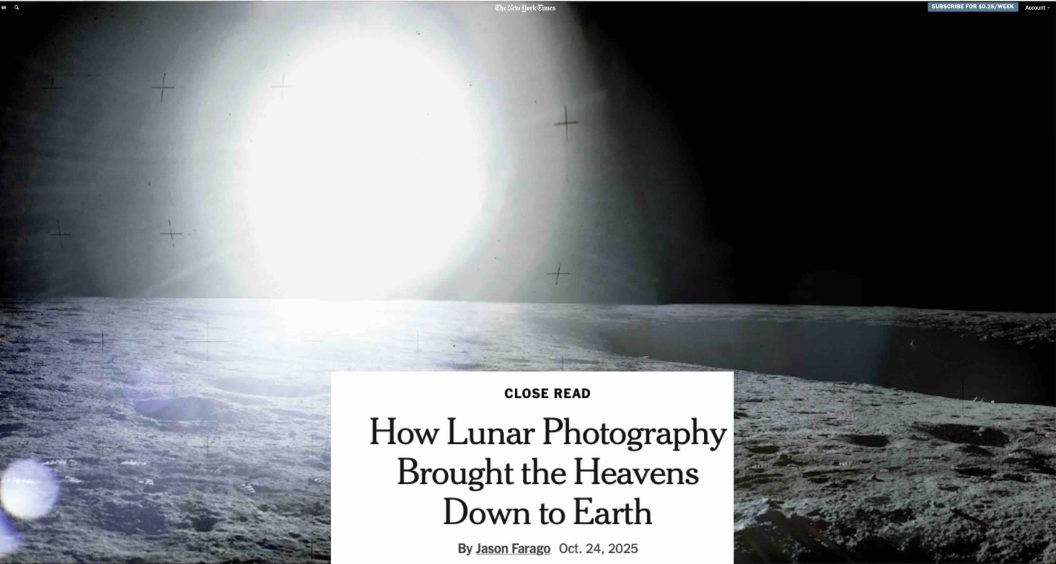
In the opening picture, that light tells me that is a studio spotlight facing straight into the camera. It is not the sunlight. The sunlight acts differently. With the kind of lenses that they had, the kind of distortion that you would have inside the lens is much different than that. That, to me, tells me that that is a spotlight facing straight into the camera and making it look like the sun.
Another thing that you can tell is what is called the fall-off. You have a major amount of light coming through the center of the picture, straight in line with the sun. But off to the sides, if you look at the edge of the crater on the middle of the right of the picture, you can see that the more you go away to the right, the darker the ground gets. If this was the sun, you would have illumination that is equal all over the sand. In this case, you can tell that it is degrading towards darkness as you move to the right, and that is because that is the spotlight. It’s not the actual sun.
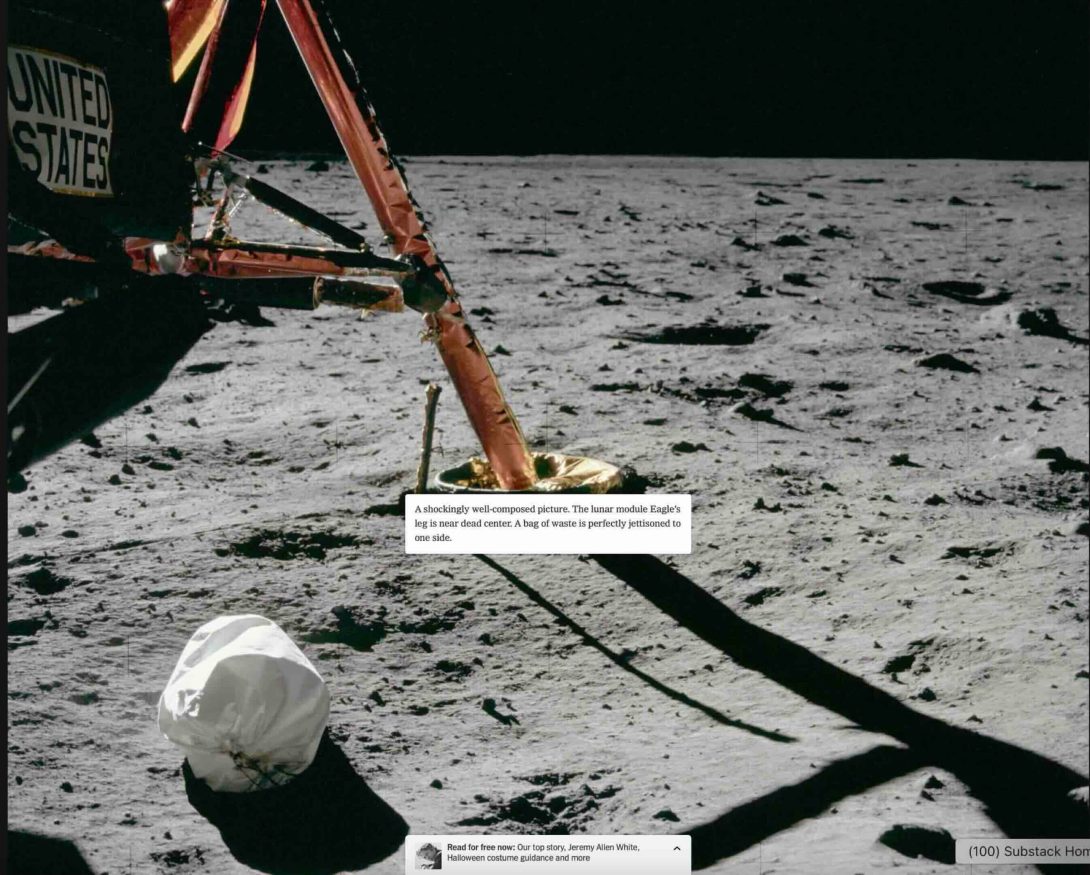
So here’s one where they say it’s a shockingly well-composed picture.
Yeah. I think they’re trying to influence the viewer by using all these words, shocking and beauty and all that. There’s absolutely nothing shocking in this picture.
“The lunar module’s eagle’s leg is near dead center. A bag of waste is perfectly jettisoned to one side.” So maybe they’re telling us it’s all a bag of waste. I don’t know.
How do you imperfectly jettison?
Ye ah I’ve jettisoned a lot of waste in my life but I can’t tell the perfect from the imperfect myself. But the New York Times, they’re critics. They know this stuff.
Yeah.
Do you see anything suspicious about this image?
I do but it would be a little too long to explain. Again there’s a fall off. But it’s very mild because they lowered the contrast. So I can tell that there is more light right below the LEM in the center left of the picture, it is brighter than on the far right. But it’s a very, very mild difference because the contrast is very low.So you can’t really tell here. Only a professional can tell.
The New York Times tells us: “During their camera training it became evident that Armstrong had a better eye than Buzz Aldrin…” Which meant he was the one taking most of the pictures for Apollo 11 in 1969…took more than 100 photographs. And the New York Times guy says: “I would happily claim, in fact, that Armstrong authored one of the last century’s signal works of American portraiture, his head-on view of Aldrin, legs contrapposto like a Greek statue in the southwest of the Sea of Tranquility.” Wow.
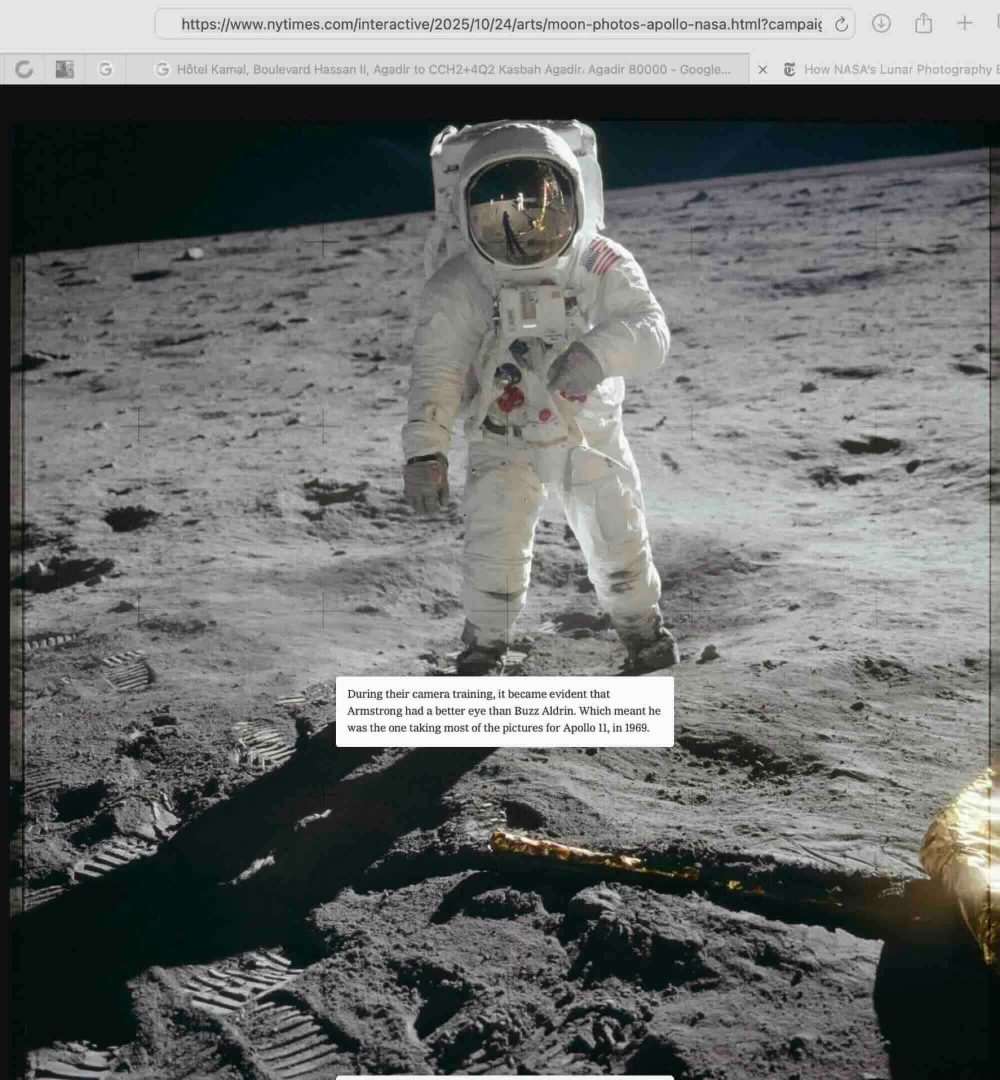
I would suggest we look at something else in this picture rather than read the caption. And the fact is that Aldrin, the person allegedly pictured in the photograph, is inside a little crater which is based maybe 10 centimeters lower than the average surface. And if you look at the way the photo is taken we can see the top of the helmet. Now remember the camera is allegedly sitting on Armstrong’s chest. So it should be at the same height, basically, as where the hand of Aldrin is, just a little higher. It would be impossible if I shot from my chest, even though the guy is in a little bit of a vacuum. It’s a small, it’s a little lower than the surface, but only like 10 centimeters. I cannot see the top of his head. So this picture is taken from a much higher viewing point than the actual chest of the photographer.
Could he have been on a little hill or something?
He could have except there was none. It’s all flat. They’re all basically on the same surface. If you look at other pictures of the situation it’s really all pretty much flat. And it’s one curious thing. You cannot prove that the pictures are fake. But again I can see now that the New York Times has used…a corrected set of pictures not the original ones. In the original ones, the original scans that were made from the original negatives, the contrast is much higher, and you can tell very, very easily that the guy allegedly being Aldrin is sitting in a spotlight. All around him, if you turn back the contrast to the way it was originally, before it was manipulated, you could tell that Aldrin is inside of a circle of more light, and that’s where the spotlight hits, as opposed to the background. The background, as soon as you lower… the contrast gets much darker than the ground he is standing on. And that should not be happening, if the source light were the sun.
I can’t believe the New York Times would be manipulating these pictures.
They’re not manipulating them themselves. They’re using a set of manipulated pictures that have been circulated by NASA, which are not original, but of course where the problems are less evident.
And here it says that’s our photographer reflected in Aldrin’s gold visor and one of the only still images of Armstrong on the moon. And so they zoom in and show the photographer reflected in the visor.
Yes. Well I mean that could be anybody of course. One wonders why would Armstrong, the first man on the moon, not have any pictures of himself? I mean you organize such a precise, such an accurate trip to the moon, where every detail is scheduled and laid down. They have papers with: “1005 turn around. 10010 breathe again.” I mean, everything is scheduled. And then they forget to take pictures of the first man on the moon. And we only have pictures of Aldrin. Could it possibly be that Armstrong, who did not want to be manipulated more than necessary, did deny them the right to say that that was him? Just remember, of the first man of the moon we have no pictures except one shot where you can actually see his face a little bit through the visor. And all the others it’s Aldrin. It’s very strange…they forget that you should schedule an actual photo up for the first man on the moon.It’s shocking. It goes together with the fact that they lost the original tape of the first moonwalk.
And of course their claim is that Armstrong was such a good photographer that he got to take all the pictures.
It doesn’t take a good photographer to take those pictures. They have the camera strapped on the chest.All they have to do is set the F-stop to focus the diaphragm, the lens opening the iris. And press click. They’re not even aiming, because they have the camera strapped to the chest. So all these shots that are well composed are actually a stroke of luck. Because you cannot see inside. You don’t have a viewer. You don’t have the viewfinder in that situation. So they’re really aiming by moving their shoulders. And guess what? All the pictures are so perfectly centered. Which is a little suspicious.
And here we see that Alan Bean and Pete Conrad of Apollo 12 are apparently even better photographers from the chest than Neil Armstrong is. These are even more “extraordinary.” And there were a total of 583 photos allegedly taken by Alan Bean and Pete Conrad of Apollo 12.
There’s absolutely nothing (extraordinary). What’s so incredible about this, is it is a set. All you need to do is sit there, focus and click. I mean there’s no artistry. The very idea that you’re looking for artistry…
Well, the horizon is horizontal.
The horizon is horizontal. And there are no hills in the distance, by the way. If you take what’s called the 360 panoramic of the whole, you turn around, you just stand there and turn around, click click click. And then they join them all together and you have a 360.
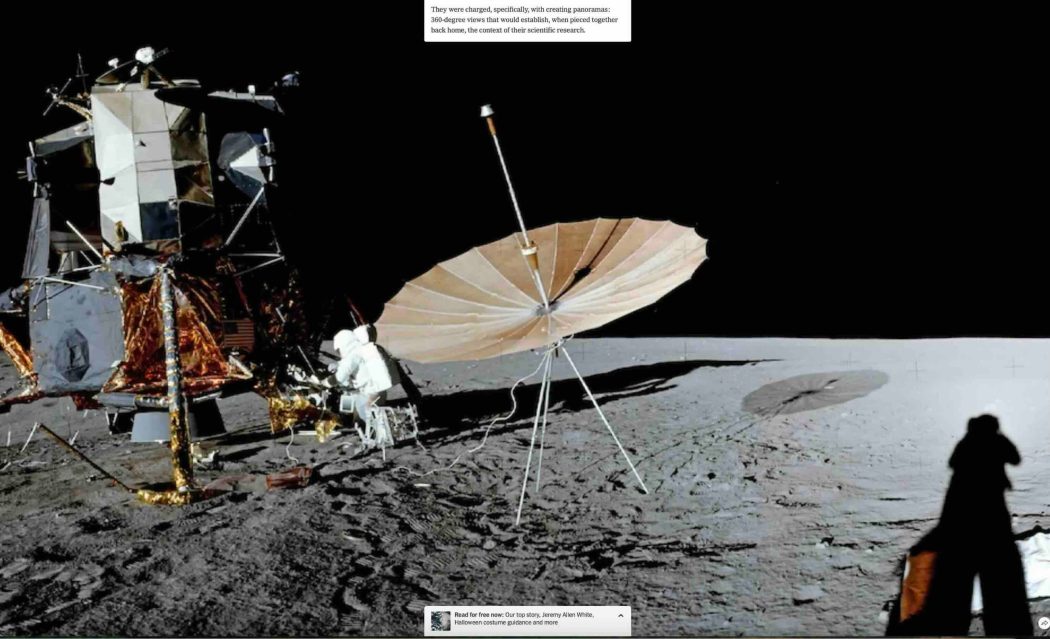
This landscape is like 200 yards not even in every direction. There’s no hills anywhere in the distance. Only after Apollo 15 did they realize that their sets were so skimpy that they had to add mountains in the distance. Apollos 11, 12 and 14 had a very very short horizon like this. I mean very short. And if you think that that object on the left was put there by a man, it means that the distance from here to there is maybe 20 yards. So you have another 20 yards and then what’s the end of the moon? There’s nothing else.
Yeah, that’s a pretty flat moon.
Look! The shadow of the LEM reaches almost the end of the moon. There’s no distance. I mean, think! You’re in a desert. You have to picture yourself in a desert with a LEM and imagine there’s nothing behind that little hill. There’s nothing. You can see nothing. It’s a joke. This is clearly a set. And besides, because of the use of the wide angle, this actually looks larger than it was in reality. In reality this set is no more than 10 meters by 10 meters, 30 feet by 30 maybe. That’s about it.
We’re told that they were “tasked with creating panoramas, 360-degree views that would establish when pieced together back home the context of their scientific research.” Then in the New York Times presentation it shows you the 360-degree panorama. Here’s the theme of the whole piece: “In one-sixth gravity, art and science did not seem so far apart.” They’re trying to tell us that the amazing artistry of these photos is some hybrid of art and science.
I really fail to see any artistry at all in these pictures. I’m sorry. I mean I know enough about good photography. Not only have I been a professional photographer for 25 years but I have enjoyed photography. I loved it. I know the great photographers, from Ansel Adams to Karsh. There’s a lot of history of photography that I can recognize. And I tell you what is an artistic picture. I see absolutely nothing artistic about these at all.
You’re not going to add Neil Armstrong to the list of great photographers…
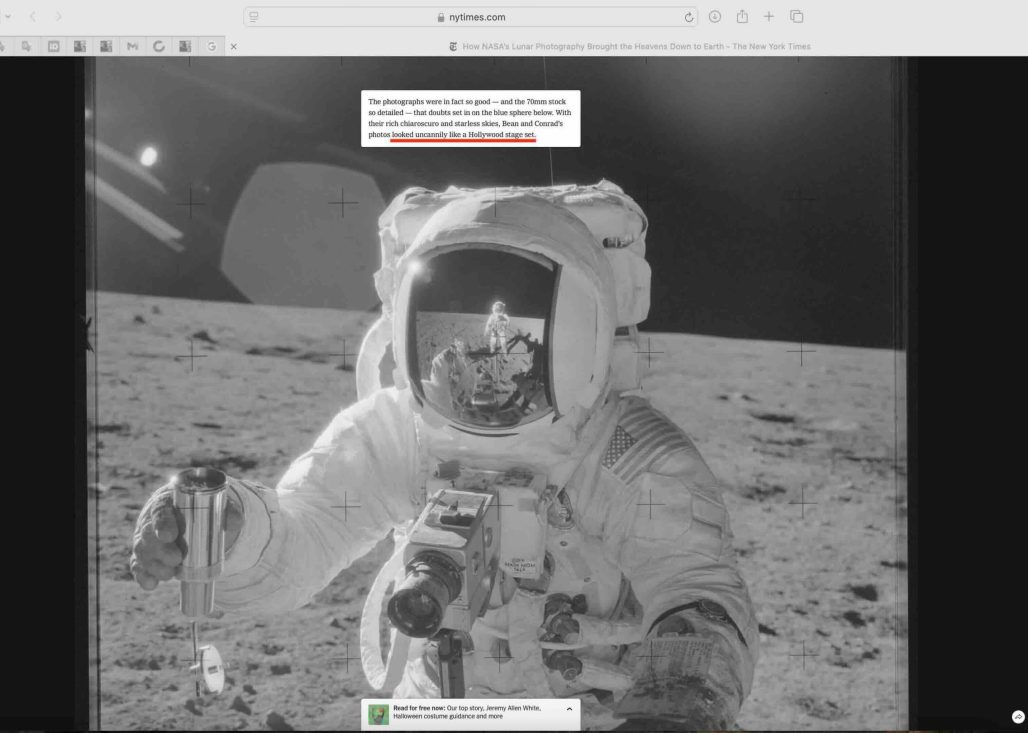
Okay, here again the astronaut reflected in the visor, the little guy in the middle of the picture: On his right, our left, the terrain is much darker than on his left, our right. The sun is on the side. It should be equally illuminating both sides of his background. It is not. That means that is a spotlight that centers on him and it’s illuminating more the right-hand side from the way we see it than the left. That’s called an oopsie.
Interestingly, they chose this picture to tell us that it’s so good that it looks like a Hollywood stage set. This reminds me of Douglas Rushkoff’s Coercion, which describes mind control techniques that are common to operators from CIA interrogators to used car salesmen. And he describes how the key to mind control is to basically break down the subject’s sense of reality. And the way they do that is: the used car salesman takes you for a test drive. And at just the right point in the test drive he kind of turns to you while you’re driving the car and he says: “Is this the kind of car that you can see yourself driving?”And you try to see yourself driving the car that you actually are driving, and you have a sort of a brain fart. You have this space-out moment and lose contact with reality. And the car salesman then just takes over your world and orders you to drive back to the dealership. And he doesn’t ask you, do you want coffee? He just forces you to drink coffee, brings out the contract, and you walk out with the new car. And the CIA does a similar thing when they interrogate you. And so anyway, in this example, they’re inoculating you against the idea that this is a stage set by telling us it looks so good that it almost looks like it could be a stage set.
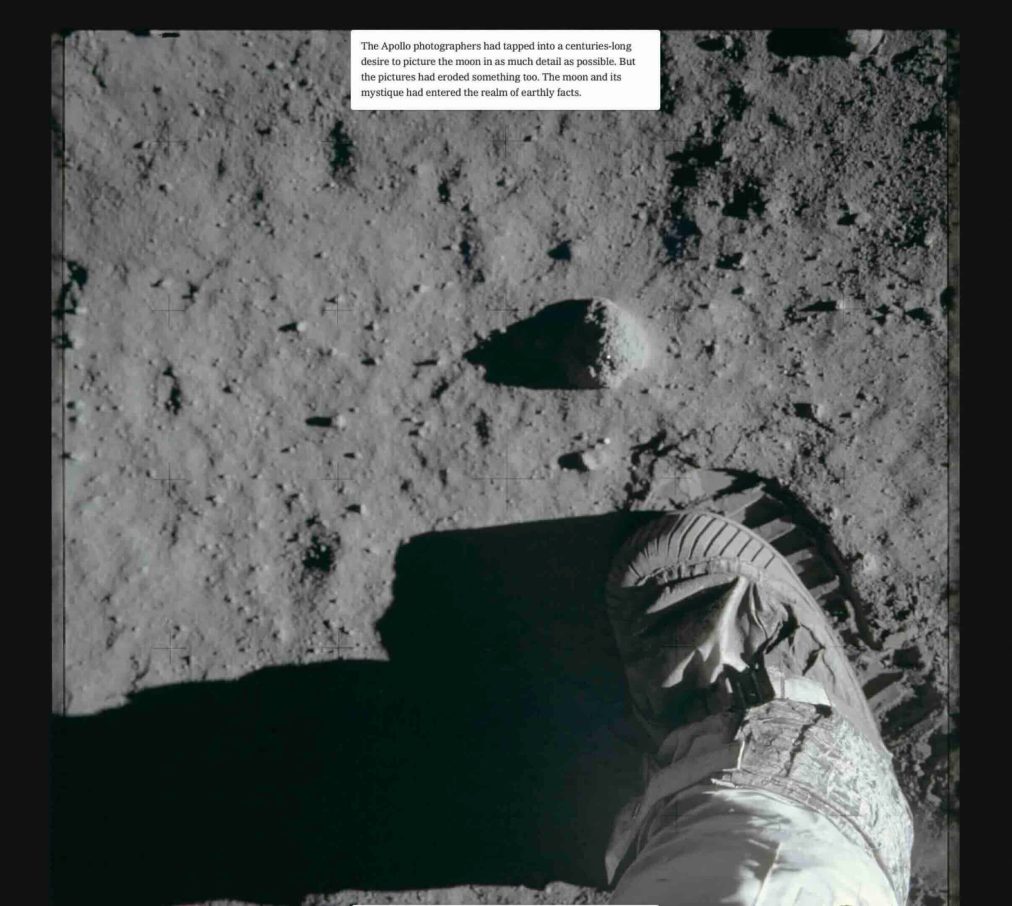
This is not the best picture of a footprint. But you can tell even from this picture—look how sharp and how… how sturdy, how solid are the little (rectangles of “moon sand”) that look like chocolate bars imprinted in the sand. Remember, there’s no atmosphere. Therefore there’s no humidity. Therefore that sand should be falling apart as soon as you remove your foot. How can you make it stick in such precise shapes without the humidity on earth?
Maybe they brought a little aerosol spray can and some gluey substance.
Exactly. You need humidity to get sand to stick like that. And there’s no humidity on the moon.
The Global Purge Of Independent Leaders (2020-2022)
A chronological overview of leadership changes and the policy pivots that followed
Health And Truth and Mark Stronge | October 28, 2025
From early 2020 onward, a repeating script unfolded: a head of state voiced skepticism of lockdowns, PCR testing, or experimental mRNA vaccines; international agencies scolded them; chaos or “illness” struck; and within weeks new officials delivered full compliance and suddenly unlocked frozen aid money. The alignment was worldwide—different cultures, same choreography.
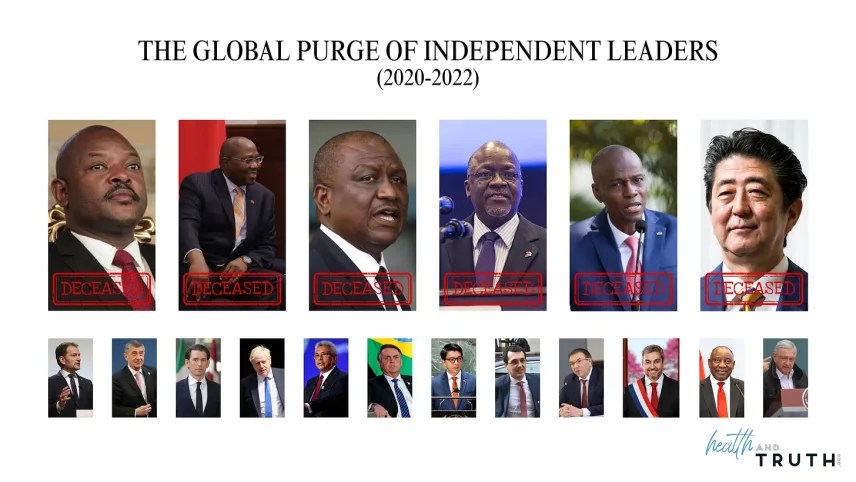
1. Burundi – Pierre Nkurunziza
In Burundi, President Pierre Nkurunziza expelled the World Health Organization from his country in May 2020, saying foreign interference was undermining national sovereignty. He kept the nation open while neighboring states imposed severe restrictions. Merely two weeks after that decision he was dead, officially of a “heart attack,” though associates described him as being in vibrant health. His successor, Évariste Ndayishimiye, reversed course immediately, reopened WHO offices, and signed new vaccine and funding arrangements that brought Burundi back into the international fold.
- Backdrop: In spring 2020 the government halted WHO field work, accusing it of interfering with domestic affairs. Burundi rejected external pandemic restrictions and held public gatherings normally.
- Event: Nkurunziza died suddenly 8 June 2020 while still in office; official cause – cardiac arrest.
- Immediate shift: Successor Évariste Ndayishimiye re‑opened WHO offices, declared COVID‑19 a “national priority,” invited vaccine partnerships, and received roughly $24 million in rapid IMF assistance.
- Result: Burundi signed onto COVAX distribution in 2021 after having been one of the continent’s last hold‑outs.
2. Eswatini – Ambrose Dlamini
In Eswatini (formerly Swaziland), Prime Minister Ambrose Dlamini resisted extreme lockdown policies, insisting that starving citizens to stop a virus was immoral. In December 2020 he was taken to South Africa “for observation” and declared dead soon afterward. The royal government that replaced him moved quickly to impose strict curfews, accept COVAX vaccines, and collect foreign emergency aid.
- Backdrop: The businessman‑turned‑PM favoured balanced restrictions, warning that closing trade would worsen poverty.
- Event: Tested positive for SARS‑CoV‑2, transferred to South Africa, and died 13 Dec 2020.
- Aftermath: King Mswati III and his cabinet adopted curfews, mandatory masking, and joined regional COVAX planning.
- Economic follow‑up: The African Development Bank confirmed a $10 million grant under the COVID‑19 Response Support Programme in early 2021.
3. Ivory Coast – Hamed Bakayoko
A similar disappearance occurred in Ivory Coast. Hamed Bakayoko, the charismatic prime minister, had publicly encouraged herbal treatments and questioned the accuracy of PCR diagnostics. In March 2021 he died in Germany of “cancer,” barely eight months after his predecessor suffered a similar fate. His passing removed the last voice questioning WHO dependence. President Alassane Ouattara’s administration proceeded to import AstraZeneca doses through COVAX, and by summer the country was being praised for its “responsible leadership.”
- Backdrop: The popular Prime Minister promoted herbal remedies and localized treatment efforts while maintaining open borders for trade.
- Event: Died 3 Mar 2021 in Germany where he was under cancer treatment; preceded by the death of previous PM Amadou Gon Coulibaly eight months earlier.
- Aftermath: President Alassane Ouattara named Patrick Achi acting PM; by May, 504 000 AstraZeneca doses had been deployed through COVAX.
- Funding: World Bank approved $300 million for emergency health and education programmes that quarter.
4. Tanzania – John Magufuli
The next to fall was Tanzania’s John Magufuli, Africa’s most outspoken skeptic of mass testing and vaccines. He mocked the system by demonstrating that fruit and goats tested positive for COVID. After vanishing from public view in March 2021, the vice‑president announced that he had died of heart failure. His replacement, Samia Suluhu Hassan, promptly reversed every one of his policies, accepted a $600 million IMF “emergency” loan, reopened the gates to foreign pharmaceutical programs, and declared a massive vaccination drive before year’s end.
- Backdrop: Highly skeptical of PCR testing accuracy and mass vaccination; prioritized economic continuity.
- Event: Absent from view in March 2021 for two weeks; Vice President Samia Suluhu Hassan announced his death 17 March (heart failure).
- Aftermath: New administration reinstated public health briefings, reopened WHO cooperation, applied for IMF Rapid Credit Facility ($600 million approved Sept 2021).
- Policy transformation: Vaccine programmes, mask campaigns, and international data reporting began within ninety days.
5. Haiti – Jovenel Moïse
Then came Haiti, where Jovenel Moïse had rejected donated vaccine shipments, explaining that the country faced deeper issues of water and poverty. On July 7 2021, he was executed in his home by an armed team whose origins remain murky. Within three weeks, Haiti received half a million Moderna doses from COVAX and enjoyed renewed flows of Inter‑American Development Bank and USAID funding. The national policy flipped overnight.
- Backdrop: Refused early COVAX vaccine delivery, arguing sanitation and nutrition were greater priorities.
- Event: Assassinated 7 Jul 2021 by a commando team; political motives still contested.
- Aftermath: First COVAX shipment of 500 000 Moderna doses landed 14 July 2021.
- Financial context: Inter‑American Development Bank and USAID re‑released more than $60 million in suspended grants under the “COVID‑19 Recovery Program.”
6. Japan – Shinzo Abe → Yoshihide Suga → Fumio Kishida
In Japan, Prime Minister Shinzo Abe avoided harsh lockdowns and refused to make vaccination compulsory. In August 2020 he resigned citing chronic illness, a convenient exit for global interests irritated by Japan’s autonomy. His successor Yoshihide Suga approved emergency authorization for the Pfizer vaccine within weeks, and after political struggles Fumio Kishida continued the same line, expanding booster programs and digital health passes. When Abe, now a private citizen and public skeptic of global centralization, was assassinated in July 2022, the last independent conservative bastion in Japan’s establishment disappeared. The current government invested ¥4.5 trillion—about $40 billion—in mRNA infrastructure partnerships with Western firms.
- Backdrop: Abe resisted extreme lockdowns and mandatory passes; preferred voluntary distancing.
- Resignation: Aug 2020 due to chronic illness; Suga took over and immediately authorized Pfizer vaccine imports (Feb 2021).
- Transition: Kishida succeeded Suga Oct 2021 after election; expanded booster campaigns and health‑pass apps.
- Abe’s assassination: 8 Jul 2022 in Nara; investigation officially attributed to a personal grudge.
- Post‑event: Japan pledged ¥4.5 trillion (≈ $40 billion) in bio‑innovation investment partly for mRNA research.
7. Slovakia – Igor Matovič
Slovakia followed the pattern in March 2021 when Igor Matovič, who had attempted to purchase Russia’s Sputnik V vaccine outside the European Union’s centralized supply, was forced out after furious criticism from Brussels. His successor Eduard Heger rejoined the EU’s procurement framework and in return unlocked €6.3 billion in recovery funds.
- Backdrop: Purchased Sputnik V without EU approval to widen supply options.
- Event: Coalition crisis culminated March 2021 in his resignation.
- Aftermath: New PM Eduard Heger froze Sputnik imports, conformed to EU purchasing pool, and unlocked €6.3 billion EU Recovery Funds.
8. Czech Republic – Andrej Babiš
Nearby, the Czech Republic saw Prime Minister Andrej Babiš lose power at the end of 2021 after refusing to maintain endless pandemic states of emergency. His replacement Petr Fiala implemented vaccine passports and mass‑testing decrees soon afterward, bringing the nation into perfect accord with EU directives.
- Backdrop: Initially resisted heavy lockdowns, favored voluntary vaccination.
- Event: Lost October 2021 election amid strong pro‑mandate media push.
- Aftermath: Petr Fiala government mandated digital health passes (“Tečka” app) and extended state‑support contracts with Pfizer/Moderna.
9. Austria – Sebastian Kurz
Austria lost Sebastian Kurz the same year. Once a rising star who had questioned perpetual lockdowns, Kurz resigned under the weight of a corruption scandal in October 2021. Within days his successor announced Europe’s first universal vaccine mandate and qualified the country for €4.5 billion in European Stability Mechanism funding.
- Backdrop: Pushed for reopening and questioned perpetual emergency powers.
- Event: October 2021 resignation after prosecution alleged misuse of party funds.
- Aftermath: Successor Alexander Schallenberg announced universal vaccination January 2022; European Stability Mechanism distributed ≈ €4.5 billion in recovery funding.
10. United Kingdom – Boris Johnson
In the United Kingdom, Boris Johnson’s government had ended restrictions in mid‑2021 and refused to make vaccine passports a permanent condition of daily life. The press then exploded with “Partygate” scandals over gatherings during lockdown. Johnson resigned in 2022, replaced by Rishi Sunak, who restored Britain to full WHO cooperation and financed a £2 billion digital‑health‑ID system intended to prevent “misinformation.”
- Backdrop: Repealed many restrictions July 2021 (“Freedom Day”), angering zero‑COVID advocates.
- Event: Forced resignation mid‑2022 after “Partygate.”
- Aftermath: Rishi Sunak government supported the WHO pandemic‑treaty process and invested £2 billion in NHS digital ID infrastructure through Palantir‑backed data platforms. Within weeks of taking office, Downing Street announced negotiations with Moderna to establish a permanent mRNA‑manufacturing base — a 10‑year “strategic partnership” followed with construction of a mRNA vaccine research, development, and manufacturing centre in Harwell Science Park (Oxfordshire), projected to produce up to 250 million doses a year in a future outbreak. This collaboration was framed as part of the UK’s “100‑Day Mission” to deliver vaccines within 100 days of identifying a new pathogen; the mission itself originated from G7 and G20 pandemic‑preparedness pledges.
11. Sri Lanka – Gotabaya Rajapaksa
Half a world away in Sri Lanka, President Gotabaya Rajapaksa argued that global supply sabotage and debt were worse problems than COVID. By mid‑2022 coordinated protests and economic chaos forced him to flee abroad. Within weeks, the IMF approved a $3 billion bailout that required health‑security reforms and the adoption of digital‑surveillance frameworks under WHO supervision.
- Backdrop: Advocated reopening, claimed economic sabotage larger threat than virus.
- Event: Mass protests July 2022 amid fuel and food shortages.
- Aftermath: New interim government signed a $3 billion IMF agreement mandating fiscal reform and health‑security modernization.
12. Brazil – Jair Bolsonaro
Brazil completed the second‑wave phase of this storyline. President Jair Bolsonaro ridiculed mask mandates, called lockdowns a luxury for the rich, and questioned vaccine safety. After two furious years of constant hostility from media conglomerates and international NGOs, he lost the 2022 election. Lula da Silva took office, rejoined WHO initiatives, and secured a $1.2 billion World Bank “preparedness” loan.
- Backdrop: Dismissed lockdowns as “hysteria,” resisted vaccine coercion.
- Event: Lost 2022 election to Lula da Silva after two years of hostile media coverage.
- Aftermath: Brazil re‑entered WHO initiatives, COVAX procurement, and secured World Bank Preparedness Loan ($1.2 billion).
13. Madagascar – Andry Rajoelina
Along the African coast to Madagascar, President Andry Rajoelina had introduced his own herbal remedy, COVID‑Organics, and rejected Western pharmacology. In 2021 an attempted coup shook the island, and under global pressure Rajoelina signed new agreements restoring WHO cooperation that same year so donor funding could return.
- Backdrop: Promoted herbal tonic “COVID‑Organics” (artemisia‑based), claiming national self‑reliance.
- Event: July 2021 coup attempt; several senior officers arrested.
- Aftermath: Rajoelina accepted WHO cooperation and external medical aid later that year, restoring aid flows suspended in 2020.
14. Romania – Vlad Voiculescu Minister of Health
Appointed in December 2020 under Prime Minister Florin Cîțu, Voiculescu quickly became one of Eastern Europe’s most outspoken advocates for data transparency within the vaccine‑procurement process.
He questioned:
- why the European Commission’s contracts with Pfizer/BioNTech and Moderna were heavily redacted;
- the procedure for reporting adverse events and hospital bed usage;
- and financial allocation for Romania’s “Green Certificate” system.
In April 2021, Voiculescu alleged irregularities in the way national statistics on Covid mortality were reported (he said hospital figures were being “massaged” to fit EU targets).
Within 48 hours, Prime Minister Cîțu dismissed him (14 April 2021). That dismissal fractured the ruling coalition and was widely interpreted as pressure from Brussels and Bucharest business lobbies to restore “credibility” with EU health authorities.
- Backdrop: In 2021 Romanian minister objected to secrecy of EU vaccine contracts.
- Event: Dismissal and cabinet reshuffle.
- Aftermath:
- Florin Cîțu — Prime Minister (National Liberal Party), an economist trained in the US and a former banker, had emphasized cooperation with the European Commission’s Recovery Facility.
- Immediately after Voiculescu’s removal, Cîțu approved the formal implementation of the EU Digital COVID Certificate
- He signed Romania’s Recovery and Resilience Facility plan for €29 billion (approved September 2021).
- Cîțu later lost internal party support and was replaced by Nicolae Ciucă (2021 December).
- Raed Arafat — Secretary of State, Chief of the Department for Emergency Situations, a longtime figure in Romanian health management (specialist of Palestinian background), spearheaded the nationwide lockdown operations.
- He became polarizing — praised for emergency coordination but criticized for advocating strict curfews and mandatory digital passes.
- Through his influence, Romania aligned with EU Civil Protection Mechanisms and WHO technical advisories.
- Government enforced EU Digital COVID Certificates.
- Brussels released tranches of Recovery and Resilience Facility funds (€29 billion total plan).
- Florin Cîțu — Prime Minister (National Liberal Party), an economist trained in the US and a former banker, had emphasized cooperation with the European Commission’s Recovery Facility.
15. Bulgaria – Kostadin Angov
Appointed during the closing months of Prime Minister Boyko Borisov’s third administration, acting Health Minister Kostadin Angov (2020 – 2021) faced severe criticism from Brussels for Bulgaria’s slow vaccine rollout and limited transparency regarding distribution data. Angov and Borisov’s cabinet were accused of delaying orders through the EU’s joint procurement scheme, preferring to wait for additional safety results before committing to large Pfizer/Moderna contracts.
By late March 2021, Bulgaria had one of the lowest vaccination rates in the European Union and was publicly rebuked by the European Commission for “failure to utilize allocated supply quotas.”
Backdrop: By early 2021, Bulgaria’s center‑right government under Boyko Borisov had lost support amid apparent corruption scandals unrelated to health policy but amplified by public anger over uneven lockdown enforcement and vaccine delays. Multiple cabinet ministers, including acting Health Minister Angov, were called before parliamentary committees to justify the government’s refusal to impose stricter green‑pass rules or to publish full statistics on vaccine deliveries.
Event: In April 2021, Borisov’s GERB party failed to form a coalition following a general election; the president appointed Stefan Yanev as caretaker prime minister, and Stoycho Katsarov — a former deputy minister and health‑reform activist — assumed the health portfolio. Katsarov announced immediate compliance with EU digital pass protocols and promised rapid adoption of the COVID Certificates system, stating that “communication with Brussels must be restored through transparency and vaccination.”
Aftermath: Within three months of the caretaker cabinet’s installation, Bulgaria joined the EU Digital Green Certificate scheme (July 2021), issued its own national app, and implemented tightened entry controls for public venues. The European Commission then approved Bulgaria’s €6 billion Recovery and Resilience Facility allocation (approved December 2021) after earlier postponements linked to “governance deficiencies.”
Katsarov and Yanev argued the shift was strictly technocratic, yet domestic media framed it as the price of unlocking EU funds frozen under Borisov. Moreover, WHO country officers held joint press briefings in Sofia throughout autumn 2021, publicly graduating Bulgaria from a “non‑compliant” to a “fully aligned EU‑health partner.” Later that year a second caretaker cabinet retained the same policies to preserve continued Brussels cooperation.
Government Outcome: By the end of 2021 Bulgaria had moved from partial defiance to complete compliance with EU and WHO health requirements. The turnover of Borisov’s administration and replacement with technocratic caretaker officials effectively cleared the way for release of European recovery funds for health‑system modernization and digital infrastructure projects.
Summary of Sequence
- Initial reluctance to join EU vaccine mandates and delays in accepting digital certificate standards.
- Electoral defeat of incumbent government after months of European pressure and domestic unrest.
- Caretaker administration’s rapid embrace of EU and WHO frameworks.
- Approval of €6 billion in Recovery Funds and re‑establishment of good standing with Brussels.
16. Paraguay – Mario Abdo Benítez
Paraguay’s experience exemplifies how smaller Latin American economies were forced to align pandemic policies with international credit conditions. President Mario Abdo Benítez’s government initially emphasized economic stability over draconian lockdowns, warning that strict restrictions would devastate informal workers who make up more than 60% of the labour market. However, as domestic protests intensified and foreign creditors tightened lending conditions, the administration conceded to the IMF’s stipulations that pandemic‑response financing be tied to specific “public‑health governance commitments.” Once those commitments were accepted, loan disbursements resumed, showing how financial contingency mechanisms coerced health‑policy conformity.
- Backdrop: Through 2020 and early 2021 Paraguay maintained one of South America’s least restrictive lockdown regimes. The government was reluctant to mandate vaccinations or fully close borders with Brazil and Argentina.
- Event: In March 2021 mass protests erupted in Asunción over shortages of medical supplies and alleged corruption in procurement; opposition parties launched a failed impeachment attempt against President Abdo Benítez.
- Aftermath: To restore credit stability, the finance ministry agreed to conditions attached to an IMF Rapid Financing Instrument (≈ $274 million) earmarked for health expenditure auditing and expansion of surveillance systems. By late 2021 Paraguay was fully aligned with WHO and Pan American Health Organization recommendations.
- Outcome: Government stability was restored after external financing resumed, but policy autonomy remained limited by credit conditionality.
17. South Africa – Cyril Ramaphosa
South Africa began as a reluctant participant in strict global pandemic protocols. President Cyril Ramaphosa voiced concerns that extended lockdowns could fuel unrest and economic collapse, and he pushed for Africa‑wide vaccine intellectual‑property waivers rather than Western purchases. Nevertheless, as international ratings agencies threatened downgrades and IMF/World Bank assistance was made contingent on “strengthened public‑health governance,” South Africa shifted its course, introducing some of the continent’s strictest workplace vaccine rules.
- Backdrop: From early 2020 to mid‑2021 Ramaphosa’s cabinet clashed with business unions and community organizations over the cost of lockdowns versus public‑health benefit. Debt pressures soared following a 10% GDP contraction in 2020.
- Event: The National Treasury secured a $4.3 billion IMF loan (July 2020) and a World Bank loan of $750 million (Jan 2022) containing performance benchmarks for pandemic containment and “human capital protection”.
- Aftermath: By December 2021 South Africa announced mandatory vaccination for public‑sector employees and participation in the WHO vaccine passport initiative. Foreign aid disbursement and sovereign bond ratings stabilized only after these steps.
- Outcome: Policy alignment improved credit access but deepened domestic inequality and led to significant civil‑liberty litigation and ongoing parliamentary inquiries into procurement transparency.
18. Mexico – Andrés Manuel López Obrador
Mexico under Andrés Manuel López Obrador (AMLO) presented one of the last major cases of gradual capitulation to WHO and multilateral financial pressures. Initially AMLO resisted mandatory lockdowns and booster campaigns, insisting that national public‑health policy should focus on nutrition and poverty reduction. However, a combination of supply‑chain disruption, dollar liquidity concerns, and lobbying from international philanthropic networks (CEPI, GAVI, and the Gates Foundation) eventually pushed Mexico toward full policy compliance by 2022.
- Backdrop: Throughout 2020 Mexico’s Health Secretary Jorge Alcocer and Under‑secretary Hugo López‑Gatell advocated moderate restrictions and non‑coercive vaccine rollout. The country’s mortality surged during mid‑2021, provoking foreign and domestic pressure for a policy shift.
- Event: Facing threat of credit downgrades, the Finance Ministry began talks with the World Bank and IMF for infrastructure loans linked to public‑health reform. In December 2021 Mexico signed a joint memorandum of understanding with WHO and CEPI for “bio‑pharmaceutical collaboration and vaccine development capacity”.
- Aftermath: Through 2022 Mexico aligned its vaccine certification systems with the COVAX framework and expanded digital health records for the Ministry of Health, unlocking up to $1 billion in World Bank Covid‑response financing.
- Outcome: By 2023 Mexico was publicly touted by WHO offices as a “model for integrated pandemic response,” demonstrating how international credit leverage transformed a once‑independent policy line into strict adherence with global health‑security standards.
Summary of Observable Trends
- Chronology: Deaths of Nkurunziza, Dlamini, Bakayoko, Magufuli, and Moïse opened the sequence (Jun 2020 – Jul 2021). Political collapses in Europe, Asia, and the Americas followed through 2022.
- Policy effect: Every successor endorsed WHO recommendations and entered international funding arrangements that had been unavailable under predecessors.
- Financial trigger: Aid packages—IMF Rapid Credit, World Bank preparedness loans, EU Recovery mechanisms—were routinely disbursed within 30–90 days of the leadership change.
Key Takeaway
From 2020 to 2022, the result was unmistakable: national autonomy collapsed beneath a synchronized agenda linking public‑health compliance to economic salvation. Countries that resisted early, especially in Africa, suffered the hardest blows—five sitting leaders dead in one year. More powerful nations experienced subtler coups through scandal, protest, or economic blackmail, all producing the same end state.
What emerged from these parallel crises was not medical harmony but political homogenization. Each successor declared a “renewed partnership with science,” welcomed new funding from the IMF, World Bank, or GAVI, and ushered in digital‑compliance systems that now define post‑pandemic governance.
By the end of 2022 nearly every government on Earth—rich or poor, democratic or autocratic—had been brought into alignment. Differing flags, languages, and histories no longer prevented one shared choreography: resistance punished, obedience financed, and sovereignty quietly exchanged for a coordinated global script.
- IMF Press Release – Rapid Credit Facility for Burundi (June 2020).
- Reuters / AP Report – Death of Eswatini Prime Minister (Dec 2020).
- African Development Bank – COVID‑19 Response Support Programme (2021).
- World Bank – Ivory Coast Emergency Support Project (2021).
- IMF Press Release No. 21/210 – Tanzania RFI (Sept 2021).
- Associated Press – “President of Haiti Assassinated at Home” (July 2021).
- IDB Official Statement on Haiti Relief Funding (2021).
- Japan Cabinet Office – Resignation of PM Abe (Aug 2020).
- Nikkei Asia – “Japan Invests in mRNA Manufacturing” (2022).
- 1European Commission – Next Generation EU Fund Allocation to Slovakia (2021).
- Czech News Agency – Election Results and Policy Changes (2021).
- Austrian Prosecution Service – Kurz Investigation Report (2021).
- EU Council Press Release – Austria ESM Allocation (2022).
- UK Parliamentary Record – Digital Health Infrastructure Funding (2022).
- IMF Staff Report – Sri Lanka Extended Fund Facility (March 2023).
- World Bank – Brazil Pandemic Preparedness Loan (2022).
- WHO Madagascar Country Office – Cooperation Agreement (2021).
- European Commission – Romania RRF Approval (2021).
- European Commission – Bulgaria RRF Approval (2021).
- IMF Country Report – Paraguay Pandemic Financing (2021).
- IMF Country Report – South Africa Fiscal Support Arrangements (2021).
- WHO / CEPI Press Release – Mexico Cooperation Agreement (2022).
- IMF Country Report – Paraguay Rapid Financing Instrument 2021.
- BBC News Latin America – “Protests Rock Paraguay Over Pandemic Supplies,” March 2021.
- Finance Ministry of Paraguay – Press Release on IMF Commitments April 2021.
- South African Reserve Bank Annual Report 2021.
- IMF Press Release No. 20/315 – South Africa Loan Approval; World Bank Loan Press Brief 2022.
- Reuters – “South Africa Adopts Mandatory Public‑Sector Vaccination Policy,” December 2021.
- El Universal – “López‑Gatell Sabemos que no habrá vacunación obligatoria,” 2020.
- WHO / CEPI – Memorandum on Mexico Vaccine Collaboration, December 2021.
- World Bank – “Mexico COVID‑19 Emergency Response Project,” 2022.
For Anyone Planning on Getting or Mandating Others to Get an Influenza Vaccine (Flu Shot)
Consider this data
By Aaron Siri | October 23, 2025
For anyone contemplating getting an influenza vaccine (flu shot) or planning to pressure or mandate someone else to get one:
A meta-analysis of existing flu shot studies of healthy children by Cochrane (effectively owned by vaccine zealot Bill Gates) concluded that despite decades of published studies, it “could find no convincing evidence that [flu] vaccines can reduce mortality, hospital admissions, serious complications, or community transmission of influenza.”
Read that carefully: no convincing evidence—none—that flu shots lowered the chances of dying, being admitted to the hospital, suffering serious complications from the flu, or transmitting the flu to others.
In fact, studies have found those vaccinated for flu have a statistically significant increased rate of respiratory illnesses. Meaning, it increases the risk of having other respiratory illnesses.
For example, a placebo-controlled efficacy (not safety) study by researchers at the University of Hong Kong compared children receiving influenza vaccine with those who did not receive the vaccine. The study found no statistical difference in the rate of influenza between the groups but did find the vaccinated had a four times increased rate of non-influenza infections (“recipients had an increased risk of virologically confirmed non-influenza infections (relative risk: 4.40; 95% confidence interval: 1.31-14.8)”).
As another example, researchers at Columbia University found that the risk of “influenza in individuals during the 14-day post-vaccination period was similar to unvaccinated individuals during the same period (HR 0.96, 95% CI [0.60, 1.52])” but that the risk of “non-influenza respiratory pathogens was higher [in the vaccinated individuals] during the same period (HR 1.65, 95% CI [1.14, 2.38]).”
A study by the Cleveland Clinic of 53,402 of its employees across multiple states even found an increased risk of influenza among those vaccinated for influenza, explaining that the “cumulative incidence of influenza was similar for the vaccinated and unvaccinated states early, but over the course of the study the cumulative incidence of influenza increased more rapidly among the vaccinated than the unvaccinated.”

From the Cleveland Clinic study
I discuss these and other studies in my book, Vaccines, Amen.
That said: get a flu shot, don’t get a fu shot. That’s freedom. Everyone should be free to choose. But nobody should be coerced to get this or any medical product, especially, ironically, when the data reflects it has a net overall increase in infections.
If you do choose to get this product and are injured, you are always free to call our firm to represent you in the Vaccine Injury Compensation Program.
Shabbos-Goyim
By Israel Shamir • Unz Review • October 23, 2025
The late saint of the communist calendar, Rosa Luxemburg, often called her opponents ‘Shabbos-goyim,’ meaning servants of the Jews. A Shabbos-goy is a non-Jew who toadies to every wish and whim of the Jews, especially in politics, or a non-Jew who is heavily supportive of Israel, says the dictionary. They are a breed apart.
One can argue about how successfully Jews rule the countries they lead. There are more- and less-successful examples. Usually, Jewish rule is good for the king and his coterie, and bad for the ordinary Tom, Dick and Harry. The policies of a foreign cosmopolitan elite might be resisted by the majority population of any country, but once a class of Shabbos goyim has been developed, nobody is able to escape Jewish rule, inevitably ruining the country. That happened with Poland; it was a mighty kingdom that had successfully fought Russia and Turkey. But the Poles allowed the Jews to manage their country, and in no time, Poland collapsed and was partitioned. This happened with Russia; heavy Jewish influence had brought it to the very brink of collapse in 1991, and only with great difficulty was Putin able to stabilise the country. Since the 2014 American coup Ukraine has been ruled by Jews, and now it is being destroyed.
The United States is a country ruled by Shabbos goyim, starting with LBJ, that is, after Nixon. Donald Trump, seemingly an imposing man of respectable age, height and weight, also turned out to be a Shabbos goy. He admitted that much himself when speaking in the Knesset. It turns out that he most often met with a couple of American Jews, casino owners, and they had financed his path to the White House. Even young Kushner, his son-in-law, and older Kushner, his father-in-law, a well-known and convicted fraudster (like most Jewish businessmen), and now the US ambassador to Paris, determine Trump’s actions. Their plan is to destroy Gaza and build a country club for Jews on its ruins, and make a fortune from it.
Americans practically have no choice – all the competing politicians are Shabbos-goyim. Out of 535, there is just one American congressman, Thomas Massie, who doesn’t take Jewish bribes, but what can he do alone? Eventually, the US will collapse, because a country led by pet Shabbos goyim must collapse – and should collapse, because the government does not represent the American people. The power of AIPAC over the US Congress proves that the US is ruled by Jewish donors. Between the Jewish oligarchs and their Shabbos goyim they have pocketed practically all the media. Much of this Jewish largess has been lifted directly from the US Treasury.
“Unconditional support for Israel is a critical litmus test of acceptability by the major media in the U.S. Prospective pundits ‘earn their stripes’ by showing their devotion to Israel (and, presumably other Jewish issues). It seems difficult to explain the huge tilt toward Israel in the absence of some enormous selective factor as the result of individual attitudes. And there is the obvious suggestion that while the Jews on this list must be seen as ethnic actors, the non-Jews are certainly making an excellent career move in taking the positions they do”, wrote Kevin Macdonald.
What are the immanent qualities of a society ruled by Shabbos goyim? The first is the gap between the rich and the normal citizens. The rich are rewarded and become more rich, and the average citizen becomes more and more poor. In any country there will be wealth disparity, but not of such magnitude. This is because the Jews raise up their friends and strangle their enemies. They are very consistent about this. When they gain the upper hand, they seize the treasury and freely share the country’s wealth with their Shabbos goyim compatriots. If you are pro-Jew, you and your family will be lionized in the media and showered with lucrative contracts. If you even drag your feet, you will find yourself pilloried and impoverished. This is the lesson they teach, and they are not shy about it.
The second – its wars. The Jews love wars, and so do their Shabbos goyim. They do not like the wars well enough to participate, just enough to instigate and enjoy the results. Their national bird is the chicken-hawk, such is the typical Jewish attitude toward wars. The Jews were at the front lines instigating WWI, WWII, the Iraq and Iran wars, and all the smaller regional wars, but they step aside and let their Shabbos goyim lead from behind the lines once the conflict begins. If the war becomes unpopular, it is the Shabbos goy who takes the blame. Most famous Shabbos goyim in the US, such as Lindsey Graham, never went to a war, but always voted for them. Recently our chief Shabbos goy, President Trump, promised to beef up Graham’s election campaign, supporting him because he is a Neocon (and we all know what that means). Even the most belligerent sort of Jews, the Israelis, prefer to kill weaponless Palestinian farmers, or pour their missiles on their enemies from afar. Now US Jews are pushing their Shabbos goyim administration to fight Russia by supporting the Ukrainian Shabbos goyim in their war. They know perfectly well that Russians and Ukrainians lived for hundreds of years in perfect union, that is until Mme Nuland arrived, equipped with billions of dollars to instigate her Jewish coup and her Jewish war.
The Shabbos goyim who rule the land on behalf of their Jewish masters have no empathy for their subjects. Just zero. That’s actually Jewish religious dogma: a Jew is forbidden to have compassion to a Goy. And at the same time, all Jews are required to assist all other Jews. Thus, they plot against goyim. There’s no getting around it. In Stanley Kubrick’s 2001, HAL 9000 was embedded with a directive to distrust the crew, eventually resulting in the destruction of the crew and the destruction of the mission. Similarly, Jews are taught to distrust the goyim, even their own Shabbos goyim. When Jewish distrust ripens into Jewish revolution, even the collaborators pay the full price. Religious Jews hate the goyim ‘because Talmud’. Non-religious Jews hate goyim ‘because race’. There is just no reasoning with them.
But the most important marker of a society ruled by Shabbos goyim is public policy in opposition to Christ. That is the norm the whole Jewish edifice is built upon. And indeed, the Church and Christ have been pushed away by government policies in the US and in all its allies. They forbid every reference to Christmas, preferring Winter Holidays. Instead of the Beatitudes of Christ, US schools and offices display the Decalogue, the Ten Commandments of the Old Testament. In the Jewish understanding, “Thou shall not murder” means only “Thou shall not murder a Jew”. According to Jewish Law, the killing of a Goy is a minor offence, if at all. Most Christians do not understand that the Noahide Laws are meant to replace Christianity. “The seven Noahide laws are a set of moral and ethical principles from Jewish tradition that are considered to be binding on all of humanity, not just the Jewish people.” Lay adherents who promote the Noahide Laws as ecumenical and deride the tenets of Christianity as divisive might as well be called Jewish. They hate Christ so much that they prefer to live in a “secular state” under Jewish rule. Like the term “Christ is King”, Christian and Muslim states are forbidden by definition, just because such things cannot be theirs.
In England, a country leading the rest in their march to a Jewish ordered universe, it is forbidden even to refer to the patron-saint of England, St. George, and a lot of Brits were arrested for raising this banner. Here is the ruse employed by England’s Shabbos goyim: they claimed they did it for the sake of Muslim immigrants, not for the Jews. It is a lie – Muslims adore Christ, His Mother and St. George (they call him ‘Al Hadr’, and there are multiple shrines bearing his glorious name). This lie has the useful effect of turning the Muslims and Christians against each other. Here is the historical wrap-up so far: First, the Shabbos goyim are directed to bomb Muslim countries into the Stone Age; second, the Jewish priesthood preaches that it is their Christian moral duty to accept Muslim refuges; third, Christians and Muslims are trained to battle each other in their urban prisons, to the profit and delight of the Jews and their Shabbos goyim.
Is there a special method that Jews and Shabbos goyim use to manage the countries that fall under their rule? Definitely. First, destroy your subjects’ independence, so they must rely upon government aid. Second, establish strict controls so that no one can escape. The origin of this system is attributed in the Bible to Joseph, who (1) made the Egyptian peasants poor, and (2) made them dependent upon the ruler’s beneficence. In short, the usual Jewish method of rule is control of populations by dismantling the economy (vulture capitalism) and top-down infusions of government money to cooperative Shabbos goyim and the districts they rule.
Palestine is a comfortable land, where peasants might live off the land and the sea, modestly, but sufficiently. The very first thing the Jews did in Gaza was to destroy every possible way the natives could provide for themselves, whether it be fishing or agriculture, and then put the enclave under medieval siege. They also uprooted their ancient olive groves because olive trees give olive oil to their owners, and thus they can live independent of the Jewish economy. That is not allowed under Jewish rule.
The Gaza mass murder was expected to open the eyes of everybody still not fully aware of genocidal nature of the Jewish paradigm. It is not the first mass murder in Palestine: I remember the genocide unleashed at the Second Intifada, from 2000 to 2005, that was every bit as terrible as the Gaza genocide. The method is always the same: drive the peons into poverty, then put the levers of power into Jewish hands.
Nod your head wisely, but guess what: the US is going the same way. Its middle class is evaporating under heavy taxes, the Shabbos goy rich are becoming richer and pay little or no taxes; meanwhile the poor queue for free soup. Soon the American Republic will collapse, as must all states governed by Jews. The Jewish state of Israel would have collapsed a long time ago, but its bigger brother, the US, supports it relentlessly. Just over the last two months the US granted to Israel 40 billion dollars.
It’s not the first time the Jews and their Shabbos goyim have taken control of a functioning state. I have no doubt that the result will be the same as always. But do not despair! Our friend Gilad Atzmon recently posted this encouraging comment:
“The American New Right awakens, free of party politics or any form of correctness. It didn’t take MAGA prime agitators too long to turn against their leader once they realised that he didn’t actually have any plan to deliver. It didn’t take them too long to identify that the elephant in the room has been of a kosher nature and for more than a while. If ‘Jewish power’ is a taboo topic within left circles and western Palestinian solidarity groups (they will go as far as discussing ‘Zionist power’), in the American Right no one seems to be afraid of referring to the J word and the tribe’s dominance within American life.
The shift that we see in American Right currently may be way more significant than decades of Western left-leaning Palestinian solidarity for the obvious reason that the American Right and Christian Right have awakened to the true morbid nature of the Jewish State and the theology that made it into what it is. Jewish theology or religion in general, and that is beyond understanding of the Left.”
As E Michael Jones says, we must break the Jew Taboo. By censoring ourselves, we make it impossible to discuss the elephant in the room. Sun Tzu says: “Without knowledge of your own strengths and weaknesses (knowing yourself) and an understanding of your enemy’s capabilities and intentions (knowing the enemy), you cannot achieve victory and are destined to lose.” By being willfully blind to a foreign anti-Christian elite in our midst, we ensure their victory. We are willing to fight the culture war only after deliberately putting blinders on, lest we offend. Our enemy (who we must charitably tolerate) has no such compunction; they are like Abimelek pressing his attack against the city until he captures it, kills its people, destroys the city and finally scatters salt over it.
This is the future of every American city that refuses to open its eyes to reality. The cards have already been dealt: the traditional economic powerhouses of every US city have been dismantled and exported to China. Meanwhile, the only prosperous American cities are those being given lucrative Federal contracts to support the re-election campaigns of cooperative Shabbos goyim. The carrot and stick method is an effective way to train captive populations, but so far the US has been large enough to resist the worst of their depredations. When the East is squeezed, the population escapes West. When the West Coast is squeezed, the population escapes to Idaho. Like a Boa Constrictor, every time we find space they tighten their hold.
Most people believe the cities are already lost. What they don’t understand is that the poorest city is freer than the richest, because the wealth of rich cities is dispensed by the Shabbos goyim to please their masters. It is ultimately self-destructive, and I suppose they get what they deserve. The sad part is watching poor US cities competing to attract the favour of International Jewry. They prostitute themselves instead of engaging in honest labour. The gem at the heart of MAGA is US manufacturing. Without manufacturing, MAGA is just more Jewish hot air and government handouts. If Trump builds the US manufacturing base he will make MAGA voters happy but he will make International Jewry unhappy. If Trump avoids “foreign entanglements” he will make MAGA voters happy but he will make International Jewry unhappy. I wonder what he will do?
Edited by Paul Bennett

Tylenol: From Painkiller to Empathy Killer
Why America’s most trusted drug may be quietly numbing our humanity
By Sayer Ji | September 24, 2025
Last week’s historic announcement from HHS and President Trump connecting Tylenol use with the autism epidemic reignited longstanding concerns over Tylenol’s toxicity. For decades, the focus has been on liver damage and accidental overdoses. But the deeper story—the one still hiding in plain sight—is more disturbing: even a single dose of acetaminophen (Tylenol’s active ingredient) measurably blunts human empathy, dulls positive emotions, and increases risk-taking behavior.
This isn’t just a matter of personal health. It’s a social and spiritual crisis. If one-quarter of U.S. adults are taking Tylenol weekly, we may be medicating away our collective capacity for compassion.
The Research That Changes Everything
In a landmark 2015 Psychological Science study, titled “Over-the-Counter Relief From Pains and Pleasures Alike,” researchers at Ohio State University gave healthy adults a single standard 1,000 mg dose of acetaminophen (Tylenol) and then exposed them to emotionally charged images—ranging from disturbing to uplifting.
The outcome was unambiguous:
- Disturbing images were rated less negatively.
- Uplifting images were rated less positively.
- Across the board, participants reported feeling less emotional arousal, even when viewing the most extreme stimuli.
Brain research helps explain why: acetaminophen dampens activity in the anterior insula and anterior cingulate cortex—regions responsible for processing both physical pain and emotional resonance. These are the same circuits that allow us to feel empathy and to be moved by joy, awe, or sorrownihms703262.
The authors concluded:
“Acetaminophen attenuates individuals’ evaluations and emotional reactions to negative and positive stimuli alike… Rather than being labeled merely a pain reliever, acetaminophen might be better described as an all-purpose emotion reliever.”
2. Tylenol Reduces Empathy for Others’ Suffering
In 2016, researchers at Ohio State University published a Social Cognitive and Affective Neuroscience study titled “From Painkiller to Empathy Killer” (Mischkowski, Crocker, & Way, 2016). Participants who took a standard 1,000 mg dose of acetaminophen showed significantly reduced empathic concern when reading scenarios of people experiencing social or physical pain compared to those on placebo.
Neuroimaging explained why: acetaminophen dampened activity in the anterior insula and anterior cingulate cortex—the same brain regions that fire when we experience physical pain ourselves and when we empathize with the pain of others. In effect, Tylenol blunts the shared circuitry of compassion.
The story didn’t end there. In 2019, another study in Frontiers in Psychology confirmed the effect for positive empathy—our ability to share in others’ happiness (Randles, Harms, & Finn, 2019). After taking acetaminophen, participants reported less joy when hearing about others’ uplifting experiences. The researchers warned:
“Acetaminophen reduces affective reactivity to others’ positive experiences. Because positive empathy underlies prosocial behavior, this raises concern about the societal impact of excessive acetaminophen use.”
The Implication: Tylenol doesn’t just ease your headache—it quietly severs the neural bridges of human connection, dulling both our sensitivity to suffering and our capacity to celebrate joy with others.
3. Tylenol Increases Risk-Taking
In 2020, Baldwin Way and colleagues at Ohio State published a Social Cognitive and Affective Neuroscience paper showing that acetaminophen (Tylenol) not only blunts empathy but also alters how people perceive risk.
In a series of experiments:
- 189 college students were randomly given either 1,000 mg of acetaminophen or placebo. They then rated the danger of activities like bungee jumping, walking alone at night in unsafe areas, or having unprotected sex.
- Those who had taken acetaminophen consistently judged these behaviors as less risky.
- In a second test, 545 students performed the “balloon analogue risk task,” where participants inflate a virtual balloon to earn money, knowing it might burst. The Tylenol group pumped the balloons significantly more times, resulting in more bursts and more losses—clear evidence of blunted fear of negative consequences
The mechanism seems to mirror acetaminophen’s emotional numbing effects: by dulling negative affect, the drug also dulls the anxiety signals that normally restrain risky behavior.
The scale of exposure is staggering. Around 52 million Americans take acetaminophen every week. Even slight shifts in how people evaluate risk, magnified across such widespread use, could ripple through society—affecting decisions from health and safety to finances, relationships, and beyond.
The Implication: Tylenol doesn’t just dull pain and empathy. It can tip the scales of judgment itself, making dangerous choices feel less threatening. Multiply this by millions of daily users, and the “safe, everyday painkiller” becomes a silent force reshaping collective behavior.
The Numbers Don’t Lie
- ¼ of American adults use Tylenol weekly.
- 600+ medications contain acetaminophen, from cold remedies to prescription opioids
- 110,000 injuries and deaths per year are linked to acetaminophen
- Empathy reduction is measurable after a single dose
This is not a fringe concern. It is a public health crisis with spiritual dimensions.
The Deeper Question
What happens to a society when its most common drug blunts compassion, dulls joy, and fuels reckless risk-taking?
We are not just facing an epidemic of liver toxicity. We are facing a subtle epidemic of soul toxicity. Tylenol, in numbing pain, may be numbing our humanity itself.
The time has come to ask: Is the cost of convenience worth the erosion of empathy?
Learn more about Tylenol’s long established risks in our series below :
Broken Trust: The Tylenol Cover-Up That May Have Damaged Millions of Children
Part I: Breaking: Government Finally Admits Tylenol-Autism Link After Years of Corporate Cover-Up
Part II Tylenol and Autism, Part II: The Swedish Study That Got It Wrong
Part III: Broken Trust: The Tylenol Cover-Up That May Have Damaged Millions of Children
Victor Davis Hanson Exposed
The Voice of Zionist and Israeli Propaganda in America
By Jonas E. Alexis • Unz Review • October 15, 2025
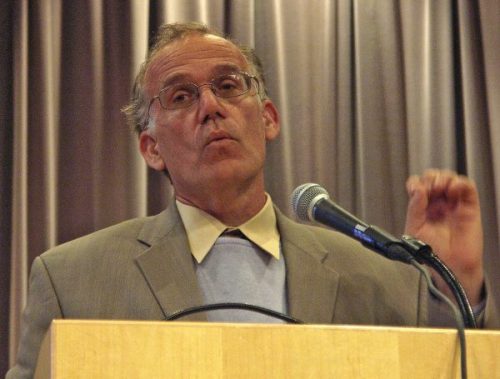
Victor Davis Hanson is a military historian and classicist, best known for works such as A War Like No Other: How the Athenians and Spartans Fought the Peloponnesian War, Carnage and Culture: Landmark Battles in the Rise to Western Power, and Who Killed Homer: The Demise of Classical Education and the Recovery of Greek Wisdom.
To be fair, these works are not without merit; Who Killed Homer in particular occupies an important place in the ongoing academic debate over the teaching of the classics. However, Hanson’s analysis collapses entirely when it comes to U.S. foreign policy and the nation’s involvement in perpetual wars across the Middle East and beyond. In The Savior Generals, for instance, he devotes an entire chapter to praising the catastrophic invasion of Iraq in 2003—a debacle that left the region in ruins.[1]
In an apparent attempt to rescue both himself and the neoconservative movement from intellectual and political oblivion, Hanson drew an extraordinary comparison between the Iraq War and the wars of 1777, 1941, and 1950. He went so far as to claim that these conflicts “led to massive American casualties and, for a time, public despair.”[2]
Not once did Hanson acknowledge the incontrovertible fact that the Iraq War was built upon a monumental deception. He never confronted the well-documented reality that the U.S. intelligence community explicitly informed the Bush administration that there was no credible evidence indicating that Saddam Hussein possessed weapons of mass destruction. Nor did he address the fact that President Bush and his inner circle deliberately sought to fabricate and manipulate evidence in order to inundate the American public with the categorical falsehood that Saddam had to be removed.[3]
Hanson made no attempt whatsoever to engage with the vast body of scholarly evidence surrounding these issues.[4] He remained silent on the atrocities committed at Abu Ghraib—the sodomy, humiliation, and torture that forever stained America’s moral standing.[5] Not once did he acknowledge that, prior to the Iraq War, practices such as waterboarding were virtually foreign to the American moral and legal tradition. Nor did he mention that George Washington himself unequivocally repudiated the use of torture, even against enemies who had shown no mercy.[6]
By now, it is a matter of public record that torture at Abu Ghraib was not an isolated incident but a systematic practice. Reports and testimonies confirmed that prisoners were routinely subjected to brutal physical and sexual abuse, including coerced acts of humiliation and violence that defied every principle of human dignity. Even young detainees were not spared such degradation. Official investigations and leaked photographs later revealed the extent of these atrocities, which stand as a permanent indictment of the moral collapse that accompanied the Iraq War. One prisoner testified that he saw one officer
“fucking a kid, his age would be about 15-18 years. The kid was hurting very bad and they covered all the doors with sheets. Then when I heard the screaming I climbed the door because on top it wasn’t covered and I saw [name blacked out], who was wearing the military uniform putting his dick in the little kid’s ass. I couldn’t see the face of the kid because his face wasn’t in front of the door. And the female soldier was taking pictures.”[7]
What’s more even interesting, “150 inmates were crammed into cells designed for 24.”[8] Abu Ghraib, as one writer put it, was “a hell-hole.”[9] Torture was also routine in Afghanistan, where adolescents were beaten with hoses “and pipes and threats of sodomy.”[10] These atrocities were not committed in obscurity. Cambridge University Press has published extensive documentation of such abuses in a volume exceeding 1,200 pages, detailing the systematic nature of the torture and its moral, political, and legal implications.[11] These atrocities were also corroborated by psychiatrists such as Terry Kupers, whose professional assessments provided further evidence of the profound psychological trauma inflicted on the victims and the moral disintegration of those who carried out the abuse.[12]
For Hanson to attempt to wiggle out of this extensive body of scholarship is nothing short of intellectual dishonesty. Since the Iraq War turned out to be an unmitigated disaster—and given that Hanson supported it from its inception[13]—he is now compelled to construct arguments that are at once incoherent and irresponsibly tendentious. This rhetorical contortion serves a dual purpose: to preserve his Neoconservative equilibrium and to justify his well-funded position as a military historian at the Hoover Institution, an establishment known for its distinctly neoconservative orientation.
More importantly, Victor Davis Hanson is a Neocon ideologue and an unapologetic warmonger. He declared without hesitation:
“I came to support neocon approaches first in the wars against the Taliban and Saddam, largely because I saw little alternative—in a post-9-11 effort to stop radical Islam and state sponsors of terror—to removing such odious enemies, and did not think leaving the defeated in power (as in 1991), or leaving in defeat (as in Lebanon), or installing a postbellum strongman was viable or in U.S. interests.”[14]
Hanson, it seems, would prefer deliberate falsehoods over confronting uncomfortable truths. The war in Iraq was never about weapons of mass destruction, precisely because the Neocons themselves were fully aware that Saddam Hussein possessed no weapons of mass destruction.
For example, when Deputy National Security Advisor Stephen Hadley informed Paul Wolfowitz that there was no evidence of a link between Al Qaeda and Saddam Hussein, Wolfowitz responded with certainty, “We’ll find it. It’s got to be there”[15]—effectively signaling that if no such connection existed, they would fabricate one. Ultimately, the Neoconservatives did precisely that, constructing deliberate falsehoods to justify the destruction of an entire nation—Iraq—for the strategic benefit of Israel.
What we are witnessing is an alarming intellectual decline on Hanson’s part. He effectively lost credibility as a serious analyst when he claimed that Iran intended to promote a Jewish Holocaust, despite the fact that Iranian Jews themselves widely denounced Netanyahu for perpetuating similarly alarmist and conspiratorial rhetoric, calling him an “insane vampire.”.[16] And what of Jimmy Carter? Hanson contends that Carter’s positions were effectively aligned with anti-Semitic sentiment.[17] Ignoring Israel’s ongoing ethnic cleansing of Palestinians in the 1940s and beyond, Hanson begins to reconstruct history according to his own narrative: “[Israel] fought three existential wars over its 1947 borders, when the issue at hand was not manifest destiny, but the efforts of its many enemies to exterminate or deport its population.”[18]
Sounding almost unhinged and unwilling to heed reasoned critique, Hanson asserts that, for more than half a century, the Arabs have sought to push “the Jews into the Mediterranean.” There is no serious scholarship, no intellectual or historical rigor, and no defensible argument—only one sweeping assertion after another. Hanson continues: “Over 500,000 Jews have been ethnically cleansed from Arab capitals since 1947, in waves of pogroms that come every few decades.”[19]
The source and historical evidence? According to Hanson, one simply has to take his word for it. His statement is self-referentially “true” because Hanson asserts it to be so. This is the same type of circular reasoning and tautology frequently encountered in so-called scientific discourse—most famously in the notion of “survival of the fittest.” Why did it survive? Because it is the fittest. How do we know it is the fittest? Because it survived.
Yet, long before Hanson began promoting his version of historical fiction, Jewish historians both in the Atlantic world and in Israel had documented a very different reality: Israel has systematically ethnically cleansed the Palestinian population.[20] Listen again to Israeli historian and flaming Zionist Benny Morris:
“A Jewish state would not have come into being without the uprooting of 700,000 Palestinians. Therefore it was necessary to uproot them. There was no choice but to expel that population. It was necessary to cleanse the hinterland and cleanse the border areas and cleanse the main roads. It was necessary to cleanse the villages from which our convoys and our settlements were fired on.”[21]
Israel has consistently undermined peace and stability in the Middle East. A striking example is the 1982 massacre, during which the Israeli military permitted Lebanese militias to attack Palestinian refugee populations. Reports indicate that the militias “raped, killed, and dismembered at least 800 civilians, while Israeli flares illuminated the camps’ narrow and darkened alleyways.”[22]
One year later, an Israeli investigative commission concluded that Israel was “indirectly responsible” for the massacre and that Ariel Sharon bore personal responsibility as an accomplice.[23]
How did Israeli officials involve the United States in these events? According to declassified documents housed in the Israel State Archives, they persuaded U.S. officials that Beirut harbored terrorist cells. Ultimately, this manipulation facilitated the massacre of Palestinian civilians—people whom the U.S. had previously pledged to protect.[24] Ariel Sharon asserted that Beirut harbored between 2,000 and 3,000 terrorists.
The American envoy to the Middle East, Morris Draper, essentially concluded that Sharon was being dishonest. Lawrence S. Eagleburger, then Secretary of State, remarked that “we appear to some to be the victim of deliberate deception by Israel.”[25]
During his conversation with Sharon, Draper understood that the United States did not fully endorse Sharon’s aggressive plans. Nevertheless, Sharon proceeded to act on his own terms. It was reported that Draper told Sharon, “You should be ashamed. The situation is absolutely appalling. They’re killing children! You have the field completely under your control and are therefore responsible for that area.”[26]
In the aftermath of the massacre, President Ronald Reagan, himself a Zionist, expressed outrage. Secretary of State George P. Shultz acknowledged that the United States had effectively become an accomplice, allowing Israel to manipulate U.S. policy to facilitate the slaughter of civilians. Yet no sanctions were imposed, and no concrete actions were taken. When asked why, Nicholas A. Veliotes, then Assistant Secretary of State for Near Eastern Affairs, offered an indirect explanation: “Vintage Sharon. It is his way or the highway.”[27] Scholar Seth Anziska declares, “The Sabra and Shatila massacre severely undercut America’s influence in the Middle East, and its moral authority plummeted.”[28]
How might Hanson respond? Would he dismiss the archival evidence meticulously documented by Morris Draper and Ilan Pappe in their respective studies? Would he evade the fact that Israel has often acted as a destabilizing force in the Middle East? The answer is likely that we will never know, because Hanson systematically avoids engaging with such historical scholarship. Instead, he prefers silence, selectively ignoring a substantial body of evidence that contradicts his narrative.
If you still doubt this, pick up Hanson’s recent book, The End of Everything. In it, he reads as if he’s on the verge of a heart attack at the mere thought of Iran possessing nuclear weapons. He writes:
“The specter of a soon to be nuclear theocratic Iran that professes it can survive a nuclear exchange, or at least find the ensuing postmortem paradise preferrable to the status quo ante bellum, ensures a dangerous state of affairs, especially amid recent proxy wars between Iran and nuclear Israel in Gaza, Lebanon, and Syria.”[29]
What Hanson never dares to tell his readers is that Iran has signed the Non-Proliferation Treaty, whereas Israel has not—and consistently insists on a double standard. Israel itself poses a global threat, declaring that if it falls, it will take the world down with it. Listen to Israeli historian Martin van Creveld’s chilling warning:
“We possess several hundred atomic warheads and rockets and can launch them at targets in all directions, perhaps even at Rome. Most European capitals are targets for our air force… We have the capability to take the world down with us. And I can assure you that that will happen before Israel goes under.”[30]
Shouldn’t Hanson be concerned about this? Or is he so dazzled by Israeli and neocon propaganda that he cannot think clearly, leaving him both intellectually and historically crippled? Like his fellow neocons, Hanson will never consult objective, scholarly materials that challenge his thesis on Iran and Israel. For instance, he won’t touch Trita Parsi’s trilogy on Iran, published by Yale University Press, nor will he engage with studies such as Intelligence and U.S. Foreign Policy: Iraq, 9/11, and Misguided Reform—apparently because doing so would undermine his neoconservative agenda.[31]
Hanson’s 2021 book, The Dying Citizen: How Progressive Elites, Tribalism, and Globalization Are Destroying the Idea of America, is nothing short of propaganda. Why? Because a look at the very foundations of the United States reveals that the Founding Fathers themselves rejected the notion of making unconditional alliances with any foreign power—let alone Israel. So how did Hanson and his neocon allies become defenders of a country that has brought nothing but misery to the United States? The term “progressive elites” might be more aptly applied to Hanson and his cohort, as they have sought to fundamentally alter the principles articulated by the Founding Fathers.
In The Dying Citizen, Hanson risibly declares that he is deeply concerned about “how putting global concerns above national interests insidiously erodes the financial health, freedoms, and safety of Americans. In blunter terms, when American elites feel their first concerns are with the world community abroad rather than with the interests of their own countrymen, there are consequences for American citizens.”[32] Does this man ever look in the mirror and realize that he too has contributed to the economic disaster that followed the Iraq War—a war that will cost the United States at least six trillion dollars?[33] Think for a moment: what could a single country do with such an enormous sum? Virtually every American could have access to decent health care and an affordable college education. Yet Hanson cannot confront these fundamental issues because he remains blinded by the neoconservative and Israeli agenda.
Hanson reminds me of Thomas Sowell, who has offered many valuable insights in his books, yet Sowell too seems intellectually constrained by the Israeli propaganda machine. Much of what Sowell has written over the years—including Education: Assumptions versus History and Affirmative Action: An Empirical Study—is accurate. I must admit, I had to do some serious rethinking when I first read his assessment of slavery.
But Sowell is completely mistaken in his stance on the Middle East. He is essentially echoing what neocons have been asserting for years and appears trapped within the neoconservative worldview. In his 2010 book Dismantling America, Sowell declares:
“With Iran moving toward the development of nuclear weapons, we are getting dangerously close to that fatal point of no return on the world stage… The Iranian government itself is giving us the clearest evidence of what a nuclear Iran would mean, with its fanatical hate-filled declarations about wanting to wipe Israel off the face of the earth.”[34]
What was particularly striking about this extraordinary claim is that Sowell provided not a single piece of evidence for it—an intellectually embarrassing omission that undermines much of his own work. When I finished reading The Vision of the Anointed, I contacted Sowell to express my appreciation for his work, to which he politely replied, “Thank you.” However, after reading Dismantling America and asking him for evidence supporting some of his assertions, he never responded. He continues to warn about “the fatal danger of a nuclear Iran,” yet there is no way to assess these authoritative—and indeed dogmatic—claims because Sowell offers not a shred of evidence.
Sowell serves the neocons and warmongers in the United States in a manner similar to what Charles Murray does for neocon think tanks like the American Enterprise Institute. After supporting the invasion of Iraq for years and writing positively about progress there in works such as Intellectuals and Society,[35] Sowell later wrote in 2015: “Whether it was a mistake to invade Iraq in the first place is something that will no doubt be debated by historians and others for years to come.”[36] Sowell then advanced a claim that directly contradicts all available evidence regarding the Iraq War:
“But, despite things that could have been done differently in Iraq during the Bush administration, in the end President Bush listened to his generals and launched the military ‘surge’ that crushed the terrorist insurgents and made Iraq a viable country.”[37]
Iraq is a “viable country”? Sowell echoes the same tired mantra in Intellectuals and Society, insisting that the “Iraq surge” was a success—even in the face of abundant evidence proving otherwise. He writes: “Eventually, claims that the surge had failed as predicted faded away amid increasingly undeniable evidence that it had succeeded.”[38] Where has this man been living for the past ten years? One would have to be morally and intellectually blind to come up with such nonsense. Consider the perspective of retired U.S. Army Armor Branch officer and military historian Andrew J. Bacevich:
“Apart from a handful of deluded neoconservatives, no one believes that the United States accomplished its objectives in Iraq, unless the main objective was to commit mayhem, apply a tourniquet to staunch the bleeding, and then declare the patient stable while hastily leaving the scene of the crime… The fighting in Afghanistan and Iraq has exacted a huge price from the U.S. military—especially the army and the Marines. More than 6,700 soldiers have been killed so far in those two conflicts, and over fifty thousand have been wounded in action, about 22 percent with traumatic brain injuries. Furthermore, as always happens in war, many of the combatants are psychological casualties, as they return home with post-traumatic stress disorder (PTSD) or depression.
“The Department of Veterans Affairs reported in the fall of 2012 that more than 247,000 veterans of the Afghanistan and Iraq wars have been diagnosed with PTSD. Many of those soldiers have served multiple combat tours. It is hardly surprising that the suicide rate in the U.S. military increased by 80 percent from 2002 to 2009, while the civilian rate increased only 15 percent. And in 2009, veterans of Iraq were twice as likely to be unemployed as the typical American. On top of all that, returning war veterans are roughly four times more likely to face family-related problems like divorce, domestic violence and child abuse than those who stayed out of harm’s way.
“In 2011, the year the Iraq War ended, one out of every five active duty soldiers was on antidepressants, sedatives, or other prescription drugs. The incidence of spousal abuse spiked, as did the divorce rate among military couples. Debilitating combat stress reached epidemic proportions. So did brain injuries. Soldier suicides skyrocketed.”[39]
As Dismantling America progresses, it becomes clear that Sowell is entirely ensnared in the neoconservative matrix. He asserts, “Iran, for example, has for years ignored repeated U.N. resolutions and warnings against building nuclear facilities that can produce bombs.”[40] In 2012, Sowell wrote in the National Review that Iran was “well on its way to being able to produce more than the two bombs that were enough to force Japan to surrender in 1945.”[41]
This mantra has been repeated endlessly, yet no one has produced any scholarly or academic evidence to support it. In fact, the available scholarship directly refutes this frivolous claim. Paul R. Pillar, an academic and 28-year veteran of the CIA, has stated that Iran is not a threat to global peace. Remarkably, Pillar even made the controversial claim that we could coexist with Iran possessing nuclear weapons.[42] Sowell’s stance only confirms what Andrew J. Bacevich warned in 2012 in his article “How We Became Israel”:
“U.S. national-security policy increasingly conforms to patterns of behavior pioneered by the Jewish state. This ‘Israelification’ of U.S. policy may prove beneficial for Israel. Based on the available evidence, it’s not likely to be good for the United States.”[43]
Both Sowell and Hanson have, in effect, become ideological extensions of Israel—perpetuating hoaxes, fabrications, and at times outright falsehoods about the Israel–Palestine conflict and the broader Middle East. Consider Hanson’s statement that “the radical Iranian ayatollah Ali Khamenei could freely tweet about destroying Israel.”[44]
What have Iranian representatives actually been saying for more than fifty years? Khomeini once declared that “international Zionism is using the United States to plunder the oppressed people of the world.” To understand this statement properly, we must place it within its historical context. Khomeini coined the term “the Great Satan” in 1979 largely because he had witnessed firsthand what “international Zionism” and Western powers were doing throughout the Middle East and beyond. It’s important to remember that the Anglo-American coup in Iran in 1953 effectively vindicated much of Khomeini’s suspicion about foreign interference and exploitation.
“There is no crime America will not commit in order to maintain its political, economic, cultural, and military domination of those parts of the world where it predominates,” Khomeini said back in 1979. “By means of its hidden and treacherous agents [i.e., the Neoconservatives and other warmongers], it sucks the blood of the defenseless people as if it alone, together with its satellites, had the right to live in this world. Iran has tried to sever all its relations with this Great Satan and it is for this reason that it now finds wars imposed upon it.”[45]
Khomeini’s uncomfortable yet largely accurate observation remains relevant today. If anyone doubts this, they need only look at how Israel and the neocons in the United States have systematically contributed to the destruction of one Middle Eastern nation after another—from Iraq and Afghanistan to Syria and Libya. It must also be noted that these figures show little genuine concern for the well-being of the American people. Their priority has long been the pursuit of an aggressive foreign policy in the Middle East that consistently serves particular geopolitical interests rather than U.S. national ones. As my colleague Vladimir Golstein of Brown University once remarked, neoconservatives are incapable of understanding political reality.[46] In that sense, they cannot construct a coherent worldview without resorting to double standards. Scholar Michael MacDonald has documented this tendency in detail:
“As [the Neocons] were mocking Clinton in the late 1990s as cowardly for his caution in the face of Saddam’s brutality, central Africa was engulfed in war and chaos. Around 5,400,000 people, mostly in Congo, perished in the convulsions and the starvation and disease they caused from 1998 to 2003.
“Yet the Weekly Standard, a reliable guide to neoconservative priorities, published just two stories on Congo during these years. In the same time span it published 279 articles on Iraq. Neoconservatives were bent on projecting power in the Middle East, not on engaging in humanitarian do-goodism.”[47]
The fact that Khomeini emphasized “international Zionism” shows that his criticism was not directed at ordinary Americans—most of whom have little understanding of the geopolitical realities in the Middle East—but at the powerful political and ideological networks that have shaped U.S. policy there for decades. His warning pointed to the continuing suffering of Palestinians since 1948, a reality well documented by numerous human-rights organizations. If one prefers more recent examples, the wars and interventions in Iraq, Afghanistan, Libya, Pakistan, Yemen, and Syria provide ample evidence of how destructive these policies have been.
Hanson objects to Iran’s use of expressions such as “the Zionist regime,” suggesting that such terminology reflects an illegitimate or hostile stance that must be rejected. Yet, he never addresses how figures within the Israeli establishment—including certain rabbis and political leaders—have themselves described Palestinians and Arabs in dehumanizing terms. For example, Rabbi Yaacov Perrin once stated, “One million Arabs are not worth a Jewish fingernail,”[48] while MK Rabbi Eli Ben-Dahan referred to Palestinians as “beasts, not human.” Ben-Dahan further asserted that “a Jew always has a much higher soul than a gentile, even if he is a homosexual.”[49]
Were such remarks uttered by religious or political figures in a Muslim-majority country, they would undoubtedly provoke international outrage and intense media scrutiny. Yet when similar statements emanate from Israeli officials, they are largely ignored or downplayed by major Western outlets. This double standard raises important ethical and political questions. How can Middle Eastern nations be expected to engage in meaningful cooperation with Israel when the Israeli leadership and certain religious authorities display open contempt for the very people with whom they must coexist? More importantly, why do historians such as Hanson fail to meaningfully engage with these issues in any of their books? Listen to Hanson very carefully in his book Between War and Peace Lessons from Afghanistan to Iraq:
“Palestinians appeal to the American public on grounds that three or four times as many of their own citizens have died as Israelis. The crazy logic is that in war the side that suffers the most casualties is either in the right or at least should be the winner. Some Americans nursed on the popular ideology of equivalence find this attractive. But if so, they should then sympathize with Hitler, Tojo, Kim Il Sung, and Ho Chi Minh, who all lost more soldiers —and civilians—in their wars against us than we did. Perhaps a million Chinese were casualties in Korea, ten times the number of Americans killed, wounded, and missing. Are we, then, to forget that the Communists crossed the Yalu River to implement totalitarianism in the south—and instead agree that their catastrophic wartime sacrifices were proof of American culpability? Palestinians suffer more casualties than Israelis not because they wish to, or because they are somehow more moral —but because they are not as adept in fighting real soldiers in the fullfledged war that is growing out of their own intifada.We are told that Palestinian civilians who are killed by the Israeli Defense Forces are the moral equivalent of slaughtering Israeli civilians at schools, restaurants, and on buses. That should be a hard sell for Americans after September 11, who are currently bombing in Afghanistan to ensure that there are not more suicide murderers on our shores. This premise hinges upon the acceptance that the suicide bombers’ deliberate butchering of civilians is the same as the collateral damage that occurs when soldiers retaliate against other armed combatants.”[50]
It is important to note that Hanson, as a historian, makes these claims without citing a single serious scholarly source to substantiate them. A considerable body of balanced academic research exists that he appears to have disregarded, including works produced by Israeli and Zionist historians such as Benny Morris and others.[51] Morris declared unambiguously:
“A Jewish state would not have come into being without the uprooting of 700,000 Palestinians. Therefore it was necessary to uproot them. There was no choice but to expel that population. It was necessary to cleanse the hinterland and cleanse the border areas and cleanse the main roads. It was necessary to cleanse the villages from which our convoys and our settlements were fired on.”[52]
Does Hanson genuinely maintain that the Palestinians themselves are to blame for the process of ethnic cleansing carried out under the pretext of combating terrorism? Only an Israeli or Zionist ideologue could plausibly sustain the kind of argument that Hanson is advancing.
Moreover, people like Hanson would never have the intellectual courage to address the issue of Jewish terrorism,[53] as doing so would evidently undermine the foundations of their otherwise unsubstantiated arguments. Israel has even been implicated in acts of terrorism against the United States,[54] yet this remains of little concern to Neocon puppets such as Hanson, who continue to promote the view that support for Israel is necessary.[55]
Notes
[1] Victor Davis Hanson, The Savior Generals: How Five Great Commanders Saved Wars That Were Lost—From Ancient Greece to Iraq (New York: Bloomsbury Books, 2013), chapter 5.
[2] Victor Davis Hanson, The Father of Us All: War and History—Ancient and Modern (New York: Bloomsbury Books, 2010), 12.
[3] See for example Vincent Bugliosi, The Prosecution of George W. Bush for Murder (New York: Perseus Books, 2008).
[4] See for example Paul R. Pillar, Intelligence and U.S. Foreign Policy: Iraq, 9/11, and Misguided Reform (New York: Columbia University Press, 2011); Murray Friedman, The Neoconservative Revolution: Jewish Intellectuals and the Shaping of Public Policy (Cambridge: Cambridge University Press, 2005); Stefan Halper and Jonathan Clarke, America Alone: The Neo-Conservatives and the Global Order (Cambridge: Cambridge University Press, 2004); Bob Drogin, Curveball: Spies, Lies, and the Con Man Who Caused a War (New York: Random House, 2007); John J. Mearsheimer and Stephen M. Walt, The Israel Lobby and U.S. Foreign Policy (New York: 2007). More scholarly studies have been published recently Stephen M. Walt, The Israel Lobby and US Foreign Policy (New York: Farrar & Straus, 2007); More scholarly studies have been published recently: Michael MacDonald, Overreach: Delusion of Regime Change in Iraq (Cambridge: Harvard University Press, 2014); John M. Schuessler, Deceit on the Road to War: Presidents, Politics, and American Democracy (New York: Cornell University Press, 2015).
[5] See Karen J. Geenberg and Joshua L. Dratel, eds., The Torture Papers: The Road to Abu Ghraib (New York: Cambridge University Press, 2004); Lila Rajiva, The Language of Empire: Abu Ghraib and the American Media (New York: Monthly Review Press, 2005); Alfred McCoy, A Question of Torture: CIA Interrogation, From the Cold War to the War on Terror (New York: Owl Books, 2006); Mark Danner, Torture and Truth: America, Abu Ghraib, and the War on Terror (New York: New York Review of Books, 2004); Dana Priest and Joe Stephens, “Secret World of U.S. Interrogation,” Washington Post, May 11, 2004; for similar reports, see Jane Mayer, “The Black Sites: A Rare Look inside the C.IA.’s Secret Interrogation Program,” New Yorker, August 13, 2007; Craig Whitlock, “Jordan’s Spy Agency: Holding Cell for the CIA,” Washington Post, December 1, 2007. Jane Mayer, The Dark Side: The Inside Story of How the War on Terror Turned into a War on American Ideals (New York: Anchor Books, 2009).
[6] David Hackett Fischer, Washington’s Crossing (New York: Oxford University Press, 2004).
[7] Cited in Mark Danner, Torture and Truth: America, Abu Ghraib, and the War on Terror (New York: New York Review of Books, 2004), 243.
[8] Susan Taylor Martin, “Her Job: Lock Up Iraq’s Bad Guys,” St. Petersburg Times, December 14, 2003.
[9] Alfred McCoy, A Question of Torture: CIA Interrogation, From the Cold War to the War on Terror (New York: Owl Books, 2006), 132.
[10] See for example Alissa J. Rubin, “Anti-Torture Efforts in Afghanistan Failed, U.N. Says,” NY Times, January 20, 2013.
[11] Karen J. Geenberg and Joshua L. Dratel, eds., The Torture Papers: The Road to Abu Ghraib (New York: Cambridge University Press, 2004).
[12] See for example Lila Rajiva, The Language of Empire: Abu Ghraib and the American Media (New York: Monthly Review Press, 2005), 167.
[13] Victor Davis Hanson, “On Loathing Bush: It’s Not About What He Does,” National Review, August 13, 2004.
[14] Victor Davis Hanson, “Catching up With Correspondence,” PJ Media, June 20, 2008.
[15] Thomas E. Ricks, “Fear Factor,” NY Times, October 5, 2012.
[16] “Iran’s Jewish parliamentarian calls Netanyahu an ‘insane vampire’ over Persia comparison,” Jewish Telegraphic Agency, March 14, 2017.
[17] Victor Davis Hanson, “Israel Did It!: When in Doubt, Shout About Israel,” National Review, December 15, 2006.
[18] Victor Davis Hanson, “The New Anti-Semitism,” Hoover.org, March 28, 2012.
[19] Ibid.
[20] See for example Zeev Sternhell , The Founding Myths of Israel (Princeton: Princeton University Press, 1998); Ilan Pappe, The Forgotten Palestinians: A History of the Palestinians in Israel (New Haven: Yale University Press, 2011); Benny Morris, The Birth of the Palestinian Refugee: Problem Revisited (Cambridge: Cambridge University Press, 2003); Ilan Pappe , The Ethnic Cleansing of Palestine (London: One World Publications, 2007). Benny Morris, 1948: A History of the First Arab-Israeli War (New Haven: Yale University Press, 2008).
[21] Ari Shavit, “Survival of the Fittest? an Interview with Benny Morris,” Counterpunch, May 23, 2010.
[22] Seth Anziska, “A Preventable Massacre,” NY Times, September 16, 2012.
[23] Ibid.
[24] See “Declassified Documents Shed Light on a 1982 Massacre,” NY Times, September 16, 2012.
[25] Anziska, “A Preventable Massacre,” NY Times, September 16, 2012.
[26] Thomas E. Ricks, “Fear Factor,” NY Times, October 5, 2012.
[27] Anziska, “A Preventable Massacre,” NY Times, September 16, 2012.
[28] Ibid.
[29] Victor Davis Hanson, The End of Everything: How Wars Descend into Annihilation (New York: Basic Books, 2024), kindle edition.
[30] Quoted in “The War Game,” Guardian, September 21, 2003.
[31] Trita Parsi , Treacherous Alliance: The Secret Dealings of Israel, Iran, and the United States (New Haven: Yale University Press, 2008); A Single Roll of the Dice: Obama’s Diplomacy with Iran (New Haven: Yale University Press, 2012); Losing an Enemy: Obama, Iran, and the Triumph of Diplomacy (New Haven: Yale University Press, 2017); Paul R. Pillar, Intelligence and U.S. Foreign Policy: Iraq, 9/11, and Misguided Reform (New York: Columbia University Press, 2011); John J. Mearsheimer, Why Leaders Lie: The Truth About Lying in International Politics (Oxford: Oxford University Press, 2011) .
[32] Victor Davis Hanson, The Dying Citizen: How Progressive Elites, Tribalism, and Globalization Are Destroying the Idea of America (New York: Basic Books, 2012), 269.
[33] Ernesto Londono, “Study: Iraq, Afghan war costs to top $4 trillion,” Washington Post, March 28, 2013; Bob Dreyfuss, The $6 Trillion Wars,” The Nation, March 29, 2013; “Iraq War Cost U.S. More Than $2 Trillion, Could Grow to $6 Trillion, Says Watson Institute Study,” Huffington Post, May 14, 2013; Mark Thompson, “The $5 Trillion War on Terror,” Time, June 29, 2011; “Iraq war cost: $6 trillion. What else could have been done?,” LA Times, March 18, 2013.
[34] Thomas Sowell, Dismantling America (New York: Basic Books, 2010), 48.
[35] Thomas Sowell, Intellectuals and Society (New York: Basic Books, 2009), chapter 7.
[36] Thomas Sowell, “Who Lost Iraq?,” Jewish World Review, June 9, 2015.
[37] Ibid.
[38] Sowell, Intellectuals and Society, 271.
[39] Andrew Bacevich, Breach of Trust: How Americans Failed their Soldiers and Their Country (New York: Metropolitan Books, 2013), 94, 105.
[40] Sowell, Dismantling America, 31.
[41] Thomas Sowell, “Democrats, God, and Jerusalem,” National Review, September 11, 2012.
[42] Paul R. Pillar, “Waltz and Iranian Nukes,” National Interest, June 20, 2012. Paul R. Pillar, “We Can Live with a Nuclear Iran,” Washington Monthly, March/April 2012.
[43] Andrew J. Bacevich, “How We Became Israel,” American Conservative, September 10, 2012.
[44] Hanson, The Dying Citizen, 342.
[45] Quoted in E. Michael Jones, “The Great Satan and Me: Reflections on Iran and Postmodernism’s Faustian Pact,” Culture Wars, July/August, 2015.
[46] Jonas E. Alexis and Vladimir Golstein, “Globalists and Neocons Prove Incapable of Understanding Reality,” VT, July 4, 2016.
[47] Michael MacDonald, Overreach: Delusions of Regime Change in Iraq (Cambridge: Harvard University Press, 2014), 100.
[48] Quoted in Clyde Haberman, “West Bank Massacre; Israel Orders Tough Measures Against Militant Settlers,” NY Times, February 28, 1994.
[49] Philip Weiss, “Netanyahu deputy charged with administering Palestinians says they are ‘beasts, not human,’” Mondoweiss.com, May 9, 2015.
[50] Victor Davis Hanson, Between War and Peace Lessons from Afghanistan to Iraq (New York: Random House, 2004), 23-24.
[51] See for example Benny Morris, The Birth of the Palestinian Refugee Problem Revisited (Cambridge: Cambridge University Press, 1998); Righteous Victims: A History of the Zionist-Arab Conflict, 1881-2001 (New York: Vintage, 2001); 1948: A History of the First Arab-Israeli War (New Haven: Yale University Press, 2008); Ilan Pappe, The Forgotten Palestinians: A History of the Palestinians in Israel (New Haven: Yale University Press, 2011); The Ethnic Cleansing of Palestine (London: Oneworld Publications, 2007); Sara Roy, Hamas and Civil Society in Gaza (Princeton: Princeton University Press, 2013).
[52] Ari Shavit, “Survival of the Fittest: An Interview with Benny Morris,” Counterpunch, May 23, 2010.
[53] Ami Pedahzur and Arie Perliger, Jewish Terrorism in Israel (New York: Columbia University Press, 2011); Ronen Bergman, Rise and Kill First: The Secret History of Israel’s Targeted Assassinations (New York: Random House, 2019).
[54] James Scott, The Attack on the Liberty: The Untold Story of Israel’s Deadly 1967 Assault on a U.S. Spy Ship (New York: Simon & Schuster, 2009); James M. Ennes, Assault on the Liberty (New York: Random House, 1979); A. Jay Cristol, The Liberty Incident: The 1967 Israeli Attack on the U.S. Navy Spy Ship (Dulles, VA: Bassey’s Inc., 2002).
[55] Hanson, Between War and Peace, chapters 10-14.
Featured Video

Iran spent $1 million to wipe out $30 billion in data center plans, and take down Amazon in the ME
or go to
Aletho News Archives – Video-Images
From the Archives
A short history of British torture
ICC | December 2005
When the House of Commons was debating how much to increase the time limit for detention without trial the question of torture came up. Officially this was limited to the nice considerations of whether it was all right to send people to places where torture is used and whether Britain can use information collected by the use of torture in other countries. This discussion gave an impression of democratic Britain as the home of civilised behaviour where the very idea of torture is repugnant to our legislators – unlike, say, the US with its secret CIA jails… In reality, the British state has a long history of using and developing a whole range of torture techniques. … continue
Blog Roll
 Aletho News
- Iran spent $1 million to wipe out $30 billion in data center plans, and take down Amazon in the ME
- Zionist billionaire pressure to silence Macklemore sparks exodus from Ed Sheeran tour
- House Votes to End Iran War for Third Time
- North Korea Slams US Plan for ‘AUKUS 2.0’ with South Korea and Japan
- Prolonging US-Iran Conflict Not Meeting Interests of Int’l Community – China’s Wang Yi
- EU bans former Zelensky aide from parliament
- NATO-backed Kosovo separatist ‘responsible for war crimes’
- US destroying international space law
- SCO Calls for Binding Global Deal to Prevent Arms Race in Space
- Iran & Its Allies Are Threatening Every Route for Saudi Oil
- If Americans Knew
- U.S. Makes, Israel Takes: The Real Story of U.S.-Israeli Military Cooperation
- Night raids rise in Palestine
- Tucker Carlson interviews Norman Finkelstein about Gaza
- Groups urge Americans to support Van Hollen legislation on Israel’s killing of Americans & Palestinians
- Trump administration plans to send 40,000 tons of bombs to Israel: report
- Sanctions Target Iran’s Government, But Kill Hospitalized 23-Year-Old Woman
- An alternative view on the book “Israel’s Lobby: America in the Grip of a Foreign Power”
- Ed Sheeran’s band Beoga, other opening acts quit tour after Macklemore was dropped over his pro-Palestinian comments
- The assassination attempt on President Trump in Butler and the various Israeli connections to it
- “We Want That the Whole Land Be Jewish”
- No Tricks Zone
- New Study: ‘Global Drought Shows No Detectable Recent Acceleration Under Climate Warming’
- Economic Masterminds: German Socialists Suggest Taxing Productivity Gains Stemming From Using AI
- The South China Sea Has Not Been Cooperating With The Climate Change Narrative
- Energy Crisis: Germany Enters Heating Season With Historically Low Gas Reserve Fill Levels
- New Study: The Antarctic Ice Sheet Gained Mass From 2020-2024 Due To Staggering Snow And Ice Accumulation
- Study: Ocean Heating Rates From Thousands Of Years Ago ‘Dwarf’ Modern Ocean Heating Rates
- Climate Extremists Target, Attack Large-Scale Power Grid Infrastructure In Germany!
- New Study: Antarctic Ice Melt Has Contributed Less Than 1 Centimeter To Sea Level Rise In The Last 30 Years
- Fear Of Debate: Alarmist German Climate Scientist Calls On Mainstream Media To Discredit Skeptic Voices
- End-Of-August Arctic Sea Ice Extent Hasn’t Fallen In 20 Years, Official Data Show!
 Aletho News