Beware the Hijacking of U.S. Protests Into a ‘Color Revolution’
By Max Parry • Unz Review • June 14, 2020
The May 25th killing of George Floyd, an unarmed African-American man, at the hands of a white police officer in Minneapolis, Minnesota shocked the world and set off mass protests against racism and police brutality in dozens of cities from the mid-western United States to the European Union, all in the midst of a global pandemic. In the Twin Cities, what began as spontaneous, peaceful demonstrations against the local police quickly transformed into vandalism, arson and looting after the use of rubber bullets and chemical irritants by law enforcement against the protesters, while the initial incitement for the riots was likely the work of apparent agent provocateurs among the marchers. Within days, the unrest had spread to cities across the country including the nation’s capital, with U.S. President Donald Trump threatening to invoke the slavery-era Insurrection Act of 1807 to deploy the military and National Guard on American soil, federal powers not used since the 1992 Los Angeles riots following the Rodney King case.
The debate over the catalyst for the uprising into its period of lawlessness has drawn a range of theories. The suspicious placement of pallets of bricks in the proximity of numerous protest sites have spurred rumors of sabotage by everything from white supremacist groups to “Antifa” to law enforcement itself. Predictably, liberal hawks such as Susan Rice, the former National Security Advisor in the Obama administration, made ludicrous assertions suggesting “Russian agents” were behind the unrest, a continuation of the narrative that the Kremlin has been behind inflaming racial tensions in the U.S. that began during the 2016 election. While Democrats like Rice and Senator Kamala Harris of California have revived an old trope dating back to the Civil Rights movement of Moscow exploiting racial divisions in the U.S., Trump and the GOP have similarly resurrected the ‘outside agitators’ myth attributed to segregationists of the same era. Hypocritically, many of those claiming to be in support of the protests have denounced the latter theory while endorsing the former, when both equally show contempt for the legitimate grievances of the demonstrators and deny their agency. However, both false notions overlook the more likely hidden factors at play attempting to hijack the movement for its own purposes.
Believe it or not, there could be a kernel of truth in accusations coming mostly from the political right as to the possible role of the notorious liberal billionaire investor and “philanthropist” George Soros and his Open Society Foundation (OSF). Ironically, if any of the right-wing figures of whom Soros is a favorite target were aware of his instrumental role in the fall of communism staging the various CIA-backed protest movements in Eastern Europe that toppled socialist governments, he would likely not be such a subject of their derision. The Hungarian business magnate’s institute, like other NGOs involved in U.S. regime change operations such as the National Endowment for Democracy (NED), is largely a front for the CIA to shield itself while destabilizing U.S. adversaries, the spy agency’s preferred modus operandi since the exposure of its illicit activities in previous decades by the Rockefeller Commission and Church Committee in the 1970s. In the post-Soviet world, nations across Central Asia, Eastern Europe, the Middle East and beyond have become well acquainted with the political disruptions of the international financier and his network. In particular, governments that have leaned toward warm relations with Moscow during the incumbency of President Vladimir Putin have found themselves the victims of his machinations.
Under Putin’s predecessor Boris Yeltsin, Soros made a killing off the mass privatization of the former state-run assets in the Eastern Bloc, as journalist Naomi Klein explained in The Shock Doctrine:
“George Soros’s philanthropic work in Eastern Europe — including his funding of (Harvard economist and economic advisor Jeffrey) Sachs’s travels through the region — has not been immune to controversy. There is no doubt that Soros was committed to the cause of democratization in the Eastern Bloc, but he also had clear economic interests in the kind of economic reform accompanying that democratization. As the world’s most powerful currency trader, he stood to benefit greatly when countries implemented convertible currencies and lift capital controls, and when state companies were put on the auction block, he was one of the potential buyers.”
In contrast, the Putin administration over a period of two decades has since restored the Russian economy through the re-nationalization of its oil and gas industry. Its two energy giants, Gazprom and Rosneft, are state-controlled companies serving as the basis of the state machinery‘s reassertion of control over the Russian financial system, a move that has gotten Mr. Putin branded a “dictator” by the West. As a result, most of the notorious Russian oligarchs enriched overnight during the extreme free market policies of the 1990s have since left the country, now that such rapid accumulation of wealth to the rest of the nation’s detriment is no longer permitted. While economic inequality in Russia may persist, it is nowhere near that of the Yeltsin era where the average life expectancy was reduced by a full decade.
In the last decade, the United States has gotten its own taste of the incitement and agitations that have previously fallen upon governments across the global south. Instead, domestically the CIA cutouts in the non-profit industrial complex have played a pivotal counterrevolutionary role in co-opting and ultimately derailing such uprisings meant to bring systemic change to the U.S. political system. In late 2011, the Occupy Wall Street movement emerged at Zuccotti Park in New York City’s financial district against the deepening global economic inequality following the Great Recession and the protests quickly spread to other cities and continents. In just a few months, the sit-in was expelled from Lower Manhattan and the anti-capitalist movement itself largely was diverted towards reformism and away from its original radical intentions. It was also revealed the origins of OWS and its marketing campaign were traced to Adbusters, a media foundation that was the recipient of grants from the Democratic Party-connected Tides Foundation, a progressive policy center which receives significant endowments from none other than George Soros and the OSF.
Emerging just two years later, the roots of Black Lives Matter were not just in community organizing but partially took inspiration from the Occupy movement. Unfortunately, the similarities between them were not limited to a shared lack of clarity in their demands but facing the same dilemma of being absorbed into the system. While OWS was quickly suppressed after hopeful beginnings, the BLM leadership became career-oriented apparatchiks of the Democratic Party and left grass-roots organizing behind. Through the non-profit industrial complex, the Democratic Party has mastered bringing various social movements under its management on behalf of Wall Street in order to funnel public funds into private control through various foundations. Along with the Ford Foundation which has given BLM enormous $100 million grants, Soros and the OSF have been one of the principal offenders. Still, many who correctly identify right-wing protests such as the Tea Party movement and the recent ‘anti-lockdown’ demonstrations as the work of astro-turfing by the Koch Brothers and Heritage Foundation seldom apply the same scrutiny to seemingly authentic progressive movements assimilated by corporate America.
One figure who mysteriously appeared on the scene in the early days of OWS connected to Soros was the Serbian political activist Srđa Popović, the founder of Otpor! (“resistance” in Serbian) and the Center for Applied Nonviolent Action and Strategies (CANVAS) political organizations which led the protests in 2000 which ousted the democratically-elected President of Serbia, Slobodan Milošević, known as the “Bulldozer Revolution.” Not long after Popović’s consulting of activists in Zuccotti Park, Wikileaks documents revealed the Belgrade-born organizer’s significant ties to U.S. intelligence through the global intelligence platform Stratfor (known as the “shadow CIA”), exposing the real motives behind his involvement in U.S. politics of outwardly supporting OWS while trying to sabotage the popular movement. Since their role as instruments of U.S. regime change in Serbia, Otpor! and CANVAS have received financial support from CIA intermediaries such as the NED, OSF, Freedom House and the United States Agency for International Development (USAID), as well as the Boston-based Albert Einstein Institute founded by the American political scientist, Gene Sharp.
Despite ostensibly professing to use the same civil disobedience methods of Mahatma Gandhi and Martin Luther King, Jr., Gene Sharp‘s manual for “non-violent resistance” entitled From Dictatorship to Democracy has been the blueprint used by political organizations around the world that have only served the interests of Western imperialism. Beginning with the Bulldozer Revolution in Serbia, the successful formula which ousted Milošević spread to other Central Asian and Eastern European nations overthrowing governments which resisted NATO expansion and the European Union’s draconian austerity in favor of economic ties with Moscow. These were widely referred to in the media as ‘Color Revolutions’ and included the 2003 Rose Revolution in Georgia, the 2004 Orange Revolution in Ukraine and its 2014 Maidan coup d’état follow-up, as well as the 2005 Tulip Revolution in Kyrgyzstan, among others.
Subsequently, Srđa Popović and CANVAS also lent their expertise in Egypt during the predecessor to its Arab Spring in the April 6 Youth Movement which appropriated Otpor!’s raised fist logo as its emblem. In preparation for the organization of anti-government demonstrations, the activists poured over Gene Sharp’s work in coordination with Otpor! whose fingerprints can be found all over the Arab Spring uprisings which began as protests to remove unpopular leaders in Egypt and Tunisia but were carefully reeled in to preserve the despotic Western-friendly systems that had put them to power initially. Where Sharp’s “non-violent” template failed, countries with U.S. adversaries in power such as Libya and Syria saw their protests rapidly morph into a resurgence of Al-Qaeda and a terrorist proxy war with catastrophic consequences. This recipe has also been exported to Latin America in attempts to remove the Bolivarian government in Venezuela, with self-declared ‘interim president’ and opposition leader Juan Guaido having received training from CANVAS.
While the right seems to have a bizarre misconception that the parasitic hedge fund tycoon is somehow a communist, there is an equal misunderstanding on the pseudo-left where it has become a recurring joke and subject of mockery to naively deny Soros’s undeniable influence on world affairs and domestic protest movements. Less certain, however, are the claims from conservatives that Soros is a supporter of “Antifa” which Trump wants to designate as a domestic terrorist organization, a dangerous premise given the movement consists of a very loose-knit and decentralized network of activists and hardly comprises a real organization. Various autonomous chapters and groups across the U.S. may self-identify as such, but there is no single official party or formal organization with any leadership hierarchy. While the original Antifa movement in the 1930s Weimar Republic was part of the Communist Party of Germany (KPD), the current manifestation in the U.S. has a synonymous association with black bloc anarchism (even inverting the colors of the original red and black flag), though it is really made up of a variety of amateurish political tendencies.
Amidst the ongoing nationwide George Floyd protests, the demonstrations in Seattle, Washington culminated in the establishment of a self-declared “autonomous zone” by activists in the Northwestern city’s Capitol Hill neighborhood — known as the Capitol Hill Autonomous Zone (CHAZ). In response, Trump doubled down on his threats to quash protests with the use of the military while blaming “anarchists” in “Antifa” for the unrecognized commune occupying six city blocks around an abandoned police precinct. Anyone who has paid close attention to the war in Syria for the last nine years will find this highly ironic, given the U.S. military support for another infamous “autonomous zone” of Kurdish nationalists in Northern Syria’s Rojava federation. The Kurdish sub-region and de facto self-governing territory purports to be a “libertarian socialist direct democracy” style of government and has been the subject of romanticized praise by the Western pseudo-left despite the fact that the autonomous administration’s paramilitary wing, the People’s Protection Units (YPG), were until recently a cat’s paw for American imperialism as part of the U.S.-founded coalition, the Syrian Democratic Forces (SDF).
Not coincidentally, many of those who use the Antifa vexillum are enthusiastic supporters of and even volunteer mercenaries fighting with the YPG/SDF in an ‘International Freedom Battalion’ which claims to be the inheritors of the legacy of the International Brigades which volunteered to defend the Spanish Republic from fascism in the Spanish Civil War. Unfortunately, these cosplayers forgot that the original International Brigades were set up by the Communist International, not the Pentagon. Meanwhile, despite their purported “anti-fascism”, there are no such conscripts to be found defending the Donetsk or Luhansk People’s Republics of eastern Ukraine against literal Nazis in the War in Donbass where the real front line against fascism has been. Instead, they fight alongside a Zionist and imperial proxy to help establish an ethno-nation state while the U.S. loots Syria’s oil.

Prior to Trump’s decision last October to withdraw troops from northeastern Syria which preceded a Turkish invasion, Ankara and the U.S. repeatedly butted heads over Washington’s decision to incorporate the Kurds into the SDF, since the YPG is widely acknowledged an off-shoot of the Kurdistan Workers’ Party (PKK), the militant and cult-like political group regarded as a terrorist organization that has been at war with Turkey for over forty years. It is also no secret that jailed PKK founder Abdullah Öcalan’s theories of “democratic confederalism” are heavily influenced by the pro-Zionist Jewish-American anarchist theorist, Murray Bookchin. So when Turkish President Recep Tayyip Erdoğan told Trump that there were links between the U.S. protests and the PKK, there was a tiny but core accuracy in his exaggerated claim. As Malcolm X said, “chickens coming home to roost never did make me sad.”
The George Floyd protests, like previous uprisings in Ferguson and Baltimore, certainly began spontaneously, nor does any of this discount the legitimate issue of ending the militarization of U.S. law enforcement which disproportionately victimizes black Americans. Nevertheless, time and again we have seen how bona fide social movements become political footballs or quickly go to their graves. Like BLM, it is practically inevitable the protests will become a partisan tool for the Democratic Party in the coming 2020 election when it has no concrete political articulations of its own, even if it does bring substantive change to domestic policing. In January, Trump was impeached for temporarily withholding security aid to the Ukraine and Democrats advocated his removal because he is regarded as insufficiently hawkish toward Moscow. Since 2016, they have actively diverted all opposition to Trump into their own reactionary anti-Russia campaign and soft-coup attempt in the interests of the military- intelligence community, a shared agenda with Soros. When all of corporate America, the media, and even the NED have publicly declared their support for a movement, it is no longer just about its original cause of getting justice for Mr. Floyd, whose funeral became a virtual campaign rally for Trump’s opponent, Joe Biden. It is too early to say determinedly whether what is taking place in the U.S. is indeed a ‘Color Revolution’, but by the time we realize it may too late.
Max Parry is an independent journalist and geopolitical analyst. His writing has appeared widely in alternative media. Max may be reached at maxrparry@live.com
Jacob Cohen: “The Zionists Have Become Masters in The Art of Propaganda”
Interview realized by Mohsen Abdelmoumen | American Herald Tribune | June 12, 2020
Mohsen Abdelmoumen: What is your analysis of the annexation of the West Bank this July 1?
Jacob Cohen: The Zionist regime is not crazy enough to annex the entire West Bank, because then it would have to naturalize all Palestinians. It only wants to annex the “useful” West Bank, i.e. the Jordan Valley, thus preventing a possible Palestinian State to control its own borders and the large Jewish settlement blocs. It would thus continue to have a submissive and cheap labor force at its disposal, and the cooperation of a docile Palestinian police force to maintain colonial order.
It is not sure that this annexation will take place on July 1. Zionists are pragmatic people and know how to step back to jump better.
But in any case, annexation or not, the Zionists will never give up these territories they claim. The Jordan Valley is already implicitly recognized to them by all the great powers, even Russia, to ensure “the security of Israel”. And no one can imagine that the Zionist regime would bring 700,000 settlers below the Green Line.
These are the main lines of a possible Israeli-Palestinian agreement, and the Palestinian Authority pretends to believe, madly or stupidly, that it could recover the whole of the West Bank.
How do you explain that twenty ministers of the Israeli government are of Moroccan origin? Israeli security and defense companies are based in Morocco. How do you analyze these facts? Is not Morocco a real launching pad for the normalization policy advocated by the Zionist entity of Israel?
Only ten ministers have a distant connection with Morocco, which they do not care about. It is the Judeo-Zionist lobby in Morocco, led by the “sayan” (Mossad agent) André Azoulay, advisor to the monarchy for forty years, who does everything to maintain the illusion of perfect understanding between Morocco and its former Jewish citizens. Everything is done in Morocco to rekindle an almost extinguished flame. This to allow the visit of Israelis to Morocco, tourists, artists, businessmen, to push towards an official normalization of Israeli-Moroccan relations.
It is true that Morocco, since the installation of Mossad in that country in the 1950s to send Moroccan Jews to Israel, and the agreement obtained from Hassan II in 1961 for this purpose, is Israel’s de facto ally and support for its legitimization in the Arab world. In 1986, in the middle of the Intifada, the King received with great pomp the Israeli leaders Rabin and Peres.
Furthermore Morocco, on the other hand, which needs American diplomatic support to ensure its stranglehold on Western Sahara, does everything possible to please Israel, whose influence on American institutions is known.
How do you explain the strategic redeployment of the Zionist entity of Israel throughout Africa?
This redeployment had begun in the fields of construction and agriculture as early as the 1960s, after African independences. A redeployment stopped by the June 1967 war and the military occupation of vast Arab territories. The non-aligned movement at the time was still very influential.
The Oslo Accords restored some good repute to the Zionist regime, because it was assumed that it would give a State to the Palestinians in the long run.
Africa from the 1990s was no longer this non-aligned bloc sensitive to a form of international justice. It had joined the globalist circuit and security issues had become paramount.
Israel had become an important and feared partner. Did it not contribute to the amputation of the southern part of Sudan? Its networks in East Africa are very active and their strike force is well known.
Finally, little by little, the Zionist regime has managed, something inconceivable 20 years ago, to win the diplomatic support of many African countries in crucial votes in international institutions.
Algeria is one of the few countries that does not recognize Israel. Doesn’t Algeria still remain a permanent target of the Zionist entity of Israel?
All Arab countries are a permanent target of the Zionist entity. Even countries that submit are not definitively spared. Thus, even Morocco is not immune to Mossad’s attempts to stir up separatism in the Berber areas. If for no other reason than to keep the pressure on this country and make it understand that it has an interest in keeping its nose clean.
Let us remember the fate of Iraq and Syria, which the Zionist regime contributed to destroying.
Algeria will not escape the Zionist vindictiveness, which will try to reach it in one way or another. But this country is far away, not very sensitive to foreign influence, sitting on a large income, with a long history of national resistance, and a strong sense of patriotism. This is what makes it one of the few countries to stand up to the Zionist entity. And because of its geographical position and size, it is a country that is essential to regional security and therefore preserved.
We know the weight of the Zionist lobby in the United States through AIPAC. What is the weight of the Zionist lobby in Europe?
No difference except from a formal point of view. In the United States, the Zionist lobby has a legal existence, with its recognized networks of influence, its buildings in Washington and elsewhere, its congresses, where any candidate for an important post, be it senator or president, must appear and express his support to Israel.
Whereas in Europe, the lobby is more discreet but no less effective. Practically all European countries have banned the BDS movement, and adopted the definition of anti-Semitism proposed by a Jewish organization fighting against the “Shoah”. With this in particular that any criticism of Israel is equated with anti-Semitism. European countries have not even been able to implement their resolution to label products that come from the Zionist settlements in the West Bank.
In France, at the CRIF (note: Representative Council of Jewish Institutions in France) dinner, the entire establishment of the French Republic, including the President, bowed down and received instructions from the Judeo-Zionist lobby.
The European Union has set up a body to combat anti-Semitism headed by the German Katharina Von Schnurbein. How do you explain the fact that the European Union is setting up a body to defend Israel’s interests with European taxpayers’ money and that there is no hesitation in condemning all those who are against the criminal and fascist policies of Israel by calling them anti-Semites?
“Antisemitism” has been an extraordinary discovery of the Judeo-Zionist lobby in Europe. Of course, we know the history of the Second World War. But for the past 30 years or so, this lobby has been working hard to make it the greatest scourge of the 21st century. A few arranged or staged attacks, a few so-called verbal aggressions, a few desecrations that come in at the right time, a swastika lost here or there, and all the media networks are being used to make it look like there’s a resurgence of anti-Semitism. European governments are under pressure. They cannot afford any weakness.
But from criticism of Israel, we move on to anti-Semitism. The argument is fallacious, but it works. When you criticize Israel, you stir up “hatred” against that country and European Jewish citizens, and thus anti-Semitic aggression. Therefore, Israel should not be criticized. Anti-Zionism becomes an offense because it is equated with anti-Semitism. Pro-Palestinian demonstrations are banned because they lead to anti-Semitism.
Anti-Semitism has become a kind of blank cheque given to the Zionists to do whatever they like in Palestine without being worried, condemned or criticized.
You are a great anti-Zionist activist and a defender of the just cause of the Palestinian people. In your book “Le printemps des Sayanim” (The Spring of the Sayanim), you talk about the role of the sayanim in the world. Can you explain to our readership what sayanim are and what exactly is their role?
The “sayanim”, in Hebrew “those who help”, are Jews who live outside Israel and who, by Zionist patriotism, collaborate with the Mossad in their fields of activity.
They were created as early as 1959 by the Mossad chief at the time, Méir Amit. They’re probably between 40,000 and 50,000. Victor Ostrovsky, a former Mossad agent and refugee in Canada, talks about it for certain cases. He estimated that in the 1980s, in London alone, there were 3,000 sayanim.
What is their utility? Mossad recruits sayanim who work voluntarily in all major areas. For example, the media: these Jewish journalists or press bosses around the world will orient information in such a way as to favor Israel at the expense of Arabs.
In the United States, the Jewish power in the film industry is well known. Just an example. In 1961, Hollywood produced the film “Exodus” with Paul Newman, which tells the story of the birth of Israel in 1948 from a Zionist point of view. This film has shaped Western consciousness for at least a generation.
The same could be said for the financial institutions based in New York and dominated by Judeo-Zionists.
In France, advertising, publishing, the press, television, university, etc. are more or less controlled by “sayanim”.
It is therefore easy to understand the Zionist lobby’s strike force, a strike force that remains moreover invisible.
Isn’t Zionism, which is the direct product of the Talmud and the Jewish Kabbalah, an ideology that is both racist and fascist?
If we take Zionism in its political sense, that is, in the nationalist vision of the political movements of the 19th century, it was a secular and progressive ideology. It had seduced tens of thousands of activists, particularly in Russia and Poland, who sought to realize their revolutionary ideal outside the progressive movements of the time. They wanted to transform the Jewish people, to make it “normal”.
Despite these characteristics, these activists, upon arriving in Palestine, had excluded the Arabs from their national project from the outset. The seeds of racism were already planted. The Arabs had to be expelled or got rid of somehow. Even the kibbutzim, the flagships of “Zionist socialism”, did not admit Arabs within them.
Wars and conquests, especially of the “biblical” cities in the West Bank, have plunged Israeli society into a messianic fascism and racism that is no longer even hidden. The latest “Law on the Nation of the Jewish People” clearly establishes racist elements, such as the possibility for a Jewish municipality to refuse Arab inhabitants, even though they have Israeli nationality.
Doesn’t the just cause of the Palestinian people need a more intense mobilization in the face of the criminal offensives of the fascist Israeli colonial army? Don’t you think that the role of BDS is very important to counter Israeli fascism?
For the reasons I mentioned earlier, the Zionist regime has managed to stifle, at least in part, the legitimate demands of the Palestinian people. As far as the media and relations with the governments of the major powers are concerned, the balance is tipped in favor of Zionism. That’s a fact. Even the majority of Arab countries, for reasons that cannot be confessed, are turning away from it.
BDS is an extraordinary weapon, but as I said, it is increasingly banned in the West because it is considered as an ” anti-Semitic ” movement. It’s absurd, sure, but it’s so. Example: Germany withdrew a European prize from a woman writer because she had tweeted pro-BDS a few months before.
How do you explain that at a time when freedom-loving Westerners support BDS, Arab countries such as Saudi Arabia, Emirates, Qatar, etc. are normalizing their relations with the Zionist entity of Israel as part of the “deal of the century” spearheaded by Jared Kushner?
Historically, these monarchies have never supported the Palestinians, or at least with lip service, because they feared the revolutionary potential of the Palestinian movements in the 60s and 70s. The Arab world was then divided between “conservatives” and “progressives”. Following the example of Hassan II mentioned above, these monarchies were just waiting for the historic opportunity to normalize their relations with the Zionist regime. It is in their interest, the interest of the castes in power. We have seen what could happen to nationalist or progressive Arab regimes (Iraq, Syria, Libya). They were given a choice: fall in line and collaborate with Israel or some “Daesh” or separatist movements will drop on them. These monarchs do not have the suicidal instinct for a Palestine that has become an increasingly evanescent myth.
What is your opinion about the infamous blockade that the Palestinian people are suffering in Gaza while the world is in the midst of the Covid-19 pandemic?
The Zionist regime is submitting the people of Gaza to a concentration camp quasi-regime. Why quasi? Because the Zionist conqueror remains just below, cynically and intelligently, the level that could no longer leave the world indifferent. The blockade is not hermetic, allowing to pass through it in dribs and drabs at the occupant’s discretion, just enough to not sink. The fishing area is reduced or increased so as to keep this sword of Damocles on any fisherman who dares to go out. Electricity is limited to a few hours a day. Information from the inside is reduced, travels are limited. Israel even took the liberty about two years ago of banning European parliamentarians from entering the Gaza Strip. All the more so as Egypt’s complicity makes it possible to maintain this situation, and the Palestinian Authority withhold all payments to officials in Gaza. The world is given the impression that the Gazans are struggling, indeed, but that they had something to do with it, because they launch a few rockets from time to time and Hamas is considered a “terrorist” organization. The Zionists have become masters in the art of propaganda, with the complicity of Western governments. And Gaza is paying a terrible price.
You have been threatened and attacked on several occasions, including by the LDJ (Jewish Defense League), for supporting the cause of the Palestinian people and for being anti-Zionist. How do you explain the fact that in France, a country that prides itself on being a State governed by the rule of law and which is a champion of human rights and freedom of speech, fascist militias like Betar (note: radical Zionist Jewish youth movement), LDJ, CRIF, which defend the interests of Israel can act with impunity?
First there is the history of the Second World War and the Vichy regime, which leaves a sense of guilt, a feeling cleverly exploited by the Judeo-Zionist lobby with the multiplication of films on the Shoah which are shown over and over again on French channels.
Then there is the action of the “sayanim” very presents in the media and other institutions, and who terrorize, the word is not too strong, all those who deviate even a little. Take Dieudonné (note: French humorist, actor and political activist), he has been made the devil to such an extent that he can be assassinated with impunity. On the other hand, saying two or three wrong words to Eric Zemmour (note: French political journalist, writer, essayist and polemicist) in the street, and the President of the Republic calls him on the phone for 40 minutes.
Finally, there is great cowardice on the part of French intellectuals, journalists and politicians who do not say what they think. The fear of the CRIF is paralyzing them. Remember Etienne Chouard, a very famous intellectual who became well known during the referendum on Europe in 2005 and for his support for Yellow Vests. He was summoned to explain himself about the gas chambers on the site “Le Média“. The unfortunate man tried to clear out. He’s been bombarded with insults. He went to apologize on “Sud Radio“. He has since lost all credibility.
How do you explain the fact that all the media remain silent about the crimes of the Zionist entity of Israel and do not give voice to people like you? Where is the freedom of speech those western countries brag about? In your opinion, doesn’t the mass media serve an oligarchy?
Modern media are not supposed to track down the truth and proclaim it. See the way they treated covid19 and big-pharma. See also the coverage of Presidents Trump and Putin by these media, or the Syrian case. The major media belong either to the State (public radio and television) or to the financial oligarchies, all of which are, as I have shown, close to the interests of the Zionist lobby. So, when they boast about being free and promoting freedom of speech, they’re just self-promotion by brazenly lying. Moreover, the tendency in the name of this “freedom to inform” is to track down the so-called fake news, in fact the information that don’t fit the mould. And as long as this balance of power lasts, the crimes of the Zionist entity will be silenced or diminished, and the rights of the Palestinian people will be ignored.
In your opinion, weren’t the Oslo Accords a big scam that harmed the Palestinians by depriving them of their rights?
The Oslo Accords were one of the finest diplomatic scams of the century. With the Palestinians’ consent. In a SM (sadomasochistic) relationship, the master and the slave freely assume their role. The Zionist master found in Arafat the ideal slave to play the role.
I say this with great sadness and rage. But the reality is there. Arafat disappeared from the international scene in 1992. When Rabin beckons him, he no longer holds back. He was about to come back into the limelight.
It’s Rabbi’s stroke of genius. Israel was in a very difficult, let’s say catastrophic situation. The Intifada showed an over-armed and brutal army of occupation in the face of stone-throwing kids. The Palestinian cause was at the top. If Rabin had contacted Barghouti, the leader of the Intifada, the latter would have had strict and inflexible demands: Independence or nothing.
Arafat has given up everything. On all the sensitive issues, the refugees, Jerusalem, the settlements, the borders, the independent State, Rabin told him: “we will see later”. And Arafat agreed.
And furthermore, he delivered 60 % of the West Bank under the total sovereignty of Israel. This is the Zone C, on which the major cities of occupation are built.
Ultimately, Arafat could have realized after 2 or 3 years that he had been manipulated, that the Zionists will never give him a State, and slam the door, and put the occupier back in front of his responsibilities. But no, he continued until his death and Mahmoud Abbas is continuing along the same path, which lead to the progressive strangulation of what remained of Palestine.
But for Rabin, and the Zionist regime, the gain was fantastic. Israel was no longer the occupant. The whole world was pretending to proclaim the need for 2 States. It was just a matter of being patient and negotiating. The Zionist regime has thus restored much of its international credibility and legitimacy.
We saw the United States and the whole world shocked by the way George Floyd was murdered by a police officer. However, Palestinians suffer the same abuses on a daily basis, as this hold (a technique known as strangulation) is often used by the Israeli army, Tsahal. How do you explain the fact that nobody protests this? The world was rightly moved by the murder of George Floyd, why does it not react when Palestinians are murdered?
We keep coming back to the same problem. It is the media that make the news. And who controls the media? The Palestinians do not have a voice for the reasons mentioned above. Because when the media decides to inflate a problem, they do.
Who is Jacob Cohen?
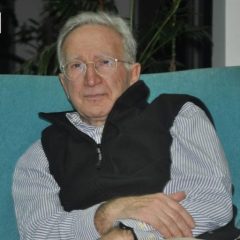 Jacob Cohen is a writer and lecturer born in 1944. Polyglot and traveler, anti-Zionist activist, he was a translator and teacher at the Faculty of Law in Casablanca. He obtained a law degree from the Faculty of Casablanca and then joined Science-Po in Paris where he obtained his degree in Science-Po as well as a postgraduate degree (DES) in public law. He lived in Montreal and then Berlin. In 1978, he returned to Morocco where he became an assistant lecturer at the Faculty of Law in Casablanca until 1987. He then moved to Paris where he now focuses on writing. He has published several books, including « Le commando de Hébron » (2014), « Dieu ne repasse pas à Bethléem » (2013), « Le printemps des Sayanim » (2010), « L’espionne et le journaliste » (2008), « Moi, Latifa S. » (2002).
He has a blog and performs on YouTube where he discusses various topics.
Mohsen Abdelmoumen is an independent Algerian journalist. He has written for several Algerian newspapers such as Alger Républicain and in different sites of the alternative press.
Palestinian Christians
By Jonathon Cook | Americans for Middle East Understanding | Volume 53 2020
It was inevitable that when the coronavirus pandemic reached the occupied Palestinian territories, as it did in early March, it would find its first purchase in Bethlehem, a few miles south-east of Jerusalem in the occupied West Bank.
Staff at the Angel Hotel in Beit Jala, one of Bethlehem’s satellite towns, tested positive after they were exposed to a group of infected Greek tourists. Israel worked hurriedly with the Palestinian Authority – the Palestinians’ permanent government-in-waiting in the occupied territories – to lock down Bethlehem. Israel was fearful that the virus, unlike the city’s Palestinian inhabitants, would be difficult to contain. Contagion might spread quickly to nearby Palestinian communities in the West Bank, then to Jewish settlements built illegally by Israel on Bethlehem’s lands, and finally on into Israel itself.
The Palestinian territories were under a form of lockdown long before the arrival of the coronavirus, however. Israel, the occupying power, has made sure that the entire Palestinian population is as isolated from the world as possible – their voices silenced, their experiences of oppression and brutality at Israel’s hands near-invisible to most of the Israeli public and to outsiders.
But Bethlehem, the reputed site of Jesus’s birth 2,000 years ago, is the one Palestinian area – outside East Jerusalem, which has been illegally annexed by Israel – that has proved hardest for Israel to hermetically seal off. During visits to the Church of the Nativity, tourists can briefly glimpse the reality of Palestinian life under occupation.
Some 15 years ago Israel completed an 26 foot-high concrete wall around Bethlehem. On a typical day – at least, before coronavirus halted tourism to the region – a steady stream of coaches from Jerusalem, bearing thousands of Christian pilgrims from around the world, came to a stop at a gap in the concrete that served as a checkpoint. There they would wait for the all-clear from surly Israeli teenage soldiers. Once approved, the coaches would drive to the Nativity Church, their passengers able to view the chaotic graffiti scrawled across the wall’s giant canvas, testifying to the city’s imprisonment and its defiance.
Like the plague-bearing Greeks, visitors to Bethlehem could not avoid mixing, even if perfunctorily, with a few locals, mostly Palestinian Christians. Guides showed them around the main attraction, the Church, while local officials and clergy shepherded them into queues to be led down to a crypt that long ago was supposedly the site of a stable where Jesus was born. But unlike the Greek visitors, most pilgrims did not hang around to see the rest of Bethlehem. They quickly boarded their Israeli coaches back to Jerusalem, where they were likely to sleep in Israeli-owned hotels and spend their money in Israeli-owned restaurants and shops.
For most visitors to the Holy Land, their sole meaningful exposure to the occupation and the region’s native Palestinian population was an hour or two spent in the goldfish-bowl of Bethlehem.
In recent years, however, that had started to change. Despite the wall, or at times because of it, more independent-minded groups of pilgrims and lone travelers had begun straying off grid, leaving the Israeli-controlled tourism trail. Rather than making a brief detour, they stayed a few nights in Bethlehem. A handful of small, mostly cheap hotels like the Angel catered to them, as did restaurants and souvenir stores around the church.
In tandem, a new kind of political tourism based in and around Bethlehem had begun offering tours of the wall and sections of the city, highlighting the theft of the city’s land by neighboring Jewish settlements and the violence of Israeli soldiers who can enter Bethlehem at will.
 A few years ago, the famous anonymous British graffiti artist Banksy gave a major boost to this new kind of immersive tourism by allying with a Bethlehem tour guide, Wisam Salsa, to open the Walled-Off Hotel. They converted an old building boxed in by the wall, liberally sprinkling it with Banksy’s subversive artworks about the occupation, as well as installing a gallery exhibiting the work of Palestinian artists and a museum detailing the occupation’s history and Israel’s well-tested methods of control and repression.
Admittedly, few visitors managed to get a room in Banksy’s small hotel, but many more came to sit in the lobby and sip a beer, produced by one of a handful of newly emerging breweries run by Christian Palestinians, or add some graffiti to the wall just outside with the help of a neighboring art supplies shop.
Before coronavirus, the Walled-Off offered daily tours of Aida, a refugee camp attached to Bethlehem, whose inhabitants were expelled from some of the more than 500 Palestinian communities Israel erased in 1948 – in the Nakba, or Catastrophe – to create a Jewish state on their homeland. There, visitors not only learned about the mass dispossession of Palestinians, sponsored by the western powers, that made Israel’s creation possible, but they heard the camp’s inhabitants tell of regular violent, night-time raids by Israeli soldiers and of the daily struggle for survival when Israel tightly controls and limits essentials like water.
Until the coronavirus did Israel’s work for it, Israeli authorities had noted with growing concern how more tourists and pilgrims were staying in Bethlehem. According to Israeli figures, there are about a million tourist overnights annually in Bethlehem. And that figure was growing as new hotels were built, even if the total was still a tiny fraction of the number of tourists staying in Israel and Israeli-ruled East Jerusalem.
The new trend disturbed the Israeli authorities. Bethlehem was proving an Achilles’ heel in Israel’s system of absolute control over the Palestinians for two reasons.
First, it brought money into Bethlehem, providing it with a source of income outside Israel’s control. The Israeli authorities have carefully engineered the Palestinian economy to be as dependent on Israel as possible, making it easy for Israel to punish Palestinians and the PA economically for any signs of disobedience or resistance. Aside from its tourism, Bethlehem has been largely stripped of economic autonomy. After waves of land thefts by Israel, the city now has access to only a tenth of its original territory, and has been slowly encircled by settlements. The city’s residents have been cut off from their farmland, water sources and historic landmarks. Jerusalem, once Bethlehem’s economic and cultural hinterland, has become all but unreachable for most residents, hidden on the other side of the wall. And those working outside the tourism sector need a difficult-to-obtain permit from Israel’s military authorities to enter and work in low-paying jobs in construction and agriculture inside Israel, the settlements or occupied Jerusalem. Israel’s second ground for concern was that foreign visitors staying in Bethlehem were likely to learn first-hand something of the experiences of the local population – more so than those who simply made a brief detour to see the church. A self-serving narrative about Palestinians central to Israeli propaganda – that Israel stands with the west in a Judeo-Christian battle against a supposedly barbaric Muslim enemy – risked being subverted by exposure to the reality of Bethlehem. After all, anyone spending time in the city would soon realize that it includes Palestinian Christians only too ready to challenge Israel’s grand narrative of a clash of civilizations.
From Israel’s point of view, a stay in Bethlehem might also open tourists’ eyes in dangerous ways. They might come to understand that, if anyone was behaving in a barbaric way and provoking an unresolvable, religiously inspired clash, it was not Palestinians – Muslim or Christian – but Israel, which has been brutally ruling over Palestinians for decades.
For both reasons, Israel wished to prevent Bethlehem from becoming a separate, rival hub for tourism. It was impossible to stop pilgrims visiting the Church of the Nativity, but Israel could stop Bethlehem developing its own tourism industry, independent of Israel. The wall has been part of that strategy, but it failed to curb the development of new tourism ventures – and in some cases, as with the Banksy hotel, had actually inspired alternative forms of tourism.
In early 2017 the Israeli authorities finally acted. The daily Haaretz newspaper revealed that the interior ministry had issued a directive to local travel agencies warning them not to allow their pilgrimage groups to stay overnight in Bethlehem, with the implication that the firms risked losing their licenses if they did so. According to Haaretz, the government claimed that “potential terrorists were traveling with groups of tourists”.
Bethlehem is lucky that, unlike other Palestinian communities, it has allies Israel cannot easily ignore. Haaretz’s exposure of the new policy led to a rapid backlash. International churches, especially the Vatican, were worried that it was the thin end of a wedge that might soon leave the City of the Nativity off-limits to its pilgrims. And Israeli travel agencies feared their business would suffer. Pilgrim groups from poorer countries that could not afford Jerusalem’s high prices, especially for accommodation, might stop coming to the Holy Land.
As one agent told Haaretz : “The meaning of a letter like this is the end of incoming tourism from India, Sri Lanka, Indonesia and eastern European countries like Poland, Slovakia and Ukraine. All the tourists who visit Israel and sleep in Bethlehem are doing that primarily to reduce costs.” The loss of such tourists not only threatened to deprive Bethlehem of the benefits of tourism but threatened Israel’s much larger tourism sector. Soon afterwards, the Israeli authorities backtracked, saying the directive had been a draft issued in error.
Why the Shrinkage?
Bethlehem’s plight – a microcosm of the more general difficulties faced by Palestinians under occupation – offers insights into why the region’s Palestinian Christian population has been shrinking so rapidly and relentlessly.
The demographics of Bethlehem offer stark evidence of a Christian exodus from the region. In 1947, the year before Israel’s creation, 85 percent of Bethlehem’s inhabitants were Christian. Today the figure stands at 15 percent. Christians now comprise less than 1.5 percent of the Palestinian population in the West Bank – some 40,000 of a population of nearly 3 million – down from 5 percent in the early 1970s, shortly after Israel occupied the territory in 1967.
In 1945 Bethlehem had nearly 8,000 Christian residents, slightly more than the 7,000 who live there today. Natural growth should mean Bethlehem’s Christian population is many times that size. There are, in fact, many times more Palestinian Christians overseas than there are in historic Palestine. The 7,000 Christians of Beit Jala, next to Bethlehem, are outnumbered by more than 100,000 family members who have moved to the Americas.
Israel ostensibly professes great concern about this decline, but actually it is only too happy to see native Christians depart the region. Their exodus has helped to make Israel’s clash of civilizations narrative sound more plausible, bolstering claims that Israel does indeed serve as a rampart against Muslim-Arab terror and barbarism. Israel has argued that it is helping Christian Palestinians as best it can, protecting them from their hostile Muslim neighbors. In this way, Israel has sought to mask its active role in encouraging the exodus.
The rapid decline in the numbers of these Christians reflects many factors that have been intentionally obscured by Israel. Historically, the most significant is that Palestinian Christians were nearly as badly impacted as Palestinian Muslims by the mass expulsions carried out by Zionist forces in 1948. In total, some 80 percent of all Palestinians living in what became the new state of Israel were expelled from their lands and became refugees – 750,000 from a population of 900,000. Those forced into exile included tens of thousands of Christians, amounting to two-thirds of the Palestinian Christian population of the time.
Palestinian Christians who remained in historic Palestine – either in what had now become Israel or in the territories that from 1967 would fall under Israeli occupation – have naturally shrunk over time in relation to the Muslim population because of the latter’s higher birth rates. Palestine’s Christians mostly lived in cities. Their urban lifestyles and generally higher incomes, as well as their greater exposure to western cultural norms, meant they tended to have smaller families and, as a result, their community’s population growth was lower.
But rather than acknowledge this historical context, Israeli lobbyists seek to exploit and misrepresent the inevitable tensions and resentments caused by the mass displacements of the Nakba, developments that had a significant impact on traditionally Christian communities like Bethlehem. During the events of 1948, as rural Palestinian villages were ethnically cleansed by Zionist forces, the refugees sought shelter either in neighboring states like Lebanon, Syria and Jordan, or in West Bank cities.
Bethlehem found its demographics transformed: an 85 percent Christian majority before the Nakba has been reversed into an 85 percent Muslim majority today. These dramatic social and cultural upheavals – turning the city’s majority population into a minority – were not easy for all Bethlehem’s Christian families to accept. It would be wrong to ignore the way these changes caused friction. And the resentments have sometimes festered because they are incapable of resolution without addressing the source of the problem: Israel’s mass dispossession of Palestinians, and the continuing tacit support for these abuses by the international community.
Given this context, it has been easy for inter-family rivalries and conflicts that are inevitable in a ghettoized, overcrowded community like today’s Bethlehem to be interpreted by some members of the minority group as sectarian, even when they are not. The lack of proper law enforcement in Palestinian areas in which Israel rather than the PA is the ultimate arbiter of what is allowed has left smaller Christian families more vulnerable in conflicts with larger Muslim families. In the competition for diminishing resources, family size has mattered. And whereas globalization has tended to encourage increased identification among Palestinian Christians with the west and its more secular norms, the same processes have entrenched a religious identity among sections of the Muslim population who look to the wider Middle East for their ideas and salvation. Consequently, a cultural gap has widened.
These problems exist but it would be wrong to exaggerate them – as Israel’s loyalists wish to do – or to ignore who is ultimately responsible for these tensions. That is not a mistake most Palestinian Christians make. In a recent survey of Christians who have emigrated, very few pointed to “religious extremism” as the reason for leaving the region – just 3 percent. The overwhelming majority cited reasons relating in some way to Israel’s continuing malevolent role in controlling their lives. A third blamed a “lack of freedom”, a quarter “worsening economic conditions”, and 20 percent “political instability.”
To make sense of the specific problems faced by the Christian community, other historical contexts need to be understood. Palestinian Christians break down into four broad communities. The first is the Eastern Orthodox Churches, dominated by the Greek Orthodox. The second is the Catholic Churches, led by the “Latin” community that looks towards Rome, although they are outnumbered among Palestinians by Greek and Syrian Catholics. The third category is the Oriental Orthodox churches, which include the Copts, Armenian and Syrian Orthodox. And finally, there are various Protestant Churches, including the Anglicans, Lutherans and Baptists.
Long before Israel’s creation on most of the Palestinians’ homeland, Christians were concentrated in and around Palestine’s urban centers. In Jerusalem, Bethlehem and Nazareth, large numbers of Christians coalesced around sites associated with Jesus’s life. This tendency was reinforced as Palestine’s cities flourished and expanded from the 18th century onwards under Ottoman rule. The Ottomans encouraged the immigration of Christians to these centers of worship and cultivated a confessional system that made conditions attractive for the foreign Churches.
The result was a relatively privileged urban Christian population that consisted largely of merchants and traders, and benefited from the resources poured in by the international Churches as part of their missionary work, including schools and hospitals. Christians were typically wealthier, better educated and healthier than their Muslim counterparts often living nearby in isolated rural communities as peasant farmers. In addition, Christian families had good connections to the international Churches through local clergy, as well as the staff of Church-run schools and hospitals.
Those differences have proved significant as Palestinian Christians and Muslims alike have struggled under Israeli colonization, whether inside Israel’s internationally recognized borders or in the occupied territories.
Israel’s institutionalized racism towards Palestinians – systematic land thefts, uninhibited state and settler violence, as well as restrictions on movement and the denial of educational and employment opportunities – have put pressure on all Palestinians to leave. But Christians have enjoyed significant advantages in making their escape. They could tap their connections in the Churches to help them settle abroad, chiefly in the Americas and Europe. And that path was made easier for many given that relatives had already established lives overseas following the mass expulsions of 1948. As a result, the emigration of Palestinian Christians is generally reckoned to have been around twice that of Muslims.
Israel’s oft-repeated claim that Hamas and the Palestinian Authority are responsible for the exodus of Christians out of the Holy Land is given the lie simply by examining the situation of Palestinian Christians both inside Israel, where neither Hamas nor the PA operate, and in East Jerusalem, where the influence of both has long been negligible. In each of those areas, Israel has unchallenged control over Palestinians’ lives. Yet we can see the same pattern of Christians fleeing the region.
And the reasons for Gaza’s tiny Palestinian Christian population, today numbering maybe only 1,000, to leave their tiny, massively overcrowded enclave, which has been blockaded for 13 years by Israel, barely needs examining. True, it has been hard for these Christians – 0.0005 percent of Gaza’s population – to feel represented in a territory so dominated by the Islamic social and cultural values embodied by the Hamas government. But there is little evidence they are being persecuted.
On the other hand, there is overwhelming proof that Gaza’s Christians are suffering, along with their Muslim neighbors, from Israel’s continuing violations of their most fundamental rights to freedom, security and dignity.
The picture in the West Bank, meanwhile, needs closer study. As noted, Palestinian Christians have generally enjoyed historic privileges over their Muslim compatriots that derive from their historic connections to the Churches. They have been able to exploit tourism as guides, drivers and guesthouse owners. They enjoy greater access to church-run schools and, as a consequence, improved access to higher education and the professions. They possess more valuable urban land, and many own shops and businesses in the cities. There are both Muslim and Christian lawyers, shopkeepers and business owners, of course, but proportionately more Christians have belonged to the middle classes and professions because of these various advantages.
While Israel’s occupation policies have harshly impacted all Palestinians, some have been hit harder than others. And those who have tended to suffer most live not in the main cities, which are under very partial Palestinian rule, but in rural areas and in the refugee camps. Those in the camps, in places such as Aida, next to Bethlehem, lost their lands and property to Israel and have had to rebuild their lives from scratch since 1948. Those living in isolated farming communities designated by the Oslo accords as “Area C” (a temporary designation that has effectively become permanent) are fully exposed to Israel’s belligerent civil and military control.
The residents of these communities have few opportunities to earn a living and have been most vulnerable to Israeli state and settler violence, as well as land thefts and the severe water restrictions imposed by Israel. In practice, these precarious conditions are endured disproportionately by Muslim Palestinians rather than Christians.
Nonetheless, Israel’s policies have increasingly deprived urban Christian families of the opportunities they had come to expect – the kind of opportunities westerners take for granted. And significantly, unlike many Muslim Palestinians, Christians have continued to enjoy one privilege: an escape route out of the region to countries where they have a chance to live relatively normal lives.
The damage to Christian life has been felt particularly keenly in relation to movement restrictions – one of the ways Israel has established a system of near-absolute control over Palestinian life. Those involved in trade and business, as many Christians are, have struggled to succeed as those restrictions have intensified over the past quarter-century, since the introduction of measures under the Oslo accords. An elaborate system of checkpoints and permits was established to control Palestinians’ freedom to move around the occupied territories and to enter Israel in search of work. Over time the system was enforced by a lengthy steel and concrete “separation barrier” that Israel began building nearly two decades ago.
Taybeh’s Beer Challenge
Typifying the difficulties of trading under these circumstances is the Taybeh micro-brewery in a West Bank village of the same name, in a remote location north of Ramallah overlooking the Jordan Valley. Taybeh is exceptional: its 1,300 inhabitants comprise the last exclusively Christian community in the occupied territories. The village – its name means both “good” and“delicious” in Arabic – is reputedly on the Biblical site of Ephraim. A small church marks the spot where Jesus reputedly retired with his disciples shortly before heading to Jerusalem, where he would be crucified. Taybeh has its own Roman Catholic and Greek Orthodox schools, and a Catholic nursing home.
 Nonetheless, Taybeh has long been in demographic meltdown. Today, its population is dwarfed by those of its diaspora: some 12,000 former residents and their descendants live abroad, mostly in the United States, Chile and Guatemala. Daoud and Nadim Khoury, two brothers who were themselves raised in the US, established the Taybeh brewery shortly after their return to the West Bank village under the Oslo accords. The business depended on the experiences and connections they had gained abroad.
For them, developing a sustainable business like the brewery was a way to halt and reverse the gradual demise of their village and the loss of its Christian heritage. They feared that any further decline in numbers would leave Taybeh’s lands and its ancient olive groves vulnerable to takeover by the three Jewish settlements that surround the village. The business was seen as a way to save Taybeh.
Maria Khoury, Daoud’s Greek wife, whom he met at Harvard, says the conditions of village life have continued to deteriorate. Unemployment stands at 60 percent, and Israel shuts off the water four times a week to preserve supplies for the Jewish settlements. The drive to the nearest Palestinian city, Ramallah, takes five times longer than it did 20 years ago – when it took little more than 15 minutes. That was before checkpoints and roadblocks were established on local roads to protect the settlers.
The Khourys have succeeded in their ambition to develop a range of award-winning beers made to the highest purity standards. The family has expanded into making boutique wines, and has built a prestige hotel in the village center, belying Taybeh’s small size. An annual Oktoberfest, modeled on German beer-drinking celebrations, has helped to put the remote village on the map. And a few restaurants have opened as Taybeh has tried to reinvent itself, with limited success, as a weekend-break destination.
But despite all these achievements, their larger ambitions have been foiled. Movement restrictions imposed by Israel’s military authorities have stymied efforts at growing the business. With a domestic market limited by opposition to alcohol consumption among most of the Palestinian population, Taybeh brewery has depended chiefly on exports to Europe, Japan and the US. But the difficulties of navigating Israel’s hostile bureaucracy have sapped the business of money, time and energy, making it hard to compete with foreign breweries.
Daoud told me at one Oktoberfest that the brewery faced Israeli “harassment in the name of security.” He noted that even when the crossing points were open, Israel held up the company’s trucks for many hours while bottles were unloaded and individually inspected with sniffer dogs. Then the bottles had to be reloaded on to Israeli trucks on the other side of the checkpoint. Apart from local spring water, all the beer’s ingredients and the bottles have to be imported from Europe, adding further logistical problems at Israeli ports. The ever-creative Khourys have been forced to circumvent these problems by licensing a plant in Belgium to produce its beers for foreign export. But that has deprived the village of jobs that could have gone to local families.
And while the Khourys struggle to get their products into Israel, Israel has absolute freedom to flood the occupied territories with its own goods. “The policy is clearly meant to harm businesses like ours. Israel freely sells its Maccabee and Goldstar beers in the West Bank,” Daoud told me.
Such experiences are replicated for Palestinian businesses, big and small, across the West Bank.
In Jerusalem, the Christian population has been shrinking too, even though the city has been entirely under Israeli control since its eastern neighborhoods were occupied and illegally annexed by Israel in 1967. The Palestinian Authority was briefly allowed a minimal presence in East Jerusalem in the late 1990s, but was effectively banished when the second intifada erupted a few years later, in 2000. A similar fate soon befell Jerusalem’s politicians associated with Hamas. After they won the Jerusalem seats in the 2006 Palestinian legislative elections, Israel expelled them to the West Bank.
Perhaps unsurprisingly, Israel has not been keen to provide official figures for the exodus of Christians from Jerusalem. However, rather than growing, as one would have expected over the past five decades, the numbers have dropped significantly – from 12,000 in 1967 to some 9,000 today, according to Yousef Daher, of the Jerusalem Interchurch Center, located in Jerusalem’s Old City. Of those, he estimated that no more than 2,400 remained in the Christian Quarter of the Old City, where Israel has made life especially difficult.
Jerusalem is historically, symbolically, spiritually and economically important to the Palestinian people, and houses key Muslim and Christian holy sites. It has long been regarded by Palestinians as the only possible capital of their future state. But Israel views the city in much the same terms – as the religious and symbolic heart of its hybrid religious and ethnic national project. It has shown no interest in sharing the city as a capital, and has instead viewed it in zero-sum terms: whatever benefits Israel requires a loss to the Palestinians.
Gradually Israel’s stranglehold over Jerusalem has become complete. The wall it began building through the city more than 15 years ago has not only separated Palestinians in Jerusalem from Palestinians in the West Bank but has divided the city itself, placing more than 100,000 Palestinians on the wrong side, cutting them off from the city of their birth.
Two years ago, President Donald Trump added a US seal of approval by recognizing Jerusalem as Israel’s capital and moving the US embassy there.
Those Palestinians in occupied East Jerusalem still on the “Israeli” side of the wall have found themselves isolated and ever more vulnerable to the abuses inherent in Israel’s system of control. They have suffered planning restrictions that make it almost impossible to build homes legally. Israel demolishes dozens of Palestinian houses every year in the city, leading to ever greater overcrowding. Meanwhile, Israel has seized vast tracts of land in East Jerusalem for its illegal settlements and has helped Jewish settlers take over Palestinian homes.
The city’s security forces act as an occupying power in Palestinian neighborhoods, while city authorities pursue an official policy of “Judaization,” making Jerusalem more Jewish. Israel has accorded the city’s native Palestinian population a “residency” status that treats them as little more than immigrants. Many thousands who have left the city for extended periods to study or work abroad have returned to find their residency permits revoked.
The city’s Christian residents face similar problems to Muslims. But as a very small community, they have also faced specific pressures. Israel’s policy of cutting off Jerusalem from the West Bank, and especially from the nearby cities of Bethlehem and Ramallah, has left the city’s Christians particularly isolated. With many working as merchants and traders, the so-called “separation” policy has hit them hard economically.
Similarly, because the communal marriage pool is small for Christians in Jerusalem, many have been forced – at least, before the wall was erected – to search for a spouse among Christian populations nearby in the West Bank. That now leaves them disproportionately exposed to Israel’s increasingly draconian family unification policies. Typically Jerusalem’s Palestinians are denied the right to live with a West Bank spouse in the city, or to register the children of such marriages as Jerusalem residents. That has forced many to move into the West Bank or abroad as the only way to stay together.
As in Bethlehem, many of Jerusalem’s Christians work in tourism, either as tour guides or as owners of souvenir shops in the Old City’s Christian Quarter. That has proved a particularly precarious way to make a living in recent decades, with tourism collapsing on repeated occasions: during two lengthy intifadas, during Israel’s attacks on Gaza, and now from the coronavirus.
Israel will soon make it even harder for the Old City traders to make a living, when it completes a cable car into East Jerusalem. Currently many tourists enter via Jaffa Gate into the Christian Quarter, where shopkeepers have a chance to sell them goods and souvenirs. But the cable car will “fly in” tourists from a station in West Jerusalem directly to an illegal settlement complex at the City of David in Silwan, just outside the Old City walls. From there, either they will be guided straight into the Jewish Quarter through Dung Gate or they will pass through a network of underground passages lined with settler-owned shops that will take them to the foot of the Western Wall. The aim appears to be not only to make the Old City’s Palestinian population invisible but to deprive them of any chance to profit from tourism.
Land Sales by Churches
But the problem runs deeper still for Palestinian Christians – and is felt especially acutely in Jerusalem. Local Christians have found themselves effectively pawns in a three-way international power-play between Israel, the established, land-owning Churches in the region, primarily the Vatican and Greek Orthodox Churches, and the evangelical movements. None of the parties represent their interests.
It is easy for pilgrims to ignore the fact, as they tour the Holy Land, that the Roman Catholic and Greek Orthodox Churches are not local. They are vast foreign enterprises, based out of the Vatican and Greece, that are as concerned with their commercial viability and diplomatic influence on the global stage as they are with the spiritual needs of any specific flock, including Palestinian Christians. And in recent years that has become increasingly evident to local congregations.
The problems were symbolized two years ago when, for the first time in living memory, the main Churches shuttered the doors of the Church of the Holy Sepulcher, the presumed site of Jesus’ crucifixion in Jerusalem. Church leaders said their actions were in response to Israel launching a “systematic and unprecedented attack against Christians in the Holy Land.” In that way, they mobilized international sympathy, and Israel quickly backed down. But only in the most tangential sense were the Churches looking out for the interests of local Christians. Their show of force was actually motivated by concern for their business interests.
The then mayor of Jerusalem, Nir Barkat, had sought to impose back taxes on the Churches’ substantial land-holdings in Jerusalem, hoping to recoup $180 million. Despite the impression presented by Church leaders, the row was not really about holy sites. Over the centuries, the Churches have become major real-estate enterprises in the Holy Land, benefiting from donations of land and properties in Jerusalem and elsewhere that have been made by Palestinian Christians and overseas pilgrims. The Greek Orthodox Church, for example, is the largest land-owner in the region after the Israeli state.
Historically, the Churches enjoyed a tax exemption derived from the charitable status of their spiritual mission and outreach work with Palestinian communities, including the provision of schools and hospitals. But increasingly the Churches have downgraded their charitable works and diversified into other, more clearly commercial ventures, such as shops, offices and restaurants. Pilgrimage hostels have been redeveloped into well-appointed and profitable hotels. Part of the income has then been siphoned off to the Church authorities in the mother countries rather than reinvested in strengthening local Palestinian communities.
That was why Aleef Sabbagh, a Palestinian member of the Orthodox Central Council, described the Holy Sepulcher protest as a “charade.” The Church had not been closed to protest Israel’s savagery towards Palestinians during either of the two intifadas, or in protest at the exodus of local Christians from the region. The foreign Churches found their voice only when they needed to protect their profits from real-estate and investment deals.
That does not, however, mean that Palestinian Christians have no reason to be concerned about Israel’s efforts to bully the Churches’ into paying more taxes, or that they were indifferent to the brief stand-off at the Sepulcher Church. The Vatican and Orthodox Patriarchate have become increasingly cowed in relation to Israel in recent decades, both as Israel has become ever more assertive of its powers in the region and as western states have shown they will support Israel however badly it treats Palestinians.
Israel has many points of leverage over the international Churches. It can, and has, frozen clerical work visas needed by their thousands of staff in the Holy Land. Israel regularly obstructs planning permits for the Church needed to build or renovate properties. And far-right groups close to Israel’s governing coalition regularly menace clergy in the streets and vandalize Church property, including cemeteries, under cover of dark. Israeli police have rarely caught or punished the perpetrators of such attacks.
 Most notable of these attacks was a fire set by arsonists in 2015 that gutted sections of the Church of the Multiplication, the site on the shore of the Sea of Galilee where Jesus is reputed to have fed a large crowd with loaves and fishes. Graffiti in Hebrew scrawled on a church wall read: “Idol-worshippers will have their heads cut off.”
This strategy of weakening and intimidating the international Churches has been particularly glaring in relation to Orthodoxy. Each new Patriarch, the highest Orthodox figure in the region, must be jointly approved by the Palestinian Authority, Jordan and Israel. And in the case of the last two Patriarchs, Irineos I and Theophilos III, Israel, unlike the PA and Jordan, has dragged its heels before approving their appointment. Irineos had to wait nearly four years, and Theophilos two and a half. The reason why has gradually become clear to local Christians.
Shortly after each Patriarch has belatedly received approval, evidence has come to light that his advisers have overseen the sale of some of the Churches’ vast landholdings in Israel and the occupied territories. These shadowy deals, usually selling invaluable land for a comparative pittance, have been made to Israeli companies or overseas organizations that it has later emerged acted as a front for Jewish settler groups.
The most infamous case concerns the sale to settlers of two large properties, serving as Palestinian-run hotels, at a highly strategic location by Jaffa Gate, the entrance into the Christian Quarter of Jerusalem’s Old City. These sales appear to be part of the price paid for Irineos to win Israeli approval. Israel has long been keen to Judaize Jaffa Gate because it effectively serves as a bridge between West Jerusalem, in Israel, and the Jewish Quarter, the main settler colony in the occupied Old City. Reporting on the land sales at Jaffa Gate, the Haaretz newspaper revealed tape recordings of a Jerusalem settler leader boasting that his organization, Ateret Cohanim, had a veto over the appointment of each Patriarch. He said Ateret Cohanim would only give its blessing once the Patriarch had sold it land.
The pattern appears to have repeated with Theophilos, who is accused of selling numerous plots of land near Bethlehem, West Jerusalem, Jaffa, Haifa, Nazareth and Caesarea. The Church is reported to have pocketed more than $100 million from the deals. In 2017 some 300 Palestinian Christians filed a criminal complaint to the Palestinian attorney general in Ramallah, accusing the Patriarch of “treason.” The same year, 14 local Orthodox institutions – representing many of the half a million Greek Orthodox Christians in the occupied territories, Israel and Jordan – severed ties with Theophilos and his synod, and demanded his removal.
Palestinian Christians have increasing grounds for concern that the Churches are not looking out for their interests when they make these deals. Historically, lands were donated to the Greek Orthodox Church as an endowment, and the income used for the collective good of the Orthodox community in the Holy Land. But local communities say the money is nowadays siphoned off to the foreign Church authorities.
Further, nearly a quarter of land in East Jerusalem is reported to be Church-owned, including the Mount of Olives, Sheikh Jarrah and large swaths of the Old City. Many Palestinian Christians live in these areas, which are being aggressively targeted by the settler movement. Local Christians have little faith that the Church will not sell these lands in the future, leaving them vulnerable to eviction by settlers.
Atallah Hanna, the only Palestinian serving as a Greek Orthodox archbishop, has been repeatedly punished for speaking out against the Patriarch’s policies. He issued a statement about the land sales at Jaffa Gate: “Those who sell and forfeit our real estate and Orthodox endowments do not represent our Arab Church, its heritage, identity and historical presence in this holy land.”
The effort to financially “squeeze” the Churches by the Jerusalem mayor in 2018 should be seen in this light. If the Churches face big new tax bills, the pressure will increase on them over the longer term either to be more submissive to Israel, for fear of attracting additional taxes, or to sell off yet more land to cover their debts. Either way, Palestinian Christians will suffer.
An Obstacle to the End-Times
A separate essay could be written about the role of overseas Christian evangelical movements in damaging the situation of Palestinian Christians. Suffice it to point out that most evangelical Christians are largely indifferent to the plight of the region’s local Christian population.
In fact, Zionism, Israel’s state ideology, draws heavily on a Christian Zionism that became popular among British Protestants more than 150 years ago. Today, the heartland of evangelical Zionism is the United States, where tens of millions of believers have adopted a theological worldview, bolstered by prophecies in the Book of Revelation, that wills a Jewish “return” to the Promised Land to bring about an apocalyptic end-times in which Christians — and some Jews who accept Jesus as their savior — will be saved from damnation and rise up to Heaven.
Inevitably, when weighed against a fast-track to salvation, the preservation of Palestinian Christians’ 2,000-year-old heritage matters little to most US Christian Zionists. Local Christians regularly express fears that their holy sites and way of life are under threat from a state that declares itself Jewish and whose central mission is a zero-sum policy of “Judaization”. But for Christian Zionists, Palestinian Christians are simply an obstacle to realizing a far more urgent, divinely ordained goal.
US evangelicals have, therefore, been pumping money into projects that encourage Jews to move to the “Land of Israel,” including in the settlements in the occupied West Bank and East Jerusalem. Their leaders are close to the most hawkish politicians in Israel, such as Prime Minister Benjamin Netanyahu.
The political clout of the evangelical movements in the US, the world’s only superpower and Israel’s chief patron, has never been more evident. The vice-president, Mike Pence, is one of their number, while President Donald Trump depended on evangelical votes to win office. That was why Trump broke with previous administrations and agreed that the US would become the first country in modern times to move its embassy from Tel Aviv to Jerusalem, effectively killing any hope for the Palestinians of securing East Jerusalem as their capital.
Given this international atmosphere, the isolation of Palestinian Christians and their leaders is almost complete. They find themselves marginalized within their own Churches, entirely ignored by foreign evangelical movements, and an enemy of Israel. They have therefore tried to break out of that isolation both by forging greater unity among themselves and by setting out a clearer vision to strengthen ties to Christians outside the Holy Land.
One important milestone on that path was the publication of the Kairos Palestine document in December 2009, drawing on a similar document drafted by mainly black theologians in apartheid South Africa in the 1980s. Kairos Palestine, which describes itself as “the Christian Palestinians’ word to the world about what is happening in Palestine,” has been signed by more than 3,000 leading Palestinian Christian figures, including Atallah Hanna, the Greek Orthodox Archbishop for the Sebastiya diocese; Naim Ateek, a senior Anglican priest; Mitri Raheb, a senior Lutheran pastor; and Jamal Khader, a senior figure in the Latin Patriarchate.
The Kairos document calls unequivocally on “all the churches and Christians in the world … to stand against injustice and apartheid” and warns that “any theology, seemingly based on the Bible or on faith or on history, that legitimizes the occupation, is far from Christian teachings”. It asks Christians abroad to “revisit theologies that justify crimes perpetrated against our people and the dispossession of the land”. And further, it supports the wider Palestinian BDS call to boycott, divest and sanction Israel and those who conspire with the oppression of Palestinians. It describes non-violent resistance as a “duty” incumbent on all Palestinians, arguing that such resistance should end only when Israeli abuses end, not before.
Faced with inevitable accusations of antisemitism from Israel partisans in the west, most of the overseas Churches – including importantly, the World Council of Churches – have failed to respond to this Palestinian Christian call. Only the Presbyterian Church in the US has endorsed the document, while the United Church of Christ has praised it. Predictably, Israel lobbyists have tried to undermine the document’s significance by correctly highlighting that the foreign Church leaderships in Palestine, such as the Greek Orthodox Patriarch, have refused to endorse it. But then, these kind of Church leaders have rarely had the interests of their Palestinian congregations foremost in their minds.
Nonetheless, Israel is deeply concerned by the document. Were it to be accepted, it would bring the international Churches onboard with the wider Palestinian BDS movement, which calls for an international boycott of Israel. Israeli leaders deeply fear the precedent set by the international community’s treatment of apartheid South Africa.
Of the three planks of the BDS campaign, the most troubling for Israel are not the boycott or sanctions components, but the threat of divestment – the withdrawal of investments from Israel by Churches, civil society organizations, trade unions and pension funds. Were the Churches to adopt BDS, such actions could quickly gain a moral legitimacy and spread. The Kairos document is therefore viewed as the thin end of a very dangerous wedge.
 Atallah Hanna, as the most senior cleric to have signed the document, has found himself particularly in the crosshairs from Israel. In December last year he ended up in hospital in Jordan, treated for “poisoning by chemical substance,” after a tear gas canister was reportedly thrown into the grounds of his church in Jerusalem. In the circumstances, Hanna’s claim that Israel had tried to “assassinate,” or at the very least incapacitate, him resonated with many Palestinians.
Certainly Hanna has found himself repeatedly in trouble with the Israeli authorities for his Palestinian activism. In 2002, during the second intifada, for example, he was seized at his home in the Old City of Jerusalem and charged with “suspicion of relations with terrorist organizations,” a trumped-up allegation relating to the fact that he had spoken in favor of the popular uprising against Israeli occupation.
In a meeting with a foreign delegation last year, Hanna warned that Israel, with the support of the international community, was being allowed to gradually transform Jerusalem: “The Islamic and Christian holy sites and endowments are targeted in order to change our city, hide its identity and marginalize our Arabic and Palestinian existence.”
Unwelcome Israeli Citizens
The final community of Palestinian Christians to consider is the largest group, and the one most often overlooked: the 120,000 living in Israel with a degraded form of citizenship. These Palestinians have been exclusively under Israeli rule for more than 70 years. Israel falsely trumpets the claim that its Palestinian minority enjoys exactly the same rights as Jewish citizens. And yet the decline in the number of Palestinian Christians in Israel closely mirrors the situation of those in the occupied territories.
The Palestinian Christian population emerged from the events of 1948 in relatively better shape than their Muslim compatriots inside the territory that was now considered Israel. Aware of western states’ priorities, Israel was more cautious in its approach to the ethnic cleansing of communities with large numbers of Christians. As a result, the 40,000 Christians in Israel at the end of the Nakba comprised 22 per cent of the country’s new Palestinian minority. A few years later members of this minority would gain a very inferior form of Israeli citizenship.
Israel’s early caution in relation to Palestinian Christians was understandable. It feared antagonizing the western, largely Christian states whose backing it desperately needed. That policy was typified in the treatment of Nazareth, which was largely spared the wider policy of expulsions. However, as with Bethlehem, Nazareth’s Christian majority began to be overturned during 1948, as Muslims from neighboring villages that were under attack poured into the city, seeking sanctuary. Today, Nazareth has a 70 per cent Muslim majority.
The proportion of Christians among the Palestinian population in Israel has fallen more generally too – from nearly a quarter in the early 1950s to about 9 percent today. There is a similar number of Druze, a vulnerable religious sect that broke away from Islamic orthodoxy nearly 1,000 years ago. The rest of Israel’s Palestinian population – over 80 per cent – are Sunni Muslim.
The Christian exodus has been driven by similar factors to those cited by Palestinians in the West Bank. Within a self-declared Jewish state, Christians have faced diminished educational and employment opportunities; they must deal with rampant, institutional discrimination; and, after waves of land confiscations to Judaize the areas they live in, they can rarely find housing solutions for the next generation. Israel has encouraged a sense of hopelessness and despair equally among Christians and Muslims.
Problematic for Israel has been the fact that Palestinian Christians have played a pivotal role in developing secular Palestinian nationalism in both the occupied territories and in Israel. For obvious reasons, they have been concerned that Palestinian national identity should not deform into a divisive Islamic identity, mirroring Israel’s own hybrid ethnic and religious nationalism.
Given the difficulties of political activism for Palestinians inside Israel — for decades it could lead to jail or even deportation — many, especially Christians, joined the joint Jewish-Palestinian Communist party, on the assumption that its Jewish cadre would ensure protection. The most prized benefit of membership of the Communist party were scholarships to universities in the former Soviet bloc. Israel’s segregated school system, which included a near-dysfunctional state system for Palestinians, ensured higher education in Israel was mostly off-limits.
The scholarships were a boon to Christians because they enjoyed access to surviving, private Church-run schools in cities like Nazareth, Haifa and Jaffa that offered a better education. But Israel’s hope was that, once outside the region, many would never return — and indeed, this did become an additional factor in the decline of Israel’s Palestinian Christian population.
Onward Christian soldiers
But the advantages enjoyed by Palestinian Christians soon came to be seen by Israel as a liability. The Christians lived mostly in cities. Many had the advantages of access to good schools and higher education. Some had been exposed to the wider world through attending universities abroad. And Christians enjoyed connections to sympathetic communities abroad. Their continuing presence in the Holy Land, as well as their articulation of Palestinian nationalism to outsiders, served to undermine Israel’s claims of a simple Judeo-Christian clash of civilizations with Islam.
It was in this context that in late 2012 Israel secretly revived plans to recruit into the Israeli army Christian youth in Nazareth and its environs, using Christian Scout groups as the vehicle. Neither Muslims nor Christians in Israel are drafted into the army on leaving school, unlike Jewish and Druze youngsters. However, they can volunteer, though in practice only a tiny number do. Figures suggest there are a few dozen Christian families, typically poorer ones, whose sons join the army. But from 2012 onwards, the Netanyahu government worked hard to introduce a draft for Christians, hoping to drive a wedge between Christians and Muslims in Israel.
Netanyahu schemed on several fronts. He aggressively promoted the small number of Christian families with children in the army to suggest that they were representative of the wider community. Meanwhile, he claimed that the overwhelming majority of Christians who publicly opposed his plan did so only because they had been intimidated by their Muslim neighbors.
 The Israeli media trumpeted too the fact that Netanyahu had recruited a “religious leader” – Jibril Nadaf, a Greek Orthodox bishop in Nazareth – to support the draft of Christians. In fact, it was widely rumored in Nazareth at the time that Nadaf was being pressured by Israel’s secret police, the Shin Bet, to offer his support. Only much later did the Israeli media report that Nadaf had been investigated for sexual assaults on young men, and that the Shin Bet had hushed up his case.
At around the same time Israel introduced the option of registering a new nationality, “Aramaic”, on Israeli identity cards. Israel has always refused to recognise an “Israeli” nationality because it would risk conferring equal rights on all Israeli citizens, Jews and Palestinians alike. Instead many rights in Israel are accorded to citizens based on their assigned nationalities – with the main categories being “Jewish”, “Arab” and “Druze”. “Jewish” nationals receive extra rights unavailable to Palestinian citizens in immigration, land and housing, and language rights. The new “Aramaic” category was intended to confer on Christians a separate nationality mirroring the Druze one.
The obscure “Aramaic” identity was chosen for two reasons. First, it referred to a time 2,000 years ago when Jews like Jesus spoke Aramaic – now almost a dead language. Aramaic therefore fused Jewish and Christian identities, replicating the claim of “blood ties” Israel had fostered with the Druze community. And second, Aramaic had already been cultivated as an identity by the handful of Palestinian Christian families that volunteered to serve in the army. For them, Aramaic lay at the heart of a pure, proud, supposedly original Christian nationalist identity. They argued that their forefathers’ Aramaic heritage and language had been usurped and corrupted by the arrival of Arab and Islamic identities in the region during the Arab conquests in the seventh century.
For those who promoted it, including the Israeli government, “Aramaic” was not a neutral Christian identity but consciously intended as an anti-Arab, anti-Muslim identity. It was intimately tied to the government’s larger, fanciful agenda of turning the local Christian population into Palestinian Christian Zionists.
In tandem with these developments, Netanyahu’s government also began aggressively squeezing the resources available to Church schools operating in Nazareth and elsewhere. An arrangement that had historically provided partial state funds for private religious schools, primarily to help the Jewish ultra-Orthodox, began to be progressively withdrawn from Church schools. Pupils in the dozen such schools in Nazareth, which serve both Christians and Muslims, staged an unprecedented strike in 2014 as it became harder for the schools to cover costs. The government offered a way out: the schools, it proposed, should come under the umbrella of the state education system. So far the Church schools have managed to resist.
Although the policy has not been implemented yet, there are indications of what Israel ultimately hoped to achieve. The aim, it seems, was to reinvent the Church schools as “Aramaic” schools, limiting the intake to Christians and teaching a curriculum, as with the Druze, that emphasized the “blood ties” between Jews and Christians and prepared pupils for the army draft. The first such school, teaching in Aramaic, has opened in Jish, a village in the central Galilee that is home to some of the main families that volunteer to serve in the Israeli army.
In fact, Israel failed dismally in its efforts to persuade Christians to accept the draft, and appears to have largely abandoned the plan, even after dedicating several years to bringing it to fruition. Israel should have guessed that such a scheme was unlikely to succeed. In a city like Nazareth, too many Christians are professionals – doctors, lawyers, architects and engineers serving their community – and have no interest in gaining the sole advantage of military service the poorer Druze have depended on: lowly jobs after the draft in the security sectors, as prison wardens or security guards.
But that may not have been Israel’s only goal. In line with its long-standing ambitions, Israel also doubtless wanted to intensify sectarian tensions between Christians and Muslims in places where the two communities live in close proximity, especially Nazareth. And for a variety of reasons, sectarian divisions have started to emerge over the past few years. The causes are manifold, but Israel’s efforts to recruit Christians to the army – to divide them from Muslims – undoubtedly exacerbated the problem.
Another significant factor was the gradual demise of the Communist party, especially in Nazareth, after it came to be too closely identified with Christians and was seen as playing a role in maintaining their relative privileges. That led to a backlash in Nazareth that saw Ali Salam, a populist politician who revels in comparisons with Donald Trump, becoming mayor after subtly exploiting these sectarian tensions.
It also did not help that for nearly two decades nihilistic Islamic movements edged ever closer to Israel’s borders – first with al-Qaeda, and later with Islamic State. That has unnerved many Palestinian Christians and Muslims in Israel. In recent years it has provoked a political reaction from some who have begun to wonder whether a militarily strong, western-backed Israel was not the lesser regional evil.
Israel has every interest in reinforcing such developments, exploiting tensions that shore up its clash of civilizations narrative. Paradoxically, it is Israel’s long-term interference in the region and a more recent policy of direct military intervention by the US in places such as Iraq, Afghanistan, Libya, Syria and Iran that has created the very conditions in which Islamic extremism has prospered. Between them, Israel and the US have sown despair and generated political voids across the Middle East that groups like Islamic State have filled with their own narrative of a clash of civilizations.
For Israel, recruiting Palestinian Christians to its side of this self-serving clash narrative – even if it is only a few of them – is helpful. If Israel can muddy the waters in the region by finding enough allies among local Christians, it knows it can further dissuade the international Churches from taking any substantive action in addressing the crimes it has perpetrated against Palestinians unhindered for more than seven decades.
Israel’s great fear is that one day the international Churches may assume moral leadership in resolving the Israeli-Palestinian conflict and ending the traumas set in train by the Nakba.
Judging by the Churches’ current record, however, Israel appears to have little reason to worry. ■
Featured Video
or go to
Aletho News Archives – Video-Images
Book Review
The Maidan Killings and the False-Flag Case
By Freddie Ponton | 21st Century Wire | September 5, 2026
Before the killings that helped bring down Ukraine’s president in February 2014, American diplomats were discussing who should enter its government. In a leaked telephone call, senior State Department official Victoria Nuland told US ambassador Geoffrey Pyatt, “I think Yats is the guy,” referring to opposition leader Arseniy Yatseniuk. Washington had clear preferences and was working to advance them. Later that month, Yatseniuk became prime minister.
Ivan Katchanovski’s The Maidan Massacre in Ukraine examines the violence that preceded that transfer of power. Drawing on television footage, witness testimony, forensic examinations and Ukrainian court proceedings, he argues that elements of the opposition shot protesters and police in a false-flag operation. His case centres on evidence of protesters being shot from opposition-controlled locations, including Hotel Ukraina, overlooking the killing ground. … continue
Blog Roll
 Aletho News
- France projects nuclear power as Macron pushes arsenal expansion
- The fallacy of US delusions about Iran’s economic collapse
- What changes with Lula or Flávio?
- Britain leads Western media’s demise through ‘fear porn’ narrative
- The Maidan Killings and the False-Flag Case
- Georgia’s Largest Healthcare System Will Fire Employees Who Refuse Flu Vaccine
- The Five-Year Fuel Crisis: Why the World Economy Is Paying for a War It Thinks Is Ending
- Trump’s Big Bluff on Iran
- Swiss scammed out of millions by Ukraine-linked call centers – media
- Germany facing potential ‘violent conflict’ with Russia – spy chief
- If Americans Knew
- Israeli Attacks Kill Two Palestinians in Gaza
- Gaza genocide at 3: Israeli-U.S. cruelty and the smart, deep resistance to it are changing the world
- As genocide is about to enter 3rd year, little of Gaza remains– Daily Update
- “We See Our Homes Now From A Satellite, Like Strangers”
- Watch “Gaza: Doctors Under Attack”, originally censored by BBC
- NAZA: Israeli embassies in UK and US promote rival documentary to challenge Gaza genocide allegations
- David Ellison appoints Israeli to lead merged Paramount-Warner studios
- Turkish Red Crescent helps elderly Gaza man walk again after Israel confiscates his prosthetic limb
- Four Palestinians Killed in Israeli Attacks in Gaza
- Two Palestinian youths killed and village razed as Israeli attacks on West Bank continue
- No Tricks Zone
- Latest European Green Energy Debacle; Portugal’s Largest Flagship Solar Park Insolvent!
- Green Energy Debacle: German Expert Professor Fritz Vahrenholt Warns Of Severe Economic And Social Consequences
- Two More Paleo Reconstructions Affirm Meters-Higher Sea Levels Across Ireland, Brazil 7000-6000 Years Ago
- New Study: Earth And Venus Surface Warmth Largely Explained By Convection And Lapse Rate, Not CO2 Or Radiation
- 2025 Nature Paper Claiming Worsening Global Drought Gets RETRACTED …Heavily Flawed
- New Study: ‘Global Drought Shows No Detectable Recent Acceleration Under Climate Warming’
- Economic Masterminds: German Socialists Suggest Taxing Productivity Gains Stemming From Using AI
- The South China Sea Has Not Been Cooperating With The Climate Change Narrative
- Energy Crisis: Germany Enters Heating Season With Historically Low Gas Reserve Fill Levels
- New Study: The Antarctic Ice Sheet Gained Mass From 2020-2024 Due To Staggering Snow And Ice Accumulation

