US atomic bomb and missile tests crowded them onto Ebeye. Now their former Marshall Islands paradise is “the Slum of the Pacific.”

Photo by Vlad Sokhin shows North Camp, one of the most populated areas on Ebeye. Ebeye is the second most densely populated city in the world, home to at least 15,000.
By Vlad Sokhin | Beyond Nuclear International | November 25, 2018
The tiny island of Ebeye in Kwajalein Atoll, Marshall Islands, has a total area of 0.36 square kilometres and is home to over 15,000 people, most of whom were moved there from nearby islands because of a US Army missile range-testing program that was launched in the late 1940s. Overcrowding, poverty, outbreaks of infectious diseases and a high level of unemployment has led some to refer to Ebeye as the ‘ghetto of the Pacific’. Until the 1940s, the island’s population was negligible. During the Second World War, Japan occupied the Marshall Islands and moved some 1,000 settlers there and when the US captured the islands in 1944, a new naval base and the movement of people from other parts of the Atoll rapidly augmented Ebeye’s population.
In preparation for ‘Operation Crossroads’, an extensive missile testing programme that would eventually comprise 67 blasts, the US military decided to move all non-US personnel from around the Kwajalein Atoll onto Ebeye, which lies around five kilometres north of Kwajalein Island, the largest in the Atoll. On 1 March 1954, under the code name of ‘Castle Bravo’, the US military detonated a dry fuel hydrogen bomb on Bikini Atoll, in the north of the island chain, which was to be the most powerful nuclear device ever exploded by the United States. Though the Bikini Islanders had been persuaded to relocate to a neighbouring island in 1946, where they had suffered shortages and malnutrition, members of other nearby communities on Rongelap island were not evacuated until 3 days after the blast, causing many to suffer the effects of radiation sickness and birth defects.
Keen to return to their ancestral lands, Bikini islanders were tentatively allowed to come back to their homes three years after ‘Castle Bravo’ but had to be moved again after many developed leukaemia and thyroid tumours.
Over the coming decades, some islanders continued to return and try to reestablish their old communities but periodic tests of the soil, water and plant life on Bikini islands consistently suggested that the place had been so polluted by the nuclear fallout of ‘Castle Bravo’ and other tests that it was unsafe to live on the Atoll any longer. Many Bikini Islanders ended up on Ebeye, now the most densely populated of the Marshall islands, with the help of Greenpeace which in 1985 organised a mass evacuation from areas affected by fallout.
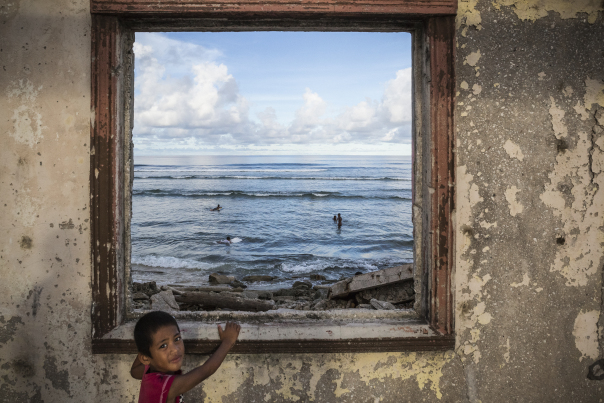
A child stands at the window opening in one of the many derelict houses on the island.
As the US nuclear testing programme developed and grew in the 1950s, most of the people living around the Kwajalein Atoll, where various US military installations that assist the nuclear test sites are based, were relocated from their homes and into a planned settlement on Ebeye. After they were joined by the ‘nuclear migrants’ from Bikini and other northern atolls, the poorly constructed settlements on Ebeye became increasingly crowded, leading to a polio outbreak in 1963, a measles outbreak in 1978 and regular occurrences of cholera, tuberculosis and other diseases up to the present day. The most overcrowded settlement of Northern Camp is a large shanty town without water supply or sewage system. Since much of the population is dependent on the service industry at US installations, unemployment is a major problem.
According to George Junior, a health worker at Ebeye’s hospital, ongoing missile testing around Kwajalein Atoll continues to impact on the health of local people. ‘When the Americans test their missiles and then the rain comes, the entire population of Ebeye gets sick. We have diarrhoea, flu and conjunctivitis. Such symptoms continue for 10 to 15 days and then everyone gets better until the next tests’ he says. And while US personnel enjoy excellent health care in places like Kwajalein Hospital, the majority of Ebeye residents who need emergency care are often referred to hospitals in Majuro, the administrative capital of the Marshall Islands, or to Manila or Hawaii since they do not have clearance to enter military installations.
Vlad Sokhin (Russia/Portugal) is a documentary photographer, videographer and multimedia producer. He covers social, cultural, environmental, health and human rights issues around the world, including post-conflict and natural disaster zones.
Eisenhower’s Starvation Order
A holocaust was what the Americans did to the Germans
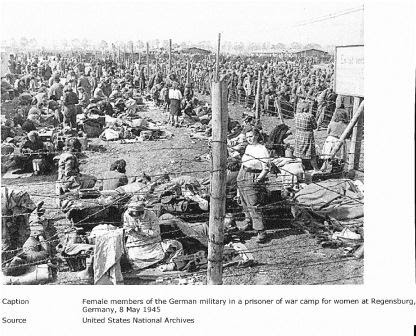
By James Bacque
Never had so many people been put in prison. The size of the Allied captures was unprecedented in all history. The Soviets took prisoner some 3.5 million Europeans, the Americans about 6.1 million, the British about 2.4 million, the Canadians about 300,000, the French around 200,000. Uncounted millions of Japanese entered American captivity in 1945, plus about 640,000 entering Soviet captivity.
As soon as Germany surrendered on 8 May 1945, the American Military Governor, General Eisenhower, sent out an “urgent courier” throughout the huge area that he commanded, making it a crime punishable by death for German civilians to feed prisoners. It was even a death-penalty crime to gather food together in one place to take it to prisoners … The order was sent in German to the provincial governments, ordering them to distribute it immediately to local governments. Copies of the orders were discovered recently in several villages near the Rhine … The message [which Bacque reproduces] reads in part: “… under no circumstances may food supplies be assembled among the local inhabitants in order to deliver them to the prisoners of war. Those who violate this command and nevertheless try to circumvent this blockade to allow something to come to the prisoners place themselves in danger of being shot….”
Eisenhower’s order was also posted in English, German and Polish on the bulletin board of Military Government Headquarters in Bavaria, signed by the Chief of Staff of the Military Governor of Bavaria. Later it was posted in Polish in Straubing and Regensburg, where there were many Polish guard companies at nearby camps. One US Army officer who read the posted order in May 1945 has written that it was “the intention of Army command regarding the German POW camps in the US Zone from May 1945 through the end of 1947 to exterminate as many POWs as the traffic would bear without international scrutiny.”
… The [American] army’s policy was to starve [German] prisoners, according to several American soldiers who were there. Martin Brech, retired professor of philosophy at Mercy college in New York, who was a guard at Andernach in 1945, has said that he was told by an officer that “it is our policy that these men not be fed.” The 50,000 to 60,000 men in Andernach were starving, living with no shelter in holes in the ground, trying to nourish themselves on grass. When Brech smuggled bread to them through the wire, he was ordered to stop by an officer. Later, Brech sneaked more food to them, was caught, and told by the same officer, “If you do that again, you’ll be shot.” Brech saw bodies go out of the camp “by the truckload” but he was never told how many there were, where they were buried, or how.
… The prisoner Paul Schmitt was shot in the American camp at Bretzenheim after coming close to the wire to see his wife and young son who were bringing him a basket of food. The French followed suit: Agnes Spira was shot by French guards at Dietersheim in July 1945 for taking food to prisoners. The memorial to her in nearby Buedesheim, written by one of her chidren, reads: “On the 31st of July 1945, my mother was suddenly and unexpectedly torn from me because of her good deed toward the imprisoned soldiers.” The entry in the Catholic church register says simply: “A tragic demise, shot in Dietersheim on 31.07.1945. Buried on 03.08.1945.” Martin Brech watched in amazement as one officer at Andernach stood on a hillside firing shots towards German women running away from him in the valley below.
The prisoner Hans Scharf … was watching as a German woman with her two children came towards an American guard in the camp at Bad Kreuznach, carrying a wine bottle. She asked the guard to give the bottle to her husband, who was just inside the wire. The guard upended the bottle into his own mouth, and when it was empty, threw it on the ground and killed the prisoner with five shots.
…. Many prisoners and German civilians saw the American guards burn the food brought by civilian women. One former prisoner described it recently: “At first, the women from the nearby town brought food into the camp. The American soldiers took everything away from the women, threw it in a heap and poured gasoline [benzine] over it and burned it.” Eisenhower himself ordered that the food be destroyed, according to the writer Karl Vogel, who was the German camp commander appointed by the Americans in Camp 8 at Garmisch-Partenkirchen. Although the prisoners were getting only 800 calories per day, the Americans were destroying food outside the camp gate.
James Bacque, Crimes and Mercies: The Fate of German Civilians Under Allied Occupation, 1944-1950, pp. 41-45, 94-95.
Who or What Brought Down Dag Hammarskjöld?
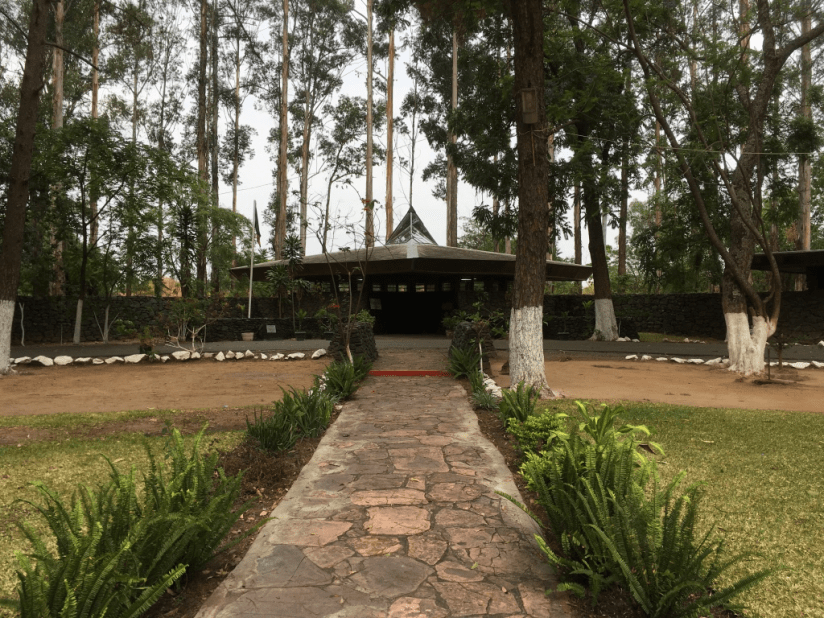
Ndola, Zambia, showing the roof of the memorial museum and Dag Hammarskjöld’s DC-6 as it would have appeared coming through the trees onto the crash site.
By Joseph Majerle III – Matthew Stevenson | CounterPunch | January 11, 2019
Background to the Crash
A plane carrying the Secretary General of the United Nations, Dag Hammarskjöld, crashed while approaching the Ndola (Zambia) airport on September 18, 1961. The exact time of the crash is unknown, although it was around midnight. The DC-6, named Albertina, had flown a circuitous route from Kinshasa, the capital of the Congo, to Ndola, a large town in what was then Northern Rhodesia. The purpose of the flight was to bring Secretary Hammarskjöld to a meeting with Moise Tshombe, the president of the breakaway republic of Katanga, in which many western (British, French, Belgian and American) investors had large stakes in various mineral deposits.
Those corporate interests had supported independence for Katanga after the Congolese leadership, notably Prime Minister Patrice Lumumba, had advocated closer relations with the Communist bloc. (Lumumba, himself, was assassinated in January 1961, in what some researchers now believe was part of a Central Intelligence Agency plot to get rid of him.)
For his part, Hammarskjöld believed that the Congo ought to remain one country, and toward that end he was flying to Ndola (just over the border of Northern Rhodesia from Katanga) to have ceasefire talks with Tshombe, in the hope of mediating a settlement to the conflict. Instead, his plane crashed in the darkness, killing fifteen of the sixteen passengers and crew aboard the DC-6. One security officer for Hammarskjöld survived for about eight days.
Since the fatal crash, various investigative instruments, including UN committees and independent aviation groups in the United Kingdom and Sweden, have looked into the cause of the crash. The initial investigation, conducted by colonial authorities in 1961, concluded that the pilots of the DC-6 (an experienced Swedish crew) had misjudged the night landing on an unfamiliar approach and flew the plane into the ground. A UN inquiry at the same time, however, failed to reach the same conclusion, although it was at a loss to explain the crash.
More recent inquiries, including one chaired by Stephen Sedley and with Hans Corell and Richard Goldstone as co-panellists, have come to more nuanced conclusions, saying that earlier investigators lacked a true picture of the situation on the ground and in the air around Ndola that night to come to definitive conclusion about what happened to the Albertina. It has led to new inquiry, originally supported by then Secretary General Ban Ki-Moon and approved by the UN Security Council, to reopen the investigation under the direction of the former chief justice of Tanzania, Mohamed Chande Othman, although for the moment the budget approved for such an exercise is little more than $300,000 (and the information needed is literally all over the world).
All of the recent re-examinations of the crash have concluded that the first conclusions of pilot error might well be in inaccurate. For example, the 2013 UN Hammarskjöld Commission, for example, concluded: “There is persuasive evidence that the aircraft was subjected to some form of attack or threat as it circled to land at Ndola, which was by then widely known to be its destination.” The 2017 report of Judge Othman concludes:
Based on the totality of the information that we have at hand, it appears plausible that an external attack or threat may have been a cause of the crash, whether by way of a direct attack causing SE-BDY to crash or by causing a momentary distraction of the pilots. Such a distraction need only have taken away the pilots’ attention for a matter of seconds at the critical point at which they were in their descent to have been potentially fatal. There is a significant amount of evidence from eyewitnesses that they observed more than one aircraft in the air, that the other aircraft may have been a jet, that SE-BDY was on fire before it crashed, and/or that SE-BDY was fired upon or otherwise actively engaged by another aircraft. In its totality, this evidence is not easily dismissed.
Both reports cite evidence that British, American, French, South African, or Belgian governments might hold but which remain unreleased, and they urge its release for the purpose of understanding exactly what happened to Hammarskjöld’s plane.
On November 8, 2018, when Judge Othman last updated the UN on the progress of his investigation, he concluded (with some frustration): “… the fact that certain Member States have not responded to repeated requests in 2018… or to engage with this process at all, has a crucial bearing on the success or failure on the full implementation of the above General Assembly resolution.”
It is where this case has gone—from the crash zone outside Ndola to the files of the great powers—but many countries, notably the United States and South Africa, have refused to cooperate or done so grudgingly.
* * *
In addition to the various international investigations of the crash, a professor at the University of London’s Institute of Commonwealth Studies, Dr. Susan Williams, has published a book about what could have happened to Hammarskjöld’s plane. The title of the book is Who Killed Hammarskjöld? The UN, the Cold War and White Supremacy in Africa, and it was originally published in 2011, laying the ground for the later UN inquiries.
In the book Dr. Williams lays out the facts of the plane crash and outlines various theories—including pilot error of the kind imagined after the plane went down—that could explain the crash. She also talks about the possibility that French or Belgian mercenaries had access that night to trainer Fouga Magister jets or other attack aircraft, and that one or several of those planes might have shot at SE-BDY or tried to force the Albertinato the ground (perhaps by shining spot lights into the cockpit or by dropping flash bombs). She examines the case for pilot error, noting that the pilots had flown a long way across the world, beginning on September 12, 1961, when they picked up the Secretary General in New York City). She discusses the possibility that the pilots mis-programmed the altimeter on the DC-6 or that someone placed a bomb on the doomed flight.
Dr. Williams also examines theories that have speculated on possible CIA interference with the Hammarskjöld mission, making the point that the anti-communist CIA had strong vested interests in wanting his African diplomacy to fail. Dr. Williams ends her book strongly hinting that her belief is that western mercenaries were more likely than pilot error to have brought down the Hammarskjöld plane, and she outlines many incongruent aspects of the fatal night in Ndola, such as the closure of the local airport (even though it was expecting the Hammarskjöld plane) and the local witnesses on the ground spoke about hearing or seeing a large flash and bang before the “big plane” came down.
The Williams book is not a polemic for any one theory about the Hammarskjöld plane crash. Instead, as a serious academic, she prefers to indicate the range of possible fates for the flight and to leave it to the reader to come to his or her own conclusions.
* * *
In my case, after reading the Williams book in 2017, I decided to visit the Hammarskjöld crash site outside Ndola and to compare what I would see and hear there on the ground with the words in the book. I had been planning for some time to visit Africa and to write about it, but having the Williams book in hand gave my visit to Zambia a direction and purpose, even though I am not an air-crash investigator or even a licensed pilot. Still, I decided it would be easier to read the many Hammarskjöld reports if I could visualize how far from the airport the plane had crashed and what local residents were saying on the ground about the plane.
Given the vagaries of African travel, I was not able to spend as much time on the ground in Ndola as I had planned. My train, from Dar es Salaam to the Zambian city of Kapiri Mposhi, was three days late, and I had other appointments in southern Africa, which made it hard to spend more than a day in Ndola. Nevertheless, I did get to the crash site, and there I met with some local investigators and museum officials, all of whom had their own ideas about what might have happened to the Albertina. (Most dismiss out of hand that pilot error was the cause.)
In particular, I learned that one local researcher had spoken with more than twenty eyewitnesses to the crash. Many of them were convinced that several smaller planes had swarmed around the larger DC-6 on its landing approach and that, prior to the crash, many people living in the bush near the crash site saw large flashes of light, consistent with the dropping of a bomb or bombs onto the Albertina. But because these witnesses were African natives of the area, their testimony was largely ignored by colonial authorities in Northern Rhodesia when in fall 1961 the first inquiry was held.
For my part, I came away from the crash site unable to believe that Hammarskjöld’s experienced Swedish crew had simply flown the Albertina into the ground. Maybe if the landscape of the crash site had been mountainous or even hilly, I could have imagined a sophisticated group of pilots—at night in Africa—making some fundamental errors of navigation. But two things made me think otherwise. First, the terrain around the crash site, while not a completely flat plain, is devoid of any serious hills. All I saw as I drove up to the crash site in a taxi and as I walked around the memorial were open fields and small clusters of forest land, none of which were very dense. The Albertina did not crash into the jungle or a mountain; it came down in the outskirts of Ndola where now there is open farmland that is part of a broad African plain.
Second, I doubted that the Swedish pilots misread the altitude of the plane, especially on a clear night. These were professional pilots, and that’s a rookie mistake. Nevertheless, early investigators in Northern Rhodesia concluded that the Albertina was the victim of what in the airline world is called Controlled Flight Into Terrain (CFIT). But standing at the somber Ndola memorial to the lost flight, I came to the conclusion that something other than pilot error had driven the plane into the ground on that fateful evening. To me it felt like an ambush.
I also concluded, while poking around the memorial in Ndola, that my brother-in-law, Joseph Majerle III, is the one person I know who could make sense of the technical details in the Williams book and in some of the many Hammarskjöld reports. Joe, as I call him, works in aviation in Alaska, and in his long career he has visited many crash sites and repaired many damaged planes. He is also a voracious reader of history, especially about aviation matters. Joe has also spent much of his adult life talking with other pilots about various aircraft and their deficiencies. If anyone could help me sort out the complexities of the Ndola crash, it would be Joe, and shortly after I got back from Africa, I mailed him a copy of the Williams book.
Joe read the book twice, took ample notes, discussed his thinking with other pilots in Alaska (some of whom are still flying on the DC-6), and answered my questions in several long emails, which I have copied here but which I also have edited (although only for the sake of clarity).
What follows might best be understood as a colloquy on the Williams book between two people who are struggling to make sense of a crash that happened more than fifty years ago.
* * *
Why does the Hammarskjöld crash still matter? It matters because Secretary General Hammarskjöld had undertaken his mission just as many countries in Africa were seeking their independence from the colonial world. Hammarskjöld was ahead of his time in pushing back against what today we might call the deep state—that confluence of interests between corporate investors, intelligence agencies, and governmental power brokers, all of whom were eager to siphon profits out of the breakaway territory of Katanga. Hammarskjöld thought that Katanga (and its extensive mineral wealth) belonged in the newly independent Republic of the Congo, and the purpose of his mission was to oppose independence for Katanga, which otherwise would fall under the spell of various French, British, Belgian and American multinational corporations.
If you believe—as I do—that Hammarskjöld was the victim of a plot, it can be concluded that the truth about his death has been covered up to shift the blame away from the usual suspects, including the CIA and various mercenary organizations that were then arming themselves across southern Africa. Hammarskjöld and his liberal internationalism were getting in the way of corporate profits, if not Cold War politics, and it was decided—somewhere, somehow—to cut him down to size. Maybe the plotters did not intend to kill him? Maybe they simply wanted to scare him away? But the facts about the Hammarskjöld crash have never been fully available, in part because invaluable transcripts (picked up in particular by US government eavesdropping on that night) have never been released.
What follows are the questions that I posed to Joe, and his responses, based on his reading of the Williams book and his lifetime as a pilot and in aviation. Neither of us pretends that what follows is anything approaching a “last word” in the Hammarskjöld investigation. At the same time it shows how much several concerned citizens, and a budget of $1500 (the cost of my African train travels), can discover. Let’s hope that the new UN investigation can take the Hammarskjöld matter much further. The Secretary’s exemplary life and work demand that the truth of his death be known. — Matthew Stevenson
* * *
Stevenson: Is it possible that pilot error was responsible for the crash of the Albertina?
Majerle: The facts that investigators admitted to in their original reports tell a different story from their conclusions. To me, their conclusions are laughable. This crash was not pilot error.
Per the chart at the beginning of the Williams book, it shows the crash site very close to the turn-back circle (on a safe instrument approach) of the official instrument approach path, which means that the Swedish pilots knew exactly where they were. I don’t think any accident investigation board in the world would dispute that that they were properly executing the published instrument approach procedure for Ndola airport.
The official report admitted that they were at least nominally executing the instrument approach properly, except that they were 1700 feet lower than they were supposed to be, and that was the pilots’ error.
On page 70, according to A. Campbell Martin, the controller on duty, the last communication received from SE-BDY (the code for the Albertina) was confirmation of 1021 millibars—the altimeter setting—which is something I and every pilot I have ever flown with has never failed to reset at the instant we are told the new number.
To me it is inconceivable that the Albertina pilots didn’t know their altitude at that time. If the controller had said he never got around to telling them the current millibars setting, they would have had a basis to sow doubt on that subject, even though that would have been a flimsy excuse in itself, for the following reason.
Explain to me how it is unlikely that the Albertina pilots flew the plane into the ground.
The radio (radar) altimeter came into widespread use in military and commercial airplanes by the end of WW2, even in single-seat fighters such as the P-38. I would bet that, without exception, every DC-6 was equipped with one when it left the factory. And it is the device you base your instrument approach on, if you have one, because a radio altimeter is more accurate and has large graduations up to 1000 feet AGL (Above Ground Level).
Even if the Albertina pilots didn’t have a current altimeter setting, they would have been using their radar altimeter anyway, assuming it was in working order. If not, I think it’s very likely the pilot would have informed the controller of that fact. Which, again, points to the fact that they knew exactly where they were, in all three dimensions.
In the book Dr. Williams writes that an evasive strategy to “lose height, veer and head for the airfield as quickly as possible… may possibly offer some explanation for the low height of SE-BDY as it made its approach to Ndola—about 1700 feet lower than it should have been.”
This conclusion is at the heart of her book and research, and any new investigation needs to focus on what she has written here.
To me it indicates that the Albertina pilots were already planning to evade an attack by getting low enough to prevent another airplane from getting beneath SE-BDY, which to an attacker is the easiest and most preferred way to shoot down another airplane—and there would have been no better way to do that at night than basing it on a radar altimeter.
Explain some of the discrepancies between the official crash report, and the data that Dr. Williams includes in her book, especially in regard to the crash site.
The official report stated that the ground scar at the wreck site was 150 yards long, which is 450 feet. The published stall speed of the DC-6 with flaps down is 92 mph, which is almost exactly 135 feet per second. That is the absolute slowest speed at which it would stay in the air—not the speed at which you would make an approach.
The original Jeppesen approach plate chart for the Ndola airport would have contained a sidebar that would have given the time, in seconds, required to reach the airport at several different approach speeds, usually spaced by 30 mph and 60 mph increments, which simplifies the mental calculations the pilot would need to make or eliminates them if it’s practical for the aircraft to fly at one of the stated speeds exactly.
I would estimate that, in this situation, for a light-to-moderately loaded DC-6, the pilots would have used either 150 or more probably 180 mph, which would be 220 or 264 feet per second of forward velocity.
If, as the official report says, the pilots misjudged their altitude and just flew the plane into the ground while making their final approach, it is beyond a stretch of the imagination that 80-to-90 thousand pounds of airplane would come to a stop in no more than 2.04 seconds, and that every last piece of it would be contained in a mere 450 feet.
This is just very basic math that a 4th-grader could do nine out of ten times and get right. It is an insult to human intelligence to suggest that that’s what happened.
Have you ever examined the crash site of a DC-6 airliner?
Many years ago I had opportunity several times to walk over the crash site of a DC-7 [very similar to the DC-6] that crashed shortly after takeoff due to an out-of-control engine fire in which the pilots tried to crash-land into a recently logged parcel of land.
The fuel dealer told me that he watched as an engine caught fire almost as soon as the plane started its takeoff run, but apparently the pilots didn’t realize it until they were committed to fly. But after clearing the end of the runway, they immediately angled off and headed for the clear-cut area, obviously in an effort to get the plane back on the ground.
It had been nine years since it happened when I first saw the site, and in that rain forest the vegetation had regenerated quite a bit, but the wreckage path of the DC-7 was still obvious. The crew had left the gear and flaps down in takeoff configuration, obviously intending to put it down at as slow a speed as possible in this off-airport area.
My recollection of the debris path was that it was at least 1200 feet long, with no standing trees throughout the path. The largest piece of wreckage at the end of the path was stopped and literally wrapped around what was at least a 6 foot diameter tree, in the flight engineers compartment. Control cables and wiring bundles were literally wrapped all the way around that tree. I would guess that the site is still that way today.
There are some fairly close parallels between that crash and Hammarskjöld’s. The DC-6B and DC-7 are very similar airplanes; sharing the same basic wing and fuselage with the DC-7 employing another short section of fuselage, more powerful engines and a higher gross weight due to the extra power, and with a higher cruise speed also because of the power. But they are both listed on the same type rating for pilots. Sitting side by side, you would have to study them carefully to see the differences.
In these two cases, both planes made it to the ground before impacting any real solid objects; in Hammarskjöld’s case it was the anthill and in the Yakutat crash it was tree stumps. In both cases, the immovable objects turned the airplanes sideways while they still had a lot of momentum, which began the breakup process while the kinetic energy just kept them going.
If they had been able to continue moving straight ahead they might have had a chance, more so for the passengers aft of the cockpit bulkhead. There isn’t a lot of metal in the nose ahead of the pilots compartment to crush and absorb energy.
The DC-7 was known to be overloaded with fresh salmon but would have been light on fuel. Hammarskjöld’s plane would have had a lighter cabin load but would have had considerably more fuel. I would assume that the DC-7 was somewhat heavier overall, but probably not by an amount that would have required a significant speed difference to stay airborne.
What I am getting at here is that in both these cases the airplanes probably hit the ground at roughly equivalent speeds. And the DC-7’s ground scar was about three times as long as Hammarskjöld’s, and still had some energy when it wrapped itself around a tree.
If Hammarskjöld’s pilots had inadvertently flown the aircraft into the ground, I think it is reasonable to assume that it would have traveled much farther before all the pieces came to rest.
This did not happen, which to me indicates that the physics of the official reports are all wrong—at least when matched to their conclusions.
What can we conclude from the configuration of the Hammarskjöld plane as it hit the ground?
The official report stated that the landing gear was down and locked, and the wing flaps were extended to the 30 degree position. I would have loved to cross examine the local accident board and ask them which pilots they know that would be 8-to-9 miles out on an instrument approach and have 30 degrees of flaps down at that point, to say nothing of having the gear down.
Thirty degrees of flap down on a DC-6 is a lot of flap; probably about optimal for a low speed approach over obstacle-free terrain to make a short-field landing. Maximum flap down angle on a DC-6 is 50 degrees, which you would normally only use to bleed off a lot of excess altitude, and it would require a lot of engine power with which to maintain altitude.
In my experience no pilot would drop the landing gear until about the point that you had crossed the “final approach fix,” in this case the non-directional (radio) beacon, which is at four miles or so from the end of the runway.
At four miles out the pilots would have had plenty of time to drop the gear and double check it before reaching the runway end roughly 90 seconds later. Experienced crews normally do that as late as they can just to get there sooner. This accident board didn’t even know how to lie to make the facts fit their case.
Recently I had opportunity to talk to a friend of mine that flew DC-6s about thirty years ago. He currently owns and flies two DC-4’s, a freighter and a fuel tanker, around the state.
He confirmed to me—as I thought earlier—that a DC-6 pilot would have flown that instrument approach at 156 to 160 knots (180 to 184 miles per hour) and would absolutely not have had gear and flaps down 8 or 9 miles from the runway.
And if he found his wing on fire, unless on short final to a runway, his only thought would be to get it on the ground.
What do you think happened?
To me, all of the admitted evidence (in UN reports and in the Williams book) adds up to one thing. The crew made a desperate attempt to save their lives by getting the airplane on the ground, most probably because they knew they had a wing fuel tank on fire.
A gasoline fire at night, to my experience, is very bright and from the cockpit side windows of a DC-6 you can see to the inboard nacelle without straining your neck. If it was a wing fire, the pilots would have known it. It would have taken all of their strength not to panic and just continue to do what needed to be done.
And here I take issue with one of the advisers to Dr. Williams—a Mr. Kjell Peterzén—who is quoted in the book as saying: “There is no way he would have gone down into the darkness and the woods…” I can name six incidents here in Alaska since 1977 in which pilots have descended into the woods, or whatever was below including a mountain ridge, to deliberately crash burning airplanes in an attempt to save their own lives.
In one of these cases—coincidentally it was a DC-6—the pilot hesitated because he didn’t want to have to do that, even though the cockpit voice recorder picked up other crew members urging him to get the airplane “on the ground, NOW!” But he didn’t. The wing folded up and moments later they all crashed to their deaths.
In all of the other cases the pilots understood how few seconds they had to live if they didn’t “put it on the ground.” Remarkably, most of the crews survived, although some had bad injuries.
I would say—at least from my corner of the world—that pilots will attempt a crash into the unknown if they understand how quickly an airplane made from aluminum can disintegrate in a raging fire.
Aluminum, of the kind used in the making of the Hammarskjöld DC-6,yields at 925 degrees Fahrenheit and liquifies at 1225 degrees Fahrenheit. When the fire gets much above the 1225 degrees Fahrenheit point, the metal itself actually ignites and burns up, which is why there is normally so few pounds of airplane left after one has burned uncontrollably.
Pilots know this, and will respond instinctively when they see, for example, one of their wings on fire.
What’s your reaction to the conclusion that the Albertina was simply flown into the ground, so-called Controlled Flight Into Terrain (CFIT)?
As for all of the talk about pilot error and CFIT, I still cannot believe that no-one ever mentions the fact that they had gear and flaps down when they were still at least three minutes from the runway, which you just wouldn’t do, unless you’re planning to land “very soon.”
I thought it curious when I read in the Williams book: “It was as if the aircraft was making a perfect landing…” That conclusion is a very astute observation. That doesn’t happen in CFIT situations.
In my experience, CFIT planes start breaking little things and leaving little pieces over a long area before you start seeing the larger pieces and more ground disturbance. If you see something that looks like a landing attempt was being made, it usually is. And this explains why the crash site itself was so contained in such a small area.
In the Williams book, Virving states that “an explosion a few yards from the aircraft could have dislodged vital control wires from their pulleys…” My reaction to that thesis: “Ah, no, generally not.”
All type certificated aircraft are required to have a cable guard at every pulley station to retain them and to prevent that very thing from happening. In all my time working on airplanes (some forty years), I have never seen that happen unless the whole pulley mounting structure was ripped away from the primary structure, in which case the pulley and guard assembly would still be hanging on the cable. But that requires the wing or fuselage or tail component itself to be massively damaged. In this case, the airplane was obviously under control when it started hitting the sapling trees—in order to be “making a perfect landing.”
It has occurred to me that, in a sense, the British investigators were right when they said that it was a CFIT accident. But they left out the part that it was an INTENTIONAL controlled flight into terrain accident.
Right now, it seems really hard to believe that the original 1962 UN report did not ever advance that notion, i.e., that no-one they consulted ever suggested that as a possibility. To me it seems obvious.
In any new UN investigation (led by Judge Othman) of the Hammarskjöld crash, one of the keys to discovering the truth about what happened could be found on intercepted transcripts of the voice communication from the Albertina, which, as Dr. Williams reports, were picked up at a CIA listening post on Cyprus. How would that have been possible in 1961?
In the Williamsbook, someone who was at the airport that night states that while waiting for Hammarskjöld’s plane to arrivehe “heard an airplane start up but never took off.”
I would speculate that what he heard would have been one of the USAF DC-3’s (C-47) that were parked that night at Ndola, and which explains how a CIA listening post in Cyprus would have intercepted the Albertina’s voice communications.
Here’s some background: At least some of the military C-47’s that were kept in service after World War II had radio rooms, for lack of a better word, that had gear that could transmit or receive (or both) on every frequency from LF through UHF. These rooms were state of the art. All of this gear and their trays, mount brackets, and bulkheads weighed over a thousand pounds.
In 1978 I did some work on a DC-3C that had recently been surplussed, sold, and converted from a VC-47D. I had opportunity to see all that analog electronic stuff on a shelf for about a dozen years after that and was always impressed.
I would suggest that the source of the radio conversation that Charles Southall listened into on Cyprus originated from a keyed HF microphone held into a headset speaker on the VHF frequency of Ndola airport by the crew of an idling USAF C-47.
They would have needed to have an engine generator online to run an inverter because some of that radio equipment was using AC voltage. And if it was going to take very long, they would have run down the batteries without a generator operating.
One of the persistent theories about the Hammarskjöld crash is that mercenaries, perhaps flying Fouga CM.170 Magister or other aircraft, might have intercepted SE-BDY on its approach, and either bombed it or caused the larger plane to crash. There is speculation that a De Havailland Dove might have been involved. What do you think?
About the speculation that aDe Havilland Dove might have been modified to drop small bombs from above the DC-6, I think not. That configuration has been tried since WW I with virtually nosuccess; when it worked it was a fluke.
In WWII, the Germans experimented with it a little and the Japanese more, and all with a very low success rate. The Dove also could have only kept up with the DC-6 in the landing pattern; the DC-6 was capable of roughly twice the Dove’s speed.
The Percival P.56 Provosts that were on the Ndola field at that time and had forward firing armament could have had some chance against the Albertina, but, as I recall, they were not thought to have flown that night.
But a single tracer round from even a 30-caliber gun at even 500 yards range could punch through the DC-6’s relatively thin aluminum skin and ignite a fuel vapor chamber that would break seams loose in the resulting explosion and doom any airplane. The Fouga Magister was known to have two such guns with a tracer in every fifth clip of the ammo belts.
Dr. Williams cites some of the Fouga’s performance and range specs, although other sources that I know give them as considerably lower. But, still, if you ask me, this operation was well within its capabilities.
When I visited the Ndola museum and spoke with some of the guides, they explained that the Hammarskjöld plane was flying away from the airport, in the direction of the plane replica at the site, which is headed west. You think it was heading toward the Ndola airport. Why?
I’m sure you heard the guide correctly; the problem is that the guide probably does not understand what happened. Which is really not at all surprising; even if the guide was someone that had seen it before the pieces were hauled away, the crash site would have appeared to be mostly chaos in a big charred spot with a lot of garbage laying around at random, especially if they weren’t familiar with airplanes.
Can you describe the crash site?
The UN chart tells the story, which is corroborated by Björn Virving’s account of the crash site. [Virving, a Swedish citizen, was an observer to the early investigation of the crash.]
Abeam the ant hill, way ahead of the main body of wreckage where it came to rest, was the warning horn, the primary function of which is to alert the pilots to the fact that the landing gear is still up if the throttles are retarded and is below a certain airspeed, and it is mounted in the cockpit area.
Coming a bit closer to the main body of wreckage (MBW), identified items are almost all from the fuselage nose area, except for a small piece of heavy spar section and wing fairing (fillet)—the spar section almost certainly being from the left wing.
Included in the distant cockpit area wreckage is the radio (radar) altimeter, I have just noticed for the first time. This is where the pilots’ bodies start to appear also. So there is no doubt now that it had a radar altimeter.
At the point about dead abeam the MBW, the airplane was pivoting on its belly to the left, the left wing was folding back and the fuselage ahead of the wing was splitting open and folding to the left also. The right hand horizontal stabilizer was probably catching on the tree stumps left after the right hand wing mowed the trees down and twisting the tail-cone loose before being sheared off completely.
The tail control cables evidently held and didn’t fail in tension in this case; otherwise the tail-cone section would have ended up near the right hand tailplane.
The left wing, compromised not only by impact with the ant hill but with the alleged inflight fire, is folded back to lie alongside the aft fuselage with to me, surprisingly, its engines in approximately their correct positions. I could easily have imagined them to be found up near the ant hill. The other surprising thing is that the main landing gear stayed under it, in place, which is almost unheard of in a wheels down landing out in the woods.
The chart doesn’t show, or at least so far I haven’t found, where the main nose gear strut came to rest. Associated parts are right where I’d expect them to be in the first third of the wreckage path. The DC-6 pilots I know say that the nose gear is a bit fragile; if it digs in to soft ground it will fold up or tear off and needs to be treated carefully.
If the Albertina hadn’t had the misfortune to hit he anthill, the skinny trees would probably have arrested its forward movement in a fairly short distance and the passengers, if they were strapped in, would have had a pretty good chance of walking away.
If the chart is to scale, and it appears to be, the airplane had already lost a lot of its momentum, i.e., it didn’t travel more than about eighty feet or so past the ant hill, which is not very far for a one hundred foot long fuselage. It might even have come to a stop still standing on all three gear. Just about like a Navy plane (on an aircraft carrier) missing the arresting cables and running into the net barrier.
The UN chart shows the Ndola runway orientation to be magnetic 100 – 280, or only 10 degrees from east-west. It says that the aircraft was on a heading (it should say “course,” because a heading is a course when corrected for wind) of 120 degrees, which would have been aiming them toward the non-directional beacon, to line them up with the runway. As I have said, they were very close to where the instrument approach procedure wants you to be for the procedure turn.
Can you hypothesize Hammarskjöld’s last moments? Alone of the passengers he was found propped up against an ant hill at the crash site, and he was not burned in any way.
In my view, Hammarskjöld himself was probably standing in the cockpit bulkhead doorway, behind the flight engineer, who sits behind and in between the pilots, facing forward in the DC-6, and all three of them would have been strapped into their seats.
After bouncing over the ant hill, the nose would have broken open as it would have been the first thing to hit the ground, and Hammarskjöld, not being fastened in, would have just been thrown out or fallen out through the opening.
The still-moving, burning remainder of the airplane just kept on moving past him, and was arrested by the trees as it swung around. It all fits, really, and has been seen to happen that way many times in history.
Can you sum up your thinking about what happened to Hammarskjöld’s plane, SE-BDY?
I would surmise that SE-BDY (Albertina) was attacked at the beginning of the procedure turn to return the plane to the non-directional beacon bearing. (To me the attacking planes had to have had the capacity to shoot bullets or tracers. I don’t believe anyone tried to bomb the DC-6.)
The pilot then quickly decided to finish the turn back toward where he knew there to be light and to get the plane on the ground as soon as he could, knowing that the runway, some three minutes away, was way too far to expect a burning wing to get him to.
In my opinion, the pilots (by name—Captain Per Hallonquist, Captain Nils-Erik Åhréus and Second Pilot Lars Litton) came very, very close to pulling it off and should be commended for their bravery and professionalism. They knew what they were doing.
What would you like to see the new investigation of the crash look into?
Keep in mind that all of the evidence from the crash site, at this point, has been compromised, by age or the dictates of the earlier crash examiners, who came to the wreckage only with the intent to blame the pilots for the accident. What we got from the first 1962 inquiry into the crash was a political judgment—not the informed thinking of experienced pilots or crash investigators. Since that time, most of the primary evidence has been lost to time.
Most of all I would like to see the Swedish crew and especially its pilot in command exonerated for blame in this crash. As I said before, the pilots acted heroically and professionally in trying to land a burning plane on the ground in order to save the lives of their passengers. Instead of being recognized for their valor, the crew, themselves victims, was blamed for the crash.
I would love to believe that physical evidence of the crash might help new investigators come to some conclusions about the crash, but the fact is that the plane was made of a zinc alloy aluminum that will have turned to mud and paste after more than fifty years under ground. I am not optimistic that the physical evidence will reveal anything new in the inquiry.
Instead, investigators should turn their attentions to old photographs, video, and audio recordings that might be found in archives around the world, and from these files try to reconstruct the last moments of the doomed flight. They might also make a microscopic reexamination of the original report for just the kinds of contradictions that even a reader like myself picked up in some of the files quoted in the Williams book. There have to be a lot more inconsistencies in the files that professionals of today would find.
If the files of the listening post on Cyprus were to have any transmissions from the flight deck (personally, I don’t think they exist), we might learn more details of what was said once it was discovered that their left wing was on fire. But cockpit recorders were not around in those days.
Please sum up what you think happened
In conclusion, let me state again what I think happened: I think one of the mercenary aircraft, operating around Ndola on that night, fired a tracer bullet into the fuel tanks of the Hammarskjöld plane, causing the left wing to catch on fire. Fearing that the left wing would fold up into the fuselage of the plane, the pilots did the only thing that was available to them: to configure the plane for a controlled (so to speak) crash landing in the short amount of time available to them. That action explains the 30 degrees of flaps setting on impact (nine miles out from the Ndola runway!), the relative slow speed at impact (they were just above the stall speed), and the compact crash site (not consistent with CFIT). The pilots had no choice but to put the plane “on the ground… now!” and that they did, skillfully, in my mind.
Had they succeeded and been able to tell their own story at the inquests, we would now have a clearer picture of what happened on that fatal approach. Because the crew was killed on impact or in the subsequent fires, it was left to colonial administrators—in places such as Northern Rhodesia—to whitewash the crash scene and to blame the pilots, who along with Hammarskjöld and his team were also the victims. Exonerating the pilots would go a long way in correcting an injustice that has lingered since 1961.
Finally, I hope the publishers of Dr. Williams’ book encourage her to release yet another edition of the book. (An updated edition did come out in late 2016.) Perhaps she might be able to integrate into her book the more recent findings of Judge Othman? I would hope so. As much as anyone outside the UN system, Dr. Williams has kept alive the tragic story of what happened to Secretary Hammarskjöld in Ndola, and I commend her for all of the excellent work she has done to uncover the truth. If someone wants to know more about this case, her book, Who Killed Hammarskjöld? The UN, the Cold War and White Supremacy in Africa, is the best place to begin.
Matthew Stevenson is the author of many books, including Reading the Rails and, most recently, Appalachia Spring, about the coal counties of West Virginia and Kentucky. He lives in Switzerland and was in Africa at the crash site in 2017.
Joseph Majerle has worked in aviation for the last forty-one years, both as a mechanic and a pilot, and he has worked on a number of historic planes. He lives in Alaska.
A Clinton Memo That Killed Half a Million People
By Daniel Lazare | Consortium News | January 11, 2019
A Hillary Clinton memo that Wikileaks made public in 2016 has not gotten the attention it deserves.
It takes us back to 2012 and the early phase of the Syrian war.
At that point, it was largely an internal affair, although Saudi arms shipments were playing a greater and greater role in bolstering rebel forces. But once the Obama administration decided in favor of intervention, the conflict was quickly internationalized as thousands of holy warriors flooded in from as far away as western China.
The 1,200-word memo by then-Secretary of State Clinton begins with the subject of Iran, an important patron of Syria.
She dismisses any notion that nuclear talks will stop Iran “from improving the crucial part of any nuclear weapons program—the capability to enrich uranium.” If it does get the bomb, it goes on, Israel will suffer a strategic setback since it will no longer be able to “respond to provocations with conventional military strikes on Syria and Lebanon, as it can today.” Denied the ability to bomb at will, Israel might leave off secondary targets and strike at the main enemy instead.
Consequently, Clinton argues that the U.S. should topple the Assad regime so as to weaken Iran and allay the fears of Israel, which has long regarded the Islamic republic as its primary enemy. As the memo puts it:
“Bringing down Assad would not only be a massive boon to Israel’s security, it would also ease Israel’s understandable fear of losing its nuclear monopoly. Then, Israel and the United States might be able to develop a common view of when the Iranian program is so dangerous that military action could be warranted.”
This document making the case to arm Syrian rebels may have been largely overlooked because of the dates, which appear to be inaccurate.
One line gives the time as “2001-01-01 03:00” even though Clinton was still a New York senator-elect at that point. That date is also out of synch with the timeline of nuclear diplomacy with Iran.
Another contains a State Department case and document number and a date of Nov. 30, 2015. But that’s incorrect as well since it postdates Clinton’s resignation as secretary of state by better than two and a half years.
Central to the Great Debate
Consequently, anyone stumbling across the memo in the Wikileaks archives would have no idea of how its rather loopy logic figures in the great debate about whether to use force to bring down Syrian President Bashir al-Assad. But textual clues provide an answer. The second paragraph refers to nuclear talks with Iran “that began in Istanbul this April and will continue in Baghdad in May,” events that took place in 2012. The sixth invokes an interview with CNN’s Christiane Amanpour conducted with then-Israeli Defense Minister Ehud Barak “last week.” Since the interview took place on April 19, 2012, the memo can therefore be dated to the fourth week in April. This is shortly before Clinton joined forces with then-CIA Director David Petraeus to push for an aggressive program of rebel military aid.
Needless to say, Clinton’s skepticism about negotiating with Iran proved to be unwarranted since Iran eventually agreed to shut down its nuclear program. The memo thus illustrates her hawkishness along with her conviction that Israeli security trumps all other considerations even if it means setting fire to a region that’s been burned over more than once.
But the memo illustrates much else besides: Clinton’s recklessness, her lack of realism and her almost mystical belief that everything will fall neatly into place once the United States flexes its muscle. Overthrowing Assad would be nothing less than “transformative,” she writes:
“… Iran would be strategically isolated, unable to exert its influence in the Middle East. The resulting regime in Syria will see the United States as a friend, not an enemy. Washington would gain substantial recognition as fighting for the people in the Arab world, not the corrupt regimes. For Israel, the rationale for a bolt from the blue attack on Iran’s nuclear facilities would be eased. And a new Syrian regime might well be open to early action on the frozen peace talks with Israel. Hezbollah in Lebanon would be cut off from its Iranian sponsor since Syria would no longer be a transit point for Iranian training, assistance and missiles.”
It was “a low-cost high-payoff approach,” she writes, that would eliminate one enemy, weaken two more, and generate such joy among ordinary Syrians that peace talks between Damascus and Tel Aviv will spring back to life. The risks were nil. Since “the Libyan operation had no long-lasting consequences for the region,” the memo says, referring to the overthrow of strongman Muammer Gaddafi six months earlier, the Syrian operation wouldn’t either:
“Some argue that U.S. involvement risks a wider war with Russia. But the Kosovo example [in which NATO bombed Russian-ally Serbia] shows otherwise. In that case, Russia had genuine ethnic and political ties to the Serbs, which don’t exist between Russia and Syria, and even then Russia did little more than complain. Russian officials have already acknowledged they won’t stand in the way if intervention comes.”
So, there was nothing to worry about. Sixty-five years of Arab-Israeli conflict would fall by the wayside while Russia remains safely marginalized.
How it Turned Out
Needless to say, that’s not how things turned out. At that moment, Libya seemed under control. But three or four months later, it would explode as Western-backed Islamist militias blasted away at one another, imposing strict Sharia law, re-instituting slavery and rolling back decades of social progress. Once President Barack Obama approved a modified version of the Clinton-Petraeus plan, Syria would plunge into the same abyss as jihadis funded by Saudi Arabia and the other oil monarchies spread sectarian violence and fear.
Clinton’s assumption that the U.S. could neatly and cleanly decapitate the Syrian government without having to worry about broader consequences was little short of deluded.
The notion that ordinary Syrians would fall to their knees in gratitude was ludicrous while her disregard for the intricacies of Syrian politics was astonishing.
Then there’s the memo’s blithe suggestion that Washington “work with regional allies like Turkey, Saudi Arabia, and Qatar to organize, train, and arm Syrian rebel forces.”
In late 2009, Clinton wrote in another diplomatic memo made public by Wikileaks that “donors in Saudi Arabia constitute the most significant source of funding to Sunni terrorist groups worldwide.” So what made her think two years later that the kingdom would not fund Syrian jihadis of precisely the same ilk?
The 2009 memo slammed Qatar for allowing Al Qaeda, the Taliban and other terrorist groups to use the sheikdom “as a fundraising locale.” So what made her think that a pro-Al Qaeda autocracy would now help Syrians “fight for their freedom,” as the memo puts it? Wouldn’t Qatar be more likely to remove what little freedom Syrians had left? Of course, it would.
There is a remarkable continuity between the Syria policy that Clinton was proposing and earlier policies in Afghanistan and Libya. In the first, U.S. military aid wound up flowing to the notorious warlord Gulbuddin Hekmatyar, a religious sectarian and raging anti-western xenophobe who nonetheless was “the most efficient at killing Soviets,” as Steve Coll put it in “Ghost Wars,” his bestselling 2004 account of the CIA’s love affair with jihad.
Hekmatyar’s cutthroats wound up with the lion’s share of American arms. More or less the same thing happened in Libya once Clinton persuaded Qatar to join the anti-Gaddafi coalition. The sheikhdom seized the opportunity to distribute some $400 million to various rebel militias, many of them Islamist. The Obama administration said nothing in response.
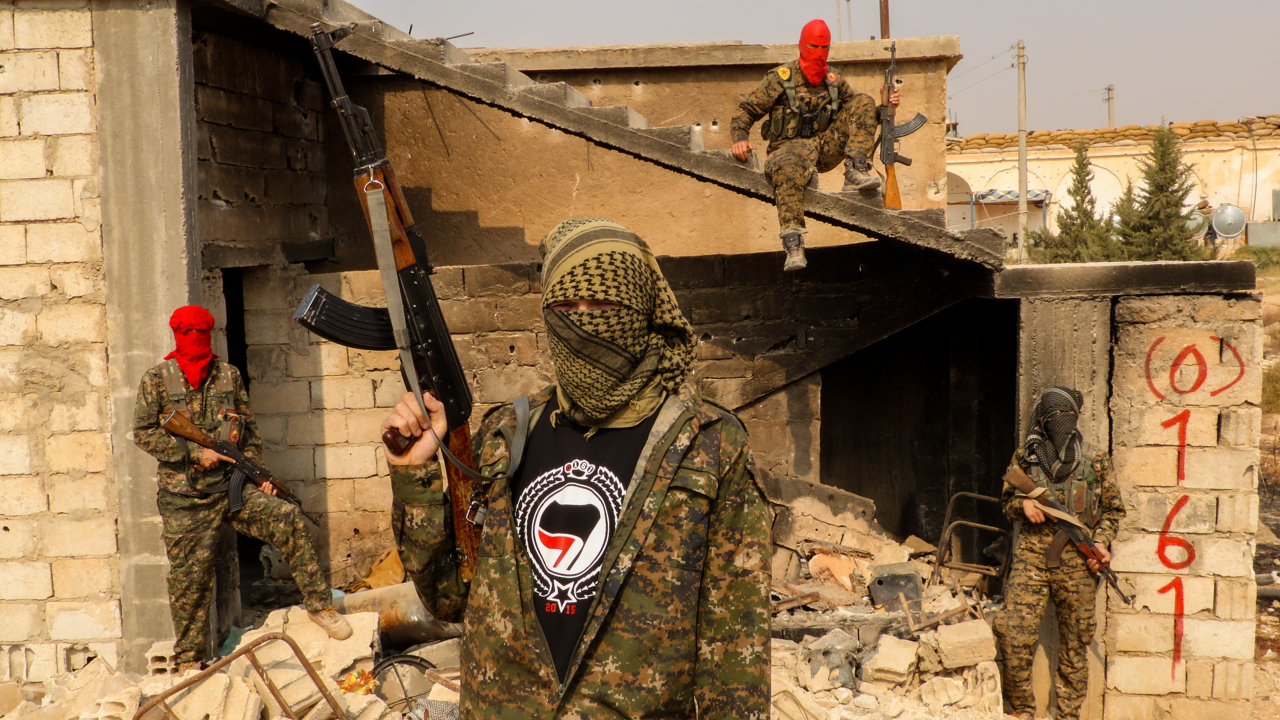
British Fighters with International Freedom Battalion in northern Iraq. (Wikimedia)
Once again, U.S. arms and materiel flowed to the most reactionary elements. The same would happen in Syria where U.S. and Saudi arms went to the local Al Qaeda affiliate, known as Jabhat al-Nusra, and even to ISIS, as a meticulous report by Conflict Armament Research, a Swiss and EU-funded study group in London, has shown. (See “Did Obama Arm Islamic State Killers?” Consortium News, Dec. 21, 2017.)
Insurgency Mix
By August 2012, a secret Defense Intelligence Agency report found that Salafists, the Muslim Brotherhood, and Al Qaeda were already “the major forces driving the insurgency” and that the U.S. and Gulf states backed them regardless. Speechwriter Ben Rhodes summed up the problem of “moderate” rebels who were indistinguishable from Al Qaeda in his White House memoir, “The World As It Is.” In that, he writes that “Al Nusra was probably the strongest fighting force within the opposition, and while there were extremist elements in the group, it was also clear that the more moderate opposition was fighting side by side with al Nusra. I argued that labeling al Nusra as terrorists would alienate the same people we want to help, while giving al Nusra less incentive to avoid extremist affiliations.”
The problem was how to separate the “good” Al Qaeda fighters from the “bad.” Rhodes later complained when Russian President Vladimir Putin said that he and his fellow Obama officials were “trying to climb a spruce tree naked without scratching our ass.” This was “smug,” Rhodes says. But Putin was merely using a colorful expression to say that the policy made no sense; which it didn’t.
The cost, half a dozen years after the Clinton email, is staggering. As many as 560,000 people have died, half the population has been displaced, while the World Bank has estimated total war damage at $226 billion, roughly six years’ income for every Syrian man, woman, and child. A cockeyed memo thus unleashed a real-life catastrophe that refuses to go away. It’s a nightmare from which President Donald Trump is struggling to escape in his confused and deluded way and that the Deep State – everyone from arch-neocon John Bolton to “liberal” Nancy Pelosi– is determined to renew.
Another Climate Propaganda Story Promoting the Normal as Abnormal
By Dr. Tim Ball | Watts Up With That? | January 8, 2019
Almost every day there are stories in the media about weather or climate events that create the impression that they are new and outside of the normal pattern. None of them are. The objective is to sensationalize the story, even if it means using a meaningless period. A simple trick is to pick a period in which your claim is valid. This practice of cherry-picking the period of study is not exclusive to the media. It was a clear sign of corruption of climatology brought to a head with Roseanne D’Arrigo’s infamous comment to the 2006 National Academy of Science (NAS) panel that “if you are going to make a cherry pie, you have to pick cherries.”
That doesn’t condone the media use of the technique. All it does is illustrate why it was a convenient technique for creating a deception about what is normal. For example, a 2017 BBC headline said “Hottest June day since summer of 1976 in heatwave.” That is 41 years, which is statistically significant but not climatologically significant. A Youtube story reports “Sydney has wettest November day since 1984.” CBS Pittsburgh reported “NWS: 2018 is the 2nd Wettest Year on Record in Pittsburgh.” The record began in 1871 or 147 years ago, but even that is not climatologically significant. The ones I like are this one from North Carolina, that says, “A Look Back at the Coldest day Ever in North Carolina.” “Ever” is approximately 4.5 billion years.
Other stories focus on a pattern or change in a pattern again with the idea that it is new or abnormal. Headlines like this one from 2012, “Why have there been more tornadoes than usual this year?” Often, they are suggestive such as this 2017 New York Times story. “The 2017 Hurricane Season Really Is More Intense Than Normal.” When you read the story, you find, as is usually the case, that the caveats at the end indicate it is not unusual. The problem is the headline already set the pattern in the public mind.
The headline says, “Forget El Nino, StormFest Is about To Hit The West Coast.” The author is talking about a series of storms tracking on to the west coast of North America. The story told us
Things often calm down after January 1 during El Nino years… but not this year… with the U.S. West Coast from central California to Washington State about to be pummeled by a series of storms. Rain, snow, wind? Plenty for everyone. A view of the latest infrared satellite imagery shows an amazing line-up of one storm after another stretching way into the Pacific. A traffic jam of storms.
The terms, “pummeled” and “traffic jam” are evocative and imply the pattern is unusual. In fact, it is perfectly normal to the point that there is a descriptive term for it, the Pineapple Express. This refers to the establishment of the Polar Front along the northwest coast of North America after it migrates south from its summer position off the coast of Alaska and northern British Columbia. Low pressure systems known as anti-cyclones develop along the Front all year round. The areas affected by these systems changes as the Front migrates between its more northerly summer position and more southerly winter position. The term Pineapple Express refers to the situation in the winter when these anti-cyclones generate in the region of Hawaii and track along the Front hitting the northwest coast in a series of storms. The pattern does not stop in an El Nino year but takes a different path.
These anti-cyclone systems are also the focus of exploitation of normal weather events as abnormal, in Europe. The southerly shift of the Polar Front in the Northern Hemisphere occurs around the globe. Two major factors influence the weather pattern, sea surface temperatures that fluctuate with ocean circulation, and the Rossby Wave pattern in the Circumpolar Vortex. This pattern of anti-cyclones hitting western Europe in the winter was added to the propaganda list when they started naming the storms. It linked them to hurricanes in the public mind, and it implied they were a recent phenomenon.
They are not recent, new, or of greater intensity.

A significant part of professor Hubert Lamb’s ground-breaking and monumental work on historical climatology was a long-term reconstruction of the pattern of these anti-cyclones. It fit with his claim about why he established the Climatic Research Unit (CRU) at the University of East Anglia.
“… it was clear that the first and greatest need was to establish the facts of the past record of the natural climate in times before any side effects of human activities could well be important.”
Once he created a long-term record of these anti-cyclonic systems, there was a better chance of determining the underlying mechanisms. From this, he could achieve his final objective of better forecasting. The ability to forecast defines science. If that is not the final objective the work is mostly irrelevant.
Consider the destructive and history-altering impact of storms like the one that hit the Spanish Armada that attempted to invade England in 1588. Ironically, Phil Jones, who ran the CRU reputation into the ground while under his direction, wrote a good synopsis of Lamb’s work. There is also the storm of 1703 reported in great detail in the book “The Storm” by the famous author Daniel Defoe.
Marcel Leroux was an early major skeptic of the claim of anthropogenic global warming (AGW). His 2005 book “Global Warming: Myth or Reality” was impactful because Leroux was well qualified. As one review of his book notes,
In the global-warming debate, definitive answers to questions about ultimate causes and effects remain elusive. In Global Warming: Myth or Reality? Marcel Leroux seeks to separate fact from fiction in this critical debate from a climatological perspective. Beginning with a review of the dire hypotheses for climate trends, the author describes the history of the 1998 Intergovernmental Panel on Climate Change (IPCC) and many subsequent conferences. He discusses the main conclusions of the three IPCC reports and the predicted impact on global temperatures, rainfall, weather and climate, while highlighting the mounting confusion and sensationalism of reports in the media.
The comment about sensationalism in the media is relevant to this article because Leroux, like Lamb, also worked on a reconstruction of the anti-cyclonic systems in the North Atlantic. Leroux also worked on another later exploitation of the normal by John Holdren, Obama’s Science Advisor, the so-called “Polar Vortex.” Leroux’s 1993 work on the impact of the “The Mobile Polar High: a new concept explaining present mechanisms of meridional air-mass and energy exchanges and global propagation of palaeoclimatic changes” showed how these outbreaks of cold Polar air are a normal weather event that enter the climate record because of their regular but variable appearance and impact.
We are confronted by the unholy alliance between the political use of science by the Intergovernmental Panel on Climate Change, the spin doctors or, as I prefer, the professional liars, and the mainstream media, that create fake news by making the normal appear abnormal. As the Yiddish proverb observes, “Truth never dies but lives a wretched existence,” especially under such a deliberate onslaught.
The War on Populism
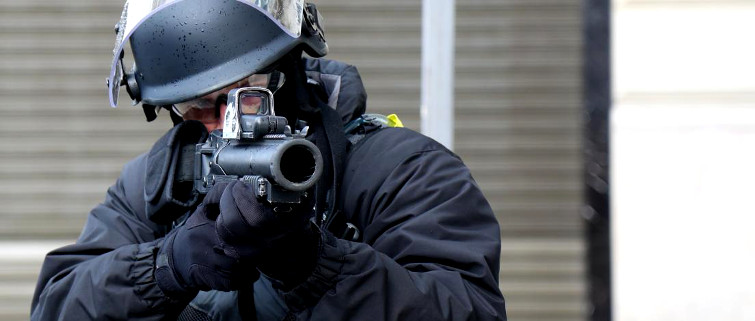
CJ Hopkins | Consent Factory | January 10, 2018
Remember when the War on Terror ended and the War on Populism began? That’s OK, no one else does.
It happened in the Summer of 2016, also known as “the Summer of Fear.” The War on Terror was going splendidly. There had been a series of “terrorist attacks,” in Orlando, Nice, Würzberg, Munich, Reutlingen, Ansbach, and Saint-Étienne-du-Rouvray, each of them perpetrated by suddenly “self-radicalized” “lone wolf terrorists” (or “non-terrorist terrorists“) who had absolutely no connection to any type of organized terrorist groups prior to suddenly “self- radicalizing” themselves by consuming “terrorist content” on the Internet. It seemed we were entering a new and even more terrifying phase of the Global War on Terror, a phase in which anyone could be a “terrorist” and “terrorism” could mean almost anything.
This broadening of the already virtually meaningless definition of “terrorism” was transpiring just in time for Obama to hand off the reins to Hillary Clinton, who everyone knew was going to be the next president, and who was going to have to bomb the crap out of Syria in response to the non-terrorist terrorist threat. The War on Terror (or, rather, “the series of persistent targeted efforts to dismantle specific networks of violent extremists that threaten America,” as Obama rebranded it) was going to continue, probably forever. The Brexit referendum had just taken place, but no one had really digested that yet … and then Trump won the nomination.
Like that scene in Orwell’s 1984 where the Party switches official enemies right in the middle of the Hate Week rally, the War on Terror was officially canceled and replaced by the War on Populism. Or … all right, it wasn’t quite that abrupt. But seriously, go back and scan the news. Note how the “Islamic terrorist threat” we had been conditioned to live in fear of on a daily basis since 2001 seemed to just vanish into thin air. Suddenly, the “existential threat” we were facing was “neo-nationalism,” “illiberalism,” or the pejorative designator du jour, “populism.”
Here we are, two and a half years later, and “democracy” is under constant attack by a host of malevolent “populist” forces …. Russo-fascist Black vote suppressors, debaucherous eau de Novichok assassins, Bernie Sanders, the yellow-vested French, emboldened non-exploding mail bomb bombers, Jeremy Corbyn’s Nazi Death Cult, and brain-devouring Russian-Cubano crickets. The President of the United States is apparently both a Russian intelligence operative and literally the resurrection of Hitler. NBC and MSNBC have been officially merged with the CIA. The Guardian has dispensed with any pretense of journalism and is just making stories up out of whole cloth. Anyone who has ever visited Russia, or met with a Russian, or read a Russian novel, is on an “Enemies of Democracy” watch list (as is anyone refusing to vacation in Israel, which the Senate is now in the process of making mandatory for all U.S. citizens). Meanwhile, the “terrorists” are nowhere to be found, except for the terrorists we’ve been using to attempt to overthrow the government of Bashar al Assad, the sadistic nerve-gassing Monster of Syria, who illegally invaded and conquered his own country in defiance of the “international community.”
All this madness has something to do with “populism,” although it isn’t clear what. The leading theory is that the Russians are behind it. They’ve got some sort of hypno-technology (not to be confused with those brain-eating crickets) capable of manipulating the minds of … well, Black people, mostly, but not just Black people. Obviously, they are also controlling the French, who they have transformed into “racist, hate-filled liars” who are “attacking elected representatives, journalists, Jews, foreigners, and homosexuals,” according to French President Emmanuel Macron, the anointed “Golden Boy of Europe.” More terrifying still, Putin is now able to project words out of Trump’s mouth in real-time, literally using Trump’s head as a puppet, or like one of those Mission Impossible masks. (Rachel Maddow conclusively proved this by spending a couple of hours on Google comparing the words coming out of Trump’s mouth to words that had come out of Russian mouths, but had never come out of American mouths, which they turned out to be the exact same words, or pretty close to the exact same words!) Apparently, Putin’s master plan for Total Populist World Domination and Establishment of the Thousand Year Duginist Reich was to provoke the global capitalist ruling classes, the corporate media, and their credulous disciples into devolving into stark raving lunatics, or blithering idiots, or a combination of both.
But, seriously, all that actually happened back in the Summer of 2016 was the global capitalist ruling classes recognized that they had a problem. The problem that they recognized they had (and continue to have, and are now acutely aware of) is that no one is enjoying global capitalism … except the global capitalist ruling classes. The whole smiley-happy, supranational, neo-feudal corporate empire concept is not going over very well with the masses, or at least not with the unwashed masses. People started voting for right-wing parties, and Brexit, and other “populist” measures (not because they had suddenly transformed into Nazis, but because the Right was acknowledging and exploiting their anger with the advance of global neoliberalism, while liberals and the Identity Politics Left were slow jamming the TPP with Obama and babbling about transgender bathrooms, and such).
The global capitalist ruling classes needed to put a stop to that (i.e, the “populist” revolt, not the bathroom debate). So they suspended the Global War on Terror and launched the War on Populism. It was originally only meant to last until Hillary Clinton’s coronation, or the second Brexit referendum, then switch back to the War on Terror, but … well, weird things happen, and here we are.
We’ll get back to the War on Terror, eventually … as the War on Populism is essentially just a temporary rebranding of it. In the end, it’s all the same counter-insurgency. When a system is globally hegemonic, as our current model of capitalism is, every war is a counter-insurgency (i.e., a campaign waged against an internal enemy), as there are no external enemies to fight. The “character” of the internal enemies might change (e.g., “Islamic terrorism,” “extremism,” “fascism,” “populism,” “Trumpism,” “Corbynism,” et cetera) but they are all insurgencies against the hegemonic system … which, in our case, is global capitalism, not the United States of America.
The way I see it, the global capitalist ruling classes now have less than two years to put down this current “populist” insurgency. First and foremost, they need to get rid of Trump, who despite his bombastic nativist rhetoric is clearly no “hero of the common people,” nor any real threat to global capitalism, but who has become an anti-establishment symbol, like a walking, talking “fuck you” to both the American and global neoliberal elites. Then, they need to get a handle on Europe, which isn’t going to be particularly easy. What happens next in France will be telling, as will whatever becomes of Brexit … which I continue to believe will never actually happen, except perhaps in some purely nominal sense.
And then there’s the battle for hearts and minds, which they’ve been furiously waging for the last two years, and which is only going to intensify. If you think things are batshit crazy now (which, clearly, they are), strap yourself in. What is coming is going to make COINTELPRO look like the work of some amateur meme-freak. The neoliberal corporate media, psy-ops like Integrity Initiative, Internet-censoring apps like NewsGuard, ShareBlue and other David Brock outfits, and a legion of mass hysteria generators will be relentlessly barraging our brains with absurdity, disinformation, and just outright lies (as will their counterparts on the Right, of course, in case you thought that they were any alternative). It’s going to get extremely zany.
The good news is, by the time it’s all over and Trump has been dealt with, and normality restored, and the working classes put back in their places, we probably won’t remember that any of this happened. We’ll finally be able to sort out those bathrooms, and get back to paying the interest on our debts, and to living in more or less constant fear of an imminent devastating terrorist attack … and won’t that be an enormous relief?
#
Photo: Zakaria Abdelkafi – AFP
Featured Video

When Israel Is Mighty
or go to
Aletho News Archives – Video-Images
From the Archives
US murdering 1 million Iraqis is democracy, Iran giving yogurt to Iraq is “domination”
By Ali Salaam | American Herald Tribune | July 31, 2017
The New York Times, owned by the Zionist Jewish supremacist Ochs-Sulzberger family, has no problem with Iraqi suffering as long as Iran is not the one behind it.
The Iraq War was a genocide of the Iraqi people by Zionist supremacists in the Bush administration. Over 1 million innocent people were killed based on a lie. American soldiers died in an Israeli war and now an average of 22 soldiers commit suicide every day because their consciences cannot cope with the fact they committed crimes in an illegal war that served no purpose other than to benefit Israel, not America.
Benjamin Netanyahu, Prime Minister of the Zionist regime, once said “We are benefiting from one thing, and that is the attack on the Twin Towers and Pentagon, and the American struggle in Iraq.”
Paul Wolfowitz had his sights on Iraq since his time in the first Bush administration. Former Israeli official and Bush administration official Richard Perle had his eyes on Iraq since at least his authorship of the Clean Break white paper. The Zionist regime had their eyes on Iraq since the 1980s when strategist Oded Yinon wrote his white paper in support of dividing the Arab-Muslim world along ethnic and sectarian lines. The global Zionist lobby has had their eyes on Iraq since Theodor Herzl stated that Eretz Israel’s true borders go from the Nile River in Egypt to the Euphrates River in Iraq. … continue
Blog Roll
 Aletho News
- Huckabee aide goes to ‘unusual lengths’ to portray ‘Israel’ positively
- Trump Announces Diesel Supply Deal With Putin Following Phone Call
- MEP blasts ‘Euro-Gestapo’ for lecturing Russia on democracy
- Syria May Send Troops to Saudi Arabia Amid War with Ansar Allah
- UK whines about losing billions to ‘Putin tax’
- Baghaei to Rubio: Distorted narratives cannot erase US record of broken commitments
- Houthis Don’t Have to Conquer Saudi Arabia to Make It Pay
- MOE: Nearly 22,000 Students and Education Workers Killed
- Guterres in Islamabad: Genocide, cowardice, and the cage of Imran Khan
- Johnson, Marandi say Yemen holds upper hand over Saudi Arabia
- If Americans Knew
- Gaza ceasefire exists in name only, say more than 100 organizations
- Nearly 2 Million in Gaza Need Urgent Shelter Assistance as Winter Looms: IOM Chief Warns
- Suppressing Palestinian resistance: US charity under fire for AI monitoring of Gaza classrooms
- Thousands Are Held in Israeli Torture Camps. This Is What Happens Inside
- Israel puts Gaza’s sick, injured, newborn in peril – Daily Update
- Report claimed Mark Levin used by Israeli government to influence Trump
- Over 2,000 Gazans have died awaiting medical evacuation amid Israel’s continued siege
- How a U.S. Diplomat Suppressed and Altered Reports Critical of Israel
- 5 Palestinians Die from Israeli Strikes in Gaza as Relentless Attacks Continue
- Report: Ceasefire Slows Killing but Leaves Devastation Intact
- No Tricks Zone
- New Study: 50 Years Of The Most Aggressive ‘Net Zero’ Policies Can Only Affect The Global Climate By 0.03°C
- US September “Heat” Was No Record…Many Records Set Decades Ago
- Latest European Green Energy Debacle; Portugal’s Largest Flagship Solar Park Insolvent!
- Green Energy Debacle: German Expert Professor Fritz Vahrenholt Warns Of Severe Economic And Social Consequences
- Two More Paleo Reconstructions Affirm Meters-Higher Sea Levels Across Ireland, Brazil 7000-6000 Years Ago
- New Study: Earth And Venus Surface Warmth Largely Explained By Convection And Lapse Rate, Not CO2 Or Radiation
- 2025 Nature Paper Claiming Worsening Global Drought Gets RETRACTED …Heavily Flawed
- New Study: ‘Global Drought Shows No Detectable Recent Acceleration Under Climate Warming’
- Economic Masterminds: German Socialists Suggest Taxing Productivity Gains Stemming From Using AI
- The South China Sea Has Not Been Cooperating With The Climate Change Narrative

