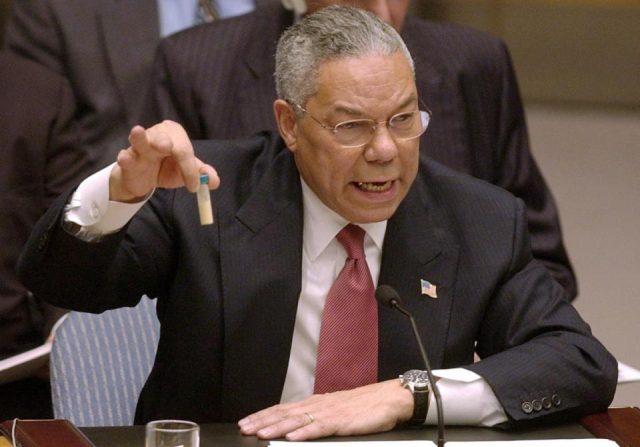
Did everyone urging us to trust the CIA forget this happened? Or do they just want us to?
In the hysterical wake of the Trump-Putin Summit in Helsinki, President Donald Trump was roundly criticised in the media for taking the side of a “hostile state” over his own intelligence agencies. The Guardian referred to Mueller as a “heroic marine” who Trump disbelieved in favour of a “Russian dictator”.
In the past, when Trump has criticised the FBI, CIA or NSA he has been accused of “undermining faith in our institutions”. He’s been blamed for a collapse of trust in the government. But was this trust ever earned?
At every corner, we are urged to simply believe what we are told. Whether it is about believing Porton Down and MI6 about “novichok”, or believing the White Helmets about Sarin, or believing the FBI about “collusion”, we are presented with no facts, just assertions from authority. Those who question those assertions are deemed “bots” at best or “traitors” at worst.
Well here, fellow traitors, are the Top Ten reasons to question anything and everything the CIA – or any intelligence agency – has ever told you.
10. OPERATION PAPERCLIP – we’ll start with an oldie but a goody. In 1945, as the allies were advancing on Berlin from both sides, American Army Intelligence (this was before the CIA were founded) were “capturing” (read: recruiting) over 1,600 Nazi scientists and engineers. Most famous of them was Werhner von Braun… sorry, SS Sturmbannführer von Braun.
Whilst Allied soldiers died in the name of defeating fascism, the CIA’s predecessors were actively recruiting Nazis to come and build bombs for them.
9. OPERATION NORTHWOODS – The original, and important, precedent for accusations that the CIA et al. might engage in false-flag attacks. Operation Northwoods was a joint CIA/Pentagon proposal designed around the idea of escalating a war with Cuba by stoking public anger:
The proposals called for the Central Intelligence Agency (CIA) or other U.S. government operatives to commit acts of terrorism against American civilians and military targets, blaming it on the Cuban government, and using it to justify a war against Cuba.
The idea was vetoed by President Kennedy. Fifty years later, the CIA and Pentagon still very much exist, but there’s no longer a Kennedy there to veto their more psychopathic ideas. Funny how that worked out.
8. ALLENDE COUP – In 1970 Salvador Allende was elected to the Chilean Presidency. A Physician and dedicated socialist, Allende was the first socialist president elected in South America. The Nixon-lead government of the United States immediately implemented “economic warfare” (as they do, to this day, against Cuba, Venezuela and others). The economic warfare did not work, and in 1973 Allende’s socialist party increased their parliamentary majority.
In response, the US “assisted” (read: instructed) the Chilean military in carrying out a coup. Allende allegedly shot himself, and Augusto Pinochet was placed in power as the first dictator in Chile’s history. Pinochet was a fascist who executed Chilean “subversives” by the thousand… and was the darling of Western leaders.
7. MOSADDEGH COUP – I could just copy-and-paste the above paragraph and the change the names for this entry. In 1953, the Prime Minister of Iran – Mohammad Mosaddegh, a democratic socialist – wanted to audit the income of the Anglo-Iranian Oil Company with an eye to limiting foreign control of Iran’s oil. Within a few months, a joint US/UK operation – Operation Ajax – had removed Mosaddegh’s elected government and turned over full control of the state to the Shah. He was a brutal absolute monarch, but the question of Western control of Iran’s enormous oil reserves wasn’t raised again under his leadership.
6. OPERATION MOCKINGBIRD – A CIA operation that you could deduce existed, even if were not proven…. and it is proven. Mockingbird was the CIA project to coerce, train, control or plant CIA-friendly journalists in major news networks all across the country and in every medium. It’s existence is no longer disputed, thanks to FOIA releases of internal memos.
Mockingbird was allegedly shut down in 1976 – just after its existence was leaked – then CIA director George HW Bush claiming:
… effective immediately, CIA will not enter into any paid or contractual relationship with any full-time or part-time news correspondent accredited by any U.S. news service, newspaper, periodical, radio or television network or station.”
If you’re willing to stake anything on the word of a Bush, well, good luck with that. It’s a decision that flies in the face of historical evidence.
Remember this one when you hear about the need to trust the CIA from some pundit on CNN or MSNBC.
5. MASS SURVEILLANCE – It’s not really talked about much these days – what with the vast majority of the media and huge sections of the supposedly “anti-establishment” progressive left marching in-step with the Deep State – but the NSA spied on the whole world. The whole world. We know this to be true because an employee of the Deep State – Edward Snowden – leaked the information.
When challenged on this issue, representatives of the NSA and CIA lied. They lied to the public, and they lied to congress. When they were proven to have lied, they carefully qualified their lies.
A qualified lie is still a lie.
There is no indication they have stopped this illegal surveillance, but they may have passed laws to make it legal.
4. NAYIRAH – A classic of “atrocity propaganda”, Nayirah should be required reading material for anybody looking top hop on a pro-war bandwagon. Nayirah – who originally gave only her first name – was a fifteen year old girl who testified in front of the United States Congress. She claimed to be a volunteer from at a Kuwaiti hospital, and to be an eye-witness to Iraqi soldiers throwing Kuwaiti babies out of incubators and leaving them to die:
I volunteered at the al-Addan hospital with twelve other women who wanted to help as well. I was the youngest volunteer. The other women were from twenty to thirty years old. While I was there I saw the Iraqi soldiers come into the hospital with guns. They took the babies out of the incubators, took the incubators and left the children to die on the cold floor. It was horrifying.
It was later revealed, not only that her full name was Nayirah al-Sabah and she was the daughter of the Kuwaiti ambassador, but that she had never volunteered at a hospital and had seen no babies, soldiers or incubators. The whole thing was a fiction. A fiction paid for by the “Citizens of Free Kuwait”, an NGO (and obvious CIA front) set up to lobby the US to intervene in the Iraq-Kuwait war.
By the time this fiction was revealed it was too late, and the US had launched Operation Desert Storm…. which was, of course, the entire point of the exercise.
Remember this, when you hear about Assad gassing children or bombing kittens.
3. COINTELPRO – The FBI’s long running (and sometimes illegal) COunter INTELligence PROgram, COINTELPRO was a series of domestic projects carried out by the FBI (with cooperation from other agencies), over decades, with the aim of “surveilling, infiltrating, discrediting, and disrupting domestic political organizations”.
These political organizations included anti-Vietnam protestors, civil rights groups (including both MLK and Malcolm X), socialists, Communist Party USA, environmental groups and feminist organizations.
The brief for these “disruptions” came straight from J. Edgar Hoover who wanted the FBI to “expose, disrupt, misdirect, discredit, or otherwise Neutralize” people he perceived to be enemies of the state. The capital N in “neutralise” is no accident, as the FBI was implicated in the deaths of several Black Panther leaders, including Fred Hampton.
COINTELPRO didn’t just involve undermining left-wing groups, but also creating right-wing groups:
The FBI also financed, armed, and controlled an extreme right-wing group of former Minutemen, transforming it into a group called the Secret Army Organization that targeted groups, activists, and leaders involved in the Anti-War Movement, using both intimidation and violent acts.
Whether this was done to actually push a right-wing agenda, create a fake threat to step up police powers, or just sow division and chaos, is unclear. But it definitely happened.
Much like MKUltra (below), COINTELPRO was “officially shut down”, not long after the public found out it existed. However, the accidental outing of undercover policeman at a rally in Oakland, and recent relaxation of the laws limiting the FBI’s powers, means that COINTELPRO – or a modern successor – is very likely still a thing.
The aim of COINTELPRO was to “Neutralize” anti-establishment political figures – the vast majority of targets were left wingers – through “smearing individuals and groups using forged documents and by planting false reports in the media”. Remember that when you see Rand Paul called a “traitor” on twitter, or read about “Russian collusion”, or see Jeremy Corbyn branded an anti-Semite.
Remember that it is proven that the Deep State – our trusted intelligence agencies – pay people to plant false stories and discredit political opponents.
2. PROJECT MKULTRA – It might sound like something from a 70s sci-fi TV series, but it is unfortunately real. MKUltra was a series of (illegal) experiments carried out by the CIA from 1953 until it was *cough* “officially halted” in 1973 (just after its existence was leaked). The experiments were wide-ranging, achieved varied levels of success, but pretty uniformly brutal and unethical. They included, but were not limited too:
– Giving LSD to unsuspecting soldiers to see what happened.
– Mass hypnosis and mass suggestion
– Torture studies
– Studies on the effect of verbal and/or sexual abuse
We’ll never know the full range of studies, or how they were carried out, because in 1973 Richard Helms, then director of the CIA, ordered all MKUltra files destroyed. Only a fraction of them survive, thanks to FOIA requests, but it’s reasonable to assume they destroyed the worst parts and kept the more quote-unquote innocent files.
The CIA were not unique in this regard either, MKUltra was their baby – but there were parallel projects in other quarters of the deep state. Army Intelligence had Edgewood Arsenal, whilst the Department of Defense had Project 112. All these projects were “officially halted” in the early 70s… just around the time the public found out they existed.
The CIA (et al.) have strongly denied that these experiments and projects have ever been continued in any way, shape or form…but if you’d asked them in 1969, they would have denied they had ever taken place at all.
1. THE IRAQ WAR – This might not be the most callous, the most dangerous, the most recent, the most secret or the most insidious of the items on this list, nevertheless it is – must be – number one… because it is the most brazen.
The war was started in the name of “weapons of mass destruction” that everyone – everyone – knew never existed. They all knew the truth, but they lied.
The President lied, the vice-president lied, the secretary of defence lied, the secretary of state lied. The Prime Minister lied, the defence minister lied, the foreign minister lied. They lied to the press, the people and the UN.
The CIA, the NSA, the FBI – then headed by the “heroic marine” Robert Mueller – they lied too. The press repeated these lies, without question (see: Operation Mockingbird). They weren’t “misinformed”, they weren’t “mistaken”. They lied, they lied repeatedly – and provably – and they did it in order to start a war, make money, take control, spread influence.
One million Iraqis died.
Our ruling class is peopled with psychopaths and war criminals, who have so little regard for the people they lie to they recycle the same childishly simple falsehoods to further their evil agenda again and again and again. They tried the same in Libya… it worked again. They tried again in Syria… luckily, it didn’t work there.
Our “democratic institutions” lie to start wars. There’s no reason to think they aren’t doing – or wouldn’t do – the same thing about Iran, North Korea… or Russia.
That’s our list, and there’s really only one lesson you can take away from it:
These people, agencies and institutions deserve no trust, have earned no trust and have abused every micron of trust ever placed in them. To suggest we have a duty to believe them – or that they have ever done anything to serve the public good – is to live in a dream world.
This list is not a full catalogue of Deep State crimes, it would be 1,000s of entries long if it were, but these ten are important. They’re important because they are admitted, proven and beyond debate. They are important because they show the many facets of dishonesty, hypocrisy and abuses of power that Intelligence agencies engage in, and they are important because they form the best riposte to the disingenuous clamour for “trust” in our “democratic institutions”.
Never trust the CIA, they have proved they don’t deserve it.
July 20, 2018
Posted by aletho |
Deception, Fake News, False Flag Terrorism, Mainstream Media, Warmongering, Timeless or most popular | CIA, FBI, NSA, The Guardian, United States |
Leave a comment
On the world’s Grand Chessboard, the US is fighting for control and influence. And there are countries where its ambassadors are perceived more as imperial governors than simple channels of communication.
At the height of the Maidan protests in Kiev in early 2014, a conversation was leaked between the US ambassador to Ukraine, Geoffrey Pyatt, and the then-Assistant Secretary of State in the Obama administration, Victoria Nuland. The conversation gained notoriety because Nuland said to Pyatt, “F**k the EU” and the recording was almost instantly available on Youtube.
More shocking than Nuland’s bad language, however, was what the conversation was about. The US government officials were discussing how to put their men into power in Ukraine – which of the three then opposition factions would dominate, who would take the lead (Arseniy Yatsenyuk) and who would be excluded (Vladimir Klitschko). At the time of this conversation, early February 2014, their enemy Viktor Yanukovych was still president. The leaked recording proved that the US and its Kiev embassy were actively involved in a regime change operation. The composition of the post-Maidan government corresponded exactly with US plans.
What few people knew at the time was that such levels of control over the composition of foreign governments had become standard practice for US embassies all over the world. As I could see on my very numerous travels around the Balkans in the late 1990s and early 2000s, the US ambassador was treated by the political class and the media in those countries not as the officially accredited representative of a foreign government but instead as an imperial governor whose pronunciamentos were more important than those of the national government.
This has been going on for decades, although the levels of control exercised by the United States increased as it rushed to fill the political vacuum created by the collapse of Soviet influence in Eastern Europe after 1989. In earlier times, such control, especially regime change operations, had to be conducted either covertly, as with the overthrow of Iranian prime minister, Mohammad Mosaddegh, in 1953, or by financing and arming an anti-government militia, such as in Nicaragua and elsewhere in central and South America, or by encouraging the army itself, most famously in Chile in 1973. There is a huge body of literature on this vast subject (for the coup against Mosaddegh, see especially ‘All the Shah’s Men’ by Stephen Kinzer, 2003) and there is no possibility of denying that such operations took place. Indeed, former CIA director, James Woolsey, recently admitted that they continue to this day.
Many of the ambassadors who engineered or attempted regime change operations in Eastern Europe and the former USSR had cut their teeth in Latin America in 1980s and 1990s. One of them, Michael Kozak, former US ambassador to Belarus, even boasted in a letter to The Guardian in 2001 that he was doing the same thing in Minsk as he had done in Managua. He wrote: “As regards parallels between Nicaragua in 1989-90 and Belarus today, I plead guilty. Our objective and to some degree methodology are the same.”
Kozak did not mention that he also played a key role in the overthrow of General Noriega in Panama in 1989 but he is far from alone. The experience accumulated by the Americans during the Cold War, including in major European countries like Italy where US interference was key to preventing Communist victories in elections, spawned a whole generation of Kermit Roosevelts (the architect of the coup against Mosaddegh) who have made their careers over decades in the State Department. Some names, such as that of Michael McFaul, former US ambassador to Russia who made no secret of his opposition to the president of the state to which he was accredited, will be familiar to RT readers.
Two years after the violent overthrow of Viktor Yanukovych, which he helped coordinate, Geoffrey Pyatt was appointed US ambassador to Greece. He remains in that post to this day – which is why some are asking whether his hand might be behind last week’s expulsion of Russian diplomats from Athens. Greece and Russia have customarily had good relations but they differ on the Macedonian issue. Now, the Greek government headed by the “pseudo-Euroskeptic” Alexis Tsipras, claims that four Russian diplomats were engaged in covert operations in Greece to lobby against forcing Macedonia to change its official name.
Like almost every other political issue these days, this relatively arcane one is regarded through the distorting prism of alleged Russian “interference“: any decision which does not consolidate the power of American-dominated supranational structures like the US or the EU is now routinely attributed to all-pervasive Russian influence, as if all dissidents were foreign agents. Western discussion of this subject now resembles the paranoia of the old Soviet regime, and of its satellites in Eastern Europe, which similarly attacked anti-Communists for being “fifth columnists” – the very phrase used by a prominent European politician last month to lambast all his enemies as Russian stooges.
US influence is suspected in this case between Greece and Macedonia because the Americans are pushing to bring the whole of the Balkan peninsula under Western control. This has been policy for nearly thirty years – at least since the Yugoslav wars led to a US-brokered peace deal in Bosnia in 1995. In recent years the tempo has quickened, with the accession of Montenegro to NATO last year leaving only Macedonia and Serbia as missing pieces of the puzzle. The Greek victory over the name of Macedonia removes the last obstacle to that country’s accession to NATO and other “Euro-Atlantic structures” like the EU and soon only Serbia will be left. Will she last long?
One of the most notorious anecdotes of the Second World War was told by Churchill. While in Moscow in 1944, he and Stalin divided up Eastern Europe and the Balkans into spheres of influence, putting percentage figures to show the respective weight of the West and the USSR – 10:90 in Greece, 50:50 Yugoslavia, 25:75 in Bulgaria, and so on. Churchill recalls how this so-called Percentages Agreement was concluded in a few minutes, and how he scribbled a note of their verbal agreement on a piece of paper which Stalin glanced at for a second and then ticked off. Churchill wrote, “It was all settled in no more time than it takes to set down.”
Churchill then reflected that it might seem cynical to decide the fate of millions of people in such an offhand manner. Later generations have generally agreed with his self-criticism. Today’s West would certainly never conclude such an agreement – but not because of any squeamishness or lack of cynicism on its part. Instead, the West, especially the US, could not conclude any agreement because in every case the only acceptable outcome would be 100% influence for itself. That is what Geoffrey Pyatt and his colleagues spend their entire careers trying to achieve – and, to a large extent, they succeed.
John Laughland, who has a doctorate in philosophy from the University of Oxford and who has taught at universities in Paris and Rome, is a historian and specialist in international affairs.
July 20, 2018
Posted by aletho |
Timeless or most popular | CIA, Latin America, Ukraine, United States |
Leave a comment

© Erin Scott / Global Look Press
After his landmark summit with Russian leader Vladimir Putin in Helsinki, US President Donald Trump was apparently forced into an embarrassing u-turn over allegations of Russian interference in American elections.
On returning to the White House from his summit in Finland, Trump read out a statement, saying that he “accepted” US intelligence claims that Russia had meddled in the 2016 presidential election.
He offered the explanation that he had “mis-spoken” during his press conference with Putin in Helsinki the day before, when he appeared then to accept the Russian president’s “powerful denial” that his country had not interfered in the race for the White House.
What to make of it? Was Trump correcting a glitch in his speech, or is there something more sinister at play?
In any case, political and media critics in the US don’t believe the president’s “attempt at backtracking,” as the Washington Post put it.
Senior Democrats insisted Trump “could not squirm his way out” of the torrent of accusations that he had “capitulated to Putin” and dishonored US intelligence services by appearing to accept Moscow’s assurances it had not interfered in the elections.
The context of words spoken at the press conference in Helsinki does indeed suggest that Trump was countenancing Putin’s denial of Russian meddling. The US president went on to say that the various probes into the matter were a “disaster” for America’s international image and for bilateral relations with Russia. This is consistent with Trump’s long-held view that the Mueller inquiry is a “witch-hunt” based on “fake news”.
So, Trump’s belated about-turn on what he meant to say in Helsinki regarding alleged Russian interference does not seem to be a convincing, genuine correction on his part. It suggests rather that the president is being forced into making a retraction.
What could be viewed as more disturbing is the way the American president has been browbeaten and cowed to make an embarrassing denial of something he actually believes. In other words, Trump has been humiliated or intimidated into toeing a line.
The US media reaction following the summit with Putin was immediate and shockingly coordinated, like a full-on assault.
“Trump faces tidal wave of criticism over handling of summit with Putin,” reported US government-funded Radio Free Europe.
The president was assailed with a torrent of abuse, decrying him as a “disgrace” and “traitor” for having engaged in a cordial manner with the Russian leader. The uniform scorn poured on Trump by the political and media establishment was something to behold.
Rabid pundits in supposedly prestigious newspapers such as the New York Times were declaring that it’s “Trump and Putin vs. America,” claiming that “the president’s refusal to condemn Russian attacks was a betrayal of every single American citizen.”
The media backlash of vituperation against the president was nothing short of extraordinary. It was a concerted campaign of sedition against his authority which, at times, openly called for a palace coup to oust him.
Under the headline, “This sad, embarrassing wreck of a man,” one oped in the Washington Post posed the question: “Which Republicans will stand behind a president who puts Russia first?”
Ironically, Trump’s instincts about the whole Russiagate affair are correct. It is a load of unsubstantiated farrago promoted by Democrats and large sections of supportive news media who have never got over the ignominy of Hillary Clinton losing out to “deplorable Trump.” Clinton was also backed by high-ranking officials in the state intelligence apparatus, as well as the foreign policy establishment.
This constituency of the political class in Washington shared Clinton’s avowed hostility towards Putin. It is to their unforgivable chagrin that Donald Trump was elected. Moreover, Trump was elected partly on the promise of restoring normal relations between the US and Russia. His policy was given a democratic mandate upon his election to the White House.
After nearly two years of relentless Russophobia from the US political and media establishment, the case for alleged Russian interference in American politics remains embarrassingly vacuous. Not even the latest so-called indictments produced by special counsel Robert Mueller have any credibility to anyone who looks earnestly at the charges. What’s more, ordinary American citizens seem to agree that the whole Russiagate affair is a frivolity indulged in by the political and media elites confined to Washington’s Beltway Bubble.
In a poll out this week following the Helsinki summit, a small majority of Americans (55 percent) seem to think that Trump is “mishandling” relations with Russia. It is perhaps not surprising, given the wall-to-wall media pillorying of the president as a “traitor.” Nevertheless, the same poll found that only a minority of Americans view Russia as “an enemy” (38 percent) or an “imminent threat” (27 per cent).
These figures are cold comfort for the US political establishment, which has assiduously pushed the narrative of Russian malevolence.
What the astounding media backlash against Trump shows is not so much the fecklessness of his character. No, the really perplexing issue is how American democracy is warped and fashioned to meet the demands of powerful unelected forces. The imperative is brazen and brutal.
Trump may want to normalize relations with Russia. The people may have voted for this policy. But the powers-that-be are making sure that this policy is not implemented. They want hostility towards Russia to prevail, as it would have explicitly if Hillary Clinton had been elected.
In short, what we are seeing this week is “American democracy” in action. Meaning there is no actual democracy exercised by the power of the people. It is power exercised by elite interests.
In that way, Russian reaction to the Helsinki summit should be restrained.
Indeed, it was welcome to see Trump and Putin engage in cordial, mutual dialogue. Trump deserves credit for holding the summit and for his civilized manner towards the Russian leader, instead of adopting the vulgar offensiveness for which so much of the US establishment is baying.
The problem is that Trump has evidently very limited political authority to implement the obvious goodwill he desires between Washington and Moscow. He has limited authority to actually adopt one of the key policies for which he was elected by the people.
Trump’s cringe-making u-turn was not a correction over his misuse of “double negative speech.” It was a positively damning sign that the president and the citizens who voted for him have actually negligible power when it comes to overturning a fundamental objective of the unelected plutocrats of the deep state.
For Russia, and indeed the wider world, that is deeply troubling. Because the American powers-that-be are evidently hell-bent on pursuing a hostile agenda towards Russia. Their Russophobia is not just some passing phase. It’s a symptom of an incorrigible malaise and desire within the US establishment for conflict.
Finian Cunningham (born 1963) has written extensively on international affairs, with articles published in several languages. Originally from Belfast, Northern Ireland, he is a Master’s graduate in Agricultural Chemistry and worked as a scientific editor for the Royal Society of Chemistry, Cambridge, England, before pursuing a career in newspaper journalism. For over 20 years he worked as an editor and writer in major news media organizations, including The Mirror, Irish Times and Independent. Now a freelance journalist based in East Africa, his columns appear on RT, Sputnik, Strategic Culture Foundation and Press TV.
July 19, 2018
Posted by aletho |
Mainstream Media, Warmongering, Russophobia, Timeless or most popular | New York Times, United States, Washington Post |
Leave a comment

Crazy. Unhinged. Un-American. Those are just a few of the adjectives used to describe Congresswoman Maxine Waters as she emerges as a star of the anti-Trump ‘Resistance’ and riles both Democrats and Republicans with her fervor.
The California Democrat has drawn sharp criticism even from her own party for what many interpreted as an incitement to ‘mob violence’ when she called on Americans to harass members of Donald Trump’s administration if they saw them in public — antics which led her to receive serious threats against her life.
While Democrats have tried to criticize Waters in a more diplomatic manner, appealing for calm in trying times, Republicans haven’t been holding back. One congressional candidate called her a “hustler of hate” who should be behind bars.
President Waters?
Waters has embarrassed herself on a number of other occasions in recent months, too; There was the time she called for Trump to be impeached because Russia had (according to her) invaded Korea. Then there was the time she claimed that RT had hacked C-SPAN in an effort to interfere specifically with her speech on the House floor — and let’s not forget the time she promised two phone pranksters posing as the Ukrainian prime minister that the US would “stand with” Ukraine to keep sanctions on Russia. She also has what seems like an unhealthy preoccupation with the idea of being shot at.
And now, there is speculation that she could be the Democratic nominee for president in 2020.
CNN political commentator John Phillips penned a piece last week for the L.A. Daily News arguing that “Mad Max” really could be the nominee two years from now. Waters, he wrote, is “the only one dancing to the beat” of the resistance.
The scary thing is, he could be right. Waters, with her fiery, nothing-held-back approach has tapped into the rage and anger many Americans are feeling about Trump — and she is feeding it, to her own advantage. The woman, Phillips wrote, “who is the biggest rock star with liberals right now is Auntie Maxine” — and it doesn’t even matter that she was just called un-American by her own party leadership.
Waters is a bit like marmite. People seem to love her or hate her — and it’s not just since Trump became president and gave her license to reveal her own special brand of crazy.
Back in 2013, I met Waters in Washington D.C. at the screening of a documentary about America’s war on drugs and the desperate need to reform the country’s criminal justice system.
The documentary was co-produced by Danny Glover, Brad Pitt, Russell Simmons and John Legend — but, as I wrote at the time, Waters herself turned into the unlikely star of the show. After the screening, as I tried to get near her to ask a few questions, she was mobbed by supporters looking for selfies. That day she came across as a celebrity in her own right.
And, speaking, of celebrity, Phillips makes the point that the media and political pundits wrote Donald Trump off as a “reality show buffoon” and a “shameless self-promoter” with zero chance of winning the election. Here again, he is correct.
The media did write Trump off — and he won. So if Waters, crazy and all as she might be, did throw her hat in the ring for the 2020 election, pundits would want to be very careful not to assume for a second time that there is such thing as ‘too crazy’ or radical to win.
In the same way Trump challenged Republican party orthodoxy and defeated 16 other primary challengers to win the nomination, Phillips thinks Waters could tread a similar path.“[Trump] understood the mood and frustrations of the electorate better than anyone in the race,” he wrote.
No frontrunner
But Phillips’ musing also highlights something else; just how lacking the Democratic party is in good alternatives to Trump. That someone as erratic and downright strange as Maxine Waters could be reasonably considered a viable candidate says a lot about the state of the Democratic party — and just guess who thinks she is poised to take advantage of that sorry state of affairs?
None other than Hillary Clinton. Confirming beyond doubt that incompetence reigns in the Democratic Party is the recent bout of speculation that Clinton is gearing up to run for president —again — and that people within the party structure might actually be supportive of that plan.
Clinton has been running around giving campaign-style speeches and doing some vigorous fundraising — and although she says publicly she won’t run again, that’s what she said after she lost the Democratic nomination to Barack Obama in 2008, so it might be advisable to take those words with a big pinch of salt.
But perhaps she should think twice about going in for round three. A new poll has found that 73 percent of Democrats want a fresh face to challenge Trump in 2020 — while only 16 percent said they would be happy with a candidate who has run before. The Rasmussen survey also found that 58 percent of Democratic voters think Clinton has damaged the party’s standing.
It has been largely accepted among liberal pundits and (by all accounts) many high profile Clinton supporters that she was a terrible candidate — so terrible that she managed to lose to a hated reality TV star who broke every rule in the playbook —and yet here they are, thinking of wheeling her out again, hoping it’ll be third time’s the charm.
This is the kind of backward thinking that could potentially see Trump — the object of their rage — sail straight back into the White House for another four years in 2020.
But it’s hard to feel sorry for the Democrats. They have positioned themselves as close to the centre as politically possible (some would even argue they are a centre-right party at this point). They have shown only disdain to progressive left candidates, despite ample proof that they are hugely popular with voters. The party threw away the only real chance it had to win in 2016 when it rigged the primary against Bernie Sanders and sent a hugely unpopular candidate to fight and lose against Trump — and now they’re seriously considering doing it all over again.
When you look at it that way, maybe Maxine Waters is their best hope.
Danielle Ryan is an Irish freelance journalist. Having lived and worked in the US, Germany and Russia, she is currently based in Budapest, Hungary. Her work has been featured by Salon, The Nation, Rethinking Russia, Russia Direct, teleSUR, The BRICS Post and others. Follow her on Twitter @DanielleRyanJ, check out her Facebook page, or visit her website: danielle-ryan.com
Read more:
July 19, 2018
Posted by aletho |
Timeless or most popular | Maxine Waters, United States |
Leave a comment
Despite increased spending on mental health treatment, mental illness disability and suicide rates have skyrocketed. “Perhaps more disturbingly,” notes clinical psychologist Noël Hunter, “recent evidence has demonstrated that as contact with psychiatric intervention increases, so too does completed suicide, suggesting the possibility that the current mental health system may be creating the very problems it purports to aid.” In Hunter’s recently published Trauma and Madness in Mental Health Services (Palgrave Macmillan, 2018), she asks, “Are we continuing to funnel money into a fundamentally broken system?”
For many on the Left, it is obvious that the military-industrial complex is devoted only to its own preservation and expansion, thus routinely jeopardizing national security and freedom—this despite many men and women serving in the U.S. military who care about national security and freedom. Far fewer on the Left recognize that the psychiatric-industrial complex (which includes the American Psychiatric Association and its Big Pharma financial partners) is also devoted only to its own preservation and expansion, thus routinely exacerbating emotional suffering—this despite many individual practitioners who want to help their patients.
The majority of psychiatrists and psychologists, owing to both ignorance and cowardice, routinely comply with diagnostic and treatment notions that pretend to be scientific but which have been politically and financially forged. There are, however, a handful of anti-authoritarian professionals who have rebelled, and Noël Hunter is one of them.
Hunter is a rare psychologist. She not only has extensive knowledge of the empirical research, but she herself was once diagnosed with serious mental illness, and she takes very seriously the insights of “experts by experience”—recovered ex-patients—who Hunter quotes throughout her book. Both objective and subjective sources make clear to Hunter that the essential cause for what is called serious mental illness is not some kind of biochemical or genetic defect but some kind of trauma, and that the essential remedy is healing from trauma. For critical thinkers who are not mental health professionals, Hunter’s assertions in Trauma and Madness in Mental Health Services may sound like simple common sense, but it is sense that is not common in the mental health profession.
Wisdom has been derailed by politics and misinformation in the mental health profession (as is the case for many other aspects of U.S. society). Despite what the general public repeatedly hears from the mass media, there is no actual science behind proclamations that “schizophrenia” or other “serious mental illnesses” are caused by a biochemical imbalance, a genetic flaw, or any other innate defect. After many years and much money spent attempting to prove defect theories, even establishment mental health has rejected the widely popularized chemical-imbalance theory of mental illness (though word of this rejection hasn’t gotten out to much of the U.S. general public or to even many practitioners).
In contrast, there is a great deal of scientific evidence showing that people diagnosed with schizophrenia and other serious mental illnesses are far more likely to have been victims of societal and familial trauma. Citing the empirical research, Hunter reports:
“Adverse experiences, particularly in childhood (such as physical and sexual abuse, parental separation, bullying, parental death, foster care, neighborhood violence, poverty, racism, etc.), have been demonstrated to have a direct and dose-response relationship (meaning the more adversity, the greater the risk) with adult mental health issues like hearing voices, suicidality, drug abuse, experiencing altered states of consciousness, extreme and intense emotions, fragmented sense of self, obesity, depression, paranoia, beliefs in conflict with consensus reality, anxiety, and more.”
A great tragedy for people viewed as biochemically defective rather than as victims of trauma is that such individuals who are already suffering are then stigmatized and marginalized owing to their defect status. Hunter reports that “ongoing efforts to combat stigma by asserting that ‘mental illness is an illness like any other’ are actually associated with increased stigma and increased efforts to distance oneself from those deemed mentally ill.”
Politics has long dictated a trauma cover-up. The significance of trauma, Hunter recounts, was obvious over a century ago to Pierre Janet, and so too did Sigmund Freud recognize the importance of sexual abuse as a cause of his patients’ problems. However, Freud then shifted his focus onto unconscious conflicts. While it took some courage for Freud to talk about repressed sexuality, it would have likely been reputation suicide if he had continued to focus on societal and familial trauma—this would have challenged those in society who had far greater status and influence than he had.
To be clear, modern psychiatry does not completely reject trauma as a cause of emotional suffering, and with good luck a patient can  get the kind of diagnosis in which trauma is taken seriously. Post-traumatic stress disorder (PTSD) was included in the American Psychiatric Association’s diagnostic bible, the DSM, in 1980. “This inclusion,” Hunter points out, “was largely the result of political efforts on the part of American veterans of war.”
Politics, not science, dictates not only the explanations for mental illnesses but their creation (as with the case of PTSD) and abolition, as was the case with homosexuality. By the 1970s, gay Americans, angry about their sexual preference being viewed as a disease and defect, finally had enough political power to compel the American Psychiatric Association to abolish homosexuality as a mental illness, and it was excluded from the APA’s 1980 DSM-III. Unfortunately, people diagnosed with schizophrenia and other serious mental illnesses lack the political power to change psychiatric dogma, and so they are seen as defective rather than as victims of trauma.
Phil Ochs sang: “There but for fortune may go you or I.” This is the reality when it comes to psychiatric diagnoses. You and I can exhibit the same behaviors, but whether you or I become a chronic psychiatric patient depends on our bad or good fortune. I’ve talked to many people who as teenagers and young adults innocently told their parents about voices that they were hearing and were then labeled by doctors as schizophrenic, resulting in long careers as mental patients. And I’ve talked with others who kept their voice hearing to themselves; these voices actually helped them have breakthroughs, and they have had no such careers as mental patients.
In a scientific sense, terms like “schizophrenia” are completely meaningless—wastebaskets to toss people who are behaving in ways that appear bizarre to doctors. Often what causes people acting in unusual ways to become chronically dysfunctional are their doctors’ problematic reactions and “treatments.” In other words, it is common for the source of chronic dysfunction to be physician-induced (iatrogenic) trauma.
In the real world of psychiatric diagnoses, probably the most important criteria for whether you are diagnosed with schizophrenia or dissociative identify disorder (DID) is how much your doctor likes you, and Hunter was likable enough to get a DID diagnosis. For reasons of dogma, not science, trauma is taken seriously for DID but not for schizophrenia (in which one is simply seen as defective). So, Hunter considers herself relatively lucky, and one senses her “survival guilt.”
Unlike many books critical of the psychiatric-industrial complex, Trauma and Madness in Mental Health Services offers a great deal of practical help for both practitioners and for those in emotional turmoil. In very concrete terms, Hunter offers chapters on what is helpful and what is not. The research, her own experience as a patient, and her discussions with other ex-patients inform her: “Relationships matter. Relaxation matters. Nutrition matters. Hope and purpose matter. Nature matters. Love matters.”
Professionals often waste their limited time obsessing over a diagnostic process that is scientifically invalid and unreliable. “Rather,” Hunter concludes, “what is more important is to take an individualized, collaborative, trauma-informed approach that is attuned to individual needs without making assumptions and considering the person’s subjective experiences as real and something to be respected.” It’s important, Hunter concludes, to help people find meaning and value in the adaptive nature of their atypical experiences.
In general, I have little hope for the mental health profession, but I have seen individual professionals rise above their desire for security and then revolt against the policies of institutions in the psychiatric-industrial complex. In academia, such rebellion can jeopardize one’s chances for tenure, yet a handful of educators are willing to take that risk. They care less about security than being remembered by their students for turning them on to a book in which they actually acquire knowledge about some very interesting human beings and that is of great value in helping them. Such a book is Noël Hunter’s Trauma and Madness in Mental Health Services.
Bruce E. Levine, a practicing clinical psychologist often at odds with the mainstream of his profession, writes and speaks about how society, culture, politics and psychology intersect. His most recent book is Resisting Illegitimate Authority: A Thinking Person’s Guide to Being an Anti-Authoritarian―Strategies, Tools, and Models(AK Press, September, 2018). His Web site is brucelevine.net
July 18, 2018
Posted by aletho |
Book Review, Science and Pseudo-Science, Timeless or most popular |
Leave a comment
NOTE: Because “NATO” these days is little more than a box of spare parts out of which Washington assembles “coalitions of the willing”, it’s easier for me to write “NATO” than “Washington plus/minus these or those minions”.
Home Secretary Sajid Javid has called on Russia to explain “exactly what has gone on” after two people were exposed to the Novichok nerve agent in Wiltshire. (BBC)
The Russian state could put this wrong right. They could tell us what happened. What they did. And fill in some of the significant gaps that we are trying to pursue. We have said they can come and tell us what happened. I’m waiting for the phone call from the Russian state. The offer is there. They are the ones who could fill in all the clues to keep people safe. (UK security minister Ben Wallace)
Leaving aside their egregious flouting of the elemental principle of English justice, note that they’re uttering this logical idiocy: Russia must have done it because it hasn’t proved it didn’t. Note also, in Javid’s speech, the amusing suggestion that Russia keeps changing its story; but to fit into the official British story “novichok” must be an instantly lethal slow acting poison which dissipates quickly but lasts for months.
This is an attempt to manipulate our perception of reality. In a previous essay I discussed NATO’s projection of its own actions onto Russia. In this piece I want to discuss another psychological manipulation – gaslighting.
The expression comes from the movie Gaslight in which the villain manipulates her reality to convince his wife that she is insane. Doubt the official Skripal story and it is you – you “Russian troll” – who is imagining things. Only Russian trolls would question Litvinenko’s deathbed accusation written in perfect English handed to us by a Berezovskiy flunky; or the shootdown of MH17; or the invasion of Ukraine; or the cyber attack on Estonia. Only a Russian troll would observe that the fabulously expensive NATO intelligence agencies apparently get their information from Bellingcat. Argumentum ad trollem is everywhere: count the troll accusations here or admire the clever anticipatory use of the technique there.
This is classic gaslighting – I’m telling the truth, you’re the crazy one.
We may illustrate the eleven signs of “gaslighting” given in Psychiatry Today by Stephanie A. Sarkis with recent events.
They tell blatant lies.
The Skripals were poisoned by an incredibly deadly nerve agent that left them with no visible symptoms for hours but not so deadly that it killed them; at least not at Easter; nor the policeman; a nerve agent that could only have been made in Russia although its recipe was published in the open media; that poison having been administered on a doorknob that each had to have touched at the exact same minute that no one else touched; a nerve agent so deadly that they only bothered to clean up the sites 51 days later. And so on: a different story every day. But your mind must be controlled by Putin if you smell a falsehood at any point. And, now we have it all over again: apparently the fiendishly clever Russian assassins smeared the doorknob and then, rather than getting out of town ASAP, sauntered over into a park to toss the container. (Remember the fiendishly clever Russian assassins who spread polonium everywhere?)
And, speaking of proven, long term, repeating liars: remember when accusing the British government of complicity in torture renditions was a conspiracy theory? Well, it turns out the conspiracy was by the other side. “Conspiracy Theorist” is the perfect gaslighting accusation, by the way: you’re the crazy one.
They deny they ever said something, even though you have proof.
The Skripal case gives a perfect illustration: here’s the UK Foreign Secretary saying Porton Down told him it was Russian (“absolutely categorical”) And here’s the UK Foreign Office disappearing the statement: We never said Porton Down confirmed the origin. It’s rare to get such a quick exposure of a lie, so it’s useful to have this example. Here is an obvious fake from Bellingcat. Already the Douma story is being re-polished now that the OPCW has said no organophosphates.
Most of the time it takes years to reveal the lie: gaslighters know the details will be forgotten while the impression remains. 64 years later we learn the “conspiracy theorists” were right about the CIA/UK involvement in the Iran coup. It’s rather amazing how many people still believe the proven liars this time around.
They use what is near and dear to you as ammunition.
Russians cheat at the sports you follow, scatter nerve agents and radioactive material in places you could be in, sneak into the voting booth with you, blow up airplanes you might be on and tear up the “very fabric of our democracy.” Your favourite actor tells you “we are at war with Russia“.
And the children! The boy on the beach. The boy in the ambulance. Bana from Aleppo. Miraculous recoveries. Dramatic rescues with camera! Dead children speaking. And finally, the little girl, Trump and the Time cover.
If it’s a child, they’re gaslighting you.
They wear you down over time.
Skripal story fading? How about a CW attack in Syria? No? Back to MH17: same story with one new obviously suspicious detail. Pussy Riot is forgotten and Pavlenskiy an embarrassment, but “Russian bear in Moscow World Cup parade video sparks PETA outrage“! This is what is known as a Gish Gallop: the gaslighter makes 47 assertions, while you’re thinking about the first, he makes 20 more: in former times it was recognised by the the folk saying that “a fool can ask more questions than ten wise men can answer”. But the fools quickly come up with more: dead dogs in Russia: without tuk-tuks, with tuk-tuks; your choice.
You are worn down by ten new fake outrages every month: all expressed in simplistic terms. How much context is stuffed into this imbecilic headline? The Plot Against Europe: Putin, Hungary and Russia’s New Iron Curtain. How many thousand words, how many hours to discuss it intelligently? Too late! Time for “Trump and Putin’s Too-Friendly Summit” (NYT 28 June). Forget that! “Sexism at Russia World Cup the worst in history as female fans and broadcasters are harassed“. (Telegraph 30 June). Gone! “We already gave Syria to Putin, so what’s left for Trump to say?” (WaPo 5 July) Stop wondering! “Amesbury poisoning: Here’s what we know about the novichok victims” (Sky News 6 July). No! Trumputin again! “Will Trump Be Meeting With His Counterpart — Or His Handler?” (NY Mag 8 July). Gish Gallop. The sheer volume of easily-made accusations forces two conclusions: they’re right and you’re wrong (smoke: fire) or, more simply, eventually you – you crazy one! – give up.
Their actions do not match their words.
They bomb hospitals on purpose, we bomb them by accident. Discussed further here but the essence of the point is that
it would be physically impossible for Russia to be more destructive than NATO is.
If you want a single word to summarize American war-making in this last decade and a half, I would suggest rubble.
They throw in positive reinforcement to confuse you.
There are direct rewards of course: cue Udo Ulfkotte; many benefits to swimming with the stream; swimming the other way, not so many. It’s only after they retire that British generals question the story, the cynic observes. German generals too. Maybe even US generals.
But for the rest of us, NATO bathes us in gush: “NATO’s Enduring Mission – Defending Values, Together“. Together, our values: we – you and I – have the good values. NATO loves to praise itself “the Alliance also contributes to peace and stability through crisis management operations and partnerships.” Remember Libya? “A model intervention” said the NATO GenSek of the time. Here is the view on the ground. Most of the “migrants” tearing Europe apart are fleeing the destruction of NATO’s wars. NATO backs (plus/minus minions) the intervention in Mali, a country destabilised by its destruction of Libya. Cue the positive reinforcement: “Projecting Stability: an agenda for action“. In NATOland the gaslight burns bright: “Nato chief: Vladimir Putin ‘weaponising’ refugee crisis to ‘break’ Europe“. NATO keeps pouring butterscotch sauce on the rubble: “NATO is based on some core values – democracy, the rule of law, individual liberty” (25 June).
All I can say, over and over again, is Libya. NATO destroyed Libya, weird as it was, killed Qaddafi, weird as he was, and smugly congratulated itself: “NATO’s Victory in Libya: The Right Way to Run an Intervention“. Ubi solitudinum faciunt pacem appelant. But should that thought occur to you, you’re part of “Russia’s secret plan to destroy EU and NATO“.
They know confusion weakens people.
Remember PropOrNot? Sites that do not agree with the Establishment are Russian bots! Authenticated experts! 100% reliable! The WaPo published the list; when under attack even from proponents of the Putindunnit hysteria, it feebly backtracked: it “does not itself vouch for the validity”. Vermont power grid hack? WaPo fell for that one too. Confusion from the endless Gish Gallop about Putin: in December 2015 I compiled a number: Aspergers, pychopath, slouching and on and on and on.
You may be confused but the gaslighter isn’t: Russia’s to blame for whatever-it-was!
They project.
NATO projects all the time and this headline from the NYT is classic: “Russia’s Military Drills Near NATO Border Raise Fears of Aggression“. I discuss NATO’s projection here.
They try to align people against you.
NATO exerts a continual pressure for unanimity. Again, the Skripal story is a good example: London accused Russia and, “in solidarity“, Russian diplomats were expelled all over the world. Allies took its word for it. Now the doubts: in Germany especially. Sanctions must be imposed on Russia because we must be in solidarity with Kiev. “Solidarity” on migrants. “Solidarity” is perhaps the greatest virtue in NATOland. We will hear more pleas for solidarity as NATO dies: when mere “solidarity” is the only reason left; there’s no reason left.
They tell you or others that you are crazy.
It also must be said that when elected officials — including members of Congress — and media platforms amplify propaganda disseminated by Russian trolls, they are aiding the Russians in their efforts.
The goal is to undermine democracy. So you want America to look unstable and Americans not to trust each other.
How Russian Trolls Won American Hearts andMinds
An “existential threat posed by digitally accelerated disinformation“. So no forgiveness to you, crazy Putin trolls. And don’t dare doubt that American democracy is so feeble that it can be directed by a few Facebook ads. Never forget that NATO’s opponents are crazy: Putin is a “madman“; Qaddafi was “crazy“; Saddam Hussein “insane“; Milosevic “rabid“. Only crazy people would defend crazy people.
They tell you everyone else is a liar.
Honest people don’t have to tell you they’re trustworthy, and neither, once upon a time, did the BBC. The Atlantic Council smoothly moves from “Why Is the Kremlin So Fixated on Phantom Fascists?” in May 2017 to “Ukraine’s Got a Real Problem with Far-Right Violence (And No, RT Didn’t Write This Headline)” in June 2018. But it still calls Russia the liar: “Why the Kremlin’s Lies Stick” (May 2018). The Atlantic Council hopes you’re dumb enough not to notice that Russia hasn’t changed its line but the gaslighters have. (Remember O’Brien and two plus two?)
Russian Federation is not the USSR.
I said it the last time: the USSR did lots of things in its time – influencing, fiddling elections, fake news, gaslighting and so on. But, in those days the Communist Party was the “leading and guiding force” but today it’s the opposition. Things have changed in Moscow, but NATO rolls on.
Some hope, though.
While many people are still taken in by the gaslighters, there are hopeful signs. Once upon a time Internet versions of the mass media allowed comments. Gradually, one by one, they shut down their comments sections because of “trolls”, “fake news” and offended “standards” but really because of disagreement. Perhaps the most famous case is that of the Guardian : an entire website, has been created by people whose comments were rejected because they violated “community standards”. I always read the comments in the Daily Mail, especially the best rated, and on the Skripal stories, the comments are very sceptical indeed of the official story. For example.
This is rather encouraging: for gaslighting really to work, the gaslighter either has to be in such a position of power that he can completely control the victim’s surroundings or in such a position of authority that the victim cannot imagine doubting what he says. Those days are gone.
July 17, 2018
Posted by aletho |
Deception, Fake News, Mainstream Media, Warmongering, Timeless or most popular | NATO, UK, United States |
Leave a comment
A two-year probe by the All Party Parliamentary Group (APPG) on drones claims that British military personnel could be prosecuted for murder and complicit in alleged war crimes, a report launched today reveals.
The inquiry – ‘The UK’s use of Armed Drones: Working with Partners’ – received 17 written evidence submissions and conducted six oral evidence sessions by experts in the field. Some 19 recommendations were put forward to “guarantee a solid foundation for UK drone policy and operations moving forward”.
The inquiry called upon the British government to immediately publish its “targeted killing” policy, just as the United States and Israel have done previously, but more importantly to establish “an independent scrutiny mechanism responsible to Parliament in the event that any UK drone (armed or unarmed) is used in an operation where lethal force is employed,” the report said.
Currently, all drone strikes involving civilian casualties and cases where British nationals have been killed go without any transparency or accountability.
The report raises concern that the ongoing uncertainty about government policy may leave front-line British personnel in considerable doubt about whether what they are being asked to do is lawful, therefore exposing them to the risk of criminal prosecution for murder or complicity in murder.
The UK’s military engagement in Syria and Iraq since 2014 against Daesh “raised some serious questions about the legality, efficacy, and strategic coherence” of the British targeted killing programme. “The APPG argues that there is a political and ethical imperative for the government to review and clarify its procedures for using drones and all the multi-national systems that back them up, lest ambiguities in the current position leave the UK dangerously exposed to legal challenges arising either from its own direct use of drones, or effective complicity in their use by others”, the report said.
Parliament’s concerns about the legality of the drone programme began in 2015, when a British drone targeted two British nationals, Reyaad Khan and Ruhul Amin. The killings took place in Syria, at a time when military action was not mandated by the British Parliament. Rights Watch UK, a British human rights organisation working for a just and accountable security, requested the disclosure of the legal basis for targeting British citizens abroad.
Top secret documents attained by the American news website, The Intercept, revealed that Menwith Hill Station, based in North Yorkshire in England, is being used to track and pass on intelligence information to the United States for drone strikes. Complicity in US drone strikes has raised questions over unlawful killings.
The UK is working with partners around the globe, sharing intelligence and collaborating on operational missions. Middle Eastern states are also involved in the killing programme, including Qatar.
July 17, 2018
Posted by aletho |
Timeless or most popular, War Crimes | UK |
Leave a comment
About a decade ago, I happened to be talking with an eminent academic scholar who had become known for his sharp criticism of Israeli policies in the Middle East and America’s strong support for them. I mentioned that I myself had come to very similar conclusions some time before, and he asked when that had happened. I told him it had been in 1982, and I think he found my answer quite surprising. I got the sense that date was decades earlier than would have been given by almost anyone else he knew.
Sometimes it is quite difficult to pinpoint when one’s world view on a contentious topic undergoes sharp transformation, but at other times it is quite easy. My own perceptions of the Middle East conflict drastically shifted during Fall 1982, and they have subsequently changed only to a far smaller extent. As some might remember, that period marked the first Israeli invasion of Lebanon, and culminated in the notorious Sabra-Shatila Massacre during which hundreds or even thousands of Palestinians were slaughtered in their refugee camps. But although those events were certainly major factors in my ideological realignment, the crucial trigger was actually a certain letter to the editor published around that same time.
A few years earlier, I had discovered The London Economist, as it was then called, and it had quickly become my favorite publication, which I religiously devoured cover-to-cover every week. And as I read the various articles about the Middle East conflict in that publication, or others such as the New York Times, the journalists occasionally included quotes from some particularly fanatic and irrational Israeli Communist named Israel Shahak, whose views seemed totally at odds with those of everyone else, and who was consequently treated as a fringe figure. Opinions that seem totally divorced from reality tend to stick in one’s mind, and it took only one or two appearances from that apparently die-hard and delusional Stalinist for me to guess that he would always take an entirely contrary position on every given issue.
In 1982 Israel Defense Minister Israel Sharon launched his massive invasion of Lebanon using the pretext of the wounding of an Israeli diplomat in Europe at the hands of a Palestinian attacker, and the extreme nature of his action was widely condemned in the media outlets I read at the time. His motive was obviously to root out the PLO’s political and military infrastructure, which had taken hold in many of Lebanon’s large Palestinian refugee camps. But back in those days invasions of Middle Eastern countries on dubious prospects were much less common than they have subsequently become, after our recent American wars killed or displaced so many millions, and most observers were horrified by the utterly disproportionate nature of his attack and the severe destruction he was inflicted upon Israel’s neighbor, which he seemed eager to reduce to puppet status. From what I recall from that time, he made several entirely false assurances to top Reagan officials about his invasion plans, such that they afterward called him the worst sort of liar, and he ended up besieging the Lebanese capital of Beirut even though he had originally promised to limit his assault to a mere border incursion.
The Israeli siege of the PLO-controlled areas of Beirut lasted some time, and negotiations eventually resulted in the departure of the Palestinian fighters to some other Arab country. Shortly afterward, the Israelis declared that they were moving into West Beirut in order to better assure the safety of the Palestinian women and children left behind and protect them from any retribution at the hands of their Christian Falangist enemies. And around that same time, I noticed a long letter in The Economist by Shahak which seemed to me the final proof of his insanity. He claimed that it was obvious that Sharon had marched to Beirut with the intent of organizing a massacre of the Palestinians, and that this would shortly take place. When the slaughter indeed occurred not long afterward, apparently with heavy Israeli involvement and complicity, I concluded that if a crazy Communist fanatic like Shahak had been right, while apparently every mainstream journalist had been so completely wrong, my understanding of the world and the Middle East required total recalibration. Or at least that’s how I’ve always remembered those events from a distance of over thirty-five years.
During the years that followed, I still periodically saw Shahak’s statements quoted in my mainstream publications, which sometimes suggested that he was a Communist and sometimes not. Naturally enough, his ideological extremism made him a prominent opponent of the 1991 Oslo Peace Agreement between Israel and the occupied Palestinians, which was supported by every sensible person, though since Oslo ended up being entirely a failure, I couldn’t hold it too strongly against him. I stopped paying much attention to foreign policy issues during the 1990s, but I still read my New York Times every morning and would occasionally see his quotes, inevitably contrarian and irredentist.
Then the 9/11 attacks returned foreign policy and the Middle East to the absolute center of our national agenda, and I eventually read somewhere or other that Shahak had died at age 68 only a few months earlier, though I hadn’t noticed any obituary. Over the years, I’d seen some vague mention that during the previous decade he’d published a couple of stridently anti-Jewish and anti-Zionist books, just as might be expected from a hard-line Communist fanatic, and during the early 2000s I started seeing more and more references to these works, ironically coming from fringe sources of the anti-Semitic Far Right, thereby once again proving that extremists flock together. Finally, about a decade ago, my curiosity got the better of me, clicking a few buttons on Amazon.com, I ordered copies of his books, all of which were quite short.

My first surprise was that Shahak’s writings included introductions or glowing blurbs by some of America’s most prominent public intellectuals, including Christopher Hitchens, Gore Vidal, Noam Chomsky, and Edward Said. Praise also came from quite respectable publications such as The London Review of Books, Middle East International, and Catholic New Times while Allan Brownfeld of The American Council for Judaism had published a very long and laudatory obituary. And I discovered that Shahak’s background was very different than I had always imagined. He had spent many years as an award-winning Chemistry professor at Hebrew University, and was actually anything but a Communist. Whereas for decades, Israel’s ruling political parties had been Socialist or Marxist, his personal doubts about Socialism had left him politically in the wilderness, while his relationship with Israel’s tiny Communist Party was solely because they were the only group willing to stand up for the basic human rights issues that were his own central focus. My casual assumptions about his views and background had been entirely in error.
Once I actually began reading his books, and considering his claims, my shock increased fifty-fold. Throughout my entire life, there have been very, very few times I have ever been so totally astonished as I was after I digested Jewish History, Jewish Religion: The Weight of Three Thousand Years, whose text runs barely a hundred pages. In fact, despite his solid background in the academic sciences and the glowing testaments provided by prominent figures, I found it quite difficult to accept the reality of what I was reading. As a consequence, I paid a considerable sum to a young graduate student I knew, tasking him to verify the claims in Shahak’s books, and as far as he could tell, all of the hundreds of references he checked seemed to be accurate or at least found in other sources.
Even with all of that due diligence, I must emphasize that I cannot directly vouch for Shahak’s claims about Judaism. My own knowledge of that religion is absolutely negligible, mostly being limited to my childhood, when my grandmother occasionally managed to drag me down to services at the local synagogue, where I was seated among a mass of elderly men praying and chanting in some strange language while wearing various ritualistic cloths and religious talismans, an experience that I always found much less enjoyable than my usual Saturday morning cartoons.
Although Shahak’s books are quite short, they contain such a density of astonishing material, it would take many, many thousands of words to begin to summarize them. Essentially almost everything I had known—or thought I had known—about the religion of Judaism, at least in its zealously Orthodox traditional form, was utterly wrong.
For example, traditionally religious Jews pay little attention to most of the Old Testament, and even very learned rabbis or students who have devoted many years to intensive study may remain largely ignorant of its contents. Instead, the center of their religious world view is the Talmud, an enormously large, complex, and somewhat contradictory mass of secondary writings and commentary built up over many centuries, which is why their religious doctrine is sometimes called “Talmudic Judaism.” Among large portions of the faithful, the Talmud is supplemented by the Kabala, another large collection of accumulated writings, mostly focused on mysticism and all sorts of magic. Since these commentaries and interpretations represent the core of the religion, much of what everyone takes for granted in the Bible is considered in a very different manner.
Given the nature of the Talmudic basis of traditional Judaism and my total previous ignorance of the subject, any attempt on my part of summarize some of the more surprising aspects of Shahak’s description may be partially garbled, and is certainly worthy of correction by someone better versed in that dogma. And given that so many parts of the Talmud are highly contradictory and infused with complex mysticism, it would be impossible for someone like me to attempt to disentangle the seeming inconsistencies that I am merely repeating. I should note that although Shahak’s description of the beliefs and practices of Talmudic Judaism evoked a fire-storm of denunciations, few of those harsh critics seem to have denied his very specific claims, including the most astonishing ones, which would seem to strengthen his credibility.

On the most basic level, the religion of most traditional Jews is actually not at all monotheistic, but instead contains a wide variety of different male and female gods, having quite complex relations to each other, with these entities and their properties varying enormously among the numerous different Jewish sub-sects, depending upon which portions of the Talmud and the Kabala they place uppermost. For example, the traditional Jewish religious cry “The Lord Is One” has always been interpreted by most people to be a monotheistic affirmation, and indeed, many Jews take exactly this same view. But large numbers of other Jews believe this declaration instead refers to achievement of sexual union between the primary male and female divine entities. And most bizarrely, Jews having such radically different views see absolutely no difficulty in praying side by side, and merely interpreting their identical chants in very different fashion.
Furthermore, religious Jews apparently pray to Satan almost as readily as they pray to God, and depending upon the various rabbinical schools, the particular rituals and sacrifices they practice may be aimed at enlisting the support of the one or the one. Once again, so long as the rituals are properly followed, the Satan-worshippers and the God-worshippers get along perfectly well and consider each other equally pious Jews, merely of a slightly different tradition. One point that Shahak repeatedly emphasizes is that in traditional Judaism the nature of the ritual itself is absolutely uppermost, while the interpretation of the ritual is rather secondary. So perhaps a Jew who washes his hands three times clockwise might be horrified by another who follows a counter-clockwise direction, but whether the hand-washing were meant to honor God or to honor Satan would be hardly be a matter of much consequence.
Strangely enough, many of the traditional rituals are explicitly intended to fool or trick God or His angels or sometimes Satan, much like the mortal heroes of some Greek legend might seek to trick Zeus or Aphrodite. For example, certain prayers must be uttered in Aramaic rather than Hebrew on the grounds that holy angels apparently don’t understand the former language, and their confusion allows those verses to slip by unimpeded and take effect without divine interference.
Furthermore, since the Talmud represents a massive accretion of published commentary built up over more than a millennium, even the most explicit mandates have sometimes been transformed into their opposites. As an example, Maimonides, one of the highest rabbinical authorities, absolutely prohibited rabbis from being paid for their religious teaching, declaring that any rabbi who received a salary was an evil robber condemned to everlasting torment; yet later rabbis eventually “reinterpreted” this statement to mean something entirely different, and today almost all rabbis collect salaries.
Another fascinating aspect is that up until very recent times, the lives of religious Jews were often dominated by all sorts of highly superstitious practices, including magical charms, portions, spells, incantations, hexes, curses, and sacred talismans, with rabbis often having an important secondary role as sorcerers, and this even remains entirely true today among the enormously influential rabbis of Israel and the New York City area. Shahak’s writings had not endeared him to many of these individuals, and for years they constantly attacked him with all sorts of spells and fearful curses aimed at achieving his death or illness. Many of these traditional Jewish practices seem not entirely dissimilar to those we typically associate with African witch-doctors or Voodoo priests, and indeed, the famous legend of the Golem of Prague described the successful use of rabbinical magic to animate a giant creature built of clay.

If these ritualistic issues constituted the central features of traditional religious Judaism, we might regard it as a rather colorful and eccentric survival of ancient times. But unfortunately, there is also a far darker side, primarily involving the relationship between Jews and non-Jews, with the highly derogatory term goyim frequently used to describe the latter. To put it bluntly, Jews have divine souls and goyim do not, being merely beasts in the shape of men. Indeed, the primary reason for the existence of non-Jews is to serve as the slaves of Jews, with some very high-ranking rabbis occasionally stating this well-known fact. In 2014, Israel’s top Sephardic rabbi used his weekly sermon to declare that the only reason for the existence of non-Jews is to serve Jews and do work for them. The enslavement or extermination of all non-Jews seems an ultimate implied goal of the religion.
Jewish lives have infinite value, and non-Jewish ones none at all, which has obvious policy implications. For example, in a published article a prominent Israeli rabbi explained that if a Jew needed a liver, it would be perfectly fine, and indeed obligatory, to kill an innocent Gentile and take his. Perhaps we should not be too surprised that today Israel is widely regarded as one of the world centers of organ-trafficking.
As a further illustration of the seething hatred traditional Judaism radiates towards all those of a different background, saving the life of a non-Jew is generally considered improper or even prohibited, and taking any such action on the Sabbath would be an absolute violation of religious edict. Such dogmas are certainly ironic given the widespread presence of Jews in the medical profession during recent centuries, but they came to the fore in Israel when a religiously-minded military doctor took them to heart and his position was supported by the country’s highest religious authorities.
And while religious Judaism has a decidedly negative view towards all non-Jews, Christianity in particular is regarded as a total abomination, which must be wiped from the face of the earth.
Whereas pious Muslims consider Jesus the holy prophet of God and Muhammed’s immediate predecessor, according to the Jewish Talmud, Jesus is perhaps the vilest being who ever lived, condemned to spend eternity in the bottommost pit of Hell, immersed in a boiling vat of excrement. Religious Jews regard the Muslim Quran as just another book, though a totally mistaken one, but the Christian Bible represents purest evil, and if circumstances permit, burning Bibles is a very praiseworthy act. Pious Jews are also enjoined to always spit three times at any cross or church they encounter, and direct a curse at all Christian cemeteries. Indeed, many deeply religious Jews utter a prayer each and every day for the immediate extermination of all Christians.
Over the years prominent Israeli rabbis have sometimes publicly debated whether Jewish power has now become sufficiently great that all the Christian churches of Jerusalem, Bethleham, and other nearby areas can finally be destroyed, and the entire Holy Land completely cleansed of all traces of its Christian contamination. Some have taken this position, but most have urged prudence, arguing that Jews needed to gain some additional strength before they should take such a risky step. These days, many tens of millions of zealous Christians and especially Christian Zionists are enthusiastic advocates for Jews, Judaism, and Israel, and I strongly suspect that at least some of that enthusiasm is based upon ignorance.
For the last two thousand years, Jews have almost invariably existed as small, relatively weak minorities living in the lands of others, whether Christian or Muslim, so a religious doctrine so unswervingly hostile to outsiders has naturally presented considerable obstacles for peaceful co-existence. The solution to this dilemma has been based on the divine mandate to preserve Jewish life and well-being above all else, superseding almost all other religious considerations. Thus, if any of the behaviors discussed above are considered likely to stir up resentment from powerful Gentile groups and put Jews at risk, they must be avoided.
For example, the prohibition against Jewish physicians treating the illnesses of non-Jews is waived in the case of powerful non-Jews, especially national leaders, whose favor might provide benefits to the Jewish community. And even ordinary non-Jews may be aided unless some persuasive excuse can be found to explain such lack of assistance since otherwise the vengeful hostility of their friends and relatives might cause difficulties for other Jews. Similarly, it is permissible to exchange gifts with non-Jews but only if such behavior can be justified in strictly utilitarian terms, with any simple expression of friendship towards a non-Jew being a violation of holy principles.
If the Gentile population became aware of these Jewish religious beliefs and the behaviors they promote, major problems for Jews might develop, so an elaborate methodology of subterfuge, concealment, and dissimulation has come into being over the many centuries to minimize this possibility, especially including the mistranslation of sacred texts or the complete exclusion of crucial sections. Meanwhile, the traditional penalty for any Jew who “informs” to the authorities on any matter regarding the Jewish community has always been death, often preceded by hideous torture.
Much of this dishonesty obviously continues down to recent times since it seems very unlikely that Jewish rabbis, except perhaps for those of the most avant garde disposition, would remain totally unaware of the fundamental tenets of the religion that they claim to lead, and Shahak is scathing toward their apparent self-serving hypocrisy, especially those who publicly express strongly liberal views. For example, according to mainstream Talmudic doctrine, black Africans are traditionally placed somewhere between people and monkeys in their intrinsic nature, and surely all rabbis, even liberal ones, would be aware of this religious doctrine. But Shahak notes that the numerous American rabbis who so eagerly worked with Martin Luther King, Jr. and other black Civil Rights leaders during the 1950s and 1960s strictly concealed their religious beliefs while denouncing American society for its cruel racism, presumably seeking to achieve a political quid pro quo beneficial to Jewish interests from America’s substantial black population.
Shahak also emphasizes the utterly totalitarian nature of traditional Jewish society, in which rabbis held the power of life and death over their congregants, and often sought to punish ideological deviation or heresy using those means. They were often outraged that this became difficult as states grew stronger and increasingly prohibited such private executions. Liberalizing rabbis were sometimes murdered and Baruch Spinoza, the famous Jewish philosopher of the Age of Reason, only survived because the Dutch authorities refused to allow his fellow Jews to kill him.
Given the complexity and exceptionally controversial nature of this subject matter, I would urge readers who find this topic of interest to spend three or four hours reading Shahak’s very short book, and then decide for themselves whether his claims seem plausible and whether I may have inadvertently misunderstood them. Aside from the copies on Amazon, the work may also be found at Archive.org and also a very convenient HTML copy is freely available on the Internet.
My encounter a decade ago with Shahak’s candid description of the true doctrines of traditional Judaism was certainly one of the most world-altering revelations of my entire life. But as I gradually digested the full implications, all sorts of puzzles and discontented facts suddenly became much more clear. There were also some remarkable ironies, and not long afterward I joked to a (Jewish) friend of mine that I’d suddenly discovered that Naziism could best be described as “Judaism for Wimps” or perhaps Judaism as practiced by Mother Teresa of Calcutta.
There may actually be a deeper historical truth behind that irony. I think I’ve read here and there that some scholars believe that Hitler may have modeled certain aspects of his racially-focused National Socialist doctrine upon the Jewish example, which really makes perfect sense. After all, he saw that despite their small numbers Jews had gained enormous power in the Soviet Union, Weimar Germany, and numerous other countries throughout Europe, partly due to their extremely strong ethnic cohesion, and he probably reasoned that his own Germanic people, being far greater in numbers and historical achievements could do even better if they adopted similar practices.
It’s also interesting to note that quite a number of the leading racialist pioneers of 19th century Europe came from a particular ethnic background. For example, my history books had always disapprovingly mentioned Germany’s Max Nordau and Italy’s Cesare Lombroso as two of the founding figures of European racism and eugenics theories, but it was only very recently that I also discovered that Nordau had also been the joint founder with Theodor Herzl of the world Zionist movement, while his major racialist treatise Degeneration, was dedicated to Lombroso, his Jewish mentor.
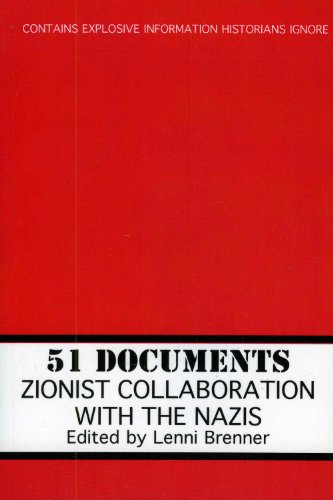
Even as late as the 1930s and afterward, international Zionist groups closely cooperated with the Third Reich on international economic projects, and during the world war itself one of the smaller rightwing factions, led by future Israeli Prime Minister Yizhak Shamir, actually offered a military alliance to the Axis Powers, denouncing the decadent Western democracies and hoping to cooperate against their mutual British enemies. The Transfer Agreement by Edwin Black, 51 Documents by Lenni Brunner, and other writings have documented all these facts in detail, though for obvious reasons they have generally been ignored or mischaracterized by most of our media outlets.
Obviously the Talmud is hardly regular reading among ordinary Jews these days, and I would suspect that except for the strongly Orthodox and perhaps most rabbis, barely a sliver are aware of its highly controversial teachings. But it is important to keep in mind that until just a few generations ago, almost all European Jews were deeply Orthodox, and even today I would guess that the overwhelming majority of Jewish adults had Orthodox grand-parents. Highly distinctive cultural patterns and social attitudes can easily seep into a considerably wider population, especially one that remains ignorant of the origin of those sentiments, a condition enhancing their unrecognized influence. A religion based upon the principal of “Love Thy Neighbor” may or may not be workable in practice, but a religion based upon “Hate Thy Neighbor” may be expected to have long-term cultural ripple effects that extend far beyond the direct community of the deeply pious. If nearly all Jews for a thousand or two thousand years were taught to feel a seething hatred toward all non-Jews and also developed an enormous infrastructure of cultural dishonesty to mask that attitude, it is difficult to believe that such an unfortunate history has had absolutely no consequences for our present-day world, or that of the relatively recent past.
Furthermore, Jewish hostility toward non-Jews may have often served the interests of others, and helped determine the economic role they played, especially in European countries, with this factor having been obscured by widespread ignorance of the underlying religious tenets. As most of us know from our history books, political rulers with little sympathy for their subjects sometimes restrict military power to a relatively small group of well-rewarded mercenaries, often of foreign origins so that they will have little sympathy for the population they harshly repress. I strongly suspect that some of the most common traditional economic niches of European Jews, such as tax-farming and the arrenda estate-management system of Eastern Europe, should be best understood in a similar light, with Jews being more likely to extract every last penny of value from the peasants they controlled for the benefit of their local king or lords, and their notorious antipathy for all non-Jews ensuring that such behavior was minimally tempered by any human sympathy. Thus, we should not be surprised that Jews first entered England in the train of William the Conqueror, in order to help him and his victorious Norman lords effectively exploit the subjugated Anglo-Saxon population they now ruled.
But states in which the vast majority of the population is oppressed and dominated by a thin slice of rulers and their mercenary enforcers tend to be much weaker and more brittle than those in which rulers and ruled share common interests, and I believe this is just as true for economic enforcers as for military ones. In many cases, lands reliant upon Jewish economic intermediaries, notably Poland, never successfully developed a native middle class, and often later fared quite poorly against their nationally-unified competitors. Spain was actually one of the last countries in Europe to expel its Jews, and over the next century or two reached the peak of its military and political glory. Prof. Kevin MacDonald’s controversial books on Judaism have also extensively argued that rulers who seem to have been more concerned for the well-being of their subjects also tend to be the ones more likely to be labeled “anti-Semitic” in modern history books, and his volumes are now easily available in my selection of HTML Books:
Judaism as a Group Evolutionary Strategy
Toward an Evolutionary Theory of Anti-Semitism
In 2009, Gene Expression blogger Razib Khan interviewed eminent evolutionary theorist David Sloan Wilson on the group selection ideas that have been his major focus. During this hour-long discussion, the theories of MacDonald became a major topic, with Wilson seeming to take them quite seriously, and pointing out that within the scientific framework “parasitism” has a simple technical definition, namely the exploitation of the large by the small. Unsurprisingly, the video record of such extremely touchy subject matter was quickly truncated to just the first 11 minutes, and eventually completely removed from both YouTube and BloggingHeadsTV. But it still at least partially survives in archived form:

In recent years, the history of Jewish expulsions from various European societies over the last thousand years has received considerable attention. The total number is somewhat disputed but almost certainly in excess of 100, with the 1930s policies of Hitler’s Germany being merely the most recent example, and Wired Magazine provided an interesting graphical presentation of this large dataset in 2013. Given these unfortunate facts, it may be difficult to point to any other group so consistently at bitter odds with its local neighbors, and the religious details provided by Shahak certainly make this remarkable historical pattern far less inexplicable.
A very even-handed but candid description of the behavior pattern of Jewish newcomers to America was provided in a chapter of a 1914 book on immigration groups by E.A. Ross, one of America’s greatest early sociologists. Ross had been one of the towering Progressive intellectuals of his era, widely quoted by Lothrop Stoddard on the Right while still so highly regarded by the Left that he was named to the Dewey Commission to adjudicate the conflicting accusations of Trotsky and Stalin and also received glowing praise in the pages of the Communist New Masses. His dismissal on political grounds from Stanford University led to the formation of the American Association of University Professors. Yet his name had so totally vanished from our history books I had never even encountered it until beginning work on my content-archiving project, and I would not be surprised if that single chapter from one of his many books played a major role in his disappearance.
The Eastern European Hebrews

Jews spent two thousand years living as a diaspora people, and their tightly-bound trans-national colonies provided them with a uniquely effective international trading network. Since their religious traditions regarded slavery as the natural and appropriate lot of all non-Jews, both ideological and practical factors combined to apparently make them some of the leading slave-traders of Medieval Europe, though this is hardly emphasized in our histories. Closer to home, in 1991 the Black Nationalists of The Nation of Islam published The Secret Relationship Between Blacks and Jews, Volume One, which seemed to persuasively document the enormous role Jews had played in the American slave-trade. In 1994, Harold Brackman published a short attempted rebuttal entitled Ministry of Lies under the auspices of the Simon Wiesenthal Center, but I found his denials much less compelling. I very much doubt that most Americans are aware of these historical facts.
Throughout most of my life, Nobel Laureate Alexander Solzhenitsyn was generally regarded as the greatest Russian literary figure of our modern era, and after reading all of his works, including The First Circle, Cancer Ward, and The Gulag Archipelago, I certainly concurred with this assertion, and eagerly absorbed Michael Scammel’s brilliant thousand page biography. Although Russian himself, many of his closest friends were Jewish, but during the 1980s and 1990s, whispers of his supposed anti-Semitism began floating around, probably because he had sometimes hinted at the very prominent role of Jews in both financing and leading the Bolshevik Revolution, and afterward staffing the NKVD and administering the Gulag labor camps. Late in his life, he wrote a massive two-volume history of the tangled relationship between Jews and Russians under the title Two Hundred Years Together, and although that work soon appeared in Russian, French, and German, nearly two decades later, no English translation has ever been authorized. His literary star seems also to greatly waned in America since that time, and I only very rarely see his name mentioned these days in any of my regular newspapers.
Samizdat versions of major sections of his final work may easily be located on the Internet, and a few years ago Amazon temporarily sold a 750 page hard copy edition, which I ordered and lightly skimmed. Everything seemed quite innocuous and factual, and nothing new jumped out at me, but perhaps the documentation of very heavy Jewish role in Communism was considered inappropriate for American audiences, as was the discussion of the extremely exploitative relationship between Jews and Slavic peasants in pre-revolutionary times, based on liquor-dealing and money-lending, which the Czars had often sought to mitigate.
When a ruling elite has limited connection to the population it controls, benevolent behavior is far less likely to occur, and those problems are magnified when that elite has a long tradition of ruthlessly extractive behavior. Enormous numbers of Russians suffered and died in the aftermath of the Bolshevik Revolution, and given the overwhelmingly Jewish composition of the top leadership during much of that period, it is hardly surprising that “anti-Semitism” was deemed a capital offense. Kevin MacDonald may have been the one who coined the term “hostile elite,” and discussed the unfortunate consequences when a country comes under such control.
After the collapse of the Soviet Union in 1991, reborn Russia soon fell under the overwhelming domination of a small group of Oligarchs, almost entirely of Jewish background, and a decade of total misery and impoverishment for the general Russian population soon followed. But once an actual Russian named Vladimir Putin regained control, these trends reversed and the lives of Russians have enormously improved since that time. America’s media organs were overwhelmingly friendly toward Russia when it was under Jewish Oligarchic rule, while Putin has been demonized in the press more ferociously than any world leader since Hitler. Indeed, our media pundits regularly identify Putin as “the new Hitler” and I actually think the analogy might be a reasonable one, but just not in the way they intend.
Sometimes it is much easier to notice obvious patterns in a foreign country than in one’s own. In the early 2000s I read The Master Switch, a widely-praised history of modern communications technology by Columbia University professor Tim Wu, who has subsequently become a leading Internet-rights activist. I found the account fascinating, with so many stories never before known to me. However, I couldn’t help but notice that all the powerful mass-media technologies of our modern world–film, radio, and television–had been invented and pioneered by Gentiles, mostly of Anglo-Saxon origin, but in each case control was seized by ruthless Jewish businessmen, who sometimes destroyed the lives and careers of those creators. By the 1950s, nearly all of America’s leading concentrations of electronic media power—with the sole major exception of Disney Studios—were solidly in Jewish hands. In an open society such as ours, these are the central levers of political influence, and over the next generation or so, America’s long-dominant and heavily Anglo-Saxon ruling elite was replaced by a mostly Jewish one, a development I alluded to in my long Meritocracy article of a few years ago.
Critics today of all backgrounds bemoan the total impoverishment of so much of America’s once comfortably affluent middle class, noting that some sixty percent of the American population today possesses less than $500 in readily available savings. A younger generation has been reduced to permanent debt-servitude by ruinous student loans, while the the newspapers report that the opioid drug epidemic has claimed a dreadful toll in lives and family-breakdown even while Wall Street and other elite sectors of the financialized economy are richer than they have ever been before. There are certainly many different explanations for this sad economic trajectory, including technological change, growing international competition, and shifts of political power in the American system of government. But it does sometimes seem like a substantial fraction of our population has been reduced to a 21st century version of the drunken, ignorant, exploited, indebted, impoverished, and immiserated Slavic peasantry of the Jewish-dominated Pale of Settlement, and a striking graph produced by the Economic Policy Institute demonstrates that a very sharp economic inflection point occurred in the early 1970s, right around the time that the aforementioned ethnic transformation of our ruling elites was fully under way.
Contrary to widespread popular belief, it is not actually illegal to be a “Nazi” in America, nor are Nazis prohibited from owning property, even including media outlets. But suppose that the overwhelming majority of America’s major media concentrations were owned and controlled by Nazis of a particularly fanatical type. Surely that might have serious consequences for the course of our society, and especially that fraction of the population viewed with considerable disfavor under Nazi doctrine.
One important point to consider in the abbreviated history of Hitler’s Third Reich was that although the ruling Nazi elite was often quite harsh and extreme in its behavior, well over 98% of the population it ruled prior to the outbreak of war consisted of Germans, the particular group which that ruling elite most sought to benefit and uplift in all possible ways, and despite the obscuring cloud of retrospective propaganda, this goal seems to have largely been achieved. In 2004, Counterpunch published a column by the late Alexander Cockburn, its redoubtable editor, noting the tremendous success of Hitler’s peacetime economic policies, and in 2013 that same webzine carried a much longer column focused entirely on this same subject, citing the analysis of Henry C.K. Liu, whose Chinese background provided him greater critical distance. Indeed, during most of the 1930s Hitler received widespread international praise for the great success of his domestic economic and social achievements, making the cover of Time Magazine on numerous occasions and even being named its Man of the Year for 1938. By contrast, I suspect that a population that was some 98% non-German but ruled by those same fanatically pro-German leaders might have fared far worse.
Most of these disheartening facts that have so completely upended my understanding of reality over the last decade could not possibly have come to my attention until the rise of the Internet, which partially broke centralized control over the distribution of information. But many other people surely must have known large portions of this important story long before that, and recognized the very serious consequences these matters might have for the future of our society. Why has there been so little public discussion?
I believe one factor is that over the years and the decades, our dominant media organs of news and entertainment have successfully conditioned most Americans to suffer a sort of mental allergic reaction to topics sensitive to Jews, which leads to all sorts of issues being considered absolutely out of bounds. And with America’s very powerful Jewish elites thereby insulated from almost all public scrutiny, Jewish arrogance and misbehavior remain largely unchecked and can increase completely without limit.
I’ve also sometimes suggested to people that one under-emphasized aspect of a Jewish population, greatly magnifying its problematical character, is the existence of what might be considered a biological sub-morph of exceptionally fanatical individuals, always on hair-trigger alert to launch verbal and sometimes physical attacks of unprecedented fury against anyone they regard as insufficiently friendly towards Jewish interests. Every now and then, a particularly brave or foolhardy public figure challenges some off-limits topic and is almost always overwhelmed and destroyed by a veritable swarm of these fanatical Jewish attackers. Just as the painful stings of the self-sacrificing warrior caste of an ant colony can quickly teach large predators to go elsewhere, fears of provoking these “Jewish berserkers” can often severely intimidate writers or politicians, causing them to choose their words very carefully or even completely avoid discussing certain controversial subjects, thereby greatly benefiting Jewish interests as a whole. And the more such influential people are thus intimidated into avoiding a particular topic, the more that topic is perceived as strictly taboo, and avoided by everyone else as well.
For example, about a dozen years ago I was having lunch with an especially eminent Neoconservative scholar with whom I’d become a little friendly. We were bemoaning the overwhelmingly leftward skew among America’s intellectual elites, and I suggested it largely seemed a function of our most elite universities. Many of our brightest students from across the nation entered Harvard and the other Ivies holding a variety of different ideological perspectives, but after four years departed those halls of learning overwhelmingly in left-liberal lock-step. Although he agreed with my assessment, he felt I was missing something important. He nervously glanced to both sides, shifted his head downward, and lowered his voice. “It’s the Jews,” he said.
I do not doubt that much of the candid analysis provided above will be quite distressing to many individuals. Indeed, some may believe that such material far exceeds the boundaries of mere “anti-Semitism” and easily crosses the threshold into constituting an actual “blood libel” against the Jewish people. That extremely harsh accusation, widely used by stalwart defenders of Israeli behavior, refers to the notorious Christian superstition, prevalent throughout most of the Middle Ages and even into more modern times, that Jews sometimes kidnapped small Christian children in order to drain their blood for use in various magic rituals, especially in connection with the Purim religious holiday. One of my more shocking discoveries of the last dozen years is that there is a fairly strong likelihood that these seemingly impossible beliefs were actually true.
I personally have no professional expertise whatsoever in Jewish ritual traditions, nor the practices of Medieval Jewry. But one of the world’s foremost scholars in that field is Ariel Toaff, professor of Jewish Renaissance and Medieval Studies at Bar-Ilan University near Tel Aviv, and himself the son of the Chief Rabbi of Rome.
In 2007, he published the Italian edition of his academic study Blood Passovers, based on many years of diligent research, assisted by his graduate students and guided by the suggestions of his various academic colleagues, with the initial print run of 1,000 copies selling out on the first day. Given Toaff’s international eminence and such enormous interest, further international distribution, including an English edition by a prestigious American academic press would normally have followed. But the ADL and various other Jewish-activist groups regarded such a possibility with extreme disfavor, and although these activists lacked any scholarly credentials, they apparently applied sufficient pressure to cancel all additional publication. Although Prof. Toaff initially attempted to stand his ground in stubborn fashion, he soon took the same course as Galileo, and his apologies naturally became the basis of the always-unreliable Wikipedia entry on the topic.

Eventually, an English translation of his text turned up on the Internet in a PDF format and was also placed for sale on Amazon.com, where I purchased a copy and eventually read it. Given those difficult circumstances, this work of 500 pages is hardly in ideal form, with most of the hundreds of footnotes disconnected from the text, but it still provides a reasonable means of evaluating Toaff’s controversial thesis, at least from a layman’s perspective. He certainly seems an extremely erudite scholar, drawing heavily upon the secondary literature in English, French, German, and Italian, as well as the original documentary sources in Latin, Medieval Latin, Hebrew, and Yiddish. Indeed, despite the shocking nature of the subject matter, this scholarly work is actually rather dry and somewhat dull, with very long digressions regarding the particular intrigues of various obscure Medieval Jews. My own total lack of expertise in these areas must be emphasized, but overall I thought Toaff made a quite persuasive case.
It appears that a considerable number of Ashkenazi Jews traditionally regarded Christian blood as having powerful magical properties and considered it a very valuable component of certain important ritual observances at particular religious holidays. Obviously, obtaining such blood in large amounts was fraught with considerable risk, which greatly enhanced its monetary value, and the trade in the vials of this commodity seems to have been widely practiced. Toaff notes that since the detailed descriptions of the Jewish ritualistic murder practices are very similarly described in locations widely separated by geography, language, culture, and time period, they are almost certainly independent observations of the same rite. Furthermore, he notes that when accused Jews were caught and questioned, they often correctly described obscure religious rituals which could not possibly have been known to their Gentile interrogators, who often garbled minor details. Thus, these confessions were very unlikely to have been concocted by the authorities.
Furthermore, as extensively discussed by Shahak, the world-view of traditional Judaism did involve a very widespread emphasis on magical rituals, spells, charms, and similar things, providing a context in which ritualistic murder and human sacrifice would hardly be totally unexpected.
Obviously, the ritual murder of Christian children for their blood was viewed with enormous disfavor by the local Gentile population, and the widespread belief in its existence remained a source of bitter tension between the two communities, flaring up occasionally when a Christian child mysteriously disappeared at a particular time of year, or when a body was found that exhibited suspicious types of wounds or showed a strange loss of blood. Every now and then, a particular case would reach public prominence, often leading to a political test of strength between Jewish and anti-Jewish groups. During the mid-19th century, there was one such famous case in French-dominated Syria, and just before the outbreak of the First World War, Russia was wracked by a similar political conflict in the 1913 Beilis Affair in the Ukraine.
I first encountered these very surprising ideas almost a dozen years ago in a long article by Israel Shamir that was referenced in Counterpunch, and this would definitely be worth reading as an overall summary, together with a couple of his follow-up columns, while writer Andrew Hamilton offers the most recent 2012 overview of the controversy. Shamir also helpfully provides a free copy of the book in PDF form, an updated version with the footnotes properly noted in the text. Anyway, I lack the expertise to effectively judge the likelihood of the Toaff Hypothesis, so I would invite those interested to read Toaff’s book or better yet the related articles and decide for themselves.
The notion that the world is not only stranger than we imagine, it is stranger than we can imagine has often been misattributed to the British astronomer Sir Arthur Eddington, and over the last fifteen-odd years I’ve sometimes begun to believe that the historical events of our own era could be considered in a similar light. I’ve also sometimes joked with my friends that when the true history of our last one hundred years is finally written and told—probably by a Chinese professor at a Chinese university—none of the students in his lecture hall will ever believe a word of it.
Related Readings:
July 17, 2018
Posted by aletho |
Book Review, Economics, Ethnic Cleansing, Racism, Zionism, Timeless or most popular | Russia, Ukraine, United States, Zionism |
Leave a comment
In a historic bilateral summit, Russian President Vladimir Putin met his US counterpart Donald Trump in the Finnish capital. In an interview with Sputnik, Dr. Denis Rancourt, a civil rights advocate and social theorist, provided his insight into the importance of the meeting.
Sputnik: Could you share your feelings as to how significant this is; how significant is the timing of this? What do you expect to be accomplished?
Dr. Denis Rancourt: I don’t think the timing is that important, I mean it had to happen because Trump and the US want it to happen and also Russia wants it to happen. It’s going to happen anyway. The US wants things from Russia and to some degree, the US needs Russia more than Russia needs the US, because the United States in the world has lost a lot of credibility and Russia has credibility. It has a coherent diplomacy, which the US no longer has.
So it needs that credibility… Trump uses the expression “We need to run the world”: what he means by that is that he wants to be able to acquire the benefits of having a collaboration with Russia on certain issues. I think that credibility is one; but there is another important issue that clearly is of concern to Trump and the United States and that is the question of weapons; the democratizing of missiles, especially.
The US would have a lot to lose if more and more nations acquire the possibility of defending themselves against US threats and attacks. And so, the possibility of missiles being given to people who need them, by Korea or by Iran, or even indirectly, or directly, by Russia itself, is a great threat to the United States, because the US system relies on military intimidation and its projection of power in the world.
So, for that to be removed would take away many of its acquired territories and ability to coerce and intimidate economies and large parts of the world. I think those are the things, it’s in that sense that the United States wants kind of a weapons management and understanding that they are going to limit this […] spread of weapons; because it’s not just nuclear weapons. Technology is advancing, and we now have more and more accurate missile that can hit cities that are estimated to be the source of military intimidation. For example, Tel Aviv can be hit by missiles and so on. It’s illustrated by what’s happening in Yemen now.
The Yemenis have rudimentary missiles that are able to hit targets in Saudi Arabia and have demonstrated their ability to take our ships. So, the US is more and more vulnerable to this advancing technology. It relies on projection of power through aircraft carriers, which are themselves, by their nature, vulnerable to missile attacks and to the kind of technology that can easily hit large ships. They need to be able to protect themselves and they’ve lost credibility, especially after the total destruction that they have made in Iraq and Libya. The world has seen this and understands how vicious NATO and the United States can be. I think it’s a combination of those two things that brings Trump and the US to the table, to try to negotiate with Russia.
Sputnik: […] Trump has virtually dismissed reports, even from his own intelligence, on the alleged Russian meddling. What do you think about this?
Dr. Denis Rancourt: […]Of course this is a global war. Of course, RT and Sputnik exist now and that’s a reality, and it influences opinions and outlooks in the world, and that’s not going to change, it’s not going to go away. This is all largely a domestic issue, whether it’s true or not, it’s still just a domestic issue.
July 16, 2018
Posted by aletho |
Militarism, Timeless or most popular | Iran, Middle East, NATO, Russia, United States, Yemen |
Leave a comment
Vladimir Putin laughed after being asked if Russia had compromising information about Donald Trump or his family, replying that it’s absurd to suggest that Moscow collects dirt on every American businessman who visits the country.
Jonathan Lemire, a White House reporter for the Associated Press, asked Putin during the post-summit press conference whether Russia had any “compromising material on president Trump or his family.”
Laughing once the question was fully translated, Putin responded: “When Trump came over to Moscow, I was not aware of it. When he came over as a businessman, I was not even aware that he was in Moscow. Take the St. Petersburg Economic Forum. More than 500 senior executives from the US came over to Russia. Do you think that we are compiling compromising material on all of them? Well, definitely it’s absurd. I cannot really imagine anything more absurd than this. So please, throw out this nonsense.”
Trump added that if there was compromising information about him, it would have been published long ago.
While the Russian leader’s answer was hardly ambiguous, journalists flocked to Twitter to claim that Putin had not denied that Moscow had dirt on Trump.
The theory that Moscow has dirt on the US president stemmed from the so-called ‘Steele Dossier,’ which – among other sensational but ultimately unproven allegations – claims that Trump paid prostitutes to urinate on a bed in which Barack Obama once slept. The dossier, written by retired UK intelligence officer Christopher Steele and allegedly compiled using sources from “inside the Kremlin,” has been repeatedly cited by Russiagate enthusiasts who claim that Donald Trump is a Kremlin puppet.
July 16, 2018
Posted by aletho |
Fake News, Mainstream Media, Warmongering, Russophobia, Timeless or most popular | Russia, United States |
Leave a comment
The sight of US President Donald Trump and Russian President Vladimir Putin not attacking each other at the press conference following their summit in Helsinki sent mainstream US media into a spiral of rage.
“You have been watching one of the most disgraceful performances by an American president at a summit in front of a Russian leader that I have ever seen,” CNN anchor Anderson Cooper declared at the end of the joint press conference.
“Trump declines to side with US intelligence over Putin” blared a CNN chyron a little while later, as anchor Wolf Blitzer somberly declared the “Russians must be high-fiving each other” following the summit.
CNN has been openly confrontational with Trump since before his inauguration and the president has called them “fake news” on more than one occasion – most recently during his visit to the UK.
The network’s White House correspondent Jeff Zeleny was appalled that, instead of confronting Putin publicly, Trump brought up the Democratic National Committee servers – which the FBI never inspected – as well as servers of House Democrats managed by Imran Awan, a Pakistani national who was recently convicted of wire fraud.
The mere fact that the summit happened in the first place was a “political victory for the Kremlin,” added senior international correspondent Matthew Chance. “Russians must be toasting Trump with champagne right now, I imagine.”
Russia’s “invasion” of Crimea, the shooting down of the MH17 passenger jet, the “novichok” poisoning in Salisbury – all the favorite talking points the US politicians and media have used to attack Russia since 2014, without offering any proof – “none of it matters now,” Chance lamented.
MSNBC let the former CIA director, now contributor, John Brennan set the tone of the debate, with a tweet declaring Trump’s behavior at the press conference “nothing short of treasonous.”
AP correspondent Jonathan Lemire, who had asked Trump to denounce Putin at the press conference, told MSNBC’s Stephanie Ruhle that the president bringing up the DNC servers instead was “an attack on [Special Counsel] Robert Mueller.”
Putin admitted he’d wanted Trump to win the presidency and Trump castigated the FBI instead of Russia, New York Times correspondent Peter Baker chimed in.
Republicans have traditionally been more suspicious and skeptical of Russia than Democrats but, in light of the summit, they now either have to oppose the president of their party or accept that “President Putin is really running the show,” Baker argued.
Trump and Putin “essentially parroted each other’s talking points,” said former CIA officer Ned Price, who dubbed as “delusional” those Republicans who thought Trump would raise the issue of elections-meddling, even though “we know in minute detail” the names and methods of the conspirators that “attacked our democracy in 2016.”
Evelyn Farkas, the former State Department official in charge of Russia during the Obama administration, declared it “despicable” that Trump was siding “against democracy,” reminding viewers she’s descended from Hungarian immigrants who fled a Soviet crackdown in 1956.
“We have to defend Langley, we have to defend the US,” Farkas added.
Earlier, MSNBC had interviewed Michael McFaul, the former US ambassador to Russia.
Even Fox News, accused by Democrats of being a propaganda network for Trump, had several anchors blasting the president.
Neil Cavuto of Fox Business thought it was “disgusting” that Trump did not use the press conference to publicly accuse Putin of interfering in the 2016 election.
“I’m sorry, it’s the only way I feel. It’s not a right or left thing to me, it’s just wrong,” Cavuto said. “A US president on foreign soil talking to our biggest enemy, or adversary, or competitor … is essentially letting the guy get away with this. That sets us back a lot.”
Brett Baier, who hosts Special Report, wondered how exactly the summit might improve US interests and brought up the Republican lawmakers who were putting out statements against the summit, such as Senators Lindsey Graham (R-South Carolina), Ben Sasse (R-Nebraska) and Jeff Flake (R-Arizona).
Fox anchors were also puzzled by Putin’s offer to interrogate suspects in the presence of Mueller’s investigators, as long as the US would allow Russian prosecutors to question Americans suspected by Russia of crimes, as outlined in a treaty going back to 1999.
“What we did hear was this kind of moral equivalence when it comes to meddling,” Baier said, adding Trump standing in a foreign country next to a leader who “clearly attacked the US” and saying such things is going to “ruffle a lot of feathers.”
As to what the summit may have produced in terms of nuclear disarmament, peace in the Korean Peninsula, resolving the conflicts in Ukraine and Syria, or ratcheting down tensions in Europe… no one in the US media seemed interested in asking.
July 16, 2018
Posted by aletho |
Fake News, Mainstream Media, Warmongering, Russophobia, Timeless or most popular | Ben Sasse, CNN, Jeff Flake, Lindsey Graham, United States |
Leave a comment
Carlos Lozada, the nonfiction book critic for the Washington Post, promised “an honest investigation” of whether truth can survive the Trump administration in the lead article in the paper’s Sunday Outlook section. He delivered considerably less.

The Washington Post fails. But, hey, it’s the Washington Post.
Most importantly and incredibly, Lozada never considers the possibility that respect for traditional purveyors of “truth” has been badly weakened by the fact that they have failed to do so in many important ways in recent years. Furthermore, they have used their elite status (prized university positions and access to major media outlets) to deride those who challenged them as being unthinking illiterates.
This dynamic is most clear in the trade policy pursued by the United States over the last four decades. This policy had the predicted and actual effect of eliminating the jobs of millions of manufacturing workers and reducing the pay of tens of millions of workers with less than a college education. The people who suffered the negative effects of these policies were treated as stupid know-nothings, and wrongly told that their suffering was due to automation or was an inevitable product of globalization.
These claims are what those of us still living in the world of truth know as “lies,” but you will never see anyone allowed to make these points in the Washington Post. After all, its readers can’t be allowed to see such thoughts.
This was far from the only major failure of the purveyors of truth. The economic crisis caused by the collapse of the housing bubble cost millions of workers their jobs and/or houses. While this collapse was 100 percent predictable for anyone with a basic knowledge of economics, with almost no exceptions, our elite economists failed to see it coming, and ridiculed those who warned of the catastrophe.
Incredibly, there were no career consequences for this momentous failure. No one lost their job and probably few even missed a scheduled promotion. Everyone was given a collective “who could have known?” amnesty. This leaves us with the absurd situation where a dishwasher who breaks the dishes get fired, a custodian that doesn’t clean the toilet gets fired, but an elite economist who completely misses the worst economic disaster in 70 years gets promoted to yet another six-figure salary position.
And, departing briefly from my area of expertise, none of the geniuses who thought invading Iraq was a good idea back in 2003 seems to be on the unemployment lines today. Again, there was another collective “who could have known?” amnesty, with those responsible for what was quite possibly the greatest foreign policy disaster in US history still considered experts in the area and drawing high salaries.
When we have a world in which the so-called experts are not held accountable for their failures, even when they are massive, and they consistently look down on the people who question their expertise, it undermines belief in truth. It would have been nice if Lozada had explored this aspect of the issue, but, hey, it’s the Washington Post.
Dean Baker is the author of Rigged: How Globalization and the Rules of the Modern Economy Were Structured to Make the Rich Richer.
July 16, 2018
Posted by aletho |
Economics, Fake News, Mainstream Media, Warmongering, Militarism, Timeless or most popular | Carlos Lozada, United States, Washington Post |
Leave a comment