The Committee calls on Israel to end administrative detention, repeal the Unlawful Combatants Law, and prohibit the solitary confinement of children; emphasizes that forced feeding of hunger strikers may be torture or ill-treatment.
The Committee raised concerns about Israel’s extrajudicial executions of Palestinians in the West Bank, including East Jerusalem and in the access-restricted areas of Gaza; and called for the immediate release of the bodies of deceased Palestinians.
On 13 May 2016, the UN Committee Against Torture issued its extensive concluding observations on Israel. Spanning over 50 items, these recommendations follow from the Committee’s 3 and 4 May 2016 review of Israel’s compliance with the UN Convention against Torture (CAT). Israel ratified the CAT in 1991, and as other state parties, is reviewed regularly by the Committee Against Torture.
Adalah, Al Mezan Center for Human Rights, and Physicians for Human Rights-Israel submitted a joint NGO report to the Committee, and attended the review session in Geneva. The Committee raised numerous issues highlighted by the human rights organizations in its report in the concluding observations as matters of grave concern. Included among the principal subjects of concern and recommendations are the following:
Scope of the Convention’s applicability: Despite Israel’s contention otherwise, the Committee reaffirmed that the Convention applies to the Occupied Territories (para. 9)
Definition and criminalization of torture, removal of necessity defense: The Committee remained “concerned that a specific offence of torture” based on the Convention has not yet been adopted. While the Committee noted that the Justice Ministry is drafting a new bill in this regard, the Committee called on Israel “to speed up the process”. It also urged Israel again “to completely remove necessity as a possible justification for torture.” (para. 12-15) In the partners’ view, Israel is in non-compliance with the Convention 25 years after ratification, as Israeli law contains no crime of torture and includes the “necessity defense”.
Access to a lawyer and arraignment before a judge: The Committee recommended that Israel “ensure, in law and in practice, that all persons deprived of liberty, irrespective of the charges brought against them, the law applicable to them or wherever they may be located, are afforded all legal safeguards from the very outset of the deprivation of liberty, including the rights to be assisted by a lawyer and to be brought before a judge without delay.” (para. 16, 17)
Audio-visual documentation of interrogations: The Committee recommended that Israel “ensure the compulsory audio-visual recording” of all suspects’ interrogations … and that “Audio-visual footage should be monitored by an independent body and kept for a period sufficient for it to be used as evidence in courts.” (para. 18, 19)
Independent medical examinations of persons deprived of liberty: Israel should to guarantee that all physicians and medical staff dealing with imprisoned persons “duly document all signs and allegations of torture or ill-treatment and report them without delay to the appropriate authorities.” Further, it should consider “transferring responsibility for all types of healthcare of persons deprived of liberty to the Ministry of Health in order to ensure that medical staff can operate fully independently from the custodial authorities.” (para. 20, 21)
Administrative detention and Incarceration of Unlawful Combatants Law: Israel should take urgent measures to “end the practice of administrative detention” and ensure that all persons who are currently held in administrative detention are “afforded all basic legal safeguards; and to “repeal the Incarceration of Unlawful Combatants Law.” (para. 22, 23)
Solitary confinement: Israel should “(a) ensure that solitary confinement and [isolation] are used only in exceptional cases as a measure of last resort, for as short a time as possible and subject to independent review, in line with international standards; (b) put an immediate end and prohibit the use of solitary confinement … for juveniles and persons with intellectual or psychosocial disabilities; and (c) … regularly publish comprehensive disaggregated data on the use of solitary confinement and equivalent measures.” (para. 24, 25)
Hunger strikes/forced feeding: Israel should guarantee that hunger strikers “are never subjected to ill-treatment or punished for engaging in a hunger strike, and are provided with necessary medical care in accordance with their wishes.” Further, that hunger strikers, who are competent to take informed decisions, “are never subjected to feeding or other medical treatment against their will, as these are practices that may amount to torture or ill-treatment.” (para. 26, 27)
Excessive use of force: The Committee raised concerns at allegations of excessive use of force, including lethal force, by security forces, mostly against Palestinians in the West Bank, including East Jerusalem, and the access-restricted areas (ARAs) of the Gaza Strip, particularly in the context of demonstrations, in response to attacks or alleged attacks against Israeli civilians or security forces, and to enforce the ARAs of the Gaza Strip. Notably the UN High Commissioner for Human Rights stated that, “some of these responses strongly suggest unlawful killings, including possible extrajudicial executions” (A/HRC/31/40, para. 10). Thus, Israel should ensure that “the rules of engagement or regulations on opening fire are fully consistent with the Convention and other relevant international standards” and that “all instances and allegations of excessive use of force are investigated promptly, effectively and impartially by an independent body, that alleged perpetrators are duly prosecuted and, if found guilty, adequately sanctioned.” (para. 32, 33)
Return of bodies: While noting Israel’s new agreement to initiate the return of the bodies, the Committee urged Israel“to return the bodies of the Palestinians that have not yet been returned to their relatives as soon as possible so they can be buried in accordance with their traditions and religious customs, and to avoid that similar situations are repeated in the future.” (para. 42, 43)
The chairman of the Russian Constitutional Court has said that Barack Obama’s statements about American exceptionalism were very similar to propaganda used by Nazi Germany and equally dangerous to world peace.
“The idea of specialness, exceptionality and unique rights of the American state and American people has been used in US internal political rhetoric for quite a while, but in the recent years it is being actively and persistently offered in US foreign policy documents and public speeches on international politics delivered by US officials,” Judge Valery Zorkin said at the St Petersburg international legal forum on Thursday.
“Any unbiased and educated person would see that this statement by Obama is an almost exact copy of leading politicians and propaganda specialists of the Third Reich, including Adolph Hitler… In essence, Obama is using the exact same thing that Nazi bosses said about the German exceptionalism when they started the world war,” he added.
The judge also said that in his view the exceptionalism concept had direct influence on the modern US concepts of military planning and these concepts see the main objective of all activities as reaching such degree of military might that the United States remains out of reach of other nations, on land, sea, in air and in space.
According to Zorkin, the same applies to the US doctrines on development of mass media and electronic communications – the US authorities see their goal as establishing absolute global domination of their country in the global information space. This idea also constantly appears in Obama’s public speeches.
“Obama says that Americans and the USA are an exceptional people and an exceptional state and thus they can pretend for much more than any other people or state. In other words, he follows the plot of James Orwell’s ‘Animal Farm’ dystopia and, while formally not rejecting the principle of equality of sovereign states and peoples, fixed by the UN Charter, he still declares that Americans and America are ‘more equal’ than any other country and the rest of the planet’s population,” RIA Novosti quoted the judge as saying.
Zorkin also told his colleague at the forum that he considered such approach to be a blatant violation of international legal norms.
Russian politicians and officials have repeatedly addressed the topic of American exceptionalism when talking on bilateral relations with the US and of international politics in general. In particular, in mid-2015 President Vladimir Putin said in his speech before the UN General Assembly that attempts to influence internal politics of sovereign nations should not be tolerated regardless of where they are taking place and who are making such attempts.
“It seems that some nations are not learning from others’ mistakes, but keep repeating them. The export of so-called ‘democratic’ revolutions continues.” Putin said.
“I cannot help asking those who have caused this situation, ‘Do you realize now what you have done?’” he said. “But I am afraid the question will hang in the air, because policies based on self-confidence and belief in one’s exceptionality and impunity have never been abandoned.”
After provoking Russia for decades, the United States government has apparently concluded that the Russians are all saints and decided to escalate the provocations with confidence that nothing will go wrong, or go nuclear. Either that or the U.S. government truly wants World War III.
I wouldn’t treat a diseased rat the way the United States treats Russia. The Russian government has exercised such incredible restraint that the United States has apparently decided it can get away with being even nastier, a move that is now openly described by Washington insiders as being driven by weapons profiteering:
“‘This is the “Chicken-Little, sky-is-falling” set in the Army,’ the senior Pentagon officer said. ‘These guys want us to believe the Russians are 10 feet tall. There’s a simpler explanation: The Army is looking for a purpose, and a bigger chunk of the budget. And the best way to get that is to paint the Russians as being able to land in our rear and on both of our flanks at the same time. What a crock.'”
In fact, the United States spends well over 8 times what Russia does on militarism, not counting “Homeland Security” or Energy or State or Veterans, etc. The world still contains enough nuclear weapons to destroy human life if just a small fraction of them are used, and 93 percent of them belong to Russia and the United States.
Why aren’t the nukes gone, when Gorbachev was willing to give them up?
Because Reagan was unwilling to give up a stupid, non-functioning, and fraudulent technological defense against a threat that would not have existed if he had. That technology is back in the movie theaters and back in the news: Star Wars.
The Cold War continued. The Soviet Union broke up. Germany reunified. And the Cold War still continued at the Pentagon. The Warsaw Pact went away. NATO expanded. When Germany reunited, the United States promised Russia that NATO would never expand eastward. NATO then added the Czech Republic, Poland, Hungary, Slovakia, Romania, Bulgaria, Lithuania, Latvia, Estonia, Slovenia, Albania, and Croatia to its membership. Since the U.S.-facilitated coup in Ukraine, and against the desires of the Ukrainian people, NATO has been pushing for a partnership with Ukraine, as well as with Georgia.
Imagine if Russia had promised not to expand the Warsaw Pact and then added to its membership Greenland, Canada, Bermuda, the Bahamas, Cuba, and Mexico. If Russia claimed to have done all that to protect itself from Iran, how many U.S. pundits would treat that as a serious, non-laughable claim? And if Russia made a deal with Iran under which more stringent inspections than ever endured by any nation would verify that Iran had no threatening weapons, and if Russia bragged about this deal, but if Russia went right on expanding the Warsaw Pact, would the United States take that as the harmless gesture of friendship that NATO depicts its actions as?
NATO has also been “looking for a purpose” and rushing off to wage wars in Yugoslavia, Afghanistan, and Libya. The United States and some of its NATO allies are waging wars in Afghanistan, Iraq, Pakistan, Libya, Syria, Somalia, and Yemen. In a number of those places, drone wars and proxy wars have been turned into U.S. ground wars, perfectly primed for major expansion. Yet, the United States speaks of its actions as “defensive,” describes Russia as aggressive, and falsely accuses Russia of invading Ukraine, a mythical act that Hillary Clinton determined made Vladimir Putin the equivalent of “Hitler.”
Now the United States has sent ships to the Black Sea, sent tanks to Georgia, planned a huge military “exercise” in Poland, opened a “missile defense” site in Romania, which Russia calls a “direct threat” (and a violation of the Intermediate-Range Nuclear Forces Treaty), and begun building another “missile defense” site in Poland. There’s a video online of NATO Secretary General Jens Stoltenberg at the opening of the new site in Romania, describing it as a “team effort” involving Romania, Poland, Spain, Turkey, Germany, Denmark, the Netherlands, and the UK. Stoltenberg’s stilted speech claims repeatedly that “Missile defense is for defense. It is defensive.” Stoltenberg claims the “missile defense” missiles are too close to Russia to intercept Russian missiles, which misses the point that Russia views the U.S. missiles as offensive, not “defensive.”
Even CBS News finds it impossible to take NATO’s nonsense completely seriously:
“U.S. officials say the Romanian missile shield, which cost $800 million, is intended to fend off missile threats from Iran and is not aimed at Russia. But NATO decided in January 2015 to set up command-and-control centers in Latvia, Estonia, Lithuania, Poland, Romania and Bulgaria by the end of 2016 — at least partly in response to challenges from Russia and Islamic extremists and to reassure eastern partners.”
What challenges? Essentially the 10-foot giants landing in the U.S. rear and on both flanks simultaneously — in other words: money to be made.
Read this further bit from CBS News carefully:
“President Obama and other NATO heads of state and government met in September and ordered an overhaul of the alliance’s capabilities and defense posture, called the Readiness Action Plan, or RAP, to take into account Russia’s annexation of the Crimean Peninsula and purported military interference in eastern Ukraine.”
The key word there is “purported.” It’s been years now since the weekly announcements that Russia had invaded Ukraine, something it obviously never did. And of course the people of Crimea voted to join Russia after the U.S. state department facilitated a violent coup in Ukraine that installed a government significantly made up of Nazis. CBS can’t bring itself to comment on whether or not there is any evidence of the “purported military interference,” so it just calls it “purported” and hopes that not too many people know what that word means.
Russia, believe it or not, is expressing some annoyance. As Jonathan Marshall recounts: “Moscow spokesmen have warned that Romania could become a ‘smoking ruins’ if it continues to host the new anti-missile site; threatened Denmark, Norway and Poland that they too could become targets of attack; and announced development of a new generation of intercontinental ballistic missiles designed to penetrate the U.S. missile shield.”
Russian planes have come near U.S. ships and planes in recent weeks, although U.S. reports have generally failed to focus on the fact that those ships and planes were quite near Russia’s borders. These near misses at starting a war between the world’s major nuclear militaries present a far greater threat than is generally imagined, because most U.S. citizens have zero interest in starting World War III and so don’t think about it, but the U.S. government and NATO want blood. NATO’s new commander says he wants to be ready to fight Russia immediately.
Donald Trump blurted out the common sense solution of abolishing NATO but quickly backed off and reversed himself, as on so many other topics. Hillary Clinton has wholeheartedly supported NATO’s expansion from the beginning, when she was First Lady. Bernie Sanders generally accepts whatever the military is doing, so as not to rock the boat, which still might leave him the best of the three on foreign policy, as he so obviously is on domestic.
But a great deal can happen in 8 months. A lot can happen before anyone new is elected. And with all eyes focused on the election, it’s more likely than ever to do so. And what could happen makes climate change seem manageable by comparison.
Nothing disturbs me more about the modern mainstream U.S. news media than its failure to test what the U.S. government says against what can be determined through serious and impartial investigation to be true. And this is not just some question of my professional vanity; it can be a matter of life or death.
For instance, did Syrian President Bashar al-Assad cross President Barack Obama’s supposed “red line” against using chemical weapons, specifically in the sarin gas attack outside Damascus on Aug. 21, 2013, or not?
Upon this question rests the possibility that a future President Hillary Clinton will invade Syria under the guise of establishing a “safe zone,” a project that would surely expand into another bloody “regime change,” as occurred in Iraq and Libya amid similar U.S. claims about protecting “human rights.”
Yet, there is substantial evidence that Assad was not responsible for the sarin attack – that it was perpetrated by jihadist rebels as a provocation to draw the U.S. military directly into the war on their side. But it remains conventional wisdom that Assad ignored Obama’s “red line” and that Obama then flinched from enforcing it.
The New York Times and other major U.S. publications cite this “group think” about the “red line” as flat fact, much as many of them reported without doubt that Iraq’s Saddam Hussein was hiding WMD, reinforcing the pretext for the U.S. invasion of that country in 2003.
On Wednesday, Times correspondent David E. Sanger wrote an article about the need for a coercive “Plan B” to force Assad from power and added that “president [Obama] has repeatedly defended his decision not to authorize a military strike against Mr. Assad after he crossed what Mr. Obama had described as a ‘red line’ against using chemical weapons.”
Note that there is no attribution to that claim about Assad crossing the “red line,” no “allegedly” or “widely believed” or any modifier. Assad is simply judged guilty by The New York Times, which — in doing so — asserts this dubious narrative as flat fact.
Yet, the Times hasn’t conducted a serious investigation into whether Assad is, in fact, guilty. Their last stab at proving Assad’s guilt in late 2013 collapsed when it turned out that the one missile found to have carried sarin had a range of only two kilometers, less than a quarter of the distance from which the Times had alleged that Assad’s military had fired the rocket.
Faced with that evidence, the Times essentially retracted its findings in a little-noticed article buried deep inside the paper during the Christmas-New Year holidays. So, even as the case collapsed, the Times maintained its phony narrative, which it reprises regularly as happened in Sanger’s article on Wednesday.
Misleading Readers
But what does that do to the Times’ readers? They are essentially being propagandized by the “paper of record,” with a questionable assertion slipped past them as an incontrovertible “fact.” How are they supposed to evaluate whether the U.S. government should launch another war in the Middle East when they have been told that a dubious claim is now enshrined as a basic truth in the Times’ narrative?
We saw something similar earlier this year when Jeff Goldberg of The Atlantic wrote a lengthy article on Obama’s foreign policy focusing on his 2013 decision not to launch punitive airstrikes against the Syrian military for the sarin attack.
The opus contained the remarkable disclosure that Director of National Intelligence James Clapper had told Obama that U.S. intelligence lacked “slam dunk” evidence that Assad was guilty. In other words, Obama pulled back in part because he was informed that Assad might well be innocent.
Later in the same article, however, Goldberg reverted to Official Washington’s “group think” that held as a matter of faith that Assad had crossed Obama’s “red line.” That false certainty has proved so powerful that it defies any contrary evidence and keeps popping up as it did in Sanger’s article.
Which gets me to one of my pet peeves about modern America: we almost never get to the bottom of anything, whether significant or trivial. Often there’s “a conventional wisdom” about some issue but almost never is there a careful assessment of the facts and an unbiased judgment of what happened.
On the trivial side, we have the NFL accusing New England Patriot quarterback Tom Brady of participating in some scheme to deflate footballs, even though the scientific and testimonial evidence doesn’t support the claim. But lots of people, including The New York Times, assume the allegations to be true even though they come from one of the most disreputable and dishonest corporations in America, the National Football League, which has recently been exposed for covering up the dangers of concussions.
On more substantive matters, we never see serious investigations into U.S. government claims especially when they’re aimed at “enemies.” The failure to test President George W. Bush’s claims about Iraq’s WMD cost hundreds of thousands of lives, including those of nearly 4,500 American soldiers, and has spread chaos through much of the region and now into Europe.
Arguably, the fate of humankind rests on the events in Ukraine where U.S. propagandists are stirring up the West to engage in a military conflict with nuclear-armed Russia.
So, shouldn’t The New York Times and other major publications take special care not to feed a war fever that could exterminate life on the planet? Can’t they find the time to undertake serious examinations of these issues and present the evidence without fear or favor?
But that apparently isn’t how the editors of the Times or The Washington Post or any number of other major U.S. news outlets view matters. Instead of questioning the stories coming from the U.S. government’s propaganda shops, the mainstream media simply amplifies them, all the better to look “patriotic.”
If instead these outlets joined some independent journalists and concerned citizens in demanding that the U.S. government provide verifiable evidence to support its claims, that might force many of these “artificial secrets” out into the open.
For instance, we don’t know what the current U.S. intelligence assessments are about the Syria-sarin attack or the MH-17 shoot-down. Regarding the MH-17 case, the U.S. government has refused to divulge its overhead surveillance, radar and other technical evidence about this tragedy in which 298 people were killed.
If there was some journalistic unity – refusing to simply blame the Russians and instead highlighting the lack of U.S. cooperation in the investigation – the U.S. government might feel enough heat to declassify its information and help bring whoever shot down the plane to justice.
As it stands now on these issues, why should the U.S. government reveal what it actually knows when all the major news outlets are accepting its dubious propaganda themes as flat fact?
The Times and other big media outlets could contribute to the cause of truth by simply refusing to serve as conduits for unsubstantiated claims just because they come from senior U.S. government officials. If the mainstream media did, the American people and the world public might be much better informed — and a lot safer.
Investigative reporter Robert Parry broke many of the Iran-Contra stories for The Associated Press and Newsweek in the 1980s. You can buy his latest book, America’s Stolen Narrative, either in print here.
I believe I first read George Orwell’s essay, Politics and the English Language, as part of the reading list for an English 101 college class. I was a teenager at the time and I don’t believe I really understood what Orwell was getting at. I think my understanding was at the superficial level. I mostly just took it to be a screed against crappy writing — which it is, of course. But it is much more than that. Some of the ideas in that essay were later developed in his magnum opus, the dystopian novel Nineteen Eighty-Four, wherein the government of Oceania are designing a new language called Newspeak, which brings to mind the current-day scourge of “political correctness”. Come to think of it, Nineteen Eighty-Four is also something I first read around that time but did not fully understand.
Now, here we are, 66 years after Orwell’s untimely death and many of these ideas he explores in his writing are still topical and relevant. In fact, increasingly so. When it comes to understanding the pervasive propaganda matrix, one important aspect is seeing how language is manipulated to frame issues. Much of this is quite blatant. Anybody paying the slightest attention ought to notice how different words are used depending on the desired framing. Thus, Osama Bin Laden was a “freedom fighter” when he was fighting the Soviet Union, but when he started opposing the United States, he became a “terrorist”. Likewise, if an enemy uses a torture method like water-boarding, it is simply called torture and is utterly deplorable. When we do it, it is “enhanced interrogation”.
I wonder what Orwell would have made of what happened to the word “gay”. Surely, in his time, it was perfectly normal to say: “You seem in a very gay mood today!” Nowadays, not so much. Granted, language is a living, dynamic thing, and thus tends to evolve over time. However, I don’t think this particular change of meaning happened organically. It seems to be an example of deliberate framing. While there already was a perfectly good, neutral term, “homosexual”, and we still have that word, it seems there was a conscious attempt to promote “gay” as an alternative term with a more positive connotation, what with its normal meaning of “merry” or “cheerful”.
The case where Orwell would have had a field day, though, is with the word “conspiracy”. The official dictionary definition has not changed since Orwell’s day. From the Merriam-Webster dictionary online:
a secret plan made by two or more people to do something harmful or illegal
the act of secretly planning to do something that is harmful or illegal
By that definition, a conspiracy theory would just mean some theory that posits that two or more people planned in secret to do some shit. Nonetheless, the very same Merriam-Webster dictionary has a separate entry for “conspiracy theory”.
a theory that explains an event or situation as the result of a secret plan by usually powerful people or groups
Truth told, I don’t think the above definition of “conspiracy theory” is really adequate, at least assuming that the purpose of a dictionary is to document how words are actually used. This definition comes nowhere near fully capturing to what extent this has become a term of derision. In popular usage, the person who believes in conspiracies, the conspiracy theorist, is taken to be self-evidently crazy and anything he says can be dismissed out of hand.
I assume that Orwell would note that the way this term is used contains built-in question-begging. By all means, tell me that what I am saying is absurd and crazy, be my guest. Except, now, you do have to demonstrate that it is!
Well, apparently not… When somebody says: “Oh, that’s just a conspiracy theory!” don’t hold your breath waiting for the explanation of why the theory is wrong. ‘Cause it ain’t coming! No, somehow the person who trots out this cliché is relieved of any obligation to demonstrate, using facts and logic, that an idea is mistaken. It’s enough to just say “Conspiracy theory!” like some sort of magical incantation that short-circuits all the necessary debate.
Actually, it is well established that this state of affairs did not come about on its own, but rather, was deliberately engineered by the CIA in the wake of the Kennedy assassination. Nonetheless, I do wonder whether they anticipated just how successful they would be in implanting this notion in the public mind — that believing in so-called “conspiracies” was the hallmark of a nutter.
We can read old novels and characters say things like: “I’m feeling a bit queer, it must be something I ate.” But nowadays, most of us find some other way to express the idea. Rage, by all means, that yet another perfectly innocent English word has suffered an identity theft. But know that it serves no purpose. Once you recognize that a word has become effectively unusable, you just have to look for an alternative term to use. In the case of “conspiracy”, I would propose that we talk more in terms of “deep events” and “deep politics”. Using that framing, the Kennedy assassination and 9/11 are quintessential “deep events” that require a “deep political analysis” to be properly understood. I think this is a good counter-framing of the question. If you say, quite correctly, that Lee Harvey Oswald was just a patsy and there was a high-level conspiracy to kill Kennedy, you’ve all but conceded the debate, given how the word “conspiracy” has been hijacked. If you say, on the other hand, that the JFK assassination was a “deep event” that requires a “deep political analysis”, you are implicitly saying that the people repeating this discredited “Lee Harvey Oswald acted alone” nonsense are not engaging in a deep political analysis, but rather a shallow analysis. I mean to say, there really is the need to think about how they manipulate language to frame these questions and to come up with a counter to that.
When it comes to this sort of framing, aside from the overloading of already existing words, like “conspiracy” or “gay”, there is also the invention of new words — neologisms to use the more academic term. For our purposes here, there is nothing particularly interesting about the cases where a new word is invented to describe something that really did not exist before and now does — like “smartphone”. What we need to examine are the cases where new words enter common usage for propaganda or framing purposes.
In this vein, the term “blowback” really merits some careful consideration. The aforementioned Merriam-Webster dictionary claims that the first known use of the word is from 1973, while the wikipedia page on the term cites CIA internal documents from 1954. Said documents expressed the concern that the CIA operation to overthrow the government of Mossadegh in Iran could lead to “blowback”. (Boy, did it ever!)
It seems that the discrepancy between Wikipedia’s first usage of the term in 1954 and Merriam-Webster saying that it was 1973 is that Merriam Webster was referring to public usage. It does not seem under dispute that “blowback” began as internal CIA shorthand that meant unintended (and undesirable) consequences of CIA covert operations.
The “Blowback” theory of terrorism
At this point in time, the term “blowback” seems to have gone from being internal CIA jargon to being a sort of shibboleth of the left-liberal intelligentsia. The basic idea is that the major terrorist events of recent history, such as 9/11 or 7/7 in London or the recent events in Paris and Brussels, are a natural (yet unintended) result of the brutal policies of Western governments in far off (largely Muslim) countries. Anybody listening to these people would surely conclude that this is a well established phenomenon. But what is odd is that when you step back and look at this with ample historical perspective, the whole concept looks pretty dubious. Let’s consider certain key facts:
The British Empire…
Some people look back on it fondly, but it is safe to say that a lot of people around the world really did not appreciate it; they had their reasons… So, if “blowback terrorism” is a real, important phenomenon, the British Empire should have had a huge “blowback” problem, no? Surely angry Indians or Africans or Arabs were plotting how they would make their way to London and kill some random Brits to express their dissatisfaction with British government policies, no? And surely, the local authorities in the home country of Britain were on constant guard against this “blowback”, right?
Well…. not exactly….
The police departments of American cities have been acquiring military grade weaponry to deal with an alleged terrorism threat, yet throughout the entire period of the British empire, English cops felt no need to even carry a firearm. Ain’t that something?
What is striking about this is that, not only were the authorities of the time not concerned about “blowback”, they did not even have a word for it! The very word had not been invented yet! This phenomenon, disgruntled people showing up in London or Paris or New York and carrying out terrorist attacks as a result of whatever meddling in their country — there was not even a word for it!
Well, the sun set on the British Empire a while back and it could be that something happened since then such that blowback terrorism became a big problem. Scan forward a bit…. the United States carpet bombed villagers throughout Southeast Asia, killing literally millions of innocents, yet I cannot recall a single “blowback” terrorism incident, where somebody who lost his entire family, entire village, decided to get even by blowing up some Americans in California. It never happened, I think not even once. There are large ethnic Vietnamese populations in the U.S. and all it would take is one embittered person, but no… nothing.
Fast forward to the 1980′s and we can make some similar comments about very brutal U.S. policies in Central America, the support for Nicaraguan contras or the Salvadoran death squads. Surely the U.S. suffered a wave of “blowback terrorism” as a result, no? Uh,.. no. There was a large population of refugees from those countries. Most of them, in my own personal experience, are very nice people, but out of hundreds of thousands of them, surely all it would take is one person with a grudge to do a suicide bombing or some such thing. But it doesn’t seem to have happened.
So, on the face of it, so-called “blowback terrorism” is a very dubious concept, no? There are so many situations where, by all rights, there should have been plenty of “blowback terrorism”, or some amount anyway, but it just never happened! And I don’t mean to say that it was rare. No, there simply was not a single case! I think it bears repeating: it was so rare that nobody had yet bothered to invent a word for it!
Magical Incantations
In the above, I referred to the term “conspiracy theory” as a magical incantation of a sort. Another way of putting this is that the use of the term contains built-in question-begging. The person using this loaded term is strongly implying that the so-called “conspiracy theory” is self-evidently crazy. However, that is precisely what needs to be demonstrated!
The term “blowback” is similar. It contains an implicit theory of events that there should be a need to demonstrate. Specifically, the concept of “blowback” is that a certain outcome is an unfortunate, and unintended consequence of whatever policy. Thus, the rise of these “jihadist” or “islamist” groups such as Al Qaeda or ISIS/Daesh was an unanticipated consequence of U.S. policy. Or to put it another way, this is a bug, as opposed to a feature.
But is that true? Well, maybe… but that is precisely what there is a need to demonstrate, no? The person using this “blowback” term is simply begging the question, assuming the proposition that needs to be proven, that whatever phenomenon is an unintended consequence of the government’s foreign policy — as opposed to it being an intended result.
Of course, more importantly, the people using the term “blowback terrorism” assume invariably that the people whom the authorities claim carried out the terrorist attacks in question actually did so! They always seem to be willfully ignorant of all of the independent research that shows that the people in question were just patsies. But hey, that’s what the other magical incantation, “conspiracy theory”, is for: to dismiss all of that independent research! Don’t even bother to look at any of that. Those are all just “conspiracy theories”.
Now, the foregoing discussion leads us two key questions — well, I think they are two separate questions, albeit rather entangled with one another:
Given that the “blowback” theory of terrorism is quite tenuous at best (since in situations where there should have been a lot of blowback terrorism, there was none) then why is the entire American “intelligentsia” so invested in this explanation? In particular, figures such as Noam Chomsky and Chris Hedges and many others (practically anybody who writes for Counterpunch and other such “alternative media”) never tire of telling us that an event such as 9/11 is “blowback”. Likewise for the recent events in France and Belgium.
The aforementioned people are not stupid. So, must we conclude that they are being consciously dishonest when they use these magical incantations such as “blowback” or “conspiracy theory”?
I think the first question can be answered with some level of confidence. As for the second question, whether these people are being consciously dishonest, it is hard, maybe impossible, to come to any determination on that. Possibly these various intellectual gatekeepers are not even being consciously dishonest for the most part. In their own minds, they are honest, but they have internalized a kind of tortuous mental gymnastics to such a degree that it has become second nature to them. This is the phenomenon that I shall now explore.
The HIQI revisited and introducing the concept of TITT
In a previous article, I introduced the concept of the HIQI, which is the “High IQ Idiot”. A HIQI is a person with a fairly high IQ and typically a high level of formal education (the two things usually go together obviously…) who has an abysmally low BDQ, Bullshit Detection Quotient.
Now, nobody really took much issue with the HIQI or BDQ concepts. I guess it corresponds to most people’s casual observation: somebody can have an arbitrarily high IQ and still be utterly incapable of seeing through political propaganda (a.k.a. bullshit). In fact, the bullshit can be really laughably absurd, cartoonish — hence my terminology of RRN, Roger Rabbit Narrative — yet the HIQI in question cannot see through it. So I made that observation in the article and I don’t think hardly anybody really disagreed with me, but what I didn’t do was make any attempt to explain why.
Well, actually, I don’t even presume to know fully the reasons why so many high IQ people are so easily taken in by absurd political propaganda. What I’ll attempt to do though is to lay some groundwork that could be useful in exploring the question. What I shall do now is go off on what looks like a tangent and introduce a sort of archetypal situation. My point may not be initially obvious but please bear with me.
Let us consider an intellectual figure in the Middle Ages, who has a great interest in understanding celestial phenomena. Let’s say this early astronomer has developed a theory to explain a certain phenomenon — the solar eclipse, let’s say. Let us call this theory A.
Theory A is a very clear, very elegant model of the solar eclipse. However, it has a very major problem. Theory A is based on the heliocentric model, i.e. the earth revolves around the sun. Well, that is not the problem precisely. After all, the earth does revolve around the sun. The problem is that, at this point in time, this was considered to be heresy. (Heresy, by the way, is the older term, what they used to call inconvenient truths, long before the CIA came up with the term “conspiracy theory”.)
Or, alternatively, the real problem is that our medieval astronomer does not fancy getting burnt at the stake, which is what they used to do to conspiracy theorists heretics back then. (Medical knowledge was not as advanced as it is now, but it was generally understood that this was not good for one’s health.)
So what is one to do? Well, let’s say that the not so heroic hero of our story decides to tear up his elegant theory A and comes up with a new theory, theory B.
Theory B is very inelegant and complicated compared to theory A. It has a very contrived feel about it. Despite having invented the theory himself, our astronomer is not really very happy with it, thinking that it is actually kind of self-contradictory and doesn’t withstand very much scrutiny at all.
The advantage of theory B — actually its only positive point — is that it is not heretical. Theory B is based on the sun revolving around the earth, as Church doctrine claims. What happens now in the story is that, much to this person’s surprise, theory B is widely lauded and accepted by the leading minds of the day.
Okay, this is the story and we can make certain observations about it. First of all, we do not need to introduce any new terminology to describe theory A. Theory A is simply the correct explanation, the truth. Yes, it runs counter to Catholic Church dogma, but hey, guys, check out this radical concept:
Objective reality simply exists. It is not the slightest bit constrained by Catholic Church dogma… OR any other dogma!
Now, theory B is, of course, not the correct explanation. In fact, it only comes into existence because the correct explanation, theory A, is taboo, heresy. And that, obviously, is why the leading thinkers of the day rush to endorse theory B and disavow theory A. Theory B is not a very good theory, it doesn’t withstand much serious scrutiny, but it won’t get you burnt at the stake!
Now for some new terminology. The phenomenon that the above story illustrates is Taboo Induced Tortuous Thinking (or Theorizing) which we can call TITT for short. Such tortuous thinking leads to Taboo Induced Tortuous Theories, or TITTs, of which theory B above is an example. (As for the approved pronunciation of TITT, I’m not going to be very prescriptive. I always assumed that the pronunciation of HIQI was pretty clearly “hickey”. As for TITT, if the final T is pronounced separately, it is Tit-Tee. If the term really catches on, we could have a vote. It does not strike me as such an important matter to resolve in any case. For example, if British readers prefer to think that BDQ stands for “Bollocks Detection Quotient”, I have no particular objection. A native speaker of Spanish would tend to pronounce TITT more like “teat”, which also seems appropriate. So I’m willing to leave this up to the reader.)
Grasping TITT
Now, once you understand this concept, then (as per Doctor Freud) you start seeing TITTs everywhere! You open the op-ed page of the New York Times or some such mainstream publication and you just see nothing but TITTs — explanations for events that are very tortuous and contrived and you realize they are necessary because the correct, simpler explanation is a taboo. It dawns on you that many of the conventional explanations of events that you were taught as part of your (mis)education are actually just examples of Taboo Induced Tortuous Thinking. Thus:
The mainstream history of the Second World War is chock full of TITTs.
The Warren Commission explanation of the Kennedy assassination is a TITT.
The 9/11 Commission Report is a TITT.
All the mainstream media explanation of what happened in Ukraine in the past few years is TITT.
The theory of “Blowback Terrorism” is a TITT.
This is a very incomplete list, of course…
Yes, WW2, a.k.a. the “Good War”. I was hesitant to go there for obvious reasons, but aspects of the conventional history are such major examples of TITT that I think we really need to examine it a moment. So here goes:
On 22 June 1941, Germany launched an invasion of the Soviet Union. Some months later, the German army was occupying a large part of the country, had encircled major Soviet army groups, taking millions of prisoners. And not long after that, German troops were on the outskirts of Moscow and Leningrad. So, at this historical juncture, when this country, the Soviet Union, the flagbearer of international communism, was on the verge of collapse, what did the major capitalist countries do?
Simply stay out of it and hope that Hitler’s Germany would finish off the USSR, and thus remove the specter of communism for good
Actively join in with Germany to make sure they finished off the USSR
Pull out all the stops in order to save the USSR, economic aid, lend-lease, sending supplies and equipment…
Well, it’s a silly question, right? You all know the answer. (I hope to hell you know the answer. If you don’t, go get some remedial education…) What happened is number 3. The question to consider, though, is this: let’s say you didn’t know that the answer was 3, let’s say you are Rumpelstiltskin and you went to sleep on 21 June 1941 and just woke up. And now you are catching up on the last 75 years of history, what would you guess?
I put it to you that option 3 is very surprising. In particular, why would the United States, the pre-eminent capitalist power in the world, be so intent on saving the Soviet Union? My own guess would be that option 1 is the most likely as there is no strong reason for the U.S. in particular to want the Soviet Union to survive. Surely the owners of the country, the capitalist corporate elite, would very much like to the see the Soviet Union destroyed.
Now, option 2 seems less likely than option 1 because, okay, they may not like the German regime that much either, not enough to actively ally with it. In any case, in principle, you need a positive reason to actually get involved in a fight; simply remaining neutral in a conflict so far away is the default option, no? So option 2 seems less likely than option 1. However, a priori, option 3 seems even less likely, since it is very hard to understand why the capitalist elite of the U.S.A. would prefer Stalin over Hitler, certainly not enough to get involved actively on Stalin’s side.
Yet we know what happened: option 3. But why? It is pretty well established that Hitler never had any designs against the West and his war aims were in the East. In 1941, Hitler would have been delighted to make a separate peace with Churchill, thus freeing him to concentrate on smashing the Soviet Union. He hated the idea of a two-front war which had been Germany’s downfall in the previous war. No, certainly after Germany invaded the USSR, Britain was, effectively, staying in the war against Germany specifically to save the USSR, to save Stalin.
Why?
Well, the intent of this essay is not to be a lesson in World War 2 history any more than to discuss medieval astronomy. I just want to make a simple point here.
If you believe that you can explain this episode of history without any reference to the political power of world Jewry, I believe you have your work cut out for you.
I suppose few readers need it explained to them that Jewish power generally is a very major taboo. To engage in “conspiracy theories” is one thing, but to engage in “anti-semitic conspiracy theories”? Hardly the way to advance your academic career if you are an ambitious historian, eh?
So, again, just like the medieval astronomer who does not want to be branded as a heretic, you must come up with an alternative explanation that avoids the taboo. So you engage in some “Taboo Induced Tortuous Thinking”. You publish some TITT. Pass Go, collect tenure….
Now, okay, if you were up to that, and you’ve come up with your TITT explanation of why Britain and the U.S. helped Joe Stalin in his hour of need, it’s time for the next exercise in TITT and… boy, it’s a doozy:
Explain how, some 60 years later, the same countries basically, America and Britain, got embroiled in something called the Global War on Terror, all of these disastrous military adventures in Muslim countries — Afghanistan, Iraq, Libya, Syria…. (Actually, one should mention Iran, where they have tried but not been successful in getting something going. Yet….)
Explain how we got into this huge mess BUT:
WITHOUT any mention of the Jewish lobby, a.k.a. the Zionist Power Configuration (ZPC, to use the term of James Petras)
WITHOUT any mention of false flag terrorism (specifically as a tool to manipulate public opinion in favor of the disastrous wars)
I welcome you to have a go at it, but I am pretty sure that any explanation that you come up with which fails to mention both the ZPC and false flag terrorism will be yet another example of pure TITT.
Earlier, I posed the question: given how tenuous and implausible the blowback theory of terrorism is when you examine it, why is the the left-liberal intelligentsia in the U.S.A. so committed to it? Well, I think the foregoing analysis basically answers the question. “Blowback” is a perfect example of TITT in action, Taboo Induced Tortuous Thinking. The correct explanation is taboo so there is a need to come up with an alternative. The “Blowback” theory of terrorism is a TITT but there are many other examples of TITT as well.
Doublethink, Cognitive Dissonance, and the Emperor’s New Clothes
When you reach a certain adult understanding of the world, sometimes you look back on stories you heard or read as a child with a much greater understanding. We all probably heard some version of the Hans Christian Andersen story “The Emperor’s New Clothes” in our childhood. We have the little naive child who just says: “That man is naked”. And we have the adults in the story, courtiers… sycophants… who fulsomely praise the emperor’s fine new clothes. I suppose that the idea is that the sycophants in the story know perfectly well that the king is naked but pretend that he is clothed. What I wonder nowadays is whether the courtiers, at least some of them, actually believe somehow that the king is clothed despite the fact that their own eyes tell them that he is not! In Nineteen Eighty-Four, George Orwell introduces doublethink, the capacity of the indoctrinated person to hold contradictory views at the same time.
So, applying it to this story, doublethink would allow somebody to see a naked man right in front of him with his own two eyes and simultaneously believe — I mean sincerely believe — that he is dressed in a fine set of clothes! In light of this, I now wonder whether some of the courtiers really possess this Orwellian doublethink capability and thus believe (on some level, somehow) that the king really is wearing clothes, while others are just pretending.
In this whole doublethink/emperor’s new clothes vein, consider a video that I found quite appealing, entitled “This is an Orange”:
I later learned that the man who created that video, the late Anthony Lawson, was a retired advertising professional. It shows. In just over two minutes, he really gets to the heart of the issue. At the end, he shows the viewer an orange and basically says: “Are you going to believe somebody if they say this is an apple?” That is a rhetorical question obviously, but I guess the retort could be: “Damn right. I’ve gotten so good at doublethink that you can show me an orange and I can sincerely believe it is an apple.” (Okay, I know these people would never really say that. They aren’t that self-aware!)
The other question I posed above is whether the people pushing the “blowback” and the other TITT explanations are being consciously dishonest. This is a tough question. How many people, for example, really believe in “gender fluidity”? Do so many people sincerely believe that Bruce Jenner is really, somehow a woman? I have no idea, it’s mind-boggling. There really is this problem when you live in a society that is so utterly suffused with… drenched in… bullshit; it can be very hard to know who really believes all of it and who is just playing along. There can be massive rewards for going along with all the bullshit, and though they no longer burn people at the stake, the personal cost people pay for going against it can be very high. My own speculation is that, in most cases, somebody whose entire career in academia or as a commentator is based on espousing TITTs is never going to admit even to himself that he is basically a charlatan. That is simply too disturbing. If so, this means that many people really have mastered doublethink. The problem is that doublethink produces a lot of mental tension. In fact, there is a technical word in psychology for this: cognitive dissonance.
TITT Monger Tactics (TMTs)
Now, regardless of whether they are being consciously dishonest or really have mastered Orwellian doublethink, the various intellectual gatekeepers, the TITT mongers, do not debate in an intellectually honest manner. Their discourse is invariably chock full of all manner of illegitimate argumentation: straw men, arguments from ignorance, you name it. Especially question-begging. They just constantly assume as a given the proposition that they need to demonstrate.
The basic problem they have is that they are espousing an explanation of events that does not really fit the available facts. Not only that, but there is usually a competing explanation (the taboo explanation like the earth going round the sun) that does fit the facts. In my last article, I wrote a section about how the most basic HIQI approach to defending ridiculous stories (WOP, Wings on Pigs narratives) is that they simply never cede the initiative. So there is always an onus on you to respond to them, but they never have to respond to you. I got a fair bit of positive feedback about that and I think that it is maybe the most practically useful part of the article.
As infuriating as it is, one should probably not take it too personally. When somebody is up bullshit creek without a paddle, they must resort to illegitimate tactics. They have no other option. So, as a public service, it could be useful to outline the basic tactics they use. Also, I find it useful, just for myself, to sit down and delineate it all.
So, let’s look at it from their point of view. If you are committed to your TITTs, you will typically resort to a set of basic tactics. These, we can call “TITT Monger Tactics” or TMTs for short:
Guard the Gate! Suppress or disallow the competing explanation that actually does explain the facts.
The Memory Hole. Suppress or ignore the facts that do not conform to your explanation.
Coincidence Theory. Also Lower the Bar. Recognize the facts that do not fit your theory but attribute it all to “coincidence”. What you will typically need to do is to “lower the bar” such that you no longer need to prove that your theory is true, just that it is possible.
Blowhard Tactics. This is a grab-all category, a varied repertoire of bullying methods — pseudo-intellectual browbeating, hyper-emotionalism… Also, never concede a debating point.
The first tactic above, guard the gate, is self-explanatory. Actually, it’s not really a debating tactic per se; you just don’t let the other people into the debate. Typically, you just say that’s a “conspiracy theory” and it’s like: “We’re a respectable venue, we don’t discuss conspiracy theories here!” Well, if they do discuss a so-called “conspiracy theory”, it’s some sort of hit piece in which a straw-man version of the theory is presented and then lampooned. The actual independent researchers (whom they call “conspiracy theorists”) will never be allowed to present and defend their case in an open, intellectually honest setting.
The next TMT, the memory hole, comes from Orwell of course. The protagonist of Nineteen Eighty-Four, Winston Smith, works in the Ministry of Truth (sic) and when he comes across some item, like a photo or news clipping that contains one of these pesky facts that do not support the current official dogma, it goes down the memory hole. I think the single most glaring example in recent history of this is the collapse of the third building, WTC7, on the day of 9/11. How do they explain the fact that a third building collapsed into its own footprint and was definitely not hit by a plane? The most important component of the establishment strategy is simply to suppress the fact, just never mention it. In fact, the 9/11 Commission issued a report and simply never mentioned the third building.
Another example of the memory hole in action is when the coup in Ukraine against the constitutional, elected government, is presented as some sort of popular revolution. People who depend solely on Western mainstream media for their information are not likely to know about this:
Yes, two American functionaries discussing who will form the next Ukrainian government after the U.S. instigated armed coup popular revolution.
In this vein, “doublethink” (again from Orwell) can be understood as a fallback. Let’s say some pesky little fact, like the above video, pops out of the “memory hole” and you are confronted with it. (Poor little things, they must hate it when that happens.) Now, if you are one of these TITT mongers, obviously you never concede that this pesky little fact refutes your TITT. For example, in this case, the TITT you would be embracing is that there was a popular revolution in Ukraine and that the new government was put in there by the Ukrainian people. Say you are shown the above video, two unelected American officials deciding who will be in the next Ukrainian government, with no input from any Ukrainian. Of course, you will never admit that it is what is clearly is, proof that “Yatz” is an American-installed puppet leader of a puppet regime. No, you just keep hanging onto the TITT. When shown the orange, you maintain that it is an apple. Maybe you can give way a tiny bit to appear reasonable. “Okay, I know it looks a little bit like an orange, and yeah, I can see why an uneducated person such as yourself would be duped into thinking that it is, but I’m a Harvard-educated expert and I can assure you that this is definitely an apple.” So, there, you make a show of being open-minded and reasonable while still maintaining the appropriate arrogant condescending tone. Anyway, you can vary the parameters on all that a fair bit, but of course, I’m sure you understand, whatever you do, you never admit that the orange actually is an orange! “The collapse of building 7 does look a tiny bit like a controlled demolition and those “conspiracy theorists” try to make a big deal out of that, but we know those people are all whack jobs….”
Coincidence Theory
The other major approach to pesky facts is coincidence theory; you explain away the pesky fact by saying that it is some sort of “coincidence”. Well, of course, what that really means is that your TITT offers no explanation of the fact. Now, in a normal, non-corrupted intellectual process, if a theory doesn’t fit the facts and another theory does, you eventually must abandon the first theory in favor of the second one. But that doesn’t happen here. (Surprise, surprise…) No, if you’re committed to your TITT — “blowback” or “lone nut gunman who self-radicalized” — you never let go of it. But you do have a problem. What you need to do now is you need to drastically lower the bar. Rather than having to prove that your theory, your TITT, is true — or even likely — you only need argue that it is within the limits of the possible. That’s a great trick because all kinds of utterly far-fetched things are still possible. For example, if I told you that a monkey banged away at a keyboard randomly and produced a Shakespeare sonnet, you would (quite reasonably) say that this is impossible. But no! It’s not absolutely impossible! So in a mode of absolute logical rigor, we cannot say it is impossible. The problem is that the probability, while not a true absolute zero, is so infinitesimal that, in terms of everyday common-sense use of language, it is perfectly reasonable to say that this is simply impossible!
So if your TITT, to be viable, requires some event of a very low order of probability, you simply argue that it is possible, i.e. it is not absolutely impossible….
So…. therefore it happened.
(Did you catch the sleight of hand there?)
And then you dance your victory dance, chant your victory chant: “I really showed those conspiracy theorists, kicked their asses!”
The classic example of “lowering the bar” would surely be the “single bullet theory”, which is part of the Warren Commission report on the assassination of President Kennedy. The JFK research community tends to call this the “magic bullet theory”, to emphasize the far-fetched nature of the story, one bullet causing seven different wounds on two men.
In any case, this “single/magic bullet theory”, proposed by an ambitious young lawyer by the name of Arlen Specter, is really an archetypal TITT. The task of the Warren Commission was to issue a report saying there was only one shooter, Lee Harvey Oswald, who was acting alone. They had some thorny problems though. Oswald’s alleged murder weapon was a cheap Italian-made WW2 surplus bolt action rifle. Given the very short window of time, Oswald could only have fired at most three shots (and even that is in dispute) yet they had to explain eight wounds on two different men, Kennedy and John Connally. The utterly obvious explanation is that, in fact, there were other people shooting. However, that is the theory that could not be admitted, it’s the taboo, thus the need for this very contrived explanation, the TITT, the magic bullet theory.
Now, I do not know offhand precisely how unlikely the magic bullet story is — assuming that it even is possible. However, I think it is quite safe to say that it is pretty damned unlikely — sufficiently unlikely that a reasonable, honest person, given the available facts, would conclude that Oswald could not have acted alone. What you’ll notice when you look at the arguments of people who defend the Warren Commission story is that they have set the bar very low for themselves. They don’t even try to argue that the single bullet theory is particularly likely, or that it is more likely than the alternative theory of more than one shooter. They simply set out to argue that it is possible. Nothing more. It’s possible, therefore it happened, so I win the argument…. And, of course, you should know that, not only do they set the bar very low for themselves, but they also set the bar impossibly high for anybody on the other side of the debate.
With so many of these deep events, they are running a drill of the event on the same day. If this were a crime mystery from Agatha Christie, surely something like this would be a very big clue. For example, with the Sandy Hook shooting, Adam Lanza (for no obvious reason) decides to get a gun and shoot his momma and then go to the nearest primary school and shoot a bunch of cute little kids. On the very same day, they are running a “live shooter drill” which is a simulacrum of the event that actually happens. This was also the case with 9/11. The actual attacks coincided with large-scale drills in which a scenario being drilled is multiple plane hijackings.
Here is an article I came across a couple of years ago and I think I belly laughed when I read it.
The author of the article, one Mike Rothschild, outlines a large number of cases in which a terrorist attack coincides with a drill, at a level that it is beyond belief that this is a pure coincidence, and then argues that the so-called “conspiracy theorists” are crazy because they do not accept that all this is just a coincidence. It’s a funny article because the author seems so oblivious to the fact that what he has written refutes itself! In any case, it’s the same sort of thing. The rock-solid chain of reasoning goes something like this: “It is possible that the conjunction of drills and real events is a coincidence, therefore it is, therefore people who suggest otherwise are crazy.”
Blowhard Tactics
What I call blowhard tactics is really a set of different things. I already outlined some of them in my previous essay. One is simply never relinquishing the initiative. Now, any game or sport with formalized rules is structured in a fair manner. Consider tennis. The serve (the initiative) alternates: if I play a tennis match with you, and in this game, I am the one serving, then the next game, you serve. Well, needless to say, to the people we are talking about here, a fairly structured situation like that is anathema. They need to play a rigged game. So, for them, it’s more like a tennis match in which they always get to serve, and even if their opponent executes a perfect return of serve, they don’t recognize any need to respond to that. They just grab another ball and serve again and never concede the previous point. Actually, this is what characterizes the blowhard tactics in a debate generally speaking: never, ever concede a point. Like so:
Monty Python meant this as a comedy skit, but little did they know that it would prove to be invaluable training material for participants on Sunday morning talk shows.
Actually, thinking of Sunday morning talk shows, this immediately brings to mind another major blowhard tactic, the resort to hyper-emotionalism. Basically, you affect that you are infuriated at the person who brings up whatever uncomfortable fact. For example, somebody asks legitimate questions about 9/11 and you angrily claim that they are dishonoring the memory of the victims of that day. Don’t concern yourself that it doesn’t make any sense. (Does it have to? Does it make sense to say that an orange is an apple?) The idea is that if somebody’s brother or best friend died in some murky incident, then a person who investigates and tries to get to the bottom of what happened is dishonoring their loved one’s memory. Or, conversely, the people who are trying to cover up the circumstances of the death of one’s spouse or family member are honoring them?! Go figure that one out.
The key thing to understand here is that if you can say something, even something nonsensical, with enough emotional intensity, it somehow becomes convincing — for weak-minded people, I suppose, but that is most people and is good enough. They’ll tell you as much in any sales training course: emotional intensity sells… excitement… So this is well understood by sales people. It is less well understood by bookish, intellectual types.
Counter-Tactics, Turning the Tables, Fighting Fire with Fire
While I think it is already somewhat empowering to outline all the illegitimate tactics these people use, the real question is now how to counter this. I don’t presume to have all the answers. It’s easier to say what not to do than what to do. The old adage that the best defense is a good offense has a real core of truth to it. As I said in my previous essay, regardless of the game or contest, a passive, reactive stance is almost never a winning strategy — in any activity. Another way of putting this is that we must be on the lookout as to how to seize the initiative — to turn the tables. What this amounts to, I think, is not accepting the preset framing of the issue and finding the appropriate counter-framing.
Take the JFK assassination, which is really the canonical “conspiracy”. After all, the whole weaponized “conspiracy theory” construct was created by the CIA as part of the subsequent cover-up. What has happened is that they have managed to create such a stigma around the term “conspiracy” that, as I point out earlier, we probably should do our best to avoid using the very word — just like we avoid using “gay” or “queer” for their original meanings.
One does have to hand it to them. They really have created a bizarro inverted world. A HIQI can fall for any bullshit and there is really no attached stigma. He can believe in the magic bullet that caused seven wounds on two people. He can find it perfectly normal that a reporter announces the collapse of a steel-framed skyscraper (from fire) before it happens. He can believe that cartoon characters portrayed by actors, like Jihadi John and Jihadi Joseph, are real people. He can fall for any crude hoax and nobody questions his sanity. But if you say that there was a “conspiracy” to kill Kennedy (when there obviously was) then you are crazy. Go figure…
I guess the perceptive reader will have noticed that I have invented some rather… well… silly sounding terminology. The High IQ Idiot, the HIQI… or, a Taboo Induced Tortuous Theory, i.e. a TITT. And saying that somebody who espouses such theories however badly they fit the facts is “grasping TITTs”. This is not just sophomoric humor (though, okay, there is a bit of that) but rather, an attempt to turn the tables. They say: “You’re crazy, you believe in conspiracies”. Now we can say: “Get real, you HIQIs. Let go of the TITTs.” So, yes, I am very consciously inventing terminology to cast these people in a ridiculous light. If they are going to have these question-begging magical incantations, like “conspiracy theory” to smear us as crazy for telling the truth, then it’s high time we fight fire with fire. Rather than deal with the truth, that these are Deep State false flag operations, they invent these pathetic silly theories like “blowback”. To call their silly explanations TITTs and refer to these people as “TITT mongers” seems right and proper to me. Who knows? Maybe other people feel the same way and my terminology will catch on.
Reclaiming Reality
In my last essay, I started with the Matrix, and developed the idea of the Roger Rabbit mental world, in which cartoons are superimposed on reality. In this essay, I started by riffing on George Orwell and ended up developing the idea of magical incantations and TITT. Somehow this reminds me of the proverb of the blind men and the elephant. Are we not all blind men groping at the same creature and reporting different things? Or finding different terms to describe the same thing? There is Orwell with “doublethink” and the “memory hole”. Ron Unz refers to “American Pravda”. Here I am with Roger Rabbit narratives and Taboo Induced Tortuous Theories. Well, hey, there is nothing wrong with having more than one term to refer to roughly the same thing — slime, ooze, goo… twaddle, nonsense, bullshit, bollocks… Whether you call it the Matrix or the Roger Rabbit mental world, or American Pravda, there is this feeling of a need to reclaim reality.
We live in a world of great specialization. Given the vastness of human knowledge at this point in time, few people can have expert domain knowledge in more than one or two fields. The optimal career strategy for most people (assuming they have the capacity and the follow-through) is to develop deep expertise in some fairly narrow field. This means that, when it comes to anything outside that narrow field in which you are a specialist, you would defer to the corresponding experts in that domain. In principle, that sounds right, but as we see, there really is a need to be able to detect bullshit, to be able to discern when the alleged experts are bullshitting you. But how can you tell if you are not an expert in the relevant field (or fields)?
For example, suppose we are watching CNN and some general or expert on military affairs is on there explaining how they had to incinerate some isolated village in the Hindu Kush, using a drone or cruise missile or whatever…. in order to defend America. I ask you: do we need domain expertise to know that this is absolute bullshit?! (Criminally insane bullshit to boot…)
Or suppose some economist from Harvard or some place comes on espousing “austerity economics”, telling us, essentially, that the way a country gets rich is by impoverishing itself. Can a non-specialist, a generalist, figure out that the prestigious professor is, in fact, talking shit?
Obviously, I think the answer to the above two questions is yes. Yes, I believe that, armed with only generalist knowledge and a certain baseline BDQ level, we can state that the aforementioned “experts” are full of shit. (Shout after me: Yes, we can!) It occurs to me that some of what I’m talking about here, the HIQI/BDQ concept, is reclaiming the ability of the generalist to come to some understanding of the world. We need not (and must not) be so utterly defenseless against all this pompous bullshit.
If we were to form a new 12-step group, HIQIs anonymous, the redemption of the chronic HIQI must start with some first step, and what would that be? Well, I guess like with Alcoholics Anonymous, it would start with a recognition of the problem.
HIQI: Hi, my name is Jon and I’m a HIQI.
Group: Hi, Jon. (in unison)
HIQI: You know, I used to read the New York Times every morning.
Group: OMG! (collective gasp)
HIQI: Yeah, and I believed every word of it.
Group: (another collective gasp)
HIQI: Yep, I ate up all that shit with a spoon — every morning with my corn flakes. etcetera, etecetera
Step by step. Reclaim reality. There are things one can know without being a specialist. Pigs cannot fly. If a naked man is standing in front of you, you believe what you see. If somebody tries to tell you otherwise, he’s bullshitting you. If somebody tries to tell you that an orange is an apple, it doesn’t matter how many phD’s he’s got, he’s talking shit… Just tentatively, these might be some initial steps towards reclaiming reality.
When they show you something that is basically a cartoon and ask you to accept that this is real, you do not need domain expertise to reject it. This is for a very simple reason: a grownup knows that the real world ain’t a cartoon. And getting back to a main theme of this essay, TITT issue, a theory is a TITT if the only reason for its existence is to avoid a taboo, i.e. it’s taboo-induced. So another rule could be:
If you can see that something is a TITT, then you don’t need specialized domain knowledge to know that the theory is not correct.
Or, to put it more succintly, TITTs are always bullshit. (A Brit would say that TITTs are always bollocks, which, I know doesn’t make a lot of sense to the uninitiated, but never mind…)
Concluding Remarks
I must make a point about one aspect of this essay. I’m quite aware that I broke a major taboo by alluding to the revisionist history of the Second World War. Asking people to reconsider the conventional analysis of WW2 is akin to heresy. Well, actually, it is not akin to heresy. It is heresy! The History Channel Atlanticist version of WW2 is, to all intents and purposes, a secular religion at this point in time.
Arguably, I did not have to go there at all. There are so many examples of what I call Taboo Induced Tortuous Thinking, TITT, that I did not need to use this one. But, finally, I think I did have to go there because it makes no sense to decry all these taboos and then consciously skirt around one, especially when it is the biggest taboo of them all.
Now, if you want to attack what I am saying, feel free. However, I would dissuade you from one particular line of attack (that I already anticipate). I anticipate people asking me (quite aggressively) why I think I am such an expert on the Second World War. Since I anticipate the question, I answer it in advance.
No, I do not consider myself very knowledgeable about WW2. In fact, many people who comment on this very website have a much more detailed knowledge of the history of that period. But, you see, that is a completely invalid critique of my point in this article. My first example of what I call TITT was the medieval astronomer. Was I implying at all that I myself have any expertise in astronomy? No, actually, I was implying the opposite! I was saying that, even given my lack of expertise, I can say with absolute confidence that an explanation of the solar eclipse that is based on the sun going round the earth cannot be correct.
So, if your line of attack is that I am not an expert in WW2 history, or that I lack expertise in whatever other thing, then you might as well save us both the bother. In fact, such a critique would mean that you don’t understand what I am saying. You see, I’m not claiming any particular expertise in anything. I am reclaiming the ability of the generalist, with a certain level of BDQ, to come to some understanding of the world. We have to stop being so defenseless against all the bullshit, stop being such HIQIs. Truth told, all the right/left sorts of debates are starting to bore me. I now tend to believe that the central front in the battle for the future is…. Roger Rabbit!!!
Now, when it comes to all these various big honking issues — capitalism versus socialism, religion versus secularism, ethno-nationalism versus multiculturalism, right to bear arms versus gun control, spank your kids or don’t spank your kids… — I don’t mean that these various debates are not important. The problem is that I have this growing, gnawing sense that one cannot really debate these things or anything else if one does not escape from the Roger Rabbit mental universe. In other words, when people end up allowing the various debates to be framed for them by the MSM via Roger Rabbit narratives, the situation is hopeless from the get-go. Whatever your mix of views on these issues, if you insist on believing in cartoons, you can really only be part of the problem, not any solution. Not to say that taking the red pill or putting on the sunglasses solves things on its own. It’s not sufficient, but it is a necessary initial step.
On or around September 11 of every year, we have articles that come out, especially in the left-liberal media, decrying what has happened since that fateful day over a decade ago. What has become of the country: the loss of basic constitutional freedoms, the perpetual paranoia and state of warfare, the criminality, the wars, the torture… But such articles will still pretend that the official Roger Rabbit narrative is true — the bearded religious fanatic in the cave and the nineteen suicide hijackers.
Well, guys, if you really care so much, really care — I mean care more about it than about your career in the commentariat — maybe it’s time to let go of all the TITTs and grow yourselves a pair of bollocks.
Fan mail (as well as hate mail) can be directed to revusky at gmail.
US presidential candidate Donald Trump says British leaders should put the needs of their own country before that of the United States, and should not act as Washington’s poodles.
In an interview broadcast on Tuesday, Trump censured former British Prime Minister Tony Blair for his collusion with former US President George W. Bush over the 2003 Iraq invasion.
The presumptive Republican presidential nominee said Blair did a “terrible job” by invading Iraq, adding that he should have stood up to Bush. He also warned the Chilcot inquiry will be a “disaster” for the Labour Party’s prime minister.
The Chilcot inquiry was launched in 2009 by then Prime Minister Gordon Brown into the Iraq invasion by the United States and the UK and its aftermath that saw British forces remained in the Arab country for six years. The 2.6 million-word report will finally be published on July 6.
“I don’t see it as war crimes,” Trump said. “I just think he goes down as somebody who did a terrible job. Bush got us into it, that’s a terrible, terrible thing that happened.”
The billionaire businessman said he would respect a UK prime minister who ignored America’s wishes and paid attention to the interests of the British people. “It should be for the people, it shouldn’t be a word about the relationship.”
“I’m surprised somebody would see the Bush relationship as being that important,” he said.
“Tony Blair made a mistake. You can’t just go in haphazardly. You folks got involved in that mess just as we did and now look at it,” Trump added.
According to a White House memo, titled “Secret… Memorandum for the President”, Blair had agreed to support the war a year before the invasion even started, while publicly the British prime minister was working to find a diplomatic solution to the crisis.
The document, which was sent by then-US Secretary of State Colin Powell to President Bush on March 28, 2002, also disclosed that Blair agreed to act as a spin doctor for Bush and convince a skeptical public that Iraqi dictator Saddam Hussein had Weapons of Mass Destruction, which actually did not exist.
In response, Bush would flatter Blair and give the impression that London was not Washington’s poodle but an equal partner in the “special relationship.”
Powell told Bush that Blair “will be with us” on the Iraq war, and assured the president that “the UK will follow our lead in the Middle East.”
Blair has always denied the claim that he and Bush signed a deal “in blood” at Crawford, Texas, to launch a war against Iraq that began on March 20, 2003, that has killed hundreds of thousands of people.
The Powell memo, however, showed how Blair and Bush secretly prepared the Iraq war plot behind closed doors at Crawford.
Bombs going off in Iraq? Well, it happens all the time – what’s there to see? Let’s all move along shall we?
On Thursday, at least 13 people were killed in a ISIS attack on a café in Baghdad for the ‘crime’ of watching a football match. The day before at least 88 people were killed in three explosions across Baghdad; scores were injured.
Yes, these events got some coverage on Western news channels, but they weren’t the main stories.
The neocon war lobby, who, remember, couldn’t stop talking about Iraq in 2002/3, and saying what a terrible threat the country’s WMDs posed to us, would of course like us to forget the country altogether now. They’ve told us lots of times we need to ‘move on’ from talking about the 2003 invasion and instead focus on more important things – like how we can topple a secular Syrian president who’s fighting the very same terrorists who are bombing Baghdad.
The next few months though are going to be very tricky for the ‘Don’t Mention the Iraq war’ clique. After years of delay, the Chilcot report into the war, is finally coming out in Britain in July.
There are legitimate fears, bearing in mind the composition of the panel, that Chilcot will seek to whitewash those who took us to war. Another Establishment cover-up certainly can’t be discounted.
But if Sir John does try and tell us that the war was all an ‘honest mistake’, he and his panel will be a laughing stock. Whatever Chilcot’s conclusions are, the important thing is that Iraq will be back in the news headlines, and this represents a great opportunity for those of us who opposed the 2003 invasion to ensure that justice is finally done.
It’s surely clear to almost everyone now that we were lied into an illegal war which not only destroyed an entire country, but which also led directly to the rise of IS and helped bring terrorism to Europe too.
We don’t need Sir John to tell us that Bush and Blair knew there were no WMDs in Iraq – as common sense and logic tells us that the deadly duo would never have invaded if they had genuinely believed the lurid claims contained in the decidedly dodgy dossiers.
Everything we were told by the neocons in the lead-up to war was false. To quote the title of a book by the antiwar British MP Peter Kilfoyle, there were Lies, Damned Lies and Iraq.
‘Saddam has existing and active military plans for the use of chemical and biological weapons, which could be activated within 45 minutes’.
Horse manure.
‘Saddam’s weapons of mass destruction program is active, detailed and growing’.
Hogwash.
‘Saddam Hussein… has the wherewithal to develop smallpox’.
Garbage.
‘We know that Iraq and al-Qaeda have had high-level contacts that go back a decade… We’ve learned that Iraq has trained al-Qaeda members in bomb-making and poisons and deadly gases’.
Baloney.
‘The threat is very real and it is a threat not just to America or the international community but to Britain.’ Has the trash been collected yet?
Yet up to now- the people who peddled this bullsh** – bullsh** which led to the deaths of up to 1m people and made the Middle East and the world a far more dangerous place – have got off scot-free.
Tony Blair did step down as British Prime Minister in 2007, but remains a free man. Almost every week, we read in the newspapers about the vast fortune he has accumulated, with much of the money coming from governments and countries which benefited from the toppling of Saddam.
Blair’s partner in crime, George W. Bush, also remains at liberty.
Politicians who voted for an illegal war and who have failed to offer us a mea culpa for doing so – have advanced – but not to the jailhouse. In 2005, as I explained here, the pro-war David Cameron was fast-tracked by the neocons to become Conservative leader – at the expense of the more popular anti-war Ken Clarke.
In the US, the pro-Iraq war Hillary Clinton is the current odds-on favorite to succeed Barack Obama in the White House.
Disgustingly, obscenely, and outrageously, some of the most vociferous opponents of the Iraq war – the people who correctly predicted the disasters that would occur if Iraq was invaded – have seen their careers go into reverse because of the stance they took.
In Britain, George Galloway, the antiwar socialist who toured the country warning us what would happen if we listened to Bush and Blair, has become an outcast. The man who was branded as a ‘traitor’ by the pro-war Blairites for his stance on Iraq, is still waiting for his expulsion from the Labour Party to be rescinded. In the US, as anti-war activist Don Debar pointed out on Crosstalk this week, people of note who had opposed the Iraq war resolution – including Cynthia McKinney and Dennis Kucinich – had been ‘driven out of Congress by one mechanism or another’.
Meanwhile, in the media, the journalists and neocon think-tankers who fed us with conspiracy theories about Saddam’s non-existent WMDs and his non-existent links with Al Qaeda, continue to push pro-war propaganda. They are regular guests on Establishment friendly current affairs programmes on both sides of the Atlantic, imparting their ‘expertise’ on Syria and other foreign policy issues. No one ever has the courage to ask them: ‘Whatever happened to those WMDs you told us that Iraq had?
At the same time, the journalists who called Iraq right – like the great John Pilger – are absent from Western television news and current affairs programs. You’ve got to tune in to channels like RT – which the hawks would dearly love to see taken off air – to see them.
I’m sure that future generations will be shocked and appalled at how the Iraq war brigade were able to get away with it for so long.
Iraq, in the words of John Pilger, was an ‘epic crime against humanity’, yet its perpetrators and enablers, are still there, thirteen years on, making money before our very eyes.
How have we allowed this to happen?
The pro-Iraq war clique have attempted to use political correctness to their advantage. As part of what Media Lenscalls ‘demonising dissent’ – the fourth component of a ’Propaganda Blitz’, principled opponents of western foreign policy are smeared as ‘sexist’ ‘misogynist‘, ‘racist’ ‘conspiracy theorists’ ‘genocide deniers’ and even ‘dictator apologists’ -in the hope that no one will draw attention to the ‘morally virtuous’ attacker’s support for wars which have led to over 1m people losing their lives.
Identity politics has played into the war lobby’s hands. The neocons and Blairites are able to pose as ‘progressives’ who care deeply about the rights of women and gay people- while all the time pushing for wars which will kill women and gay people in great numbers.
To deflect attention away from their crimes, the Iraq war clique- who have clearly read their Orwell- also encourage us to focus on the alleged crimes of ‘Official Enemies’. We’re supposed to feel outraged over a non-existent ‘Russian invasion of the Ukraine’, while forgetting about the all too real invasion of Iraq and its catastrophic consequences.
Cowardly Establishment-friendly ‘leftists’, who wouldn‘t retweet or cite with approval an article published by RT because of fear they’d be excommunicated from the ‘Elite Journos Club’, happily engage with unrepentant pro-Iraq war propagandists on social media.
In doing so these western faux-progressives are effectively saying that the deaths of up to 1m Iraqis don’t matter. They’re sticking a big two fingers up at the people of the global south who have been the victims of neocon wars and destabilization campaigns.
The Nuremberg Judgement was quite clear: To launch a war of aggression, as the Iraq war clearly was, ‘is not only an international crime; it is the SUPREME INTERNATIONAL CRIME differing only from other war crimes in that it contains within itself the accumulated evil of the whole.’
If we have retain any proper sense of right and wrong, then it is those who carried out the ‘supreme international crime’ – and their supporters – who should be treated as pariahs, and not those who opposed the crime.
We don’t just need to campaign for Bush and Blair and their cohorts to stand trial (a website here offers a reward for those who attempt a peaceful citizen’s arrest of Blair), but also to work for a new law to bar those who supported the ‘supreme international crime’ and who have not publicly apologized for their actions, from holding public office in Britain and America.
In Germany after WW2, Denazification took place to remove Nazis from positions of power and influence. We need similar action today against the serial warmongers of the 21st century.
In Britain, the publication of Chilcot in July should provide the perfect opportunity for Labour leader Jeremy Corbyn, who opposed the Iraq invasion, to go on the front foot against his pro-war critics in the party who have worked tirelessly to undermine his democratic mandate.
There’s still hope too that in America, Hillary the Hawk can be defeated.
Let’s talk about Iraq. Let’s talk about it incessantly. Let’s make sure that there is a reckoning, at long last, in 2016. Because if we want justice for the 1m or so people who lost their lives because of pack of lies nothing else will do.
Neil Clark is a journalist, writer, broadcaster and blogger. He is the co-founder of the Campaign For Public Ownership @PublicOwnership. His award winning blog can be found at http://www.neilclark66.blogspot.com. He tweets on politics and world affairs @NeilClark66
One of the most popular apps these days is Snapchat. It allows the sender to set a timer for any photo dispatched via the app, so that a few seconds after the recipient opens the message, the photo is automatically deleted. The evidence of what you did at that party last night is seen and then disappears. POOF!
I hope you’ll forgive me if I suggest that the Iraq-Syria War against the Islamic State (ISIS) is being conveyed to us via Snapchat. Important things happen, they appear in front of us, and then… POOF!… they’re gone. No one seems to remember them. Who cares that they’ve happened at all, when there’s a new snap already arriving for your attention? As with most of what flows through the real Snapchat, what’s of some interest at first makes no difference in the long run.
Just because we now have terrifyingly short memories does not, however, mean that things did not happen. Despite the POOF! effect, events that genuinely mattered when it comes to the region in which Washington has, since the 1980s, been embroiled in four wars, actually did occur last week, last month, a war or two ago, or, in some cases, more than half a century in the past. What follows are just some of the things we’ve forgotten that couldn’t matter more.
It’s a Limited Mission — POOF!
Perhaps General David Petraeus’s all-time sharpest comment came in the earliest days of Iraq War 2.0. “Tell me how this ends,” he said, referring to the Bush administration’s invasion. At the time, he was already worried that there was no endgame.
That question should be asked daily in Washington. It and the underlying assumption that there must be a clear scope and duration to America’s wars are too easily forgotten. It took eight long years until the last American combat troops were withdrawn from Iraq. Though there were no ticker tape parades or iconic photos of sailors smooching their gals in Times Square in 2011, the war was indeed finally over and Barack Obama’s campaign promise fulfilled…
Until, of course, it wasn’t, and in 2014 the same president restarted the war, claiming that a genocide against the Yazidis, a group hitherto unknown to most of us and since largely forgotten, was in process. Air strikes were authorized to support a “limited” rescue mission. Then, more — limited — American military power was needed to stop the Islamic State from conquering Iraq. Then more air strikes, along with limited numbers of military advisers and trainers, were sure to wrap things up, and somehow, by May 2016, the U.S. has 5,400 military personnel, including Special Operations forces, on the ground across Iraq and Syria, with expectations that more would soon be needed, even as a massive regional air campaign drags on. That’s how Washington’s wars seem to go these days, with no real debate, no Congressional declaration, just, if we’re lucky, a news item announcing what’s happened.
Starting wars under murky circumstances and then watching limited commitments expand exponentially is by now so ingrained in America’s global strategy that it’s barely noticed. Recall, for instance, those weapons of mass destruction that justified George W. Bush’s initial invasion of Iraq, the one that turned into eight years of occupation and “nation-building”? Or to step a couple of no-less-forgettable years further into the past, bring to mind the 2001 U.S. mission that was to quickly defeat the ragged Taliban and kill Osama bin Laden in Afghanistan. That’s now heading into its 16th year as the situation there only continues to disintegrate.
For those who prefer an even more forgotten view of history, America’s war in Vietnam kicked into high gear thanks to then-President Lyndon Johnson’s false claim about an attack on American warships in the Gulf of Tonkin. The early stages of that war followed a path somewhat similar to the one on which we now seem to be staggering along in Iraq War 3.0 — from a limited number of advisers to the full deployment of almost all the available tools of war.
Or for those who like to look ahead, the U.S. has just put troops back on the ground in Yemen, part of what the Pentagon is describing as “limited support” for the U.S.-backed war the Saudis and the United Arab Emirates launched in that country.
The new story is also the old story: just as you can’t be a little pregnant, the mission never really turns out to be “limited,” and if Washington doesn’t know where the exit is, it’s going to be trapped yet again inside its own war, spinning in unpredictable and disturbing directions.
No Boots on the Ground — POOF!
Having steadfastly maintained since the beginning of Iraq War 3.0 that it would never put “American boots on the ground,” the Obama administration has deepened its military campaign against the Islamic State by increasing the number of Special Operations forces in Syria from 50 to 300. The administration also recently authorized the use of Apache attack helicopters, long stationed in Iraq to protect U.S. troops, as offensive weapons.
American advisers are increasingly involved in actual fighting in Iraq, even as the U.S. deployed B-52 bombers to an air base in Qatar before promptly sending them into combat over Iraq and Syria. Another group of Marines was dispatched to help defend the American Embassy in Baghdad after the Green Zone, in the heart of that city, was recently breached by masses of protesters. Of all those moves, at least some have to qualify as “boots on the ground.”
The word play involved in maintaining the official no-boots fiction has been a high-wire act. Following the loss of an American in Iraqi Kurdistan recently, Secretary of Defense Ash Carter labeled it a “combat death.” White House Press Secretary Josh Earnest then tried to explain how an American who was not on a combat mission could be killed in combat. “He was killed, and he was killed in combat. But that was not part of his mission,” Earnest told reporters.
Much more quietly, the U.S. surged — “surge” being the replacement word for the Vietnam-era “escalate” — the number of private contractors working in Iraq; their ranks have grown eight-fold over the past year, to the point where there are an estimated 2,000 of them working directly for the Department of Defense and 5,800 working for the Department of State inside Iraq. And don’t be too sanguine about those State Department contractors. While some of them are undoubtedly cleaning diplomatic toilets and preparing elegant receptions, many are working as military trainers, paramilitary police advisers, and force protection personnel. Even some aircraft maintenance crews and CIA paramilitaries fall under the State Department’s organizational chart.
The new story in Iraq and Syria when it comes to boots on the ground is the old story: air power alone has never won wars, advisers and trainers never turn out to be just that, and for every soldier in the fight you need five or more support people behind him.
We’re Winning — POOF!
We’ve been winning in Iraq for some time now — a quarter-century of successes, from 1991’s triumphant Operation Desert Storm to 2003’s soaring Mission Accomplished moment to just about right now in the upbeat third iteration of America’s Iraq wars. But in each case, in a Snapchat version of victory, success has never seemed to catch on.
At the end of April, for instance, Army Colonel Steve Warren, a U.S. military spokesperson, hailed the way American air power had set fire to $500 million of ISIS’s money, actual cash that its militants had apparently forgotten to disperse or hide in some reasonable place. He was similarly positive about other recent gains, including the taking of the Iraqi city of Hit, which, he swore, was “a linchpin for ISIL.” In this, he echoed the language used when ISIS-occupied Ramadi (and Baiji and Sinjar and…) fell, language undoubtedly no less useful when the next town is liberated. In the same fashion, USA Today quoted an anonymous U.S. official as saying that American actions had cut ISIS’s oil revenues by an estimated 50%, forcing them to ration fuel in some areas, while cutting pay to its fighters and support staff.
Only a month ago, National Security Adviser Susan Rice let us know that, “day by day, mile by mile, strike by strike, we are making substantial progress. Every few days, we’re taking out another key ISIL leader, hampering ISIL’s ability to plan attacks or launch new offensives.” She even cited a poll indicating that nearly 80% of young Muslims across the Middle East are strongly opposed to that group and its caliphate.
In the early spring, Brett McGurk, U.S. special envoy to the global coalition to counter the Islamic State, took to Twitter to assure everyone that “terrorists are now trapped and desperate on Mosul fronts.” Speaking at a security forum I attended, retired general Chuck Jacoby, the last multinational force commander for Iraq 2.0, described another sign of progress, insisting that Iraq today is a “maturing state.” On the same panel, Douglas Ollivant, a member of former Iraq commander General David Petraeus’s “brain trust of warrior-intellectuals,” talked about “streams of hope” in Iraq.
Above all, however, there is one sign of success often invoked in relation to the war in Iraq and Syria: the body count, an infamous supposed measure of success in the Vietnam War. Washington spokespeople regularly offer stunning figures on the deaths of ISIS members, claiming that 10,000 to 25,000 Islamic State fighters have been wiped out via air strikes. The CIA has estimated that, in 2014, the Islamic State had only perhaps 20,000 to 30,000 fighters under arms. If such victory statistics are accurate, somewhere between a third and all of them should now be gone.
Other U.S. intelligence reports, clearly working off a different set of data, suggest that there once were more than 30,000 foreign fighters in the Islamic State’s ranks. Now, the Pentagon tells us, the flow of new foreign fighters into Iraq and Syria has been staunched, dropping over the past year from roughly 2,000 to 200 a month, further incontrovertible proof of the Islamic State’s declining stature. One anonymous American official typically insisted: “We’re actually a little bit ahead of where we wanted to be.”
Yet despite success after American success, ISIS evidently isn’t broke, or running out of fighters, or too desperate to stay in the fray, and despite all the upbeat news there are few signs of hope in the Iraqi body politic or its military.
The new story is again a very old story: when you have to repeatedly explain how much you’re winning, you’re likely not winning much of anything at all.
It’s Up to the Iraqis — POOF!
From the early days of Iraq War 2.0, one key to success for Washington has been assigning the Iraqis a to-do list based on America’s foreign policy goals. They were to hold decisive elections, write a unifying Constitution, take charge of their future, share their oil with each other, share their government with each other, and then defeat al-Qaeda in Iraq, and later, the Islamic State.
As each item failed to get done properly, it became the Iraqis’ fault that Washington hadn’t achieved its goals. A classic example was “the surge” of 2007, when the Bush administration sent in a significant number of additional troops to whip the Iraqis into shape and just plain whip al-Qaeda, and so open up the space for Shiites and Sunnis to come together in an American-sponsored state of national unity. The Iraqis, of course, screwed up the works with their sectarian politics and so lost the stunning potential gains in freedom we had won them, leaving the Americans heading for the exit.
In Iraq War 3.0, the Obama administration again began shuffling leaders in Baghdad to suit its purposes, helping force aside once-golden boy Prime Minister Nouri al-Maliki, and pushing forward new golden boy Prime Minister Haider al-Abadi to — you guessed it — unify Iraq. “Today, Iraqis took another major step forward in uniting their country,” National Security Adviser Susan Rice said as Abadi took office.
Of course, unity did not transpire, thanks to Abadi, not us. “It would be disastrous,” editorialized the New York Times, “if Americans, Iraqis, and their partners were to succeed in the military campaign against the Islamic State only to have the politicians in Baghdad squander another chance to build a better future.” The Times added: “More than 13 years since Saddam Hussein’s overthrow, there’s less and less reason to be optimistic.”
The latest Iraqi “screw-up” came on April 30th, when dissident Shia leader Muqtada al-Sadr’s supporters broke into the previously sacrosanct Green Zone established by the Americans in Iraq War 2.0 and stormed Iraq’s parliament. Sadr clearly remembers his history better than most Americans. In 2004, he emboldened his militias, then fighting the U.S. military, by reminding them of how irregular forces had defeated the Americans in Vietnam. This time, he was apparently diplomatic enough not to mention that Saigon fell to the North Vietnamese 41 years ago on the day of the Green Zone incursion.
Sadr’s supporters crossed into the enclave to protest Prime Minister Abadi’s failure to reform a disastrous government, rein in corruption (you can buy command of an entire army division and plunder its budget indefinitely for about $2 million), and provide basic services like water and electricity to Baghdadis. The tens of billions of dollars that U.S. officials spent “reconstructing” Iraq during the American occupation of 2003 to 2011 were supposed to make such services effective, but did not.
And anything said about Iraqi governmental failures might be applied no less accurately to the Iraqi army.
Despite the estimated $26 billion the U.S. spent training and equipping that military between 2003 and 2011, whole units broke, shed their uniforms, ditched their American equipment, and fled when faced with relatively small numbers of ISIS militants in June 2014, abandoning four northern cities, including Mosul. This, of course, created the need for yet more training, the ostensible role of many of the U.S. troops now in Iraq. Since most of the new Iraqi units are still only almost ready to fight, however, those American ground troops and generals and Special Operations forces and forward air controllers and planners and logistics personnel and close air support pilots are still needed for the fight to come.
The inability of the U.S. to midwife a popularly supported government or a confident citizen’s army, Washington’s twin critical failures of Iraq War 2.0, may once again ensure that its latest efforts implode. Few Iraqis are left who imagine that the U.S. can be an honest broker in their country. A recent State Department report found that one-third of Iraqis believe the United States is actually supporting ISIS, while 40% are convinced that the United States is trying to destabilize Iraq for its own purposes.
The new story is again the old story: corrupt governments imposed by an outside power fail. And in the Iraq case, every problem that can’t be remedied by aerial bombardment and Special Forces must be the Iraqis’ fault.
Same Leadership, Same Results — POOF!
With the last four presidents all having made war in Iraq, and little doubt that the next president will dive in, keep another forgotten aspect of Washington’s Iraq in mind: some of the same American leadership figures have been in place under both George W. Bush and Barack Obama, and they will initially still be in place when Hillary Clinton or Donald Trump enters the Oval Office.
Start with Brett McGurk, the current special presidential envoy for the global coalition to counter ISIS. His résumé is practically a Wikipedia page for America’s Iraq, 2003-2016: Deputy Secretary of State for Iraq and Iran from August 2013 until his current appointment. Before that, Senior Advisor in the State Department for Iraq, a special advisor to the National Security Staff, Senior Advisor to Ambassadors to Iraq Ryan Crocker, Christopher Hill, and James Jeffrey. McGurk participated in President Obama’s 2009 review of Iraq policy and the transition following the U.S. military departure from Iraq. During the Bush administration, McGurk served as Director for Iraq, then as Special Assistant to the President, and also Senior Director for Iraq and Afghanistan. In 2008 McGurk was the lead negotiator with the Iraqi Government on both a long-term Strategic Framework Agreement and a Security Agreement to govern the presence of U.S. forces. He was also one of the chief Washington-based architects of The Surge, having earlier served as a legal advisor to the Coalition Provisional Authority from nearly the first shots of 2003.
A little lower down the chain of command is Lieutenant General Sean MacFarland. He is now leading Sunni “tribal coordination” to help defeat ISIS, as well as serving as commanding general of the Combined Joint Task Force. As a colonel back in 2006, MacFarland similarly helped organize the surge’s Anbar Sunni Awakening movement against al-Qaeda in Iraq.
And on the ground level, you can be sure that some of the current colonels were majors in Iraq War 2.0, and some of their subordinates put their boots on the same ground they’re on now.
In other words, the new story is the old story: some of the same people have been losing this war for Washington since 2003, with neither accountability nor culpability in play.
What If They Gave a War and No One Remembered?
All those American memories lost to oblivion. Such forgetfulness only allows our war makers to do yet more of the same things in Iraq and Syria, acts that someone on the ground will be forced to remember forever, perhaps under the shadow of a drone overhead.
Placing our service people in harm’s way, spending our money in prodigious amounts, and laying the country’s credibility on the line once required at least the pretext that some national interest was at stake. Not any more. Anytime some group we don’t like threatens a group we care not so much about, the United States must act to save a proud people, stop a humanitarian crisis, take down a brutal leader, put an end to genocide, whatever will briefly engage the public and spin up some vague facsimile of war fever.
But back to Snapchat. It turns out that while the app was carefully designed to make whatever is transmitted quickly disappear, some clever folks have since found ways to preserve the information. If only the same could be said of our Snapchat wars. How soon we forget. Until the next time…
On the 68th anniversary of the Nakba (Catastrophe), when the Zionist State of Israel was created on Palestinian land, it is worth reflecting on the propaganda that the world has been fed ever since. Arguably the most pervasive is the perennial claim that Israel only ever “responds” to Palestinian “terrorism” every time it sends its tanks, jets and drones over the border into the Gaza Strip, or its troops into the West Bank and East Jerusalem to destroy Palestinian homes and lives.
Let’s put aside for one moment the fact that the Palestinians have a legal right – some would say obligation – to resist Israel’s brutal military occupation of their land with all means at their disposal. Their legitimate resistance is neither “terrorism” nor mindless violence; it is focused and with a clear purpose in mind: the liberation of Palestine. This is a fact that is ignored by media and politicians alike when they back Israel’s offensives against Palestinian civilians with the claim that Israel has a “right to defend itself”. It certainly does if it is attacked by a belligerent state, but not, in law, to defend itself against the people living under its military occupation. Statements by Western politicians dismiss the Palestinians’ legal rights at a stroke, exposing their blatant support for Zionism in the process.
Scrutiny of how Israel’s offensives have been launched against the people of Gaza over the past few years demonstrates that the Zionist state is the prime cause of the violence through its vicious occupation policies in the occupied West Bank and the blockade of the Gaza Strip; indeed, its polices before, during and since the Nakba. Rockets fired from the territory and other acts of resistance have to be viewed within that context if there is to be a genuine attempt to decipher the reality of the situation. The same is true of the three major Palestinian uprisings in 1987-1991, 2000-2005 and 2015-present. All were in response to Israeli oppression and occupation, rather than the over-simplistic “violence against Israelis” that some claim.
When Israel’s “Declaration of Independence” was read out by David Ben-Gurion in 1948, the pro-Israel narrative insists that “Arab armies” immediately invaded the nascent state to strangle it at birth, ignoring very conveniently that, apart from anything else, a deal had been struck by the Zionists with the then King Abdullah of Jordan (the current monarch’s grandfather), who also had his eyes on Palestinian territory. The context of the ethnic cleansing and massacres committed as part of “Jewish terror tactics” (Guerrilla Warfare, Robin Corbett, 1986) in the run-up to May 1948 is not mentioned, nor is the steadily-rising levels of Jewish immigration to British Mandate Palestine during the 1920s and 1930s; nor, indeed, is the Zionist lobbying that went on to squeeze the infamous Balfour Declaration out of the British government in 1917, when Britain had no right whatsoever to promise to give Palestine, or parts thereof, to “the Jewish people”. In short, the narrative, which has been picked up and disseminated by pro-Israel politicians and media in the West for decades, was and remains that Israel – “the only democracy in the Middle East” – is always being attacked by “the Arabs” and so must be supported with endless military, political and economic assistance. Context is everything, and it is missing from this narrative, as is the fact that Israel has nuclear and possibly chemical weapons.
If there is an iota of sincerity in Israel’s claims that its legitimacy was provided by either Balfour (which mentioned a “national home” not a state) or the 1947 UN Partition Plan (passed without consulting the indigenous people of Palestine), then let its government pull back to the land designated under the UN plan and place Jerusalem under international control; end the occupation of the West Bank and Jerusalem, and the Gaza Strip, and around 25 per cent of what is now part of Israel. This will never happen, of course, for the simple reason that the aim of Zionism is to establish “Greater Israel”, from the sea to the River Jordan, at the very least. This was described by Joseph Weitz, the head of the Jewish National Fund (which buys land in Palestine for settlement by Jews) in 1940 as “… the Western Israel”. Some argue that it goes further (as Weitz implied), and includes southern Lebanon (which was occupied by Israel from 1982 to 2000), the Sinai Peninsula (occupied from 1967 to 1982, apart from Taba, 1989), across to the Euphrates and south into what is now Saudi Arabia. Israel remains to this day the only member state of the United Nations which has never declared what its borders are.
This is all consistent with what prominent Zionist Israelis have expressed over the years. In 1954, for example, Ben-Gurion wrote, “To maintain the status quo will not do. We have to set up a dynamic state, bent upon creation and reform, building and expansion.” (Rebirth and Destiny of Israel, 1954, p419).
A year later, ex-prime minister Menachim Begin, who was wanted in Britain until the day he died for his role in massacres carried out by the Zionist terror group Irgun in the 1940s, told the Knesset (Israeli parliament): “I deeply believe in launching preventive war against the Arab states without further hesitation. By doing so, we will achieve two targets: firstly, the annihilation of Arab power; and secondly, the expansion of our territory.”
Begin’s “preventive war” came about in 1956, with the British-French-Israeli assault on the Suez Canal, and in 1967 when, again contrary to the pro-Israel narrative, Israel attacked and destroyed the Egyptian air force in a pre-emptive strike to launch the “Six-Day War”. Former minister Mordechai Ben-Tov denounced the claim that Israel’s existence had “hung upon a thread” in the run-up to the war: “The entire story of the danger of extermination was invented in every detail and exaggerated a posteriori, to justify the annexation of new Arab territory.” Furthermore, General Ezer Weizmann was quoted in Maariv, also in 1972, as saying “There was never a danger of extermination [prior to the Six-Day War in 1967].”
In 1972, Yitzhak Rabin, a general and then Prime Minister of Israel, who was assassinated by a Zionist fanatic in 1995, told France’s Le Monde, “I do not believe that Nasser [Egypt’s president] wanted war. The two divisions which he sent into Sinai on 14 May [1967] would not have been enough to unleash an offensive against Israel. He knew it and we knew it.”
Numerous Israeli politicians have, over the years, expressed their intentions with regards to the land of Palestine, and what should be done to the Palestinians. Before his first term as prime minister, the then Deputy Foreign Minister Benjamin Netanyahu told students at Bar Ilan University in 1989, “Israel should have exploited the repression of the demonstrations in China [Tiananmen Square], when world attention focused on that country, to carry out mass expulsions among the Arabs of the [occupied Palestinian] territories.”
According to the late Ariel Sharon in 1998, “It is the duty of Israeli leaders to explain to public opinion, clearly and courageously, a certain number of facts that are forgotten with time. The first of these is that there is no Zionism, colonisation, or Jewish State without the eviction of the Arabs and the expropriation of their lands.”
With this in mind, it is worth remembering that Israel has wiped off the map more than 500 Palestinian towns and villages since 1948 in a deliberate effort to destroy all evidence that Palestine was ever an Arab land. “Jewish villages were built in the place of Arab villages,” said former General Moshe Dayan in Haaretz in April 1969. “You do not even know the names of these Arab villages, and I do not blame you because geography books no longer exist. Not only do the books not exist, the Arab villages are not there either. Nahlal arose in the place of Mahlul; Kibbutz Gvat in the place of Jibta; Kibbutz Sarid in the place of Huneifis; and Kefar Yehushua in the place of Tal al-Shuman. There is not a single place built in this country that did not have a former Arab population.” (Quoted by Edward Said in, Zionism from the Standpoint of Its Victims, Social Text, Volume 1, 1979, 7-58)
It should be obvious, therefore, that Israel does not “respond” to Palestinian violence, but the Palestinians are defending themselves against the existential threat that is the State of Israel and its expansionist policies. The ethnic cleansing that began prior to the creation of the Zionist State in 1948 has been ongoing for 68 years and shows no sign of abating.
That is the lesson that we must learn from the Nakba: everything that Israel does is part of a well-thought out plan; it is not prone to spontaneous “responses” to Palestinian resistance, but it is very good at being the aggressor and blaming the victims. We – and the Palestinians – forget that at our peril.
North Korea’s May 7 declaration that it would not be first to use nuclear weapons was met with official derision instead of relief and applause. Not one report of the announcement I could find noted that the United States has never made such a no-first-use pledge. None of three dozen news accounts even mentioned that North Korea hasn’t got one usable nuclear warhead. The New York Times did admit, “US and South Korean officials doubted that North Korea has developed a reliable intercontinental ballistic missile that would deliver a nuclear payload to the continental United States.”
Nuclear “first use” means either a nuclear sneak attack or the escalation from conventional mass destruction to the use of nuclear warheads, and presidents have threatened it as many as 15 times. In the build-up to the 1991 Persian Gulf bombing, US officials including then Def. Sec. Dick Cheney and Sec. of State James Baker publicly and repeatedly hinted that the US might use nuclear weapons. In the midst of the bombardment, Rep. Dan Burton, R-Ind., and syndicated columnist Cal Thomas both explicitly promoted nuclear war on Iraq.
In April 1996, President Bill Clinton’s deputy Defense Secretary Herald Smith publicly threatened to use nuclear weapons against non-nuclear Libya — which was a party to the Nuclear Nonproliferation Treaty — for allegedly building a secret weapons plant. When Clinton’s Defense Secretary William J. Perry was questioned about this threat he repeated it, saying, “[W]e would not forswear that possibility.” (The Nonproliferation Treaty forbids a nuclear attack on other state parties.)
In “Presidential Policy Directive 60” (PD 60) of Nov. 1997, Clinton made public the nuclear first use intentions of his war planners. US H-bombs were now being aimed at nations identified by the State Department to be “rogues.” PD 60 alarmingly lowered the threshold against nuclear attack possibilities. The Clinton doctrine “would allow the US to launch nuclear weapons in response to the use of chemical or biological weapons,” the Los Angeles and New York Times reported. (Arguing that we need H-bombs to deter chemical attacks is like saying we need nuclear reactors to boil water.) Throwing deterrence policy under the bus, Clinton then “ordered that the military … reserve the right to use nuclear arms first, even before the detonation of an enemy warhead.”
Clinton’s order was an imperious rebuke to the National Academy of Sciences (NAS) — the nation’s highest scientific advisory group — which recommended six months earlier, on June 18, 1997, that the US, “declare that it will not be the first to use nuclear weapons in war or crisis.” In April 1998, Clinton’s US Embassy reps in Moscow coldly refused to rule out the use of nuclear weapons against Iraq, saying, “… we do not rule out in advance any capability available to us.”
Again, in January and February 2003, Secretary of State Colin Powell and White House Press Secretary Ari Fleischer declined to explicitly exclude nuclear weapons as an option in a war on Iraq, saying US policy was not to rule anything out, Wade Boese of the Arms Control Association reported. Additionally, Def. Sec. Donald Rumsfeld said at a Feb. 13 Senate Armed Services Committee hearing that official policy dictated that the US, “… not foreclose the possible use of nuclear weapons if attacked.”
Putting an end to these ultimate bomb scares would bring US action in line with Presidential speechifying which has regularly denounced “nuclear terrorism.” An international agreement on “non-nuclear immunity,” adopted by five nuclear-armed states May 11, 1995, has not quelled charges of hypocrisy made against them. The pact is full of exceptions – e.g., PD 60 — and is nonbinding. Only China has made this unequivocal pledge: “At no time and under no circumstances will China be the first to use nuclear weapons and [China] undertakes unconditionally not to use or threaten to use nuclear weapons against non-nuclear countries and nuclear-free zones.” India has made a similar no-first-use promise.
A formal US renunciation of first use would let cooler heads prevail by ending the debate over so-called “threshold” use of the Bomb. It would also end the blatant public duplicity of proclaiming that nuclear weapons are only for deterrence while preparing for attacks “before the detonation of an enemy warhead.”
Pledging “no first use” would save billions of dollars in research, development and production, as well as the cost of maintaining first-strike systems: B61 H-bombs, Trident submarine warheads, Cruise and land-based missile warheads.
Significantly, nuclear war planners who have used their first-strike “master card” believe they were successful — the way a robber can get a bag of cash using a loaded gun but without pulling the trigger. They want to keep their ghastly “ace” up their sleeve, and they have manufactured a heavy stigma against formally renouncing nuclear first use, since to do so might further call into question the official “winning” reasons for having tested radiation bombs on Hiroshima and Nagasaki in 1945.
The US should embrace China’s unambiguous language and promise never to use nuclear weapons first or against non-nuclear states. If President Obama wants to ease world tensions without apologizing for Hiroshima when he visits the iconic city, he could replace Clinton’s presidential directive with his own, declaring that the US will never again be the first to go nuclear.
John LaForge is a Co-director of Nukewatch, a peace and environmental justice group in Wisconsin, and edits its newsletter.
The monstrous US military budget is a classic illustration of the proverb about not seeing the wood for the trees. It is such an overwhelming outgrowth, all too often it is misperceived.
In recent years, Washington’s military expenditure averages around $600 billion a year. That’s over half of the total discretionary spending by the US government, exceeding budgets for education, health and social security. It’s well over a third of the total world military annual spend of $1.7 trillion.
The incipient military-industrial complex that President Dwight Eisenhower warned of in his farewell speech in 1961 has indeed become a central, defining feature of American society and economy. To talk of «American free-market capitalism» is a staggering oxymoron when so much of the country’s economy is wholly dependent on government-funded militarism.
Or put it another way: if the US military budget were somehow drastically reduced in line with other nations, the all-powerful military-industrial complex and the American state as we know it would collapse. No doubt something better would evolve in time, but the impact on established power interests would be calamitous and therefore is trenchantly resisted.
This is the context for the escalation in Cold War tensions with Russia this week, with the deployment of the US missile system in Romania. The $800 million so-called missile shield is set to expand to Poland over the next two years and eventually will cover all of Europe from Greenland to southern Spain.
Washington and NATO officials maintain that the Aegis anti-missile network is not targeted at Russia. Unconvincingly, the US-led military alliance claims that the system is to defend against Iranian ballistic missiles or from other unspecified «rogue states». Given that Europe is well beyond the range of any Iranian ballistic capability and in light of the international nuclear accord signed last year between Tehran and the P5+1 powers, the rationale of «defense against Iranian rockets» beggars belief.
The Russian government is not buying American and NATO denials that the new missile system is not directed at Russia. The Kremlin reproached the latest deployment as a threat to its security, adding that it would be taking appropriate counter-measures to restore the strategic nuclear balance. That’s because the US Aegis system can be reasonably construed as giving NATO forces a «first-strike option» against Russia.
A couple of things need to be clarified before addressing the main point here. First, European states are chasing Iranian business investments and markets following the breakthrough P5+1 accord signed last July. Germany, France, Italy, Britain and Austria are among the Europeans who have been vying to tap Iran’s huge economic potential. The notion that Iran is harboring a military threat to such prospective partners is ludicrous, as Russian officials have pointed out.
Secondly, the US protestations of innocent intentions towards Russia are a contemptible insult to common sense. They contradict countless statements by Washington, including President Obama and his Pentagon top brass, which have nominated Russia as an aggressive threat to Europe. Washington is quadrupling its military spending in Europe, increasing its troops, tanks, fighter jets, warships and war exercises on Russia’s borders on the explicit basis of «deterring Russian aggression».
In other words, Russia is viewed as a top global enemy – an existential threat – according to Washington. So, the deployment of the US Aegis missile system this week in Eastern Europe is fully consistent with Washington’s bellicose policies towards Russia. It would thus be irrational and foolishly naive to somehow conclude otherwise, that the US and its NATO allies are not on an offensive march towards Russia.
The depiction of Russia as a global security threat is of course absurd. We can also include similar US claims against China, Iran and North Korea. All such US-designated «enemies» are wildly overblown.
Western claims – amplified relentlessly in the Western news media – of Russia «annexing» Crimea and «invading» eastern Ukraine can be easily contested with facts and indeed counterpoised more accurately as belying Washington’s covert regime change in Kiev.
Nevertheless, Western fear-mongering supported by unremitting media propaganda has to a degree succeeded in conflating these dubious claims into a bigger specter of Russia menacing all of Europe with hybrid warfare. It is, to be sure, a preposterous scare story of a Russian bogeyman which has racist undertones and antecedents in Nazi ideology of demonizing Slavic barbarians.
But this demonizing of Russia, as with other global enemies, is a necessary prop for the American military-industrial complex and its essential functioning for the US economy.
The $600 billion-a-year military spend by Washington is roughly tenfold what Russia spends. And yet, inverting reality, Russia is presented as the threat!
The US military budget is greater than the combined budgets of the world’s next nine big military spenders: China, Saudi Arabia, Russia, Britain, France, Germany, India, Japan and South Korea, according to the Stockholm International Peace Research Institute.
Arguably, the US economy as we know it – dominated by Pentagon, corporate, Wall Street and congressional interests – would cease to exist were it not for the gargantuan government-subsidized military budget.
Structurally, the US economy has ossified into a war economy and the only way for this to be maintained is for the US to be continually placed on a war footing, either in the form of a Cold or Hot conflict. Historians will note that out of its 240 years of existence as a modern state, the US has been in war or overseas conflict for more than 95 per cent of its history.
During the former Cold War with the Soviet Union, a recurring theme in Washington was the alleged «missile gap» which purported to portray the US as losing its military edge. This resulted in relentless military expenditure and an arms race that in part led to the collapse of the Soviet Union.
Washington’s self-ordained privilege to run up endless debt (currently nearly $20 trillion) because of its dollar dominance as the world’s reserve currency has permitted the US to escape a day of reckoning for its ruinous military profligacy.
This madcap situation continues to prevail. A quarter of a century after the official end of the old Cold War, US military spending continues at the same profligate, unsustainable pace.
What Washington needs in order to keep the fiasco going is to whip the rest of the world into a frenzy of fear and loathing. That’s why the Cold War with Russia and China has had to be rehabilitated in recent years. Swords cannot be turned into plowshares because the US power interests that command its economy have no use for plowshares.
Russian President Vladimir Putin has on several occasions invited global cooperation on security matters, and with the US in particular. Moscow has also recently said that it does not want to embark on a new arms race. The latter wariness is understandable given the deleterious experience for the Soviet Union from runaway military spending.
However, that is precisely what the US wants and needs to induce: a global arms race which it can then invoke as justification for its own monstrous military.
According to SIPRI, both China and Russia have significantly increased their military budgets, by about 7.5 per cent each in 2015.
Russia may not want to engage in an arms race, mindful of the warping pressure that can inflict on its national resources and development.
But when the US installs a new missile system on Russia’s doorstep, the impetus for Russia to likewise scale up military commitments is onerous.
And that is what Washington is driving at. It is not that Russia is an objective security threat to Washington or its allies. The real threat to Washington is peaceful international relations which would make its military-industrial complex redundant.
It is a disturbing reality that world peace is antithetical to the very foundation of America’s corporate capitalist power.
Shamefully, the world is subjected to the risk of war and even annihilation all for the purpose of maintaining elite American power privileges. And among those who suffer this diabolical injustice are none other than the majority of American citizens, who have to endure poverty and misery while their corporate elite siphon off $600 billion a-year in military obscenity.
If the United States ever ends up stumbling into a major conventional or nuclear war with Russia, the culprit will likely be two military boondoggles that refused to die when their primary mission ended with the demise of the Soviet Union: NATO and the U.S. anti-ballistic missile (ABM) program.
The “military-industrial complex” that reaps hundreds of billions of dollars annually from support of those programs got a major boost this week when NATO established its first major missile defense site at an air base in Romania, with plans to build a second installation in Poland by 2018.
Although NATO and Pentagon spokesmen claim the ABM network in Eastern Europe is aimed at Iran, Russia isn’t persuaded for a minute. “This is not a defense system,” said Russian President Vladimir Putin on Friday. “This is part of U.S. nuclear strategic potential brought [to] . . . Eastern Europe. . . Now, as these elements of ballistic missile defense are deployed, we are forced to think how to neutralize emerging threats to the Russian Federation.”
Iran doesn’t yet have missiles capable of striking Europe, nor does it have any interest in targeting Europe. The missiles it does have are notoriously inaccurate. Their inability to hit a target reliably might not matter so much if tipped with nuclear warheads, but Iran is abiding by its stringently verified agreement to dismantle programs and capabilities that could allow it to develop nuclear weapons.
The ABM system currently deployed in Europe is admittedly far too small today to threaten Russia’s nuclear deterrent. In fact, ABM technology is still unreliable, despite America’s investment of more than $100 billion in R&D.
Nonetheless, it’s a threat Russia cannot ignore. No U.S. military strategist would sit still for long if Russia began ringing the United States with such systems. That’s why the United States and Russia limited them by treaty — until President George W. Bush terminated the pact in 2002.
President Reagan’s famous 1983 “Star Wars” ABM initiative was based on a theory developed by advisers Colin Gray and Keith Payne in a 1980 article titled “Victory is Possible”: that a combination of superior nuclear weapons, civil defense programs, and ballistic missile defenses could allow the United States to “prevail” in a prolonged nuclear war with the Soviet Union.
Such nuclear superiority, Gray argued, could back up “very large American expeditionary forces” fighting in a future conflict “around the periphery of Asia.” By limiting damage to the U.S. homeland, missile defenses would neutralize Russia’s nuclear deterrent and help the United States “succeed in the prosecution of local conflict . . . and — if need be — to expand a war.”
Gray published that latter observation in a 1984 volume edited by Ashton Carter, who as President Obama’s Secretary of Defense now champions the new missile shield in Europe. So it should come as little wonder that Moscow is going all out these days in a sometimes ugly campaign to remind the world of its nuclear potency, lest NATO take advantage of Russia’s perceived weakness.
Russian Tough Talk
Moscow spokesmen have warned that Romania could become a “smoking ruins” if it continues to host the new anti-missile site; threatened Denmark, Norway and Poland that they too could become targets of attack; and announced development of a new generation of intercontinental ballistic missiles designed to penetrate the U.S. missile shield.
Secretary Carter responded this month that “Moscow’s nuclear saber-rattling raises troubling questions about . . . whether they respect the profound caution that nuclear-age leaders showed with regard to brandishing nuclear weapons” — even as he announced new details of a $3.4 billion military buildup to support NATO’s combat capabilities.
U.S. military leaders say they are drawing up even bigger funding requests to send more troops and military hardware to Eastern Europe, and to pay for new “investments in space systems, cyber weapons, and ballistic missile defense designed to check a resurgent Russia.”
Speaking in February at security conference in Munich, Russian Prime Minister Dmitry Medvedev called for an end to such confrontation, noting that “almost every day [NATO leaders] call Russia the main threat for NATO, Europe, the U.S. and other countries. It makes me wonder if we are in 2016 or in 1962.”
But stepped-up conflict comes as a godsend to the Pentagon and its contractors, which only a few years ago faced White House plans for major cutbacks in funding and troop strength in Europe. It allows them to maintain — and increase — military spending levels that today are greater than they were during the height of the Cold War.
U.S. and other NATO leaders justify their buildup by pointing to Russia’s allegedly aggressive behavior — “annexing” Crimea and sending “volunteers” to Eastern Ukraine. They conveniently neglect the blatant coup d’état in Kiev that triggered the Ukraine crisis by driving an elected, Russian-friendly government from power in February 2014. They also neglect the long and provocative record of NATO expansion toward Russia’s borders after the fall of the Soviet Union, contrary to the pledges of Western leaders in 1990.
That expansion was championed by the aptly named Committee to Expand NATO, a hot-bed of neoconservatives and Hillary Clinton advisers led by Bruce Jackson, then vice president for planning and strategy at Lockheed Martin, the country’s largest military contractor. In 2008, NATO vowed to bring Ukraine — the largest country on Russia’s western border — into the Western military alliance.
Cold War Warnings
George Kennan, the dean of U.S. diplomats during the Cold War, predicted in 1997 that NATO’s reckless expansion could only lead to “a new Cold War, probably ending in a hot one, and the end of the effort to achieve a workable democracy in Russia.”
Last year, former Secretary of Defense William Perry warned that we “are on the brink of a new nuclear arms race,” with all the vast expense — and dangers of a global holocaust — of its Cold War predecessor.
And just this month, President Obama’s own former Defense Secretary Chuck Hagel warned that NATO’s plans to deploy four battalions to the Baltic States could result “very quickly in another Cold War buildup here, that really makes no sense for either side.”
If “we continue to build up the eastern flank of NATO, with more battalions, more exercises, and more ships and more platforms,” he told an audience at the Atlantic Council, “the Russians will respond. I’m not sure where that takes you.”
Nobody knows where it takes us, and that’s the problem. It could take us all too easily from small provocations to a series of escalations by each side to show they mean business. And given the trip-wire effect of nuclear weapons stored on NATO’s soil, the danger of escalation to nuclear war is entirely real.
As foreign policy expert Jeffrey Taylor commented recently, “The Obama administration is setting the stage for endless confrontation, and possibly even war, with Russia, and with no public debate.”
Returning to the days of the Cold War will buy less security and more danger. As President Obama contemplates what he will say about the lessons of nuclear war in Hiroshima, he should fundamentally reconsider his own policies that threaten many more Hiroshimas.
Butchered by “Healthcare” is Robert Yoho’s plain-spoken account of how American medicine stopped being a profession and became an industry. 341 pages. Over a thousand references. Thirty-eight chapters.
“Screening Tests Are Useless”, on tests that find diseases that would never have hurt you. “The FDA Protects the Big Drug Companies”, on an agency funded by the companies it regulates. “The Journals’ Sins Are the Editors’ Sins”, on ghostwritten studies and captured peer review. “Opioids and ‘Pain Management’”, on how a generation was prescribed its way into addiction. “Prozac and Relatives” and “Antipsychotics Are Disastrous”, on what psychiatry does to adults and children. “Surgery: Money Before Patients”. “Failed Cancer Treatments”. “Futile CPR and Overprescribing”. “Billing Scams & Specialty Warfare”. “Hospitals Are Sharks”. Each with a Patient Tips section at the end on how to survive it.
If you have ever walked out of a doctor’s office with a prescription you didn’t ask for, or watched a parent put through a treatment that made them worse, this is the book you want on your shelf before the next appointment. … Full review
This site is provided as a research and reference tool. Although we make every reasonable effort to ensure that the information and data provided at this site are useful, accurate, and current, we cannot guarantee that the information and data provided here will be error-free. By using this site, you assume all responsibility for and risk arising from your use of and reliance upon the contents of this site.
This site and the information available through it do not, and are not intended to constitute legal advice. Should you require legal advice, you should consult your own attorney.
Nothing within this site or linked to by this site constitutes investment advice or medical advice.
Materials accessible from or added to this site by third parties, such as comments posted, are strictly the responsibility of the third party who added such materials or made them accessible and we neither endorse nor undertake to control, monitor, edit or assume responsibility for any such third-party material.
The posting of stories, commentaries, reports, documents and links (embedded or otherwise) on this site does not in any way, shape or form, implied or otherwise, necessarily express or suggest endorsement or support of any of such posted material or parts therein.
The word “alleged” is deemed to occur before the word “fraud.” Since the rule of law still applies. To peasants, at least.
Fair Use
This site contains copyrighted material the use of which has not always been specifically authorized by the copyright owner. We are making such material available in our efforts to advance understanding of environmental, political, human rights, economic, democracy, scientific, and social justice issues, etc. We believe this constitutes a ‘fair use’ of any such copyrighted material as provided for in section 107 of the US Copyright Law. In accordance with Title 17 U.S.C. Section 107, the material on this site is distributed without profit to those who have expressed a prior interest in receiving the included information for research and educational purposes. For more info go to: http://www.law.cornell.edu/uscode/17/107.shtml. If you wish to use copyrighted material from this site for purposes of your own that go beyond ‘fair use’, you must obtain permission from the copyright owner.
DMCA Contact
This is information for anyone that wishes to challenge our “fair use” of copyrighted material.
If you are a legal copyright holder or a designated agent for such and you believe that content residing on or accessible through our website infringes a copyright and falls outside the boundaries of “Fair Use”, please send a notice of infringement by contacting atheonews@gmail.com.
We will respond and take necessary action immediately.
If notice is given of an alleged copyright violation we will act expeditiously to remove or disable access to the material(s) in question.
All 3rd party material posted on this website is copyright the respective owners / authors. Aletho News makes no claim of copyright on such material.
 On the 68th anniversary of the Nakba (Catastrophe), when the Zionist State of Israel was created on Palestinian land, it is worth reflecting on the propaganda that the world has been fed ever since. Arguably the most pervasive is the perennial claim that Israel only ever “responds” to Palestinian “terrorism” every time it sends its tanks, jets and drones over the border into the Gaza Strip, or its troops into the West Bank and East Jerusalem to destroy Palestinian homes and lives.
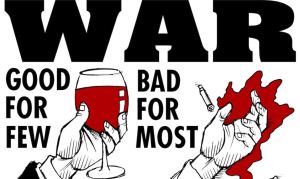 The monstrous US military budget is a classic illustration of the proverb about not seeing the wood for the trees. It is such an overwhelming outgrowth, all too often it is misperceived.

 Butchered by “Healthcare” is Robert Yoho’s plain-spoken account of how American medicine stopped being a profession and became an industry. 341 pages. Over a thousand references. Thirty-eight chapters.
 Aletho News

