Creating a Prison-Corporate Complex
Introduction
As cash-starved state governments scrape their way through this so-called recovery, they might as well hang signs with this message on their capitals: “Everything must go.” States are hemorrhaging workers and selling off assets at a startling rate as they grapple with anemic tax revenues and dwindling federal dollars. So dire are the states’ economic woes that, in recent years, they’ve begun offloading a more unusual type of property: prisons.
That’s right — states are so broke they’ve resorted to selling off their correctional facilities (with the prisoners inside) as a way to cut costs and make ends meet. In 2011, for instance, Ohio sold one of its prisons for $73 million to the Corrections Corporation of America (CCA), the largest private prison company in the country. And make no mistake: CCA and its ilk are eager buyers. As reported in February, CCA sent a letter to 48 governors offering to buy — not just manage, but acquire entirely — prisons in their states. The company said it had earmarked $250 million for buying and running state-owned prisons as part of a “corrections investment initiative.”
But CCA, to borrow a trope from journalism, buried the “lede” in the governors’ letter. The real head-snapping revelation appeared in the third-to-last paragraph: in exchange for buying a state’s prison, CCA required that the state prison agency ensure that the prison remained at least 90% full. Translation: We’ll buy your prisons and keep ’em orderly and clean, so as long you keep the prisoners coming in.
This is just the latest episode in the decades-long takeover of the prison industry by private interests. Reagan’s “tough on crime” policies, as Michelle Alexander has written, caused spiraling incarceration rates, which in turn spawned a cottage industry of prison management companies looking to make a buck off the influx of inmates. CCA, for instance, has watched revenues grow by 500% in the past two decades.
Another growth industry in our Age of Incarceration is prison labor, putting inmates to work making everything from uniforms to furniture for a few cents an hour. As historians Steve Fraser and Joshua Freeman explain, prison labor has a long and sordid history that should make us anxious indeed for our own degraded economic moment. Leasing prisoners to companies at wages from hell is a “Yankee invention” dating back almost 200 years that was modern then and, frighteningly enough, couldn’t be more modern today. – Andy Kroll
Locking Down an American Workforce
Prison Labor as the Past — and Future — of American “Free-Market” Capitalism
Steve Fraser and Joshua Freeman | TomDispatch | April 19, 2012
Sweatshop labor is back with a vengeance. It can be found across broad stretches of the American economy and around the world. Penitentiaries have become a niche market for such work. The privatization of prisons in recent years has meant the creation of a small army of workers too coerced and right-less to complain.
Prisoners, whose ranks increasingly consist of those for whom the legitimate economy has found no use, now make up a virtual brigade within the reserve army of the unemployed whose ranks have ballooned along with the U.S. incarceration rate. The Corrections Corporation of America and G4S (formerly Wackenhut), two prison privatizers, sell inmate labor at subminimum wages to Fortune 500 corporations like Chevron, Bank of America, AT&T, and IBM.
These companies can, in most states, lease factories in prisons or prisoners to work on the outside. All told, nearly a million prisoners are now making office furniture, working in call centers, fabricating body armor, taking hotel reservations, working in slaughterhouses, or manufacturing textiles, shoes, and clothing, while getting paid somewhere between 93 cents and $4.73 per day.
Rarely can you find workers so pliable, easy to control, stripped of political rights, and subject to martial discipline at the first sign of recalcitrance — unless, that is, you traveled back to the nineteenth century when convict labor was commonplace nationwide. Indeed, a sentence of “confinement at hard labor” was then the essence of the American penal system. More than that, it was one vital way the United States became a modern industrial capitalist economy — at a moment, eerily like our own, when the mechanisms of capital accumulation were in crisis.
A Yankee Invention
What some historians call “the long Depression” of the nineteenth century, which lasted from the mid-1870s through the mid-1890s, was marked by frequent panics and slumps, mass bankruptcies, deflation, and self-destructive competition among businesses designed to depress costs, especially labor costs. So, too, we are living through a twenty-first century age of panics and austerity with similar pressures to shrink the social wage.
Convict labor has been and once again is an appealing way for business to address these dilemmas. Penal servitude now strikes us as a barbaric throwback to some long-lost moment that preceded the industrial revolution, but in that we’re wrong. From its first appearance in this country, it has been associated with modern capitalist industry and large-scale agriculture.
And that is only the first of many misconceptions about this peculiar institution. Infamous for the brutality with which prison laborers were once treated, indelibly linked in popular memory (and popular culture) with images of the black chain gang in the American South, it is usually assumed to be a Southern invention. So apparently atavistic, it seems to fit naturally with the retrograde nature of Southern life and labor, its economic and cultural underdevelopment, its racial caste system, and its desperate attachment to the “lost cause.”
As it happens, penal servitude — the leasing out of prisoners to private enterprise, either within prison walls or in outside workshops, factories, and fields — was originally known as a “Yankee invention.”
First used at Auburn prison in New York State in the 1820s, the system spread widely and quickly throughout the North, the Midwest, and later the West. It developed alongside state-run prison workshops that produced goods for the public sector and sometimes the open market.
A few Southern states also used it. Prisoners there, as elsewhere, however, were mainly white men, since slave masters, with a free hand to deal with the “infractions” of their chattel, had little need for prison. The Thirteenth Amendment abolishing slavery would, in fact, make an exception for penal servitude precisely because it had become the dominant form of punishment throughout the free states.
Nor were those sentenced to “confinement at hard labor” restricted to digging ditches or other unskilled work; nor were they only men. Prisoners were employed at an enormous range of tasks from rope- and wagon-making to carpet, hat, and clothing manufacturing (where women prisoners were sometimes put to work), as well coal mining, carpentry, barrel-making, shoe production, house-building, and even the manufacture of rifles. The range of petty and larger workshops into which the felons were integrated made up the heart of the new American economy.
Observing a free-labor textile mill and a convict-labor one on a visit to the United States, novelist Charles Dickens couldn’t tell the difference. State governments used the rental revenue garnered from their prisoners to meet budget needs, while entrepreneurs made outsized profits either by working the prisoners themselves or subleasing them to other businessmen.
Convict Labor in the ‘New South’
After the Civil War, the convict-lease system metamorphosed. In the South, it became ubiquitous, one of several grim methods — including the black codes, debt peonage, the crop-lien system, lifetime labor contracts, and vigilante terror — used to control and fix in place the newly emancipated slave. Those “freedmen” were eager to pursue their new liberty either by setting up as small farmers or by exercising the right to move out of the region at will or from job to job as “free wage labor” was supposed to be able to do.
If you assumed, however, that the convict-lease system was solely the brainchild of the apartheid all-white “Redeemer” governments that overthrew the Radical Republican regimes (which first ran the defeated Confederacy during Reconstruction) and used their power to introduce Jim Crow to Dixie, you would be wrong again. In Georgia, for instance, the Radical Republican state government took the initiative soon after the war ended. And this was because the convict-lease system was tied to the modernizing sectors of the post-war economy, no matter where in Dixie it was introduced or by whom.
So convicts were leased to coal-mining, iron-forging, steel-making, and railroad companies, including Tennessee Coal and Iron (TC&I), a major producer across the South, especially in the booming region around Birmingham, Alabama. More than a quarter of the coal coming out of Birmingham’s pits was then mined by prisoners. By the turn of the century, TC&I had been folded into J.P. Morgan’s United States Steel complex, which also relied heavily on prison laborers.
All the main extractive industries of the South were, in fact, wedded to the system. Turpentine and lumber camps deep in the fetid swamps and forest vastnesses of Georgia, Florida, and Louisiana commonly worked their convicts until they dropped dead from overwork or disease. The region’s plantation monocultures in cotton and sugar made regular use of imprisoned former slaves, including women. Among the leading families of Atlanta, Birmingham, and other “New South” metropolises were businessmen whose fortunes originated in the dank coal pits, malarial marshes, isolated forests, and squalid barracks in which their unfree peons worked, lived, and died.
Because it tended to grant absolute authority to private commercial interests and because its racial make-up in the post-slavery era was overwhelmingly African-American, the South’s convict-lease system was distinctive. Its caste nature is not only impossible to forget, but should remind us of the unbalanced racial profile of America’s bloated prison population today.
Moreover, this totalitarian-style control invited appalling brutalities in response to any sign of resistance: whippings, water torture, isolation in “dark cells,” dehydration, starvation, ice-baths, shackling with metal spurs riveted to the feet, and “tricing” (an excruciatingly painful process in which recalcitrant prisoners were strung up by the thumbs with fishing line attached to overhead pulleys). Even women in a hosiery mill in Tennessee were flogged, hung by the wrists, and placed in solitary confinement.
Living quarters for prisoner-workers were usually rat-infested and disease-ridden. Work lasted at least from sunup to sundown and well past the point of exhaustion. Death came often enough and bodies were cast off in unmarked graves by the side of the road or by incineration in coke ovens. Injury rates averaged one per worker per month, including respiratory failure, burnings, disfigurement, and the loss of limbs. Prison mines were called “nurseries of death.” Among Southern convict laborers, the mortality rate (not even including high levels of suicides) was eight times that among similar workers in the North — and it was extraordinarily high there.
The Southern system also stood out for the intimate collusion among industrial, commercial, and agricultural enterprises and every level of Southern law enforcement as well as the judicial system. Sheriffs, local justices of the peace, state police, judges, and state governments conspired to keep the convict-lease business humming. Indeed, local law officers depended on the leasing system for a substantial part of their income. (They pocketed the fines and fees associated with the “convictions,” a repayable sum that would be added on to the amount of time at “hard labor” demanded of the prisoner.)
The arrest cycle was synchronized with the business cycle, timed to the rise and fall of the demand for fresh labor. County and state treasuries similarly counted on such revenues, since the post-war South was so capital-starved that only renting out convicts assured that prisons could be built and maintained.
There was, then, every incentive to concoct charges or send people to jail for the most trivial offenses: vagrancy, gambling, drinking, partying, hopping a freight car, tarrying too long in town. A “pig law” in Mississippi assured you of five years as a prison laborer if you stole a farm animal worth more than $10. Theft of a fence rail could result in the same.
Penal Servitude in the Gilded Age North
All of this was only different in degree from prevailing practices everywhere else: the sale of prison labor power to private interests, corporal punishment, and the absence of all rights including civil liberties, the vote, and the right to protest or organize against terrible conditions.
In the North, where 80% of all U.S. prison labor was employed after the Civil War and which accounted for over $35 billion in output (in current dollars), the system was reconfigured to meet the needs of modern industry and the pressures of “the long Depression.” Convict labor was increasingly leased out only to a handful of major manufacturers in each state. These textile mills, oven makers, mining operations, hat and shoe factories — one in Wisconsin leased that state’s entire population of convicted felons — were then installing the kind of mass production methods becoming standard in much of American industry. As organized markets for prison labor grew increasingly oligopolistic (like the rest of the economy), the Depression of 1873 and subsequent depressions in the following decades wiped out many smaller businesses that had once gone trawling for convicts.
 Today, we talk about a newly “flexible economy,” often a euphemism for the geometric growth of a precariously positioned, insecure workforce. The convict labor system of the nineteenth century offered an original specimen of perfect flexibility.
Companies leasing convicts enjoyed authority to dispose of their rented labor power as they saw fit. Workers were compelled to labor in total silence. Even hand gestures and eye contact were prohibited for the purpose of creating “silent and insulated working machines.”
Supervision of prison labor was ostensibly shared by employers and the prison authorities. In fact, many businesses did continue to conduct their operations within prison walls where they supplied the materials, power, and machinery, while the state provided guards, workshops, food, clothing, and what passed for medical care. As a matter of practice though, the foremen of the businesses called the shots. And there were certain states, including Nebraska, Washington, and New Mexico, that, like their Southern counterparts, ceded complete control to the lessee. As one observer put it, “Felons are mere machines held to labor by the dark cell and the scourge.”
Free market industrial capitalism, then and now, invariably draws on the aid of the state. In that system’s formative phases, the state has regularly used its coercive powers of taxation, expropriation, and in this case incarceration to free up natural and human resources lying outside the orbit of capitalism proper.
In both the North and the South, the contracting out of convict labor was one way in which that state-assisted mechanism of capital accumulation arose. Contracts with the government assured employers that their labor force would be replenished anytime a worker got sick, was disabled, died, or simply became too worn out to continue.
The Kansas Wagon Company, for example, signed a five-year contract in 1877 that prevented the state from raising the rental price of labor or renting to other employers. The company also got an option to renew the lease for 10 more years, while the government was obliged to pay for new machinery, larger workshops, a power supply, and even the building of a switching track that connected to the trunk line of the Pacific Railway and so ensured that the product could be moved effectively to market.
Penal institutions all over the country became auxiliary arms of capitalist industry and commerce. Two-thirds of all prisoners worked for private enterprise.
Today, strikingly enough, government is again providing subsidies and tax incentives as well as facilities, utilities, and free space for corporations making use of this same category of abjectly dependent labor.
The New Abolitionism
Dependency and flexibility naturally assumed no resistance, but there was plenty of that all through the nineteenth century from workers, farmers, and even prisoners. Indeed, a principal objective in using prison labor was to undermine efforts to unionize, but from the standpoint of mobilized working people far more was at stake.
Opposition to convict labor arose from workingmen’s associations, labor-oriented political parties, journeymen unions, and other groups which considered the system an insult to the moral codes of egalitarian republicanism nurtured by the American Revolution. The specter of proletarian dependency haunted the lives of the country’s self-reliant handicraftsmen who watched apprehensively as shops employing wage labor began popping up across the country. Much of the earliest of this agitation was aimed at the use of prisoners to replace skilled workers (while unskilled prison labor was initially largely ignored).
It was bad enough for craftsmen to see their own livelihoods and standards of living put in jeopardy by “free” wage labor. Worse still was to watch unfree labor do the same thing. At the time, employers were turning to that captive prison population to combat attempts by aggrieved workers to organize and defend themselves. On the eve of the Civil War, for example, an iron-molding contractor in Spuyten Duyvil, north of Manhattan in the Bronx, locked out his unionized workers and then moved his operation to Sing Sing penitentiary, where a laborer cost 40 cents, $2.60 less than the going day rate. It worked, and Local 11 of the Union of Iron Workers quickly died away.
Worst of all was to imagine this debased form of work as a model for the proletarian future to come. The workingman’s movement of the Jacksonian era was deeply alarmed by the prospect of “wage slavery,” a condition inimical to their sense of themselves as citizens of a republic of independent producers. Prison labor was a sub-species of that dreaded “slavery,” a caricature of it perhaps, and intolerable to a movement often as much about emancipation as unionization.
All the way through the Gilded Age of the 1890s, convict labor continued to serve as a magnet for emancipatory desires. In addition, prisoners’ rebellions became ever more common — in the North particularly, where many prisoners turned out to be Civil War veterans and dispossessed working people who already knew something about fighting for freedom and fighting back. Major penitentiaries like Sing Sing became sites of repeated strikes and riots; a strike in 1877 even took on the transplanted Spuyten Duyvil iron-molding company.
Above and below the Mason Dixon line, political platforms, protest rallies, petition campaigns, legislative investigations, union strikes, and boycotts by farm organizations like the Farmers Alliance and Grange cried out for the abolition of the convict-lease system, or at least for its rigorous regulation. Over the century’s last two decades, more than 20 coal-mine strikes broke out because of the use of convict miners.
The Knights of Labor, that era’s most audacious labor movement, was particularly exercised. During the Coal Creek Wars in eastern Tennessee in the early 1890s, for instance, TC&I tried to use prisoners to break a miners’ strike. The company’s vice president noted that it was “an effective club to hold over the heads of free laborers.”
Strikers and their allies affiliated with the Knights, the United Mine Workers, and the Farmers Alliance launched guerilla attacks on the prisoner stockade, sending the convicts they freed to Knoxville. When the governor insisted on shipping them back, the workers released them into the surrounding hills and countryside. Gun battles followed.
The Death of Convict Leasing
In the North, the prison abolition movement went viral, embracing not only workers’ organizations, sympathetic rural insurgents, and prisoners, but also widening circles of middle-class reformers. The newly created American Federation of Labor denounced the system as “contract slavery.” It also demanded the banning of any imports from abroad made with convict labor and the exclusion from the open market of goods produced domestically by prisoners, whether in state-run or private workshops. In Chicago, the construction unions refused to work with materials made by prisoners.
By the latter part of the century, in state after state penal servitude was on its way to extinction. New York, where the “industry” was born and was largest, killed it by the late 1880s. The tariff of 1890 prohibited the sale of convict-made wares from abroad. Private leasing continued in the North, but under increasingly restrictive conditions, including Federal legislation passed during the New Deal. By World War II, it was virtually extinct (although government-run prison workshops continued as they always had).
At least officially, even in the South it was at an end by the turn of the century in Tennessee, Louisiana, Georgia, and Mississippi. Higher political calculations were at work in these states. Established elites were eager to break the inter-racial alliances that had formed over abolishing convict leasing by abolishing the hated system itself. Often enough, however, it ended in name only.
What replaced it was the state-run chain gang (although some Southern states like Alabama and Florida continued private leasing well into the 1920s). Inmates were set to work building roads and other infrastructure projects vital to the flourishing of a mature market economy and so to the continuing process of capital accumulation. In the North, the system of “hard labor” was replaced by a system of “hard time,” that numbing, brutalizing idleness where masses of people extruded from the mainstream economy are pooled into mass penal colonies. The historic link between labor, punishment, and economic development was severed, and remained so… until now.
Convict Leasing Rises Again
“Now,” means our second Gilded Age and its aftermath. In these years, the system of leasing out convicts to private enterprise was reborn. This was a perverse triumph for the law of supply and demand in an era infatuated with the charms of the free market. On the supply side, the U.S. holds captive 25% of all the prisoners on the planet: 2.3 million people. It has the highest incarceration rate in the world as well, a figure that began skyrocketing in 1980 as Ronald Reagan became president. As for the demand for labor, since the 1970s American industrial corporations have found it increasingly unprofitable to invest in domestic production. Instead, they have sought out the hundreds of millions of people abroad who are willing to, or can be pressed into, working for far less than American workers.
As a consequence, those back home — disproportionately African-American workers — who found themselves living in economic exile, scrabbling to get by, began showing up in similarly disproportionate numbers in the country’s rapidly expanding prison archipelago. It didn’t take long for corporate America to come to view this as another potential foreign country, full of cheap and subservient labor — and better yet, close by.
What began in the 1970s as an end run around the laws prohibiting convict leasing by private interests has now become an industrial sector in its own right, employing more people than any Fortune 500 corporation and operating in 37 states. And here’s the ultimate irony: our ancestors found convict labor obnoxious in part because it seemed to prefigure a new and more universal form of enslavement. Could its rebirth foreshadow a future ever more unnervingly like those past nightmares?
Today, we are being reassured by the president, the mainstream media, and economic experts that the Great Recession is over, that we are in “recovery” even though most of the recovering patients haven’t actually noticed significant improvement in their condition. For those announcing its arrival, “recovery” means that the mega-banks are no longer on the brink of bankruptcy, the stock market has made up lost ground, corporate profits are improving, and notoriously unreliable employment numbers have improved by several tenths of a percent.
What accounts for that peculiarly narrow view of recovery, however, is that the general costs of doing business are falling off a cliff as the economy eats itself alive. The recovery being celebrated owes thanks to local, state, and Federal austerity budgets, the starving of the social welfare system and public services, rampant anti-union campaigns in the public and private sector, the spread of sweatshop labor, the coercion of desperate unemployed or underemployed workers to accept lower wages, part-time work, and temporary work, as well as the relinquishing of healthcare benefits and a financially secure retirement — in short, to surrender the hope that is supposed to come with the American franchise.
Such a recovery, resting on the stripping away of the hard won material and cultural achievements of the past century, suggests a new world in which the prison-labor archipelago could indeed become a vast gulag of the downwardly mobile.
Steve Fraser is Editor-at-Large of New Labor Forum, co-founder of the American Empire Project (Metropolitan Books). He is, most recently, the author of Wall Street: America’s Dream Palace. He teaches history at Columbia University.
Joshua B. Freeman teaches history at Queens College and at the Graduate Center of the City University of New York and is affiliated with its Joseph S. Murphy Labor Institute. His forthcoming book, American Empire, will be the final volume of the Penguin History of the United States.
[Further Reading: For those interested in learning more about the history of prison labor and the convict-leasing system, we highly recommend three books that were crucial to us in writing this essay: Rebecca M. McLennan’s The Crisis of Imprisonment: Protest, Politics, and the Making of the American Penal State, 1776-1941, Alex Lichtenstein’s Twice the Work of Free Labor: The Political Economy of Convict Labor in the New South, and Douglas A. Blackmon’s Slavery by Another Name: The Re-Enslavement of Black Americans from the Civil War to World War II.]
Related articles
- Private prisons – the best investment in America? (rt.com)
- Disturbing Questions About Our Government and the So-Called ‘War on Drugs’ – [2 of 3] (bradblog.com)
- Jailing Americans for Profit: The Rise of the Prison Industrial Complex (blacklistednews.com)
- Private Prison Company to Demand 90% Occupancy (blacklistednews.com)
- The Economics of Incarceration (activistpost.com)
- Montana CCA/Shelby Prison Has Manipulated The Question Of The Week In The Helena Independent Record (montanacorruption.org)
The History and Resurgence of Death Squads in Central America
By Annie Bird | Upside Down World | April 17, 2012

On March 24, in the Public Health Workers neighborhood in Guatemala City, community leaders and neighbors chatted in a regular gathering place in front of a local store. The relaxed Saturday night was broken up by gunfire, a massacre that killed health care union leader Ovidio Ortiz, along with Bildave Santos Barco, Fredy Leonel Estrada and Oscar Alexander Rodriguez.
Public health workers unions are a strong force in defense of public services and natural resources, and among the most outspoken critics of the abuses of transnational corporations in Guatemala.
Ovidio Ortiz, a life-long health union leader, community organizer and political activist, was apparently the main target in the massacre; he received 8 bullets.
U.S. Assistant Secretary of State’s Visit to Central America and the Return of Repressive States in Central America
The next day, Assistant Secretary of State for International Narcotics and Law Enforcement William Brownfield arrived in Central America on a two day trip, visiting Honduras and Guatemala. Brownfield’s trip is to promote the US’s “drug war” in the Central America, in close coordination with a government born of a military coup in Honduras, and in Guatemala, a government led since January 7, 2012 by President Otto Perez Molina, a former general accused of participation in genocide.
Politically motivated killings apparently by death squads have been growing over the past few years in Central America, and concern in Guatemala is heightened as the new administration has brought back to public office many of the same individuals directly implicated in the State repression and genocide of the 1980s.
Ex-General, now President Perez Molina is no stranger to death squads. According to declassified State Department and CIA documents, in 1994 while head of Military Intelligence, Perez Molina ran a secret torture center with over 300 political prisoners rounded up by military intelligence. An investigative journalist reported that Perez Molina was a CIA asset at the time.
Human rights activists reflect that the Public Health Workers neighborhood massacre appears to be one in a series of incidents indicating the return to the repressive State, what one Guatemala sociologist describes as the return of the three rights, the neoliberal right, the anti-communist right and the counterinsurgency right.
Criminal Network Death Squads Re-enter Politics
Like the death squads in the 1960s-70s, recent crimes in Guatemala appear to employ criminal networks, drug trafficking network hit men, to carry out violence against unions and communities organizing against abuses by transnational corporations, with the collusion or support of the military and police.
The return of the repressive state in Guatemala is part of a regional process that mixes drug war, anti-terrorism and anti-communist rhetoric and partners US security experts and agencies with repressive States, States made up of many of the same individuals responsible for crimes against humanity carried out just one generation ago with the assistance of US military advisors.
In Honduras, death squads targeting anti-coup activists have been operating across the country since the June 2009 military coup; human rights activists denounce over 300 politically motivated killings. In the Bajo Aguan region, since January 2010 death squad killings have been spearheaded by private security forces working for transnational palm oil corporations with the collaboration of police and the same Honduran military units that have received ongoing training from US military forces. As a result over 60 campesinos and journalists have been killed.
Killing Ovidio, Killing Democracy: Counterinsurgency Violence without the Violence
On September 2, 1993 Ovidio Ortiz helped lead public health workers in recovering a tract of land that the then-militarized Health Ministry had purchased in 1982. Though ostensibly purchased to build a hospital, years passed and public health workers worried the property would fall into the hands of military linked businesses, as has happened with other public lands purchased under military governments, such as a now cement mine on the South side of the city. So, they occupied the land and the union negotiated with the Health Ministry to facilitate access to housing lots for health workers.
Ever since Ovidio was elected either president or vice president of the neighborhood development committee; he was vice president when he was killed. He was also a member of the Executive Committee of the National Union of Health Care Workers of Guatemala, and the Conflict Resolution Secretary of the National Front for Struggle in Defense of Public Services and Natural Resources (FNL), an alliance of public health unions and community organizations. And, he was a political activist with the URNG party born from the URNG revolutionary movement.
Over the past decade, health workers have been the most outspoken defenders of public services, with a strong and public political identification with the Latin American “left,” emphasizing the importance of sovereignty, an end to North American hegemony in the region, and popular struggle.
Ovidio was killed just two days after the National Union of Health Workers signed a hard-fought collective agreement with the Health Ministry. The March 22, 2012 agreement was the product of difficult negotiations that involved months of work stops, protests and road blockades. Though most of the struggle took place during the previous presidential administration, on February 24, 2012 the FNL, comprised in large part of the health workers unions, froze the nation for five hours blocking the eight major highway intersections. Public health workers showed their strength, leaving no doubt they are a force to be reckoned with.
Shooting Sprees in Working Class Neighborhoods Spread Fear
Guatemalan human rights organizations observe that the Public Health Neighborhood massacre is also part of a trend of shooting sprees in meeting places like corner stores that began occurring in working class neighborhoods.
On January 15, 2012, in Zone 6 of Guatemala City, young people were reportedly kidnapped by a military patrol. A similar action is reported to have occurred again two weeks later in the El Mezquital settlement, when men dressed in black with ski masks again kidnapped young people.
Six days after the March 24, 2012 Public Health Workers Neighborhood massacre, on March 30, 2012, a passing car sprayed bullets on residents gathered in front of a neighborhood store in Zone 18 in northern Guatemala City, injuring 8.
8 FNL Energy Nationalization Movement Leaders Killed in 6 Months
The National Front for Struggle (FNL), an organization where Ovidio Ortiz held a leadership position, is among the most outspoken opponents of the abuses of transnational corporations in Guatemala, and has been a target of death squad killings. The FNL has led a struggle for the nationalization of electrical services in Guatemala, privatized in 1999, while denouncing illegal surcharges and other abuses by Union Fenosa, a Spanish distribution company that benefitted from the privatization.
Communities organized with the FNL in the Department of San Marcos were part of a movement to withhold payment for electrical services in protest of abuses, including non-compliance with court mandated refunds to clients.
Murders of FNL Members
- On October 24, 2009, Victor Galvez, a local leader in opposition to Union Fenosa and member of the Front in Defense of Natural Resources (FERNA), a San Marcos based organization that belongs to the FNL, was shot 32 times as he left his office in Malacatan, San Marcos.
- On December 15, 2009, Union Fenosa cut electrical services to entire townships of San Marcos, and a State of Emergency was declared in response to the resulting protests. Over the next few months, during the state of emergency, a further seven FNL activists were killed in San Marcos.
- On January 13, 2010 Evelinda Ramirez was shot and killed in the municipality of Ocos while driving to her home in nearby Chiquirines.
- On January 29, 2010, energy nationalization activist, member of the FNL and the Malacatan municipal workers union Pedro Garcia was shot and killed while driving home.
- On February 17, 2010 Octavio Roberlo, a principal leader of the FNL in San Marcos was shot 16 times from a passing car when he was closing up his store in the bus terminal.
- On March 21, 2010, Carlos Noel Maldonado Barrios, Leandro Maldonado, and Ana María Lorenzo Escobar, three community leaders active in the denouncements against Union Fenosa were brutally killed by gunshots and machete wounds in the municipality of Ocos.
- On March 22, 2011, during protests in reaction to Union Fenosa cutting electrical service to the town of Las Brisas in Ocos, Guatemalan soldiers shot and killed Santiago Gamboa, head of the local committee for the nationalization of energy, while injuring six others.
Drug Hitmen Working for Spanish and US Transnational Businesses?
Ocos and Malacatan in the department of San Marcos are towns renowned to be controlled by drug trafficking networks. Reportedly following the December 15, 2009 massive suspension of electrical services, including to medical centers, Union Fenosa moved their San Marcos offices to a building owned by one of San Marcos’ most infamous drug traffickers, which to local residents appeared to be a signal of an alliance between the Spanish electrical company and traffickers.
The 2009-2010 killings of FNL leaders and supporters in San Marcos were carried out in a way characteristic of drug hit men killings.
The municipality of Morales in Izabal is another area dominated by drug traffickers where unionists are being killed in an apparent alliance between transnational corporations and drug traffickers.
Del Monte Fresh Produce banana workers are organized into the SITRABI union. Del Monte Fresh Produce is charged with hiring some of Guatemala’s most important drug traffickers, including Mario Ponce (extradited to the US on drug charges in January 2012), to kidnap SITRABI leaders in 1999, at the same that Marvin Bush, the brother of Jeb and George Bush, sat on the Florida based Del Monte Fresh Produce board of directors.
Over the past year a new round of hit style killings of SITRABI unionists are terrorizing banana workers: Oscar Humberto Gonzalez Vasquez was killed on April 10, 2011; Idar Joel Hernandez Godoy was killed on May 26, 2011; on September 24, 2011 Henry Anibal Marroquin Orellana was killed; on October 16, 2011 Pablino Yaque Cervantes was killed; and most recently, Miguel Angel Gonzalez Ramirez was shot to death while holding his son.
Death Squad Denounced in Cement Plant Conflict with Swiss Investment
In 2007, indigenous communities denounced the emergence of a death squad in San Juan Sacatepequez, Guatemala, where 12 Kaqchiquel Maya communities are resisting the entry of a cement plant which will decimate their territory, a project promoted by a consortium of the Guatemalan cement monopoly Cementos Progreso, owned by the politically powerful Novella and Torrebiarte families, and by the Swiss cement giant Holchim.
Community activists report that the violent group emerged following the May 13, 2007 community consultation that rejected the cement companies’ presence in the municipality, claiming it is run by former military officers and known as El Escuadron (The Squad). It first began extorting local residents, generating a ‘security crisis’ and then began killing accused “gang members” they claimed were responsible for the extortion.
Community leaders resisting the cement plant were subject to constant threats and violent attacks, and subject to flawed and apparently malicious prosecution for killings apparently carried out by El Escuadron.
1960s-1980s Death Squads Grew from Criminal Networks and US Security Advisors
The United Nations sponsored Truth Commission, published in 1999, reported on atrocities committed during Guatemala’s 36 year civil war (1960-1996). US government documents declassified in the 1990s as a contribution to the Truth Commission demonstrate that in the mid-1960s a U.S. public safety advisor to Guatemala, John Longdon, pressed superiors over the need to set up covert operations centers, a safe house for coordination of security intelligence and the designation of a room in the National Palace, the starting point of the infamous “El Archivo” parallel intelligence center and nerve center for death squads.
In mid-1966, US Southern Command forwarded a request from the Guatemalan government to the US government for assistance in setting up kidnapping squads. A surge of death squad killings that began in 1966 resulted in thousands of deaths.
The UN Truth Commission found that the death squads of Guatemala’s ‘internal’ conflict were initially criminal groups made up of civilians whose actions were tolerated and covered up for by State authorities, which received logistical support from the military, responded to decisions made in the military command structure, and eventually incorporated military personnel.
Death squads that incorporated drug traffickers like Arnoldo Vargas, a member of the infamous 1980s ‘Mano Blanco’ squad and the first Guatemalan extradited to the US on drug charges in 1992, carried out politically motivated killings.
The Truth Commission’s description of the origins of Guatemalan death squads is disturbingly similar to the picture emerging in Guatemala and Honduras today.
Post Peace Process Police Forces and One Alleged CIA Asset
The military intelligence networks were restructured after the 1990s peace processes and have continued as criminal networks. They shied away from political killings, likely due to the strong international presence accompanying the peace processes. But these intelligence / criminal networks continued to infiltrate the States on all levels.
With the partial demobilizations of the militaries and creation of new National Civilian Police forces after the signing of the peace accords in El Salvador and Guatemala, which involved the large scale recycling of soldiers as police officers, a new generation of death squads was created in Central America.
In the early 1980s, Victor Rivera, a Venezuelan national and reported Central Intelligence Agency asset, came to the Ilopango Airforce base in El Salvador to work alongside the infamous Cuban American bomber and alleged former CIA asset Luis Posada Carriles in running Oliver North’s National Security Council covert operations that employed former Nicaraguan National Guardsmen who had been operating as criminal gangs in Guatemala in attacking the Sandinista government of Nicaragua, the “Contra supply operation.”
Rivera went on to become a security advisor to El Salvador’s post peace accord Vice Minister of Security, Hugo Barrera. Rivera assisted in the creation of an unofficial police unit that operated out of the office of a business owned by Barrera. When the “Police Analysis Unit” was implicated in the killing of a medical student, he fled to Guatemala in 1996.
In 1996, the same year as the signing of the peace accords, wealthy Guatemalans became concerned about a rash of kidnappings, and organizations like Madres Angustiadas (Anguished Mothers) and Friends Against Extortion and Kidnapping (FADES) were formed. They welcomed Victor Rivera who set up another special parallel police team, this one in Guatemala.
Adela Torrebiarte, a founder of Madres Angustiadas and member of the Novella-Torrebiarte family which owns Cementos Progreso involved in the mining conflict in San Juan Sacatequez, supported Rivera’s entry into Guatemala. The two reportedly were close over 12 years.
The United Nations peace process verification mission MINUGUA reported that in 1996 a covert anti-kidnapping commando operated out of the Presidential Palace, and was involved in the capture of kidnappers of the elderly Isabel Bonifasi de Botran (brutally murdered in the course of the kidnapping), and in the capture and forced disappearance of a member of the ORPA revolutionary movement involved in the kidnapping of Olga Novella of the Novella-Torrebiarte family.
In 1997, when Victor Rivera’s parallel security teams office was raided by police, Madres Angustiadas jumped to his defense claiming that he had helped them resolve kidnapping cases. On May 4, 2001 Adela Torrebiarte’s nephew, Juan Andres Torrebiarte Novella, was kidnapped, but was rescued on May 24. MINUGUA reported that four of his captors were severely tortured.
Social Cleansing or Organized Crime Violence?
While kidnappings were the topic of concern in the late 1990s, from 2001 to 2005 it was murder, gangs and social cleansing. The murder rate grew 40% from 2001 to 2005. A large number of killings of young people, apparently gang related and murder of street children by police and gangs was widely reported.
Investigations by the UN-backed special prosecutors unit CICIG demonstrated in 2010 that in 2004 a network of officials in the Ministry of Governance and Police used their positions to engage in a range of criminal activities, including murder, robbery and drug trafficking. In 2010, arrest warrants were issued for 18 officials involved, including the Director of the National Police Erwin Sperinsen and the Secretary of Governance Carlos Vielmann.
Though reporting focused on their role in the death squad killings of prison inmates and escapees, the breadth of activities that this network was allegedly involved in leads to the conclusion that the inmate killings were not simply about cleaning up society or “social cleansing” but related to other criminal activities the officials were involved in.
This leads one to question what other motives besides “cleaning up” society may have been behind the crisis of killings of young people in the early 2000s.
Guatemalan Death Squads Reemerge in the Public Eye
In 2006, questions about Veilmann’s, Sperinsen’s and Rivera’s activities began to surface after compromising information surfaced in the press that seemed to link them to questionable conduct related to the 2006 killing of three Central American parliamentarians, and the ensuing investigation of the crime. Two fled to Europe in 2007.
Victor Rivera was also suspected to have been in some way involved in the killings of the Central American Parliamentarians. Rivera visited four police officers detained as the material authors of the Parliamentarians’ murders in prison just hours before they were killed in a suspicious prison massacre, and a video was circulated of the officers threatening to bring down Rivera, essentially that they would not be his scapegoats, when they were first detained, illegally, by Rivera.
Then President Oscar Berger named Adela Torrebiarte, founder of Madres Angustiadas, as the new Secretary of Governance after Vielmann, and she kept Rivera on as an advisor.
However, shortly after Torrebiarte left the Ministry of Governance, Rivera was fired on March 30, 2008 and a week later, on April 7, 2008 he was murdered as he drove in Guatemala City.
CICIG’s investigations of Rivera’s murder identified drug kingpin Jorge “El Gordo” Paredes as a suspect. CICIG’s director described Paredes as a long-time associate of Rivera, and described one of two potential motives for Rivera’s murder as the consequence of a collaboration with Paredes that had gone bad. Parades was also implicated in the killing of the Central American Parliamentarians.
Former Police Director Arrested for 2009 Death Squad Killing
The most recent death squad scandal erupted on March 23, 2012 when Marlene Blanco, Director of the National Civil Police in 2008 and Assistant Secretary of Governance for Community Security in 2009, was arrested on charges of running a death squad that tortured and murdered suspects in the extortion and murder of bus drivers. She has been charged with three 2009 killings and is being held in prison.
A dramatic rash of killings of bus drivers began during the 2007 presidential campaign, won by Alvaro Colom, and continued during his presidency to be so dramatic that they were deemed to be a source of political instability.
Marlene Blanco’s brother, Orlando Blanco, was prominent in Colom’s administration as Secretary of Peace and is currently a congressman for Colom’s UNE party. Marlene Blanco’s arrest is the latest in a series of cases initiated against prominent figures or relatives of prominent figures in the outgoing administration, including a sister of the former First Lady in what seem to some to be a political vendetta by the ruling party against the outgoing UNE party, its stiffest competitor.
While some suspect that the case against Marlene Blanco may be politically motivated and promoted by current functionaries, the case has been investigated by CICIG, which has gained a great deal of legitimacy. The public prosecutor in charge of the case requested that the proceedings be reserved from the public
2012: New Police Forces in Central America – Restructuring Death Squads?
Sweeping police reform and the creation of new police forces is planned as part of the Regional Security Strategy backed by the US State Department.
In February 2012, a proposal for the creation of a tri-national police composed of Guatemala, Honduras and El Salvador emerged, and Brownfield promoted that initiative during his March 2012 tour. The tri-national force would be charged with controlling a 20 mile perimeter around borders of those nations, and would undoubtedly be trained in the Regional Security Strategy’s regional training center in Panama whose focus is training in border security and is run by US and Colombian security forces.
In January 2012, incoming Guatemalan president Otto Perez Molina named Adela Torrebiarte as the special commissioner in charge of police reform. Torrebiarte helped bring Victor Rivera to Guatemala in 1996, the reported CIA asset who had created some of the first parallel networks in the El Salvadoran police, and was suspected to be implicated in 2006 and 2007 death squad scandals.
Torrebiarte’s family business is suspected by indigenous rights activists in San Juan Sacatepequez to be implicated in the creation of death squads to facilitate the entry of a controversial cement plant in their communities.
She will now be in charge of reforming the Guatemalan police, and participate in the creation of a regional police force, with extensive US assistance.
We can expect that death squads will weather the reform, and probably even flourish.
(Annie Bird is co-director of Rights Action, since 1995, and has written extensively about Central American human rights issues, about the historic and on-going role of the USA in the region, and about global business and investors interests in the region. annie@rightsaction.org).
Related articles
- The roots of Bain Capital in El Salvador’s civil war (blacklistednews.com)
The cost and consequences of exposing the drone wars
Drone Wars UK – 16/04/2012
As secret and unaccountable US and British drone strikes continue in remote corners of the globe, closer to home (but firmly behind closed doors), the drone industry continues to research and develop a drone-filled future.
Over the past couple of weeks, protesters in the UK and the US have gathered to turn the spotlight on the increasingly secret use and development of armed drones. In Bristol, at the beginning of April, the great and good of the drone industry came together at the Annual International UAV Conference to be met with a good-natured, noisy protest. Meanwhile, across the Atlantic at the Creech Air Force base, members of the faith-based group Nevada Desert Experience delivered an ‘Indictment for the Violation of Human Rights’ to the commander of the base. At each demonstration protesters were arrested and jailed.
But it’s not just protesting against the drone wars, that can bring serious trouble. Pakistani human rights lawyer Shahzad Akbar, who represent victims of US drone strikes in Pakistan is being denied a travel visa to enter the US to speak at a conference organised by Code Pink and others. Speaking from Pakistan by telephone, Akbar told the Guardian:
“Denying a visa to people like me is denying Americans their right to know what the US government and its intelligence community are doing to children, women and other civilians in this part of the world. The CIA, which operated the drones in Pakistan, does not want anyone challenging their killing spree. But the American people should have a right to know.”

Abdulelah Haider Shaye in court detention cell
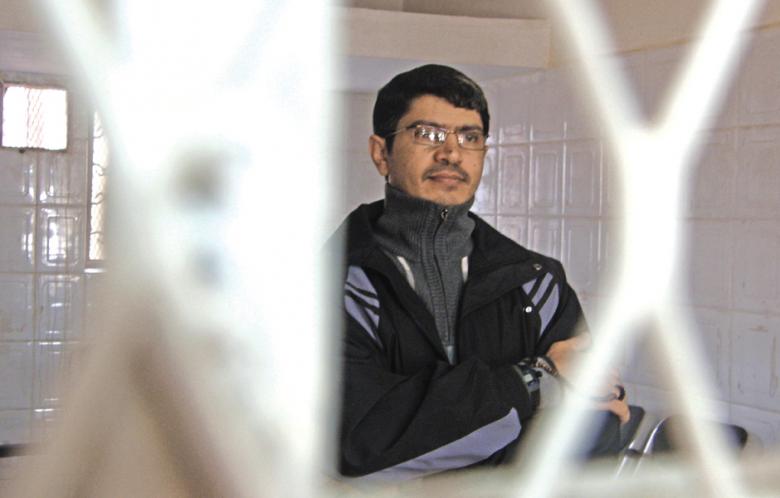
However it is Yemeni journalist Abdulelah Haider Shaye who is suffering the most for exposing the drone wars.
In 2010 Shaye revealed that an airstrike that took place in al Majala, Yemen in December 2009 killing 14 women and 21 children was launched by US drones, not the Yemeni air force, thus embarrassing both the Yemeni and US authorities. Later, Shaye also interviewed AQAP leaders including Anwar Al-Awlaki challenging them about their methods.
In August 2010, Shaye was kidnapped from his house by Yemeni security forces and disappeared for a month. He turned up in detention after being beaten and was sentenced to five years imprisonment for associating with terrorists. Amnesty International and other human rights groups have campaigned for his release, and it looked as though in February 2012 he was about to be freed. However a few days before Ali Abdullah Saleh, was forced to step down as President, Obama called him to “express concern” at the news that Shaye was about to be pardoned. Shaye release was immediately halted and he remains in prison.
Related articles
- Why Is President Obama keeping a journalist in prison in Yemen? (truthaholics.wordpress.com)
- Obama’s personal role in a journalist’s imprisonment (federaljack.com)
- Obama and Shaye: Will the White House Explain its Actions? (motherjones.com)
- Is Barack Obama a Murderous Sociopath? (motherjones.com)
- Pakistani Lawyer Representing Victims of Drone Strikes Prevented From Speaking in U.S. (alethonews.wordpress.com)
- Cluster Bombs: Still Legal, Still Lethal (conflictofconscience.wordpress.com)
Featured Video

Ivermectin and iodine
or go to
Aletho News Archives – Video-Images
From the Archives
UN declares war on ‘dangerous’ conspiracy theories
‘World is not secretly run by elites’
Free West Media | August 5, 2022
UNESCO says it is seriously concerned about the increase in “disinformation” and “conspiracy theories”. And they plan to put an end to it through a network of informants.
“Conspiracy theories can be dangerous,” the UN agency warned. “Often they ignore scientific evidence and polarize society with dire consequences. This has to stop.”
Unesco’s director-general warned that “conspiracy theories” could cause damage to people as well as to their health. “They reinforce misconceptions about the pandemic, reinforcing stereotypes that can fuel violence and violent, extremist ideologies,” said Audrey Azoulay.
The UN agency has launched a campaign to help people identify, debunk and report “conspiracy theories” to prevent them from spreading further.
This campaign is being carried out in collaboration with the European Commission, Twitter and the World Jewish Congress. The UN has created a toolkit to “debunk” such theories and smear anyone who dares to claim that governments are not fair and transparent.
The UN also warned that George Soros, the Rothschilds and Israel should not be linked to “alleged conspiracies”.
World events “are not secretly manipulated behind the scenes by powerful players with malicious intent,” the UN agency maintained.
And if anyone therefore comes across someone who believes that the world elite is plotting to consolidate power or direct events, then that person needs to take action. According to the UN agency, when meeting a “conspiracy theorist”, under no circumstances should one enter into a discussion. … continue
Blog Roll
 Aletho News
- Russia shows Europe that prolonging the Ukraine war is pointless
- There is cautious optimism about ending the Ukraine War – Part 2
- Ukrainian air alert app hacked with fake nuclear warnings
- Ivermectin and iodine
- Congratulations climate skeptics — you are a ‘Hybrid weapon of war’ and a growing public health threat
- ‘The Arab Vote’: How Israeli Racism Has Ruined Their Elections
- Israel forces Palestinians in Gaza to choose between assassination alone or death with their families: Report
- US Approves Sale of 500 Patriot Missiles to Ukraine, Deliveries May Take Years
- German Imperialism: An Urgent Explainer
- Backed by AAP, West Virginia Proposal Would Allow Dental Hygienists to Give HPV Vaccine to 9-Year-Olds
- If Americans Knew
- An error has occurred; the feed is probably down. Try again later.
- No Tricks Zone
- Germany’s Green Energy Transition Becoming Increasingly Expensive…Another 6 Trillion Euros!
- Sudden Stratospheric Warming, Powerful El Niño Combination May Lead To Extreme Europe Cold, Energy Crisis!
- Two New Studies Find Thwaites Glacier Melt Cannot Be Driven By Human Activity Or A Warming Ocean
- E-Cars Reduce CO2 Emissions By Only 41% Compared To Internal Combustion Engine Vehicles
- Predictions Made By Renowned Climate Professor Over Past Decades Have Been Proven To Be Poor
- New Study Suggests Large Regions Of The Pacific Ocean Have Been Cooling For The Last 80 Years
- Germany’s Green Energy Debacle: High Energy Costs Force Kahla Porzellan to Close After 182 Years!
- New Study: 50 Years Of The Most Aggressive ‘Net Zero’ Policies Can Only Affect The Global Climate By 0.03°C
- US September “Heat” Was No Record…Many Records Set Decades Ago
- Latest European Green Energy Debacle; Portugal’s Largest Flagship Solar Park Insolvent!

