Letter to Canadian Transport Minister: Israeli Apartheid Not Welcome in Canadian Ports #BlocktheBoat

Samidoun Palestinian Prisoner Solidarity Network | June 15, 2021
The following letter was sent today to Canada’s Transport Minister Omar Alghabra and called on “the Canadian government to stop legitimizing the crimes of apartheid…and suspend all instances of Zim-operated ships docking and unloading in Canadian ports.” This action is part of the growing demand that Canada must hold Israel accountable, through economic sanctions and a bilateral arms embargo.
June 15, 2021
Minister of Transport Omar Alghabra
Ottawa, OntarioIn recent weeks, people of conscience in Canada watched in horror as the Israeli regime ruthlessly targeted Palestinians from all regions of historic Palestine. What started as a popular movement to #SaveSheikhJarrah residents from further ethnic cleansing expanded into a broad unity of Palestinians from Jerusalem to Gaza to Haifa to Toronto and Vancouver all sending the same message. Palestinians will no longer accept the status quo of Israeli apartheid.
As part of this burgeoning movement, Palestinian-Canadians and their supporters have actively participated in rallies, pickets and #BlockTheBoat actions. The latter refers to the efforts to stop Zim-operated ships from either docking in, or unloading, at U.S., Canadian and other international ports.
Zim Integrated Shipping Services Ltd is Israel’s largest and oldest cargo shipping company, dealing in Israeli manufactured military technology, armaments and logistics equipment, as well as consumer goods.
The Palestinian General Federation of Trade Unions (PGFTU) and a large coalition of all major Palestinian workers unions and professional associations have called on fellow trade unions and workers worldwide to boycott Israel and businesses that are complicit with its apartheid regime. They specifically urge “refus[ing] to handle Israeli goods” and “supporting [union] members refusing to build Israeli weapons.”
Last month, and in response to the above appeal from Palestinian trade unions, South African trade unions refused handling cargo from an Israeli ship in Durban. Dockworkers in Italy have also successfully blocked a recent shipment of munitions and armaments destined for Israel.
At Canada’s largest port in Vancouver, there was a successful community picket on June 8 that tied up both the Port entrance and a busy intersection; activists from a diverse range of groups stated clearly – “Israeli Apartheid Not Welcome in Vancouver Ports”. (The same message was also delivered on June 14 at the Prince Rupert Port.)
Port Authorities in Canada fall under the Ministry of Transport. As such, Mr. Alghabra, allowing and enabling such Israeli apartheid profiteering makes both the ports and the Canadian government further complicit in the ongoing dispossession of the Palestinians. Both B’tselem and Human Rights Watch have been clear in exposing the system of Israeli governance as apartheid. We, the undersigned organizations, expect the Canadian government to stop legitimizing the crimes of apartheid, and to refuse to give economic incentives to such abhorrent behaviour.
Your ministry is already mired in controversy for refusing to cancel a contract with Elbit Systems to purchase one of their drones. Who would have imagined that the Canadian Ministry of Transport would be so entangled with Israeli apartheid? We call on you to observe your government’s alleged respect for international law and human rights and suspend all instances of Zim-operated ships docking and unloading in Canadian ports.
Popular protest is not going to stop as long as Palestinians are not free.
c.c. PM of Canada, Justin Trudeau
Vancouver Fraser Port AuthoritySigned:
BDS Vancouver-Coast Salish Territories
Canada Palestine Association
Palestinian Youth Movement Vancouver
Samidoun Palestinian Prisoner Solidarity NetworkEndorsed by:
Anti-Imperialist Alliance, Ottawa
BAYAN Canada
Canadian Peace Congress
Communist Party of Canada
Gabriela BC
Independent Jewish Voices Vancouver
Just Peace Advocates
Niagara Movement for Justice in Palestine Israel
OPRA – Oakville Palestinian Rights Association
Palestinian Canadian Community Centre – Palestine House
Poetic Justice Foundation
Regina Peace Council
Sulong UBC
West Coast Coalition Against Racism Society
Dear PETA, Israel’s animal rights record leaves a lot to be desired
By Zarefah Baroud | MEMO | June 15, 2021
People for the Ethical Treatment of Animals (PETA) praised Israel last week for being the first country to ban the sale of animal furs. Such legislation is worthy of praise, of course, but in the case of Israel any praise, especially regarding its ethics towards animals, is completely misplaced.
Throughout the country’s short history, Israel has repeatedly exposed its worrying position on environmental justice with its state-protected environmental terrorism and deliberate military attacks on animals. The military offensive against the Gaza Strip in 2008-2009, for example, killed hundreds of Palestinians, as well as many animals, particularly those sheltered at the Gaza Zoo.
“This camel was pregnant, a missile went into her back,” Gaza zookeeper Emad Jameel Qasim told Gulf News at the time. “Look, look at her face. She was in pain when she died.”
According to Qasim, when Israeli soldiers entered the zoo, they made their way to the lion enclosures and shot the animals at point-blank range. Monkeys nearby tried to flee. Some were shot inside their enclosures, while others attempted to hide in clay pots and adjacent offices, only to be hunted down and killed in the most brutal of ways at the hands of the “world’s most moral army”. Many of the animals that weren’t killed by Israeli bullets starved to death because the people taking care of them were trapped in their own homes due to the Israeli bombardment.
Rather than a condemnation of Israel’s attacks on all living beings in Gaza, less than a month later PETA took it upon itself to come up with a solution to the so-called “Israeli-Palestinian conflict”. The campaign group appealed to the Israeli Defence Ministry to install a “pro-vegetarian mural” on both sides of Israel’s apartheid wall and barriers in the West Bank and Gaza adorned with the phrases “Give Peas a Chance” and “Nonviolence Begins on Your Plate: Go Vegetarian”. PETA has made it perfectly clear through statements such as these that, like the lives of the people of Palestine, the lives of Palestinian animals are not worthy of mention.
![PETA poster [PETA]](https://i0.wp.com/www.middleeastmonitor.com/wp-content/uploads/2021/06/hebrew_sign2.jpeg?quality=85&strip=all&zoom=1&ssl=1 "hebrew_sign2")
Unfortunately, 2008/9 was not the only time that Israel has attacked Gaza Zoo. In 2014, during the occupation state’s so-called “Operation Protective Edge”, Israeli forces bombarded the zoo again, killing more than 80 animals. A number of the zoo’s lions had to be taken elsewhere to recover from the trauma they suffered, a privilege that no Palestinian human beings are afforded.
During that same assault on the Gaza Strip, Palestinian farmers were devastated by the bombing of their agricultural land and livestock. Ali Alommor, a Palestinian farmer in Gaza explained to Middle East Eye that his donkeys were vital for his livelihood and that of his family. However, the Israeli offensive left his donkeys “riddled with bullets” and one looking like it had been run over by a tracked vehicle, such as a tank or armoured bulldozer, as it tried to flee. Another farmer, Sami Abu Hadaeid, had to flee from the bombing, leaving his beloved sheep behind. All 30 of the animals were killed before he could return. They were either shot and decapitated by soldiers or were crushed underneath the rubble of their shelters. Israeli tanks also killed more than 500 cows that supplied many Palestinians with milk, supporting the livelihoods of sixty families. Similarly, in 2017 an Israeli F-16 aircraft fired a missile at a chicken farm in Gaza. The roofs of the enclosures collapsed, killing hundreds of the birds.
Israel’s lack of humanity and concern for Palestinian life has always been extended to include the local environment, livestock, and crops. Whether that be the state-protected illegal settler arson attacks on Palestinian olive groves, toxic waste dumping in the West Bank, or the destruction of Gaza’s water treatment infrastructure leading to the dangerous pollution of the Mediterranean Sea, the Israeli regime has remained consistent in its positions towards Palestine’s people, animals, and wildlife habitats.
At the very least, it is irresponsible for PETA to applaud any action by the Israeli government, considering Israel’s brutal legacy of violence towards Palestine’s environment and the animals it sustains. The activists within the organisation would be better off campaigning for animal rights in the territory occupied and controlled by the colonial state. Anything less diminishes their credibility.
See also:
Critics of conditions in Gaza Zoo expose the value placed on Palestinian lives
On ‘conflict’, ‘peace’ and ‘genocide’: Time for new language on Palestine and Israel
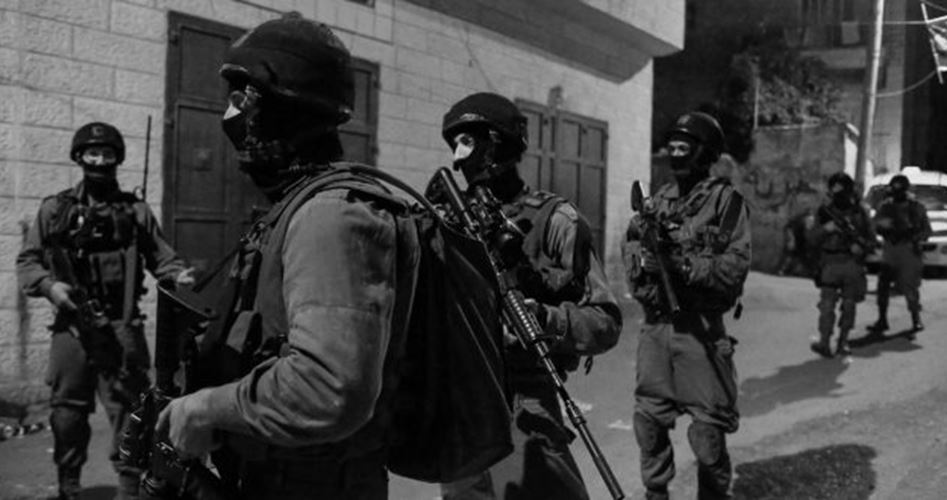
By Ramzy Baroud | MEMO | June 12, 2021
On 25 May, famous US actor Mark Ruffalo tweeted an apology for suggesting that Israel is committing “genocide” in Gaza.
“I have reflected and wanted to apologise for posts during the recent Israel/Hamas fighting that suggested Israel is committing ‘genocide’,” Ruffalo wrote, adding: “It’s not accurate, it’s inflammatory, disrespectful and is being used to justify anti-Semitism, here and abroad. Now is the time to avoid hyperbole.”
But were Ruffalo’s earlier assessments, indeed, “not accurate, inflammatory and disrespectful”? And does equating Israel’s war on besieged, impoverished Gaza with genocide fit into the classification of “hyperbole”?
To avoid pointless social media spats, one only needs to reference the “United Nations Convention on the Prevention and Punishment of the Crime of Genocide”. According to Article 2 of the 1948 Convention, the legal definition of genocide is: “Any of the following acts committed with intent to destroy, in whole or in part, a national, ethnical, racial or religious group, such as (a) Killing members of the group; (b) Causing serious bodily or mental harm to members of the group; (c) Deliberately inflicting on the group conditions of life calculated to bring about its physical destruction in whole or in part.”
In its depiction of Israel’s latest war on Gaza, the Geneva-based human rights group, Euro-Med Monitor, reported: “The Israeli forces directly targeted 31 extended families. In 21 cases, the homes of these families were bombed while their residents were inside. These raids resulted in the killing of 98 civilians, including 44 children and 28 women. Among the victims were a man and his wife and children, mothers and their children, or child siblings. There were seven mothers who were killed along with four or three of their children. The bombing of these homes and buildings came without any warning despite the Israeli forces’ knowledge that civilians were inside.”
As of 28 May, 254 Palestinians in Gaza were killed, and 1,948 were wounded in the latest 11-day Israeli onslaught, according to the Palestinian Ministry of Health. Though tragic, this number is relatively small compared with the casualties of previous wars. For example, in the 51-day Israeli war on Gaza in the summer of 2014, over 2,200 Palestinians were killed, and over 17,000 were wounded. Similarly, entire families, like the 21-member Abu Jame family in Khan Younis, also perished. Is this not genocide? The same logic can be applied to the killings of over 300 unarmed protesters at the fence separating besieged Gaza from Israel between March 2018 and December 2019. Moreover, the besiegement and utter isolation of over two million Palestinians in Gaza since 2006-2007, which has resulted in numerous tragedies, is an act of collective punishment that also deserves the designation of genocide.
One does not need to be a legal expert to identify the many elements of genocide in Israel’s violent behaviour, let alone language, against Palestinians. There is a clear, undeniable relationship between Israel’s violent political discourse and equally violent action on the ground. Potentially Israel’s next Prime Minister Naftali Bennett, who has served the role of defence minister, in July 2013 stated: “I’ve killed lots of Arabs in my life – and there’s no problem with that.”
With this context in mind, and regardless of why Ruffalo found it necessary to back-track on his moral position, Israel is an unrepentant human rights violator that continues to carry out an active policy of genocide and ethnic cleansing against the native, indigenous inhabitants of Palestine.
Language matters, and in this particular “conflict”, it matters most, because Israel has, for long, managed to escape any accountability for its actions, due to its success in misrepresenting facts and the overall truth about itself. Thanks to its many allies and supporters in mainstream media and academia, Tel Aviv has rebranded itself from being a military occupier and an apartheid regime to an “oasis of democracy“, in fact, “the only democracy in the Middle East”.
This article will not attempt to challenge the entirety of the misconstrued mainstream media’s depiction of Israel. Volumes are required for that, and Israeli Professor Ilan Pappé’s Ten Myths about Israel is an important starting point. However, this article will attempt to present some basic definitions that must enter the Palestine-Israel lexicon, as a prerequisite to developing a fairer understanding of what is happening on the ground.
A military occupation – not a ‘conflict’
Quite often, mainstream Western media refers to the situation in Palestine and Israel as a “conflict“, and to the various specific elements of this so-called conflict as a “dispute“. For example, the “Palestinian-Israeli conflict” and the “disputed city of East Jerusalem”.
What should be an obvious truth, is that besieged, occupied people do not engage in a “conflict” with their occupiers. Moreover, a “dispute” happens when two parties have equally compelling claims to any issue. When Palestinian families of East Jerusalem are being forced out of their homes which are, in turn, handed over to Jewish extremists, there is no “dispute” involved. The extremists are thieves, and the Palestinians are victims. This is not a matter of opinion. The international community itself says so.
“Conflict” is a generic term. Aside from absolving the aggressor – in this case, Israel – it leaves all matters open to interpretation. Since US audiences are indoctrinated to love Israel and hate Arabs and Muslims, siding with Israel in its “conflict” with the latter becomes the only rational option.
Israel has sustained a military occupation of 22 per cent of the total size of historic Palestine since June 1967. The remainder of the Palestinian homeland was already usurped, using extreme violence, state-sanctioned apartheid, and, as Pappé puts it, “incremental genocide” decades earlier.
From the perspective of international law, the term “military occupation”, “occupied East Jerusalem”, “illegal Jewish settlements”, and so forth, have never been “disputed”. They are simply facts, even if Washington has decided to ignore international law, and even if mainstream US media has chosen to manipulate the terminology to present Israel as a victim, not the aggressor.
‘Process’ without ‘peace’
The term “peace process” was coined by US diplomats decades ago. It was put to use throughout the mid and late 1970s when, then-US Secretary of State Henry Kissinger laboured to broker a deal between Egypt and Israel in the hope of fragmenting the Arab political front and, eventually, sidelining Cairo entirely from the “Arab-Israeli conflict”.
Kissinger’s logic proved vital for Israel as the “process” did not aim to achieve justice according to fixed criteria that has been delineated by the United Nations for years. There was no frame of reference anymore. If any existed, it was Washington’s political priorities that, historically, almost entirely overlapped with Israel’s priorities. Despite the obvious US bias, the US bestowed upon itself the undeserving title of “the honest peace broker“.
This approach was used successfully in the write-up to the Camp David Accords in 1978. One of the accords’ greatest achievements is that the so-called “Arab-Israeli conflict” was replaced with the so-called “Palestinian-Israeli conflict”.
Now, tried and true, the “peace process” was used again in 1993, resulting in the Oslo Accords. For nearly three decades, the US continued to tout its self-proclaimed credentials as a peacemaker, despite the fact that it pumped – and continues to do so – $3-4 billion of annual, mostly military, aid to Israel.
On the other hand, the Palestinians have little to show. No peace was achieved; no justice was obtained; not an inch of Palestinian land was returned and not a single Palestinian refugee was allowed to return home. However, US and European officials and a massive media apparatus continued to talk of a “peace process” with little regard to the fact that the “peace process” has brought nothing but war and destruction for Palestine, and allowed Israel to continue its illegal appropriation and colonisation of Palestinian land.
Resistance, national liberation – not ‘terrorism’ and ‘state-building’
The “peace process” introduced more than death, mayhem and normalisation of land theft in Palestine. It also wrought its own language, which remains in effect to this day. According to the new lexicon, Palestinians are divided into “moderates” and “extremists”. The “moderates” believe in the US-led “peace process”, “peace negotiations” and are ready to make “painful compromises” in order to obtain the coveted “peace”. On the other hand, the “extremists” are the “Iran-backed“, politically “radical” bunch that use “terrorism” to satisfy their “dark” political agendas.
But is this the case? Since the signing of the Oslo Accords, many sectors of Palestinian society, including Muslims and Christians, Islamists and secularists and, notably, socialists, resisted the unwarranted political “compromises” undertaken by their leadership, which they perceived to be a betrayal of Palestinians’ basic rights. Meanwhile, the “moderates” have largely ruled over Palestinians with no democratic mandate. This small but powerful group introduced a culture of political and financial corruption, unprecedented in Palestine. They applied torture against Palestinian political dissidents whenever it suited them. Not only did Washington say little to criticise the “moderate” Palestinian Authority (PA)’s dismal human rights record, but it also applauded it for its crackdown on those who “incite violence” and their “terrorist infrastructure”.
A term such as “resistance” – muqawama – was slowly but carefully extricated from the Palestinian national discourse. The term “liberation”, too, was perceived to be confrontational and hostile. Instead, such concepts as “state-building” – championed by former Palestinian Prime Minister Salam Fayyad and others – began taking hold. The fact that Palestine was still an occupied country and that “state-building” can only be achieved once “liberation” was first secured, did not seem to matter to the “donor countries”. The priorities of these countries – mainly US allies who adhered to the US political agenda in the Middle East – was to maintain the illusion of the “peace process” and to ensure “security coordination” between PA police and the Israeli army carried on, unabated.
The so-called “security coordination”, of course, refers to the US-funded joint Israeli-PA efforts at cracking down on Palestinian resistance, apprehending Palestinian political dissidents and ensuring the safety of the illegal Jewish settlements, or colonies, in the occupied West Bank.
War and, yes, genocide in Gaza – not ‘Israel-Hamas conflict’
The word “democracy” was constantly featured in the new Oslo language. Of course, it was not intended to serve its actual meaning. Instead, it was the icing on the cake of making the illusion of the “peace process” perfect. This was obvious, at least to most Palestinians. It also became obvious to the whole world in January 2006, when the Palestinian faction Fatah, which has monopolised the PA since its inception in 1994, lost the popular vote to the Islamic faction, Hamas.
Hamas, and other Palestinian factions, have rejected – and continue to reject – the Oslo Accords. Their participation in the legislative elections in 2006 took many by surprise, as the Palestinian Legislative Council (PLC) was itself a product of Oslo. Their victory in the elections, which was classified as democratic and transparent by international monitoring groups, threw a wrench in the US-Israeli-PA political calculations.
Lo and behold, the group that has long been perceived by Israel and its allies as “extremist” and “terrorist” became the potential leaders of Palestine! The Oslo spin doctors had to go into overdrive in order for them to thwart Palestinian democracy and ensure a successful return to the status quo, even if this meant that Palestine is represented by unelected, undemocratic leaders. Sadly, this has been the case for nearly 15 years.
Meanwhile, Hamas’s stronghold, the Gaza Strip, had to be taught a lesson, thus the siege imposed on the impoverished region for nearly 15 years. The siege on Gaza has little to do with Hamas’s rockets or Israel’s “security” needs, the right to “defend itself” and its supposedly “justifiable” desire to destroy Gaza’s “terrorist infrastructure”. While, indeed, Hamas’s popularity in Gaza is unmatched anywhere else in Palestine, Fatah, too, has a powerful constituency there. Moreover, the Palestinian resistance in the strip is not championed by Hamas alone, but also by other ideological and political groups, for example, the Islamic Jihad, the socialist Popular Front for the Liberation of Palestine (PFLP) and other socialist and secular groups.
Misrepresenting the “conflict” as a “war” between Israel and Hamas is crucial to Israeli propaganda, which has succeeded in equating Hamas with militant groups throughout the Middle East and even Afghanistan. But Hamas is not Daesh, Al-Qaeda or the Taliban. In fact, none of these groups is similar, anyway. Hamas is a Palestinian Islamic nationalist movement that operates within a largely Palestinian political context. An excellent book on Hamas is the recently published volume by Dr Daud Abdullah, Engaging the World. Abdullah’s book rightly presents Hamas as a rational political actor, rooted in its ideological convictions, yet flexible and pragmatic in its ability to adapt to national, regional and international geopolitical changes.
But what does Israel have to gain from mischaracterising the Palestinian resistance in Gaza? Aside from satisfying its propaganda campaign of erroneously linking Hamas to other anti-US groups, it also dehumanises the Palestinian people entirely and presents Israel as a partner in the US global so-called “war on terror”. Israeli neofascist and ultranationalist politicians then become the saviours of humanity, their violent racist language is forgiven and their active “genocide” is seen as an act of “self-defence” or, at best, a mere state of “conflict”.
The oppressor as the victim
According to the strange logic of mainstream media, Palestinians are rarely “killed” by Israeli soldiers, but rather “die” in “clashes” resulting from various “disputes”. Israel does not “colonise” Palestinian land; it merely “annexes”, “appropriates” and “captures”, and so on. What has been taking place in the Sheikh Jarrah neighbourhood in occupied East Jerusalem, for example, is not outright property theft, leading to ethnic cleansing, but rather a “property dispute”.
The list goes on and on.
In truth, language has always been a part of Zionist colonialism, long before the state of Israel was itself constructed from the ruins of Palestinian homes and villages in 1948. Palestine, according to the Zionists, was “a land with no people” for “a people with no land”. These colonists were never “illegal settlers” but “Jewish returnees” to their “ancestral homeland”, who, through hard work and perseverance, managed to “make the desert bloom”, and, in order to defend themselves against the “hordes of Arabs”, they needed to build an “invincible army”.
It will not be easy to deconstruct the seemingly endless edifice of lies, half-truths and intentional misrepresentations of Zionist Israeli colonialism in Palestine. Yet, there can be no alternative to this feat because, without proper, accurate and courageous understanding and depiction of Israeli settler colonialism and Palestinian resistance to it, Israel will continue to oppress Palestinians while presenting itself as the victim.
I’m on a ‘hit list’ Kiev allows to silence dissent & journalism. That’s all you need to know about Ukrainian ‘democracy’
By Eva Bartlett | RT | June 12, 2021
Address issues which Ukraine, the West’s client state, does not like and you could end up on a ‘hit list’. Because that’s apparently how flourishing democracies roll…
Last week, photojournalist Dean O’Brien participated in a United Nations meeting to give his perspective on the war in Donbass, Ukraine’s breakaway region in the east. Shortly after the discussion, O’Brien came under fire from the Ukrainian embassy in the UK.
However, smears from Ukrainian officials are nothing compared to what the controversial ‘enemies of Ukraine’ database, the Mirotvorets (Peacekeeper) website, could bring.
In May, O’Brien and I discussed this hit list, noting that we were both on it, with photos of us published on the witch-hunt website.
“It’s a website called ‘Peacemaker.’ It’s anything but, really. It seems to be a hit list, a target for journalists or anybody that goes against the grain in Ukraine. If you’re reporting on them, they see you as some kind of threat and put you on this list,” he said.
The platform was created in 2014, shortly after Crimea was reabsorbed by Russia and the Kiev government’s military campaign in eastern Ukraine was launched. As TASS noted in 2019, Mirotvorets “aims to identify and publish personal data of all who allegedly threaten the national security of Ukraine. In recent years, the personal data of journalists, artists or politicians who have visited Crimea, Donbass, or for some other reason have caused a negative assessment of the authors of the site, have been blacklisted by Peacemaker.”
Talking about the horrors that Donbass civilians endure under Ukrainian shelling is, according to this rationale, a threat to Ukraine’s national security. As is going to Crimea, maintaining that Crimeans chose to be a part of Russia (or, as many in Crimea told me, to return to Russia) and criticising the influence neo-Nazis wield in Kiev.
“The most worrying thing is that they seem to be able to get a hold of people’s passports, visas,” O’Brien told me. “The fact that they can get ahold of your passport photo, your visa photocopies, these can only come from official government offices in Ukraine. This is a governmental website, it’s been discussed in parliament, to close it down. They’re not interested in closing it down. This website is kind of like a hit list, really.”
That might seem like an exaggeration, but people listed on Mirotvorets have been targeted and even killed.
A report by the Foundation for the Study of Democracy titled “Ukrainian War Crimes and Human Rights Violations (2017-2020)” gave the example of a Ukrainian journalist assassinated in 2015 after his personal details were published on the website.
“A few days before his death, Oles Buzina’s details, including his home address, had been posted on the Canadian-based Mirotvorets website, created with the initiative of Anton Gerashchenko, the Ukrainian deputy minister of internal affairs. The people listed on it are recommended for liquidation and arrest, and the total number of people listed are in the tens of thousands.
According to many experts, it was the listing on the site and the publication of the home address that prompted the murder of Oles Buzina, Oleg Kalashnikov, and many other opposition figures by members of the Ukrainian ‘death squads’.
Back in 2015, Georgiy Tuka, who participated in the creation and operation of the site, stated that, of the people listed on the site, “more than 300 were either arrested or destroyed,” the report states.
When in April 2015 the Ukrainian parliament’s Commissioner for Human Rights Valeriya Lutkovskaya launched an effort to shut the list down, the then-adviser to Minister of Internal Affairs Anton Gerashchenko threatened her position and stated that the work of the site was “extremely important for the national security of Ukraine.” He said that “anyone who does not understand this or tries to interfere with this work is either a puppet in the hands of others or works against the interests of national security.”
So the website remains active, with Ukraine’s security service reportedly stating that it did not see any violations of Ukrainian law in the activities of the Mirotvorets website.
Ukrainian President Volodymyr Zelensky, too, has refused to have the website shut down, ironically claiming that it’s wrong to interfere with the work of websites and the media.
Let’s remember that in Ukraine, untold numbers of journalists, activists and civilians have been imprisoned, and killed, for their crimes of voicing criticism of the government and neo-Nazi groups.
Ukraine isn’t the only country to host such a hit list. Although Stop the ISM (International Solidarity Movement) – the project of crazed US-based journalist, Lee Kaplan – named activists, including myself, for our crimes of reporting on Israel’s brutal bombardment of Gaza in 2008/09, the website has since changed format and is far less detailed. But cached versions show the extent of its insanity, including a clear call for our murders:
“ALERT THE IDF MILITARY TO TARGET ISM
“Number to call if you can pinpoint the locations of Hamas with their ISM members with them. Help us neutralise the ISM that is now definitely a part of Hamas since the war began.”
Others on the kill list were named for their crimes of reporting Israel’s systematic abuse and killing of Palestinians. Their personal details, including passport information, were published.
An article on this heinous website noted: “The dossiers are openly addressed to the Israeli military so as to help them eliminate ‘dangerous’ targets physically, unless others see to it first.”
Although arguably that website was the project of one lunatic and their allies, the fact that for many years it stayed active and called for the murders of international peace activists speaks volumes on America’s own values.
I’m sure these two hit-list examples are not isolated ones. Quite likely, there are similar lists targeting journalists reporting on the crimes of other countries. But they are the height of absurdity, and fascism: targeting people whose reporting aims to help persecuted civilians.
Meanwhile in Donbass, Ukraine reportedly continues its shelling of civilian areas. Recently in Gorlovka, a northern city hammered by Ukrainian bombing over the years, a mine blew off part of a woman’s leg as she gathered mushrooms.
In spite of the hit list, journalists, rightly, continue to report on these war crimes.
Eva Bartlett is a Canadian independent journalist and activist. She has spent years on the ground covering conflict zones in the Middle East, especially in Syria and Palestine (where she lived for nearly four years).
Pentagon Gave $39 MILLION To Dr. Peter Daszak’s EcoHealth Alliance
“Charity” that funded coronavirus research at the Wuhan lab accused of being the source of the outbreak, federal data reveals
By JOSH BOSWELL and MARTIN GOULD – Daily Mail – June 10, 2021
The Pentagon gave $39 million to a charity that funded controversial coronavirus research at a Chinese lab accused of being the source for Covid-19, federal data reveals. The news comes as the charity’s chief, British-born scientist Dr. Peter Daszak, was exposed in an alleged conflict of interest and back-room campaign to discredit lab leak theories.
The charity, EcoHealth Alliance (EHA), has come under intense scrutiny after it emerged that it had been using federal grants to fund research into coronaviruses at the Wuhan Institute of Virology in China.
The U.S. nonprofit, set up to research new diseases, has also partly funded deeply controversial ‘gain of function‘ experiments, where dangerous viruses are made more infectious to study their effect on human cells.
A political storm broke when former president Donald Trump canceled a $3.7 million grant to the charity last year amid claims that Covid-19 was created in, or leaked from, the Wuhan lab funded by EHA.
But federal grant data assembled by independent researchers shows that the charity has received more than $123 million from the government – from 2017 to 2020 – and that one of its biggest funders is the Department of Defense, funneling almost $39 million to the organization since 2013.
Exactly how much of that money went toward research at the Wuhan Institute of Virology is unknown.

Federal grant data assembled by independent researchers shows that the charity has received more than $123 million from the government – and that one of its biggest funders is the Department of Defense, funneling almost $39million to the organization since 2013.
Grants from the Pentagon included $6,491,025 from the Defense Threat Reduction Agency (DTRA) from 2017 to 2020 with the description: ‘Understanding the risk of bat-borne zoonotic disease emergence in Western Asia.‘
The grant was categorized as ‘scientific research – combating weapons of mass destruction.‘
The majority of the DoD funding came from the DTRA, a military branch with a mission to ‘counter and deter weapons of mass destruction and improvised threat networks.’
EHA also received $64.7 million from the US Agency for International Development (USAID), $13 million from Health and Human Services, which includes the National Institutes of Health and Centers for Disease Control, $2.3 million from the Department of Homeland Security, and $2.6 million from the National Science Foundation.
A government funding figure of $3.4 million was widely reported, after White House chief medical advisor Anthony Fauci was questioned in a Senate hearing on how much money the National Institutes of Health sent to the Wuhan lab via its grants to EcoHealth Alliance in 2019.
But the total grant figures including Pentagon funding dwarf that number.
Researchers James Baratta and Mariamne Everett assembled grant filings from US government agencies to EHA, which were published on popular science site Independent Science News in December.
The site found EHA’s declaration of its vast military funding is nestled deep in the ‘Privacy Policy’ section of its website, under the title ‘EcoHealth Alliance Policy Regarding Conflict of Interest in Research’.
In the disclosure EHA says it is ‘the recipient of various grant awards from federal agencies including the National Institute of Health, the National Science Foundation, US Fish and Wildlife Service, and the US Agency for International Development and the Department of Defense.‘
It does not disclose the size of its DoD funding.
In 2014 the Obama administration outlawed gain of function research, such as the experiments funded by EHA, after concerns were raised among scientists that it could lead to a global pandemic from a genetically enhanced virus escaping a lab.
But EHA reportedly continued to legally fund the practice, using a loophole that allowed for the research in cases ‘urgently necessary to protect the public health or national security.‘
One notable EHA ‘policy advisor’ is David Franz, a former commander at the principal US government biowarfare and biodefense facility Fort Detrick.
Franz was an official in the United Nations Special Commission which inspected for bioweapons in Iraq.

The charity’s head, Daszak, has been accused of orchestrating a behind-the-scenes ‘bullying’ campaign to ensure the blame for covid-19 did not fall on the Wuhan lab he funded.
The 55-year-old worked closely with the lab’s so-called ‘bat woman,’ Shi Zhengli, in their studies of coronaviruses.
In February 2020 Daszak persuaded more than two dozen other scientists to sign off on a letter he had written to highly respected medical journal The Lancet, that was seen as so influential that it cowed most experts into refusing even to consider that the virus could have been man-made and escaped from the Wuhan institute.
Former high-level Clinton administration staffer Jamie Metzl, who now sits on the World Health Organization’s advisory committee on human genome editing, told DailyMail.com that the Lancet letter ‘was scientific propaganda and a form of thuggery and intimidation.‘
Freedom of Information Act disclosures revealed Daszak tried to distance his charity from the letter to make it appear it was coming from ‘a community supporting our colleagues.‘
The charity chief told his fellow signatories in an email that the letter would not be sent under the EcoHealth logo ‘and will not be identifiable as coming from any one organization or person.‘
The joint letter, published in the journal on February 19 last year, praised the Chinese ‘who continue to save lives and protect global health during the challenge of the Covid-19 outbreak‘ and added ‘We stand together to strongly condemn conspiracy theories suggesting that Covid-19 does not have a natural origin.‘
Despite his close connections to the Chinese lab, Daszak was also picked by the World Health Organization (WHO) to be part of its 13-member team that was tasked with finding the cause of the pandemic which began in Wuhan, a city of some 11 million people in Central China.
Metzl told DailyMail.com the appointment was a ‘massive and outrageous conflict of interest,‘ allowing a man who had significant financial and reputational stakes in discrediting lab leak theories to investigate those theories.
Prominent scientists have criticized the WHO probe, which dismissed lab leak theories, as lackluster and incomplete.
In a Freedom of Information disclosure of Fauci’s emails obtained by Buzzfeed last month, Daszak thanked the White House doctor for pushing back on the theory that covid-19 was man made.
‘I just wanted to say a personal thank you on behalf of our staff and collaborators, for publicly standing up and stating that the scientific evidence supports a natural origin for COVID-19 from a bat-to-human spillover, not a lab release from the Wuhan Institute of Virology,‘ Daszak wrote in April 2020.
Fauci says the emails have been taken out of context.
EHA’s most recent financial statements filed with the IRS say that around 90 per cent of its funding comes from government sources.
The 2019 report says Daszak was paid a total $410,801 for the year, including $311,815 base pay, $42,250 bonus, $24,500 deferred compensation and $32,236 nontaxable benefits.
Zarif defends Iran’s voting rights as Guterres set to get reelected as UN chief
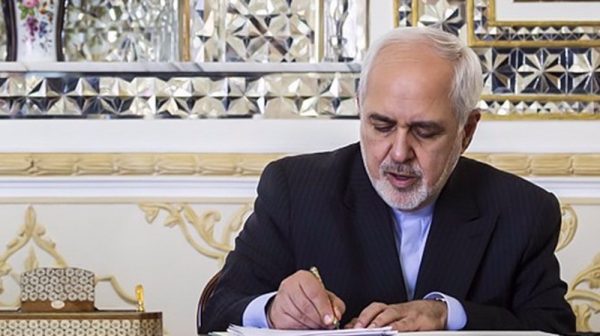
Iranian Foreign Minister Mohammad Javad Zarif
Press TV – June 9, 2021
Iran’s Foreign Minister Mohammad Javad Zarif wrote a letter to UN Secretary General Antonio Guterres earlier this month, criticizing the United Nations’ decision to deprive Iran of its voting rights.
As the UN Security Council backed Guterres for a second term on Tuesday, it is worthwhile to read highlights of Zarif’s letter to the UN chief, in which the Iranian foreign minister slammed the UN decision as “fundamentally flawed, entirely unacceptable and completely unjustified.”
“Iran’s inability to fulfill its financial obligation toward the United Nations is directly caused by ‘unlawful unilateral sanctions’ imposed by the United States to punish those who comply with a Security Council resolution,” Zarif wrote.
He was making a reference to the sanctions that the US slapped on Iran after former president Donald Trump withdrew from the 2015 Iran nuclear deal and violated UN Security Council Resolution 2231 that endorsed the historic pact.
The sanctions have blocked Iran’s access to global financial systems, and its money in foreign banks, including in South Korean, Japanese and Iraqi banks.
Zarif said the world is well aware that the people of Iran have been under unprecedented economic warfare and terrorism since the US withdrawal from the nuclear deal, also called the JCPOA, in material breach of preemptory norms of international law, the Charter of the United Nations and Resolution 2231.
“It is astonishingly absurd that Iranian people, who have been forcibly blocked from transferring their own money and resources to buy food and medicine – let alone pay UN contributions arrears – by a permanent member of the United Nations’ Security Council, are now being punished for not being allowed to pay budget arrears by the secretariat of the same organization, which has unjustifiably chosen for the past 3 years to remain indifferent in the face of attempted mass starvation – a crime against humanity – by the United States,” he noted.
The letter came after the UN said it had suspended the voting rights of Iran and four other countries over dues under Article 19 of the UN Charter, which states that any member owing the previous two years of assessments may not vote in the General Assembly.
However, Zarif pointed out that the UN Charter gives the General Assembly the authority to decide “that the failure to pay is due to conditions beyond the control of the member,” and in that case a country can continue to vote.
“By what definition are Iran’s arrears not ‘due to conditions beyond control’?” the chief Iranian diplomat asked.
“The Islamic Republic of Iran is fully committed to fulfilling its financial obligations to the United Nations and will continue to make every effort to settle the arrears in the payment of its financial contribution to the UN and other international organizations as soon as the underlying imposed conditions, i.e. the US unlawful unilateral coercive measures, is removed,” Zarif added.
The UN decision came while Iran and the other parties to the JCPOA are engaged in multilateral talks to bring the US back into compliance with the deal and remove the anti-Iran sanctions in exchange for the reversal of Iran’s nuclear activities that go beyond the JCPOA limits.
The talks, which began in early April, have not led to a tangible outcome yet.
Zarif said on Monday that it remains unclear whether US President Joe Biden and State Secretary Antony Blinken are ready to bury the failed “maximum pressure” policy of Trump and his State Secretary Mike Pompeo.
“Iran is in compliance with the #JCPOA. Just read paragraph 36,” Zarif wrote in a tweet. “Time to change course.”
World should not tolerate Israel’s reckless terrorism, North Korea says
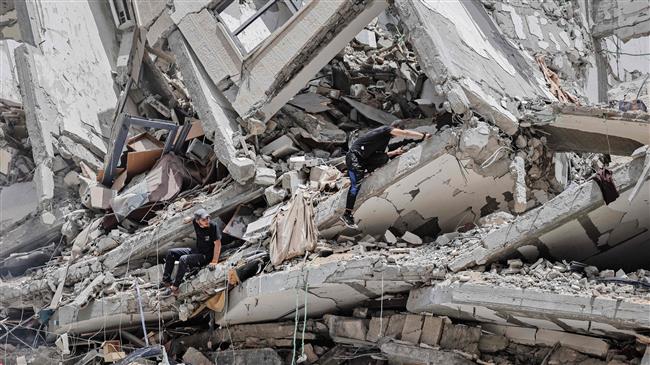
Palestinian workers clear rubble and debris in al-Rimal neighborhood of Gaza City on June 8, 2021. (Photo by AFP)
Press TV | June 9, 2021
North Korea has denounced the latest Israeli military aggression on the besieged Gaza strip, stating that Tel Aviv is massacring children and that the international community should not tolerate Israel’s reckless sponsorship of terrorism.
“It is no exaggeration to say that the whole Gaza Strip has turned into a huge human slaughterhouse and a place of massacring children,” the North Korean Foreign Ministry said in a statement.
“Israel’s horrific crime of killing the … children is a severe challenge to the future of humankind and a crime against the humanity,” it added.
The international community should not tolerate “Israel’s reckless state-sponsored terrorism and act of obliterating other nations.”
At least 260 Palestinians, including 66 children, were killed in the Israeli bombardment of the Gaza Strip in 11 days of the conflict that began on May 10. Israel’s airstrikes also brought widespread devastation to the already impoverished territory.
The Gaza-based resistance movements responded by launching over 4,000 rockets into the occupied territories, some reaching as far as Tel Aviv and even Haifa and Nazareth to the north.
The Israeli regime was eventually forced to announce a ceasefire, brokered by Egypt, which came into force in the early hours of May 21.
The World Health Organization (WHO) has warned that Palestinians are facing “staggering health needs” in the occupied territories after the last month’s conflict in the Gaza Strip.
Blinken’s statements encourage Israel to continue its crimes: Hamas
Palestine Information Center – June 8, 2021
GAZA – The Hamas Movement denounced the recent statement of US Secretary Antony Blinken on Israel’s right to self-defense, saying that it gives the green light to the “Zionist enemy” to continue its aggression against the Palestinian people.
Hamas in a press statement on Tuesday said, “Is the killing of women and children, demolishing homes on the heads of their residents, expelling citizens from their homes in Jerusalem, attacking Al-Aqsa Mosque, assaulting journalists and breaking their hands, self-defense?”
It stressed that the occupier does not have the right to self-defense but its duty according to international law is to end the occupation and stop the aggression against the occupied people.
Hamas also condemned the continued US military support to Israel and providing it with all kinds of advanced weapons which makes the United States an accomplice in the violence against Palestinians.
“Hamas is a democratically elected Palestinian national resistance movement that exercises its legitimate right under international law to resist the occupation by all available means, including armed resistance”, it added.
The Movement demanded that Blinken and his administration abide by international law and implement international resolutions that affirm Palestinians’ right to freedom and independence and to return to their homes from which they were forcibly displaced.
Questions as Israel intelligence officer dies in detention
MEMO | June 8, 2021
Mystery has shrouded the death of an Israeli military intelligence officer in prison three weeks ago after he was accused of committing crimes that harmed the state, local media reported on Monday.
The Israeli military said that “the investigation uncovered suspicions that the officer, who served in a technology unit in the Intelligence Directorate, knowingly took actions that severely harmed state security.”
Haaretz reported the military saying: “The officer cooperated during his investigation and confessed to many of the deeds that were attributed to him.”
Information about the case was revealed after the military scaled back a complete gag order on it, but, according to the Times of Israel, key details about the affair, including the officer’s identity and the exact nature of his alleged crimes, remain barred from publication.
The Israeli military said, according to the Times of Israel, that the soldier acted alone and did not commit the actions on behalf of a foreign government, for financial reasons or as a result of a specific ideology, but rather for unspecified “personal motivations”.
Meanwhile, Haaretz reported the soldier’s relatives saying: “We are confused, we are frightened and we want real answers.”
“No one has explained to us what happened.”
The soldier was arrested in August. He was found injured in his prison cell on 17 May and died later in hospital.
Featured Video
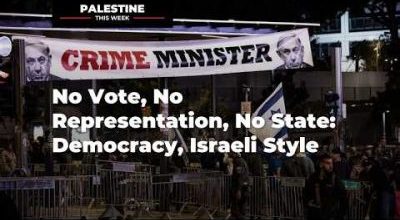
No Vote, No Representation, No State: Democracy, Israeli Style
or go to
Aletho News Archives – Video-Images
From the Archives
Sanctions, War and the Policy of Dual Containment
By SASAN FAYAZMANESH | March 17, 2008
It is now nearly three decades since the Unites States adopted the policy of dual containment of Iran and Iraq. While much has been written about the containment of Iraq, there has been very little in-depth analysis of this policy when it comes to Iran. In a book that is going to be released on March 31, 2008, entitled The United States and Iran: Sanctions, Wars and the Policy of Dual Containment (Routledge), I attempt to address this shortcoming by investigating when and why the US policy of containment of Iran came about, how it evolved, and where it stands today.[1] To the extent that Israel has been involved in US policy making, the study will also include the role that Israel has played in the containment of Iran. Also, since the fate of Iran has been inextricably linked to that of Iraq, occasionally the investigation will overlap with the containment of Iraq.
The policy of dual containment of Iran and Iraq originated during the Carter Administration, but it was not until the Clinton Administration that the expression “dual containment” became popular. … continue
Blog Roll
 Aletho News
- Americans are paying the price to preserve Israel’s nuclear hegemony
- Resistance factions are necessary to ensure a permanent US Iraq withdrawal
- How Israel destabilizes the Middle East: Denying sovereignty and the right to exist
- Europe’s Establishment Is Embracing War – and Losing Voters
- NATO chief advocates war of aggression
- No Vote, No Representation, No State: Democracy, Israeli Style
- Zionist Bought Senate Blocks Information About American Citizens Killed By Israel
- While Gaza dominates the UN, these are the people keeping it alive
- New Report: “Scholasticide and Genocide in Gaza: Assessment, Testimonies and Legal Analysis”
- ‘THAAD Delusion’: Iran war exposes US missile shield limits – The Atlantic
- If Americans Knew
- Israeli Soldiers Abduct At Least 22 Across Occupied West Bank
- Eight Palestinians Killed in Israeli Attacks on Gaza
- Israeli former leaders and security chiefs threaten legal action over ‘Jewish terrorism’
- Israel map in LA Times ad includes all land from the river to the sea
- Inside Lebanon’s 200-page dossier on Israeli war crimes
- Flydubai, genocide, settler violence, Trump abuse of power to deport – Daily Update
- Counting Antisemitic Incidents: What the ADL Audit Reveals — and Obscures
- Mamdani releases plan to combat antisemitism and hate crimes in New York City
- Iran’s Revolutionary Guards Publish Letter to the American People
- DMFI launches $1 million ad campaign supporting Virginia’s Elaine Luria
- No Tricks Zone
- Green Energy Debacle: German Expert Professor Fritz Vahrenholt Warns Of Severe Economic And Social Consequences
- Two More Paleo Reconstructions Affirm Meters-Higher Sea Levels Across Ireland, Brazil 7000-6000 Years Ago
- New Study: Earth And Venus Surface Warmth Largely Explained By Convection And Lapse Rate, Not CO2 Or Radiation
- 2025 Nature Paper Claiming Worsening Global Drought Gets RETRACTED …Heavily Flawed
- New Study: ‘Global Drought Shows No Detectable Recent Acceleration Under Climate Warming’
- Economic Masterminds: German Socialists Suggest Taxing Productivity Gains Stemming From Using AI
- The South China Sea Has Not Been Cooperating With The Climate Change Narrative
- Energy Crisis: Germany Enters Heating Season With Historically Low Gas Reserve Fill Levels
- New Study: The Antarctic Ice Sheet Gained Mass From 2020-2024 Due To Staggering Snow And Ice Accumulation
- Study: Ocean Heating Rates From Thousands Of Years Ago ‘Dwarf’ Modern Ocean Heating Rates

