Israel Wins Big in Washington
$1.2 billion more is on the way!

BY PHILIP GIRALDI • UNZ REVIEW • JUNE 8, 2021
Now let me get this straight. A nation bullies and harasses a much smaller neighbor which eventually leads that neighbor to strike back with largely home-made weapons. The larger and more powerful country, armed with state of the art killing machines, attacks its basically unarmed opponent and kills hundreds of civilians, including a large number of children. It also destroys billions of dollars of infrastructure in the poorer and weaker neighbor. Almost immediately after the fighting stops, senior legislators from a third nation that had nothing to do with the war apart from supplying the larger nation with weapons appeared on the scene and promoted the lie that the larger nation had actually been the victim of an unprovoked attack by the “terrorists” running the small nation. They did so publicly while meeting with and endorsing the actions of the government officials from the large nation, which, it would seem, is about to be investigated by an international body for war crimes. They were joined by an ex-officio former foreign minister of the third nation who likewise echoed the propaganda being put out by the large nation. Several of them also promised to provide military assistance worth $1 billion so the large nation could rearm itself.
Of course, I am writing about how Republican Senators Lindsey Graham, Ted Cruz and Bill Hagerty traveled to Israel over the Memorial Day weekend and bowed and scraped before Prime Minister Benjamin Netanyahu and company. During his meeting with Bibi, Graham even held up a sign reading “More for Israel.” They were joined in Jerusalem by former Secretary of State Mike Pompeo who was in town visiting with his old friend Yossi Cohen, head of the Israeli Intelligence service Mossad, who is retiring soon.
I sometimes wonder what the Founding Fathers would think about senior legislators ignoring their constituent duties so they could instead travel overseas to pander to the corrupt rulers of a foreign nation that exhibits none of the civic virtues that the Constitution of the United States once embraced in establishing a new republic? Cruz, for example, is a particularly ambitious slimeball who clearly sees his future in the tight embrace of the Israel Lobby. He was recently on the receiving end of some bad press when he abandoned his home in Houston, at the time suffering from a prolonged electricity crisis due to storm damage, to take his family to Cancun. Cruz is a senator whose main job is promoting himself.
Cruz used the opportunity provided by his presence besides the exalted Netanyahu to denounce President Joe Biden for his Administration’s failure to help Israel while it was under attack by the terrorist hordes. Before he left for Israel he stated that he intended “to hear and see firsthand what our Israeli allies need to defend themselves, and to show the international community that we stand unequivocally with Israel. Far too many Democrats morally equivocated between Israel and the terrorists attacking them, and fringe progressive Democrats went even further with wild accusations and conspiracy theories.”
After a day spent touring Israel’s Iron Dome rocket-defense system before viewing damage in Ashkelon in Israel from the Gazan rockets, which he commemorated with a weepy self-video demonstrating his empathy for the Israeli dead, he said that Biden’s calls for Israel to seek a cease fire had “emboldened” the “Hamas terrorists.” He elaborated that “The longer Joe Biden shows weakness to Hamas or Hezbollah or Iran, the more you’re going to see terrorist attacks escalating.”
But it was Lindsey Graham who has to be awarded the prize for being completely oleaginous in the presence of Netanyahu, holding up a sign reading “More for Israel” while practically swooning in the presence of the great leader. He said, with a grin, “The eyes and ears of America is Israel. Nobody does more to protect America from radical Islam than our friends in Israel.”
Flattery will apparently get you everywhere you want to be as Graham is surely aware that Israel is a strategic liability for the United States and its brutality is in fact a recruiting tool for radical groups. Holding up his sign, Graham then asked, “So what can you expect, my friends in Israel, in the next coming days and weeks from Washington? More.” For the home audience he then elaborated on a tweet what “More” would mean. “Great meeting this morning in Jerusalem with Israeli PM Netanyahu. ‘More for Israel’ to help protect and defend from Hamas rocket attacks.” Graham later reported to Fox News that Israel would be sending Defense Minister Benny Gantz to Washington to negotiate the request for the $1 billion increase in military aid to restore its “deterrent” after the savage bottle rocket attack by Hamas. He elaborated “It will be a good investment for the American people. I will make sure in the Senate that they get the money.”
Since the Senate Committee is packed full of Democratic Party Zionists, Graham knows for sure that his support for giving Israel the money will be approved in committee to go to the House for a final vote where it will be also be approved. And the White House is actually signaling that the Treasury check will be somewhat bigger, to the tune of $1.2 billion. A smiling Netanyahu demonstrated that he knows how to say thanks for the freebee, telling Graham “No one has done more for Israel than you, Senator Lindsey Graham, stalwart champion of our alliance and we have no better friend. You’ve been a tremendous friend and a tremendous ally.”
The third Republican Senator Bill Hagerty of Tennessee, a former Trump Ambassador to Japan, is a bit of a non-entity compared to his superstar traveling companions, though he, like Cruz, is unfortunately on the Senate Foreign Relations Committee and has taken the lead on authorizing immediate resupply of Israel’s weapons. And he too got into the game of kissing Israel’s posterior, posting a media release on his Senate website saying “Cruz and Hagerty Land in Israel to Assess Damage from Hamas War: Americans watched in horror when Hamas and other Iran-backed terrorists in Gaza recently launched thousands of rockets at innocent men, women, and children in Israel. I’m joining Senator Cruz, my colleague on the Senate Foreign Relations Committee, to visit Israel and stand shoulder-to-shoulder with our allies after they endured the worst terrorist attacks in recent years because I want to see firsthand what more the U.S. can do to strengthen our vital alliance with Israel at a time when terrorists like Hamas and Hezbollah and terror-sponsoring regimes in Iran and Syria are making the Middle East more dangerous…”
Pompeo also did his bit, enthusing over his attendance at the retirement party for Cohen. He tweeted how it was “Great to be with good friends in Tel Aviv!” He clearly has acquired the presidential pretensions disease and knows which button has to be pressed first.
One notices immediately the complete lack of any expression of sympathy for the hundreds of Palestinians who were killed by Israel in what was a war that was provoked by the home seizures, armed mobs of settlers in remaining Arab neighborhoods and attacks by soldiers and police on the al-Aqsa mosque in Jerusalem. After that, one notes that these clowns pretending to be senators are people who were elected and generously paid by American citizens, not by Israel, yet they seem to believe it is completely appropriate to be spend time in that country meddling in someone else’s war on behalf of a rogue state. If anyone is worthy of impeachment, it is they, but never mind, neither the Zionist dominated US national media nor the Establishment will make any such demand, quite the contrary. Be that as it may, their behavior is despicable and is symptomatic of type of corruption that is preceding the decline and fall of what was once a great nation.
Philip M. Giraldi, Ph.D., is Executive Director of the Council for the National Interest, a 501(c)3 tax deductible educational foundation (Federal ID Number #52-1739023) that seeks a more interests-based U.S. foreign policy in the Middle East. Website is https://councilforthenationalinterest.org address is P.O. Box 2157, Purcellville VA 20134 and its email is inform@cnionline.org
Belfast urges expulsion of Israeli envoys from UK, Ireland
Press TV – June 6, 2021
The City Council of Belfast in Northern Ireland has approved a motion calling on the governments of the UK and Ireland to expel Israeli ambassadors over the occupying regime’s crimes against the Palestinians.
The document, passed with votes from left-wing parties, urged Belfast municipality to call on London and Dublin “to expel from office Israeli ambassadors, with immediate effect.”
Speaking at the voting session, Socialist councilor Fiona Ferguson said, “I think the expulsion of ambassadors is a first step – a preliminary step – to greater action, but it’s an incredibly important and symbolic step.”
Ferguson, who has tabled the motion, demanded that the UK and Ireland lead by example and answer “the call from Palestinians across the world who have asked for ambassadors to be expelled.”
The resolution states that Israel’s military operation in Gaza amounts to the “ongoing ethnic cleansing of Palestinians” and that the regime’s “illegal settlement expansion, represents flagrant breaches of international law.”
It further says normal cooperation with Tel Aviv is “untenable” at a time when “a growing list of human rights organizations has determined that Israel’s actions amount to apartheid.”
“The council recognizes the rich history of solidarity and activism in this city from all communities for Palestine, including very recently when a huge demonstration called for an end to Israeli mistreatment of the Palestinians; and that such solidarity on the part of our citizens can be an important tool in dismantling support for Israel’s actions,” the motion reads.
Meanwhile, pro-Palestinian students and activists staged a sit-in protest in front of the Irish Foreign Ministry in Dublin.
They blocked the entrance to the ministry, waving signs urging Ireland to expel the Israeli envoy.
Tel Aviv launched the bombing campaign against the besieged Gaza Strip on May 10, after Palestinian retaliation against violent raids on worshipers at the al-Aqsa Mosque and the regime’s plans to force a number of Palestinian families out of their homes at Sheikh Jarrah neighborhood of East Jerusalem al-Quds.
Apparently caught off guard by unprecedented rocket barrages from Gaza, Israel announced a unilateral ceasefire on May 21, which Palestinian resistance movements accepted with Egyptian mediation.
According to Gaza’s Health Ministry, 260 Palestinians were killed in the Israeli offensive, including 66 children and 39 women, and 1948 others were wounded.
Israel, Don’t Raise the Roof Beams High As You “Resettle” Lifta; Its Owners Will Return

By Rima Najjar | Global Research | June 1, 2021
The latest crisis in Palestine cannot be set aside as another passing episode in Israel’s forever war against the Palestinian people.
We are now witnessing shocks within Israel behind the Green Line, something that Israel had hitherto been able to contain. In the process, it pretended, along with much of the western world, that it is the “longest-lived democracy in the Middle East” and that only its continued occupation of the West Bank and its harsh blockade of Gaza undermine its “constitutional ideals”- ideals now exposed for what they’ve always been: Jewish supremacist in nature.
We know, as CJ Werleman wrote in Inside Arabia on May 14, 2021,
“Israel is a country built on racism, dispossession, and genocide. The recent rise in attacks by Israeli settlers, vigilante groups, and lynch mobs targeting Palestinians are a continuation of that history and must be addressed.”
There is an unbreakable thread between the Palestinian man lynched by Israeli Jews on the pavement after being pulled from his car in Jaffa and then beaten unconscious recently and the killings and massacres at the hands of Zionist militia in Jaffa and elsewhere in 1948 that resulted in the deaths of hundreds of Palestinian civilians, as recounted by Israeli historian Benny Morris.
The myth, amplified by Wikipedia, is that historians [presumably Israeli] disagree “concerning the effect these killings and massacres had on the Palestinian refugee flight and whether or not these killings and massacres were carried out with the intent of hastening it.”
Palestinian historians have absolutely no doubt about what happened then and why, just as we Palestinians have no doubt about what is happening now in occupied Jerusalem and the rest of the West Bank, in Gaza and in several towns and cities behind the Green Line where Israel has imposed states of emergency — and why.
Take, for example, my own father’s village of Lifta on the northwestern edge of Jerusalem. It is the last remaining Palestinian village that was ethnically cleansed of its population in the 1948 Nakba. Now, Israel is set to destroy what remains of it.
The Jerusalem Post (JP), an Israeli English newspaper where facts are shaped by a narrative driven by Zionist values instead of knowledge, reported on this deeply disturbing piece of news this month by denying, like those Israeli historians who are still disputing historical facts, that any ethnic cleansing took place in Lifta — apparently, my grandfather just up and put his eight children and wife in a truck and abandoned his home so that, 73 years later, his village would be “resettled” by Israeli Jews and a luxury hotel built there.
The Israeli newspaper published the following shameful headline:
“Arab village of Lifta, abandoned in ’48, to house new Israeli neighborhood: The western neighborhood in Jerusalem which was abandoned in ’48 will be resettled with 259 housing units, including a luxury hotel.”
A report by Hidden Palestine: a News & Media Website, which, unlike JP, is a site driven by a narrative that values freedom from oppression, provides us with the following facts:
The Israeli land authority announced this month that it is taking bids from construction companies to take charge of the real estate development of Lifta, with the contract set to last 98 years.
The agreement includes the construction of 259 buildings, as well as commercial and business units, in addition to a hotel. If it moves forward, the deal would also see the majority of the Palestinian village’s remaining buildings razed to the ground.
Thanks to petitions by its past Palestinian residents, Lifta was declared as one of 25 endangered sites on the 2018 World Monuments Watch list. It also appears on UNESCO’s tentative list of World Heritage Sites, which has led to threats from Netanyahu that Israel would withdraw from UNESCO.
Lifta has few parallels anywhere in the world. The Palestinian village, lying on a slope at the entrance to Jerusalem, is the last ethnically cleansed Palestinian village to be frozen in time. Here, hundreds of beautiful Palestinian stone houses have continued to stand the test of time, empty and neglected for the past 73 years.
With a history dating back at least 700 years as a Palestinian Arab village, Lifta was among the wealthiest communities in the Jerusalem area, and the women were known for their fine embroiders. Thob Ghabani bridal dresses were sewn in Lifta, which were made of ghabani, a natural cotton covered with gold color silk floral embroidery produced in Aleppo. The village’s clothing stores attracted Palestinians and Arabs from across the Levant.
The entire population was forced out following brutal attacks by the invading Hagannah militias in early 1948. It is an incredible but depressing place to visit, and its destruction would contribute to the continued erasure of Palestinian culture and heritage.
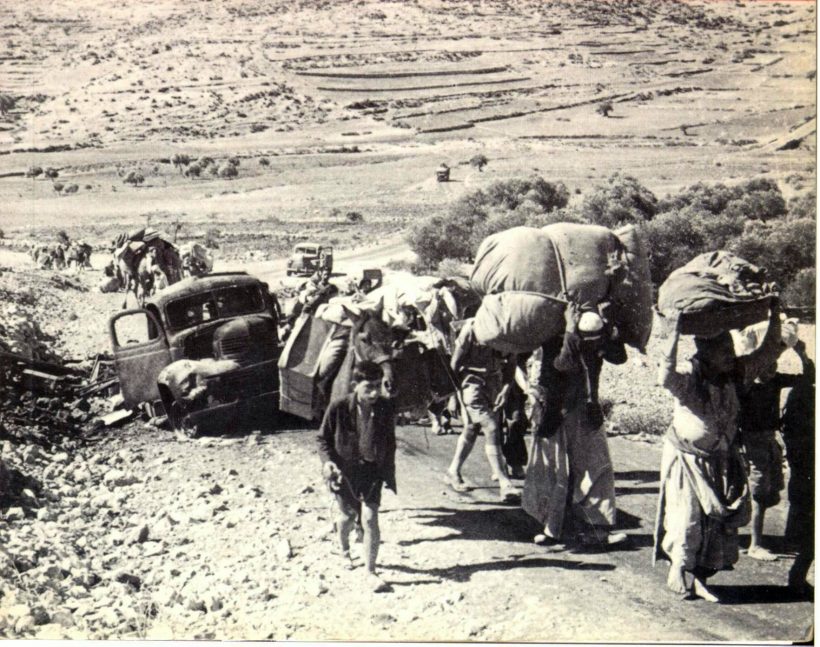
The Jerusalem Post’s story made it sound as though the “resettling” of Lifta was a preservation and development project. What it is, in fact, is a rewriting of history.
Destroying Lifta destroys opportunities for Palestinians to uncover the past of both Palestinians and Israelis: “Lifta has a lasting value in its own right, as it can link restitution to the right of return. Moreover, its preservation will be an opportunity to assert the restoration of dignity in the Palestinian as well as the Jewish community. Finally, by halting the new development in Lifta, UNESCO will affirm its global credibility in response to cultural cleansing.” [See LIFTA AFTER ZIONIST PLANNING and PLANNING AS A CRIMINAL ACT]
Israel’s expulsions of Palestinian families from their homes in Sheikh Jarrah and Silwan, Jerusalem neighborhoods just outside the Green Line, are motivated by the same Zionist objective that resulted in the expulsion, also known as ethnic cleansing, of Palestinians like my family from Lifta, which is just inside the Green line. (See Israeli 2019 map of so-called “Greater Israel” below with Lifta, Sheikh Jarrah and Silwan circled). That objective is Israel’s desire to Zionize/Judaize all of Jerusalem and all of Palestine.
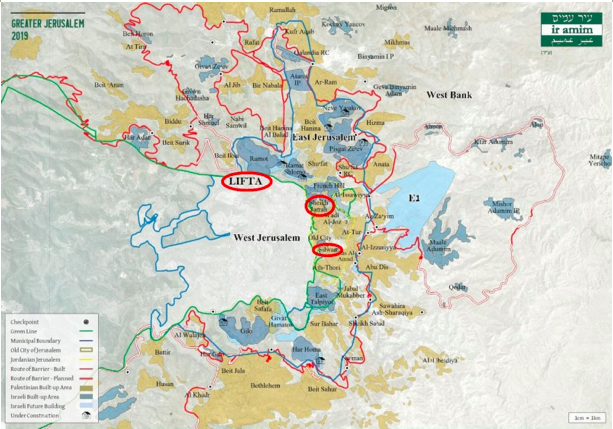
Israeli 2019 map of so-called “Greater Israel” below with (left to right) Lifta, Sheikh Jarrah and Silwan circled
I hope the ongoing worldwide protests on social media against Israel’s crimes will now add the rallying cry of #SaveLifta, in addition to #SaveSheikhJarrah and #SaveSilwan.
If you are still in doubt about Israel’s intention, listen to two Palestinian citizens of Israel reacting to the message they have heard loud and clear all their lives from successive Israeli governments:
Eva Najjar, Haifa-based lead designer and developer at Just Vision, writes:
“I knew I was bringing my children into an ethnic-supremacist state when they were born. But after these past weeks, I don’t know how I can continue to raise them here.” (In The Washington Post : Palestinian citizens of Israel like me are facing terrifying new attacks)
Diana Buttu wonders:
“How do I explain to my 7-year-old son what being a Palestinian citizen of Israel means? What future can he look toward, when the leaders of the government incite hatred against him? What audacious hope can he have when he is bound to face racism and discrimination in education, employment and housing? For now, I try to shield him from the images on television and on our phones, but there will soon come a time when I cannot shield him from the reality that he is surrounded by people who consider him a second-class citizen.” (In The New York Times : The Myth of Coexistence in Israel)
I am heartened by the United Nations Human Rights Council (HRC) Special Session held on May 27, which for the first time has included a geographic scope encompassing Israeli violations targeting the Palestinian people on both sides of the Green Line.
Israel’s institutionalized regime of racial domination and oppression targets the Palestinian people as a whole, including those no longer in Lifta through no fault of their own, who have more right by far to reconstruct their homes in Lifta than Israeli Jews have in constructing housing and luxury hotels to “resettle” the village. We will return, so don’t raise the roof beams high, Israel.
*
Rima Najjar is a Palestinian whose father’s side of the family comes from the forcibly depopulated village of Lifta on the western outskirts of Jerusalem and whose mother’s side of the family is from Ijzim, south of Haifa. She is an activist, researcher and retired professor of English literature, Al-Quds University, occupied West Bank.
Revealed: The American Money Entwined with Israel’s Jewish Terrorist Groups
By Jessica Buxbaum | MintPress News | May 28, 2021
JERUSALEM — As Israel rained rockets down on Gaza in mid-May, inside 1948-occupied Palestine (Historic Palestine and modern-day Israel), another kind of Israeli terror emerged. Jewish supremacists stormed cities with high Palestinian populations chanting “Death to Arabs!,” attacking scores of Palestinians and vandalizing their properties.
The mob violence killed two Palestinian citizens of Israel, according to the Mossawa Center: the Advocacy Center for Arab Citizens of Israel. And despite calls for calm, the attacks are ongoing. On Thursday, a Jewish mob dragged a Bedouin driver out of his car and beat him with glass bottles in northern Historic Palestine. Earlier, footage posted on social media showed Arab gas station workers lying on the ground after being surrounded and beaten by a Jewish mob in the town of Binyamina:
The American Jewish community condemned the wave of anti-Palestinian violence, under the assumption these attacks stem from the fringes of Jewish society. In reality, however, these Jewish supremacists receive financial support from a network of charities in the United States.
Jewish extremists organizing online
As the Israeli government orchestrated a bombing campaign on Gaza, right-wing Israeli activists were coordinating their own war-like operations online.
According to HaBloc, an Israeli nonprofit organization monitoring anti-democratic activity, tens of new groups have been created in the last two weeks on WhatsApp and Telegram. The number of participants in each group ranged from the tens, hundreds, and even thousands. About 2,200 people in total were active in these groups.
HaBloc’s observation of these ultra-right-wing groups reveals how they used social media to organize attacks in advance offline. The groups exchanged information, sold weapons like knives, bats, and pepper spray, used inflammatory rhetoric such as calling for revenge against Palestinian citizens of Israel and documented themselves rioting in the streets.
“This is far more than what’s happening on a daily basis within the far right in Israel,” Ran Cohen, co-founder of HaBloc, said of the extremist activity.
News media reported that the main groups behind the recent rampage were Lehava, a Jewish supremacist organization opposing assimilation and coexistence, and La Familia, a far-right group supporting the Israeli Premier League football club Beitar Jerusalem.
The Israel Religious Action Center (IRAC), the public and legal advocacy arm of the Reform Movement in Israel, has been monitoring Lehava’s activity for more than a decade.
“Lehava is an organization that claims to work against assimilation, but basically wants to create a Jewish-only space in Jerusalem and in Israel in general,” Rabbi Noa Sattath, IRAC’s director, told MintPress News. “In this last wave of violence, they were certainly instigators in several of the cases.”
IRAC demanded Lehava be labeled a terrorist organization in a letter sent this week to Israeli Minister of Defense Benny Gantz, Attorney General Avichai Mandelblit, and Head of the Shabak (General Security Service) Nadav Argaman.
Researchers within HaBloc, cautioned, though, attaching the violence to specific organizations.
“The role of Lehava in what happened is not direct,” HaBloc said. “It’s not like there was a central command and they’re sending people into the streets. It was really something that sort of spread out in a more organic way.”
“But the infrastructure and the ideology of Lehava is present and it contributes to what happened in the past few weeks,” HaBloc added.
The American charities bankrolling Lehava
Ben-Zion Gopstein is the leader of Lehava (or “flame” in Hebrew) and founded the organization in 2005. He is a notorious right-wing activist and disciple of Rabbi Meir Kahane, an American-Israeli extremist who founded the Kach Party, a political movement espousing racist beliefs.
After a brief stint in the Knesset (Israeli parliament) in the 1980s, the Kach Party was banned from Israeli politics and deemed a terrorist organization by both Israel and the U.S.
Kahane called for the expulsion of Palestinians and Arabs from the Holy Land and advocated for the outlawing of marriage between Jews and non-Jews.
Four years after Kahane’s assassination in 1990, Baruch Goldstein, an ardent Kahane follower, opened fired at the Ibrahimi Mosque in Hebron—killing 29 worshippers.
Kahane and Goldstein have become revered within the Israeli settler movement. Settlers have shared Kahane’s teachings on social media and have prayed at his grave.
Lehava is considered the successor to Kach, and Kahane’s racist ideology, Kahanism, runs deep within Lehava circles.
In addition to following right-wing interactions online, HaBloc’s research has also found a complex web of nonprofits in Israel and the U.S. connected to Lehava.
Lehava is not a registered charity in Israel so it can’t accept donations. Instead, money is funneled to Lehava through the Israeli nonprofit, the Foundation for the Salvation of the People of Israel, or Hakeren Lehazalat Am Israel in Hebrew. Israeli fund, Chemla or “mercy” in Hebrew has also been linked to Lehava until about 2014, according to HaBloc.
The Foundation for the Salvation of the People of Israel did not respond to requests for comment via email. The email address may be Gopstein’s as “benzion” is part of it. When contacted at the telephone number associated with the organization’s GuideStar (a nonprofit database) profile, the person said this was not the foundation and hung up. Contact information for Chemla is not publically available.
Two tax-exempt charities in the U.S. fund Kahanist activity in Israel: Charity of Light and the American Friends of Yeshivat HaRa’ayon HaYehudi.
Charity of Light funnels money to Chasdei Meir (which translates roughly into “charity which shines” in Hebrew). Chasdei Meir was named after Kahane, according to the fund’s website. As evidenced on Charity of Light’s tax returns, Chasdei Meir is related to the Chemla Fund. Charity of Light donated $72,000 to Chasdei Meir/Chemla Fund in 2018, according to its most recent tax filing.
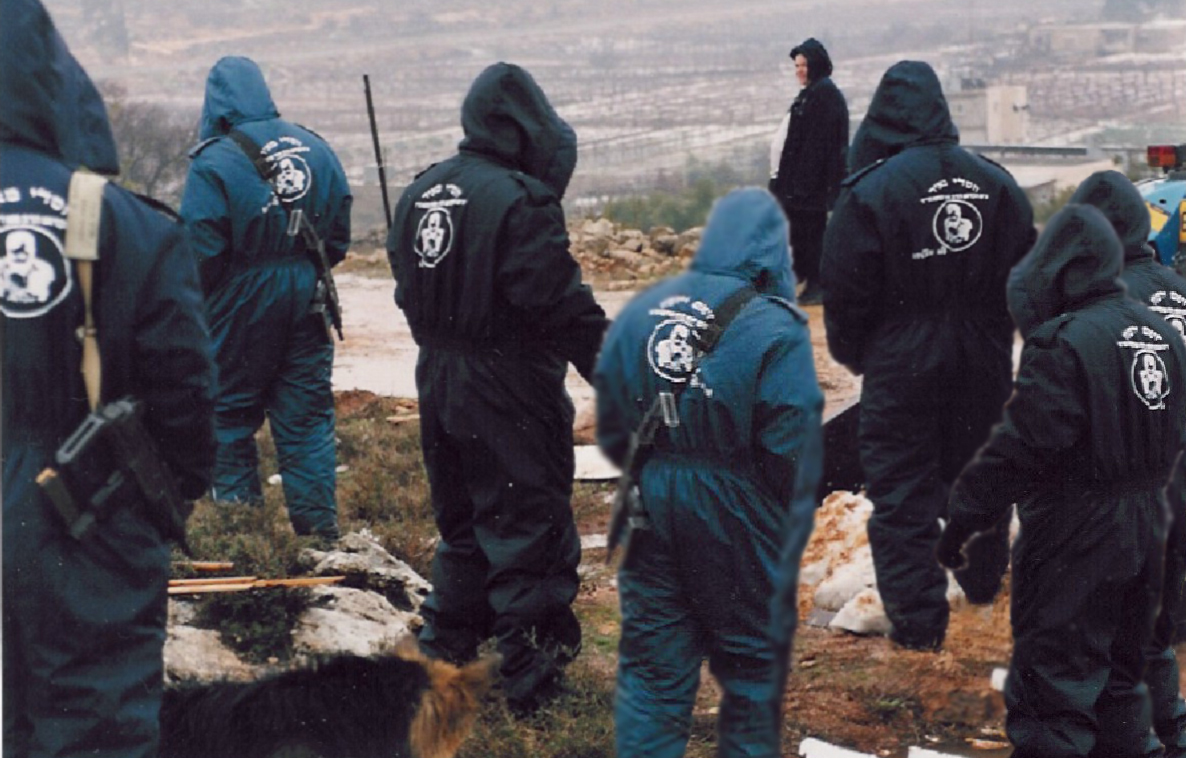
Armed members of Chasdei Meir are shown wearing jumpsuits emblazoned with portarts of Meir Kahane
The American Friends of Yeshivat HaRa’ayon HaYehudi directly supports Yeshivat HaRa’ayon HaYehudi or the Jewish Idea Yeshiva, a Jewish education institution founded by Kahane.
“This is sort of the place for indoctrination of Kahanist ideology,” HaBloc said. “It’s where Benzi Gopstein studied and other prominent Kahanist figures.”
The charity gave $154,000 to Yeshivat HaRa’ayon HaYehudi in 2018, according to the most recent tax report. The yeshiva is even classified as a terrorist organization by the United States. The yeshiva’s dean, Rabbi Yehuda Kroizer, is also part of Chasdei Meir. The yeshiva did not return a request for comment.
The nonprofits’ tax filings list Levi Chazan as the director of Charity of Light and American Friends of Yeshivat HaRa’ayon HaYehudi, and Steven Goldrich is listed as a director of Charity of Light and treasurer of American Friends of Yeshivat HaRa’ayon HaYehudi. Chazan was convicted in a 1984 bus shooting in the Occupied West Bank, which wounded seven Palestinians. Both did not respond to requests for comment.
HaBloc explained this entanglement of Israeli and American organizations is not directly supporting Lehava with monetary contributions, but rather aiding the network around it.
“The relationship between [Lehava] and groups that are funded with American money are two separate issues,” HaBloc’s Cohen said. “There are connections, of course, but we cannot say that these groups that were active in the last two weeks were funded with American dollars.”
Other financial players
The aforementioned charities are largely linked to Kahanism and Lehava, but other American foundations have also been tied to Israeli extremism.
The Traditional Fund gave $51,000 to American Friends of Yeshivat HaRa’ayon and $11,500 to American Friends of Chasdei Meir in 2018. The American Friends of Chasdei Meir is not listed in any available nonprofit database, however, Chasdei Meir’s website does name the American Friends of Chasdei Meir as its contact. The Traditional Fund did not respond to press inquiries.
According to T’ruah: The Rabbinic Call for Human Rights, the Central Fund of Israel (CFI) funds Chemla and Yeshivat HaRa’ayon HaYehudi. The organization filed a complaint with the Internal Revenue Service (IRS) in 2018 to revoke CFI and the American Friends of Yeshivat HaRa’ayon’s charitable status on the grounds these groups are funding terrorism.
IRS charity law states that terrorist activities are considered substantial means for disqualifying an organization’s tax-exempt status. This is in accordance with engaging in illegal acts contrary to standard U.S. policy.
A litany of private foundations supports the CFI. Most notably, the foundations belonging to the late American billionaires Sheldon Adelson and Irving Moskowitz. The Moskowitz family foundations have contributed more than $8 million to CFI since 2018 and Adelson’s foundation gave $50,000 to CFI in 2018.

Israeli soldiers and settlers attack Palestinian protesters in the Occupied West Bank town of Salfit, Nov. 30, 2020. Majdi Mohammed | AP
Jay Marcus of CFl said in a statement to MintPress News that, “The Central Fund of Israel absolutely rejects violence and does not support any organizations that promote violence. Furthermore, if an organization that we once supported ever started promoting violence, CFI would not support them in the future.”
Marcus claims that he hasn’t heard of Lehava, adding, “having had rockets indiscriminately showered down on my head, I would certainly disagree with your myth about which ‘groups start violence.’”
The Falic family, owners of the major retail chain Duty Free Americas, has supported The Fund for Saving the People of Israel in the past, providing a total of $60,000 to the association from 2007-2017. The money is wired through the Falic’s Israel-based foundation, the Segal Fund. The Falics could not be reached for comment.
Kahanism’s surge in Israel
Kahane’s Kach Party was banned from entering Israeli politics in 1988. But thanks to Israeli Prime Minister Benjamin Netanyahu, Kahanists are now infiltrating the halls of the Knesset (Israeli parliament).
In the lead-up to Israel’s March election, Netanyahu pushed for a right-wing alliance with Itamar Ben-Gvir, a Kahanist, a defense lawyer for price tag campaigners, and leader of the far-right Otzma Yehudit (Jewish Power) party. Otzma Yehudit partnered with the anti-LGBTQ Noam Party and the National Union-Tkuma faction to form the Religious Zionism bloc in the last election. The coalition allowed the electoral list to secure six seats in the Knesset and for a Kahanist to gain political power. Rabbi Sattath pins the blame squarely on Netanyahu for Jewish supremacists’ rise in government.

A Jewish settler wears a T-shirt with the image of Meir Kahane near the city of Ramallah. Bernat Armangue | AP
“Because the prime minister was in such a dire situation and was desperate for every vote, he gave [Otzma Yehudit] the legitimacy,” Rabbi Sattath said. “What we’re seeing here in Israel and around the world is that one of the symptoms of democracies in decline is when the extreme right takes over the center right. The fact that the prime minister and some of the right-wing parties gave the Jewish Power Party legitimacy has then increased their power. And that’s what enabled them to use these methods they’ve used for over a decade on a large scale in the last wave of violence.”
Upon reflecting back to Kahane’s short time in the Knesset, Rabbi Sattath said he faced opposition from every politician and was immediately ostracized.
“When he got into the Knesset, he got the bare minimum [of votes] to get one seat. But what happened in the eighties was he was boycotted by every other Knesset member. Nobody would sit in the plenum when he was speaking,” Rabbi Sattath said. “Everybody from the left and the right understood that these ideas were dangerous and extreme and had to be restrained.”
Today, the political climate in Israeli politics is different.
“What we’re seeing now is that the restraint is completely over,” Rabbi Sattath continued. “And we’re hoping that by shedding light on the past weeks’ violence, we can return to the understanding that there needs to be a red line, that these violent militias and racist, Jewish supremacists have to be stopped.”
Jessica Buxbaum is a Jerusalem-based journalist for MintPress News covering Palestine, Israel, and Syria. Her work has been featured in Middle East Eye, The New Arab and Gulf News.
Four People Dead After SDF Fighters Attack Demonstrators in Syria’s Manbij
Sputnik – 01.06.2021
DAMASCUS – Four people were killed and 13 more injured after militants from Syrian Democratic Forces (SDF) opened fire at demonstrators in Syria’s Manbij on Tuesday, a local source said.
“SDF fighters opened fire on demonstrators at the Jazeera circle in the centre of Manbij, four people were killed and 13 injured as a result,” the source said, adding that some of the injured are in critical condition.
According to the source, demonstrators against the SDF are ongoing for several days in Manbij as locals disagree with “forced conscription of the male population into the armed forces of the Kurdish formations.”
Kurdish militias imposed a curfew and fully blocked the city.
At the same time, another source said that locals in a settlement east of Manbij kicked Kurdish fighters out after they used force against residents.
Israeli State Terror — Killing Palestinians with Impunity

By Stephen Lendman | May 31, 2021
Throughout Jewish state history, its ruling regimes treated Occupied Palestinians and Arab citizens ruthlessly.
Terrorizing them is longstanding Israeli policy, including daily arrests throughout the Occupied Territories, torture, beatings and other forms of abuse, targeted killings, and justice nearly always denied.
Last week, Al Jazeera reported about “grief and anger (in the al-Amari refugee camp) as women wept, young men chanted with raised fists, and masked gunmen fired into the air during” Ahmed Fahd’s funeral.
According to his family, he was extrajudicially arrested by Israeli undercover agents — then assassinated by multiple shots in the back and legs.
Mortally wounded and bleeding to death in public pre-dawn, he was left to die in Ramallah’s Um al-Shayaret neighborhood last Tuesday.
What happened to Fahd repeats time and again throughout the Occupied Territories, accountability virtually never forthcoming.
Weeping at her son’s funeral, Fahd’s mother mother said he “was shot without mercy.”
According to a Palestinian health ministry spokesman, he was shot multiple times at close range, adding:
“Doctors reported that one of the bullets that entered his back made a 2.5cm entry hole, but when it exited his stomach the hole was 7cm, proving that he’d been shot at close range.”
Israeli soldiers, security forces, and undercover agents use dumdum “butterfly bullets,” Palestinian doctors explained.
They explode on impact, cause severe internal injuries, and make large exit wounds.
Palestinian human rights group Al Haq’s general director Shawan Jabarin said Fahd’s state-sponsored murder was no accident, adding:
His “killing is part of a deliberate Israeli policy of assassinating Palestinians at close range by undercover units known as Musta’ribeen as well as regular troops.”
“The(se) (elements) come into Ramallah nearly every night after 2:00 AM to carry out arrests.”
“There have been a number of cases where Shin Bet intelligence officers phoned the families of Palestinians they killed after shooting them at close range and blocking ambulances from evacuating those critically wounded – young men whom they accused of armed attacks on Israeli soldiers and settlers – saying that ‘the account had now been settled.’ ”
Al Haq documented numerous cases of Israeli state-sponsored assassinations of Palestinians for invented reasons.
Musta’ribeen are ruthless. Arabic speaking, they pose as Arabs to seek out, abduct, and assassinate targeted Palestinians.
According to the Public Committee Against Torture in Israel (PCATI), undercover Israelis “pos(e) as protesters and incit(e) the situation.”
They “attack civilians very violently and make severe threats, especially against minors.”
“There have been cases when undercover officers pulled people, including minors, off the street without identifying themselves, which made the arrests look like kidnappings.”
In May alone, Palestinians threatening no one were killed almost daily in the West Bank and East Jerusalem — with impunity.
B’Tselem explained that when Israeli security forces kill or otherwise harm Palestinians, “none of those responsible have faced charges.”
Most often, probes aren’t conducted. When initiated, whitewash nearly always follows.
The Israeli Yesh Din human rights group denounced targeted killings of Palestinians, saying:
“The combination of permissive rules of engagement, regarding firing at unarmed protesters and a law enforcement system that prevents genuine, effective investigation of protester deaths, is a lethal one,” adding:
“The result is the unfortunate, unnecessary loss of many lives, a lack of accountability for harming innocents, and the abandonment of (Palestinians) who remain defenseless against the specter of losing their lives.”
A Final Comment
Countless thousands Gazan children were terrorized, traumatized, and severely damaged emotionally from days of Israeli aggression in May.
During round-the-clock IDF terror-bombing and shelling, children endured nightmares.
When bombs detonated overnight, many woke up screaming.
The effects of what happened left permanent scars.
Parents tried to stay strong for their children, but devastation in much of the Strip took a toll on most all its residents.
According to Palestinian psychotherapist Ghada Redwan:
“There are a number of cases suffering from severe panic and intense fear.”
“There are also children whose psychological symptoms are showing up in strong emotions and vomiting.”
The Norwegian Refugee Council (NRC) explained that Palestinian children who survived the trauma of war likely relive what they endured for some time after it ended.
For some, trauma never ends.
As a boy and adolescent in the 1940s, my next door neighbor was a WW II survivor around my own age.
I was too young at the time to understand why he was different from other neighborhood kids, largely keeping to himself, not playing with me and my other friends.
The trauma of war took its toll on countless numbers who survived the ordeal, developing young children likely affected most of all.
Israel Rejects Cooperation With UN Human Rights Council Commission, Foreign Ministry Says
Sputnik – 27.05.2021
Israel refuses to cooperate with the commission on Gaza and Israel, the creation of which is envisaged by a UN Human Rights Council resolution, and rejects the resolution itself, claiming that it acted in accordance with international law and ethical standards, the Israeli Foreign Ministry said in a statement.
Earlier in the day, the UN Human Rights Council passed a resolution calling for the creation of a commission of inquiry to investigate violations in the Gaza Strip and Israel.
“Israel rejects outright the resolution adopted today (Thursday, 27 May 2021) by the United Nations Human Rights Council, a body with a built-in anti-Israel majority, guided by hypocrisy and absurdity. Any resolution that fails to condemn the firing of over 4,300 rockets by a terror organization at Israeli civilians, or even to mention the terror organization Hamas, is nothing more than a moral failure and a stain on the international community and the UN,” the statement says.
The ministry noted that Israeli security forces had acted in accordance with the highest ethical standards and in accordance with international law, protecting their citizens from Hamas attacks.
“Israel cannot and will not cooperate with such an investigation,” the statement says.
Israeli Prime Minister Benjamin Netanyahu called the resolution a mockery of international law.
“Today’s shameful decision is yet another example of the UN Human Rights Council’s blatant anti-Israel obsession. Once again, an immoral automatic majority at the Council whitewashes a genocidal terrorist organization that deliberately targets Israeli civilians while turning Gaza’s civilians into human shields. This while depicting as the “guilty party” a democracy acting legitimately to protect its citizens from thousands of indiscriminate rocket attacks. This travesty makes a mockery of international law and encourages terrorists worldwide,” Netanyahu said.
The resolution adopted on Thursday by the UN Human Rights Council, inter alia, calls for the urgent creation of a permanent independent international commission of inquiry, to be appointed by the president of the UN Human Rights Council, to investigate all alleged violations of international humanitarian law and all alleged violations and abuses of international human rights law in the Occupied Palestinian Territories, including East Jerusalem, and in Israel before and after April 13, 2021, as well as all root causes of recurring tension, instability and protracted conflict, including systematic discrimination and repression on the basis of national, ethnic, racial or religious affiliation.
Brits protest outside BAE Systems for weapons sales to Israel
By Ahmed Kaballo – Press TV – May 28, 2021
London – Hundreds of pro-Palestine protestors gathered outside the BAE Systems factory in Blackburn in the north of England, to call upon the weapons manufacturer to stop supplying components for F-35 fighter jets that have been used in the recent bombardment of Gaza.
The protest came on the back of one the largest pro-Palestine demonstrations in British history on Saturday and similar demonstrations throughout the week led by Palestine action groups who have been protesting outside the Israeli-owned Elbit Systems factory that provides drones, weapons, and military hardware to the Israeli army.
We have seen protests in Leicester, Tamworth, Oldham, and today in Blackburn as the anger amongst the British public begins to swell at the thought that UK weapons have been used by the Israeli army to kill Palestinian children.
It has become increasingly clear that the British government’s unwavering support for Israel is not representative of the feeling on the ground with more than 383,000 Brits calling on their government to sanction the Israeli regime for their crimes against the Palestinian people.
But while the UK remains complicit through the hundreds of millions of pounds worth of weapons sold to the Israeli army. Some might wonder if the UK should also be held accountable.
Shocking! – Latest update on adverse reactions to the Covid Vaccines in the USA released by CDC
THE DAILY EXPOSE • May 23, 2021
The number of reported adverse reactions to the Covid vaccines in the USA surpassed 200,000 according to data released by the Centers for Disease Control and Prevention (CDC). The data comes directly from reports submitted to the Vaccine Adverse Event Reporting System (VAERS).
VAERS is the primary government-funded system for reporting adverse vaccine reactions in the U.S. Reports submitted to VAERS require further investigation before a causal relationship can be confirmed.
Every Friday, VAERS makes public all vaccine injury reports received as of a specified date, usually about a week prior to the release date. The latest data shows that between the 14th December 2020 and the 14th May 2021, a total of 227,805 total adverse events were reported to VAERS, including 4,201 deaths — an increase of 144 over the previous week — and 18,528 serious injuries, up 1,338 on the previous week.

This data also showed 943 total adverse events, including 23 rated as serious, among 12- to -17-year-olds.
In the U.S., 268.4 million COVID vaccine doses had been administered as of May 14. This includes 115 million doses of Moderna’s vaccine, 144 million doses of Pfizer and 9 million doses of the Johnson & Johnson (J&J) COVID vaccine. […]
The latest VAERS data shows:
- 20% of deaths were related to cardiac disorders.
- 54% of those who died were male, 44% were female and the remaining death reports did not include gender of the deceased.
- The average age of death was 74.7 and the youngest deaths reported include two 15-year-olds (VAERS I.D. 1187918 and 1242573 ) and a 16-year-old (VAERS I.D. 1225942). There were other reported deaths in children under 16 that could not be confirmed or contained obvious errors.
- As of May 14, 1,140 pregnant women reported adverse events related to COVID vaccines, including 351 reports of miscarriage or premature birth.
- Of the 2,275 cases of Bell’s Palsy reported, 51% were reported after Pfizer-BioNTech vaccinations, 42% following vaccination with the Moderna vaccine and 192 cases, or 10%, of Bell’s Palsy cases were reported in conjunction with J&J.
- There were 195 reports of Guillain-Barré Syndrome with 40% of cases attributed to Pfizer, 38% to Moderna and 26% to J&J.
- There were 65,854 reports of anaphylaxis with 38% of cases attributed to Pfizer’s vaccine, 51% to Moderna and 11% to J&J.
- There were 3,758 reports of clotting disorders and other related conditions. Of those, 1,468 reports were attributed to Pfizer, 1,093 reports to Moderna and 1,093 reports to J&J.
There have also been 822,845 adverse reactions to the Covid vaccines in the UK alongside 1,180 unnecessary deaths, you can read our latest analysis of the UK report here.
Israel’s Friends overwhelm Capitol Hill
By Philip Giraldi • Unz Review • May 25, 2021
Yes folks, there is an international conspiracy and it is all about “protecting” Israel. It operates through front and lobbying groups that uniquely promote the interests of a foreign country, Israel, even when those interests do serious damage to the host country where the lobbyists actually live. In Britain, for example, there are a Conservative Friends of Israel and a Labour Friends of Israel, comprising together 216 members of parliament and party officials. British Prime Minister Boris Johnson has been silent about Gaza apart from expressing “deep concern” and blaming both sides while Labour leader Keir Starmer, who has also been under pressure to say something, has focused on how four car loads of alleged Palestinian supporters in London may or may not have driven around shouting out “anti-Semitic” comments. Starmer, one recalls, ran on a leadership campaign pledging to root out “anti-Semitism” in the party as a response to previous leader Jeremy Corbyn’s apparently ill-advised public recognition that Palestinians are human beings. Also in Britain, contesting details of the standard narrative of the so-called holocaust can result in a large fine and even some jailtime.
In 2017, Al-Jazeera ran an undercover operation directed against various Israeli front groups in Britain and in the US which determined that officers from the respective Israeli Embassies, presumably intelligence linked, were meeting regularly with members of the alleged non-government organizations that had been set up to provide support for the Jewish state. In Britain, the interaction included explicit discussions on how to destroy the careers of politicians who were deemed to be insufficiently pro-Israeli. In the US the objective has been to disrupt the activities of pro-Palestinian groups, most particularly the Boycott, Divest and Sanctions (BDS) movement. The pro-Israeli and anti-Arab initiatives were coordinated with and sometimes initiated by the Israeli Embassy officers, suggesting that they were actually intelligence operations.
That many American Jewish groups are collaborating directly with the Israeli Embassy raises two concerns. First, it is ipso facto a violation of the Foreign Agents Registration Act (FARA), which should require registration and complete transparency regarding one’s sources of income and interactions with the foreign embassy. And second, as many of the groups are in tax exempt status with the IRS as either charitable or educational foundations, that status should be rescinded given their foreign affiliation. Of course, the reality is that the Treasury Department has known all that and more for many years and has never taken any action relating to deceptive behavior by pro-Israel groups.
Elsewhere in Europe, “Holocaust denial” even if it only consists of challenging clearly fabricated “factual” details of the event can also land you in jail in Germany and France while criticizing the state of Israel is construed as anti-Semitism, a hate crime. Jewish groups have, in fact, promoted an official “International Holocaust Remembrance Alliance” (IHRA) definition of anti-Semitism, which includes any criticism of Israel as a defining characteristic. The United States Department of State has accepted that definition and language.
Yes, the United States has an office of the Special Envoy to Monitor and Combat Anti-Semitism and it is always headed by a Jew, as has been also the office in the Justice Department that continues to be dedicated to rooting out 90 year old Nazis. Meanwhile, the Republican Party, most particularly in its Trump version, is so close to Israel that it might reasonably be regarded as part of the Israel Lobby. And the Democrats are not much better, though there has been some dissent from progressives, which has led to the creation of a Zionist pressure group within the party called the Democratic Majority for Israel. It exists to defend Israel against any and all criticism while also protecting the billions of dollars and other benefits that the Jewish state receives from the US Treasury and government annually.
One might speculate that there is a whole federal government infrastructure devoted to Jewish and Israeli issues. How did that develop? Well, of course, money is what has made it happen. American politicians have notoriously always been easily corruptible, all it takes is a little cash. But no one is allowed to point out that obvious truth as linking Jews to money is regarded, by Jews and their captive media of course, as some kind of “anti-Semitic trope.”
Now it appears that a ceasefire is more-or-less in place but Israel’s ethnic cleansing that preceded its high-tech slaughter of Palestinian civilians who were being deliberately targeted has been perceived by the world, including many Americans, as particularly brutal. Which means the Zionist propaganda plus coercion machine has been working full time. Capitol Hill offices and the White House have no doubt been inundated with calls, emails and visits from constituents, are now all singing the same song that was also being repeated by the President and Congress. It goes like this: “Israel is being attacked by Hamas terrorists and has a right to defend itself!” Sometimes there is a second verse which includes “The only democracy in the Middle East and America’s best friend and ally.”
Too bad that none of it is true, but the media also did its best to support the narrative by reporting how Hamas was launching “swarms” of rockets against Israel, making it appear as if a beleaguered Israel was valiantly defending itself against terrorist hordes. But the actual numbers told a different tale with only 12 Israelis killed after the violence erupted versus 232 Palestinians, including 65 children. Considerable infrastructure was also deliberately targeted and destroyed in Gaza versus limited damage in Israel while the calculated destruction of the building housing Associated Press (AP) and al-Jazeera should be seen as an attempt to eliminate any independent media observers on the ground in Gaza, even though AP predictably has hardly been critical of the Jewish state.
The Israel Lobby is, to be sure, expert at promoting and marketing its product. It is currently engaged in attacking celebrities and others who expressed any sympathy with the Palestinians while they were being slaughtered by the Israelis as anti-Semites. The larger and more openly combative Lobby groups like the American Israel Political Action Committee (AIPAC) have supporters in virtually every congressional district in the United States who can be called upon to get on the phone and start pouring out emails as needed. So every congress critter hears the call and knows what it means. And no one wants to have a hostile Israel Lobby on one’s back if there is any thought of being re-elected. In some cases, approaches include suggestions that significant donations to support one’s political campaign will either increase or be denied depending on what the legislator chooses to do or say.
And then there are the personal visits on Capitol Hill from the Israel lobbyists. The door is always open for the man or woman from AIPAC. Sometimes the Congressman is actually urged to sign a statement on his or her view of the conflict, a document carefully prepared in advance by The Lobby, of course. And the work by the Israel Firsters is almost always effective. Witness for example what took place concerning the assault on Gaza, where Congress and the White House tried to outdo each other in declaring how much they love Israel even though they don’t necessarily have to say or do anything as Prime Minister Benjamin Netanyahu did what he wanted anyway. Biden reportedly spoke with Netanyahu six times urging teethlessly “de-escalation” of the fighting but the Israeli each time insisted that he would continue the operation “mowing the grass” in Gaza until “its aim is met.”
The Israeli grip on the US government is and should be astonishing and one has to ask why the American people put up with it. They likely endure because they are unaware of the extent of it. If anyone still doubts the degree to which Jewish power is a major force in the United States it is only necessary as a test case to look at the Congressional and White House comments on Gaza, which served absolutely no American interest and which will only make the world even more anti-US due to the Administration’s enablement of the slaughter of the Palestinians. Washington’s UN Ambassador vetoed three Security Council resolutions calling for a cease fire, as is often the case, the only country to vote “no.”
Several aspects of the US role in the fighting particularly demonstrate the ability of Israel and its domestic lobby to get what they want from Washington even when it seems counterintuitive for the Administration and Congress to be falling in line. To be sure, 138 Congressmen and 29 Senators eventually signed onto letters urging a cease fire, but the texts tended to be generic, lacking any context, which means the recommendations were basically useless and not intended to go anywhere.
A highly partisan approach, in line with many of the comments by other government spokesmen, was reflected in a letter from Kevin McCarthy, the “leading Republican” (sic) in Congress, who released a statement confirming his allegiance to Israel. Part of it read:
“The ongoing rocket attacks against Israeli civilians show why America must act immediately to support Israel, condemn Hamas, and sanction those who fund terrorism. Instead of pressuring Israel to compromise with this terrorist group, Democrats should join Republicans in voting to cut off international funding for terrorists.
“That is why today, Rep. Brian Mast, a U.S. Army combat veteran who served alongside the Israel Defense Force (IDF), will push for a vote on the Palestinian International Terrorism Support Prevention Act of 2021.
“This bipartisan bill, which passed the House last Congress, would sanction foreign governments and individuals who fund Hamas and the Palestinian Islamic Jihad, such as Iran.”
For starters, how exactly is it that a US Army combat veteran served alongside the Israeli Army? And now this great admirer of Israel is in Congress? Once upon a time one would lose US citizenship for serving in a foreign army. Mast must have missed something about swearing an oath to uphold the US Constitution, not Benjamin Netanyahu and his band of thugs and war criminals. And why are McCarthy and Mast including Iran in their indictment? Possibly because Tehran support of the Palestinian cause would be a pretext for another war? And what are McCarthy and Mast doing pledging anything at all to a foreign country which at the time was engaged in genocide?
Bad enough, but what is really appalling is the role of Joe Biden “the peacemaker” in hurriedly pushing through approval to provide the Israelis with $735 million dollars-worth of precision guided missiles, exactly the kind of weapon being used by Israel currently to kill Gazans. One might reasonably ask “What was Joe thinking?” but that raises the second question of “Was he thinking at all, apart from exercising knee jerk loyalty to Israel and its psychotic leader?” He did not have to provide more weapons to the Jewish state, which apparently was not running out of weapons of its own, but he did it anyway.
The United States already pays one fifth of Israel’s so-called “defense” budget and this extra contribution, as well as the funds provided annually to pay for Iron Dome defense, is on top of that. If there was any question whether the US was enabling the Israeli slaughter of Palestinians the question was surely answered by the decision made by the president, who knowingly provided US made weapons to be used by Israel to commit war crimes in violation of the Fourth Geneva Convention, the US Arms Control Export Act and the existing Arms Supply Agreement between the US and Israel. He also was providing advanced tactical weapons to a country which is in violation of the Leahy Law due to its uninspected nuclear arsenal and is therefore ineligible for US government military assistance of any kind.
To be sure, some in Congress introduced a resolution to stop the weapons “sale” (a euphemism as Israel never pays for anything). Alexandria Ocasio-Cortez and Rashida Tlaib have proposed blocking the presidential authorization based on its one-sidedness and unsuitability when fighting is actually going on, but it was a futile gesture as House Speaker Nancy Pelosi will surely let the bill die in committee. It will never reach the House floor for a vote. Senator Bernie Sanders has introduced a similar resolution in the Senate which will likely suffer the same fate.
Tlaib has argued that “The US cannot continue to give the right-wing Netanyahu government billions each year to commit crimes against Palestinians. Atrocities like bombing schools cannot be tolerated, much less conducted with US-supplied weapons. To read the statements [from the Biden Administration] you’d hardly know Palestinians existed at all. No child, Palestinian or Israeli, whoever they are, should ever have to worry that death will fall from the sky. How many of my colleagues are willing to say the same, to stand for Palestinian human rights as they do for Israel? How many Palestinians have to die for their lives to matter?”
So it is all same old, same old. Biden, who boasts that American ties to Israel are “unbreakable,” has welcomed the cease fire in Gaza but it is at best a pause in what has become generational intercommunal warfare based on Israeli intentions to eliminate the Palestinians. And Biden will even be seen as having provided the weapons to further that process. Americans, who have no compelling interest in being involved at all apart from their domination by a ruthless Israel Lobby on foreign policy issues relating to the Middle East, will pay the piper as they rearm the Israelis and enable the next round of killing. Some believe that the tide of public opinion is turning against Israel due to its brutality, but I have my doubts as the Lobby has been in control for so long and knows exactly which buttons to push to get what it wants. That, the subversion and corruption of American democracy, is the real tragedy.
Philip M. Giraldi, Ph.D., is Executive Director of the Council for the National Interest, a 501(c)3 tax deductible educational foundation (Federal ID Number #52-1739023) that seeks a more interests-based U.S. foreign policy in the Middle East. Website is https://councilforthenationalinterest.org address is P.O. Box 2157, Purcellville VA 20134 and its email is inform@cnionline.org
Featured Video
No Vote, No Representation, No State: Democracy, Israeli Style
or go to
Aletho News Archives – Video-Images
From the Archives
Sanctions, War and the Policy of Dual Containment
By SASAN FAYAZMANESH | March 17, 2008
It is now nearly three decades since the Unites States adopted the policy of dual containment of Iran and Iraq. While much has been written about the containment of Iraq, there has been very little in-depth analysis of this policy when it comes to Iran. In a book that is going to be released on March 31, 2008, entitled The United States and Iran: Sanctions, Wars and the Policy of Dual Containment (Routledge), I attempt to address this shortcoming by investigating when and why the US policy of containment of Iran came about, how it evolved, and where it stands today.[1] To the extent that Israel has been involved in US policy making, the study will also include the role that Israel has played in the containment of Iran. Also, since the fate of Iran has been inextricably linked to that of Iraq, occasionally the investigation will overlap with the containment of Iraq.
The policy of dual containment of Iran and Iraq originated during the Carter Administration, but it was not until the Clinton Administration that the expression “dual containment” became popular. … continue
Blog Roll
 Aletho News
- British state targets Palestine Action with yet another crooked trial
- Americans are paying the price to preserve Israel’s nuclear hegemony
- Resistance factions are necessary to ensure a permanent US Iraq withdrawal
- How Israel destabilizes the Middle East: Denying sovereignty and the right to exist
- Europe’s Establishment Is Embracing War – and Losing Voters
- NATO chief advocates war of aggression
- No Vote, No Representation, No State: Democracy, Israeli Style
- Zionist Bought Senate Blocks Information About American Citizens Killed By Israel
- While Gaza dominates the UN, these are the people keeping it alive
- New Report: “Scholasticide and Genocide in Gaza: Assessment, Testimonies and Legal Analysis”
- If Americans Knew
- Israeli Soldiers Abduct At Least 22 Across Occupied West Bank
- Eight Palestinians Killed in Israeli Attacks on Gaza
- Israeli former leaders and security chiefs threaten legal action over ‘Jewish terrorism’
- Israel map in LA Times ad includes all land from the river to the sea
- Inside Lebanon’s 200-page dossier on Israeli war crimes
- Flydubai, genocide, settler violence, Trump abuse of power to deport – Daily Update
- Counting Antisemitic Incidents: What the ADL Audit Reveals — and Obscures
- Mamdani releases plan to combat antisemitism and hate crimes in New York City
- Iran’s Revolutionary Guards Publish Letter to the American People
- DMFI launches $1 million ad campaign supporting Virginia’s Elaine Luria
- No Tricks Zone
- Green Energy Debacle: German Expert Professor Fritz Vahrenholt Warns Of Severe Economic And Social Consequences
- Two More Paleo Reconstructions Affirm Meters-Higher Sea Levels Across Ireland, Brazil 7000-6000 Years Ago
- New Study: Earth And Venus Surface Warmth Largely Explained By Convection And Lapse Rate, Not CO2 Or Radiation
- 2025 Nature Paper Claiming Worsening Global Drought Gets RETRACTED …Heavily Flawed
- New Study: ‘Global Drought Shows No Detectable Recent Acceleration Under Climate Warming’
- Economic Masterminds: German Socialists Suggest Taxing Productivity Gains Stemming From Using AI
- The South China Sea Has Not Been Cooperating With The Climate Change Narrative
- Energy Crisis: Germany Enters Heating Season With Historically Low Gas Reserve Fill Levels
- New Study: The Antarctic Ice Sheet Gained Mass From 2020-2024 Due To Staggering Snow And Ice Accumulation
- Study: Ocean Heating Rates From Thousands Of Years Ago ‘Dwarf’ Modern Ocean Heating Rates

