Countering the American Way of War – Proof of Concept
By Patrick Armstrong | Strategic Culture Foundation | May 23, 2021
The American Way of War is founded on three assumptions. Ever since 1945 the USA has assumed that it would have air superiority: it knew that it would have to fight for it against the Soviets but assumed that it would be able to gain it, at least in the areas where needed (local air superiority). In Korea there was some resistance but the USAF was able to bomb pretty freely. Wikipedia informs us that it dropped more bombs on Korea than it did in the entire Pacific Theatre and about half as many as it did in the European Theatre in 1941-1945. North Korea was obliterated: “We went over there and fought the war and eventually burned down every town in North Korea anyway, some way or another, and some in South Korea, too.” Which, of course, is the principal reason why North Korea has nuclear weapons today.
Bombing became the American Way of War par excellence with ever greater tonnages dropped: Cambodia received about the same amount as Korea, Laos about three times as much, Vietnam about six times as much. And the bombing continues today throughout Washington’s forever wars. Officially it is precise, surgical, carefully selected: “The targets I’m assigned to destroy have been vetted through the most professional members of our armed services, and (I know) that others are taking their jobs as seriously as I am“. But U.S. Precision Bombing is a “Persistent Myth” and the reality is quite different:
Since World War II, the U.S. Air Force has loosened its definition of “accuracy” from 25 feet to 10 meters (39 feet), but that is still less than the blast radius of even its smallest 500 lb. bombs. [Here’s one.] So the impression that these weapons can be used to surgically “zap” a single house or small building in an urban area without inflicting casualties and deaths throughout the surrounding area is certainly contrived.
In the end, there is no difference from random carpet bombing: “precision strike” after “precision strike” after “precision strike” – even assuming the intelligence that guides the “precision” is accurate, which it isn’t – leaves nothing but rubble:
If you want a single word to summarize American war-making in this last decade and a half, I would suggest rubble. It’s been a painfully apt term since Sept. 11, 2001. In addition, to catch the essence of such war in this century, two new words might be useful — rubblize and rubblization.
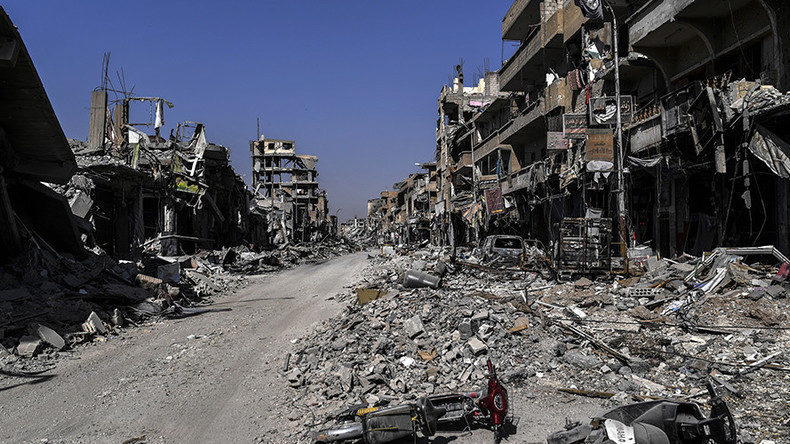
Here are pictures from Raqqa in Syria. Amnesty International calculates that 30,000 artillery rounds were fired and the New Yorker estimates 10,000 bombs dropped; given an assumed population of 300,000 that’s one for every seven or eight people; “precision” or not, what would your neighbourhood look like after that?
Doing war from the air is pretty cost-free especially if your targets have weak air defence. The 1998 NATO operation in Kosovo had two accidental NATO deaths and two aircraft shot down. The 2011 NATO operation in Libya cost one soldier and two aircraft from accidents and one helicopter captured. It’s engagingly technical and allows much talk of precision. To say nothing of the opportunity to smugly accuse others of just tossing bombs around: “Putin’s modern Air Force choosing devastating dumb bombs over precision strikes“. (In this puff piece the authors do not understand that the Russians actually have figured out a cheap way to make “dumb” bombs “precise”. The process is explained here. Also note the familiar American boast “We’re able to do very precise weaponeering in order to strike and then also minimize civilian casualty”.)
The second assumption of the American Way of War is a prerequisite of the first – assured communications. The American way of precision bombing requires that the bomb or missile “talk” continually to its guide, whether that be a laser designator, a signal to the target and back or GPS satellites. This “talking” must be free, unrestricted and continuous – if it is stopped, the “smart” missile or bomb immediately becomes “stupid”. (Another advantage of the Russian way, incidentally, is that the “talking” is unnecessary once the bomb is dropped.)
U.S. warfighting doctrine depends on air power operating and communicating freely.
The countries on Washington’s target list are well aware of this and that is why they are continually improving their air defence and electronic warfare capabilities. Conversely, the reason why NATO members have feeble air defence and limited EW capability is that they’ve never thought they needed to have them. Years of beating up countries with trivial air defence and EW has left them complacent. (Even a wake-up call like the shooting down of the F-117 is soon sent down the Memory Hole.)
Great strategists have always known that victory is found in avoiding the enemy’s strength and attacking his weakness and that one should “fight the enemy with the weapons he lacks.” Russia, China and Iran cannot expect to win a naval battle in the South Pacific against the U.S. Navy: there will be no second Battles of Leyte Gulf, Midway or Coral Sea. That would be to attack U.S. strengths. Missiles to take out aircraft carriers are the answer: do not attack the enemy’s strength, fight him with the weapons he lacks. Neither would they attempt to invade and conquer the USA itself. Defence is what they want and these are the principles that guide them.
But there is a third assumption of the American Way of War and that is simply this:
the air raid sirens will sound somewhere else.
Everything that I have said above applies to Israel. Just like the USA, Israel has grown accustomed to using air power, “precision strikes” and all the rest of it. In 1973 it had a hard ground fight but since its 2006 repulse by Hezbollah in Lebanon it has relied ever more on air strikes. Like the U.S., it is confident that it has air superiority and secure communications. Being so much closer to its enemies, it is not as confident that the air raid sirens will always scream somewhere else, but confident that it can inflict, via its air power, unacceptable damage on its enemy, Israel proceeds. Hezbollah and Hamas would be fools to try – even if they could – to build an air force to fight Israel, neither can they expect to have air defence and electronic warfare assets to seriously challenge Israel’s air superiority. Because they cannot attack the two assumptions of air superiority and communications, they must therefore attack the third assumption of invulnerability. Not the enemy’s strength but his weakness.
The last big U.S. ground operations, the Iraq wars of 1990 and 2003, were preceded by months of unimpeded transportation of immense quantities of supplies across the Atlantic. Baghdad never interfered and the complacent supposition that the air raid sirens would sound only in the enemy’s skies was further strengthened. But, should NATO be so suicidal as to provoke Russia to war, this will not be the case: the Iskanders will come calling and there will be no uninterrupted buildup. NATO bases will not be safe sanctuaries and the convoys will have to fight their way through.
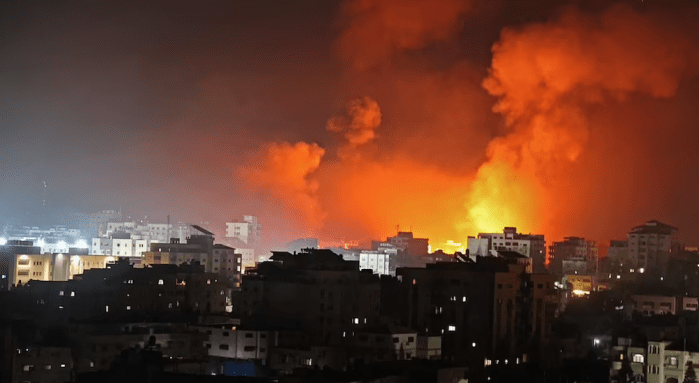
We see, today, the proof of concept. In May Gaza fired hundreds of simple, cheap rockets at Israel. The Israeli air defence system, Iron Dome, was reasonably effective but it will run out of missiles long before Gaza, to say nothing of Hezbollah, will. Iron Dome suffers from the weakness that it is far more expensive than the simple rockets Hamas is using. Debris rained down on Israeli cities, the odd rocket got through (probably more than we were told). The air raid sirens were continuous and Israelis were in bomb shelters. It’s true that Israel’s air force obliterated buildings in Gaza but that’s not the point: everyone knew they could do that, it’s the continuous rockets that are new. This went on for eleven days with no diminution of fire from Gaza. A piece in the NYT, not a noticeably Israel-hostile outlet, quotes an estimate of 30,000 rockets in Gaza; only about ten percent were fired. Hezbollah has at least four times as many. The myth of Israel’s invincibility has been broken: gravely diminished in 2006 on land, its skies are no longer safe. Fight the enemy’s weakness (its home morale – how many dual citizens are already packing their suitcases?) and use weapons it does not have.
A ceasefire was announced after eleven days; we’ll see if it holds: Israeli police have again stormed the al-Aqsa Mosque which was the trigger in the first place. The Jerusalem Post attempts a summing up; and a very pro-Israeli one it is: so many commanders, headquarters, launching sites claimed destroyed. Most important though is its recognition that Hamas “increased its volume and range” of rocket launches. And “Hamas took credit for redrawing the equation of power in the region in its battle with Israel, asserting that Israel is now in a state of decline”. A claim to be sure. But one with some reality. Hamas struck with greater numbers and deeper into Israel than ever before and there were also disturbances in the Arab population in Israel proper. Hamas is claiming a victory and it is not wrong to do so.
Air superiority, assured immediate communications and security of the home front. Gaza and Hezbollah present the poor man’s solution to the problem – lots of cheap rockets to challenge the assumption of a secure home front: Israel’s “illusion of normality” is gone.
Richer and more industrially-based entities can counter the first two assumptions and challenge the third with more sophisticated answers. Perhaps the greatest challenge to the complacency that other countries will be the amphitheatres for American wars is the Russian Poseidon; this weapon, a sort of giant autonomous underwater cruise missile, is designed to create a tsunami to wipe out U.S. ports and coastal areas. Iran, in its retaliatory attack on the U.S. base in Iraq last year, showed that U.S. forces were not safe in their bases. China and Russia are both creating weapons systems to attack the USA where it is weak using weapons it does not have. U.S. aircraft carrier battle groups, rather than projections of mighty power, are mere targets to hypersonic missiles. Russian EW capability has been described by at least one U.S. general as “eye-watering“, able to turn off U.S. systems; and one may be sure that the Russians are saving their best for later. (Can they blind an entire warship? Not at all! Disinformation! Nonsense! Information Warfare! A little too much protesting?) Russia and China can do this because they are not lost to fantasies of “power projection” or “full spectrum superiority“; they defend themselves with weapons the aggressor does not have that are directed at his weakness. Enough and not too much is their guide.
Gaza vs Israel represents the proof of the concept.
Weakened Israeli Immunity?
By Stephen Lendman | May 22, 2021
Did Netanyahu go too far this time?
Did he shoot himself in the foot for massacring Gazan civilians — and by doing so generate mass pro-Palestinian protests in cities worldwide?
Did his international support weaken for terror-bombing and shelling residential neighborhoods on the phony pretext of claiming that Hamas used families and others as human shields?
Is his Western and regional media support diminished for targeting their Gazan facilities to silence them?
Did he generate widespread international anger for destroying Gazan infrastructure essential to sustain life and well-being, for striking medical facilities and much more in Gaza intensively?
For time immemorial, US and other Western media provided one-sided support for Israel, including earlier wars on Gaza and against Syria and Lebanon.
Did 11 days in May change things — even if only partially?
Did it put a chink in longstanding Israeli impregnability?
Days earlier, the most always pro-Israel NYT said the following:
The IDF “damaged 17 hospitals and clinics in Gaza, wrecked its only coronavirus test laboratory, sent fetid wastewater into its streets and broke water pipes serving at least 800,000 people, setting off a humanitarian crisis that is touching nearly every civilian in the crowded enclave of about two million people,” adding:
“Sewage systems inside Gaza have been destroyed.”
“A desalination plant that helped provide fresh water to 250,000 people in the territory is offline.”
“Dozens of schools have been damaged or closed, forcing some 600,000 students to miss classes.”
“Some 72,000 Gazans have been forced to flee their homes.”
“And at least 213 Palestinians have been killed, including dozens of children.”
“The level of destruction and loss of life in Gaza has underlined the humanitarian challenge in the enclave, already suffering under the weight of an indefinite blockade by Israel and Egypt even before the latest conflict.”
The above and more that followed was sharp criticism of Israel rarely ever reported about a US allied state.
On Friday, NBC News said “Israel-Gaza cease-fire doesn’t mean the IDF should be excused for striking health facilities.”
“Even if the fighting soon stops, not holding Israel to account for potential war crimes green-lights future heinous attacks.”
At times of war, civilians are protected persons under international law.
Targeting and “preventing them from receiving effective care for their wounds compounds their suffering,” NBC News added.
WaPo has been notably critical of Israeli aggression this month.
An opinion piece it published by Columbia University Professor of Arab Studies Rashid Khalidi said the following last week:
Days of Israeli aggression on Gaza reflect “the latest episode in the hundred-plus year war on Palestine,” adding:
“Israel’s brutal actions in and around Jerusalem’s al-Aqsa Mosque, and its attempts to forcibly displace Palestinians in the nearby neighborhood of Sheikh Jarrah, were triggers for another violent, asymmetrical confrontation” between Israel’s powerful military and Palestinians armed with no more than crude rockets and their redoubtable will to resist oppression.
What went on for days and continues throughout the Occupied Territories through daily oppression of Palestinians has nothing to do with “riot(ing)” or a “real estate dispute” as phony Israeli “talking points” claimed, Khalidi explained.
It’s all about pursuing Israel’s longstanding aim for maximum Jews and minimum Arabs throughout all valued parts of historic Palestine — notably to assure that the world community recognizes Jerusalem as Israel’s exclusive capital.
On November 29, 1947, the UN General Assembly passed Resolution 181.
The Palestine Partition Plan granted 56% of historic Palestine to Jews (with one-third of the population), 42% to Palestinians.
Jerusalem was designated an international city under a UN Trusteeship Council.
Res. 181 also called for an Independent Arab state by October 1, 1948.
It called for “all governments and peoples to refrain from taking any action which might hamper or delay the carrying out of these recommendations.”
The Security Council was and continues to be empowered with “necessary measures as provided for in the plan for its implementation.”
Security Council (SC) Resolution 242 (1967) called for an end of conflict and withdrawal of Israeli armed forces from the Occupied Territories.
The UN Charter, Fourth Geneva, and other international laws protect the rights of everyone everywhere, including Palestinians and other oppressed people.
Like the US and West, Israel operates exclusively by its own rules.
A permanent state of war by hot and other means has existed by Israel against Palestinians for nearly three-fourths of a century — with no end of it in prospect.
WaPo contributors Noura Erakat and Mariam Barghouti said Israel’s intention to expel Palestinian Sheikh Jarrah residents from their East Jerusalem homes and land “highlights the violent brazenness of (its) colonialist project.”
WaPo contributor Michael Chabon accused Israel of “violat(ing) the Fourth Geneva Convention, which limits the duration of military occupation to a year and prohibits an occupying power from transferring its own citizens to occupied territory.”
WaPo accused Israel of “leav(ing) Gaza in shambles.”
Questioning Netanyahu’s future, it said “Jerusalem is on verge of erupting again” because of Israeli violence on its people straightaway after agreeing to ceasefire in Gaza.
According to Palestinian Red Crescent spokesman Mohammad Fityani, Israeli forces on Friday injured 21 Palestinians in and around the Al-Aqsa Mosque, adding:
Similar confrontations occurred throughout the West Bank.
WaPo quoted Hamas political leader Ismail Haniyeh, saying:
“Our people rose up… to defend the al-Aqsa Mosque with their bare chests, and to prove to the whole world that (East) Jerusalem is (the exclusive Palestinian capital), and that Al-Aqsa is a red line.”
WaPo quoted Oxfam’s policy officer in Gaza Laila Barhoum, last week saying:
“We dread the darkness of the night, when you can no longer tell where or how close the black smoke is” from Israeli missiles and shells.
“You can only hear it, feel it and, if you’re lucky, survive it.”
“So, we gather together, support each other and tell ourselves that we will survive the night.”
“And we wait for the condemnation from the international community — condemnation that never comes,” notably not from the West.
WaPo contributor Raphael Mimoun said “(t)he Israeli occupation of the West Bank is, by every definition, apartheid: two legal systems for two ethnic groups.”
“Zionism cannot produce a just peace. Only external pressure can end Israeli apartheid.”
The above and more like it in WaPo and in other US media editions expressed uncharacteristically harsh criticism of Israel.
Does it reflect a crack in its longstanding invulnerability to justifiable criticism?
Or is it the emotional response of the moment that’s likely to pass in the days and weeks ahead?
A Final Comment
Al Jazeera stressed that 11 days of Israeli bombardment… left (Gaza) in ruins,” adding:
The Biden regime “faced unprecedented criticism for failing to demand an immediate ceasefire to end Israel’s devastating bombing campaign, instead putting out what rights advocates described as milquetoast statements reaffirming Washington’s unequivocal support for Israel.”
Following ceasefire on Friday, “(w)hat’s Biden’s plan” for besieged Gazans and Palestinians throughout the Occupied Territories?
Al Jazeera quoted Nader Hashemi, director of the Center for Middle East Studies at the University of Denver saying:
“There’s zero (US) plan” — other than supplying Israel with more heavy weapons and munitions for further war at its discretion against Palestinians and neighboring states.
Hashemi also stressed that “the more Israel is coddled, supported, and sustained (by the US and West), the more belligerent and intransigent (it) becomes” — knowing it can do what it pleases unaccountably.
Israel bombing destroys water supplies of 20% of Gaza residents
MEMO | May 20, 2021
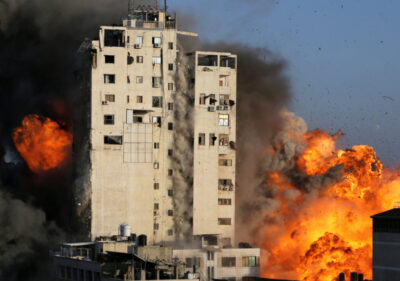
Israeli forces have deliberately targeted two water pipelines in the Al-Saftawi area cutting supplies to 20 per cent of the residents of Gaza City, the municipality said in a statement today.
“The Israeli air strikes on Al-Saftawi area last night damaged two main water pipelines feeding the northwestern residential areas,” the statement said.
“The Municipality of Gaza regrettably confirms that the bombing of these two water pipelines, one of which serves more than 200,000 citizens, leaves them with no water supply and aggravating the water crisis that the city suffers due to the deliberate targeting of its infrastructure,” the statement said.
The municipality of Gaza has begun inspecting the destruction and creating temporary solutions to reduce the water crisis caused by the destruction.
It went on to renew its condemnation of the deliberate targeting of civilian infrastructure, buildings and vital facilities.
The J&J Covid-19 vaccine is being manufactured by the anthrax vaccine company. This is its history
By Dr Meryl Nass, MD | May 19, 2021
Emergent BioSolutions will be in the spotlight today during a House Select Subcommittee Meeting on the Corona Virus Crisis, today at 10:30 am. It can be watched here.
Below, I provide the backstory aka checkered past of this company.
DOD created a plan to vaccinate its service-members against many biowarfare threat agents in the 1990s. At the time, of the bioterrorism vaccines that were being considered, only anthrax and smallpox vaccines had licenses. Anthrax vaccine was chosen to initiate the program in March of 1998.
The first 2 million doses of anthrax vaccine came from a stockpile that had been made for the US army by Michigan’s state vaccine lab (Michigan Biologics Products Institute). What became known in November 1997, after the FDA performed an inspection, was that most of the army’s 11 million dose stockpile of anthrax vaccine, stored at the Michigan lab, was multiply expired, had been redated, and was contaminated, with visible bacterial and fungal growth in some of the lots. FDA immediately shut down the anthrax vaccine factory, and quarantined 9 million of the 11 million existing doses. Unfortunately, FDA allowed the Defense Department to use 2 million doses, which it did over the next two years.
The Conclusions from FDA’s 1998 and 1999 inspection reports of the facility can be read here.
The Michigan state lab was a massive affair with many buildings on a campus in downtown Lansing. It produced a large variety of vaccines and blood products for the state of Michigan. However, over the years the state had not made the required repairs and updates. After the 1997 FDA inspection, Michigan had to repair the place or close it. Michigan decided to sell, and looked for a buyer.
The former head of the Joint Chiefs of Staff, Admiral William Crowe, heard about the sale. He had come to know the el Hibri family when he was Ambassador to the UK. The el Hibri’s had purchased anthrax vaccine from the UK government laboratory at Porton Down just before the Gulf War, and resold it to the Saudi government at a 100x markup.
Crowe and the el Hibri family joined with several of the lab’s officials, and the newly formed group purchased the lab. The purchase price was about 19 million dollars. Admiral Crowe was given a 13% share in exchange for his role as Chairman of the Board, risking none of his own funds. Much of the cost was later paid by the transfer of vaccines to the state of Michigan.
The new company, formed in the first half of 1998, was named Bioport. It chose to focus on its sales of anthrax vaccine to the Army. However, the new company was deeply concerned about potential liability for the lab’s products. The purchase was delayed until the Secretary of the Army signed an indemnification for injuries that might result from use of anthrax vaccine in soldiers, and it also indemnified the company against claims if the vaccine failed to provide the expected protection against anthrax. The state of Michigan had also been indemnified by the Army to produce the vaccine. But from its 1970 licensure until 1998, almost all the anthrax vaccine had only been used in animal experiments.
After FDA had shuttered the anthrax vaccine plant for manufacturing defects, the Army paid to bulldoze and then rebuild the factory in 1999. But even after it was rebuilt, FDA withheld its approval, and the plant lay idle.
Meantime, the 2 million doses that FDA had failed to quarantine were injected into 500,000 military service-members between 1998 and 2001. Many thousands became ill. An official report on the program, quoting unnamed government officials, claimed that 1-2% of recipients had developed permanent disabilities. The military vaccinations were mandatory, and refusers were punished with a court martial or loss of a month’s pay and performance of extra duties. Nonetheless, seeing the injuries sustained by their colleagues, many refused.
In 2001, the anthrax vaccine label, a legal document that describes what is known about the product, listed the CDC’s definition of Gulf War syndrome as a possible adverse effect of the vaccine. (It has been removed from the current label.)
Five Congressional hearings were held throughout 1999 on different aspects of the anthrax vaccine program by the House Committee on Government Reform and National Security (now known as the House Committee on Oversight and Reform). Additional hearings held by other Congressional committees also touched on the vaccine program. The Government Reform and National Security Committee wrote up its findings in a report titled Unproven Force Protection. Its June 30, 1999 hearing dealt specifically with Bioport and its sole source contracts.
Despite this, Bioport has been very successful. Although the Pentagon was considering an end to the anthrax vaccine program in the summer of 2001, the sudden appearance of the anthrax letters after the September 11, 2001 attacks breathed new life into the vaccine program and turned Bioport’s fortunes around. DHHS Secretary Tommy Thompson announced in November 2001 that the anthrax vaccine plant would finally receive an FDA approval and begin production. At the end of January 2002 that is what happened.
But that was not the end of Bioport’s problems. Soldiers challenged the legality of the vaccine’s license in federal court. It was learned that while there had been efficacy testing of an earlier version of the vaccine, the current vaccine formulation had never undergone either efficacy or safety testing in a clinical trial. Aware of this major omission, FDA had withheld the issuing of a “final rule and order” for the anthrax vaccine for over thirty years.
The soldiers prevailed on the legal issues, and First District Court Judge Emmett Sullivan rescinded the vaccine license in 2004, based on the company’s failure to prove efficacy or meet basic FDA standards for licensure.
Unwilling to bow to judicial authority, the Defense Department rolled out a backup plan. A new regulatory authority had just been created, the Emergency Use Authorization (EUA). An EUA was slapped on the unlicensed anthrax vaccine, and DOD quickly restarted its mandatory vaccinations. (There was no emergency: the issuing of an EUA required only the potential for an emergency.)
The attorneys for the soldiers took the case back to court, and Judge Sullivan ruled that even if an experimental medical product received an EUA, it was still investigational and could not be mandated. The law required that EUA products be offered with informed consent. To receive an EUA (unlicensed) product, the recipient must be apprised of the risks and benefits of the product, be informed of alternatives to the product, and no coercion in any form could be applied. Ergo, no mandate.
FDA waited about 18 months, and then issued a full license for Bioport’s anthrax vaccine, although there were still no efficacy data. FDA instead claimed that a 1950’s era trial of a very different anthrax vaccine was sufficient for licensure, even though that trial failed to show benefit against inhalation anthrax.
When the soldiers and their attorneys challenged the licensing decision in court, the next judge ruled in favor of FDA on the basis of “deference”—meaning that FDA could ignore its own regulations when making a determination on safety and efficacy, with or without acceptable data. In 2006 mandatory vaccination restarted.
Bioport then shed its old skin in an attempt to leave its baggage behind. It renamed itself Emergent BioSolutions. Its vaccine had been renamed BioThrax.
Emergent BioSolutions (EBS) then branched out, buying other companies, primarily those making other sole source biodefense products. The military continued to mandate anthrax and (in 2003) smallpox vaccines for service-members. Eventually EBS purchased the smallpox company as well, and the cholera and typhoid vaccines used in the US.
A 2010 report on Emergent BioSolutions, written by Scott Lilly for the Center for American Progress, was titled, “Getting Rich off Uncle Sucker.” It revealed 300% profit margins, unique for a government contractor.
The company’s business plan was to rely on insiders to sell sole source biodefense products to the US government, most of which were stockpiled and never used–inking contracts with multiple federal agencies, including CDC, DOD, NIAID, the State Department, ASPR and BARDA.
In 2012 EBS got one of three DHHS contracts to house a so-called Center for Innovation in Advanced Development and Manufacturing (CIADM) that could be used to produce pandemic or biodefense products in the event of emergencies. With this grant EBS purchased and expanded what became its Bayview factory in Baltimore. The CIADM contract essentially guaranteed Emergent a big role in any future pandemic response.
Emergent acquired the maker of Narcan nasal spray, the opioid overdose antidote. Soon FDA began recommending to prescribers that they write a Narcan script whenever they wrote a narcotic script, just in case. States started buying large quantities for free distribution. Sales rose 600% after EBS bought the company.
Under the Trump administration, retired Air Force Colonel, physician and biodefense consultant Robert Kadlec was appointed to the position of Assistant Secretary of DHHS for Preparedness and Emergency Response (aka ASPR). Kadlec had also been a consultant and business partner of EBS’ founder and chairman Fuad el-Hibri. Kadlec had omitted this information from the required disclosures for Senate confirmation. Once confirmed as Assistant Secretary, Kadlec was able to transfer responsibility for the National Strategic Stockpile (containing the US stockpiles of pandemic remedies, masks and equipment) from the CDC to his own agency. Kadlec then gave multiple sweetheart deals to EBS, until the value of EBS’ contracts with ASPR exceeded those of every other contractor.
ASPR Kadlec was blamed for cancelling a federal contract to make N95 masks while buying more and more anthrax and smallpox vaccines, pre-Covid.
Covid-19 presented a huge opportunity for Emergent BioSolutions. EBS received $628 million from DHHS to retool its CIADM factory. It inked additional contracts with the Astra-Zeneca, Johnson and Johnson, Novavax, Providence Therapeutics and VaxArt companies to provide bulk manufacturing of their vaccines in its Baltimore facilities. Altogether its pandemic contracts were worth about $1.5 Billion. It was slated to manufacture 9 separate medical products to address Covid-19, all designed by other companies.
But there were serious potential problems.
While it had a storied Board of former federal officials, Emergent BioSolutions had never brought a single product to market. Its expertise was in contracting and acquisitions, not production. It had a history of production failures, and had demanded that the federal government bail the company out, or else the sole source products the company provided would become unavailable. Some of this was detailed in the Congressional report Unproven Force Protection. Entering the pandemic, EBS was still making the same mistakes it had been guilty of twenty years earlier:
- EBS sold and continues to sell nerve gas auto-injectors to federal agencies which have been defective and are not licensed. According to the law, these products can neither be produced in the US nor sold here. Instead, Emergent manufactures them in Germany and restricts its sales to US embassies overseas.
- In July 2020, the Soligenix company requested arbitration against Emergent BioSolutions, claiming a loss of $19 million, because EBS had manufactured its experimental ricin vaccine, used in a human trial, which failed to meet specifications.
EBS did not have an active workforce in Baltimore. On September 30, EBS held an online job fair which it titled “Warp Speed Careers Event.” The event sought to recruit 300 employees. Yet EBS had begun inking vaccine contracts 5 months earlier, and could have hired and trained a workforce that was ready to go when FDA gave it the go-ahead. Instead, doing things on the cheap, EBS hired late, failed to provide adequate training to its employees, and experienced a spectacular series of production failures. Many millions of doses of its Johnson and Johnson and its Astra-Zeneca Covid vaccines had to be dumped. J and J missed its 20 million dose quota for the end of March, and FDA, despite repeated inspections, would not give the plant an authorization so its products could be used.
Despite this, somehow millions of doses produced in the unauthorized plant were shipped to Canada, the European Union, South Africa and Mexico. The EU, at least, used the product. How did that occur? We don’t know. Did any get distributed in the US? We can’t be sure none did.
On April 4, 2021, EBS announced it would receive an additional $23 million from DHHS for new equipment to use in the manufacture of Johnson and Johnson’s Covid-19 vaccine.
As of last week, EBS was facing another lawsuit from its shareholders, and its stock price had fallen to $60 from the peak on February 12 of $125 per share. However, Emergent CEO Robert Kramer exercised his stock options in January and February, near the stock’s peak, earning himself over $7 million dollars in profit.
In summary, EBS, despite considerable manufacturing shortcomings, has been extremely successful at obtaining government contracts and earning huge profits. But its products have repeatedly been unreliable. The company has managed to turn failures into success, especially when its products, like civilian stockpiles of anthrax and smallpox vaccine, and nerve gas auto-injectors, are stockpiled but not used.
The public has only gradually been learning that the vaccines it thought were being produced by huge Pharma companies Astra-Zeneca and Johnson and Johnson were in fact being manufactured by the anthrax vaccine company, Emergent BioSolutions. How did it come to pass that the federal government, and these established pharmaceutical companies, bet the farm on EBS’ production of Covid-19 vaccines?
Netanyahu Warns Biden Not to Get Involved
But Biden gives Israel more weapons even as Gaza is bleeding

By PHILIP GIRALDI • Unz Review • MAY 18, 2021
An interesting recent article by international lawyer John Whitbeck suggests that the billions of dollars that the United States gives to Israel annually is not technically “foreign aid” as the Jewish state is as measured by per capita GDP the 19th wealthiest in the world, ahead of countries like Germany. It is, instead “tribute,” which is defined as the “payment made periodically by one state or ruler to another, especially as a sign of dependence.”
That the United States has surrendered key aspects of its national sovereignty to Israeli control has been observed by many. Whitbeck dates the submission to the events surrounding the Israeli attack on the USS Liberty in June 1967, in which 34 crewmen died and 172 were injured in an attempt to sink the ship and kill all the crew. To protect Israel, President Lyndon B. Johnson and his Secretary of Defense Robert McNamara initiated a cover-up that has persisted until this day. The unavenged killing of large numbers of US servicemen has signaled to a series of Israeli governments since that time that they could do anything to Washington without any consequences, including spying on its benefactor, involving Washington in its own wars, and exploiting the US Treasury as its own resource.
The United States has favored Israel above all other nations while a series of Republican and Democratic administrations have accepted that the US is the junior partner in the relationship virtually without demur, culminating in the unprecedented Barack Obama arrangement whereby Israel would receive $38 billion over the course of ten years, automatically and with no conditions placed on the Jewish state’s actions vis-à-vis American regional interests. And now, with the bloodletting continuing unabated in Gaza, Honest Joe Biden has agreed to “sell” the Israelis $735 million worth of new weapons to replenish their arsenal.
Whitbeck’s analysis is convincing, but one might also see a more personal element in how Israel has achieved dominance. Any American politician who seeks to object to the “most favored nation” status of Israel is likely to get unelected the next time he or she has to run for office. The list of the fallen includes Senators Chuck Percy and William Fulbright as well as congressmen Paul Findley, Pete McCloskey, Cynthia McKinney and James Traficant. The key to defeating incumbents in electoral office was and is money and the power and access that it buys. Israel and its supporting cast of 600 pro-Zionist Jewish organizations have billions of dollars to play with and they also include in their ranks co-religionists and other bought sympathizers who control the editorial and news content of America’s printed, television and radio media. Those congressmen who make a show of strongly supporting Israel are rewarded with campaign donations, a friendly media and a virtual lock on reelection. Those who do not are “disappeared.”
The last president who successfully made Israel back down was Dwight D. Eisenhower, who compelled Israel, France and Britain to cease their attempt to seize the Suez Canal from Egypt in 1956. George H. W. Bush was the most recent president to try to pressure Israel, when he refused to guarantee loans that Israel intended to use to expand its illegal settlements, a move which Bush correctly perceived as being bad for US relations through the region. The media subsequently piled on Bush when he ran for a second term, discovering that there was something “wrong” with the economy, which was not true. That and other contrived stories led to Bush’s loss to safely Zionist Bill Clinton. Bush’s son George W. learned the lesson from his father’s loss, even failing to investigate the possible Israeli role in 9/11 so as not to irritate his masters in Tel Aviv. W also acquired along the way a throng of neocon Jewish advisers at the Pentagon and National Security Council who were the architects of the disastrous Iraq War and the Global War on Terror (GWOT) which still plagues us to this day.
Israel’s power to control developments in the United States has recently been manifest in its ability to influence government decision making even down to the state and local level. An increasing number of public schools now have mandatory holocaust education, which, in Wisconsin for example, includes both grade school and high school levels and also applies to private schools. Also, thirty-three states now have laws punishing citizens who promote or participate in boycotts of Israeli products, the non-violent so-called Boycott Divestment and Sanction (BDS) option. Many states have special trade agreements with Israel that are designed to benefit the import of products and services from the Jewish state without mandating any reciprocity while the federal government likewise allows Israel to bid on contracts, including those relating to defense, intelligence and national security.
The Israelis take advantage of their easy access to US infrastructure by spying on both the American government and on private organizations that it considers to be unfriendly. Last year a number of electronic intrusion devices were discovered near federal buildings in Washington. They were planted by the Israelis but nothing was ever done about it. One also recalls how Israeli snoopers were recording White House phone calls under Bill Clinton, some of which were conversations with Monica Lewinsky, at the time potential blackmail material.
Another part of the Zionist game plan is the aggressive use of the anti-Semitism label to silence critics as well as the exploitation of the so-called holocaust with its assertion of perpetual victimhood of the Jewish people to create eternal sympathy for Israel. Of course, it helps to have a media willing to support such nonsense rather than expose it for what it is, but that is what having gross overrepresentation of Zionists as media owners and editors is all about.
All of which brings us to the present, in which an Israeli terror campaign against the Palestinians which has included removing families from their homes and marches through the remaining Arab parts of Jerusalem by angry mobs of armed settlers chanting “death to Arabs” while also calling for “burning” and “hanging” the local residents. The Palestinians have finally had enough and are fighting back and the Israeli armed forces have characteristically responded by attacking targets including apartment buildings in Gaza, killing numerous children.
And a bit of context is necessary. Israel has for many years denied the Palestinians basic human rights while also stealing their homes, land and water. Houses and even villages have been demolished and an estimated millions of productive olive trees burned or destroyed. Palestinians are not free to travel in the West Bank, are arrested and held in prison for no reason, including children, and are shot with no consequences for the Israeli army or police shooter.
US media attempts to portray the violence taking place currently as some kind of even-handed struggle, which it is not. Israel has had control of the historic Palestine for more than fifty years. It has the most powerful military in the Middle East and the Palestinians are basically unarmed, hitting Israel with “rockets” that are largely home-made and ineffective as demonstrated by the disparity in the casualty count. Human Rights Watch, which has been timid about how it treats Israel, has finally reported with stacks of evidence how Israel is an apartheid state that commits numerous human rights violations and occasional war crimes, just as it is doing right now. The intention of all this is to make the life of Palestinians so miserable that they all leave. Israel would prefer not to have to do the job by killing all of them, a route nevertheless endorsed by a number of leading Israeli politicians, but would much prefer that they go voluntarily.
The fact is that the United States enables Israeli behavior by cravenly heeding Netanyahu’s warning not to interfere. It has already blocked several resolutions in the United Nations Security Council to stop the fighting because they are too critical of Israel. The fact that Washington, like a broken record, continues to voice support of Israel the perpetual victim even when it is clearly the aggressor is shameful. If you want to know just what kind of country we Americans now live in, Jen Psaki, White House press spokesperson has provided the answer. She has announced that our government’s position on the ongoing violence in the Middle East is that “The president’s support for Israel’s security, for its legitimate right to defend itself and its people, is fundamental and will never waiver. We condemn ongoing rocket attacks by Hamas and other terrorist groups against Jerusalem.”
Excuse me, but even some minimal compassion for dead Arab children seems to be missing in Biden’s statement, though its ruthlessness inevitably is exceeded by Donald Trump’s bleat “When I was in office we were known as the Peace Presidency, because Israel’s adversaries knew that the United States stood strongly with Israel and there would be swift retribution if Israel was attacked. Under Biden, the world is getting more violent and more unstable because Biden’s weakness and lack of support for Israel is leading to new attacks on our allies. America must always stand with Israel and make clear that the Palestinians must end the violence, terror, and rocket attacks, and make clear that the U.S. will always strongly support Israel’s right to defend itself.”
Donald Trump’s “peace presidency?” Does he include his attacks on Syria and his assassination of a senior Iranian official? Another wannabe with GOP presidential aspirations Florida’s Ron DeSantis, self-designated as “Israel’s governor,” puts it another way, “Hamas is a terrorist organization and Israel has the right to defend itself against terrorist attacks.” Is this a Monty Python sketch? Israel was attacked and is defending itself? Time to wake up America. Israel the victim is preparing a genocide and the fact that no one is Washington is willing to say “no” gives it a green light to go ahead. The blood will be on our hands this time around as Joe Biden and company could have made the decision to stop the developing madness over the past month by putting pressure on Israel to stop the home expulsions and riots by settlers, but clearly that did not and will not happen. And when it all blows up and maybe tens of thousands will die, we will likely hear the same noise coming out of Washington: “Israel has a right to defend itself.”
To conclude with another comment by John Whitbeck relating to his desire to see the United States reclaim its sovereignty would be appropriate. He writes “For many years, I have had a recurring but thus far unrequited dream: Someday, during a Senate confirmation hearing, a nominee will respond to demands to… pledge allegiance to [Israel] with a simple affirmation of pure and genuine patriotism: ‘Senator, with all due respect, I owe my allegiance to the United States of America and to no other country. If you have a problem with that, don’t vote to confirm me.’”
Philip M. Giraldi, Ph.D., is Executive Director of the Council for the National Interest, a 501(c)3 tax deductible educational foundation (Federal ID Number #52-1739023) that seeks a more interests-based U.S. foreign policy in the Middle East. Website is https://councilforthenationalinterest.org address is P.O. Box 2157, Purcellville VA 20134 and its email is inform@cnionline.org
Sunday’s attack on Gaza City claims 42 civilian lives
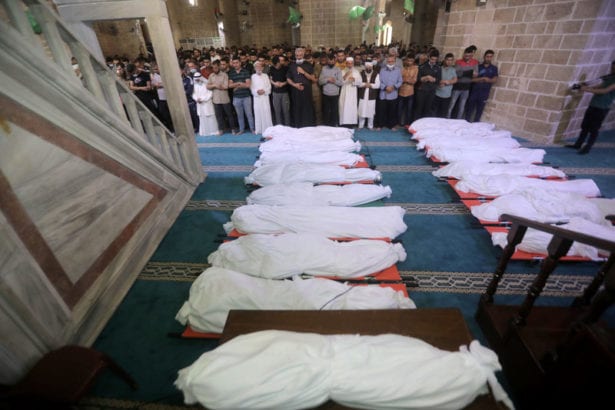
Mourners pray over the bodies of Palestinians killed in overnight Israeli airstrikes in Gaza City on 16 May. (Atia Darwish APA images)
Palestine Information Center – May 17, 2021
GAZA – The health ministry in the Gaza Strip said that a total of 42 civilians were killed and 50 others suffered injuries, some seriously, in the horrific massacre that was committed by Israeli warplanes at dawn Sunday in al-Wehda neighborhood in Gaza City.
Deputy health minister Yousef Abul-Rish told a news conference on Sunday evening that the weapons that were used in the bombing of the neighborhood tore the children’s bodies apart and made them unrecognizable.
Abul-Rish said that two doctors, Mu’ein al-Aloul and Ayman Abul-Auf, were killed in the aerial attack on al-Wehda neighborhood.
He accused Israel of deliberately bombing and destroying vital facilities and sectors that are needed to provide water, electricity and health services as well as roads that lead to hospitals.
The health official also accused Israel of obstructing the work of medical crews through targeting ambulances and paramedics and preventing them from reaching bombed areas to evacuate casualties.
According to the latest statistics from the health ministry in Gaza, the number of Palestinians killed, since the Israeli military aggression against the Gaza Strip started on May 10, has now risen to 197 martyrs, including 58 children and 34 women.
More than 1,235 others have also been wounded so far amid the ongoing brutal Israeli attacks on Gaza.
Israel’s War on Truth-Telling Media and Journalists
By Stephen Lendman | May 16, 2021
Time and again, truth-telling journalism as it should be is a casualty of all things war and related violence.
Big Lies, mass deception, and censorship are weapons of war by other means — in support of the official falsified narrative.
In their book titled “Guardians of Power,” David Edwards and David Cromwell explained why today’s media are in crisis — free and open societies at risk.
It’s because press prostitution substitutes fiction for fact — notably in the US, other Western countries and Israel.
Their state-approved sanitized reports stick exclusively to the official falsified narrative in support of wealth, power and privilege over full and accurate reporting.
In the US especially, news consumers are fed a daily diet of managed news misinformation, disinformation, junk food news and infotainment — at all times.
Notably in times of war, their reports regurgitate state-supplied talking points.
Whatever diverges from the official falsified narrative is filtered out and suppressed.
Adopted unanimously by Security Council members in December 2006, SC Res. 1738 affirms protection for civilians and journalists in war theaters — calling their safety and security “urgent and important.”
Condemning intentional attacks on fourth estate members, the resolution demands accountability for responsible parties.
At all times, especially at times of war and under occupation, civilians are protected persons. So are journalists — under international law.
Throughout at least most of its history, Israel waged war on truth-telling Palestinian journalists.
They’re at risk of arrest, prosecution, imprisonment, and/or assassination.
According to the Committee to Support Palestinian Journalists, “(t)he Israeli occupation tries to muzzle the Palestinian journalists’ mouths and prevent them from unmasking its barbaric practices in the occupied Palestinian territories to the international media.”
Palestinian journalists covering Israeli violence against legitimate protesters risk serious injury or death.
Anyone wearing a flak jacket labeled press is vulnerable, their unprotected areas vulnerable to Israeli sniper attacks by live fire — including use of exploding dum dum bullets able to leave fist-sized existing wounds in individuals struck.
They’re designed to inflict disabling damage to internal organs or death — even though banned by the 1899 Hague Convention.
Since IDF terror-bombing and shelling of Gaza began on May 10, silencing truth-telling media has been a prioritized Netanyahu regime aim.
The same objective is sought in all Israeli preemptive wars, as well as at all other times on whatever conflicts with official falsified Israeli talking points.
On May 15 in Gaza, Israeli terror-bombing turned the 11-story Al-Jalaa building to smoldering rubble — its occupants given one hour to vacate the premises.
It’s unknown so far if some remained inside and perished.
Along with residences of Gazan families, the building housed international media offices.
According to DW News, AP News, AFP, Al Jazeera, other international media operations, and local Palestinian news agencies had offices in the building.
The IDF defied reality by falsely claiming that the building included Hamas “military assets (sic),” adding:
“(O)ffices of civilian media outlets (were) use(d) (by Hamas) as human shields (sic).”
According to AP News, the Netanyahu regime and IDF “did not provide evidence for the claim” — because there is none.
On its Saturday newscast, senior Al Jazeera (AJ) political analyst Marwan Bishara minced no words in debunking the thinly veiled IDF Big Lie.
Gaza-based AJ journalist Al Kahlout said the following in response to Israel’s destruction of the Al-Jalaa building with three missiles:
“(N)o one can understand the feeling of the people whose homes have been destroyed by such kind of air attacks,” adding:
“It’s really difficult to wake up one day and then you realize that your office is not there with all the career experiences, memories that you’ve had.”
Separately on Saturday, IDF terror-bombing destroyed a Gaza City area refugee camp three-story residence, massacring eight children and two women.
The above buildings had no military significance. Israel defied reality by claiming otherwise.
In response to its destruction of Gaza’s Al Jalaa building, AP News president and CEO Gary Pruitt said the following:
“The world will know less about what is happening in Gaza because of what happened today.”
“We are shocked and horrified that the Israeli military would target and destroy the building housing AP’s bureau and other news organizations in Gaza.”
“This is an incredibly disturbing development. We narrowly avoided a terrible loss of life.”
Separately, AP reported:
“For 15 years, the AP’s top-floor office and roof terrace were a prime location for covering Israel’s conflicts with Gaza.”
Now it’s gone, along with scores of massacred Gazans, including women and children.
NY-based Committee to Protect Journalists’ executive director Joel Simon said the following:
“This latest attack on a building long known by Israel to house international media raises the specter that the IDF is deliberately targeting media facilities in order to disrupt coverage of the human suffering in Gaza.”
Indeed so!!
Silencing coverage of its high crimes of war, against humanity, and other human rights abuses is longstanding Israeli policy — in flagrant breach of international law.
On May 10, the Palestinian Center for Development and Media Freedoms (MADA) reported the following:
It “condemn(ed) escalating attacks of the occupation forces against journalists and media workers in Palestine…”
MADA noted what’s going on in “occupied…Jerusalem…aim(s) (to) block the transmission of the violations to the world.”
“This was accompanied by widespread violations of freedom of expression committed by social media companies to serve the goal of the occupation state by obscuring the attacks implemented by its soldiers and settlers.”
In early May alone, “Israeli attacks against journalists during their field coverage of events, as the occupation army targeted a number of journalists while they were” reporting on what’s going on.
At least “10 (Palestinian) journalists” were targeted and “injured.”
“(I)mpunity of the Israeli occupation forces over the years for their almost daily crimes and violations of media freedoms in Palestine, including the killing of more than 40 journalists during the past two decades, is what encourage them to continue committing more crimes and violations, which requires serious action to prosecute the perpetrators of these crimes, as the only way to reduce it.”
Facebook, Twitter, and other “social media companies… deliberately blocked and suspended the accounts of many Palestinian citizens, including many journalists…”
MADA called their action “a severe violation against freedom of expression (in cahoots with) the occupation state (by) blocking facts and suppressing media freedoms and freedom of expression.”
At the same time, they freely allow hostile-to-truth-telling Western and Israeli propaganda on their “platforms.”
Israel is deliberately obliterating media buildings in Gaza to cover up the war crimes that will follow
By Eva Bartlett | RT | May 14, 2021
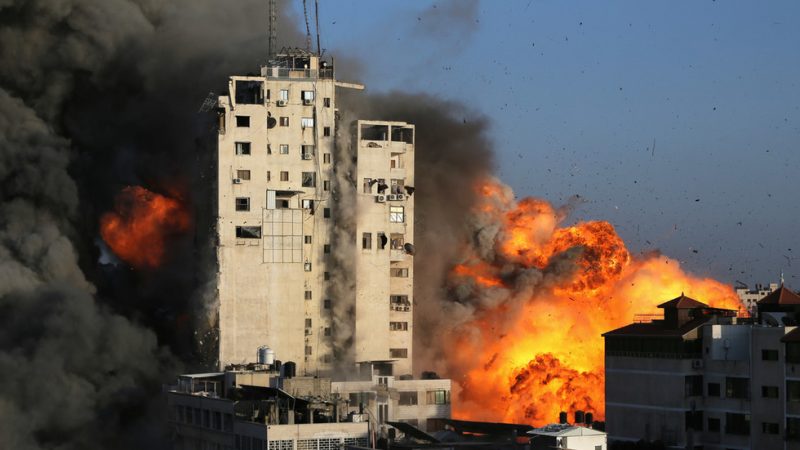
The destruction of two important Gaza buildings housing 20 media outlets was both shocking and predictable. History shows that if the media aren’t around to document Israel’s war crimes, it’s a lot easier for it to commit them.
On Tuesday, Israel bombed the 10-storey Al-Jawhara Tower, causing it to collapse. Before doing so, it had ‘benevolently’ warned that the airstrikes were coming. The following day, it bombed the 14-storey Al-Shorouk Tower, also giving warning it was going to do so.
Most reports have the buildings as evacuated before being levelled. But without these media offices, reporting on Israel’s other war crimes will be left largely to what little media remain and citizen journalists.
The buildings were significant. A statement by the International Federation of Journalists (IFJ) noted the Al-Jawhara building housed the offices of 13 media institutions and NGOs. And an advisory by the Committee to Protect Journalists noted that the Al-Shorouk building housed at least seven media outlets.
A further statement by the same committee said that the Israeli military had defended its bombing of the building via email, bizarrely claiming it had “acted within international law,” alleging the Al-Jawhara building housed Hamas’ intelligence and military offices, and saying the Al-Shorouk building was a base for Hamas’ military intelligence offices and “infrastructure to communicate tactical-military information.”
Just minutes after the Al-Shorouk building was destroyed, I spoke by phone with Shadi Ali, a producer who had worked there for ten years and was understandably devastated at what had happened. He told me of previous occasions when Israel had bombed the building, in 2009, 2012, and 2014.
“I was there in 2012. My office was on the 14th floor when it was hit at 6am. I was sleeping; I had only slept for one-and-a-half hours when it was hit by two missiles on the top floor,” he told me. “When it was bombed in 2014, we had taken precautions and left it already. They struck the 15th floor, destroying it completely. Our floor became the top floor after that.”
The building was on a main Gaza street, Omar Mukhtar, surrounded by residential apartment buildings. I asked whether he knew if there had been casualties this time. He replied, “We’re waiting, because often they’ll strike again soon after, knowing that people have come to search for casualties.”
I’ve witnessed this tactic with my own eyes. In January 2009, while I was accompanying Palestinian Red Crescent medics, one of the bodies the medics retrieved was that of a Kiffah Lum Towwak, 35, killed by an Israeli missile strike on her backyard in Jabaliya, just minutes after a strike which killed a family member living in the same house.
The same month, I was inside the now-destroyed Al-Shorouk building, having just finished an interview with RT about what I’d seen while riding in ambulances in the extremely dangerous areas of Gaza’s north. Shortly after concluding the interview, Israel shelled the building at least seven times. Thankfully, the tank shelling didn’t destroy the building, and we were able to run down the stairs to “safety” (although in reality nowhere was safe).
The Al-Shorouk building was again bombed a week after this. Reporters Without Borders and the Committee to Protect Journalists condemned the bombing and noted that the Israeli military had contacted Reuters (which had an office inside) “minutes before the attack to confirm the location of its Gaza office,” and had explained it would not be targeted.
In November 2012, I reported from a hospital in Deir al-Balah, central Gaza, after Israeli attacks, and documented the destruction of bridges and other infrastructure as well as visiting the media buildings which had been targeted. I wrote at the time, “At least three Palestinian journalists were killed in the November 2012 Israeli attacks on Gaza, and at least 12 reported injured. The Sharook building suffered damage on its upper floors from a number of bombings including drone and possibly Apache helicopter missiles. The building housing Aqsa TV and various other media offices likewise suffered major damage on its upper floors.”
The CPJ reported, “A series of airstrikes beginning early Sunday and continuing today targeted two buildings, Al-Shawa and Housari Tower and Al-Shuruq Tower, which are well-known for housing numerous international and local news organizations, news reports said. At least seven journalists were injured in the first attack. Khader al-Zahhar, a cameraman for Al-Quds TV, lost his right leg.”
Having journalists on the ground in a place like this is critical. In previous wars on Gaza, Israel has committed a litany of war crimes, including in 2009 targeting with a flechette bomb and killing a uniformed Palestinian medic as he worked to save injured civilians; firing more dart bombs on mourners the following day, killing six, including a pregnant woman; targeting with sniper fire two medics I was with, during ceasefire hours; assassinating children and infants; drone-striking a 14-year-old during ceasefire hours; raining white phosphorous down heavily on civilian areas throughout Gaza; bombing a school sheltering the displaced; bombing hospitals and repeatedly shelling a home Israeli soldiers had forced 60 members of an extended family into, killing 26, including 10 children and seven women.
And that was only in 2009. In 2012 and 2014, Israel again committed more unspeakable crimes of war, destroying entire neighbourhoods and massacring the residents, shelling children on a beach, and drone-striking a teen hours before ceasefire, among many others.
And now, after a few days of Israeli bombardment, horrific reports are emanating from Gaza, including accounts of Palestinians killed by what is believed to be toxic gas, and Israeli precision bombings killing entire families. As of May 14, Gaza’s health ministry reports at least 119 killed, including 31 children.
Meanwhile, across occupied Palestine, Israelis are calling for Palestinians’ deaths, with a rabbi allegedly saying, “I call on you to kill all Arabs!” and others using Facebook and Telegram to organize attack mobs. And it was recently reported, “Israel’s defense minister Benny Gantz threatened more destruction than he ordered in Gaza in 2014. At that time, he was Israel’s chief of staff commanding the 51-day assault that killed more than 2,200 Palestinians, including 551 children.”
Also reported is an Israeli MP’s call for the Israeli army to “flatten the Strip.” That is nothing new. As I wrote in 2014, “During the eight days of slaughter, Israeli figures called to ‘blow Gaza back to the Middle Ages, destroying all the infrastructure including roads and water,’ and to ‘Flatten all of Gaza. There should be no electricity in Gaza, no gasoline or moving vehicles, nothing,’ said the deputy Israeli Prime Minister Eli Yishai and Gilad Sharon respectively.”
Israel’s bombing spree of media targets has been rightly condemned. The Palestinian Journalists Syndicate stated that, “the targeting of media headquarters in the brutal bombardment of Gaza is part of the full-fledged war crimes committed by the Israeli occupation authorities against the Palestinian people,” and called for the United Nations and the Red Cross “to provide urgent protection to journalists and the media, and to activate Security Council resolution 2222 (which includes the protection of journalists) and oblige the occupation to fulfil [sic] this.”
The CPJ stated, “It is utterly unacceptable for Israel to bomb and destroy the offices of media outlets and endanger the lives of journalists, especially since Israeli authorities know where those media outlets are housed.” And the International Federation of Journalists said, “The international community cannot turn a blind eye to the systematic violations of human rights and the deliberate targeting of media and journalists. Urgent actions must be taken to hold those responsible for these crimes internationally accountable”.
However, while journalist protection committees have condemned the recent Israeli bombings of media buildings in Gaza, Western corporate media generally haven’t. Imagine, though, if this was taking place in Syria: if Syrian or Russian planes premeditatedlybombed and levelled media buildings there. That would be front page news for days, if not weeks.
I would go back to Gaza to report on this horror if I could enter, but that’s impossible: Israel would not let me in, and is not allowing journalists in in general.
In December 2008, RWB reported, Israel declared the Gaza Strip a “closed military zone” and denied access to journalists working for international media. And now, as Shadi Ali told me the other day, Israel knows there are not many foreigners in Gaza to report what is going on. There is a media blockade, on top of the brutal siege of Gaza and Israel’s bombardment.
“Israel will commit so many crimes in Gaza, while foreign media are not present,” Ali predicted. And he’s right. As Israel threatens to invade by land, the protection of media buildings and journalists becomes all the more important, because Israel will commit more war crimes. They’ve already pledged to make Gaza burn.
Eva Bartlett is a Canadian independent journalist and activist. She has spent years on the ground covering conflict zones in the Middle East, especially in Syria and Palestine (where she lived for nearly four years).
Israel’s War Cabinet Approves Escalated Aggression on Gaza
By Stephen Lendman | May 13, 2021
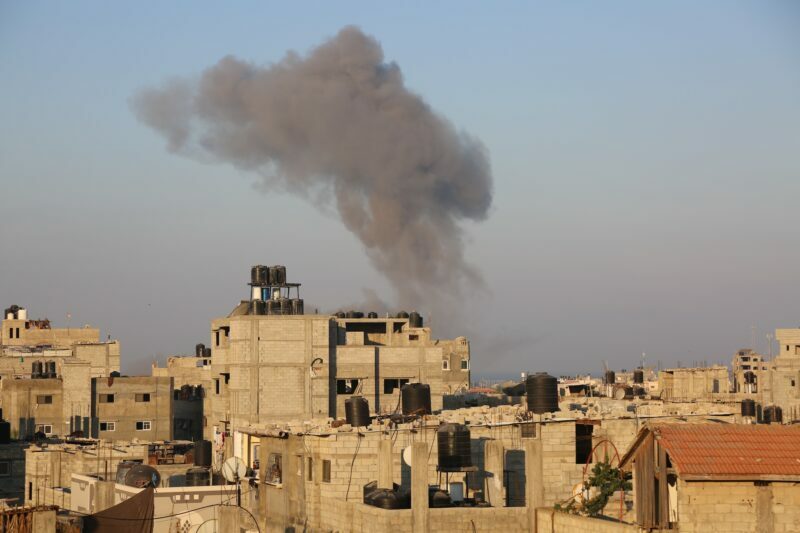
Late Wednesday, cabinet members unanimously agreed to intensify IDF terror-bombing of Gaza — including strikes on civilian targets.
War minister Gantz said “Gaza will burn” — meaning an intent to commit greater crimes of war and against humanity than already.
He lied accusing Hamas of using civilians as human shields.
Israeli warplanes continue terror-bombing civilian neighborhoods as it’s done before during preemptive wars on the Strip.
Residential and government buildings, schools, medical facilities, at least one mosque, agricultural lands, farmers in their fields, children in harm’s way, and Strip infrastructure was struck to make conditions for Gazans more untenable than already.
Mass slaughter and destruction keeps increasing by the hour.
Cold-blooded murder of Arabs is longstanding Israeli policy.
According to Defense for Children International – Palestine on Wednesday:
“Israeli forces continue to exhibit…complete disregard for international law, deploying explosive weapons and attacking densely-populated civilian areas in Gaza,” adding:
“As Palestinian children and families seek shelter from Israeli attacks, there is no safe space in the Gaza Strip.”
“Palestinian children in Gaza increasingly bear the brunt of Israel’s repeated military offensives and a human-made humanitarian crisis as a result of Israel’s closure policy toward the Gaza Strip.”
Deputy mayor of Lod, Ami Kaufman, said “hundreds of armed settlers from the West Bank are on their way to the city.”
“I suggest to every Arab resident not to leave their homes.”
“This has potential to be a bloodbath.”
Palestinian students in Israeli universities are being attacked, including in their dorms.
The Al Mezan Center for Human Rights condemned “intentional and disproportionate targeting of civilians and civilian properties” by Israeli terror-bombing and cross-border shelling,” adding:
The organization sharply criticized “inaction of the international community, as Gaza is pushed into perpetually worse security and humanitarian conditions.”
On Thursday, Al Jazeera reported that “residents and shop owners in Gaza City walked among the rubble and what is left of their homes and businesses following the heavy Israeli bombardment,” adding:
Shop owner Zakria Al-Halees struggled for words to explain damage affecting “the whole area.”
Images show widespread debris from days of ruthless IDF terror-bombing, defenseless civilians bearing the brunt of it — while the world community yawns and does nothing to hold Israel accountable for the highest of high crimes.
Iranian President Hassan Rouhani called for Muslim countries to unite against Israel, saying:
“The tragic incidents of the last few days and the crimes of the Zionist regime, more than ever, remind us of the need for unity and cooperation of Islamic countries to confront the Zionist coercion and occupation.”
“It is necessary for the Islamic countries to work together to defend the Palestinian people, and to confront the aggression and hostile and racist actions of the Zionist regime that we have witnessed in recent days and during the holy month of Ramadan.”
“The attacks and aggressions of the Zionist regime against the people of Palestine and Gaza Strip should stop immediately and we must not allow the Palestinian people to be oppressed anymore.”
In Damascus for discussions on “bilateral, regional and international issues,” Iran’s Foreign Minister Zarif condemned the “Israeli regime’s brutal aggression against Palestinians,” separately tweeting:
“It wasn’t enough for the Israeli regime to
-Steal people’s land & homes;
-Create an Apartheid regime;
It had to shoot innocent worshippers inside Islam’s 3rd Holiest Mosque upon Islam’s Holiest Eid.”
On Thursday, the Syrian People’s Assembly (PA) “condemned in the strongest terms the barbaric Zionist racist practices against the defenseless Palestinian Arab people, stressing that these practices are a flagrant violation of all international pacts, resolutions and norms, and a violation of the most basic rules of the international humanitarian law” — the Syrian Arab News Agency (SANA) reported, adding:
The PA “affirmed its stand by the Palestinians in Occupied Jerusalem and in every part of the land of Palestine, indicating that the Syrians, who have faced for years and are still facing the forces of evil and terrorism, will continue to support their Palestinian brothers, as their enemy is one, and their fate and victory are the same.”
In vain, it urged the world community to intervene against Israeli aggression on their behalf.
It hasn’t happened since Israeli forces stole historic Palestine for exclusive Jewish use and development.
Nor is Israel ever held accountable for the highest of high crimes of war, against humanity, and other atrocities against Palestinians and other Arabs.
Separately on Thursday, Hamas political leader Ismail Haniyeh said “(r)esistance responds to the crimes of the occupying regime in Quds, the Gaza Strip and everywhere.”
“If the occupying regime wants to continue its attacks, we will also continue more attacks.”
According to the Hamas Al-Qassam Brigades’ Abu Obeida:
Its forces fired a cruise “missile… at (Israel’s) Ramon airport, about 220km from Gaza.”
Reuters reported that the facility continues to operate, saying it wasn’t struck.
According to Palestinian/American writer/activist Yousef Munayyer:
“Israeli lynch mobs (are) attacking Palestinians” unobstructed while IDF warplanes terror-bomb Gaza.
Armed and dangerous, extremist settlers are assaulting Palestinians in public, storming their homes, beating and terrorizing them — including women and children — while nearby Israeli security forces do nothing to stop them.
They’ve been roaming East Jerusalem streets, shouting “Death to Arabs.”
In Occupied Palestine, the safety and welfare of non-Jews is never secure at all times.
Today in apartheid Israel, Arabs are in mortal danger — from Netanyahu regime security forces and extremist settlers out for blood.
A Final Comment
Instead of condemning Israeli ruthlessness and demanding accountability, spokesman for UN secretary general Guterres, Stephane Dujarric, merely called on the Netanyahu regime to “exercise maximum restraint and respect the right to freedom of peaceful assembly,” according to a UN statement.
“The secretary general reiterates his commitment, including through the Middle East Quartet, to supporting Palestinians and Israelis to resolve the conflict on the basis of relevant United Nations resolutions, international law and bilateral agreements,” Dujarric added.
Time and again, Guterres disgraced himself and the office he holds by failing to denounce US/NATO/Israeli aggression and demand accountability for high crimes too serious to ignore.
Meaningless weak-kneed statements — directly or through his spokesman — are issued time and again instead of doing the right thing he consistently avoids.
Horrific bombing in Kabul part of US plot to cover up failures in proxy, Takfiri wars: Iran military chief
Press TV – May 13, 2021
Iran’s military chief has condemned a terrorist attack that recently targeted a girls’ school in the Afghan capital, saying the “horrific crime” committed by mercenaries of the US is part of America’s plots to cover up two decades of its failures in the Asian country and the region.
“This horrific crime is in fact part of a series of the Americans’ overt and covert measures to cover up the defeat of their policies in Afghanistan during 20 years of disgraceful presence [in Afghanistan] and also their failure in the proxy and Takfiri wars in the region,” said Chairman of the Chiefs of Staff of the Iranian Armed Forces Major General Mohammad Baqeri in a statement on Friday.
At least 85 people, mostly schoolgirls, lost their lives in explosions caused by a car bomb and mortar shells targeting a school in the Shia majority neighborhood of Dasht-e-Barchi in western Kabul on Saturday.
The Afghan government blamed the Taliban for the bloody attack, but the militant group has denied any role. Analysts say the incident bears the hallmark of attacks by Daesh terrorists, who have gained a foothold in the country by taking advantage of the mayhem caused by the US-led military intervention.
Baqeri further said the US had organized and sent the remnants of Daesh terrorists and other Takfiri groups from Syria and Iraq to Afghanistan as a pretext to prepare the ground for halting the pullout of the American forces from the war-stricken state and to justify the claim that the presence of its troops there would prevent violence.
“The brutal crime committed by mercenaries of the terrorist regime in the US… showed that the hated and evil rulers of this country consider it permissible to commit any crime against humanity, specially Muslims, to achieve their evil goals and intentions,” Baqeri said.
He extended his condolences to the prudent Afghan people, especially the bereaved families of the victims, and expressed hope that the brave nation would neutralize the vicious plots of the US and its regional and trans-regional allies through their vigilance.
The top Iranian commander also expressed hope that the perpetrators of the terrorist crime would be identified, and that Afghanistan and other Muslim nations in the West Asia region would witness sustainable independence, stability, security and tranquility.
Just two days after the Kabul attack, a bus explosion in Afghanistan’s Zabul Province’s Shahr-e Safa District killed or injured as many as 25 people.
The rise in such acts of violence follows a decision announced by the United States for the withdrawal of its forces from the country.
Some observers view as suspicious the circumstances surrounding the terrorist attacks and the fact that no group has yet claimed them.
They cite the precedence of Washington’s refusal of acting on its pledge of withdrawal from the regional countries, saying such incidents could be used as pretexts to prolong the presence of America and its allies.
Featured Video
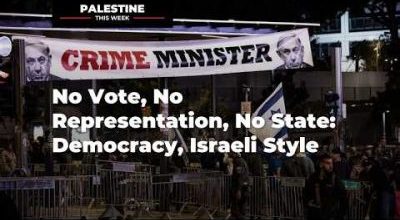
No Vote, No Representation, No State: Democracy, Israeli Style
or go to
Aletho News Archives – Video-Images
From the Archives
Sanctions, War and the Policy of Dual Containment
By SASAN FAYAZMANESH | March 17, 2008
It is now nearly three decades since the Unites States adopted the policy of dual containment of Iran and Iraq. While much has been written about the containment of Iraq, there has been very little in-depth analysis of this policy when it comes to Iran. In a book that is going to be released on March 31, 2008, entitled The United States and Iran: Sanctions, Wars and the Policy of Dual Containment (Routledge), I attempt to address this shortcoming by investigating when and why the US policy of containment of Iran came about, how it evolved, and where it stands today.[1] To the extent that Israel has been involved in US policy making, the study will also include the role that Israel has played in the containment of Iran. Also, since the fate of Iran has been inextricably linked to that of Iraq, occasionally the investigation will overlap with the containment of Iraq.
The policy of dual containment of Iran and Iraq originated during the Carter Administration, but it was not until the Clinton Administration that the expression “dual containment” became popular. … continue
Blog Roll
 Aletho News
- Elmo Sold mRNA Jabs to Your Toddler. Now They Are “Off-Label.”
- British state targets Palestine Action with yet another crooked trial
- Americans are paying the price to preserve Israel’s nuclear hegemony
- Resistance factions are necessary to ensure a permanent US Iraq withdrawal
- How Israel destabilizes the Middle East: Denying sovereignty and the right to exist
- Europe’s Establishment Is Embracing War – and Losing Voters
- NATO chief advocates war of aggression
- No Vote, No Representation, No State: Democracy, Israeli Style
- Zionist Bought Senate Blocks Information About American Citizens Killed By Israel
- While Gaza dominates the UN, these are the people keeping it alive
- If Americans Knew
- Israeli Soldiers Abduct At Least 22 Across Occupied West Bank
- Eight Palestinians Killed in Israeli Attacks on Gaza
- Israeli former leaders and security chiefs threaten legal action over ‘Jewish terrorism’
- Israel map in LA Times ad includes all land from the river to the sea
- Inside Lebanon’s 200-page dossier on Israeli war crimes
- Flydubai, genocide, settler violence, Trump abuse of power to deport – Daily Update
- Counting Antisemitic Incidents: What the ADL Audit Reveals — and Obscures
- Mamdani releases plan to combat antisemitism and hate crimes in New York City
- Iran’s Revolutionary Guards Publish Letter to the American People
- DMFI launches $1 million ad campaign supporting Virginia’s Elaine Luria
- No Tricks Zone
- Green Energy Debacle: German Expert Professor Fritz Vahrenholt Warns Of Severe Economic And Social Consequences
- Two More Paleo Reconstructions Affirm Meters-Higher Sea Levels Across Ireland, Brazil 7000-6000 Years Ago
- New Study: Earth And Venus Surface Warmth Largely Explained By Convection And Lapse Rate, Not CO2 Or Radiation
- 2025 Nature Paper Claiming Worsening Global Drought Gets RETRACTED …Heavily Flawed
- New Study: ‘Global Drought Shows No Detectable Recent Acceleration Under Climate Warming’
- Economic Masterminds: German Socialists Suggest Taxing Productivity Gains Stemming From Using AI
- The South China Sea Has Not Been Cooperating With The Climate Change Narrative
- Energy Crisis: Germany Enters Heating Season With Historically Low Gas Reserve Fill Levels
- New Study: The Antarctic Ice Sheet Gained Mass From 2020-2024 Due To Staggering Snow And Ice Accumulation
- Study: Ocean Heating Rates From Thousands Of Years Ago ‘Dwarf’ Modern Ocean Heating Rates

