Israel’s list of compromised officials suggests their guilt of war crimes
By Ramona Wadi | MEMO | July 21, 2020
The International Criminal Court (ICC) has adjourned without issuing its ruling on whether Israeli officials will be tried for war crimes against the Palestinian people since 2014, when Gaza was destroyed during “Operation Protective Edge”. With an extended timeframe until the ruling is due, Israel now has additional time to prepare for any eventual action taken by The Hague. It has apparently already drawn up a list of officials who might be liable to be prosecuted for war crimes.
According to Haaretz, the list contains the names of 200-300 Israeli officials, most probably including Prime Minister Benjamin Netanyahu and Defence Minister Benny Gantz. The list has been drawn up in utmost secrecy, not least because, as Haaretz points out, “The court is likely to view a list of names as an official Israeli admission of these officials’ involvement in the incidents under investigation.” The existence of the list alone is likely to be viewed as such.
However, what needs to change at an international level is the endorsement of Israel’s security narrative. The ICC’s clear mention of war crimes, as opposed to alleged war crimes – the latter being a phrase which many human rights organisations have used and through which Israeli impunity has also been cultivated – should prompt a new reckoning of Israel’s standing and its state violence.
During that 2014 military offensive against the Palestinians in Gaza, the international community was quick to promote “Israel’s right to defend itself” even as Palestinian civilians were being slaughtered. So far, the UN has never considered Palestinians as anything other than a statistical detail supporting its purported humanitarian endeavours.
The fact of the matter is that Israel is a colonial entity, but this has been eliminated from international diplomatic discourse, to the detriment of the Palestinian people. Hence the discrepancies when speaking of Israel’s perpetual violations against the Palestinians; by refusing to include the colonial-settler context, the international community eliminates the foundations of what have now been described clearly as war crimes by the ICC.
The list itself suggests guilt, admitted more or less openly by the very fact of its compilation. While the criminal investigations are down to the competence of the ICC, it rests with the international community to see them through to their conclusion, rather than simply parroting Israel’s excuses for its violence. The planned annexation of the occupied West Bank is a case in point. Israeli officials are concerned that implementing the annexation plans will be detrimental to Israel, especially given that settlement expansion is being considered as the strongest evidence of war crimes. The international community, however, has still failed to unite against the possibility of additional war crimes being committed against the Palestinian people, and limited its response to repeated statements that annexation is against international law.
Israel has never, ever, heeded such statements. The possibility of ICC investigations, however, is exposing the fact that Israel knows it has committed war crimes and is preparing to shield the perpetrators from international prosecution. If the UN is truly concerned with safeguarding human rights, it should seize the opportunity to refrain from further endorsement and dissemination of Israel’s security and “self-defence” narrative, which itself violates international law. It should adopt a strong stance against Israel and its annexation plan, and stand by the ICC’s clear admission that colonial expansion is a war crime. The UN, however, cannot do so without taking into account its own complicity in maintaining Israel’s colonial violence, hence the absence of a consistent human rights narrative which would support a possible criminal investigation at an international level.
Is Israel Uniquely Evil?
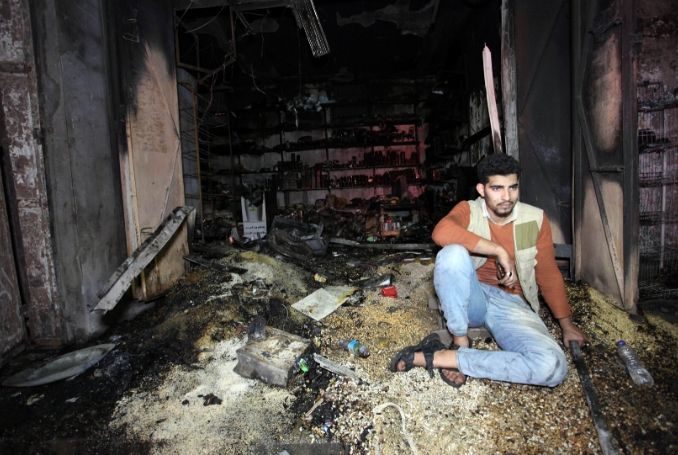
Many Palestinians in the camp lost their small businesses amid a dire economic crisis. Photo: Fawzi Mahmoud
By Irfan Chowdhury | Palestine Chronicle | July 18, 2020
Recently, political journalist Sunny Hundal tweeted in relation to the left’s alleged obsession with Israel:
“In isolation, Israel does a lot of bad things re: human rights.
Is it uniquely bad? Is it worse than others?
Not even close. So if you’re obsessed by actions of Jews, don’t be surprised if people suspect your motives.”
Similar sentiments have been expressed by LBC radio host Maajid Nawaz, who has declared that Israel is “the constant what-about excuse used by everyone who doesn’t want to address some real grave, serious issues in the Middle East but constantly wants to point fingers instead at the Middle East’s only secular, democratic and yes, very imperfect, country”.
Likewise, former Labour MP Ian Austin recently wrote an article for Express & Star in which he asserts that “many people on the left have become obsessed with Israel. This tiny country – the world’s only Jewish state and the Middle East’s only democracy – seems to attract more criticism than all the world’s other controversies combined… Of course, Israel’s not perfect. What country is? But where else in the Middle East would you find free and fair elections, a free and vibrant media; a robust and independent judiciary and strong trade unions?”
As a factual matter, it is untrue that the left is single-mindedly focused on Israel; when I was on the committee of my university’s Socialist Students Society a few years ago, we had meetings on the Israel-Palestine conflict, the economic crisis in Venezuela, protests in Iran, Saudi Arabia’s war on Yemen, Bolsonaro’s election in Brazil, gun violence in the US and the prospect of reforming the EU, among other international issues.
Former Labour leader Jeremy Corbyn, who is one of the most important left-wing figures in British political history, has been a life-long champion of the rights of not only Palestinians, but also Kurds, Western Saharans, West Papuans, hagossians, and numerous other oppressed peoples. Nevertheless, even if it were true that the left does focus on Israel more than other countries, this would not be unjustified because, contrary to the claims of the aforementioned commentators, there are certain respects in which Israel’s human rights violations are uniquely severe in the international arena.
For example, Israel’s military occupation of the West Bank and Gaza is the longest-running military occupation in modern history. It has been ongoing now for 53 years and has been characterized by systematic and egregious human rights violations such as home demolitions, torture, night raids, abduction and imprisonment of children, harassment at checkpoints, the killing of civilians, destruction of agriculture, and daily humiliation at the hands of soldiers and settlers (all of this is documented in great detail by the Israeli human rights organization B’Tselem).
All military occupations are brutal and vicious; to have to endure one that is also predicated on deliberate displacement and dispossession for 53 years is simply unimaginable for most people. In the case of Gaza, the occupation has been compounded by an illegal siege that has been ongoing now for 13 years; in 2015, then UNRWA Commissioner-General Pierre Krahenbuhl described Israel’s siege of Gaza as the “longest in history” and “a very extreme form [of] illegal collective punishment.”
The siege prevents anyone from leaving Gaza, apart from in exceptional cases; for example, sick children are sometimes allowed to receive medical treatment in the West Bank, but their parents aren’t allowed to accompany them – even when it means that the children are forced to die alone (as in the case of 5-year-old Aisha alLoulou). Anyone who tries to fish beyond the contaminated coastal waters of Gaza gets either shot at or kidnapped by the Israeli navy, and anyone who crosses the barbed-wire fence into Israel runs the risk of being murdered by the IDF (as in the case of 17-year-old Emad Khalil Ibrahim Shahin, who crossed over in 2018 and was returned to his family one year later in a body bag).
As a result of the siege, 97% of the water in Gaza is now unfit for human consumption; according to Sara Roy, Senior Research Fellow at Harvard University’s Centre for Middle East Studies, this means that “Innocent human beings, most of them young, are slowly being poisoned by the water they drink and likely by the soil in which they plant”.
Thus, Israel has been carrying out the longest-running military occupation in modern history and the longest-running siege in modern history. These two facts alone render Israel unique in terms of the scope of its brutality and criminality.
There are other respects in which Israel stands out from other countries in its use of terror and violence; for example, it is one of the most aggressive countries in the world, having waged wars of aggression against Lebanon in 1978, 1982, 1993, 1996 and 2006, and against Gaza in 2004, 2006, 2008/9, 2012 and 2014, killing huge numbers of civilians in the process (all while issuing threats and carrying out various covert attacks against Iran, which are all in violation of the UN Charter).
Furthermore, according to Amnesty International, Israel is “the only country in the world that automatically prosecutes children in military courts that lack fundamental fair rights and guarantees” (the military courts have a 99% conviction rate).
Children are routinely abused during interrogations (the UN Committee on the Rights of the Child has reported that “Palestinian children arrested by [Israeli] military and police are systematically subject to degrading treatment, and often to acts of torture”), and in the overwhelming majority of cases, their parents are excluded from the entire ‘judicial’ process. It is worth noting that all of these human rights violations are directly enabled and facilitated by both the US and the UK.
These are all examples of how, in many ways, Israel is uniquely evil. The easiest way for Israel to stop being singled out for criticism – whether real or imagined – would be for it to stop singling itself out with its appalling human rights record.
– Irfan Chowdhury is a freelance writer who has previously been published in openDemocracy, The Iranian, Mondoweiss, Peace News and Hastings In Focus. He also runs a blog, where he mostly writes about British foreign policy, the Israel-Palestine conflict and civil liberties: https://irfanchowdhury98.com/
Israel creates list of officials to prevent arrests for war crimes
MEMO | July 16, 2020
Israel is preparing a secret list of hundreds of its officials who are liable to be tried in The Hague on war crimes charges, it has been revealed. The government is warning them not to travel in case they are arrested.
According to Haaretz, the list has the names of between 200 and 300 military and intelligence officials who could be arrested and put on trial for war crimes committed against civilians in the occupied Palestinian territories of the West Bank and the Gaza Strip.
The report comes amid news of the International Criminal Court (ICC) possibly opening an investigation into war crimes committed by both Israel and Hamas, starting from the Israeli military offensive on Gaza in 2014, known as “Operation Protective Edge”. The request for the trial was made by ICC Prosecutor Fatou Bensouda.
The list was supposed to be kept secret due to the danger it could pose to the officials whose names it contains. It could also be viewed by the ICC as an admission of guilt. Those on the list include Prime Minister Benjamin Netanyahu; former Defence Ministers Moshe Ya’alon, Avigdor Lieberman and Naftali Bennett; former Chiefs of Staff Benny Gantz and Gadi Eisenkot, and current Chief of Staff Aviv Kochavi, as well as the former and current heads of the Shin Bet intelligence agency, Yoram Cohen and Nadav Argaman respectively.
It is suspected that the remainder could be more junior officers and officials, including those who approved the building of Jewish-only settlements within the occupied West Bank. Such settlements are illegal under international law and are one of the subjects of the ICC investigation.
The future of the investigation is to be decided by Judges Peter Kovacs of Hungary, Marc Perrin de Brichambaut of France and Reine Adelaide Sophie Alapini-Gansou of Benin. It will also depend on whether the court has jurisdiction over the areas where the war crimes were committed, which include the occupied West Bank, Gaza Strip and East Jerusalem. Israel insists that the ICC has no such authority or jurisdiction in those areas, as the Palestinian Authority (PA) is not a sovereign state.
This has led many observers to predict that Israel will refuse to cooperate with the ICC, which could result in the court ordering secret detention orders and warrants against the Israeli officials. This would limit their ability to travel and keep Israel unaware of the court proceedings.
If an investigation into alleged war crimes is opened, Israel’s illegal annexation plans for the West Bank could also have a serious impact on any defence that it might mount. Bensouda has included this factor in her preliminary investigation.
The threat of an ICC investigation into Israel’s and America’s alleged war crimes has been criticised by both countries. US President Donald Trump imposed sanctions on the court last month, a move praised by Israel. Nevertheless, the ICC has received further complaints about alleged Israeli and US war crimes over the past month, strengthening the case for a formal investigation.
US sanctions are part of a multi-front war on Syria mainly targeting its long-suffering civilians
By Eva Bartlett | RT | July 13, 2020
The US is waging multiple fronts of war against Syria, including brutal sanctions, while claiming concern over the wellbeing of Syrian civilians – the vast majority of whom are suffering as a direct result of US policies.
On June 17, the US implemented the Caesar Act, America’s latest round of draconian sanctions against the Syrian people, to “protect” them, America claims. This, after years of bombing civilians and providing support to anti-government militants, leading to the proliferation of terrorists who kidnap, imprison, torture, maim, and murder the same Syrian civilians.
Just weeks after these barbaric sanctions were enforced, cue American crocodile tears about Syrian suffering, and claims that Moscow and Damascus are allegedly preventing the delivery of humanitarian aid. More hot air from American hypocritical talking heads who don’t actually care about Syrians’ well being.
America trigger-happily sanctions many nations or entities that dare to stand up to its hegemonic dictates. The word “sanctions” sounds too soft – the reality is an all-out economic war against the people in targeted nations.
Sanctions have, as I wrote last December, impacted Syria’s ability to import medicines or the raw materials needed to manufacture them, medical equipment, and machines and materials needed to manufacture prosthetic limbs, among other things.
Syria reports that the latest sanctions are already preventing civilians from acquiring “imported drugs, especially antibiotics, as some companies have withdrawn their licenses granted to drug factories,” due to the sanctions.
In Damascus, pharmacies I’ve stopped into, when I ask what some of the most sought-after medications are, hypertension medications are at the top.
But sanctions have yet another brutal effect: they wreak havoc on the economy.
The destruction of Syria’s economy is something US envoy for Syria, James Jeffrey, boasted about, reportedly saying that the sanctions “contributed to the collapse of the value of the Syrian pound.”
The website Sanctions Killnotes :
“Currencies are devalued and inflated when sanctions are levied. Countries are pressured to stop doing business with targeted countries. Sanctions violate international law, the UN charter, Geneva and Nuremberg conventions because they target civilians by economic strangulation, creating famines, life-threatening shortages, and economic chaos.”
So you have Western hypocritical talking heads pretending they want to get aid to Syrian civilians while literally cutting them off from medicine and the ability to purchase food.
Resource theft and arson
But these crimes against humanity don’t suffice for America. The US occupation troops and their Kurdish proxy forces (the SDF) are plundering Syria’s oil resources to the tune of $30 million a month as of last October, according to Russian military estimates.
In early July, SANA reported another convoy leaving Syria to Iraq, loaded with oil thieved from areas under US occupation.
Terrorists and US proxy groups are also thieving Syria’s cotton, olives, wheat, and flour.
Further, Syria accuses the US of deliberately setting fire to crops using Apache-dropped thermal balloons.
Civilians from affected areas near Turkish occupation posts likewise blame Turkish forces for setting fires and firing live ammunition upon those who attempt to extinguish the fires, farmers literally watching their livelihoods go up in flames. The Hasakah Agriculture Directorate director likewise blames Turkey for arson of the crops.
Turkish occupation forces are also accused of cutting water supplies at Alouk water pump station, depriving one million people in the Hasakah region of drinking and agricultural water, with no condemnation from the Security Council.
The poverty and suffering Syrians are enduring these days is unbearable, with prices of basic goods doubled and tripled from just a few months ago, turning what were affordable items into luxuries, particularly for the 7.9 million food-insecure Syrians.
But alarmist Western media and representatives omit the context: the nearly 10 years of war on Syria; the deliberate targeting by terrorists and by US and Turkish occupation forces, and Israel, of Syria’s infrastructure; the looting of oil, wheat and cotton, even allegedly stealing parts of an Idlib power plant for scraps sale in Turkey.
Likewise, Aleppo’s heavy industry was thieved during the years when terrorists occupied the industrial zones of the city. Heavy machinery was reportedly trucked in broad daylight to Turkey.
With all of these factors, of course there is poverty and a chaotic economy.
A safe resolution rejected
Recently, the UNSC passed a resolution to maintain one humanitarian border crossing from Turkey into Syria, the Bab al-Hawa crossing.
Prior to that, Russia had proposed a resolution enabling the safe delivery of humanitarian aid from within Syria.
On July 11, Russia’s Permanent Mission to the UN issued a statement again noting the need to phase out cross-border deliveries, as the Syrian government has regained much of the territories previously occupied by terrorist factions, and deliveries must be made from within Syria.
The UNSC resolution that passed, however, continues the delivery of aid via Turkey, delivering to the hands of Al-Qaeda and other terrorist groups occupying Idlib. It is with these people the US aid ends up when delivered, from Turkey, not from Syrian territory.
Given that the US has supplied weapons to anti-government extremists in Syria before, it is not illogical to believe they hoped to funnel still more weapons in under the pretext of “aid” deliveries.
Russia’s statement also noted the lack of UN presence in the Idlib de-escalation zone, saying:
“It’s not a secret that the terrorist groups, listed as such by the UN Security Council, control certain areas of the de-escalation zone and use the UN humanitarian aid as a tool to exert pressure on [the civilian] population and openly make profit from such deliveries.”
This is what Russia and China opposed, not the delivery of aid.
Those are details which US Ambassador Kelly Craft slyly omitted when she spoke of callousness and dishonesty being an established pattern. Her verbal guns were aimed at Syria and Russia, but her choice of words perfectly describes US policy towards Syrians.
One only needs to look at US policy towards displaced Syrians in Rukban Camp to see that the US has actively worked to prevent aid deliveries there and prevent Syrians from being evacuated from there. Or the lack of US outcry at Turkey’s prevention of humanitarian convoys from reaching Idlib areas, which while scheduled for last April still hasn’t been successful.
On the other hand, on July 4 the WHO acknowledged the Syrian-Russian delivery of 85 tons of medicines and medical supplies from Damascus to Al Hasakah. On July 9, the Russian Reconciliation Center noted that 500 food packages (2,424 tons) were delivered to Idlib province and Deir-ez-Zor province.
I wonder how many tons of actual aid the US would send…
In case it isn’t yet clear, America is weaponizing and politicizing aid, as it tried to do in Venezuela last year. American representatives posture and bellow, and Russia and Syria quietly go about actually delivering aid to needy Syrians.
The Russian post-resolution statement also critically noted the brutal impact of sanctions on Syria, which, as detrimental to Syrians’ wellbeing as they are, somehow don’t merit the feigned concern of representatives like Craft.
The statement said:
“These coercive measures seriously undermine not only the socioeconomic situation in Syria, but also impede activities of many humanitarian NGOs that are ready to help the population in territories controlled by Syrian official authorities.”
If America truly wanted to alleviate the suffering of Syrians, all sanctions against the country and people would be immediately lifted.
Eva Bartlett is a Canadian independent journalist and activist. She has spent years on the ground covering conflict zones in the Middle East, especially in Syria and Palestine (where she lived for nearly four years). Follow her on Twitter @EvaKBartlett
Britain’s Gentleman Posturing Comes Undone With Absurd Hypocrisy
By Finian Cunningham | Strategic Culture Foundation | July 13, 2020
It’s official Britain at its best, posing as the quintessential gentleman upholding morality while at the same time engaging in despicable double-dealing for grubby interests.
The British government announced sanctions against various nations last week, including Russia and Saudi Arabia, proclaiming the punitive measures were due to alleged human rights violations. Foreign minister Dominic Raab, summoning throaty British authority, declared to the House of Commons that it sent a “clear message” to the world of British rectitude.
The next day, however, London made a separate announcement that it was resuming arms sales to Saudi Arabia, despite an international outcry over war crimes committed in Yemen. Thousands of civilians have been killed in Yemen by Saudi warplanes bombing that country over the past five years.
It is estimated by the United Nations that the majority of civilian casualties have been caused by air strikes carried out by the Saudi-led coalition.
Britain, as well as the United States and France, has been arming the Saudi military coalition in its war in Yemen. The British arms trade was halted last year as “unlawful” by a court ruling out of concern for civilian deaths. Now though the British government has decided that the arms dealing can resume because violations were deemed by ministers to be “isolated” incidents. How quaint is the self-serving subjectivity of British officialdom.
The UK-based Campaign Against the Arms Trade (CAAT) slammed the government’s decision, saying it was “morally bankrupt”.
“The Saudi-led bombardment of Yemen has created the world’s worst humanitarian crisis, and the government itself admits that UK-made arms have played a central role in the bombing,” said CAAT, adding with wry irony: “The government claims that these are isolated incidents, but how many hundreds of isolated incidents would it take for the government to stop supplying the weaponry?”
What’s more, it turns out that the British posturing on human rights and sanctions was only meant for public appearance, not be taken seriously. That’s according to the British government itself.
The Independent newspaper reports that British defense minister Ben Wallace immediately phoned his counterpart in Riyadh to “apologize” for the latest imposition of sanctions. “The UK government privately showered Saudi Arabia’s government with praise,” it is reported.
The “discreet” phone call, which emphasized the importance of British arms sales to the oil-rich kingdom, was not publicly disclosed by London. Instead it was revealed by the Saudi state media which boasted about the lavish praise from the British government.
Between 2015 and 2019, it is estimated that Britain sold over £5.3 billion ($6.7 bn) worth of weapons to Saudi Arabia, much of that boosted by the war in Yemen.
The war has led to the world’s worst current humanitarian crisis with millions of Yemenis facing starvation and death from disease. Images of skeletal children dying from cholera and other preventable diseases should make anyone with a heart tremble with indignation.
The UK’s arms trade is fueling that catastrophe. Evidently, British avarice for profits is too great to put a check on its lucrative weapons dealing regardless of the death and destruction it generates.
But that best of British baseness is only matched by its government’s rank hypocrisy in posing as a defender of human rights and wielding sanctions against other nations.
The sanctions it imposed on Russia were, according to London, related the death in a Moscow prison of tax accountant Sergei Magnitsky in 2009. Russia claims Magnitsky died from an existing medical condition while in detention on massive corruption charges. Washington has used the case as a political stick to beat Moscow with. London is doing Washington’s bidding with its latest sanctions. It also fits the lurid narrative of Russia allegedly running assassination plots in Western states against dissidents and former spies. Thereby stoking a Cold War-style stand-off between the West and Russia.
Britain has been doing similar kowtowing to Washington with its belated ban on China’s Huawei telecoms firm being involved in modernizing mobile phone and internet networks.
Moscow has dismissed the latest British sanctions as “pointless” and said it would reciprocate with its own punitive diplomatic measures against London. That’s something which the British government may come to rue as it seeks to drum up wider international business in the post-Brexit world. The price for serving as Washington’s Jeeves-the-butler flunkey could be high indeed.
How absurd and surreal for London to lecture others about violations when it is complicit in genocide in Yemen. We could also cite Iraq and Afghanistan among many other foreign aggressions. That feat of preposterousness is a reflection of the insidious efficacy of British state propaganda and “education”. Polls show Britons are more likely (compared with other former colonial powers) to think that the British Empire was a good thing, despite the tens of millions who were killed under British subjugation.
One can only hope for the day when the world will actually implement human rights justice and the government in London will be sanctioned to the hilt for the pariah that it truly is.
The UN has found that the US killing of Soleimani broke international law. It’s right, but nothing will happen as a result
By Scott Ritter | RT | July 8, 2020
For America, international law has no meaning. In Washington’s view, it applies to other countries, but not to them. Sadly, this well-reasoned UN declaration is simply an exercise in frustration and irrelevance.
On paper, it sounds very copesetic: “… a single strike, one or two cars targeted, 10 individuals killed, in a non-belligerent country, surrounded by people unaware of and unprepared for an international armed conflict.”
With these words, Agnes Callamard, the United Nations Special Rapporteur on extrajudicial, summary or arbitrary executions, described the assassination of Qassem Soleimani in a report submitted to the Human Rights Council.
Callamard’s report covered the broad topic of ‘Extrajudicial, summary or arbitrary executions’, and focused in particular on the use of armed drones for targeted killing. She observed that such acts are carried out by conventional means, such as Special Operations Forces, and as such her report “contains findings applicable to all forms of targeted killings, no matter their method.”
In her report, Callamard singled out the assassination (i.e., “targeted killing”) of General Soleimani as “the first known incident in which a State [e.g., the US] invoked self-defense as a justification for an attack against a State-actor, in the territory of another state, thus implicating the prohibition on the use of force in Article 2(4) of the UN Charter.” It declares that “All Members shall refrain in their international relations from the threat or use of force against the territorial integrity or political independence of any state, or in any other manner inconsistent with the Purposes of the United Nations.”
Callamard labeled the killing of Soleimani by a US drone strike an “arbitrary killing,” noting that while the US claimed that the strike was in response to an “escalating series of armed attacks in recent months” by Iran, the US claim “fails to describe even one ongoing attack.”
Instead, Callamard describes a series of separate and distinct attacks which are not, in and of themselves, escalating, related in time or at all. Moreover, by attacking Soleimani on Iraqi soil without the consent of Iraq, the US violated Iraq’s “territorial integrity.”
Callamard couches her case in the language of international law, noting that various international courts have “established that human rights treaty obligations can apply in principle to the conduct of a State outside its territory.” Moreover, as Callamard points out, the Human Rights Committee to whom she reports “has established that a State party has an obligation to respect and to ensure the right to life of all persons whose right to life is impacted by its military or other activities in a direct and reasonably foreseeable manner.” This obligation, Callamard argues, applies to drones strikes and their targets, which fall within the jurisdiction of the state operating the drone.
As Callamard notes, to date there is a refusal on the part of courts of jurisdiction to provide oversight regarding extra-territorial killings by armed drones, noting that “such matters are political, or relate to international relations between states and thus are non-justiciable.” Callamard rejects this excuse, noting that it “cannot be reconciled with recognized principles of international law, treaties, conventions, and protocols, and violates the rights to life and to a remedy.”
Callamard says that the US, in justifying the assassination of Qassem Soleimani, cites the self-defense clause of Article 51 of the UN Charter. But, as she points out, “even the legality of a strike under Art. 51 of the UN Charter does not preclude its wrongfulness under humanitarian or human rights law.”
International jurisprudence, as Callamard observes, suggests that self-defense could only be invoked against a threat that is already there. Void of such an imminent threat, the US action operates in violation of Article 6 of the International Covenant on Civil and Political Rights (ICCPR), which prohibits “arbitrary deprivations of life.”
At the end of the day, however, the Special Rapporteur’s report is, for all practicalities and solid reasoning, an exercise in frustration and irrelevance.
For laws to have any effect, they must be enforceable, and to be enforceable there must be jurisdiction. To decide that the US, through its extrajudicial and extraterritorial assassination of Soleimani, was in violation of Article 6 of the ICCPR is one thing; turning that decision into anything other than an act of moralistic chest-thumping is another.
One would think it should not be this way. After all, Article VI, paragraph 2 of the US Constitution makes treaties the supreme law of the land on the same footing with acts of Congress. The US Senate provided its advice and consent to the ratification of the International Covenant on Civil and Political Rights, which had been adopted by the United Nations General Assembly on December 16, 1966, and signed on behalf of the US on October 5, 1977. Simply put, Article 6 of the ICCPR is the law of the land.
Not so fast. Senate ratification was contingent upon a number of “Reservations, Understandings, Declarations and Proviso,” including one which declared that “the United States declares that the provisions of Articles 1 through 27 of the Covenant are not self-executing.”
As such, regardless of whether issues pertaining to the entry into and ratification of the ICCPR make it sufficient to imbue its provisions as the “law of the land,” the fact that the US Senate expressly indicated that certain provisions of the ICCPR not to be self-executing means that Article 6 of the ICCPR cannot be seen as standing alone as the equivalent to an act of the legislature, but rather requiring a subsequent act of Congress before its provisions can be put into effect.
As the US Supreme Court once observed, “A treaty is primarily a compact between independent nations. It depends for the enforcement of its provisions on the interest and the honor of the governments which are parties of it.”
The odds of the US Congress stepping up and enacting legislation that would confer legitimacy to the Special Rapporteur’s finding that the US acted in violation of Article 6 of the ICCPR when killing Soleimani are zero; it is not in the interest of Congress to do so, and anyone searching for a semblance of honor within Congress would have better odds canvassing a brothel.
International law, like the Constitution which imbues it with relevance as far as the US is concerned, only possesses the meaning and legitimacy that a society is willing to vest in it. The US, acting on legislation passed by Congress, has engaged in a whittling away of the rights and protections afforded to Americans and world citizens to the point that neither international law nor the Constitution have much meaning anymore.
It is not just the US Congress that has lost its voice when it comes to expressing moral outrage against the murder done in its name. “To date drones’ attacks and targeted killings are not the object of robust international debates and review,” Callamard concludes in her report. “The Security Council is missing in action; the international community, willingly or not, stands largely silent. That is not acceptable.”
Seen in this light, the words of Callamard take on a whole new level of urgency. “[T]he targeted killing of General Soleimani, coming in the wake of 20 years of distortions of international law, and repeated massive violations of humanitarian law, is not just a slippery slope. It is a cliff.”
Scott Ritter is a former US Marine Corps intelligence officer. He served in the Soviet Union as an inspector implementing the INF Treaty, in General Schwarzkopf’s staff during the Gulf War, and from 1991-1998 as a UN weapons inspector. Follow him on Twitter @RealScottRitter
Report finds UK enabled ‘unlawful’ Saudi-led naval blockade of Yemen, as London resumes arms sales to Riyadh
RT | July 8, 2020
The United Kingdom has been providing naval training to members of the Saudi-led coalition fighting in Yemen, skills which may have been used to impose a widely condemned embargo on the war-torn country, according to a new report.
The Royal Navy is instructing naval personnel from Saudi Arabia and the United Arab Emirates (UAE), Declassified UK has uncovered, even as the Gulf states continue to impose a devastating sea blockade on Yemen, resulting in millions of civilians living on the brink of starvation.
In September 2015, a UAE naval officer attended a four-week training course in southern England – just months after the Saudi-led coalition began its embargo on Yemen and bombed the port of Hodeidah, destroying warehouses, cranes and other infrastructure used to unload and store badly needed humanitarian supplies. The British program included instruction in ‘counter-smuggling’ and ‘board and search’.
Six months later, according to Declassified UK, Royal Navy officers spent a week in Saudi Arabia drilling 15 sailors on how to “board and search” vessels in “international waters or territorial seas.” The Saudi personnel were taught “high-risk search techniques” as well as detention procedures. Between September 2016 and March 2017, the UK also provided Saudi and UAE forces with instruction on protecting an Exclusive Economic Zone – the area off the coast of a country containing its exclusive fishing and other resource-gathering rights. The course was followed by training exercises with the Saudi Navy.
The relationship between the Royal Navy and the Saudi-led coalition continued even as the situation in Yemen rapidly deteriorated, the investigative report revealed. In 2019, the UAE navy received instruction on how to “board and search” vessels. The same year, nine Saudis, as well as personnel from Bahrain and the UAE, attended the Royal Navy’s officer academy at Dartmouth. Meanwhile, a number of commandos from the UAE were given instruction in amphibious operations during a 60-week Royal Marines course.
The training reportedly continues to the present day. According to the UK military watchdog, the Royal Navy has five sailors, including a lieutenant commander, on loan to the Saudi Navy. Three of the individuals are listed as instructors, suggesting that they could possibly be providing regular training to Saudi personnel. Some instruction coming from the UK has been provided by the private sector; BAE Systems, Britain’s largest arms firm, has a contract to train the Saudi navy.
The Saudi-led blockade, part of the coalition’s campaign against the Houthi rebels in Yemen, has been denounced by the international community as illegal. The UN’s special rapporteur on human rights and sanctions, Idriss Jazairy, warned that the embargo was “paralyzing a nation” and amounted to an “unlawful unilateral coercive measure under international law.” Millions of Yemenis now face starvation due in part to the sea blockade.
The humanitarian catastrophe has not deterred London from increasing its involvement in the conflict. On Tuesday, International Trade Secretary Liz Truss confirmed that the UK will resume arms sales to Saudi Arabia. The UK temporarily halted weapons deliveries to Riyadh after a court ruling in June 2019 found that the practice was unlawful. The British government now claims that, although there is cause for concern, “possible” war crimes carried out by the Saudi-led forces are only “isolated incidents.”
Featured Video

Can the U.S. Afford to Annihilate Iran?
or go to
Aletho News Archives – Video-Images
From the Archives
Sanctions, War and the Policy of Dual Containment
By SASAN FAYAZMANESH | March 17, 2008
It is now nearly three decades since the Unites States adopted the policy of dual containment of Iran and Iraq. While much has been written about the containment of Iraq, there has been very little in-depth analysis of this policy when it comes to Iran. In a book that is going to be released on March 31, 2008, entitled The United States and Iran: Sanctions, Wars and the Policy of Dual Containment (Routledge), I attempt to address this shortcoming by investigating when and why the US policy of containment of Iran came about, how it evolved, and where it stands today.[1] To the extent that Israel has been involved in US policy making, the study will also include the role that Israel has played in the containment of Iran. Also, since the fate of Iran has been inextricably linked to that of Iraq, occasionally the investigation will overlap with the containment of Iraq.
The policy of dual containment of Iran and Iraq originated during the Carter Administration, but it was not until the Clinton Administration that the expression “dual containment” became popular. … continue
Blog Roll
 Aletho News
- Can the U.S. Afford to Annihilate Iran? /Seyed M. Marandi
- Elmo Sold mRNA Jabs to Your Toddler. Now They Are “Off-Label.”
- British state targets Palestine Action with yet another crooked trial
- Americans are paying the price to preserve Israel’s nuclear hegemony
- Resistance factions are necessary to ensure a permanent US Iraq withdrawal
- How Israel destabilizes the Middle East: Denying sovereignty and the right to exist
- Europe’s Establishment Is Embracing War – and Losing Voters
- NATO chief advocates war of aggression
- No Vote, No Representation, No State: Democracy, Israeli Style
- Zionist Bought Senate Blocks Information About American Citizens Killed By Israel
- If Americans Knew
- Israeli Soldiers Abduct At Least 22 Across Occupied West Bank
- Eight Palestinians Killed in Israeli Attacks on Gaza
- Israeli former leaders and security chiefs threaten legal action over ‘Jewish terrorism’
- Israel map in LA Times ad includes all land from the river to the sea
- Inside Lebanon’s 200-page dossier on Israeli war crimes
- Flydubai, genocide, settler violence, Trump abuse of power to deport – Daily Update
- Counting Antisemitic Incidents: What the ADL Audit Reveals — and Obscures
- Mamdani releases plan to combat antisemitism and hate crimes in New York City
- Iran’s Revolutionary Guards Publish Letter to the American People
- DMFI launches $1 million ad campaign supporting Virginia’s Elaine Luria
- No Tricks Zone
- Green Energy Debacle: German Expert Professor Fritz Vahrenholt Warns Of Severe Economic And Social Consequences
- Two More Paleo Reconstructions Affirm Meters-Higher Sea Levels Across Ireland, Brazil 7000-6000 Years Ago
- New Study: Earth And Venus Surface Warmth Largely Explained By Convection And Lapse Rate, Not CO2 Or Radiation
- 2025 Nature Paper Claiming Worsening Global Drought Gets RETRACTED …Heavily Flawed
- New Study: ‘Global Drought Shows No Detectable Recent Acceleration Under Climate Warming’
- Economic Masterminds: German Socialists Suggest Taxing Productivity Gains Stemming From Using AI
- The South China Sea Has Not Been Cooperating With The Climate Change Narrative
- Energy Crisis: Germany Enters Heating Season With Historically Low Gas Reserve Fill Levels
- New Study: The Antarctic Ice Sheet Gained Mass From 2020-2024 Due To Staggering Snow And Ice Accumulation
- Study: Ocean Heating Rates From Thousands Of Years Ago ‘Dwarf’ Modern Ocean Heating Rates

