Think Tank-Addicted Media Turn to Regime Change Enthusiasts for Iran Protest Commentary
By Adam Johnson | FAIR | January 5, 2018
Since the outbreak of mass demonstrations and unrest in Iran last week, US media have mostly busied themselves with the question of not if we should “do something,” but what, exactly, that something should be. As usual, it’s simply taken for granted the United States has a divine right to intervene in the affairs of Iran, under the vague blanket of “human rights” and “democracy promotion.” (The rare exception, such as an op-ed by ex-Obama official Philip Gordon—New York Times, 12/30/17—still accepted the premise of regime change: “I, too, want to see the government in Tehran weakened, moderated or even removed.”) With this axiom firmly established in Very Serious foreign policy circles, the next question becomes the nature, degree and scope of the “something” being done.
Leading the pack in the “do something” insta-consensus was the right-wing pro-Israel think tank Foundation for Defense of Democracies (FDD), which has overwhelmed the narrative. In the past five days, FDD has had op-eds in influential US outlets like the Wall Street Journal, New York Times, New York Post and Politico, and has been quoted in a dozen more. Its punditry was marked by cynical “support” for Iranian protesters, demagoguing of the Iranian “regime” and disgust with the Obama-era Joint Comprehensive Plan of Action (JCPOA), otherwise known as the Iran deal.
The scrapping of JCPOA has been the primary political charge of FDD for years, and it seems to see the recent unrest in Iran—and any subsequent crackdown—as the thin moral pretext it needs to justify snuffing out a treaty it’s long opposed. Thus FDD has eagerly jumped on the unrest, painting itself as the sigh of the oppressed.
Op-eds written or co-written by FDD staff in the past five days:
- “Iran’s Theocracy Is on the Brink” (Mark Dubowitz/Ray Takeyh, Wall Street Journal, 1/1/18)
- “Where We Can Agree on Iran” (Mark Dubowitz/Daniel Shapiro, Politico, 1/1/18)
- “Eruption in Iran: And It’s Not Just the Economy, Stupid” (Clifford D. May, Washington Times, 1/2/18)
- “The Worst Thing for Iran’s Protesters? US Silence” (Reuehl Marc Gerecht, New York Times, 1/2/18)
- “What Washington Can Do to Support Iran’s Protesters” (Richard Goldberg/Jamie Fly, New York Post, 1/2/18)
A sampling of quotes by FDD staff in news reporting:
- “Since Rouhani entered office, he has managed to inflate expectations with lofty rhetoric but has actually done little to change the reality of life on the ground in Iran,” said Behnam Ben Taleblu, an Iran expert at the Foundation for Defense of Democracies in Washington.” (Washington Post, 12/30/17)
- “‘Western governments should make it clear that the regime will be held responsible and will pay a price for any bloodshed,’ Mr. Dubowitz said.” (Wall Street Journal, 1/1/18)
- “‘[Trump’s] not going to want to waive sanctions and keep money flowing to dictators when there are people protesting in the streets,’ said Richard Goldberg, a former Senate Republican aide who helped design Iran sanctions and is now a senior adviser at the hawkish Foundation for Defense of Democracies.” (Politico, 1/2/18)
- “‘If there is a bipartisan bill that is ready for congressional action, that would go a long way toward persuading the president to issue the waivers,’ said Mark Dubowitz, the chief executive of the Foundation for Defense of Democracies. ‘If there’s not, what’s happening in Iran will give the president all the more reason to say, “I’ve had it with this deal.”’” (New York Times, 1/2/18)
FDD op-eds and quotes followed a similar formula: express outrage on behalf of the protesters, applaud Trump for his hypocritical defense of the right to protest, and push for increased sanctions against Iran—often while taking a swipe at the hated Iran deal.
FDD’s pro-Iranian people posture was rarely accompanied by an explanation of their ideological project. The outfit—funded by big-name pro-Israel billionaires like casino mogul Sheldon Adelson, Home Depot founder Bernard Marcus (who’s said that “Iran is the devil”) and Wall Street speculator Paul Singer—are largely presented as bespectacled academics calling balls and strikes without a particular agenda beyond their self-proclaimed “defense of democracies.” (The name ought to provoke some skepticism, given the group’s eagerness to enlist the hereditary dictatorship Saudi Arabia in its anti-Iranian crusade—LobeLog, 2/26/16.)
This problem is not unique to FDD; as FAIR (8/12/16) has noted before, the overreliance by the media on deeply conflicted think tanks that present as neutral but are, in reality, glorified lobbyists for a political cause or corporate cohort misleads readers on an institutional scale. (In FDD’s case, it’s Israel’s right wing; for the Center for Strategic and International Studies, it’s weapons contractors—FAIR.org, 5/8/17, 7/17/17.)
FDD, it’s worth noting, also worked closely with the Trump administration and CIA to curate documents implicating Iran in the 9/11 attacks, as part of a broader anti-Iran strategy that rogue DoJ lawyers spelled out in November in leaks to the Washington Post (11/17/17; FAIR.org, 11/24/17).

FDD’s Reuel Marc Gerecht has had stints at PNAC, AEI and the CIA
Occasionally, editors will note they are “conservative” or “hawkish,” but FDD is mostly presented as a quasi-academic and impartial observer. The average reader, for example, would probably be surprised to find out the FDD “fellow” expressing concern for The Iranian People™ in the Times, Reuel Marc Gerecht, has long joked about wanting to bomb these same Iranians. As Eli Clifton noted in LobeLog (1/4/18), in 2010 Gerecht quipped: “Counted up the other day: I’ve written about 25,000 words about bombing Iran. Even my mom thinks I’ve gone too far.”
Shouldn’t someone so self-admittedly obsessed with killing Iranians be disqualified from posing as their protector in a major US newspaper? Failing that, shouldn’t readers be alerted that Gerecht was the director in the late ’90s of the Middle East Initiative at the Project for the New American Century—the most prominent advocacy group for the invasion of Iraq, a war that left 500,000 to a million dead?
Think tank addiction for overworked and often myopic reporters and editors has rendered such glaring questions unaskable. FDD are the “experts,” and the “experts” are needed to drive the bulk of commentary, regardless of their well-documented ulterior motives.
Pro-Israel editor’s joke about Iran-Iraq War provokes response

MEMO | January 4, 2107
The editor of a prominent Jewish community newspaper has come under strong attack for making a joke about a war in which more than a million Iranians and Iraqis lost their lives.
Stephen Pollard, editor of Britain’s Jewish Chronicle, now stands accused of inciting hatred and bigotry following a tweet in which the staunchly pro-Israel and equally enthusiastic Tottenham Hotspur fan compared the Premier League game between Chelsea and Arsenal yesterday to the war between Iran and Iraq because he wanted both sides to lose.
“Time to wheel out my regular comment,” tweeted Pollard. “It’s Arsenal v Chelsea tonight, the football version of the Iran/Iraq war when you want both sides to lose.”
Tweet: https://twitter.com/stephenpollard/status/948617705351012352
Other twitter users condemned the JC editor for his insensitive and callous remarks about a war in which more than a million people were killed.
“I wonder what your reaction would of been if someone made football related jokes about the Holocaust!” one furious twitter user responded. Another said: “Wow, how callous can you be? 1 Million people died and 10s of thousand people suffer from chemical attack and you make this comment. What is next? you will compare it to Holocaust?”
Others described the comment as “vile” and “disgusting”. Many were keen to point out the latent racism displayed by Pollard.
“You despicable man. A million people died & you make fun of them? Is this implicit #Islamophobia coming out? If someone had made such a hideous analogy with Israel etc you’d be crying antisemitism. Truly hideous man”.
Tweet: https://twitter.com/alihadi68/status/948847842931638272
“His hate and contempt for Arabs and Muslims is so obvious. And this is the editor of a major Jewish paper!” wrote another angry user.
One took aim at Pollard’s well-known support for Israel: “Is it a bit like the Israeli Palestinian conflict where you wish Israel would just leave after their away game with Palestine, instead of permanently making the stadium their home?”
Tweet: https://twitter.com/Vghandi/status/948669884321484800
John Bolton: “Our Goal Should Be Regime Change In Iran”

By Hunter Wallace | Occidental Dissent | January 1, 2018
If you wondered what happened to John Bolton, the neocon throwback who advocated the disastrous Iraq War, he is back to educate normies on how tell deal with Iran.
Follow the money to President Donald Trump:
“Indeed, the influence of these key donors—Sheldon Adelson, Bernard Marcus, and Paul Singer—over U.S. foreign policy, particularly with regards to Iran, doesn’t stop at the White House, where combined they contributed over $40 million to various pro-Trump political groups and causes.
Those three donors also contributed $65 million at the congressional level. That represents nearly half of the individual contributions made to the Senate Leadership Fund (CLF) and Congressional Leadership Fund (CLF), Super PACs dedicated to maintaining Republican majorities in the House and Senate. Those contributions provide a considerable incentive for Hill Republicans to stake out a hawkish position on the JCPOA. …”
The GOP has a lot of shekels riding on this!
Bibi Netanyahu wants you to know it has nothing to do with Israel even though it came the day after the announcement of the Trump administration and Israel’s joint plan to counter Iran.
It is all just one big (((coincidence))).
Clean Break II: Iran Hawks Decide to Burn It All Down
By Derek Davison and Jim Lobe | LobeLog | December 27, 2017
The 20th century was rife with partitions, many of them involving European powers carving up colonial possessions in Africa and the Middle East with what often appears to have been little or no concern for local realities. Perhaps the most famous of these free-hand attempts at state creation is the Sykes-Picot Line, whose legacy is very much still with us (and not for the better). But Sykes-Picot is far from the only example of European colonial borders that are still causing problems decades after they were drawn.
But who cares about all of that? It doesn’t seem to be an issue for at least some of America’s anti-Iran hawks. In response to Iran’s rising profile in the Middle East, fueled mostly by a war those neocons ardently championed and the striking ineptitude of the hawks’ new favorite Persian Gulf monarchy, the intellectual heirs to the men who drew those ill-fated borders are proposing, long after it might have done any good, to re-draw them.
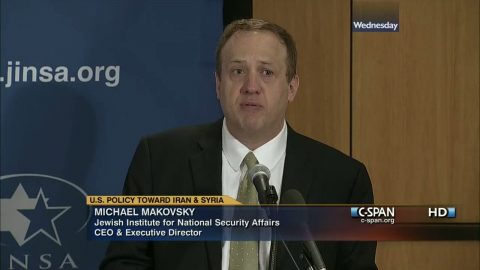
Writing for Fox News on December 25, Michael Makovsky—who is no fringe figure, being CEO of the neoconservative Jewish Institute for National Security Affairs (JINSA)—suggests just such a strategy for countering Iranian influence in the Middle East:
Maintaining Syria, Iraq, Lebanon and Yemen in their existing forms is unnatural and serves Iran’s interests. There is nothing sacred about these countries’ borders, which seem to have been drawn by a drunk and blindfolded mapmaker. Indeed, in totally disregarding these borders, ISIS and Iran both have already demonstrated the anachronism and irrelevance of the borders.
Syria, Iraq, Lebanon and Yemen are not nation-states as Americans understand them, but rather post-World War I artificial constructs, mostly created out of the ashes of the Ottoman Empire in a colossally failed experiment by western leaders.
With their deep ethno-sectarian fissures, these four countries have either been held together by a strong authoritarian hand or suffered sectarian carnage.
It is astonishing to read neoconservatives, who have done little else since the 1970s but lobby for exerting American hegemony in the Middle East, decry the results of the exertion of European hegemony in the Middle East. It reads like an artificial intelligence that just briefly verges on full self-awareness before pivoting and falling back to safer ground. It’s particularly rich for Makovsky, whose JINSA predecessors promoted the ouster of two of those “strong authoritarian hands” in former Iraqi leader Saddam Hussein and former Yemeni President Ali Abdullah Saleh, to bemoan one result of their ouster.
But let’s focus on the proposal Makovsky makes: redrawing borders in the Middle East, creating what he calls “loose confederations or new countries with more borders that more naturally conform along sectarian lines,” in order to counter Iran. The proposal strongly resembles recommendations found in “A Clean Break: A New Strategy for Securing the Realm,” a 1996 publication of the Jerusalem-based Institute for Advanced Strategic and Political Studies that was prepared in collaboration with several other neoconservative think tanks—including JINSA.
“A Clean Break,” the conclusion of a task force that included such Likudnik geniuses as Richard Perle, Douglas Feith, and David Wurmser, argued in part that Israel should work with friendly governments in Turkey and Jordan to contain regional threats, particularly coming from Syria. It concluded, among other things, that Israeli leaders should pursue “removing Saddam Hussein from power in Iraq-an important objective in its own right-as a means of foiling Syria’s regional ambitions.” “Syria” in this context serves as a stand-in for “Iran.” Long-term, the report envisioned the formation of a “natural axis” of Israel, Turkey, Jordan, and a “Hashemite” Iraq serving as “the prelude to a redrawing of the map of the Middle East, which could threaten Syria’s territorial integrity.”
Even a cursory glance at the state of the Middle East since the end of the Iraq War shows that ousting Saddam Hussein achieved the opposite of the report’s stated goals. The idea of a Hashemite restoration in Shia-majority Iraq was ridiculously far-fetched, and Iraq’s democratically-elected government has–justifiably–greatly improved the Baghdad-Tehran relationship. Makovsky, who wants to reverse this trend, argues that the United States should “declare our support and strong military aid for an eventual Iraqi Kurdish state, once its warring factions unify and improve governance. We could support a federation for the rest of Iraq.”
In Makovsky’s imagination, the new Kurd-less Iraqi federation would presumably wish Erbil well and send it on its way. In reality, another serious Kurdish move toward independence would probably lead to a civil war, as it nearly did in October over the status of Kirkuk. Iraqi Prime Minister Haider al-Abadi’s first foreign trip after his dramatic capture of Kirkuk was… to Iran. If the United States were to come out in full support of an independent Kurdistan, it would almost certainly push the rest of Iraq more firmly into Iran’s orbit. Speaking of Kirkuk, does Makovsky imagine that independent Kurdistan would be given the city and its surrounding oil fields? If yes, then that only increases the chances of a war with Baghdad. If no, then there are serious questions about whether that hypothetical Kurdish state would be economically viable.
For Syria, Makovsky says that “we could seek a more ethnically coherent loose confederation or separate states that might balance each other – the Iranian-dominated Alawites along the coast, the Kurds in the northeast, and the Sunni Arabs in the heartland.” He might want to check a recent map of Syria, because while “heartland” is obviously a subjective term, by almost any definition Syria’s “heartland” now belongs to President Basher al-Assad and his Russian and Iranian allies. This includes the country’s five largest (pre-war) cities: Aleppo, Damascus, Homs, Latakia, and Hama. How does Makovsky propose any of that territory be taken from Assad so as to be turned over to “Sunni Arabs,” even in a confederate sense? If the answer is “war,” then his Fox News thinkpiece is burying the lede to say the least.
Makovsky then recommends that the U.S. strengthen relations with Shia-majority Azerbaijan, in order to “demonstrate we are not anti-Shia Muslim.” Yes, that should do the trick. Of course, that’s not the only reason:
An added potential benefit of this approach could be a fomenting of tensions within Iran, which has sizable Kurdish and Azeri populations, thereby weakening the radical regime in Tehran.
You might even say that it could threaten Iran’s territorial integrity. Make a Clean Break, if you will.
The dangers of the United States trying to redraw Middle Eastern borders—Makovsky graciously allows that America “cannot dictate the outcomes” but should instead “influence” them—should be obvious. For one thing, there’s the immediate likelihood that attempting to draw new borders would intensify regional instability. For another, there’s little reason to expect that the United States would get the new borders any more “right” than Britain and France did a century ago, particularly not when the process is being managed by the same people who brought us the invasion of Iraq. For still another, the most recent example of such Western “influenced” partitioning isn’t exactly a positive one.
But we can’t leave Makovsky’s piece without mentioning its most jaw-dropping paragraph (emphasis ours):
Artificial states have been divided or loosened before with some success, such as the Soviet Union, Yugoslavia and Czechoslovakia, which are all post-WWI formations. Bosnia and Herzegovina have also managed as a confederation.
Czechoslovakia divided peacefully of its own accord. The Soviet Union more or less did likewise, though that dissolution hasn’t been quite so peaceful in recent years. As for Yugoslavia—well, maybe Dr. Makovsky’s definition of “success” is a bit different from most other people’s. To be fair, though, if the breakup of Yugoslavia is his template for the future of the Middle East, this piece makes a lot more sense.
But if Makovsky believes in federalizing existing Middle Eastern states along “ethno-sectarian” lines, why not start with Israel and the Occupied Territories, a notion that would seem logical to any 21st century mapmaker? After all, occupation of one people by another via a “strong authoritarian hand”—in this case the IDF—would seem to be a prescription for a “colossally failed experiment,” no? Perhaps Makovsky’s experience as a former West Bank settler may make it difficult for him to see the relevance.
The Danger and Challenge of Jewish-Zionist Power

Mark Weber addressing the ‘London Forum’ meeting, April 11, 2015
Text of an address given at the “London Forum” meeting at the Grosvenor Hotel in London, England, on April 11, 2015, and, slightly modified, at the “International Identitarian Congress” in Guadalajara, Mexico, on May 2, 2015. The text has been edited for posting here, and source references have been added.
By Mark Weber, Institute for Historical Review
For many years Israel has violated well established standards of international law and has defied numerous United Nations resolutions in its occupation of conquered lands, in extra-judicial killings, and in repeated acts of military aggression.
Most of the world regards Israel’s policies, and especially its oppression of Palestinians, as illegal and outrageous. This international consensus is reflected, for example, in numerous UN resolutions condemning Israel, which have been approved with overwhelming majorities.
In October 2003, for example, the UN General Assembly approved a resolution condemning Israel’s so-called “security barrier,” a grotesque thing, parts of it much larger and more formidable than the Berlin Wall, that Israel has built on occupied Palestinian territory. Supporting the resolution were 144 countries, representing nearly the entire world’s population. Twelve countries abstained. Just four countries opposed the resolution. They were: Israel, the United States, the Marshall Islands and Micronesia. The latter two member states are small island countries in the Pacific Ocean, with a combined population of 180,000, that are utterly dependent on the US. / 1
In December 2003, to take another example, the members of the UN General Assembly considered a resolution re-affirming the principle of Palestinian sovereignty. It received the backing of 142 states, including all the nations of Europe and South America. In this case as well, just four countries voted against the resolution: Israel, the US, the Marshall Islands and Micronesia. / 2
“The whole world,” said United Nations Secretary General Kofi Annan some years ago, “is demanding that Israel withdraw [from occupied Palestinian territories]. I don’t think the whole world … can be wrong.” / 3
Why is it that the United States stands out among the world’s nations in such matchless support of the Zionist state?
With very few exceptions, even those American politicians and media figures who might sometimes criticize a particular Israeli policy are, nonetheless, all but unanimous in their enthusiastic support for Israel — and not just as a country, but as an emphatically Jewish ethnic-religious state. In spite of occasional disputes over specific policies, the US continues, as it has for years, to provide Israel with crucial military, diplomatic and financial backing, including more than $3 billion each year in aid.
Why is it that support for Israel by politicians and in the media is more vehement and unquestioning in the United States than anywhere else? Well, one possible explanation for this unparalleled level of support is that Americans are vastly more aware, enlightened or principled than people anywhere else in the world.
One person who has spoken candidly about the real reason is Bishop Desmond Tutu of South Africa, who was awarded the 1984 Nobel Peace Prize. Addressing an audience in Boston, he said: “But you know as well as I do that, somehow, the Israeli government is placed on a pedestal [in the US], and to criticize it is to be immediately dubbed anti-Semitic … People are scared in this country, to say wrong is wrong because the Jewish lobby is powerful — very powerful.” / 4
Bishop Tutu spoke the truth. Although Jews make up only two or three percent of the US population, they wield immense power and influence – much more than any other ethnic or religious group.
As Jewish author and political science professor Benjamin Ginsberg has pointed out: / 5
“Since the 1960s, Jews have come to wield considerable influence in American economic, cultural, intellectual and political life. Jews played a central role in American finance during the 1980s, and they were among the chief beneficiaries of that decade’s corporate mergers and reorganizations. Today, though barely two percent of the nation’s population is Jewish, close to half its billionaires are Jews. The chief executive officers of the three major television networks and the four largest film studios are Jews, as are the owners of the nation’s largest newspaper chain and the most influential single newspaper, the New York Times … The role and influence of Jews in American politics is equally marked…
“Jews are only three percent of the nation’s population and comprise eleven percent of what this study defines as the nation’s elite. However, Jews constitute more than 25 percent of the elite journalists and publishers, more than 17 percent of the leaders of important voluntary and public interest organizations, and more than 15 percent of the top ranking civil servants.”
Stephen Steinlight, one-time Director of National Affairs of the American Jewish Committee, has likewise noted what he calls the “disproportionate political power” of Jews, which, as he puts it, is “pound for pound the greatest of any ethnic/ cultural group in America.” He goes on to explain that “Jewish economic influence and power are disproportionately concentrated in Hollywood, television, and in the news industry.” / 6
Two well-known Jewish writers, Seymour Lipset and Earl Raab, pointed out in their 1995 book, Jews and the New American Scene: / 7
“During the last three decades Jews [in the United States] have made up 50 percent of the top two hundred intellectuals … 20 percent of professors at the leading universities … 40 percent of partners in the leading law firms in New York and Washington … 59 percent of the directors, writers, and producers of the 50 top-grossing motion pictures from 1965 to 1982, and 58 percent of directors, writers, and producers in two or more primetime television series.”
Vanity Fair magazine in 2007 published a list of what it calls “the world’s most powerful people” – a lineup of the one hundred most influential media bosses, bankers, publishers, image makers, and so forth, who determine how we view ourselves and the world, and who – directly and indirectly — shape our lives and our futures. Jews made up more than half of the powerful men and women on the Vanity Fair list, reported a leading Israeli newspaper, The Jerusalem Post. / 8
The Jewish role in American political life is similarly formidable and lopsided. One member of the influential Conference of Presidents of Major American Jewish Organizations “estimated Jews alone had contributed 50 percent of the funds for [President Bill] Clinton’s 1996 re-election campaign.” / 9 The American magazine Mother Jones compiled a listing of the 400 leading contributors to the 2000 US national elections. Seven of the first ten were Jewish, as were twelve of the top 20, and 125 of the top 250. / 10
In recent years the single biggest donor to American politicians, by far, has been Sheldon Adelson, a vehemently pro-Zionist Jewish billionaire. In the 2012 US election campaign, the gambling casino magnate and his wife gave tens of millions of dollars to Republican presidential contender Mitt Romney and other pro-Israel candidates, groups and organizations. As The New York Times reported: “Mr. Adelson, whose $38 billion fortune makes him among the richest men in the world, poured roughly $100 million into Republican campaigns in 2012 …” / 11
The biggest donor to Democratic Party candidates in recent years has been Haim Saban, an Israeli billionaire and global media mogul. Taking note of Saban’s ardent devotion to the Jewish state, The New York Times reported: “He has since emerged as perhaps the most politically connected mogul in Hollywood, throwing his weight and money around Washington, and increasingly, the world, trying to influence all things Israeli. ‘I’m a one-issue guy and my issue is Israel,’ he said.” / 12 M. J. Rosenberg, a political affairs analyst for The Nation observed: “Adelson and Saban are top funders, respectively, of the Republican and Democratic parties, although as Adelson points out, ‘when it comes to Israel we’re on the same side’.” / 13
Michael Medved, a well-known Jewish author and film critic, has written: “It makes no sense at all to try to deny the reality of Jewish power and prominence in popular culture … Any list of the most influential production executives at each of the major movie studios will produce a heavy majority of recognizably Jewish names.” / 14
One person who has carefully studied this subject is Jonathan J. Goldberg, editor of the influential Jewish community weekly Forward. In his 1996 book, Jewish Power, he wrote: / 15 “In a few key sectors of the media, notably among Hollywood studio executives, Jews are so numerically dominant that calling these businesses Jewish-controlled is little more than a statistical observation …”
Goldberg went on to point out:
“Hollywood at the end of the twentieth century is still an industry with a pronounced ethnic tinge. Virtually all the senior executives at the major studios are Jews. Writers, producers, and to a lesser degree directors are disproportionately Jewish — one recent study showed the figure as high as 59 percent among top-grossing films.
“The combined weight of so many Jews in one of America’s most lucrative and important industries gives the Jews of Hollywood a great deal of political power. They are a major source of money for Democratic candidates.”
Joel Stein, a columnist for the Los Angeles Times, has written: “As a proud Jew, I want America to know about our accomplishment. Yes, we control Hollywood … I don’t care if Americans think we’re running the news media, Hollywood, Wall Street or the government. I just care that we get to keep running them.” / 16
Over the years, this clout has had a profound impact on how Americans feel, think and act. One prominent political figure who has publicly acknowledged this reality is Vice President Joe Biden. In a remarkable address in May 2013, he said that what he called the “immense” and “outsized” Jewish role in the US mass media and cultural life is the single most important factor in shaping American attitudes over the past century, and in driving major cultural- political changes. / 17 Vice President Biden said: “I bet you 85 percent of those [social-political] changes, whether it’s in Hollywood or social media, are a consequence of Jewish leaders in the industry. The influence is immense.” He went on to say: “Jewish heritage has shaped who we are – all of us, us, me – as much or more than any other factor in the last 223 years. And that’s a fact.”
As Biden mentions, this is by no means a new phenomenon. Forty-three years ago — during a private White House meeting that was secretly recorded, President Richard Nixon and the Rev. Billy Graham — the nation’s best-known Christian evangelist — spoke frankly about the Jewish grip on the media. Graham said: “This stranglehold has got to be broken or the country’s going down the drain.” To which the president responded: “You believe that?” “Yes, sir,” said Graham. “Oh, boy,” replied Nixon. “So do I. I can’t ever say that [publicly, that is], but I believe it.” / 18
How could all this have happened? Jewish American scholar Alfred M. Lilienthal provided an answer in his detailed 1978 study, The Zionist Connection. He wrote: / 19
“How has the Zionist will been imposed on the American people? … It is the Jewish connection, the tribal solidarity among themselves and the amazing pull on non-Jews, that has molded this unprecedented power … The Jewish connection covers all areas and reaches every level. Most Americans may not even sense this gigantic effort, but there is scarcely a Jew who is not touched by its tentacles …
“The extent and depth to which organized Jewry reached – and reaches – in the U.S. is indeed awesome … The most effective component of the Jewish connection is probably that of media control … Jews, toughened by centuries of persecution, have risen to places of prime importance in the business and financial world … Jewish wealth and acumen wields unprecedented power in the area of finance and investment banking, playing an important role in influencing U.S. policy toward the Middle East … In the larger metropolitan areas, the Jewish-Zionist connection thoroughly pervades affluent financial, commercial, social, entertainment, and art circles.”
Because US military might is the most formidable and intrusive in the world, by far, the Jewish-Zionist role in setting American policy has consequences for people far beyond the borders of the United States. In the administration of President George W. Bush a group — a cabal — of high-level, so-called “neoconservative” Jews played a key role in prodding the United States into war in Iraq. They included: Paul Wolfowitz, Deputy Secretary of Defense; Richard Perle of the Pentagon’s Defense Policy Board; David Wurmser in the State Department; and, Douglas Feith, the Pentagon’s Undersecretary for Policy. These men acted in accord with Zionist plans to overthrow the Iraqi regime that were already in place well before Bush became president in early 2001. / 20
For well-informed people, this reality is no secret. In Britain, a veteran member of the House of Commons candidly declared in May 2003 that pro-Israel Jews had taken control of America’s foreign policy, and had succeeded in pushing the US and Britain into war in Iraq. Tam Dalyell, a Labour party deputy known as “Father of the House” because he was the longest-serving Member of Parliament, said: “A Jewish cabal have taken over the government in the United States and formed an unholy alliance with fundamentalist Christians …”, and, he added: “There is far too much Jewish influence in the United States.” / 21
In Washington, Senator Ernest Hollings was moved to declare that Iraq was invaded, as he put it, to “secure Israel,” and that “everybody” knows it. Referring to the reluctance of his Congressional colleagues to openly acknowledge this reality, Hollings said that “nobody is willing to stand up and say what is going on.” Members of Congress, with few exceptions, uncritically support Israel and its policies due to what Hollings called, “the pressures that we get politically.” / 22
Americans have paid a high price for the US alliance with Israel. This includes tens of billions of dollars in economic and military aid to the Jewish state, the hundreds of billions of dollars that the Iraq war and occupation have cost, and the deaths there of more than four thousand American military personnel. Directly and indirectly, America’s so-called “special relationship” with Israel has also generated unprecedented distrust, fear and loathing of the United States around the world. By supporting Israel and its policies, the United States betrays not only its own national interests, but the principles it claims to embody and defend.
In truth, if the United States held Israel to the same standards that it has applied to Iraq, Serbia, and other countries, American bombers and missiles would be blasting Tel Aviv, and American officials would be putting Israeli leaders behind bars for war crimes and crimes against humanity.
With Zionist leaders now prodding the United States into new wars against Israel’s adversaries, the cost of the US alliance with the Zionist state is likely to rise much higher in the years to come. / 23
Israeli and Jewish- Zionist leaders affirm that Jews constitute a “people” or a “nation” – that is, a distinct nationality group to which Jews everywhere are supposed to feel and express a primary loyalty. / 24 Some American Jewish leaders have been explicit about this. Louis Brandeis, a US Supreme Court justice and a leading American Zionist, said: “Let us all recognize that we Jews are a distinctive nationality of which every Jew, whatever his country, his station or shade of belief, is necessarily a member.” / 25
While Zionist Jews routinely speak of the “Jewish people” as a distinct ethic-religious group, and often affirm that Jews are members of a separate nationality to which they must be loyal, Zionists simultaneously insist that Jews must be welcomed as full and equal citizens in whatever country they may wish to live – with no social, legal or institutional obstacles to Jewish power and influence in public life. In short, Jewish-Zionist leaders and organizations (such as the World Jewish Congress and the American Jewish Committee) demand full citizen rights for Zionist Jews not only in “their country,” Israel, but everywhere.
Major Jewish-Zionist organizations, and, more broadly, the organized Jewish community, also promote so-called “pluralism,” “tolerance” and “diversity” in the United States and other countries. They believe this is useful for Jews. Abraham Foxman, director of the Anti-Defamation League, one of the world’s most influential Jewish- Zionist organizations, puts it this way: “America’s pluralistic society … is at the heart of Jewish security … In the long run, what has made American Jewish life a uniquely positive experience in Diaspora history and which has enabled us to be such important allies for the State of Israel, is the health of a pluralistic, tolerant and inclusive American society.” / 26
Consistent with this outlook, the ADL has for years promoted the slogan “Diversity is Our Strength.” In keeping with this motto, which it claims to have invented, the ADL has devoted great effort and resources to persuading Americans — especially younger Americans — to welcome and embrace ever more social, cultural and racial “diversity.” / 27
This campaign has been very successful. American politicians and educators, and virtually the entire US mass media, promote “diversity,” “multiculturalism” and “pluralism,” and portray those who do not embrace these objectives as hateful and ignorant. At the same time, influential Jewish-Zionist organizations such as the American Israel Public Affairs Committee, or AIPAC, insist that the US must recognize and defend Israel as a specifically Jewish ethnic-religious state. Pluralism and diversity, it seems, are only for non-Jews. What’s good for Jews in their own homeland, Jewish-Zionist leaders seem to say, is not diversity and multiculturalism, but a tribalistic nationalism.
There are some people who object to the power of the so-called “Jewish lobby” because it supports and makes possible Israel’s oppression of Palestinians. Others object because they are unhappy with this or that aspect of the lobby’s agenda. But to me this is beside the point. Apart from the harmful consequences of any particular policy that the Jewish community makes possible, is the injustice and danger inherent in permitting any distinct minority group or interest to wield immense, disproportionate power and influence — and especially in the country that is the world’s foremost military and financial power, and most important cultural factor.
Imagine the response, for example, if evangelical Christians, or Muslims, or African-Americans, were to secure a grip on the American media and on America’s political life comparable to that held by Jews. In reality, the Jewish hold on American life is far more dangerous than one that, in theory, might be held by any of those other groups I’ve mentioned.
There are two main reasons for this:
First, Jews in America have, manifestly, a strong loyalty to a foreign country, Israel, that since its founding in 1948 has been embroiled in seemingly endless crises and conflicts with its neighbors, and which is now a formidable military power with a large nuclear arsenal.
Second, the Jewish grip is especially dangerous because of the distrustful and sometimes even adversarial way that Jews view the rest of us.
Over the centuries, the Jewish community, more than any other single group, has demonstrated a pronounced sense of separateness from the rest of humanity, and, accordingly, views its interests as quite distinct from those of everyone else. This “chosen people” mindset – this “Us vs. Them” attitude – is anchored in centuries of Jewish history and heritage, and is deeply rooted in the collective Jewish psyche.
The ancient Jewish sense of alienation from, and abiding distrust of, non-Jews is manifest in a remarkable essay published in the Forward, the prominent Jewish community weekly. Entitled “We’re Right, the Whole World’s Wrong,” it is written by Rabbi Dov Fischer, an attorney and a member of the Jewish Community Relations Committee of the Jewish Federation of Los Angeles. Rabbi Fischer is also national vice president of the Zionist Organization of America. / 28
So this essay was written not by an obscure scribbler, but rather by a prominent Jewish community figure. And it did not appear in the some marginal periodical, but rather in what is perhaps the most literate and thoughtful Jewish weekly in America, and certainly one of the most influential.
In his essay, Rabbi Fischer tells readers: “If we Jews are anything, we are a people of history … Our history provides the strength to know that we can be right and the whole world wrong.”
He goes on: “We were right, and the whole world was wrong. The Crusades. The blood libels and the Talmud burnings in England and France, leading those nations to expel Jews for centuries. The Spanish and Portuguese Inquisition. The ghettos and the Mortara case in Italy. Dreyfus in France. Beilis in Russia and a century’s persecution of Soviet Jewry.
“The Holocaust. Kurt Waldheim in Austria. Each time, Europe stood by silently — or actively participated in murdering us — and we alone were right, and the whole world was wrong.
“Today, once again, we alone are right and the whole world is wrong. The Arabs, the Russians, the Africans, the Vatican proffer their aggregated insights into and accumulated knowledge of the ethics of massacre. And the Europeans. Although we appreciate the half-century of West European democracy more than we appreciated the prior millennia of European brutality, we recognize who they are, what they have done — and what’s what. …
“We remember that the food they [Europeans] eat is grown from soil fertilized by 2,000 years of Jewish blood they have sprinkled onto it. Atavistic Jew-hatred lingers in the air into which the ashes rose from the crematoria …
“Yes, once again, we are right and the whole world is wrong. It doesn’t change a thing, but after 25 centuries it’s nice to know.”
I want to emphasize here that to deal candidly with the reality of Jewish-Zionist power is not, as we so often hear, “hate” or bigoted “anti-Semitism.” We wish no harm to any individual, Jewish or not, because of his or her ancestry, religion or background. At the same time, we must not permit intimidation, malicious smears or threats to keep us from affirming what is true, and doing what is right.
The most direct and obvious victims of Jewish-Zionist power are, of course, the Palestinians who live under Israel’s harsh rule. But we Americans are also victims. Through the Jewish-Zionist grip on the media, and the organized Jewish-Zionist corruption of our political system, we are pressured, seduced, cajoled, and deceived into propping up the Jewish state, providing it with billions of dollars yearly and state-of-the-art weaponry, and even sacrificing American lives.
But it is also the truth that we Americans share some responsibility for all this. We have allowed immense power, affecting every aspect of our lives and our future, to be wielded by members of an ethnic-religious minority group that views the American people with suspicion as potential enemies. Put another way, Americans have permitted people who regard them with wariness and distrust to play a major role in determining how we live our lives, and in determining our future both as individuals and as a nation. To permit such power to pass into the hands of people who clearly do not have our best interests at heart — indeed, do not even trust us — is, to put it mildly, irresponsible.
As long as the power of what Desmond Tutu calls “the very powerful” Jewish lobby remains entrenched, there will be no end to the systematic Jewish distortion of history and current affairs, the Jewish-Zionist domination of the US political system and the American media, Zionist oppression of Palestinians, the bloody conflict between Jews and non-Jews in the Middle East, and the Israeli threat to peace.
That’s why no task is more important or pressing than to identify, counter and break this power.
Today, we are engaged in a great, global struggle — in which two distinct and irreconcilable sides confront each other: A struggle that pits a self-assured and diabolical power which feels ordained to rule over others, on one side, and all other nations and societies — indeed, humanity itself — on the other.
This struggle is not a new one. It is the latest enactment of a great drama that has played itself out again and again, over centuries, and in many different societies, cultures and historical eras. In the past this drama has played itself out on a local, national, regional, or, sometimes, continental stage. Today this is a global drama, and a global clash.
It is a struggle for the welfare and future not merely of the Middle East, or of America, but a great historical battle for our global well-being — a struggle that calls all of us who share a sense of responsibility for the future of our own nation and of humankind.
Source Notes
1. “General Assembly, in Resumed Emergency Session, Demands Israel Stop Construction of Wall, Calls on Both Parties to Fulfill Road Map Obligations.” United Nations Press Release, Oct. 21, 2003. ( http://unispal.un.org/unispal.nsf/1ce874ab1832a53e852570bb006dfaf6/c4963112ac76556d85256dc7005047aa )
2. UN General Assembly vote on Dec. 23, 2003, on draft resolution 58/ 229.
( http://unispal.un.org/UNISPAL.NSF/0/77660E5C1B79EF8C85256EA90068A58B )
3. On April 8, 2002, in Madrid. J. Brinkley, “Israel Starts Leaving … ,” The New York Times’, April 9, 2002.
( http://www.nytimes.com/2002/04/08/international/08CND-MIDE.html )
4. D. Tutu, “Apartheid in the Holy Land,” The Guardian (Britain), April 29, 2002.
( http://www.guardian.co.uk/israel/comment/0,10551,706911,00.html )
5. Benjamin Ginsberg, The Fatal Embrace: Jews and the State (University of Chicago, 1993), pp. 1, 103.
6. S. Steinlight, “The Jewish Stake in America’s Changing Demography: Reconsidering a Misguided Immigration Policy,” Center for Immigration Studies, Nov. 2001.
( http://www.cis.org/articles/2001/back1301.html )
7. Seymour Martin Lipset and Earl Raab, Jews and the New American Scene (Harvard Univ. Press, 1995), pp. 26-27.
8. N. Burstein, “Jewish power dominates at ‘Vanity Fair’,” The Jerusalem Post (Israel), Oct.11 (12?), 2007.
( http://www.jpost.com/Jewish-World/Jewish-News/Jewish-power-dominates-at-Vanity-Fair )
9. Janine Zacharia, “The Unofficial Ambassadors of the Jewish State,” The Jerusalem Post (Israel), April 2, 2000. Reprinted in “Other Voices,” June 2000, p. OV-4, a supplement to The Washington Report on Middle East Affairs.
10. A. Cockburn, “The Row Over the Israel Lobby,” May 8 (or 5?), 2006.
( http://www.counterpunch.org/cockburn05082006.html )
11. N. Confessore, E. Lipton, “Seeking to Ban Online Betting, G.O.P. Donor Tests Influence,” The New York Times, March 27, 2014
( http://www.nytimes.com/2014/03/28/us/politics/major-gop-donor-tests-his-influence-in-push-to-ban-online-gambling.html ); J. Horowitz, “Republican Contenders Reach Out to Sheldon Adelson, Palms Up,” The New York Times, April 26, 2015
( http://www.nytimes.com/2015/04/27/us/politics/republican-contenders-reach-out-to-sheldon-adelson-palms-up.html ) ; E. Lipton, “G.O.P.’s Israel Support Deepens as Political Contributions Shift,” The New York Times, April 4, 2015
( http://www.nytimes.com/2015/04/05/us/politics/gops-israel-support-deepens-as-political-contributions-shift.html ) ;
See also: M. Gold, P. Rucker, “Billionaire mogul Sheldon Adelson looks for mainstream Republican who can win in 2016,” The Washington Post, March 25, 2015
( http://www.washingtonpost.com/politics/billionaire-mogul-sheldon-adelson-looks-for-mainstream-republican-who-can-win-in-2016/2014/03/25/e2f47bb0-b3c2-11e3-8cb6-284052554d74_story.html ); P. Stone, “Sheldon Adelson Spent Far More On Campaign Than Previously Known,” The Huffington Post, Dec. 12, 2012 ( http://www.huffingtonpost.com/2012/12/03/sheldon-adelson-2012-election_n_2223589.html )
12. A. R. Sorkin, “Schlepping to Moguldom,” The New York Times, Sept. 5, 2004.
( http://www.nytimes.com/2004/09/05/business/yourmoney/05sab.html ) ;
13. M. J. Rosenberg, “Sheldon Adelson and Haim Saban: Billionaire Funders for Israel,” The Nation, Dec. 8, 2014
( http://www.thenation.com/article/192065/sheldon-adelson-and-haim-saban-want-be-koch-brothers-israel )
14. M. Medved, “Is Hollywood Too Jewish?,” Moment, Vol. 21, No. 4 (1996), p. 37.
15. Jonathan Jeremy Goldberg, Jewish Power: Inside the American Jewish Establishment/ (Addison-Wesley, 1996), pp. 280, 287-288. See also pp. 39-40, 290-291.
16. J. Stein, “How Jewish Is Hollywood?,” Los Angeles Times, Dec. 19, 2008.
( http://www.latimes.com/news/opinion/commentary/la-oe-stein19-2008dec19,0,4676183.column )
17. Jennifer Epstein, “Biden: ‘Jewish heritage is American heritage’,” Politico, May 21, 2013.
( http://www.politico.com/politico44/2013/05/biden-jewish-heritage-is-american-heritage-164525.html ); Daniel Halper, “Biden Talks of ‘Outsized Influence’ of Jews: ‘The Influence Is Immense’,” The Weekly Standard, May 22, 2013.
( http://www.weeklystandard.com/blogs/biden-talks-outsized-influence-jews-influence-immense_728765.html ) See also: M. Weber , “Vice President Biden Acknowledges ‘Immense’ Jewish Role in American Mass Media and Cultural Life,” July 2013.
( http://ihr.org/other/biden_jewish_role )
18. “Nixon, Billy Graham Make Derogatory Comments About Jews on Tapes,” Chicago Tribune, March 1, 2002 (or Feb. 28, 2002)
( http://www.fpp.co.uk/online/02/02/Graham_Nixon.html );
“Billy Graham Apologizes for ’72 Remarks,” Associated Press, Los Angeles Times, March 2, 2002. “Graham Regrets Jewish Slur,” BBC News, March 2, 2002.
( http://news.bbc.co.uk/2/hi/americas/1850077.stm ) The conversation apparently took place on Feb. 1, 1972.
19. A. Lilienthal, The Zionist Connection (New York: Dodd, Mead, 1978), pp. 206, 209, 212, 218, 228, 229.
20. See: John J. Mearsheimer and Stephen M. Walt, The Israel Lobby and US Foreign Policy. New York: Farrar, Straus & Giroux, 2007.
21. F. Nelson, “Anger Over Dalyell’s ‘Jewish Cabal’ Slur,” The Scotsman (Edinburgh), May 5, 2003 ( http://www.highbeam.com/doc/1P2-13027250.html ) ; M. White, “Dalyell Steps Up Attack On Levy,” The Guardian (London), May 6, 2003. ( http://www.theguardian.com/uk/2003/may/06/race.politics ).
22. M. Weber, “`Iraq Was Invaded to Secure Israel,’ Says Senator Hollings,” July 16, 2004
( http://www.ihr.org/news/040716_hollings.shtml )
23. See, for example: M. Weber, “Behind the Campaign for War Against Iran,” April 2013.
( http://www.ihr.org/other/behindwarcampaign )
24. See: Kevin MacDonald, The Culture of Critique. Praeger, 1998 (Softcover edition, 2002); Review by S. Hornbeck of The Culture of Critique in a 1999 issue of American Renaissance (http://www.csulb.edu/~kmacd/review-AR.html) ; M. Weber, “The Weight of Tradition: Why Judaism is Not Like Other Religions.” Oct. 2010
( http://www.ihr.org/judaism0709.html ) ; M. Weber, “Jews: A Religious Community, a People, or a Race?,” March-April 2000 ( http://www.ihr.org/jhr/v19/v19n2p63_Weber.html ) ; Israel even claims to speak on behalf of Jews who lived and died before the state was established. “Holocaust Victims Given Posthumous Citizenship by Israel,” The Associated Press, Los Angeles Times, May 9, 1985.
( http://articles.latimes.com/1985-05-09/news/mn-6754_1_posthumous-citizenship ) ;
25. Louis D. Brandeis, “The Jewish Problem and How to Solve It.” Speech of April 25, 1915. ( http://www.pbs.org/wnet/supremecourt/personality/sources_document11.html )
26. Foxman letter of Nov. 11, 2005. Published in The Jerusalem Post, Nov. 18, 2005.
( http://archive.adl.org/media_watch/newspapers/20051111-JPost.htm )
27. ADLOn the Frontline (New York), Summer 1997, p. 8. This issue of the ADL bulletin also noted with some pride that President Clinton, in his Feb. 1997 “State of the Union” address, had given an unexpected boost to what it called the “ADL tag line.” In that address, Clinton said: “My fellow Americans, we must never, ever believe that our diversity is a weakness. It is our greatest strength.”
28. Dov Fischer, “We’re Right, the Whole World’s Wrong,” Forward (New York), April 19, 2002, p. 11.
( http://ravfischer.blogspot.com/2008/05/april-19-2002-forward-were-right-whole.html )
Some of Fischer’s remarks here are gross distortions of history. For example, his mention of “a century’s persecution of Soviet Jewry” is a breathtaking falsehood. For one thing, the entire Soviet period lasted 74 years, not 100. And during at least some of that period, above all during the first ten years of the Soviet era, Jews wielded tremendous, if not dominant power. Rabbi Fischer seems to have forgotten such figures as Leon Trotsky, commander in chief of the young Soviet state’s Red Army, Grigori Zinoviev, head of the Communist International, and Yakov Sverdlov, the first Soviet president. (See: M. Weber, “The Jewish Role in the Bolshevik Revolution and Russia’s Early Soviet Regime,” The Journal of Historical Review, Jan.-Feb. 1994.[ (http://www.ihr.org/jhr/v14/v14n1p-4_Weber.html ]. )
For Further Reading
Norman F. Cantor. The Sacred Chain: A History of the Jews. New York: Harper, 1994.
Benjamin Ginsberg. The Fatal Embrace: Jews and the State. The Univ. of Chicago Press, 1993.
Peter Harrison, “What Causes Anti-Semitism?” Review of Macdonald’s Separation and Its Discontents. The Journal of Historical Review, May-June 1998.
( http://ihr.org/jhr/v17/v17n3p28_Harrison )
Alfred M. Lilienthal, The Zionist Connection. New York: Dodd, Mead, 1978.
Seymour Martin Lipset and Earl Raab. Jews and the New American Scene. Harvard University Press, 1995.
Kevin MacDonald, A People That Shall Dwell Alone: Judaism as a Group Evolutionary Strategy. Praeger, 1994.
Kevin MacDonald, Separation and Its Discontents: Toward an Evolutionary Theory of Anti-Semitism. Praeger,1998
Kevin MacDonald, The Culture of Critique: An Evolutionary Analysis of Jewish Involvement in Twentieth-Century Intellectual and Political Movements. Praeger, 1998 (Softcover edition, 2002).
John J. Mearsheimer and Stephen M. Walt, The Israel Lobby and US Foreign Policy. New York: Farrar, Straus & Giroux, 2007.
W. D. Rubinstein. The Left, The Right and the Jews. New York: Universe Books, 1982.
Israel Shahak. Jewish History, Jewish Religion. London: Pluto Press, 1994
Goldwin Smith. “The Jewish Question.” From: Essays on Questions of the Day. New York: Macmillan, 1894.
( http://www.ihr.org/jhr/v17/v17n1p16_Smith.html )
Mark Weber, “Anti-Semitism: Why Does It Exist? And Why Does it Persist?,” Jan. 2014.
( http://ihr.org/other/anti-semitism-why-does-it-exist-dec-2013 ).
M. Weber, “Behind the Campaign for War Against Iran,” April 2013.
( http://www.ihr.org/other/behindwarcampaign )
M. Weber, “Iraq: A War for Israel.” March 2008
(http://www.ihr.org/leaflets/iraqwar.shtml)
Mark Weber, “Jews: A Religious Community, a People, or a Race?,” March-April 2000.
( http://www.ihr.org/jhr/v19/v19n2p63_Weber.html )
M. Weber, “A Straight Look at the Jewish Lobby,” August 2012.
( http://ihr.org/leaflets/jewishlobby.shtml )
M. Weber, “Straight Talk About Zionism: What Jewish Nationalism Means,” April 2009.
( http://www.ihr.org/zionism0409.html )
M. Weber, “Vice President Biden Acknowledges `Immense’ Jewish Role in American Mass Media and Cultural Life,” July 2013.
( http://ihr.org/other/biden_jewish_role )
M. Weber, “The Weight of Tradition: Why Judaism is Not Like Other Religions.” Oct. 2010.
( http://www.ihr.org/judaism0709.html )
New details emerge of Saudi Arabia’s treatment of Hariri
Press TV – December 25, 2017
A leading US daily has revealed new details of Saudi Arabia’s degrading treatment of Lebanese Prime Minister Saad Hariri during a recent trip to Riyadh, where the Lebanese leader was coerced into reading a prepared resignation speech under conditions similar to that of a captive.
Prime Minister Hariri abruptly declared his resignation from a then-unknown location in Saudi Arabia and from Saudi-owned television on November 4, accusing Iran and Hezbollah of interfering in the region and signaling that that was his reason to quit.

But Lebanese President Michel Aoun, who suspected early on that Hariri hadn’t resigned of his free will, refused to accept his resignation and demanded his return from Saudi Arabia first. Lebanese intelligence sources soon concluded that Hariri was under restrictions in Riyadh.
That drama ended when Hariri returned to Lebanon on November 22 — partially after a diplomatic intervention by France — and rescinded his resignation on December 5.
While some details had already emerged of the circumstances of Hariri’s three-week stay in Saudi Arabia, more appeared in a Sunday report by The New York Times, which used information from “a dozen Western, Lebanese and regional officials and associates of Mr. Hariri” to draw a better picture of what happened to him in Riyadh.
Hariri, who reached a power-sharing deal with Hezbollah in 2016 and who had formerly attempted to convince Riyadh of the need to work with Hezbollah, met with Ali Akbar Velayati, a senior Iranian adviser to Leader of the Islamic Revolution Ayatollah Seyyed Ali Khamenei, on November 3.
“That may have been the last straw for the Saudis,” the report said, adding, ” Within hours, Mr. Hariri received a message from the Saudi king — come now — ahead of a meeting that had been scheduled days later.”
A well-connected Lebanese analyst was cited as saying that Hariri was also invited to spend a day in the desert with the prince.
“But when he (Hariri) landed in Riyadh, Saudi officials took Mr. Hariri to his house and told him to wait — not for the king, but for the prince. He waited, from 6 p.m. to 1 a.m. No one came,” it said.
The next morning, he was “summoned at 8:30 a.m. to the Saudi royal offices — unseemly early, by the kingdom’s standards.”
Thinking that he would go camping with the prince, Hariri wore jeans and a T-shirt to the Saudi royal offices.
“But instead he was stripped of his cellphones, separated from all but one of his usual cluster of bodyguards, and shoved and insulted by Saudi security officers,” the report said. “Then came the ultimate indignity: He was handed a pre-written resignation speech and forced to read it on Saudi television.”
“Before going on TV, he was not even allowed to go to the house he owns there; he had to ask guards to bring him a suit.”
‘Down the hall from the prince’s office’
Information on what happened between Hariri’s arrival in Riyadh and the resignation is missing. The Times cited Lebanese officials as describing that interval as the “black box.”
“They (the Lebanese officials) said they were reluctant to press Mr. Hariri for details. When asked, one of them said, Mr. Hariri just looked down at the table and said it was worse than they knew.”
Hariri, who runs a private business in Saudi Arabia, was “manhandled” by Saudi officials and was also threatened that he would face “corruption charges,” according to one official.
He read the resignation speech he had been given “from a room an official said was down the hall from the prince’s office.”
‘Our prime minister has been detained’
“Lebanese officials,” the report said, “began making the rounds to puzzled Western diplomats with an unusual message: We have reason to believe our prime minister has been detained.”
Hariri “was eventually placed with Saudi guards in a guesthouse on his own property, forbidden to see his wife and children.”
Some Western diplomats were allowed to meet with the Lebanese prime minister there. “There were two Saudi guards in the room [during those meetings]… and when the diplomats asked if the guards could leave, Mr. Hariri said no, they could stay.”
Opposite effect
The drama was seen as a Saudi attempt to disrupt the political balance in Lebanon to the disadvantage of Hezbollah, which shared power both in the parliament and Hariri’s government with other Lebanese factions.
The Times report pointed to how Mohammed bin Salman was looking to use Hariri as a “pawn” against Iran, “as if he were an employee [of Riyadh] and not a sovereign leader.”
But instead, the Lebanese people of all political inclinations soon came out with massive support for their prime minister, demanding that he safely return and continue work. Hezbollah’s Secretary General Sayyed Hassan Nasrallah also voiced support for Hariri.
The report said Western officials were wondering what Saudi Arabia “hoped to accomplish with all this intrigue.”
“Several do not rule out the possibility that they aimed to foment internal unrest in Lebanon, or even war.”
Mohammed bin Salman has orchestrated a war on Yemen already. Since 2015, Saudi Arabia has been leading a number of its allies in pounding Yemen — already the Arab world’s poorest state — causing famine and a cholera epidemic there.
The report said Saudi [Persian] Gulf Affairs Minister Thaber al-Sabhan, who is believed to have been a key figure in the Hariri scheme, “got a withering reception” on a visit later to Washington, where US officials “demanded that Mr. Sabhan explain why Riyadh was destabilizing Lebanon.”
Prime Minister Hariri, in the meantime, has been continuing work with renewed support and stronger unity among Lebanese people and political groups.
“Now, Mr. Hariri remains in office with new popularity, and Hezbollah is stronger than before,” the Times said.
Nikki Haley: The De Facto Agent of Influence
(US Permanent Representative to the UN, Ambassador Nikki Haley meets Israeli Prime Minister Benjamin Netanyahu in Jerusalem, June 7, 2017. Image credit: US Embassy Tel Aviv/ flickr)
By Philip Giraldi | American Herald Tribune | December 24, 2017
The most recent claim that Russian President Vladimir Putin is “running” Donald Trump as if the U.S. president is a Russian intelligence asset comes from former Director of National Intelligence (DNI) James Clapper. “[Putin] knows how to handle an asset, and that’s what he’s doing with the president,” Clapper told CNN last Monday.
Clapper, who served as DNI under President Barack Obama, and who has repeatedly disparaged Trump both before and since the 2016 election, called the Russian president a “great case officer,” which might be the only nice thing said about Putin by a former senior U.S. official in quite some time.
Clapper was asked by CNN’s Jim Sciutto, “You’re saying that Russia is handling President Trump as an asset?” He responded “That seems to be… that’s the appearance to me.” Later in the conversation, Clapper backtracked slightly, clarifying his remarks by adding “I’m saying this figuratively.”
It was not the first time that a former senior intelligence official rendered a judgment that Trump is an intelligence asset being exploited by the Russians. Back during the campaign, former Acting Director of the CIA Michael Morell wrote an op-ed for the New York Times entitled “I Ran the CIA: Now I’m Endorsing Hillary Clinton.”
Morell reasoned that Putin, a wily ex-career intelligence officer, is “trained to identify vulnerabilities in an individual and to exploit them… In the intelligence business, we would say that Mr. Putin had recruited Mr. Trump as an unwitting agent of the Russian Federation.” Morell went on to explain that he based his critique on his assessment that “Mr. Trump has… taken policy positions consistent with Russian, not American, interests…”
Having actually been a Case Officer, unlike “experts” in tradecraft Clapper and Morell, I am not sure what figuratively or unwitting really mean. But I will accept the Morell definition that acting for a foreign power fits the definition of an “agent of influence.” Based on that, I do think that there are some individuals in the Trump administration who are more-or-less being directed by a foreign government and its intelligence service and that government would be Israel.
I would like to know more, for example, about the ties that the President’s son-in-law and family have to Israel and to its leadership. The Kushners are reported to be extremely close to Israeli Prime Minister Benjamin Netanyahu, and, if media reports are correct, they have engaged in the financial support of Israeli settlements on the West Bank, which the United States as well as the rest of the world consider to be illegal. And then there is America’s ambassador to Israel, David Friedman, who is known to be a supporter of the settlers and Jason Greenblatt, the designated regional “negotiator.” What exactly is their relationship to Israel? Do any of them have dual nationality? Shouldn’t U.S. taxpayers who pony up their salaries and expenses while also having to suffer the damage they are doing to America’s reputation through their identification with an apartheid regime know who they are really loyal to? Maybe a little transparency is in order.
Per Morell’s model, Kushner, Friedman and Greenblatt might all be considered agents of influence since their brief as U.S. officials seems to include making sure that Israel is both happy and in the loop on everything they do. How often do they meet privately with Israeli officials? Are intelligence officers involved in their meetings? What do they not report back to Washington?
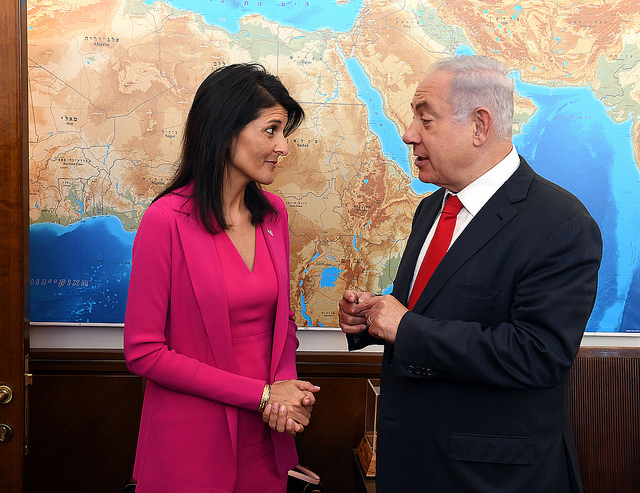
Nevertheless, my candidate for most likely to be a de facto Israeli agent of influence is America’s United Nations Ambassador Nikki Haley. Haley has from the start made it clear that she is all about Israel and she has done nothing since to change that impression, most dramatically so over the past week when she was “taking names” and threatened retaliation against any country that was so “disrespectful” as to dare to vote against Washington’s disastrous recognition of Jerusalem as Israel’s capital, which she also helped to bring about.
As governor of South Carolina, Haley first became identified as an unquestioning supporter of Israel. Immediately upon taking office at the United Nations she complained that “nowhere has the U.N.’s failure been more consistent and more outrageous than in its bias against our close ally Israel” and vowed that the “days of Israel bashing are over.” On a recent visit to Israel, she was applauded honored by Israeli Prime Minister Benjamin Netanyahu.
In February, Haley blocked the appointment of former Palestinian Prime Minister Salam Fayyad to a diplomatic position at the United Nations because he is a Palestinian. In a congressional hearing this past week, she was asked about the decision: “Is it this administration’s position that support for Israel and support for the appointment of a well-qualified individual of Palestinian nationality to an appointment at the U.N. are mutually exclusive?” Haley responded yes, that the administration is “supporting Israel” by blocking every Palestinian.
Haley is inevitably a hardliner on Syria and Iran, reflecting the Israeli bias. She has said that regime change in Damascus is a Trump administration priority. A recent foray involved the White House warning that it had “identified potential preparations for another chemical weapons attack by the Assad regime.” Haley elaborated in a tweet, “… further attacks will be blamed on Assad but also on Russia and Iran who support him killing his own people.” At one point, Haley warned “We need to see Russia choose to side with the civilized world over an Assad government that brutally terrorizes its own people.”
I would point out that none of these positions taken by Haley is an actual American interest, but they all involve Israeli preferences. As in the cases of Kushner, Friedman and Greenblatt, I would like to know how frequently she meets alone with Israeli officials and, most particularly, intelligence officers. Is she taking direction from the Israeli government? Is she an Israeli agent of influence or just a gullible fool? The American public, which pays her, and has to bear the consequences of her actions need to know.
Featured Video

Death Spikes & Rising Cancer In Our Youth Explained
or go to
Aletho News Archives – Video-Images
From the Archives
Politicians lie
By Mazin Qumsiyeh | Popular Resistance | August 18, 2013
There is no way to say this truth nicely: Politicians lie. That includes Japanese, American, Egyptian, Israeli, and Palestinian politicians! Is there something more common sense than that? Yet, so many citizens around the world believe their own politicians or wistfully acknowledge lies but think it is part of the job needed to run things. They believe even when politicians contradict themselves blatantly. This phenomenon is rather remarkable. It is a dissonance and disconnect from reality that many seem oblivious to. It is very dangerous because it can lead to accepting rationales for going to war. These can be deadly wars that lead to millions of lives lost as happened in what was called World War 1 and WW2. Even when incredible and declassified evidence abound, politicians continue to lie and old mythologies refuse to die. Here are just a few of the countless lies told to us over the past few decades… continue
Blog Roll
 Aletho News
- Ukrainian Soldiers, Potential Mercenaries: Have Gun, Will Travel!
- Burnham’s UN debut… A masterclass in British disinformation
- Iran flights continue despite US aviation sanctions
- Global Tipping Points Lead the World Into a State of Entropy
- The day-after at the White House: USA and Xi Jinping
- The Geopolitical Balance in the Red Sea: The UAE Being Displaced by New Players
- Iraqi resistance group vows to stage airport sit-ins over Iran aerial blockade
- Turkish parliament to review Saudi-Pakistan defense pact next month
- DEATH SPIKES & RISING CANCER IN OUR YOUTH EXPLAINED
- Iran offers Trump deal before US election
- If Americans Knew
- Deconstructing Netanyahu’s pants-on-fire UN rant – Daily Update
- Trump betrayed voters with his campaign lies and prioritized a foreign country once he took office
- Netanyahu calls Israel’s war in Gaza ‘opposite of genocide’ in UN speech to near-empty hall
- Settler Kidnappings: Torture, Sexual Abuse and Terrorisation of Palestinian Abductees as Israel Deepens Annexation of West Bank
- Gaza winter nears as 162,000 tents become unusable, raising fears of humanitarian crisis
- Netanyahu says, “It’s the opposite of genocide”; UN says Gaza economy is world’s ‘most severe crisis on record’ – Daily Update
- Israel’s US-Backed Assault on Gaza Has Created the ‘World’s Most Severe Economic Crisis on Record’: UN
- ‘Protecting U.S. Citizens’… From Israel
- ‘This is where I live now, the back of a truck’: a day in the life of a grandmother in Gaza
- In UN Speech, Iran’s President Displays Pictures of Children Killed by US, Brings Attention to Israel’s Nuclear Arsenal
- No Tricks Zone
- New Study: Earth And Venus Surface Warmth Largely Explained By Convection And Lapse Rate, Not CO2 Or Radiation
- 2025 Nature Paper Claiming Worsening Global Drought Gets RETRACTED …Heavily Flawed
- New Study: ‘Global Drought Shows No Detectable Recent Acceleration Under Climate Warming’
- Economic Masterminds: German Socialists Suggest Taxing Productivity Gains Stemming From Using AI
- The South China Sea Has Not Been Cooperating With The Climate Change Narrative
- Energy Crisis: Germany Enters Heating Season With Historically Low Gas Reserve Fill Levels
- New Study: The Antarctic Ice Sheet Gained Mass From 2020-2024 Due To Staggering Snow And Ice Accumulation
- Study: Ocean Heating Rates From Thousands Of Years Ago ‘Dwarf’ Modern Ocean Heating Rates
- Climate Extremists Target, Attack Large-Scale Power Grid Infrastructure In Germany!
- New Study: Antarctic Ice Melt Has Contributed Less Than 1 Centimeter To Sea Level Rise In The Last 30 Years

