US Congress calls for sanctions against Argentina over growing Iran ties
Press TV – July 15, 2013
Members of the US Congress have called for the imposition of sanctions against Argentina over its growing ties with Iran and Buenos Aires’ bid for joint investigations with Tehran into the 1994 AMIA Jewish center bombing.
In a letters to US Secretary of State John Kerry and US Attorney General Eric Holder, the Congressmen cited growing economic and diplomatic relations between Iran and Argentina as grounds for slapping sanctions against Buenos Aires.
A memorandum of understanding (MoU) signed by Iran and Argentina to probe the bombing at the Argentine Israelite Mutual Association (AMIA) was cited as another reason to take action against Buenos Aires.
The July 10 letter to Kerry said the US Congressmen found it “extremely troubling” that Argentina had agreed to a joint effort with Iran to investigate the AMIA bombing, which left 85 people dead.
Iranian Foreign Minister Ali Akbar Salehi and his Argentinean counterpart, Hector Timerman signed the MoU in Addis Ababa, Ethiopia, on January 27.
Under intense political pressure from the US and Israel, Argentina had previously accused Iran of having carried out the bomb attack. The Islamic Republic has categorically denied any involvement in the terrorist bombing.
Earlier in July, Washington reacted fiercely when Argentina prevented AMIA case special prosecutor Alberto Nisman from taking part in a US Congress meeting to level allegations against Iran.
Nisman had collected a 500-page indictment in which he accused the Islamic republic of “infiltrating” regional countries to spread an “intelligence network”.
In a letter personally addressed to Argentine President Cristina Fernandez de Kirchner, American lawmakers expressed disappointment over the veto of Nisman’s visit to the US Congress and questioned the “veracity” of the South American country’s intentions to probe the 1994 AMIA attack through the MoU with Iran.
Related article
US reassures Israel of more pressure on Iran: Report
Press TV – July 14, 2013
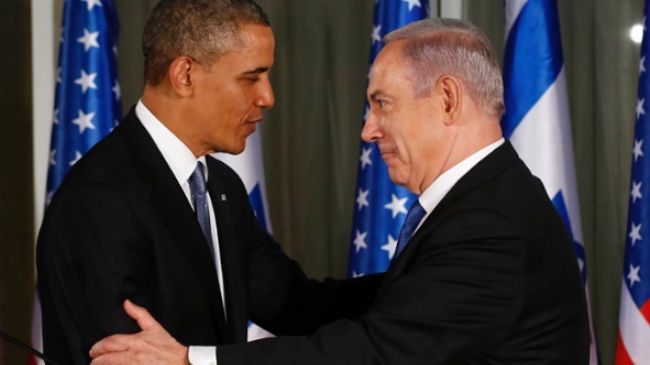
The US reportedly plans to increase pressure on Iran over its nuclear energy program in a move to appease the Israeli regime.
“We will not ease the sanctions [against the Islamic Republic] if Iran does not take action to stop 20 percent enrichment,” senior US officials, who spoke on the condition of anonymity, told the Israeli daily Haaretz on Sunday.
The US officials added that Washington does not intend to ease the sanctions on Iran unless Tehran demonstrates a “change in attitude.”
Referring to the new sanctions against Iran that came into effect on July 1, the officials said Washington plans to ratchet up pressure on the Islamic Republic.
The newly-implemented sanctions against Iran, which target the Iranian energy sector, maritime transportation, ship-building industry, oil trade and currency, were ratified by the US Congress in December 2012 and signed by President Barack Obama in January 2013.
According to the Israeli daily, the upcoming meeting of the P5+1 (Britain, China, France, Russia and the US plus Germany) to discuss the resumption of talks with Iran had fueled Tel Aviv’s concern that Washington may be seeking to ease its pressure on Tehran.
EU foreign policy chief Catherine Ashton is scheduled to meet top officials from the P5+1 on Tuesday in Brussels to discuss “how to move forward in the Iran nuclear file,” said her spokesman Michael Mann on July 12.
Iran and the P5+1 have held several rounds of talks on a range of issues, with the main focus being on Tehran’s nuclear energy program.
The latest round of negotiations between the two sides was held in Istanbul, Turkey, on May 16. Two earlier meetings had also been held in the Kazakh city of Almaty on April 5-6 and February 26-27. … Full article
Who’s at the top of Britain’s Tory party?

Prime Minister David Cameron shaking hands with Israeli regime’s agent in Britain, Daniel Taub.
By Stuart-Littlewood | Press TV | July 11, 2013
Ten years ago Tam Dalyell, the ‘Father of the House’ (the most senior member of the House of Commons in the British Parliament), sparked a huge row by accusing the then Prime Minister, Tony Blair, of “being unduly influenced by a cabal of Jewish advisers.”
In an interview with Vanity Fair, Dalyell named Lord Levy (Blair’s personal envoy on the Middle East), Peter Mandelson (whose father was Jewish), and Jack Straw, the Foreign Secretary (who has Jewish ancestry), as three of the leading figures who had influenced Blair’s policies on the Middle East.
He told The Telegraph: “If it is a question of launching an assault on Syria or Iran…. then one has to be candid.” Blair, he said, was also indirectly influenced by Jewish people in the Bush administration, including Richard Perle, a Pentagon adviser, Paul Wolfowitz, the deputy defence secretary, and Ari Fleischer, the President’s press secretary.
Dalyell’s remarks were sad and unfounded, said Lord Janner, chairman of the Holocaust Education Trust. “Tony Blair is his own man. He will follow advice if he considers it correct and not otherwise. He has been a good friend of the Jewish people and the Jewish state.”
Dalyell was misguided, said Rabbi Dr Jonathan Romain, a spokesman for Britain’s Reform Synagogues. “Concerning Iraq it was crystal clear that Tony Blair was not swayed by popularity or anyone else but by his own deep convictions. It is also obvious that the majority of President Bush’s circle are Christian Evangelicals rather than Jews.”
Ned Temko, the American-born editor of the Jewish Chronicle, said: “I just think these sort of comments are offensive and are a profound misunderstanding of the way foreign policy is made in the United States or here.”
Dalyell also told The Scotsman on Sunday: “Blair and Straw have become far too close to these people and Lord Levy, who is an unaccountable ambassador in the Middle East, is part of this group. They are acting on an extremely Zionist, Likud-nik agenda. In particular I am concerned that some of them are pushing for an attack on Syria, for reasons of Israeli security. ”
MP Louise Ellman, a member of the Inter-Parliamentary Committee Against Anti-Semitism, said: “This absurd proposition implies a Jewish plot in high places…”
Former Foreign Secretary Sir Malcolm Rifkind, a senior member of Scotland’s Jewish community, was rudely dismissive: “We all know that Tam gets bees in his bonnet and eight times out of 10 they are nuts but the other two are brilliant. This is, I’m afraid, one of the nutty ones.”
Next day the Guardian reported that Dalyell could face an investigation for inciting racial hatred. Eric Moonman, president of the Zionist Federation, was seeking advice on whether there was a case for referral. “I believe there is,” he said.
Today it is obvious that old Tam was neither nutty nor misguided. He joined the dots and saw the danger, as did many others.
‘The Torah party’
Meanwhile the Jewish cabal flourishes. A few weeks ago Ian Livingston was handpicked by Prime Minister David Cameron for the trade minister job. Cameron, who had previously broken with traditional wisdom and appointed the first Jewish ambassador to Israel, was reported by an ecstatic Times of Israel as having now decided to bring into the government possibly its most committed Jew yet, and certainly its most outspoken supporter of Israel, which Livingston called “the most amazing state in the world.”
Livingston is not elected. He’s appointed. The newspaper went on to name other top Jewish figures in the Conservative party such as co-chairs Lord Feldman and Grant Shapps MP, senior treasurer Howard Leigh, a member of the Jewish Leadership Council; and former party treasurers Richard Harrington MP and Lord Fink, another member of the JLC.
“There are so many Jews at the top of Britain’s Conservative party, Prime Minister David Cameron once quipped, that it should be known as the Torah party rather than the Tory party,” crowed the paper.
And to make the Prime Minister feel thoroughly at home in his Torah party a Jewish scholar, after tracing Cameron’s ancestry, claimed he could be “a direct descendant of Moses or, at least, a cousin”.
In case our American friends are puzzled by this Torah/Tory business, ‘Tory’ is an old 17th century name for the modern Conservative party founded in the 1830s.
Three years ago The Jewish Chronicle published a list of Jewish MPs in Britain’s parliament, naming 24. The Jewish population in the UK at that time was – and probably still is – around 280,000 or just under 0.5%. There are 650 seats in the House of Commons so, on a proportional basis, Jews could expect 3 seats. But with 24 they were 8 times over-represented. Which meant, of course, that other groups were under-represented.
The UK’s Muslim population is about 2.4 million or nearly 4%. Similarly, their quota would be 25 seats but they had only 8 – a serious shortfall. If Muslims were over-represented to the same extent as Jews (i.e. 8 times) they’d have 200 seats. Imagine the hullabaloo.
Israeli flag-waving
Over-representation in the House of Commons is only part of the picture. Many more Jews have been inserted into the House of Lords and other non-elected and unaccountable positions. An even bigger worry is the huge number of non-Jewish Zionists that have infiltrated every level of political and institutional life. They swell the pro-Israel lobby to such an extent that it is believed to account for 80% of the Parliamentary Conservative Party, which now rules with the Liberal Democrats as their junior coalition partner.
Too many pro-Israel MPs speak and act as if they’d rather wave the Israeli flag than the Union Jack. These ‘Israel-firsters’ never condemn the regime’s illegal occupation, apartheid-style policies, war crimes and refusal to sign up to nuclear non-proliferation, inspection and safeguards. They lock Britain (and British foreign policy) into Israel’s sickening ambitions and immorality. Defending the indefensible, as they do, inevitably raises questions for our national security, a deadly serious issue given the sheer number of Zionists now in British public life and the enemies they have made across the world, and continually provoke.
The Jewish Chronicle, in its 2006 special report ‘Team Cameron’s big Jewish backers’, revealed the support that enabled Cameron to suddenly burst into the political limelight, almost unknown, to take the Conservative leadership. With no significant achievement under his belt he was then able to manoeuvre, with the help of his backers, into Britain’s PM slot.
He is also a self-declared Zionist and voted for the war in Iraq, so how trustworthy does that make him? In a speech to Jewish fundraisers in London last year he declared: “There is no contradiction between being a proud Jew, a committed Zionist and a loyal British citizen.” How can someone who so closely aligns himself with a belligerent foreign military power like Israel hope to convince us that he’s 100 percent loyal to Britain and her interests, while once again drawing us unwillingly into conflict with Israel’s enemies, this time Iran and Syria, with whom we have no quarrel?
Cameron’s Foreign Secretary, William Hague, has been a member of Conservative Friends of Israel since he was 15. Hague once said: “The unbroken thread of Conservative Party support for Israel that has run for nearly a century from the Balfour Declaration to the present day will continue.”
Alistair Burt, a former officer of the Parliamentary group of Conservative Friends of Israel, is Foreign Office minister for the Middle East. And David Lidington, who has spoken of being a “staunch defender” of the State of Israel, is Foreign Office minister for Europe.
So the key stooges are safely installed and activated.
Powerless to deliver justice
It is said that becoming a Friend of Israel is a necessary stepping-stone to high office. Consequently fans of Israel are embedded at all levels in the fabric of British political life and at the heart of the Government.
When a group of concerned academics wrote to the Committee on Standards in Public Life complaining about Israel’s “deep penetration”, they were told it was not something the committee could investigate. A closer look revealed that some members of the committee had close links with Friends of Israel.
How do these Israeli flag wavers think it looks, standing shoulder to shoulder with religious fanatics and psychopaths who horribly persecute the Christian and Muslim communities of the Holy Land? It is especially offensive to see them endorsing a pseudo democracy that dishes out thuggish treatment even to children who, says the UN, are arrested by Israeli military and police and systematically subjected to degrading treatment, and often tortured. Read the report and weep.
Thanks to its misplaced admiration for Israel, the British government fails to intervene and stand up for justice. The disgrace is unbearable. Here is just one of many appalling examples. Right now Christians in that once beautiful country are under imminent threat of losing their land, their livelihood, and their way of life because an emergency law cooked up by the illegal occupier Israel, and upheld by an Israeli court, allows the Israelis to seize territory in the Cremisan Valley near Bethlehem. This brazen land-grab opens the way for the hated separation wall (ruled illegal by the International Court of Justice) to be extended across the valley, connecting two Israeli settlements built on stolen Palestinian land in the eastern suburbs of Jerusalem.
The onward construction of the barrier will divide a Salesian Catholic monastery from the neighbouring Salesian Catholic convent, confiscate most of the convent’s property, and cut off 58 Palestinian families from their agricultural lands – including vineyards, olive groves, and pastures. The barrier will also separate families and surround an elementary school on three sides, forcing young children to pass through a checkpoint to go to class.
The ICJ required the wall to be dismantled, not extended. And it reminded all States party to the Fourth Geneva Convention that they are under an obligation “to ensure compliance by Israel with international humanitarian law as embodied in that Convention”. That was 9 years ago. The world is still waiting. The States never act. Compliance never happens. Non-compliance is rife, and highly profitable to Israel.
And Israel’s allies, including Britain, perversely reward its non-compliance. Across the West Bank, continuing restrictions on Palestinian access to agricultural lands have led to the slow abandonment and eventual confiscation of those lands by Israeli authorities.
Israel’s Knesset has approved the first reading of the Prawer Plan to remove 40,000 indigenous Bedouin people from their ancestral homeland in the Negev. This evil scheme clears the way for the $4 billion “Blueprint Negev” project intended to transform the Negev into a majority-Jewish area even though the Bedouin have lived there for thousands of years.
At the same time one of Israel’s most dangerous lunatics, Avigdor Lieberman (chairman of the foreign affairs and defence committee), is calling for Israel, after imposing a vicious 7-year blockade, to conquer the Gaza Strip and carry out “a thorough cleansing”, just because Hamas still hasn’t succumbed to Israel’s illegal occupation of the Palestinian homeland.
Britain could, at a stroke, bring Israel to heel and force the regime to conform to international law or face massive trade penalties.
Key Israel lobby senator calls for US military strikes on Syria
Press TV – July 11, 2013
A prominent U.S. senator has called on the administration of President Barack Obama to attack Syrian “airfields, airplanes and massed artillery.”
The influential chairman of the Senate Armed Services Committee, Carl Levin (D-Mich.) who has returned from a fact-finding trip to the Middle East, also expressed support for arming the militant groups fighting against the government of President Bashar al-Assad.
“Increased military pressure on Assad is the only way to achieve a negotiated settlement in Syria, which in turn is needed to restore stability to a region that certainly doesn’t need any more instability,” Levin said Wednesday during a speech at the Carnegie Endowment for International Peace.
Levin conceded that the U.S. public opposes an increased involvement in the Syrian conflict and that there is “no consensus” on the issue on Capitol Hill.
Senator Levin and Senator Angus King (I-Maine) spent five days in Jordan and Turkey, talking to government officials as well as U.S. diplomatic and military personnel about the conflict in Syria.
The two senators also met with militant leaders including Salim Idriss, the leader of the so-called Free Syrian Army (FSA), and visited refugee camps along the Syrian border.
In a joint statement on Tuesday, Levin and King said the U.S. and its allies should arm and train the militants and consider “options for limited, targeted strikes at airplanes, helicopters, missiles, tanks and artillery.”
However they said they were not calling for American troops on the ground in Syria.
The senators noted that “doing nothing may be the worst option of all,” potentially destabilizing U.S. allies in the region, including Turkey and Jordan, and threatening Israeli interests.
In a letter last month, Sen. Levin, Sen. John McCain, a Republican from Arizona and Democratic Sen. Robert Menendez of New Jersey called on President Obama to take “more decisive military actions” against Syria.
A recent opinion poll conducted by the Pew Research Center shows that the majority of Americans, 70 percent, are against U.S. involvement in Syria’s unrest.
As Obama regurgitates Israel lobby script on Syria, America sliding toward another Iraq
By Maidhc Ó Cathail | The Passionate Attachment | July 5, 2013
At a Washington Institute policy forum luncheon debate on June 28 entitled “Arming the Rebels: Sliding Toward Iraq or Inching Toward Stability,” Andrew J. Tabler, a senior fellow in the institute’s program on Arab politics, hinted at the pro-Israel think tank’s influence over President Obama’s recent shift in Syria policy. Referring to his Foreign Affairs piece entitled “Syria’s Collapse: And How Washington Can Stop It,” Tabler said he would like to say that it “follows a lot” of President Obama’s responses in a major June 17 television interview. Whether out of modesty or a desire to downplay the Israel lobby’s role in deepening Washington’s involvement in the destabilization of Syria, a smiling Tabler added, “I’m sure that he didn’t read it and then just go and regurgitate it to Charlie Rose.”
WINEP’s executive director Robert Satloff was similarly coy in his introduction. Describing Tabler as a “very consulted” expert on Syria, Satloff said, “I won’t go into the details of the consultations” he has with senior government officials “but suffice to say that the arguments that we’ll be hearing today very much reflect the arguments that are on the table.”
Given the proven track record of such arguments made “in the national interest” by partisans of Israel, it would appear that its oblivious American proxy is rapidly sliding toward another Iraq.
Maidhc Ó Cathail is an investigative journalist and Middle East analyst. He is also the creator and editor of The Passionate Attachment blog, which focuses primarily on the U.S.-Israeli relationship. You can follow him on Facebook and Twitter @O_Cathail.
Related articles
- Ó Cathail: ‘Israel dominates US Syria policy’ (thepassionateattachment.com)
- Did an Israel lobby front group organize McCain’s trip to Syria? (thepassionateattachment.com)
Brzezinski: Saudi Arabia, Qatar, their western allies orchestrated Syria crisis
Press TV – June 29, 2013
The former US national security adviser says the ongoing crisis in Syria has been orchestrated by Saudi Arabia, Qatar, and their western allies.
“In late 2011 there are outbreaks in Syria produced by a drought and abetted by two well-known autocracies in the Middle East: Qatar and Saudi Arabia,” Zbigniew Brzezinski said in an interview with The National Interest on June 24.
He added that US President Barack Obama also supported the unrest in Syria and suddenly announced that President Bashar al-Assad “has to go — without, apparently, any real preparation for making that happen.”
“Then in the spring of 2012, the election year here, the CIA under General Petraeus, according to The New York Times of March 24th of this year, a very revealing article, mounts a large-scale effort to assist the Qataris and the Saudis and link them somehow with the Turks in that effort,” said Brzezinski, who was former White House national security adviser under Jimmy Carter and now a counselor and trustee at the Center for Strategic and International Studies and a senior research professor at the School of Advanced International Studies at Johns Hopkins University.
Criticizing the Obama administration’s policies regarding Syria, he questioned, “Was this a strategic position? Why did we all of a sudden decide that Syria had to be destabilized and its government overthrown? Had it ever been explained to the American people? Then in the latter part of 2012, especially after the elections, the tide of conflict turns somewhat against the rebels. And it becomes clear that not all of those rebels are all that ‘democratic.’ And so the whole policy begins to be reconsidered.”
“I think these things need to be clarified so that one can have a more insightful understanding of what exactly US policy was aiming at,” Brzezinski added.
He also called on US officials to push much more urgently to draw in China, Russia and other regional powers to reach some kind of peaceful end to the Syrian crisis.
“I think if we tackle the issue alone with the Russians, which I think has to be done because they’re involved partially, and if we do it relying primarily on the former colonial powers in the region-France and Great Britain, who are really hated in the region-the chances of success are not as high as if we do engage in it, somehow, with China, India and Japan, which have a stake in a more stable Middle East,” Brzezinski said.
Brzezinski also warned again any US-led military intervention in Syria or arming the militants fighting government forces there.
“I’m afraid that we’re headed toward an ineffective American intervention, which is even worse. There are circumstances in which intervention is not the best but also not the worst of all outcomes. But what you are talking about means increasing our aid to the least effective of the forces opposing Assad. So at best, it’s simply damaging to our credibility. At worst, it hastens the victory of groups that are much more hostile to us than Assad ever was. I still do not understand why — and that refers to my first answer — why we concluded somewhere back in 2011 or 2012 — an election year, incidentally that Assad should go.”
Foreign-sponsored militancy in Syria, which erupted in March 2011, has claimed the lives of many people, including large numbers of Syrian soldiers and security personnel.
The New York Times said in a recent report the CIA was cooperating with Turkey and a number of other regional governments to supply arms to militants fighting the government in Syria.
The report comes as the US has repeatedly voiced concern over weapons falling into the hands of al-Qaeda-linked terrorist groups.
Al-Nusra Front was named a terrorist organization by Washington last December, even though it has been fighting with the US-backed so-called Free Syrian Army in its battle against Damascus.
~
Excerpt from TNI interview:
Heilbrunn: Are we, in fact, witnessing a delayed chain reaction? The dream of the neoconservatives, when they entered Iraq, was to create a domino effect in the Middle East, in which we would topple one regime after the other. Is this, in fact, a macabre realization of that aspiration?
Brzezinski: True, that might be the case. They hope that in a sense Syria would redeem what happened originally in Iraq. But I think what we have to bear in mind is that in this particular case the regional situation as a whole is more volatile than it was when they invaded Iraq, and perhaps their views are also infected by the notion, shared by some Israeli right-wingers, that Israel’s strategic prospects are best served if all of its adjoining neighbors are destabilized. I happen to think that is a long-term formula for disaster for Israel, because its byproduct, if it happens, is the elimination of American influence in the region, with Israel left ultimately on its own. I don’t think that’s good for Israel, and, to me, more importantly, because I look at the problems from the vantage point of American national interest, it’s not very good for us.
What will Obama do?
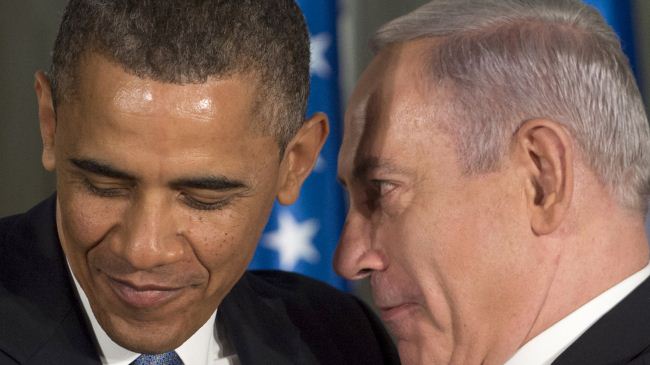
President Obama’s actions are unlikely to stray outside the parameters the Israel lobby is willing to accept. But there is a growing movement that is challenging the lobby’s stronghold on U.S. politics.
By Alison Weir | Palestine News | Spring 2013
Whenever a US president begins a term of office many people round the world are curious about what policies he may pursue on Israel-Palestine. They wonder if he will once again call on Israel to reduce its settlement activities as almost every president has done at least once.
Will he condemn Israeli aggression, or only Palestinian rockets? Will he push a “peace process” in which virtually all the American mediators are Israel partisans[1] or will a few non-Zionists be permitted to play a role?
As Barack Obama began his second term as president, these questions came up again. But these are the wrong questions. Instead, to predict what he will do, one only needs to ask what the Israel lobby is likely to require.
The president won’t always do what the lobby demands – on rare occasions he may deviate a bit from its dictates– but a large percentage of the time he will dutifully do what the lobbyists command.
In other words, in order accurately to analyse American policies in the Middle East, to predict how they will change or not and to develop effective ways to revamp them in the directions that are so urgently needed for humanitarian relief and real peace, it is essential to understand the decisive role the Israel lobby plays in the United States.
Presidents and politicians from both major parties have long been extremely aware of this lobby. It may greatly improve or impede their chances of winning an election, of passing legislation, of receiving positive press coverage, of, quite simply, going on to bigger and better things.
Through the years the lobby for Israel has been a decisive factor in the defeat of Republicans Paul Findley, Pete McCloskey (at one time a Presidential contender) and Charles Percy (another Presidential contender) and Democrats Adlai Stevenson, William Fulbright, Earl Hilliard, Cynthia McKinney and quite likely many more.[2]
Politicians from both parties attend the annual convention of its major lobbying arm, the American Israel Public Affairs Committee (AIPAC) and pledge their loyalty to this foreign country. President Barack Obama, whose early and major backing came from members of the Israel lobby[3], gave his first post-nomination speech at the AIPAC convention.
Yet, despite the lobby’s inordinate power, most Americans are only minimally aware of it. For decades surveys have shown that the large majority of Americans don’t wish to take sides on Israel-Palestine, a reflection of a public that is uninformed about how much of our tax money goes to Israel and how decisively our government is, indeed, taking a side.
This widespread lack of awareness about the role of the Israel lobby in determining American policies is particularly startling given that the movement on behalf of Israel has been active in the United States for over 100 years and that it played a significant role in Israel’s creation.[4]
By the 1920s it was able successfully to promote its policies over those recommended by the US State Department; by the 1940s it had added Pentagon policies to those it could overrule and both presidential candidates Harry Truman and Thomas Dewey were currying its favour[5]; by 1967 it was able to push its cover story on Israel’s lethal attack on the US naval ship Liberty over opposition by high ranking admirals, the director of the CIA and the Secretary of State[6]; and by 1977 the head of AIPAC could state with accuracy: “We have never lost on a major issue.”[7]
Half a century ago the Senate Foreign Relations Committee investigating lobbying activities found an illicit cycle in which the Israel lobby succeeded in procuring money for Israel, some of this was then secretly funneled back into these groups, which then used this money to lobby for still more American tax dollars to Israel.
The hearings concluded that Israel operated “one of the most effective networks of foreign influence” in the United States.[8] Yet, since the media reported on this so little, most Americans are unaware of these extremely grave findings.
The term “Israel lobby” fails to do justice to the extraordinary scope and composition of this special interest group. Below is a small sampling of the American organisations that work on behalf of Israel. Virtually all have multi-million dollar budgets; a few have endowments in the hundreds of million dollars and most of them are funded by tax-deductible donations:
- The American Israel Public Affairs Committee (AIPAC): $100 million endowment, [9] $60 million annual revenues.[10]
- The Washington Institute for Near East Policy (WINEP): $23.5 million net assets. $9.4 million annual revenues.
- International Fellowship of Christians and Jews (aka Stand for Israel): $100 million annual revenues.[14]
- Friends of the Israeli Defense Forces (FIDF): $80 million net assets,[16] $60 million annual revenues.[17]
- Hadassah (Women’s Zionist Organization of America): $400 million net assets, $100 million annual revenues.
- Jewish Community Relations Councils, in cities all over U.S.: Boston annual revenues $2.5 million; Louisville annual revenues $7-10 million; Detroit $734,000, New York $4.5 million, etc.[23]
- JINSA Jewish Institute for National Security Affairs: $3 million annual revenues.
In addition to these nonprofit organisations, there are dozens of political action committees (PACs) that donate to political candidates on the basis of their positions on Israel. Most of these disguise their purpose by using such deceptive names as “Northern Californians for Good Government,” “National Action Committee,” “American Principles,” etc.
While other issue-based PACs almost always announce their focus publicly[31], in 2012 only two of the pro-Israel PACs made any reference to Israel in their names.[32] While US media frequently discuss the gun rights lobby, the largely uncovered pro-Israel PACs gave almost twice as much money to candidates – and the donations went to both parties.[33]
In addition, there are numerous individuals who play an extremely important role in the Israel lobbying effort. Two examples are political campaign mega-donors Haim Saban and Sheldon Adelson. Saban donated $12.3 million to the Democratic Party in 2002 alone and has contributed millions more to pro-Israel organisations.

Adelson, a billionaire casino magnate, set a new record in political donations by giving $70 million in the 2012 elections, nearly triple the previous highest amount. He also funds such pro-Israel organisations as Birthright Israel which takes thousands of young Jewish Americans on recruiting visits to Israel.
In other cases, it is individuals with a different kind of power – the power to affect which information reaches the American public and which does not. One example is Eric Weider, whose Weider History Group publishes eleven history magazines in the United States, the largest history magazine publisher in America (and, according to its website, the world).[34]
Given this reality, President Obama’s actions are unlikely to stray outside the parameters the Israel lobby is willing to accept. While the media are making a great deal over the very mild apology Israel made to Turkey for having murdered nine of its citizens, crediting Obama with this alleged break-through, none of the news reports seem to mention that Israel has largely failed to apologise to the US for the death of 19-year-old dual American Turkish citizen, Furgan Dogan, who was killed with five bullets, one to his face at point blank range.[35]
It is also relevant to note that an AIPAC-drafted letter signed by 76 out of 100 Senators was sent to President Obama on the eve of his visit to Israel in March.[36]
Congressional actions can also be expected to remain within what the Israel lobby directs, though here, too, there may be rare occasions where the lobby seems to have lost – such as the confirmation of Chuck Hagel for Secretary of Defence.
However, the alleged triumph that some pro-Palestinian writers are proclaiming for Hagel’s appointment is a bit overblown. Before he was allowed to take his position, he was made to grovel humiliatingly before his Congressional interrogators, retract acceptable statements he had made earlier in his life and all but swear devotion to Israel (like all top government officials seemingly must do).
This degrading spectacle surely made it clear to Hagel that he better watch his step in the future and made it even clearer to ambitious Americans of all ages that they must be extremely careful about any statements they make about Israel and its lobby if they are to achieve their political ambitions.
Despite the power of the lobby, however, the situation is not as bleak as the above may suggest. There is a highly diverse movement in the US that opposes this lobby and it is steadily growing.
The Left, which for decades was largely silent on Israeli abuses of human rights, has finally become active on the issue. Similarly, both traditional conservatives and libertarians frequently oppose aid to Israel and this opposition is becoming more outspoken. While this stance is often motivated by fiscal considerations, in many cases it is also fuelled by outrage at Israeli cruelty and by genuine empathy with Palestinians.
The money being mobilised on this side is only a small fraction of the other and some of the groups within this movement could arguably be considered simply a more reasonable and compassionate arm of the Israel lobby in that their advocacy is often framed according to what “is good for Israel” while failing to address the inherent injustice of an ethnic state imposed on a multicultural region.
Nevertheless, there is no doubt that the opposition to current US policies is growing increasingly important. The tide may not yet have turned but it is certainly in the slowing phase that must come first.
To use another oft-quoted and particularly apt metaphor, lobbies thrive in the dark. More and more people in the US and elsewhere are shining light on this one, steadily reducing its power.
While there are numerous deeply significant issues, an increasing number of individuals are deciding to focus on this one, the core issue of the Middle East and the cause of war after war, including the current “war on terror” and demonisation of Muslims.
To use the framing posed by journalist Glenn Greenwald, an expanding number of people are refusing to prioritise domestic issues over the killing of Arab and Muslim children on the other side of the world.
Therefore, despite the enormous power of the Israel lobby in the US, this growing movement is quite likely to overcome the obstacles confronting it and to join history’s other successful movements against oppression.
The main question is how long this will take, and how many more massacres, and possibly wars, will occur in the interim.
[1] Even Aaron David Miller admitted they acted as “Israel’s lawyer” – Miller, Aaron David. “Israel’s Lawyer.” Washington Post 23 May 2005, posted by Matt Miller Opinion Writer. Online at http://www.washingtonpost.com/wp-dyn/content/article/2005/05/22/AR2005052200883.html
[2] Findley, Paul. They Dare to Speak Out: People and Institutions Confront Israel’s Lobby. Westport, CT: Lawrence Hill, 1985. Online at http://archive.org/stream/They-Dare-To-Speak-Out-Paul-Findley/They_Dare_to_Speak_Out_Paul_Findley_djvu.txt and Mearsheimer, John J., and Stephen M. Walt. The Israel Lobby and U.S. Foreign Policy. New York: Farrar, Straus and Giroux, 2007.
[3] Yearwood, Pauline Dubkin. “Obama and the Jews.” Chicago Jewish News 24 Oct. 2008.
Online at http://www.chicagojewishnews.com/story.htm?sid=212226&id=252218
[4] Weir, Alison. “Against Our Better Judgment: The Hidden History of How the United States Was Used to Create Israel.” IfAmericansKnew.org. 2012. Web. http://ifamericansknew.org/us_ints/history.html
[5] Weir, “Against Our Better Judgment”
[6] http://www.ussliberty.org/supporters.htm
[7] The Power Peddlers, by Russell Warren Howe and Sarah Hays Trott, Doubleday, p. 292.
http://ifamericansknew.org/us_ints/history.html
[8] Smith, Grant. “Where Did AIPAC Come From?” Antiwar.com. N.p., 09 Oct. 2007. Web. http://antiwar.com/orig/gsmith.php?articleid=11727 and Neff, Donald. “Ulbright Called for U.S. Defense Pact With Israel But Was Labeled Anti-Semite.” Washington Report on Middle East Affairs August-September (1997): 96. Online at http://www.wrmea.org/wrmea-archives/188-washington-report-archives-1994-1999/august-september-1997/2677-middle-east-history-it-happened-in-august-.html
[9] http://www.nytimes.com/2008/04/25/washington/25lobby.html?_r=1
In 2009, the Economist reported: “AIPAC has an annual budget of around $60m, more than 275 employees, an endowment of over $130m and a new $80m headquarters building on Capitol Hill.” http://www.economist.com/node/14753768
[10] http://firststreetresearch.cqpress.com/2012/03/08/aipac-still-commands-attention-among-movers-and-shakers/
[11] http://www.charitynavigator.org/index.cfm?bay=search.summary&orgid=3265
[12] http://www.charitynavigator.org/index.cfm?bay=search.summary&orgid=10657
[13] http://www.charitynavigator.org/index.cfm?bay=search.summary&orgid=10657
[14] http://www.charitynavigator.org/index.cfm?bay=search.summary&orgid=3889
[15] http://www.theisraelproject.org/site/apps/nlnet/content3.aspx?c=ewJXKcOUJlIaG&b=7717007&ct=11735981#.UbKK4uuhU0o
[16] http://www.charitynavigator.org/index.cfm?bay=search.summary&orgid=3734
[17] http://www.charitynavigator.org/index.cfm?bay=search.summary&orgid=3734
[18] http://www.charitynavigator.org/index.cfm?bay=search.summary&orgid=7699
[19] http://www.charitynavigator.org/index.cfm?bay=search.summary&orgid=7699
[20] http://www.faqs.org/tax-exempt/CA/Shimon-Ben-Joseph-Foundation-Dba-Jim-Joseph-Foundation.html
[21] http://207.153.189.83/EINS/133252800/133252800_2010_07b9bf0d.PDF
[22] http://www.jewishfederations.org/about-us.aspx
[23] http://www.jewishlouisville.org/images/JCL/Financials/annual_report_2011-12.pdf
http://www.charitynavigator.org/index.cfm?bay=search.summary&orgid=10095
http://jcrcny.org/images/00_media/about/jcrc-ny2011form990.pdf
[24] http://www.charitynavigator.org/index.cfm?bay=search.summary&orgid=4540
[25] http://www.politico.com/static/PPM152_100828_centerforsecuritypolicy.html
[26] https://bulk.resource.org/irs.gov/eo/2011_09_EO/26-4392915_990_201012.pdf
[27] http://www.charitynavigator.org/index.cfm?bay=search.summary&orgid=8188
[28] http://www.charitynavigator.org/index.cfm?bay=search.summary&orgid=11247
[29] https://bulk.resource.org/irs.gov/eo/2011_02_EO/16-1616489_990_200912.pdf
[30] http://www.charitynavigator.org/index.cfm?bay=search.summary&orgid=5429
[31] http://www.opensecrets.org/pacs/industry.php?txt=Q11&cycle=2012 and http://www.opensecrets.org/pacs/industry.php?txt=Q13&cycle=2012
[32] http://www.opensecrets.org/pacs/industry.php?txt=Q05&cycle=2012
[33] http://www.opensecrets.org/pacs/sector.php?cycle=2012&txt=Q05
[34] Weir, Alison. “The Empire Behind World’s Largest History Magazine Chain: How American History Magazine Censored Palestine.” CounterPunch Dec. 6, 2012. Online at http://ifamericansknew.org/media/weider.html
[35] Lynch, Colum. “U.N. Panel Endorses Report Accusing Israel of Executions aboard Aid Flotilla.” Washington Post 30 Sept. 2010, A Section. Online at http://www.washingtonpost.com/wp-dyn/content/article/2010/09/29/AR2010092907110.html?wprss=rss_print/asection
[36] “Did Your Favorite Progressive Senator Sign AIPAC Letter To Obama Telling Him To Stand Up For Occupation? Here Is The List.” MJ Rosenberg, Mar. 2013. Online at http://mjayrosenberg.com/2013/03/19/did-your-favorite-progressive-senator-sign-aipac-letter-to-obama-telling-him-to-stand-up-for-occupation-here-is-the-list/
Alison Weir is the President of the Council for the National Interest (CNI) and Executive Director of If Americans Knew.
Related articles
- How AIPAC Rules (alethonews.wordpress.com)
- Israel Lobby Dominates Congress, Media Covers it Up (alethonews.wordpress.com)
- Organ trafficking & Israel – A message from Alison Weir (gilad.co.uk)
Iran ready to halt 20% uranium enrichment, West must reciprocate – Lavrov
RT | June 18, 2013
Iran has confirmed it is prepared to halt its enrichment of 20-percent uranium, Russian Foreign Minister Sergey Lavrov said, urging Western nations to end their sanctions against Tehran.
“For the first time in many years, there are encouraging signs in the process of settlement of the situation with the Iranian nuclear program,” he said in the interview to Kuwait’s KUNA news agency, that was published on Russian Foreign Ministry’s website.
“Without going into details, the Iranians confirm the most important [point]: Their readiness to stop 20 percent uranium enrichment at its current levels,” Lavrov said.“This could become a breakthrough agreement, significantly alleviating existing problems, including concerns about the possibility of advanced uranium enrichment to a weapons-grade level.”
Such a move “implies significant reciprocal steps by the Six,” the minister added, referring to the group of world powers seeking to peacefully resolve the issue of Iran’s nuclear program.
“The international community must adequately respond to the constructive progress made by Iran, including gradual suspension and lifting of sanctions, both unilateral and those introduced by the UN Security Council. It would be a shame not to take advantage of this opportunity,” Lavrov concluded.
News of Iran’s possible concessions over its nuclear program comports with promises made by Iranian President-elect Hassan Rowhani, who vowed to make the program more transparent.
Still, the moderate cleric stressed on Monday that Tehran would not consider halting the country’s uranium enrichment activities entirely. Rowhani insisted that Iran’s nuclear activities are “within the framework of law,” and dubbed the international sanctions “baseless.”
Despite numerous accusations by Israel and the US that it is secretly conducting military nuclear research, Iran has maintained that its nuclear program is only for civilian purposes.
At his first media conference since winning the presidential elections, Rowhani – who previously headed Iran’s delegation during nuclear talks with the six world powers – said that Tehran’s nuclear activities “are already transparent,” but “the only way to end the sanctions is to increase the transparency and trust” between Iran and the international community.
Washington has been expecting changes in Iran’s hardline stance on the nuclear issue following the country’s presidential elections. White House Chief of Staff Denis McDonough said Sunday on ‘Face the Nation’ that Washington is ready to work with the new administration in Tehran, “If he lives up to his obligations under the UN Security Council resolution to come clean on this illicit nuclear program.”
But Israeli Prime Minister Benjamin Netanyahu remained unconvinced: “The international community must not become caught up in wishes and be tempted to relax the pressure on Iran to stop its nuclear program,” he said.
President-elect Rowhani will assume office in August. He believes that he can heal the “old wound” of troubled US-Iran relations if Washington stops interfering in Tehran’s internal affairs and permanently ends its “bullying” practices towards Iran.
Related article
- What Should be Expected From President Rowhani? (alethonews.wordpress.com)
Featured Video

New positive ivermectin evidence
or go to
Aletho News Archives – Video-Images
From the Archives
Fanatical Followers of the Covid Regime: A Jim Jones-Style Cult?
By Professor Roger Watson and Dr. Niall McCrae | The Daily Sceptic | November 15, 2021
As scholars at leading British universities over recent decades, we witnessed the replacement of critical thinking and debate by narrative: facts are discrimination and scientific method is imperialism; truth, instead, is derived from ‘progressive’ values. This educational trend may be a major contributory factor to the ease in which society has been inculcated to the Covid ‘new normal’ of masking, testing, and repeated doses of vaccines for a disease of similar risk to severe influenza.
One doesn’t need much critical reasoning to observe the flawed logic of some vaccination enthusiasts, such as people who respond to experiencing any side effects, however debilitating, by saying “at least I know it’s working”, or, after contracting the disease despite their promised inoculation (over 90% effective, according to initial drug company claims), “I’d have been worse off without the jab.” … continue
Blog Roll
 Aletho News
- EU Council Advances Chat Control 2.0 Scanning Proposal
- Ex-Greek MEP files complaint against Israeli spyware firm over alleged Pegasus surveillance
- Troubling ideas throughout the Torah, Talmud, Mishneh Torah and Tanya
- ‘Grave, alarming’: Iran mission on Trump’s UNGA ‘annihilation’ threats
- Najaf airport to reopen to Iranian flights within 24 hours: Ambassador
- From ‘How Will This End For Iran’ to ‘When America Walks Away’: A tale of two Economist covers
- Tehran blasts ‘baseless’ speculation linking Iran to alleged bomb plot at UK air base
- The Rise And… Rise Of ‘Color Revolutions’
- The Coming GOP Bloodbath?
- Arctic Scare Stories Melt Away
- If Americans Knew
- Netanyahu Asked UAE Leader to Deny Report on Oct. 7 Warning in Secret Visit, Sources Say
- CNN Chief Int’l Correspondent Clarissa Ward on Journalists in Gaza
- Democratic Party Consultants Surround Troy Jackson with Pro-Israel Donors
- Christian Leader Responds To Netanyahu’s Claims Regarding Palestinian Christians
- In Gaza, ‘Whoever Survives the Bombing Won’t Survive the Rubble’
- Israel kills more Palestinians, amid push to resettle Gaza – Daily Update
- Israel forces Gazans to live in constant peril – Daily Update
- Deconstructing Netanyahu’s pants-on-fire UN rant – Daily Update
- Trump betrayed voters with his campaign lies and prioritized a foreign country once he took office
- Netanyahu calls Israel’s war in Gaza ‘opposite of genocide’ in UN speech to near-empty hall
- No Tricks Zone
- New Study: Earth And Venus Surface Warmth Largely Explained By Convection And Lapse Rate, Not CO2 Or Radiation
- 2025 Nature Paper Claiming Worsening Global Drought Gets RETRACTED …Heavily Flawed
- New Study: ‘Global Drought Shows No Detectable Recent Acceleration Under Climate Warming’
- Economic Masterminds: German Socialists Suggest Taxing Productivity Gains Stemming From Using AI
- The South China Sea Has Not Been Cooperating With The Climate Change Narrative
- Energy Crisis: Germany Enters Heating Season With Historically Low Gas Reserve Fill Levels
- New Study: The Antarctic Ice Sheet Gained Mass From 2020-2024 Due To Staggering Snow And Ice Accumulation
- Study: Ocean Heating Rates From Thousands Of Years Ago ‘Dwarf’ Modern Ocean Heating Rates
- Climate Extremists Target, Attack Large-Scale Power Grid Infrastructure In Germany!
- New Study: Antarctic Ice Melt Has Contributed Less Than 1 Centimeter To Sea Level Rise In The Last 30 Years

